Tag: Ceedee Lamb

  • Scouts vs Stats: Top 10 Non-Quarterbacks in the NFL

    Scouts vs Stats: Top 10 Non-Quarterbacks in the NFL

    Photo: Brian Lynn/Icon Sportswire

    If you’ve listened to the Off The Charts Football Podcast, you know that we like to examine things from a “Scouts versus Stats” perspective – and so we’ve brought that back for at least one discussion as we wait for the 2024 season to begin. 

    This week’s episode considers a question from those perspectives: Who are the Top 10 non-quarterbacks in the NFL.

    Ex-NFL scout Matt Manocherian and podcast host Bryce Rossler took the scouts’ perspective. Our director of football analytics Alex Vigderman and research analyst James Weaver created a statistical ranking based on a suite of metrics.

    We can tell you that officially, Sports Info Solutions does not condone the dichotomy between scouting and statistical analysis. Each of them provides data in their own way and should inform our evaluation of a player. We want to put the scouting reports and stats side-by-side, leveraging both to come to a conclusion.

    Fair warning: These are vastly different lists.

    Scouts’ Opinion Statistical Analysis
    1. Myles Garrett 1. Derrick Henry
    2. Micah Parsons 2. T.J. Watt
    3. Tyreek Hill 3. Travis Kelce
    4. Justin Jefferson 4. Chris Jones
    5. Nick Bosa 5. Justin Jefferson
    6. T.J. Watt 6. Tyreek Hill
    7. Pat Surtain II 7. Sauce Gardner
    8. Maxx Crosby 8. George Kittle
    9. Roquan Smith 9. Amon-Ra St. Brown
    10. Ja’Marr Chase 10. CeeDee Lamb

    Now that you’ve finished gasping at a running back – and not Christian McCaffrey – ranking No. 1 in the statistical analysis column, let’s explore the contrast of the two lists.

    And let’s get right to the point. Yes, the statistical analysis list has Derrick Henry as the No. 1 non-quarterback.

    In simplest form, our stats group created a methodology that is favorable to where Henry stands in the running back universe. He’s No.1 because he’s been “more better” (for lack of a better term) at running back over the last two years than other players are at their respective positions. 

    The Stats List Methodology

    You can listen to the podcast to hear the discussion regarding the surprising analytics-based ranks, but obviously there’s some explanation needed here. 

    The stats-based ranking includes a two-year average of a player’s results across a handful of flavors of our catch-all Total Points system.

    First, there is Points Above Average (PAA) per play, scaled to the positional average and standard deviation. This encapsulates the extent to which the player excels relative to the position on a play-to-play basis.

    Second, there is Points Above Replacement (PAR), scaled to the league average and standard deviation. This uses our WAR methodology that measures how valuable a player is in general, incorporating a notion of relative positional value.

    This is the first time we’ve mentioned it, but we’re working on a large update to the Total Points system this offseason, which will incorporate a whole bunch of new data points and ideas into the system. We’re not ready to publish those results, but we thought it’d be interesting to include them here to inform our player values.

    So, we have each of the scaled PAA per play and PAR values for each of the two versions of Total Points, equally weighted between the four.

    The one other element that’s included is player aging. Players start to drop off in production within just a few years of coming into the league, so we want to make sure that we’re capturing that. We computed an aging factor for each of the above metrics and applied that to each player’s two-year averages, to make it more like a projection for 2024.

    What the Stats Showed

    Having Derrick Henry number 1 is a bit rich, no? Especially given that McCaffrey exists?

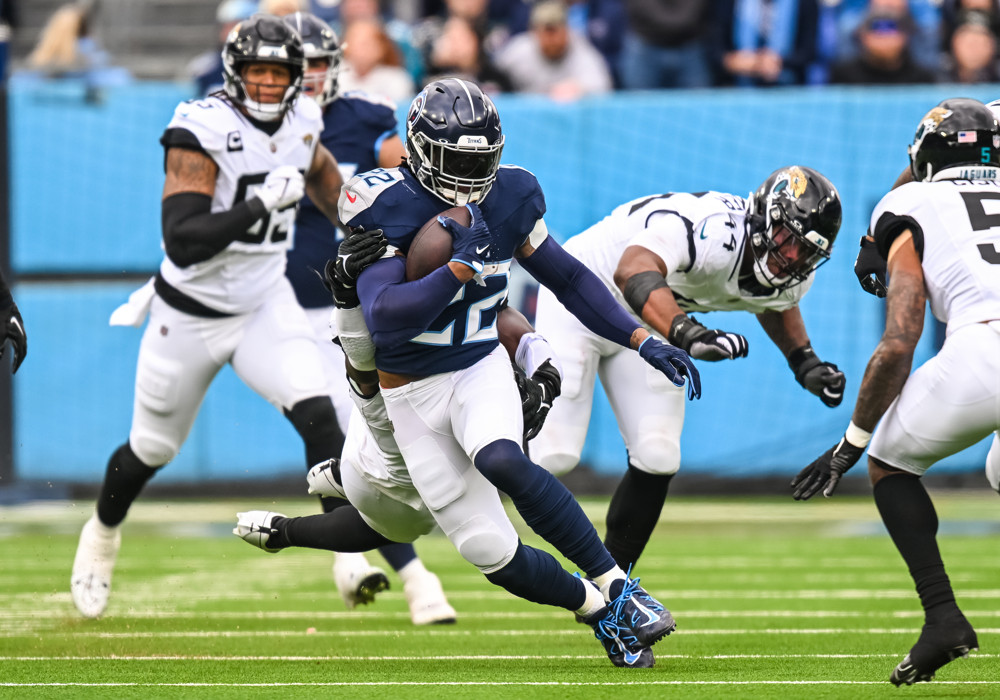
    Let’s take the second point first. Over the last two years, Henry has generated almost 30 more PAA than McCaffrey as a rusher, which doesn’t get sufficiently counterbalanced by McCaffrey’s receiving excellence.

    The gap in rushing is in large part to the difference in their circumstances. Henry has continued to be productive year after year despite having the most carries in the NFL when the offensive line blew a block in front of him over the last two years, and last year he turned more than 60 percent of those into gains. Henry’s elusiveness has not eluded him yet, with similar or better broken and missed tackle rates to McCaffrey’s.

    The positional value question is a valid one, though. How is a running back rated so highly in general? In short, we can only measure what we have access to, and that informs how we value positions. 

    A running back can fumble or get stuffed for a loss on third down, losing a big chunk of value, in a way that a pass rusher or a center does not often do. So the depth of the floor for a running back is more extreme, at least in the statistical record. That means that within the Points Above Replacement framework, the floor for rushers is lower than you think, and therefore the position as a whole is considered more valuable.

    The other big contrast

    The scouts’ list has several edge rushers on it. The stats list is lacking in them.

    Myles Garrett and Micah Parsons are at worst among the handful of best defensive players in the league, so there’s not much to say about them to argue for their inclusion at the top of a crowded field of edge rushers. Parsons is probably the pick if you need one guy to wreck a play, but consistent with their general approach, Garrett got the nod because of how he impacts all phases of the game.

    An otherworldly motor against the pass and the run got Maxx Crosby onto the list, and the scouts were indignant at his exclusion from the stats-based list—but only moderately indignant compared to what happened at the top of the board.

    So why are many of the top pass rushers in the league not at the top of the stats-based list (although the upcoming Total Points updates will do a lot to make up for that)?

    There are more excellent edge rushers than there are excellent interior players, so a single player at the top stands out more in the interior. Chris Jones projects to be one of the biggest risers in the updated Total Points because of how much he dominates as a pass rusher from the interior, as he ranked first and third in 2023 and 2022 in pressure rate, respectively. This isn’t true for the edge rushers, where there are many solid producers.

    Parsons will have a similar jump to Jones, but he’s competing at a much tougher position at the top. There are six edge rushers in the top 20 on the stats-based list, compared to just two interior defenders.

    Also, our measure of the floor of a defensive front player isn’t as low as it is for other positions—a bad play by a cornerback or a running back is more likely to be a big liability. As a result, when we determine replacement level for each position, we don’t have as much value assigned to pass rushers as we do other positions.

    Other highlights from the stats list

    Travis Kelce might have been a more palatable choice for this list a year ago, but it’s worth noting that he still posted the best receiving PAA among tight ends last season. George Kittle’s balanced skill set got him on the list, coming in the Top 2 in Receiving and Blocking Total Points among tight ends. However, even at a younger age, it doesn’t make up for the gap in receiving production.

    The lists differed on which of the top cornerbacks cracked their lists, with Sauce Gardner getting the nod thanks to his consistent production across his first two seasons. He finished in the top 10 each of the last two seasons in yards allowed per coverage snap, yielding fewer than 700 receiving yards in nearly two years. 

    Amon-Ra St. Brown snuck onto the stats-based list because of how well he does his job, even though his job might be limited relative to others at the position. He is as money as it gets in big spots, ranking second in the NFL in both On-Target Catch Rate and third down completions over the last two years.

    CeeDee Lamb is there because of his production in 2023, specifically ranking first in Receiving Total Points. The updates to Total Points will ding him because of his merely good catch rate on accurate balls, which is why he ended up below St. Brown, for example.

    Other highlights from the scouts’ list

    While the stats-based list was heavy on wide receivers, the scouts-based list was heavy on edge rushers, to the point that they felt the need to stretch for a couple of less-valuable positions.

    In the interest of being less boring, the scouts included Roquan Smith as an off-ball linebacker choice. He’s a downhill player and an “enforcer,” per Matt, and while he doesn’t have the crazy athleticism that other potential candidates do, he closed the gap in that respect in 2023 in terms of being an excellent well-rounded player.

    The scouts really only considered two cornerbacks for their list, and they went with Pat Surtain II over Gardner as the prototypical corner with versatility and consistency that very few corners have.

    Ja’Marr Chase and CeeDee Lamb were candidates  for the back end of their list, with Chase getting the nod because “he’s more of a headache in more ways that lead to touchdowns for him and for other players on his offense.” This also contributed to the choice of Tyreek Hill as their top receiver. 

    Want to hear the rest of the debate and discussion? Check out Off The Charts wherever you get your podcasts.


  • Prop Recommendations: Cowboys vs Saints

    Prop Recommendations: Cowboys vs Saints

    by STEVE SCHWARZ

    Here are three props that are statistically favorable tonight based on the analysis done by SISBets.com.

    In the interests of full disclosure, our picks are 11-16 this season but we believe over the long haul that our numbers provide accurate and worthwhile insights.


    *Odds courtesy of DraftKings


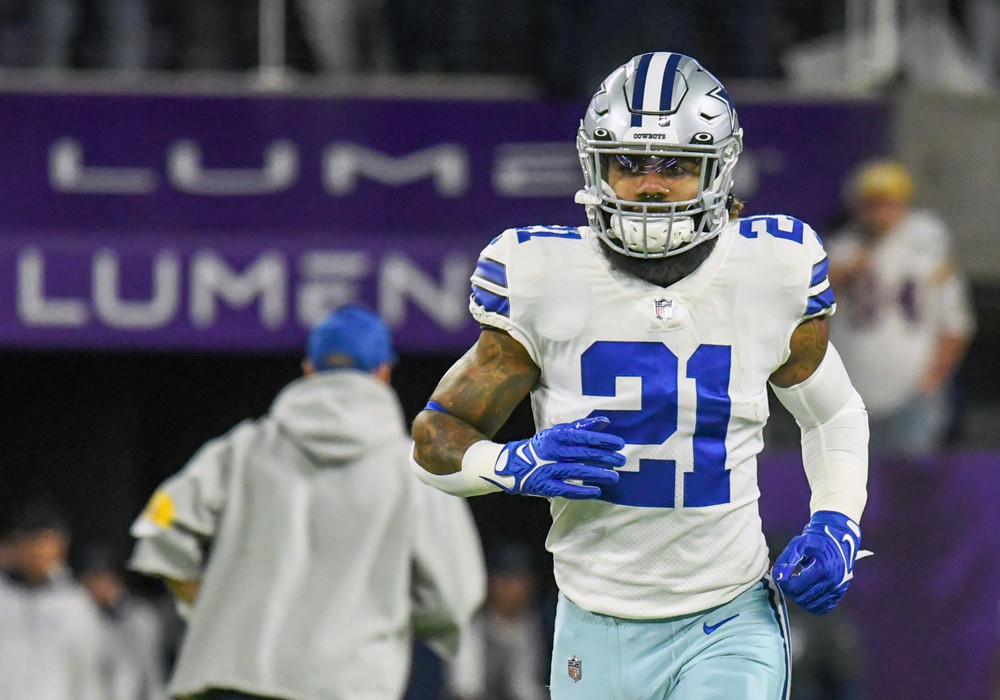
    1) Ezekiel Elliott, over 18.5 receiving yards, -120.

    Elliott has been a large part of the Cowboys passing game of late, with six catches in each of the last two games. He cracked the 20-yard receiving mark in both games and in five of the last six contests. Based on SIS data, we expect Elliott to get 4.5 targets and catch 3.2 of them for 27.4 yards almost 50% more yards than needed to cover the over number.


    2) Juwan Johnson, over 10.5 receiving yards, -110.

    Starter Adam Trautman remains on the IR, which means Juwan Johnson should continue to get a majority of the tight end snaps. Johnson’s production has been inconsistent, but he’s averaging 12 yards per reception so likely only needs one catch to cover the 10.5-yard number.

    New starting quarterback Taysom Hill can hardly be worse than what we saw from Trevor Siemian on Thanksgiving Day. In fact, Hill produced three games last season where he threw for more than 230 yards in four starts. The change under center should help Johnson and we are projecting 2.9 targets, 1.9 receptions and 22.1 yards, more than double what is needed for the over.


    3) CeeDee Lamb, under 4.5 receptions, +120.

    It’s always a question mark when your receiver is likely to go head-to-head against Marshon Lattimore. Although he hasn’t been as good in 2021 as past seasons, Lattimore is still a tough customer for a receiver to take advantage of, particularly in front of a national television audience. SIS analysis sets Lamb’s totals with 5.7 targets and 3.7 receptions for 47.2 yards.


    Sports Info Solutions has been an innovator in the collection and analysis of sports data for almost two decades. SIS specializes in baseball, footbal, and basketballl data, using professional scouting practices to collect the most detailed and accurate information in both sports. Their data can be found in the majority of team front offices, and on websites such as FanGraphs and Football Outsiders.


    Dallas at New Orleans

    Dak Prescott

    Over 283.5 yards -115, under -115

    Over 1.5 TD passes -230, under +170

    Over 0.5 INTs -105, under -130

    Over 24.5 completions -110, under -125


    Taysom Hill

    Over 209.5 yards -115, under -115


    TD Scorers

    Dallas –

    Ezekiel Elliott, -125

    CeeDee Lamb, +120

    Michael Gallup, +175

    Cedrick Wilson, +225

    Tony Pollard, +165

    Dalton Schultz, +180

    Amari Cooper, +180

    Dak Prescott, +450


    New Orleans –

    Alvin Kamara, +100

    Mark Ingram, +110

    Taysom Hill, +160

    Marquez Callaway, +220

    Tre’Quan Smith, +250

    Deonte Harris, +250

    Nick Vannett, +400

    Tony Jones, Jr., +650

    Ty Montgomery, +650

    Kenny Stills, +850


    Rushing Yards

    Dallas –

    Dak Prescott, over 8.5 yards -115, under -115

    Ezekiel Elliott, over 46.5 yards -115, under -115

    Tony Pollard, over 43.5 yards -115, under -115


    New Orleans –

    Taysom Hill, over 32.5 yards, -115, under -115


    Receptions

    Dallas –

    Ezekiel Elliott, over 2.5 receptions -170, under +125

    CeeDee Lamb, over 4.5 receptions -160, under +120

    Dalton Schultz, over 3.5 receptions -170, under +125

    Michael Gallup, over 3.5 receptions -140, under +105

    Tony Pollard, over 2.5 receptions +105, under -140


    Receiving Yards

    Dallas –

    Dalton Schultz, over 42.5 yards -115, under -115

    Ezekiel Elliott, over 18.5 yards -120, under -110

    Michael Gallup, over 46.5 yards -115, under -115

    Tony Pollard, over 16.5 yards -115, under -115

    Amari Cooper, over 47.5 yards -115, under -115


    New Orleans –

    Deonte Harris, over 33.5 yards -115, under -115

    Juwan Johnson, over 10.5 yards -110, under -120

    Marquez Callaway, over 30.5 yards -115, under -115

    Tre’Quan Smith, over 39.5 yards -115, under -115