Author: Alex Vigderman

  • Scouts vs Stats: Top 10 Non-Quarterbacks in the NFL

    Scouts vs Stats: Top 10 Non-Quarterbacks in the NFL

    Photo: Brian Lynn/Icon Sportswire

    If you’ve listened to the Off The Charts Football Podcast, you know that we like to examine things from a “Scouts versus Stats” perspective – and so we’ve brought that back for at least one discussion as we wait for the 2024 season to begin. 

    This week’s episode considers a question from those perspectives: Who are the Top 10 non-quarterbacks in the NFL.

    Ex-NFL scout Matt Manocherian and podcast host Bryce Rossler took the scouts’ perspective. Our director of football analytics Alex Vigderman and research analyst James Weaver created a statistical ranking based on a suite of metrics.

    We can tell you that officially, Sports Info Solutions does not condone the dichotomy between scouting and statistical analysis. Each of them provides data in their own way and should inform our evaluation of a player. We want to put the scouting reports and stats side-by-side, leveraging both to come to a conclusion.

    Fair warning: These are vastly different lists.

    Scouts’ Opinion Statistical Analysis
    1. Myles Garrett 1. Derrick Henry
    2. Micah Parsons 2. T.J. Watt
    3. Tyreek Hill 3. Travis Kelce
    4. Justin Jefferson 4. Chris Jones
    5. Nick Bosa 5. Justin Jefferson
    6. T.J. Watt 6. Tyreek Hill
    7. Pat Surtain II 7. Sauce Gardner
    8. Maxx Crosby 8. George Kittle
    9. Roquan Smith 9. Amon-Ra St. Brown
    10. Ja’Marr Chase 10. CeeDee Lamb

    Now that you’ve finished gasping at a running back – and not Christian McCaffrey – ranking No. 1 in the statistical analysis column, let’s explore the contrast of the two lists.

    And let’s get right to the point. Yes, the statistical analysis list has Derrick Henry as the No. 1 non-quarterback.

    In simplest form, our stats group created a methodology that is favorable to where Henry stands in the running back universe. He’s No.1 because he’s been “more better” (for lack of a better term) at running back over the last two years than other players are at their respective positions. 

    The Stats List Methodology

    You can listen to the podcast to hear the discussion regarding the surprising analytics-based ranks, but obviously there’s some explanation needed here. 

    The stats-based ranking includes a two-year average of a player’s results across a handful of flavors of our catch-all Total Points system.

    First, there is Points Above Average (PAA) per play, scaled to the positional average and standard deviation. This encapsulates the extent to which the player excels relative to the position on a play-to-play basis.

    Second, there is Points Above Replacement (PAR), scaled to the league average and standard deviation. This uses our WAR methodology that measures how valuable a player is in general, incorporating a notion of relative positional value.

    This is the first time we’ve mentioned it, but we’re working on a large update to the Total Points system this offseason, which will incorporate a whole bunch of new data points and ideas into the system. We’re not ready to publish those results, but we thought it’d be interesting to include them here to inform our player values.

    So, we have each of the scaled PAA per play and PAR values for each of the two versions of Total Points, equally weighted between the four.

    The one other element that’s included is player aging. Players start to drop off in production within just a few years of coming into the league, so we want to make sure that we’re capturing that. We computed an aging factor for each of the above metrics and applied that to each player’s two-year averages, to make it more like a projection for 2024.

    What the Stats Showed

    Having Derrick Henry number 1 is a bit rich, no? Especially given that McCaffrey exists?

    Let’s take the second point first. Over the last two years, Henry has generated almost 30 more PAA than McCaffrey as a rusher, which doesn’t get sufficiently counterbalanced by McCaffrey’s receiving excellence.

    The gap in rushing is in large part to the difference in their circumstances. Henry has continued to be productive year after year despite having the most carries in the NFL when the offensive line blew a block in front of him over the last two years, and last year he turned more than 60 percent of those into gains. Henry’s elusiveness has not eluded him yet, with similar or better broken and missed tackle rates to McCaffrey’s.

    The positional value question is a valid one, though. How is a running back rated so highly in general? In short, we can only measure what we have access to, and that informs how we value positions. 

    A running back can fumble or get stuffed for a loss on third down, losing a big chunk of value, in a way that a pass rusher or a center does not often do. So the depth of the floor for a running back is more extreme, at least in the statistical record. That means that within the Points Above Replacement framework, the floor for rushers is lower than you think, and therefore the position as a whole is considered more valuable.

    The other big contrast

    The scouts’ list has several edge rushers on it. The stats list is lacking in them.

    Myles Garrett and Micah Parsons are at worst among the handful of best defensive players in the league, so there’s not much to say about them to argue for their inclusion at the top of a crowded field of edge rushers. Parsons is probably the pick if you need one guy to wreck a play, but consistent with their general approach, Garrett got the nod because of how he impacts all phases of the game.

    An otherworldly motor against the pass and the run got Maxx Crosby onto the list, and the scouts were indignant at his exclusion from the stats-based list—but only moderately indignant compared to what happened at the top of the board.

    So why are many of the top pass rushers in the league not at the top of the stats-based list (although the upcoming Total Points updates will do a lot to make up for that)?

    There are more excellent edge rushers than there are excellent interior players, so a single player at the top stands out more in the interior. Chris Jones projects to be one of the biggest risers in the updated Total Points because of how much he dominates as a pass rusher from the interior, as he ranked first and third in 2023 and 2022 in pressure rate, respectively. This isn’t true for the edge rushers, where there are many solid producers.

    Parsons will have a similar jump to Jones, but he’s competing at a much tougher position at the top. There are six edge rushers in the top 20 on the stats-based list, compared to just two interior defenders.

    Also, our measure of the floor of a defensive front player isn’t as low as it is for other positions—a bad play by a cornerback or a running back is more likely to be a big liability. As a result, when we determine replacement level for each position, we don’t have as much value assigned to pass rushers as we do other positions.

    Other highlights from the stats list

    Travis Kelce might have been a more palatable choice for this list a year ago, but it’s worth noting that he still posted the best receiving PAA among tight ends last season. George Kittle’s balanced skill set got him on the list, coming in the Top 2 in Receiving and Blocking Total Points among tight ends. However, even at a younger age, it doesn’t make up for the gap in receiving production.

    The lists differed on which of the top cornerbacks cracked their lists, with Sauce Gardner getting the nod thanks to his consistent production across his first two seasons. He finished in the top 10 each of the last two seasons in yards allowed per coverage snap, yielding fewer than 700 receiving yards in nearly two years. 

    Amon-Ra St. Brown snuck onto the stats-based list because of how well he does his job, even though his job might be limited relative to others at the position. He is as money as it gets in big spots, ranking second in the NFL in both On-Target Catch Rate and third down completions over the last two years.

    CeeDee Lamb is there because of his production in 2023, specifically ranking first in Receiving Total Points. The updates to Total Points will ding him because of his merely good catch rate on accurate balls, which is why he ended up below St. Brown, for example.

    Other highlights from the scouts’ list

    While the stats-based list was heavy on wide receivers, the scouts-based list was heavy on edge rushers, to the point that they felt the need to stretch for a couple of less-valuable positions.

    In the interest of being less boring, the scouts included Roquan Smith as an off-ball linebacker choice. He’s a downhill player and an “enforcer,” per Matt, and while he doesn’t have the crazy athleticism that other potential candidates do, he closed the gap in that respect in 2023 in terms of being an excellent well-rounded player.

    The scouts really only considered two cornerbacks for their list, and they went with Pat Surtain II over Gardner as the prototypical corner with versatility and consistency that very few corners have.

    Ja’Marr Chase and CeeDee Lamb were candidates  for the back end of their list, with Chase getting the nod because “he’s more of a headache in more ways that lead to touchdowns for him and for other players on his offense.” This also contributed to the choice of Tyreek Hill as their top receiver. 

    Want to hear the rest of the debate and discussion? Check out Off The Charts wherever you get your podcasts.
     

  • Drafting Breakout Pro Bowlers for the 2024 NFL Season

    Drafting Breakout Pro Bowlers for the 2024 NFL Season

    With the majority of impactful offseason moves complete, it’s time to turn to the upcoming season. We’ve decided to keep the optimism from draft season going by talking about breakout players for 2024. 

    To keep things simple, we’re just looking for players who haven’t yet made a Pro Bowl but who we think might this year. Some of these selections take into consideration the depth at the position in that player’s conference, but every player has shown hallmarks of opportunity and production that suggest they could take a leap this year.

    The SIS Football R&D crew of former NFL scout (and SIS COO) Matt Manocherian, our director of football analytics, Alex Vigderman, and research analysts James Weaver and Bryce Rossler, named their choices via a draft format, and they each provided their own notes below (with some occasional commentary from others sprinkled in).

     To listen along with their selections, check out this Off the Charts Football Podcast episode.

    1. Matt Manocherian – Rashan Gary, Packers EDGE

    Who made these rules? This is the easiest pick. It’s so easy that it’s uninteresting. I’m not sure how it’s possible that Gary hasn’t made a Pro Bowl yet, but this seems like a matter of time. 

    One of my favorite metrics for pass rushers is Pressure Rate Above Expectation (Pressure % +/-), which looks at how often a pass rusher in a given situation and alignment creates pressure compared to an average player in that context. Gary has been among the leaders in this stat for each of the last three seasons, and that doesn’t even reflect the 10 holding penalties that he drew over that time. 

    Gary is 26 years old and was 5th among linebackers in Pass Rush Total Points in 2023. If he can stay healthy and play with some leads this year, it feels more likely than not that he ends up in the Pro Bowl.

    2. Alex Vigderman – Jayden Reed (or Dontayvion Wicks), Packers WR

    Reed and Wicks were each taken by the Packers in the 2023 Draft, and they proceeded to have identical per-play production. They were within 0.1 yards per route run of each other, and had identical Total Points per route run to three decimals. 

    Coming out of the draft, I viewed them as possible overachievers based on their (also nearly identical) performance against press coverage and otherwise, which I’ve found to be a positive indicator. So this is a bet on that phenomenon, with Reed winning my vote because we (and the Packers) graded him as a much better prospect.

    It also doesn’t hurt that after the bye week last year (Week 6), Jordan Love ranked among the best in passing Total Points per play and first in Boom Percentage (the rate of plays gaining at least 1 EPA).

    3. James Weaver – Drake London, Falcons WR

    As a Top 10 pick in 2022, London was expected to come in and make an immediate impact to a Falcons offense going through a transition period. The problem has been below-average quarterback play at best and an offensive scheme that has limited his potential.

    Even battling those two issues, London still put up 866 and 905 receiving yards in his first two seasons in Atlanta. Now, Kirk Cousins steps in as QB1 and Zac Robinson from the Rams takes over as offensive coordinator, each coming from potent offenses at their previous stops. 

    With London’s 6’4” frame, look for him to get more than 7 end zone targets and 2 touchdowns like he had in 2023.

    4. Bryce Rossler – Chris Olave, Saints WR

    Olave has recorded 1,000-yard seasons in each of his first two seasons with the Saints, but the touchdowns haven’t been there. He had just 8 end zone targets in 2023, which is pretty pedestrian considering the overall volume he sees, but he did rank 5th in deep targets (20+ yards)with 28. An uptick in red zone usage could spell a breakout year for him in 2024.

    5. Bryce – Devonte Wyatt, Packers DT

    Wyatt didn’t see a lot of playing time in his rookie season, but he flashed considerably in Year 2. He ranked first in Pressure Rate +/- and second in raw pressure rate among DTs last year, and his combination of power and explosiveness is evident on film. He’ll be a better fit under a new defensive coordinator this year, and the staff has already said they’ll let him pin his ears back going forward.

    6. James – Bryce Huff, Eagles EDGE

    Huff had the best year of his career with the Jets in 2023, recording 10 sacks on 60 pressures and had the 11th-highest Pressure Rate +/- at 5% above expectation. He also accounted for the highest tackle total of his career at 29.

    Now part of a talented Eagles defense coordinated by Vic Fangio, look for Huff to take advantage of more 1-on-1 opportunities to get to the opposing quarterback. He will be part of a rotation with Nolan Smith and Josh Sweat and have the opportunity to be fresh when needing to make an impact play.

    7. Alex – Martin Emerson Jr., Browns CB

    This was the only “Who?” pick of the draft, which comes with pride and shame. Emerson was taken in the 3rd round of the 2022 Draft and has been quietly productive in both of his NFL seasons. He’s been one of the better pass defenders in the league across a few compelling metrics: Total Points per play, Boom Percentage Allowed, and Deserved Catch Rate (an adjusted catch rate accounting for drops and uncatchable passes).

    2022 2023
    Total Points per play 16th 10th
    Boom% Allowed 9th 6th
    Deserved Catch Rate 7th 11th

    * Among players targeted at least 50 times

    8. Matt – Jalen Carter, Eagles DT

    You guys really stink at this game. You are making it too easy for me. Jalen Carter didn’t even start on the Eagles’ broken defense last year, and he still was a Will Anderson away from winning Defensive Rookie of the Year.

    In terms of advanced stats, Carter was good-but-not-elite last year. With a new defensive staff, a larger role, and an Aaron Donald-sized hole in the conference, I think this will be the first of many Pro Bowls in Carter’s career.

    I’m sure Martin Emerson is great though…

    9. Matt – Marvin Harrison Jr., Cardinals WR 

    (or Bijan Robinson, if you prefer to play by the spirit of the activity)

    Seriously?! You made the rules! It’s not my fault that you are all bad at this game. Marvin Harrison Junior has never made a Pro Bowl. How is this pick even controversial?

    If you take rookies off the table, Bijan Robinson and Kyle Pitts are attractive picks for me for similar reasons to James’ pick of Drake London. I also like Devone Achane’s chances to take Raheem Mostert’s Pro Bowl spot.

    You know what? I take it back. I’m bad at this game. My picks are too good, so they are boring. I prefer the “spirit” of Alex taking Martin Emerson Jr. because he deserves legitimate credit if that dude makes the Pro Bowl.

    10. Alex – Jaquan Brisker, Bears S

    Brisker shows some markers of being a playmaking safety who puts up a variety of statistics that can wow awards voters. SIS graded him as a probable strong starter coming out of the draft in 2022, so there’s some upside and pedigree here.

    He got his hand on the ball (via a pass breakup, forced fumble, etc.) at the second-highest rate of any defender in the league, including 9 pass breakups (second at the position to not-exactly-a-safety Brian Branch). That also included 4 dropped interceptions, which could easily go the other way and make a huge impact.

    While he’s not a box safety or anything, he did rush the passer a couple dozen times in 2023, generating pressure almost half the time. If he pairs a few sacks with some turnovers, that’s a recipe for a breakout.

    11. James – Chase Brown, Bengals RB

    With Joe Mixon out of the picture, Brown will have every opportunity to fight for the RB1 role in a productive offense with Joe Burrow back in the picture. 

    Last year as a rookie, Brown started to see an increase in usage from Week 13 on and took advantage. He was tied for third in yards after contact per attempt and eighth in broken or missed tackles per attempt. He will be battling for time with newly acquired Zack Moss, but Brown being in a familiar system in year two will give him a slight advantage.

    12. Bryce – Anthony Richardson, Colts QB

    Richardson looked like a star in the making before an unfortunate injury derailed his rookie season. He ranked 10th in passing Total Points per play up to the point of his season ending in Week 5–which is pretty good for a rookie–and his ability as a rusher was obvious. Dual threats who produce on the ground tend to get a lot of fanfare, and Richardson is poised to pump the box score in 2024 if he can come back full strength.

  • Thinking About Daniel Kahneman’s Work As It Relates To Football Research

    Thinking About Daniel Kahneman’s Work As It Relates To Football Research

    As I start writing this, it’s been about two hours since I found out about the death of legendary behavioral psychologist and Nobel laureate Daniel Kahneman. And the fact that I’m already writing an article about it should tell you how much of a loss I felt it to be. 

    A psychology major in college, I was well aware of the impact of his research (much of which was done alongside Amos Tversky). He wrote a bestseller in Thinking, Fast and Slow, and his work was chronicled by Michael Lewis in The Undoing Project, and there’s plenty else to look up if you fancy yourself more than a pop psychology enthusiast.

    I don’t have a robust thesis here, I kind of just want to talk about some of his areas of research and how immediately relevant they are in the context of sports research.

    Substituting simpler questions for more complex ones

    I find that psychology research is often an exercise in formalizing (through rigorous study) our understanding of things we intuitively know about ourselves. 

    One idea that Kahneman presented to help us answer difficult questions was to try to reframe them into simpler ones that can be answered much more immediately, then map the answer back to the original question. 

    For example, you could reframe a question like,
    “How much would you contribute to save an endangered species?”

    to

    “How much emotion do you feel when you think of dying dolphins?”

    The idea is that it’s easier to evaluate questions that address things that are right in front of your face, immediate both in physical space and time. You can address the relationship between the two questions later, but first you want to get an answer to the question you have a better chance of evaluating in any fashion.

    This applies to an incredibly broad range of research, because we’re constantly looking for ways to evaluate complex questions without the ability to assess them directly. 

    How good will this quarterback be when he transitions to the pros? Is this promising rookie going to keep it up? How does the increase in the use of Cover 2 defenses impact the success of NFL offenses?

    We can’t go at these questions head on, but we should start by thinking about what answerable questions we can define that would map to those questions, and then make the translation afterward.

    The Law of Small Numbers

    We know that large samples are more useful than small samples, within reason.

    If I’m building an expected points model for football, I don’t want to use one season of data. There are not nearly enough plays in a year to cover all of the situations I’d want to evaluate. At the same time, I wouldn’t want to use 10 years, because the game has changed enough that teams would approach the same situation differently now than they did 10 years ago.

    The trouble that Kahneman and Tversky found was that most people don’t apply sufficient suspicion to small samples, assuming that they operate roughly like large ones in many ways. In particular, we don’t account for the increased likelihood that a small sample is biased in some way.

    We’re inundated with situational breakdowns like platoon splits and performance against certain defensive coverages, sure. But we don’t acknowledge often enough that even full seasons of performance are subject to a lot of random variation. We need to do a better job of starting from the point of “how much sample is enough to trust the result?” and using that as a guidepost.

    Heuristics, for better or worse

    I imagine most everyone has encountered some of these heuristics explored by Kahneman and Tversky. 

    • Anchoring: our tendency to stick close to what we’ve already observed or thought.
    • Representativeness: our tendency to respond more to examples of a group that match what we think of as the prototype for that group
    • Availability: our tendency to judge how common something is by how easily we can think of examples of it

    We’re in NFL Draft month, so this section feels extremely topical. Scouting as a general practice is rife with examples of these heuristics at work. They are useful tools to save us time—we probably don’t need to worry much about scouting a 170-pound defensive tackle—but they can get us in trouble.

    We knew before the year that Caleb Williams and Marvin Harrison Jr. were likely to be top five picks, so maybe we were a little rosier in our evaluation of them during the 2023 season. (Not saying that’s what happened, but what very likely could have.)

    We don’t see a lot of small interior defensive linemen making an impact at the NFL level, so Aaron Donald falls through the cracks (relatively speaking).

    We give a lot of credit to offensive linemen for pancake blocks, despite them being far from common.

    Perhaps the best way to integrate analytics and scouting is to use data to put guardrails around our perception of a player on film, to correct for the downsides of these heuristics.

    Prospect Theory

    Kahneman espoused an integrated theory that merges ideas like diminishing returns and loss aversion into a single framework. Again, everyone knows these ideas to be true, but Prospect Theory adds graphs!

    Internally at Sports Info Solutions, we’ve spent a decent amount of time pondering how we might change the way people talk about football win probability using this framework. 

    One of the biggest gripes about the nerds with the models is that they don’t properly account for the downside of missing on a bold fourth down. And while from a purely in-game situational perspective that’s not a fair critique, it’s worth entertaining the possibility that we could incorporate ideas like loss aversion and diminishing returns into our measures of the value of making certain choices.

    For example, say you’re already 90% likely to win. If an overall superior choice presents the possibility of dropping to 75% against a possible improvement to 95%, we might want to encourage a nonlinear win probability measure that considers the risk of bringing the opponent back in the game to be less desirable. 

    It’s absolutely worth noting here that I haven’t put a ton of research into any of the words that preceded these, but I feel his work was important enough to drop other things on my plate to talk about. He’s an extremely important person in the sports research world, even if his work wasn’t directly impactful on the game.

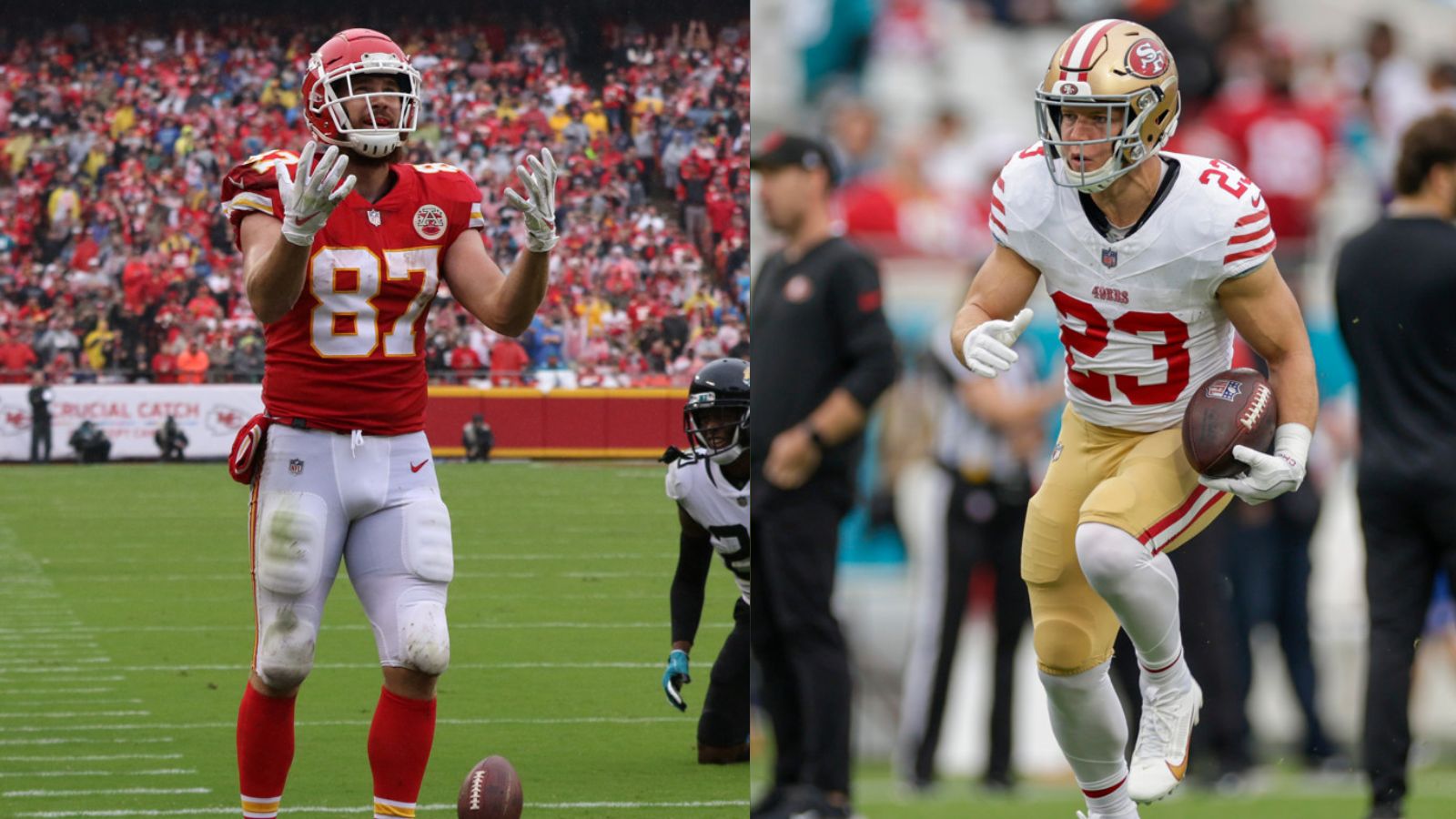
  • The One Key To Winning Super Bowl LVIII for the Chiefs and 49ers

    The One Key To Winning Super Bowl LVIII for the Chiefs and 49ers

    Let’s get right to the point: What’s the most important thing for each team going into Super Bowl LVIII?

    Chiefs: Catch the ball!

    As a preface, let’s talk about Brock Purdy a bit (and this is Chiefs-related).

    Perhaps the biggest reason the 49ers are in this game is that Brock Purdy delivered four interceptable passes that the Lions got their hands (or faces) on, but they only converted one into a turnover. 

    Purdy has been a revelation for the 49ers, but he has lived a charmed life, for sure. Ignoring the embarrassment of riches available to him at the skill positions, he has delivered quite a few turnover-worthy throws that have fallen for (relatively) harmless incompletions.

    Of the top 10 quarterbacks in EPA per pass attempt this year (minimum 300 attempts including playoffs), he’s the only one to have more than 4 percent interceptable throws—and he’s at 5 percent. Purdy has also been intercepted less than half those times, which puts him among the more fortunate passers in this regard. 

    Let’s compare with a noted gunslinger, Josh Allen.

    Turnover-worthy throws in 2023

    Turnover Worthy % Intercepted Dropped
    Brock Purdy 5.1% 12 14
    Josh Allen 3.2% 18 3

    Our own Bryce Rossler has driven this home on our podcast multiple times over the last month: as a defense facing the 49ers, Brock Purdy is going to throw you the ball. You just need to catch it.

    Unsurprisingly, the hands thing matters for the offense as well. The Lions pass catchers dropped multiple late-down attempts themselves, not wanting their defense to have all the fun. 

    The Chiefs are as likely as any team to have hands issues. Only the Browns dropped more passes during the regular season, and Chiefs pass catchers were in the bottom ten in On-Target Catch Rate, wasting some good throws by Patrick Mahomes. The group has been better overall as the season has gone on, but they still have dropped multiple passes in four of the last seven games, and they don’t have as much margin for error as an offense as they did a few years ago. 

    49ers: Run with your advantage in the run game

    If the Lions showed the blueprint for how not to beat the 49ers, the Ravens might have shown how not to beat the Chiefs. 

    Kansas City was in the bottom group of teams in both EPA and Success Rate allowed against the run through 20 weeks, and despite having a 50% success rate on eight designed runs in the first half, Baltimore called just 3 in the second half in a winnable game.

    So here come the 49ers, who rank in the top 2 in both EPA and Success Rate on designed runs. Their reliability as an offense as a whole hinges on their ability to make hay on the ground, in part because of that note above about Brock Purdy’s penchant for pickable passes.

    EPA/Attempt (Rank) Success Rate (Rank)
    49ers offense 0.00 (1st) 46% (3rd)
    Chiefs defense -0.03 (29th) 42% (26th)

    They have the most consistent running back in the league in Christian McCaffrey, who had some workload concerns in Carolina but combined top-of-the-league efficiency with top-of-the-league volume in his first full year in San Francisco.

    If this team gets away from the run in this spot, something has gone horribly wrong.

    And if we like building narratives about establishing the run and using play action alongside it, the Chiefs offer a real opportunity. They saw as much play action on defense as anyone and ranked in the middle of the pack in EPA per play allowed, while they ranked as the best defense in the NFL on other pass attempts. 

    San Francisco (somewhat surprisingly) doesn’t rely on play fakes much, but whether the 49ers actually hand it off or not it makes sense for them to show run quite a bit in this matchup.

  • Where Did It All Go Wrong For The Eagles?

    Where Did It All Go Wrong For The Eagles?

    BY ALEX VIGDERMAN AND BRYCE ROSSLER

    In what is inarguably one of the most surprising collapses in NFL history, the Eagles are out of the 2023 playoffs. They had gone 26-5 since the start of 2022, and then finished the 2023 season losing six of seven games. Jason Kelce is apparently retiring, Nick Sirianni is on the hot seat apparently. It’s all bad.

    For a team with this one’s preseason and midseason expectations, the loss to the Buccaneers is a major disappointment. But throughout the season the Eagles had shown themselves to be a shadow of their 2022 selves, so it’s not entirely surprising.

    Looking just at the per-game scoring differential, the Eagles had led the league in 2022 (including the playoffs), while they were only seventh through their 10-1 start to 2023. And remember, that included consecutive wins against the Chiefs, Bills, and Cowboys at the end of that stretch.

    After that point, Philly posted the second-worst per-game point differential in the NFL (including their loss a couple days ago). 

    And that doesn’t tell the whole story, because their opponents were also notably worse in this stretch than they’d faced prior. Per the team strength model that SIS uses within its win probability model, their poor performance came against substantially worse opponents than their previous ones.

    The Eagles played worse against worse opponents down the stretch
     

    Time Frame Record Point Diff Rank Strength of Schedule
    2022 (All) 16-4 1st 7th
    2023 (Through W12) 10-1 7th 7th
    2023 (W13 and on) 1-6 31st 22nd

    But even before the crash the team wasn’t exactly running on all cylinders, as a 10-1 start might suggest. By Total Points per play they ranked outside the 10 best teams, ranking 9th on offense and 16th on defense. Heck, the 5-6 Falcons were better than the Eagles in Total Points Per Play to that point in the season.

    Through the rest of the 2023 season, the Eagles lost their edge on defense while maintaining solid (if slightly disappointing) offense.

    Eagles Total Points per Play Ranks

    Time Frame Offense Rank Defense Rank
    2022 (All) 2nd 5th
    2023 (Through W12) 9th 16th
    2023 (W13 and on) 10th 29th

    With that setting the scene, let’s take a look at some of the key failings of the 2023 version.

    Dropping the opposing quarterback

    Perhaps the most noticeable difference between these consecutive Eagles seasons is the performance of the pass rush. They pressured the quarterback at nearly identical rates (36% and 35%), but in 2023 the sacks didn’t come nearly as often (6% in 2023 compared to 11% in 2022). 

    That’s just straight up regression that anyone could have seen coming. The 2022 Eagles led the NFL with 29% of pressures becoming a sack, a rate that only one team in the last several seasons has gotten close to (the 2021 Bears). In the seasons surrounding those seasons, neither of those top teams achieved even a 20% rate. Even with the addition of Defensive Rookie of the Year candidate Jalen Carter, they weren’t going to retain that production.

    Big holes in the middle of the field

    It turns out that acquiring a big-name player that had been released midseason isn’t a slam-dunk move. The Shaquille Leonard addition didn’t help a linebacker group that ended the season with both starting linebackers in the bottom quintile on a per-play basis by Total Points.

    With those limitations and the loss of slot corner Avonte Maddox for most of the year, the Eagles allowed 24% of 15-yard or shorter throws between the numbers to go for a big EPA gain, which was the sixth-worst rate in the league. These underneath defenders were very visible on Monday (in a bad way), and while they didn’t yield monster plays over the middle, they were beaten consistently to the tune of 8.3 Y/A.

    RP-Oh-No

    For years the Eagles’ offensive calling card has been the RPO game. It was the crutch that supported Nick Foles’ outstanding 2017 playoff run. 

    In 2022 the Eagles gained almost a quarter of an Expected Point per play on RPOs. That was the best SIS has charted (since 2018). In 2023, they were almost exactly league average. 

    This drop-off drove the overall offensive downturn in both the passing and running game.

    Eagles RPO Success Rate in the passing game
     

    RPO No RPO
    2022 59% 43%
    2023 49% 45%

    Eagles RPO Success Rate in the running game

    RPO No RPO
    2022 52% 48%
    2023 45% 46%

    A limited Jalen Hurts capped their upside

    Jalen Hurts was famously successful on quarterback sneaks this year. He had 12 more first downs on sneaks than any other quarterback had sneak attempts in 2023. And that resulted in a lot of successful drives that other teams wouldn’t have had.

    But especially with a nagging knee injury, his designed runs outside of those sneaks were dramatically less effective. He not only attempted 10 fewer designed runs, but he was stuffed for no gain or worse more than twice as often, and had one-quarter the broken and missed tackles per attempt.

    Going back to the RPO point, Hurts struggled with quick-game accuracy. He ranked 8th in On-Target Rate on RPOs and 1-step drops in 2022 and 24th in 2023 (minimum 50 attempts). And there wasn’t a similar fall-off on deeper drops, for what it’s worth.

    With a simplified offensive scheme and an RPO-heavy approach, you need the skill position players to be elite and/or the quarterback to be precise to be a top offense. The Eagles had only one of those things this year.

    How do they look going forward?

    The Eagles can’t confidently run it back and say they just suffered from weird variance in the second half. They were a good-not-great team when they were running well.

    There have to be changes made on the defensive side to shore up an extremely leaky unit from the end of the year. They will have to grapple with questions in the secondary and at linebacker, with aging cornerbacks on the outside and an extremely flawed interior. It’ll be another offseason talking about the impending departure of Fletcher Cox and Brandon Graham, who each flashed but generally had down years (understandably for old fogeys).

    The offense has the talent to be a top-five unit and should with little effort be a Top 10 unit provided Hurts is healthier and the offensive line can coalesce without All-Pro (and Total Points leader) Jason Kelce. But it’s clear at this point that the quarterback isn’t an MVP candidate without dynamic athleticism, so the scheme needs to elevate him as much as he elevates the offense.

  • DaRon Bland’s Overall Production Makes Him A Strong DPOY Candidate

    DaRon Bland’s Overall Production Makes Him A Strong DPOY Candidate

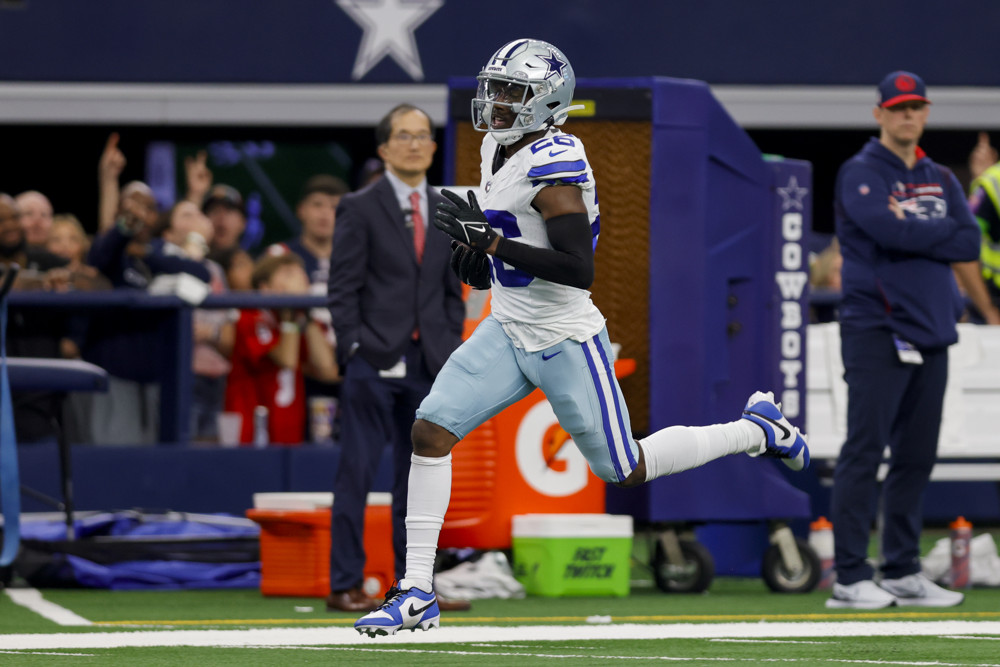
    Two years ago, I wrote about Cowboys cornerback Trevon Diggs’ ridiculous start to the 2021 season, intercepting six passes in five games. Through that point in the season, he was an obvious Defensive Player of the Year candidate based on that productivity alone. But his value in totality didn’t add up to that, because he was performing very poorly on the other 99% of plays.

    This year, in Diggs’ absence, the Cowboys are again benefiting from a ridiculous turnover season, this time in the form of pick-six record holder DaRon Bland. But this time, that’s resulting in truly elite value (even if the stats that don’t care about interceptions aren’t transcendent). 

    DaRon Bland ranks, 2023 CB (min 30 targets)

    Rank (out of 77)
    Pass Coverage Total Points per play 1st
    Positive% Allowed 39th
    Deserved Catch % 16th
    Yards per Cover Snap T-68th

    Through Week 13, Bland has generated 61 Total Points, which puts him at the top of the list of non-quarterbacks. That’s 40 points—more than three points per game—above an average cornerback. Corners are admittedly more likely to have extreme seasons like this because of their ability to generate defensive touchdowns, but this total already puts him among the most productive non-quarterback seasons Total Points has seen (i.e. since 2016).

    When you think about how pick-sixes work from an Expected Points Added (EPA) perspective, this isn’t shocking. Each one turns a situation where the offense might expect a point or two into one where they’ve locked in negative-six, for a swing of more than a touchdown on average. Just those five plays basically account for the difference between Bland and an average corner.

    The bigger difference between Bland’s 2023 and Diggs’ 2021 is what the former is doing on the rest of his snaps. Diggs was outright bad when he wasn’t ending up with the football, which resulted in his overall numbers looking average.

    Trevon Diggs ranks, 2021 CB (min 45 targets)

    Rank (out of 72)
    Pass Coverage Total Points per play 43rd
    Positive% Allowed 48th
    Deserved Catch % 50th
    Yards per Cover Snap 72nd

    If we break down their Total Points contributions on interceptions versus other plays, we see that Bland has been more valuable regardless of the turnovers.

    Pass Coverage Total Points comparison

    Interceptions Other plays
    DaRon Bland, 2023 52 (on 8 plays) 6 (on 615 plays)
    Trevon Diggs, 2021 39 (on 11 plays) -16 (on 941 plays)

    Bland is generating more than six points per interception (and return), which is insane. That’s like if he scored eight 90-yard touchdowns as a receiver. 

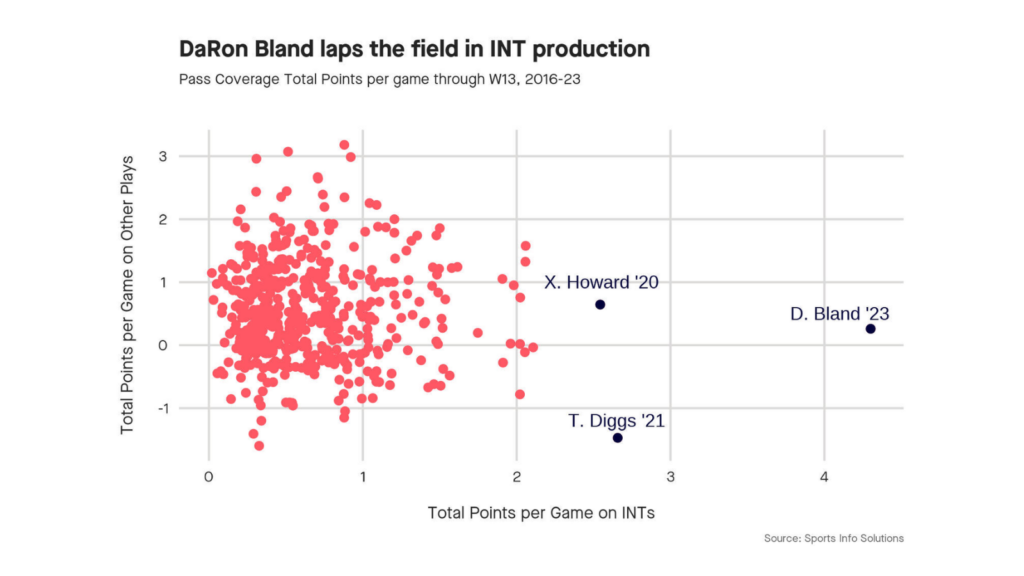
    To put some more context on that production, here is a look at the value defensive backs have generated with interceptions versus other plays through 13 weeks of the last eight seasons. A few outstanding interception seasons are highlighted, including Xavien Howard’s 10-pick 2020.

    Bland blows everyone out of the water on interceptions because of all those touchdowns, blending that with middle-of-the-road production overall. This puts him solidly ahead of Diggs in both respects, and in line with Howard (plus some touchdowns tacked on top).

    We generally don’t see big turnover numbers from true shutdown corners, because the big play guys are often trying to jump routes and bait quarterbacks, which results in a lot of completions when they don’t get there. Bland is keeping his head above water when he doesn’t pick off the quarterback, though, which makes him a legit contender for Defensive Player of the Year.

  • Scouts vs Stats: Top 10 Interior Offensive Linemen

    Scouts vs Stats: Top 10 Interior Offensive Linemen

    Over the spring/summer, the SIS R&D staff is convening on the Off the Charts Podcast to talk about their top ten players at a position. To do this, we pit two methodologies against each other: 

    • The “Scouts,” which comes down to the film-based opinions of Matt Manocherian and Bryce Rossler, each of whom has a lot of experience breaking down film and scouting players (Matt having been a scout for NFL teams).
    • The “Stats,” which involves James Weaver and Alex Vigderman devising a ranking based on a suite of metrics, and having that ranking speak for itself.

    Officially, Sports Info Solutions does not condone the dichotomy between scouting and statistical analysis. Each of them provides data in their own way and should inform our evaluation of a player. 

    When we originally produced the Football Rookie Handbook before transitioning that content to our NFL Draft site, we put the scouting reports and stats side-by-side with the idea that the reader would bounce back and forth between them and leverage both to come to a conclusion about a prospect.

    So, without further ado, let’s head into the trenches and break down the ‘Best Interior Offensive Linemen in the NFL’ Top 10 lists.

    Scouts’ Opinion Statistical Analysis
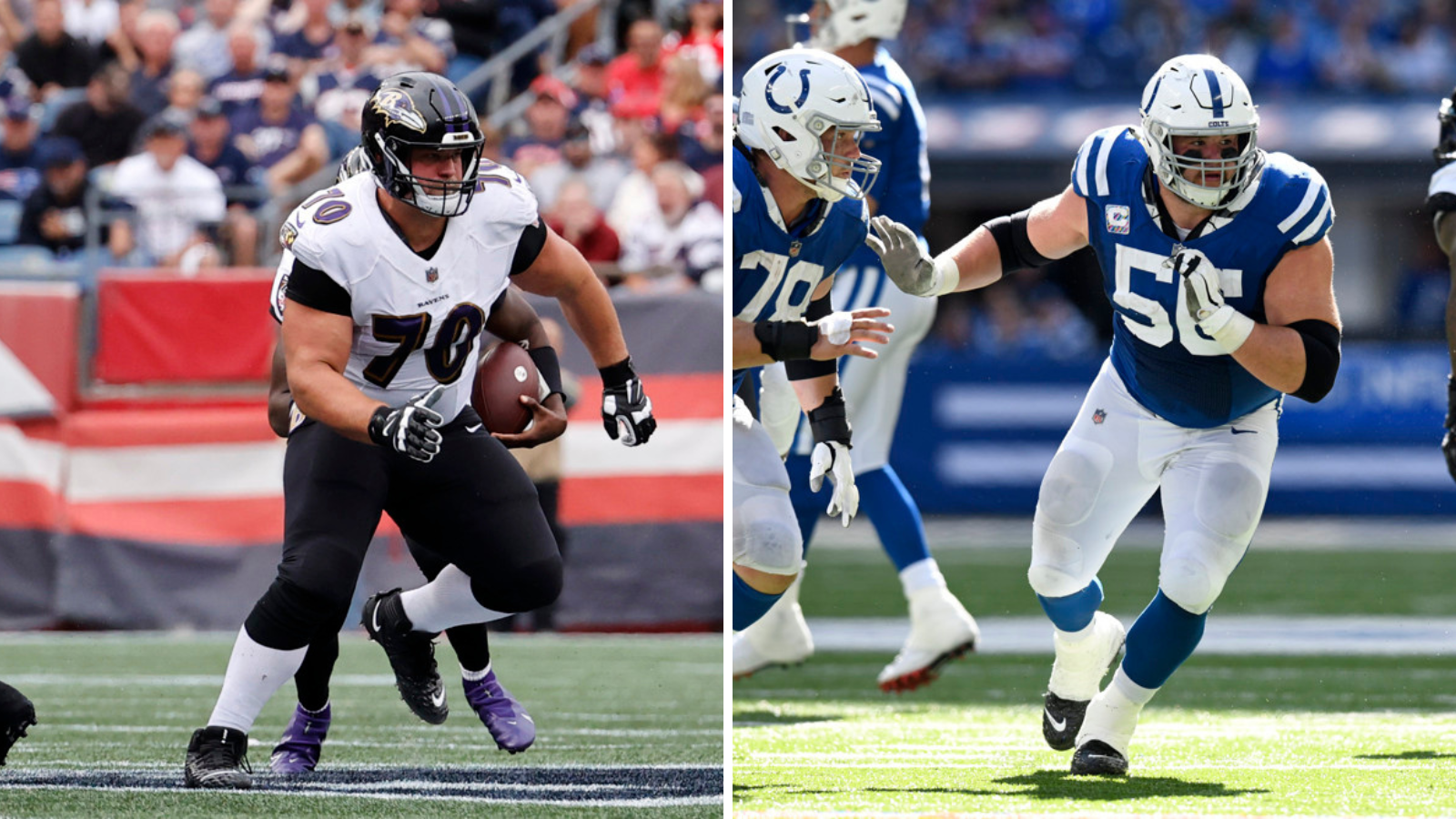
    1. Zack Martin 1. Jason Kelce
    2. Jason Kelce 2. Kevin Zeitler
    3. Creed Humphrey 3. Joel Bitonio
    4. Quenton Nelson 4. Isaac Seumalo
    5. Joel Bitonio 5. Zack Martin
    6. Erik McCoy 6. Tyler Linderbaum
    7. Joe Thuney 7. Joe Thuney
    8. Brandon Scherff 8. Jon Runyan Jr.
    9. Corey Linsley 9. Ben Powers
    10. Frank Ragnow 10. Creed Humphrey

    The Stats List Methodology

    The stats-based ranking includes a three-year recency-weighted average of a player’s results across several different metrics, with the following weights applied to each:

      • 25% Pass Blocking Total Points 
      • 20% Run Blocking Total Points
      • 10% Pass Blown Block Rate
      • 10% Run Blown Block Rate
      • 10% Holding penalty avoidance
    • 5% Positional versatility

    Total Points does as good a job of evaluating offensive line play as anything in our arsenal, so we leveraged that most, leaning a bit more into pass blocking than run blocking. These are both season totals, so to give more credit to play-to-play effectiveness we added in blown block rates as well.

    Total Points doesn’t account for penalties (yet), so we wanted to ascribe some value to avoiding holding penalties. Typically linemen aren’t being called for these more than a few times a year, but they’re absolute drive killers.

    And lastly, we wanted to give players credit for playing multiple positions. Most of the top players aren’t moving around because they’re so good at their primary position, but being able to provide support at multiple alignments is absolutely a valuable aspect of a player.

    What the Stats Showed

    The top three players on the stats list have two things in common: they are strong in both the pass game and run game, but they’re better as run blockers. That’s a bit surprising because the passing game was weighted more strongly in the metric the stats group used.

    Each of Eagles C Jason Kelce, Ravens G Kevin Zeitler, and Browns G Joel Bitonio ranked in the top 15 in both Pass Blocking and Run Blocking Total Points (out of over 200 candidates), but all of their Run Blocking Total Points ranks were the higher of the two. Kelce separated himself by ranking in the top 20 in blown block rate both passing and running, which no one else could claim.

    One feature that contributed to Kelce’s Total Points ranking (and is somewhat relevant for other players on the list) is that it’s difficult to disentangle responsibility for quarterback designed runs, particularly sneaks. With how much the Eagles leaned into the sneak in 2022, there are a lot of high-value plays for which Kelce is getting some Total Points credit. 

    Almost every player outside the top few was a good bit more productive at one type of blocking than the other. Cowboys G Zack Martin (No. 5) and Chiefs G Joe Thuney (No. 7) were the notable exceptions, ranking in the top 25 in each, but down years by their standards in 2022 dropped them down the list.

    First-year Ravens center Tyler Linderbaum cracked the list at No. 6, thanks to excellent production in the run game. He ranked second in the Run Blocking Total Points category, and 12th in run blown block rate. It’s worth noting that he does have the quarterback-run caveat that affects Kelce (and former teammate Isaac Seumalo, now of the Steelers), but he was a top pick who was expected to deliver “out of the box”, so to speak, so this isn’t surprising.

    What the Scouts Thought

    The scouts’ list was chalky at the very top, featuring two perennial All-Pros in Martin and Kelce. A slightly less chalky No. 3 ranking went to Chiefs C Creed Humphrey

    The Chiefs are the only team to have two players on the list for both groups, with Humphrey showing up higher on the scouts’ list but below Joe Thuney on the stats list. Humphrey came in and helped transform the Kansas City line in 2021, and has done so with a difficult role, being asked to reach block and sometimes take on interior pass rushers 1-on-1. 

    Arguably the biggest discrepancy between the lists came with Colts G Quenton Nelson coming in at No. 4. 

    Per Matt, “when [Nelson’s] at his best, he’s just an absolute mauler, somebody who can move defensive tackles off the ball in the duo game when you have double teams on the inside.” Nelson helped make the Indy offensive line what it was the last few years, but a down year in 2022 did give some pause as to where he’d rank.

    No. 6 ranked Erik McCoy (Saints C) plays with control and power, with exceptional processing ability in the passing game. Bryce would easily rank him a top-three center, while Matt has concerns about his skill in the run game and his ability to stay on the field consistently. The stats back that up to some extent, as he ranked in the Top 10 in avoiding blown blocks in the passing game and in the 60s in the run game.

    Matt and Bryce each advocated for Chargers C Corey Linsley and Lions C Frank Ragnow to make the list at Nos. 9 and 10, respectively. They actually ranked first and second in three-year pass blown block rate, but other factors took them out of the Top 10 on the stats-based list.

    Matt contends that the Chargers did well to build “inside-out” by bringing in Linsley to play center a couple years ago, taking pressure off their guards. Bryce notes that Ragnow allows the Lions to “do a lot of wacky stuff” with the complexity in their run game, and his intelligence allows him to pick up pass rush games on the interior.

    Want to hear more discussion and debate? Check out this episode of the podcast:

  • Scouts vs Stats: Top 10 NFL Running Backs

    Scouts vs Stats: Top 10 NFL Running Backs

    Over the spring/summer, the SIS R&D staff is convening on the Off the Charts Podcast to talk about their top ten players at a position. To do this, we pit two methodologies against each other: 

    • The “Scouts,” which comes down to the film-based opinions of Matt Manocherian* and Bryce Rossler, each of whom has a lot of experience breaking down film and scouting players (Matt having done it for NFL teams).
    • The “Stats,” which involves James Weaver and Alex Vigderman devising a ranking based on a suite of metrics, and having that ranking speak for itself.

    *This week, Matt called for some backup, so we brought in Jeff Dean from our Football Ops department

    Officially, Sports Info Solutions does not condone the dichotomy between scouting and statistical analysis. Each of them provides data in their own way and should inform our evaluation of a player. 

    When we originally produced the Football Rookie Handbook before transitioning that content to our NFL Draft site, we put the scouting reports and stats side-by-side with the idea that the reader would bounce back and forth between them and leverage both to come to a conclusion about a prospect.

    So, without further ado, let’s get to these ‘Best Running Backs in the NFL’ lists and then do a deep dive on why each group ranked as it did.

    Scouts’ Opinion Statistical Analysis
    1. Josh Jacobs 1. Nick Chubb
    2. Christian McCaffrey 2. Derrick Henry
    3. Nick Chubb 3. Christian McCaffrey
    4. Derrick Henry 4. Tony Pollard
    5. Jonathan Taylor 5. Josh Jacobs
    6. Dalvin Cook 6. Rhamondre Stevenson
    7. Rhamondre Stevenson 7. Javonte Williams
    8. Aaron Jones 8. A.J. Dillon
    9. Kenneth Walker III 9. Aaron Jones
    10. Saquon Barkley 10. Cordarrelle Patterson

    The Stats List Methodology

    The stats-based ranking includes a two-year recency-weighted average of a player’s results across several different metrics, with the following weights applied to each:

    • 35% Rushing Total Points
    • 15% Receiving Total Points
    • 5% Pass Blocking Total Points
    • 10% Broken + Missed Tackle Rate
    • 10% Heavy Box %
    • 10% Positive% (when hit at the line)
    • 5% Average Depth of Target
    • 5% Positive% Balance – Gap/Zone
    • 5% Positive% Balance – Inside/Outside

    Once again, the stats team leans heavily into Total Points. This catch-all metric incorporates many of the elements that we would care about when evaluating a player’s performance. In this case, receiving impact is less relevant than rushing, but has a sizable impact for certain players in the Top 10. A key element of passing game impact for running backs is the ability to threaten the defense with more than just dump-offs, which is captured in Average Depth of Target.

    Multiple stats measure the back’s ability to make people miss and to get past initial contact at the line. This is particularly relevant when the box is stacked, which is perhaps as relevant a contextual factor as any when it comes to rushing productivity.

    The Positive% Balance stats take Positive%—the rate of successful plays from an EPA standpoint—and compare their performance across different splits. The players get rated on whichever is the lower of the two (gap vs. zone, or inside vs. outside). This basically gives credit to players who are good regardless of what they’re asked to do, as opposed to being a scheme specialist.

    What the Stats Showed

    4 out of the top 5 players on the stats list came in the Top 5 in Rushing Total Points. The outlier was Christian McCaffrey, who was the most productive receiver in the sample and ranked in the Top 3 on each list.

    The player who stands out at the top of the stats-based list is Tony Pollard, who has been excellent in limited usage and exemplifies the challenge of evaluating running backs in this era. The Stats list ranked Pollard No. 4. The Scouts list did not put him in their Top 10. Often running backs are being given a limited scope of opportunities that helps them be successful, and it’s difficult to identify statistically if a player is only excelling because he’s being kept away from suboptimal run contexts.

    Josh Jacobs was No. 5 on the Stats list and No. 1 on the Scouts list. He probably has the most polarizing statistical profile. He ranked in the Top 10 in Rushing Total Points, Broken + Missed Tackle Rate, and both Positive% Balance metrics. He ranked in the bottom half of the rest of the metrics.

    The bottom half of the stats-based list was less solid due to questions about role, age, and health. No. 7 Javonte Williams was outstanding in 2021 and was set to have a good follow-up until he suffered a devastating knee injury. We elected to give him credit for what he did in a season-plus, acknowledging that it’s unlikely he maintains that performance going forward.

    In that same vein, Cordarrelle Patterson makes the list at No. 10 in part because of excellent receiving production in 2021. His age and the direction of the roster make it extremely unlikely that he could make this list next year, but he was still acceptably productive as a rusher while seeing a ton of heavy boxes in an offense that struggled in the passing game.

    Both Packers backs make the stats list, in an order that most people would probably disagree with. No. 8 A.J. Dillon had a much more successful 2021 than 2022 and failed to unseat No. 9 Aaron Jones in the way that some might have expected, producing a lot fewer eluded tackles than expected given his frame. But Jones has run into a lot of light boxes and didn’t differentiate himself in terms of passing game impact relative to Dillon.

    What the Scouts Thought

    The scouts were wowed by what their No. 1, Josh Jacobs, has put on film, not just in his 2022 campaign. Per Bryce, the things that stand out are his elusiveness and the contact balance. He’s extremely hard to tackle and runs with great leverage and tempo, and also brings speed in the open field. 

    Their second pick went to Christian McCaffrey, who stands out compared to the other top choices because of, as Jeff put it, his “gravity as a receiver,” with defenses having to account for him in multiple ways.

    The scouts admit that their top three choices were pretty interchangeable, and that mostly aligns with how the stats list worked out. 

    No. 4 Derrick Henry falls just short of that group, in part because of his age (which proved to be a distinguishing factor between the lists, because the stats didn’t build in any sort of projection going forward). Bryce jokingly notes that his reduced broken and missed tackle rate compared to his reputation is partly because defenders just don’t want to get in his way once he builds up momentum.

    The most notable discrepancies between the lists come in the middle of the scouts’ rundown, with Jonathan Taylor and Dalvin Cook.

    Taylor came out 12th on the stats list because of a very unproductive 2022, but he cracks the scouts’ list at No. 5 as maybe one of the three best pure rushers in the league. He combines speed, vision, and elusiveness that few runners do, as shown in what he put on film in 2021. Jeff noted that the 2022 film was not great, but he gets a fresh start this year to show which of those two seasons to believe.

    No. 6 Cook has been the topic of a lot of discussion with his release from the Vikings. According to Jeff (who just wrote an article about the flaws in Minnesota’s offseason plan), he brings breakaway ability that NFL teams value a lot, and he could be a bigger asset in the passing game for a team that uses him in more dynamic ways. He does have ball security issues at times and doesn’t always express that breakaway ability, but the tools are there to be a lead back.

    The last name on the scouts’ list—Saquon Barkley—was debated on their end, which aligns with the stats in the sense that he does not have the statistical profile that his talent suggests. 

    Per Jeff, “The talent is obvious…when he’s on the field, he’s a difference maker. He’s a guy that provides value as both a receiver and a rusher, and when he’s in your backfield, you consider running back a ‘plus’ position.” Bryce pointed out that he’s gotten more disciplined as a runner—and the numbers back that up—which was a point of concern when he was coming out of college.

    Overall, the lists aligned on six out of 10 players, with a couple players from each list being “off the board” for the other. However, four of the top five players on each list matched up, which says a lot for what those players have been able to put on film and the stat sheet the last couple years.

    Want to hear more discussion and debate? Check out this episode of the podcast:

  • Scouts vs Stats: Debating The Top 10 NFL Offensive Tackles

    Scouts vs Stats: Debating The Top 10 NFL Offensive Tackles

    Over the spring/summer, the SIS R&D staff is convening on the Off the Charts Podcast to talk about their top ten players at a position. To do this, we pit two methodologies against each other: 

    • The “Scouts”, which comes down to the film-based opinions of Matt Manocherian and Bryce Rossler, each of whom has a lot of experience breaking down film and scouting players (Matt having done it for NFL teams).
    • The “Stats”, which involves James Weaver and Alex Vigderman devising a ranking based on a suite of metrics, and having that ranking speak for itself.

    Officially, Sports Info Solutions does not condone the dichotomy between scouting and statistical analysis. Each of them provides data in their own way and should inform our evaluation of a player. 

    When we originally produced the Football Rookie Handbook before transitioning that content to our NFL Draft site, we put the scouting reports and stats side-by-side with the idea that the reader would bounce back and forth between them and leverage both to come to a conclusion about a prospect.

    So, without further ado, let’s get to these ‘Best Offensive Tackle in the NFL’ lists and then do a deep dive on why each group ranked as it did.

    Scouts’ Opinion Statistical Analysis
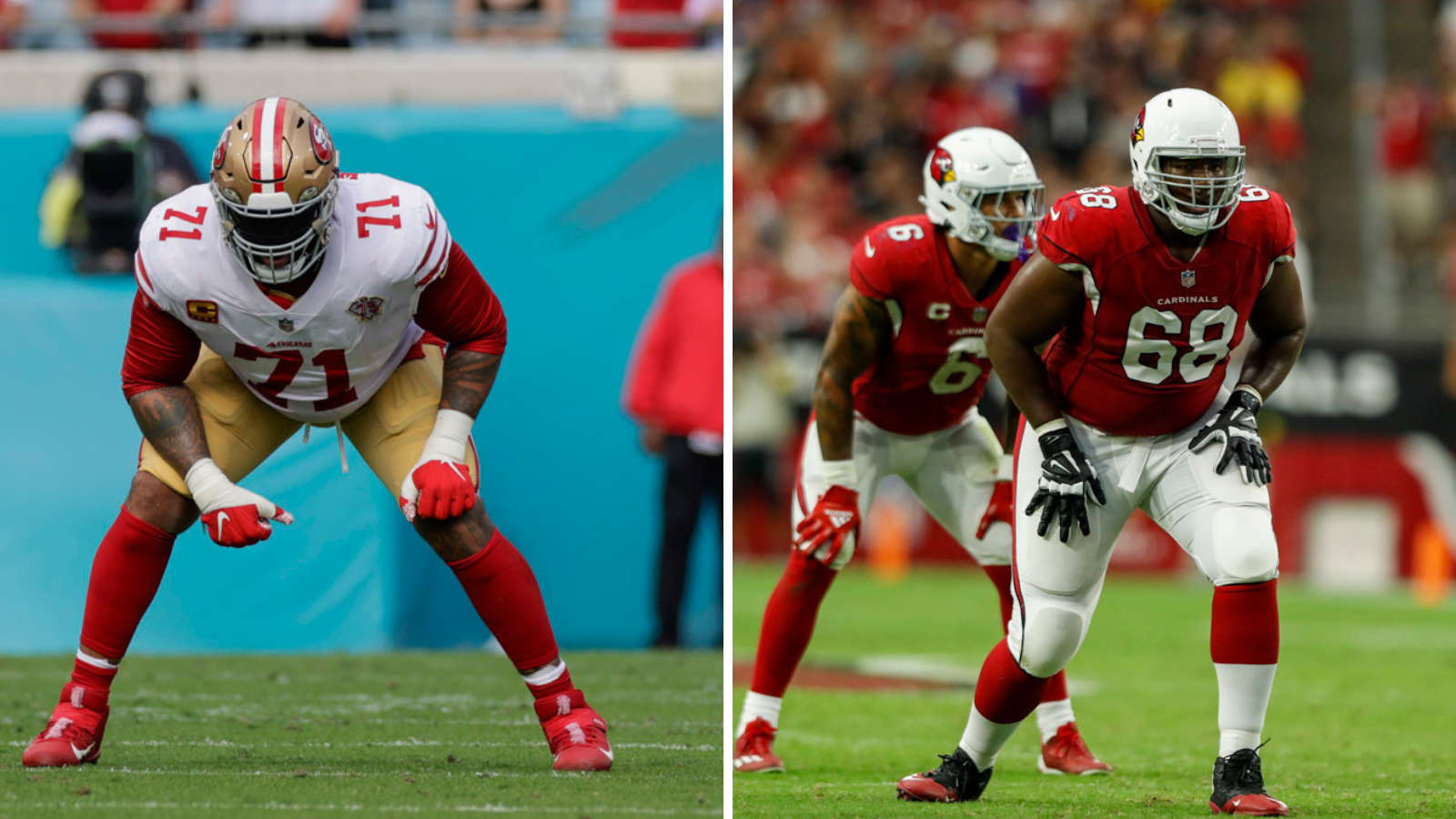
    1. Trent Williams 1. Tristan Wirfs
    2. Tristan Wirfs 2. Kelvin Beachum
    3. Lane Johnson 3. Orlando Brown Jr.
    4. Laremy Tunsil 4. Taylor Moton
    5. Andrew Thomas 5. Rob Havenstein
    6. Rashawn Slater 6. Lane Johnson
    7. Penei Sewell 7. Ryan Ramczyk
    8. Ryan Ramczyk 8. Brian O’Neill
    9. Taylor Moton 9. Jake Matthews
    10. Terron Armstead 10. Braden Smith

    We’ll explain the methodology that generated the Stats list in a little bit, but the biggest discrepancies between the lists came as a result of the ‘Stats’ crew leaning so hard on volume numbers. Only three players from the stats-based list accrued fewer than 2,700 snaps over the last three years (Lane Johnson, Ramczyk, and Braden Smith). By contrast, none of the four players who the scouts ranked fourth through seventh cracked that threshold.

    If we had to re-do this exercise, some percentage of the Total Points weighting that the Stats crew generated would have been repurposed towards per-snap performance in the same metric, to give excellence a bit more credit.

    What the Scouts Thought

    One of the things that Matt and Bryce realized while doing this exercise is that there aren’t as many outstanding tackles in the league as there sometimes are. There are a few potential Hall-of-Fame players at the top of the list, but the rest of the top ten felt a bit less impressive than they’d typically expect. 

    “It’s been harder to find tackles who can play right now coming out of college the way the game has developed right now,” Matt said.

    There are more excellent right tackles right now than left tackles, at least subjectively. Trent Williams tops the list as one of those elite LTs because, as Bryce argues, “he’s a freak, he’s an absolute monster, probably the most athletic guy in space even in his old age.” 

    There was some dissent in the ranks, with Matt arguing in favor of Tristan Wirfs, who he feels stands out more in terms of his performance relative to his peers than Williams at this point, though the greater dissent was with the Stats folks not ranking Williams at all.

    The scout rankings are effectively in three tiers, with the top three players in that HoF range, Laremy Tunsil and Andrew Thomas occupying the next tier (at different points in their careers, of course), and Rashawn Slater and Penei Sewell in the might-be-top-five-in-a-year tier. 

    “I think Sewell took a huge leap this year for the Lions,” Bryce said. “The thing that impresses me the most about Slater is how much control he plays with. He’s very balanced. Rep-in and rep-out he always seems to be in control of the rep.”

    None of those players made the Top 10 on the Stats list, because of either injury history or rookie growing pains. Thomas in particular has improved a lot since his rookie year, when he looked like he was overmatched but now has established himself as one of the most powerful tackles in the NFL. “The turnaround has been incredible,” Bryce said. “The amount of power he plays with is probably Top 3 in the league.”

    Tunsil not making the Stats list due to one season with significant missed time was a stunner to the Scouts. “A blue chipper for sure,” Bryce said. “Still relatively young. Can pass-block with the best of them. Really good run blocker (though the Run Blocking Total Points numbers didn’t agree). Long, athletic, technical. He’s gotta be Top 10.”

    Ryan Ramczyk was similarly rated on both lists, and while he doesn’t stand out as much as the top handful of tackles, he has shown well against top pass rushers like Brian Burns and Maxx Crosby.

    Terron Armstead was a tough rank because of how much time he’s missed, but if we didn’t have to worry about age and injury risk, Armstead could have easily made it higher on the list.

    The Stats List Methodology

    The stats-based ranking includes a three-year recency-weighted average of a player’s results across several different metrics, with the following weights applied to each:

    • 40% Run Blocking Total Points
    • 10% Holding penalty avoidance
    • 5% Positional versatility

    Total Points does as good a job of evaluating offensive line play as anything in our arsenal, so we leveraged that heavily, leaning a bit more into pass blocking than run blocking. These are both season totals, so the fact that teams pass more than they run already builds in some preference for the passing game, but we elected to lean a bit more into that.

    Total Points doesn’t account for penalties (yet), so we wanted to ascribe some value to avoiding holding penalties. Typically linemen aren’t being called for these more than a few times a year, but they’re absolute drive killers.

    And lastly, we wanted to give players credit for playing multiple positions. Most of the top players aren’t moving around because they’re so good at a valuable spot, but being able to provide support at multiple alignments is absolutely a valuable aspect of a player.

    What the Stats Showed

    The volume accumulators who surprised the scouts were Kelvin Beachum, Orlando Brown Jr., Rob Havenstein, Brian O’Neill, and Jake Matthews. Each of them ranked in the top ten in at least one of the pass blocking or run blocking Total Points categories, with the exception of Matthews, who was no worse than 13th in either.

    “Matthews to me is the epitome of the old scouting trope,” Bryce said, explaining why he didn’t make the scouts list. “‘This guy’s gonna be a 10-year NFL vet.’ He’s a solid starter. I could make a case for him in the Top 10, maybe. But I’m not super-inspired.”

    Getting back to our point about volume: We don’t want to focus entirely on play-to-play success, because being on the field is crucial, but a little more balance would have, if nothing else, kept this list more in line with the breakdown of weights for the previous exercises.

    There were also some cases—more so than in previous position discussions—where that third year in the three-year weighted average really skewed things. Brown Jr. had a very productive final year in Baltimore, particularly as a run blocker (he ranked No. 1 in Run Blocking Total Points) which buoyed him to the top rank in that dimension. The Stats guys pointed out that Brown Jr. ranked 8th and 11th in Total Points on a per-play basis over the last two seasons, and thus should have been considered more highly by the Scouts.

    There was a similar story for Havenstein, whose productivity has declined since the Rams’ Super Bowl year.

    The holding penalty category moved the needle for a couple players, including Sewell, who just missed the stats-based list in part because he drew the ire of referees too often. O’Neill, on the other hand, has been called for just three holding penalties in three years.

    One stat that was discussed often on the podcast was Run Behind %, which measures how often a team designs runs behind a lineman. Moton’s run game production (ranked 24th) lags in a way that doesn’t match the eye test, in part because in 2022 the Panthers ran behind him a little more than half as often as they had the year prior.

    Want to hear more discussion and debate? Check out this episode of the podcast:

  • Scouts vs Stats: Debating The Top 10 NFL Receivers

    Scouts vs Stats: Debating The Top 10 NFL Receivers

    For the second straight week, the SIS R&D staff convened on the Off the Charts podcast to talk about their Top 10 NFL players at a position (LISTEN HERE). But to do this, we pit two methodologies against each other: 

    • The “Scouts”, which comes down to the film-based opinions of Matt Manocherian and Bryce Rossler, each of whom has a lot of experience breaking down film and scouting players (Matt having done it for NFL teams).
    • The “Stats”, which involves James Weaver and Alex Vigderman devising a ranking based on a suite of metrics, and having that ranking speak for itself.

    Officially, Sports Info Solutions does not condone the dichotomy between scouting and statistical analysis. Each of them provides data in their own way and should inform our evaluation of a player. 

    When we originally produced the Football Rookie Handbook before transitioning that content to our NFL Draft site, we put the scouting reports and stats side-by-side with the idea that the reader would bounce back and forth between them and leverage both to come to a conclusion about a prospect.

    So, without further ado, let’s get to these ‘Best Receivers in the NFL’ lists and then do a deep dive on why each group ranked as it did.

    Scouts’ Opinion Statistical Analysis
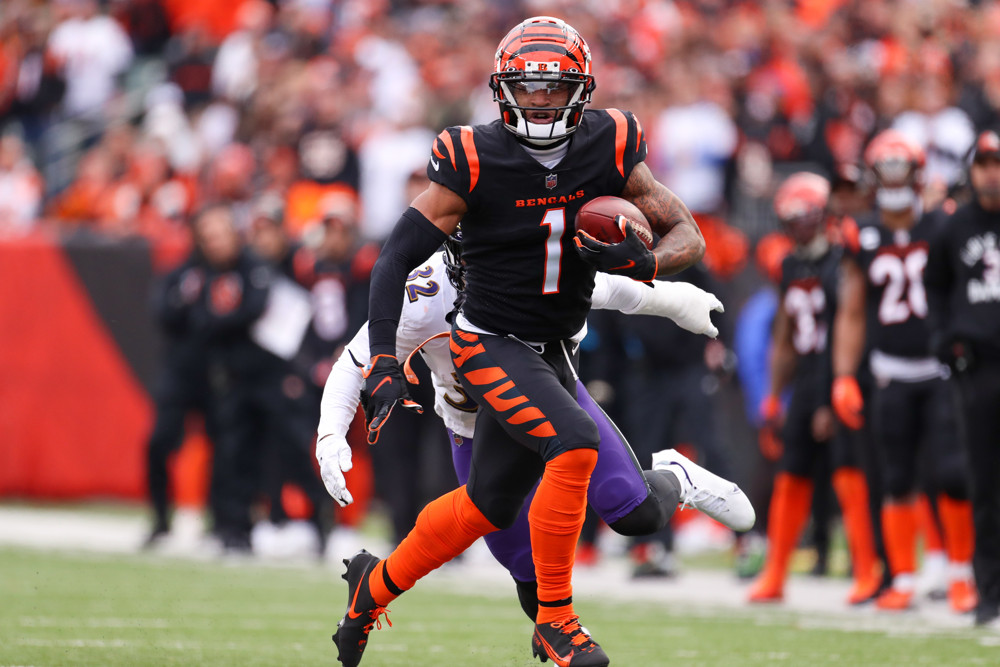
    1. Tyreek Hill 1. Cooper Kupp
    2. Justin Jefferson 2. Davante Adams
    3. Ja’Marr Chase 3. Stefon Diggs
    4. A.J.Brown 4. Justin Jefferson
    5. Davante Adams 5. A.J. Brown
    6. Stefon Diggs 6. Amon-Ra St. Brown
    7. CeeDee Lamb 7. Deebo Samuel
    8. Jaylen Waddle 8. Tyreek Hill
    9. Cooper Kupp 9. CeeDee Lamb
    10. Deebo Samuel 10. DeVonta Smith

    The Stats List Methodology

    The stats-based ranking includes a three-year recency-weighted average of a player’s results across several different metrics, with the following weights applied to each:

    • 10% Run Blocking Total Points
    • 10% Positive% vs. Man Coverage
    • 10% Target Rate Above Expectation
    • 10% On-Target Catch Rate
    • 10% Broken+Missed Tackles per Reception

    We unsurprisingly lean heavily into Receiving Total Points, because it’s a catch-all metric that incorporates many of the other elements we might care about, and is a volume stat, meaning full-time players will be given credit for that.

    Run blocking is included because it is a part of every receiver’s job, but some players (like Cooper Kupp) are more crucial to their team’s overall success because of it. More a feather-in-the-cap type inclusion.

    We wanted to have some measure of success against man coverage, so we included Positive%, which is just asking how often their targets result in positive EPA. This technically includes quarterback play, which isn’t optimal, but the man coverage split is important enough that we kept it in.

    Target Rate Above Expectation takes into account a variety of factors to estimate how likely a player is to earn a target on a play, so it’s not just a matter of getting a lot of screens. You need to get open consistently beyond having a lot of schemed looks to have good results.

    And lastly we included measures of hands and elusiveness, and specifically metrics that we feel are the best evaluators of these specific skills in isolation. 

    What The Scouts Thought

    Matt and Bryce leaned heavily into the value of being disruptive from a game-planning perspective. The best players should be the answer to “Who scares me the most?” 

    Matt would have put Ja’Marr Chase second on the list, specifically noting that he forces the opponent to play 10-on-11 when he’s on the field. (We’ll talk about Chase more in a bit). While at times his production has looked similar to teammate Tee Higgins, that fear factor contributes to Chase’s rank here.

    Matt and Bryce debated the Davante Adams/A.J. Brown rankings as much as any of them, with age starting to contribute a bit to the evaluation of Adams. Brown’s beat-you-by-speed-or-by-physicality skill set won out, but Adams could have won out because of his surprising strength and acrobatics at the catch point.

    Despite an unbelievable 2021 season, Cooper Kupp’s injury-hampered 2022 dropped him on the scouting rankings. This is admittedly a bit of a hedge against his injury risk and age (relative to some of the others on the list), but in half a season in 2022 he still racked up 75 catches, so he’s not slowing down just yet.

    What The Stats Showed

    The stats-based list has 8 out of 10 of the same names, but there are still some pretty stark differences. Kupp at No. 1 is a little surprising because he missed half of his most recent season, but record-setting production in the prior year and a half more than moves the needle. 

    Kupp ranked in the top five in 3-year Receiving Total Points, Run Blocking Total Points, and Target Rate Above Expectation.

    The most alarming discrepancy between the scouts and stats is Chase, who ranked 3rd by the scouts and 28th by the stats. 

    Part of this is Chase missing a handful of games in 2022, which sinks him to 24th in the Receiving Total Points weighted average. But he also didn’t rank higher than 20th in any of the metrics. Beyond that, his 84% On-Target Catch% puts him in the bottom quarter of qualifying receivers.

    The Dolphins receivers also stand out in contrast. Tyreek Hill’s mind-blowing skill set—and how that affects game-planning—is tough to account for statistically, but so is his effect on other players on the offense. His value in stretching the field and drawing attention is probably enough to make the difference between his ranks on these lists.

    Jaylen Waddle ranks 61st on the stats-based list, largely because of problematic usage in his rookie year and some hands issues. 

    In 2021 his average target depth ranked 11th-lowest of 89 receivers with at least 50 targets, and he combined that with a pretty high number of drops for that usage. In 2022 that was a different story. 

    A year from now it won’t be surprising to find him surging up these rankings.