Author: James Weaver

  • SIS College Football Playoff Predictions

    SIS College Football Playoff Predictions

    Who did you beat? How did you beat them? Does this team pass the eye test? All of these questions are a part of answering the much larger one…Does this team stand tall against the others when comparing resumes and deserve a spot in the College Football Playoff?

    *If you are interested in the guts of our model, we have included that at the bottom in the section labeled “The SIS College Football Projection Model.”

    SIS College Football Playoff Predictions

    The SIS college football projections  model powers the SIS playoff predictions. We are able to simulate the remaining season, including conference championships, and tabulate a final standings at the theoretical end of the season. 

    Conference championships are determined by the standings and tiebreakers that each conference utilizes, with some slight substitutes to specific ratings tiebreakers further down the list, instead using our own Total Points ratings.

    Once the final standings are produced, we fill in the 5 automatic bids by ranking each conference winner by the most up to date CFP Rankings and Total Points rating if a team isn’t ranked. From there, we create an at-large pool that includes all 3-loss teams and better from the Big Ten and SEC and 2-loss teams and better from the Big 12, ACC, and independents. The conference championship loser is considered even if that loss pushes them over the edge of the bounds set prior. No other group of 5 teams are considered other than the 1 automatic bid.

    Once the at-large pool is set, the teams are ranked based on the current CFP Rankings and are assigned a probability based on an exponential decay model where the remaining 7 entrants into the playoffs are sampled accordingly. This is to introduce variance when trying to predict what the CFP Committee will ultimately select. 

    At the end of the day, the committee uses their set of criteria to determine the best teams without setting any rigid structure on ranking them. Therefore, it is nearly impossible to objectively capture the logic of the 12 individuals in a modeling capacity. This is why variance is introduced rather than standing firm on a rigid selection structure.

    Additionally, with only one year in the books of the 12 team playoff, the sample size is too small in trying to capture past decisions made by the committee. That is why we didn’t try to model what the 12 teams look like at the end based on the final rankings last year.

    The Lay of the Land Heading Into the Final Week

    Team College Football Playoff Probability
    Ohio State >99%
    Indiana >99%
    Texas A&M >99%
    Georgia >99%
    Texas Tech >99%
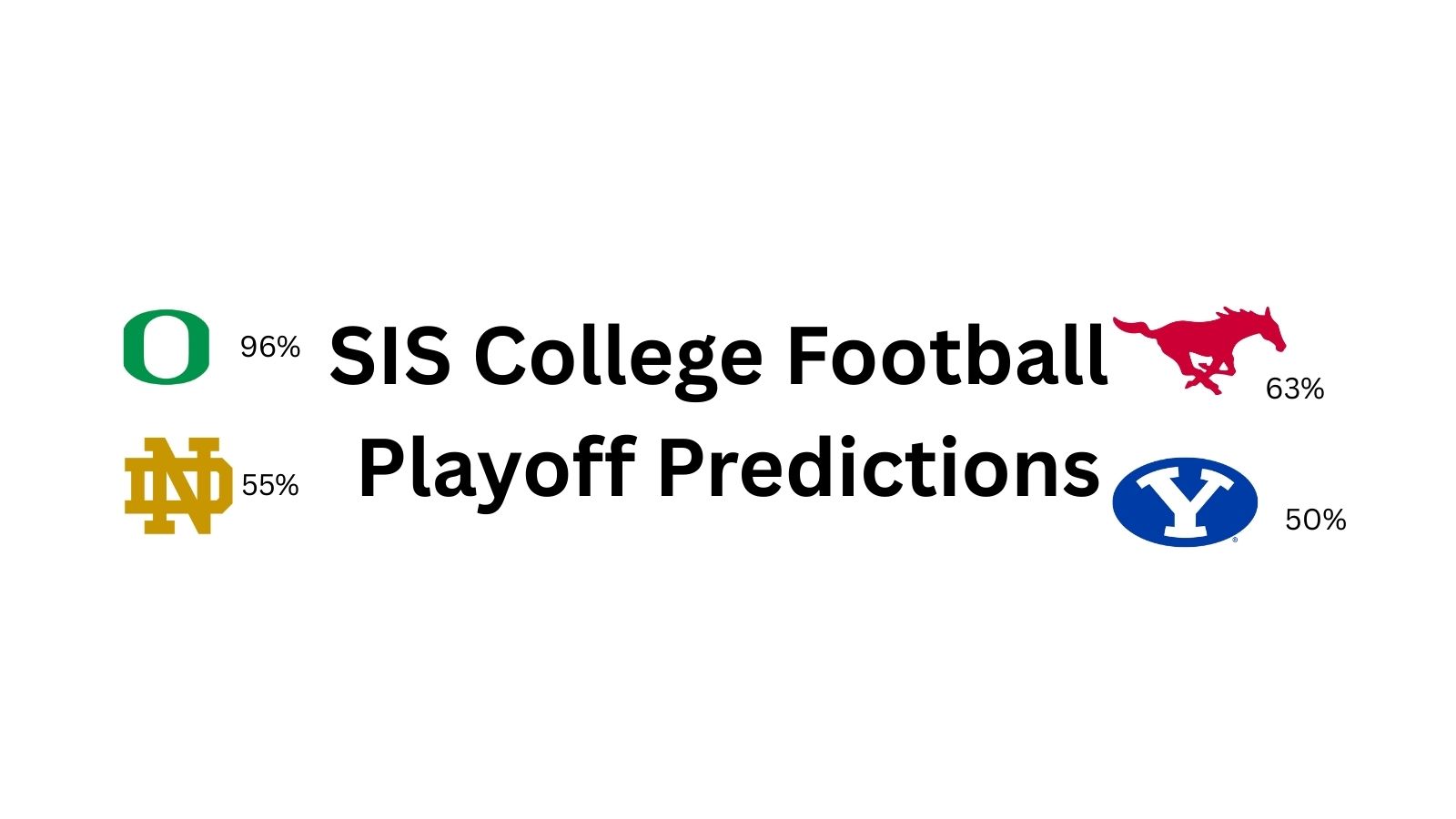
    Oregon 96%
    Ole Miss 91%
    Oklahoma 79%
    Alabama 69%
    North Texas 67%
    SMU 63%
    Notre Dame 55%
    BYU 50%
    Tulane 25%
    Virginia 18%
    Utah 17%
    Michigan 15%
    Vanderbilt 15%
    Pittsburgh 14%
    James Madison 7%
    Miami 6%
    USC 5%
    Duke 3%
    Texas 2%
    Tennessee 2%
    Arizona State 2%
    South Florida, Georgia Tech, San Diego State, Washington, Navy <1%

    Ohio State and Indiana are on a collision course for the Big Ten Championship, with their two quarterbacks Julian Sayin and Fernando Mendoza staring at a Heisman dual in Indianapolis in a couple of weeks. Both of these quarterbacks are 1st and 2nd (Mendoza in 1st) in our Independent Quarterback Rating metric and On-Target Percentage in all of FBS.

    Texas A&M and Georgia will both be tested against their respective rivals this weekend in Texas and Georgia Tech, respectively. Even with a loss these teams find themselves in prime position to make the playoffs, as they both have a greater than 99% chance of making it to the playoff.

    The interest begins with North Texas, as we have them as our highest rated group-of-5 team ahead of Tulane, James Madison, and Navy. Drew Mestemaker has been nothing short of spectacular this season, leading all of FBS in passing yards and is 3rd in IQR. Our model predicts that more often than not this team will be in good shape to take the AAC crown.

    The whirlwind ACC has come down to the wire, but the predictions like SMU to come out on top 63% of the time. A strong performance down the stretch has enticed the predictions to give them the best opportunity out of the ACC. Virginia and Pittsburgh both have a shot, but they will have to get right in some areas to have a legitimate shot at the playoff.

    And then there are the Irish, which the predictions are lower on than most. Coming in at 9th in the CFP Rankings, the Irish need to hope that there aren’t any bid stealers (like BYU or Michigan) that come through and win their conference.

    There is randomness that comes with a group of people coming together to select ‘the best’. However, we can use results on the field and the small set of criteria used to model the outcome of who they believe are the best teams. Besides, the speculation is what makes all of this fun, right?

    The SIS College Football Projection Model

    Our playoff predictions are rooted in our college football projection model, which outputs projected team totals, totals, spreads, and moneylines given various features from our robust data. These features include:

    • Points For and Against Averages
    • Team Snaps per Game For and Against Accounting for Garbage Time
    • Offensive Penalty Yards Average
    • Defensive Penalty Yards Average
    • Home Team Designation
    • Player Projected Snap Counts
    • Passing Total Points Projection
    • Rushing Total Points Projection
    • Receiving Total Points Projection
    • Pass Blocking Total Points Projection
    • Run Blocking Total Points Projection
    • Pass Coverage Total Points Projection
    • Run Defense Total Points Projection
    • Pass Rush Total Points Projection
    • Kicking Total Points Projection

    The team level metrics (Points For and Against Averages through Home Team Designation above) are averages based on the teams past 7 games and are recency weighted. The player level metrics (the remaining items from the list above) are per-snap averages of a player’s last 12 games and are also recency weighted. The projected snaps for a player in the game are then multiplied through a sample from a normal skewed distribution of each individual player’s projected Total Points value, and then aggregated at the team level before being inputted into the model.

    The model is hierarchical, meaning that an output of one is an input into a proceeding one. All of the team based metrics are features for an XGBoost model that outputs a team level metric. The output is then used as an average and sampled via a normal distribution, with the residuals of the fitted model used to calculate the standard deviation of team performance. Once that number is outputted, it is then inputted as a feature into the next XGBoost model with all of the player level metrics, where the output is a team projected score for the game.

    The opposing team’s defensive metrics are inputted as the defensive features of the model to balance the team’s offensive metrics.

    Using Monte Carlo simulations, the games are simulated 1,000 times each. Therefore, a distribution is built with a team’s score, game spread, game total, and game outcome. 

  • State of the Steel Curtain: Paid To Be The Best, Still Getting There

    State of the Steel Curtain: Paid To Be The Best, Still Getting There

    Photo: Mark Alberti/Icon Sportswire

    The Steelers are sitting at a surprise 4-1 and leading the AFC North after the first 6 weeks of the season. This is even more of a surprise when considering the subpar performance on defense the first two weeks, allowing 32 points on 394 yards to the Jets and 31 points (24 on offense) on 395 yards to the Seahawks.

    At a cool $163.1 million, the Steelers defense is the highest paid in the league by $23 million. At that price tag, relinquishing 30 points in back-to-back games to start the season is unacceptable.

    Since then, this unit has been able to rebound and only allowed 14, 21, and 9 points over the last 3 games. After struggling in both the run and pass phases the first two weeks, it has been able to settle in just in time for a stretch in which the team will see a string of potent offenses (leaving a Joe Flacco-led Bengals offense to your imagination).

    How exactly has the defense improved? Will it be sustainable against better competition? Is the Steel Curtain back? Only one of these is a definitive no, but let’s dive into the former two.

    Looking at things from a personnel perspective, the Steelers defense has primarily utilized three groupings. However, the allowed success rates vary drastically.

    Personnel Grouping Usage % Usage Rank Success % Success Rank
    3-3-5 30% 9 57% 31
    2-4-5 29% 14 40% 8
    3-4-4 27% 5 41% 15

    Obviously, the 3-3-5 has yielded the worst results. This the result of the pass defense, which has allowed a 58% success rate in this grouping, the 4th worst in the league. This result is in stark contrast when compared to the 2-4-5 in which the Steelers defense allows a 33% success rate against the pass, which is good for 5th in the league.

    When looking at men in the box, the Steelers may want to consider simplifying things a bit.

    Men in Box Usage % Usage Rank Success % Success Rank
    7-Man 25% 25 34% 1
    Light (< 7) 49% 16 54% 32
    Stacked (> 7) 26% 8 48% 26

    The Steelers have the most success in the league when operating out of a 7-man box. They are the worst and 7th-worst when operating out of a light and stacked box, respectively. This is not lopsided either in regards to the run or the pass, as they are 1st and 5th out of a 7-man box and 2nd- and 4th-worst with a light box in success rate allowed against the run and pass, respectively. Essentially, adding in the extra defensive back has not yielded the dividends that they hoped to get thus far.

    Last season, the Steelers blitzed at a 25% clip, the 15th-highest rate in the league. So far in 2025, they are at a 35% rate which is the 3rd-highest in the league. Not only are they blitzing more, but they are also playing man coverage 39% of the time, the 7th-highest rate.

    Yes, Blitzburgh might be back, but this isn’t the zone blitz that legendary defensive coordinator Dick LeBeau utilized time and time again with the great defenses of the early 2000s. Adding veteran corners Jalen Ramsey and Darius Slay to the fold has allowed the defense to bring the heat and put those guys on islands against guys like Justin Jefferson and Jaxon Smith-Njigba. And Joey Porter Jr. has recently come back from injury and will play into the mix going forward.  

    Overall, the Steelers are pressuring the quarterback at a 39% rate, the 10th-highest in the league. When bringing the blitz, they are getting pressure 55% of the time, good for 6th. When bringing the standard 4-man pass rush, that number drops to 30%, only the 22nd-best.

    So far, T.J. Watt has been solid, but has not produced to his standard Defensive Player of the  Year type numbers. He ranks 18th in pressures with 21 and his 3.5 sacks are tied for 23rd. He has a pressure rate +/- of -2%, meaning that he should be applying pressure more than he is given factors like his alignment, game situation, etc. 

    Watt has struggled with his bull rush move this year. He has used it the most out of his repertoire, but has yet to log a pressure when utilizing it. The speed and speed-to-power rushes are where he has made his hay thus far, logging a total of 10 pressures and 2.5 sacks.

    The pass rusher who has made the most noise this year is Nick Herbig, whose role increased after Alex Highsmith was injured in Week 2. Herbig is 6th in Pass Rush Total Points and is tied for 8th in sacks with 4.5. 

    Herbig’s speed rush is his go-to as he has given it a go on 30 pass snaps and has generated 5 pressures and a sack. After this, he has a pretty robust repertoire where he has attempted 6 other moves at least 10 times this year. The inside cross, cross chop, and rip moves have all generated at least 3 pressures for him this season and an additional 2 sacks. He’s trying the rip much more often, though, so his success rate has not been as good with that move.

    The defensive line is what has been the main issue early on for this unit. With Cam Heyward sitting out the majority of camp and rotating in some young guys like Derrick Harmon (who missed the first two games), Yahya Black, and Logan Lee, the Steelers needed guys like Keeanu Benton and Isaiahh Loudermilk to step up.

    Early on, they did not do that, as both of them had negative Total Points Above Average in Run Defense, the lowest values on the team through the first two weeks. Benton was also a negative in pass rush. Both of these guys were getting blown off the ball and unable to disrupt any runs that came their way. The struggling interior was the main culprit of the vulnerabilities in the run game.

    Derrick Harmon has now made his debut and has contributed 3 tackles for loss. Benton has also improved slightly in the run game, but he has made his presence felt on the pass rush, accounting for 1.5 sacks in the last 3 games.

    Overall, this defense has begun to show flashes of the top unit it intends (and is paid) to be. The growth of Harmon and Black will help fortify the trenches for the likes of Patrick Queen and Payton Wilson to roam free. The returns of Alex Highsmith and Joey Porter Jr. will bolster a pass defense that is looking to attack the quarterback while playing man on the back end. There are plenty of tests to come, the question is: Will this unit be able to cash in?

  • A New Expected Points Model

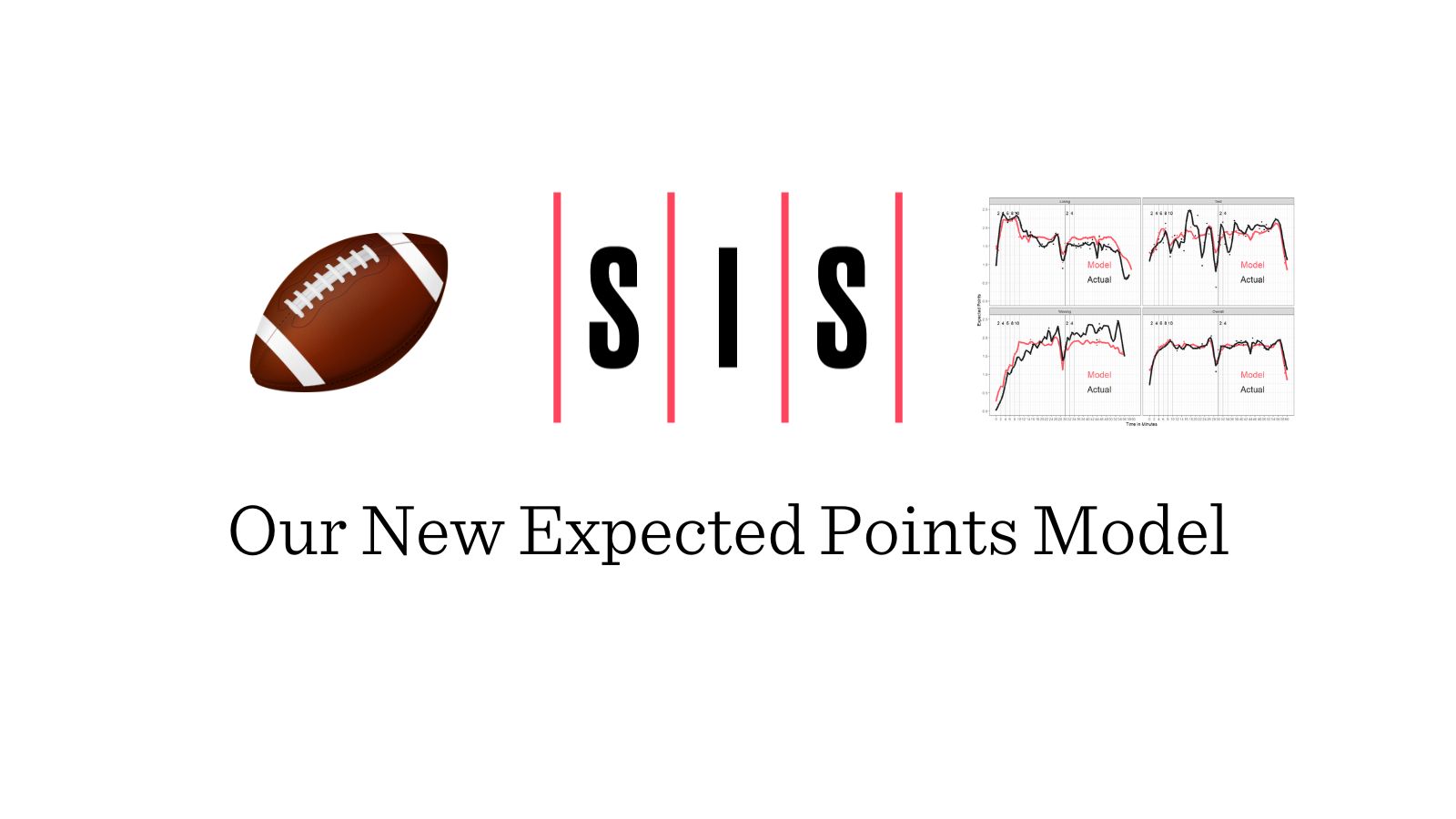
    A New Expected Points Model

    In the dynamic world of football, there are an infinite number of variables to consider when analyzing the game. Expected Points offers a lens through which to view team performance, moving beyond simple yardage gains. By accounting for critical game state variables, Expected Points provides a robust baseline for evaluating how well a team moves (or stops) the ball.

    As an analytics service, we have our own Expected Points model, as many services do, that takes game state variables and quantifies the amount of points a team should score on the play. However, by recently digging into our original model, we found some gaps that we wanted to address when comparing the actual scoring results of the game. Before addressing those changes, let’s dive into how the original model was built.

    The Old Model

    Our previous model used down, to go distance, distance to the end zone, and whether or not the offense is the home team. Usually, the first three listed are the core of all Expected Points models, but we also added the binary “home offense” feature to add a little more context.

    Although effective, we found a phenomenon that our model was less calibrated at the end of halves, especially at the end of games. Also, we found a substantial difference between the actual results and our model in 4th quarters as to whether or not the offensive team was losing. To get to the root cause, we needed to dive deeper into the scoring environment at these times.

    Time Left vs. Scoring Percentage by the End of the Half

    In the graph above, we can see that the rate of scoring decreases as available time in the half decreases in the NFL (time left = 0 on the left side of the chart). Intuitive, yes, but we also see the severity changes given the times. 

    In the 4th quarter, we see scoring begin to decrease sharper at the 15 minute mark (beginning of the 4th quarter) and then decrease more and more sharply at the 2 minute intervals outlined above. 

    This also occurs in the first half and in overtime, but the decline starts much later. The shape in the last 4 minutes of the first half is mostly similar to the shape of the 8-10 minute mark in the second half. This same trend exists on the college side as well.

    NFL Model Calibration – Pre Changes

    In the graph above highlighting the NFL calibration before the changes, there is a distinct gap in expected scoring and actual scoring on average in the 4th quarter in all 3 scoring margin buckets. The model underpredicts scoring when a team is losing (as those teams are often hurrying to catch up), and overpredicts scoring when a team is winning and tied (as those teams are often slowing things down), but tied is a much lesser degree. At the end of the first half, there is a slight deviation inside 4 minutes, but not nearly as severe as the end of the game.

    CFB Model Calibration – Pre Changes

    From a college perspective, the model shows more deviance than the NFL. There is still an effect at the same time ranges that were previously highlighted, but there are bigger gaps in the winning and losing phases. The larger gaps in the college model might be attributed to larger gaps in team quality, which we are not addressing in this model. For the purpose of this re-work, the time and lead theories still apply here.

    After reviewing this data, we concluded that both end of half situations combined with the lead type at the end of the game factor into a pace of play component that has an effect on expected scoring in a game, and that pace takes effect at the end of the first half and in the 4th quarter.

    This is not to be confused with the rating of the teams with the lead component, which we did not want to build into the Expected Points model. This model is centered around the state of the game, factoring in average outcomes against the level at which teams are playing (NFL or college). A model that incorporates team rating is more complex and something that we did not want to attempt at this time. The general trend of “good teams are winning more” is reversed once the lack of time to score comes into play. This specific state of the game factor is what we are trying to account for.

    If we did incorporate team ratings, this would help the college model more given the larger gaps in winning and losing.

    The New Model

    To factor in pace, three new features were created for the model. These new features are described as follows:

    1. Quarter Grouping:
      1. 10 minutes and under to go in the 4th quarter
      2. 2 minutes and under to go in the 2nd quarter
      3. All other time situations
    2. Time Left in the Quarter in Minutes:
      1. Counting down from 10 by 2s (10,8,6,4,2) for the 4th quarter and only a 2 for the 2 minute mark and under in the 2nd quarter 
      2. All other times are labeled as a 15 to be the catch all
    3. Offensive Team Lead Grouping:
      1. Losing (<10 minutes left in the 4th quarter)
      2. Winning (<10 minutes left in the 4th quarter)
      3. Tied (<10 minutes left in the 4th quarter)
      4. All other cases (>10 minutes left in the 4th quarter)

    The time features were engineered this way strictly to look at the specific time periods under consideration. This is a proxy for the pace of play at the end of halves where a team may operate differently when under a time crunch and if they are winning or losing. The goal isn’t to try and find the difference in play at all times of the game, which is why the time groupings were created instead to only capture the times when the game context imposes a pace on a team.

    NFL Model Calibration – Post Changes

    CFB Model Calibration – Post Changes

    The calibrations are now more aligned at the end of halves and follow the pattern of actual scoring. The college model still sees larger disparities in the winning and losing phases with over-predicting scoring when losing and under-predicting scoring when winning. However, the end of game situations are much better. The NFL model adjusted smoothly to the actual results at the end of halves as well, especially in higher expected scoring environments when a team is losing.

    The goal of improving our models incorporating pace at the end of halves given the lead situation has been met here. The calibration to actual scoring on average has improved in both NFL and college. With this improvement at the base level of evaluation, we can now assess EPA metrics more accurately when it comes to teams as well as our Total Points metric to evaluate players.

  • 10 Facts About NFL Schedule Trends

    10 Facts About NFL Schedule Trends

    The 2025 NFL schedule release has come and gone. Fans are flocking to the internet to purchase their tickets, experts are analyzing every aspect to see where teams might take off or find the basement, daily fantasy enthusiasts are stacking their teams with favorable Week 17 matchups, and the players on the teams are griping over their rest or holiday plans.

    On last week’s episode on The Off the Charts Football Podcast, we decided to take a different approach. Using our data, we took a look at long term schedule trends and put our best experts to the test in a game show style episode. 

    Our host, James Weaver, put together 10 questions in regards to long-term schedule trends (mainly going back to 2015) and his R&D team members, Alex Vigderman and Bryce Rossler, made guesses and discussed the answer.

    Here is a recap on how the episode went:

    Question 1: Since 2015, what is the winning percentage of first-year coaches coming off 4 or fewer days of rest?

    The Answer: 23%

    You may refer to this as the “first-year coach Thursday Night death spot”, where the honeymoon phase goes to die for these coaches. Granted, first year coaches only win at a 44% clip overall, but this is considerably lower. The strength of the opponent is not factored in here and perhaps a better exercise would find how often these teams cover the spread.

    Question 2: Since 2018, how many more injuries per game are there on Thursday games compared to Sunday games?

    The Answer: Sunday 7.55, Thursday 7.64, Difference = 0.09 more on Thursday

    As a point of clarification, we noted that injuries with a more severe initial grade (being taken off the field) was only 0.04 higher on Thursdays. So the impact here is negligible.

    Question 3: Since 2015, what is the winning percentage for teams who take a bye coming back from international travel vs. teams that don’t take the bye (excluding Mexico)?

    The Answer: Takes a bye: 21% lower winning percentage (42% vs. 63%)

    Disclaimer: The answer is different from what was discussed in the podcast due to a calculation error. However, this is still a stunner. 45 teams who took the bye won only 42% of the time in their following game, while 19 teams who did not take the bye won 63% of their games!

    As you could imagine, this left our contestants baffled and scrambling for an explanation on how this could be.

    “The Jaguars have been bad, but not that bad.” 

    – Alex on the Jaguars being the primary team coming back from London

    Question 4: Since 2015, what is the winning percentage of road teams playing in Florida in September (non-Florida road teams)?

    The Answer: 57%

    Alex’s guess of 47% stemmed from his belief that the Florida heat would be balanced out by the fact that those teams were generally worse over this stretch of time than the average team. But even with the heat advantage, the Dolphins, Buccaneers, and Jaguars still lost more games in September than won.

    Question 5: Since 2015, what is the winning percentage of road teams playing in Denver in September?

    The Answer: 41%

    If you consider the idea that playing in the altitude early in the season before peak conditioning is difficult, that gets you close to the correct answer. And remember, the Broncos have been a below-.500 team in this span overall.

    Question 6: Since 2015, what is the winning percentage of dome teams playing in cold climates in December? Cold climates include: Maryland, New York, New Jersey, Massachusetts, Illinois, Ohio, Pennsylvania, Missouri, Wisconsin, and Washington

    The Answer: 48%

    A little bit of a shocker here, as neither of our experts thought dome teams would fare that well.

    Question 7: Since 2015, what is the winning percentage of teams playing their 2nd straight home game?

    The Answer: 57%

    Question 8: Since 2015, what is the winning percentage of teams playing their 3rd straight home game?

    The Answer: 67%

    This is a pretty high number, especially when considering that there is no reason for there to be a team quality effect here. However, in 2025, 6 of the 11 teams who have this advantage were playoff teams last year, including the Chiefs, Bills, Ravens, and Lions

    Question 9: Since 2015, what is the winning percentage of teams playing their 2nd straight road game?

    The Answer: 44%

    Question 10: Since 2015, what is the winning percentage of teams playing their 3rd straight road game?

    The Answer: 43%, higher than either of our experts thought.

    For the 3 straight home or road games, there were 166 cases of 3 straight home games and 61 cases of 3 straight road games. This does include games with a bye week in between.

    Be sure to listen to the full episode to hear what else the guys had to say about the schedule.

  • A Comparison of the Top 3 QBs in the 2025 NFL Draft Class

    A Comparison of the Top 3 QBs in the 2025 NFL Draft Class

    Photos: David Rosenblum (left, right), David Buono (middle)/Icon Sportswire

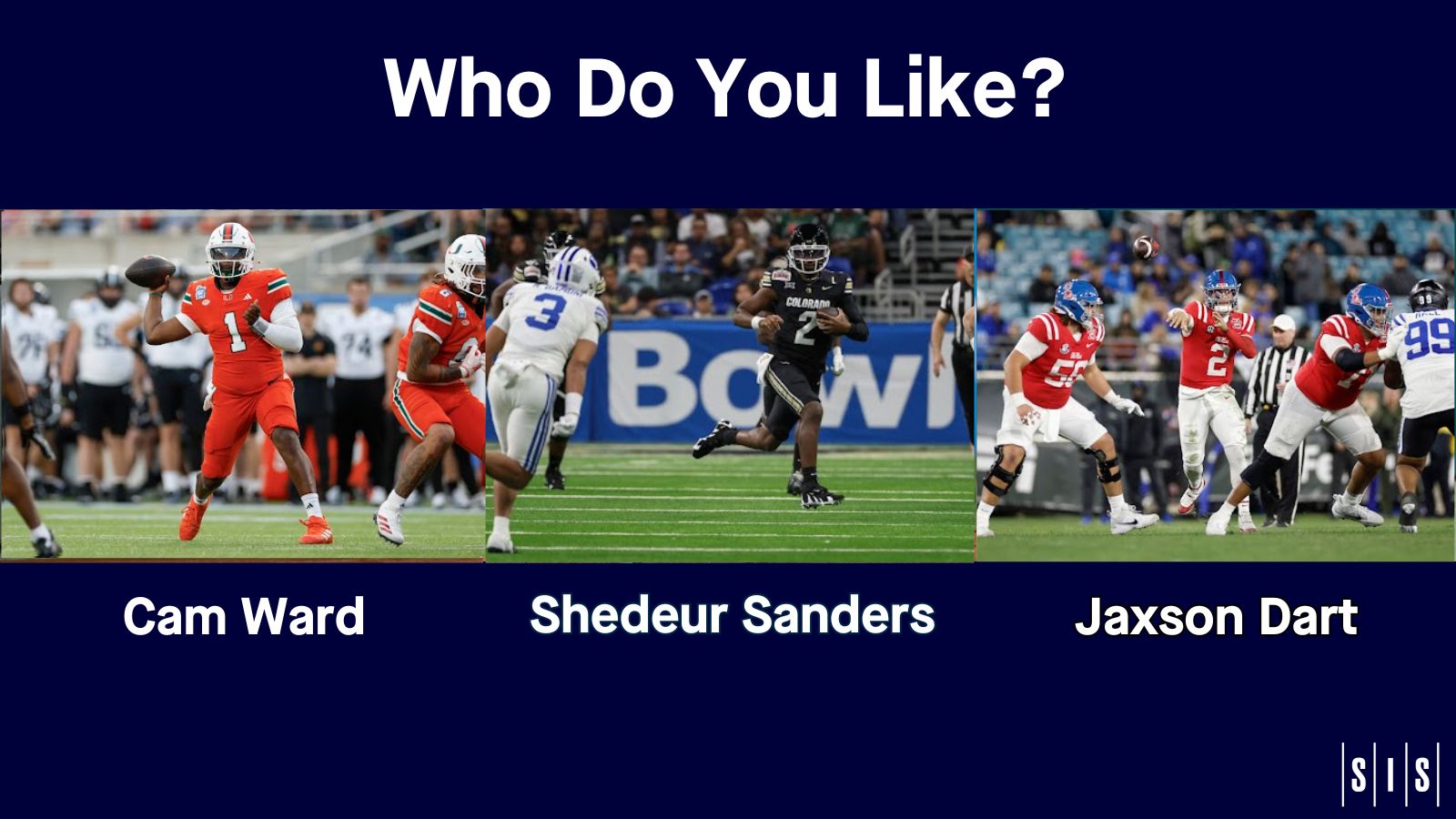
    It will be years until we determine what prospects pan out to be the best of this upcoming class, but that isn’t going to stop us from making predictions. Cam Ward, Shedeur Sanders, and Jaxson Dart are projected to be the top 3 quarterbacks taken in this class, but we don’t know the order in which they’ll be selected.

    What we do know is how they performed in their collegiate careers from a statistical and scouting perspective, and that is what will be used to project them forward. 

    Without a true consensus No. 1 like we have seen in past seasons (e.g. Trevor Lawrence, Joe Burrow), teams will have to look at the fit in their schemes to see which one will have the best potential to succeed. 

    A quick pass RPO scheme? Dart would be the look. 

    A more mobile playmaker? Ward’s your guy. 

    Someone who can avoid pressure and throw on the move? That would be Sanders. 

    Using the reports from our scouting department and the metrics from our charting operation, let’s take a look deeper into how these three compare (and contrast) and why we think each fits as they do.

    Overall

    From a statistical perspective, Dart had the better season in yards per attempt, interceptions, and SIS’ Independent Quarterback Rating (IQR, an SIS quarterback metric that builds on the traditional Passer Rating formula by considering the value of a quarterback independent of results outside of the his control such as dropped passes, dropped interceptions, throwaways, etc.). His success is all the more impressive when considering he also had the higher average depth of target by 2 yards over Ward and almost 4 higher than Sanders.

    Under Pressure and On the Move

    Most of Dart’s success comes from a clean pocket, as his IQR dips significantly when under pressure and falls behind his two counterparts. As Max Nuscher and Brandon Tew highlighted in Dart’s scouting report, When under pressure, he throws too often off his back feet and will put the ball in dangerous places.”

    Sanders is the one who led the pack in IQR when pressured, but Ward led in accuracy with a 73% on-target percentage. Dart’s was a measly 61%, which was 44th in FBS among 116 QBs with 50 attempts under pressure (put another way, he was in the 63rd percentile of those QBs).

    All three of these guys have talent on the move according to our scouts…

    “He does a good job with his accuracy on the move and has shown the ability to make good throws across his body and down the field if can’t get set.”

    – Max and Brandon on Dart


    “He is accurate on the move as long as he can get enough into the throw.”

    – Matt Manocherian on Sanders


    “His ability to extend plays is phenomenal. He scrambles with a pass-first mindset, constantly keeping his eyes downfield on broken plays.”

    – Zach Somma and Vincent Shipe on Ward

    IQR and On-Target Percentage while on the move

    Player IQR On-Target Percentage
    Shedeur Sanders 125.8 78%
    Jaxson Dart 112.9 68%
    Cam Ward 75 71%

    However, Sanders has the advantage while on the move, leading in both IQR and on-target percentage on those passes. Ward is accurate but made too many poor decisions that resulted in 4 interceptions, the most out of the three. Dart’s accuracy was better when on the run than it was while pressured, meaning he can benefit from having better pocket awareness and escaping when able.

    Accuracy on Throws to Different Areas of the Field

    My colleague Chris Lee wrote a great piece projecting accuracy from college to the pros and highlighted the on-target percentages of the quarterbacks of this year’s class. He found that, out of the three, Dart had the best accuracy on intermediate throws at 74%, followed by Sanders at 69% and Ward at 67%. On deep throws, Sanders had the edge at 55% with Dart at 51% and Ward at 46%.

    Ward’s deep ball accuracy being worse than 50% is at the low end of the spectrum. The vast majority of those misses are on overthrows, over 70 percent of them. The trend is less stark on intermediate throws, but he is still more prone to sailing a throw when he misses. According to our scouts, his footwork may be the main culprit.

    “Mechanically, Ward has decent footwork, but relies upon an extra hitch often in order to fully set his feet rather than throwing at the top of his drop consistently. Additionally, he often fails to transfer his weight toward his target, throwing off his back foot or while falling to one side or the other.”

    – Zach and Vincent on Ward’s mechanics

    Inside vs. Outside Throw On-Target Percentage

    When comparing accuracy on inside and outside throws, Dart’s is 7 percentage points higher on outside throws than the next closest in Sanders.

    Player Middle On-Target Percentage Outside On-Target Percentage
    Cam Ward 85% 64%
    Jaxson Dart 82% 80%
    Shedeur Sanders 82% 73%

    Dart shines on a specific sideline throw according to our scouts:

    “He throws with good accuracy throwing to the back shoulder along the sideline where only his receiver can get to it.”

    – Max and Brandon

    Snap to Throw Times

    All of these guys had clean-pocket snap-to-throw times in 2024 ranging between 2.43 and 2.49 seconds.  Ward had the fastest at 2.43 seconds followed by Dart at 2.47 seconds and Sanders at 2.49 seconds. However, the way that they got to those numbers differs considerably.

    In 2023, Cam Ward recorded the fastest clean-pocket snap-to-throw time we have recorded at 2.13 seconds, following up the 8th-fastest in 2022 at 2.20 seconds. The jump this year is certainly notable given that he played in a new offense in Miami. 

    Part of the reason might be a change in his drop type distribution. The number of deep drops he had last season increased to 49 in 2024 from 31 in 2023 while his short drops decreased to 351 in 2024 from 395 in 2023.

    Shedeur had nearly 3 times the amount of deep drops than the other two in 2024. According to our scouts, deep drops can get him into trouble…

    “However, he tends to hold the ball for much too long on deep drops. He doesn’t always trust his reads and will miss some on-schedule opportunities, extending plays unnecessarily and getting himself into trouble.”

    – Matt on Shedeur’s deep drops

    His 3.1 second snap-to-throw time on deep drops is roughly average. However his on-target percentage on deep drops falls to 63.4%, the lowest out of the group.

    Conclusion

    This quarterback class certainly is more up-in-the-air than ones in the past. Ward, Sanders, and Dart each have plenty of strengths and flaws. If one is provided a system that highlights their best traits (the ones we’ve noted here), we think they’ll have a better chance to thrive. There is a long time until we know the answer of who is the best, so set your predictions now and see where they take you.

  • Analytics Scouting Report: Travis Hunter, Wide Receiver

    Analytics Scouting Report: Travis Hunter, Wide Receiver

    Photo: Chris Leduc/Icon Sportswire

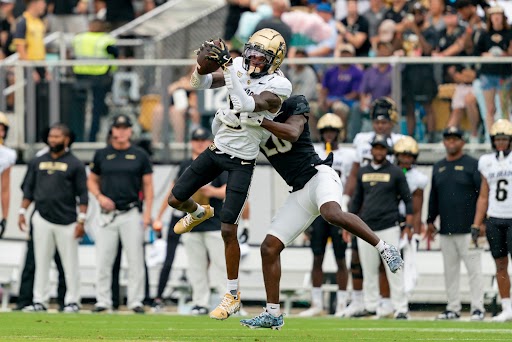
    Usually, the saying goes that players who are athletes but can’t catch the ball play cornerback. Well, a cornerback who won the Chuck Bednarik Award as the nation’s best defender also took home the Fred Biletnikoff Award as the nation’s best receiver (and something else called the Heisman Trophy).

    Travis Hunter is an incredible athlete whose versatility reached unprecedented levels while playing at Jackson State and Colorado. In his final year, Hunter played 700-plus snaps on both offense and defense, rarely coming off the field at any point in time.

    Even though Hunter’s intentions are to play both sides of the ball 100% of the time in the NFL, it will be rather difficult to excel at both on a full-time level. Covering the best receivers in the world AND trying to become one of the best receivers in the world is something nobody has seen and would be a monumental task to achieve. 

    Assuming he will pick one side as primary, our scouting department believes he will provide the most value as a cornerback and scouted him as such. But to capture the full picture of who Hunter is, we wanted to break down his receiving ability from a metrics perspective to find where his best part-time value can be applied on the offensive side of the ball. Playing both sides all the time may be impossible, but there will come opportunities that having one of the freakiest athletes on the field can pay dividends on the scoreboard.

    Here is what his Stats Overview would look like on our draft site if he were coming out as a receiver.

    Stat Value Rank (out of 22) Percentile
    TPTS Per Game 2.5 4 87th
    TPTS RTG Overall 91 9 57th
    TPTS Per Gm Slot 0.9 8 65th
    TPTS Per Gm Wide 1.5 3 87th
    Catchable Catch % 94% 2 96th
    Target% +/- 5.7% 11 57th
    Target Share 27% 8 61st
    Deep Route% 26% 22 0
    Unique Routes 31 17 30th
    YAC Per Rec 5.0 18 26th
    Brk+Miss Tkl Per Rec 0.28 7 74th

    Hunter comes into the draft with some of the surest hands we have seen since we started collecting data in 2016. Hunter’s 2024 ranked 14th in catchable catch percentage at 94% and 19th in on-target catch percentage at 97% among the nearly 1,200 receivers with 75 or more targets in a season since 2016. Not too bad for a corner! 

    From a Total Points perspective, Hunter led the Buffaloes with 31 Receiving Total Points, which was also good for 9th in FBS last season. The majority of this production was from out wide, notching 21 Receiving Total Points on 103 targets compared to only 9 Receiving Total Points on 22 targets from the slot, with the former being good for 6th in FBS last season.

    Travis Hunter’s Top 10 Routes Run

    Route Type Percent of Routes Percent of All Completions
    Curl 32% 25%
    Fade 10% 3%
    Slant 9% 8%
    Dig 9% 16%
    Screen 6% 19%
    Post 5% 3%
    Deep Cross 4% 4%
    Out 4% 5%
    Go/Fly 3% 4%
    Drag 2% 4%

    Hunter’s route tree is pretty concentrated to the curl route, accounting for about one-third of his routes in 2024. Colorado had to get the ball out quick with a below-average pass protection unit, so throwing to your best player on a simple curl route with hands as sure as his proved to be successful. This also could help explain his low rate of running deep routes generally.

    Even though he ran more fades and slants, the percent of his completions are lower than digs and screens. Fades make sense, as that is a lower catch probability than others and can be used as a clearout route for underneath targets. However, the gap between slants and the others is significant given that was his third most common route, but was only targeted 9 times.    

    Given that the majority of his receptions come on the curl route, it isn’t a shock that his yards after catch per reception were so low (18th out of 22 qualifying players SIS scouted this year). His ability to make people miss and break tackles is above average, so hitting him more in space where he can show that athleticism can help his YAC.

    Hunter starred on both sides of the ball in college, both with his production (most Total Points among receivers and corners in FBS in 2024) and pure athleticism. He made plenty of highlight reel catches and has sure hands in got-to-have-it situations. He has room to grow as a receiver and was not fully unleashed at Colorado on that side of the ball. It will be intriguing to see if a team lets him play both sides in some capacity, as there is a path to success with his profile.

  • Running Backs Matter … Again?

    Running Backs Matter … Again?

    Photos: Andy Lewis, Charles Brock/Icon Sportswire

    Year after year, the narrative gets louder and louder about the diminishing value of running backs in today’s NFL. This has led to diminishing contract values across the position as teams have been convinced that granting a running back a second contract with significant value is unadvisable.

    In an attempt to slay the dragon, over the offseason Derrick Henry, Saquon Barkley, Josh Jacobs, Austin Ekeler, Nick Chubb, and Christian McCaffrey met to discuss this suppressed market and potential solutions on fixing this. Not much, other than supporting one another, staying healthy, and increasing the level of play came out of the meeting, but Henry, Barkley, Jacobs, and Ekeler all signed with new teams and were looking to prove their worth elsewhere. 

    On average, running back production does drop with age. This isn’t unique to running backs, but the aging curve is most clear at that position.

    A graph showing the decline in performance of running backs as they age

    From a Total Points perspective, this drop-off is apparent at the start of a running back’s second contract. At the age 26 season, running backs start to dip below 0 in Rusher Points Above Average and never get above the mark throughout the duration of their career. And this doesn’t account at all for the attrition of players leaving the player pool, who do so generally as below-average players.

    On average, the production drops over time. This year, the problem is that we aren’t looking at average at the top of the running back totem pole.

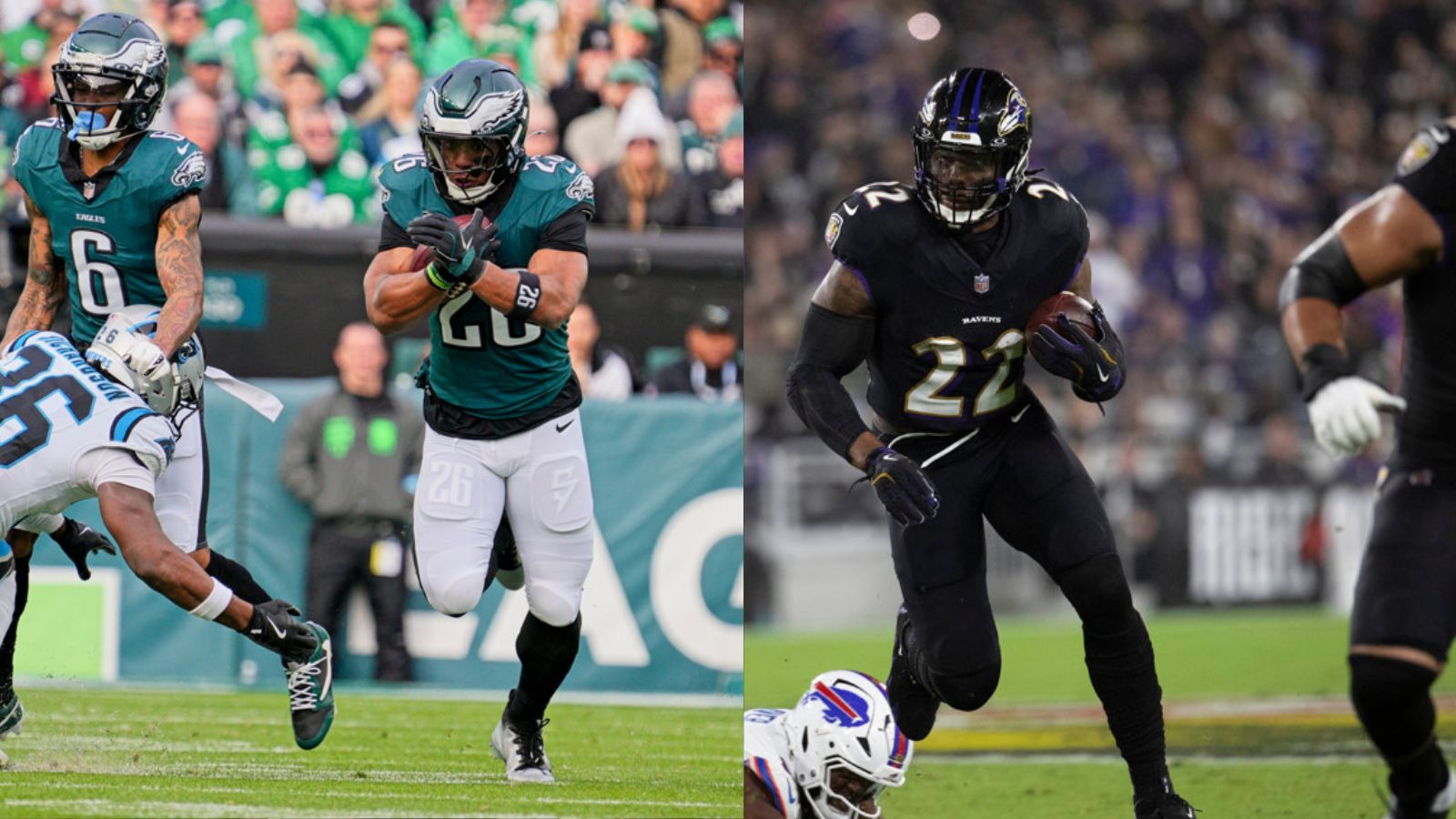
    Barkley (27), Henry (30), and Jacobs (26) are all having career years with Barkley on pace to surpass Eric Dickerson’s rushing record (with an extra game). All three signed with new teams over the offseason and are all focal points to their new offenses, a rare occurrence for free agent running backs.

    How have these three made such a massive impact on their new teams? Let’s take a look!

    An MVP…Running Back?

    Not only has Saquon come to the Eagles and led the league in rushing thus far at 1,623 yards, but he is getting serious consideration for league MVP from the betting market. He currently sits as the second favorite behind only Josh Allen at +550 odds on FanDuel. He is also the odds-on favorite for Offensive Player of the Year at -450.

    At this rate, Barkley is on pace for 2,122 yards, which would break Dickerson’s single season rushing record*. He has the most attempts in the league with 266 and also leads the league in yards per attempt at 6.1 (minimum 100 attempts).

    In regards to Total Points, however, Saquon finds himself sitting at 14th in Rusher Points Above Average. Part of this low total can be attributed to his low broken and missed tackle rate which sits at only 10%, the 5th-lowest among RB’s with 100 carries.

    The other factor contributing is how good his offensive line is. The Eagles O-line has accumulated the most run blocking Total Points and has the 3rd-lowest blown block percentage on run plays.

    Saquon has accumulated outstanding production this season, and a lot of that has to do with the team around him. MVP will be tough with Allen playing as well as he is, but Offensive Player of the Year is well within his grasp.

    King Henry

    Somehow, someway, Derrick Henry might be having the best year of his career at age 30. He is averaging a career-best 5.9 yards per carry and is 3rd in the league in positive run percentage at 50%.

    Additionally, Henry is 1st in Rushing Total Points and has proved his individual value beyond team success. The Ravens are a top 3 team when it comes to Run Blocking Total Points as well, but Henry’s 3.2 yards after contact per attempt and 19% broken and missed tackles per attempt percentage prove that he is still one of the best running backs in the league. He has also carried the ball about twice as often into a heavy box than into a light box, which is a much higher ratio than others we’re talking about.

    He is not on pace to break Dickerson’s record like Saquon is, but he is on pace for an 1,800-yard season which would be the second-most yards gained of his career. He also leads the league with 13 rushing touchdowns and can tie his career high if he can get one per game the rest of the season.

    It is no secret what King Henry is all about, but the mystery remains how he can produce at such a high level at this stage of his career. Hopefully, cutting the signature dreads does not have any biblical effects on his powers.

    Run Pack Run!

    Josh Jacobs has come to Green Bay and provided stability and power to the Packers backfield, producing the 3rd-most rushing yards and 2nd-most Rushing Total Points so far this season. His elusiveness and power are also on display regularly, as he is in the Top 10 in yards after contact per attempt and broken and missed tackle rate.

    The offense he is working in has also contributed to his success. His offensive line has been solid, ranking in the Top 10 in Run Blocking Total Points. The passing attack is also potent enough (Top 10 in EPA) to allow for more light boxes, and the Packers have the best rushing success rate against light boxes this year.

    Jacobs will be an important piece of a potential Super Bowl push for the Packers down the stretch, ensuring balance and power from an offense that still has room to improve.

    Honorable Mentions

    Two other players worth noting:

    James Conner is still humming at age 29 for the Cardinals. He is 7th in Rushing Total Points and is 2nd among running backs with a 25% broken and missed tackle rate.

    David Montgomery, in his age 27 season, has fit into a prominent role with his second team in the Lions. “Knuckles” is tied for the 2nd-most rushing touchdowns and leads the league in positive run percentage.

    Conclusion

    The running-backs-don’t-matter crowd is really having a rough go of things in 2024. The three top rushers are all guys on their second contracts and one of them is looking to break the rushing record. There are plenty more that are making significant impacts on their respective teams as well.

    Can we expect this phenomenon to happen in future years? If there is a focal point to add a talented running back when the rest of the roster is in place, then – as proven this year – there can be success. The fight against father time is always against us, and even more so for running backs. 

    However, they are beginning to fight back.

  • Assessing The NFL Awards Field Using Total Points And IQR

    Assessing The NFL Awards Field Using Total Points And IQR

    Photo: Ian Johnson/Icon Sportswire

    We are (unofficially) halfway through the 2024 NFL season, so why not break down the current state of the awards markets. There are a lot of usual suspects at the top of the odds boards, like Josh Allen for MVP and T.J. Watt for Defensive Player of the Year, and some young stars at the top of the Rookie of the Year markets like Jayden Daniels and Jared Verse.

    Is a player required to reach a threshold of play at this point in the season to have a chance at winning their respective award at season’s end? Are the favorites the locked-in winners through only 8 weeks? Each award is different and can vary on a multitude of factors that are reflected on the voters ballot, such as current production and prior prestige.

    For our attempt, we dive into the world of Total Points and look at the ranking of past winners 8 weeks through the year to box in the set of candidates for 2024. The rank reflects where a player stood in their given award pool through 8 weeks of the regular season. For example, the OPOY rankings reflect an offensive player’s ranking without quarterbacks, as the award usually goes to the most productive non-quarterback (QB winners will be addressed). This attempt tries to answer if there is a certain production threshold required at this point to even have a chance at winning.

    The awards covered are MVP, Offensive Player of the Year, Offensive Rookie of the Year, Defensive Player of the Year, and Defensive Rookie of the Year. Comeback Player of the Year has an additional sentimental layer factored in and cannot be assessed strictly by production.

    Without further ado, let’s dive in!

    Offensive Player of the Year

    Year Player Position Total Points Rank
    2016 Matt Ryan QB 3*
    2017 Todd Gurley RB 22
    2018 Patrick Mahomes QB 1*
    2019 Michael Thomas WR 16
    2020 Derrick Henry RB 3
    2021 Cooper Kupp WR 1
    2022 Justin Jefferson WR 7
    2023 Christian McCaffrey RB 11

    * Overall Offensive Total Points Ranking

    Recent history suggests that the OPOY winner can come from as far down as 16 with the exception of Todd Gurley in 2017, where he made the climb from 22nd to 1st! Matt Ryan and Patrick Mahomes both won while putting up historic offensive numbers at quarterback.

    Players that win this award push historic production numbers at their positions, like Mahomes breaking the passing yards record, Jefferson becoming the youngest player to lead the league in receptions and receiving yards, and Henry eclipsing 2,000 rushing yards in 2020.

    Somehow, someway, Derrick Henry is pushing historic numbers in his age 30 season with 946 rushing yards and 9 touchdowns, both league bests from a rushing standpoint. This has propelled him to the top of the odds board as a +125 favorite.

    From a Total Points perspective, Henry is 2nd among offensive players, trailing James Conner (+40000!) Conner is Top 10 in rushing yards and has scored 4 touchdowns, but his league leading 36 broken and missed tackles propel him to the top of the Total Points leaderboard as he controls the means of production. 

    George Kittle, Najee Harris (2nd in broken and missed tackles himself), and the injured Chris Godwin round out the Top 5.

    Offensive Rookie of the Year

    Year Player Position Total Points Rank
    2016 Dak Prescott QB 1
    2017 Alvin Kamara RB 6
    2018 Saquon Barkley RB 1
    2019 Kyler Murray QB 2
    2020 Justin Herbert QB 2
    2021 Ja’Marr Chase WR 3
    2022 Garrett Wilson WR 8
    2023 C.J. Stroud QB 1

    There is a pretty stark trend for OROY. By this point in the season, a player has to be in the Top 10 and most likely in the Top 3. And given the current OROY Total Points leaderboard, there is a good chance this happens.

    Bo Nix has the top spot with 65 Total Points, followed by Jayden Daniels with 59 and Caleb Williams with 26. This may come as a surprise given Daniels is the clear cut favorite in the market at -400, followed by Williams at +1000 and Nix at +1400.

    From a counting stats perspective, Nix trails Daniels by 206 yards, but bests him by one passing touchdown. On the ground, Daniels has Nix beat by 191 yards and both have four rushing scores.

    The first non-QB on the list is Brock Bowers at 5th with 16 Total Points. Bowers leads the league (not just rookies) with 52 receptions and is just outside the Top 10 with 535 receiving yards.

    Defensive Player of the Year

    Year Player Position Total Points Rank

    (Secondary Included)

    Total Points Rank

    (Secondary Not Included)

    2016 Khalil Mack DE 113 51
    2017 Aaron Donald DT 53 22
    2018 Aaron Donald DT 2 1
    2019 Stephon Gilmore CB 1 NA
    2020 Aaron Donald DT 14 3
    2021 T.J. Watt OLB 24 9
    2022 Nick Bosa DE 34 14
    2023 Myles Garrett DE 7 3

    The Defensive Player of the Year award is a bit tricky to decipher because secondary players can accumulate Total Points at a much higher clip than any of the other positions. This is due to big plays that can happen on 1-on-1 opportunities like interceptions, touchdowns, etc. 

    When looking at the past few seasons, it is apparent that the winner is likely to be a pass rusher with prominent regard from prior performance. All of the players on the list were an All-Pro at one point prior to them winning the award.

    The Top 2 in Total Points on the non-secondary list are Fred Warner and T.J. Watt, respectively. Ironically, Warner has accumulated the majority of his Total Points on pass defense with 26 out of his 36 and leads all linebackers with 2 INTs. Watt is T-7th with 6.5 sacks and is Top 10 in both Pass Rush Total Points and Run Defense Total Points. 

    If Warner doesn’t keep up the Pass Coverage production and Watt continues the pace in both the Pass Rush and in Run Defense, Watt will take control of the top spot soon.

    Defensive Rookie of the Year

    Year Player Position Total Points Rank

    (Secondary Included)

    Total Points Rank (Secondary Not Included)
    2016 Joey Bosa DE 29 12
    2017 Marshon Lattimore CB 1 NA
    2018 Shaq Leonard LB 2 1
    2019 Nick Bosa DE 2 2
    2020 Chase Young DE 12 3
    2021 Micah Parsons DE 3 1
    2022 Sauce Gardner CB 1 NA
    2023 Will Anderson Jr. DE 5 2

    This one fits the best into a clear narrative. Other than 2016, all of the winners were either in the Top 3 in non-secondary Total Points rankings or were at the top of secondary rankings halfway through the year. 

    Projecting that to this season, we see a Top 3 of Jared Verse with 20 Total Points, Edgerrin Cooper with 12, and Laiatu Latu with 12. Verse is the odds on favorite to win at -120 with Latu at +600 next. Cooper is all the way down at +3000. Cooper is T-9th with 9 tackles for loss and is coming off his best game with 9 tackles, 1 tackle for loss, and a forced fumble.

    Including secondary players, Calen Bullock and Kamari Lassiter are at the top of the leaderboard and both have been stalwarts in Houston’s secondary. Lassiter is leading the league in completion percentage allowed at 29%.

    MVP

    Year Player Total Points Rank  SIS Independent Quarterback Rating Rank
    2016 Matt Ryan 3 2
    2017 Tom Brady 1 4
    2018 Patrick Mahomes 1 2
    2019 Lamar Jackson 14 13
    2020 Aaron Rodgers 5 2
    2021 Aaron Rodgers 13 12
    2022 Patrick Mahomes 2 2
    2023 Lamar Jackson 3 3

    Only Lamar Jackson (2019) and Aaron Rodgers (2021) were outside of the Top 10 at this point in the season when they won their MVP awards. All of the others were in the Top 5. Team success also plays a large role in this award, with all of the quarterbacks on the list except Matt Ryan leading their team to the No. 1 seed in the playoffs.

    In addition to Total Points, the last six winners of the MVP award went to the leader in SIS’ Independent Quarterback Rating at the end of the year and all but two (the same two above) were in the Top 4 through Week 8.

    Currently, Lamar is the Total Points leader with 92. The next closest is Joe Burrow with 69 followed by Nix, Mahomes, and Jalen Hurts to round out the Top 5. In IQR, Jackson once again has the lead at 121.8 followed by Josh Allen at 113.6. Sam Darnold, Burrow, and Jared Goff round out the Top 5.

    Josh Allen is the current favorite at +270, which makes sense from an IQR perspective. He does rank only 8th in Total Points and has some ground to make up on Jackson (+310) who is chasing his 3rd MVP and in the driver’s seat metrically.

    Conclusion

    Awards are difficult because the winners are determined by a person’s vote and not a machine, but there are metrics that certainly have high correlation when finding the winner. Total Points and IQR are good at this given we are looking for a range of players at this point in the season rather than pinpointing the winner. Only time will tell with over half of the season yet to go where the awards will land.

  • Study: What’s Going On With Red Zone Offense?

    Study: What’s Going On With Red Zone Offense?

    You have probably heard this before, but once again, scoring in the NFL is down. At a measly 42.3 points per game, the league is scoring at the lowest rate in the last 10 years. This is a (disturbing?) trend that has continued in 2024 after we also saw drops in 2023 (43.5) and 2022 (43.8).

    What is contributing to the dearth of scoring across the league? Some are arguing it is shoddy quarterback play, others are saying play calling has gotten worse, and some are saying defenses have adapted too much and are calling for the banning of basic principles (looking at you, Mel).

    All of these have a legitimate argument to be the winner. However, looking at these items as a whole is very complex and rather difficult to evaluate. What if we could evaluate these hypotheses by shrinking the field by 80 yards and still account for nearly 70% of all scoring plays? Oh wait, we can!

    By looking at red zone success, we can see whether or not the decrease in efficiency is even more stark than that of non-red zone plays. As it turns out, the overall trend correlates heavily with the red zone trend.

    Overall Red Zone vs. Non Red Zone

    Over the past two seasons, red zone success rate decreased year-over-year while non red zone success rate increased. These are the only two seasons where this occurs over the last ten; otherwise, these success rates generally have mirrored each other. 

    Additionally, this season and the previous two are in the bottom four of red zone success, with 2017 coming in as the other season. There is a clear trend in decreasing efficiency in the red zone, one that does not hold true for non red zone plays.

    Why does this trend exist? What has happened in the last few seasons relative to non red zone plays? To help answer, let’s look at the pass/run splits when in the red zone.

    Pass vs. Run

    Generally speaking, it is hard to convince someone in today’s game that running the ball is more efficient than passing. In fact, there isn’t much of an argument, as passes have a success rate of 46.7% while runs are at 40.5% over the past decade. This trend holds on plays in the majority of the field.

    However, the red zone is a different story. Running the ball has resulted in a 46.2% success rate, while passing is only at 42.1%. When there is less space to work with and the field shrinks, gaining yards on the ground becomes the preferred method of advancement.

    Breaking out the splits by season and play type, we see that running in the Red Zone overwhelmingly is the more efficient option, with only two running seasons coming below the top passing season. Additionally, there were more pass plays in all of the seasons, suggesting that play calling can improve at the basic run or pass decision.

    So far in 2024, passing has been the worst it has been in the past decade at a putrid 37.3% success rate. Rushing is at the middle of the pack at roughly 45.3% when strictly looking at rushing seasons.

    The ratio of pass plays to run plays is at 1.15 in 2024, which is in line with what it has been the past few seasons (1.09 in 2023, 1.15 in 2022). More pass plays is not the problem, but rather what is happening on those plays.

    No Fly Zone

    On-Target Throw Percentage

    Season Red Zone On-Target Percentage Non Red Zone On-Target Percentage
    2018 75.0% 79.7%
    2019 73.1% 76.5%
    2020 74.7% 78.9%
    2021 72.7% 77.2%
    2022 71.3% 75.3%
    2023 71.6% 73.9%
    2024 68.5% 78.7%

    Accuracy in the red zone has been on a steady decline since 2016 and has hit the sub 70% marker for the first time through four weeks in 2024. Specifically, crossing routes, flat routes, hook routes, and vertical routes are all at their lowest accuracy levels during this time. Given this applies to multiple routes with different depths, we are unable to point at specific increases or decreases in targeted routes that solely contribute to the drop in percentages, but rather a phenomenon that is happening at a general level in the red zone.

    On the contrary, accuracy on non red zone passes has increased in 2024. So much so that we haven’t seen these levels since 2020. Only the post route is at its lowest level of accuracy in this time period outside of the red zone.

    There is a clear struggle on making tighter throws when it matters most and is the difference between success in the red zone and the other areas of the field. Also, this phenomenon isn’t a result of making more difficult throws in the red zone than in the open field, as this holds when looking at Expected On-Target Percentage as well (which accounts for factors like throw depth and pressure). Defenses are allowing the completions underneath in exchange for not allowing the big play (see 2 High discourse), and are able to tighten in the red zone to prevent points on the board.

    Conclusion

    Overall, success in the red zone has declined faster than success in non red zone situations. Specifically, the accuracy of quarterbacks has dropped off a cliff in the red zone but has increased in non red zone situations. Running the ball leads to more success when the field gets smaller, so teams that can do that successfully have an advantage. 

    Scoring is hard, so it is imperative to take advantage of the opportunities given when in the red zone. Everyone loves the downfield pass, but when it comes down to it, success in the red zone relies on more balance than the rest of the field.

  • 2024 AFC West Preview

    2024 AFC West Preview

    Photo: Peter Joneleit/Icon Sportswire

    The kings of the AFC West have been the Kansas City Chiefs for the past 8 years. By the looks of things, it seems as if the streak will not end this year, as the Chiefs are -230 favorites to win the division again according to DraftKings. The other 3 teams, meanwhile, will all have a different head coach and starting quarterback combination from what they had at the beginning of the year last year. Not ideal.

    To help break it all down, Bryce Rossler and Matt Manocherian debate what we can expect from the defending Super Bowl champion Chiefs and new-look Chargers, Raiders, and Broncos on the Off the Charts Football Podcast.

    Here are a few takeaways from each team on what they discussed.

    Can the Chiefs receiving core improve?

    The defending Super Bowl champions Kansas City Chiefs will look to bring home a third straight Lombardi Trophy. In order to do so, there needs to be improvement from their receiving core. Last year, the Chiefs receivers had the 2nd-highest drop percentage at 7.8% and the 10th-lowest on-target catch percentage at 88.4%. 

    Patrick Mahomes was able to mask the issues last year, but Bryce feels that the passing game will hinge on the Chiefs pass catchers this season.

    “The Chiefs’ offense is a powerhouse, but without a reliable receiving core, Mahomes might struggle to maintain his usual high level of play. We need to see some young players step up this season.”

    Matt agrees, but believes that it’s not about plugging in bigger names, as he states:

    “It’s not just about having big names; it’s about how they fit into the system. The Chiefs have to ensure that their receivers can create separation and make big plays down the field.”

    Even with the poor showing by the receivers, the Chiefs offense still ranked 8th in EPA per pass play last year and 5th in Total Points per play. If the pass catchers play even a fraction better than they did last season, there’s no reason to believe this team can’t go for three in a row.

    Bo Nix leaves a lot to be desired in year one

    It’s a new dawn in Denver, as rookie quarterback Bo Nix will try to take the reins of Sean Payton’s offensive system. Matt, who was a scout for the Saints in the Payton days, knows what it takes to succeed as a quarterback under Payton.

    “The thing that was non-negotiable for him was accuracy. The ability to put the ball where it needed to go. There were quarterbacks that Payton brought in that surprised me. Players like T.J. Yates who weren’t particularly accurate in college. Bo Nix is that for me.”

    Bryce, who wrote our scouting report on Nix, said

     “His willingness is a problem. He leaves a lot of throws on the field past 10 yards. He makes good decisions in the quick game, but they are slow decisions. What is he doing to march the ball down the field other than the dink and dunk they did at Oregon?”

    Last season, Nix had the 3rd-worst average depth of target (6.3 yards) among the 133 FBS quarterbacks with at least 150 pass attempts. Yes, he was successful in the offense, but there wasn’t much on his end trying to push the ball down the field.

    There are some decent weapons there, but everything falls back on Nix, and the guys are concerned that he won’t be able to get the job done in year one.

    The Raiders pass rush will need to mask the deficiencies on the back end of the defense

    Bryce and Matt highlighted the Raiders’ strong pass rush but expressed concerns about the rest of the roster. The Raiders have some standout players who can pressure the quarterback, but other areas of the team might not be as solid.

    Bryce believes the Raiders pass rush as a whole is underrated. He pointed out that they were 2nd in Team Pressures Above Expectation in 2023 and have 3 players in 2024 who were in the Top 20 (Maxx Crosby 2nd, Malcolm Koonce 16th, Christian Wilkins 19th).

    The pass rush is a strength going into 2024, especially if Tyree Wilson can break out in year 2. However, the pass coverage unit is going to be an issue. The Raiders coverage unit was 29th in Pass Coverage Total Points in 2023 and didn’t do much to improve it in the offseason. 

    Said Bryce:

     “This is not a very inspiring back end. Also, the linebackers aren’t good in coverage. They are towards the bottom in Pass Coverage Total Points as well.”

    The pass rush will need to be elite for the Raiders defense to be a formidable stop unit, as the rest of the defensive roster leaves a lot to be desired.

    Justin Herbert will be limited with Greg Roman as his OC…or will he?

    Matt and Bryce disagreed on the outlook of the Chargers offense under Greg Roman, citing how good of a fit he is for Justin Herbert. 

    Bryce went the negative route 

    “I feel bad for Justin Herbert because the offensive line is trending in the right direction and now you have nothing at receiver and you also have Greg Roman as your offensive coordinator.”

    Matt disagreed and likes the perspective of Roman taking over this offense. 

    “I really like this for Justin Herbert. Harbaugh and Roman made Kaepernick look good back in the day. These two are capable of putting a good offense together. 

    I believe the right way to build an organization is with the quarterback and the guys up front. I think the Chargers are acknowledging they aren’t a Super Bowl contender this year, but they are interested in making the playoffs. They aren’t interested in having the most productive Justin Herbert, but the most efficient Justin Herbert.” 

    Bryce disagreed, as he believes Kaepernick and Lamar Jackson (who Roman coached) are much different quarterbacks then compared to Herbert, and he believes the Roman scheme won’t fit Herbert well.

    We’ll know which one was right in a few months.

    Conclusion

    The SIS Betting Model has spoken when it comes to the win totals for these teams. 

    The model has the Chiefs at 10 wins, while the market has them at 11.5. With the injury risk and depth issues, the under is intriguing to the guys.

    The Raiders are projected at 9.8 wins, well above the 6.5 line in the market. Matt buys the over because they are gonna be in close games and believes that Minshew is a quarterback that can win games.

    The Chargers are projected to finish 3rd at 8.7 wins, a mere 0.2 wins higher than the line. The Broncos are projected last at 4.7, 0.8 less than the line. Generally, the guys agree with the model and see more negative outcomes for the Broncos than positive ones.

    Check out the entire podcast to get a more in-depth analysis of each team.