Author: James Weaver

  • Study: Combine Measurements and Total Points – Do they Correlate?

    Study: Combine Measurements and Total Points – Do they Correlate?

    After a week of workouts, drills, and interviews, combine week has come to an end and NFL teams are now deep in draft evaluation. Some players have had record-setting performances, while others might have more work to do at their Pro Day to shoot their name up big boards. The data is now there for everyone to analyze, but the question is: 

    What do these combine numbers actually mean?

    There has been a lot of discussion over the past few years as to whether or not combine results translate to a better performance on the field. Does the height, weight, arm length, hand size, 40-yard dash time, number of 225-lb. bench presses, vertical jump measurement, broad jump measurement, 20-yard shuttle run time, or 3-cone drill time of a player truly predict immediate future performance for a 1st- or 2nd-year player in the NFL?

    There have been studies done in the past (here and here) in finding correlations from combine  measurements to draft order, salary, and player performance. In regards to the latter, player performance was measured in total yards, yards in rates, and quarterback rating.

    At SIS, we can use our Total Points metric as the proxy to player performance to find correlations to combine measurements. For the purpose of this article, combine data from players who participated between 2016-2020 was collected and compared to the respective player’s first two-year Total Points sum. Correlations were computed between both Total Points and categorical Total Points (ex. Passing Total Points) based on positions to find any signal for a specific skill. 

    Without any further ado, let’s dive into the numbers…

    Quarterbacks

    When it comes to quarterbacks, it is not a big surprise that Total Points and Passing Total Points are very similar. The main skill the quarterback has to perform is throwing the football, so seeing that these two align for most measurements make sense. 

    Three measurements that stand out from the rest in terms of correlating to Total Points. The broad jump takes the cake as the highest correlated at 0.39 (0.35 Pasing Total Points), followed by the three cone drill at 0.33 (faster times lead to more Total Points) and the 40-yard dash at 0.23.

    Contradicting some of the discourse about quarterback hand-size, this measurement has a 0 correlation to Passer Points. Turns out Kenny Pickett might have a chance after all!

    Running Backs

    When looking strictly at Rushing Total Points, there are three measurements that clear the 0.2 correlation threshold. Weight, vertical jump, and broad jump measurements correlate the most to Rushing Total Points. 

    This suggests that explosiveness and leg strength translate well to the next level and can be a potential indicator of running back performance. Across the board, being bigger and faster correlates with success.

    When it comes to Receiving Total Points, the 40-yard dash and the broad jump correlate the most by far. This suggests that the ‘explosive pass-catcher out of the backfield’ moniker truly does exist.

    Looking at Pass Block Total Points for running backs, the three cone drill and vertical jump seem to predict some success at the next level.

    Wide Receiver

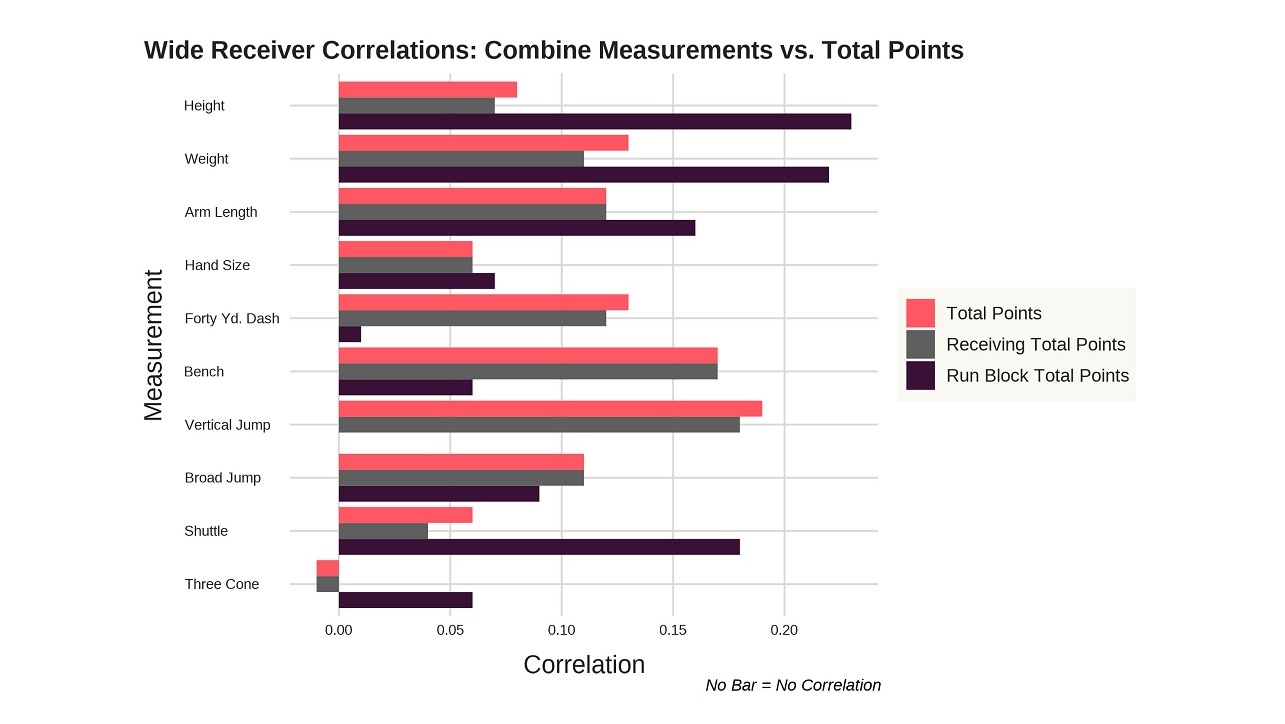
    The vertical jump and bench reps stand out as the two highest correlated measurements to Receiving Total Points. Even though the average Run Blocking Total Points value among receivers is small, height, weight, arm length, and the shuttle run correlate the most out of these measurements when projecting success.

    No measurements for Receiving Total Points reach the 0.2 threshold. One point to note is that pass blocking correlations in height and weight for receivers are much higher than those for the running backs.

    Offensive Linemen

    Pass Blocking and Run Blocking Total Points correlations for offensive linemen are similar for each measurement, with the 40-yard dash, arm length, and height having some difference between the two. Surprisingly, height and arm length seem to correlate more with run blocking than pass blocking.

    Overall, the 40-yard dash, three cone drill, vertical jump, and broad jump are the highest correlations when it comes to offensive line play. Bench reps have a low correlation, once again showing that leg strength and explosiveness predict higher success.

    Tight Ends

    For tight ends, the 40-yard dash and the broad jump have high correlations to Total Points, as they both nearly reach the 0.4 correlation threshold. The vertical jump does not fall that far behind either.

    The difference in broad jump, shuttle times, and three cone times between tight ends and receivers in Receiving Total Points is interesting. The get-off speed for a tight end might result in higher Total Points, which can be measured in explosiveness from the legs.

    Defensive Linemen

    Moving along to defense, we start with the defensive line. All of the speed measurements, height, weight, vertical jump, and broad jump correlate well to Pass Rush Total Points. This is very different when compared to Run Defense Total Points, as the higher the weight and more bench reps, the higher the Total Points value.

    All in all, an athletic freak on the defensive line when getting to the passer seems to be a good thing to have. On run defense, a strongly built defensive linemen is the key for success. The contrast between these two skill sets in one position group is the biggest from this analysis. 

    Linebackers

    Once again, for the linebacker position, athletic freaks tend to have the most success. All but 3 measurements reach the 0.2 correlation threshold for Pass Rush Total Points. After being significant for defensive linemen, the shuttle run and three cone times correlate to 0 and below, respectively, for linebackers. From a run defense perspective, the vertical jump and 40-yard dash times show the strongest correlations. Finally, both the 40-yard dash and shuttle runs are where the highest correlations are for linebacker pass coverage.

    Defensive Backs

    There are no correlations for Pass Coverage Total Points that reach the 0.2 threshold for defensive backs. The 40-yard dash and arm length are the two highest correlations for Pass Coverage Total Points. On run defense, only the 40-yard dash reached the 0.2 threshold. 

    Conclusion

    Overall, there are no correlations that exceed the 0.4 threshold across any position, measurement, and Total Points category. This is consistent with the previous studies that suggest there is no strong correlation between measurements and skill sets. 

    Two measurements that seem to find themselves at the top of most positions were the vertical jump and broad jump. 

    A strong and explosive lower body tends to predict more success, generally speaking, when looking at Total Points. On defense, speed is the key, as 40-yard dash, three cone, and shuttle times were some of the highest correlated measurements for all 3 defensive skills.

    All in all, don’t be fooled by the insane numbers seen at the combine. Yes, some are more meaningful than others, but there is a lot more that factors into having success in the NFL.

  • Which Steelers QB will start Week 1?

    Which Steelers QB will start Week 1?

    After an illustrious 18-year career as the starting quarterback of the Pittsburgh Steelers, Ben Roethlisberger decided to hang up his cleats and move on to bigger and better things. After his elbow surgery in 2019, everyone could tell that he was not the same “Killer B” as he once was.

    In his final year, Roethlisberger was 40th in Total Points Earned Per Pass, 36th in Positive Play Percentage, and 30th in Independent Quarterback Rating (IQR) out of 42 quarterbacks who had more than 100 pass attempts in the regular season. 

    As a going-away gift, he has left his predecessor with a low floor to improve the Steelers offense. The question is will that predecessor be Mason Rudolph, Kenny Pickett, or Mitch Trubisky?

    Mason Rudolph

    The 26 year old Mason Rudolph has had four seasons in the Steelers offense to prove that he is more than a backup QB. In 2019 after Roethisberger’s elbow surgery, Rudolph was given the keys to the offense full-time with 10 appearances. Even though he was able to keep the Steelers in the playoff hunt, he was unable to take the offense to the next level and performed as a below-average QB statistically.

    Mason Rudolph

    Metric 2019 (Rk)
    Adjusted Net Yards/Attempt 5.0 (35)
    On-Target % 72.9% (35)
    Independent QB Rating (IQR) 91.8 (25)
    Total Points Earned Per 60 Plays 3.4 (34)
    Positive Pass % 41.9% (35)
    INT % 3.2% (32)

    This season is best remembered for being carried off the field against the Ravens with his facemask sawed off and was involved in an incident with Myles Garrett on the field.

    In 2021, he was given another opportunity with Roethlisberger out due to COVID against the Lions at home. Rudolph was unable to pull out the win in a 16-16 tie against a team with the second worst record in the league. He went 30-50 with 242 yards, 1 TD, and 1 INT. 

    With the additions of other QBs via free agency and the NFL Draft, it seems as though time has expired for Rudolph’s opportunity.

    Kenny Pickett

    In 2021, Kenny Pickett was able to take full advantage of the extra year of eligibility due to COVID. Pickett’s 334 completions, 4,319 passing yards, and 42 TD were all good for Top 10 in the FBS and single season records at Pitt, resulting in an invitation to New York City as a Heisman Finalist. 

    Pickett then cemented his legacy by leading the Pittsburgh Panthers to their first ACC Championship since joining the conference in 2011 and a Peach Bowl appearance. All of his success in his final season as a Panther resulted in him being the 20th overall pick in the NFL Draft by the Steelers. 

    Requiring only a 25-step walk across the UPMC Rooney Sports Complex to his new home, how big of a step will Pickett actually have to take to win the starting job? 

    Kenny Pickett

    Metric 2019 (Rk) 2020 (Rk) 2021 (Rk)
    Adjusted Net Yards/Attempt 5.5 (125) 6.1 (72) 8.8 (10) 
    On-Target % 76.6% (28)  80.0% (14) 78.1% (23)
    Independent QB Rating (IQR) 92.3 (95) 94.7 (66) 125.6 (7)
    Total Points Earned Per 60 Plays 13.3 (58) 11.5 (51) 15.4 (19)
    Positive Pass % 40.6% (114) 44.2% (68) 50.6% (10)
    INT % 1.9% (53) 2.7% (76) 1.4% (18)

    Over his final 3 seasons at Pitt, Pickett was able to improve in many key areas that led to the Panthers success offensively. Importantly, Pickett was able to reduce his Interception Percentage from 2020 to 2021, which he will need to keep low if he wants to win the starting job in Week 1.

    Pickett was able to produce these numbers with Pitt offensive coordinator Mark Whipple’s pro-style offense, where the Panthers ran 12 Personnel 38% of the time. His familiarity with a pro-style offense as well as Steelers offensive coordinator Matt Canada (who recruited Pickett at Pitt) is a positive when factoring in the time required to learn the Steelers offense. 

    If Pickett is able to build on his knowledge of the offense, continue to limit turnovers, and improve his accuracy in the Steelers offensive scheme, he will certainly be on the fast track to the starting job in 2022.

    Mitch Trubisky

    In the 2017 NFL Draft, the Chicago Bears traded up to the 2nd overall pick to draft Mitch Trubisky. At the time, Trubisky was considered the top QB prospect in the draft after a prolific career at North Carolina. His best season with the Bears was in 2018, where he amassed 289 completions, 3,223 yards, and 24 TD. This performance helped earn the Bears an NFC North crown. 

    Unfortunately, he was unable to regain the success that he had in 2018 and only led the Bears to one more Wild Card round appearance.

    Mitch Trubisky

    Metric 2018 (Rk) 2019 (Rk) 2020 (Rk)
    Adjusted Net Yards/Attempt 6.6 (16) 5.0 (36) 6.0 (27)
    On-Target % 75.3% (33) 75.0% (24) 75.0% (34)
    Independent QB Rating (IQR) 95.2 (24) 81.2 (38) 87.4 (32)
    Total Points Earned Per 60 Plays 5.0 (31) 2.1 (39) -1.4 (40)
    Positive Pass % 49.8% (14) 43.1% (30) 53.0% (6)
    INT % 2.8% (29) 1.9% (19) 2.7% (32)

    Even though the Bears made the playoffs in 2020, Trubisky was again below-average in his final season as the starter. He was 40th in WAR out of 44 QBs with a minimum 100 passing attempts in the regular season. Additionally, his Interception Percentage spiked back up to 2.7%. 

    Unable to take the Bears offense to the next level, the Bears declined his 5th-year option and Trubisky then signed with the Bills to be their backup.

    In Buffalo, Trubisky only played in 4 games behind MVP candidate Josh Allen. However, he was able to sit and learn in an offense that resulted in 4,284 Net Passing Yards, a 47.5% Positive Pass rate, and 11.5 Total Points Per 60 Plays, all good for Top 10 in the NFL.

    Trubisky’s experience and opportunity to reset behind a successful offense may prove to be the main factor that can land him the starting job Week 1.

    Conclusion

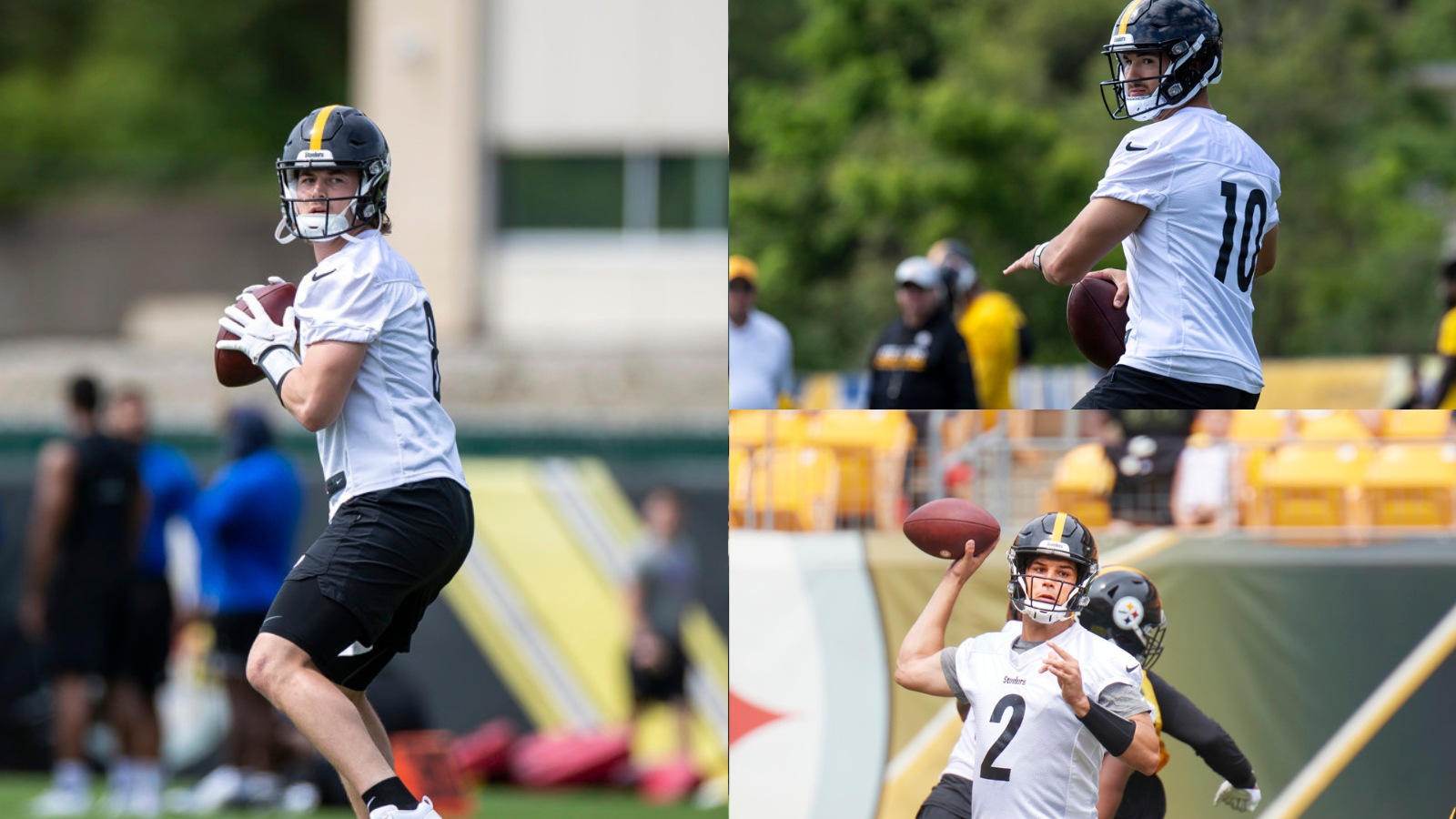
    In OTAs, it was apparent that Trubisky was taking the majority of first team reps, followed by Rudolph then Pickett. When it comes to rookies, Tomlin has historically made every one of them earn their stripes by putting in the grunt work in the offseason. Therefore, Pickett taking the third-team reps comes as no surprise early on. 

    Expect this to be a true battle between Trubisky and Pickett for the starting job in the offseason. Pickett coming in at the age of 24 and running a pro-style system already puts him in a good spot to compete for the job with the experienced Trubisky. 

    Whichever QB can make the least amount of mistakes and make the correct decisions in Matt Canada’s RPO/Play-Action scheme will win the job Week 1.