Last week we explored the idea of evaluating different pass rush units like different lines in hockey or lineups in basketball. Leveraging the same participation data at SIS’s disposal, we can use similar analysis in evaluating the NFL’s most dynamic duos at each position.
To evaluate each pair, we will use SIS’s player value metric Total Points for each player while both are on the field and add them together. Total Points is used because it allows us to evaluate individual players on a play-by-play level even if they did not register a traditional stat in the box score. Total Points for this analysis will also be scaled to Per 60 Plays, which approximates per game value.
It is important to remember that the numbers here are not representing each player’s full season value. They are only representing his value on plays in which he is on the field with the other member of the duo. This is done to truly evaluate dynamic duos that play to each other’s strengths and elevate each other and their teams.
Top Wide Receiver Duos
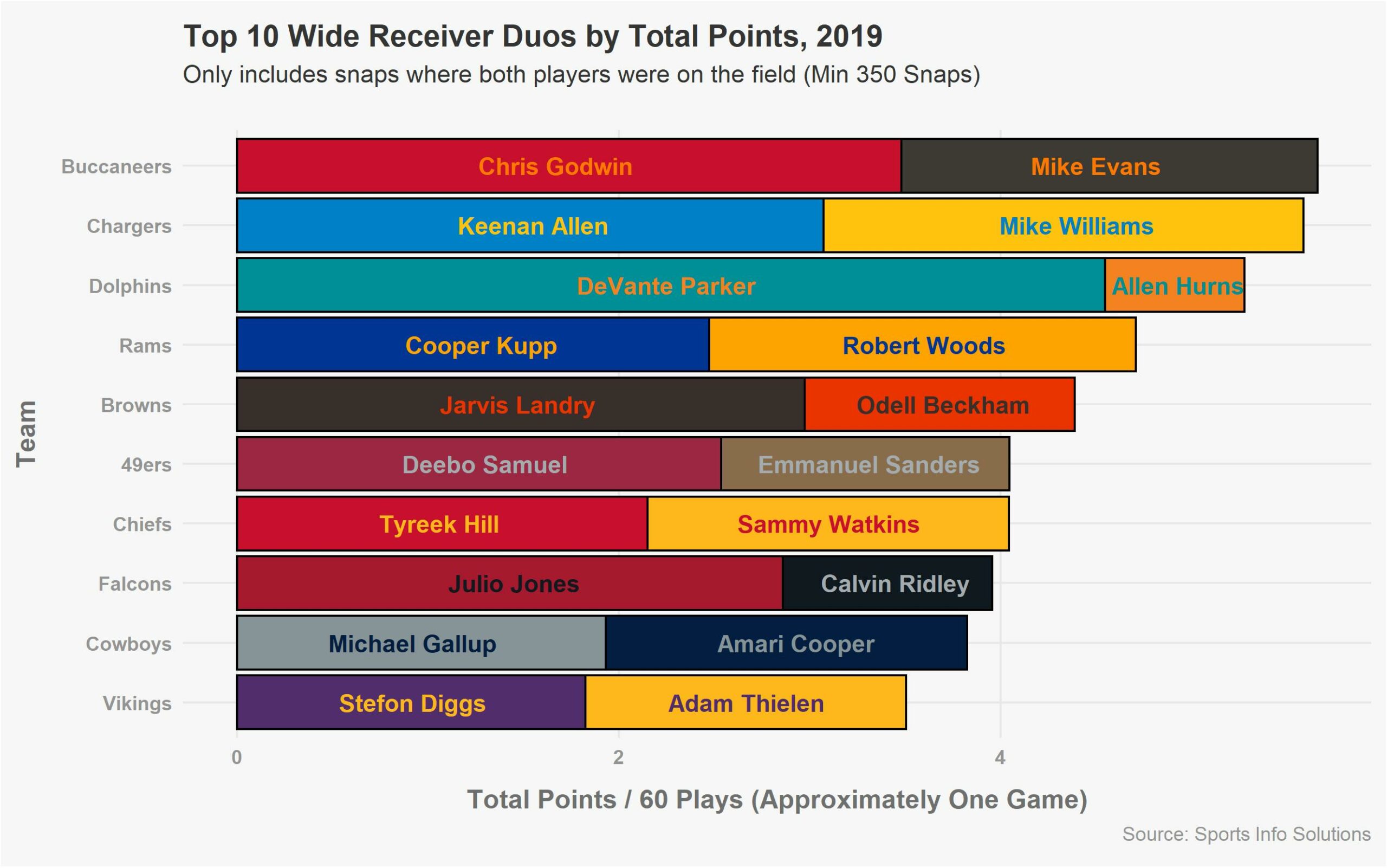
Wide receiver is one of the positions where the argument over duos is generally most prevalent. In 2019, the race for the best duo was tight, but the Buccaneers combo of Mike Evans and Chris Godwin edged out the Chargers’ Mike Williams and Keenan Allen. In third place, were the surprising duo of Davante Parker and Allen Hurns—though Parker provided most of the value when they were on the field together.
Top Backfield Duos
Many of the duos on this list are running back/fullback combos, since most teams don’t use multi-running back sets that often. One exception is the top spot Chargers combo of Austin Ekeler and Melvin Gordon, where Ekeler provided elite level value. Other top combos include some of the best fullbacks in the game, such as the third ranked combo of Raheem Mostart and Kyle Juszczyk.
Top Tight End Duos
The Bay Area was full of elite tight end play last season. One of the best in the game, George Kittle, teamed with Levine Toilolo to give the 49ers the top duo. The Raiders duo of Darren Waller and Foster Moreau ranked second, and will now take their talents to Las Vegas.
Top Interior Defensive Line Duos
Aaron Donald has been the top interior defensive lineman in Total Points each of the four years we have on record. So, it should surprise no one that he and a teammate, in this case Michael Brokers, ranked as the top duo. What might be more surprising is the strong showing from the second ranked duo, the Giants Dalvin Tomlinson and rookie Dexter Lawrence. Other impressive pairs include the Buccaneers Vita Vea and Ndamukong Suh and the Packers Kenny Clark and Dean Lowry.
Top Edge Rusher Duos
Last season T.J. Watt led all defenders in Total Points Saved, with 77. When he was on the field with fellow edge rusher Bud Dupree, the Steelers duo was by far the best in the NFL, saving an entire point more per 60 plays than any other edge duo. The Bosa brothers helped their duos rank second and third, Joey pairing with Melvin Ingram and Nick pairing with Arik Armstead. The Smith brothers paired up to save over six points per 60 plays when they were both on the field, giving the Packers defense the fourth rated edge duo to go along with the fourth rated interior defensive line duo.
Top Cornerback Duos
Having a pair of lock down corners can cause havoc for opposing quarterbacks, and these top duos did just that in 2019. The Patriots defense was a historic pace for much of last season, and a lot of it had to do with their secondary play. Stephon Gilmore won Defensive Player of the year and when he was on the field with Jonathan Jones, they paired to give the Patriots the best cornerback duo in the league.
Top Safety Duos
Great safety duos probably depend on each other more so than any other position. Where other positions can pair two similar players together and combine for a great duo, safety duos rely on a combination of skills that need to complement each other. Though it is possible for two extremely versatile safeties to interchange roles, the best recent example of complementary players was the Legion of Boom. Earl Thomas provided the deep range and coverage ability, while Kam Chancellor provided the hard hitting in-the-box role.
In 2019, there were multiple safety duos who complement each other in close to perfect ways. The Broncos duo of Kareem Jackson and Justin Simmons were the top ranked duo, combining to save over six points per 60 plays when they were on the field together. The best safety in each of the last three years in Total Points Saved, Harrison Smith, paired with 2019 interception co-leader Anthony Harris to create the second best safety duo in the league.
Normally when people talk about teams with a great pass rush, the discussion is centered around specific elite players, such as Aaron Donald, Khalil Mack, or J.J. Watt. If they do go further than that, it is generally to mention a bookend rusher or team Pressure% as a whole. While player and team level pass rush metrics are worthwhile talking points, here we will be breaking down and evaluating specific pass-rushing lineups. You can think of this as similar to evaluating different lines in hockey or a specific lineup in basketball.
Best Three-Man Pass Rush Lineups
Getting pressure from a three-man rush is extremely valuable for a defense. It speeds up the quarterback’s timing, while allowing eight defenders to drop in coverage to leave him almost no windows to the throw ball. Getting pressure from a three-man rush is more difficult, as the league average Pressure% is only 28%, but the lineups below had no problem getting after opposing quarterbacks.
Top 3-Man Pass Rush Lineups by Pressure%, 2019 (Minimum 15 Snaps)
Team
Lineup
Snaps
Pres%
Packers
Preston Smith, Za’Darius Smith, Kenny Clark
29
45%
Vikings
Everson Griffen, Danielle Hunter, Ifeadi Odenigbo
19
42%
Titans
Jurrell Casey, Reggie Gilbert, Harold Landry
19
42%
Saints
Cameron Jordan, David Onyemata, Trey Hendrickson
15
40%
Colts
Justin Houston, Denico Autry, Jabaal Sheard
21
38%
Last off-season the Packers invested heavily in free agent additions to their defense. That investment absolutely paid off, as edge rushers Preston Smith and Za’Darius Smith teamed with Kenny Clark to create the best three-man rush in 2019.
Best Four-Man Pass Rush Lineups
Getting pressure from a three-man rush is great, but add in a fourth rusher and the league average Pressure% increases five percentage points to 33%. Four-man pass rushes are also the most common, as they accounted for 65% of all dropbacks in 2019.
Top 4-Man Pass Rush Lineups by Pressure%, 2019 (Minimum 25 Snaps)
Team
Lineup
Snaps
Pres%
Packers
Preston Smith, Za’Darius Smith, Kenny Clark, Rashan Gary
29
59%
Seahawks
Jadeveon Clowney, Jarran Reed, Quinton Jefferson, Poona Ford
28
54%
Chargers
Melvin Ingram III, Joey Bosa, Isaac Rochell, Uchenna Nwosu
30
53%
Panthers
Bruce Irvin, Gerald McCoy, Mario Addison, Brian Burns
27
52%
Chiefs
Terrell Suggs, Frank Clark, Chris Jones, Tanoh Kpassagnon
31
52%
Once again, off-season additions help the Packers to the top spot. The lineup of Preston Smith, Za’Darius Smith and Kenny Clark was an elite three-man rush. But add last year’s first round pick Rashan Gary to the lineup, and you get an explosive pass rush that got pressure on 59% of opponent dropbacks.
The Packers elite lineup will be teaming up again this season, but that isn’t the case for some other team’s four-man rush lineups. The top three most used four-man rush lineups from last season could all be missing at least one piece this year.
Most Often Used 4-Man Pass Rush Lineups, 2019
Team
Lineup
Snaps
Pres%
Vikings
Linval Joseph, Everson Griffen, Danielle Hunter, Shamar Stephen
155
29%
49ers
Arik Armstead, Dee Ford, DeForest Buckner, Nick Bosa
132
45%
Jaguars
Calais Campbell, Yannick Ngakoue, Dawuane Smoot, Josh Allen
116
44%
The Vikings could be without Everson Griffen, who is still a free agent. The 49ers will be without defensive tackle DeForest Buckner, who was traded to the Colts in the offseason. And the Jaguars might end up missing two players, as Calais Campbell was traded to the Ravens and Yannick Ngakoue’s relationship with the team is up in the air.
Best Five-Man Pass Rush Lineups
Adding a fourth pass rusher increases the league average Pressure% by around five percentage points. Add a fifth pass rush on top of that, and the league average Pressure% increased another ten percentage points to 43% in 2019. This isn’t that surprising, but it just highlights how effective blitzing can be—something we pointed out on Football Outsiders last off-season.
Top 5-Man Pass Rush Lineups by Pressure%, 2019 (Minimum 15 Snaps)
Team
Lineup
Snaps
Pres%
Cowboys
DeMarcus Lawrence, Michael Bennett, Robert Quinn, Jaylon Smith, Maliek Collins
16
69%
Steelers
Bud Dupree, Cameron Heyward, Mark Barron, Javon Hargrave, T.J. Watt
Clay Matthews, Aaron Donald, Michael Brockers, Dante Fowler Jr., Sebastian Joseph-Day
21
52%
Buccaneers
Ndamukong Suh, William Gholston, Jason Pierre-Paul, Shaquil Barrett, Vita Vea
19
42%
The Cowboys lineup of DeMarcus Lawrence, Michael Bennett, Robert Quinn, Jaylon Smith, and Maliek Collins was the league’s best five-man blitz package last season, with a Pressure% of 69%. Unfortunately for the Cowboys, this lineup will be nonexistent this season, as Bennett, Quinn and Collins have all moved on from the team.
This was the first time the Packers didn’t top the leaderboard. Although if we were to lower the minimum number of pass rush snaps to 10, the Packers blitz package of Preston Smith, Za’Darius Smith, Kenny Clark, Kyler Fackrell, and Blake Martinez would have topped the list with a Pressure% of 73% on 11 snaps.
A few weeks ago on this site, we published research showing the effects weather has on a quarterback’s expected completion percentage. Now we will be applying that same question to the running game to see if any weather effects exist.
For this analysis, weather effects on running backs will be analyzed with a few different statistics, including Yards Per Carry, Positive%, and Broken/Missed Tackles. Data used will be from the past two seasons and include only rushing attempts by the road team to help with sampling bias. This results in a data set that includes a little over 11,500 carries.
Dome vs Outdoor
As a first look into weather effects on rushing, lets see how performance is impacted by whether or not the game was played in a covered stadium.
Running Back Rushing Performance of Road Teams by Roof Type (2018-2019)
Roof Type
Yds / Carry
Avg Yds After Contact
Positive%
BT+MT / 100 Carries
Open
4.3
2.6
42%
15.7
Dome
4.1
2.4
42%
14.6
By looking at the numbers simply grouped by outdoor games versus games in a dome, it seems there could be a very slight positive benefit to playing outdoors. Running backs had an increase in three of the statistical categories when they were outside, though, Positive% was noticeably unchanged. This is the opposite effect that was seen previously in quarterback performance.
Weather Effects
Similar to the previous research into quarterback performance, we will also look into the role weather plays in rushing performance, if any. The weather variables used will once again be Temperature and Significant Precipitation (defined as any time the precipitation intensity was greater than or equal to 0.25 mm/hr).
As with passing performance being adjusted for other variables such as throw depth and throws outside the numbers, running back rushing performance needs to be adjusted for down, distance, and defenders in the box.
After attempting to model a relationship between the two weather variables and the first two rushing metrics of Yards and Yards After Contact, we found both variables not statistically significant.
However, when modeling a relationship between the two weather variables and Positive%, Temperature becomes statistically significant, albeit with only a marginal impact, even on the season level. Temperature was determined to have a negative relationship with Positive%, meaning that as the temperature increases, the Expected Positive Play Rate decreases.
One way to quantify which performances were most affected is comparing a running back’s Expected Positive% without accounting for weather conditions to a model that includes Temperature as a variable.. The 2019 game which was most positively impacted by the weather was the Bears vs Packers matchup in Week 15. After adjusting for weather, both starting running backs Aaron Jones and David Montgomery had close to a 2% boost in Expected Positive%.
Player
Week
Expected Pos%
Weather Adjusted Expected Pos%
Difference
Aaron Jones
15
37.9%
40.0%
2.1%
David Montgomery
15
42.2%
44.2%
2.0%
This shows that even though Temperature is a significant variable in the model, even in the most extreme case its impact is relatively small.
Grass vs Turf
Although the field surface type is not a weather variable, we did find it to be an interesting piece when attempting to model a predicted rate for running backs forcing a broken or missed tackle on each individual tackle attempt. The two weather variables were both insignificant in this analysis, but field surface type was found to be a significant variable. This differs from each of the previous models mentioned within this article, in which field surface type did not play a role.
Running backs attempting to force a broken or missed tackle have a higher success rate of doing so on grass fields rather than turf fields. This is somewhat shown in the first table, where outdoor stadiums had a higher Broken+Missed Tackles / 100 Attempts. But it doesn’t tell the whole story, as a stadium’s roof type is not the deciding factor. A stadium’s field surface type seems to be the actual factor providing the difference. Though, this research is currently limited by a binary classification of field surface type, when in reality there are multiple different types of turf and grass being used in the NFL.
Overall Findings
Temperature and Precipitation are NOT significant variables when trying to predict Rushing Yards, Rushing Yards After Contact, or Broken+Missed Tackle Rate.
Temperature IS statistically significant when predicting Rushing Positive%. This results in running the ball being slightly more efficient in cold weather. Though, the overall impact is relatively small, even in the most extreme cases.
The field’s surface type IS a factor in forcing broken and missed tackles, where it is easier to do so on grass than turf. Though, this too has a relatively small impact overall.
Overall, weather and the field’s surface type have limited impacts on rushing offense.
Every NFL season we see young players who haven’t cracked the starting lineup, but nevertheless flash big-time potential. These players have taken advantage of their limited opportunities and hope to build upon them to become larger contributors the next season. Here we will highlight some of these players from last season who hope to breakout in 2020.
Players were chosen based on their performance in the SIS player value metric Total Points per Snap. To qualify for this list players have to be entering either their second or third NFL season and must have played between 10 and 40 percent of their teams’ snaps in 2019.
Guice has so far had trouble staying healthy during his first two seasons in the NFL. But when he was healthy last season, he flashed high-end potential. His 5.8 yards per rush average ranked second among backs with at least 40 carries. And he ranked first in Yards After Contact (4.6) and fourth in Broken Tackles Per 100 Rushes (28.6).
Tony Pollard, RB Cowboys
Pollard will continue to be a role player for the foreseeable future. When he is given the opportunity, he is an explosive player in both the running and passing game. As a rookie, he averaged more Yards Per Rush (5.3), Yards After Contact (4.0), and Broken Tackles Per 100 Rushes (26.7) than starter Ezekiel Elliott (4.5, 2.6, and 14.6).
Ryan Connelly, LB Giants
Connelly was well on his way to a breakout season as a rookie, before being derailed by a torn ACL. When he returns from injury, look for him to build on his 2019 season that included 20 Tackles, 3 Pressures, 2 Interceptions, and an ATD+ of 155 in only 4 games played.
George Odum, S Colts
Odum has been a reserve safety for the Colts the past two seasons since going undrafted in 2018. He put up a solid 2019 campaign racking up 36 Tackles, 2 Forced Fumbles, and allowing a completion percentage of 67% (8 completions) on 12 Targets.
Rashad Fenton, CB Chiefs
In limited playing time, mostly consisting of sub packages, Fenton had an efficient season for the Super Bowl champion Chiefs. On 15 Targets, he allowed only 6 completions and 4.6 Yards Per Target.
T.J. Edwards, LB Eagles
After going undrafted a year ago, Edwards is now projected to be the Eagles starting middle linebacker. His play in limited opportunities last season bodes well for his new role. He was above average against the run with an Adjusted Tackle Depth+ of 115 and 4 Tackles Above Expectation on designed running plays.
Foyesade Oluokun, LB Falcons
As a reserve linebacker, Oluokun made quite a few plays, racking up 62 tackles on only 291 defensive snaps. In coverage, he allowed 10 of his 12 targets to be completed. Though, he allowed only 3.3 Yards Per Target, which resulted in a combined -11.2 EPA for the offense.
Chandon Sullivan, CB Packers
Sullivan is the front-runner to take over the primary nickel spot for the Packers in 2020. In 2019, he was one of the most efficient corners in the entire NFL, allowing a league low Completion Percentage of 28.6 among corners with at least 20 targets. He also allowed a league low 3.5 Yards Per Target and broke up almost as many passes (5) as he allowed receptions (6).
D.J. Reed, S 49ers
Similarly to Fenton, Reed is another secondary player who has excelled in sub packages and could breakout if given the opportunity. After allowing a completion percentage of 81.3% during his rookie season, last year Reed allowed 5 completions on 10 targets.
Darius Phillips, CB Bengals
During his career at Western Michigan, Phillips set the FBS record with 12 non-offensive touchdowns. He hasn’t had the same level of success quite yet in the NFL, but showed his immense potential in 2019. In coverage, he was targeted 12 times, allowed only 4 Completions, had 4 Interceptions and dropped another one, and added 3 Passes Defensed.
Earlier this month Dan Pizzuta of Sharp Football Analysis posted an interesting finding concerning Giants quarterback Daniel Jones’ performance based on dropback type to Twitter. The crux of the finding was that Jones performed at an above-average rate when using only a 0/1-Step Drop and generally having fewer reads on a given play. But with longer drops and more time to process and read the field, Jones’ performance significantly faltered.
This finding led to us wondering if this was a unique instance of a rookie struggling with more reads, or if there is a relationship between experience and dropback types.
If a relationship were to exist, the theory would be that experience impacts longer dropbacks more than shorter ones. A 0/1-Step Drop with limited reads on the play should be a similar throw for a rookie or a seasoned veteran, while a 5-Step Drop would involve more processing and reads and therefore have a stronger relationship to experience.
Based on exploratory analysis, there is evidence of this theory being true among quarterbacks within their first four seasons.
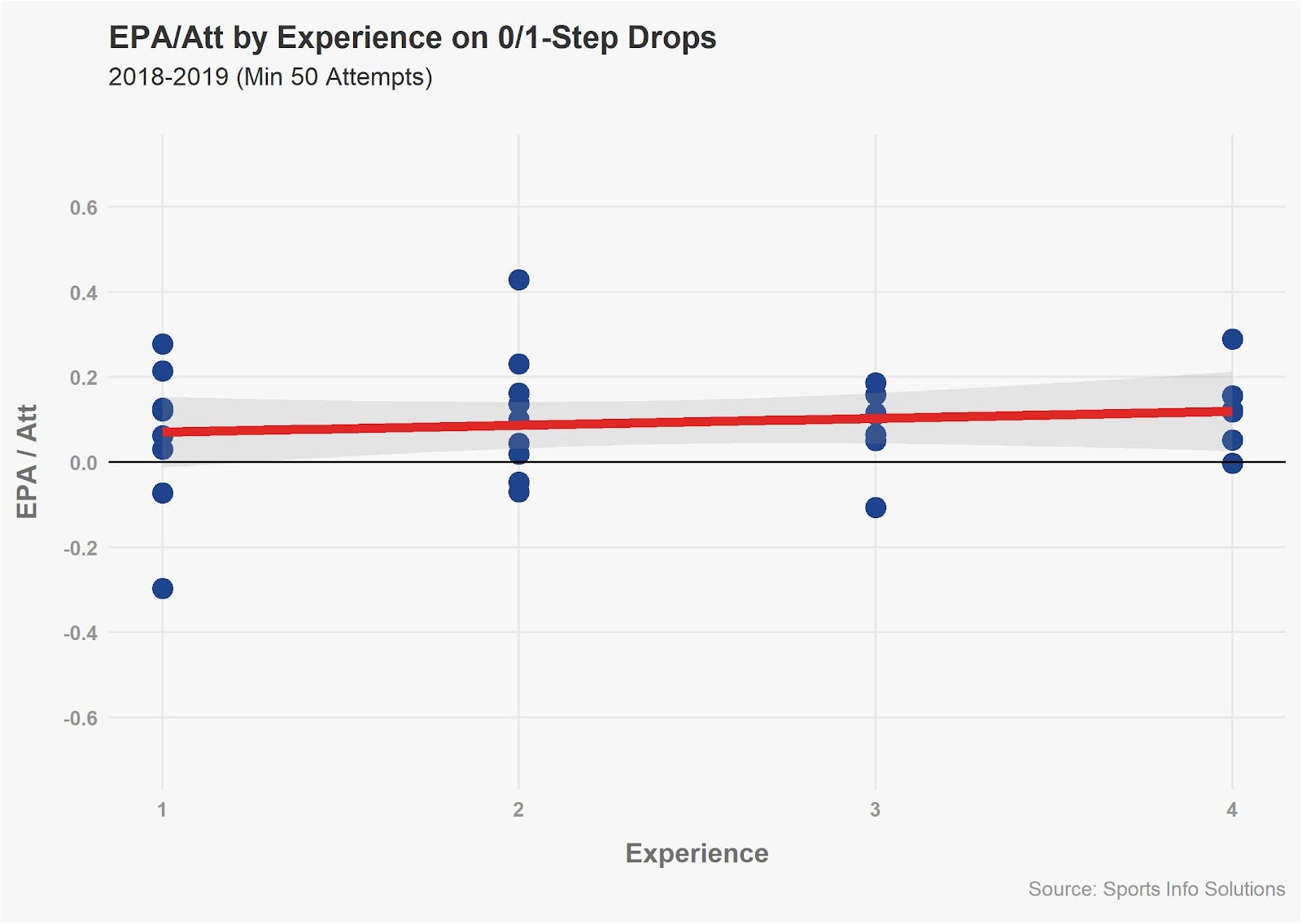
In the above graphic, experience shows a weak relationship with EPA/Att on 0/1-Step Drops, with a correlation of 0.13. This follows the theory that these throws are similar for most quarterbacks and generally don’t require much experience for high-level performance. One of the more extreme outliers within our dataset is Josh Rosen’s rookie season of -0.30 EPA/Att, which is shown as the dot furthest towards the bottom left of the graphic.
On 3-Step Drops, we see a slightly stronger relationship between experience and EPA/Att, with a correlation of 0.31. The above graphic also shows a noticeable trend of rookies quarterbacks having a much wider variance in their performance on these throws. The range for rookie quarterbacks spans from Ryan Finley’s -0.48 EPA/Att to Lamar Jackson’s +0.47 EPA/Att.
5-Step Drops are where experience matters the most for quarterback performance, with a correlation of 0.46. There is also the noticeable trend of every quarterback in years three and four having a positive EPA/Att on these throws, while only a single rookie quarterback had a positive EPA/Att. Gardner Minshew, with his +0.46 EPA/Att, was that sole rookie quarterback, though, Kyler Murray would have joined him had he met the minimum attempts threshold, with an EPA/Att of +0.17.
This analysis shows a trend of experience being a larger factor in quarterback performance on longer dropbacks. This supports the theory that these throws generally require more reads, which players can improve upon with more playing time. However, experience and more playing time does not show a relationship with quick drops, suggesting that players are unable to improve significantly on these throws over time.
These findings bode well for Jones, the subject of the original Twitter thread, who performed well on 0/1-Step Drops and struggled on longer dropbacks. Over the next few years, experience should help his performance more on 3-Step and 5-Step drops. All of this analysis comes with an important caveat of smaller sample sizes, but it has provided interesting insight and something for SIS to monitor moving forward.
The NFL Draft wrapped on Saturday, leaving most fans with a feeling of hope and optimism for the upcoming season. Unfortunately this doesn’t apply to Packers fans, who were left wondering what their team was thinking throughout the three-day process.
The Packers left their fan base speechless on the Draft’s opening night by trading up in the first round for quarterback–and future Aaron Rodgers replacement–Jordan Love. Then they continued to torture fans who desperately begged for a receiver by taking an old school power back and a lowly rated H-Back in the second and third rounds, respectively. The later rounds were not well received either, as the team took an injured linebacker, a trio of offensive linemen, two seventh-round defenders, and continued to ignore fans’ pleas for any receiving help in what could be the deepest receiver draft in memory.
If all of these sources have unanimously panned the Packers draft haul, what exactly should fans be optimistic about?
The Packers might have caught lightning in a bottle, again.
Barring an injury to Rodgers, we won’t know much about the Jordan Love selection for at least two years. That is the earliest the Packers could get out of Rodgers’ contract, but they have stated they hope he continues to be a Packer. Love will have to sit and wait, which should help him after a rocky junior season.
The Good (2018) and The Bad (2019) of Jordan Love
Metric
Jordan Love (2018)
Jordan Love (2019)
Comp%
64%
62%
Catchable%
81%
78%
Yds/Att
8.5
7.2
Yds/Dropback
8.1
6.6
EPA/Att
0.27
0.01
EPA/Dropback
0.22
-0.04
EPA/Att (Clean Pocket)
0.34
0.10
EPA/Att (Deep Throws)
3.00
2.62
If, after a few years watching and learning, the Packers can get more of 2018 Love than 2019 Love, they might have just captured lightning in a bottle for a third time and provided themselves good-to-great QB play from 1992 to 10-plus years in the future. Part of that process might be asking Love to be a little more conservative, as he rated as the most aggressive QB in this draft class by ADoT +/- (Average Distance of Target Above Expectations).
Of course that is all a best case scenario for the Packers, and Love is a boom-or-bust type player. But, based on college metrics that have shown stability between college and the NFL (mainly Accuracy, Downfield Aggression, and Propensity to Scramble), Love’s junior season compares most similar to Sam Darnold.
The drafted offensive weapons make more sense than fans think.
Fans clamored for receivers, and instead the Packers drafted a running back and a tight end. Both A.J. Dillon and Josiah Deguara were probably drafted a round or two early, so the value of the selections has rightfully been criticized. But, ignoring the round/positional value for a second, because the picks are in and there’s no going back now, these two selections do make some sense for the Packers offense.
The Packers top two running backs, Aaron Jones and Jamaal Williams, both have expiring contracts at the end of this season. The Packers also have a handful of other expiring contracts that should take priority over the running back position. So, drafting another back to take some of the load in 2020 and most likely a larger role in the future makes some sense.
Dillon is also a solid player, who produced for Boston College despite being run into loaded boxes on an incredibly high 44% of his carries. For perspective, Clyde Edwards-Helaire ran into a heavy box on only 12% of his carries, J.K. Dobbins 10%, Cam Akers 13%, D’Andre Swift 21%, and Jonathan Taylor 20%. And of these other highly-rated backs, only Edwards-Helaire and Swift join Dillon in having a Positive% (Percent of Carries w/ a Positive EPA) on the majority of both inside runs and outside runs. Dillon had a Positive% of 53% on both.
As for Deguara, one just has to look at head coach Matt LaFleur’s past to see the plan for him. The comparisons have already been made between Deguara and how LaFleur’s former boss, Kyle Shanahan, has used Kyle Juszczyk, and that is definitely an intriguing comparison for the versatile tight end. Over the past two seasons, Deguara aligned in the slot on 36% of his snaps and also lined up in the backfield a handful of plays.
LaFleur’s tenure as the Titans OC also offers a glimpse of how the Packers will be aligning on offense in 2020. In 2018, LaFleur’s offense used two or more tight ends on 41% of their snaps, which ranked third-highest in the league. In contrast the 2019 Packers only used two or more tight ends on 27% of their snaps. With versatile tight ends Jace Sternberger, Robert Tonyan, Marcedes Lewis, and now Deguara on the roster, look for the 2020 Packers to heavily use two tight end sets, which LaFleur seems to favor.
They created offensive line depth for the future
Similar to the running back situation, this draft class provides the Packers with depth this season and insurance policies against expiring contracts in the future. Guard Lane Taylor’s contract expires after this season, and could be a cap casualty sooner than that. Starting center Corey Linsley’s contract is also up at the end of 2020.
One of the interior line spots should be locked down for years by Elgton Jenkins, but the two spots could be open in 2021. With Taylor and Linsley’s expiring contracts and Billy Turner’s spotty performance–he rated as the team’s worst starting offensive lineman in 2019 by our player value metric, Total Points–it makes sense for the Packers to load up on depth in the draft.
Jon Runyan rated as SIS’s 17th-rated tackle prospect, but the Packers are most likely moving him to guard. He provided solid value for Michigan last season with 33 Total Points, and his 0.04 Total Points/Snap ranked 34th in the country among all lineman with at least 500 snaps (essentially those who played regularly or semi-regularly). Jake Hanson was a longtime starter for Oregon and finished 2019 with 24 Total Points. Simon Stepaniak finished 2019 with 22 Total Points for Indiana.
The elephant in the room: the need at WR
In SIS’s season review of the Packers, it was mentioned that they needed to improve their receiving corps if they want to contend in 2020. They are now banking on that improvement to come from within or from free agent acquisition Devin Funchess. It also looks like No.1 receiver Davante Adams will again see a large workload. He has been targeted on 27% of passing snaps he was on the field for over the past two seasons, the third highest rate in the NFL behind only Michael Thomas and Julio Jones.
Although fans desperately wanted the Packers to draft multiple receivers, this plan never fully made sense for their roster. They usually keep six receivers on their roster and based on contracts and potential, five of those spots have already been locked up for the most part.
Adams is clearly not going anywhere, Funchess was signed for a reason, third year pros Equanimeous St. Brown and Marquez Valdes-Scantling have shown promise, and former undrafted free agent Allen Lazard showed he belonged by being the team’s second-best receiver last year. That only leaves a single open spot for Jake Kumerow, Darrius Shepherd, another free agent veteran, or a rookie.
The two most intriguing options for internal improvement are St. Brown, who showed promise his rookie season before missing all of 2019 with an injury, and Lazard, who stepped up late last season after being on the practice squad in September. Both of these players have shown flashes of being able to take over the No. 2 role next to Adams.
In 2018 with St. Brown on the field, the Packers averaged 1.1 yards more per pass attempt and 5 more Expected Points Per 60 Plays than when he was off the field. In 2019, the Packers showed similar improvement when Lazard was on the field, averaging 1 yard more per pass attempt and 5 more Expected Points Per 60 Plays than when he was off the field.
Aaron Rodgers should be happy with the potential to get both of these young receivers on the field together, as he has performed much better with either one of them over the last two seasons.
Rodgers Performance w/ and w/o St. Brown or Lazard on the Field
(2018-2019 Regular Seasons)
St. Brown & Lazard
Att
Comp%
Yds/Att
TD / INT
EPA/Att
Both Off Field
691
61.2%
6.9
26 / 6
0.14
St. Brown On Field
211
64.0%
8.2
8 / 0
0.29
Lazard On Field
261
64.0%
7.6
16 / 0
0.26
Final Word
Is it disappointing that the Packers didn’t add a single receiver from a historically deep draft class? Should they have waited to draft a running back until a later round? Did they reach on an H-back? Do they deserve some of the criticism currently circulating the internet? The answer to all of these questions is: Yes.
However, there does seem to be a specific plan in place with this draft class, even if that plan is wildly different from fan’s expectations. The plan is to tailor the offense to LeFleur’s liking, give the roster much needed flexibility over the next few years as contracts start expiring, focus on internal development of WRs, and hope Love follows in his predecessor’s footsteps as the next great Packer quarterback. It might not seem like it at the moment, but in two to three years this plan could look a lot better than it does now.
College fan bases love to argue over which school produces the best players. Monikers such as “Linebacker U” or “DB U”’ get thrown around a lot, but are normally backed up solely based on opinion or by how many players have been drafted from each school in the last few years. By using SIS’s Total Points value metric, we can actually show how much NFL value different colleges have produced at each position.
To determine which college can claim the title at each position group, we will sum each NFL player’s Total Points over the previous three seasons (2017-2019), and the school with the most total value wins.
Running Back
Top Colleges by 2017-2019 NFL Total Points
College
Players
Total Points
Alabama
9
214
Stanford
2
152
Oklahoma
6
141
Georgia
3
121
Miami (FL)
6
115
Carried by two former Heisman Trophy winners, Mark Ingram and Derrick Henry, Alabama takes the crown as “Running Back U”. Henry leads the way with 61 Total Points and Ingram follows close behind with 60 Total Points. There has also been significant depth produced from Alabama, as Kenyan Drake, Josh Jacobs, and T.J. Yeldon have each contributed over 20 Total Points.
New Arizona Cardinal, DeAndre Hopkins, has been Clemson’s key player at receiver, as he has contributed 109 of their 297 Total Points over the past three seasons. Other former first round receivers Mike Williams (48 Total Points) and Sammy Watkins (40 Total Points) have contributed as well. Clemson has also produced solid NFL contributors Adam Humphries (42 Total Points), Martavis Bryant (26 Total Points), and Hunter Renfrow (13 Total Points during his rookie year in 2019).
It should be no surprise that Stanford and Iowa are at the top of the list for producing NFL caliber tight ends. Iowa might be able to take the crown in a few seasons, if George Kittle continues to dominate and 2019 first rounders T.J. Hockenson and Noah Fant emerge as legitimate weapons. But, for now Tight End U belongs to Stanford. Zach Ertz and Austin Hooper have led the way with 72 and 64 Total Points, respectively, while Stanford has also gained positive contributions from Levine Toilolo, Coby Fleener, Kaden Smith, Dalton Schultz, and Ryan Hewitt.
Wisconsin has a reputation as an offensive line factory, and it is well earned based on Total Points. An impressive 10 former Badger linemen have seen snaps in the NFL over the past three seasons, including five who have accumulated at least 50 Total Points: Ryan Ramczk (108), Rob Havenstein (88), Kevin Zeitler (83), Rick Wagner (74), and Travis Frederick (53).
Ohio State has consistently produced some of the NFL’s elite defensive ends over the past few seasons. Cameron Heyward leads the way with 109 Total Points, with Joey Bosa following closely with 100 Total Points.
Ohio State has also gotten large contributions from Johnathan Hankins with 71 Total Points and Nick Bosa, who accumulated an impressive 61 Total Points in his rookie year. Other solid Total Points contributors include: Sam Hubbard (39), Tyquan Lewis (16), and Dre’Mont Jones (12).
Kentucky claiming the title as “Linebacker U” is probably the biggest surprise of these lists (it finished ahead of Georgia by one point). But, when broken down by individual, it is easy to see the talent Kentucky has produced. Bud Dupree (138 Total Points) and Za’Darius Smith (82) have both become pass rushing threats on the edge, while Danny Trevathan (84), Wesley Woodyard (81), and Avery Williamson (53) have put together solid careers as off-ball linebackers. Though, the most talented of them all might end up being Jaguars edge rusher Josh Allen, who had 29 Total Points in his rookie season.
Next Up for Kentucky: Jamar Watson
35 College Total Points in 2019
Entering Senior year in 2020
Defensive Back
Top Colleges by 2017-2019 NFL Total Points
College
Players
Total Points
Alabama
13
728
LSU
11
599
Ohio State
12
575
Florida State
10
485
Florida
13
384
“DB U” might be the most hotly debated among all the position groups, with fan bases from LSU, Miami, Ohio State, Florida State, and Florida all laying some sort of claim. But based on Total Points, Alabama claims the title, and it’s not really that close. While LSU might have the top single player among those schools in Tre’Davious White (142 Total Points), Alabama’s incredible depth wins out. Alabama has produced nine defensive backs who have 40 or more Total Points over the past three NFL seasons: Marlon Humphrey (128), Kareem Jackson (122), Eddie Jackson (90), Landon Collins (86), Ha Ha Clinton-Dix (80), Minkah Fitzpatrick (64), Dre Kirkpatrick (55), Ronnie Harrison (53), and Levi Wallace (40).
The Colts and Steelers were in unfamiliar territory last season. They were both attempting to rally behind an unproven quarterback, after losing their projected starters unexpectedly. After having matching circumstances and similar results in 2019, the two teams find themselves paralleling each other again heading into the 2020 Draft.
Both teams have traded away their first round pick for defensive help and both need a boost at receiver to help an aging quarterback from the legendary 2004 draft class. Based on SIS’s Total Points metric, only the Eagles currently have a worse receiving corps than the Colts and Steelers.
Current WR Corps Rankings by 2019 Total Points
Rank
Team
WR Total Points
32
Eagles
21
31
Colts
25
30
Steelers
26
The good news for the Colts and Steelers is that the upcoming NFL Draft is loaded with premier talent at the wide receiver position. While they won’t be in play for the class’s headliners, they will still have high-level players to choose from when they select at 34 and 49, respectively.
Colts
Colts Projected Top 3 WR’s 2019 Stats
Player
Tgts
Catch%
ADoT
YAC/Rec
Slot%
Total Points
Zach Pascal
73
56%
11.7
5.8
53%
17
T.Y. Hilton
69
65%
9.9
4.9
37.5%
9
Parris Campbell
25
72%
8.0
6.0
57%
0
The Colts returning receivers should be better this season if they can stay healthy, as they lost significant time from both T.Y. Hilton and Parris Campbell last season. But, they could still use some help at the position. A deep threat with a large catch radius would be a welcome addition, as Zach Pascal’s team leading ADoT of 11.7 only ranked 55th among receivers with at least 20 targets. New quarterback Philip Rivers is used to getting a lot of help from his receivers.
Potential Targets:
Tee Higgins, Clemson (SIS Football Rookie Handbook Grade: 6.7)
Scouts Take: Higgins has the natural hands, contested-catch ability, and wide catch radius to be a solid No. 2 at the next level, but his rounded cuts and inability to consistently separate against press may hold him back. – Nathan Cooper
Jalen Reagor, TCU (SIS Football Rookie Handbook Grade: 6.8)
Scouts Take: Reagor has the speed, playmaking ability, quickness in and out of routes, and strong hands to be a consistent contributor in the NFL, but will need to win more against physical DB’s and learn an NFL route tree to take his game to the next level. – Nathan Cooper & Matt Johnston. (video analysis here)
Denzel Mims, Baylor (SIS Football Rookie Handbook Grade: 6.4)
Mims is a very athletic, physical wide receiver who is an asset in all areas of the field with a wide catch radius and good blocking ability, but needs to improve his route running and become more consistent in traffic to become a better overall player. – Evan Butler
Steelers
Steelers Projected Top 3 WR’s 2019 Stats
Player
Tgts
Catch%
ADoT
YAC/Rec
Slot%
Total Points
Diontae Johnson
91
65%
9.1
5.2
24%
15
James Washington
78
56%
15.2
4.6
40%
13
JuJu Smith-Schuster
72
58%
9.2
5.8
71%
-1
The Steelers receiving corp took a major step back last season due to multiple reasons. The absence of a starting caliber quarterback, after Ben Roethlisberger’s injury, definitely lowered the group’s potential, as did JuJu Smith-Schuster being miscast as a No. 1 receiver.
The good news for the Steelers is that with Smith-Schuster in the slot, James Washington emerging as a legitimate deep threat, and Diontae Johnson surprising as a third-round pick, they should have some solid pieces this year. Though, they could use some added size on the outside to complement the returning weapons.
Potential Targets:
Laviska Shenault Jr., Colorado (SIS Football Rookie Handbook Grade: 6.8)
Shenault is a big-bodied, versatile receiver who wins at the point of attack and has a fierce, competitive attitude, but brings limited play speed and needs to refine his route running before he can become a star. – Cyril Penn
Grabriel Davis, UCF (SIS Football Rookie Handbook Grade: 6.7)
Davis has the tracking, vertical separation, playmaking ability, and physical gifts to be a solid starter in the NFL, but he will need to show more after the catch and learn to run a more diverse route tree to become the complete package. – Alex O’Brian
Michael Pittman Jr, USC (SIS Football Rookie Handbook Grade: 6.4)
Pittman Jr. will succeed in the NFL with his ability to high-point and body-up secondary defenders, but his lack of quickness and lateral athleticism should keep him from becoming a true No. 1 target. – Steve Chang & John Todd
The 2020 Football Rookie Handbook is available for $15 from ACTASports.com. If you liked this article and like studying the NFL Draft, you’ll surely enjoy the book.
Quarterbacks are often labeled by their propensity for taking risks down the field. Throw it deep often and you get labeled a “Gunslinger.” Throw it short and rely on your receivers to make plays and you get labeled a “Game Manager.”
These designations are usually only provided by anecdotal evidence and fans’ feelings towards different players. But, the underlying principle of analyzing quarterback aggression by using throw depth can be a useful tool when predicting certain quarterback metrics and playing styles.
Throw depth has been shown to be a major driver in quarterback accuracy metrics and to be relatively stable year to year. Intuitively this makes perfect sense due to the fact that shorter throws are generally easier than throws down the field. This is why throw depth is a key factor in our metrics such as pComp and why average depth of target (ADoT) has been used to compare similarity between college quarterbacks.
Factoring throw depth into these types of analysis is extremely important, but using raw ADoT to evaluate a quarterback’s downfield aggression ignores the fact that all offensive schemes are not the same. Some offenses are predicated on a quick passing game, while others incorporate more field stretching concepts. This can skew ADoT in either direction and our view of certain quarterback’s downfield aggression.
In the NFL
By using ADoT +/- we can see which NFL quarterbacks were the most aggressive (the first five QBs listed on this leaderboard) and which were most conservative (the last five QBs) this past season.
2019 NFL Quarterbacks by ADoT +/- (Minimum 250 Attempts)
Rank
Player
Team
ADoT
ADoT +/-
1
Ryan Tannehill
Titans
9.5
1.6
2
Matthew Stafford
Lions
10.8
1.6
3
Jameis Winston
Buccaneers
10.4
1.4
4
Dak Prescott
Cowboys
9.4
0.9
5
Baker Mayfield
Browns
8.4
0.8
…
26
Jimmy Garoppolo
49ers
6.5
-0.6
27
Tom Brady
Patriots
7.5
-0.6
28
Lamar Jackson
Ravens
8.6
-0.7
29
Derek Carr
Raiders
6.6
-1.2
30
Drew Brees
Saints
6.5
-1.4
This provides an interesting look at the new quarterback situation in Tampa Bay, as the Buccaneers’ previous starter, Jameis Winston, has consistently been among the league’s most aggressive passers and their new starter, Tom Brady, has consistently been among the league’s most conservative.
It also provides nice examples of why ADoT can be misleading in AFC North quarterbacks Baker Mayfield and Lamar Jackson. These are two players who have very similar ADoT’s, with Mayfield averaging 8.4 yards and Jackson averaging 8.6. However, based on their downfield opportunities, Mayfield is the more aggressive passer, as his ADoT +/- is 1.5 yards higher.
The 2020 Draft Class
The same analysis done in the NFL can also be done for college quarterback prospects. Shown here are the ADoT +/- numbers for the Top 10 quarterbacks in this year’s SIS Football Rookie Handbook.
Top 10 SIS Football Rookie Handbook Quarterbacks by ADoT +/-
Player
School
ADoT
ADoT +/-
Jordan Love
Utah State
9.6
1.5
Jalen Hurts
Oklahoma
10.6
1.3
Tua Tagovailoa
Alabama
8.3
1.0
Justin Herbert
Oregon
8.4
1.0
Jake Fromm
Georgia
9.7
0.9
Jacob Eason
Washington
8.7
0.5
Tyler Huntley
Utah
8.4
0.3
Steven Montez
Colorado
8.0
-0.1
Joe Burrow
LSU
9.1
-0.2
Anthony Gordon
Washington State
6.7
-1.2
This is one of the few times you will see LSU’s Joe Burrow near the bottom of a leader board. Although he had a relatively high ADoT, his almost even ADoT +/- suggests he was not airing it out or taking risks more than you would expect. The offense he was playing in simply called deeper routes on average. Not surprising considering LSU coaches could put their trust into one of the best offensive lines in the country, high-level NFL prospects at all skill positions, and a historically-accurate quarterback.
On opposite ends of the spectrum we have Utah State’s Jordan Love and Washington State’s Anthony Gordon. Love aired the ball out more than any other prospect. Though, this aggressive style for Love resulted in the worst On-Target% of the 17 quarterback prospects within the Rookie Handbook at 68%. Gordon was ultra-conservative within the Air Raid offense, which led to the fourth highest On-Target% in the Rookie Handbook at 80%.
Here at Sports Info Solutions our video scouts chart many things within each NFL game, including multiple in-depth data points pertaining to quarterback accuracy. Our in-depth quarterback accuracy is charted on three scales:
Whether the pass was Completed
Whether the pass was Catchable
Whether the pass was On-Target (Includes throws that are over/under thrown and ones that are in-front/behind the receiver)
While all three measure a similar concept, by differentiating them, we can begin to separate the value between quarterback and receiver. By comparing completion percentages on throws that were deemed Catchable but Off-Target, we can look at which quarterbacks were bailed out the most by their receivers. These throws, which are Catchable but Off-Target, are ones in which the receiver has a chance to make the catch but would require significant adjustment to complete the catch. In essence, think diving or leaping catches that you would see in highlight reels.
The list of quarterbacks who were bailed out by their receivers the most features the faces of this year’s free agency class and Giants rookie Daniel Jones.
Player
Team
Attempts
Comp%
Philip Rivers
Chargers
44
59%
Drew Brees
Saints
21
57%
Jameis Winston
Buccaneers
34
50%
Daniel Jones
Giants
21
48%
Tom Brady
Patriots
53
47%
New Colts quarterback Philip Rivers was helped quite a bit by his receiving core in Los Angeles last year, as he led the league in Off-Target Completion% with 59%. This does not bode well for him in Indianapolis, as he will be without trusted receivers Keenan Allen (8/13 on Off-Target Throws), Mike Williams (4/8), and Hunter Henry (4/8) to help him out on off-target passes. Also, last year, the Colts ranked only 18th in Off-Target Completion% at 37%.
On the opposite end of the spectrum are the quarterbacks who were rarely bailed out by their receivers.
Player
Team
Attempts
Comp%
Aaron Rodgers
Packers
37
27%
Andy Dalton
Bengals
37
27%
Dak Prescott
Cowboys
45
24%
Deshaun Watson
Texans
17
24%
Baker Mayfield
Browns
32
22%
Gardner Minshew
Jaguars
40
20%
Jaguars rookie, Gardner Minshew, ranked last among the 32 quarterbacks who threw at least 15 passes that were deemed Catchable and Off-Target. He received little help from his number one option DJ Chark (2/11 on Catchable Off-Target passes) and running back Leonard Fournette (1/6).
Analysis such as this is a simple way to see which quarterbacks were helped quite a bit by their receivers and which were not. This also shines a light on why metrics such as On-Target% are better barometers of success for quarterbacks than Completion%. Completion% is not a bad metric, but it is a simple one that can lead to the wrong conclusion of how accurate a quarterback is.
As shown above by analyzing Off-Target Completion%, completions and incompletions are not always on the quarterback.