Author: Nate Weller

  • The Rams’ Rushing Success is More Than Just Todd Gurley or C.J. Anderson

    The Rams’ Rushing Success is More Than Just Todd Gurley or C.J. Anderson

    The resurgence of C.J. Anderson in Los Angeles has seemingly breathed life back into the debate about the relevance of running backs in the modern NFL. On Saturday night, Anderson went for 123 yards on 23 carries, adding two touchdowns. On the opposite side of the ball, superstar running back Ezekiel Elliott turned his 20 carries into only 47 yards.

    It was the latest chapter in a season in which James Conner gained close to 1,500 scrimmage yards in only 13 games, and a 33-year-old Adrian Peterson get back over the 1,000 yard mark for the first time since 2015. Meanwhile, teams like the Jaguars, whose run game carried them to a conference championship only a year ago, failed to have a single 100-yard rusher.

    Based on pretty much any metric, passing provides more value than running, but what that really means for play calling is still hotly debated. And if it’s so inefficient, why were the Rams, Chiefs, and Patriots able to win this weekend by dominating on the ground?

    Stop Trying to Establish the Run

    Conventional wisdom has always stated that establishing the run is crucial to an offense’s success. Even if you aren’t running the ball particularly well, you should stick with it because you will wear down the down the defense and have more success as the game wears on.

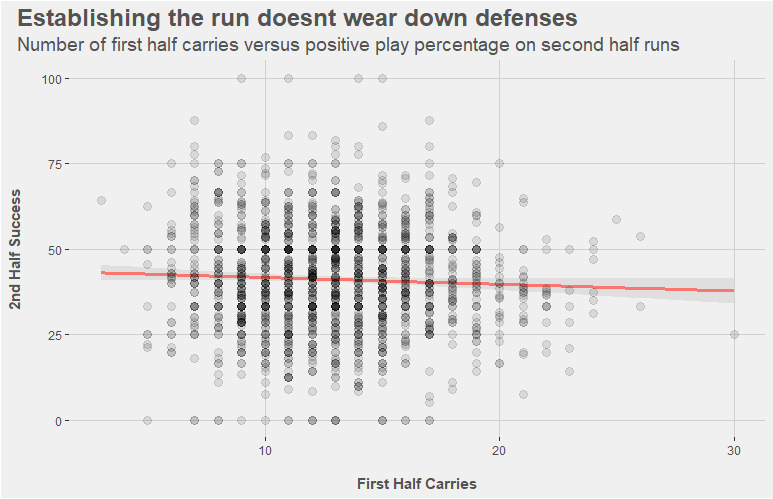
    To look at this, we compared a team’s first half carries versus their positive play percentage (Positive%) on second half carries. (Positive% is an Expected Points-based metric that represents the percentage of plays a player earned a positive Expected Points Added value.) Establishing the run in the first half shows almost no correlation to second half success. In fact, it actually shows a small negative correlation, indicating at some level that rushing performance actually decreases the more carries are forced onto a running back early in the game.


    This potentially indicates a few things: that running the ball a lot early does not cause the defense to fatigue more than a normal offensive split, at least not enough to affect performance in a meaningful way, and that predictable play calling can lead to decreased offensive performance.

    Despite this, coaches continue to stick by this strategy. As recently as Wild Card weekend the Seahawks ran the ball 24 times for 3.0 yards per carry, waiting until the final quarter to open up the pass game. This is despite Russell Wilson averaging 8.6 yards per attempt and posting a QB Rating of 115.3.

    This also illustrates another important point: passing success generally acts independent of rushing success. Since 2016, the correlation between a teams Positive% on the ground and their Positive% through the air is close to zero, and this correlation even holds true when looking at play action. On average, success rate on play action passes tended to stay around 50 percent, with some noise on either side, regardless of a team’s success on the ground.

    Creating Mismatches at the Line of Scrimmage

    Teams that are successful on the ground in the modern NFL are not doing so by staying patient, or “establishing the run” early. They are doing so by putting their running backs and linemen in advantageous situations.


    C.J. Anderson is the perfect case study. During his 2017 campaign with Denver, Anderson ran into a stacked box on 33 percent of attempts, and had a Positive% of 36 percent. In weeks 16 and 17 with the Rams this season, Anderson ran into a stacked box on only 19 percent of his carries, and flipped that into a Positive% of 62 percent. Among running backs with at least 25 carries in that time period, that ranked second behind fellow Rams running back Malcolm Brown (69 percent). Put into context, no running back with more than 100 attempts in 2018 had a success rate above 50 percent.

    Even without considering that he was unemployed for most of the season, Anderson has been impressive, and McVay’s creative play calling deserves a lot of credit. While the Rams predominantly stick to one personnel grouping, they use a wide variety of formations and move players around a lot to generate mismatches, including some of the most creative use of motion in the league.

    Nobody Uses Motion More Effectively Than the Rams

    In 2018, teams averaged 1.6 yards before contact (YBC) and 4.1 yards per attempt (Y/A) on runs that didn’t use motion. When using motion in any capacity those numbers jumped to 1.9 and 4.5, and jumped further to 2.2 and 4.9 on plays using jet motion (YBC and Y/A exclude jet sweeps and QB scrambles).

    No team made use of this more than the Rams, who led the league in jet motion usage by a long shot. In total, the Rams used jet motion on 17 percent of offensive snaps in 2018. The next closest teams were the Chargers and Titans who used jet motion on 14 and 8 percent of offensive snaps respectively.

    The Rams averaged an astonishing 2.7 YBC on plays utilizing jet motion, significantly better than their overall average on runs plays of 2.0, and almost a full yard better than the average run play in the NFL (1.8).

    There’s more to this than simply using jet motion more, and having a talented running back certainly adds value, but the point is that scheme plays an important role too. Nobody will argue that Anderson is a better running back than Ezekiel Elliott, but Elliott wasn’t good enough on Saturday to overcome facing a stacked box on 40 percent of his carries.

    Running the ball still has an important role in modern offenses, but for teams to be successful they need to start moving away from the more traditional ground-and-pound methods. The Rams are creating a blueprint; now it’s time for other teams to start using it.

  • Preview: NFC Divisional Round – Cowboys vs. Rams

    By NATE WELLER

    Let’s take a brief look at some statistical notes and storylines ahead of the NFC Divisional Round playoff game between the Cowboys and Rams.

    Prescott Needs to Use His Legs to Negate the Rams Pass Rush

    Aaron Donald led the league with 20.5 combined sacks this year, 4.5 more sacks than runner up J.J. Watt. He also leads the league in pressure rate, pressuring the quarterback on just shy of 17 percent of pass rush snaps. Dak Prescott though has excelled when he has been able to escape the pocket. His Independent Quarterback Rating (IQR) on throws from outside the pocket is 113.2, versus 99.5 on throws from inside the pocket. Looked at another way, using SIS’s total points metric, he earned 2 points from outside the pocket, and -13.2 from inside the pocket.

    If the Rams’ defensive ends can contain Prescott and keep him in the pocket, their pass rush will be very disruptive. If the Cowboys’ offense is going to be successful, Prescott will need to extend some plays with his feet and continue making plays from outside of the pocket.

    The Cowboys Need to Run Smart

    On runs against a defense with less than 8 men in the box, Ezekiel Elliot leads the NFL with 5.1 yards per attempt (Y/A). This number drops drastically to 3.3 when facing a stacked box. Unfortunately for the Cowboys, the Rams stacked the box on defense more than any team in the NFL this year, doing so on 17.5 percent of defensive snaps.

    On third or fourth down with less than a yard to go, this number jumps all the way to 46 percent (3rd in the league). Elliot is a crucial part of the Cowboys offense, and the Rams will likely make it a priority to stop him.  If the Cowboys are going to find offensive success, they will need to use audibles to prevent sending Elliot into a stacked box consistently, and Prescott will likely need to make some plays with his arm on short yardage downs to take advantage of an aggressive Rams defense.

    Goff Needs to Find a Way to Beat the Cowboys Zone

    The Cowboys play in zone coverage 52 percent of the time, the 8th most in the NFL, and in man coverage 35 percent of snaps. (Screen, prevent, and combo coverages make up the remaining percentage). Against man coverage this season Jared Goff posted an IQR of 114.4 (4th), compared to an IQR of only 96.7 (18th) on passes versus zone coverage. The 17.7 split is the 6th largest among quarterbacks with at least 100 attempts. Additionally, Goff has thrown 9 of his 12 interceptions against zone coverage.

    Player

    IQR vs Man

    IQR vs Zone

    Split  

    Cam Newton

    118.9

    78.6

    -40.3

    Ryan Fitzpatrick

    118.6

    89.6

    -29

    Drew Brees

    131.5

    111.7

    -19.8

    Ben Roethlisberger

    103.8

    84.8

    -19

    Matthew Stafford

    101.1

    83.1

    -18

    Jared Goff

    114.4

    96.7

    -17.7

    Sam Darnold

    82

    72.4

    -9.6

    Kirk Cousins

    107.2

    98.8

    -8.4

    Jameis Winston

    101.9

    93.6

    -8.3

    Deshaun Watson

    110.6

    102.6

    -8


    The Rams Offense Needs to Get Back on Track

    Since the bye, Goff’s IQR of 79.7 ranks 30th among quarterbacks. This number is mostly due to a particularly bad three game stretch coming out of the bye where he posted IQR’s of 78.1, 23.5, and 75.1 in consecutive games.

    Through week 15, the Rams had used 11 personnel (1 RB, 1 TE) on 96 percent of offensive snaps, almost 20 percentage points higher than the next closest team. In weeks 16 and 17, the Rams only ran 56 percent of plays out of 11, and used 12 personnel (1 RB, 2 TE) on 40 percent of offensive snaps. In limited action in these two games, Goff threw out of 12 personnel 11 times (he had 1 such attempt in the 14 games prior), completing 8 of them for 88 yards with two touchdowns and no interceptions, an IQR of 147.

    The Rams also found success running the ball out of 12 personnel in the team’s final two games. C.J Anderson and John Kelley ran the ball a total of 37 times for 161 yards and a touchdown. Put into context, the Rams ran the ball out of 12 personnel a total of 16 times the first 14 games of the season. With Gurley back in the lineup, it’s possible the Rams will continue to lean on 12 personnel sets.

  • Couple of questionable calls played a role in shaping AFC Playoff picture

    Couple of questionable calls played a role in shaping AFC Playoff picture


    BY NATE WELLER

    It’s the time of year where teams and fans alike look back at what could have been. No team will be wondering more than the Steelers, who after a 7-2-1 start to the season, were officially eliminated from the playoffs when the Colts and Texans game ended decisively in regulation.

    All of this is not without controversy though. The struggles of referees in the NFL this year have been well documented and thoroughly scrutinized, and the Steelers arguably have the biggest issue of any team. Two of the games with the biggest implications for their own playoff chances swung on miscues by the officiating crew.

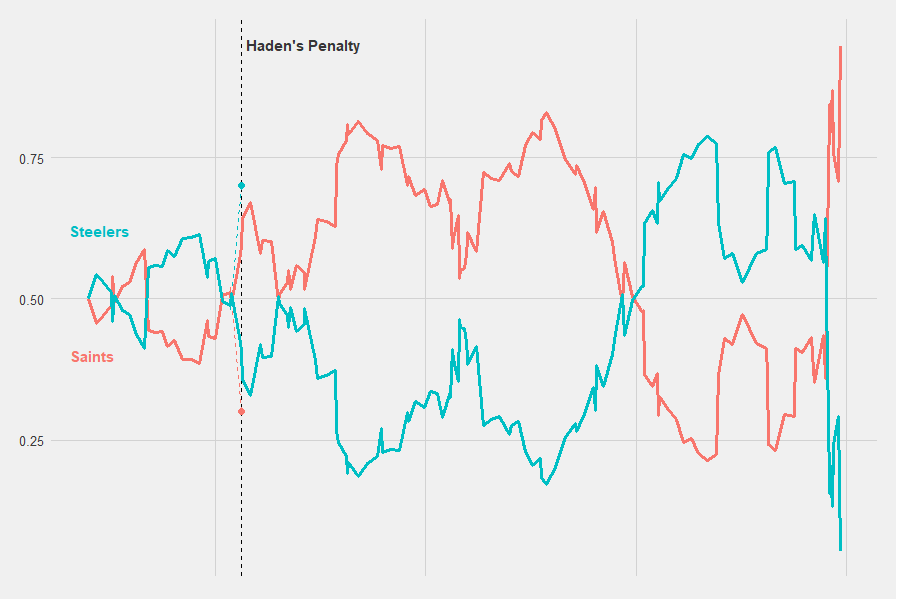
    With about three minutes left in the first quarter of the Steelers’ Week 16 game against the Saints, the Saints, down 3, elected to go for a fourth-and- short from the Steelers’ 34-yard line. Brees was flushed from the pocket, and threw up what was effectively a punt towards Alvin Kamara in the endzone. The ball fell incomplete, but Joe Haden was called for pass interference. Replay appeared to show that no foul had occurred. The Saints were given a first-and-goal from the 1, and subsequently scored their first touchdown.

    A fourth-down stop would have resulted in -3.28 EPA for the Saints, and set the Steelers up in good field position. Instead the play resulted in 3.73 EPA for the Saints, a total swing of 7.01 expected points. Put into context, Derrick Henry’s 99-yard touchdown run versus the Jaguars added 5.73 expected points. The sequence of events for the Steelers and Saints was among the largest swings in expected points this season.

    From a win probability standpoint, the Saints chance of winning prior to the fourth-down attempt was 49 percent. Following Ingram’s score, their win probability jumped to 68 percent. With a fourth-down stop, the Steelers’ win probability would have jumped to almost 70 percent.

    The penalty was a major turning point in a game that the Steelers would lose by a field goal. The foul occurred early, and the Steelers still had plenty more opportunities to win, but most people will still look back at the penalty and ensuing touchdown as a major factor in the loss.

    The defeat left them needing help from the division rival Browns in week 17. The Steelers’ scenario was simple, a win and a Ravens loss and they were in .

    With a little under two minutes remaining in the second quarter of that matchup, the Ravens were set up on the Browns 1 with an opportunity to extend their lead to three scores. On third down, Ravens quarterback Lamar Jackson attempted to clear the pile on a quarterback sneak, and extended the ball towards the goal line. The ball was punched loose, and cleanly recovered by Jabril Peppers of the Browns, who took off towards the end zone. The play however was immediately whistled dead as it was ruled the ball had crossed the plane.

    The play would be reviewed and correctly overturned, but due to the premature whistle, Cleveland was given the ball at its own 7 , cancelling out what would have undoubtedly been a defensive touchdown.

    The play as it stood was still worth -4.6 expected points for the Ravens. A 99- yard fumble-return touchdown though would have been an expected points swing of more than 12 points, effectively worth close to two touchdowns.

    Looking at the win probability, the Browns chances were down to about 5 percent with the Ravens likely to go into the half up three scores. The play as it stood increased their chances by almost 10 percentage points, up to 14 percent. A touchdown would have increased their odds to nearly 46 percent going into the half, which would have been the biggest swing in win probability on a single play this season. The Browns would go on to make things interesting in the fourth quarter, but were not able to do enough to erase the two-score second half deficit, losing the game 26-24.

    The Steelers are a team that is full of Super Bowl-level talent. Given that they won 7 of their first 10, they should’ve been battling for home field, not hoping for a wild card spot. But it still does not feel like much of a leap to think that both of the plays mentioned above played a large role in their failure to make the playoffs. Calls going the wrong way have always been a part of the game, but the Steelers and their fan base will likely feel slighted going into this offseason a little more than everyone else.