On this episode of the Sports Info Solutions Baseball Podcast, Mark Simon (@MarkASimonSays) is joined by Braves third base coach Ron Washington who has an incredible amount of wisdom to share from his home in New Orleans. Wash explains what defensive excellence means to him (2:19), his first defensive mentor in baseball, Chico Fernandez (2:57), how hard it is to be a good defensive player (4:02), how defense has evolved (5:17), and the best lesson he learned from failing as a player (6:20).
Coach Washington also shares what it was like to play catcher and the difference between a pitch-framer and a pitch singer (7:19), and how he has evolved as a coach (8:55). He explains the role he’s had in working with excellent defenders like Eric Chavez and Ozzie Albies (10:22). Lastly, he says what he likes most about coaching defense and what advice he would give an aspiring coach (15:58).
LISTEN HERE!
On this edition of the Sports Info Solution Baseball Podcast, Mark Simon (@MarkASimonSays) is joined by Tampa Bay Rays Platinum-Glove winning center fielder Kevin Kiermaier (@KKiermaier39) for a comprehensive explanation of what goes into playing defense.
Kiermaier explains what he is doing to keep busy with his wife and toddler son in Tampa and the commonalities between bow-fishing and trying to catch a fly ball – and there are parallels! (1:00) He also shares the memories of the first good defensive plays he made in Little League and in the majors (4:00), who his favorite defensive player was as a kid (6:06), and the details of the intense amount of preparation he does to play defense the way he does – he takes opponents’ batting practice seriously – and to avoid having any weaknesses (6:59).
Kevin also explains how he defenses Aaron Judge and Ichiro Suzuki and how he adjusts his positioning based on instinct and observations (11:30), what the difference is between making a catch and missing the ball on a low line drive (16:51), and a guide to what goes into a home run robbery (19:24). Mark also details what goes into tracking a home run robbery and how much credit a fielder gets for one and Kevin notes that defensive stats are important to players like him being in the major leagues (21:58).
He also describes his glove and explains the routine he goes through to keep his arm strong (27:35). He also notices that baserunners have stopped challenging him and appreciates the respect that comes with that (31:28). Lastly, he runs through the coaches who helped him out along the way. All hail Skeeter Barnes! (33:00)
On this edition of the Sports Info Solutions Baseball Podcast, Mark Simon (@MarkASimonSays) is joined by Dr. Aaron Gray (@MizzouSportsDoc), a Youth & Adult Sports Medicine Physician at the University of Missouri, and SIS Injury Coordinator John Verros (@VerrosJohn).
Dr. Gray gives his advice on sifting through the overwhelming amount of information (and misinformation) related to Coronavirus (1:54), what is known about training to play sports in a pandemic (3:31), and he also evaluates ongoing discussions related to fear of contracting the virus from breathing it in (4:26).
John explains some of the things he’s looking at, like how successfully a pitcher like Justin Verlander can return from injury (5:24). He and Dr. Gray both provide examples of exercises that athletes can do to keep in shape (8:25), what injuries they are most concerned about (10:40), and what studies have piqued their interest (15:42). Lastly, Dr. Gray explains the scenario that MLB officials are likely most concerned about – what happens if the season begins and a player tests positive in midseason (21:42).
The following article was written in April 2019 and is an excerpt from The Fielding Bible – Volume V, on sale now at ACTA Sports.
Executive Summary
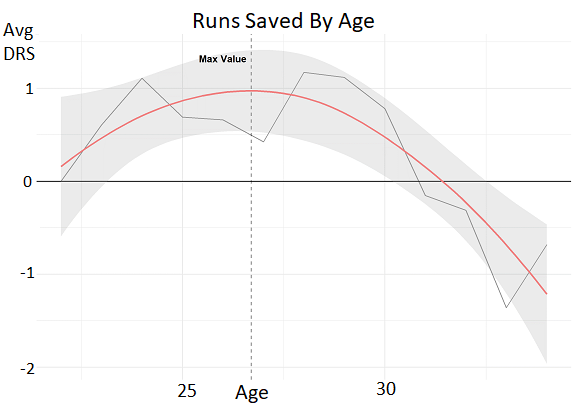
It is understood that as a player ages, his performance weakens, but just how does that happen on the defensive end? In looking at the history of Defensive Runs Saved, an aging curve was generated. It showed that a player’s defensive peak is his age 26 season, with a steady decline for the rest of his career, including a more substantial decline beyond his age 30 season.
Introduction
This adds another challenging element to signing free agents, because almost every player will hit free agency past his defensive peak.
How is a player’s defense impacted as he ages?
Some of the signings in the 2018-19 offseason merit that question. With 27-year-old Nolan Arenado, who signed an eight-year contract extension, it seems fair to consider whether he’s hit his defensive peak yet. He finished with 5 Defensive Runs Saved (DRS) in 2018 after back-to-back seasons of saving 20 runs.
With the two 26-year-olds, Manny Machado and Bryce Harper, it’s a question of how much their poor performance in DRS in 2018 may foreshadow some sort of decline for the long term. Machado struggled at shortstop in 2018 and will move back to third base with the Padres after inking an eight-year deal. Harper blamed tired legs and playing out of position in center field for a season in which his defense cost the Nationals 26 runs. He’s signed with the Phillies for the next 13 seasons.
To get a better feel for how much aging impacts a player’s defensive performance, the history of the DRS stat was studied.
Methodology
To start, a player’s total DRS values dating back to 2003 were aggregated by age to produce average values by age group. When looking at these values, you can see that a player’s defensive peak is around his age 26 season, with a steady decline for the rest of his career, including a more substantial decline beyond their age 30 season.
The plot gives a general idea about a player’s expected career trajectory but is ultimately incomplete. Simple averages by age fail to account for survivorship bias in older players, selection bias of younger players who are good enough to make the majors at a young age, and more generally fails to account for how different players develop from year to year.
A few different methods were used to account for this and provide a more complete analysis.
To account for the volatility of defensive performance from year to year, a two-year rolling total, converted to DRS per 1,000 innings is used as opposed to single-season DRS totals. The sample included only players who had played in at least 1,800 fractional innings over the course of the two seasons.
Additionally, since all positions are not created equal, a positional adjustment was used. The goal was to account for players who switched to easier positions as they aged. This also inherently gives extra value to players who excelled in more difficult positions such as center field. The positional adjustments used are shown below:
Position
Adjustment
First Base
13
Second Base
32
Third Base
25
Shortstop
36
Left Field
19
Center Field
29
Right Field
20
Finally, the DRS totals were evaluated using the Delta method. The sample included only players who played in consecutive two-year windows, and their change in DRS between those two windows. As an example, a player who has 4 DRS per 1,000 innings in his age 26 and 27 seasons, and 2 combined DRS per 1,000 between his age 27 and 28 seasons would be evaluated as having -2 DRS, despite both values being positive.
As an example, a typical player who peaked with 5 Runs Saved in their age 25 season could be expected to see that number decrease to 3 Runs Saved by their age 30 season, and to 0 by their age 34 season. There will be outliers in each direction, but the images presented show an overall representation.
Conclusion
When looking at the plot, the pattern in defense becomes clearer. The average player’s defensive performance begins a steady decline following their age 25 season and takes an even sharper decline following their age 30 season.
With defensive performance declining that early, it is extremely rare that a free agent will still be trending upwards defensively. It’s another factor to be considered within the risk of signing players like Arenado, Harper, and Machado long term.
After looking at where the Athletics’ corner info combo stacked up against others in the Defensive Runs Saved era (since 2003), it made sense to continue the theme and look at middle-infield combos to see which ones ranked best.
In terms of having a current interest, a logical question would be whether the 2019 Cardinals combination of Paul DeJong and Kolten Wong is the top one, given how good they were last season.
Let’s use Defensive Runs Saved to take a look. We’ll do it slightly differently from our look at corner infields in that we’ll look at specific players rather than overall team performance.
2017 Angels – Andrelton Simmons and Danny Espinosa (49 Runs Saved)
It shouldn’t come as a surprise that the Angels end up here given that they have the player selected the top defender of the 21st century. The 2017 season was Andrelton Simmons’ best year. He saved 40 runs with his defense, the most that any player has had in a season since 2003, the first season that the stat tracks.
All Simmons needed was a good second baseman for this combination to end up at the top and he had that, at least for a little while in Danny Espinosa, an infielder with a good defensive reputation who saved nine runs in 71 games playing second base there.
2008 Phillies – Jimmy Rollins and Chase Utley (48 Runs Saved)
The Phillies won a World Series in 2008 with this revered pair manning the middle infield. Chase Utley’s 30 Runs Saved match the most that a player has had at the position in a season (Craig Counsell also saved 30 runs at second base in 2005). The most important run Utley saved that year didn’t count in his stats – it came on a play in Game 5 of the World Series.
The 18 runs saved by Jimmy Rollins led shortstops that season, equaled his career high and turned out to be his peak (he’d never save more than six runs at shortstop after that). Regardless, he’s held in high regard. Arguing that this season’s work is one of the best middle-infield defensive combos of all-time isn’t that much of a stretch.
2019 Cardinals – Paul DeJong and Kolten Wong (45 Runs Saved)
It’s a case of close but not quite for the Cardinals top infielders last season. Nonetheless, Kolten Wong saved 19 runs and won his second straight Fielding Bible Award at second base. Paul DeJong’s 26 Runs Saved tied Javier Báez for the MLB lead at shortstop and brought to light that he deserved to be mentioned when discussing some of the game’s top defenders at the position.
https://www.youtube.com/watch?v=Pb0lIQQnJqU
2007 Blue Jays – John McDonald and Aaron Hill (45 Runs Saved)
This is probably one you wouldn’t have guessed (unless you’re from Toronto), but it’s worth noting because this is the only instance of a team having a shortstop and a second baseman who each had at least 20 Runs Saved in a season.
Shortstop John McDonald had 23 in 102 games, the most he played at that position in his career. McDonald is now the Indians’ Field Coordinator after previously working as the organization’s Defensive Coordinator. Hill had back-to-back seasons of 26 and 22 Runs Saved in 2006 and 2007 but was never able to quite return to that level again. Nonetheless, he had a solid 13-year career in the big leagues, starring both in Toronto and Arizona.
Strong middle-infield defense played a role in the Rockies’ incredible late-season run that culminated with a trip to the World Series. This year was Troy Tulowitzki in peak defensive form (31 Runs Saved) and Kaz Matsui performing at a level he hadn’t reached before or since, with 14 Runs Saved. Tulowitzki, who wore No. 2 as a tribute to Derek Jeter, excelled at fielding the ball in the shortstop-third base hole that year at a level that was tough to match. And let’s not forget he turned an unassisted triple play (albeit on a relatively easy play)!
Talking with Matt Olson on the latest Sports Info Solutions Baseball Podcast got me thinking about great corner infield combos. And I figured there was a good chance that the A’s got more defensive value out of first and third base in 2019 (50 Defensive Runs Saved) than any team previously had from those two positions in the 17-year history of the stat.
It turned out that a couple of teams had them beat.
2003 Rangers (60 Runs Saved From 1B and 3B)
What a luxury the Rangers had at first base in 2003. They had a rookie, Mark Teixeira, who went on to win five Gold Gloves and a three-time Gold Glove winner at DH in Rafael Palmeiro.
Teixeira saved 19 runs in his debut season, living up to his status as one of the game’s top prospects with both the bat and the glove. Palmeiro gets knocked for winning a Gold Glove in a season in which he barely played (1999), but he was legit when he did take the field. He saved 11 runs in 55 games as Teixeira’s alternate. Add in a run saved each for Mike Lamb and Todd Greene and the Rangers got 32 Runs Saved from first base.
On top of that, they got 28 more out of second-year man Hank Blalock at third base. Blalock didn’t win a Gold Glove that year, but he probably should have. Between the two-headed monster at first base and Blalock’s work at third, the Rangers got 60 Runs Saved. Olson and Chapman couldn’t quite beat that.
2007 Cardinals (51 Runs Saved)
I can’t knock this one. This is a season in which Albert Pujols played the best first base that anyone has played in the DRS era (I wrote about it for The Athletic). Pujols saved 31 runs by playing well off the bag, and he was still able to recover to get back to catch throws without issue. On the opposite side of the diamond, perennial defensive star Scott Rolen saved 12 runs in 112 games and five backups showed they were in sync with “The Cardinal Way,” combining to save nine more runs.
In all, the Cardinals corner infielders combined for 51 Runs Saved, just edging out the A’s.
So about Olson and Chapman …
All right, so the A’s don’t come out on top here. Though Olson saved 18 runs, his backups cost the Athletics five runs. Combining their 13 with Chapman and company’s 37 gives the Athletics 50 runs, good for third best on this list. Oakland’s corner infielders also combined for 43 Runs Saved in 2018, which ranks tied for fourth with the 2005 Phillies (of Ryan Howard and Scott Rolen fame).
However, if we just look at combos and take the backups out of the mix, Olson and Chapman combined for 52 Runs Saved last season. No other third-first combination beats them out. They’re the best of the DRS era.
On this edition of the Sports Info Solutions Baseball Podcast, two-time Fielding Bible Award winner Matt Olson (@mattolson21) joins Mark Simon (@MarkASimonSays) from Atlanta to talk shop – defensive excellence at first base. Matt remembers the first time he made a great defensive play (2:40), the state of Georgia’s excellence when it comes to great defense (4:09), who he watched growing up (5:30), his conversion from third base to first base as a kid (6:18), the disadvantages of being a right-handed first baseman (9:23), and how wide he’s willing to play (10:34). Matt also explains what it’s like to play first base in Oakland with its wide foul territory (13:20), the preparation that goes into playing the position and how it pays off (16:07), the mental side of playing first base and the challenge of not taking a slump into the field (17:26), his favorite Matt Chapman play (19:25), and the things he most wants to improve upon (20:58).
Let’s get aboard the Mock Draft train the best way we can by doing a defense-oriented MLB mock draft.
The intent here was to try to draft the best defensive group for the next three seasons.
I put together eight teams of nine players (one player at each position, exempting pitcher, along with a utility player who could play multiple different spots) using six different draft philosophies. Teams picked to those philosophies as much as possible, with each making 1-2 exceptions if needed.
Here are the results (pick numbers are in parenthesis).
The Ozzie’s
The Kaline’s
The Mazeroski’s
The Robinson’s
C
Buster Posey (33)
Danny Jansen (63)
Roberto Perez (14)
Austin Hedges (29)
1B
Anthony Rizzo (32)
Matt Olson (18)
Freddie Freeman (35)
Yuli Gurriel (68)
2B
Ozzie Albies (17)
Ketel Marte (34)
Kiké Hernández (30)
Jonathan Schoop (52)
SS
Trevor Story (16)
Carlos Correa (50)
Andrelton Simmons (3)
Francisco Lindor (20)
3B
Matt Chapman (1)
Ke’Bryan Hayes (66)
Evan Longoria (51)
Nolan Arenado (4)
LF
Mike Tauchman (64)
Michael Brantley (47)
Chad Pinder (67)
David Peralta (45)
CF
Michael Taylor (48)
Byron Buxton (15)
Harrison Bader (19)
Lorenzo Cain (13)
RF
Josh Reddick (65)
Mookie Betts (2)
Yasiel Puig (46)
Jason Heyward (36)
Utility
Jarrod Dyson (49)
Ronald Acuna Jr. (31)
Alex Verdugo (62)
Jackie Bradley Jr. (61)
Approach
Great infield
Great outfield
Strong up middle
Best player available
The Griffey’s
The Mays’
The Vizquel’s
The Clemente’s
C
Tony Wolters (60)
Yasmani Grandal (38)
Christian Vazquez (55)
J.T. Realmuto (41)
1B
Evan White (53)
Christian Walker (59)
Paul Goldschmidt (26)
Joey Votto (40)
2B
Cavan Biggio (44)
Yolmer Sanchez (70)
Kolten Wong (10)
Brandon Lowe (72)
SS
Adalberto Mondesi (21)
Nick Ahmed (11)
Javier Baez (7)
Paul DeJong (25)
3B
Manny Machado (12)
Josh Donaldson (22))
Alex Bregman (23)
Anthony Rendon (57)
LF
Manuel Margot (69)
Brett Gardner (43)
Joc Pederson (71)
Hunter Renfroe (24)
CF
Cody Bellinger (5)
Kevin Kiermaier (6)
Adam Haseley (39)
Victor Robles (8)
RF
Cristian Pache (37)
George Springer (54)
Max Kepler (42)
Aaron Judge (9)
Utility
David Fletcher (28)
DJ LeMahieu (27)
Max Muncy (58)
Brian Anderson (56)
Approach
Potential (youth)
Runs Saved Reliability
Great infield
Great outfield
Let’s look at how each team fared. Remember that we’re only considering defense here and that we’re trying to project the next three years of value.
The Ozzie’s
Aprroach: Strong infield defense
First pick: Matt Chapman, 3B
Overall: Matt Chapman has been the best defensive player in baseball the last three seasons and he’s only 26 years old, which made the No. 1 overall pick an easy one. This team surrounded him with lots of talent at the three other infield spots. Ozzie Albies ranks second in Defensive Runs Saved at second base the last two seasons. Trevor Story has been a top-five shortstop in three of his four seasons. Anthony Rizzo has four seasons of double-digit Runs Saved at first base in his career.
The outfield will likely be a weak spot for this team as it lacks an elite center fielder and has an old right fielder in 33-year-old Josh Reddick, whose success in 2019 was largely from his homer-robbing results (five robbed home runs). Age may also be an issue at catcher with Buster Posey, and it’s likely he’ll shift positions soon.
The Kaline’s
Approach: Strong outfield defense
First pick: Mookie Betts, RF
Overall: Mookie Betts led right fielders in Runs Saved in three of the last four seasons and he’s only 27, so he’s both the best and safest pick at No. 2. The outfield has depth, with Ronald Acuna able to come off the bench should Byron Buxton or Michael Brantley get injured. On the infield, The Kaline’s secured Matt Olson early, but is a little weaker in the infield. It did get three infielders with upside, particularly Pirates third base prospect Ke’Bryan Hayes (son of ex-MLB player Charlie Hayes).
The Mazeroski’s
Approach: Strength up the middle
First pick: Andrelton Simmons, SS
Overall: The strong up the middle philosophy resulted in taking Andrelton Simmons, Roberto Perez, Harrison Bader, and Kike Hernandez with the first four picks. Bader may seem like a reach, but he finished third in Runs Saved in center field last season and played 200-plus innings fewer than the two players ahead of him. The key for this team will be in whether its corner infielders, Freddie Freeman and 34-year-old Evan Longoria, stay healthy and effective.
The Robinson’s
Approach: Best player available right now
First pick: Nolan Arenado, 3B
Overall: There are lots of recognizable names on this team, with Arenado being a safe No. 1 pick. We’ll see how the aging curve hits this outfield of David Peralta (age 32), Lorenzo Cain (34), and Jason Heyward (30). Whether robot umps come into play will also determine how valuable elite pitch-framer Austin Hedges is at catcher in the future.
The Griffey’s
Approach: Youth and upside
First pick: Cody Bellinger, CF
Overall: This is the upside team with no one on its roster older than 27. If Bellinger performs to the level he did in 2019 (albeit shifting to center field full-time) and Manny Machado returns to top-flight form, and prospects Cristian Pache (Braves) and Evan White (Mariners) live up to their potential, this could be the team to beat by the end of the competition.
The Mays’
Approach: Reliable veterans
First pick: Kevin Kiermaier, CF
Overall: This team took players from whom you feel like you know what you’re going to get from them right now. That did mean taking a couple of aging veterans, Josh Donaldson (age 34) and Brett Gardner (36), and banking on them for three more years. It also meant a little bit of risk on Kevin Kiermaier, whose excellence overrode his injury history. This might be the best team for the short term but one of the riskiest for the long term.
The Vizquel’s
Approach: Strong infield defense
First pick: Javier Baez, SS
Overall: This team did well for itself all the way around, even in the outfield, where it didn’t pick anyone until it secured an infield that features three past Fielding Bible Award winners (Paul Goldschmidt, Kolten Wong, Javier Baez). Joc Pederson saved six runs in each corner spot last season. Adam Haseley was outstanding in center field in a brief look for the Phillies. Max Kepler has shown in past seasons that he can handle right field well.
The Clemente’s
Approach: Strong outfield defense
First pick: Victor Robles, CF
Overall: Some will probably say that J.T. Realmuto and Anthony Rendon shouldn’t have fallen that far. But Realmuto’s track record suggests that 2019 may have been an aberrational success. And Rendon doesn’t compare as well to his peers in Runs Saved as you might think. The outfield here should be very good so long as Aaron Judge stays healthy and Hunter Renfroe’s improvements stand. Joey Votto should be good at first base for the short term. We’ll see if he hurts them three years down the road.
On this episode of the SIS Baseball Podcast, senior research analyst Mark Simon (@MarkASimonSays) talks with the authors of “Future Value: The Battle for Baseball’s Soul And How Teams Will Find The Next Superstars,” Eric Longenhagen (@longenhagen) and Kiley McDaniel (@kileymcd). They discuss how much of the book is based on personal experience versus how much is from others in the business (4:26), scouting stories about Scott Olsen and J.T. Realmuto and the lessons applied to each (6:31), and the variance team-to-team when it comes to the sophistication of scouting and player evaluation (12:09).
They also share the four different groupings in which MLB teams can be placed based on scouting/statistical sophistication and success (14:27) and explain the challenges in evaluating defense and what fans should look for when they watch new players (19:24). The show ends with both of them giving their tips to people who want to work in scouting and player development (languages to learn both for speaking and computer programming) (28:22) and Eric recounts his time working for our company (32:01).
We’ve been exploring a variety of topics related to best of the century the last couple of weeks. We’ve looked into both the best defensive players and best defensive teams.
But how about this one: Which outfield combination was the best of the 21st century?
Our metrics, which date back to 2003, can help answer that question. Our outfield Defensive Runs Saved numbers incorporate both range and positioning (meaning the coaching staffs likely deserve some credit for putting players in the right spot), as well as their throwing arm, their home run robbing success, and their ability to make Good Fielding Plays (like cutting a ball off in the gap to prevent an extra base being taken) and avoid mistakes (like an overthrow).
Here are the team leaders in Defensive Runs Saved by Outfields Since 2003.
2005 Braves
62
2007 Braves
59
2014 Red Sox
58
2017 Red Sox
55
2016 Red Sox
54
2013 Royals
53
2005, 2007 Braves
One thing that emerged from creating this leaderboard was that franchises had years clumped together if they were able to keep their core stars on the roster and healthy. For example, the top two teams in Outfield Runs Saved since 2003 are the 2005 Braves and the 2007 Braves.
The common bonds here are center fielder Andruw Jones and right fielder Jeff Francoeur. Jones was an all-time great at chasing down fly balls who ranked third in the majors in Runs Saved in center field in 2005 and led the majors in that stat in 2007 (remember, he debuted in 1996 at age 19). Francoeur led right fielders in both seasons, with nearly half of his Runs Saved credited to his amazing throwing arm.
What separated the 2005 team from the 2007 team was its other outfielders. The Braves had four outfielders record at least 10 Runs Saved, with Ryan Langerhans and Kelly Johnson joining Jones and Francoeur. Langerhans saved at least three runs at each outfield position and finished with 14 Runs Saved. Johnson had 11 Runs Saved in left field. The 2007 team wasn’t quite that good, but did have Willie Harris (10 Runs Saved in left field) and Matt Diaz (7 Runs Saved in left field) to complement Jones and Francoeur.
2014, 2016, 2017 Red Sox
The second clump on this list belongs to the Red Sox, as the 2014, 2017, and 2016 teams ranked No. 3 through 5 in Runs Saved from its outfielders. If you’re going to pick solely on the stats, the highest outfield Runs Saved total actually came from the 2014 team (the one that doesn’t have Mookie Betts as a regular starter). Though Betts wasn’t there, Daniel Nava and Brock Holt combined for 20 Runs Saved in right field. Pair that with Jackie Bradley Jr.’s 16 Runs Saved in center and a group effort in left field (where Nava and Yoenis Cespedes combined for 15 Runs Saved in 81 games) and you have a pretty good group.
Putting Betts in the mix results in the 2016 and 2017 outfields rating among the best. He accounted for more than half of the outfield’s Runs Saved in each season, saving 30 runs in back-to-back years, in each case the most among right fielders.
2013 Royals
I have a feeling that if we asked people to guess which outfield had the most Runs Saved that the 2014 or 2015 Royals would have gotten the highest percentage of votes. As it turns out, their predecessor is the next team on the list.
The 2013 Royals, who went 86-76 but didn’t make the postseason, had the Royals’ top-rated outfield (and sixth-highest since 2003) when it came to Defensive Runs Saved. Left fielder Alex Gordon won a Fielding Bible Award and finished second at the position with 15 Runs Saved. Lorenzo Cain’s 17 Runs Saved in center field ranked third. He also chipped in six Runs Saved in right field. Had a multi-position award existed that year, Cain would have had a good chance to win it. He’d be the first player to take that honor when BIS added it in 2014.
The 2013 team wins out among Royals teams because David Lough helped differentiate it. Lough, in his second and last year in Kansas City, saved 13 runs between left and right field. Though Jarrod Dyson would become an impact defender for the Royals in future seasons, his presence wasn’t enough to push the playoff teams of ’14 or ’15 above the ’13 squad.
Other teams
Five outfield groups have totaled either 51 or 52 Defensive Runs Saved: the 2013 Diamondbacks, 2017 Rays, 2008 Mets, 2019 Astros, and 2019 Dodgers.
The Diamondbacks were led by 29 Runs Saved in right field from Gerardo Parra, along with 14 from fellow right fielder Cody Ross.
The 2017 Rays had twelve outfielders record at least one Run Saved and none finish with a negative total (Kevin Kiermaier’s 22 Runs Saved led the way).
Carlos Beltran saved 17 runs in center field to pace the Mets, though not far behind was Endy Chavez, who combined to save 16 more at the corner outfield spots.
The 2019 Astros got a group effort in the outfield, with Josh Reddick’s 11 Runs Saved in right and Michael Brantley’s 11 in left the best of the bunch.
Cody Bellinger’s 20 Runs Saved in right field steered the 2019 Dodgers to a solid spot.
Pre-2003, the 2001 Mariners could be on this list, given that they had two Gold Glove winners in center fielder Mike Cameron and rookie right fielder Ichiro Suzuki, along with veterans Stan Javier and Al Martin. Their gloves helped the Mariners to an amazing 116 wins that year.