Category: Baseball

  • The Silent Contributor to the Rise of Catcher’s Interference

    The Silent Contributor to the Rise of Catcher’s Interference

    In the wake of Willson Contreras’s brutal injury, catcher’s interference has found its way into the spotlight. A lot of the discourse has focused on the rise of catcher’s interference (and the injury risk that goes with it) due to catchers setting up closer to home plate to try to frame low strikes. While that is a big factor, another cause in the rise of catcher’s interference calls is replay review.

    The Data

    Catcher’s Interference became a reviewable play that teams can challenge in 2020, and it has been a call that teams have success challenging. From 2020 through 2023, catcher’s interference challenges have been successful 69% of the time, with a success rate about 10% higher than the next most successful replay category (force plays).

    Season Total Catcher’s Interference Catcher’s Interference Challenges Challenges Overturned
    2018 41
    2019 60
    2020* 35 7 4
    2021 61 17 11
    2022 74 25 19
    2023 96 21 14

    From Experience I Know: It’s A Tough Call To Make

    From personal experience having umpired amateur softball for 9 years, catcher’s interference can be a tricky call to make. As the pitcher starts their windup, you are making sure that the delivery is legal, and once the pitch is released you are tracking the ball to see if it ends up in the strike zone. If the batter starts to swing, then you also have to consider if the batter did swing or not. Processing this while tracking rapidly moving objects and listening for sounds is tricky at the best of times.

    Was the pitch high? The catcher will be reaching up for it, and possibly blocking your view with their glove.

    Did you hear two sounds in rapid succession on the swing? Was that catcher’s interference, or was it a foul tip?

    Sometimes you get lucky and there is an obvious call, like if the batter knocks the catcher’s glove off their hand, but it isn’t always that easy.

    Also consider the rarity of catcher’s interference. MLB employs 19 crews of 4 umpires, for a total of 76 full-time umpires (not including call-ups). Even in 2022, there was less than 1 catcher’s interference called per full-time umpire over the entire season. Generally your first instinct when making a call will not be that catcher’s interference happened.

    Diving deeper into catcher’s interference challenges, they are often challenged by the batting team, and frequently they are challenged on check swings. That is an important nuance, as a checked swing will not make a loud noise by hitting the catcher’s glove at max speed (hence the title of the article). Also, a checked swing will not knock the glove off the catcher’s hand, and is less likely to cause the catcher to react in pain. This limits the two key cues that tell umpires catcher’s interference happened.

    A checked swing will also split the umpire’s concentration even more. Trying to determine if the pitch was in the zone, if the batter went around, and then if the bat made contact with the glove in a fraction of a second is very difficult.

    For example

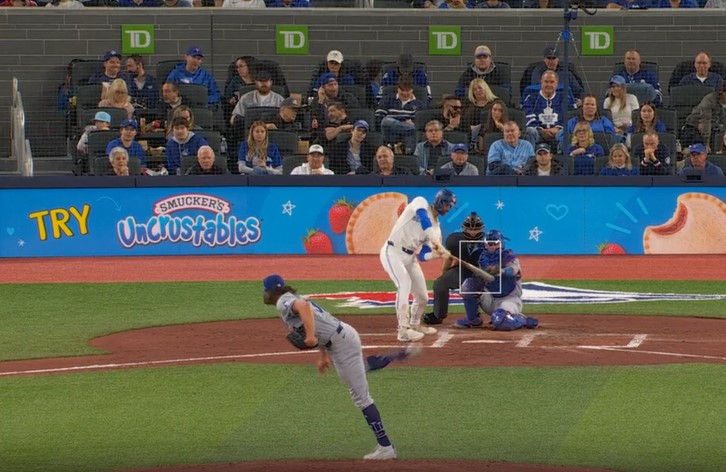
    An example from April 27 of this year shows this perfectly as Cavan Biggio initially strikes out while checking his swing. Home plate umpire John Tumpane initially calls a strike three looking, then follows that up with a foul tip signal, before getting together with the rest of his crew. In the end the Blue Jays challenge for catcher’s interference and the call gets overturned. 


    MLB Ramifications

    Diving into 2023 as the most recent full season, there are two main takeaways. Of the 14 overturned catcher’s interference challenges, 12 of them resulted in catcher’s interference being awarded when it had not initially been called. Of those 12 plays, 6 were plays where the batter had attempted to check his swing.

    Had catcher’s interference challenges not existed in 2023, there would have only been 86 catcher’s interferences instead of 96, due to the 10 net catcher’s interferences added after challenges. This is still a large uptick from previous seasons.

    However, applying the same logic to 2021 and 2022, catchers were getting hit with the bat at roughly the same rate as 2019, just that more were being called catcher’s interferences due to team challenges.

    Catcher’s interference is definitely on the rise, and while that is due in part to catchers trying to steal more strikes, the use of technology to assist umpires in making a difficult call correctly (which replay is supposed to do) is contributing to that rise as well.
  • Stat of the Week: Who Has Benefited Most Often From Good Defensive Plays?

    Stat of the Week: Who Has Benefited Most Often From Good Defensive Plays?

    BY MARK SIMON

    If you happened to catch the Cubs-Brewers game on Sunday, you saw Cubs starter Javier Assad pitch 6 scoreless innings, lowering his season ERA to 1.66.

    But a glimpse of the box score tells only part of the story.

    The Cubs infield made 4 very good defensive plays behind Assad.

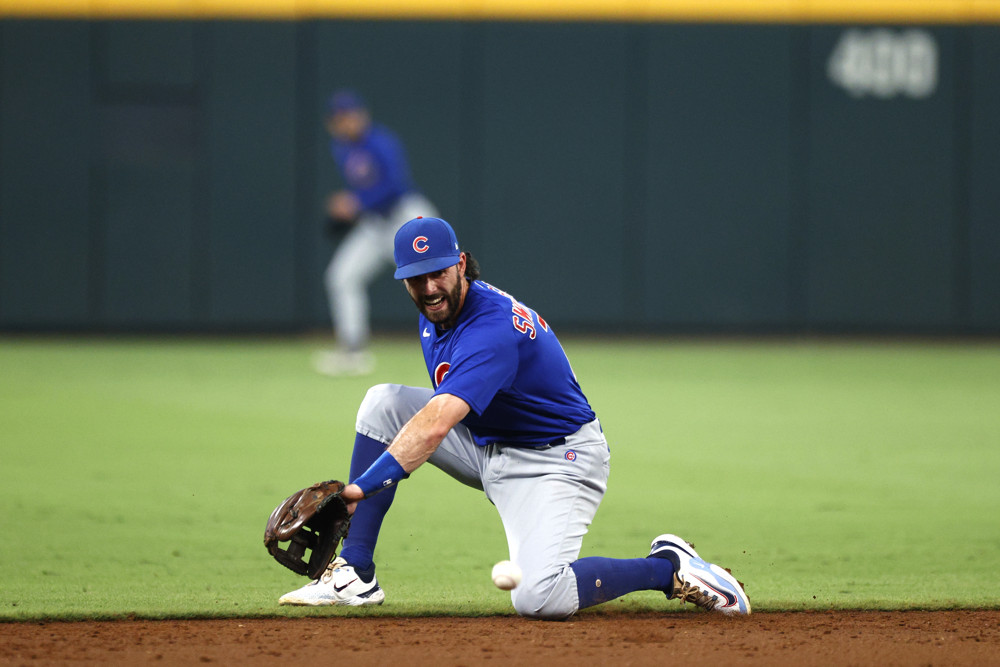
    In the top of the first, Dansby Swanson kept the game scoreless with a sliding play in the 5/6 hole and subsequent throw-out of Willy Adames with a man on 3rd and 2 outs.

    In the second inning, first baseman Michael Busch dove to tag out Oliver Dunn on a drag bunt attempt, ending the inning.

    Then Swanson took a hit away from Brice Turang with a 4th-inning sliding stop in the other direction, behind second base. Though a runner on first advanced to second, Swanson helped kill a rally.

    In the fifth inning, Busch made a sprawling stop on a Sal Frelick grounder then dove to tag first base. Again, a runner advanced to second base but the out prevented further potential damage.

    There was one other play that probably went unnoticed by many but not by us – Mike Tauchman hustled to the right field line to field a ball off the side wall and hold Tyler Black to a single.

    At SIS, we keep track of Good Fielding Plays and Defensive Misplays. These are given by our game-watching Video Scouts for about 30 types of good plays and 60 types of mistakes.

    The 4 plays on ground balls all count as Good Fielding Plays under the categorization of ‘ground ball out.’ Tauchman’s play counts as a ‘holds to single,’ and for that play Tauchman gets a fractional credit applied to his Defensive Runs Saved.

    The Cubs made 5 Good Fielding Plays behind Assad in 6 innings. He’s now been the beneficiary of 11 Good Fielding Plays this season against 2 Defensive Misplays & Errors.

    The Cubs have 3 unbeaten starting pitchers with sub-2 ERAs: Assad, Shota Imanaga, and Jameson Taillon. But there’s a difference in what’s happened behind them.

    Assad was the beneficiary of 5 Good Fielding Plays in those 6 innings. Imanaga and Taillon have received 4 Good Fielding Plays (against 8 Misplays & Errors) in 65 2/3 innings pitched all season.

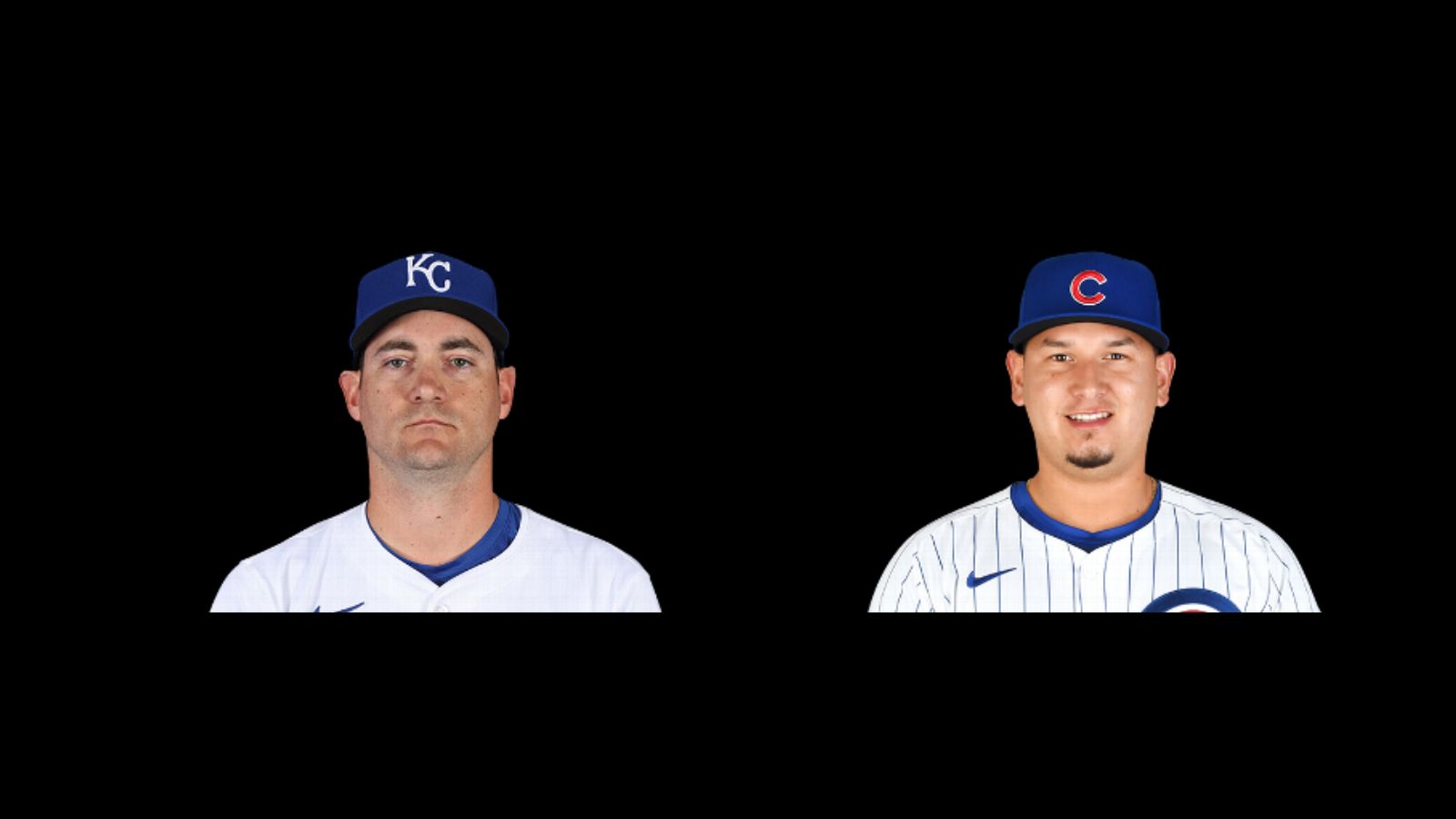
    Assad has been on the mound for the second-most Good Fielding Plays by a team for a pitcher this season. Seth Lugo of the Royals has benefited from the most, 13 (including this this home run robbery).

    But Lugo’s experience has been a little different from Assad’s. He’s been on the mound for 12 Royals misplays and errors, the most by any team for any pitcher. Lugo has thus far benefited more from the good plays than he has from the mistakes and is pitching to a 1.92 ERA.

    Phillies starter Ranger Suárez is another who has benefited from Good Fielding Plays. The Phillies have made 10 behind him (including this one by first baseman Bryce Harper). They’ve turned 85% of grounders and bunts against Suarez into outs, the 4th-highest rate in the majors (minimum 40 grounders and bunts against them). Suárez has a 1.72 ERA.

    But a high total of Good Fielding Plays does not guarantee success. Chris Bassitt of the Blue Jays and Logan Allen of the Guardians each have had 10 Good Fielding Plays behind them, just like Suárez. Each has an ERA of 5.00 or higher.

    Most Good Fielding Plays – By Team For Pitcher

    Pitcher Team Good Fielding Plays
    Seth Lugo Royals 13
    Javier Assad Cubs 11
    Ranger Suárez Phillies 10
    Chris Bassitt Blue Jays 10
    Logan Allen Guardians 10
  • The Defensive Dynamic Duo: Christian Walker and Ketel Marte

    The Defensive Dynamic Duo: Christian Walker and Ketel Marte

    Photo: Rick Ulerich/Icon Sportswire

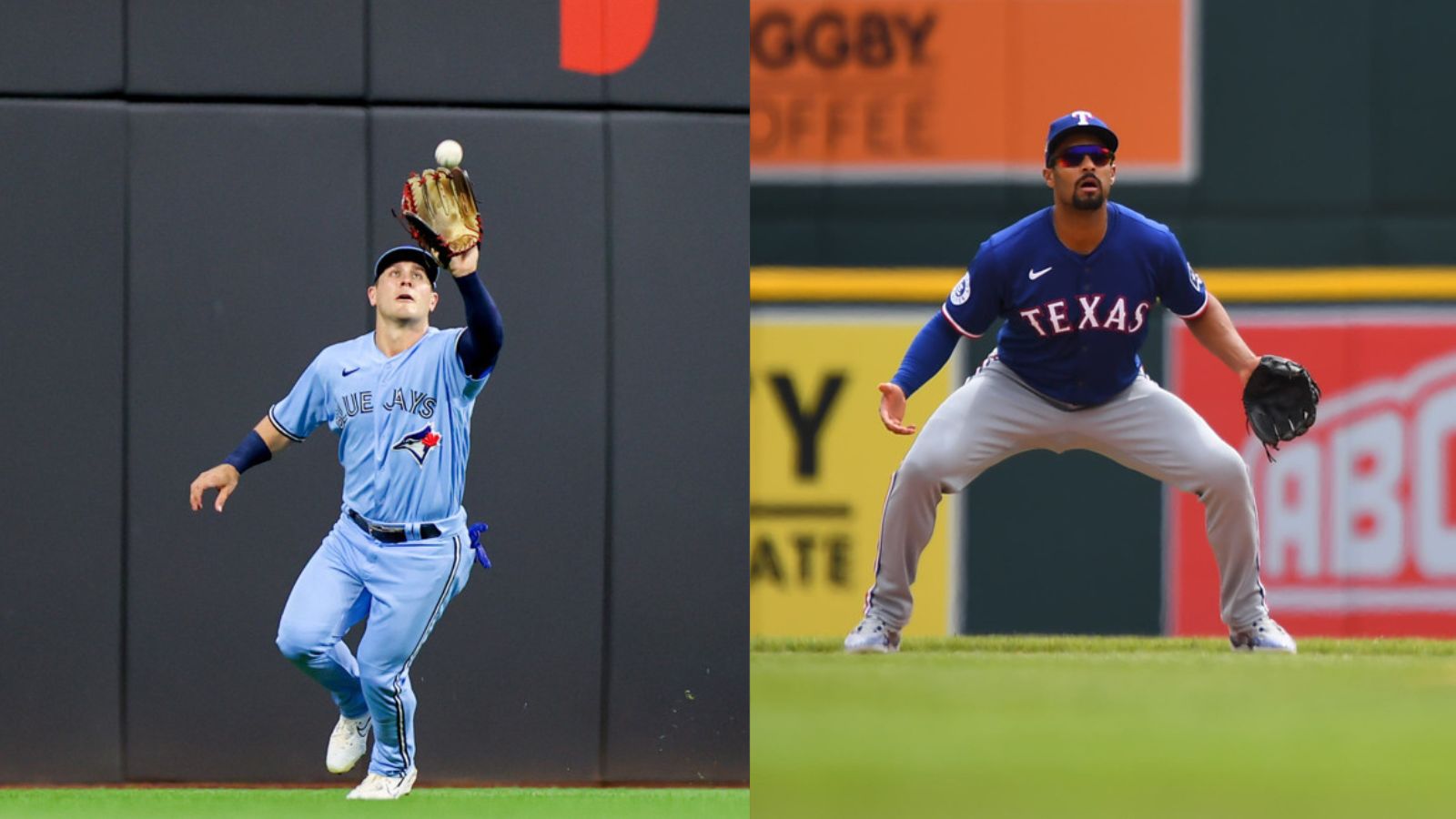
    Today we named Blue Jays outfielder Daulton Varsho and Rangers second baseman Marcus Semien as our Defensive Players of the Month. If it had been the Defensive Duo of the Month, we would have gone in another direction.

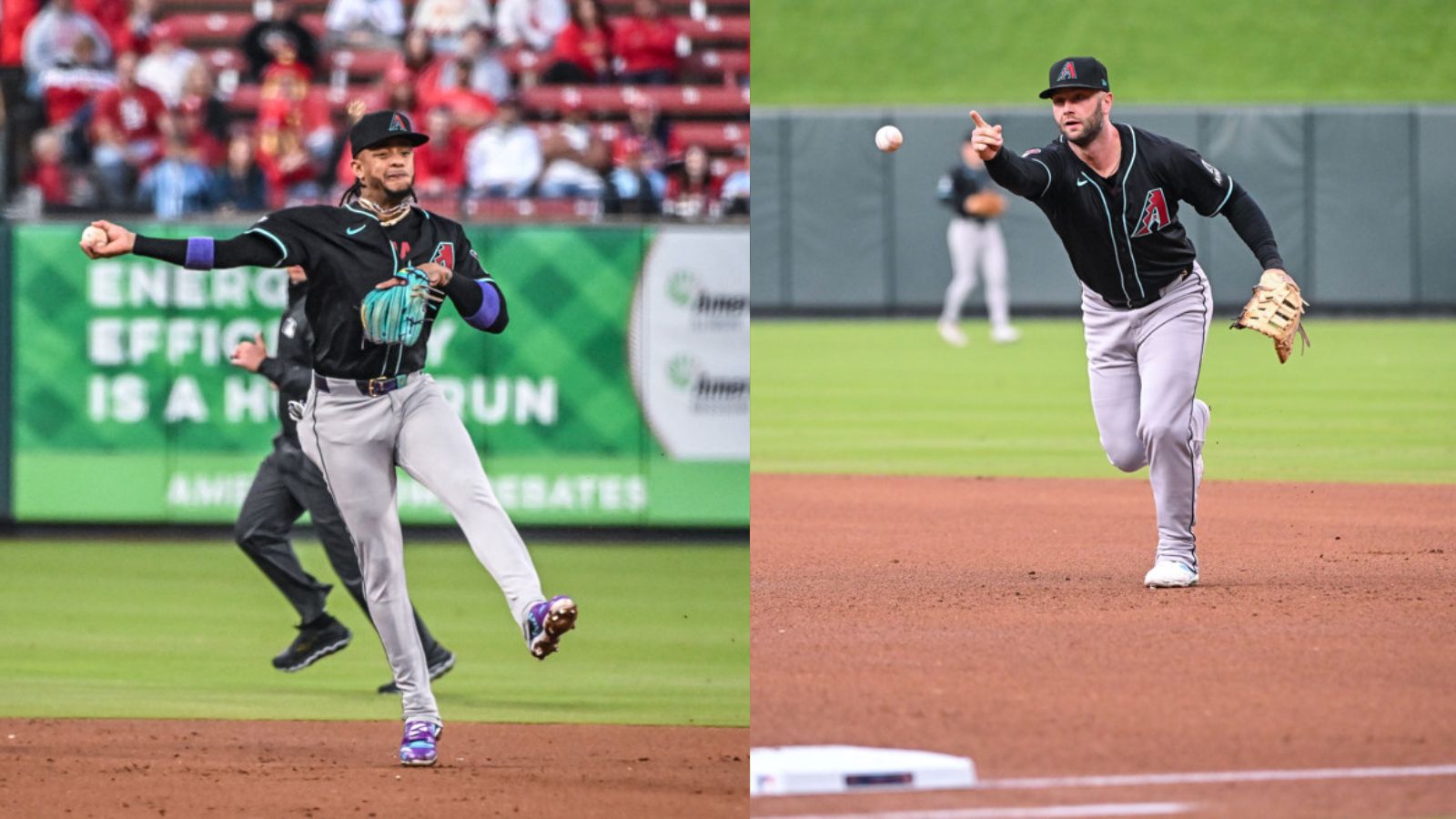
    Diamondbacks first baseman Christian Walker and second baseman Ketel Marte were each worthy on their own of being given the top honor. Together, the Diamondbacks right side of the infield was terrific, even if the team sputtered to a 14-18 start.

    The Diamondbacks have had more ground balls and bunts hit from the first base line out from home plate at an angle that roughly replicates the midpoint between home plate and second base. They’ve been the 2nd-best team at turning those balls into outs.

    Both Walker and Marte have 8 Defensive Runs Saved this season. Walker, a 2-time Fielding Bible Award winner, easily leads first basemen in Runs Saved. Marte is second to Semien at second base.

    Christian Walker

    You know how it’s said that the best players make the routine plays routinely?

    Walker has had 52 opportunities to make plays with an out probability of at least 64%. He’s completed 51 of them, the lone one he didn’t was because Brandon Pfaadt dropped Walker’s throw at first base (Walker still gets credit for successfully fielding the ball). Those “routine” plays account for 5 of Walker’s 8 Runs Saved.

    Walker has also made the tough plays when needed, like this one.

    Ketel Marte

    Marte has usually been a good defensive second baseman, though he’s only played more than 100 games in a season at the position twice. He’s averaged about 6 Runs Saved per 1,000 innings, which is a solid total. He’s totaled as many as 14 Runs Saved in a season though he had only 2 last season.

    What’s separated Marte through the first 15 to 20% of the season is that he’s minimized his mistakes in a way that runs counter to the last 2 seasons.

    Season Innings Misplays & Errors Misplays & Errors Per 1,000 Innings
    2022 806 1/3 18 22.3
    2023 1,210 1/3 28 23.1
    2024 228 2 8.8

    And he’s sprinkled in a few nice plays too.


    That the Diamondbacks entered Thursday ranked 4th in Runs Saved as a team is basically entirely the duo’s doing. The rest of the Arizona team has a combined 3 Runs Saved.

    What they’ve done on defense has basically mirrored what they’ve done on offense. Marte and Walker lead the Diamondbacks in the batting runs component of Baseball-Reference’s Wins Above Replacement too. They’re legit MVP candidates for multiple reasons.

  • Stat of the Week: March/April Defensive Players of the Month

    Stat of the Week: March/April Defensive Players of the Month

    Blue Jays outfielder Daulton Varsho and Rangers second baseman Marcus Semien are our co-Defensive Players of the month for March/April.

    The two have an additional common bond. Despite gaudy defensive statistics, they’ve never won a Fielding Bible Award.

    By our eyes, Varsho has the best highlight reel of any player in MLB this season. He finished April tied for the MLB lead among all players with 8 Defensive Runs Saved and 10 Good Fielding Plays. He’s split his time between left field (5 Runs Saved) and center field (3 Runs Saved) and thus does not lead either position individually in Runs Saved.

    Blue Jays fans (and Toronto media) shared their annoyance at Varsho not winning a Fielding Bible Award last season. Varsho led all outfielders in Runs Saved but finished 2nd in the voting to Steven Kwan of the Guardians for left field and 4th in our inaugural Defensive Player of the Year voting to Pirates third baseman Ke’Bryan Hayes. Varsho didn’t win a Gold Glove either.

    Since the start of the season, Varsho has made a statement with how good his defense has been. He’s had a knack for making great plays against great hitters. Check out his fence-crashing catch against Shohei Ohtani and his diving catches against Bobby Witt Jr. and Kyle Tucker.

    Varsho has 55 Defensive Runs Saved as an outfielder since the start of 2022 season. No one else is within 20 runs of him. It’s not just catches either. In that time, he has 11 Outfield Arm Runs Saved, 1 shy of the MLB lead.

    Semien has finished 2nd in the Fielding Bible Awards voting twice, in 2021 and 2023. Perhaps this is the season that Semien wins it as he’s off to a pretty good start.

    Semien has 7 Defensive Runs Saved this season for an infield that has turned the highest percentage of grounders and bunts into outs of any MLB team. His defensive work has been less about fancy plays (though he has this one and this one) and more about just getting to balls without issue and accumulating outs. That’s not calling him a compiler. That’s calling him good at his job.

    Semien has made just about every play he should make. Most of the balls he’s missed fielding, other second basemen have a history of missing similar balls too. Last season, Semien had 30 plays on which he was debited more than 0.4 runs. In March and April, he had only one. He’s made 19 of 19 plays with a 60% to 80% out probability and is 47-of-48 fielding balls with a greater than 80% out probability.

    By a bizarre coincidence, Semien also ended April ranked No. 1 in Defensive Runs Saved against him as a hitter. Teams have saved a combined 6 runs against his batted balls.

    Semien ended April hitting .258 but should probably be doing better than he is.

    Here are a bunch of examples of very good plays being made against him: a running catch by Cubs left fielder Mike Tauchman, a sliding snag by Astros right fielder Kyle Tucker, a play from deep in the hole by Cubs shortstop Dansby Swanson and a nifty play by Braves shortstop Orlando Arcia. Defensive positioning has also gotten Semien a couple of times, including on this catch by Mark Canha.

    There’s no shortage of good defense being played against Semien at the moment. But there’s no shortage of good defense being played by him either.

    Most Defensive Runs Saved By Position

    Through End of April 

    Player Team Runs Saved
    1B – Christian Walker Diamondbacks 7
    2B – Ketel Marte Diamondbacks 8
    3B – Trey Lipscomb Nationals 4
    SS – Masyn Winn Cardinals 6
    LF – Riley Greene Tigers 7
    CF – Kyle Isbel (Tie) Royals 5
    CF – Parker Meadows (Tie) Tigers 5
    RF – Wilyer Abreu Red Sox 4
    C – Cal Raleigh Mariners 7
    P – Josh Fleming Pirates 3

  • Going Deep with Kyle Isbel, Who Goes Deep Better Than Anyone

    Going Deep with Kyle Isbel, Who Goes Deep Better Than Anyone

    Photo: Keith Gillett/Icon Sportswire

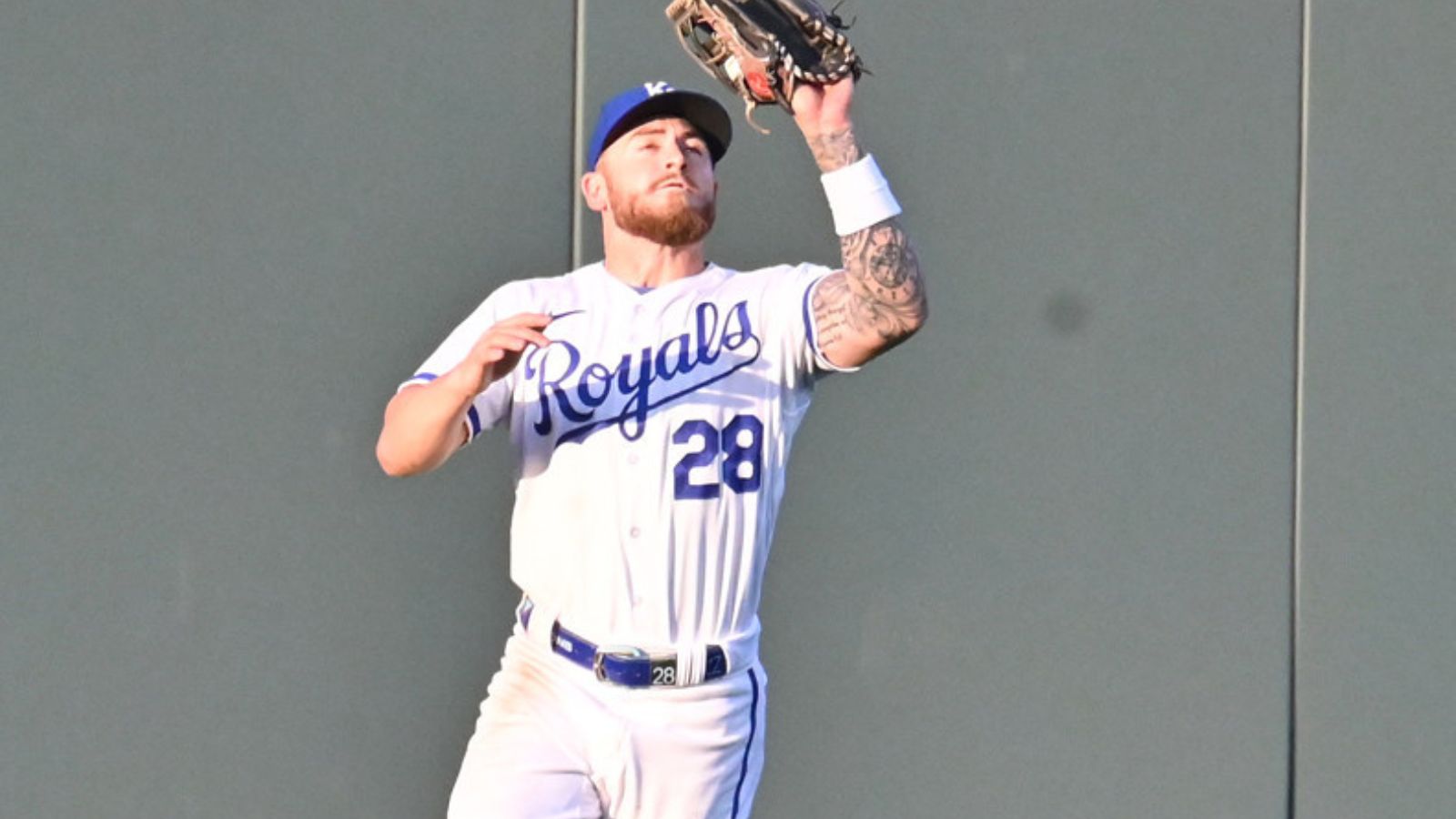
    One of the things we liked about talking to Royals center fielder Kyle Isbel was that he takes an analytical approach to playing center field without explicitly saying he’s taking an analytic-based approach. He processes data points – ones he estimates as he sees them.

    “Being able to read swings and the different pitches guys throw, you can get certain outcomes based on certain guy’s swing paths,” Isbel said in our podcast interview last week. “You can pretty much see where a ball’s going before a guy even makes contact.”

    The play on which Isbel gained the most value towards his Defensive Runs Saved this season was not a jumping, sliding, or diving catch, but one on which he got a great jump. Statcast measured him as being 7.7 feet ahead of the average major league center fielder within the first 1.5 seconds of Luis Robert Jr. making contact.

    That allowed Isbel to turn a ball with a 29% out probability into an out.

    Being able to do that and do it well is vital for any MLB center fielder. Isbel is one of the best outfielders in baseball when it comes to covering ground with immediacy. By Statcast’s jump stats he’s nearly 3 feet ahead of the average center fielder within the first 1.5 seconds of ball hitting bat.

    And as he keeps running (in a manner honed by Olympian Maurice Greene this spring), he’s still processing and analyzing estimated data points.

    “The wind is a factor, the sun is a factor,” he said. “How you perceive the ball. How does it spin?”

    That last one explains why Isbel doesn’t rank as well in another aspect of what Statcast tracks, routes.

    Watch Isbel make catches and you’ll see that sometimes he’s taking indirect paths to the ball. He goes back or comes in first and then does other things second. Relative to other center fielders it seems that there’s more in-the-moment adjustment going on.

    By Statcast’s measures, he takes among the least direct routes to a ball of any center fielder. And that doesn’t bother him.

    “You can’t necessarily see the spin off the bat at contact,” Isbel said. ”You can just kind of see the direction, so as you make your move in the direction, you figure out how the ball is spinning and that’s how your route is getting altered. The ball’s not hit straight every single time.”

    “Back or in is the first thing that pops into your head. You can see if a guy gets jammed. You can see if he hits it well, takes a big swing. The more you really watch, I try to do it in BP every day, just watch a guy’s swing. See the ball flight. Is it top spun off the bat, is it side spun, is it back spun? Did he get everything into it?”

    Isbel has the 3rd-most Defensive Runs Saved among center fielders since the start of the 2023 season.

    Most Defensive Runs Saved – CF since start of 2023

    Player Runs Saved
    Daulton Varsho 20
    Kevin Kiermaier 19
    Kyle Isbel 18
    Johan Rojas 14
    Brenton Doyle 13

    That’s driven largely by how well he’s done catching balls hit to the deepest part of the ballpark and making plays like the one he made against Robert.

    Entering Tuesday, Isbel had caught 87 of 100 balls classified as “deep” by our data tracking in the last 2 seasons. Based on out probabilities, the average center fielder would have caught 75.

    He’s 12 percentage points better than expectations. There’s no center fielder better among the 40 who have had the most opportunities since the start of 2023.

    Biggest Differential – Out Rate vs Expected Out Rate – CF Since Start of 2023

    Player Out Rate Expected Rate Difference
    Kyle Isbel 87% 75% 12%
    Daulton Varsho 93% 82% 11%
    Kevin Kiermaier 90% 82% 8%
    Johan Rojas 86% 80% 6%

    Stats through games of April 29, 2024

    The other thing we liked about talking to Isbel was that he played along with some of our questions. He opened the interview by sharing his defense origin story, playing “Impossibles” with his father as a kid (he’d have to try to make difficult catches). And he closed it by indulging us on a hypothetical.

    Isbel has a heavily tattooed left arm and says he’s done with body art. But what if he added one to commemorate his defense. What would it be?

    “I would get a lock,” he said. “That’s what comes to me when I play center field. If you get the ball over here, you’re out. It doesn’t matter where it’s at. I’m gonna lock it down. That’s just my mindset.”

    He’s got the mindset. The analytical approach is the key that unlocks the skill.

  • The Running Reds Are Even Better in 2024

    The Running Reds Are Even Better in 2024

    Photo: Joe Robbins/Icon Sportswire

    The Reds took great advantage of changes to MLB’s basestealing rules last season. They finished with 190 stolen bases, 24 more than the next-closest team.

    However, the Reds ranked only 14th in our Net Bases Gained baserunning stat, which measures the combination of stolen bases, success rate, and other baserunning elements, such as advancing an extra base on hits and doing other positive things on the bases.

    One reason why the Reds did not rank well in Net Bases Gained was that they ranked 25th in bases advanced on wild pitches, passed balls, balks, sacrifice flies, and defensive indifference.

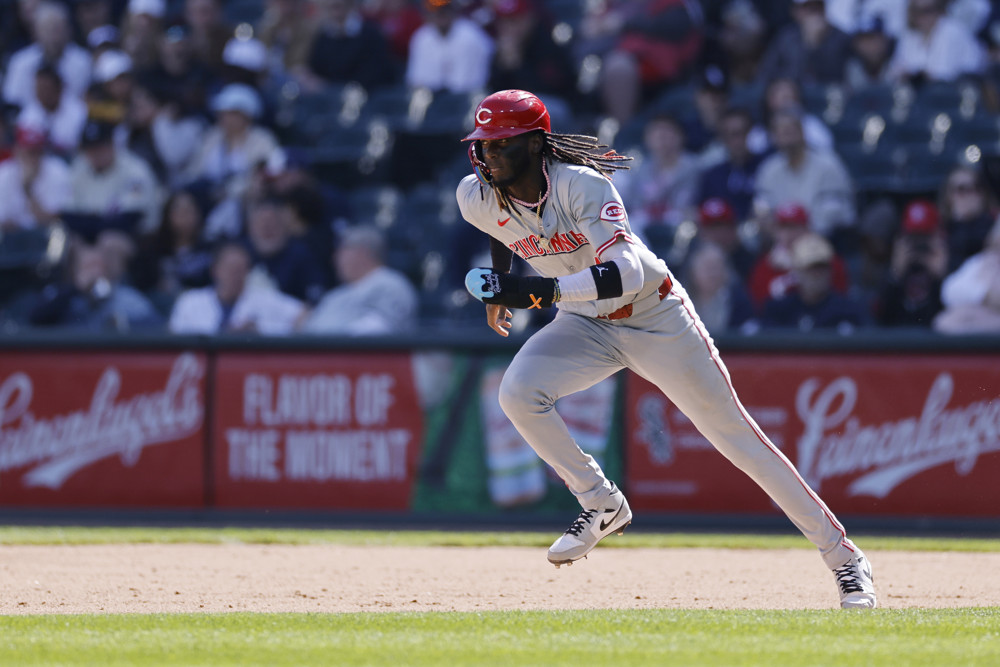
    But in 2024, the Reds have ramped up their baserunning game. They enter Friday with an MLB-best 45 stolen bases in 24 games (Elly De La Cruz has an MLB-leading 15). But they also rank 3rd in the majors with 36 bases advanced on wild pitches, passed balls, balks, etc.

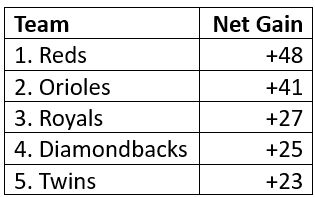
    They’ve gone from middle of the pack in that all-encompassing Net Bases Gained to No. 1.

    It’s easy to point to De La Cruz’s stolen base total or the 6 other players with at least 4 stolen bases as important. But there are 2 Reds who haven’t stolen a base this season who have also contributed to the team’s baserunning success.

    Catcher Tyler Stephenson, a decidedly negative baserunner last season, has already recorded 7 of those baserunning advances in 21 games. He tallied 10 in 142 games in all of 2023.

    Additionally, Stephenson has batted with a man on first and no outs or one out 17 times and not hit into a double play. He grounded into 16 double plays last season. As a team, the Reds have grounded into only 9 double plays, 2nd-fewest in MLB.

    Another player not known as a burner on the bases, designated hitter Nick Martini already has 5 bases advanced via wild pitch, passed ball, etc. He didn’t have any in the last 2 seasons he played in the majors (2021 and 2023).

    Shout-out to some of the other teams off to strong baserunning starts:

    The Orioles rank 2nd in Net Bases Gained with Gunnar Henderson and Jordan Westburg tied for 8th individually. They are a combined 9-for-9 basestealing this season. The Orioles are 20-for-21 in that department. The Royals rank 3rd with basestealing being the primary reason why. Kansas City ranks 2nd with 27 steals in 31 attempts.

    The Diamondbacks and Twins, who rank 4th and 5th in Net Bases Gained, respectively, have been better baserunning teams than basestealing teams. Arizona is the one team with more advances on wild pitches, passed balls, balks, etc than the Reds. It has 48. Corbin Carroll is tied for 3rd in Net Bases Gained so far in 2024. He was the runaway leader in 2023.

    The Twins are a weird case. They rank 5th in Net Bases Gained despite having an MLB-low 5 stolen bases this season. When they’ve had baserunners, they’ve done a good job of taking bases and avoiding outs. But getting baserunners to begin with is the bigger issue. The team has the 4th-lowest on-base percentage in MLB this season.

    Net Baserunning Gain Leaders

  • Stat of the Week: AL Central Doing It With Defense

    Stat of the Week: AL Central Doing It With Defense

    As someone who likes to write about defense, this is a little bit of a challenging time for me, because it’s hard to find much meaning in small sample sizes. Defensive Runs Saved isn’t necessarily meant to be an evaluative tool within the first 10 to 15 percent of the season.

    But we can still find instances in which good defense has mattered. Just look at the three teams in the AL Central that rank in the top 7 in Runs Saved.

    Royals (2nd)

    The Royals enter today ranked 2nd in the majors in Defensive Runs Saved. What’s propelled them is their defense up the middle.

    Two years ago, Bobby Witt Jr. ranked as the worst shortstop in the majors in Runs Saved. He still rated below-average per Defensive Runs Saved last season, but made considerable improvements (some metrics rated him above-average last season). This season, he’s setting an early standard.

    The Royals’ infielders have turned ground balls and bunts into outs at the highest rate in MLB, with Witt leading the way no matter what’s in his path. He leads shortstops with 5 Runs Saved.

    In the outfield, center fielder Kyle Isbel has continued his fine defensive work from 2023. Isbel doesn’t hit a lot, but thus far he’s done what the Royals have needed him to do: catch enough fly balls and line drives to have an impact.

    Combine 2023 and 2024 and Isbel ranks 3rd among center fielders in Defensive Runs Saved.

    Meanwhile, catcher, long held down by Salvador Perez, has turned into a timeshare between Perez and Freddy Fermin, the latter being a better pitch framer and the former typically being good at throwing out baserunners. Between the two of them they’ve allowed only 8 stolen base attempts all season. And Perez’s past issues with pitch framing haven’t manifested yet. The Royals’ pitchers have fared well with both.

    Guardians (3rd)

    The Guardians have last year’s Platinum Glove and Fielding Bible Award winner, Andrés Giménez, and he’s been doing as he typically does at second base. But other than that, you have to look a little deeper in order to ascertain what’s going on there.

    For one thing, the Guardians’ outfielders have combined for an MLB-high 8 assists. That’s the most in MLB. The average team has 2.5. Ramón Laureano’s 4 assists (though a couple have been awkwardly attained) are more than 25 teams have gotten from their outfield this season.

    The Guardians have also done well – at least through 19 games – in another aspect that we measure. They are tied for the major league lead when we combine their infield and outfield positioning Runs Saved totals. Score one early on for the team’s coaching staff (and probably their analytics department too).

    The Tigers (T-6th)

    Our timing on this isn’t great given that the Tigers made 3 errors yesterday, but let’s not let one bad game get in the way of some good work here.

    The Tigers have turned the 2nd-highest rate of balls hit in the air into outs of any defense in MLB (73%). And they’ve turned grounders and bunts into outs at the 7th-highest rate. If you’re wondering why the Tigers have the lowest BABIP allowed in the majors by a healthy margin, that’s why (.244, 14 points better than the next-closest team).

    Additionally, the Tigers have a pair of home run robberies, which count significantly in Defensive Runs Saved because these plays literally save runs. On March 30, Parker Meadows brought this one back from White Sox catcher Martin Maldonado. On April 9, Riley Greene snared a would-be homer from Pirates third baseman Ke’Bryan Hayes. The Tigers won a close game in both instances.

    The good D has helped the Tigers to a 10-9 start despite an offense that ranks in the bottom 5 of the American League in runs scored and the slash line stats.

  • Stat of the Week: Scouting Home Plate Umpires and Their Tendencies

    Stat of the Week: Scouting Home Plate Umpires and Their Tendencies

    Photo: David J. Griffin/Icon Sportswire

    If you’re a regular viewer of Yankees, Phillies, Cubs, Athletics or White Sox broadcast crews this season, you might have seen and heard the broadcasters provide a scouting report on the home plate umpire.

    The information from those scouting reports comes from our company. We provide them with heat maps and data points on strike-calling tendencies. The primary questions we answer with that information are:

    How often is a pitch thrown to a certain area called a strike and how does that compare to other umpires?

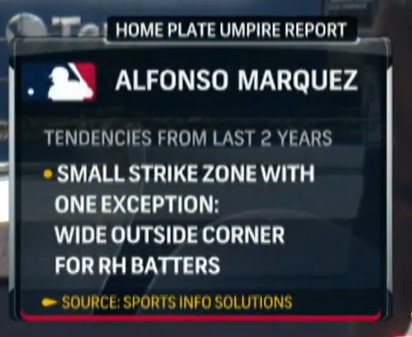
    For example, here’s what the Phillies’ broadcast on NBC Philadelphia ran after Trea Turner took an outside pitch that home plate umpire Alfonso Márquez called a strike a few days ago.

    Alfonso Marquez tendencies - a small strike zone with one exception, wide outside corner for RH Batters

    From a broader perspective, SIS divides credit for called strikes among the catcher, umpire, pitcher, and batter through a process that you can read about here. In doing so, we created two metrics: Extra Strikes Per 150 Called Pitches and Strike Zone Runs Saved, with the latter being calculated to provide a run value based on the raw number of extra strikes called.

    This allows us to gauge an umpire’s tendency to call more or fewer strikes than expected. An umpire who calls a lot more strikes than expected has a high Strike Zone Runs Saved total.

    Note that we’re not exploring the idea of correct call versus incorrect call. We’re looking at how each MLB umpire compares to other umpires in strike-calling. And with more detailed data, we can ascertain whether their strike zones are bigger or smaller heightwise and narrower or wider lengthwise.

    Last season we wrote an article about how Doug Eddings and Bill Miller have called considerably more strikes than expected dating to the first season we tracked for umpire tendencies, 2010.

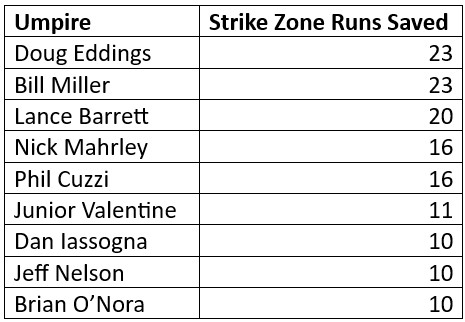
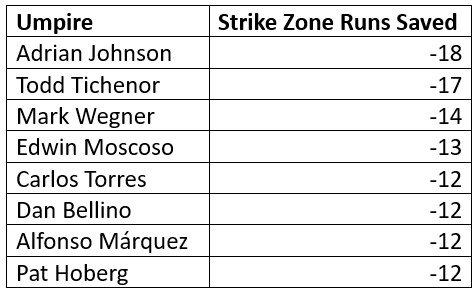
    Here are the umpires with the most Strike Zone Runs Saved since the start of the 2022 season. You can think of them as umpires who tend to call a good deal more strikes than expected when looking at all MLB umpires’ strike-calling tendencies.

    Most Strike Zone Runs Saved – Since 2022

    Márquez, despite that odd strike call against Turner, ranks closer to the other end of called strike tendency leaderboards.

    Here are the umpires with the fewest Strike Zone Runs Saved since the start of the 2022 season. You can think of them as umpires who tend to call considerably fewer strikes than expected when taking into account all MLB umpires’ strike-calling tendencies.

    Fewest Strike Zone Runs Saved – Since 2022

    If you’re watching one of our partner’s telecasts this season, we hope you enjoy the added perspective this umpire information brings. It gives you another way to look at how the human element – that of not all umpires being the same when it comes to calling balls and strikes – impacts the sport.


  • Stat of the Week: Trey Lipscomb Makes A Good First Impression

    Stat of the Week: Trey Lipscomb Makes A Good First Impression

    Early this season baseball fans are celebrating big starts at the plate from Mookie Betts, Juan Soto, and Bobby Witt Jr. 

     But what about recognizing a good start in the field?

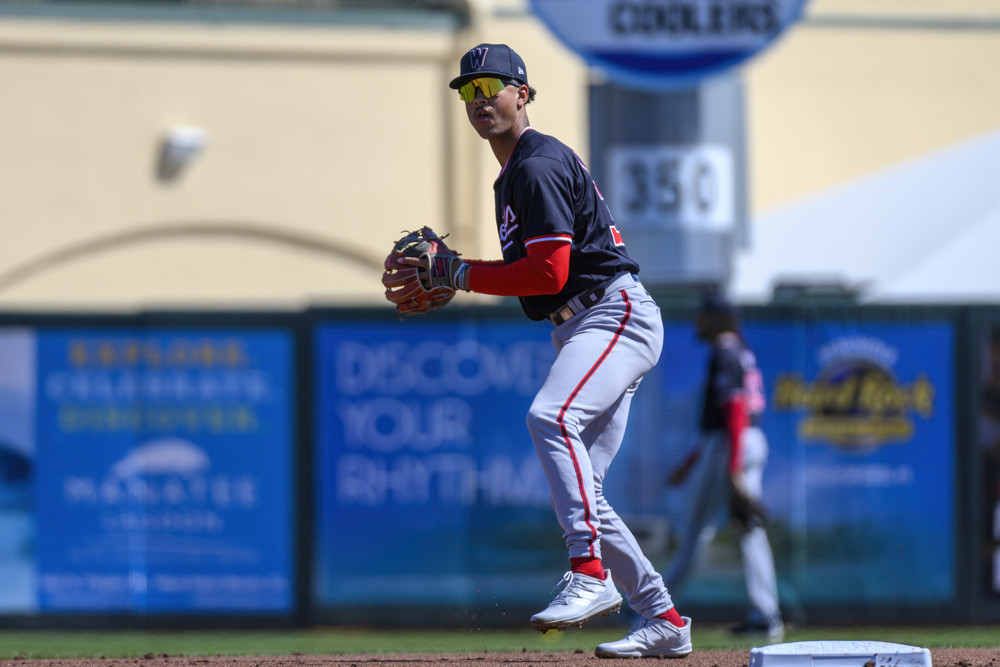
     It’s an oft-said baseballism that when you’re newly in a game, the ball finds you. The ball has found Nationals third baseman Trey Lipscomb a lot. In his first 3 major league games, Lipscomb has already handled 15 chances cleanly.

     That’s busy for a third baseman. Ke’Bryan Hayes led the position in range factor last season. He had a few three-game stretches last season like the one Lipscomb just did, but his range factor last season was an average of just under 3 chances per game.

     Now you may ask why we’re bringing up an unknown rookie on a 1-3 team that may finish at the bottom of the NL East this season. Fair question. 

     It’s easy to get excited by the superduperstars and the hyped rookies, like Jackson Chourio and Wyatt Langford. But part of the fun of baseball is about the under-the-radar guys who might catch some people by surprise.

     And while maybe Lipscomb won’t be Hayes or Nolan Arenado in the field, he could still be someone you’ll want to watch. Reds broadcaster and Hall of Famer Barry Larkin was impressed and said so during during the telecasts of the last 2 games of the Reds-Nationals series. Larkin’s a 3-time Gold Glove winner, so when he says a player has been “impressive,” we listen.

    We talked to Lipscomb last year after he won a minor league Gold Glove at third base in a season in which he played every infield position. He was among the Nationals’ final cuts after hitting .400 in spring training but was almost immediately recalled when Nick Senzel suffered an injury that required an IL stint.

    Lipscomb made a couple of nifty plays on ground balls, getting an initiation in the first inning of his first game at third base on a Christian Encarnacion-Strand grounder that took a high hop. Lipscomb handled it well and got the out.

    Lipscomb’s best play by Runs Saved was also against Encarnacion-Strand, one that he turned into a 5-4-3 double play. That play was worth nearly 3/4 of a Run Saved by itself.

    Lipscomb and Encarnacion-Strand had quite the batter-fielder relationship for a couple of days, with Lipscomb retiring Encarnacion-Strand 5 times.

    Lipscomb said in our interview that he wanted to be a fielder who dominated the routine plays. He had his share in his first 3 games and looked comfortable.

    But there were a couple of interesting challenges. On one play Lipscomb made, against Bryan Reynolds of the Pirates, he chose not to throw home in a situation in which he may have had a play at the plate. For those unaware, that decision is factored into Lipscomb’s Defensive Runs Saved. He gets a credit for retiring Reynolds at first base but also loses some run value within his Runs Saved for what we call “Giving Away a Lead Runner” in our cataloging of Defensive Misplays.

    Lipscomb also was unable to make a play on a hard-hit ball down the third base line. However, by diving and reaching the ball, Lipscomb held Santiago Espinal to a single rather than a double.

    Lipscomb got penalized within Defensive Runs Saved for not making the play on Espinal, but he gets a chunk of that run value back because he recorded a “Keeping The Ball In The Infield” in our tracking of more than 30 types of Good Fielding Plays.

    All in all, Lipscomb got through his first 3 days in the major leagues pretty well. He experienced a variety of plays and handled them. He wasn’t perfect but he made a strong impression.

    “The game of baseball is not about perfection,” Lipscomb said in our offseason conversation. “But if you can be as physically sound and mentally sound on defense as you can, it can help you a lot.

     So far so good. Let’s see if he can keep it up.

  • Stat of the Week: 2024’s NL Defensive Stories

    Stat of the Week: 2024’s NL Defensive Stories

    BY MARK SIMON

    With Opening Day approaching, we wanted to preview the 2024 season from a defensive perspective. So to be fair to all 30 teams, we’ve got a stat-driven theme or story to watch for each team. Here’s our look at the National League teams after we did our tour through the American League last week.

    Braves – The Braves were generally average or better through much of their defensive lineup last season. The big exception was shortstop, where Orlando Arcia and Vaughn Grissom didn’t do well. Arcia had -6 Runs Saved last season due to poor range numbers. He is back for another go and looking to return to the form he showed in 2018 when he totaled 8 Runs Saved.

    Brewers – The Brewers ranked 2nd in MLB in Defensive Runs Saved last season but they’ve got some unknowns on this year’s roster with Jackson Chourio in right field and Joey Ortiz at third base. Last year’s Brewers rookies played very well (Brice Turang, Joey Wiemer, Blake Perkins) and the defensive success of this year’s team may hinge on their young players again.

    CardinalsNolan Arenado went from overwhelmingly awesome to decidedly average at third base overnight (from 20 Runs Saved in 2022 to 0 in 2023). So the big question this season is whether he can return to the standard-setting level of excellence of years past.

    Cubs – The Cubs have the best double play combination in baseball with shortstop Dansby Swanson and second baseman Nico Hoerner. Given that they also have two-time Gold Glove winner Ian Happ in left field, Mike Tauchman and Cody Bellinger in center field, with Bellinger likely also at first base, the Cubs could be pretty good defensively. They finished tied for 8th in Defensive Runs Saved last season and could better that.

    Diamondbacks – It’s reasonable to suggest that the Diamondbacks are the NL’s best defensive team. They finished 4th in Defensive Runs Saved last year and have very good defenders at catcher (Gabriel Moreno), first base (Christian Walker), and center field (Alek Thomas). Shortstop and third base may determine whether that suggestion becomes reality. Runs Saved has not viewed Geraldo Perdomo or Eugenio Suárez favorably, so those are the positions to watch entering 2024.

    Dodgers – The Dodgers have been a Top 10 team in Defensive Runs Saved in each of the last 8 seasons. They always seem to make the right moves and in 2024 they’re making a bold one by making Mookie Betts their everyday shortstop. Betts, who won the Fielding Bible Award last year for multi-position play, handled second base very well last season. The Dodgers do have some flexibility here. They could move Betts back to second and play one of the game’s best defensive shortstops, Miguel Rojas, if things don’t work out.

    Giants – In theory, the Giants should be a lot better defensively than they were last season. Their 3 weakest defensive positions by Runs Saved were shortstop, third base, and center field. They signed 2 standout infield defenders in Matt Chapman and Nick Ahmed and signed Jung Hoo Lee, who led all KBO center fielders in Runs Saved last season. Those could be a boon to pitchers like Blake Snell and Logan Webb.

    Marlins – What can infield coach Jody Reed do for Tim Anderson? The new Marlins shortstop has totaled -22 Runs Saved the last 2 seasons, which ranks 2nd-worst at the position. Reed will do his best to maximize what Anderson can do. The Marlins ranked as one of the best-positioned infields in MLB last season.

    Mets – One year after signing Brandon Nimmo to a long-term contract, they’ve moved him from center field to left field and attempted to turn a defensive weakness into a strength by signing Harrison Bader as their new primary center fielder. Bader has twice totaled at least 15 Runs Saved in a season in center field. His 5 Runs Saved there the last 2 years are 16 more than Nimmo in that span.

    Nationals – The Nationals have finished 29th and 28th in Runs Saved the last 2 seasons and need a few things to happen in order to improve on that in 2024. One would be to see some improvement from catcher Keibert Ruiz. The Nationals ranked last in MLB in Runs Saved from their catchers. It would also behoove them to find playing time for minor league Gold Glove winner Trey Lipscomb, who can play any of the infield positions (read our interview with him here).

    Padres – Two things: One is whether Fernando Tatis Jr. can replicate his 2023 season, when he blew away everyone else at the position with 29 Runs Saved. Two, the position switch of Xander Bogaerts to second base so as to put their best infield defender, Ha-Seong Kim, at shortstop. Bogaerts has managed a positive Runs Saved total once in the last 10 years. Second base may be a better fit for him but time will tell.

    Phillies – Johan Rojas didn’t have a particularly good spring training with his bat but he’s arguably too valuable to even consider sitting. He’s by far the Phillies’ best defensive player. Rojas ranked 4th in Runs Saved among center fielders despite ranking 37th among them in innings played.

    Pirates – The Pirates ranked 28th in Defensive Runs Saved from their center fielders last season, but that could change significantly if Michael A. Taylor hits enough to stay in the lineup there. Taylor leads all center fielders in Runs Saved over the last 3 seasons.

    Reds – The Reds ranked 27th in Defensive Runs Saved last season. They’re running out most of the same players this season, save for Jeimer Candelario at third base, which could be a small improvement in Defensive Runs Saved. But they may be a bottom-10 team again.

    Rockies – The most watchable thing the Rockies have right now is their defense. They have Fielding Bible Award-caliber players at second base (Brendan Rodgers), shortstop (Ezequiel Tovar), third base (Ryan McMahon), and center field (Brenton Doyle), and a left fielder with a terrific arm (Nolan Jones). This will probably be the team with the biggest difference between the quality of its defense and its win-loss record.