Category: Football

  • Just How Great Is This Denver Broncos Pass Rush?

    Just How Great Is This Denver Broncos Pass Rush?

    The 2025 Denver Broncos defense are doing things their own way. Different from what Tom Jackson, Randy Gradishar, Lyle Alzado, and the “Orange Crush Defense” of the 70’s did by suffocating opposing run games. Different from what Demarcus Ware, Von Miller, Aqib Talib, Chris Harris Jr. and the “No Fly Defense” did by locking up opposing passing attacks.

    How they are getting it done is getting to the quarterback at a historic rate. Their 68 sacks in the regular season rank 5th all time and only behind the 2022 Philadelphia Eagles this century. Their 44% pressure rate is T-2nd in the NFL since 2021.

    Denver Broncos – Overall Pass Rush Tendencies

    Usage (Rank) Success (Rank)
    3-Man Rush 5% (10th) 27% (7th)
    4-Man Rush 63% (30th) 40% (1st)
    Blitz 32% (3rd) 45% (9th)

    From a tendency perspective, one can see that they prefer to bring the blitz, doing so at the 3rd-highest rate in the league. However, what makes them different is that they like to bring the heat on early downs, specifically at a 34% clip that is the 2nd-highest in the league. This has resulted in the 6th-lowest success rate allowed. On late downs, they blitz only 28% of the time and are successful at the 19th-best rate.

    No matter what the circumstance, the Broncos are having success with the four-man rush. On early downs, they utilize the four-man rush at the second-lowest rate but are doing so at the most successful rate in the league. The usage increases to the 12th-highest on late downs, but remains incredibly successful at the 2nd-highest success rate.

    Defensive Coordinator Vance Joseph is dialing up the right mix of bringing pressure and letting his four man front get to work. This keeps them unpredictable at the right times, keeping offenses on their toes when sorting out protection schemes.

    This coordinated, team-based effort differs from deploying all-world pass rushers like the Myles Garretts and Aidan Hutchinsons of the world, but this front is still loaded with talent that rivals these two.

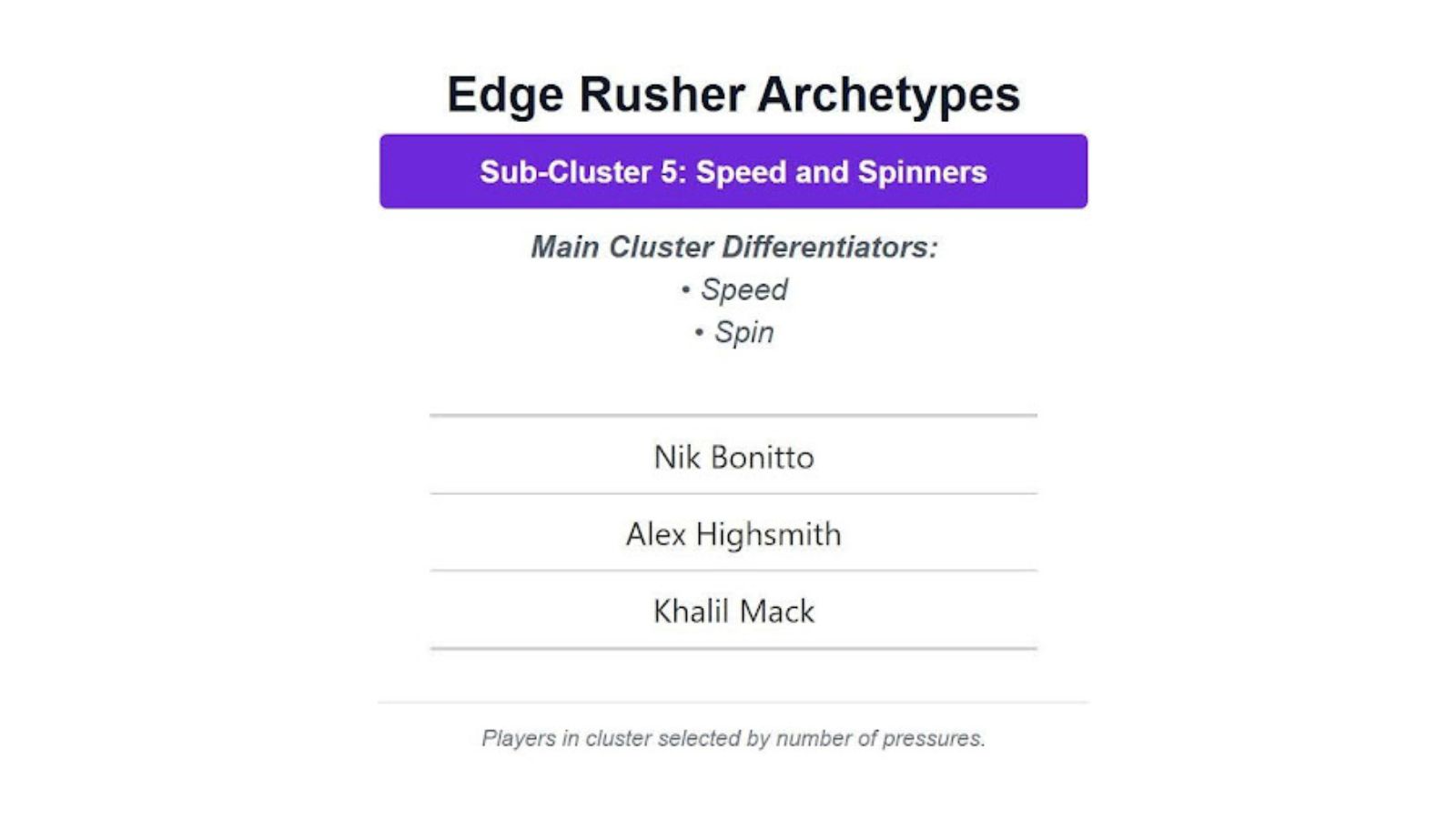
    Nik Bonitto is the first name that comes to mind when you think of pure talent on this Broncos pass rush. His 74 pressures rank him 7th in the league and he has been able to bring down quarterbacks 14 times, good for 5th.

    What is even more impressive is that he has a Pressure Above Expectation Rate at 5.6%, meaning he is getting to the quarterback more than average when factoring things like alignment, down, yards to go, etc. This rate is good for the 4th best in the league.

    His go-to bull rush (73 snaps) has generated 1 sack on a 11.4% pressure rate, but his speed move is much more effective. On 71 snaps, he has generated 6.5 of his sacks on a 32% pressure rate. His quickness and bend around the edge certainly make this his most effective move.

    His edge mate Jonathon Cooper has had a solid season with 8 sacks on 49 pressures and a 0.4% Pressure Rate Above Expectation. He is another speed and speed-to-power extraordinaire, as 7 of his sacks have come on these moves.

    So Bonitto and Cooper have been good, but to be one of the best pass rush units of the century, there has to be more, right? Right indeed.

    The interior push that the Broncos are getting is next level. Zach Allen, John Franklin-Myers, and D.J. Jones all rank in the Top 25 in Pressure Rate Above Expectation for interior defensive linemen as well.

    Denver Broncos Interior Defensive Linemen – League-Leading Totals

    Stat Total
    Pressures 139
    Sacks 25
    Pressure Rate 21%

    Zach Allen is having the best year of his career and it’s not close. His 65 pressures are tied for the most with Jeffery Simmons and his 7 sacks are good for 7th among interior defensive linemen. What might be the most impressive part of Allen’s game is his pass rush repertoire, where he has registered a half sack or more on 8 different moves! The all-around pass rusher is on the AP All-Pro First Team and is hunting more quarterbacks deeper into the playoffs.

    Nose tackle D.J. Jones may have only 3 sacks, but he leads interior defensive linemen in Pressure Rate Above Expectation at 6.6%. This is also the 3rd highest since 2020, with Dexter Lawrence’s 2022 and 2023 campaigns resulting in a higher rate. 

    John Franklin-Myers is 3rd in sacks with 7.5 and 7th in pressures with 45. He has been able to generate pressures with a bull rush, swipe, stunt-loop, and rip moves primarily, boasting a pressure rate above 10% for each of them.

    So as we head into Conference Championship Sunday, will the Patriots be able to handle this pass rush? They rank 2nd in Pass Blocking Total Points and are middle of the road in pressure percentage allowed at 37.5%. Over the course of the playoffs, Drake Maye has relinquished 3 fumbles and has been prone to do so all year. 

    The Broncos pass rush, even with all of the pressures and sacks they have generated, have forced only 5 fumbles and recovered 2 of them. With a backup quarterback, adding to those numbers could do them wonders in looking to find their way to Santa Clara.

  • 2025 SIS NFL All-Pro Team

    2025 SIS NFL All-Pro Team

    Sports Info Solutions, a leader in the football analytics space, is pleased to announce its 2025 NFL All-Pro Teams. 

    The teams were selected using a combination of advanced stats and the eye test, with emphasis placed upon SIS’ player value stat, Total Points.

    Total Points attempts to capture everything that happens during play. It’s based on the work of our Data Scouts, who watch and chart every play of every game, and our Research & Development team. Value for successful and failed plays is divvied up among all players on the field based on what happened (for a comprehensive explanation on Total Points, click here).

    Here are the 2025 Sports Info Solutions All-Pro Teams:

    1st-Team Offense
    Position Player Team
    Quarterback Matthew Stafford Rams
    Running Back Bijan Robinson Falcons
    Wide Receiver Puka Nacua Rams
    Wide Receiver Jaxon Smith-Njigba Seahawks
    Wide Receiver Ja’Marr Chase Bengals
    Tight End Trey McBride Cardinals
    Tackle Darnell Wright Bears
    Tackle Penei Sewell Lions
    Guard Joe Thuney Bears
    Guard David Edwards Bills
    Center Zach Frazier Steelers


    Quarterback: Matthew Stafford, Rams

    Matthew Stafford was on another level in 2025. He led the NFL in passing yards (4,707) and passing touchdowns (46). Among all QBs with at least 250 attempts, he had the highest touchdown rate (7.7%), was 3rd in IQR (109.2), and tied for the 3rd-lowest interception rate (1.3%) all while tying for the deepest average throw depth (9.0 yards). It’s not a surprise he’s the front runner for the MVP and has led the Rams back into the playoffs. -Nathan

    Running Back: Bijan Robinson, Falcons

    Bijan Robinson cemented himself as the best all-around running back in the NFL this season. He finished 4th in the NFL in rushing yards with 1,478 and was 2nd in receiving yards among all running backs with 820. He finished the season with an outstanding 81 Total Points which was 40 more points than the next two running backs. What also makes Robinson special is his ability to make defenders miss. He led all running backs with a 29% broken and missed tackle rate on rushing attempts (minimum 100 carries). -Jordan

    Wide Receiver: Puka Nacua, Rams

    Puka Nacua put together another incredible season, leading the NFL with 129 receptions and finishing 2nd with 1,715 receiving yards. He led the league in receiving first downs (80) as well as 20+ yard receptions (27).  Nacua led all receivers with 22 broken tackles on his receptions, plus an additional 6 missed tackles just for good measure. His Receiver Rating of 128 led all NFL wide receivers with at least 50 targets, and his 76 Total Points were the 2nd-most of any non-QB in the NFL. Finally, he won our NFC Player of the Week four times this season, the most of anybody. -Jeff

    Wide Receiver: Jaxon Smith-Njigba, Seahawks

    Jaxon Smith-Njigba led the NFL in receiving yards with 1,793 in 2025. What’s most impressive, is he had only one drop on the season. You have to go all the way down to Dalton Schultz, who was 38th in receiving yards with 777, to find someone with only a single drop. Additionally, Smith-Njigba’s 43 Receiving Total Points and 31 Points Above Average both ranked 2nd among all NFL WRs. -Nathan

    Wide Receiver: Ja’Marr Chase, Bengals

    Ja’Marr Chase stacked another phenomenal season to his NFL career, even with juggling multiple QB’s for the Bengals in 2025. He led the NFL in targets with 186, and was 2nd in receptions among WR’s with 125. He also finished 2nd in YAC (649) and defensive pass interferences drawn (9) among WRs. He finished tied 3rd in Total Points among all WRs with 40. -Jordan

    Tight End: Trey McBride, Cardinals

    Trey McBride had a historically good season on his way to setting the single-season, tight end reception record (126) and doing it within the first 16 games. His 1,239 receiving yards were over 300 yards better than the next-best tight end. His 25 broken and missed tackles forced were tops among tight ends as were his 63 first downs. Unsurprisingly, his 56 Total Points were the most among tight ends and 20 better than second place. -Jeff

    Tackle: Darnell Wright, Bears

    Darnell Wright had a fantastic 2025 season, leading all tackles in Total Points with 42. He was an iron man in his own right, having logged over 1,000 total snaps this season, which only 11 other tackles in the NFL were able to do. He also had a 2.4% blown block rate, and is one of only two tackles in the 2025 season to log over 1,000 total snaps and have a blown block rate below 2.5%. He was also an elite pass protector, who led all tackles in Pass Block Total Points with 23. -Jordan

    Tackle: Penei Sewell, Lions

    Penei Sewell having an All-Pro season is nothing new, but this was arguably the best season of his career. Some of the deficiencies he’s had in pass protection in recent years have been overlooked due to how good the Lions OL has been. However, in 2025, that wasn’t the case. Sewell had to be good, and he was. His 1.7% blown block rate was best among all NFL tackles who played at least 500 snaps with a 2.3% rate in pass pro and a miniscule 0.8% as a run blocker. His 22 Total Points as a pass blocker ranked 2nd among all tackles, and was the best ranking of his career. -Nathan

    Guard: Joe Thuney, Bears

    Joe Thuney was a major contributor to the Bears offensive improvements from last season. He led NFL guards with 44 Total Points and 15 Total Points Above Average. He was one of only two offensive linemen to earn at least Total Points as both a run blocker and as a pass blocker, Zach Frazier being the other. Thuney’s 1.1% blown block rate was the best among NFL guards as was his 0.9% blown block rate on runs (minimum 500 snaps). -Jeff

    Guard: David Edwards, Bills

    David Edwards earned the competitive second guard spot due to his reliability and impact. He was second among NFL guards in Total Points (40) and Total Points Above Average (13). His 1.5% blown block rate was tied-3rd among guards as he helped pave the way for the best rushing offense in the NFL this season. -Jeff

    Center: Zach Frazier, Steelers

    Zach Frazier had a fantastic second season in his NFL career, ranking 1st in Total Points among centers with 43. He was balanced in both the pass and run game, finishing 2nd  in Pass Block Total Points and 1st in Run Block Total Points among centers. He also finished with an outstanding 1% total blown block rate which ranked 2nd among all centers (minimum 500 snaps). -Jordan


    1st-Team Defense
    Position Player Team
    Defensive Tackle Jeffery Simmons Titans
    Defensive Tackle Quinnen Williams Cowboys
    Edge Will Anderson Jr. Texans
    Edge Myles Garrett Browns
    Linebacker Jack Campbell Lions
    Linebacker Devin Bush Browns
    Cornerback Derek Stingley Jr. Texans
    Cornerback Pat Surtain II Broncos
    Safety Kevin Byard III Bears
    Safety Talanoa Hufanga Broncos
    Defensive Back Cooper DeJean Eagles


    Defensive Tackle: Jeffery Simmons, Titans

    While the Titans struggled for much of the 2025 season, the defense, led by Jeffery Simmons, was a bright spot. Simmons’ 69 Total Points blew all other defensive tackles out of the water (Chris Jones was 2nd with 42). He led all DTs in sacks with 11 and pressures with 63, which ranked 13th in the entire league, no matter the position. His 15.5% pressure rate also led all DTs with at least double-digit pressures. -Nathan

    Defensive Tackle: Quinnen Williams, Cowboys

    Quinnen Williams had a fantastic season for both the New York Jets and Dallas Cowboys, having been traded midseason. He finished the season ranked 3rd in Total Points among defensive tackles with 40. He also ranked at the top of Run Defense Total Points among defensive tackles with 24. While he only had 2.5 sacks this season, he finished 4th in total pressures among defensive tackles with 49. -Jordan

    Edge: Will Anderson Jr., Texans

    Will Anderson Jr. has gotten better each year and he ended this season tied for 1st among edge players with 70 Total Points. He was 2nd in the NFL in pressures (94) on his way to gathering 12 sacks. His pressure rate of 23% was 2nd-best in the NFL (minimum 100 pass rushes) as was his 57 Pass Rushing Total Points. He did not slack off against the run either, finishing 4th in the NFL with 22 tackles for loss. Anderson showed why the Texans traded up to draft him, and he may have had his first Defensive Player of the Year trophy if it were not for the player below… -Jeff

    Edge: Myles Garrett, Browns

    It was a record setting year for the future Hall of Famer, Myles Garrett. He broke the single-season sack record with 23 total sacks, a mark Michael Strahan had for 24 years (though it took Garrett a 17th game to set the mark). He finished the season with a 5% sack rate on his pass rush snaps, which led all defenders (minimum 30 pressures). He also finished 3rd among defensive ends in Pass Rush Points Saved with 55 and 4th in total pressures with 83. -Jordan

    Linebacker: Jack Campbell, Lions

    The defensive leader in Total Points in 2025 was Jack Campbell, who amassed 74. Not only did that lead all defensive players, it was 17 points higher than Devin Bush’s 57 for 2nd among LBs. He also wasn’t one-dimensional. He filled up the stat sheet to the tune of 168 tackles, 5 sacks, 19 pressures, and 3 forced fumbles. His 32 Total Points against the run were most among all LBs, and his 42 Total Points in the pass game ranked 3rd. -Nathan

    Linebacker: Devin Bush, Browns

    Devin Bush may not get the same love as some of the other Browns defenders, but he was excellent this season. His 57 Total Points and 28 Total Points Above Average were both 2nd-best among linebackers. He was one of only two linebackers to earn 35+ Pass Defense Total Points and 20+ Run Defense Total Points, along with Campbell. Bush had a pair of pick-sixes this year, including a 97-yard return in the final week of the season. -Jeff

    Cornerback: Derek Stingley Jr., Texans

    Derek Stingley Jr. had another fantastic season as one of the primary defenders on a star-studded Texans defense. He led all cornerbacks in Total Points Saved with 42 on 60 total targets. He finished the season with 4 interceptions and 11 pass breakups. He also finished the season with a 61.4 Passer Rating Against, which ranked 17th-lowest among cornerbacks with at least 25 targets. -Jordan

    Cornerback: Pat Surtain II, Broncos

    The Pat Surtain effect was in full force in Denver during the 2025 season. Surtain saw 62 targets come his way, tied for 19th-most in the league. However, Riley Moss, his teammate and opposite corner, saw 103 targets, 15 more than anyone else in the league. His 38 Total Points in pass coverage and 21 Points Above Average were both 2nd-best behind Stingley. Additionally, among the 100 CBs to see at least 25 targets, his 56.1 Passer Rating Against was 12th-best. -Nathan

    Safety: Kevin Byard III, Bears

    Kevin Byard III led the NFL with 7 interceptions this season as part of a much-improved Bears defense. He led NFL safeties in Total Points (56), Coverage Total Points (32), Points Above Average (22), and was tied for the lead in Run Defense Total Points as well (24). His all-around play helped the Bears reach the postseason and solidified Byard as a ball hawk. -Jeff

    Safety: Talanoa Hufanga, Broncos

    One of the most balanced safeties in the league, Talanoa Hufanga’s 54 Total Points ranked 2nd among all safeties, 30 of which came against the pass and 24 against the run. His 13 Points Above Average in the run game were tops among all safeties. Hufanga secured over 100 total tackles, 8 of them came for a loss, and his 9.4% broken and missed tackle rate ranked in the top 25% of all safeties with at least 25 solo tackles. -Nathan

    Defensive Back: Cooper DeJean, Eagles

    Cooper DeJean was part of a great defensive back tandem in Philadelphia this season. Despite being targeted 60 times in coverage, he did not allow a touchdown as the primary defender. His 14 passes defensed were 4th-best among all defenders, and he snagged an additional 2 interceptions. He was 4th among cornerbacks in Total Points (48) and Coverage Total Points (37). -Jeff

    1st-Team Specialists
    Position Player Team
    Kicker Ka’imi Fairbairn Texans
    Punter Ryan Rehkow Bengals
    Returner Chimere Dike Titans

    Kicker: Ka’imi Fairbairn, Texans

    Ka’imi Fairbairn led all kickers in Total Points with 25 this season. He also finished the season 44-of-48 on field goal attempts, with a 91.7 FG%, which led all kickers in the NFL. He additionally finished 28-of-28 on extra point attempts. -Jordan

    Punter: Ryan Rehkow, Bengals

    Ryan Rehkow finished with the 4th-highest punting average of 50.5 and pinned 28 punts inside the 20. Underappreciated aspects of the punting game also favor Rehkow with only 4 punts going out of bounds and 10 punts being downed by his own team. These factors helped him lead all punters in both Total Points (20) and Points Above Average (11). -Jeff

    Returner: Chimere Dike, Titans

    Chimere Dike burst onto the scene as the primary returner for Tennessee in 2025 on both kick and punt returns. As a kick returner, all he did was secure the 2nd-most return yards in the entire league, 1,562 on 62 returns. As a punt returner, his 394 yards were good for 3rd-most, plus he added three returns for touchdowns, including a 90-yarder that tied for the longest punt return of the season. -Nathan

    Below, you can find our All-Pro 2nd Teams which include big names like Drake Maye, Jahmyr Gibbs, Garrett Bolles, Creed Humphrey, Chris Jones, Aidan Hutchinson, Quinyon Mitchell, and Kyle Hamilton.

    2nd-Team Offense
    Position Player Team
    Quarterback Drake Maye Patriots
    Running Back Jahmyr Gibbs Lions
    Wide Receiver Amon-Ra St. Brown Lions
    Wide Receiver George Pickens Cowboys
    Wide Receiver Stefon Diggs Patriots
    Tight End Hunter Henry Patriots
    Tackle Garrett Bolles Broncos
    Tackle Dion Dawkins Bills
    Guard Peter Skoronski Titans
    Guard Tyler Smith Cowboys
    Center Creed Humphrey Chiefs


    The 2nd-Team Offense featured some big-time names that could’ve easily found their way onto the top team. Drake Maye had an incredible year for New England, leading the Patriots back to the playoffs. His 113.5 Passer Rating and 139.6 EPA gained were best in the league among QBs with at least 250 attempts. 

    Jahmyr Gibbs and Amon-Ra St. Brown both had stellar seasons once again in Detroit. A two-time SIS NFC Player of the Week winner, Gibbs’ 25% broken and missed tackle rate as a runner ranked 2nd among RBs with at least 100 carries, and St. Brown’s 11 receiving touchdowns were 2nd in the NFL. Finally, Creed Humphrey continued his dominance in the middle of the Chiefs offensive line, leading all offensive linemen with at least 500 snaps with a 0.8% blown block rate overall and 0.4% rate in pass pro. -Nathan


    2nd-Team Defense
    Position Player Team
    Defensive Tackle Chris Jones Chiefs
    Defensive Tackle Derrick Brown Panthers
    Edge Aidan Hutchinson Lions
    Edge Danielle Hunter Texans
    Linebacker Carson Schwesinger Browns
    Linebacker Devin Lloyd Jaguars
    Cornerback Quinyon Mitchell Eagles
    Cornerback Deommodore Lenoir 49ers
    Safety Jaylinn Hawkins Patriots
    Safety Kyle Hamilton Ravens
    Defensive Back Jamel Dean Buccaneers


    The 2nd-Team Defense features some phenomenal individual seasons, who almost made the cut for 1st Team honors. The defensive line is highlighted by Aidan Hutchinson, who led all defenders in the league with 99 total pressures. Chris Jones stacked another great season to his Hall of Fame career, finishing 2nd in Total Points Saved among defensive tackles with 35. 

    Carson Schwesinger is one  of only two rookies to make either the 1st or 2nd Team selections, finishing 3rd in Total Points among all linebackers. Devin Lloyd also finished the season leading all off-ball linebackers with 47 Pass Defense Total Points. Patriots safety Jaylinn Hawkins also had a fantastic season, leading all safeties with 33 Pass Defense Total Points. -Jordan


    2nd-Team Specialists
    Position Player Team
    Kicker Will Reichard Vikings
    Punter Tommy Townsend Texans
    Returner Isaiah Williams Jets

    The 2nd-Team Specialists all have worthy cases to be on the 1st Team. Will Reichard hit 33-of-35 field goals this season, with both misses coming from 50+ yards. He went 11-of-13 on 50+ yard field goals. Tommy Townsend had 30 punts inside the 20 with only 5 touchbacks to highlight his precision.

    Finally, Isaiah Williams was a rare bright spot for the Jets with two punt return touchdowns to go along with the 2nd-best kickoff return average in the NFL (minimum 20 kickoff returns). -Jeff


    Honorable Mentions
    Position Player Team
    Quarterback Bo Nix Broncos
    Running Back De’Von Achane Dolphins
    Wide Receiver Zay Flowers Ravens
    Tight End Tucker Kraft Packers
    Tight End Tyler Warren Colts
    Guard Damien Lewis Panthers
    Defensive Tackle Jalen Redmond Vikings
    Defensive Tackle Tommy Togiai Texans
    Edge Josh Hines-Allen Jaguars
    Edge Maxx Crosby Raiders
    Linebacker Ernest Jones IV Seahawks
    Cornerback Christian Benford Bills
    Cornerback Nahshon Wright Bears
    Safety Antoine Winfield Jr. Buccaneers
    Kicker Cam Little Jaguars
    Punter Daniel Whelan Packers


    We want to highlight some of the close calls and honorable mentions who didn’t quite make the cut, but were very much in the running.

    Bo Nix led all quarterbacks in Total Points with an outstanding 142 points. De’Von Achane was tied with 2nd Team selection Jahmyr Gibbs with 41 Total Points. Tucker Kraft was well on his way to having a career year and giving Trey McBride a run for 1st Team honors before suffering a season-ending knee injury. He only played in 8 games in 2025, but still finished 3rd in Receiving Total Points among all TE’s with 27. 

    Maxx Crosby also had another great season, finishing with 35 Run Defense Total Points, which led all defenders regardless of position in the NFL, proving again he is one of, if not, the best run defenders in the league. -Jordan

    The Lions and Texans tied for the most picks with 5 selections apiece across the two teams. The Patriots weren’t far behind with 4 selections of their own.

    Stats and ranks accurate as of 1/13/2026

  • Optimistic and Pessimistic Takeaways for the Seahawks and Rams After Week 16

    Optimistic and Pessimistic Takeaways for the Seahawks and Rams After Week 16

    Photo: David J. Griffin/Icon Sportswire

    Arguably the biggest game of the year so far took place last Thursday night and it did not disappoint. History was made, with us witnessing the first NFL game to end with a walk-off 2-point conversion. The Seattle Seahawks got their revenge and defeated the Los Angeles Rams 38-37, gaining the inside track to representing the NFC as the first seed in the process. 

    The Rams will be kicking themselves for letting go of the game that was all but theirs, but all is not lost. They should still feel confident in their chances come January, backed by the fact that they rank 1st overall in our team Total Points metric.* 

    *For a refresher, here is our primer on Total Points.

    The Seahawks came into the match ranking 2nd themselves, and the two bouts between them so far have further emphasized how neck and neck the two clubs are, well summarized by this stat

    Let’s take a deeper look into why each team should and shouldn’t feel confident about its chances to win it all.


    Why the Seahawks can win the Super Bowl: Improving rushing attack, special teams advantage

    In my previous article, I covered why the Seahawks should still feel like they’re in the mix due to their defense but in order to truly contend, they will need to answer questions about both their running and passing games, especially against elite defenses in high-stakes moments. 

    While they still have more to prove to completely quell those concerns, especially in their passing attack, their showing last Thursday was a step in the right direction. 

    The Seahawks entered the game with the 2nd worst rushing EPA per attempt in the league. Given that placement, it may seem odd that they ranked 14th in rushing Total Points per attempt, but that can be explained by them ranking as the worst run blocking unit in the same metric. 

    They arguably had their best rushing performance of the season so far, gaining 171 yards on 25 carries, with two of those resulting in touchdowns. The numbers matched what our eyes were telling us, improving across the board:

    Rushing EPA/A Rushing TP/A Run Blocking TP/A
    Weeks 1-15 -0.10 0.05 0.15
    Week 16 0.24 0.27 0.25

    Seattle must continue to demonstrate that it can punish opposing defenses on the ground and take pressure off Sam Darnold and the receiving corps. Teams that end up lifting the Lombardi trophy are often the best at problem solving and have other pitches to go to when their fastball is compromised, so to speak.  

    An area they have already proven to be among the league’s elite throughout the season is special teams. The Seahawks rank 6th in special teams Total Points per play, backing up that ranking with top 5 rankings in both punt and kickoff average return yards. 

    The momentum-shifting punt return touchdown by Rashid Shaheed upped Seattle’s combined punt and kick return touchdown total to three, tied for most in the league. They also have three combined punt and field goal blocks, again tied for most in the league, showcasing their penchant for making plays in all phases of special teams.


    Why not the Seahawks: Passing questions remain, turnovers

    To Sam Darnold’s credit, he demonstrated that he could deliver when the team needed him to and win a game with massive stakes, particularly against a team who has given him the most trouble the past couple of seasons. 

    For the last half of the fourth and overtime, Darnold went 8 for 11 (excluding a spike) for 91 yards and two touchdowns, in addition to completing two 2-point conversions. At least for one game, he was able to get the proverbial monkey off of his back. 

    For the first three-and-a-half quarters however, things didn’t seem that way, with Chris Shula and his defense seemingly flummoxing Darnold at every turn and forcing two back-breaking picks, both with disguised coverages. 

    I noted previously that up through Week 11, the Seahawks had a negative passing EPA for the season when facing dime personnel (6+ defensive backs). Things were more of the same last Thursday, with them posting a 10% success rate and -13 EPA against dime (-5 EPA against nickel as well).

    There is still time for Darnold and the Seahawks to establish whether they can perform consistently when in obvious passing down situations, but for now things don’t look fixed.

    In addition to the two aforementioned interceptions, Cooper Kupp also lost a fumble to his former team, bringing Seattle’s turnover total up to 26, second-most in the league. Denver, San Francisco, and Seattle are the only teams over .500 with a negative turnover differential. 

    Teams who have lost the turnover battle are a combined 41-143-1 so far in the 2025 season.  Needless to say, the Seahawks need to turn things around in that department to give themselves the best chance come January.


    Why the Rams can win the Super Bowl: Complete team on offense

    In a lot of ways, the Rams are who the Seahawks want to become on offense. They are 1st in offensive team Total Points per play, in large part due to having top 5 players at both quarterback and wide receiver in Matthew Stafford and Puka Nacua. 

    Even having to face an elite defense, Stafford lit up the Seahawks, throwing for 457 yards and three touchdowns with no picks. Nacua accounted for 12 of those completions, racking up a ludicrous 225 yards and two touchdowns. 

    If that wasn’t enough, they also employ the receiving touchdowns leader, Davante Adams, though it may take a while for him to return to form, as detailed in this piece by Alex Vigderman.

    The passing attack is counterbalanced by a solid run game led by Kyren Williams and Blake Corum, ranking 3rd in rushing success rate and 4th lowest in percentage of runs hit at the line. 

    Since Week 9, the midway point of the season, among tailbacks, Williams ranks 1st in rushing EPA per attempt and 11th in Total Points per play, while Corum ranks 12th and 6th in those same categories respectively. 

    Their offensive line is nothing to sneeze at either, ranking 3rd in blocking Total Points per play. They have the 4th lowest blown block percentage in the league and rank 2nd and 4th in sack and pressure percentage allowed, respectively. The Seahawks couldn’t bring Stafford down even once. 

    Over the full season, both the Rams and Seahawks are among the best teams in keeping the quarterback clean (and doing so without spamming quick game).

    Scatterplot of blown block rate and pressure rate allowed, with a slight trend between them. The Seahawks and Rams are in the bottom-left (good) end.

    * Bottom left is best


    Why not the Rams: Defensive slippage, special teams mistakes

    Honestly a bit of a nitpick here, as I would consider the Rams to employ a good defense. But no team is perfect and they are no exception. 

    The Rams are quietly 19th in run defense Total Points per play. They have allowed over 120 rushing yards in four of their past six games, and two of those four have resulted in losses, including Thursday night. 

    Against play action, they came into the game ranked T-7th-worst in EPA allowed per dropback, 8th-worst in boom percentage allowed, and 2nd-worst in bust percentage forced (where boom plays gain the offense 1 EPA or more and bust plays lose the offense 1 EPA or more). The Seahawks exploited this, with Darnold completing 10 of 13 passes for 167 yards and two touchdowns when in play action. 

    If opposing teams can establish their attacks on the ground and make hay with play action, the Rams have shown themselves to be susceptible. 

    A not-so-quiet underperforming phase of their team that reared its head in this game is special teams, and this proved to be the straw that broke the camel’s back with the firing of their special teams coordinator, Chase Blackburn. 

    The Rams rank 23rd in special teams Total Points per play. Special team blunders played a crucial role in three of their four losses this season, which include allowing two blocked field goals—one of which was returned for the game-deciding touchdown—against the Eagles, allowing a blocked extra point against the 49ers, and then giving up the punt return touchdown to the Seahawks.

    Final Words

    The Seahawks should be feeling great after wrestling away control of the NFC, but they know the job is not finished. They have questions they will need to continue to address through the end of the regular season and into the playoffs. 

    On the other side, even though they lost, the Rams have a solid argument for being the NFC’s best and most complete team. Their questions may prove to be more easily addressable as well. 

    Both the Seahawks and the Rams are top five teams by almost any overall measure of team quality. They are evenly matched through two, and there is a decent chance the two will meet again for a third and final match. 

    The winner may well represent the NFC in Santa Clara. Which of the two will come out victorious? I, for one, can’t wait to find out.  

  • A Midseason Review of the Micah Parsons Trade

    A Midseason Review of the Micah Parsons Trade

    Photo: Matthew Pearce/Icon Sportswire

    Now that the dust has settled, we can start to examine the impact of the Micah Parsons trade that happened this offseason. Both teams are experiencing significant changes with their defense this season and not only in terms of results like pressure rate and success rate, but also with how they are structured and operate as a unit. Green Bay’s decision to acquire Parsons addressed its pass rush need, while Dallas believes that Kenny Clark will help improve its run defense.  

    With the Cowboys, Micah Parsons was asked to line up all over the defensive formation but was especially effective as a stand up rusher. In 2024, The Cowboys had pressure rates of 12.9% for stand up rushers on the left and 15% for stand up rushers on the right. This year, those numbers are 13.6% and 11.5%, respectively. 

    Sacks aren’t coming as easy for the Cowboys either. Micah was often asked to mug over the A gap, and rushers from that technique sacked the quarterback 3% of the time with a staggering 21.5% pressure rate for the Cowboys. This year, mugging linebackers don’t have any sacks for the Cowboys and they are only generating pressure on 12.5% of passing plays. 

    Parsons’ versatility was a big part of how the Cowboys were able to generate pressure in 2024, and they are changing how they present themselves to offenses to try and make up for it this year. The Cowboys are lining up with stand-up edge rushers more frequently in order to try and conceal where the rush may be coming from. 

    As the Cowboys try to hunt for a comparable replacement strategy off the edge, the player they got in return, Kenny Clark, does not seem to be living up to expectations in Dallas. He has not been the difference-making run stuffer that Dallas had dreamed of, as the Cowboys defense is giving up 0.9 EPA/30 Rushes with him on the field and 0.6 EPA/30 Rushes when he’s off the field. In other words, he is not improving their run defense like the Cowboys had hoped. The last five games they’ve allowed an average of nearly 170 rushing yards allowed.

    Additionally, the Cowboys are significantly worse against the pass when Clark plays as well, giving up 9.0 EPA/30 Passes when he is on the field and -0.6 EPA/30 Passes when he’s off the field, yet the Cowboys are still playing him on 68% of passing downs. 

    Conversely, and as expected, Micah Parsons is transforming the Packers passing defense. He is a major factor against the pass, as the average EPA/Play on passing downs is nearly a full 0.1 per play better when he is on the field. The Packers’ defense also performs better as a unit against the run while he is in, allowing -3.6 EPA/60 Plays when he is on the field and -2.4 EPA/60 Plays when he isn’t.

    In tangible terms, he is more than doubling Kenny Clark’s pressure percentage as a pass rusher with a 23% pressure rate compared to Clark’s 9%.

    It remains to be seen who will ultimately prosper the most from this trade as the Cowboys are owed multiple first-round picks. But the initial returns have an immensely positive effect for Green Bay as the Packers have ultimately found their star pass rusher while maintaining success against the run. Meanwhile Dallas not only failed to improve its run defense, but is now struggling to replace the passing rushing success it once had with Parsons.

  • Study: The Impact Of The NFL’s Kickoff Rule Changes

    Study: The Impact Of The NFL’s Kickoff Rule Changes

    Through one month of the NFL season the changes to the kickoff have seemingly divided football fans. This year, the NFL decided that a touchback that first lands outside the landing zone (20 yard line back to the goal line) is brought to the 35 yard line rather than the 30 yard line like in 2024.

    Is one minor change producing higher return rates, better average field position, and shorter kick hang times? Kickers are even kicking the ball in different ways to try and combat excelling return rates. We’ll look back and compare to last season to see just how much things have changed. 

    Kick Type

    The 2025 season has featured the highest use of non-normal kick types on kickoffs that we have seen. At SIS, we track kick types, and we classify a “normal” kickoff as a kick with a typical trajectory having a hang time between 3.3 – 3.8 seconds. 

    Through the first four weeks of the season, there has been a non-normal kick on 28% of kickoffs (not including squib or onside kicks). Comparatively in 2024, there was a non-normal kick on only 7% of kickoffs. Kickers are actively reducing their hang time and changing the way they kick the ball to either add or take away spin. 

    Hang time

    The increased frequency of line drive kicks is manifesting itself in the hang time as well. During the 2024 season, the average hang time on NFL kicks was 3.86 seconds. Through the first month this season, the average hang time is down to 3.37 which is about half a second shorter than last season. The difference between 2024 and 2025 gives kick returners more opportunity to create explosive returns with increased return lanes available. 

    The average hang time the two seasons before the Dynamic Kickoff was implemented was 4.00. A big part of this is the kicker allowing the ball to hit the ground before it can be caught by the returner, which in turn gives the kick coverage more time to cover potential return lanes. 

    Even if you look within a given kick type, the kicks are spending less time in the air. On non-line-drives, the average hang time is about a third of a second shorter than it was a year ago.

    Returns

    The decreased hang time on kickoffs is encouraging teams to take a chance and return the ball at a much higher rate than 2024. Last season 65% of kickoffs resulted in touchbacks, whereas so far in 2025 only 17% of kickoffs have resulted in touchbacks. 

    However, the results of returned kicks have been basically the same. The average length of returns are slightly down from last year (27 yards in 2024 and 25 in 2025). That’s made up by the average start of the return increasing from the 2 yard line to the 4 yard line between seasons. With touchbacks outside the landing zone being brought out to the 35, kickers are incentivized to make sure the kick lands in the landing zone thus producing returns at a significantly higher rate and those returns starting slightly farther from the end zone. 

    If you incorporate the touchbacks and returns into a single average, the resulting field position has nudged forward a bit, but not by much. From 2016 to 2024, teams started their drive somewhere between the 23 and 24 yard line on average every year. In 2025 so far, the average is the 26 yard line.

    Injuries

    One of the big talking points around the use of the dynamic kickoff was the potential for getting more action without increasing the rate of injury. Through four weeks of kickoffs, the per-play injury rate has been consistent with previous years, but the dramatic spike in returns leads to more total injuries. 

    SIS has charted more injury events on kickoffs through Week 4 than the previous three years combined. But those have come on a similar increase in returns. If you look per-return, the injury rate is a bit higher than 2023-24 but right in line with 2021-22. 

    Findings

    It’s still early, but a simple change of moving a touchback from the 30 yard line to the 35 yard line is producing some consequential effects in how the game looks, but it may not be changing as much as people initially thought. Contrary to popular belief, the average starting field position for all returned kicks is the 29 yard line, which is the same for both 2024 and 2025. Injuries are up, but that’s just a factor of there being more football happening. 

    One thing we know for sure: return rates are dramatically increasing and kickers are kicking the ball with less hang time in order to keep the length of return down. So far it’s been working.

  • What Liam Coen Means When He Says It’s 100% A  Go

    What Liam Coen Means When He Says It’s 100% A Go

    The Jaguars seemed to pull defeat from the jaws of victory against the Bengals on Sunday, enough so that head coach Liam Coen had to answer for a particular fourth down play late in the game.

    With just under 4 minutes left and a 3-point lead, they chose to go for a 4th-and-5 from the Bengals’ 7 yard line instead of lining up for a chip-shot field goal. They failed to convert, and the Bengals proceeded to march 92 yards down the field and score the winning touchdown with barely any time left on the clock.

    Asked about it afterward, Coen said, “In all analytics, in all data, it’s 100% a go.” And in response to that, I watched a TV personality question that statement, saying you have to feel out the situation.

    But honestly, we might not even need to bring analytics into play.

    Normally, there’s a lot of Monday-morning-quarterbacking after having seen the result, and people browbeat the decision-maker in part because of the bad result. But in this spot, the eventual result presents the exact reason why going for it is a good decision! If we knew the Bengals were going to be able to go down the field and score a touchdown with no time left, obviously the Jaguars should be pushing for a touchdown in that spot.

    But let’s take a look at “the analytics” and see how we might have evaluated that question.

    SIS has a win probability model that is trained on the last few years of basic game state information, and it can also incorporate a measure of recent team strength. For fourth down decision-making purposes, we consider the three possible choices (punt, kick, and go for it) and pit them against each other based on historical performance.

    I’ll start with the top-level result: we also would have this as a “go”. I’ll explain in a bit why there could be some slight caveats there.

    Field goal: 77% win probability

    Based on recent league history, we estimate that a field goal from this spot has a 98% chance of bringing your lead to 6. The result is likely to be the Bengals starting their upcoming drive down by 6 at around their own 30, which puts the Jaguars at about a 77% chance to win according to our model, all else equal.

    The Jaguars might think their kicker is better or worse than that average, but there’s really only downside in that wiggle room, given how short the kick is. So that’s not something that makes the decision any more difficult to make.

    Would that number be meaningfully different if we incorporated the strength of the opponent? Not really, because by this point in the game there isn’t that much time for the strength or weakness of a team to exert itself. Anything can happen in a one-drive sample.

    Go for it: 84% win probability

    With the go-for-it option, there are some more considerations.

    If the Jaguars moved the chains, recent data suggests a better-than-even chance of making it into the end zone on that play, but even if they didn’t, we’re looking at a 94% chance of winning. You’re still very likely to score a touchdown, you could kick a field goal and burn a bunch of clock or timeouts, or you could burn clock and bury the Bengals in the shadow of their own goal post.

    If they don’t make it, they’ve still set the Bengals up for a long drive to make. They could force overtime with a field goal (producing a ~50/50 situation), or drive the full distance for a winning score in regulation. In that situation, the Jaguars have a 74% chance of winning.

    We estimate the success rate for a 4th-and-5 near the goal line to be 45%. Right around a coin flip, so right around halfway between the success and failure situations.

    The result is that we estimate a pretty meaningful advantage to going for it over kicking the field goal. Of course, 7 percent is a much less impactful difference late in the fourth quarter than it is in the first, so we wouldn’t have this as a 100% no-brainer, but it’s a decent chunk of value.

    Is the answer that simple?

    When we talk about sports analytics, it’s important to acknowledge two things: “analytics” isn’t some single methodology that produces a monolithic conclusion, and analytical research is not the final answer to any question.

    Our model is going to produce a different win probability for all of these situations than plenty of other models. We’re all using similar inputs, but we’re employing them differently, making different underlying assumptions, and deploying different modeling approaches. If our model is +/- 5 percent different from another model in most situations (not that much in the scheme of things), then it’s possible that another model thinks that there’s a slight lean in favor of a field goal in this spot.

    And what about factors the model doesn’t consider? Were the Jaguars playing below-average football at that time, and therefore could be assumed to have a lower expected success rate on the fourth down try? With our model, that expected success rate would need to be as low as 15% to flip the decision. That’s a tough sell on its own, but maybe a couple specific features of this situation conspire to tip the scales.

    That’s why you want a give and take between the team’s model and the decision makers on the ground. The model is going to consider a whole bunch of factors and operationalize years of relevant history, but it might not be reflecting that the Bengals’ quarterback got hurt earlier in the game, or that the Jaguars’ passing game was generating under 5 yards per attempt in the second half. NFL rules are fairly constrained on what tech can and cannot be employed during the game, so there isn’t much leeway to do in-game model adjustments.

    All of these recommendations should have a fudge factor, which is something we employ in our own fourth down reports. We’ll have some very strong recommendations but given the combination of the model’s wiggle room and the specific context of the game, there are a ton of situations in the squishy middle. It’s in that squishy middle where teams can use some of this context to their advantage; they just have to be conscious of treating that new information with the appropriate number of grains of salt.

  • A New Expected Points Model

    A New Expected Points Model

    In the dynamic world of football, there are an infinite number of variables to consider when analyzing the game. Expected Points offers a lens through which to view team performance, moving beyond simple yardage gains. By accounting for critical game state variables, Expected Points provides a robust baseline for evaluating how well a team moves (or stops) the ball.

    As an analytics service, we have our own Expected Points model, as many services do, that takes game state variables and quantifies the amount of points a team should score on the play. However, by recently digging into our original model, we found some gaps that we wanted to address when comparing the actual scoring results of the game. Before addressing those changes, let’s dive into how the original model was built.

    The Old Model

    Our previous model used down, to go distance, distance to the end zone, and whether or not the offense is the home team. Usually, the first three listed are the core of all Expected Points models, but we also added the binary “home offense” feature to add a little more context.

    Although effective, we found a phenomenon that our model was less calibrated at the end of halves, especially at the end of games. Also, we found a substantial difference between the actual results and our model in 4th quarters as to whether or not the offensive team was losing. To get to the root cause, we needed to dive deeper into the scoring environment at these times.

    Time Left vs. Scoring Percentage by the End of the Half

    In the graph above, we can see that the rate of scoring decreases as available time in the half decreases in the NFL (time left = 0 on the left side of the chart). Intuitive, yes, but we also see the severity changes given the times. 

    In the 4th quarter, we see scoring begin to decrease sharper at the 15 minute mark (beginning of the 4th quarter) and then decrease more and more sharply at the 2 minute intervals outlined above. 

    This also occurs in the first half and in overtime, but the decline starts much later. The shape in the last 4 minutes of the first half is mostly similar to the shape of the 8-10 minute mark in the second half. This same trend exists on the college side as well.

    NFL Model Calibration – Pre Changes

    In the graph above highlighting the NFL calibration before the changes, there is a distinct gap in expected scoring and actual scoring on average in the 4th quarter in all 3 scoring margin buckets. The model underpredicts scoring when a team is losing (as those teams are often hurrying to catch up), and overpredicts scoring when a team is winning and tied (as those teams are often slowing things down), but tied is a much lesser degree. At the end of the first half, there is a slight deviation inside 4 minutes, but not nearly as severe as the end of the game.

    CFB Model Calibration – Pre Changes

    From a college perspective, the model shows more deviance than the NFL. There is still an effect at the same time ranges that were previously highlighted, but there are bigger gaps in the winning and losing phases. The larger gaps in the college model might be attributed to larger gaps in team quality, which we are not addressing in this model. For the purpose of this re-work, the time and lead theories still apply here.

    After reviewing this data, we concluded that both end of half situations combined with the lead type at the end of the game factor into a pace of play component that has an effect on expected scoring in a game, and that pace takes effect at the end of the first half and in the 4th quarter.

    This is not to be confused with the rating of the teams with the lead component, which we did not want to build into the Expected Points model. This model is centered around the state of the game, factoring in average outcomes against the level at which teams are playing (NFL or college). A model that incorporates team rating is more complex and something that we did not want to attempt at this time. The general trend of “good teams are winning more” is reversed once the lack of time to score comes into play. This specific state of the game factor is what we are trying to account for.

    If we did incorporate team ratings, this would help the college model more given the larger gaps in winning and losing.

    The New Model

    To factor in pace, three new features were created for the model. These new features are described as follows:

    1. Quarter Grouping:
      1. 10 minutes and under to go in the 4th quarter
      2. 2 minutes and under to go in the 2nd quarter
      3. All other time situations
    2. Time Left in the Quarter in Minutes:
      1. Counting down from 10 by 2s (10,8,6,4,2) for the 4th quarter and only a 2 for the 2 minute mark and under in the 2nd quarter 
      2. All other times are labeled as a 15 to be the catch all
    3. Offensive Team Lead Grouping:
      1. Losing (<10 minutes left in the 4th quarter)
      2. Winning (<10 minutes left in the 4th quarter)
      3. Tied (<10 minutes left in the 4th quarter)
      4. All other cases (>10 minutes left in the 4th quarter)

    The time features were engineered this way strictly to look at the specific time periods under consideration. This is a proxy for the pace of play at the end of halves where a team may operate differently when under a time crunch and if they are winning or losing. The goal isn’t to try and find the difference in play at all times of the game, which is why the time groupings were created instead to only capture the times when the game context imposes a pace on a team.

    NFL Model Calibration – Post Changes

    CFB Model Calibration – Post Changes

    The calibrations are now more aligned at the end of halves and follow the pattern of actual scoring. The college model still sees larger disparities in the winning and losing phases with over-predicting scoring when losing and under-predicting scoring when winning. However, the end of game situations are much better. The NFL model adjusted smoothly to the actual results at the end of halves as well, especially in higher expected scoring environments when a team is losing.

    The goal of improving our models incorporating pace at the end of halves given the lead situation has been met here. The calibration to actual scoring on average has improved in both NFL and college. With this improvement at the base level of evaluation, we can now assess EPA metrics more accurately when it comes to teams as well as our Total Points metric to evaluate players.

  • 2025 SIS Preseason All-Sun Belt Team

    2025 SIS Preseason All-Sun Belt Team

    It’s time once again to announce our SIS College Football Preseason All-Sun Belt Team. We used our all-encompassing player value stat, Total Points, along with other metrics and our scouting work as leading references in putting together our selections.

    A brief explanation of Total Points:

    Total Points takes nearly everything that SIS measures about a play and uses it to evaluate each player on a scale that allows you to compare them more easily. It’s always useful to be able to understand the different ways in which players can be valuable. Does he break a lot of tackles? Does he get a lot of yards after the catch? Does he make the best out of a poor offensive line? Does he get more pressures than expected? Does he break up a lot of passes? Total Points offers the opportunity to take all of those elements and get a quick picture of how well a player is performing overall.

    You can learn more about Total Points and the statistics referenced within this piece here.

    Here are our selections:

    1st Team Offense

    Position Name School
    QB Jaylen Raynor Arkansas State
    RB Kentrel Bullock South Alabama
    WR Ted Hurst Georgia State
    WR Corey Rucker Arkansas State
    WR Adrian Norton Marshall
    TE Kyirin Heath Southern Miss
    T Dorion Strawn Texas State
    T Nick Del Grande Coastal Carolina
    G Pichon Wimbley Georgia Southern
    G Kenton Jerido South Alabama
    C Thomas Johnson Coastal Carolina

    1st Team Defense

    Position Name School
    DT Immanuel Bush James Madison
    DT Chris Boti Arkansas State
    EDGE Jo’Laison Landry Texas State
    EDGE Bryan Whitehead II Arkansas State
    LB Jordan Stringer Troy
    LB Jaden Dugger Louisiana
    CB David Godsey Jr. UL-Monroe
    CB Josh Moten Southern Miss
    S Jacob Thomas James Madison
    S Carl Fauntroy Jr. UL-Monroe
    S Justin Meyers Georgia Southern

    1st Team Specialists

    Position Name School
    K Clune Van Andel Arkansas State
    P Alex Smith Georgia Southern
    Returner Robert Williams Louisiana

    Dorion Strawn made our Preseason All-American 1st team after a strong 2024 season that saw him finish 8th among FBS tackles with 39 Total Points. As with many conferences these days, a large amount of the 2024 All-Sun Belt team either graduated or transferred, leading to a balanced conference with 8 teams represented on the offense and 8 teams represented on the defense.

    Nick Del Grande was Top-20 last season among FBS tackles in Total Points Above Average Per Snap, and Jo’Laison Landry could be in for a big season after earning 12 Total Points Above Average last season in far fewer snaps than most of his competition.

    Kentel Bullock has the most Total Points among returning Sun Belt running backs, despite splitting the carries last season, and will look to lead the South Alabama offense this season. Josh Moten had 16 Total Points Above Average last season which is the most among returning Sun Belt defenders and will look to lock down the Southern Miss backend.

  • 2025 SIS Preseason All-Mountain West & Pac-12 Team

    2025 SIS Preseason All-Mountain West & Pac-12 Team

    It’s time once again to announce our SIS College Football Preseason All-Mountain West & Pac 12 Team. We used our all-encompassing player value stat, Total Points, along with other metrics and our scouting work as leading references in putting together our selections.

    A brief explanation of Total Points:

    Total Points takes nearly everything that SIS measures about a play and uses it to evaluate each player on a scale that allows you to compare them more easily. It’s always useful to be able to understand the different ways in which players can be valuable. Does he break a lot of tackles? Does he get a lot of yards after the catch? Does he make the best out of a poor offensive line? Does he get more pressures than expected? Does he break up a lot of passes? Total Points offers the opportunity to take all of those elements and get a quick picture of how well a player is performing overall.

    You can learn more about Total Points and the statistics referenced within this piece here.

    Here are our selections:

    1st Team Offense

    Position Name School
    QB Maddux Madsen Boise State
    RB Floyd Chalk IV San Jose State
    RB Anthony Hankerson Oregon State
    WR Cade Harris Air Force
    WR Nick Cenacle Hawaii
    TE Matt Lauter Boise State
    T Kage Casey Boise State
    T Caden Barnett Wyoming
    G Richard Pierce New Mexico
    G AJ Vaipulu Washington State
    C Costen Cooley Air Force

    1st Team Defense

    Position Name School
    DT Payton Zdroik Air Force
    DT Ben Florentine Wyoming
    EDGE Nikko Taylor Oregon State
    EDGE Trey White San Diego State
    LB Tano Letuli San Diego State
    LB Blake Fletcher Air Force
    CB Al’zillion Hamilton Fresno State
    CB Chris Johnson San Diego State
    CB Dylan Phelps Colorado State
    S Skyler Thomas Oregon State
    S Ayden Hector Colorado State

    1st Team Specialists

    Position Name School
    K Gabriel Plascencia San Diego State
    P Luke Freer Air Force
    Returner Abraham Williams New Mexico

    The college football world is just one year away from the Pac-12 poaching many of the Mountain West teams to rebuild the once great conference, so that is the reasoning for combining these two conferences to create one preseason All-Conference Team. 

    Maddux Madsen headlines the offensive team after helping lead the Boise State Broncos to the first edition of the 12-Team College Football Playoff. He is joined by his fellow teammates Kage Casey and Matt Lauter. Both Cade Harris and Floyd Chalk IV from Air Force and San Jose State return as two of the most dynamic playmakers in the conference heading into this upcoming season. 

    Defensively, Fresno State’s Al’Zillion Hamilton headlines the defensive team with 56 Total Points from the 2024 season which puts him in the Top 5 of all returning cornerbacks in the nation. San Diego State looks to have a strong defense as they lead the way with 3 players selected in EDGE Trey White, LB Tano Letuli, and CB Chris Johnson.  

    Abraham Williams is looking to make an impact as a returner for New Mexico this season after showing his playmaking ability in the FCS ranks at both Idaho and Weber State. 


  • 2025 SIS Preseason All-MAC Team

    2025 SIS Preseason All-MAC Team

    It’s time once again to announce our SIS College Football Preseason All-MAC Team. We used our all-encompassing player value stat, Total Points, along with other metrics and our scouting work as leading references in putting together our selections.

    A brief explanation of Total Points:

    Total Points takes nearly everything that SIS measures about a play and uses it to evaluate each player on a scale that allows you to compare them more easily. It’s always useful to be able to understand the different ways in which players can be valuable. Does he break a lot of tackles? Does he get a lot of yards after the catch? Does he make the best out of a poor offensive line? Does he get more pressures than expected? Does he break up a lot of passes? Total Points offers the opportunity to take all of those elements and get a quick picture of how well a player is performing overall.

    You can learn more about Total Points and the statistics referenced within this piece here.

    Here are our selections:

    1st Team Offense

    Position Name School
    QB Parker Navarro Ohio
    RB Al-Jay Henderson Buffalo
    WR Junior Vandeross III Toledo
    WR Terry Lockett Jr. Eastern Michigan
    WR Victor Snow Buffalo
    TE Blake Bosma Western Michigan
    T Evan Malcore NIU
    T Davion Witherspoon Ohio
    G Benjamin Roy Jr. UMASS
    G Mickey Rewolinski Eastern Michigan
    C Alex Padgett Bowling Green

    1st Team Defense

    Position Name School
    DT Nasir Washington Miami (OH)
    DT Darin Conley Ball State
    EDGE Louce Julien Toledo
    EDGE Roy Williams Northern Illinois
    LB Red Murdock Buffalo
    LB Dakota Cochran Central Michigan
    CB Avery Smith Toledo
    CB Tank Pearson Ohio
    S Eli Blakely Miami (OH)
    S Silas Walters Miami (OH)
    S Braden Awls Toledo

    1st Team Specialists

    Position Name School
    K Dom Dzioban Miami (OH)
    P John Henderson Bowling Green
    Returner Bryson Hammer Toledo

    Ohio’s Parker Navarro leads the way for the offensive selections and returns to the Bobcats as one of the conference’s most efficient QB’s in 2024. Al-Jay Henderson looks to build upon his impressive 1,000 campaign for Buffalo and is joined by his teammate at WR, Victor Snow. Western Michigan TE Blake Bosma’s 23 Total Points puts him in the top 10 of returning TE’s in the country. The offensive line is bookended by OT’s Evan Malcore and Davion Washington who are both in the top 30 for Total Points Rank among all returning OT’s in the nation. 

    Defensively, Red Murdock returns to Buffalo after racking up 54 Total Points in 2024, which puts him in the top 5 of all returning LB’s in the country. Miami (OH) returns one the best safety duos with Eli Blakey and Silas Walters. Toledo also has a secondary duo of their own with S Braden Awls and CB Avery Smith as well. 

    Miami (OH) specialist Dom Dzioban had an impressive 2024 season after making the transition from punter to field goal kicker, converting on 86% of his attempts last season.