Category: NFL Draft

  • NFL Draft Pick AnalySIS: Carolina Panthers

    NFL Draft Pick AnalySIS: Carolina Panthers

    The State of the Panthers:

    Since Matt Rhule was hired in 2020, the Panthers have openly been in the market for an elite quarterback. The Teddy Bridgewater era only lasted one season, and they came up short in the trade sweepstakes for Matthew Stafford, Russell Wilson, and Deshaun Watson.

    Currently, the Panthers’ front office believes they have the roster to compete in the NFC South, but their confidence in Sam Darnold seems to be wavering. 

    The Panthers are also in a prime position to secure a left tackle of the future, a position that Carolina has seen a different starter at the beginning of each season since 2013. Here are some players the Panthers could be considering for the only pick they hold in the top 100. 

    #6 Overall

    Evan Neal – OT – Alabama

    Neal is a young prospect with the rare combination of size and athletic ability that give him both a high floor and a Hall of Fame ceiling as a blind-side protector.

    Neal can give the Panthers stability at the left tackle position, and fits their history of drafting high-profile SEC prospects with Top 10 selections in recent years.

    Charles Cross – OT – Mississippi State

    Cross’ transition to a more diverse offense will be an adjustment, but he’s a true pass-protecting left tackle displaying outstanding athleticism and body control, whose improvements already at a young age suggest a very high ceiling.

    Even at a young age, Cross is the best pass-protecting left tackle in the class, which is an area Carolina really struggled stabilizing in 2021. 

    Ikem Ekwonu – OT – NC State

    Ekwonu isn’t clean in all technical areas, and his ability to blind-side pass protect against elite finesse rushers could be a concern, but his combination of size, power, athleticism, and finishing tenacity are rare, regardless of position.

    The Charlotte native Ekwonu could be a match for the Panthers with his positional versatility, whether at the left tackle spot or along the interior of the line. 

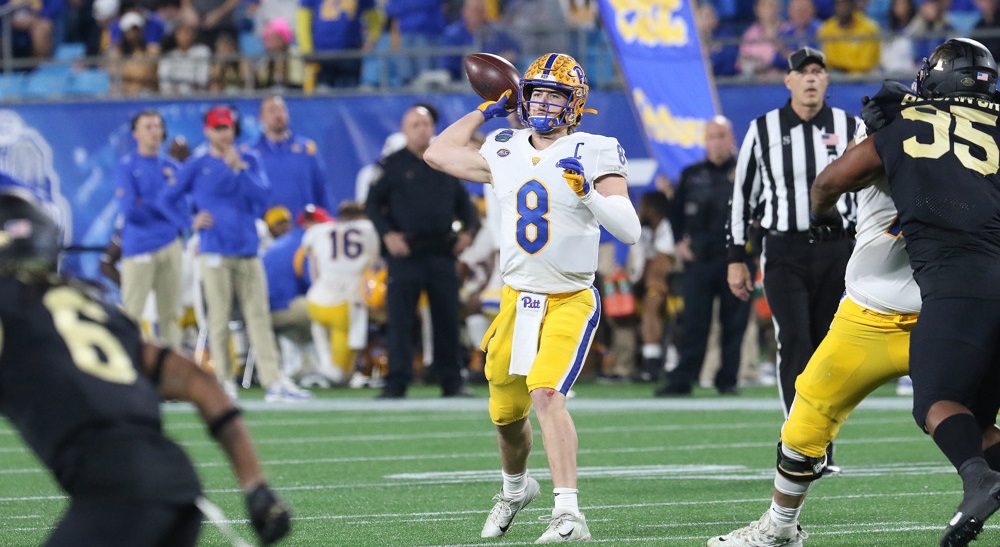
    Kenny Pickett – QB – Pittsburgh

    Pickett lacks some arm strength and the ability to truly work the pocket, but his ability to work through progressions, use eye discipline to hold safeties, and perform in clutch situations should make him a low-end “win-with” NFL starter.

    Pickett has ties to the Panthers coaching staff and ownership, and with the sense of urgency to win now, Pickett seems like the QB best suited to do so in this Draft.

    Malik Willis – QB – Liberty

    Willis is a true dual-threat quarterback with special arm talent and explosive athleticism, but needs to become a more polished and accurate passer to reach his full potential at the next level.

    Willis is the most physically gifted quarterback in this Draft, but may be best suited to sit and develop for a season. However, can the Panthers be patient with him given the urgency to win now?

    To learn more about the Panthers and their draft needs, visit their team page on our NFL Draft website here.

  • NFL Draft Pick AnalySIS: Jacksonville Jaguars

    NFL Draft Pick AnalySIS: Jacksonville Jaguars

    The State of the Jaguars:

    The Jaguars 2021 season was almost entirely negative. Urban Meyer’s tenure will forever be one of the worst coaching jobs in NFL history. After picking No. 1 for the first time in franchise history, the Jaguars find themselves right back in the same situation, selecting first. While No. 1 picks have recently been for QBs, combining a weak class with a team that holds Trevor Lawrence means that is likely not going to happen this year. Here are some players the Jaguars may be considering at each of their Day 1 & 2 picks.

    #1 Overall

    Aidan Hutchinson – Edge – Michigan

    Hutchinson is the ideal modern NFL edge with a special blend of pass rush skills, athleticism, strength, hand use, and competitiveness that will make him a cornerstone player for an NFL franchise. 

    Josh Allen has been a reputable force on one edge, but a counterpart hasn’t stepped up. Hutchinson is comes with production & athleticism who could help resurrect the 2017 “Sacksonville” moniker.

    Evan Neal – OT – Alabama

    Neal is a young prospect with the rare combination of size and athletic ability that give him both a high floor and a Hall of Fame ceiling as a blind-side protector.

    Giving your young quarterback offensive line protection is paramount to their longevity and ability to succeed. Neal is a long-term immediate starter to protect Lawrence.

    Kayvon Thibodeaux – Edge – Oregon

    Thibodeaux is a game-changing pass rusher and strong run defender who plays with heavy hands and good leverage, though he needs to improve his flexibility and run a hotter motor to become a more complete player.

    A preseason favorite for the No. 1 pick, Thibodeaux would create a hyper-athletic edge tandem that can succeed on all three downs.

    #33 Overall

    Jahan Dotson – WR – Penn State

    Dotson’s size and toughness limit him in certain situations, but his explosiveness and body control allow him to make spectacular plays at all levels of the field.

    Dotson is a versatile weapon with sure hands and can easily become a heavy target-share player, who can win at all levels from the outside, something the Jaguars must acquire.

    Bernhard Raimann – OT – Central Michigan

    Raimann is a raw athlete with good size and the strength to hold up early at the next level, though refining his hands and overall skill set as a lineman could allow him to develop into a solid starter one day.

    With Cam Robinson’s second franchise tag, the Jaguars can afford to take the swing on the Austrian’s upside while he refines his technique.

    George Pickens – WR – Georgia

    Pickens is a big-bodied, big-play threat whose hands, tracking ability and competitiveness will make him a consistent contributor, especially once he learns an NFL route tree and if he becomes more dynamic after the catch.

    A downfield threat that is a great replacement for DJ Chark, and his contested-catch ability is something the Jaguars don’t have anywhere on the roster.

    #65 Overall

    Trey McBride – TE – Colorado State

    McBride has the hands, catch radius and body control as a receiver with the willingness and competitiveness as a blocker to start at the next level, but inconsistent separation skills and run block effectiveness could hold him back.

    Doug Pederson previously emphasized TEs in Philadelphia, and McBride joining that room being a surehanded receiving tight end is a great fit.

    Channing Tindall – LB – Georgia

    While Tindall never started a game at Georgia, he has the athleticism, man coverage skills, and tackling prowess to be a starter in the NFL and he just needs to improve his power and intelligence to hit his ceiling.

    Tindall’s athletic ability to play both against the run and in the pass gives the Jaguars a quality defensive player to build with, something they simply don’t have many of.

    David Bell – WR – Purdue

    Bell needs to improve his route running separation skills, but his deep ball tracking and slippery ball carrying abilities should make for a multi-level threat and a reliable, alignment-versatile third option.

    Bell’s after-catch abilities and downfield play from a wide position is something the Jaguars lack, and is capable of moving safeties back to allow Christian Kirk and TEs to operate underneath.

    #70 Overall

    Chad Muma – LB – Wyoming

    Muma is an explosive player with ideal size and a motor that does not quit in order to make splash plays and contribute as a core special teamer, but he needs to refine his skills to make a consistent impact in all areas.

    Muma’s high motor and ability to shed blocks becomes a great fit alongside Oluokun if they want to have an answer for division rivals Derrick Henry and Jonathan Taylor.

    Kerby Joseph – S – Illinois

    Joseph is a rangy, ball-hawking deep safety who has the smarts and skills to be a starter at the next level, though he’d become more of a threat if he gets a little more physical and is willing to mix it up more often.

    Joseph would give the Jaguars a true no-fly-zone safety tandem along with Andre Cisco. 

    Myjai Sanders – Edge – Cincinnati

    Sanders has a relentless mindset with the length, repertoire, and hand use to be an effective three-down player, but he’ll need to keep his pad level down and focus on mixing up his pass rush moves in order to hit his ceiling.

    Growing up in Jacksonville, Sanders is an athletic upside rusher who consistently generated pressures with Cincinnati.

    To learn more about the Jaguars and their needs, visit their team page on our NFL Draft website here.

  • Study: What Is So Dangerous About Special Teams Plays? 

    Study: What Is So Dangerous About Special Teams Plays? 

    An In-Depth Observational Analysis of Injuries that Occurred During Kickoff and Punt Plays Between the 2017-2021 Seasons: Part 1 

    Introduction 

    For years, we have been told how dangerous special team plays are, especially kickoffs and punts. Theoretically, it makes sense as we have elite athletes running at high speeds to engage in violent collisions with one another. That sentence alone makes me want to avert my eyes, but I can’t help my desire to watch the action unfold. Are these plays as dangerous as they are made out to be? 

    The NFL believes this is the case and continues to review and implement rule changes during the offseason for player safety. Their forward actions should be applauded, as injuries are an inevitable consequence due to the nature of the sport but should be minimized to whatever degree possible. Injury prevention is more of a pipe dream than a realistic goal, but risk reduction is what all parties are hoping to attain. 

    Luckily, SIS has the data to assess the situation and investigate the relationship between injuries and specific play types. This article will focus on the relationship between injuries during kickoff and punt plays compared to other plays at the pro and collegiate levels. We will then compare the two levels to one another to identify any discrepancies that presented themselves. 

     Breakdown of Injury Data 

    First, it’s important to understand the proportion of these two play types in the totality of all plays. Special teams accounts for between 17-18% of plays in each season, and kickoff and punts will make up around 11-12% on their own.  

    SIS scouts have identified 7,294 in-game injuries at the Pro level between the seasons of 2017-2021 and over that time our Injury Analysts have reviewed the film of each injury and cross-referenced injury reports to provide the most up-to-date and accurate information. 

    From our data, injuries on kickoff and punt plays account for 7% of all in-game injuries. Although that percentage does not appear concerning, it is the areas involved and the severity of these injuries that are alarming. Previous investigations identify the head and knee regions as areas of concern. Our data will provide a thorough analysis of these two regions as well as other concerning trends found during this investigation. 

    Examination of Head and Knee Injuries at the Professional Level 

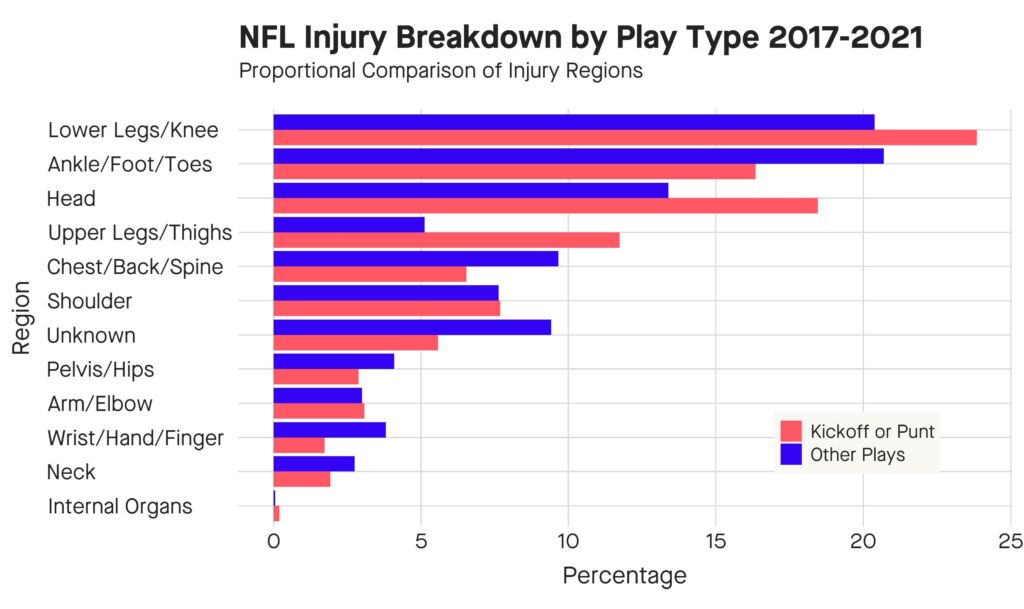
    The proportion of head injuries between kickoff and punt plays compared to other plays stands out. Injuries involving the head account for 18.5% of the injuries that occurred on kickoff and punt plays compared to 13.4% on the other play types (alpha= 0.05, p < .01). 

    NFL Injury Breakdown by Injury Region and Play Type for 2017-21. Lower extremity injuries are most common overall, with head and knee injuries being more common on kickoffs/punts.

    Assessing knee injuries on these specific play types sheds a different light. Knee injuries account for 23.8% of the injuries that occurred during kickoffs and punts compared to the 20.7% during the other play types (alpha= 0.05, p = 0.03). Though the gap between these proportions is smaller than what the head region revealed, things get interesting when you observe the specific knee diagnoses involved.  

    The alarming revelation appears when you evaluate the disparity of proportions between anterior cruciate ligament (ACL) injuries of these play type groupings. Confirmed ACL injuries account for 19.2% of the knee injuries that transpired on kickoffs and punts compared to 6.9% during other plays (alpha= 0.05, p < .01). 

    As most football fans know, ACL injuries will likely require a season-ending reconstruction surgery. Although the likelihood of a return to previous performance levels has improved, the duration of the rehab is lengthy and can vary greatly between athletes. 

    Examination of Head and Knee Injuries at the Collegiate Level 

    Next, we’ll examine the relationship between play types and injuries at the collegiate level. Since full disclosure of college injury diagnoses are difficult to verify, this analysis will focus on general regions. Like the NFL, the proportion of kickoff and punt plays follow the same ratio accounting for 11-12% of total plays. 

    SIS scouts identified 21,894 in-game injuries between the 2017-2021 seasons. As stated above, our Injury Analysts reviewed each play to identify the region affected during the play and updated that injury information accordingly.  

    From our data, 5.6% of the identified in-game injuries occurred during kickoff or punt plays. As we will see, the areas involved during those injuries stand out when comparing the regional distribution and their corresponding proportions between the play types of interest. 

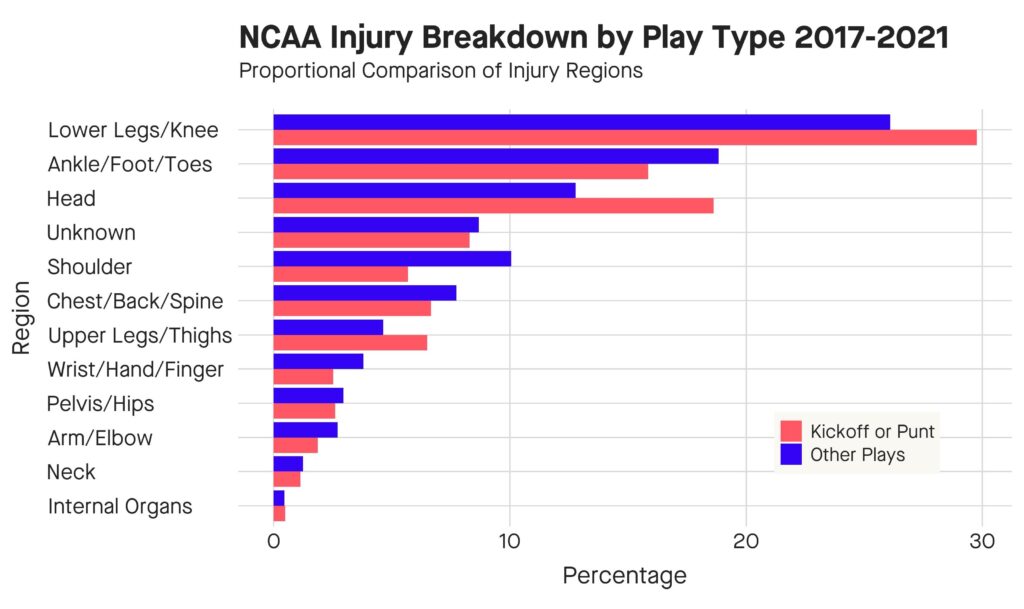
    NCAA Injury Breakdown by Injury Region and Play Type for 2017-21. Lower extremity injuries are most common overall, with head and knee injuries being more common on kickoffs/punts.

    Injuries involving the head during kickoff and punt plays account for 18.6% of our recorded injuries compared to 12.8% during the other play types (alpha= 0.05, p < .01). In addition, an injury sustained during a kickoff or punt play involved the knee 29.8% of the time compared to 26.1% for the other group of plays (alpha= 0.05, p < .01). 

    Once again, the data suggests that the head and knee regions are more likely to be involved when an injury occurs during a kickoff or punt play.  

    Comparison between College and the Pros 

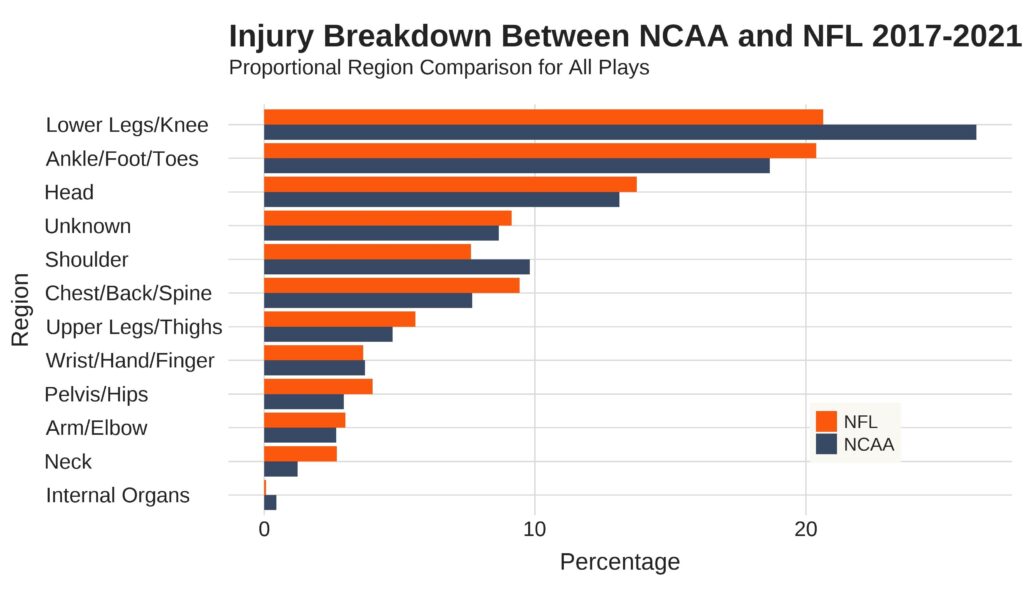
    A major discrepancy presented itself when the injury proportional data was compared between the two levels. Regardless of the type of play involved, college players’ knees were more likely to involved with the injury.

    NFL vs NCAA injury rates by body region. Lower leg / knee injuries are much more common in NCAA.  

    It is a peculiar phenomenon that proved to be significant. Retrospective research studies regarding football injuries identify the knee as an area of concern. We have gathered that the knee is the most at-risk region to be affected by an injury during a football game. The risk of involvement appears to increase at the collegiate level, in addition to during kickoff and punt plays.  

    Why do college players’ knees appear to be at higher risk compared to the pros? Is it the style of play between the levels or some other factor involved? Speculation could be drawn that the greater proportion of elite athletes at the professional level may decrease the knees’ involvement during injuries at that level. Another factor could be the increased variations of formations at the college level compared to the pros. More research is needed to understand this difference. 

    Further Research 

    Questions present themselves after observing this data. Questions like: Why do the head and knee regions appear to be more involved during kickoffs and punts? Other disproportions were apparent after examining the data that were not investigated further within this study. One example is the higher proportion of ankle and foot injuries at both levels during the other play types. 

    As one of the Injury Analysts at SIS, I hypothesize that the higher proportion of ankle and foot injuries appears because of the common mechanism of injury I witness while reviewing plays. Many ankle injuries occur at the line of scrimmage where linemen are engaged with one another and subsequently get rolled up on by another player. Eliminating this type of action from a kickoff and punt play would decrease the likelihood of the ankle being involved when an injury occurs. 

    The other disproportion that was not investigated further was the difference within the upper leg and thigh region between the play type groupings. Most injuries to that region involve a muscle strain. I elaborated on muscle strains, specifically hamstrings, during a threepart series at the beginning of this past season. A common mechanism of a muscle strain involves high velocity running, which is more likely to occur for a greater number of athletes on the field during a kickoff or punt play. I suspect that may be the culprit behind that region’s higher involvement during kickoffs and punts. 

    The goal of this observational analysis was to examine the data and evaluate the relationship between the varying play types and the injuries that occurred. It proved to be fruitful, and it will lead to further studies to help identify variables that may be contributing to the results. The next article will continue this investigation by focusing on the kickoff and punt plays individually. We will utilize our data to observe the injuries within different conditions and evaluate the players affected to enhance our understanding at what transpires during these plays. 

  • Our 2022 Charting & Scouting Process

    Our Charting Process

    John Todd

    Thanks for taking the time to check out the site. Whether you’re a new reader or a previous fan of our physical SIS Rookie Handbook editions from the past few years, hopefully you’ve enjoyed navigating our updated forum. If you’re reading this blog, you’re probably interested in how we got to this point, from our numerical and scouting evaluation perspectives. The collection process for all of the data you see on this site, our SIS DataHub, social media, and other platforms is the core of what we do at Sports Info Solutions. As usual, we hire an annual team of Football Video Scouts to be trained in our terminologies and definitions, watch and evaluate every NCAA game involving an FBS opponent and all NFL games, and input the data into our software.

    This past year, we transitioned into a hybrid in-person and remote staffing of our Video Scouts. Our group of 60 was split about evenly between our office in Coplay, Pennsylvania and around the country. Full-time remote training, scheduling, and assistance was an adjustment for us, as we’ve always felt our in-person communication was a uniquely positive approach to data accuracy and improvement throughout the season. Our team admirably and tirelessly worked through rough patches to continue ensuring on-time and accurate data to our clients.

    In total, five different initial passes of data collection for every football game are collected before our Senior Football Ops department begins a thorough auditing operation. Subsequent data quality projects are completed, external statistical suggestions are compared, and anomalous individual items are confirmed.

    The result is a quality of data that we can confidently say we can stand behind. Occasionally, raw college data may differ from school press releases, advanced data may vary from other collection forums—just know that these deviations have SIS-endorsed answers. While the personal touch of in-person networking couldn’t be made to all our Scouts this fall, we hope our entire staff feels connected to SIS and the weight they held in the success of this site and our organization.

    We are extremely proud and thankful for all of our Video Scouts and Ops staff members for the hand they played in another successful year of our football charting process.

    Moving forward, some big changes are coming to the Football Operation. We are thrilled to be in the development stage of more efficient collection software, our Video Scout hiring procedures are being thoroughly adjusted to better accommodate our staffing needs, and we’re continuing to grow our influence across multiple spaces and industries.

    As always, our Senior Ops members are suggesting exciting new data proposals and enhancements to improve the charting operation, and our scouting department is growing like never before, as Nathan will explain next. If you’d like to be involved in the future, visit the SIS careers page.

    Our Scouting Process

    Nathan Cooper

    After taking a year off from All-Star Game travels, we were back at it this year as our VP of Football & Research Matt Manocherian and John made it to the Senior Bowl in Mobile, AL. The Senior Bowl has produced a hotbed of talent—over the last few years especially—so it was important to have some of us down there to get an in-person view, take notes, and confirm some grades. While I was unable to make it, I took advantage of my virtual credential and saw all the action on the All-22 film they provided. While we start the process much earlier, the Senior Bowl is an event on the calendar that marks that Draft season is officially here and underway.

    Similar to last year, we got started on the 2022 Draft cycle over the summer, watching and taking notes on players we thought would be declaring following the season. This is also when we start creating our database of players. With the pandemic happening in 2020 and players being allowed to return to school for an extra year of eligibility, our list got much larger, much earlier in the process.

    Combining the 100+ players we had on our list last year who decided to return with the many who weren’t on our list who did the same, plus this year’s original class, made for a bigger group of players than we’ve previously considered.

    Since the Handbook started, John and I have split our cross-checking responsibilities into regions. However, one change we made this year was bringing 3 of our full-time scouts into the fold to head up their own regions. Previously, I was the primary cross-checker for players in the SEC East, Big 12, American, Mountain West, MAC, and any small school east of the Mississippi.

    John was responsible for players in the SEC West, Big Ten, Pac-12, C-USA, Sun Belt, and any Independent or small school west of the Mississippi. This year, we added Jordan Edwards to take care of all non-FBS players. Jeff Dean focused on C-USA and the Sun Belt. Ben Hrkach tracked the MAC. This allowed us to hone in and get our eyes on even more players and teams to really get a sense of the draftable players in that area all across the country.

    As John mentioned, we evolved into more of a hybrid staffing of remote and in-person Video Scouts this past season. Not only did this give us more flexibility, but it also allowed us to hire more Video Scouts. Those Video Scouts not only help collect our data, but also help watch film and write scouting reports on all of these players. We had 35 Video Scouts and numerous full-time staff write reports for us this year, many of which are featured on the new NFL Draft site.

    This year, we had nearly 1,000 players in our database, with reports or grades submitted on over 800 of them. Between the five of us, we looked at every report submitted, film of the player, and edited and/or cross-checked all 300+ players going onto the site. The number of reports that made the book the last 3 years went from 256 to 284 to 318, and this year’s number will be even higher when all is said and done.

    Even though the in-hand copy of the book is no more, the NFL Draft site features all of the same things it was known for, and more, such as the Leaderboards, a brand new Big Board  we are referring to as the “SIS 101”, and the Team Pages, with even more stats and sections to help give an idea of what your favorite team has and needs. The beauty of this new website is it will allow us to post more info and updates during the entire process. So, with that, we hope you enjoy the new and improved SIS Football Rookie Handbook, the SIS NFL Draft site.

  • How To Find An Edge In Evaluating Edge Rushers

    How To Find An Edge In Evaluating Edge Rushers

    If this year’s draft class formed its own league with just the current set of eligible players, the quarterbacks would be in trouble.

    The 2022 class of edge rushers features seven edge rushers with at least a strong starting grade according to SIS scouts (6.7 or higher). That includes two players who are at the top of many draft boards, Aidan Hutchinson from Michigan and Kayvon Thibodeaux from Oregon.

    In this article, we’ll explore more than just that elite pair, finding the big producers and hidden gems at the position from a statistical angle.

    Much more than was the case in previous decades, edge rushers vary in terms of how often they rush from a two-point or three-point stance. (For those unfamiliar, the number of points is just the number of points of contact with the ground. Standing up is two-point, one hand on the ground three-point, two hands four-point.)

    In general, edge rushers who stand up more often have better results rushing the passer. Those who play more often with their hand on the ground have better results defending the run. These aren’t large differences, but it’s something to keep in mind when looking at these prospects.


    If we look at the last four years of drafts, nearly half of all edge prospects played from a three- or four-point stance at least two-thirds of the time over their careers. But if we look just at their platform season, that number is closer to 40 percent, showing a lean towards standing up to rush as their careers progress.


    Of the top players on the board, there has been a shift over their careers. Both Hutchinson and Thibodeaux played from a down stance more than 75% of the time prior to this year, but they did so less than 20% of the time this year. South Carolina’s Kingsley Enagbare also transitioned towards stand-up rushing from a more mixed repertoire the previous two years, and his advanced pressure metrics jumped.

    But I’m getting ahead of myself; let’s start with the basic pressure metrics.

    Basic Pressure Rate

    Getting into the quarterback’s face, even without getting home for a sack, is incredibly valuable. Pressured dropbacks in FBS games in 2021 resulted in an average loss of nearly half an Expected Point. Even if you exclude the sacks, the other types of pressure come with an average loss of a quarter of an Expected Point.

    In terms of pure production on a rate basis, situational pass rushers lead the way. Among players SIS evaluated for this draft class, three players stand out in terms of the pressure they generated over their college careers, but they also rushed the passer more selectively.

    Best Career Pressure Rate by Edge Rushers in 2022 NFL Draft

    Player School Rush% Rush Snaps

    Pressure%

    Nik Bonitto Oklahoma 63% 517 23%
    Adam Anderson Georgia 65% 274 23%
    Kayvon Thibodeaux Oregon 87% 750 16%
    Myjai Sanders Cincinnati 97% 987 15%
    George Karlaftis Purdue 99% 787 15%

    Nik Bonitto was very productive as a pass rusher for an Oklahoma team that faces a lot of tough competition. He might not have the frame to be an every-down player at the NFL level, but he’s a disruptive force and was able to finish plays off with sacks as well.

    While pressure production is the more important metric than sack production because it’s much more reliable year-over-year, we can still learn something from sacks—if nothing else, who had anomalous sack production relative to their pressure generation.

    One example of this is Myjai Sanders from Cincinnati. Sanders is one of our top-graded edge rushers this year, and you can see his name on the Pressure Rate leaderboard above. Despite that, he got home for a sack just 1.4% of the time in his career. If his sack production followed the typical relationship with pressure generation, he’d have twice as many sacks.

    Correcting Biases in Pressure Statistics

    I mentioned before that situational pass rushers led the way in terms of Pressure Rate. This isn’t entirely surprising. The most obvious situational factor is the likelihood of the play being a pass, so if you’re disproportionately on the field on obvious passing downs, it stands to reason you’ll pin your ears back on the way to a higher pressure rate.

    In a similar vein, a player can receive undue credit for hurrying the quarterback several seconds into a play after things have broken down. Or the offense could run a lot of quick passing concepts that take the pass rush out of the play, tempering the stats for the pass rushers.

    To that end, SIS has three stats that better represent how a player generates pressure in a more consistent, neutral context.

    True Pressure Rate

    True Pressure Rate is relatively simple in concept. Many plays present either impossible or very awkward situations for a pass rusher to get after the quarterback, so True Pressure Rate evaluates pressure only on plays that did not feature a Run-Pass Option (RPO), play action, or a screen.


    Because we’re mostly just trimming the fat in the sample of Pressure Rate, the True Pressure Rate leaders look pretty much like the Pressure Rate leaders, but with slightly higher rates on average.

    If you find a player with a lower True Pressure Rate than Pressure Rate, that means that a disproportionate amount of their pressure came from non-traditional dropbacks.

    Players who have a True Pressure Rate more than one or two percentage points higher than their Pressure Rate have done very well on traditional dropbacks, which is a more consistent sample of plays to evaluate. Texas A&M’s Tyree Johnson is an example on that side of things.

    Quick Pressure Rate

    SIS started tracking the timing of the first pressure on a play in 2020. This allows us to examine how quickly a play was disrupted.

    In the case of pass rushers, we care about this for two reasons. Obviously, getting to the quarterback as soon as possible is the goal. The less opportunity for the offense to get itself set up, the better. But on the other side of things, pressure after the first few seconds of the play is as likely to be a result of other things going wrong than the pass rusher doing his job well.

    So, we now calculate Quick Pressure Rate, which is the percentage of pass rush snaps in which the player generated pressure within the first 2.5 seconds. This 2.5 second threshold is consistent with our internal research on the inflection point at which the nature of pressure changes.

    Career Quick Pressure% Leaders, 2022 Edge Rusher Prospects

    Player School Rush Snaps Quick Pres%
    Nik Bonitto Oklahoma 517 11%
    Kayvon Thibodeaux Oregon 750 7%
    Ali Fayad Western Michigan 1193 7%
    Sam Williams Ole Miss 829 7%
    Aidan Hutchinson Michigan 871 7%
    Alex Wright UAB 557 7%

    This leaderboard has many of the same names on it, including Hicks and Bonitto remaining at the top by a significant margin. We do start to see the top prospects show their faces, however, with Thibodeaux and Hutchinson in the tier below.

    Sam Williams should also be acknowledged here. He was in the top ten in FBS in total pressures this season playing against the best of the best in the SEC.


    Pressure Rate +/-

    Let’s get back to those situational factors mentioned above.

    Think about the kinds of scenarios that might affect a pass rusher’s ability to get to the quarterback. 

    • How likely is the offense to be passing?
    • Where are they lined up?
    • What kind of drop is the quarterback taking?

    All of these come into play in SIS’s Pressures Above Expectation metric. We take the factors above and create an expected pressure rate for each pass rush snap, and then compare that expected pressure rate to the actual pressure rate on those snaps. The result is Pressure% +/-.

    Career Pressure% +/- Leaders, 2022 Edge Rusher Prospects

    Player School Rush Snaps Pres% +/-
    Aidan Hutchinson Michigan 871 7.0%
    Nik Bonitto Oklahoma 517 6.8%
    Adam Anderson Georgia 274 6.2%
    Ali Fayad Western Michigan 1193 6.1%
    Cameron Thomas San Diego State 1083 5.0%

    That’s more like it, Aidan Hutchinson!

    The top pass rush prospect made hay relative to what his alignment and the game situation might have suggested. And he did so on many more pass rush snaps than the players around him on the leaderboard, which is more encouraging for his long-term outlook.

    It’s not surprising to see the overall Pressure Rate leaders here as well because they were so far out in front. A couple more new names, Ali Fayad and Cameron Thomas, have differing projections according to our scouting staff. Fayad projects to be more backup-caliber, while the SIS staff expects Thomas to contend for a starting role.

    For more on the NFL’s Pressures Above Expectation leaders in 2021, check out this article on Sharp Football Analysis.

    Takeaways

    The SIS NFL Draft site offers a bevy of metrics for all kinds of positions. For pass rushers, we really hone in on pressure stats, because they’re the driving force of value for those players. It’s encouraging as an analyst to see when the more advanced stats we create align better with scouting grades than the more basic ones (in this case Pressure Rate alone). Use the whole suite of stats to get the best picture of what a player does well relative to his peers.

  • Re-imagining the Draft Pick Trade Value Chart with Total Points

    Re-imagining the Draft Pick Trade Value Chart with Total Points

    Introduction

    Every April, NFL GMs are given the task to take their allocated amounts of “draft selections” in efforts to better the team in both the short- and long-term. This process of player entry into the league is meant to increase parity and allow the formerly bad teams to get marginally better in a fair manner. Maximizing value in this process is a key factor in what teams continue to play football in February.

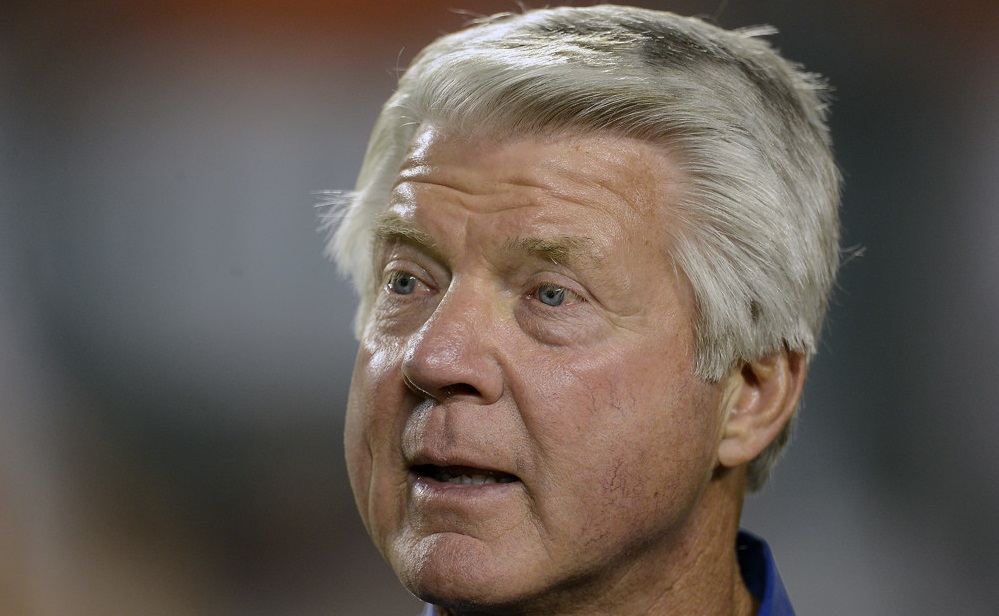
    About 30 years ago, Jimmy Johnson devised a “draft trade chart” for the Dallas Cowboys, in efforts for the team to immediately evaluate draft pick trade offers. This chart became wildly popular, is still referenced by many, and has inspired a handful of spin-off iterations. Since the chart was made, four teams joined the league, the rules have changed dramatically, coaches are much more creative, and the NFL Draft process has improved immensely. 

    Instead of looking at the perceived value of picks, what if trade value came from the value that NFL teams actually got from those selections?

    Total Points

    Sports Info Solutions developed Total Points to value every player’s contribution to the team’s score. This complex metric was developed in 2018 and retroactively applied back to 2016. You can read its intricacies here. Instead of just empty stats, this measures the effectiveness of each individual player, to look at their stats in a much more critical manner.

    Having a metric to define a player’s contributions to a team and matching that to where they were acquired in the draft, we can create a new version of the trade value chart.

    Building the Model

    Total Points begins in 2016, which will be our first evaluated class, and choosing to use the total points over a player’s first two years means 2021’s draft has to be ignored. Therefore, our dataset spans five drafts. 

    To determine the value at each pick, we have to consider that not all classes come with the same amount of talent, both overall and by position. With only five classes being considered, a wide net has to be cast in efforts to not allow individual players to affect the values too heavily. Thus, for each pick, we select the five years of Total Points earned from that selection, and the five adjacent picks in either direction, to get 55 Total Points numbers to gather information from.

    With 55 values, from there we can eliminate outliers, both positive and negative. This is because the metric is looking for a single expected value, not measuring a ceiling or floor. For example, Gardner Minshew’s Total Points success from the 6th round should not tell us a 6th round pick has a lot of value, just as Paxton Lynch’s disaster from pick 26 shouldn’t say that’s a bad pick to own. 

    To achieve this for each pick, we eliminate the values of players either below the 20th percentile and above the 80th percentile to eliminate those anomalies. For draft selections with 55 players, this roughly gives 33 values to calculate an average of. This average is our data point representing the expected Total Points that a selection will return.

    Expected Total Points returned from draft picks (based on 2016-20 drafts), shown point-by-point with a smoothing curve overlaying. The curve is approximately exponential with a sharp increase in value starting around pick 20.

    The model shown in black was developed using two separate models blended together. The first round being of such high importance, it couldn’t be represented based on influences from the 3rd round, so an exponential regression model was fit using early draft picks. The second model was a similar exponential regression model designed across the entirety of the data. 

    These are then smoothed together using a continuous gradual function to get a representative model. This gives us an Expected Total Points return based on the overall draft selection.

    Takeaways

    Likely one of the first observations made on the chart above is the “peaks” seen at the top of the first, second, and third round. These can be explained by players finding a much easier path to playing time in Years 1 and 2, as the teams selecting them theoretically have much less talent, and these players step right in as contributors. With more playing time, earning Total Points becomes much easier. 

    The trough at pick 26 can likely be explained by there being two QB selections, Paxton Lynch and Jordan Love, who returned negative and 0 Total Points respectively. The players doomed into minimal playing time will negatively impact the averages around that pick, even if on another team they would return a much better value.

    The peak around the 150th pick is partially due to the small sample size of drafts. There are relatively more players returning 20+ Total Points than many adjacent picks–George Kittle, Demontae Kazee, Desmond King, Matt Ioannidis, Andrew Van Ginkel, Jordan Howard, and Hunter Renfrow to name a few. With more years of data, these picks will regress to the mean. With a smooth, monotonically-decreasing function, this peak appears when looking at the individual picks, but does not strangely influence the model.

    Since 2016, 4 of the 5 drafts featured a QB going in spot number 1 (Jared Goff, Myles Garrett, Baker Mayfield, Kyler Murray, Joe Burrow). Naturally, quarterbacks accumulate the highest amount of Total Points, and immediate-impact QBs usually come from the top-end selections. However, there are plenty of picks in the top 10 of non-QBs to counteract this and give a real representation of expected Total Points.

    One aspect important to the model is that no successive pick can exceed the value of a previous one. Every player taken at spot 50 was available at spot 32, so we shouldn’t follow and prioritize the NFL’s drafting mistakes if earlier picks occasionally outperform later ones. All-Pro LB Darius Leonard would have been a higher selection than 36 had the league known his talent.

    The Improvement

    Back to the originally presented Jimmy Johnson model. Can it be compared to ours? If we look at all picks’ value in comparison to the No. 16 pick (midway through the 1st round), we can compare the two models in the chart below.

    Comparing the Total Points based draft value curve to the Jimmy Johnson one. The Johnson model stays flatter longer in the range of later picks, then increases very sharply and shows higher value for picks in the top 15. 

    Johnson’s model counts early first round picks as significantly better than later ones, where it is much more smooth in the Total Points chart. The perceived value difference between picks 5 and 20 is much steeper in Johnson’s. This trend continues throughout the draft. Johnson’s scale sees the draft classes as much more top-heavy, and that the middle rounds do not bring anywhere close to the value of first rounders. Total Points, which is graded independently of draft capital, argues that the difference is much smaller than what may be perceived.

    It should be noted, however, that Johnson’s chart is designed with pick value in mind. His chart could theoretically be accounting for a player’s potential upside, while the designed Total Points model is looking at expectation, in what a player likely returns. This could potentially explain the value difference of picks at the very top of the draft.

    In application, if I have a selection around the 10th pick I’m doing everything I can to secure later 1st, 2nd, and 3rd-round picks. My net gain from the draft class will likely be significantly higher than if I stay at the 10th pick. But would teams actually do this, trade all that to move up a few spots? Yes, they do!

    In the 2021 NFL Draft, the Minnesota Vikings came on the clock with the 14th pick. Instead of making a selection, they traded the pick to the New York Jets. The trade ended up being picks 14 and 143 in exchange for 23, 66, and 86. Mapping the expected Total Points return, the Vikings took 46.1 Total Points and exchanged it for 67.2 Total Points. This is a fantastic deal from the Vikings, and a massive waste of value from the Jets.

    In Conclusion

    The draft is much more of a gradual exponential function than what is normally perceived. Rounds 2 and 3 hold a ton of expected value in building championship teams, and those can be the best bang-for-your-buck selections in the entire weekend.

    In general, trading up for a future starting quarterback would be a positive Total Points value move. They are so important to a team’s success that moving up the board to secure yours is well worth the investment. Otherwise, it’s best to sit tight and let the draft come to you, and move back to maximize it.

    It wouldn’t be an analysis of draft pick trade values without sharing a chart for the 2022 Draft. What would you do with your team’s picks?

    Draft picks as of 4/4/2022. 5:00 PM EST

  • How do we evaluate Pittsburgh QB Kenny Pickett?

    How do we evaluate Pittsburgh QB Kenny Pickett?


    On the most recent episode of the Off The Charts podcast, we explained our football draft prospect scouting process. We went through the different factors our scouts consider, what they watch for as they watch film, and used a specific player to show how we do what we do.

    For quarterbacks, we looked at Kenny Pickett from Pittsburgh.

    Here’s how one of our lead editors of our upcoming NFL Draft website, Nathan Cooper, came up with his grade.

    We require watching at least four games on a specific player per report.

    For quarterbacks, you’re going to watch more than four. I watched nine on Trey Lance last year.

    The hardest part about this process is that college offenses don’t always translate to the NFL. It’s hard to find guys in college who are doing exactly what he’s going to be asked to do. You have to find the traits, project the traits, and see as many NFL-worthy plays as you can, and rate those slightly higher than the rest.

    There are 15 factors on which we grade a quarterback. Three are what we call critical factors that we put a higher value on than the other 12 factors. We grade on a scale of 1 to 9, though most of our factor grades end up either 4, 5, 6, or 7. The three critical factors for quarterbacks are accuracy decision-making and mental processing, and clutch performance.

    Accuracy

    When you think of accuracy, a lot of people think of completion percentage and for us as data collectors and even as evaluators, it goes a lot deeper than that. We’re not only looking for the ball to be caught, but was it catchable? Was it on target? Did he give the receiver a chance to make a play?

    We look at the short passes, the intermediate passes and then deep down the field. Everyone obviously expects, passes to be completed a higher rate whenever you’re in the shorter areas of the field.

    With accuracy, he’s not always spot-on with his short passes, his swings and flats are a little behind. He lacks a bit of touch on his shorter throws as well, so I don’t love that aspect about him. But he has a very good touch on the deep ball. He’s money from 25 to 35 yards.

    I do worry about arm strength with him, about getting much deeper than 25 to 35 yards on his throws.

    So I would give him a 5 overall for accuracy. But if you broke it down, I’d say a 5 on short passes and a 6 on deep.

    Decision Making/Mental Processing

    For decision making, there are a lot of factors. We’re looking at the ability to make smart decisions, but also mental processing.

    • How well does he read the field?
    • How well does he process what the defense is doing?
    • Is he poised in the pocket or flustered under pressure?
    • Does he sense pressure and hang in?
    • Is he waiting for receivers to come open before he throws or is he throwing them open?

    I like his ability to make decisions. He works the field, rarely forces the passes into super-tight windows and doesn’t take too many chances.

    A majority of his turnovers come on off-target throws or late throws. He generally does a good job processing the field, going through his progressions, manipulating the safety with his eyes, holding him to one side before going back to the other side of the field. That’s one of those things that’s hard to see as a fan unless you know to look for it, as scouts do.

    He doesn’t throw with anticipation a lot. You’ll see it a bit on comeback routes. I want to see it more. But his overall decision making, he’s at a good level, or a 6, for the NFL.

    Clutch Performance

    Our third critical factor is clutch performance

    • How do they play on 3rd and 4th downs?
    • How are they in the red zone in the final minutes when their team is trailing?
    • How do they handle playing on the road? In adverse conditions?

    Pickett had a lot of 4th-quarter comebacks at Pitt and drove the ball down the field and made the throws to put the ball in the end zone when needed. He’s a 6 clutch at the next level for me.

    Positional Factors

    There are 12 positional factors and we’re not going to go through all of them.

    But one of them is leadership. Leadership kind of goes back to clutch a little bit.

    How does he play in adverse situations?

    What’s his body language? Is he sort of dejected over on the sideline by himself when he or his team is struggling? Or is he a guy that’s trying to rally the troops?

    But also, it’s things like – is he standing in there and making plays while taking hits. Is he putting his body on the line to get an extra yard for the first down. There’s an extra value for us beyond the statistical value of the first down yardage.

    With Pickett, he’ll stand in and take hits if needed. His mobility allows him to gain yards with his feet and he usually seems willing to get the extra yard if he can. He gets a 6 from me for leadership.

    Another positional factor is footwork, which ties in to working the pocket and resetting his base as he’s about to make a throw. You’ve got to be able to maneuver the pocket and stay away from the pass rush.

    One thing that Pickett does really well and quickly is reset his base when he has the chance to, rather than throwing off one foot. Maybe he’ll see a receiver come open quicker than expected or at the last second, and instead of hurrying to throw from whatever position he’s in, he’s quick to reset his feet and get into the correct position to make an accurate throw.

    With all of that in mind, I liked what I saw from Pickett on both of these. I graded him a 6 in footwork. . Remember that there are 10 other positional factors to consider. His other grades were a range of 5s and 6s, though I gave him a 7 in eye discipline, which refers back to what I said about him looking off safeties.

    Overall

    So when we try to come up with an overall grade, we generally have a scale ranging from 5.4 to 9 and the decimals matter. The higher the better.

    For quarterbacks, a 5.4 to 6.2 are generally backups. A 6.3 to 6.9 are starters of varying degrees, with a 6.5 and 6.6 being a lower-end starter working up to 6.7 to 6.9, which are solid starters.

    The 7s and above are high-end players with the potential to be among the league’s elite players.

    Last year:

    Trevor Lawrence was a 7.2.

    Justin Fields and Zach Wilson were 6.9.

    Mac Jones and Trey Lance were 6.6.

    I think Pickett is more of a ‘win-with’ type of quarterback, who definitely has traits to play at the next level. I just don’t think he’s going to be that top-tier talent that you see coming out early in the first round.

    I have him at the 6.6 grade level for my final grade.

    You’ll be able to see the full report on our new NFL Draft website in a few weeks!

    And check out our Off The Charts episode in which John Todd & I broke down 3 other college football standouts in a similar manner.