Category: Football

  • The Top Ranked NFL Draft Prospect At Every Position

    The Top Ranked NFL Draft Prospect At Every Position

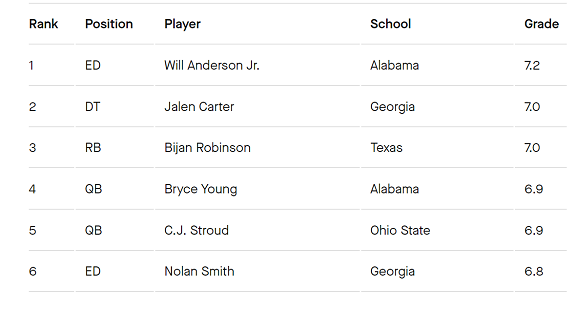
    Each year, the SIS scouting staff puts their money where their mouth is and grades hundreds of the top players in the NFL Draft player pool. The SIS NFL Draft site combines those reports with advanced metrics to provide as complete a picture of each prospect as you can find.

    To celebrate the launch of the 2023 version of the site, let’s run through the staff’s top prospects at each position.

    (Of course, if you want, you can just look at the full big board, which still has more players coming in!)

    Quarterback: Bryce Young

    School: Alabama

    Grade: 6.9 (Solid starter)

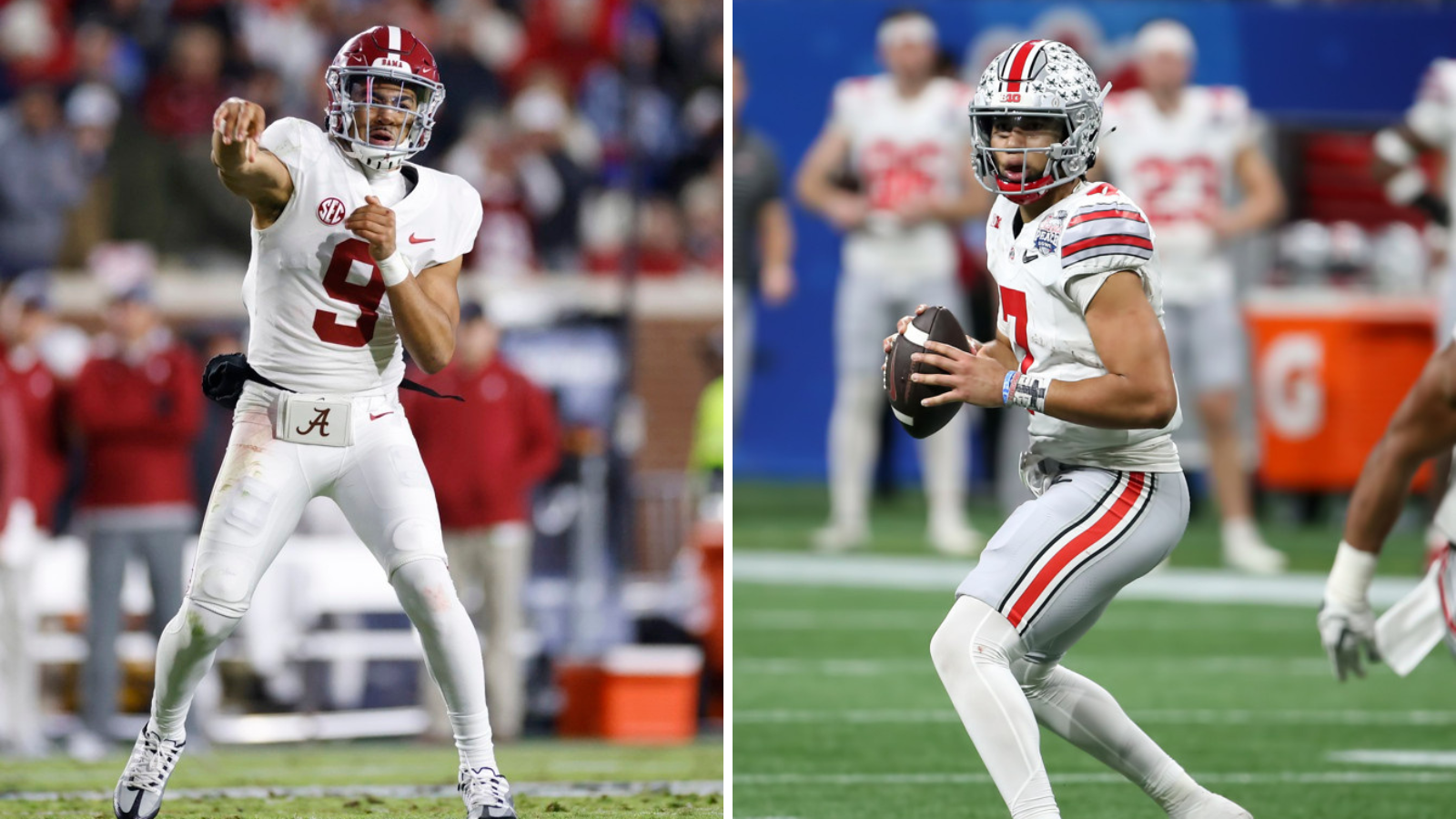
    The SIS staff has Young and C.J. Stroud graded the same, but while Young’s body composition is the weakest trait between them, he only had three traits graded as sufficient or worse compared to Stroud’s five. Young’s poise, decision making, and pocket awareness and creativity are his biggest strengths.

    From Jordan Edwards’ report:

    “Young has a smooth and lightning-quick release while also showing the comfort and effectiveness to throw from different arm angles. He is consistently accurate especially in the short and intermediate areas of the field. While his deep ball accuracy is still good overall, he can miss his targets under pressure or when he can’t set his base. He has the arm strength to make most throws downfield and can put enough velocity on throws into tight windows.”

    On the statistical side, our measures of his arm strength and his ability to get the ball out show some flaws, but all other measures of production and accuracy compare very favorably to the rest of the class. His Total Points and Independent Quarterback Rating put him at the top of the group.

    For more stats on the rest of the quarterback class, check out the positional leaderboards.

    Running Back: Bijan Robinson

    School: Texas

    Grade: 7.0 (High-end 3-down starter)

    Robinson is the consensus top back in the draft, with an unimpeachable statistical record. He easily led draft-eligible running backs in Total Points per game, and did so while running into a heavy box twice as often as he did in previous years.

    Chad Tedder highlighted his vision in his scouting report:

    “Off the handoff, he does a good job at scanning the line and seeing where openings are going to be. He watches the movements of second-level defenders and can often set them up flowing one way before using his lateral agility to cut back behind them. If the space is not opening, he has the patience and trust of his line to allow for enough space to open for him to accelerate through.”

    He’s an asset in the passing game as a receiver, but his worst trait grade came as a pass blocker, where his vision and anticipation in the run game doesn’t quite translate as well.

    For more stats on the rest of the running back class, check out the positional leaderboards.

    Wide Receiver: Jaxon Smith-Njigba

    School: Ohio State

    Grade: 6.8 (Solid 3-down starter)

    C.J. Stroud didn’t rank as our top quarterback, but one of his receivers does top that positional group. Smith-Njigba didn’t play much in 2022, but his 2021 season would have put him at the top of the position in terms of Total Points on a total and per-play basis.

    He’s not an explosive athlete with big top speed, but he’s smooth and fluid with a good understanding of how to run routes running mostly from the slot.

    From Ryan Rubinstein:

    “In the passing game, Smith-Njigba excels in the slot. He consistently shows burst off the line and can beat press coverage with a studder step or by swiping the defender’s hands away. He mainly finds separation with quickness and route running, stemming to open holes in zone coverage or by manipulating defenders at the top of his route. Occasionally, he tends to get thrown off by contact at his stem but shows the ability to use his off hand to get separation and to recover back into his route.”

    For more stats on the rest of the wide receiver class, check out the positional leaderboards.

    Tight End: Michael Mayer

    School: Notre Dame

    Grade: 6.8 (Solid starter with Y & H ability)

    Mayer isn’t head and shoulders above other tight end prospects from a scouting grade perspective, but from a statistical perspective he dominated in his last year at Notre Dame. He ranked as the top tight end in 15 out of 22 tight end leaderboards.

    The scouting report from Jeremy Percy and Seamus Rooney highlights his hands and his solid blocking fundamentals.

    “Mayer has very good hands overall. He has great manual dexterity and is extremely smooth when using his hands independently from his body. He is also adept at extending fully and catching the ball away from his body, regardless of where the pass is.”

    “He showcases very good blocking fundamentals, plays under control, and makes getting in the way of his man his top priority while rarely lunging or whiffing.”

    Offensive Line: Peter Skoronski (OT)

    School: Northwestern

    Grade: 6.8 (Solid starter with positional flexibility)

    Skoronski ties with center John Michael Schmitz as the top graded offensive linemen, but the former takes the top spot in the rankings. 

    He excels in generating power from awkward positions. To hear Jeff Dean say it:

    “Power rushers have their work cut out for them, as he has a very good anchor and uses leverage to take away the opponent’s leg drive on these rushes. Even when dropped to one knee, he generates power to keep the rusher at bay and reestablishes himself in proper position.”

    On the statistical side, the team context around him makes him look a bit worse than he should, but even the stats that separate him from his context—like blown block rate—don’t show him as an elite producer.

    For more stats on the rest of the offensive line class, check out the positional leaderboards.

    Interior Defensive Line: Jalen Carter

    School: Georgia

    Grade: 7.0 (High-end 3-down starter)

    Carter’s generally viewed as a better prospect than his former teammates who were first round picks a year ago, but one who also has some red flags in terms of his off-field behavior.

    Ben Hrkach’s scouting report alludes to Defensive Player of the Year upside, but with some inconsistency as well. His elite disruption in the running game is communicated most strongly:

    “In terms of stopping the run, Carter has a collection of traits that are rarely found outside of a video game. With ideal size and bulk, Carter blends excellent base and upper-body strength with malleable power that allows him to work from awkward angles and reestablish the [line of scrimmage] while moving laterally.”

    Inconsistency often leads to less inspiring on-field metrics, and Carter is a victim of that to some extent. He shows elite run defense production—tackling ballcarriers much further upfield than typical—but the pass rush numbers are less stellar, even considering that he’s lining up inside.

    For more stats on the rest of the interior defensive line class, check out the positional leaderboards.

    Edge Rusher: Will Anderson Jr.

    School: Alabama

    Grade: 7.2 (High-end 3-down starter)

    The highest-graded player on the SIS board, Anderson burst onto the scene in 2021 with 4 more sacks and 13 more pressures than Aidan Hutchinson in his best season. His production slipped to merely quite-good in 2022, but the traits are still there to be a top performer.

    His best trait is his strength, which gives him some margin for error in terms of pass rush technique. Jeff Dean noted that he still has room for improvement in his repertoire of rush moves.

    “Due to his physical gifts, his pass rushing moves are still a work in progress. Outside of his impressive bull rush, the cupboard is a little lacking. He will flash promising swipe, spin, and push-pull moves, but they are not second nature at this point. Developing more effective counter moves will also be key to his growth, as he can seem a little lost when his initial attack fails. He appears content to stalemate the opponent or take more of a containing role if thwarted.”

    Dean also notes that Anderson has a high floor because of his skill setting the edge in the running game (although he could use improvement as a tackler).

    For more stats on the rest of the edge rusher class, check out the positional leaderboards.

    Off-ball Linebacker: Trenton Simpson (WLB)

    School: Clemson

    Grade: 6.6 (Lower-end starter)

    Simpson is one of four off-ball linebackers to be given the top grade at the position, with athleticism and versatility that make him particularly appealing.

    He might struggle to make an impact in the running game initially despite his size, but his flexibility as a coverage defender (particularly in zone) and a pass rusher on third down could have evaluators squinting and seeing visions of Micah Parsons.

    Jordan Edwards put his coverage ability this way:

    “He can close and gain ground quickly as a zone coverage defender to limit yards after the catch. He is a sure tackler and makes his presence felt on contact, using his length and physicality to bring ballcarriers down. His speed and ability to close quickly also allow him to play in the slot where he can cover and also blitz from depth.”

    Simpson’s limitations in the run game come through in his statistical performance as well. He had the worst Adjusted Tackle Depth Plus among off-ball linebackers on the SIS draft board, meaning he was tackling ballcarriers a good bit further downfield than typical.

    For more stats on the rest of the linebacker class, check out the positional leaderboards.

    Cornerback: Devon Witherspoon

    School: Illinois

    Grade: 6.8 (Solid 3-down starter)

    Witherspoon isn’t the same kind of press-man prospect that Sauce Gardner was coming out last year, but his experience playing primarily man coverage at the college level gives him intriguing upside.

    Here’s how Ben McClure described his ability playing up on the line in man coverage:

    “He has very good mirror/match technique in press coverage and rarely finds himself out of phase when pressing. He has the ability to run with receivers on crossing routes in press, and also be physical with the opponent off the line and stay tight to vertical routes.”

    Statistically, Witherspoon’s flexibility and dominance stand out. He allowed an insane 3.9 Passer Rating in 2022, and was among the best cornerbacks in the class in yards allowed per coverage snap in both man and zone coverage. And despite playing from the slot just a quarter of the time, he tied for the lead in Total Points per game from the slot.

    For more stats on the rest of the cornerback class, check out the positional leaderboards.

    Safety: Brian Branch

    School: Alabama

    Grade: 6.8 (Solid 3-down starter)

    Branch is a particular kind of safety prospect, as he played from the slot more than two-thirds of the time at Alabama. He shows natural ability as a coverage player, with his best trait grade being his football intelligence and instincts.

    From Ryan Rubinstein:

    “He displays good footwork at the top of routes and has very good reactive athleticism when flipping his hips, He shows the ability to consistently stick with his man in either press or off-man technique and shows very good mirror/match ability. He puts himself in positions to consistently contest catches and often is able to make plays on the ball to swat it away or try and go up for an interception.”

    In the run and pass game he plays with physicality. That shows particularly strongly in his run tackling numbers, which show he makes a lot of plays upfield and doesn’t miss many tackles.

    For more stats on the rest of the safety class, check out the positional leaderboards.

  • SIS NFL Draft Website is Live!

    SIS NFL Draft Website is Live!

    We are happy to announce the re-launch of our NFL Draft Website!

    For several years we produced an NFL Draft Guide. The last two years we’ve turned it into a free website, which you can find at http://nfldraft.sportsinfosolutions.com.

    The strength of our information is in the comprehensiveness. We have a Big Board with hundreds of scouting reports that are written as if the reader is a GM. We have NFL team depth charts that provide an at-a-glance evaluation of strengths and weaknesses. Every player’s injury history is taken into account. And we have a suite of analytic stats that emanates from our charting of every play of every FBS game.

    We have many people who have worked hard to put our content together, led by former NFL scout Matt Manocherian, our draft analyst Nathan Cooper, and our director of football analytics Alex Vigderman.

    Come on over and check it out!

  • 2023 NFL Free Agent Analysis & Projections

    2023 NFL Free Agent Analysis & Projections

    The NFL offseason has its shining moments, and free agency seems to have been timed just right to not collide with the crescendo of the World Baseball Classic and the start of the NCAA Tournament.

    Alex Vigderman and James Weaver teamed up to identify a handful of players whose contracts we found interesting, taking into account what we expect from their production over the next few years. We’re not talking as much about the big ticket contracts, because often they’re not that interesting. Pay a bunch of money for the best player, and pay more than you should because of the winner’s curse.

    In order to do this, we need to have a sense for what we think a player will do over the course of the contract. We quickly built a projection system to do just that, so let’s cover that first.

    Projection Methodology

    To try to value a player’s projected contributions, we took a relatively streamlined approach. 

    Each projection started with a Marcel-like* weighted average—in this case, a three-year average with 2022 counting five times, 2021 counting three times, and 2020 counting once. Each player has a weighted average for his Total Points per snap and his snap count.

    Marcel is a baseball projection system designed by Tom Tango that you can learn more about here.

    Then we tacked on an aging factor, again for both Total Points per snap and snap count. That comes from the average change in performance or play time from year to year for players of a given position group (quarterbacks, running backs, pass catchers, offensive linemen, defensive front, and defensive backfield). There’s also a little bit of smoothing done to iron out smaller samples of positions and ages.

    We’re talking about free agents—and therefore players who are already past their first contract—so this aging factor projects decline in both expected play time and performance every successive year.

    From there, we can just multiply the projected performance per play by the projected playing time, and we have a rough look at each player’s slow march towards their eventual demise.

    And now, onto some contracts that we think represent good value based on those criteria.

    For quick reference, we’re including how each contract’s Average Annual Value (AAV) ranks at the position, and where his projected production ranks over the course of the full contract. Obviously many of these players won’t play out their contract in its entirety, but it’s a good shorthand way of judging each deal.

    Derek Carr, QB

    Team: New Orleans Saints

    Age: 31

    Contract: 4-year, $150M

    AAV Rank: 10th

    4-year Production Rank: 7th

    Derek Carr has found a new home in New Orleans after Raiders Head Coach Josh McDaniels sent a clear signal that he was ready to move on from Carr by benching him. The 4-year, $150M contract that Carr signed ranks 10th in AAV among QBs. His projected 3-year Marcel Total Points Value is 214, which ranks him 7th in projected quarterback production over that timespan. In his last season with the Raiders, Carr ranked 23rd in SIS’ Independent Quarterback Rating (IQR) at 90.2 and T-20th in adjusted net yards per attempt with 6.0. Reuniting with his former coach Dennis Allen, Carr will have a chance to provide stability at QB for the Saints and lead them back into the postseason after a 2-year hiatus.

    Jimmy Garoppolo, QB

    Team: Las Vegas Raiders

    Age: 31

    Contract: 3-year, $72.75M
    AAV Rank: 16th

    3-year Production Rank: 23rd

    Replacing Carr in Vegas is McDaniels’ old friend Jimmy Garoppolo, who comes over from an up-and-down tenure in San Francisco. Garoppolo’s 3-year Marcel Total Points Value is 79, which ranks him 23rd among quarterbacks, but his contract AAV ranks 16th. He has multiple partial seasons included in that production estimate, so he’s a bit undervalued by this method, but we also understand that there is added injury risk here.

    The question that has always hovered over Garoppolo is whether or not he is a win-with quarterback. Last year, Garoppolo ranked 8th in IQR and T-3rd in ANY/A among QBs with 100 or more attempts and has consistently been in the top 20 in IQR over the last 4 years. Joining a familiar system with McDaniels and pairing him up with a top 3 running back and top 3 receiver sets him up well for success. 

    Orlando Brown Jr., T

    Team: Cincinnati Bengals

    Age: 26

    Contract: 4-years, $64M

    AAV Rank: 17th

    4-year Production Rank: 12th

    The Bengals needed to upgrade their offensive line after finishing 27th in Blocking Total Points in 2022. They have now done that by bringing in arguably the best offensive line free agent in this class in Orlando Brown Jr. The Bengals made Brown the 17th-highest paid tackle in the league and according to the Marcel Total Points Value, this is a steal. Brown projects to have the 10th highest Total Points value over the next 3 years. After ranking 11th among tackles in Total Points in 2021, he fell back to 32nd in 2022. However, even with the drop, he had more Total Points than any Bengals tackle. This is an upgrade for the Bengals, and if they can get the 2021 version of Brown, it is a steal.

    Jessie Bates, Safety

    Team: Atlanta Falcons

    Age: 26

    Contract: 4-year, $64M

    AAV Rank: 4th

    4-year Production Rank: 20th

    The Falcons bolstered their already-interesting back end by signing Jessie Bates to a top-five contract among safeties. These Total Points projections suggest that might be a bit rich, as he’s projected to produce more like a middle of the pack safety over the course of the contract.

    Bates is coming off back-to-back extremes, ranking 6th among safeties in Total Points in 2022 after ranking 66th in 2021. That down season a year ago featured an insane 15 yards per target allowed, whereas he yielded 6 yards per target in the surrounding seasons. If we see that as a fluke, his production numbers are underselling him. He is now paired with Richie Grant on the back end, a 2021 second-rounder who was the team leader in Total Points in 2022 primarily thanks to his play against the run.

    Allen Lazard, WR

    Team: New York Jets

    Age: 27

    Contract: 4-year, $44M

    AAV Rank: 28th

    4-year Production Rank: 38th

    Allen Lazard will follow Aaron Rodgers to the Jets (presumably) after agreeing to a 4-year deal that will make him the 28th-highest paid receiver. His Marcel Total Points Value has him as the 37th-best receiver over the next 3 years. A bit of an overpay, but if it was necessary to bring in Rodgers, then it was worth it. Lazard was Rodgers’ favorite target last year, as he accumulated 100 targets (36 more than Christian Watson) and 1,249 intended air yards (311 more than Watson). Lazard was also one of the best big play threats for Rodgers, as he ranked 9th overall in the NFL in boom percentage (EPA greater than 1).. Bringing a familiar face will make the transition smoother for Rodgers in New York, especially bringing in his main guy from the Packers.

    James Bradberry, CB

    Team: Philadelphia Eagles

    Age: 29

    Contract: 3-year, $38M

    AAV Rank: 14th

    3-year Production Rank: 12th

    James Bradberry returns to the NFC Champion Philadelphia Eagles on a deal that makes him the 14th highest paid corner in the league. This comes at a potential value for the Eagles, as Bradberry projects to have the 12th highest Marcel Total Points Value with 107. Last season, Bradberry ranked T-3rd in EPA/Tgt allowed and was 1st in Y/A allowed among corners. If he can continue to produce those types of numbers, the Eagles will be well on their way to allowing the lowest EPA/Play on pass defense again.

    JuJu Smith-Schuster, WR

    Team: New England Patriots

    Age: 26

    Contract: 3-year, $25.5M

    AAV Rank: 33rd

    3-year Production Rank: 51st

    JuJu Smith-Schuster left Kansas City and signed a deal with New England that makes him the 33rd-highest paid receiver. This is a bit high, as Marcel Total Points projects him to be the 51st-best receiver when it comes to production. However, JuJu comes from a Kansas City team where he was 2nd in targets on the Chiefs and was 3rd in the NFL in positive play percentage. With Jakobi Meyers out of the fold, JuJu will have an opportunity to prove that he is a No. 1 option in an offense looking to create a spark in 2023.

    Samson Ebukam, DE

    Team: Indianapolis Colts

    Age: 27

    Contract: 3-year, $24M

    AAV Rank: 29th

    3-year Production Rank: 22nd

    The defensive line pipeline between the 49ers and Colts continues to flow, with Ebukam following a couple seasons after DeForest Buckner went to Indy. We shouldn’t compare those two players in terms of production, but Ebukam is a nice midrange pickup to complement 2021 first rounder Kwity Paye. He’s a solid contributor as a pass rusher and run defender, and he’s projected to be the 22nd-most-productive DE over the life of the contract, getting paid first-round-rookie-contract kind of money.

    Patrick Peterson, CB

    Team: Pittsburgh Steelers

    Age: 32

    Contract: 2-year, $14M

    AAV Rank: 32nd

    2-year Production Rank: 18th

    Patrick Peterson will look to make some noise at the back end of his career in Pittsburgh after signing a 2-year deal that will make him the 32nd highest paid cornerback in the league. This is undershooting him a bit even acknowledging his age, as he ranks inside the Top 20 in projected Total Points over the next two years. Even in the twilight of his career, Peterson is still a productive player as he ranked 3rd among corners in Pass Defense Total Points last season with only being targeted 59 times. After letting Cam Sutton walk for $11M a year, the Steelers added a veteran presence to the secondary for $4M less who can mentor a young corner if they decide to bring one in via the draft.

  • The 2023 QB Conversation: How Teammate and Schematic Context Impacts It

    The 2023 QB Conversation: How Teammate and Schematic Context Impacts It

    Every year, another group of interesting quarterbacks. Every year, another conundrum about how to project them effectively, given how complex the position is and how different the context around them will be in the NFL.

    C.J. Stroud is a great example of the context part of this. He’s thrown to the likes of Chris Olave, Garrett Wilson, Marvin Harrison Jr. and Jaxon Smith-Njigba over the last two years. It’s not surprising that Stroud has put up big numbers.

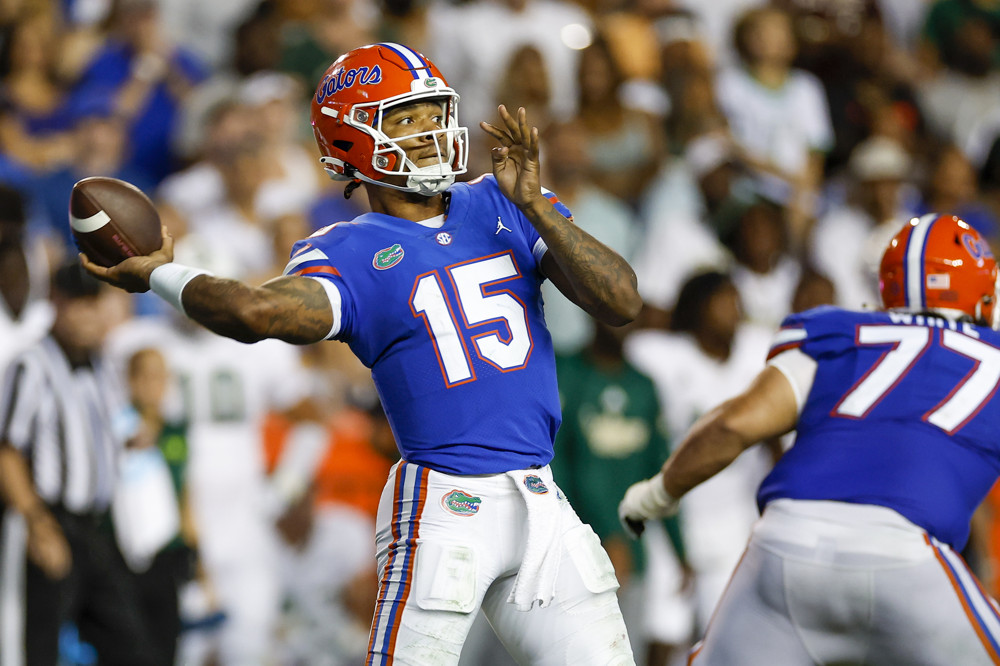
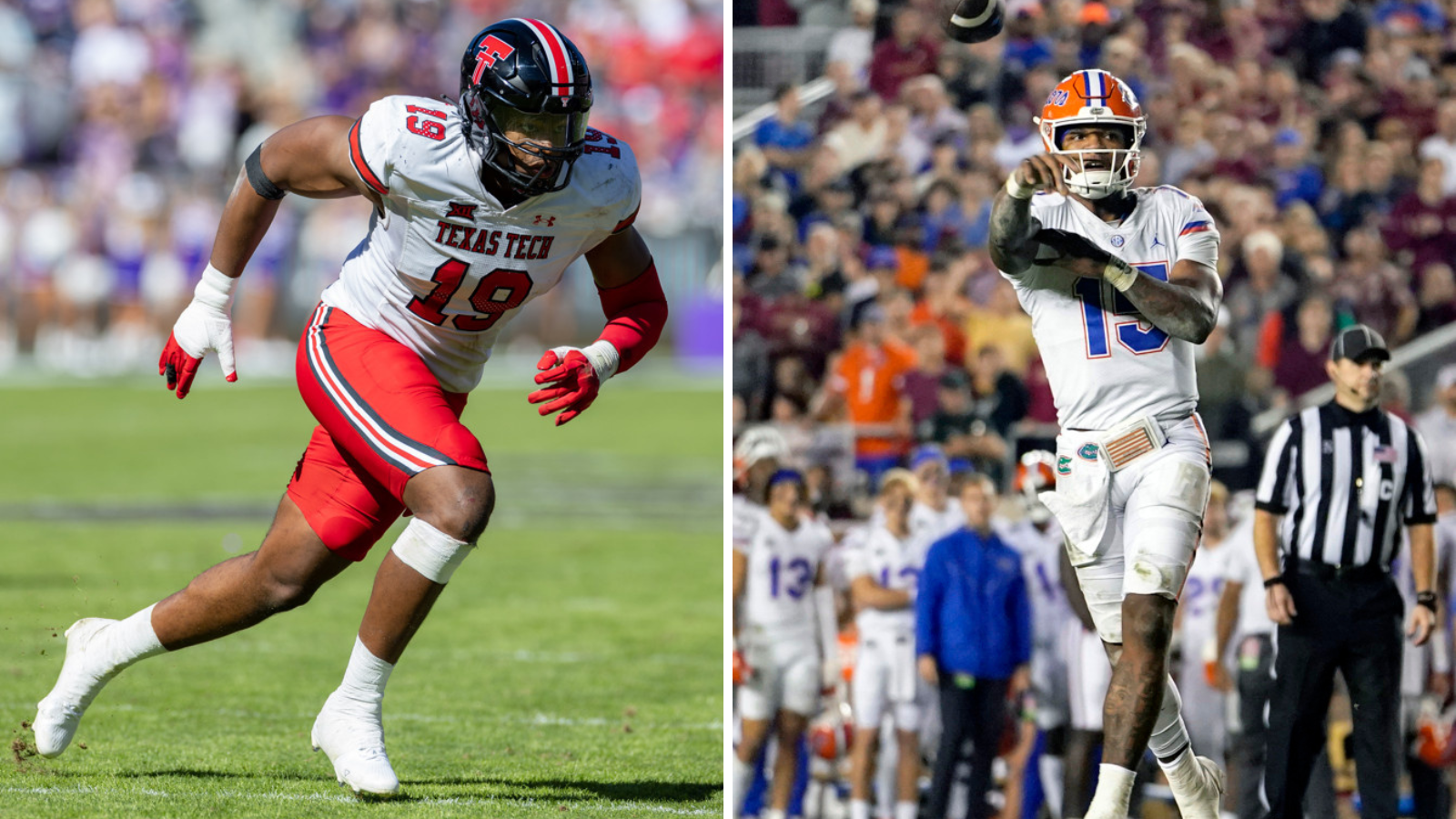
    So with this group of four top prospects—Stroud of Ohio State, Bryce Young of Alabama, Anthony Richardson of Florida, and Will Levis of Kentucky—I want to try to identify some of the bits of context that might be relevant to their evaluation. 

    Establishing a Starting Point

    It’s probably good to just start with a standard measure of total production to align on how to compare these players. Ignoring any kinds of situational factors, we can take EPA as a good measure of overall production, and then we’ll get to trying to split out the individual contributions in a second.

    QB Passing EPA Ranks, 2022 

    (out of 98 QBs with 250 attempts)

    Pass EPA Rank
    C.J. Stroud

    4

    Bryce Young

    6

    Anthony Richardson

    52

    Will Levis

    55

    That makes for some pretty obvious tiers as passers. 

    Richardson has the extra dimension with elite running ability, and obviously that’s not included here. This is just to show that Stroud and Young stand on their own from a passing production standpoint (which is, naturally, the most relevant kind of production for a QB).

    It’s difficult to advocate for Will Levis from a production perspective. His candidacy for a top pick relies on things a data analyst is ill-equipped to evaluate. So keep that in mind as we compare him to the rest of the crew.

    Now, let’s get onto trying to evaluate the offenses these players generated this production from.

    Teammates

    Let’s start with the interlocking parts of the players around each of these players. The Total Points system endeavors to disentangle the performance of each player, so let’s use that.

    Here are the team ranks in Total Points per play by the pass catchers and pass blockers around each of these prospects in 2022.

    Team Total Points per Play FBS Ranks

    Receiving Pass Blocking
    Ohio State (Stroud)

    2nd

    54th

    Alabama (Young)

    11th

    76th

    Florida (Richardson)

    26th

    18th

    Kentucky (Levis)

    16th

    16th

    Richardson’s receiving corps was definitely the most limited among this group. Their on-target catch rate was below average, which wasn’t true of the other three schools. It’s the same with contested-catch situations: Florida receivers came down with just 25% of such throws, compared to an FBS average of 32%.

    None of these players had poor offensive lines that might tilt our evaluations, but Levis and Richardson did benefit from pretty stout pass blocking overall. That’s something to keep in mind when looking at their pressure rates, which are both higher than average. That suggests they’re inviting pressure to an extent that could prove troublesome at the next level. 

    Easy Completions

    Another big talking point is how often quarterbacks are given really easy throws that can inflate their numbers. The screen game is one example of this, but so is throwing to a lot of open windows. In theory we want players who don’t rely too much on these plays.

    While only Levis was given specifically more screens than average, all of these prospects had their fair share of easy throws in 2022. Only Stroud ended up with fewer total easy throws than the FBS average.

    Top Prospects’ Easy Pass Rates, 2022

    Screen% Wide Open % (Non-Screen) Total
    C.J. Stroud

    10%

    14% 24%
    Bryce Young

    11%

    19%

    30%

    Anthony Richardson

    9%

    21%

    30%

    Will Levis

    16%

    13% 29%
    FBS Average

    13%

    14%

    27%

    On these easy throws, Richardson’s accuracy numbers are the worst of the group.  That could be seen as a large problem with his mechanics, or as low-hanging fruit to achieve quick improvement.

    If we’re trying to choose the “winner” of this comparison, we might give Stroud the advantage for having fewer “gimmes”. 

    Simplifying Reads

    Scheme can help by creating open throwing lanes, but it can also streamline the decisions the quarterback has to make. We know the hallmarks: play action, RPOs, and designed rollouts. Deceive the defense, split the field up, sharpen your focus to a limited number of players on both sides of the ball.

    Team Offense Play Type Percentages and Ranks, 2022

    Play Action % RPO % Designed Rollout %
    Ohio State (Stroud) 19% (39) 14% (95) 11% (17)
    Alabama (Young) 18% (57) 32% (14) 3% (112)
    Florida (Richardson) 31% (1) 29% (22) 12% (16)
    Kentucky (Levis) 17% (65) 10% (113) 7% (58)

    Richardson stands out here, but in a way that is probably somewhat consistent with how he’d be used at the NFL level. (Well, maybe not quite so many RPOs, since both he and Young used them at a rate higher than any NFL team.) It makes sense to get him on the move on designed rollouts to leverage his athleticism outside the pocket, but he was productive as a passer in those situations, too.

    Stroud has benefited from the simpler reads that come from designed rollouts, ranking in the top 10 in Independent Quarterback Rating each of the last two years on those plays. He’s not the same athlete as Richardson, so the threat to the defense isn’t the same, but it’s something that the team that drafts him probably would like to integrate.

    If we take out all these scheme elements and just try to isolate “straight up” pass plays, we’re sort of squinting to see what the player can do without some of the bumpers (to use a bowling reference). And when we do that, we get a result that looks a lot like the initial findings we had up top: Young and Stroud >>>.

    QB Ranks without Play Action, RPO, or Rollouts, 2022 

    (out of 101 QBs with 150 attempts)

    Total Points / Play IQR
    C.J. Stroud 2 7
    Bryce Young 1 2
    Anthony Richardson 38 87
    Will Levis 66 59

    Looking as far back as 2018, Young and Stroud each have two seasons in the top ten in the Total Points per play split (over 400 player seasons qualify). They’re joined exclusively by first round picks at the top: Kyler Murray, Justin Fields, and Mac Jones have the three best seasons. 

    Young coming at the top here is particularly compelling because of how RPO-dependent the Alabama offense is. Even if we remove those elements—which we know to be utilized less at the next level—he shows outstanding performance worthy of a top selection. 

    It’s an interesting contrast with Stroud, whose production is hard to claim is superior, but who arguably did so with fewer schematic supports to lean on.

  • Study: Combine Measurements and Total Points – Do they Correlate?

    Study: Combine Measurements and Total Points – Do they Correlate?

    After a week of workouts, drills, and interviews, combine week has come to an end and NFL teams are now deep in draft evaluation. Some players have had record-setting performances, while others might have more work to do at their Pro Day to shoot their name up big boards. The data is now there for everyone to analyze, but the question is: 

    What do these combine numbers actually mean?

    There has been a lot of discussion over the past few years as to whether or not combine results translate to a better performance on the field. Does the height, weight, arm length, hand size, 40-yard dash time, number of 225-lb. bench presses, vertical jump measurement, broad jump measurement, 20-yard shuttle run time, or 3-cone drill time of a player truly predict immediate future performance for a 1st- or 2nd-year player in the NFL?

    There have been studies done in the past (here and here) in finding correlations from combine  measurements to draft order, salary, and player performance. In regards to the latter, player performance was measured in total yards, yards in rates, and quarterback rating.

    At SIS, we can use our Total Points metric as the proxy to player performance to find correlations to combine measurements. For the purpose of this article, combine data from players who participated between 2016-2020 was collected and compared to the respective player’s first two-year Total Points sum. Correlations were computed between both Total Points and categorical Total Points (ex. Passing Total Points) based on positions to find any signal for a specific skill. 

    Without any further ado, let’s dive into the numbers…

    Quarterbacks

    When it comes to quarterbacks, it is not a big surprise that Total Points and Passing Total Points are very similar. The main skill the quarterback has to perform is throwing the football, so seeing that these two align for most measurements make sense. 

    Three measurements that stand out from the rest in terms of correlating to Total Points. The broad jump takes the cake as the highest correlated at 0.39 (0.35 Pasing Total Points), followed by the three cone drill at 0.33 (faster times lead to more Total Points) and the 40-yard dash at 0.23.

    Contradicting some of the discourse about quarterback hand-size, this measurement has a 0 correlation to Passer Points. Turns out Kenny Pickett might have a chance after all!

    Running Backs

    When looking strictly at Rushing Total Points, there are three measurements that clear the 0.2 correlation threshold. Weight, vertical jump, and broad jump measurements correlate the most to Rushing Total Points. 

    This suggests that explosiveness and leg strength translate well to the next level and can be a potential indicator of running back performance. Across the board, being bigger and faster correlates with success.

    When it comes to Receiving Total Points, the 40-yard dash and the broad jump correlate the most by far. This suggests that the ‘explosive pass-catcher out of the backfield’ moniker truly does exist.

    Looking at Pass Block Total Points for running backs, the three cone drill and vertical jump seem to predict some success at the next level.

    Wide Receiver

    The vertical jump and bench reps stand out as the two highest correlated measurements to Receiving Total Points. Even though the average Run Blocking Total Points value among receivers is small, height, weight, arm length, and the shuttle run correlate the most out of these measurements when projecting success.

    No measurements for Receiving Total Points reach the 0.2 threshold. One point to note is that pass blocking correlations in height and weight for receivers are much higher than those for the running backs.

    Offensive Linemen

    Pass Blocking and Run Blocking Total Points correlations for offensive linemen are similar for each measurement, with the 40-yard dash, arm length, and height having some difference between the two. Surprisingly, height and arm length seem to correlate more with run blocking than pass blocking.

    Overall, the 40-yard dash, three cone drill, vertical jump, and broad jump are the highest correlations when it comes to offensive line play. Bench reps have a low correlation, once again showing that leg strength and explosiveness predict higher success.

    Tight Ends

    For tight ends, the 40-yard dash and the broad jump have high correlations to Total Points, as they both nearly reach the 0.4 correlation threshold. The vertical jump does not fall that far behind either.

    The difference in broad jump, shuttle times, and three cone times between tight ends and receivers in Receiving Total Points is interesting. The get-off speed for a tight end might result in higher Total Points, which can be measured in explosiveness from the legs.

    Defensive Linemen

    Moving along to defense, we start with the defensive line. All of the speed measurements, height, weight, vertical jump, and broad jump correlate well to Pass Rush Total Points. This is very different when compared to Run Defense Total Points, as the higher the weight and more bench reps, the higher the Total Points value.

    All in all, an athletic freak on the defensive line when getting to the passer seems to be a good thing to have. On run defense, a strongly built defensive linemen is the key for success. The contrast between these two skill sets in one position group is the biggest from this analysis. 

    Linebackers

    Once again, for the linebacker position, athletic freaks tend to have the most success. All but 3 measurements reach the 0.2 correlation threshold for Pass Rush Total Points. After being significant for defensive linemen, the shuttle run and three cone times correlate to 0 and below, respectively, for linebackers. From a run defense perspective, the vertical jump and 40-yard dash times show the strongest correlations. Finally, both the 40-yard dash and shuttle runs are where the highest correlations are for linebacker pass coverage.

    Defensive Backs

    There are no correlations for Pass Coverage Total Points that reach the 0.2 threshold for defensive backs. The 40-yard dash and arm length are the two highest correlations for Pass Coverage Total Points. On run defense, only the 40-yard dash reached the 0.2 threshold. 

    Conclusion

    Overall, there are no correlations that exceed the 0.4 threshold across any position, measurement, and Total Points category. This is consistent with the previous studies that suggest there is no strong correlation between measurements and skill sets. 

    Two measurements that seem to find themselves at the top of most positions were the vertical jump and broad jump. 

    A strong and explosive lower body tends to predict more success, generally speaking, when looking at Total Points. On defense, speed is the key, as 40-yard dash, three cone, and shuttle times were some of the highest correlated measurements for all 3 defensive skills.

    All in all, don’t be fooled by the insane numbers seen at the combine. Yes, some are more meaningful than others, but there is a lot more that factors into having success in the NFL.

  • STUDY: What Does a College Receiver’s Route Tree Say About Their Pro Prospects?

    STUDY: What Does a College Receiver’s Route Tree Say About Their Pro Prospects?

    I’m sure since the world turned upside down you’re frequently thinking about what life was like in 2019. Let’s take that skill and apply it to the 2019 NFL Draft discourse.

    At that time, there were a lot of questions about DK Metcalf. He was a physical marvel who didn’t have enough of a track record—and specifically a track record of running a full NFL route tree—to be a top prospect.

    We can frame Metcalf’s limited route diversity at the time in a few ways. A relatively simple version is to just count how many routes he ran at least 5 times over his last two years at Ole Miss. SIS charted just nine, which is fewer than almost every receiver to enter the NFL over the last four seasons (among those with at least 150 routes run in their final two FBS seasons).

    Metcalf obviously turned that narrative on its head when he showed his physical tools to be more than sufficient to overcome whatever limitation he had in experience. Most players aren’t in that position. 

    So what can we learn about the value of a strong route tree in projecting into the NFL?

    Below are a few angles at what it means to have a route tree that might be desirable to NFL evaluators, and how useful they might be in identifying quality prospects.

    For this, the sample is limited to wide receivers drafted in 2019 or later who ran at least 150 routes over the two seasons prior to being drafted. In terms of their NFL performance, we’ll look at results over their first two seasons as professionals.

    When you see references to a player producing a WR1 or WR2 season, we want to show how often they played well enough to be a team’s top receiver or second-best receiver in a given year. So, a population of players having a WR2 % of 36% means that 36% of players achieved a top-64 season at least once in their first two years.

    Running a variety of routes

    As done above with Metcalf, we can look at players who simply ran a wide variety of routes in college. As we know always and in all situations, more is better!

    Are teams selecting for this?

    Not really. Receivers drafted in the first three rounds have averaged 15.8 routes run at least 5 times. Those who are Day 3 picks or go undrafted have averaged 15.1. And that’s with more than half of the players in the late/undrafted group being in the bottom third in this metric, which really drags down the average.

    Does it project success in the NFL?

    A little bit, and not in the way you might expect. 

    Among receivers selected in the first three rounds, only 2 of the 14 who were in the top third in route variety had at least one top-32 year at the position (by Total Points). 

    Of the 44 qualifying players in the middle or bottom third in route variety, 14 of them had a top-32 season (more than twice as often by proportion).

    Early NFL Production of Top-Three-Round Selections

    WR1 % WR2 %
    Top-third route variety (n=14) 14% 36%
    Lower route variety (n=44) 32% 55%


    Early NFL Production of Late Selections and Undrafted Players

    WR1 % WR2 %
    Top-third route variety (n=16) 0% 13%
    Lower route variety (n=82) 4% 10%


    This suggests that variety of routes might actually be a red herring in terms of finding top talent (bolded for emphasis)

    We don’t see enough top-32 seasons among late picks to say much about that group, but if we expand the search to top-64 campaigns, route variety might have a small benefit in terms of productivity. 

    Looking at this year’s prospects…

    To whatever extent we might be worried about players with “too much” route diversity, the names to look at would be BC’s Zay Flowers and UNC’s Josh Downs.

    At the low end, TCU’s Quentin Johnson and Tennessee’s Jalin Hyatt are not nearly at Metcalf level, but they’re solidly in the bottom third.

    Running “NFL routes”

    Logically, we can think of the routes a receiver prospect runs through the lens of the most common routes NFL receivers run. To put a point on it, more than half of NFL routes come from just the five most common routes, and more than three-quarters come from the top 10.

    Most common routes for NFL receivers

    • Curl
    • Dig
    • Go
    • Out
    • Slant
    • Post
    • Fade
    • Deep Cross
    • Corner
    • Screen

    So, we could think of a player’s NFL-readiness in terms of how often they run routes that NFL receivers run. 

    Are teams selecting for this?

    They’re selecting for it, but not within the draft. The rates of receivers running the top 10 NFL routes are virtually identical between early and late picks. But 80% of the routes run by NFL-caliber college players are NFL-caliber routes, which is roughly the same rate the NFL players run them. So there’s definitely alignment in that sense.

    Does it project success in the NFL?

    Yes, but specifically when it comes to the players at the bottom of the spectrum. The players in the bottom third in terms of running NFL routes perform worse than others drafted in a similar range.

    Early NFL Production of Top-Three-Round Selections

    WR1 % WR2 %
    Bottom-third NFL route volume (n=17) 12% 47%
    Higher NFL route volume (n=41) 34% 51%


    Early NFL Production of Late Selections and Undrafted Players

    WR1 % WR2 %
    Bottom-third NFL route volume (n=35) 3% 6%
    Higher NFL route volume (n=63) 3% 13%

    Depending on when the player is selected (and what you’d want from a pick in that range), the players who run relatively few routes from the NFL tree are substantially less likely to produce a quality season in their first two. So it seems like variety might not be the key, so much as running the routes that matter to NFL productivity.

    Looking at this year’s prospects…

    Two Tennessee receivers (Hyatt and Cedric Tillman) sit towards the top of this list, showing that while they might not be running a variety of routes, but the ones they’re running project to NFL usage. Quentin Johnson also shows up here, suggesting reduced route diversity comes along with running a lot of NFL routes.

    And would you look at that: The players towards the bottom of NFL route frequency are the variety kings, Flowers and Downs.

    Mirroring the NFL route tree

    We can take this notion of reproducing the NFL route tree a step further and identify players whose rank order of their routes closely resembles the NFL route tree. 

    For example, if deciding between two receivers who each ran the same total percentage of NFL routes, all-else-equal we’d prefer the one who ran more curls and outs over the one who was running a lot of deep crosses and corners.

    (There’s a bit of a confounding element of the player’s speed here—a promising deep threat might be more likely to run the top end of the route tree. We’ll get to that.)

    To get at this question, we can take the average deviation between the player’s rank order of their routes and the NFL average rank order, focusing on the fifteen most common routes. That group makes up 90% of NFL routes, and going too deep into the route tree could cause deviations that unfairly skew the results.

    Are teams selecting for this?

    There’s a little evidence that teams might care about this beyond the first few rounds, but it’s pretty flimsy. Players in the top third or bottom third in this deviation metric are more common among those added after the first two days of the draft. But early selections aren’t running route trees any more (or less) similar to NFL route trees, which is consistent with the previous analysis.

    Does it project success in the NFL?

    There is a bit of signal here as well. We can see that there is a difference when it comes to players with what we might call a “deviant” route tree—the upper one-third in average deviation from the NFL route tree.

    Early NFL Production of Top-Three-Round Selections

    WR1 % WR2 %
    Top-third route tree deviation (n=17) 6% 29%
    Lower route tree deviation (n=41) 37% 59%


    Early NFL Production of Late Selections and Undrafted Players

    WR1 % WR2 %
    Top-third route tree deviation (n=35) 6% 14%
    Lower route tree deviation (n=63) 2% 8%

    Like with the overall NFL-caliber-route analysis, players who don’t conform to the NFL standard who are drafted early are much less likely to produce a top season early on. 

    Interestingly we see the opposite relationship among players not drafted early, where the players who deviate from the NFL prototype have done a bit better. Technicians like Amon-Ra St. Brown and Hunter Renfrow are examples of the type of skill set that can buck this trend.

    Looking at this year’s prospects…

    We get some new names when it comes to adhering to the hierarchy of the NFL route tree: LSU’s Kayshon Boutte and Ole Miss’s Jonathan Mingo.

    However, we get even more concerning evidence for the prospects of Zay Flowers and Josh Downs, who are towards the deviant end of the spectrum.

    So what did we learn?

    Offensive schemes differ enough that there isn’t a one-size-fits-all approach to route tree analysis that’s ever going to give us a great projection into NFL productivity. However, we can see some broad strokes of what teams look for and how useful those traits are.

    More is not necessarily better when it comes to route variety. Players drafted in the first three rounds who have been asked to do a lot more in college are actually less likely to show top performance early on in their NFL careers.

    If we instead focus on the routes that NFL receivers run most often, and specifically with a frequency that aligns with what NFL receivers run, we start to see an effect. 

    This is a disqualifier more than a feather in a player’s cap, though, because the biggest effect is for players who are at the low end of the spectrum (i.e. have the least alignment with NFL-level route trees). 

    Players who come off the board in the first two days without showing they can run an NFL-like route tree are much less likely to produce like a top-level player early on.

  • 2022 SIS MAC All-Conference Team

    2022 SIS MAC All-Conference Team

    It’s finally time to release our SIS All-Conference teams. We used our all-encompassing player value stat, Total Points, along with other metrics and our scouting work as leading references in putting together our team of selections for 2022, plus a few honorable mentions.

    You can learn more about Total Points and the statistics referenced here.

    These picks are meant to honor this season’s best-of-the-best in the Mid-American Conference.

    Offense

    Position Name School
    QB Kurtis Rourke Ohio
    RB Carson Steele Ball State
    WR Dante Cephas Kent State
    WR Sam Wiglusz Ohio
    TE Brady Hunt Ball State
    FLEX Devontez Walker Kent State
    OT Davis Heinzen Central Michigan
    OT Marcellus Marshall Kent State
    OG Deiyantei Powell-Woods Central Michigan
    OG Vinny Sciury Toledo
    OC Jack Hasz Buffalo

    When talking about the 2022 MAC season, we must start with Ohio’s “Maple Missile” Kurtis Rourke. Rourke led all MAC QBs in Total Points with 97, taking a massive step forward from his 3FR season, while missing the final 3 games of the season. One reason for the progress was the addition of former Ohio State walk-on Sam Wiglusz. Wiglusz, playing primarily in the slot, was Rourke’s No. 1 target, contributing 893 yards and 11 TDs.

    Kent State’s high-paced attack was led by receivers Dante Cephas and Devontez Walker during the 2022 season. Cephas was 2nd in the MAC in Total Points as a receiver with 24, while Walker led the conference with 921 yards receiving and 11 TDs on 103 targets.  

    Carson Steele was arguably the best player in the MAC in 2022, compiling 1,531 yards and 14 TDs. What put the nation on notice was Steele’s ability to break through tackles and first contact, finishing the year with 1,113 yards after contact and 65 broken tackles. Steele was a dominant player for the Cardinals in 2022, earning a Power-5 transfer to UCLA.

    Defense

    Position Name School
    DT Braden Fiske Western Michigan
    DT Devonte O’Malley Northern Illinois
    EDGE Andre Carter Western Michigan
    EDGE Jose Ramirez Eastern Michigan
    LB Zaire Barnes Western Michigan
    LB Dyontae Johnson Toledo
    CB Quinyon Mitchell Toledo
    CB Nic Jones Ball State
    S Trey Jones Central Michigan
    S Marcus Fuqua Buffalo
    FLEX Joshua Scott Eastern Michigan

    Coming off an 8-sack year in 2021, Eastern Michigan’s Jose Ramirez became a house-hold name in 2022, finishing the year tied-3rd in the nation with 11 sacks, each one unassisted. Ramirez became the nightmare for QBs, earning a deserved 1st-Team honor.

    Let’s stick with the pass rush as Western Michigan possessed two dynamic pass rushers themselves in Braden Fiske and Andre Carter. Fiske and Carter managed 6 and 6.5 sacks, respectively, in 2022, while both maintained a pressure rate greater than 9%.

    Specialists

    Position Name School
    K Alex McNulty Buffalo
    P Luke Elzinga Central Michigan
    Returner Keegan Wilburn Ohio

    Keegan Wilburn finished 2nd in the nation in kickoff return yards, and also returned one for a touchdown. Wilburn was one of the most explosive returners in the nation, and we expect to see another big year out of him next year. Luke Elzinga was a productive punter for CMU with 22 punts inside the 20 and 20 forced fair catches. Alex McNulty was a weapon for Buffalo from anywhere on the field. He made 85% of his kicks in 2022, which led the MAC.

    Honorable Mentions

    Name School
    Marquez Cooper Kent State
    Cole Tucker Northern Illinois
    Jamal Turner Toledo
    Karl Brooks Bowling Green
    Thomas Incoom Central Michigan
    Zachary Ford Toledo

    Karl Brooks and Thomas Incoom finished right behind EMU’s Ramirez in sacks, with 10 and 11 sacks respectively. Both also possessed pressure rates greater than 10% (13.8% and 10.9%, respectively). On the offensive side, Jamal Turner for Toledo finished the year with 8 TDs, making him the go-to scoring option for the MAC Champion Rockets.

    Total Points, stats, and ranks as of 2/7/2023

  • Inside The Eagles’ Pass Rush Plan

    Inside The Eagles’ Pass Rush Plan

    The NFL passing boom of the past two decades has allowed star quarterbacks to influence their teams in a disproportionate manner. They are the most pivotal player in terms of game play, front office directive, and public image. 

    As the rules have limited what defenders can do to receivers on the outside and all but abolished the fear of going over the middle, there has been one path to disrupting the plan of the offense: Get to the quarterback. Hit him early and hit him often has long been the refrain. Joe Gibbs was thwarted by both Lawrence Taylor and the 46 defense, Tom Brady’s Super Bowl losses all came against fronts that could penetrate up the middle, and even the stupendous Patrick Mahomes has struggled against 4-man rushes that can contain him within the pocket.

    This year’s Eagles team is familiar with taking down an all-time great quarterback. Fletcher Cox and Brandon Graham may not be what they were when they defeated Tom Brady in Super Bowl LII, but they both still play a major role. With Chris Long retired and Derek Barnett on IR, Josh Sweat and Javon Hargrave more than pick up the slack. 

    One player that helps take this team from underdog to the betting favorite is second team All-Pro Haason Reddick. While his 16 sacks are tied for the second most in the league, his overall value as a pass rusher stands out: 

    • Total Points is a metric that approximates a player’s overall value contributed on each play in terms of points on the scoreboard. Reddick led the NFL in Pass Rush Total Points, as well as Total Points per pass rush. 
    • Points above Replacement (PAR) calculates a player’s value relative to what would be expected by a backup-level player at his position. Reddick’s 26 Pass Rush PAR is the most in the NFL and almost 7 points higher than Nick Bosa, who is second.

    With Andy Reid’s designs and Mahomes’ ability to capitalize on the slimmest of opportunities, the Eagles must maintain consistent pressure. Thankfully, they have one of the deepest pools of rushers in the league. In 2022 the Eagles were one of only 3 teams (Jaguars & Titans) to have 5 players with at least 26 pressures. 

    Eagles Top Pass Rushers, 2022 Season Ranks

    Total Pressures Sacks Points Saved
    Haason Reddick 14th T-2nd 1st
    Javon Hargrave 37th T-14th 67th
    Brandon Graham T-40th T-14th 21st
    Josh Sweat T-44th T-14th 39th
    Fletcher Cox T-102nd T-42ndt 48th

    While pressuring Mahomes is a must, it cannot be done by blitzing. In 2022, Mahomes’ Independent Quarterback Rating (IQR) rose from 108.5 when facing 4 rushers, to 126.1 when facing 5 or more. When looking back at Kansas City’s loss to Tampa Bay in the Super Bowl, Mahomes had an IQR of 53.9 when facing 4 rushers, as opposed to 95.8 when facing more.

    In that Super Bowl, Tampa Bay was able to give Mahomes more pressure than he had seen in the playoffs that year. The Buccaneers as a team produced a 45% pressure rate, much higher than the 30% and 32% Mahomes faced in the two games prior and they did it with 4 pass rushers having big days. 

    Shaq Barrett, Jason Pierre-Paul, Vita Vea, and current Eagle Ndamukong Suh, all had at least 5 pressures in that game. When looking at the Eagles numbers when only rushing 4 players, they show an improvement from where they rank on all pass rush plays. Any number that is highlighted green indicates a ranking that is equal to or higher than the previous table.

    Eagles Top Pass Rushers when Rushing Four, 2022 Season Ranks

    Total Pressures Sacks Points Saved
    Haason Reddick 6th 2nd 1st
    Javon Hargrave T-30th T-27th 61st
    Brandon Graham T-48th T-12th 20th
    Josh Sweat T-42nd T-12th 26th
    Fletcher Cox T-73rd T-18th 24th

    The Eagles defense has remained true to one phrase all year: “Earn the right to rush the passer.” That will need to ring true for the entire team this Sunday. They must control the game in all phases and force the Chiefs into clear passing situations. With multiple high power rushers and the positional flexibility that many of these rushers have, Philadelphia is in place to replicate the 2020 Buccaneers method of bringing pressure from multiple places without sacrificing anything on the back end. 

    The Eagles have been methodically winning the numbers all year long, and keeping 7 defenders in coverage is a key number for defeating Patrick Mahomes, which, even with a high ankle sprain, is a near-impossible task.

  • 2022 SIS All-Pac-12 Teams

    2022 SIS All-Pac-12 Teams

    It’s finally time to release our SIS All-Conference teams. We used our all-encompassing player value stat, Total Points, along with other metrics and our scouting work as leading references in putting together our team of selections for 2022, plus a few honorable mentions.

    You can learn more about Total Points and the statistics referenced here.

    These picks are meant to honor this season’s best-of-the-best in the Pac-12 Conference.

    Offense

    Position Name School
    QB Caleb Williams USC
    RB Zach Charbonnet UCLA
    WR Dorian Singer Arizona
    WR Rome Odunze Washington
    TE Dalton Kincaid Utah
    FLEX Bucky Irving Oregon
    OT TJ Bass Oregon
    OT Braeden Daniels Utah
    OG Jon Gaines II UCLA
    OG Atonio Mafi UCLA
    OC Alex Forsyth Oregon

    Heisman winner Caleb Williams is the lone representative from the Trojan offense on our Pac-12 team this season. Williams finished 2022 with a whopping 237 Total Points, which was good enough to finish second out of all players in the nation by only one point (see the ACC All-Conference team to find out who scored the most). Williams still has one more year at USC with Lincoln Riley and will look to further build upon his already illustrious collegiate career. 

    Zach Charbonnet and Bucky Irving were amongst the best running backs in a conference loaded with backfield talent, as they each tied for the conference lead in Total Points among running backs. Charbonnet led the Pac-12 in rushing yards and yards after contact while Irving boasted the highest Broken+Missed Tackle Rate in all of the FBS. 

    When it comes to the big guys, it is no surprise that our Pac-12 offensive line features two players each from UCLA (Jon Gaines II and Atonio Mafi) and Oregon (TJ Bass and Alex Forsyth), who helped pave the way for our All-Conference running backs. Braeden Daniels rounds out our unit as he represents Utah’s dominant OL. 

    No Pac-12 All-Conference team would be complete without the pass catchers. Dorian Singer and Rome Odunze proved themselves to be elite weapons in 2022 and will look to improve their numbers in 2023 as they will be returning to college next season.

    Defense

    Position Name School
    DT James Rawls Oregon State
    DT Junior Tafuna Utah
    EDGE Jeremiah Martin Washington
    EDGE Tuli Tuipulotu USC
    LB Daiyan Henley Washington State
    LB Kyrei Fisher-Morris Oregon State
    CB Chau Smith-Wade Washington State
    CB Clark Phillips III Utah
    S Cole Bishop Utah
    S Calen Bullock USC
    FLEX Christian Gonzalez Oregon

    We have a star-studded squad for our Pac-12 All-Conference Defensive Team. Utah is very well-represented, pacing the conference with 3 of our 11 total selections. USC also supplied a couple studs on this list, notably Tuli Tuipulotu, who led the country in total sacks last season while also putting up 32 Total Points, only one behind the conference leader, Washington’s Jeremiah Martin

    Specialists

    Position Name School
    K Joshua Karty Stanford
    P Eddie Czaplicki Arizona State
    Returner Anthony Gould Oregon State

    When it comes to specialists, the Pac-12 did not disappoint. Stanford’s Joshua Karty led the conference in Total Points by a good margin, mostly due to him going a perfect 18-of-18 on FGs with 13 of his makes coming from 40+ yards. Eddie Czaplicki paced the conference’s punters in Total Points while finishing 2nd in punt average and having the longest punt at 75 yards.

    As far as returners go, Oregon State’s Anthony Gould separated himself as the league’s premier returner despite only returning one kickoff. However, he led the Pac-12 in total punt return yards and had the only two punt return touchdowns the conference saw in 2022.

    Honorable Mentions

    Name School
    Michael Penix Jr. Washington
    Jacob Cowing Arizona
    Sataoa Laumea Utah
    Keaton Bills Utah
    Duke Clemens UCLA
    Mohamoud Diabate Utah
    Mekhi Blackmon USC
    Derrick Langford Washington State
    Rejzohn Wright Oregon State

    Michael Penix Jr. balled out in his first season at Washington to the tune of 178 Total Points, which was good enough for 2nd in the Pac-12 and 4th in all of FBS. He will look to improve on those numbers next year in his second season in Washington.

    Jacob Cowing finished the season 2nd amongst Pac-12 wide receivers in 2022 and Utah furthered their offensive line representation with Sataoa Laumea and Keaton Bills earning honorable mentions.

    On the defensive side, linebacker Mohamoud Diabate and ballhawking defensive back Mekhi Blackmon also caught our eyes as major playmakers in the conference.   

    Total Points, stats, and ranks as of 2/7/2023

  • 2022 SIS Sun Belt All-Conference Team

    2022 SIS Sun Belt All-Conference Team

    It’s finally time to release our SIS All-Conference teams. We used our all-encompassing player value stat, Total Points, along with other metrics and our scouting work as leading references in putting together our team of selections for 2022, plus a few honorable mentions.

    You can learn more about Total Points and the statistics referenced here.

    These picks are meant to honor this season’s best-of-the-best in the Sun Belt.

    Offense

    Position Name School
    QB Grayson McCall Coastal Carolina
    RB Frank Gore Jr. Southern Mississippi
    WR Ali Jennings III Old Dominion
    WR Jamari Thrash Georgia State
    TE Seydou Traore Arkansas State
    FLEX Khalan Laborn Marshall
    OT Cooper Hodges Appalachian State
    OT Grant Betts Troy
    OG Khalil Crowder Georgia Southern
    OG Will McDonald Coastal Carolina
    OC Logan Langemeier Georgia Southern

    Coastal Carolina’s Grayson McCall leads the conference in Total Points with 112, even though he missed 2 games because of injury. Old Dominion’s Ali Jennings III led all receivers in the conference with 31 Total Points and was tied for the conference lead in receiving TDs with 9. 

    Frank Gore Jr. dominated the rest of the conference’s running backs, leading with 55 Total Points and his Broken+Missed Tackle rate of 31.6 % was 2nd in the FBS among all players with at least 200 rushes. Khalan Laborn was no slouch either as he ranked 9th in the FBS with 1,531 yards and tied for 10th with 16 rushing TDs. 

    Georgia Southern’s Khalil Crowder led all OL in the conference in Total Points with 34. Appalachian State’s Cooper Hodges followed closely behind with 33 and Crowder’s teammate, Logan Langemeier, led all OCs in the conference with 32 Total Points. 

    Defense

    Position Name School
    DT T.J. Jackson Troy
    DT James Carpenter James Madison
    EDGE Owen Porter Marshall
    EDGE Jordan Revels Texas State
    LB Charlie Gray Marshall
    LB Logan Doublin Appalachian State
    CB Reddy Steward Troy
    CB Steven Gilmore Marshall
    S Jay Stanley Southern Mississippi
    S Andre Sam Marshall
    FLEX Micah Abraham Marshall

    Troy’s T.J. Jackson led all DT in the Sun Belt in Total Points with 38 and was a big reason why he was named 2nd Team for our All-American Team. Owen Porter of Marshall was the top edge defender in the Sun Belt with 55 Total Points. He ranked 2nd in the conference in sacks with 9.5 and 2nd in total pressures with 39. Reddy Steward led all DBs in the Sun Belt with 78 Total Points and his Passer Rating Against of 47.3 was 11th among CBs in the FBS with a minimum of 50 targets.  

    Specialists

    Position Name School
    K Dominic Zvada Arkansas State
    P Ethan Duane Old Dominion
    Returner Johnnie Lang Arkansas State

    Dominic Zvada went a near perfect 17-of-18 and his FG% of 94.4 was tied for 6th-best in the FBS for kickers with a minimum of 15 attempts. Ethan Duane’s 28 punts inside the 20 was tied for 6th-best. Johnnie Lang led the nation with 888 KR yards while adding 1 TD. 

    Honorable Mentions

    Name School
    Kyle Vantrease Georgia Southern
    La’Damian Webb South Alabama
    Derrick Canteen Georgia Southern
    Quavian White Georgia State
    Darrell Luter Jr. South Alabama
    Bralen Trahan Louisiana
    Yam Banks South Alabama

    Kyle Vantrease was 2nd in the conference in TP with 102 and threw for the 5th-most yards in the FBS. South Alabama’s Yam Banks was in conversation for the 1st Team and his 6 INTs, which was T-2nd in the FBS, is a big reason why.

    Total Points, stats, and ranks as of 2/7/2023