Category: NFL

  • Who were the best QBs on long passes in 2020?

    By KYLE RODEMANN

    Completing a deep pass can be a vital turning point in a game. In Week 17 of the 2020 NFL season, the Titans needed to secure a victory against the Texans. They were tied with less than a minute left and it looked like the game would go into overtime. Then Ryan Tannehill completed a deep pass to A.J. Brown that allowed the team to kick a field goal and win the game.

    That wasn’t the only such meaningful deep throw of 2020. There were plenty of them.

    Who were the best NFL QBs at completing the long pass this season? This article will take a look at different stats ranging from usage to overall effectiveness.

    For our purposes, we’re referring to balls thrown at least 20 yards downfield, unless otherwise stated. Minimum of 25 deep pass attempts.

    Most Deep Balls Attempted

    A quarterback who is known as a risk taker will always keep a defense honest. That defense has to plan around the deep shots, leaving safeties back and loading the box at a lower rate.

    Which quarterbacks have thrown deep the most so far in the 2020 season? The answer is in the table below:

    QuarterbackNumber of Throws
    Tom Brady83
    Matt Ryan75
    Aaron Rodgers72
    Patrick Mahomes66
    Josh Allen65
    Ben Roethlisberger65
    Drew Lock64
    Matthew Stafford62

    Buccaneers quarterback Tom Brady ends the year as the league-leader in deep passes attempted. With a head coach in Bruce Arians who loves to take deep shots, and a supporting cast of Mike Evans, Chris Godwin, and Antonio Brown, this does not come as a surprise.

    Falcons quarterback Matt Ryan ended the 2020 season with an NFL-high 626 pass attempts and he likes to throw long, so it’s not shocking that he’s second on this list. Perhaps a surprise in the top eight is Drew Lock of the Broncos, a second-year signal caller, though he was known for his arm in college. While he threw the ball deep often, his on-target percentage of 50% was below league-average (52%) and ranked tied for 19th among our 32 qualifiers.

    Highest On-Target Percentage

    It is one thing to attempt deep passes; it is a whole other thing to be accurate on them. On-Target Percentage looks at the percentage of passes that hit the receiver in stride.

    Below is a table of the season leaders in On-Target Percentage on deep balls for 2020.

    QuarterbackOn-Target %
    Cam Newton70%
    Aaron Rodgers64%
    Kirk Cousins63%
    Baker Mayfield63%
    Derek Carr63%
    Kyler Murray61%
    Daniel Jones61%
    League average: 52%

    Patriots quarterback Cam Newton tops this list partly because of where we set our qualifier (25 attempts). He had 28 deep attempts in 2020 and had an on-target percentage of 70% on them. Among the more prolific deep throwers, it was tight at the top of the leaderboard. Packers QB Aaron Rodgers displayed MVP-like accuracy, while Baker Mayfield of the Browns and Kyler Murray of the Cardinals showed us that their future in this area looks bright.

    For those wondering, Mitchell Trubisky (32%), Joe Flacco (39%) and Carson Wentz (39%) were the bottom three quarterbacks on the list. And for those looking for how each player’s completion percentage compares, check out this tweet from Dan Pizzuta of Sharp Football Analysis.

    Highest Touchdown Percentage

    Touchdown percentage not only can tell you how successful a QB is at throwing deep, but also how successful their receivers are at finishing the explosive plays by scoring.

    These QBs threw a touchdown at the highest rate when throwing the ball 20 or more yards downfield:

    QuarterbackTD% (TDs Thrown)
    Patrick Mahomes18% (12)
    Aaron Rodgers17% (12)
    Derek Carr16% (9)
    Deshaun Watson16% (9)
    Dak Prescott15% (4)
    Russell Wilson15% (9)
    Justin Herbert15% (9)
    League average: 10%

    Having Tyreek Hill and Travis Kelce to throw to has helped Chiefs quarterback Patrick Mahomes top the NFL in TD percentage on long passes. Rodgers makes another appearance on a deep ball leaderboard, and he and Mahomes share the distinction of their receivers being in the top 10 in the league in dropped deep passes, so there were even more touchdowns left on the table.

    A surprising name on this list is Dak Prescott, who missed most of the season due to injury but was incredibly prolific in the early going, leveraging his excellent receiver group and terrible defense.

    Overall

    Points Earned is one way to determine which quarterbacks have made the largest positive impact while throwing the deep ball. Here is a quick explanation of Points Earned, as shared by Alex Vigderman:

    The core assumption of passing Points Earned is that each throw has a certain expected outcome based on information like the route, the depth, and the coverage. From that point, the passer and receiver split responsibility for how well they perform above that expectation. Throwing off-target passes and deserved interceptions (caught or not) will bury a signal-caller, while he will be rewarded for leading receivers to more yards after catch and making something out of a broken pocket.

    A more in-depth explanation can be found here. This stat shows which quarterback has helped his team win the most when throwing the deep ball.

    Of the lists we’ve shown, this is the one that best reflects overall value on long passes. Check out the league leaders below:

    RankPlayerAttemptsPoints Earned
    1Aaron Rodgers7246.5
    2Tom Brady8328.9
    3Derek Carr5628.4
    4Deshaun Watson5826.2
    5Matthew Stafford6220.6
    6Kyler Murray5820
    7Daniel Jones3919.9
    8Russell Wilson6018.9
    9Patrick Mahomes6618.8
    10Justin Herbert6113.5

    If the MVP race was determined by the deep ball, Rodgers would probably win it. He has been lights-out this season when throwing deep, making every leaderboard in this article.

    Who do you think will make this list next year? Any under-the-radar names come to mind? Check back next season to find out!


  • New football podcast: Sorting out the Week 17 scenarios

    LISTEN HERE

    Former NFL scout Matt Manocherian (@mattmano) of Sports Info Solutions and football analytics pioneer Aaron Schatz (@FO_ASchatz) of Football Outsiders (@fboutsiders) take an in-depth look at the final week of the NFL regular season.

    Games they preview on a jam-packed show:

    Steelers–Browns (8:10)

    Titans-Texans (10:00)

    Bengals-Ravens (11:00)

    Colts –Jaguars (15:41)

    Cowboys-Giants (19:03)

    Washington-Eagles  (20:44)

    Packers-Bears (24:45)

    Cardinals-Rams (27:17)

    Matt then talks to Alex Vigderman (@VigManonCampus) about changes made to our flagship stat, Total Points, as relates to how it evaluates running backs.

    Thanks for listening! You can email the show with feedback at offthecharts@ww2.sportsinfosolutions.com and don’t forget to follow on Twitter @SportsInfo_SIS and Instagram @sportsinfosolutions. For more, check out: sportsinfosolutions.com footballoutsiders.com sportsinfosolutionsblog.com SISDataHub.com

  • Updated No. 1 QB Rankings: Adjustment Time

    By MARK SIMON and ALEX VIGDERMAN

    OK, so in a manner of speaking, we’re pushing the reset button on The World’s No. 1 Quarterback Ranking.

    You might have read that we changed how our Total Points player value stat evaluates run plays. These changes were to incorporate relatively new data points like defensive line techniques and the combination of initial and eventual run directions allow us to evaluate players on both sides of the ball with much more confidence as to who was involved on each play and to what extent.

    For example, we now divide responsibility for the yards before contact (plus expected yards after contact) so that the rusher has more responsibility if he is contacted late in the play and less if he is contacted early in the play. Previously the distribution was a consistent amount across all kinds of runs.

    The ramifications of this were small in some areas and large in one. Lamar Jackson gained 18 Rushing Points Earned in 2019, giving him a league-leading 46. For those of you who thought it was odd that Jackson ranked in the 20s in the World’s No. 1 Quarterback Ranking, you’ll see shortly that’s no longer a concern.

    A reminder that The World’s No. 1 Quarterback Ranking is based on a model devised by Bill James to evaluate The World’s No. 1 Starting Pitcher. Bill’s model was based on cumulative evaluation of individual starts over an extended time period using the metric Game Score.

    The World’s No. 1 Quarterback Ranking uses our player value stat, Total Points to make a cumulative evaluation of game performance over a three-year period. The key to our calculation is Points Above Average, the statistical underpinning of Total Points that is centered at zero so that positive numbers are above average and negative numbers are below average.

    Success over time is key to maintaining a good ranking. Prolonged inactivity results in a ranking drop. The recent performances carry the most weight.

    Russell Wilson’s not a Top 3 QB

    Most of the other changes to the No. 1 Quarterback Ranking to emanate from these changes to rushing calculations were small. But even small moves loom large.

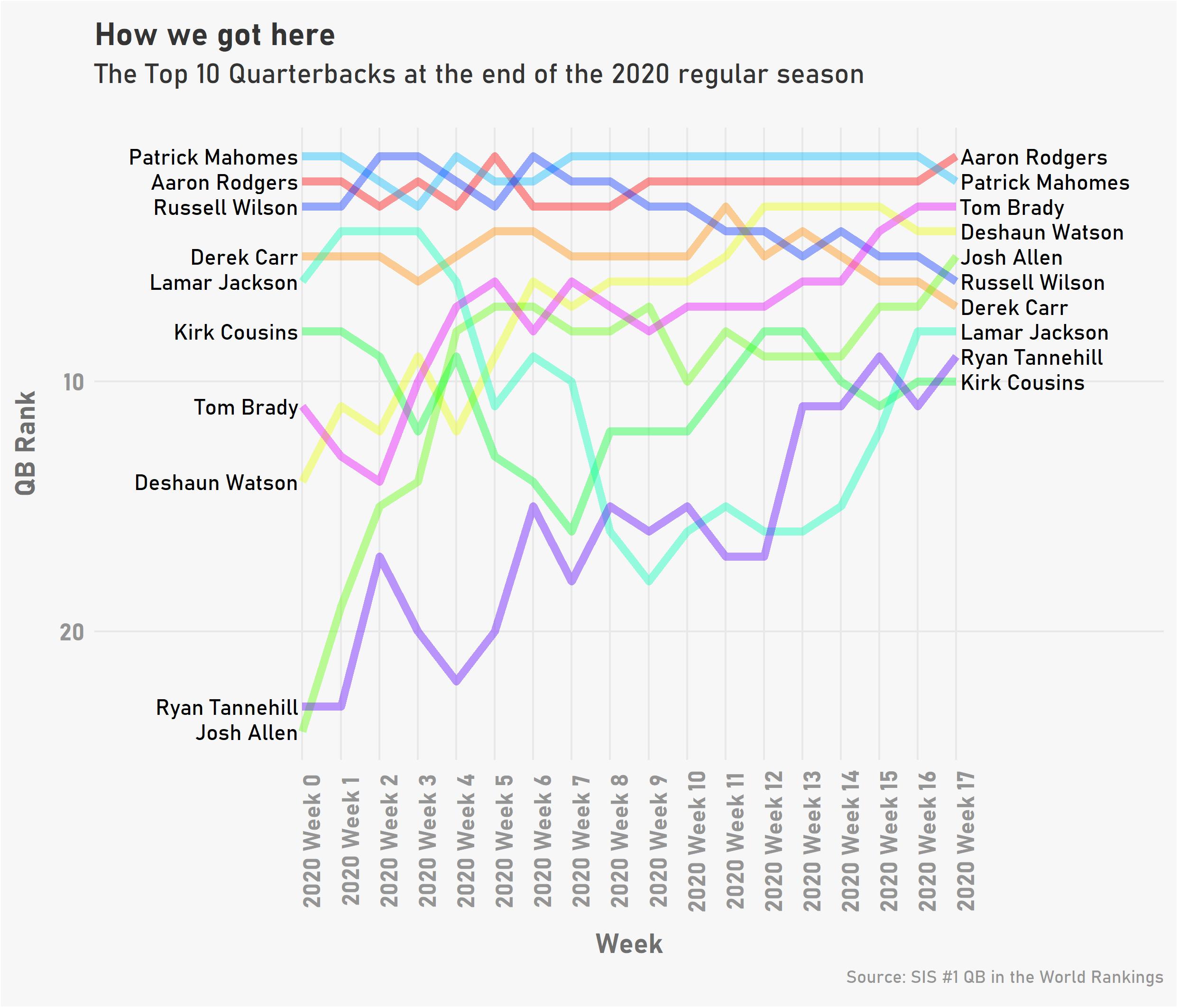
    For example, Russell Wilson, who seemed locked in as a Top-3 quarterback, has now been ranked No. 4 or 5 for five straight weeks. There has definitely been some slippage to Wilson’s game. He’s had a negative Points Above Average four times in his last seven games.

    Wilson has been usurped by Deshaun Watson, who has ranked No. 3 in four consecutive weeks with our updated calculations. Despite the Texans’ massive struggles, Watson has had a season befitting an MVP contender. He’s had a positive Points Above Average in all but one game in 2020.

    The current Top 5 is

    1. Patrick Mahomes
    2. Aaron Rodgers
    3. Deshaun Watson
    4. Russell Wilson
    5. Tom Brady

    Lamar Jackson and Kyler Murray

    Last week’s No. 1 Quarterback Rankings had Jackson as No. 22. Had we been using our updated rushing system a week ago, he would have ranked No. 15. Here’s a look at how the top 20 would have looked last week had we gone by the updated system.

     Week 14 Old System RankWeek 14 New System Rank
    Patrick Mahomes11
    Aaron Rodgers22
    Deshaun Watson43
    Russell Wilson34
    Derek Carr65
    Tom Brady56
    Drew Brees87
    Philip Rivers78
    Josh Allen119
    Kirk Cousins910
    Ryan Tannehill1011
    Kyler Murray1812
    Matt Ryan1213
    Teddy Bridgewater1314
    Lamar Jackson2215
    Dak Prescott1516
    Justin Herbert1917
    Matthew Stafford1418
    Baker Mayfield1719
    Jared Goff1620

    And since we’re using it now, we can tell you that he currently stands at No. 12 after competing 17-of-22 passes including three touchdowns in a rout of the Jaguars. Jackson’s ranking still took a dip this season. He was as high as No. 4 through games played in Week 3, but instead of dropping into the 20s as he did in the previous system, his fall was only to No. 18.

    Jackson has recovered part of his ranking with five straight games with a positive Points Above Average.

    Kyler Murray entered Week 15 ranked No. 18 in our old system and No. 12 in the updated system. This will sound odd on the surface, but despite throwing for 406 yards and three touchdowns, Murray finished with a negative Points Above Average due to an interception and two fumbles. He now stands at No. 16.

    Murray fell four spots in part because of his performance but also because of circumstance. The three quarterbacks directly in front of him, Matt Ryan, Baker Mayfield, and Justin Herbert, all had big games in Week 15.

    Long Climb up the (Tanne)hill

    After throwing for three touchdowns and rushing for two more in a Week 15 win against the Lions, Ryan Tannehill is ranked No. 9, the highest he’s ranked in the three years of games that our system tracks.

    We’ve previously written of the parity that exists outside the elite quarterbacks and Tannehill is the latest to be riding a wave that is still on its way up. He ranked No. 17 three weeks ago, but his big game in defeat against the Browns started a run of three straight standout games in which he’s recorded eight touchdown passes, one interception, and no fumbles.

    Tannehill ranks second in Passing Points Earned the last three weeks, trailing only Mayfield. Much of that value has come on intermediate-length passes. Tannehill is 17-of-25 on throws 11-to-19 yards downfield and ranks third in that time and ranks third in Passing Points Earned on those throws.

    Here are the updated rankings, with all references being to our updated evaluation system:

    World’s No. 1 Quarterback Rankings – Through 2020 Week 15

    RkPlayerPoints Above Avg Per 60Last RkStart Of Season Rk
    1Patrick Mahomes8.111
    2Aaron Rodgers7.222
    3Deshaun Watson5.0314
    4Russell Wilson4.043
    5Tom Brady3.9611
    6Derek Carr3.555
    7Josh Allen3.1924
    8Philip Rivers3.1812
    9Ryan Tannehill2.31123
    10Drew Brees2.274
    11Kirk Cousins2.1108
    12Lamar Jackson1.8156
    13Matt Ryan1.41310
    14Baker Mayfield1.31935
    15Justin Herbert0.917N/A
    16Kyler Murray0.91217
    17Matthew Stafford0.61816
    18Teddy Bridgewater0.51422
    19Dak Prescott0.3167
    20Taysom Hill-0.32118
    21Ryan Fitzpatrick-0.32213
    22Jared Goff-0.62015
    23Jacoby Brissett-0.7239
    24Ben Roethlisberger-1.12436
    25Tua Tagovailoa-1.126N/A
    26Joe Burrow-1.525N/A
    27Jimmy Garoppolo-1.82720
    28Marcus Mariota-2.24340
    29Cam Newton-2.22828
    30Matt Moore-2.32925
    31Chase Daniel-2.43026
    32Gardner Minshew-2.53641
    33Jeff Driskel-2.53131
    34Brett Hundley-2.63232
    35Matt Schaub-2.63433
    36Blake Bortles-2.63534
    37David Blough-2.73743
    38Nate Sudfeld-2.73844
    39Paxton Lynch-2.74047
    40David Fales-2.74150
    41DeShone Kizer-2.74249
    42Sean Mannion-2.74451
    43Joshua Dobbs-2.74552
    44Josh McCown-2.74655
    45Cody Kessler-2.74856
    46Phillip Walker-2.747N/A
    47Blaine Gabbert-2.74959
    48AJ McCarron-2.85058
    49Jameis Winston-2.85130
    50Andy Dalton-2.85657
    51Matt Barkley-2.85263
    52Kyle Allen-2.95374
    53Tyrod Taylor-2.95462
    54Garrett Gilbert-2.955N/A
    55C.J. Beathard-2.95754
    56Nathan Peterman-2.96075
    57Mason Rudolph-2.95865
    58Case Keenum-2.95938
    59Jalen Hurts-3.061N/A
    60Colt McCoy-3.07570
    61Devlin Hodges-3.16369
    62Joe Flacco-3.16461
    63Drew Lock-3.13353
    64Brian Hoyer-3.16568
    65Jarrett Stidham-3.266N/A
    66Eli Manning-3.26772
    67Mike Glennon-3.36839
    68Brett Rypien-3.369N/A
    69Robert Griffin III-3.37060
    70Brandon Allen-3.47166
    71Daniel Jones-3.57271
    72Ben DiNucci-3.573N/A
    73Josh Rosen-3.67476
    74Nick Mullens-3.66237
    75Kendall Hinton-3.676N/A
    76Will Grier-3.77777
    77Dwayne Haskins-3.87929
    78Alex Smith-3.87821
    79Nick Foles-4.08027
    80Ryan Finley-4.58178
    81Mitchell Trubisky-4.88267
    82Jake Luton-5.083N/A
    83Carson Wentz-5.18419
    84Sam Darnold-5.98542

  • New football podcast: Week 16 preview

    LISTEN

    Former NFL scout Matt Manocherian (@mattmano) of Sports Info Solutions and football analytics pioneer Aaron Schatz (@FO_ASchatz) of Football Outsiders (@fboutsiders) look at the most important games on the NFL Week 16 schedule. Matt and Aaron open the show with a discussion about whether the Chiefs might be a bit overrated in a historical context (0:33) before moving on to the most important games of the week: Rams-Seahawks (12:11), Colts-Steelers (17:44), Titans-Packers (23:51), and Giants-Ravens (28:02).

    You can email the show with feedback at offthecharts@ww2.sportsinfosolutions.com and don’t forget to follow on Twitter @SportsInfo_SIS and Instagram @sportsinfosolutions. For more, check out: sportsinfosolutions.com footballoutsiders.com sportsinfosolutionsblog.com SISDataHub.com

  • Enhancing the Way Total Points Evaluates the Running Game

    Enhancing the Way Total Points Evaluates the Running Game

    By ALEX VIGDERMAN

    Sports Info Solutions’ flagship player value system, Total Points, has been upgraded again.

    The incorporation of relatively new data points like defensive line techniques and the combination of initial and eventual run directions allow us to evaluate players on both sides of the ball with much more confidence as to who was involved on each play and to what extent. This new methodology combines new data points, improved evaluation strategies, and the usual tweaks and bug fixes that come every season.

    Overview of the Methodological Improvements

    1. Identify the blockers and relevant defenders based on the players’ alignment and the run direction (both the designed run direction and the eventual run direction, where previously only the designed direction was used)
    2. For the offense, divide responsibility for the yards before contact (plus expected yards after contact) so that the back has more responsibility if he is contacted late in the play and less if he is contacted early in the play. Previously the distribution was a consistent amount across all kinds of runs.
    3. For the defense, estimate how likely each player is to have made the tackle given his alignment, and compare his actual results with that expectation. Tackles upfield are better than tackles downfield, and both are better than not making a tackle at all. Previously players who made a tackle downfield were losing value relative to not making a tackle, and players who did not make a tackle were not evaluated.

    Details on the Methodological Improvements

    Using both initial and eventual run direction

    For the purposes of this discussion, a “bounce” is any run where the runner eventually ran to a gap further outside than intended, and a “cutback” is any run where the runner eventually ran to a gap further inside than intended.

    This enhancement makes each run that features a bounce or cutback evaluated first based on the initial run gap (where the run was designed to go) and then again based on the eventual run gap (where the runner ended up going). The difference between those two evaluations is based on the number of gaps moved and the blocking scheme, treating any moves of at least three gaps as similar. Then, any evaluation of the initially-run-behind linemen is based on the change in expectation for runs with a similar bounce or cutback.

    In most circumstances, a back bouncing a run outside or cutting it back means that the frontside linemen will be debited and the backside linemen credited. That’s consistent with the idea that if the play develops as designed the blockers at the point of attack are likely to have done well. And typically, the blockers at the gap the back ends up targeting are doing a good job to allow the cutback lane. That said, for example, cutbacks of three or more gaps are better than most bounces or cutbacks, so the frontside linemen won’t be debited as much (because a cutback isn’t such a bad thing in that spot) and the backside linemen won’t be credited as much (because the result isn’t expected to be as bad).

    Adjusting credit based on the yards before contact

    SIS uses a stat called “adjusted yards before contact”, which adds the expected yards after contact to the yards before contact on a play based on what typically happens on plays with similar blocking scheme and run direction. In the context of Total Points, the blockers on a play don’t get credit beyond the adjusted yards before contact.

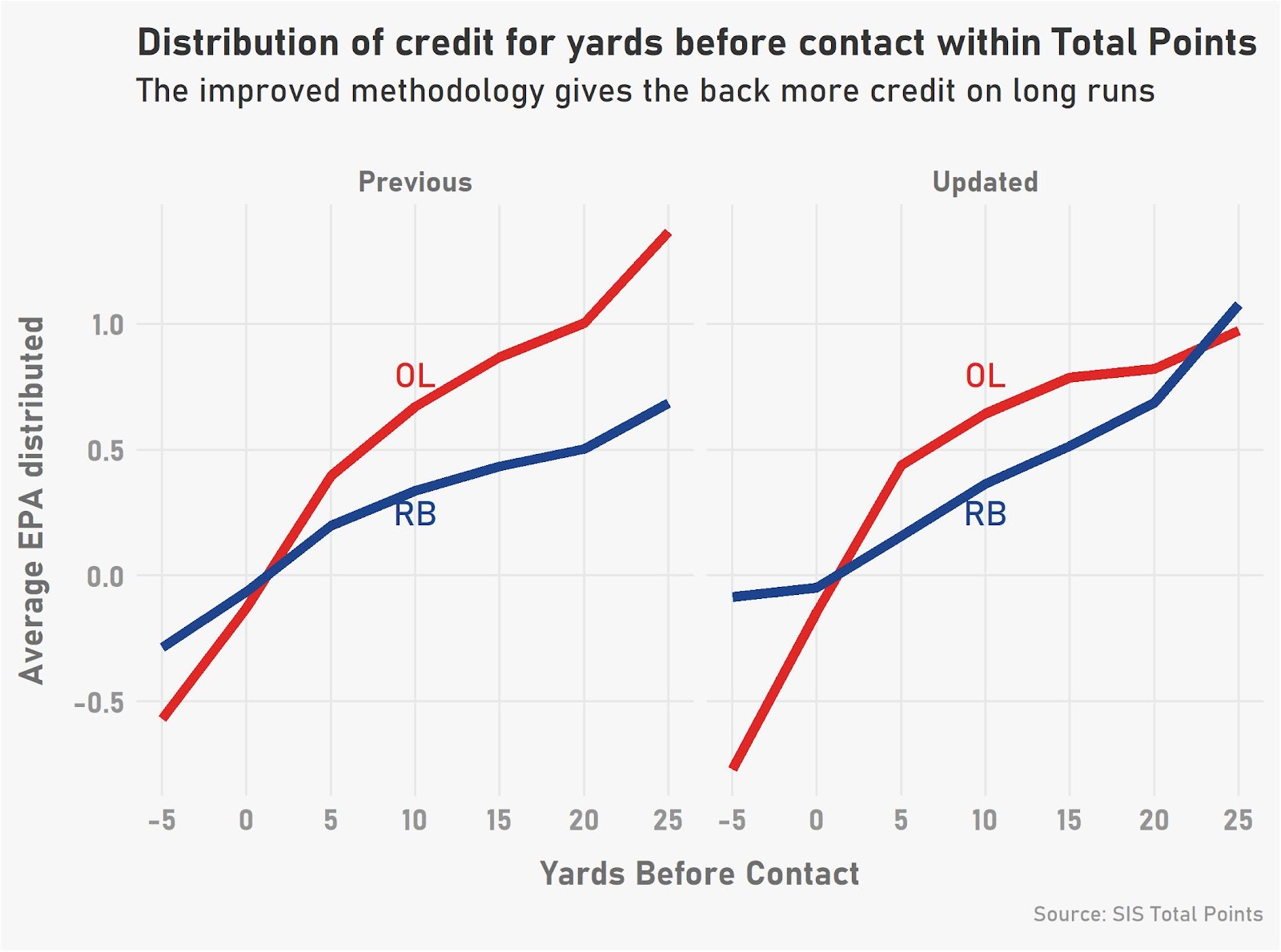
    Adjusted yards before contact are now split into “first level” (YBC <= 5), “second level” (YBC between 6 and 15), and “open field” (YBC > 15). In allocating the EPA associated with adjusted yards before contact, the offensive line now receives 3/4 of the credit at the first level, half of the credit at the second level, and 1/4 of the credit in the open field. For runs that are stuffed where the rusher is contacted behind the line of scrimmage, the line is given 90% of the responsibility.

    Here is an example of how reworking this breakdown affects how one would distribute EPA responsibility between the back and the offensive line, depending on the yards before contact on the run. The EPA shown is the value of the adjusted yards before contact.

    The new system punishes the offensive line much more when the back is contacted early, and dramatically increases the back’s responsibility for downfield yards.

    Adding defensive technique data

    Defensive alignment data informs which players were run toward, and correspondingly how responsibility for a run’s initial success or failure should go to each player on the defensive front.

    From 2019 forward the defensive alignment includes technique info for all down linemen. This allows for much more accurate judging of which defenders are most relevant. 

    To go with that, the alignment of defenders is now being considered along a continuum, where 0 is an outside cornerback on the offense’s left, 1 is an outside cornerback on the offense’s right, and anyone positioned between them has a number assigned based on their relative position. This makes it so that it’s not assumed that all adjacent defensive linemen are the same distance apart, which helps handle the variety of fronts defenses employ. This is used for determining which defenders are most relevant for runs in a certain direction or blown blocks by a certain offensive player.

    Refining how tackles are evaluated

    Before the 2019 season, SIS overhauled its evaluation of tackling in the run game to allow players to be measured based on how their tackle compared to the average tackle on similar plays from a similar position. For example, a tackle made by a MIKE on a strongside run into a heavy box would be compared to the average tackle made in those circumstances.

    One big improvement is using what’s called a plus-minus system. We measure each player’s odds of making a tackle using his alignment and the run direction, and every player is given credit or debit based on whether he made the tackle and how likely he was to make it. That plus-minus value—which will be positive for the tackler(s) and negative for everyone else—is multiplied by the EPA value of that tackle. For the non-tacklers, that EPA is the average result of similar plays, since we don’t know where they would have made the tackle. 

    The plus-minus calculation described above is modified such that it’s better to make a tackle than not, even if it was after a big gain. 

    Here is how this works out for two sample plays from last season.

    Each player has a percentage that indicates how likely he was to make a tackle based on historical data, and a decimal value that shows how much value (in terms of EPA) he was credited or debited based on his tackling or lack thereof.

    Please keep in mind that the positions of the safeties and off-ball linebackers are estimated based on typical locations for those players and are not the players’ specific locations for that play.

    Total Points Run Tackle Evaluation: Pitch to right D-gap for 30 yard run

    On this play, the left safety is one of the more likely players to make the tackle, and he does so, getting some credit. Everyone else on the play is dinged slightly, with the linebackers punished most because they were the most likely possible tacklers.

    Total Points Run Tackle Evaluation: Goal Line Power to right C-Gap for 0 yard gain

    In this case, the left end plugs up the hole and tackles the ballcarrier at the point of attack, getting a decent chunk of credit. The other players get a very small demerit for not being involved on the tackle (even though it was very unlikely for the backside players).

    It’s worth noting that in both of these cases, any of the value that these players might have accumulated based on the yards before contact on the play (as described above) are carved out, so that there isn’t any double-counting of responsibility for players on the defensive front.

    Other improvements

    • In calculating the expected yards after contact on a run play, research suggests that yards after contact is higher when the runner is contacted early or late (and lower around the line of scrimmage). As a result, several tiers of yards before contact (e.g. 0-1, 2-3, 4-5, 6+) are now being used to determine expected yards after contact more accurately.
    • To ensure that there isn’t double-counting when evaluating the defensive backfield and defensive front on a pass attempt, the value accumulated by the defensive front is subtracted from that of the defensive backfield when calculating Total Points. For example, if the defense forced two blown blocks and the quarterback attempted the throw under duress, the defensive backfield is punished more if the pass is successful and credited less if the pass is incomplete.
    • Over the last couple seasons, SIS has added several detailed route types, including a variety of screens (e.g. bubble, tunnel) which are quite similar to each other. In calculating how likely a throw is to be completed and therefore how valuable a completion or incompletion is, routes are now grouped into about a dozen categories, with screens being bundled as their own group.

    Whose Evaluations Changed the Most?

    Any of the new numbers can be found on the SIS DataHub. Let’s take a look at some players who were notable movers due to our adjustments.

    The Unanimous MVP is a Little More Unanimous

    Lamar Jackson set the league aflame last year, winning the MVP award unanimously. Total Points disagreed with the assessment, as his rushing value wasn’t enough to offset his merely above average passing value.

    The funny thing was, if you looked at EPA on run plays (designed or scrambles), Jackson’s runs were nearly three times as valuable as any other rusher, while Total Points didn’t even have him as the most valuable rusher in the league.

    The new update gives him more credit for his results, particularly on short yardage, and now he’s comfortably the most valuable rusher in terms of Total Points.

    2019 Rushing Points Earned Leaders

    PreviousCurrent
    Lamar Jackson2846
    Ezekiel Elliott3231
    Nick Chubb3228
    Chris Carson2526
    Derrick Henry2226

    That surge in rushing value puts Jackson a bit ahead of Aaron Rodgers, the previous leader in terms of Total Points (139 vs. 133). And considering he didn’t play in Week 17, the gap in performance is a bit larger than that 6 point difference suggests.

    Meanwhile, in 2020…

    The changes in terms of rusher/blocker division of credit have an impact on big plays as well. The biggest gainers in terms of Rushing Points Earned line up quite well with the players who have had long runs where they were untouched into the open field. To illustrate, here are the players who have gained the most yards before contact beyond the first fifteen this season, and how their Rushing Points Earned change with this update.

    Most Yards Gained After the First 15 Yards Before Contact, 2020 (through Week 15)

    YBC Beyond First 15Rushing Points Earned Change
    Daniel Jones130+7
    Miles Sanders101+12
    Raheem Mostert94-7
    Lamar Jackson84+15
    Russell Wilson70-3
    Kenyan Drake67+9
    Kyler Murray62+19

    Moving Defensive Backs Forward

    Total Points used to lean its defensive back evaluation slightly in favor of those who made impact tackles in the running game, primarily because other defensive backs were being suppressed for their tackles (or lack thereof).

    The new system no longer debits DBs for making a tackle downfield (after all, it’s better to make a tackle than to not make one). As a result, the elite pass defenders bubble to the top in the updated DB rankings.

    2020 Defensive Back Total Points Saved Leaders (through Week 15)

    PreviousUpdated Change
    Tre’Davious White4257+15
    Xavien Howard4755+8
    Malcolm Butler3553+18
    Carlton Davis4150+9
    Kyle Fuller4250+8
    Jaire Alexander3048+18

    What to Expect Next

    These updates started as an offseason project to enhance how we evaluated run blocking, and (as projects tend to do) extended from there in a few different directions.

    What kind of things can we expect from Total Points heading into the 2021 season?

    • Using timing data and drop types to better divide credit between the offensive line and quarterback (and defensive line and defensive backs)
    • Enhanced evaluation of quarterback accuracy (i.e. using overthrown/underthrown as well as catchable/uncatchable)
    • Using the depth of broken or missed tackles to better measure their value

  • World’s No. 1 Quarterback Update: Giving Bridgewater his due

    By MARK SIMON and ALEX VIGDERMAN

    We’re still learning about what our World’s No. 1 Quarterback Ranking calculation has to tell us about quarterback performance. The overall rankings in the important spots didn’t change much from last week to this week. Tom Brady moved up to No. 5 for the second time this season. Philip Rivers bumped up to No. 7, the highest he’s rated at any point in 2020.

    So in looking for something to comment on here before providing the updated rankings list, I thought I’d compare our World’s No. 1 Quarterback Top 10 to the 2020 quarterback leaders in Total Points Per Snap.

    World’s No. 1 QB2020 Total Points/Snap
    1Patrick MahomesPatrick Mahomes
    2Aaron RodgersAaron Rodgers
    3Russell WilsonDeshaun Watson
    4Deshaun WatsonTom Brady
    5Tom BradyRussell Wilson
    6Derek CarrJosh Allen
    7Philip RiversDrew Brees
    8Drew BreesTeddy Bridgewater
    9Kirk CousinsRyan Tannehill
    10Ryan TannehillPhilip Rivers

    The World’s No. 1 Quarterback Ranking is based on a model devised by Bill James to evaluate The World’s No. 1 Starting Pitcher. Bill’s model was based on cumulative evaluation of individual starts over an extended time period using the metric Game Score.

    The World’s No. 1 Quarterback Ranking uses our player value stat, Total Points to make a cumulative evaluation of game performance over a three-year period. The key to our calculation is Points Above Average, the statistical underpinning of Total Points that is centered at zero so that positive numbers are above average and negative numbers are below average.

    Success over time is key to maintaining a good ranking. Prolonged inactivity results in a ranking drop. The recent performances carry the most weight.

    Not surprisingly, all the names in the Top 5 on one list are in the Top 5 on the other list (Patrick Mahomes, Aaron Rodgers, Russell Wilson, Deshaun Watson, and Tom Brady).

    But there are two quarterbacks in the Top 10 in Total Points Per Snap who don’t make the Top 10 of the World’s No. 1 QB – Josh Allen and Teddy Bridgewater.

    Allen ranks No. 11 and he’s coming off a statistically poor game, the fifth-worst game in Points Above Average in Week 14. He doesn’t have enough of a positive body of work just yet for the World’s No. 1 QB system to fully embrace him. He’s been as high as No. 9 this season, so we’re not that concerned about his current absence from the Top 10.

    Bridgewater is a case of how the World’s No. 1 QB system works. Remember that we said that we use three years of data in our calculations. The lack of playing time in 2018 and 2019 dents Bridgewater’s No. 8 ranking in Total Points Per Snap this season, though not so much as to make him unfindable. He’s No. 13 in the World’s No. 1 Quarterback Rankings and he’s had a positive Points Above Average in three of his last four games, so he’s headed in a good direction even if his team is not (even though that might not be public perception).

    Liking Lamar

    If you’re looking for a big spike for Lamar Jackson in our rankings, you’re not going to find it. Jackson, who ranked No. 5 after the first game of the season, sits at No. 22, up one spot from Week 13. Though Jackson came up huge at the end of Monday’s win against the Browns, leverage is not factored into his ranking, thus he gets no bonus for big late-game plays. Jackson still has some statistical work to do to minimize the impact of his early-season issues. Jackson has two games that rank in the bottom 6 in PAA and another that ranked 31st.

    The best in the game

    If you haven’t read Sarah Thompson’s MVP breakdown, take a look because it points out just how good Mahomes has been.

    One note to add to it: Even when Mahomes has a bad game, it’s not really a bad game. His Week 14 effort against the Dolphins was his third-worst game of the season by PAA. But it still rated above average.

    In fact, Mahomes hasn’t had a game that scored below average in PAA since Week 11 last season against the Chargers.

    RkPlayerPAA Per 60 SnapsLast RkStart Of Season
    1Patrick Mahomes8.511
    2Aaron Rodgers7.722
    3Russell Wilson4.733
    4Deshaun Watson3.7415
    5Tom Brady3.7611
    6Derek Carr3.654
    7Philip Rivers2.8910
    8Drew Brees2.676
    9Kirk Cousins2.485
    10Ryan Tannehill2.01022
    11Josh Allen1.61139
    12Matt Ryan1.2129
    13Teddy Bridgewater0.41321
    14Matthew Stafford0.21616
    15Dak Prescott0.1147
    16Jared Goff-0.11714
    17Baker Mayfield-0.11541
    18Kyler Murray-0.31917
    19Justin Herbert-0.421N/A
    20Ryan Fitzpatrick-0.51813
    21Ben Roethlisberger-0.82035
    22Lamar Jackson-1.0238
    23Jacoby Brissett-1.02212
    24Taysom Hill-1.12418
    25Tua Tagovailoa-1.627N/A
    26Joe Burrow-1.825N/A
    27Jimmy Garoppolo-1.92620
    28Matt Moore-2.42824
    29Chase Daniel-2.52925
    30Drew Lock-2.54036
    31Gardner Minshew-2.53030
    32Andy Dalton-2.66655
    33Matt Schaub-2.73132
    34Jeff Driskel-2.73229
    35Blake Bortles-2.73333
    36Brett Hundley-2.83440
    37Nate Sudfeld-2.83542
    38Trevor Siemian-2.83644
    39Paxton Lynch-2.83745
    40David Fales-2.83847
    41DeShone Kizer-2.83949
    42Joshua Dobbs-2.84150
    43Josh McCown-2.84357
    44David Blough-2.84252
    45Sean Mannion-2.84453
    46Cody Kessler-2.94656
    47Phillip Walker-2.947N/A
    48Marcus Mariota-2.94848
    49AJ McCarron-2.94959
    50Blaine Gabbert-2.95160
    51Jameis Winston-2.95026
    52Case Keenum-2.95227
    53Matt Barkley-2.95461
    54Garrett Gilbert-3.055N/A
    55C.J. Beathard-3.05654
    56Mason Rudolph-3.05865
    57Nathan Peterman-3.16176
    58Nick Mullens-3.16037
    59Jalen Hurts-3.245N/A
    60Joe Flacco-3.26358
    61Tyrod Taylor-3.26464
    62Devlin Hodges-3.26568
    63Jarrett Stidham-3.362N/A
    64Mike Glennon-3.35738
    65Brian Hoyer-3.36769
    66Kyle Allen-3.36874
    67Eli Manning-3.46971
    68Brett Rypien-3.570N/A
    69Cam Newton-3.55931
    70Robert Griffin III-3.67263
    71Brandon Allen-3.67466
    72Ben DiNucci-3.773N/A
    73Daniel Jones-3.75367
    74Colt McCoy-3.87570
    75Josh Rosen-3.87677
    76Kendall Hinton-3.877N/A
    77Will Grier-3.97875
    78Alex Smith-4.17123
    79Nick Foles-4.17928
    80Dwayne Haskins-4.48034
    81Ryan Finley-4.78178
    82Mitchell Trubisky-4.98272
    83Jake Luton-5.183N/A
    84Carson Wentz-5.38419
    85Sam Darnold-6.28551
  • New football podcast: 5 games for Week 15

    LISTEN

    Former NFL scout Matt Manocherian (@mattmano) of Sports Info Solutions and football analytics pioneer Aaron Schatz (@FO_ASchatz) of Football Outsiders (@fboutsiders) look at the most important games on the NFL Week 15 schedule. Matt and Aaron break down five games this week, including the Chiefs-Saints (1:14), Bears-Vikings (10:46), Eagles-Cardinals (20:17), Browns-Giants (23:15), and Seahawks-Washington (30:38).

    You can email the show with feedback at offthecharts@ww2.sportsinfosolutions.com and don’t forget to follow on Twitter @SportsInfo_SIS and Instagram @sportsinfosolutions. For more, check out: sportsinfosolutions.com footballoutsiders.com sportsinfosolutionsblog.com SISDataHub.com

  • World’s No. 1 QB Update: Baker’s Cooking

    By Mark Simon and Alex Vigderman

    Last week we wrote about how messy The World’s No. 1 QB Rankings got once you got past the top three quarterbacks.

    This past weekend proved our point. Patrick Mahomes and Aaron Rodgers each had above-average Points Above Average (PAA) in their respective games. Of the next six quarterbacks, four had below-average numbers and the other two (Tom Brady, Drew Brees) didn’t play.

    The World’s No. 1 Quarterback Ranking is based on a model devised by Bill James to evaluate The World’s No. 1 Starting Pitcher. Bill’s model was based on cumulative evaluation of individual starts over an extended time period using the metric Game Score.

    The World’s No. 1 Quarterback Ranking uses our player value stat, Total Points to make a cumulative evaluation of game performance over a three-year period. The key to our calculation is Points Above Average, the statistical underpinning of Total Points that is centered at zero so that positive numbers are above average and negative numbers are below average.

    Success over time is key to maintaining a good ranking. Prolonged inactivity results in a ranking drop. The recent performances carry the most weight.

    Tannehill and Mayfield move up

    So let’s talk about something other than the top of the list, shall we? Let’s touch on the two quarterbacks who had the best games of Week 13. Coincidentally, they were going head-to-head.

    Titans quarterback Ryan Tannehill moved up three spots from No. 13 to No. 10 after throwing for 389 yards in a losing effort against the Browns. This is the first time that Tannehill has been positioned this high in the rankings in the three seasons for which we have data.

    Tannehill looked like someone who was going to be a Top 10 quarterback in Weeks 5 and 6, but then slipped, totaling -4 Points Above Average in his next six games. Despite that, over that span he still moved up a spot in the rankings, which speaks to the parity of quarterbacks once you get past the top few.

    But the big mover in the game was Browns quarterback Baker Mayfield, who went from No. 22 to No. 15. Mayfield, who was ranked No. 26 two weeks ago, has had two straight huge games against the Jaguars and Titans, respectively. Mayfield had a 93.5% on-target percentage against the Titans, the fourth-highest percentage for any quarterback with at least 20 pass attempts in a game this season.

    This week’s most notable dropper was Justin Herbert, who had made a nice steady climb to No. 12 in recording eight games with a positive Points Above Average in his first ten appearances. But Sunday, Herbert had the worst game of any QB this week and the fifth-worst of any QB this season against the Patriots. (-17.6 Points Above Average). This is an easy one to evaluate on the surface. Herbert’s 53 pass attempts were the most of any quarterback with a completion percentage below 50% this season. He also didn’t help matters with two interceptions and three sacks.

    In this World’s No. 1 QB system, a QB with limited experience can’t take that kind of hit without suffering significant damage to his statistical ledger. In Herbert’s case, that drops him to No. 21.

    Here are the updated rankings.

    RkPlayerPAA Per 60 SnapsLastStart of Season
    1Patrick Mahomes8.911
    2Aaron Rodgers7.322
    3Russell Wilson4.233
    4Deshaun Watson3.8415
    5Derek Carr3.654
    6Tom Brady3.4611
    7Drew Brees2.786
    8Kirk Cousins2.775
    9Philip Rivers2.4910
    10Ryan Tannehill1.81322
    11Josh Allen1.51039
    12Matt Ryan1.4119
    13Teddy Bridgewater0.31521
    14Dak Prescott0.2147
    15Baker Mayfield0.12241
    16Matthew Stafford0.01816
    17Jared Goff-0.22114
    18Ryan Fitzpatrick-0.41713
    19Kyler Murray-0.61617
    20Ben Roethlisberger-0.61935
    21Justin Herbert-0.712N/A
    22Jacoby Brissett-0.92012
    23Lamar Jackson-1.4238
    24Taysom Hill-1.52418
    25Jimmy Garoppolo-1.82520
    26Joe Burrow-1.926N/A
    27Tua Tagovailoa-2.027N/A
    28Matt Moore-2.42824
    29Chase Daniel-2.42925
    30Gardner Minshew-2.63130
    31Matt Schaub-2.73332
    32Jeff Driskel-2.73429
    33Blake Bortles-2.73533
    34Brett Hundley-2.83640
    35Nate Sudfeld-2.83742
    36Trevor Siemian-2.83844
    37Paxton Lynch-2.84045
    38David Fales-2.84147
    39DeShone Kizer-2.84249
    40Joshua Dobbs-2.84350
    41David Blough-2.84452
    42Josh McCown-2.84557
    43Jalen Hurts-2.8N/AN/A
    44Drew Lock-2.83236
    45Sean Mannion-2.84653
    46Cody Kessler-2.94756
    47Marcus Mariota-2.94848
    48Phillip Walker-2.949N/A
    49AJ McCarron-2.95159
    50Jameis Winston-2.95026
    51Blaine Gabbert-2.95260
    52Case Keenum-2.95327
    53Matt Barkley-3.05461
    54Garrett Gilbert-3.056N/A
    55C.J. Beathard-3.05754
    56Daniel Jones-3.05867
    57Mike Glennon-3.03038
    58Mason Rudolph-3.05965
    59Nathan Peterman-3.16276
    60Jarrett Stidham-3.160N/A
    61Nick Mullens-3.16137
    62Cam Newton-3.16831
    63Joe Flacco-3.26358
    64Tyrod Taylor-3.26464
    65Devlin Hodges-3.26568
    66Brian Hoyer-3.36669
    67Eli Manning-3.46771
    68Kyle Allen-3.46974
    69Andy Dalton-3.47055
    70Brett Rypien-3.571N/A
    71Alex Smith-3.77323
    72Robert Griffin III-3.75563
    73Ben DiNucci-3.774N/A
    74Colt McCoy-3.87270
    75Brandon Allen-3.87566
    76Josh Rosen-3.87677
    77Kendall Hinton-3.978N/A
    78Will Grier-3.97775
    79Nick Foles-4.27928
    80Dwayne Haskins-4.48034
    81Ryan Finley-4.88278
    82Mitchell Trubisky-4.98172
    83Jake Luton-5.384N/A
    84Carson Wentz-5.68319
    85Sam Darnold-6.08551
  • New football podcast: Week 14 Preview

    LISTEN

    Former NFL scout Matt Manocherian (@mattmano) of Sports Info Solutions and football analytics pioneer Aaron Schatz (@FO_ASchatz) of Football Outsiders (@fboutsiders) look at the most important games on the NFL Week 14 schedule. Matt and Aaron break down matchups between the Ravens and Browns (2:10), Colts-Raiders (9:33), Cardinals-Giants (15:35), and Steelers-Bills (23:59).

    You can email the show with feedback at offthecharts@ww2.sportsinfosolutions.com and don’t forget to follow on Twitter @SportsInfo_SIS and Instagram @sportsinfosolutions. For more, check out: sportsinfosolutions.com footballoutsiders.com sportsinfosolutionsblog.com SISDataHub.com

  • No. 1 QB in the World Update: We know No. 1, what about the others?

    No. 1 QB in the World Update: We know No. 1, what about the others?

    By Mark Simon and Alex Vigderman

    So who the heck is the fourth-best quarterback in the NFL? Or the seventh best?

    We know that’s not the purpose here. But right now, the No. 1 quarterback in the league is obvious (Patrick Mahomes). And the No. 2 and 3 quarterbacks (Aaron Rodgers and Russell Wilson) are clearcut too, even as they flip places from time to time. That makes for boring articles as we try to publicize these rankings. Thus, we move along.

    The most popular comment we got in the early going of releasing these rankings was that Derek Carr was an undeserving No. 4 (we explained why he was where he was). He’s been supplanted by Deshaun Watson, whose status in that position now hinges on how he fares without a couple of his best receivers. They’re now neck-and-neck at 4-5. Tom Brady currently resides in the No. 6 spot but he’s showing his age and you wonder if his aging body can survive a full season like it used to.

    Drew Brees is injured and thus slipping in the rankings. If healthy, he could stake a claim to No. 4. But we deal here in what is. And right now, Brees is an isn’t. So instead, Kirk Cousins is No. 7 and Brees is No. 8 and slipping, and his absence could extend a stretch of five different quarterbacks ranking No. 8 in the last five weeks.

    Let’s interrupt to remind you what this is:

    The World’s No. 1 Quarterback Ranking is based on a model devised by Bill James to evaluate The World’s No. 1 Starting Pitcher. Bill’s model was based on cumulative evaluation of individual starts over an extended time period using the metric Game Score.

    The World’s No. 1 Quarterback Ranking uses our player value stat, Total Points to make a cumulative evaluation of game performance over a three-year period. The key to our calculation is Points Above Average, the statistical underpinning of Total Points that is centered at zero so that positive numbers are above average and negative numbers are below average.

    Success over time is key to maintaining a good ranking. Prolonged inactivity results in a ranking drop. The recent performances carry the most weight.

    Ok, back to what we were saying.

    There’s a lot of quarterback parity (at least relative to the top of the list) once you get to No. 9 Philip Rivers. He’s neck-and-neck with No. 10 Matt Ryan, with Josh Allen a step behind at No. 11. We can talk about Justin Herbert, Ryan Tannehill, Kyler Murray and Teddy Bridgewater. They’re not quite there. They’re not good enough and not consistent enough yet. And if you’re asking about Ben Roethlisberger, last year’s absence cost him spots. He’s No. 18 (and we’ll add in Wednesday’s game against the Ravens next week).

    Anyhow, it’s worth noting that the gap between the No. 1 and No. 3 quarterbacks on our list is actually larger than the gap between the No. 4 and No. 11 quarterbacks. Which we suppose also tells you just how good the No. 1 guy is right now.

    Maybe in the end, that’s the point here.

    Here are the updated rankings

    RkPlayerPAA Per 60 SnapsLastRkStartOfSeasonRk
    1Patrick Mahomes8.411
    2Aaron Rodgers6.722
    3Russell Wilson4.833
    4Deshaun Watson4.5515
    5Derek Carr4.544
    6Tom Brady3.4611
    7Kirk Cousins3.285
    8Drew Brees3.076
    9Philip Rivers2.2910
    10Matt Ryan2.1109
    11Josh Allen1.61139
    12Justin Herbert0.712N/A
    13Ryan Tannehill0.61322
    14Dak Prescott0.4147
    15Kyler Murray0.11517
    16Teddy Bridgewater0.11621
    17Matthew Stafford-0.21716
    18Ryan Fitzpatrick-0.32213
    19Ben Roethlisberger-0.51835
    20Jacoby Brissett-0.82012
    21Baker Mayfield-1.12641
    22Jared Goff-1.21914
    23Lamar Jackson-1.3238
    24Taysom Hill-1.52118
    25Jimmy Garoppolo-1.82420
    26Joe Burrow-1.925N/A
    27Matt Moore-2.42724
    28Tua Tagovailoa-2.428N/A
    29Chase Daniel-2.42925
    30Mike Glennon-2.63638
    31Gardner Minshew-2.63130
    32Drew Lock-2.63236
    33Daniel Jones-2.76566
    34Matt Schaub-2.73332
    35Jeff Driskel-2.73429
    36Blake Bortles-2.73533
    37Brett Hundley-2.83740
    38Nate Sudfeld-2.83842
    39Trevor Siemian-2.83944
    40Geno Smith-2.84043
    41Paxton Lynch-2.84145
    42David Fales-2.84246
    43DeShone Kizer-2.84348
    44Joshua Dobbs-2.84449
    45David Blough-2.84551
    46Josh McCown-2.84756
    47Sean Mannion-2.84652
    48Cody Kessler-2.94855
    49Marcus Mariota-2.94947
    50Phillip Walker-2.950N/A
    51AJ McCarron-2.95258
    52Blaine Gabbert-2.95359
    53Jameis Winston-2.95126
    54Case Keenum-2.95427
    55Matt Barkley-3.05560
    56Robert Griffin III-3.05662
    57Garrett Gilbert-3.057N/A
    58C.J. Beathard-3.05953
    59Mason Rudolph-3.16064
    60Jarrett Stidham-3.161N/A
    61Nathan Peterman-3.16275
    62Joe Flacco-3.26357
    63Devlin Hodges-3.36667
    64Tyrod Taylor-3.36763
    65Brian Hoyer-3.46968
    66Nick Mullens-3.45837
    67Brandon Allen-3.46465
    68Eli Manning-3.57070
    69Kyle Allen-3.57173
    70Cam Newton-3.53031
    71Brett Rypien-3.573N/A
    72Andy Dalton-3.67254
    73Colt McCoy-3.76869
    74Alex Smith-3.77823
    75Ben DiNucci-3.874N/A
    76Josh Rosen-3.97576
    77Will Grier-3.97674
    78Kendall Hinton-4.0N/AN/A
    79Nick Foles-4.37928
    80Dwayne Haskins-4.58034
    81Mitchell Trubisky-4.97771
    82Ryan Finley-4.98277
    83Carson Wentz-5.28319
    84Jake Luton-5.484N/A
    85Sam Darnold-5.78150