Former NFL scout Matt Manocherian (@mattmano) of Sports Info Solutions and football analytics pioneer Aaron Schatz (@FO_ASchatz) of Football Outsiders (@fboutsiders) look at trends from Week 1 of the NFL season (0:34) and compare the play of Cam Newton and Tom Brady in their first games in new uniforms (6:45) before breaking down the most important games for Week 2: the Jaguars-Titans (12:19), Lions-Packers (17:06), and Ravens-Texans (25:00).
Former NFL scout Matt Manocherian (@mattmano) of Sports Info Solutions and football analytics pioneer Aaron Schatz (@FO_ASchatz) of Football Outsiders (@fboutsiders) welcome The Athletic’s Mike Sando (@SandoNFL) to the show to discuss his annual article on NFL QB Tiers, including background on the how the tiers are compiled (3:40), Dak Prescott being surprisingly low (7:29), Cam Newton getting votes in four different tiers (18:44), Tom Brady at the top of Tier 2 (22:28), a revival of the Aaron Rodgers debate (26:33), what to expect from rookies (33:15), using the tier system as a tool for Hall of Fame balloting (39:41), and his article about concerns for each team heading into the season (43:11).
Former NFL scout Matt Manocherian (@mattmano) of Sports Info Solutions and football analytics pioneer Aaron Schatz (@FO_ASchatz) of Football Outsiders (@fboutsiders) welcome Neil Stratton (@InsideTheLeague) of Inside the League back to the show to talk about his new book: “Scout Speak: Thinking & Talking About Being an NFL Evaluator”, which is available now on Amazon. Neil talks about what he’s been up to (1:06), what it’s like for agents trying to sign college players who have opted out of this season (3:22), and his expectations for the upcoming NCAA season (10:27). He then discusses his book, including the target audience (12:28), an insider take on the drafting of Mario Williams over Reggie Bush in 2006 (16:05), and how scouting has changed (22:53). Check out Neil’s work at both Inside The League and Succeed In Football.
Former NFL scout Matt Manocherian (@mattmano) of Sports Info Solutions and football analytics pioneer Aaron Schatz (@FO_ASchatz) of Football Outsiders (@fboutsiders) turn their focus to highlighting women working in football analytics in this week’s episode. Matt and Aaron first talk to Los Angeles Rams Manager of Analytics and Data Sarah Bailey (@sarahrunbailey) (1:16) before transitioning to a discussion with Atlanta Falcons Salary Cap and Contracts Analyst Emily Badis (@EmilyBadis) (20:50). Both women talk about their backgrounds, how they got into football analytics, the experience they’ve gained in their positions, challenges they’ve faced, and give advice for others looking to break into working in football.
Sports Info Solutions has recently developed an On-Off Splits Tool, available on its SIS DataHub Pro platform. The tool allows you to select any player and see an abundance of basic to advanced stats with and without that player on the field.
It answers questions like: How did the team’s personnel usage change? How did their play-calling change? How did the team’s success vary using metrics like EPA and Positive%? How were the other players on the team affected?
We’re excited to announce that the On-Off Splits Tool is available as a free add-on for new subscribers to the SIS DataHub Pro this season. Just subscribe to any of our NFL only or NFL+NCAAF subscription packages and get this tool bundled for no additional cost!
Player Breakdowns Using the On-Off Splits Tool
Will Fuller
Our first subject, Will Fuller, has been one of the biggest risers on fantasy draft boards as the season approaches. Over the past month, his average draft position (ADP) has jumped from 8.05 to 7.03 (per Fantasy Football Calculator). The fantasy community is warming up to the fact that Fuller is a frontrunner to fill the WR1 shoes in a high-scoring Houston Texans offense.
Due to his injury woes, Fuller is a prime candidate to observe through the On-Off Splits Tool to gain an understanding of how his presence impacts the Houston offense and what this could mean if he stays healthy in an increased role.
Snap Count Breakdown
Season
On (Pass Snaps)
Off (Pass Snaps)
2019
326
305
2018
221
399
2017
304
299
Over the past three seasons, Fuller has been on the field for just 46% of the Texans pass snaps.
Key takeaways:
Pass EPA/60
Yds/Dropback
Deep Throw Pct
On
Off
On
Off
On
Off
2019
13
-1
7.2
5.9
17%
10%
2018
12
4
7.9
6.1
14%
9%
2017
-2
-9
6.0
5.7
22%
13%
In all three seasons, Houston performed better, or saw increases, in the following metrics with Fuller on the field: Passing EPA/60 Plays, Yards per Dropback, and Deep Throw%.
The impact of losing DeAndre Hopkins is yet to be determined, but the evidence is clear that over a large sample size, the Houston has performed significantly better and has been more aggressive with Will Fuller on the field.
Kyle Juszczyk
The second player breakdown is Kyle Juszczyk, whose presence and health significantly influenced the way the San Francisco 49ers ran their offense en route to a Super Bowl appearance.
The 49ers have been among the leaders in two-RB personnel usage since signing Juszczyk to a four-year, $21 million contract in 2017. Since then, few players’ on-field presence has more heavily dictated how their team’s offense operates, and therefore also the looks they’re given by opposing defenses.
Last season Juszczyk missed four games due to injury, but was otherwise on the field for 52% of San Francisco’s total offensive snaps.
With Juszczyk in the game, the offense skewed 40 percent pass versus 60 percent run, and that rate was a mirror image without him. Regardless of their more run-heavy approach, the 49ers were better both through the air and on the ground with #44 in the backfield.
Here are the passing and rushing breakdowns, looking at EPA/60 Plays, Positive%, and Yards per Attempt:
PASSING
On
Off
EPA/60 Plays
17
4
Positive%
58%
47%
Yards per Attempt
10.0
7.8
RUSHING
On
Off
EPA/60 Plays
3
-4
Positive%
47%
35%
Yards per Attempt
5.3
4.5
The rushing improvement is intuitive considering the team’s play-calling tendencies. Raheem Mostert, Tevin Coleman, and Matt Breida each had significant Yards per Carry bumps with Juszczyk paving the way in front of them
Less obvious, but even more significant, was the advantage in the pass game that was gained by Juszczyk’s presence on the field dictating the defense’s personnel and behavior.
Jimmy Garoppolo took advantage of more real estate in the secondary, gaining 17 EPA per 60 plays with Juszczyk on the field as a diversion.
The 49ers run-first approach also opened the door for more Play Action, which increased from 30% to 52% with Juszczyk. As a team, they averaged 10.7 Yards per Attempt on Play Action, compared to 7.3 on straight dropbacks.
Remember to check out the SIS DataHub Pro and sign up for a free 7-day trial. Between now and the start of the NFL season, new paid subscribers will receive free access to our new On-Off Splits Tool!
Former NFL scout Matt Manocherian (@mattmano) of Sports Info Solutions and football analytics pioneer Aaron Schatz (@FO_ASchatz) of Football Outsiders (@fboutsiders) go one-on-one this week to talk potential surprise teams for the 2020 NFL season. They open with a discussion of how cutdowns are going to work with no preseason games (0:46) and good news on the COVID front (so far) (2:31), before transitioning to a look at teams on the lower end of projections who could be better than expected (4:08) and teams on the higher end of projections who could be worse than expected (11:31). They finish with an examination of how depth could impact the outcomes for some teams if injuries strike (15:22).
Former NFL scout Matt Manocherian (@mattmano) of Sports Info Solutions and football analytics pioneer Aaron Schatz (@FO_ASchatz) of Football Outsiders (@fboutsiders) welcome epidemiologist and FO contributor Zachary Binney (@zbinney_NFLinj) to the show to discuss the 2020 football season in the wake of the COVID-19 pandemic. The group opens with some general talk about how the virus has impacted sports (1:13) before moving to whether football is worse for virus transmission than other sports (3:42), some guidelines for restarting a sport (8:12), how football teams specifically can mitigate some of the risk of outbreak (17:36), if fans in the stands is a good idea (20:37), if there is a way to quantify the benefits of sports returning (23:24), how things could play out over the NFL and NCAA seasons (25:54), and how a potential vaccine could impact a Spring NCAA season (28:20).
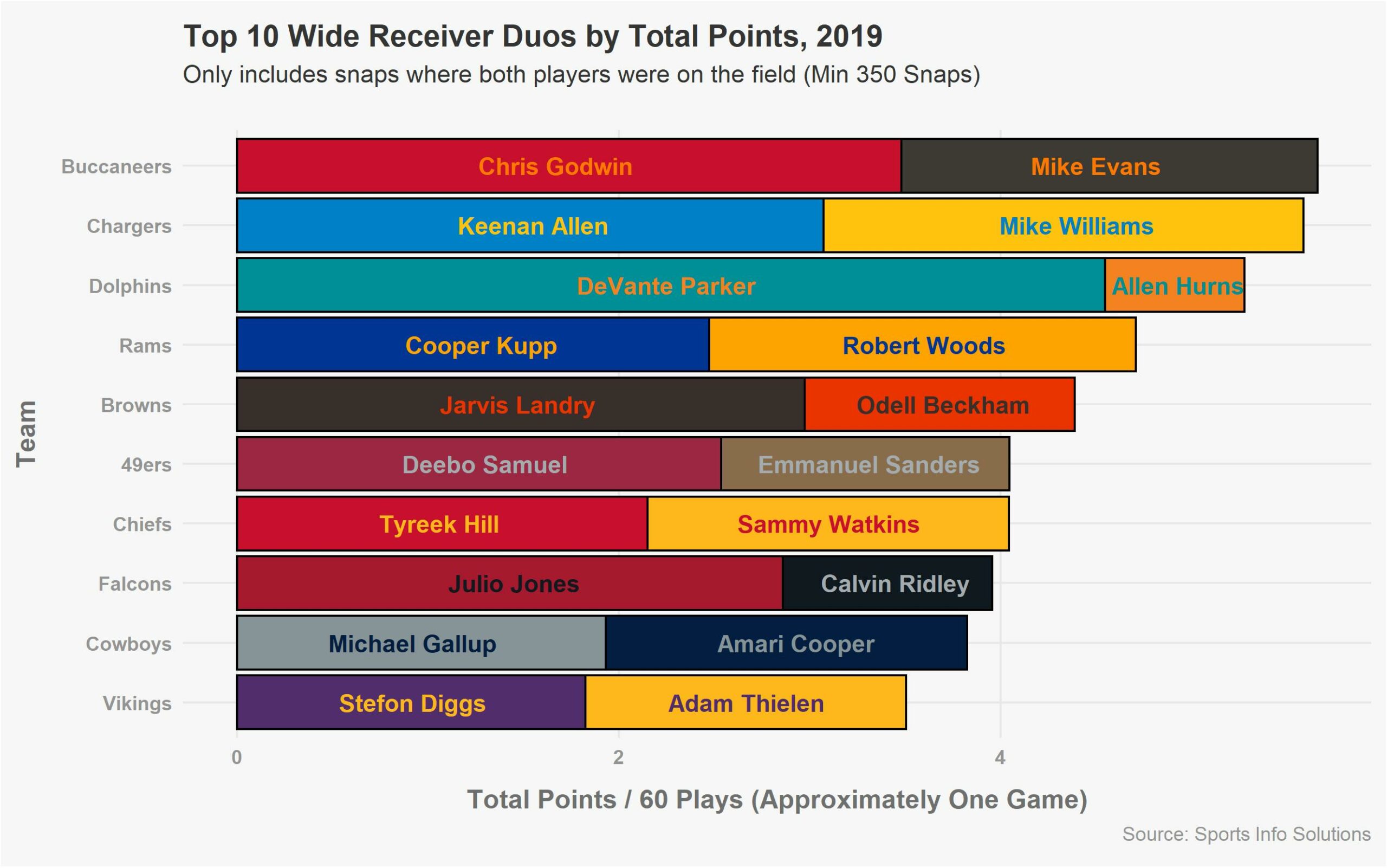
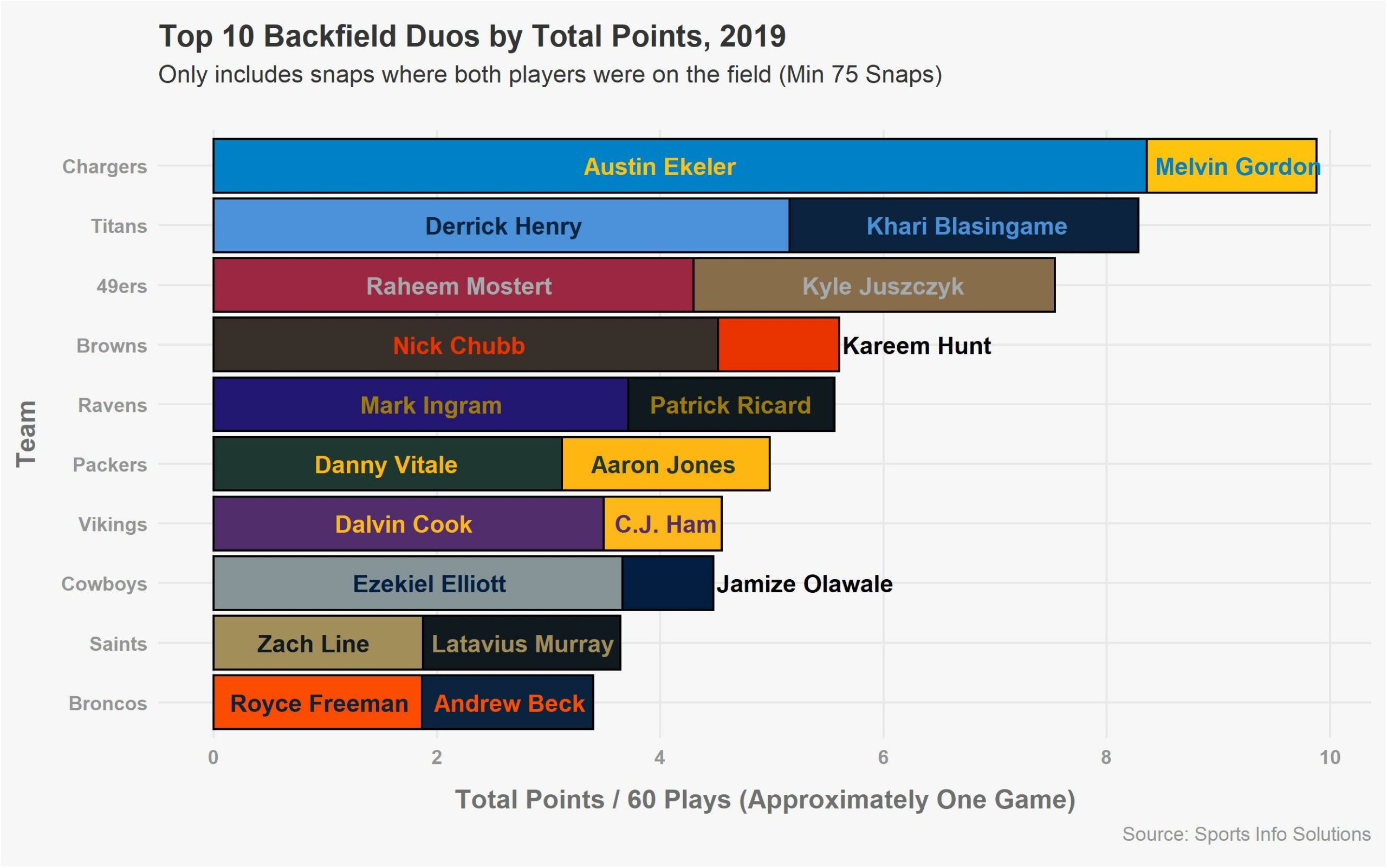
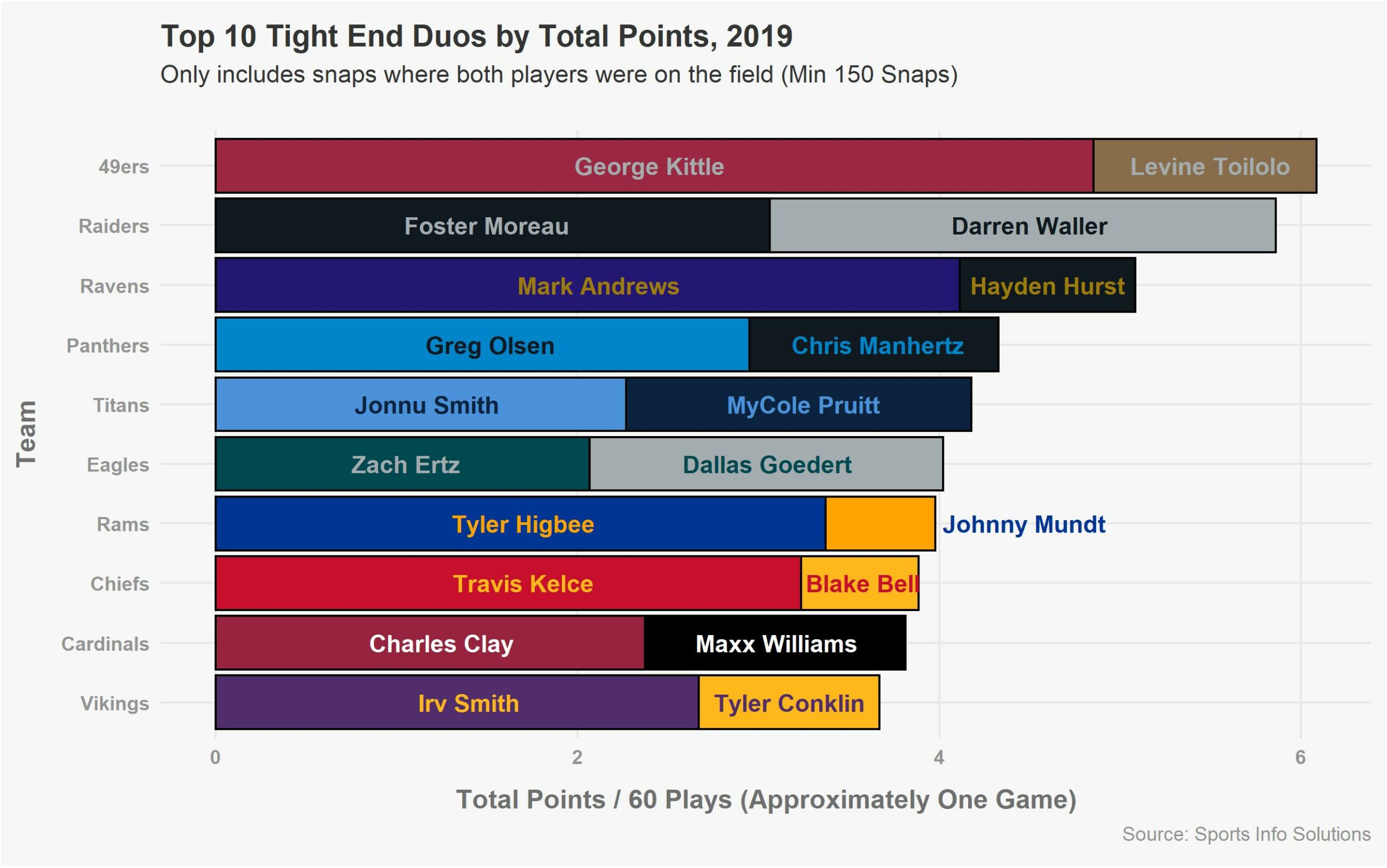
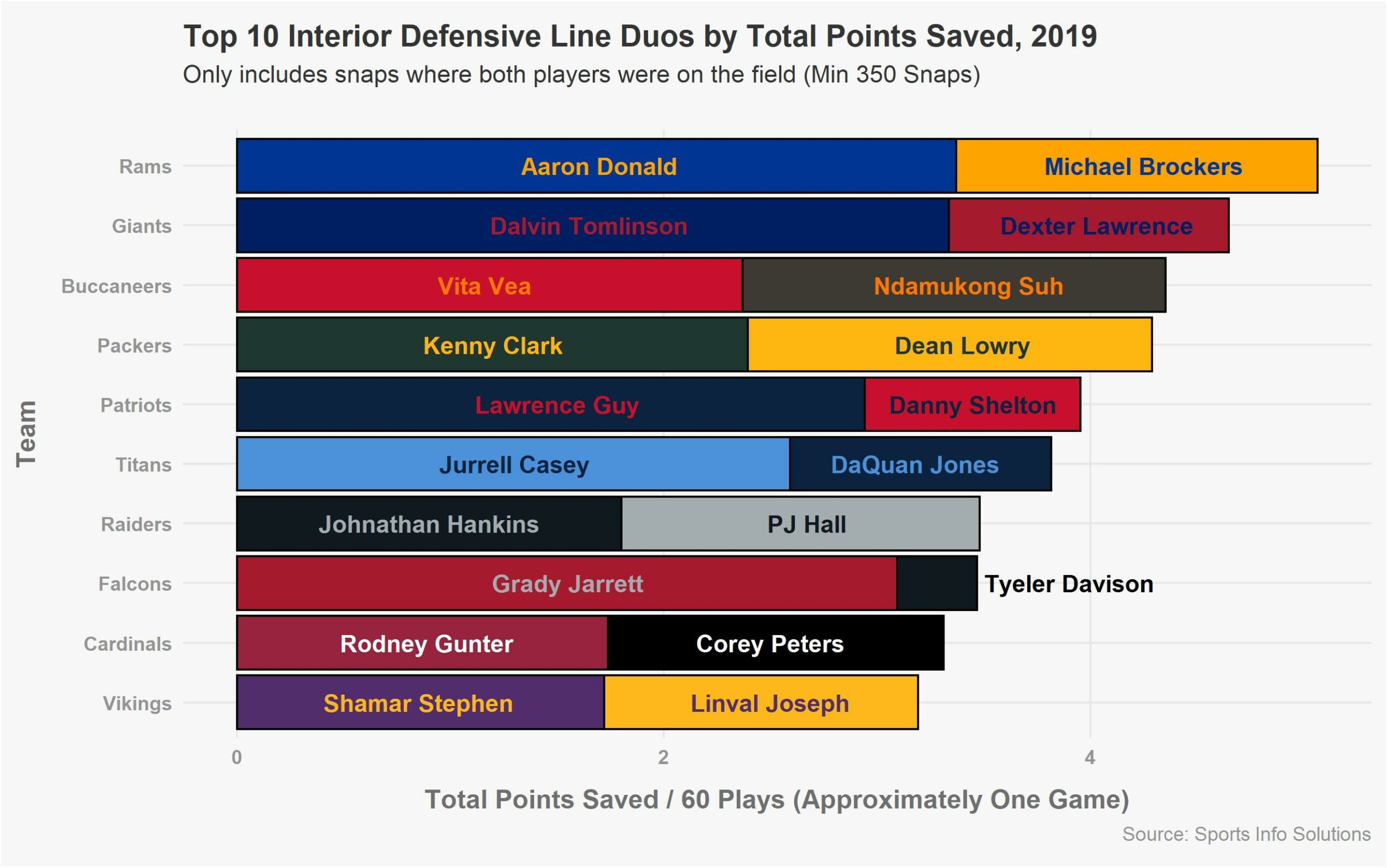
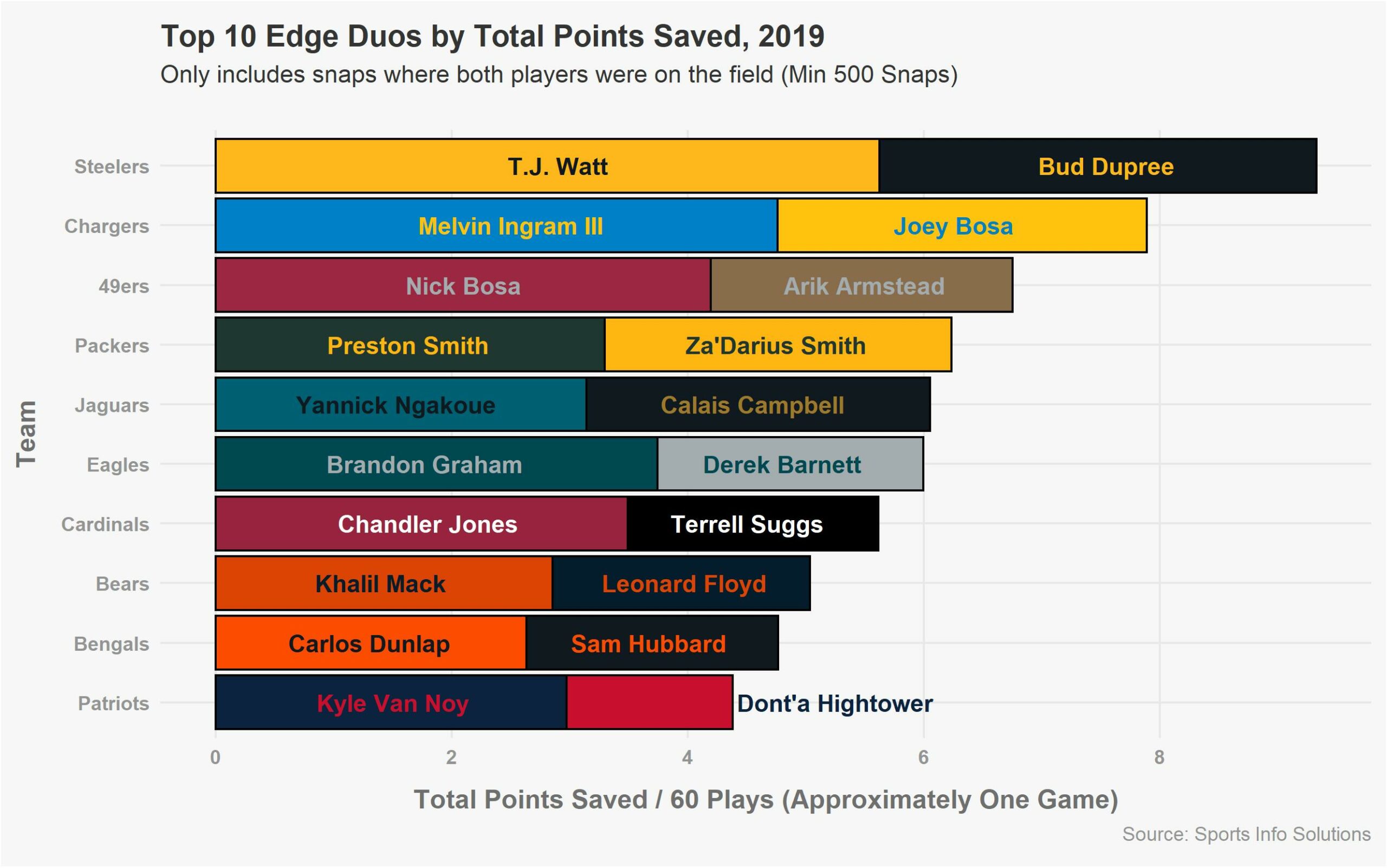
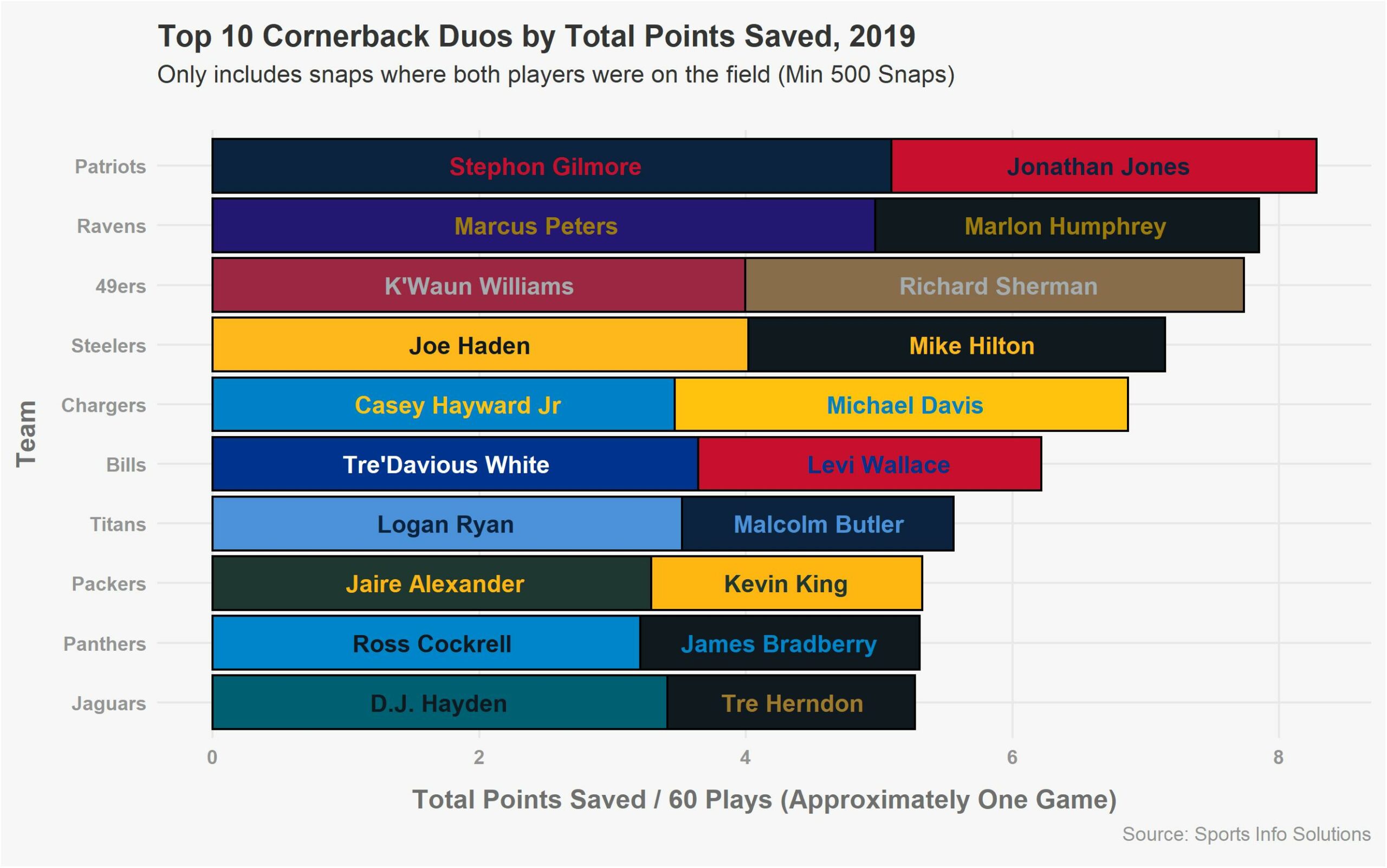
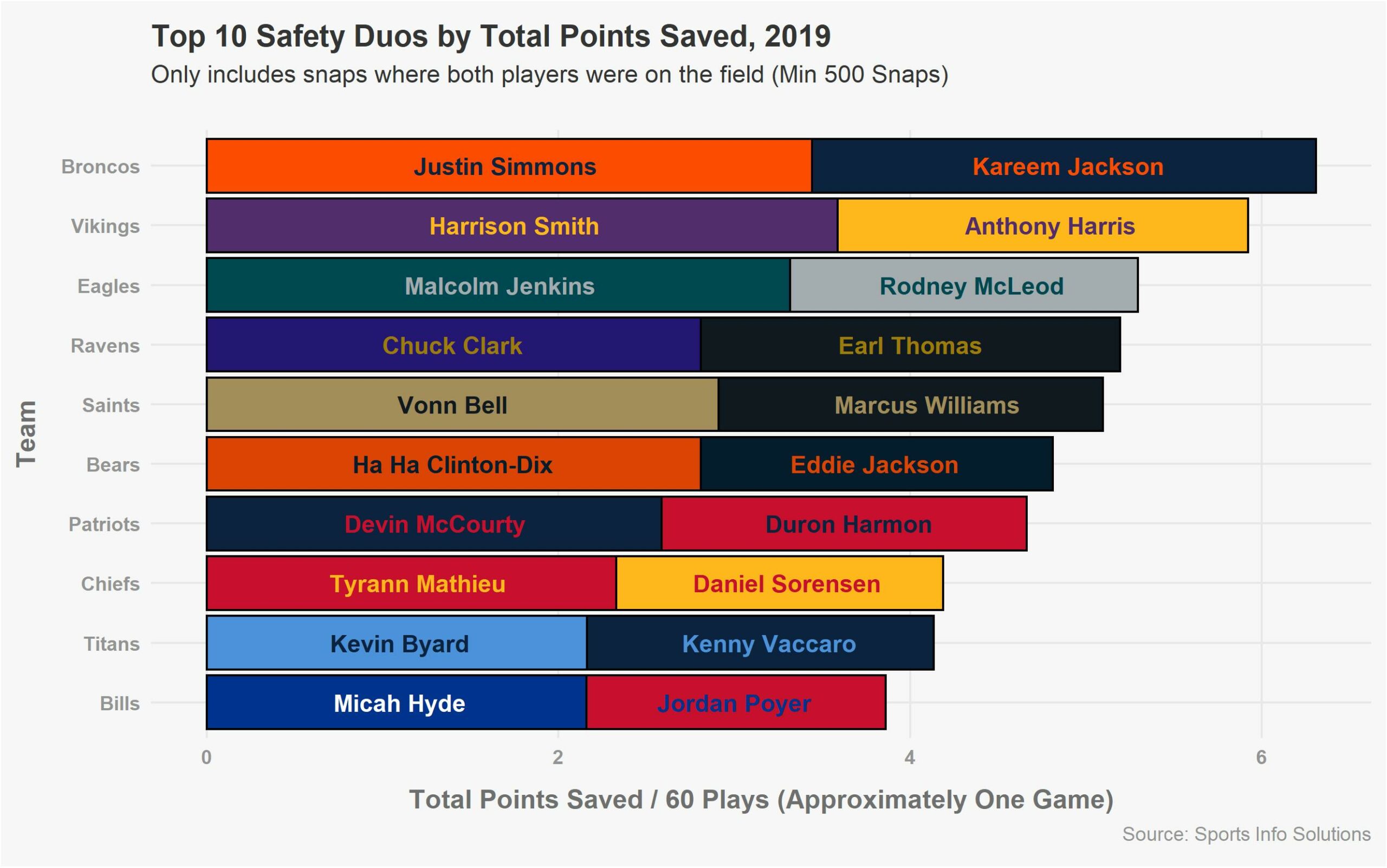
Last week we explored the idea of evaluating different pass rush units like different lines in hockey or lineups in basketball. Leveraging the same participation data at SIS’s disposal, we can use similar analysis in evaluating the NFL’s most dynamic duos at each position.
To evaluate each pair, we will use SIS’s player value metric Total Points for each player while both are on the field and add them together. Total Points is used because it allows us to evaluate individual players on a play-by-play level even if they did not register a traditional stat in the box score. Total Points for this analysis will also be scaled to Per 60 Plays, which approximates per game value.
It is important to remember that the numbers here are not representing each player’s full season value. They are only representing his value on plays in which he is on the field with the other member of the duo. This is done to truly evaluate dynamic duos that play to each other’s strengths and elevate each other and their teams.
Top Wide Receiver Duos
Wide receiver is one of the positions where the argument over duos is generally most prevalent. In 2019, the race for the best duo was tight, but the Buccaneers combo of Mike Evans and Chris Godwin edged out the Chargers’ Mike Williams and Keenan Allen. In third place, were the surprising duo of Davante Parker and Allen Hurns—though Parker provided most of the value when they were on the field together.
Top Backfield Duos
Many of the duos on this list are running back/fullback combos, since most teams don’t use multi-running back sets that often. One exception is the top spot Chargers combo of Austin Ekeler and Melvin Gordon, where Ekeler provided elite level value. Other top combos include some of the best fullbacks in the game, such as the third ranked combo of Raheem Mostart and Kyle Juszczyk.
Top Tight End Duos
The Bay Area was full of elite tight end play last season. One of the best in the game, George Kittle, teamed with Levine Toilolo to give the 49ers the top duo. The Raiders duo of Darren Waller and Foster Moreau ranked second, and will now take their talents to Las Vegas.
Top Interior Defensive Line Duos
Aaron Donald has been the top interior defensive lineman in Total Points each of the four years we have on record. So, it should surprise no one that he and a teammate, in this case Michael Brokers, ranked as the top duo. What might be more surprising is the strong showing from the second ranked duo, the Giants Dalvin Tomlinson and rookie Dexter Lawrence. Other impressive pairs include the Buccaneers Vita Vea and Ndamukong Suh and the Packers Kenny Clark and Dean Lowry.
Top Edge Rusher Duos
Last season T.J. Watt led all defenders in Total Points Saved, with 77. When he was on the field with fellow edge rusher Bud Dupree, the Steelers duo was by far the best in the NFL, saving an entire point more per 60 plays than any other edge duo. The Bosa brothers helped their duos rank second and third, Joey pairing with Melvin Ingram and Nick pairing with Arik Armstead. The Smith brothers paired up to save over six points per 60 plays when they were both on the field, giving the Packers defense the fourth rated edge duo to go along with the fourth rated interior defensive line duo.
Top Cornerback Duos
Having a pair of lock down corners can cause havoc for opposing quarterbacks, and these top duos did just that in 2019. The Patriots defense was a historic pace for much of last season, and a lot of it had to do with their secondary play. Stephon Gilmore won Defensive Player of the year and when he was on the field with Jonathan Jones, they paired to give the Patriots the best cornerback duo in the league.
Top Safety Duos
Great safety duos probably depend on each other more so than any other position. Where other positions can pair two similar players together and combine for a great duo, safety duos rely on a combination of skills that need to complement each other. Though it is possible for two extremely versatile safeties to interchange roles, the best recent example of complementary players was the Legion of Boom. Earl Thomas provided the deep range and coverage ability, while Kam Chancellor provided the hard hitting in-the-box role.
In 2019, there were multiple safety duos who complement each other in close to perfect ways. The Broncos duo of Kareem Jackson and Justin Simmons were the top ranked duo, combining to save over six points per 60 plays when they were on the field together. The best safety in each of the last three years in Total Points Saved, Harrison Smith, paired with 2019 interception co-leader Anthony Harris to create the second best safety duo in the league.
Former NFL scout Matt Manocherian (@mattmano) of Sports Info Solutions and football analytics pioneer Aaron Schatz (@FO_ASchatz) of Football Outsiders (@fboutsiders) welcome Emmett Kiernan – winner of the SIS Football Analytics Challenge – to the show.
The group opens with a brief discussion about opt-outs in the NFL (0:39) before diving into Emmett’s contest-winning project, beginning with his background and how he got into analytics (2:37), an explanation of his submission and what led him to pursue the angle he took (9:48), the modeling he decided to use (16:40), his ultimate findings (22:43), an interesting outlier (25:30), and how the findings agree with what we know about analytics (27:55).
Normally when people talk about teams with a great pass rush, the discussion is centered around specific elite players, such as Aaron Donald, Khalil Mack, or J.J. Watt. If they do go further than that, it is generally to mention a bookend rusher or team Pressure% as a whole. While player and team level pass rush metrics are worthwhile talking points, here we will be breaking down and evaluating specific pass-rushing lineups. You can think of this as similar to evaluating different lines in hockey or a specific lineup in basketball.
Best Three-Man Pass Rush Lineups
Getting pressure from a three-man rush is extremely valuable for a defense. It speeds up the quarterback’s timing, while allowing eight defenders to drop in coverage to leave him almost no windows to the throw ball. Getting pressure from a three-man rush is more difficult, as the league average Pressure% is only 28%, but the lineups below had no problem getting after opposing quarterbacks.
Top 3-Man Pass Rush Lineups by Pressure%, 2019 (Minimum 15 Snaps)
Team
Lineup
Snaps
Pres%
Packers
Preston Smith, Za’Darius Smith, Kenny Clark
29
45%
Vikings
Everson Griffen, Danielle Hunter, Ifeadi Odenigbo
19
42%
Titans
Jurrell Casey, Reggie Gilbert, Harold Landry
19
42%
Saints
Cameron Jordan, David Onyemata, Trey Hendrickson
15
40%
Colts
Justin Houston, Denico Autry, Jabaal Sheard
21
38%
Last off-season the Packers invested heavily in free agent additions to their defense. That investment absolutely paid off, as edge rushers Preston Smith and Za’Darius Smith teamed with Kenny Clark to create the best three-man rush in 2019.
Best Four-Man Pass Rush Lineups
Getting pressure from a three-man rush is great, but add in a fourth rusher and the league average Pressure% increases five percentage points to 33%. Four-man pass rushes are also the most common, as they accounted for 65% of all dropbacks in 2019.
Top 4-Man Pass Rush Lineups by Pressure%, 2019 (Minimum 25 Snaps)
Team
Lineup
Snaps
Pres%
Packers
Preston Smith, Za’Darius Smith, Kenny Clark, Rashan Gary
29
59%
Seahawks
Jadeveon Clowney, Jarran Reed, Quinton Jefferson, Poona Ford
28
54%
Chargers
Melvin Ingram III, Joey Bosa, Isaac Rochell, Uchenna Nwosu
30
53%
Panthers
Bruce Irvin, Gerald McCoy, Mario Addison, Brian Burns
27
52%
Chiefs
Terrell Suggs, Frank Clark, Chris Jones, Tanoh Kpassagnon
31
52%
Once again, off-season additions help the Packers to the top spot. The lineup of Preston Smith, Za’Darius Smith and Kenny Clark was an elite three-man rush. But add last year’s first round pick Rashan Gary to the lineup, and you get an explosive pass rush that got pressure on 59% of opponent dropbacks.
The Packers elite lineup will be teaming up again this season, but that isn’t the case for some other team’s four-man rush lineups. The top three most used four-man rush lineups from last season could all be missing at least one piece this year.
Most Often Used 4-Man Pass Rush Lineups, 2019
Team
Lineup
Snaps
Pres%
Vikings
Linval Joseph, Everson Griffen, Danielle Hunter, Shamar Stephen
155
29%
49ers
Arik Armstead, Dee Ford, DeForest Buckner, Nick Bosa
132
45%
Jaguars
Calais Campbell, Yannick Ngakoue, Dawuane Smoot, Josh Allen
116
44%
The Vikings could be without Everson Griffen, who is still a free agent. The 49ers will be without defensive tackle DeForest Buckner, who was traded to the Colts in the offseason. And the Jaguars might end up missing two players, as Calais Campbell was traded to the Ravens and Yannick Ngakoue’s relationship with the team is up in the air.
Best Five-Man Pass Rush Lineups
Adding a fourth pass rusher increases the league average Pressure% by around five percentage points. Add a fifth pass rush on top of that, and the league average Pressure% increased another ten percentage points to 43% in 2019. This isn’t that surprising, but it just highlights how effective blitzing can be—something we pointed out on Football Outsiders last off-season.
Top 5-Man Pass Rush Lineups by Pressure%, 2019 (Minimum 15 Snaps)
Team
Lineup
Snaps
Pres%
Cowboys
DeMarcus Lawrence, Michael Bennett, Robert Quinn, Jaylon Smith, Maliek Collins
16
69%
Steelers
Bud Dupree, Cameron Heyward, Mark Barron, Javon Hargrave, T.J. Watt
Clay Matthews, Aaron Donald, Michael Brockers, Dante Fowler Jr., Sebastian Joseph-Day
21
52%
Buccaneers
Ndamukong Suh, William Gholston, Jason Pierre-Paul, Shaquil Barrett, Vita Vea
19
42%
The Cowboys lineup of DeMarcus Lawrence, Michael Bennett, Robert Quinn, Jaylon Smith, and Maliek Collins was the league’s best five-man blitz package last season, with a Pressure% of 69%. Unfortunately for the Cowboys, this lineup will be nonexistent this season, as Bennett, Quinn and Collins have all moved on from the team.
This was the first time the Packers didn’t top the leaderboard. Although if we were to lower the minimum number of pass rush snaps to 10, the Packers blitz package of Preston Smith, Za’Darius Smith, Kenny Clark, Kyler Fackrell, and Blake Martinez would have topped the list with a Pressure% of 73% on 11 snaps.