Category: NFL

  • Preview: AFC Divisional Round – Chargers vs. Patriots

    Let’s take a brief look at some statistical notes ahead of the AFC Divisional Round playoff game between the Chargers and Patriots.

    Chargers Run Game vs Patriots run defense

    • A knee injury forced Melvin Gordon to miss weeks 13-15 and since returning he has not been nearly as dynamic, even before suffering a second knee injury last week. Pre-injury (weeks 1-12) he averaged 5.2 yards per attempt. Post injury, he’s at 3.2.

    Gordon’s knee injury is clearly impacting his play, as he has dropped from 3.3 yards after contact per attempt pre-injury to 1.7 since. His 3.2 yards after contact per attempt ranked sixth in the NFL this season and his 24 percent broken tackle percentage is second.

      • Austin Ekeler has also been terrific at breaking tackles and gaining extra yardage.
        • His broken tackle percentage is just outside of the top-10 among backs at 21 percent (11th).
        • His 3.8 yards after contact per attempt is the second highest rate in the league behind only Cleveland’s Nick Chubb (4.3 per attempt).
      • Ekeler’s ability to break tackles and gain extra yards after initial contact have been imperative to his success. 73 percent of Ekeler’s rush yards this season have come after contact, the fifth-highest mark in the league.
      • These two backs have combined to break free of opposing tacklers 64 times combined which is tied for the second most for a pair of teammates, behind only Derrick Henry and Dion Lewis who combined for 89.

    Chargers’ Passing Game vs Patriots passing defense

        • The Patriots play more man coverage than any other team in the NFL. Here is Keenan Allen’s target share against each defense:
          • Zone: 24% (receiver rating 120)
          • Man: 30% (96)
        • Below are Rivers splits vs man and zone:
    Defense Comp % On-Tgt % Y/A IQR TD% INT%
    Man 60% 75% 7.9 104 8.1 3.2
    Zone 75% 86% 9.4 112 5.3 1.8
        • The Chargers’ do a good job of involving their running backs in the passing game, as all of their backs combine for 65.5 yards a game, most in the league
          • The Patriots rank 23rd, allowing 46.1 yards per game through the air to opposing running backs, but since week 9 they have only allowed 27.0 (5th in NFL).
        • If the Chargers fall behind, Mike Williams is an interesting player to watch. When trailing, no one has a higher receiver rating in the NFL than Williams’ 153 (minimum 25 targets when trailing) (if we lower the minimum to 20, Chris Hogan of the Patriots rates higher).
          • This is particularly interesting because of how the Patriots line up their defensive backs. Stephon Gilmore, their top cornerback, is generally tasked with shutting down a team’s No. 2 receiver while a combination of another corner and safety (like the McCourty twins) generally double team the other team’s top receiver.
          • When Stephon Gilmore is targeted in coverage while the Patriots are winning, he has allowed a rating against of 101, which is 10th best among defensive backs who have been targeted at least 20 times while defending a lead.

    Patriots’ Run Game vs Chargers Run Defense

        • The Patriots have a reputation as a passing offense
          • However, over the last three seasons the Patriots are the only team to be top-five league wide in running back rush attempts, finishing second this year with 24 attempts per game
        • The Patriots’ are the best team in the league at spreading out where they run the ball, going to both sides and up the middle almost perfectly evenly. Rush attempts to each side listed below:
          • Left Outside and Left Off Tackle: 163, 34% of runs
          • Left Inside, Middle, and Right Inside: 163, 34% of runs
          • Right Outside and Right Off Tackle: 152, 32% of runs

    Patriots’ Passing Game vs Chargers’ Pass Defense

      • Rob Gronkowski has been exceptionally quiet this season through a mix of missing time with injuries and minimal involvement when healthy.
        • The Chargers’ have allowed the second fewest yards per pass attempt against tight ends (6.3) and the second lowest receiver rating (66)
      • James White has a very favorable matchup. This season the Patriots targeted running backs 157 times, more than any other team, with 123 targets going to White.
        • The Chargers have allowed 7.0 yards per attempt to running backs this season which ranks 25th in the NFL
      • Julian Edelman had a fantastic 2016 season, but after missing 20 consecutive regular season games, there were question marks about how productive he could be.
        • Since his return in Week 5, he ranks first on the Patriots in targets (107) and receptions (74). Those numbers rank sixth and eighth in the NFL respectively among wide receivers.
        • To illustrate how consistently active Edelman has been with the Patriots, below is a list of the players with the most 5-reception games in the playoffs for one team since 1950
          • Jerry Rice, 14 with SF (another 3 with OAK)
          • Julian Edelman, 11 with NE
          • Michael Irvin, 11 with DAL
          • Reggie Wayne, 11 with IND

    Independent Quarterback Rating is Sports Info Solutions’ proprietary quarterback metric. It builds on the traditional Passer Rating formula by accounting for results that are outside of the quarterback’s control – dropped passes, dropped interceptions, throwaways, etc. – to form a better benchmark of QB value.
  • On Nick Foles’ now-annual resurgence

    By ALEX VIGDERMAN

    Another year, another late-season Carson Wentz injury forcing Nick Foles back into the spotlight. The Eagles squeaked into the last spot in the NFC playoffs thanks to Foles regaining his form from the end of last season. It’s a fascinating turn of events after he looked like he had turned into a pumpkin earlier in the season.  This week’s matchup with the Bears doesn’t do him any favors, but let’s see where Foles has made his bones over the last month and see how that matches up with Chicago.

    In the first two weeks of the 2018 season, Foles had a 71.2 Independent Quarterback Rating (SIS’s adjusted Passer Rating that isolates the impact of factors within the quarterback’s control). In his last three games, his IQR has been 109.2.  He leads the league with 86 percent catchable throws in that time frame.

    Part of the narrative has been that head coach Doug Pederson has given Foles quicker reads, simplifying the game for him. There’s definite truth to that. Foles has taken a three-step drop or shorter as frequently as anyone in the last few weeks, whereas in the first two weeks he was taking short drops at a below-average rate. And that doesn’t even include the Run-Pass Options (RPOs) that have been such a big part of Philly’s game plan with Foles at the helm.

    The thing is, it’s not like he performs better on those short drops. In 2018, his IQR on zero-to-three-step drops is 98, compared to 100 on rollouts or drops of five or more steps.  So where has he excelled since returning as the starter?

    Downfield Throws are Looking Up

    While Foles has not made a lot of throws downfield in his late-season surge, he’s made them count.

    His excellence on throws at least fifteen yards downfield shouldn’t surprise anyone who has followed his career. In 2013 his monster season (27 TD, 2 INT) was full of deep tosses to Riley Cooper and Desean Jackson. This year, he’s thrown 15 passes at least 15 yards downfield in each of his stints as a starter. Look at the difference in performance from early to late season.

    Nick Foles Performance on Throws at Least 15 Yards Downfield, 2018

    Weeks Att Catchable Comp Yards TD INT IQR
    1-2 15 10 3 82 0 1 10.3
    15-17 15 13 11 370 1 0 131.9

    For context, his completion percentage on those throws was worst in the league through Week 2 and best in the league in weeks 15-17 (minimum 15 attempts both times).  Results on deep throws tend to fluctuate a lot over time, so it’s as likely as not that this is just extreme variance one way followed by extreme variance the other way.

    Unfortunately for the Eagles, their Wild Card opponents, the Bears, are as good as anyone against downfield throws.  Of course, they’re the best defense in the league this year, so they’re as good as anyone at almost everything.  They trail only the Bills in Passer Rating allowed on downfield passes across the entire season (59), with an absurd rating of 22 on those throws from Week 9 forward.

    “The Man” Versus Man

    Early in the season, the Eagles were missing Alshon Jeffery and lost Darren Sproles almost immediately to injury.  In his own way, each of them is an asset against man coverage because of Jeffery’s size and physicality and Sproles’ agility.

    Since Foles returned to the starting job in Week 15, while Zach Ertz has continued to be peppered with targets regardless of the situation, Jeffery, Sproles, and Nelson Agholor have feasted in particular against man coverage.  When seeing man, Foles has thrown for 309 yards and 5 touchdowns on 19 throws to those three alone (good for over 16 yards per target).  Everyone else has seen 29 targets but yielded only 187 yards and two touchdowns (a mere 6.4 yards per target).  Overall, he has the best IQR in the NFL over the last three weeks against man.

    You might have seen this coming, but the Bears are bad news here as well.  They are also second in the NFL in Passer Rating allowed in man coverage (at 76), and have also improved in this arena over the second half of the season (47 since Week 12).

    Foles has been a revelation for the third time in his career.  It’s impossible to count him out at this point given his track record, but the Eagles’ Wild Card opponent presents a particularly strong challenge based on what Foles has done well so far this year.

  • 2018 NFL Total Points Leaders

    Earlier this year, we introduced the Total Points metric at FootballOutsiders.com. This stat was created to assess player value based on what a player is truly responsible for, using charting data and the Expected Points framework.

    With that in mind, let’s look at the leaders at the different skill positions this season.

    Quarterback
    Drew Brees of the Saints edged out Patrick Mahomes of the Chiefs by a slim margin that essentially renders the two as having had equally valuable seasons. Brees excelled at throwing the ball downfield, completing an NFL-best 58 percent of his throws that went at least 15 yards beyond the line of scrimmage, and at avoiding the sack. He took 17 in 15 games.

    Mahomes racked up yardage and touchdowns in bulk, throwing for 5,097 yards and 50 scores. He had more Points Earned on third and fourth down than anyone else in the league, thanks to 14 touchdowns and an average of 9 air yards per completion (third among quarterbacks).

    Most Total Points by QB
    Player Total Points
    Drew Brees 79.0
    Patrick Mahomes 75.4
    Philip Rivers 53.8
    Andrew Luck 45.2
    Matt Ryan 41.8
    Tom Brady 31.1

    Running Back
    It’s not enough to run the ball. Someone who hopes to lead in this stat needs to catch it too. Christian McCaffrey of the Panthers does both well and ranks No. 1 in Total Points, ahead of Giants rookie Saquon Barkley. He ranked 14th in points earned on rushes and 20th in points earned on receptions (first among running backs). McCaffrey had 107 catches on 124 targets in 2018 (86 percent catch rate) compared to 80 catches on 113 targets last season (71 percent) thus allowing him to do what was needed more often. He finished the season as the only player with at least 75 targets and no drops.

    Most Total Points by RB
    Player Total Points
    Christian McCaffrey 34.8
    Saquon Barkley 30.2
    Derrick Henry 27.6
    Melvin Gordon 24.7
    Kerryon Johnson 24.3
    Chris Carson 24.1

    Wide Receivers & Tight Ends
    Since we’re looking at accumulated value, playing an entire season has value. That’s what vaults Julio Jones of the Falcons into the No. 1 spot, though on a per-play basis, he’s a smidge behind Odell Beckham Jr. of the Giants. Jones bounced back from an off-year to lead the NFL in receiving yards (1,677). In addition to his standout receiving numbers, Beckham got a spike from two long touchdown passes.

    Among tight ends, Travis Kelce emerges a hair ahead of George Kittle. Kelce caught 69 percent of targets, three percentage points better than Kittle, though both had an 88 percent on-target catch percentage. The Chiefs’ success on third down was partly due to Kelce’s success. Kelce caught 25-of-33 third-down targets, leading to 22 first downs. Kelce had one fewer third down reception than tight end leader Zach Ertz, but had 10 fewer targets.

    Most Total Points by WR
    Player Total Points
    Julio Jones 43.3
    Odell Beckham 38.2
    DeAndre Hopkins 37.3
    Keenan Allen 35.1
    T.Y. Hilton 34.3
    Tyreek Hill 32.2
    Most Total Points by Tight End
    Player Total Points
    Travis Kelce 40.7
    George Kittle 40.4
    Mark Andrews 14.5
    Jared Cook 13.1
    Eric Ebron 11.7
    Jordan Reed 11.7


  • What to do on 2nd-and-10? Let’s look at the numbers

    By BRYCE ROSSLER

    For now, EPA is a decent measure that can contextualize yardage, indicate what is and isn’t valuable, and advise us of what the most prudent course of action is most of the time. But, we can’t stop there.

    Take, for example, the case of the much-maligned second-and-10 run. Whereas conventional wisdom holds that a team should run to set up a more manageable third down, EPA frowns upon the decision to run and suggests that teams should pass instead.

    Dating back to 2016, the average EPA/attempt in such situations is -0.29, compared to -0.11 for a pass (note that here and moving forward, we’re excluding all plays in which either team had a lead larger than eight points in the fourth quarter). For these reasons, the play call is widely regarded by the analytics community as the coward’s way out and, in some ways, it is. But, blanket EPA is only part of the story.

    Risk management is undeniably a component of decision-making in football. So, perhaps a more reasonable theory about second-and-10 playcalling is that most teams should pass most of the time. Something that should be taken into consideration is eventual first down rate (EFDR), which indicates that running it on second-and-10 isn’t the end of the world. In fact, if a team runs on second-and-10, it is still more likely than not to convert that set of downs.

    Since 2016, there have been 2,129 designed runs on second-and-10. And in 1,095 (51 percent) of those instances, the team in question ultimately moved the chains. Now, EFDR still favors passing; over that same time period, teams took to the air 3,025 times and eventually picked up a first down 57 percent of the time. However, passing has risk factors that running does not, namely sacks and interceptions.

    For example, the turnover rate on such rushing plays is 0.5%, whereas the interception rate for passing is over three times that figure — 1.8%. Sacks also occur on 5.6% of those plays, and strip sacks recovered by the defense bump the turnover rate to 2.2%. There’s also the problem of incompletions and checkdowns that go for zero or negative yards. Second-and-10 dropbacks produce non-positive yardage 39 percent of the time, and the mode yardage for passing plays is 0, whereas the counterpart figures for rushing are 18 percent and 3, respectively.

    EPA failures on passing plays are also far less manageable than EPA failures for rushes. Compare the average EPA value on the set of passing plays with negative EPA values (-0.92) to that of rushing plays (-0.69), and it becomes apparent why some coaches favor conservative decision-making in these scenarios.

    Now that we’ve properly quantified some of the motivations for why coaches may elect to run on 2nd & 10, let’s examine some third-down hypotheticals tailored to the data presented above.

    Since the most common rushing gain on second-and-10 is three yards, we’ll examine 3rd-and-7 situations, of which there have been 1,144 instances since 2016. Passing is generally more optimal in this scenario, and 481 of 1,117 third-and-7 dropbacks lead to eventual first downs, a rate of 43 percent.

    Good luck if you gain no yardage on a run or throw an incompletion on second-and-10 though. Of the 1,175 third-and-10’s, teams only converted through the air at a rate of 33 percent on 1,143 passes –- a stark difference of 10 percentage points. It’s even worse if you get sacked on a second-and-10 dropback. The mode yardage lost on sacks is 7 yards, and 176 third-and-17 situations imposed a daunting 18 percent conversion rate on 148 dropbacks.

    Now, to retrace our steps, conventional wisdom tells us that running on second-and-10 can give a team a more manageable third down. This is true if we’re only considering yards-to-go, but we must consider how down and distance can affect pressure rates. The pressure rates in third-and-7 and third-and-10 are 30 percent and 31 percent, both high figures. This can likely be attributed to the predictability of the pass inherent in those set-ups.

    Quarterbacks on second-and-10, however, are pressured just 22 percent of the time. Therefore, it can be prudent to go ahead and pass if a coach is worried about his quarterback’s ability to perform under pressure. Generally speaking, a coach should certainly factor his team’s personnel when making any decision. The difference in pressure rate is already built into some of the analysis above, but it’s worth mentioning here to give a sense for why performance declines on third-and-long.

    The conclusions we can draw from this can be summarized thusly:

    1. EPA and EFDR favor passing, and
    2. Most teams should still pass most of the time on second-and-10, but
    3. Rushing on second-and-10 is still more likely than not to eventually result in a first down, and
    4. Second-and-10 passing is a bimodal proposition which has risks that merit consideration, and
    5. Some teams should run most of the time on second-and-10.

    I intend to do further research that will analyze these components on a team level and how the above assertions comport to organizational trends, indicating that most coaches are more efficient decision-makers than we may believe.

  • Couple of questionable calls played a role in shaping AFC Playoff picture

    Couple of questionable calls played a role in shaping AFC Playoff picture


    BY NATE WELLER

    It’s the time of year where teams and fans alike look back at what could have been. No team will be wondering more than the Steelers, who after a 7-2-1 start to the season, were officially eliminated from the playoffs when the Colts and Texans game ended decisively in regulation.

    All of this is not without controversy though. The struggles of referees in the NFL this year have been well documented and thoroughly scrutinized, and the Steelers arguably have the biggest issue of any team. Two of the games with the biggest implications for their own playoff chances swung on miscues by the officiating crew.

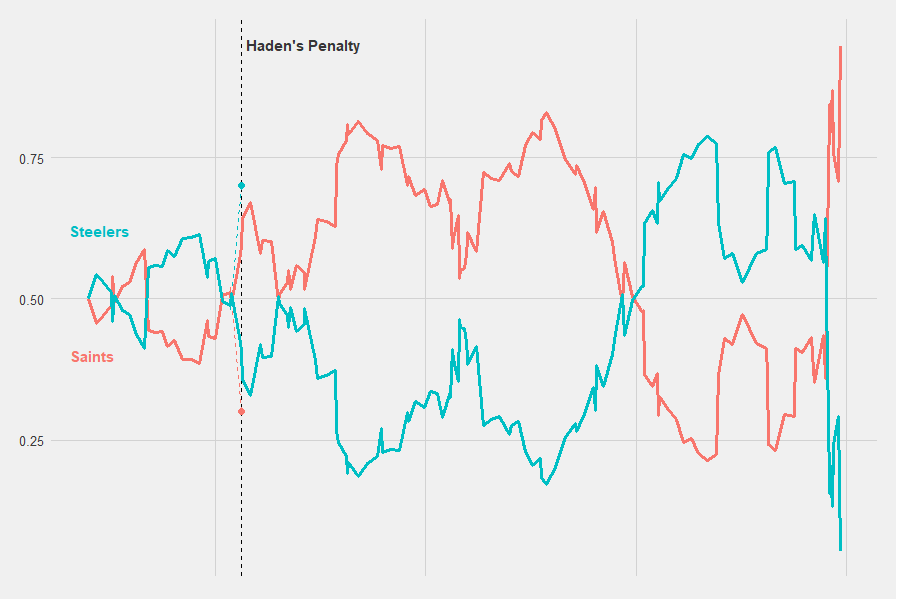
    With about three minutes left in the first quarter of the Steelers’ Week 16 game against the Saints, the Saints, down 3, elected to go for a fourth-and- short from the Steelers’ 34-yard line. Brees was flushed from the pocket, and threw up what was effectively a punt towards Alvin Kamara in the endzone. The ball fell incomplete, but Joe Haden was called for pass interference. Replay appeared to show that no foul had occurred. The Saints were given a first-and-goal from the 1, and subsequently scored their first touchdown.

    A fourth-down stop would have resulted in -3.28 EPA for the Saints, and set the Steelers up in good field position. Instead the play resulted in 3.73 EPA for the Saints, a total swing of 7.01 expected points. Put into context, Derrick Henry’s 99-yard touchdown run versus the Jaguars added 5.73 expected points. The sequence of events for the Steelers and Saints was among the largest swings in expected points this season.

    From a win probability standpoint, the Saints chance of winning prior to the fourth-down attempt was 49 percent. Following Ingram’s score, their win probability jumped to 68 percent. With a fourth-down stop, the Steelers’ win probability would have jumped to almost 70 percent.

    The penalty was a major turning point in a game that the Steelers would lose by a field goal. The foul occurred early, and the Steelers still had plenty more opportunities to win, but most people will still look back at the penalty and ensuing touchdown as a major factor in the loss.

    The defeat left them needing help from the division rival Browns in week 17. The Steelers’ scenario was simple, a win and a Ravens loss and they were in .

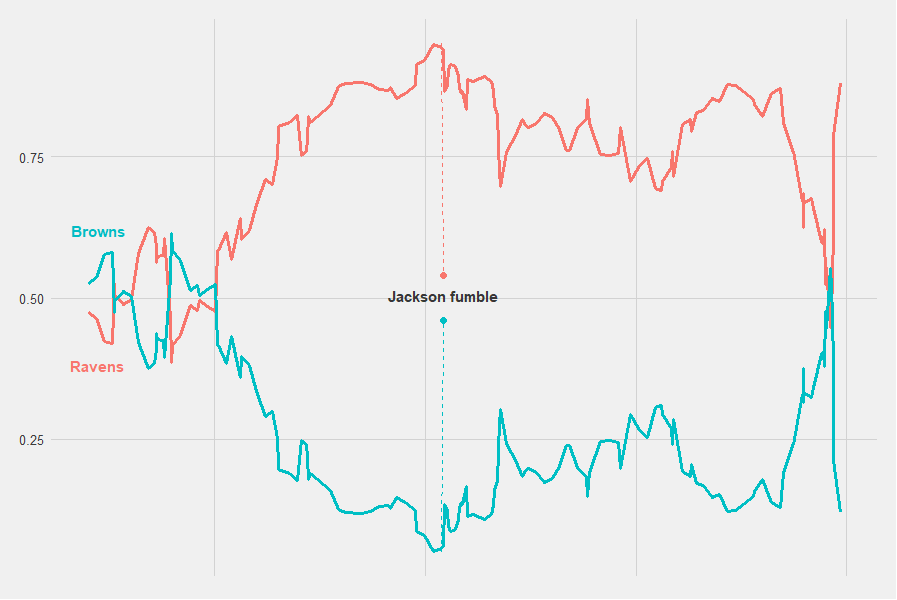
    With a little under two minutes remaining in the second quarter of that matchup, the Ravens were set up on the Browns 1 with an opportunity to extend their lead to three scores. On third down, Ravens quarterback Lamar Jackson attempted to clear the pile on a quarterback sneak, and extended the ball towards the goal line. The ball was punched loose, and cleanly recovered by Jabril Peppers of the Browns, who took off towards the end zone. The play however was immediately whistled dead as it was ruled the ball had crossed the plane.

    The play would be reviewed and correctly overturned, but due to the premature whistle, Cleveland was given the ball at its own 7 , cancelling out what would have undoubtedly been a defensive touchdown.

    The play as it stood was still worth -4.6 expected points for the Ravens. A 99- yard fumble-return touchdown though would have been an expected points swing of more than 12 points, effectively worth close to two touchdowns.

    Looking at the win probability, the Browns chances were down to about 5 percent with the Ravens likely to go into the half up three scores. The play as it stood increased their chances by almost 10 percentage points, up to 14 percent. A touchdown would have increased their odds to nearly 46 percent going into the half, which would have been the biggest swing in win probability on a single play this season. The Browns would go on to make things interesting in the fourth quarter, but were not able to do enough to erase the two-score second half deficit, losing the game 26-24.

    The Steelers are a team that is full of Super Bowl-level talent. Given that they won 7 of their first 10, they should’ve been battling for home field, not hoping for a wild card spot. But it still does not feel like much of a leap to think that both of the plays mentioned above played a large role in their failure to make the playoffs. Calls going the wrong way have always been a part of the game, but the Steelers and their fan base will likely feel slighted going into this offseason a little more than everyone else.


  • Zach Ertz: Hoping for a bounceback

    By PATRICK ROWLEY

    Last week, Zach Ertz was held below 40 yards for just the fourth time this season but the second consecutive week. Before these two games (in which he managed to pull in just 8 of his 15 targets), Ertz was on pace to finish with 124 receptions, which would have put him at fifth-most in a season all-time. He is now on pace for 115, which would still put him in the top 20 for receptions in a season and break Jason Witten’s single-season record for receptions by a tight end (110).

    Over the last two seasons, Ertz has seen an extra half-target per game with Nick Foles under center (9.2) than Carson Wentz (8.7), but these are, on average, shorter throws.

    Passes to Zach Ertz – Last 2 Seasons
    Foles Wentz
    Yards per target 5.7 8
    Yards per reception 8.2 11
    Yards per game 52.2 70
    1st down pct 34% 65%

    Perhaps the biggest difference in his production between quarterbacks can be attributed to plays in the red zone. Ertz has proven to be an excellent red zone target with his size and hands, assets that led him to ranking 15th in red zone targets last season (17) and tied for fifth this season (23).

    With Foles at quarterback, Ertz’s red zone targets per game of 1.8 is a half-target per game higher than with Wentz (1.3), but he is not converting them to receptions, let alone touchdowns. Forty-five percent of the time Wentz has targeted Ertz in the red zone the last two seasons (13-out-of-29) it has resulted in a touchdown, compared to just nine percent with Foles (1-of-11).

    At first glance, the difference in completion percentage is eye popping (69 percent in the red zone for Wentz, 36 percent for Foles), but a closer look at on-target pass percentage indicates the onus for this difference could be more on Ertz than Foles. In red zone situations Foles has a 73 percent on-target pass percentage, reasonably close to Wentz’s 82 percent.

    The Rams also provided a difficult matchup last week, as they have allowed the third-lowest QB rating against when opposing QBs target tight ends (70). This week, the Eagles will face a Texans team that is on the other end of the spectrum, allowing a rating of 114 in the same situation (26th in the league). This game will also be at home for the Eagles where Ertz’s receiver rating is 110 (compared to 81 on the road). If you believe in Ertz’s ability to catch passes, there’s a good opportunity for a bounce-back here.

  • JuJu Smith-Schuster may have met his match in Stephon Gilmore

    RESEARCH BY PATRICK ROWLEY

    The Patriots often assign their No. 2 cornerback and a safety to cover the other team’s top receiver, which means top cornerback Stephon Gilmore goes 1-on-1 with the other team’s No. 2 receiver.

    So if healthy, we would expect Gilmore to defend JuJu Smith-Schuster this weekend when the Patriots face the Steelers.

    Gilmore has been a workhorse this season, with 515 coverage snaps (fourth among cornerbacks) and 72 times targeted (12th-most). But he’s allowed only 5.4 yards per attempt, eighth-lowest out of just over 100 qualifiers. His deserved-catch percentage is 62 percent, second-lowest among that same group (deserved-catch percentage is essentially completion percentage on catchable passes, with drops counted as catches). His 14 passes defensed are the most in the NFL and more than he had in the last two seasons combined.

    In other words, he does a great job at denying plays. A matchup between the two would be a great battle. Smith-Schuster is averaging seven catches per game. Gilmore is allowing just over two per game.

  • Dak Prescott, Amari Cooper face challenge with Colts’ zone

    By PATRICK ROWLEY

    The Cowboys trading for Amari Cooper has turned their season around. Following their Week 8 bye Dallas was looking up at both the Redskins (5-2) and Eagles (4-4) in the standings. Since acquiring Amari Cooper, the Cowboys have gone 5-1 and are currently on a five game win streak, the longest current streak in the NFL.

    Amari Cooper has transformed the offense since his arrival and last game he had his most impressive showing with a 217-yard and three touchdown performance in an overtime win against the Eagles. Sunday could pose a challenge for Cooper and the Cowboys, as the Colts come in playing a zone defense the highest rate in the league (72 percent). The Colts have been middle of the pack in their zone defense. They have allowed 7.7 yards per attempt (13th), a rating against of 94 (14th), but have allowed just one more touchdown (9) than interceptions (8).

    Much of Cooper’s impact this season has been against a man defense. Since Cooper’s first game with Dallas in week nine he ranks first against man defenses in yards (432), yards after the catch (209), touchdowns (6) and has put up a 139 receiver rating.

    Having Cooper as a weapon against man defenses has improved the entire offense, as Prescott’s game has been elevated to new heights against man defenses, including a 48-point jump in IQR.

    Comp % Y/A TD INT IQR
    Pre Amari 52% 6.2 3 3 71
    With Amari 61% 8.8 8 1 119

    Despite this massive jump in production against man defense, Prescott has not had nearly as much success against a zone defense and his IQR has dropped from 100 to 84 with Cooper on the roster. Though he has an 80 percent completion percentage versus zones, it’s almost entirely short-pass based. He has no touchdowns and two interceptions on 91 attempts

    It will be interesting to see if the Colts zone-heavy defensive scheme will be the answer to finally stopping Prescott and Cooper this weekend.

  • Who have been the best pass defenders in 2018?

    Who are the top players at defending against the pass in 2018? Let’s look at that specifically through pass coverage (rather than the pass rush) We will use the player’s ranking in our Total Points stat as the basis for judgment.

    What is Total Points? Total Points takes the Expected Points stat and distributes the value gained or lost on a play to the different players involved based on their impact on the play. An article “Introducing Total Points” published on Football Outsiders explains this in more detail. You can read the article in full here. As it notes:

    Unsurprisingly, Total Points rewards ball-hawking defensive backs for defensing passes and forcing interceptions. Beyond that, though, the sure tacklers and shutdown defenders finally get their due statistically.

    Most Points Added on Pass Coverage
    Eddie Jackson Bears S 38.5
    Darron Lee Jets LB 28.3
    Damontae Kazee Falcons S 28.3
    Matt Milano Bills LB 23

    The leader here is a leader by a large margin, Bears safety Eddie Jackson. There’s an intuitive reason for this. Jackson has five interceptions, two of which he’s returned for touchdowns. He’s also returned a fumble recovery for a touchdown. But there’s a little more to it than that.

    Opposing quarterbacks are 11-of-33 when throwing at Jackson. The 33 percent completion percentage is tied for the lowest in the NFL with Adrian Phillips of the Chargers. The quarterback rating against Jackson is 26.1, second-lowest in the NFL. He’s deserving of the top spot in more ways than one.

    Jackson’s Bears rank No. 1 when looking at the stat from a team perspective. Their players have saved 68.6 points in pass coverage, way ahead of the second-place Bills (49.6). The Redskins (34.0), Vikings (19.4) and Jaguars (13.1) round out the top five.

    Falcons safety Damontae Kazee ranks tied for second among individuals, largely because of his six interceptions, though unlike Jackson, Kazee hasn’t scored on one. He’s tied with currently suspended Jets linebacker Darron Lee, who has three interceptions, including one for a score. Lee allowed a play with a positive expected result 40 percent of the time, which ranked in the top 10 percent of all players with at least 30 targets against them

    Among cornerbacks, Desmond King of the Chargers ranks first (18.9 points added). King has three interceptions, one for a touchdown. One thing that helps hold his value high is that he’s allowed only one touchdown pass on 51 targets. King has limited damage. He’s allowed only two completions on passes at least 15 yards downfield.

    On the other end of the list is Falcons defensive back Robert Alford, who ranks last in Points Saved (-50.4) by a wide margin. He’s allowed 788 yards on passes against him, the most in the NFL and 12.1 yards per attempt, which ranks first among those with at least 30 targets against. His seven touchdowns allowed is one shy of the NFL lead. The Falcons defense ranks last in this stat. Alford has been benched for this week.

  • Which NFL receivers are best at catching long passes?

    By MARK SIMON
    Yesterday, we looked at which quarterbacks are best and most prolific when it comes to throwing deep passes. Today, let’s look at which receivers are the best at catching them.

    Note that for our purposes, unless otherwise noted, we’re referring to passes thrown at least 20 yards downfield.

    Who is targeted on them most often?
    Chiefs wide receiver Tyreek Hill is one of the NFL’s best-known deep targets, so it’s not surprising that he’s No. 1 here with 31 deep ball targets. He’s also tops in receptions with 14. Antonio Brown ranks second with 28 targets, but had only nine deep receptions. Brandin Cooks of the Rams ranks second in receptions with 11. He led the NFL with 16 in 2017. DeAndre Hopkins, Adam Thielen, and Tyler Lockett each have 10 receptions.

    Most Targets – Passes At Least 20 Yards Downfield (Rec in Parentheses)
    Tyreek Hill Chiefs 31 (14)
    Antonio Brown Steelers 28 (9)
    John Brown Ravens 26 (7)
    Julio Jones Falcons 26 (8)
    Davante Adams Packers 25 (8)
    Most Receptions – Passes At Least 20 Yards Downfield (Att in Parentheses)
    Tyreek Hill Chiefs 14 (31)
    Brandin Cooks Rams 11 (23)
    DeAndre Hopkins Texans 10 (21)
    Adam Thielen Vikings 10 (17)
    Tyler Lockett Seahawks 10 (12)

    Who is most efficient in catching deep balls?
    Lockett has a number that will amaze you. He ranks tied for 32nd with 12 deep targets, but has 10 receptions, for a completion percentage of 83 percent. That’s remarkable given that the average throw at least 20 yards downfield has a 37 percent completion percentage, meaning an average player would catch 4.4 deep throws out of 12. Lockett’s success is more than double that. last season, he caught 5-of-17 throws of that length. In 2016, he snagged 8-of-14. Back to 2018, the next-best players percentage wise, Marquez Valdes-Scantling and Tyler Boyd, are 7-of-11 (64 percent).

    Also of note on Lockett. He’s second in the NFL in touchdown receptions on long passes. His six are one fewer than Antonio Brown.

    Hill’s 14-of-31 is good for 45 percent, which puts him above average. The other four players with at least 25 targets have a below-NFL average completion percentage: Antonio Brown (32 percent), Julio Jones (31 percent), John Brown (27 percent) and Davante Adams (32 percent).

    Who is most and least surehanded?
    Three players have at least 10 receptions on deep throws without a drop: Cooks (11), Thielen (10) and Lockett (10). In contrast, John Brown has seven receptions, but could easily have more. He leads the NFL with four drops on deep passes.

    So who turns out to have performed best overall?
    For this question, we’re going to use Expected Points Added (EPA). That’s the value that the receiver’s targets accumulated in terms of changing the team’s scoring expectation.

    The dozen passes targeting Lockett added 31.4 points to the Seahawks’ expected point totals on those throws. That’s the highest EPA for any player in the NFL this season. Hill ranks second as his many targets have led to enough receptions that the expected points total for the Chiefs has increased by 24.5 points. That’s a smidge better than Mike Evans.

    So, even though his sample is small, Lockett has been the best at churning out receptions on long passes this season. And as we showed yesterday, his teammate Russell Wilson tops the quarterbacks list.

    Most Expected Points Added – Passes At Least 20 Yards Downfield
    Targets
    Tyler Lockett Seawhawks 31.4 12
    Tyreek Hill Chiefs 24.5 31
    Mike Evans Buccaneers 24.4 19
    JuJu Smith-Schuster Steelers 24.1 13
    Tyrell Williams Chargers 19.1 12
    Adam Thielen Vikings 18.9 17