Category: NFL

  • NFL Scouting Report: Drake Maye

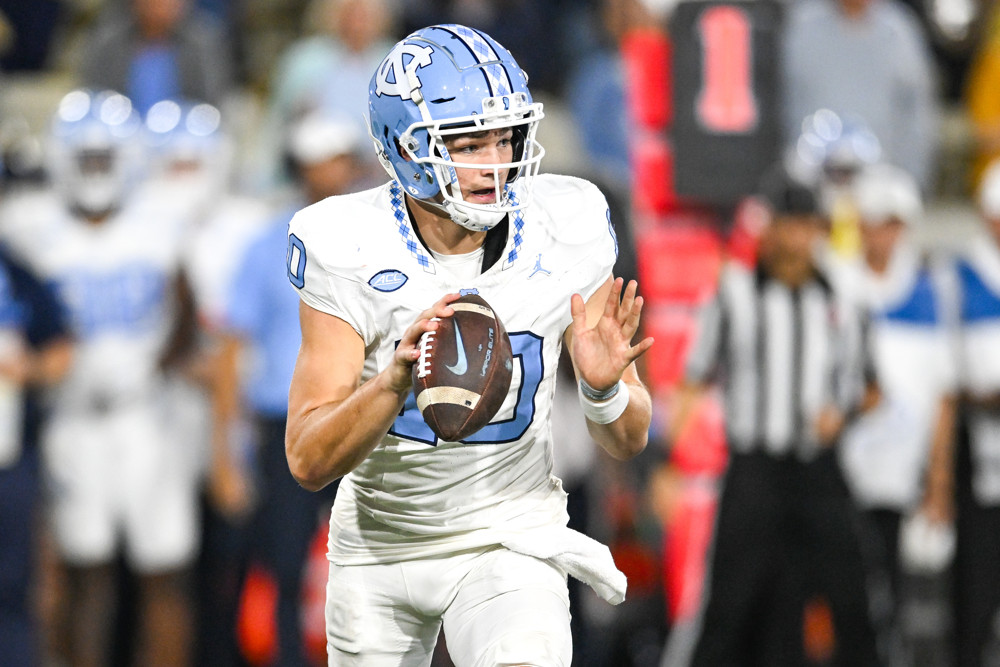
    NFL Scouting Report: Drake Maye

    Drake Maye

    6-4, 223, New England Patriots QB

    Overall Grade 6.8

    Scouting Report by Matt Manocherian 

    Summary

    Drake Maye is a young prospect with a tantalizing combination of size, athleticism, arm strength and accuracy to become a top NFL quarterback if and when the game slows down for him.

    Maye is a right-handed quarterback in North Carolina’s no huddle, spread offense, where he is primarily utilized in short drops, RPOs and read options. UNC operates exclusively out of shotgun except in short-yardage situations. He played in 30 games in 3 seasons at UNC, including starting all 14 games in 2022 and each of their 12 regular season games in 2023 before declaring for the Draft. He is a young prospect who is still growing into his body, but he already shows  good size, arm strength and athletic ability for the position. He is a tough player who was the clear leader of the offense, even as a redshirt freshman. He commands the no huddle well and can have the snap within 10 seconds at his fastest pace, including in the two minute drill against Duke to get the game to overtime. However, his inexperience shows up at times, including calling for the snap in an obviously illegal formation on the goal line in the same game.

    Pass Game

    Maye is a talented passer who is capable of flashes of brilliance. He has a clean, over-the-top release with a consistent, repeatable motion. He tends to pat the ball before he releases it, which complicates the fact that he is already not a quick processor. He needs to see things come open before he lets it rip, and it helps to present him with simplified half-field high/low reads. That said, he has enough arm that he can overcome his lack of anticipation with velocity. If he could get the ball out a hair sooner, several balls he completed out of bounds would likely be catches.

    He is a very good deep ball thrower. He shows very good touch on deep fades and go balls that stress the defense in both Cover 1 and Cover 2. He can drive the ball downfield on a line without needing to put much air under it. He shows good ball placement on quick throws, and he is very good at making level-two throws down the seam. He shows great feel with the ability to take something off of his throws when he needs to. He can also ramp up his velocity with a clean pocket. Most of his misses come when the pocket is messy, and he can’t step into his throws. He also tends to miss when he has to work through his progressions and reset his feet.

    Maye is very effective when he extends plays and gets into scramble drill situations. He keeps his eyes downfield against pressure and does a good job getting the ball out of his hands before the rush gets home. He usually throws well on the move, especially when running to his right and throwing to that side of the field, but he has also had some troubling turnovers in these situations, including a pick-six against Clemson in the 2022 ACC Championship. He can make outrageous jump-passes (touchdowns vs South Carolina and Clemson in 2023), but he also has some bad misses on plays where he tries to make these throws with no platform. He loves to give his receivers a chance to make plays down the field, but they let him down a lot in 2023.

     Run Game

    In the run game, Maye shows very good mobility. He has enough speed to be a legitimate run threat on the NFL level, but he won’t be faster than most defenders like he is in the ACC. They run a fair bit of option and read-option, but he’s a bit slow to make decisions in the read-option game. He is very dangerous on draws and can force the defense out of 2-man. He has the size to be effective on sneaks, but he isn’t a powerful runner. He is at his best on the second play when he can break contain, keep his eyes downfield, and when needed, scramble for first downs.

     Last Word

    Overall, Maye projects to become a strong starting quarterback with “win with” ability. At this time, he is best suited for and can be effective in a spread scheme with lots of deep shots, simplified half-field reads, and opportunities for improvisation. If he develops the ability to anticipate and progress through reads, the sky is the limit for him, with an upside comparable to Justin Herbert.

     Critical Factors

    Accuracy 6
    Decision Making/Mental 5
    Clutch Performance 6


    Positional Factors

    Short Accuracy 6
    Deep Accuracy 7
    Pocket Awareness 6
    Footwork 6
    Under Pressure 6
    Mobility 7
    Arm Strength 7
    Release 6
    Awkward Throw 6
    Eye Discipline 7
    Leadership 7
    Body Comp 7

    Strengths

    Prototypical size and athleticism
    Arm strength
    Accuracy downfield

     Weaknesses

    Working through progressions
    Anticipation
    Negative plays


  • NFL Scouting Report: Jayden Daniels

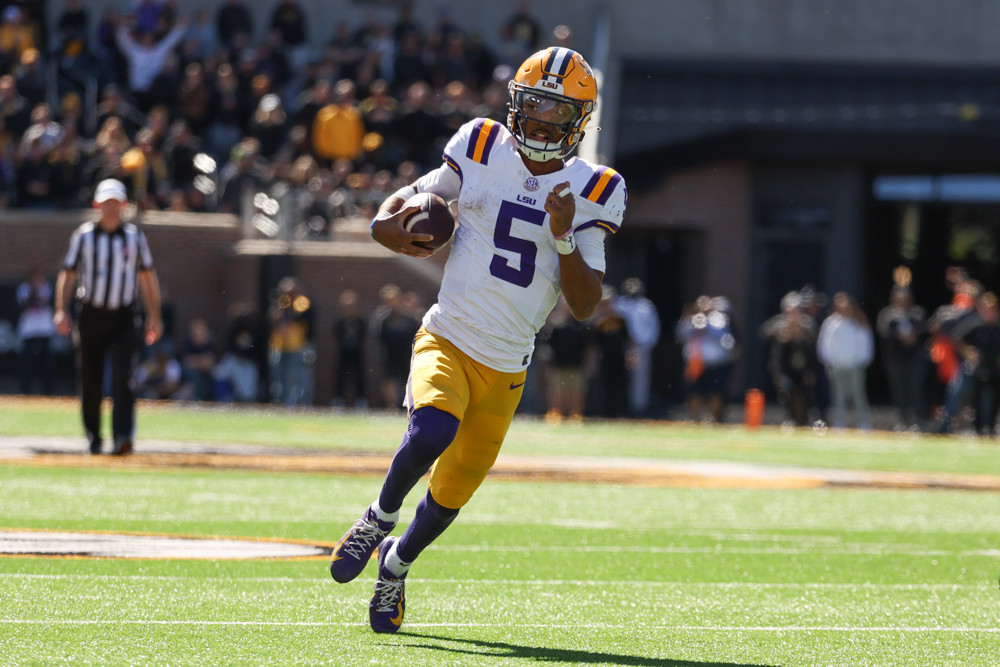
    NFL Scouting Report: Jayden Daniels

    Photo: Scott Winters/Icon Sportswire

    Jayden Daniels, QB

    6-3, 210, Washington Commanders

    Overall Grade: 6.7

    Scouting Report by Alec Mallon

    Overall

    Jayden Daniels is an elite athlete with a unique set of skills that will enable him to make game-changing plays with his arm and legs.

    Daniels is a Heisman trophy winning quarterback for LSU’s high-octane, shotgun, spread offense. Daniels is a five-year collegiate player, starting all 55 games he appeared in, beginning his first three years at Arizona State then transferring to LSU where he played these past two seasons. Daniels has the desired height for the position, but is rail thin and could serve to add a little mass to his frame. He is a fantastic athlete that has twitchy movements and the breakaway speed to match. His competitiveness and toughness is evident as he can play through physical contact as runner and in the pocket.

    Pass Game

    Daniels has a lot to like. He is calm and poised with his drops and is always under control. He does a good job of keeping his feet under him and staying square to wherever he is looking. Daniels can move defenders with his eyes, but didn’t have to often with how the offense operated. He shows good ability to go through his progressions, often not getting to option three or four, but always makes sure to reset his feet and have a strong base before throwing. Daniels has a quick and compact release which helps him get the ball out to all areas of the field. His quick release helps him when under duress and can get the ball out quickly. When given a clean pocket initially, Daniels will stand strong and routinely deliver big-time throws if given the ability to step into it. When there is quick pressure and he isn’t given the chance to be in rhythm, he is easily sped up. His feet become a little choppy, and his weight transfer isn’t as fluid, leading for some passes to sail high over his intended receivers. Daniels does have good awareness while in the pocket and feels pressure from all sides well. He does a good job staying on his toes, giving him the ability to shuffle and move quickly while also staying in phase to deliver the ball down the field. As a passer, Daniels is accurate to all fields. He does struggle with touch throws to layer the ball when he has to take some zip off. When his footwork becomes sloppy, it can lead to inaccurate passes.

    Daniels is good when delivering the ball with pace and can reach all areas of the field. He also has good ball placement and does a great job of protecting his receivers from oncoming defenders and even stopping their routes to help them change directions after the catch. An area he can improve is throwing with more anticipation. He can hold the ball a beat longer than needed as he is confirming that his targets are coming open downfield.

    Run Game

    Daniels is dangerous as a passer, but can truly change the game with his legs. On designed runs, Daniels has enough strength and physicality to run between the tackles and get tough yards when needed. When given space, he has excellent short burst and change-of-direction skills to get around edges and make defenders miss in the open field. Daniels may be at his best when designed pass plays break down. Daniels has the short burst and quick acceleration needed to escape the pocket but also has true long speed to beat defensive backs and linebackers to spots in the open field. Daniels takes on contact at the end of runs too often and makes some poor decisions. Due to his skinnier frame, he will need to take better care of himself by sliding and dodging big hits at the next level. He’s been knocked out of multiple college games due to big hits.

    Last Word

    Daniels projects as a “win-with” starting quarterback at the next level with real flashes of “win because of” traits. Daniels best fits a spread offense that will allow him to use his strong arm to drive the ball down field, while also allowing him to take off and use his legs when needed. Daniels is an accurate passer with a strong arm, but does need to clean up some of his mechanics with pressure around him and throw with better anticipation.

    Critical Factors

    Graded on 1-9 scale


    Accuracy 6
    Decision Making/Mental 5
    Clutch Performance 6


    Positional Factors

    Short Accuracy 6
    Deep Accuracy 6
    Pocket Awareness 6
    Footwork 6
    Under Pressure 5
    Mobility 8
    Arm Strength 6
    Release 7
    Awkward Throw 6
    Eye Discipline 6
    Leadership 6
    Body Comp 5

    Strengths

    Compact release
    Playmaking ability
    Ball placement

     Weaknesses

    Mechanics under pressure
    Touch throws
    Self protection


  • Scouting or Analytics? Both! (And Why Is This Even A Question?)

    Scouting or Analytics? Both! (And Why Is This Even A Question?)

    A couple of weeks ago, Seth Walder of ESPN and I were guests on Establish The Run with Adam Levitan and Michael Leone to talk about how NFL teams use “analytics.” Given my background as a scout for the Saints and Browns before spending my last eight years serving teams at SIS, I have some thoughts!

    You can use analytics for game planning and in-game decision making. You can use it for roster construction. One that people might not think about is the performance side of things, where it interacts with strength coaches and the training staff. The NFL is about keeping players healthy. If you can find an advantage there, that’s huge.

    There are certain teams and coaches that are fully in. There are certain departments that have specific use cases. Right now, there is still low-hanging fruit available that can give you an edge. It’s all part of the adoption cycle.

    I actually don’t like using the word ‘analytics’ because it can make people uncomfortable. People get afraid. People are worried that scouts are going to get replaced.

    When someone says, ‘Where can analytics make the most impact?’ I don’t think of it that way. To me, it’s ‘Where can information help people make better decisions that have impact?’

    The answer is: everywhere.

    In the best scenarios, there’s not a dichotomy of ‘this is scouting’ and ‘this is analytics.’ It’s blended. You’re using your analysts to make scouts that are more informed and can understand information that you’ve mutually agreed is important.

    For example, if you wanted to show how a quarterback handled certain situations or you wanted to see a player’s injury history, the way an analytics team organizes information can help a scout with their video cutups. They work better together rather than siloed.

    If there are people who believe that the data captures everything and there’s no use for scouts and coaches, that’s crazy and the hubris of that is crazy.

    I say this as someone who has worked on both sides. The best information a team has is its scouting information. Their scouts have been trained for years in watching players and their actions in highly specific ways. The best “analytics” make use of this treasure trove of information.

    That the place of analytics in the NFL isn’t a settled debate yet is fascinating to me. Our company has a 22-year history in baseball. It’s settled there. Every team has a sizable analytics department. The shift has been made to analytics that are more prescriptive. How can we make better players?

    If we look to other sports for a glimpse into the future, the game could change in unforeseeable ways. I can imagine scenarios as wild as teams playing with multiple quarterbacks on the field becoming the norm. More predictably, the game will continue to become much more positionless. When you look across sports, you notice teams encouraging versatile players and creating ways to take advantage of spacing.

    That’s where MLB and the NBA have been headed for years now. They measure and value the importance of spacing. And everyone is looking for versatility.

    With football analytics, there is versatility. There’s not just 4th-down decision-making info. There’s Expected Points (and in our case, Total Points). There’s injury data. There’s scouting data. Every team has access to NextGen data. There are new developments in AI and machine learning that are going to open all sorts of avenues. We’re just scratching the surface there.

    What we don’t fully have yet is belief and buy-in. We’re getting there but there’s still a way to go. I look forward to seeing it develop over time.

  • Off The Charts Division Preview: AFC North

    Off The Charts Division Preview: AFC North

    Photo: Dustin Bradford/Icon Sportswire

    Our first division preview (AFC East) highlighted three potential conference winners. The AFC North probably can’t claim that, but they had four winning teams in 2023 and the worst of those was missing its starting quarterback (the Bengals and Joe Burrow). This year, the SIS NFL betting model projects a couple of near-misses in terms of getting above .500, but the whole division is projected to be in the 8-to-11-win range.

    To talk through the key storylines for each team, we had high school coach and Bengals enthusiast Nate James on the Off the Charts podcast.

    Is the Bengals’ defense championship-caliber?

     It hasn’t been that long, but there’s been quite a bit of change on the Cincinnati defense since defensive coordinator Lou Anarumo put himself on the map a couple postseasons ago.

    In the last two offseasons the defense has lost much of its punch-you-in-the-mouth aesthetic. Two solid but relatively unheralded back-end pieces in safety Jesse Bates (Falcons) and corner Chidobe Awuzie (Titans) have left the fold in consecutive offseasons, and they’ve leaned into smaller athletes with compelling speed (e.g. Dax Hill).

    To some extent as a result of that, their biggest liability is likely to be in the run game. The loss of defensive tackle D.J. Reader (Lions) might break the camel’s back of a defense that was 26th in Run Defense Total Points per play last year.

    “You look at the fits; they corrected some of the issues theoretically, but they replaced Reader, one of the best nose tackles in the game, with Sheldon Rankins, very much not a nose tackle. They drafted Kris Jenkins, who I like a lot, but not a nose tackle. He has the potential to be an elite run defender, but frame-wise, that’s not what he is.

    “You look at the games they did win in the playoffs, you see that Reader just dominated that Tennessee game. It all started with them being able to keep people off schedule, and then Lou could cook when they got to long yardage situations.”

    – Nate James

     Ravens: In a division with tough defenders up front, can an overhauled offensive line hold up?

     The Ravens were in the top 10 in blocking Total Points per play last year, but the loss of three starters (Morgan Moses, John Simpson, and Kevin Zeitler) leaves more questions than answers. The unique run scheme that Baltimore has been able to execute with Lamar Jackson at the helm has raised their floor as an offense when the skill position players haven’t been there on the outside. With minimal continuity up front—not to mention a new backfield with Derrick Henry in the fold—there isn’t the same bankability.

    “I’m not a huge Roger Rosengarten guy. I know he’s got some length and he can move, but I can’t get the image of him getting bull rushed onto the back of his head in the National Championship Game out of my head….And it’s not like Van Cleveland’s some bum, they’ve got guys that have played in the league some. It’s just an issue of continuity and how they’ll gel together for a team that most people would expect to be in the playoffs.”

    – Nate James

    “Morgan Moses is not necessarily a name that rings bells across the league, but if Morgan Moses is your OL4 among your starting five you’re pretty happy about that.”

    “I also have some concerns about Ronnie Stanley. He’s been through quite a bit in his career, and when I watch, he’s not the same player he was two, three years ago.”

    – Bryce Rossler

    To put it differently from a numbers perspective, in 2023 SIS’s Sonar depth chart had four of the five Ravens’ starters in the top third at their position by Total Points per game. This year, only center Tyler Linderbaum qualifies.

    How much does the Browns’ roster continuity make up for their lack of solid quarterback play?

    Obviously the Browns showed in 2023 that they could make the playoffs with chaos at the most important position. But that was with a Defensive Player of the Year campaign from Myles Garrett and an overall defense that was top two in run defense and pass rush by Total Points per play. Defensive performance is famously difficult to project from season to season, and they haven’t made splashy moves in the offseason, but they’re at least bringing continuity to the table.

     “The Browns are tailor made to beat the Bengals. They have so much pass rush juice, they’ve got the corners to at least credibly challenge those guys on a down to down basis. They’re really good at corner, pass rush, they can run you over, but are they good enough at quarterback and on the margins to beat really good teams outside of that? There’s not a lot of transactions to talk about, because they haven’t had draft picks and they’ve been able to maintain most of their own guys. It’s hard to look at their roster and not wonder why they’re not a bigger factor.”

    – Nate James

     The trouble is that Deshaun Watson being healthy doesn’t necessarily mean an improvement at quarterback. Whether it’s injury or time off or psychological baggage, he has not been the same since his MVP-caliber 2020 season.

     “I think people would probably point to the quarterback situation last year and be like, ‘Well, there’s no reason we can’t do it again,’ but Deshaun Watson is not good right now. We have him 26th out of 41 quarterbacks since 2022 in Total Points per play. I think he’s sandwiched between Baker Mayfield and Aiden O’Connell, which is not good company.”

     – Bryce Rossler

     “I think the time away has hurt for sure. The last time he was good was, what, 2020, and that’s too long ago. It’s possible that he could turn around, but it’s legitimately hard not to think of some karmic debt having an impact on his and their success right now.”

    – Nate James

    Can either new Steelers quarterback make music with new offensive coordinator Arthur Smith?

    After a winning season with Kenny Pickett, Mitch Trubisky, and Mason Rudolph rotating through at quarterback, the Steelers cleaned house and added more notable names in Russell Wilson and Justin Fields. That said, it’s not clear that more notable production will come from the changes.

    “I think it’s fair to say that you trust Russell Wilson a little bit more. Even though he is not necessarily a consistent player, stylistically he is consistent. You know what you’re going to get out of him every game at this point, for better or worse. But he’s never really shown, even when he was good, the ability to consistently do the things that Arthur Smith is going to ask him to do, like turning his back under center, running play action, throwing over the middle.”

    – Bryce Rossler

     “All stuff he has been documented to not do for a prolonged period of time. You look at the last time Smith ran an offense that was good would have been in Tennessee. Is the archetype for an Arthur Smith quarterback, Ryan Tannehill? We’re talking about two very un-Tannehill-like guys, in terms of being big, standing in, getting punched in the face, pushing the ball downfield, it’s just not what they have.”

    – Nate James

    In terms of total production, Wilson and Fields were effectively tied, ranking 21st and 22nd (respectively) in Total Points in 2023. The combination of Pickett, Trubisky, and Rudolph would have placed comfortably below that. So there’s room for optimism on an otherwise winning roster, but plenty of uncertainty.

  • Off The Charts Division Preview: AFC East Has 3 Super Bowl Contenders

    Off The Charts Division Preview: AFC East Has 3 Super Bowl Contenders

    Photo: Peter Joneleit/Icon Sportswire

    There is an argument to be made that three out of the four teams in the AFC East can win the Super Bowl. There is also a case that the fourth team might have drafted the best quarterback in the draft. With so many teams fighting for ultimate glory, this division is shaping up to be one of the most competitive in the NFL. 

    To break it all down, Mark Schofield from SB Nation joins our own Bryce Rossler to look at each team in this division in the latest episode of Off The Charts.


    Let’s dive into one thing Bryce and Mark talked about for each team and how it will shape the landscape of the AFC East this season. 

    How vulnerable are the Bills to giving up the AFC East crown?

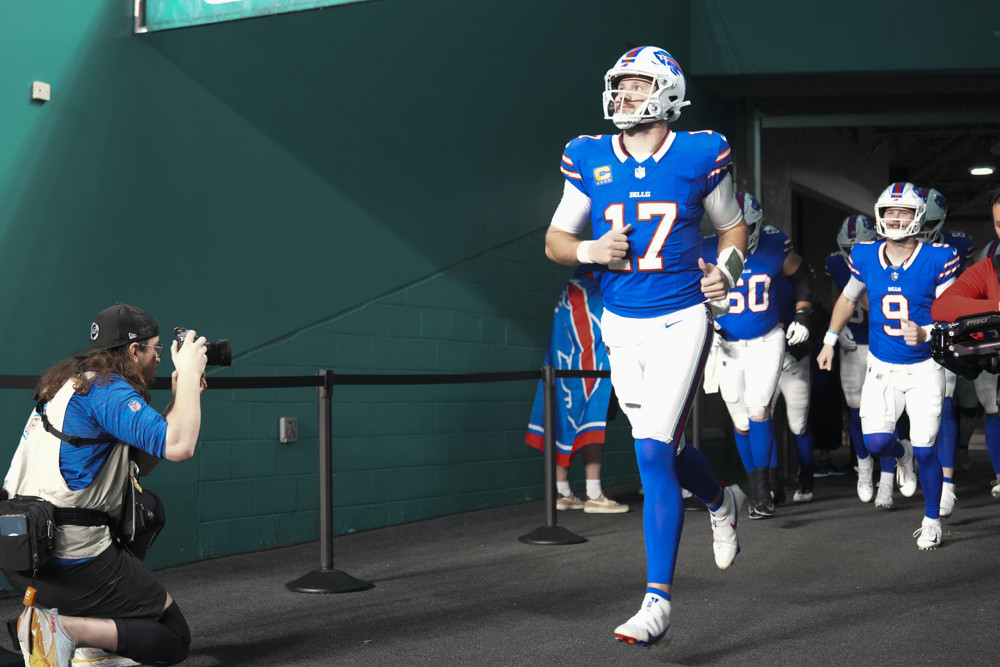
    In the offseason, the Bills lost Stefon Diggs, Tre’Davious White, Mitch Morse, Leonard Floyd, Jordan Poyer, Gabe Davis, and potentially Micah Hyde. A serious reshaping of the roster will take effect in 2024, putting all the more pressure on Josh Allen to be an MVP caliber quarterback.

    The Bills have decided to put all their eggs into the Allen MVP basket, as they have given him fewer weapons to make hay on the offensive side of the ball. The last two years of production show that he is capable of achieving this level, as he is only behind Patrick Mahomes in Total Points in that time. 

    “They still have who I would say is the second-best quarterback in football in Josh Allen. And, despite all the things I said about Josh Allen coming out, he’s a guy that can and has carried this team. But this is kind of a soft rebuilding year for them.”

    – Bryce Rossler

    A soft rebuild? With all the talent in the AFC East, it is certainly reasonable to think this team is vulnerable to not win the division. 

    The Jets don’t need vintage Aaron Rodgers to make noise this year.

    The 2024 Jets are primed to take a major step forward assuming that they can get a lot more than 4 plays out of Aaron Rodgers this year. 

    They bolstered the offensive line by signing veteran tackles Morgan Moses and Tyron Smith, and then used the 11th pick in the draft on another tackle in Penn State’s Olu Fashanu.

    After Rodgers went down, less-than-middling quarterback play ultimately led to their demise. Their young talents in Breece Hall and Garrett Wilson were severely limited by this, and they could never make the impact that they are capable of.

    On the other side of the ball, the Jets boast one of the best stop-units in the NFL. In 2023, they ranked second in EPA per play against the pass and sixth against the run. That’s all the more impressive with them being on the field more often than not due to the inept offense. Quinnen Williams and Sauce Gardner will once again be the anchors, with both coming off Pro Bowl seasons and Gardner his second straight first team All-Pro season.

    All of the talent here suggests that Rodgers doesn’t need to be otherwordly. 

    “They need just say an average Rodgers, like, subpar year. He probably gets them to be a playoff team, and that was the hope going into last year. If you just got sort of run-of-the-mill season type numbers from Aaron Rodgers, you’re probably a playoff team.”

    – Mark Schofield

    Anything can be better than an offense that ranked last in passing EPA and positive play percentage that the Jets’ quarterbacks gave them last season, so a jump to at worst 16th would be a major improvement and can get this team to a place it hasn’t been to since the days of Mark Sanchez.

    How good does the Miami Dolphins defense need to be?

    The departure of Vic Fangio at defensive coordinator, late-season injuries to Bradley Chubb and Jaelan Phillips, and free agency losses in Christian Wilkins and Andrew Van Ginkel leave a lot of questions about this Dolphins defense. This defense ranked 12th in EPA per play last season before all that upheaval.

    However, there is still plenty of talent here. Phillips and Chubb will return at some point during the season and the Dolphins used their first round pick on Penn State edge rusher Chop Robinson to add to the rotation. Jalen Ramsey ranked first in EPA per target allowed among cornerbacks in a partial season. Jevon Holland also finished in the Top 10 in EPA per target among safeties with 15 targets.

    The Dolphins also added Jordyn Brooks and Jordan Poyer via free agency, two players who had significant impacts to their prior teams. Brooks topped linebackers in Pass Rush Total Points per play while Poyer was Top 10 among safeties in Run Defense Total Points.

    Anthony Weaver comes in from the Ravens to take the reins of a defense that has seen a lot of moving parts. Luckily, this offense is still good enough to lead this team, so a top five defense isn’t really required.

    “I think this doesn’t need to be a top five defense. This doesn’t need to be a defense that you’re calling on and hoping will pitch a shutout here and there. It needs to be the kind of defense that can steal an extra possession or two for your offense, particularly. On those days where that offense is struggling a little bit, give them a short field, give them an extra possession via a turnover, things like that.”

    – Mark Schofield

    Can Drake Maye be the answer for the Patriots to push the ball down the field? 

    As soon as the 2023 NFL Draft was complete, rumblings began about the 2024 talent at quarterback. At the time, Drake Maye and Caleb Williams were considered the top tier, and mock drafts varied between the two on who would be the top pick.

    Fast forward a year after the rise of Jayden Daniels and the meteoric rise of Williams, Maye dropped out of the top tier and ended up as the third overall pick of the draft. 

    Yes, Maye also took a bit of a step back in 2023, with fewer passing yards and a lower Independent Quarterback Rating (IQR) for the Tar Heels, but there are plenty of signs that the Patriots might have found the guy to build around in the future.

    “You see some of the throws, some of the reads, the willingness to attack the middle of the field with velocity between defenders with anticipation type throws. You see the competitive toughness, which is the thing that I value highly in quarterbacks.” 

    – Mark Schofield

    In his two full seasons Maye had the 3rd and 15th most pass attempts between the numbers in the FBS, respectively, and he was in the Top 15 in IQR (our Independent QB Rating stat)  in both seasons.

    Going forward, Maye and the Patriots will look to add verticality in the offense under new offensive coordinator Alex Van Pelt. Van Pelt comes from a Browns offense that ranked 7th in average depth of target in 2023. The Patriots’ offense ranked 28th.

    The goal this year is to evaluate Maye and see if he can be the quarterback of the future, so giving him every possible opportunity to excel in this offense is crucial. 

    So what do Mark and Bryce think on how the division will pan out? You can check out the full podcast here for more of a breakdown as well as their predictions. 

  • Scouts vs Stats: Top 10 Non-Quarterbacks in the NFL

    Scouts vs Stats: Top 10 Non-Quarterbacks in the NFL

    Photo: Brian Lynn/Icon Sportswire

    If you’ve listened to the Off The Charts Football Podcast, you know that we like to examine things from a “Scouts versus Stats” perspective – and so we’ve brought that back for at least one discussion as we wait for the 2024 season to begin. 

    This week’s episode considers a question from those perspectives: Who are the Top 10 non-quarterbacks in the NFL.

    Ex-NFL scout Matt Manocherian and podcast host Bryce Rossler took the scouts’ perspective. Our director of football analytics Alex Vigderman and research analyst James Weaver created a statistical ranking based on a suite of metrics.

    We can tell you that officially, Sports Info Solutions does not condone the dichotomy between scouting and statistical analysis. Each of them provides data in their own way and should inform our evaluation of a player. We want to put the scouting reports and stats side-by-side, leveraging both to come to a conclusion.

    Fair warning: These are vastly different lists.

    Scouts’ Opinion Statistical Analysis
    1. Myles Garrett 1. Derrick Henry
    2. Micah Parsons 2. T.J. Watt
    3. Tyreek Hill 3. Travis Kelce
    4. Justin Jefferson 4. Chris Jones
    5. Nick Bosa 5. Justin Jefferson
    6. T.J. Watt 6. Tyreek Hill
    7. Pat Surtain II 7. Sauce Gardner
    8. Maxx Crosby 8. George Kittle
    9. Roquan Smith 9. Amon-Ra St. Brown
    10. Ja’Marr Chase 10. CeeDee Lamb

    Now that you’ve finished gasping at a running back – and not Christian McCaffrey – ranking No. 1 in the statistical analysis column, let’s explore the contrast of the two lists.

    And let’s get right to the point. Yes, the statistical analysis list has Derrick Henry as the No. 1 non-quarterback.

    In simplest form, our stats group created a methodology that is favorable to where Henry stands in the running back universe. He’s No.1 because he’s been “more better” (for lack of a better term) at running back over the last two years than other players are at their respective positions. 

    The Stats List Methodology

    You can listen to the podcast to hear the discussion regarding the surprising analytics-based ranks, but obviously there’s some explanation needed here. 

    The stats-based ranking includes a two-year average of a player’s results across a handful of flavors of our catch-all Total Points system.

    First, there is Points Above Average (PAA) per play, scaled to the positional average and standard deviation. This encapsulates the extent to which the player excels relative to the position on a play-to-play basis.

    Second, there is Points Above Replacement (PAR), scaled to the league average and standard deviation. This uses our WAR methodology that measures how valuable a player is in general, incorporating a notion of relative positional value.

    This is the first time we’ve mentioned it, but we’re working on a large update to the Total Points system this offseason, which will incorporate a whole bunch of new data points and ideas into the system. We’re not ready to publish those results, but we thought it’d be interesting to include them here to inform our player values.

    So, we have each of the scaled PAA per play and PAR values for each of the two versions of Total Points, equally weighted between the four.

    The one other element that’s included is player aging. Players start to drop off in production within just a few years of coming into the league, so we want to make sure that we’re capturing that. We computed an aging factor for each of the above metrics and applied that to each player’s two-year averages, to make it more like a projection for 2024.

    What the Stats Showed

    Having Derrick Henry number 1 is a bit rich, no? Especially given that McCaffrey exists?

    Let’s take the second point first. Over the last two years, Henry has generated almost 30 more PAA than McCaffrey as a rusher, which doesn’t get sufficiently counterbalanced by McCaffrey’s receiving excellence.

    The gap in rushing is in large part to the difference in their circumstances. Henry has continued to be productive year after year despite having the most carries in the NFL when the offensive line blew a block in front of him over the last two years, and last year he turned more than 60 percent of those into gains. Henry’s elusiveness has not eluded him yet, with similar or better broken and missed tackle rates to McCaffrey’s.

    The positional value question is a valid one, though. How is a running back rated so highly in general? In short, we can only measure what we have access to, and that informs how we value positions. 

    A running back can fumble or get stuffed for a loss on third down, losing a big chunk of value, in a way that a pass rusher or a center does not often do. So the depth of the floor for a running back is more extreme, at least in the statistical record. That means that within the Points Above Replacement framework, the floor for rushers is lower than you think, and therefore the position as a whole is considered more valuable.

    The other big contrast

    The scouts’ list has several edge rushers on it. The stats list is lacking in them.

    Myles Garrett and Micah Parsons are at worst among the handful of best defensive players in the league, so there’s not much to say about them to argue for their inclusion at the top of a crowded field of edge rushers. Parsons is probably the pick if you need one guy to wreck a play, but consistent with their general approach, Garrett got the nod because of how he impacts all phases of the game.

    An otherworldly motor against the pass and the run got Maxx Crosby onto the list, and the scouts were indignant at his exclusion from the stats-based list—but only moderately indignant compared to what happened at the top of the board.

    So why are many of the top pass rushers in the league not at the top of the stats-based list (although the upcoming Total Points updates will do a lot to make up for that)?

    There are more excellent edge rushers than there are excellent interior players, so a single player at the top stands out more in the interior. Chris Jones projects to be one of the biggest risers in the updated Total Points because of how much he dominates as a pass rusher from the interior, as he ranked first and third in 2023 and 2022 in pressure rate, respectively. This isn’t true for the edge rushers, where there are many solid producers.

    Parsons will have a similar jump to Jones, but he’s competing at a much tougher position at the top. There are six edge rushers in the top 20 on the stats-based list, compared to just two interior defenders.

    Also, our measure of the floor of a defensive front player isn’t as low as it is for other positions—a bad play by a cornerback or a running back is more likely to be a big liability. As a result, when we determine replacement level for each position, we don’t have as much value assigned to pass rushers as we do other positions.

    Other highlights from the stats list

    Travis Kelce might have been a more palatable choice for this list a year ago, but it’s worth noting that he still posted the best receiving PAA among tight ends last season. George Kittle’s balanced skill set got him on the list, coming in the Top 2 in Receiving and Blocking Total Points among tight ends. However, even at a younger age, it doesn’t make up for the gap in receiving production.

    The lists differed on which of the top cornerbacks cracked their lists, with Sauce Gardner getting the nod thanks to his consistent production across his first two seasons. He finished in the top 10 each of the last two seasons in yards allowed per coverage snap, yielding fewer than 700 receiving yards in nearly two years. 

    Amon-Ra St. Brown snuck onto the stats-based list because of how well he does his job, even though his job might be limited relative to others at the position. He is as money as it gets in big spots, ranking second in the NFL in both On-Target Catch Rate and third down completions over the last two years.

    CeeDee Lamb is there because of his production in 2023, specifically ranking first in Receiving Total Points. The updates to Total Points will ding him because of his merely good catch rate on accurate balls, which is why he ended up below St. Brown, for example.

    Other highlights from the scouts’ list

    While the stats-based list was heavy on wide receivers, the scouts-based list was heavy on edge rushers, to the point that they felt the need to stretch for a couple of less-valuable positions.

    In the interest of being less boring, the scouts included Roquan Smith as an off-ball linebacker choice. He’s a downhill player and an “enforcer,” per Matt, and while he doesn’t have the crazy athleticism that other potential candidates do, he closed the gap in that respect in 2023 in terms of being an excellent well-rounded player.

    The scouts really only considered two cornerbacks for their list, and they went with Pat Surtain II over Gardner as the prototypical corner with versatility and consistency that very few corners have.

    Ja’Marr Chase and CeeDee Lamb were candidates  for the back end of their list, with Chase getting the nod because “he’s more of a headache in more ways that lead to touchdowns for him and for other players on his offense.” This also contributed to the choice of Tyreek Hill as their top receiver. 

    Want to hear the rest of the debate and discussion? Check out Off The Charts wherever you get your podcasts.


  • Analyzing NFL Win Totals with the SIS Prediction Model

    Analyzing NFL Win Totals with the SIS Prediction Model

    We’ve reached prediction season for the NFL. A big part of dissecting the upcoming season is analyzing the schedule and predicting which teams will overperform or underperform their expectations.

    Expectations these days come from the sportsbooks, especially through win totals. These markets have been posted and bettors have begun forming their stance on each individual team. The lines will move all offseason long, as more information and opinions will move the lines in one direction or another.

    At SIS, we have created a pre-game prediction model to predict the spreads, totals, team totals, and moneylines of each game using a multitude of data points that we collect. We also constructed the model to be able to run for the entire season, allowing us to run simulations on the season and create win total prices of our own. The model went 18-13-1 in over-under predictions on team’s preseason win totals last season.

    We have run our first simulation of the year and the Football R&D team selected their favorite wagering opportunities in the win total markets based on the model’s output. The three of us (Alex Vigderman, Bryce Rossler, and James Weaver) each selected four hypothetical wagers we would make in a snake draft style on the Off the Charts Football Podcast.

    These are our model’s win total projections.

    Team DraftKings Win Total Model Projected Win Totals Difference
    Raiders 6.5 10.4 Over 3.9
    Saints 7.5 10.7 3.2
    Bears 8.5 10.7 2.2
    Lions 10.5 12.3 1.8
    Buccaneers 8.5 10.3 1.8
    Browns 8.5 9.8 1.3
    Packers 9.5 10.7 1.2
    Seahawks 7.5 8.7 1.2
    Jets 9.5 10.6 1.1
    Patriots 4.5 5.5 1
    Ravens 11.5 12.1 0.6
    Bills 10.5 11.1 0.6
    Giants 6.5 7.1 0.6
    Cowboys 10.5 11.1 0.6
    Rams 8.5 9 0.5
    Cardinals 6.5 6.9 0.4
    Bengals 10.5 10.9 0.4
    Texans 9.5 9.4 Under -0.1
    Panthers 5.5 5.2 -0.3
    Dolphins 9.5 9 -0.5
    Chiefs 11.5 10.9 -0.6
    Broncos 5.5 4.7 -0.8
    Steelers 8.5 7.4 -1.1
    Jaguars 8.5 7.4 -1.1
    Falcons 9.5 8.1 -1.4
    Chargers 8.5 6.9 -1.6
    49ers 11.5 9.8 -1.7
    Colts 8.5 6.1 -2.4
    Vikings 6.5 4 -2.5
    Titans 6.5 4 -2.5
    Commanders 6.5 3.2 -3.3
    Eagles 10.5 6.8 -3.7

    Model Overview (How did we get these numbers?)

    Our model utilizes 18 features that are a combination of game, team, and player level metrics. 

    Game level metrics include whether or not the game is in the postseason, weather predictions like wind speed and precipitation probability, and a home team indicator.

    Some of the team level metrics include weighted points for and points against averages, both offensive and defensive weighted penalty yards, and some possession metrics in the form of snaps per game or drive. Each of these metrics is computed for the team’s past 7 games, with the most recent weighted more heavily. 

    We use a weighted 16-game average with our Total Points for the player metrics. We calculate the average Total Points for each skill (Passer, Rusher, Pass Rush, etc.) for every player per snap, and then aggregate the projected values for each game to the team level using each player’s projected snap counts for the game.

    Then, we utilize Monte Carlo simulation to illustrate variance in player performance by simulating 1,000 games for each player. After each simulation, all of the metrics are incorporated into a Lasso regression model to predict the team’s point total. The distributions of the predictions are aggregated to an average and spread so that point estimates and alternate point estimates can be drawn from the distribution.

    Now that there are lines for each game, we can simulate 1,000 regular seasons based on the moneyline output and take the average win total for each team.

    Analyzing the Overs

    The Off The Charts podcast crew of Bryce Rossler, Alex Vigderman and I went through the over-under possibilities here and drafted the ones they felt best about (Listen to the episode here).

    They went with the Raiders, Saints, Browns, Packers, Patriots and Cardinals on the ‘over’ side (listen to the episode to find out who took whom and their reasoning).

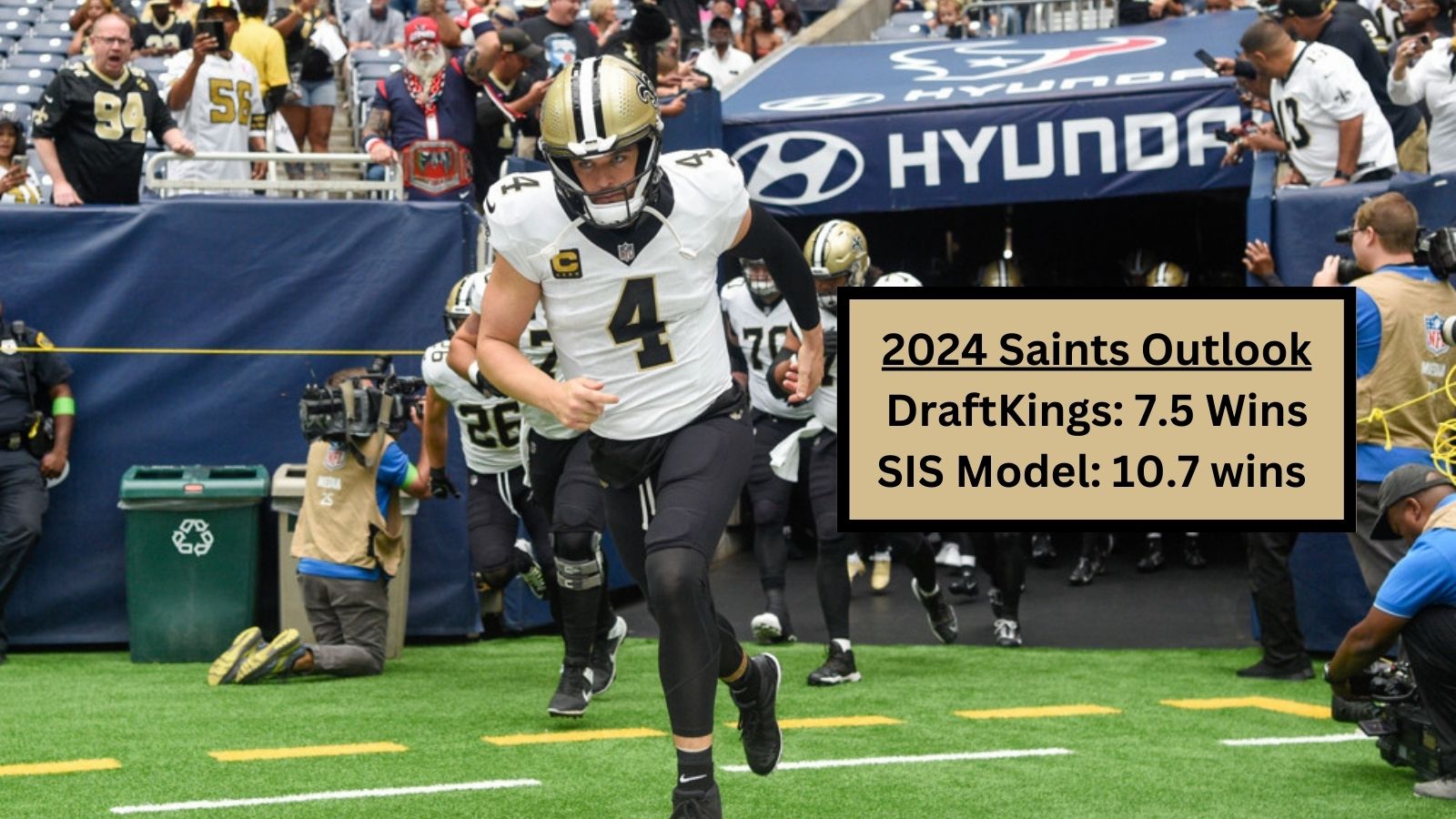
    The model picked the Raiders and Saints to go over their Vegas win total by the widest margin. The Raiders are projected to have 10.4 wins and the Saints 10.7, good for 3.9 and 3.2 wins of value, respectively. 

    Both teams finished last season strong in regards to the various model inputs. The Saints are No. 1 in our Points For weighted average and No. 5 in Points Against weighted average, which goes back to the last 7 games played of last season. Additionally, Derek Carr ranks 2nd in the Passer Points per play weighted average coming into this season (5th if you include projected snap count).

    The Raiders added Gardner Minshew, who is 8th in Passer Points per play weighted average and will battle Aidan O’Connell for the starting QB spot. They also come into the season 9th and 6th in the Points For and Points Against weighted averages, respectively.

    The Browns and Packers come in at 1.3 and 1.2 wins above their current win totals of 8.5 and 9.5. The Browns will welcome back Deshaun Watson after catching lightning in a bottle with Joe Flacco at the end of last season. The Packers also finished strong, pushing the 49ers to the brink in the divisional round and are ranked second in recency-weighted Points For. 

    Our crew drafted both the Patriots and Cardinals even though the model total only slightly exceeded the DraftKings number. The reason: quarterback optimism.

    Unders

    After a total collapse at the end of last season, the Eagles come in with the most value towards the under, as they are projected to win only 6.8 games compared to a win total of 10.5. They rank 26th and 30th in recent points for and points against. 

    Bryce took both the Eagles and the Vikings, who are projected for 4 wins in our model when DraftKings has the over-under set at 6.5. Bryce doesn’t have faith in J.J. McCarthy and believes it will take him more than a season to get to a good place.

    “This is a player who doesn’t have a lot of reps at game speed,” Bryce said. “I know he started several years at Michigan but he’s not passing a lot in that offense. I think Year 1 in the NFL is going to be very rough. I know they feel like as an organization that they’ve found their quarterback. But I don’t see it in Year 1.”

    The Vikings defense also ranked in the bottom eight in points against, with a bottom-five rank in defensive Total Points over the full season.

    Two of the other unders taken in our “draft” were the Chargers, who have a 6.9 expected win value compared to their 8.5 wins total, and the 49ers, who have a 9.8 expected win value compared to a win total of 11.5. 

    The Chargers are in the midst of a small rebuild and culture change with a new coach, and our drafter, Alex, wants to see it to believe it with another new coaching staff and a reworked skill position group. 

    The 49ers, fresh off the Super Bowl loss, were in a few dogfights down the stretch in the playoffs, and the defense wasn’t as good as its reputation last year, hence the reasons for the differential. 

    “I look at their schedule … they get the AFC East, and they lump in the Chiefs,” James said on our podcast (that’s me!) “Improved NFC, Super Bowl hangover being real. I just think 11.5, that’s pretty high.”

    A Battle in Charlotte

    Two of our draftees, Alex and Bryce, will go head-to-head this season when it comes to the Carolina Panthers. 

    Bryce has taken the under 5.5 because he doesn’t see a scenario in which Bryce Young can be a good quarterback for this team.

    Alex, on the other hand, thinks the hate has gone too far, and has a little more optimism with a new head coach in Dave Canales (who improved the quarterback play of Baker Mayfield and Geno Smith over the last few years).

    “This is my pick in the genre of ‘Rookie quarterback might take them somewhere,’” Alex said. “I think you could also have ‘Rookie quarterback is anomalously bad’ and people get kind of insane about it. A year ago people were feeling reasonably good about the rest of the team, offensive line and defense. I do think there’s an overreaction and they can get a little bit of a bounceback.”

    The model sides with Bryce by the slimmest of margins, projecting 5.2 wins to the win total of 5.5. 

    Check out the full Off the Charts Football Podcast here for more analysis!

    Follow us on Twitter at @football_SIS and check out the DataHub and DataHub Pro for access to all our stats.

  • Under Pressure? Projecting Sack Numbers using Advanced Pass Rushing Metrics

    Under Pressure? Projecting Sack Numbers using Advanced Pass Rushing Metrics

    In today’s pass-happy league, the No. 1 concern for defenses has been affecting the play of the quarterback. Allowing time from a clean pocket to make a throw spells doom for defenses.

    We have seen the massive contracts given to high-end pass rushers who make game-changing plays. Nick Bosa, Chris Jones, Josh Allen, Brian Burns, and T.J. Watt all find themselves in the Top 25 in average annual contract value where that list is primarily made up of quarterbacks and a few receivers. 

    To that point, we set out to project the next crop of sack artists using some of our metrics. The big pain with projecting pass rush performance, though, is that context plays a huge role. An interior player who primarily plays on early downs has a much harder time than a situational pass rusher coming off the edge. 

    We created Expected Pressure Percentage and Pressure Percentage Plus-Minus a few years ago for this reason. The former uses game situation, player alignment, and quarterback drop type to estimate how likely a player is to generate pressure on each play, and the latter is how much the defender performed above or below that expectation.

    In order to better predict year-over-year sack production, we looked into four stats to see how predictive each of these are towards the following year’s sack output.

    – the previous year sack percentage 

    – pressure percentage 

    – expected pressure percentage 

    – pressure percentage plus-minus of pass rushers 

     Once we dove into what has predictive value, we looked at some interesting candidates for positive or negative sack regression in 2024.

    Methodology

    Sack percentage, pressure percentage, expected pressure percentage, and pressure percentage plus-minus were aggregated for every player in their previous season going back to 2019. 

    These four metrics were then used as features in linear regression models to predict the sack percentage of the player’s next season. Players were only considered if they had 100 pass rushes in each season.

    The significance of each variable and adjusted R2 values of each model were analyzed to see which metrics have the best year-over-year predictive value. The adjusted R2 value is a 0-to-1 measure of how well the features explain the variability of the dependent variable, in this case current year sack percentage, and is adjusted based on how many features there are in the model.

    Results

    Model Adjusted R2 Statistically Significant?
    Sack% 0.13 Yes
    Pressure% 0.27 Yes
    Expected Pressure% 0.29 Yes
    Pressure% +/- 0.03 Yes
    Expected Pressure% + Pressure% +/- 0.32 Yes/Yes

    For starters, all of these are statistically significant, meaning that an increase or decrease in one of these features meaningfully impacts the following year’s sack percentage. 

    Also, we used sack percentage instead of actual sacks because we need to factor how many pass rushes a player had in a given season. Playing time can be affected by a variety of factors, so we are keeping it simple by focusing on per-play performance.

    Sack percentage comes in with the second lowest adjusted R2 value when predicting next season’s sack percentage. Considering that sacks are more output than process when it comes to good pass rush, this makes sense. Sacks come at such a low sample that having one more or fewer can drastically impact this percentage, especially year-over-year.

    Expected pressure percentage shows a slightly higher adjusted R2 value than pressure percentage and are the two with the best explanation of variability in next season’s sack percentage. This is the process driven argument, as getting more pressure on a quarterback shows better predictive value than your sack percentage from the previous year.

    Pressure percentage plus-minus comes in at the bottom. This metric strips out the opportunities to get a sack and looks solely at the skill portion. Volume is a big part in getting sacks and situational factors are very impactful, so the low explanation in variability here (low adjusted R2) makes sense.

    The best model combines expected pressure percentage with pressure percentage plus-minus, coming in with an adjusted R2 of 0.32. Factoring in the skill component with the expected measure makes the model better explain variability, and it does so better than just using pressure percentage because it weighs the situational factors more strongly.

    With the latter model leading the way, let’s use that to predict some sack percentages for 2024.

    2024 Outlook

    Decline in Wattage

    T.J. Watt once again led the league in sacks for the 3rd time in 2023 with 19. However, his unimpressive expected pressure rate of 10.3% would suggest he is in for a drop in sack percentage by 1.8 percentage points in 2024. This would be a massive drop off by Watt’s standards, putting him roughly at 10 sacks this upcoming season based  if he had roughly 500 pass rushes. Leading the league in sacks three times is very impressive, but sustaining that production over time is a very tall task.

    Trading Trey?

    Trey Hendrickson walked back his trade request with the Bengals by expressing his desire to win a Super Bowl for Cincinnati. Hendrickson, who had a career high 17.5 sacks with the Bengals last season, is a candidate due for a drop in sack percentage by 2.2 percentage points. His expected pressure rate put him in the middle of the pack last season at 10.1%. Looking at a sell high opportunity, the return on Hendrickson might be enough to warrant a trade.

    The Youthful Cameron Jordan

    Cam Jordan may be past his prime at age 34, but he can still affect the quarterback at a high rate. His 10.3% expected pressure percentage last year came only with a 0.5% sack percentage. According to the model, this should result in a bump to 11.5% in his 14th season in the league. Can Jordan turn back the clock? Maybe not, but he should have higher production than his 2.5 sacks a season ago.

    A More Hungry Lion

    Aidan Hutchinson is projected to take another step forward and increase his sack percentage to 2.2% this year, good for another half-sack. Hutchinson took a leap last season, ranking 8th in pressure percentage among those with 30 pressures and 12th in sacks. Another step forward would be huge for a Lions team coming oh so close to getting to the Super Bowl last season.

    Sack Title Contenders

    Looking at the predicted sack percentages for next year and using the pass rushes a player had last year, Maxx Crosby (13) and Aidan Hutchinson (13) are our top contenders to take home the sack crown, with Danielle Hunter, T.J. Watt, Micah Parsons, Nick Bosa, and Khalil Mack just behind. Josh Uche, who had only 214 pass rushes last season, is projected to have a higher sack percentage this year at 2.2%. Playing with Matthew Judon on the other side, Uche has a chance to accumulate a high sack total given more opportunities.

    Conclusion

    Using advanced pressure metrics gives us more of a sense of predicted output going forward. Sacks are the output, but their predictive power is minimal. Looking at the process of getting a sack leads us to seeing who may be a diamond in the rough poised for a breakout season or someone who might be overvalued. After all, this is arguably the second-most important position in football, so getting these players right is critical to success.

  • Reviewing Our Grades for the 2021 NFL Draft Class

    Reviewing Our Grades for the 2021 NFL Draft Class

    Introduction

    While many crave all the NFL Draft Team Grades that publications put out the day after the draft, including us on both accounts, there are a lot of unknowns at that point. Of course, we all have our own NFL Draft prospect rankings heading into that weekend, but those players have yet to play a snap in the NFL. So, how can we really grade a team’s draft class if those players haven’t yet stepped onto an NFL field?

    It usually takes at least three years to see how well a draft class turned out. While said publications, including us, don’t want to wait three years before putting out their grades on a draft class, we do both. This is the time that teams must decide on 5th-year options for their 1st Round picks. Additionally, this gives these players a rookie season and two full years after that to get settled in and playing time under their belt.

    Three years ago, Sports Info Solutions published the 3rd edition of The SIS Football Rookie Handbook. After the 2021 NFL Draft, we, just as many others, posted our NFL Draft Team Grades, which can be seen here. It’s worth noting we don’t give out letter grades like most. We rank the teams from 1 to 32 in terms of how much talent they got as an entire class.

    Just as I did last year, in the article you can see here, I’ve developed a system to evaluate the draft classes using Total Points relative to position as the foundation. Three seasons have now gone by since the 2021 NFL Draft. So, let’s use that to truly see how each team did with getting value from its selections and draft class as a whole.

    Our TLDR Top Things To Know

    1. We ranked the Lions No. 1 in our 2021 post-draft ranking. Three years later the Chiefs rank No. 1 according to our stat for assessing it, Total Points Score (TP Score), followed by the Lions, Jaguars, Dolphins, and Bears.
    2.  The Rams ranked last both in our original rankings in 2021 and in TP Score three years later.
    3. The Jaguars, Broncos, and Jets accrued the most Total Points from their draft classes

    How much value did teams get?

    Let’s take a look at how we ranked teams after the 2021 NFL Draft and then who got the most and least value. See the Appendix below to see how all 32 teams ranked in our 2021 rankings and in TP Score.

    Here are the teams we ranked at the top immediately following the draft back in 2021. To see our scouting grading scale, check out our NFL Draft site.

    Top 5 Teams in 2021 Post-Draft Rankings
    Team Book Rank Grade
    Lions 1 6.60
    Dolphins 2 6.46
    Browns 3 6.44
    Jaguars 4 6.40
    Falcons 5 6.38

    TP Score will be defined below, but here are the top 5 teams based on how much value they received from their draft class.

    Top 5 Teams in TP Score
    Team TP Rank TP Score
    Chiefs 1 83.33
    Lions 2 80.82
    Jaguars 3 80.72
    Dolphins 4 66.22
    Bears 5 65.39

    In our post-draft rankings in 2021, we tabbed the Lions as the No. 1 draft class, and they just got edged out by the Chiefs for No. 1 three years later. In Brad Holmes’ first draft with the Lions, he was able to draft two of the top 10 players in Total Points over the last three years: Penei Sewell and Amon-Ra St. Brown, with both signing contract extensions just before the Draft.

    We also had the Jaguars and Dolphins in our top 5 who also ended up there after three seasons. Trevor Lawrence has been a mixed bag, but when he’s looked good, he’s been really good, amassing the most Total Points in the draft class. Additionally, Tyson Campbell’s 116 Total Points is the 6th-most. The Dolphins nailed their first four picks in Jaylen Waddle (59 Total Points), Jaelan Phillips (80), Jevon Holland (91), and Liam Eichenberg (61).

    As for the Chiefs, we were high on Nick Bolton, Creed Humphrey, and Trey Smith, grading them as 6.6 or 6.7 players, but they even surpassed those expectations, as we ranked them 21st post-draft. Between the three of them, they totaled 263 Total Points and would’ve ranked 10th among full teams themselves. While Joshua Kaindoh and Cornell Powell didn’t contribute much, they still hit on four of their six picks, which is a great percentage.

    The Bears round out the top 5 of TP Score, and we originally ranked them 16th immediately following the 2021 Draft. Justin Fields finally started to turn the corner, though he was traded to Pittsburgh this offseason. We were also high on Teven Jenkins, but the other five members of their class graded out between a 5.9 and 6.3 for us. We felt they would all contribute, but most, especially Larry Borom and Khalil Herbert, exceeded our expectations.

    Conversely, here are the bottom 5 teams from our 2021 rankings.

    Bottom 5 Teams in 2021 Post-Draft Rankings
    Team Book Rank Grade
    Bills 28 6.14
    Saints 29 6.12
    Cowboys 30 6.11
    Colts 31 6.07
    Rams 32 5.82

    Based on TP Score, here are the worst teams in terms of getting value from their 2021 draft picks.

    Bottom 5 Teams in TP Score
    Team TP Rank TP Score
    Giants 28 20.22
    Panthers 29 20.02
    Seahawks 30 20.00
    Vikings 31 17.08
    Rams 32 15.48

    The big bullseye here was the Rams. We were very low on their draft class initially, and they haven’t done anything to disprove that. While we admit omitting Ernest Jones from the book was a big miss on our part, he garnered 75 of their 114 Total Points from the entire class. He and Ben Skowronek were the only picks to play above average relative to their position among the draft class.

    While we ranked the Seahawks (26th) and Vikings (23rd) low initially, we missed on the Giants (12th) and Panthers (9th).

    Kadarius Toney and Azeez Ojulari have been above-average players, but Aaron Robinson and Rodarius Williams (SIS No. 5 CB) have been disappointing in New York. As for Carolina, aside from their three above-average players (Jaycee Horn, Brady Christensen, and Tommy Tremble), six of their eight other picks we felt were 6.4s or better, but they’ve only combined for a total of 26 Total Points.

    Determining Total Points Score

    In case you missed last year’s article, let’s explain the process of creating each team’s TP Score. When looking back to see how good or bad a specific draft class was, there are two main points to detect:

    1. How productive were the draft picks on the field?
    2. How much talent did the team draft relative to the amount of picks they made? 

    As in: Did they hit on one player or did they hit on multiple players?

    To determine the value of the draft classes, I used Total Points, our flagship player value stat, from across the last three seasons. However, for those of you who are familiar with Total Points, it gives a lot of extra weight to quarterbacks. With that said, Trevor Lawrence alone would have had the 14th best draft class with his 232 Total Points if we just used raw Total Points.

    While there is a reason we weigh quarterbacks so much more compared to other positions (they are pretty important), using that raw number in this sense isn’t going to make for a perfect match. While getting your franchise quarterback is a huge win, it doesn’t automatically give you a top class. This year, Jacksonville ended up with the 3rd-highest TP Score, and I think most would agree they had a good class, but not the best.

    Now, answering question 2 takes into account how well a team drafted throughout the entirety of the draft class. I found the average Total Points per player from the 2021 class at each position, including UDFAs who have taken at least one offensive or defensive snap, since they were also available to be selected.

    The positional averages are shown in the table below.

    Pos TP per Player
    QB 56.7
    RB 8.5
    WR 12.6
    TE 15.2
    OL 30.1
    DE 17.2
    DT 12.4
    LB 23.2
    CB 34.3
    S 30.1


    The TP Score, as referenced earlier, is what’s used to rank the teams. It is calculated as follows:

    1. Add up the Total Points from the entire team’s draft class
    2. Divide that number by the number of selections the team had
    3. Multiply that number by the percentage of draft picks that were above the average Total Points for their given position
    4. Add that to the original Total Points per draft pick

    In these 4 steps, we are essentially answering how productive the draft class was and how many picks were “hits”. Let’s run through an example using our No. 1 team, the Kansas City Chiefs.

    Here is their draft class:

    Pos Player Total Points
    LB Nick Bolton 75
    OL Creed Humphrey 103
    DE Joshua Kaindoh 0
    TE Noah Gray 37
    WR Cornell Powell 0
    OL Trey Smith 85


    Add up the Total Points from the entire team’s draft class

    300

    Divide that number by the number of selections the team had

    300 Total Points divided by 6 selections equals 50.00

    Multiply that number by the percentage of draft picks that were above the average Total Points for their given position

    Bolton, Humphrey, Gray, and Smith all accumulated a Total Points number that was above average compared to their position groups

    50.00 times 66.7% (4 out of 6) equals 33.33

    Add that to the original Total Points per draft pick

    50.00 plus 33.33 equals 83.33, which is their TP Score

    So, to summarize, we took the team’s Total Points gained from these players, dispersed it throughout the entire class and then gave a bump based on how many above-average players they drafted.

    Now that we know how the teams ranked and how the TP Score is calculated, let’s dive into some of the other details.

    Other Key Takeaways

    – No teams hit on at least 75% of their picks that year. At least two teams did that in each of the past two seasons, but none did with this class. However, the Bears and Lions went 5-of-7 (71%), the Chiefs went 4-of-6 (67%), and the Jets went 6-of-10 (60%). Levi Onwuzurike of the Lions came less than a half-point short of the DT average or he would’ve given Detroit a sixth hit and the No. 1 class.

    – The Jets’ six hits were the most of any team. They ranked 7th in TP Score. They hit on six of their first seven picks, getting at least 30 Total Points from each of them, though three of them have played significant snaps for other teams. Zach Wilson has been traded to Denver and hasn’t been anything like what Jets fans hoped, but he did sneak into being an above-average player in what was a brutal quarterback class.

    – Every team drafted at least one player who has played above the positional average compared to the rest of the draft class. However, the Saints (Payton Turner), Raiders (Alex Leatherwood), 49ers (Trey Lance), Titans (Caleb Farley), Seahawks (Dee Eskridge), Rams (Tutu Atwell), and Texans (Davis Mills) were the only teams whose first draft selection wasn’t an above-average player. This is the second year in a row that’s been the case for Las Vegas, Tennessee, Los Angeles, and Houston.

    – The three teams with the most raw Total Points are the Jaguars (467), Broncos (388), and Jets (360). Jacksonville leading the way isn’t a surprise given how valuable Trevor Lawrence has been. Denver and New York ranked No. 6 and No. 7 in TP Score, as well. We detailed the Jets already, so for the Broncos, they hit a massive home run with Patrick Surtain II, who has accumulated 161 Total Points, 2nd-most in the class behind Lawrence.

    – The Seahawks (45), Giants (91), and Rams (114) totaled the least amount of Total Points from their 2021 draft class. Seattle didn’t have a pick in Round 1 and had only three picks total. They missed with their first selection Dee Eskridge in Round 2. Their only hit was Tre Brown in the 4th Round, as he’s accumulated 35 of their 45 Total Points.

    – Of the three first-rounders who weren’t above-average players (not including Alex Leatherwood), it’s no surprise none of them got their 5th-year Option picked up. Of the 16 players whose options were picked up, minus those who received extensions, the only one who didn’t rank in the top 8 of their position group among the class was Alijah Vera-Tucker. His 48 Total Points placed him 16th among the offensive linemen.

    – Now that we’re three years into this, we can begin to take a broader look across seasons. 

    The Chiefs have the highest average TP Score across the last three seasons with 65.48, nearly 10 points higher than the Jaguars in 2nd. Check out the entire list in the Appendix.

    – Conversely, the Rams are the only team with an average ranking in the bottom 8, and they also rank dead last with an average TP Score of just 23.58. As a whole, this does make some sense. They haven’t made a 1st-Round pick in any of these seasons, so it’s likely they aren’t going to get a high-end impact player, but it’s telling that they’ve struggled to find much value in the later rounds of drafts.

    – Now the real question is how do our initial rankings compare to those numbers? 

    The Chiefs have had the highest average TP Score in three years, but we’ve given them the 2nd-worst cumulative ranking post-draft. Omitting L’Jarius Snead in 2020 played into that, but that’s clearly the biggest miss on our part. However, it’s worth noting that they’ve been able to take players who fit their scheme perfectly and make them work when they may not elsewhere.

    Additionally, our average top 10 post-draft teams who also have an average TP Score rank in the top 10 include the Bengals, Dolphins, Jaguars, and Broncos. Conversely, matches in the bottom 10 include the Colts, Seahawks, and Vikings. Teams we match in the middle 12 include the Titans, Cowboys, and Jets.

    While we’ve been way too low on the Chiefs post-draft each year, conversely, we’ve been way too high on the Ravens. We’ve averaged giving them the 5th-best (tied) class across the three seasons immediately after the draft, but they have just the 25th-best TP Score.

    How do our Initial Grades Compare?

    44% (14/32) of our initial ranks were in the correct half, meaning a team we ranked between 1 and 16 or 17 and 32 was ultimately in that tier, which is a dip from the last two seasons. However, we hit 3 of the top 5 and the last-ranked Rams. Additionally, 17 of the teams were only a single-digit difference from post-draft to now.

    The biggest differences in our initial grades and these final rankings were the Chiefs (20 spots), Saints (20 spots), and the Panthers (20 spots). We had Kansas City and New Orleans fairly low post-draft and we were high on Carolina. The Saints and Panthers flip-flopped, as we ranked the Saints 29th initially and they ended up 9th, whereas the Panthers were initially ranked 9th and ended up 29th. The 20-spot difference as the biggest difference is an improvement over previous years.

    For New Orleans, even with Payton Turner, who we felt was a versatile backup with a 6.2 grade, not working out, Pete Werner and Paulson Adebo have been outstanding and exceeded our initial grades. We graded them as a 6.2 and 6.4, respectively.

    Some players we unfortunately omitted from the Handbook were Brandon Stephens, Ernest Jones, and Dan Moore Jr. Stephens’ 94 Total Points is 4th-most among CBs in the class and just outside the top 10 overall. Jones and Moore each have accumulated 75 and 68 Total Points, respectively.

    What were some of our biggest misses elsewhere? All three players selected in Round 3 that we didn’t feature in the book have been big contributors. That includes Stephens, Jones, and Milton Williams. Additionally, while we felt Tyson Campbell (6.5 grade, SIS No. 12 CB) and Paulson Adebo (6.4 grade, SIS No. 15 CB) would be No. 3 CBs by Year 2, which is a strong role given today’s NFL, they’ve outperformed those grades, ranking No. 2 and No. 3, respectively, among CBs in the class and were top 6 in Total Points overall.

    Let’s take a look at some of our biggest wins. 

    Excluding Dan Moore Jr., the other five players selected in Round 4 that we didn’t feature in the book (Kene Nwangwu, Zech McPhearson, Janarius Robinson, Buddy Johnson, and Jacob Harris), have combined for -1 Total Point.

    Anthony Schwartz was our 36th-ranked WR and was drafted in the 3rd Round, but has -5 Total Points in 25 games, worst among all WRs in the class. Three other players drafted in the 4th Round ranked low on our boards and have struggled. Josh Ball (SIS No. 20 OT) has -1 Total Point (worst among OL). Jordan Smith (SIS No. 26 ED) has -1 Total Point (worst among DE/EDGE). Joshua Kaindoh was our last-ranked EDGE (No. 31) and has 0 Total Points, only played in three games, and is no longer on the team.

    The table below shows the top Total Points earners across the past three seasons from the draft class and how we graded and ranked them in the Handbook pre-draft.

    Rank Position Player Total Points SIS Grade SIS Pos Rank
    1 QB Trevor Lawrence 232 7.2 1
    2 CB Patrick Surtain II 161 7.0 1
    3 LB Micah Parsons 148 6.7 4
    4 CB Paulson Adebo 132 6.4 15
    5 QB Justin Fields 132 6.9 2
    6 CB Tyson Campbell 116 6.5 12
    7 OG Landon Dickerson 113 6.7 3 (OC)
    8 WR Amon-Ra St. Brown 111 6.4 11
    9 QB Mac Jones 111 6.6 5
    10 OT Penei Sewell 106 7.2 1

    As mentioned before, we were a bit low on Adebo and Campbell. We graded Parsons as a Will linebacker with some pass-rush upside, but had no idea the impact he’d eventually make in the NFL. It’s easy to see why Detroit and Jacksonville ranked in our top 3 in TP Score, and top 4 post-draft, as each have two players on this list.

    Conclusion

    Nobody really knows how a draft class is going to turn out immediately after the draft, yet it still makes sense to grade and rank the teams based on player grades for an initial reaction. 

    Post-draft grades are great in a sense, but they should be taken with a grain of salt. Once three years go by and we’ve seen what these players have done in the NFL, we can get a better sense of how good the team drafted.

    These rankings are all about finding which teams drafted the best draft class as a whole, not just who got the best player. While there are some players who didn’t play for the team that drafted them for the entirety of the past three seasons, that wasn’t taken into account since those decisions came after the initial drafting of these players, which is what this is based on. 

    An example of that from this class is Jason Pinnock, who was drafted by the Jets and has 54 Total Points, but played only 12 games and about 200 snaps for them in 2021 before playing 30 games and nearly 1,500 snaps across the past two seasons for the Giants.

    It’s not a perfect science, but it does a good job at pulling player value and seeing how well teams drafted as a whole class relative to the amount of selections they were afforded.

    Three years later, the comparison between our initial rankings and these rankings aren’t terrible for Year 3 (in both our grading and our scouting process). We made some improvements from Year 2 to Year 3, like adding 34 more players to the Handbook and featuring 19 (6%) more who were drafted. Though, we hope this article next year takes a large positive swing as we went into Year 4 in the 2022 draft cycle and the first year with our new website. As with everything we do here, we hope this improves year over year and can look back and say we kept getting better every day.

    Appendix

    2021 SIS Post-Draft Rankings based on the SIS Football Rookie Handbook

    Team Book Rank Grade
    Lions 1 6.60
    Dolphins 2 6.46
    Browns 3 6.44
    Jaguars 4 6.40
    Falcons 5 6.38
    Packers 6 6.37
    Chargers 7 6.37
    Broncos 8 6.36
    Panthers 9 6.35
    Patriots 10 6.35
    Bengals 11 6.34
    Giants 12 6.32
    49ers 13 6.30
    Titans 14 6.30
    Raiders 15 6.30
    Bears 16 6.30
    Texans 17 6.30
    Ravens 18 6.28
    Eagles 19 6.26
    Steelers 20 6.23
    Chiefs 21 6.23
    Jets 22 6.22
    Vikings 23 6.20
    Cardinals 24 6.20
    Buccaneers 25 6.20
    Seahawks 26 6.20
    Washington 27 6.14
    Bills 28 6.14
    Saints 29 6.12
    Cowboys 30 6.11
    Colts 31 6.07
    Rams 32 5.82


    TP Rank based on TP Score and how much value each team got from their draft picks over the last three seasons


    Team TP Rank TP Score
    Chiefs 1 83.33
    Lions 2 80.82
    Jaguars 3 80.72
    Dolphins 4 66.22
    Bears 5 65.39
    Broncos 6 58.20
    Jets 7 57.60
    Commanders 8 47.55
    Saints 9 46.89
    Texans 10 45.12
    Bills 11 41.42
    49ers 12 39.75
    Eagles 13 39.32
    Falcons 14 36.89
    Steelers 15 36.00
    Cowboys 16 35.83
    Patriots 17 35.23
    Colts 18 35.02
    Raiders 19 34.29
    Chargers 20 33.04
    Ravens 21 32.31
    Browns 22 31.88
    Packers 23 29.37
    Cardinals 24 28.98
    Titans 25 24.00
    Bengals 26 22.75
    Buccaneers 27 22.59
    Giants 28 20.22
    Panthers 29 20.02
    Seahawks 30 20.00
    Vikings 31 17.08
    Rams 32 15.48


    Average TP Score and ranking across all three seasons (the 2019-2021 draft classes after their first three seasons in 2022-2024)


    Team Avg TP Rank Avg TP Score
    Chiefs 1 65.48
    Jaguars 2 55.50
    Broncos 3 54.52
    Dolphins 4 54.34
    Chargers 5 51.53
    49ers 6 49.63
    Bears 7 48.78
    Bengals 8 46.69
    Lions 9 46.10
    Saints 10 46.06
    Buccaneers 11 44.48
    Commanders 12 43.97
    Titans 13 42.82
    Raiders 14 42.29
    Bills 15 40.02
    Cardinals 16 39.92
    Browns 17 39.65
    Falcons 18 37.77
    Cowboys 19 36.77
    Steelers 20 35.94
    Jets 21 35.14
    Texans 22 33.77
    Packers 23 32.98
    Colts 24 32.60
    Ravens 25 31.15
    Panthers 26 31.05
    Giants 27 30.84
    Eagles 28 30.14
    Patriots 29 29.14
    Seahawks 30 28.85
    Vikings 31 26.75
    Rams 32 23.58


  • Drafting Breakout Pro Bowlers for the 2024 NFL Season

    Drafting Breakout Pro Bowlers for the 2024 NFL Season

    With the majority of impactful offseason moves complete, it’s time to turn to the upcoming season. We’ve decided to keep the optimism from draft season going by talking about breakout players for 2024. 

    To keep things simple, we’re just looking for players who haven’t yet made a Pro Bowl but who we think might this year. Some of these selections take into consideration the depth at the position in that player’s conference, but every player has shown hallmarks of opportunity and production that suggest they could take a leap this year.

    The SIS Football R&D crew of former NFL scout (and SIS COO) Matt Manocherian, our director of football analytics, Alex Vigderman, and research analysts James Weaver and Bryce Rossler, named their choices via a draft format, and they each provided their own notes below (with some occasional commentary from others sprinkled in).

     To listen along with their selections, check out this Off the Charts Football Podcast episode.

    1. Matt Manocherian – Rashan Gary, Packers EDGE

    Who made these rules? This is the easiest pick. It’s so easy that it’s uninteresting. I’m not sure how it’s possible that Gary hasn’t made a Pro Bowl yet, but this seems like a matter of time. 

    One of my favorite metrics for pass rushers is Pressure Rate Above Expectation (Pressure % +/-), which looks at how often a pass rusher in a given situation and alignment creates pressure compared to an average player in that context. Gary has been among the leaders in this stat for each of the last three seasons, and that doesn’t even reflect the 10 holding penalties that he drew over that time. 

    Gary is 26 years old and was 5th among linebackers in Pass Rush Total Points in 2023. If he can stay healthy and play with some leads this year, it feels more likely than not that he ends up in the Pro Bowl.

    2. Alex Vigderman – Jayden Reed (or Dontayvion Wicks), Packers WR

    Reed and Wicks were each taken by the Packers in the 2023 Draft, and they proceeded to have identical per-play production. They were within 0.1 yards per route run of each other, and had identical Total Points per route run to three decimals. 

    Coming out of the draft, I viewed them as possible overachievers based on their (also nearly identical) performance against press coverage and otherwise, which I’ve found to be a positive indicator. So this is a bet on that phenomenon, with Reed winning my vote because we (and the Packers) graded him as a much better prospect.

    It also doesn’t hurt that after the bye week last year (Week 6), Jordan Love ranked among the best in passing Total Points per play and first in Boom Percentage (the rate of plays gaining at least 1 EPA).

    3. James Weaver – Drake London, Falcons WR

    As a Top 10 pick in 2022, London was expected to come in and make an immediate impact to a Falcons offense going through a transition period. The problem has been below-average quarterback play at best and an offensive scheme that has limited his potential.

    Even battling those two issues, London still put up 866 and 905 receiving yards in his first two seasons in Atlanta. Now, Kirk Cousins steps in as QB1 and Zac Robinson from the Rams takes over as offensive coordinator, each coming from potent offenses at their previous stops. 

    With London’s 6’4” frame, look for him to get more than 7 end zone targets and 2 touchdowns like he had in 2023.

    4. Bryce Rossler – Chris Olave, Saints WR

    Olave has recorded 1,000-yard seasons in each of his first two seasons with the Saints, but the touchdowns haven’t been there. He had just 8 end zone targets in 2023, which is pretty pedestrian considering the overall volume he sees, but he did rank 5th in deep targets (20+ yards)with 28. An uptick in red zone usage could spell a breakout year for him in 2024.

    5. Bryce – Devonte Wyatt, Packers DT

    Wyatt didn’t see a lot of playing time in his rookie season, but he flashed considerably in Year 2. He ranked first in Pressure Rate +/- and second in raw pressure rate among DTs last year, and his combination of power and explosiveness is evident on film. He’ll be a better fit under a new defensive coordinator this year, and the staff has already said they’ll let him pin his ears back going forward.

    6. James – Bryce Huff, Eagles EDGE

    Huff had the best year of his career with the Jets in 2023, recording 10 sacks on 60 pressures and had the 11th-highest Pressure Rate +/- at 5% above expectation. He also accounted for the highest tackle total of his career at 29.

    Now part of a talented Eagles defense coordinated by Vic Fangio, look for Huff to take advantage of more 1-on-1 opportunities to get to the opposing quarterback. He will be part of a rotation with Nolan Smith and Josh Sweat and have the opportunity to be fresh when needing to make an impact play.

    7. Alex – Martin Emerson Jr., Browns CB

    This was the only “Who?” pick of the draft, which comes with pride and shame. Emerson was taken in the 3rd round of the 2022 Draft and has been quietly productive in both of his NFL seasons. He’s been one of the better pass defenders in the league across a few compelling metrics: Total Points per play, Boom Percentage Allowed, and Deserved Catch Rate (an adjusted catch rate accounting for drops and uncatchable passes).

    2022 2023
    Total Points per play 16th 10th
    Boom% Allowed 9th 6th
    Deserved Catch Rate 7th 11th

    * Among players targeted at least 50 times

    8. Matt – Jalen Carter, Eagles DT

    You guys really stink at this game. You are making it too easy for me. Jalen Carter didn’t even start on the Eagles’ broken defense last year, and he still was a Will Anderson away from winning Defensive Rookie of the Year.

    In terms of advanced stats, Carter was good-but-not-elite last year. With a new defensive staff, a larger role, and an Aaron Donald-sized hole in the conference, I think this will be the first of many Pro Bowls in Carter’s career.

    I’m sure Martin Emerson is great though…

    9. Matt – Marvin Harrison Jr., Cardinals WR 

    (or Bijan Robinson, if you prefer to play by the spirit of the activity)

    Seriously?! You made the rules! It’s not my fault that you are all bad at this game. Marvin Harrison Junior has never made a Pro Bowl. How is this pick even controversial?

    If you take rookies off the table, Bijan Robinson and Kyle Pitts are attractive picks for me for similar reasons to James’ pick of Drake London. I also like Devone Achane’s chances to take Raheem Mostert’s Pro Bowl spot.

    You know what? I take it back. I’m bad at this game. My picks are too good, so they are boring. I prefer the “spirit” of Alex taking Martin Emerson Jr. because he deserves legitimate credit if that dude makes the Pro Bowl.

    10. Alex – Jaquan Brisker, Bears S

    Brisker shows some markers of being a playmaking safety who puts up a variety of statistics that can wow awards voters. SIS graded him as a probable strong starter coming out of the draft in 2022, so there’s some upside and pedigree here.

    He got his hand on the ball (via a pass breakup, forced fumble, etc.) at the second-highest rate of any defender in the league, including 9 pass breakups (second at the position to not-exactly-a-safety Brian Branch). That also included 4 dropped interceptions, which could easily go the other way and make a huge impact.

    While he’s not a box safety or anything, he did rush the passer a couple dozen times in 2023, generating pressure almost half the time. If he pairs a few sacks with some turnovers, that’s a recipe for a breakout.

    11. James – Chase Brown, Bengals RB

    With Joe Mixon out of the picture, Brown will have every opportunity to fight for the RB1 role in a productive offense with Joe Burrow back in the picture. 

    Last year as a rookie, Brown started to see an increase in usage from Week 13 on and took advantage. He was tied for third in yards after contact per attempt and eighth in broken or missed tackles per attempt. He will be battling for time with newly acquired Zack Moss, but Brown being in a familiar system in year two will give him a slight advantage.

    12. Bryce – Anthony Richardson, Colts QB

    Richardson looked like a star in the making before an unfortunate injury derailed his rookie season. He ranked 10th in passing Total Points per play up to the point of his season ending in Week 5–which is pretty good for a rookie–and his ability as a rusher was obvious. Dual threats who produce on the ground tend to get a lot of fanfare, and Richardson is poised to pump the box score in 2024 if he can come back full strength.