Category: John Dewan’s Stat of the Week

  • Stat Of The Week: Aaron Judge’s Amazing Stretch … And Season

    Stat Of The Week: Aaron Judge’s Amazing Stretch … And Season

    By MARK SIMON

    “Oh what a sock it was!”

    “It was one of the sockiest socks we ever saw.”

    Those are the words from the person who wrote the game story in the New York Daily News for the Yankees’ 4-3 win over the Tigers on May 26, 1920 (there’s no byline, so they are forever anonymous to us). They were describing a mammoth home run hit by Babe Ruth (click here to see it in newsprint).

    Ruth’s 60 home run season in 1927 is often acknowledged as one of the best seasons in baseball history. But Ruth’s 1920 actually surpasses it. He hit .376 with an .847 slugging percentage, the latter an MLB record that stood until Barry Bonds surpassed it in 2001 .

    Within that season, Ruth had many incredible stretches.  We want to focus on one that had a lot of socky socks. Over 21 games from May 11 to June 7, Ruth had 33 hits, 6 doubles, 3 triples, and 13 home runs. He slugged 1.183. It’s the best single-season slugging stretch in Yankees history.

    “You never can tell when a man hits his batting stride,” Ruth wrote in a column alongside that game story.

    It’s a stretch that is topped since 1901 only by ones from Bonds in 2004 (thanks, Baseball-Reference!).

    We bring that up in light of Aaron Judge and the amazing season that he’s having. He hasn’t quite been Ruthian, but he has been ridiculous.

    He has an MLB-leading 45 home runs, including 14 in his last 21 games, a run that started with two home runs in a 14-1 win over the Red Sox. His slugging percentage in those games is 1.052.  The only Yankees with better 21-game stretches are Ruth (many instances) and Lou Gehrig (once).

    Look at this statline!

    Aaron Judge’s Last 21 Games  

    Category Stat
    Batting Average .434
    On-Base Percentage .561
    Slugging Percentage 1.053
    Home Runs 14
    RBI 33

    Let’s add in that Judge is playing a premium position in center field and doing it credibly in his final season before free agency. He’d be a candidate for his second straight Fielding Bible Award had circumstances not dictated his move off right field (he could move back to right field when new acquisition Harrison Bader comes off the injured list).

    The long-ago developed stat Offensive Winning Percentage is one we like to dust off every now and then to celebrate a player’s excellence. It calculates how a team would fare if it had nine of that player in their lineup, with average defense and average pitching.

    A team of Aaron Judge’s would win 82% of its games (we’d like to meet the team it would lose to!).

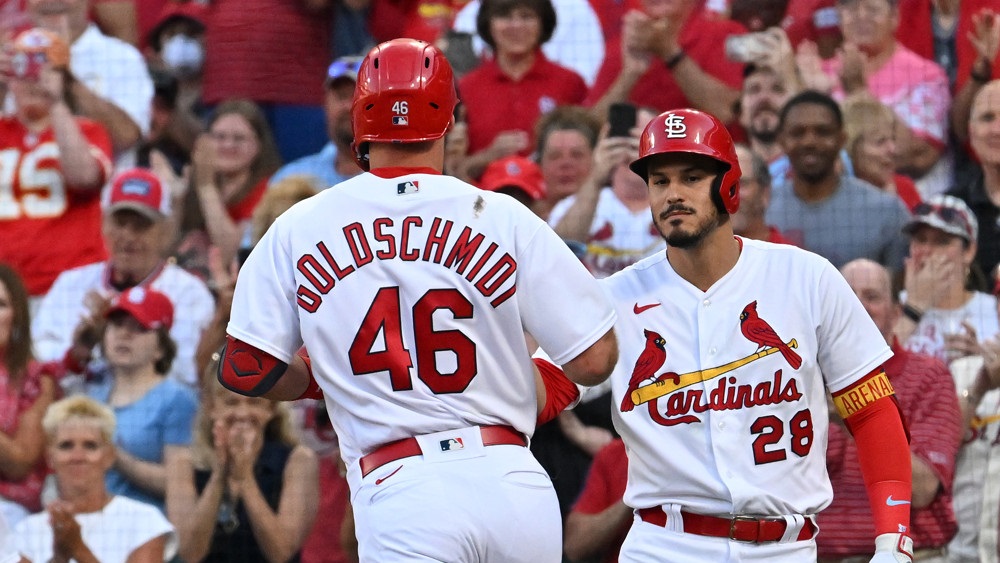
    Judge and Paul Goldschmidt are dueling for the No. 1 spot in that stat this season. Judge currently leads by one-tenth of a percentage point (82.4 to 82.3). They’ve both been amazing, but this current run by Judge has been just otherworldly. By the way, he also easily leads MLB in another Bill James-crafted stat, Win Shares, with 30.

    Admittedly Judge’s stats look a little meager compared to some of Ruth’s best seasons, and we say meager with a chuckle because Judge doesn’t look meager next to anybody.  He’s a giant among men in MLB right now. Or as the Daily News could say, he’s the sockiest socker in the game.

  • Stat of the Week: Notable Outfielders Dealt At Deadline

    Stat of the Week: Notable Outfielders Dealt At Deadline

    BY MARK SIMON

    Those who cover MLB are calling the Juan Soto trade among the biggest in baseball history, with the Padres acquiring a generational talent and sending the Nationals the top players in their farm system in return.

    And while it’s likely that Soto’s bat will have a huge impact, not just on this pennant race but on the next two, we like to look at things through a defensive lens here.

    For his career, Soto is an average defensive right fielder. It’s seemingly the only aspect of his game that could be called average. Soto has exactly 0 Runs Saved in a little more than 2,100 innings. He saved 4 runs with his right field defense last season but has dropped to -3 so far in 2022.

    The 2021 version of Soto would be about a match for the Padres’ current standing in right field (2 Runs Saved), but the 2022 version of Soto is a little bit of a drop off.

    Soto has 19 Defensive Misplays & Errors in right field in 2022, the most of anyone at the position and two more than he had in 2021. On a per-inning basis, he has the 6th-highest rate of Misplays & Errors among the 35 right fielders that have played the most innings.

    The Padres can live with that because they know that his bat will go way above and beyond in making up for it. They also landed another big bat, first baseman Josh Bell. Bell, who cost his team 25 runs with his defense from 2016 to 2019, has a career-high 3 Runs Saved there in 2022.

    Other teams made moves for outfielders from whom good defense will be essential. The Yankees traded pitcher Jordan Montgomery to the Cardinals for center fielder Harrison Bader.

    Bader just missed out on winning the Fielding Bible Award last season, after recording his second season with 15 Runs Saved in center field. He’s currently out with a foot injury and hasn’t played since late June.

    When healthy, he’ll be rejoining a team that currently ranks first in the majors in Defensive Runs Saved. It’s biggest defensive weakness? Center field (-6 Runs Saved).

    The Phillies made a move with the intention of bettering a defense that ranks tied for 27th in Runs Saved, snagging Angels outfielder Brandon Marsh. Marsh ranks second in left field with 7 Defensive Runs Saved this season.

    He’ll likely switch to center field, where his history isn’t as good (-3 Runs Saved), though he may be better than what the Phillies already have there (only two teams are worse than their -7 Runs Saved).

    A study by our former research associate Andew Kyne showed that outfielders decline by about 7 runs per 1,000 innings when moving from a corner spot to center field. Remember that when evaluating Marsh, who wasn’t the only move the Phillies made to better their defense. They also traded for Cardinals infielder Edmundo Sosa (13 Runs Saved in 737 career innings at shortstop).

    Two of the best defensive players dealt were traded in deals involving the Rays. With Kevin Kiermaier out for the season, Tampa Bay got involved in a three-way trade with the Astros and Orioles, netting center fielder Jose Siri after trading for Diamondbacks left fielder David Peralta.

    Siri ranks second in Defensive Runs Saved at that position this season and made a terrific catch in his Tampa Bay debut. Peralta won a Fielding Bible Award in 2019 but basically rates average at the position since then (-1 Run Saved from 2020 to 2022).

    With Siri’s acquisition, the Rays traded Brett Phillips to the Orioles for cash. Phillips had below-average numbers in center field in 2022 (-4 Runs Saved), but ranks tied for 3rd with 8 Runs Saved in 235 innings in right field. He has a history of defensive excellence in limited playing time and will be outfield depth for an Orioles team whose outfield has played well this season.

    Lastly, one player that wasn’t traded was versatile Marlins infielder Joey Wendle. Wendle won our Defensive Player of the Month award (determined by SIS staff voting) for July. He’d have been an interesting pickup for any number of teams looking for help. But for now, he stays with the Marlins.

    Wendle was a defensive difference maker for the 2020 Rays, helping them advance to the World Series. This October (and November) he’ll be watching players make great plays at home. Maybe even one by a player dealt at the deadline.

    For more on the trade deadline, check out the SIS Baseball Twitter.

  • Stat of the Week: Who are MLB’s top pitch framers?

    Stat of the Week: Who are MLB’s top pitch framers?

    BY MARK SIMON

    On this week’s edition of the Sports Info Solutions Baseball Podcast, we talked to Mariners catcher Cal Raleigh about the team’s success and his work behind the plate this season.

    Raleigh rates as one of the top pitch framers in MLB in 2022, so this seemed like a good time to look at the leaderboard for that stat.

    MLB’s best pitch-framer this season, in the aggregate, is Yankees catcher Jose Trevino. Trevino has an MLB-best 7 Strike Zone Runs Saved (our metric that measures how often catchers get strikes above an expected strike total, converted to a run value).

    If that number seems small relative to other seasons, that’s because it is.

    The number of catchers recording high totals in Strike Zone Runs Saved has shrunk. From 2014 to 2016, there were 12 instances of a catcher recording at least 10 Strike Zone Runs Saved. In the last three full seasons (2018, 2019, 2021) there were seven such catcher seasons.

    The only catcher to reach 10 Strike Zone Runs Saved last season was Max Stassi of the Angels.

    One thought is that the gap between catchers has shrunk. Many are now good at pitch framing and there isn’t one that rates far beyond his peers. Trevino, given how often he plays and how skilled he is, is the class of the field at the moment.

    On a per-pitch basis, Austin Barnes of the Dodgers is just about as good as Trevino. He just doesn’t play as often. Barnes has 4 Runs Saved in 288 innings this season. Trevino has 7 in 496.

    Since becoming the Dodgers’ regular backup catcher in 2017, Barnes ranks tied for fourth in Strike Zone Runs Saved despite ranking 31st in innings caught.

    Raleigh, with 4 Strike Zone Runs Saved ranks tied with Barnes and a host of other catchers for second. He’s one of the more adept catchers at framing high pitches, while still being able to stick the low ones on the bottom edge of the zone for a strike.

    “I like to get into a rhythm,” Raleigh said, explaining his technique and how he brings his glove down at or near the dirt before setting up. “I know some guys stay as still as possible. I can’t get into a rhythm that way. I’d get stuck, so I’d end up losing some strikes. My approach is to stay loose, let the ball travel as deep as I can, and then at the last second make a move to the ball and give the umpire the best viewpoint of it.”

    For all the talk about Julio Rodríguez, Raleigh’s value might go unnoticed. But Raleigh’s work behind the plate and his improvement at the plate (his .762 OPS is 230 points better than last season) are worth mentioning. The Mariners are 38-22 when Raleigh starts, 16-24 when he doesn’t.

    To learn more about our methodology for Strike Zone RunsSaved, read our award-winning paper from the 2015 Sloan Sports Conference.

    2022 MLB Strike Zone Runs Saved Leaders

    Player Team Strike Zone Runs Saved
    Jose Trevino Yankees 7
    Cal Raleigh Mariners 4
    Austin Barnes Dodgers 4
    Jonah Heim Rangers 4
    Max Stassi Angels 4
    Tomas Nido Mets 4
    Travis d’Arnaud Braves 4
    Sean Murphy Athletics 4


  • Stat of the Week: First Half Defensive Runs Saved Leaders

    Stat of the Week: First Half Defensive Runs Saved Leaders

    BY MARK SIMON

    As we get set to start the second half of the season, let’s run through the MLB leaders in Defensive Runs Saved.

    At catcher, it’s a runaway. Jose Trevino of the Yankees leads all catchers in Runs Saved by a wide margin. His 15 Runs Saved are more than double the next-closest catchers, Reese McGuire and Cal Raleigh (7). Trevino stands out because of his excellent pitch framing. He’s good at stopping the running game too.

    At first base, Christian Walker of the Diamondbacks has range for days. He’s able to get to balls in the 3-4 hole like no one else, while covering first base without issue. He’s at 13 Runs Saved. The next-closest first baseman is Vladimir Guerrero Jr. with 7.

    Tommy Edman of the Cardinals has split time between second base and shortstop. He’s been great at both spots and leads the majors in Runs Saved overall (17) and at second base (11).

    What differentiates Edman from his peers is how infrequently he makes mistakes. He has only 2 Defensive Misplays & Errors at second base. He’s the only second baseman to average less than 1 Misplay & Error per 100 innings among the 40 who have played the most innings this season.

    The Orioles have had a nice resurgence this season and shortstop Jorge Mateo deserves some credit for his great defense. He’s the Runs Saved leader at that position with 13, showing great skill in handling ground balls and line drives, particularly those hit to his right.

    Nolan Arenado’s defense at third base for the Cardinals this season looks a lot like the great defensive work he did for the Rockies. Arenado still seems to be in his defensive prime. He’s the Runs Saved leader at the position with 15, well more than the 6 he had last season.

    In left field, remember the hot start Steven Kwan of the Guardians got off to with the bat? Well, he’s pretty good with the glove too. He can catch it (9 Runs Saved for Range) and he can throw it (4 assists in left field without a cutoff man). His 10 Runs Saved as a left fielder are the most in MLB.

    Center field is going to be a tough call for Fielding Bible Awards voters down the road. Right now, the leader is Jose Siri of the Astros, who shows great athleticism on both shallow and deep balls and leads with 8 Runs Saved. A lot of other center fielders are within two runs of his total including Myles Straw, Michael A. Taylor, Michael Harris II, and Cedric Mullins.

    The first half ended with a Defensive Runs Saved tie in right field between Kyle Tucker and Hunter Renfroe, each with 10 Runs Saved. They get it done a little differently. Tucker’s been known to make impressive catches in deep right field. Renfroe has a great throwing arm. Take your pick, they’re both off to great starts.

    At pitcher, it’s the 2nd year in a row that Ranger Suarez of the Phillies has gotten it done both handling comebackers and stopping potential basestealers. He’s yet to allow a stolen base this season.

    The team leader in Defensive Runs Saved is the Yankees. This is quite a turnaround for a team that ranked 29th last season. The Bronx Bombers have become the Bronx Stoppers – remaking their infield into the best in the game at getting outs on ground balls.

  • Stat of the Week: World’s No. 1 Starting Pitcher Rankings

    Stat of the Week: World’s No. 1 Starting Pitcher Rankings

    Last night, Corbin Burnes threw 7 1/3 innings against the Giants, allowing two runs on four hits, striking out 10.

    In doing so, Burnes took over the No. 1 spot in Bill James’ World’s No. 1 Starting Pitcher Rankings.

    Burnes, the NL’s reigning Cy Young winner, has a better ERA in 2022 (2.14) than he did in 2021 (2.43), even though his peripherals are not as good (his K per 9 are down, and both his BB per 9 and HR per 9 are up). His 95 MPH cutter is one of MLB’s top run-saving pitches for the second straight season.

    You can find the current rankings for World’s No. 1 Starting Pitcher and an explanation of the methodology at Bill’s website.

    The system utilizes the Game Score stat that Bill devised in the mid 1980s and rewards consistent excellence over an extended time. It uses multiple years of pitching performance to evaluate pitchers, which explains why some pitchers having great 2022s, like Shane McClanahan of the Rays, don’t rank No. 1.

    The No. 2 pitcher, Sandy Alcantara of the Marlins, will try to re-take the lead from Burnes and hold off No. 3 pitcher, Max Scherzer of the Mets, when he pitches tonight against the Phillies.

    Alcantara leads the majors in Baseball-Reference’s Wins Above Replacement (5.0) and innings pitched (130 1/3), and he ranks second in ERA (1.73). Yet, among pitchers with at least 60 innings pitched, Alcantara ranks 59th in strikeout percentage and 52nd in percentage of swings that missed (23% – Burnes leads in this stat, 36%).

    Though Alcantara throws a fastball and changeup with average velocities of nearly 98 and 92 MPH, respectively, these are not high-end swing-and-miss pitches. He throws his 4-seamer, sinker, changeup, and slider all at similar rates, keeping hitters guessing at what will come next. His success is more about unimpressive contact than missed swings.

    Alcantara has allowed the lowest line drive rate in MLB (14%) and has the 5th-highest ground ball rate (57%). He ranks 8th in MLB’s barrel per PA, which measures how often a hitter records an optimal combination of exit velocity and launch angle. Coincidentally, his rate (3.2%) is the same as Burnes’.

    Alcantara brings two streaks into his final start before the All-Star Break – 19 straight scoreless innings and 12 consecutive starts of at least 7 innings pitched, during which his ERA is 1.24. If he continues those runs tonight, he’ll almost surely be the World’s No. 1 Pitcher heading into the All-Star Break.

  • Stat of the Week: Don’t forget Julio Rodríguez’s Defense

    Stat of the Week: Don’t forget Julio Rodríguez’s Defense

    People are wowed, and rightfully so, by 21-year-old Mariners rookie center fielder Julio Rodríguez.

    They love his power (15 home runs) and his speed (21 stolen bases), and his combination of skills is reminiscent of Mariners legend and Hall of Famer Ken Griffey Jr.

    They should also take note of his defense.

    Rodríguez has 1 Defensive Run Saved this season. Being just above average may not sound like a big deal, but it is. It’s a huge upgrade from last season, when an inexperienced Jarred Kelenic (better suited for right field) and his teammates combined to cost Seattle 16 runs with their defense in center field.

    At 6-foot-3, Rodríguez takes advantage of his long stride when closing in on deep fly balls. He ranks in the top-third of outfielders in the Statcast stat “Burst”, which measures effectiveness in breaking toward a fly ball from 1.51 to 3.0 seconds after it makes contact with the bat. He can cover 90 feet in 3.83 seconds, a time that ranks in the Top 20 in the sport.

    Rodriguez has saved 4 runs with his defense within the range component of Defensive Runs Saved, the part most connected to turning batted balls into outs.

    The key there is that Rodríguez has caught 61 of 69 balls classified by our system as deep, an 88% success rate. Kelenic caught 51 of 86, which is 59%. This is one reason why the Mariners are on pace to allow 245 doubles and triples this season, 69 fewer than last season.

    And if you’re into degree of difficulty, check out some of Rodríguez’s best work on deep balls.

    This one had a 22% catch probability.

    This one was 32%.

    And this one in front of his fan base (“The J-Rod Squad”) was 36%.

    Rodríguez is not far removed from better numbers. Of the three balls he missed on which he was most penalized, two came at Citi Field in mid-May and were ones he barely missed (one in less-than-ideal weather conditions).

    The biggest blemish on his ledger is that he’s lost two runs from his arm. Baserunners have taken an extra base against him at a 58% rate, the ninth-highest rate among 35 qualifying center fielders. He’s also yet to record an assist without the help of a cutoff man.

    The Mariners have made a big move in the standings the last couple of weeks, winning 12 of 15 games. Rodríguez’s profile is likely to be raised even more as Seattle makes a push towards making the playoffs for the first time since 2001 and ending baseball’s longest postseason drought.

  • Stat of the Week: Guardians of the Defensive Galaxy

    Stat of the Week: Guardians of the Defensive Galaxy

    BY MARK SIMON

    The Guardians are on a hot streak, with wins in 17 of 21 games entering Thursday’s matchup with the Twins.

    The Guardians were not expected to be a contender in the AL Central this season, but have proven themselves as a formidable team in the first half of the season. And one of the biggest reasons for that is their defense.

    Cleveland enters Thursday No. 2 in the majors in Defensive Runs Saved, just behind the Yankees. They are MLB’s strongest defensive team up the middle by a good margin. The Guardians have saved 24 runs with their defense at catcher, second base, shortstop and center field. The next-closest team is the Cardinals (16 Runs Saved).

    Their best infield defender this season has been Andrés Giménez, who has excelled at second base and also played a little shortstop this season. Giménez’s 9 Runs Saved are the most on the Guardians.

    Giménez and Amed Rosario were obtained from the Mets in the Francisco Lindor trade prior to last season. Rosario has stepped up his defensive game in a big way, saving 5 Runs at shortstop in 2022. Rosario had cost his teams 29 runs with his shortstop defense in the previous five seasons.

    Rosario has largely eliminated mistakes from his game. Last season, he had 34 Defensive Misplays & Errors as charted by our Video Scouts. This season, he has 8. He also has more Good Fielding Plays (7) in 52 games than he had last season (6) in 121 games.

    In the outfield, Myles Straw leads all center fielders with 8 Runs Saved. Half of those come from his outfield arm, where he’s thrown out 5 runners attempting to advance without using a cutoff man (he had only 2 such assists last season). The Guardians lead all MLB teams with 8 Outfield Arm Runs Saved this season.

    And at catcher Austin Hedges and Luke Maile have combined for 5 Runs Saved. Hedges has been his usual stellar self, with 4 Runs Saved and value added in pitch framing, pitch blocking, and defensing bunts. Hedges leads all catchers in Defensive Runs Saved over the last 6 seasons.

    Though up-the-middle play is largely responsible for the Guardians’ defensive success, players at other positions have also factored in. The most notable of those is left fielder Steven Kwan, who ranks second at the position with 7 Runs Saved.

    That the Guardians have been this good defensively this season is something of a surprise, considering that the team finished 19th in Runs Saved in 2021.

    It’s also worth noting that there’s room for growth here. Third baseman José Ramírez, who had 10 Runs Saved last season, ranks last on the team, having cost them 4 runs with his defense.

    Ramírez has more than made up for that with his bat, as he entered Thursday ranked fourth in the majors with 56 Runs Created. He’s carried his teammates on the offensive end and they’ve picked him up with their defensive play.

  • Stat of the Week: Braves Very Much In The Swing Of Things

    Stat of the Week: Braves Very Much In The Swing Of Things

    The Braves have won 14 consecutive games and the story of their winning streak is rooted in their aggressiveness.

    The Braves have been a hyperaggressive team at the plate. They rank first in swing percentage in June (swinging at 52% of pitches). They are both the No. 1 team in swinging at pitches in the strike zone and the No. 2 team in chase rate, which is the rate at which they swing at pitches out of the strike zone.

    This leads to a fascinating contrast.

    No. 1 team in chase percentage: Tigers – 30 runs scored in June

    No. 2 team in chase percentage: Braves – 101 runs scored in June

    Wherever the ball has been pitched, when the Braves have hit the ball in June, they’ve done massive damage. They’ve hit .292 and slugged .569, which rank No. 2 and No. 1 in MLB in June, respectively. In fact, the Braves’ June batting average is higher than the Tigers’ June slugging percentage (.279).

    But we’re not here to talk about the Tigers. We’re here to focus on the Braves and their amazing winning streak.

    Most of the Braves’ everyday players – Ronald Acuña Jr., Dansby Swanson, and Travis d’Arnaud among them– have been hot hitters for at least the last couple of weeks. But the most interesting player during this Braves run is their rookie center fielder, Michael Harris II. Harris is hitting .328 with an .894 OPS in 18 games and has started every game during the winning streak.

    Harris is among the Braves’ most aggressive hitters at swinging at pitches outside the strike zone (41%) and one of their least aggressive hitters at swinging at pitches in the strike zone (71%), but it’s an approach that’s working for him in the short term.

    In the long term, he’ll likely have to deal with a drop in BABIP (which currently stands at .400).

    What’s likely to become more notable about Harris in the future is his defense. Last year, he led minor league outfielders in Defensive Runs Saved. He’s MLB average thus far (0 Runs Saved) but has a couple of nifty catches under his belt.

    Harris has definitely been a spark after what was a lackluster start by the defending champs. The pendulum has now swung in a favorable direction. The bats have swung in that direction as well.

  • Stat of the Week: Adam Engel’s Amazing Home Run Robberies

    Stat of the Week: Adam Engel’s Amazing Home Run Robberies

    By MARK SIMON

    DHs aren’t carrying their weight as MLB offenses are off to a slow start. Defensive shifting is up considerably, particularly in Toronto where the Blue Jays are using them on almost every batter.

    But we’re only a week into the season. Sample sizes are so small. Let’s wait at least another week before jumping to any sort of meaningful conclusions or observations.

    And while we do that, let’s look at something fun that only SIS tracks: Home run-robbing catches

    Specifically, I want to address White Sox outfielder Adam Engel, who stole another home run on Wednesday, this one from Jesse Winker of the Mariners.

    That marked the seventh home run robbery of Engel’s career. Seven is a lot. Engel ranks sixth among active players in home run-robbing catches. And that’s particularly impressive when you look at how often he’s played compared to those who rank ahead of him in number.

    There are no cheap home run robberies in Engel’s collection, no instances of going into an outfield corner that had a short porch and just snagging the ball without too much effort. Every one of these catches has required a legitimate leap.

    Wednesday’s was arguably the easiest, as he got back to the right field wall with time to spare and timed his leap correctly in order to make the play.

    Among the other types of homer-robbing catches in his repertoire are the change-of-direction and one that showed off his NBA-calber ups. The latter came in 2018 and was his third home run robbery within a seven-day span. He’s the only player to have that many in that short a time in the 19 seasons for which we’ve tracked home run takeaways.

    In order to keep climbing up the home run robberies list, Engel needs to stay healthy and hit enough to justify his lineup spot. Staying on the field has been a challenge. Engel missed time last season due to both hamstring and shoulder injuries.

    But the offense has been there. In his first three seasons, Engel had a .601 OPS. In 2020 and 2021, that jumped to .823. He’s found something in his offensive game that has enabled him to become more than a one-note player.

  • Stat of the Week: Who could be 2022’s Defensive Runs Saved Leader

    Stat of the Week: Who could be 2022’s Defensive Runs Saved Leader

    By MARK SIMON

    Rockies infielder Ryan McMahon led the majors with 22 Defensive Runs Saved in 2021. He saved 13 runs at third base and 9 runs at second base, excelling in both spots.

    And though McMahon didn’t win either a Gold Glove or Fielding Bible Award for his efforts, there was a hearty reward waiting for him this season in a 6-year, $70 million contract from the Rockies.

    Now McMahon will be trying to do something that’s never been done since we began tracking Runs Saved in 2003 – lead the majors in that stat in consecutive seasons.

    Normally we focus on positional comparisons for Defensive Runs Saved, but the overall leader makes for some fun defense-related bragging rights.

    McMahon has the skills to repeat. He’s solid at fielding balls to both sides. He also boasts a strong list of highlight-reel plays. He ranked 2nd in Good Fielding Plays per 100 Innings at both third base and second base last season. For those unfamiliar, we track approximately 30 types of Good Fielding Plays, with examples being “Ground Ball (or Line Drive) Out” which references Web Gem-caliber plays, and “Keeping the Ball in the Infield.”

    Two players on the Twins may have something to say about McMahon’s efforts to stand atop the Runs Saved leaderboard. Shortstop Carlos Correa led the position with 20 Runs Saved last season, which ranked 3rd overall in MLB.

    We wrote about Correa’s defensive excellence earlier this winter, noting how he excels at making plays in which he leaves his feet. The key for Correa and especially for his teammate, center fielder Byron Buxton, is health. Correa missed considerable time due to injuries in each season from 2017 to 2019.

    Buxton has saved 21 Runs the last two seasons but has played in only 100 out of a possible 222 games in that time. His single-season career high is 22 Runs Saved, which he did in 2017, the only time in a seven-year career that he played in at least 100 games.

    Playing time would also be a question in considering catcher Jacob Stallings as a possible overall leader. Stallings finished with 21 Runs Saved in 2021, one run shy of the lead, and was among the top pitch blockers and pitch framers in the sport. He’ll have a new team and new pitching staff to work with as he was traded in the offseason from the Pirates to the Marlins.

    There are a good number of other players who are candidates to be the MLB Runs Saved leader, including Royals center fielder Michael A. Taylor, Cardinals center fielder Harrison Bader, Blue Jays third baseman Matt Chapman, and Pirates third baseman Ke’Bryan Hayes.

    Past leaders to consider include Yankees outfielder Joey Gallo and Cardinals third baseman Nolan Arenado, who shared the Runs Saved lead in 2020, new Tigers shortstop Javier Báez, whose 32 Runs Saved in 2019 are the most by anyone in a season within the last five seasons, and Rays center fielder Kevin Kiermaier, whose 38 in 2015 led MLB.

    And speaking of overall leads, Cubs shortstop Andrelton Simmons enters the season with 197 career Runs Saved. That’s three shy of Adrián Beltré, whose 200 are the most total Runs Saved for any player since SIS began tracking the stat in 2003. Simmons, who led MLB with a record 41 Runs Saved in 2017, had 15 Runs Saved at shortstop last season, so he may still be a contender for seasonal honors too.

    MLB Defensive Runs Saved Leaders – Last 5 Seasons

    Season Player
    2017 Andrelton Simmons
    2018 Nick Ahmed
    2019 Javier Báez
    2020 Nolan Arenado & Joey Gallo
    2021 Ryan McMahon