Tag: Defense

  • Which Teams Are Best at Drafting, Developing and Displaying DRS?

    Here at Sports Info Solutions, we have lots of data. One subset of data we have is MLB Draft data. In exploring it, it got me thinking: which teams are the best at drafting players who end up producing lots of Defensive Runs Saved for the team that drafted them?

    Here are the top five and bottom five teams since we began tracking DRS in 2003.

    TeamDRS
    Cardinals412
    Braves366
    Blue Jays294
    Red Sox293
    Giants277
    —–—–
    Rockies-58
    Tigers-61
    Phillies-77
    Yankees-122
    Pirates-182

    A lot of this checks out; the Cardinals are known for prioritizing good defense and also home-grow lots of players. On the other side of things, the Pirates have had a lot of really bad teams since 2003, and really bad teams tend to have really bad defenses.

    Now, let’s take a look at who the main contributors and culprits are for the top and bottom teams. Let’s start with the good: who’s padded that Cardinals number? Keep in mind there are plenty of other players who’ve posted a positive DRS, and also a handful whose DRS is negative.

    PlayerPosition(s)DRS
    Yadier MolinaC169
    Albert Pujols1B/3B/LF/RF119
    Brendan RyanSS/3B/2B52
    Kolten Wong2B/CF42
    Harrison BaderCF/RF27

    Just about every national broadcast–and Cardinals broadcast to boot–finds a way to talk about how good Molina’s defense is, and with good reason: he’s really good! More than any other aspect of his game, Molina’s value has come from throwing out runners on the bases, having saved 54 runs doing so. But he also excels at making Good Fielding Plays without making many Defensive Misplays or Errors (46 GFP/DME Runs Saved) and framing pitches (41 Strike Zone Runs Saved).

    Now with the Angels, Pujols is no longer the relatively fleet-of-foot multi-positional star he once was, but back in the day, he was the guy on defense. His 2007 season, in which he saved 31 runs, remains the single-season DRS zenith for a first baseman. Since DRS started in 2003, we’ll never know what Pujols’ all-over-the-diamond rookie season was like, but, for what it’s worth, most of his value came from his time at first base: he’s at -4 in left field from his time there in 2003, and at a net zero at 3B (-1 in his last season with the Cardinals, +1 in his first season with the Angels). Even without Pujols, though, the Cardinals would still be the sixth-best team; that’s how good they’ve been at drafting MLB-quality bats who can also produce positive defense.

    And now, for the not so good. Here are the five biggest culprits of the Pirates’ league-low defensive drafting.

    PlayerPosition(s)DRS
    Andrew McCutchenCF-68
    Jose Bautista3B/RF/CF-45
    Pedro Alvarez3B/1B-40
    Ryan DoumitC/RF/1B-36
    Nate McLouthCF/RF/LF-25

    McCutchen was a perfectly adequate center fielder in his first five years in the majors, with a DRS of -5; not good, but not horrible. It’s his last four years as a Pirate that really tanked his defensive value, with seasons of -13, -8, -28 and -16. He wasn’t even close to average in any direction in those last four seasons in Pittsburgh; his total Plays Saved in that time was -14 on shallow fly balls, -15 on medium fly balls, and a staggeringly low -28 on deep fly balls.

    For Bautista–the very same player who ended up slugging hundreds of memorable home runs while finding a home in right field as a Blue Jay–the main issue was in his time at third base. From 2006-07, he played about 1,300 innings at the hot corner, and combined to put up a -34 Plays Saved, including -11 on just 82 total defensive chances in 2006. His time in center field didn’t help either, where his DRS in 2006 was -10.

    Teams draft players based on not just offense, but projected defensive contribution as well, and while teams may be willing to give up a little bit on the defensive side of the ball when they have hitters as good as McCutchen, most teams can’t afford to. When looking at all 30 teams, it’s no surprise that the Cardinals are competitive just about every year, racking up homegrown DRS like nobody else. On the flip side, the teams at the bottom of the list are going to need better defense from their draftees.

  • Who are the best infielders at avoiding mistakes?

    By MARK SIMON
    A couple of weeks ago, we ran an article in The Athletic explaining our detailed scoring system for tracking Defensive Misplays and Errors. The piece focused mostly on those who were frequent mistake-makers, so we thought that we would share a look at the game’s best at avoiding defensive mistakes. We’ll do one post covering the infield and another looking at outfielders.

    For our purposes, we’ll look at extended runs of play – the referenced leaders will all be within the last four seasons entering play on April 23, and will have played at least 1,500 innings at that position.

    The leaderboard is based on video tracking that assesses Good Fielding Plays for 30 types of defensive excellence and Defensive Misplays & Errors for about 60 types of mistakes.

    First Base: The most mistake-free players here are Paul Goldschmidt of the Diamondbacks and Joe Mauer of the Twins, each of whom averages just over one Misplay & Error per 100 innings. With Goldschmidt, that’s not surprising given that he’s won three Gold Glove Awards and three Fielding Bible Awards. Mauer hasn’t won one at first base yet. But he has by far the best Good Fielding Play to Misplay & Error ratio of any first baseman.

    Second Base: Robinson Canó of the Mariners and Joe Panik of the Giants rank 1-2, each averaging just under 2 Misplays & Errors per 100 innings. Though neither ranks close to the leaders in Defensive Runs Saved at the position in that time, each plays a highly fundamentally sound brand of defense that limits miscues.

    Shortstop: The leader here is unsigned former Orioles shortstop J.J. Hardy, who was one of the game’s top infield defenders from 2012 to 2016. He averaged just under 2 Misplays & Errors per 100 innings, a hair ahead of Tigers shortstop José Iglesias. Though Andrelton Simmons dominates the shortstop position from a defensive perspective. Iglesias is better in this regard, averaging 2 Misplays & Errors per 100 Innings to Simmons’ 2.4 (which ranks fifth at the position).

    Third Base: Nationals third baseman Anthony Rendon is one of those players who is very good in many areas and avoiding mistakes is one of them. Rendon is the only player averaging fewer than 2 Misplays & Errors per 100 innings at third base. Injured Dodgers third baseman Justin Turner ranks second (2.2 Misplays & Errors per 100 innings).

    For those wondering, Nolan Arenado ranks 12th, as his style of play lends itself to an abundance of Good Fielding Plays (his 213 are 73 better than the player who ranks second) and Misplays & Errors (116 – only Todd Frazier has more with 119)

     We will look at outfielders in a future post

  • When will the phrase “hit into the shift” become outdated?

    When will the phrase “hit into the shift” become outdated?

    As a baseball fan, you hear it all the time on any MLB broadcast. As I was recently watching the Nationals play the Mets on ESPN, Curtis Granderson hit a groundball right into the heart of a “Full Ted Williams shift”, where Daniel Murphy, the second baseman playing in shallow right field, scooped it up and threw to first to record the out.

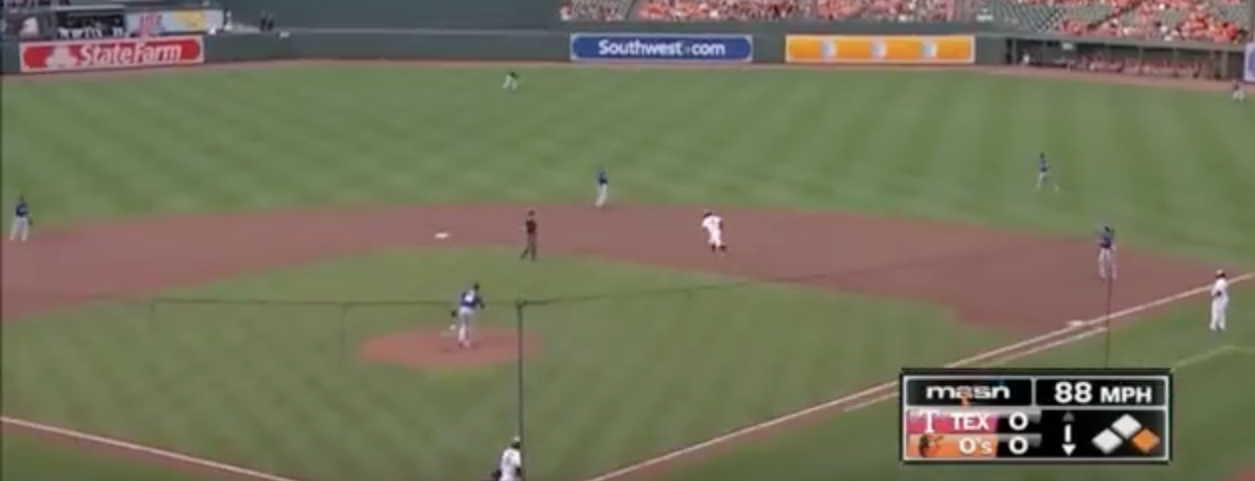
    1 - Full Ted Williams shift

    Image of a Full Ted Williams shift on the Orioles’ Chris Davis, obtained on YouTube, courtesy of Major League Baseball and MASN.

    The baseball community generally accepts when the broadcaster says the line of “he hits a groundball into the shift”, but, in reality, what was once viewed as an out-of-the-ordinary defensive alignment reserved exclusively for the big, left-handed power bats, is becoming the standard way to play defense.

    Think about it: in the NFL, the defense calls plays to prevent the offense from being successful. Teams use different formations to prevent the offense from advancing the ball. In contrast, baseball has historically deployed the same seven fielders in their seven “natural” positions. But why shouldn’t baseball feature similar advancements in defensive strategy as football? If it makes sense to move players to positions that prevent the other team from getting base hits, then baseball shouldn’t be stuck aligning players the way it did in the days of Abbott and Costello.

    2 - Abbot and Costello

    The famous Abbot and Costello “Who’s on First”

    Baseball is changing rapidly before our eyes, and before you know it, phrases like “grounding into the shift” will no longer carry meaning. The “shift” isn’t anything new; it has been around for a long time, as demonstrated in the next image of a Barry Bonds at bat in a game against the Florida Marlins on August 23rd, 1998.

    3 - Bonds shift

    Image of a Full Ted Williams shift on Barry Bonds, obtained from YouTube, courtesy of the Florida Marlins and San Francisco Giants.

    As you can see in the image above, the Marlins utilized what we now call a Full Ted Williams shift almost 20 years ago in an attempt to prevent Barry Bonds from getting a base hit through the right side of the infield. (Spoiler: He didn’t hit a groundball; he smashed his 400th career home run on a 1-1 pitch, making him the first member of the 400-HR, 400-SB club.) However, while the actual alignment isn’t anything new, the rate at which teams are shifting on players is skyrocketing, thanks in part to the great work Baseball Info Solutions (BIS) is doing.

    Look at the rapid increase in shifts on batted balls over the last five seasons:

    Season Shifts
    2011 2,350
    2012 4,577
    2013 6,682
    2014 13,299
    2015 17,744

    And this year, teams are on pace to shift over 28,000 times. Shifting is quickly becoming the rule rather than the exception. With the increase in shift pace in 2016, teams are now shifting on nearly a quarter of all groundballs.

    Season Groundballs Shifted GBs Shifted %
    2010 57,483 1,167 2%
    2011 57,706 1,149 2%
    2012 56,426 2,074 4%
    2013 53,654 2,972 6%
    2014 54,528 5,895 11%
    2015 53,310 8,093 15%
    2016 32,383 7,784 24%

    When you consider the factors, the reason why teams employ a shift is simple. If a hitter pulls the majority of his groundballs and short liners, then it makes sense to play players in accordance to the data. This works for both left-handed batters, which we have seen more commonly, but also right-handed hitters as the next image is going to show.

    4 - Right-handed batter shift

    Image of a Full Ted Williams Shift on Kris Bryant, obtained on YouTube in a game between the Milwaukee Brewers and Chicago Cubs.

    The Full Ted Williams Shift is the name for the shift when there are three players playing on one side of the infield, and for left-handed batters, you will often see the second baseman playing shallow right field. The same criteria is met for right-handed batters with the exception being the players are on the left side of the infield. These “Full Ted” Shifts are depicted in the images above.

    There are also times in which the defense adjusts where the players are positioned, but not over far enough to be considered as a Full Ted Williams Shift. We consider them to be Partial Shifts.

    5 - Partial Ted Williams shift

    Image of a Partial Ted Williams Shift. Obtained via MLBtv.

    The shift shown in the image above is on a left-handed hitter, specifically Kenny Vargas of the Minnesota Twins. Although he is left-handed, the partial shift is not limited to left-handed hitters. It is also being used increasingly for right-handed batters.

    In 2015, there were only two teams that shifted at least 1,000 times on balls in play. This year, we are on pace to see as many as nine teams utilizing the shift on balls in play at least 1,000 times.

    The top 10 teams that have shifted the most so far this year are: Astros, Rays, Brewers, Mariners, Pirates, Rockies, Angels, Yankees, Braves and Reds.

    Interestingly, the Brewers and the Mariners both saw changes at the top of their organizations. The Brewers hired David Stearns and the Mariners hired Jerry Dipoto to run their teams. Last season, the Brewers shifted 382 times on balls in play, and the Mariners 352. This season, they are both expected to shift over 1,000 times. Clearly, the new regimes decided it was best to follow the revolution that is going on in the game of baseball by shifting more.

    Teams are shifting more and more, and the data supports this claim. So what are the obstacles that are standing in the way of the the phrase “hit it into the shift” becoming non-existent?

    It could come down to the managers and coaches becoming more reliant on the data that the teams are providing. But that doesn’t mean they like it. In an article posted to ESPN.com on April 26th by Andrew Marchand, there were some interesting quotes by Yankees Manager Joe Girardi.

    “It is an illegal defense, like basketball,” said Girardi, referring to defensive three seconds in the NBA. “Guard your man, guard your spot. If I were commissioner, they would be illegal.”

    Strong comments by the Yankees manager whose team, according to the data, have shifted the 8th most times in Major League Baseball.

    “As long as it is legal, I’m going to play it,” said Girardi, whose team routinely aligns untraditionally.

    6 - Ortiz shift

    Image of a Full Ted Williams shift by the Yankees on Boston Red Sox DH David Ortiz, obatined on riveraveblues.com

    Even a gentleman who is fundamentally against the idea of the shift realizes the importance of the shift in the game. The data indicates the success of the changing of defensive alignment, and teams are using it more and more.

    There was once a time where the perception was that teams only shifted on the power-hitting left-handed hitters. That perception is now a false reality. What is true is that teams are shifting consistently more and more, regardless of the side in which the batter is standing.

    There is no longer a normal defensive alignment in baseball, and so the concept of traditional positions for infielders will soon fade. From the integration of all players to the implementation of the designated hitter, America’s pastime has always found a way to evolve into a better version of itself.  The same will happen with shifting, and, pretty soon, the remarkable event will not be the use of a shift but rather the non-use of one.

    The data is becoming stronger and stronger every season. There is an increased amount of important information that teams are gaining more access to, and it is impacting the way the game is being played. As the games are played, and the seasons go by, when will we finally feel the the phrase “hit into the shift” or “the shift is on” become outdated? Before you know it, the shifting experienced by some players will become the norm.

    Twitter: @mikechernow

  • Opening Act: Stats and scouts evaluate rookies’ defense

    Nearly a month into the MLB season, the signal in the Defensive Runs Saved data is beginning to break free of the noise. The elite defenders are steadily climbing toward the top of the leaderboards, while the less talented gloves are falling to the back of the pack. With that in mind, this seems like a good time for a (very) preliminary evaluation of this year’s crop of rookies.

    We don’t have nearly as much data to go on at the minor league level, so there is very little about a player’s defensive game we can be confident of statistically before he reaches the majors. This is where scouts come in, using their highly trained eyes to fill in the gaps in the data and providing a honed but still subjective understanding of what the player is and what he could be. With some of those rookies off to excellent starts and others struggling as they acclimate to the speed of the major league game, it’s time to compare what scouts saw from the player in the minors to what he’s shown in his small sample of chances in the majors.


    The Rookie: Chris Owings, SS, Arizona Diamondbacks

    The Scenario: Framed as the bat-first option in contrast to Didi Gregorius’ slick glove, Owings (the club’s top positional prospect) won the starting job in camp.

    The Scouts: Baseball Prospectus’ Jason Parks graded Owings out with an average glove and a plus arm, while Baseball America’s Bill Mitchell called him “an average defender at short with enough range, solid infield actions and an average arm.”

    The Numbers: Owings’ defensive numbers have outpaced the scouts lukewarm projections, as his six Runs Saved trail only Troy Tulowitzki for the lead among all infielders so far. Owings has made eight more plays than we would expect from an average shortstop, suggesting that so far, his range has surpassed the scouts’ projections of a near-neutral performance.


    The Rookie: Jackie Bradley Jr., CF/RF, Boston Red Sox

    The Scenario: Last season, Bradley won the job out of Spring Training only to lose it after a disastrous April. Jacoby Ellsbury’s departure and Shane Victorino’s early-season injury woes have forced Bradley into a key role on a club with hopes of repeating last season’s October success.

    The Scouts: Parks hung a 6+ (on the 2-8 scouting scale) on Bradley’s glove to go with a 6 arm, and Baseball America’s Alex Speier agreed that Bradley’s instincts allow him to provide plus defense in center despite lacking the elite speed generally associated with the best defenders at that position.

    The Numbers: Thus far, Bradley’s Defensive Runs Saved totals back up the scouts’ assertions, as he’s been three runs above average between center and left. Between the two positions, Bradley has accumulated seven Good Fielding Plays against five Defensive Misplays and Errors.


    The Rookie: Billy Hamilton, CF, Cincinnati Reds

    The Scenario: The undisputed fastest man in organized baseball made the switch from shortstop to center last season and will roam the outfield at the Great American Ball Park in 2014.

    The Scouts: BA’s JJ Cooper and BP’s Parks agree that Hamilton’s transition to the outfield in 2013 was a success, with Parks noting his “easy plus potential” at the position and Cooper stating that “while his jumps and routes can continue to improve, he has the speed to outrun mistakes.”

    The Numbers: Thus far, Hamilton saved one run for the Reds in center, while committing two Defensive Misplays and recording one Good Fielding Play. He still has a lot to learn about the position, so it would not be a surprise to see his Runs Saved total climb as the year goes on and he grows more comfortable in the outfield.


    The Rookie: Jose Abreu, 1B, Chicago White Sox

    The Scenario: The $68M Cuban slugger was a star in his home country and a former Serie Nacional MVP but faces a clean slate and high expectations stateside as he takes over for longtime face-of-the-franchise Paul Konerko.

    The Scouts: Largely limited to scouting Abreu based off of looks in international tournaments, scouts developed a wide range of opinions regarding his glovework. ESPN’s Keith Law suggested that without a strong commitment to conditioning, Abreu could end up at DH, while Law’s ESPN colleague Jerry Crasnick spoke to a number of scouts who suggested his size belies respectable athleticism that could make him a “solid” first baseman. BA’s John Manuel’s opinion was similar to Crasnick’s source, although he shared some of Law’s concerns, calling Abreu “an adequate defender… as long as he maintains his fitness.”

    The Numbers: Abreu has displayed below-average but not atrocious glovework, costing the South Siders three runs at first base through his first month. Six Defensive Misplays and Errors have more than neutralized the positive value provided by his nine Good Fielding Plays. However, three of those six negative plays occurred in his first five games, so it’s possible that he’s begun to adjust to the American brand of baseball after a rocky introduction to the league, at least as far as his glovework is concerned.


    The Rookie: Xander Bogaerts, SS, Boston Red Sox

    The Scenario: The Aruban phenom, a consensus top prospect in the game, was handed the reins at short after the departure of Stephen Drew.

    The Scouts: Parks grades Bogaerts as an average shortstop with a plus arm, suggesting his less-than-elite range plays up due to excellent instincts. Writing for Baseball America, Sox beat writer Alex Speier expressed confidence in Bogaerts’ performance at short despite a body much larger than the prototypical frame for the position.

    The Numbers: Bogaerts’ performance thus far has not been up to par, as the five runs he’s cost his team land him with the worst fielders in the league. However, Bogaerts’ performance is at the toughest defensive position, an excuse not available to other bottom-dwellers like Ryan Howard and Torii Hunter. While he’s generally made the plays he’s gotten to, Bogaerts’ range has been well below average among shortstops, resulting in a Plus/Minus of -5 that accounts for most of his low Runs Saved total. His outstanding bat and tremendous upside will keep him in the lineup, but if Bogaerts can’t make significant improvements to his defensive game, he could very well end up shifting to the hot corner.


    For most of these rookies, their statistical performance thus far largely mirrors previous reports from the Internet’s most respected prospect writers. For Bogaerts, who has largely underperformed the scouts’ expectations, there’s a long season ahead and still a chance to establish himself as the defensive asset he was projected to be. Each of these elite prospects has a long career ahead of them, with their defensive value a story that has just begun to be written.

  • Mark Trumbo’s Hidden Tool

    When the Diamondbacks, Angels, and White Sox agreed on a three-team deal that sent Mark Trumbo to the desert during this year’s Winter Meetings, the trade was widely panned from the Diamondbacks’ perspective. Many observers felt that the Snakes had given up too much young, controllable talent in a myopic search for power, failing to stop and consider the contributions (or lack thereof) Trumbo would make in the other phases of the game. A crux of this argument was the fact that after a breakout 2013, Paul Goldschmidt has cemented himself as one of the game’s young stars, forcing the 6’4”, 235 lb Trumbo to an outfield corner.

    While allowing Trumbo to roam the outfield may present a risk, it’s a calculated one, and it has a chance to pay off in a big way. If Trumbo can prove he has the defensive versatility to handle left field, he could become an immensely valuable piece for a team that projects to be on the fringes of the playoff picture, and there are reasons to believe he’ll thrive as a former Angel in the outfield.

    As a defender, Trumbo has taken an interesting path in his career up to this point. In 2011, his first full season in the majors, Trumbo was Los Angeles’ everyday first baseman, getting each of his 143 starts at the position. Then, in 2012, the Angels made the biggest splash of the (or nearly any) offseason in signing Albert Pujols. With the all-world first baseman locked into his former position, Trumbo was moved around the field, with manager Mike Scioscia attempting to keep his bat in the lineup by trying him at every other defensive corner. He made eight starts at the hot corner in the first month of the season before that experiment was mercifully ended. During the month of May, the Halos tried Trumbo in right, but that idea too was quickly abandoned. Finally, he was shifted across the outfield to left, where he stuck until the end of the season, making 62 starts at the position from the beginning of June on and saving the Angels an estimated seven runs according to BIS’s Defensive Runs Saved (DRS) system.

    After that relatively successful run one would think Trumbo would get an extended look at the position, but the Angels’ situation changed quickly, dictating otherwise. Kendrys Morales was shipped to Seattle, opening up the DH role for whichever one of Pujols and Trumbo wasn’t playing first at any given time. As the season went on, Pujols’ plantar fasciitis issues forced him into everyday DH duty and eventually an early end to his campaign, locking Trumbo into the 1B role. Meanwhile, J.B. Shuck and Kole Calhoun joined a crowded outfield rotation that already included Mike Trout, Josh Hamilton, and Peter Bourjos. In the end, Trumbo played just over 200 innings in the outfield last season, with over two-thirds of those coming in right.

    With a record of less than 600 innings in left, we’re clearly dealing with a small sample, but it will be fascinating to see whether Trumbo continues his pattern of outperforming the expectations dictated by his stature and foot speed in Arizona. Perhaps the most interesting facet of his left field performance is his success on deep balls. While he was slightly below average on shallow and medium-depth balls in 2012, DRS suggested that he prevented 13 extra bases on deep balls compared to an average left fielder. While he’s clearly not the quickest or most athletic player at the position, it is possible that he makes up for his lack of physical defensive tools with excellent positioning, jumps, and routes. It’s also entirely possible that his success in left is a small-sample statistical blip, and if that’s the case, he and his new employers may be in for something of a rude awakening.

    However, if Trumbo can hold his own as even an average left fielder, he could drastically alter the way he’s perceived by evaluators around the game. First basemen collectively put up a .333 Weighted On Base Average (wOBA) in 2013, putting Trumbo’s career .329 squarely in the middle of the pack. Left fielders, however, combined for just a .317 wOBA, with the more rigorous defensive requirements of the position forcing teams to sacrifice some offense for superior glovework. If Trumbo is an everyday first baseman, he’s a second-division starter. However, as a left fielder with a solid-average glove, he could be an impactful piece in the middle of a contender’s order. It will be interesting to see whether that solid-average glove materializes, but if Trumbo’s 2012 is indicative of his defensive abilities in left, his hidden tool could make him an outstanding acquisition for Kevin Towers and the D’Backs.

  • Freddie Freeman Picking Up His Teammates

    The Atlanta Braves have arguably the best defensive shortstop in all of baseball in Andrelton Simmons. The slick-fielding 23-year-old leads MLB in Defensive Runs Saved with 39 in 2013, more than double Pedro Florimon, who is second among shortstops with 18.

    However, Simmons is not the only 23-year-old in the Braves infield who is showing a knack defensively. First baseman Freddie Freeman, too, has quickly become one of the best young players at his position. Since his first full season in 2011, Freeman leads all first basemen with 230 Good Fielding Plays (GFPs).

    A cornerstone for a first baseman is his ability to handle a difficult throw from a fellow infielder. Whether you choose to call it a scoop or a pick, Freeman again is the leader. Out of his 230 GFP’s, 128 of them have been considered “handling a difficult throw,” which are throws that first hit the dirt or are wide of the bag. To put that in perspective, only five other active first baseman have more than 90 (Carlos Pena, Eric Hosmer, Paul Goldschmidt and Adrian Gonzalez).

    Over the same period, Freeman has made few negative plays. Net GFPs are accumulated by adding player errors to their defensive misplays (DM) and subtracting that number from the number of GFPs they have recorded. Freeman is second with 147 Net GFPs, behind only Goldschmidt’s 154.

    You can’t pick your teammates, but Freeman can sure pick the bad throws his teammates throw his way.
    ALL STATS AS OF August 29, 2013

  • The Best Position Player in Chicago

    It’s been a rough year for Chicago baseball fans. With disappointing seasons from the likes of Starlin Castro and Paul Konerko, plus the trades of Alfonso Soriano, Alex Rios, Jake Peavy, and Matt Garza, there have few bright spots on either side of town. In a few short weeks, Chicagoans will look back and realize that Welington Castillo might be the best player on either roster outside of All-Star victor Chris Sale.

    Welington Castillo was languishing in Iowa until August of 2012, waiting for the Geovany Soto trade to finally get his chance. He hasn’t been an offensive superstar by any means. His .265 batting average is valuable largely because he’s developed into a patient hitter with an above-average .343 on-base percentage.  While he hasn’t shown it in the majors, his minor league numbers suggest that the 26-year-old has some power in the tank. But his bat isn’t what makes him valuable to the Cubs.

    Castillo has excelled in every aspect of his defensive responsibilities this year. First of all, his ability to block pitches in the dirt is unmatched. In the eloquent words of Cubs’ skipper Dale Sveum, “There ain’t nobody better blocking the ball than he is.” The numbers back it up: Castillo has blocked 551 pitches in the dirt this year against just 28 wild pitches, a 95 percent block rate. By comparison, Indians’ catcher/first baseman Carlos Santana has allowed 42 wild pitches this year against only 255 catcher blocks (86 percent). To put it another way, Santana would have to block another 572 consecutive pitches in the dirt without allowing a single wild pitch to match Castillo’s block rate. While it’s not difficult to compare favorably to Santana defensively, BIS estimates that Castillo has saved the Cubs 10 runs on Good Fielding Plays and Defensive Misplays (carried largely by his pitch blocking). Santana, on the other hand, has cost the Indians 7.

    Additionally, there’s his control of opposing baserunners. With Castillo on the field, runners have successfully stolen 53 bases, been caught by the pitcher 5 times, and been caught by Castillo himself 19 times. Omitting pitcher caught stealing, that’s a 26 percent caught stealing rate compared to the league average of 23 percent. On top of that, Castillo has picked off four additional runners, which is more than any other catcher except Chris Iannetta. Baseball Info Solutions estimates that his control of the running game has saved the Cubs another five runs compared to an average catcher.

    All in all, Defensive Runs Saved has Welington Castillo as 18 runs better than an average catcher this season, the best mark in MLB by a full eight runs. It remains to be seen if Castillo’s play will be recognized this offseason when the hardware is passed out. While Gold Glove voters have been notoriously slow to vote for newcomers, the Fielding Bible Awards panel may be quicker to give Castillo his due. As their rebuilding efforts continue, hopefully the Cubs’ management will similarly appreciate the value their backstop provides.

    -Ben Jedlovec, Vice President–Product Development & Sales, Baseball Info Solutions