Tag: Fielding Bible Awards

  • 2025 Fielding Bible Awards Voting

    2025 Fielding Bible Awards Voting

    This post is best viewed on a desktop or laptop.

    Sports Info Solutions recently announced the winners of The Fielding Bible Awards.

    The 2025 Awards were determined by a panel of 16 voters, who ranked the top 5 players at each defensive position (including a spot for multi-position players) on a scale from 1 to 5 at the conclusion of the regular season. A first place vote gets 10 points, second place gets 4 points, third place gets 3 points, etc. Total up the points for each player, and the player with the most points wins the award. A perfect score is 80 points.

    The panel also voted its top three choices for Defensive Player of the Year, with first place getting 5 points, second place 3 points, and third place 1 point.

    Our voting panel consisted of SIS co-founder John Dewan, along with Daniel Álvarez-Montes (El Extra Base, editor/writer), Ben Clemens (FanGraphs, writer), Chris Dial (sabermetrician), Alyson Footer (MLB.com, editor), Tyler Kepner (The Athletic, writer), Bill Ladson (MLB.com, writer), Eduardo Pérez (ESPN, broadcaster), Hal Richman (Strat-O-Matic, founder), Eno Sarris (The Athletic, writer), Travis Sawchik (The Score, writer), Bobby Scales (Detroit Tigers, radio broadcaster), Joe Sheehan (Joe Sheehan’s Baseball Newsletter, writer), Mark Simon (SIS, writer), Danielle Wexelman (MLB Network Radio, broadcaster), and an aggregate vote from the SIS Baseball Operations staff.

    (scroll right, over the table to see the full list of ballots and the overall point total)

    Catcher

    Name Eduardo Perez Bobby Scales Hal Richman Danielle Wexelman Alyson Footer Joe Sheehan Daniel Álvarez-Montes Eno Sarris Travis Sawchik Chris Dial Ben Clemens Mark Simon Tyler Kepner Bill Ladson John Dewan SIS Staff TOTAL
    Patrick Bailey 1 1 1 1 1 1 1 1 1 2 1 1 1 1 1 1 79
    Alejandro Kirk 3 4 5 5 2 2 2 2 3 3 2 3 3 4 41
    Freddy Fermin 4 2 2 4 5 3 2 4 3 2 2 2 37
    Carlos Narváez 3 4 3 3 3 4 2 3 3 26
    Dillon Dingler 2 5 3 4 5 3 4 16
    Austin Hedges 2 4 2 4 5 13
    Luis Torrens 5 5 5 1 5 5 10
    Cal Raleigh 4 5 4 4 5 8
    Sean Murphy 3 5 4
    Tyler Heineman 4 2
    Yainer Diaz 4 2
    Pedro Pagés 5 1
    William Contreras 5 1

    1st Base

    Name Eduardo Perez Bobby Scales Hal Richman Danielle Wexelman Alyson Footer Joe Sheehan Daniel Álvarez-Montes Eno Sarris Travis Sawchik Chris Dial Ben Clemens Mark Simon Tyler Kepner Bill Ladson John Dewan SIS Staff TOTAL
    Matt Olson 1 1 1 1 1 1 1 1 1 1 1 1 1 1 1 1 80
    Carlos Santana 4 2 2 2 3 2 2 2 3 2 2 2 5 2 2 53
    Spencer Steer 3 3 3 5 4 5 3 5 4 3 3 3 3 5 3 5 36
    Ty France 4 2 3 3 2 4 4 4 4 3 5 3 31
    Vladimir Guerrero Jr. 2 4 3 5 4 5 5 5 2 2 4 25
    Jonathan Aranda 4 4 4 6
    Ryan O’Hearn 5 4 3
    Bryce Harper 4 2
    Christian Walker 5 1
    Michael Busch 5 1
    Rhys Hoskins 5 1
    Spencer Torkelson 5 1

    2nd Base

    Name Eduardo Perez Bobby Scales Hal Richman Danielle Wexelman Alyson Footer Joe Sheehan Daniel Álvarez-Montes Eno Sarris Travis Sawchik Chris Dial Ben Clemens Mark Simon Tyler Kepner Bill Ladson John Dewan SIS Staff TOTAL
    Nico Hoerner 1 1 1 1 1 1 1 1 1 1 1 1 1 1 1 1 80
    Andrés Giménez 3 4 2 3 2 2 3 2 3 2 4 3 3 2 3 49
    Xavier Edwards 2 2 4 5 3 4 3 2 3 3 2 2 2 4 2 47
    Marcus Semien 5 4 4 5 2 4 5 2 4 3 4 4 5 5 28
    Brice Turang 4 3 3 2 4 4 5 5 5 3 4 24
    Bryson Stott 3 5 4
    Jazz Chisholm Jr. 5 5 5 3
    Mauricio Dubon 5 4 3
    Luis Rengifo 5 5 2

    Third Base

    Name Eduardo Perez Bobby Scales Hal Richman Danielle Wexelman Alyson Footer Joe Sheehan Daniel Álvarez-Montes Eno Sarris Travis Sawchik Chris Dial Ben Clemens Mark Simon Tyler Kepner Bill Ladson John Dewan SIS Staff TOTAL
    Ke’Bryan Hayes 1 1 1 1 1 2 1 1 1 1 1 1 1 1 1 1 79
    Maikel Garcia 2 2 2 2 2 1 2 2 2 2 2 2 4 2 4 2 61
    Ryan McMahon 3 3 4 3 3 3 3 4 3 3 2 4 2 3 41
    Matt Shaw 5 3 5 5 4 4 4 3 3 5 4 21
    Matt Chapman 3 5 4 5 4 4 4 13
    Ernie Clement 5 3 3 3 5 11
    Nolan Arenado 4 4 5 5
    José Ramírez 4 5 5 4
    Ben Williamson 5 5 2
    Caleb Durbin 5 5 2
    Ramón Urias 5 1

    Shortstop

    Name Eduardo Perez Bobby Scales Hal Richman Danielle Wexelman Alyson Footer Joe Sheehan Daniel Álvarez-Montes Eno Sarris Travis Sawchik Chris Dial Ben Clemens Mark Simon Tyler Kepner Bill Ladson John Dewan SIS Staff TOTAL
    Mookie Betts 1 1 1 2 1 2 5 3 5 5 1 1 3 1 52
    Nick Allen 3 1 3 5 2 3 1 2 3 1 2 2 44
    Bobby Witt Jr. 4 4 1 3 1 1 1 1 4 34
    Taylor Walls 5 4 3 4 2 2 2 3 1 3 31
    Zach Neto 2 2 2 4 5 5 4 4 5 21
    Corey Seager 5 3 2 3 4 2 4 19
    Masyn Winn 2 4 4 2 3 3 18
    Dansby Swanson 5 5 3 5 5 5 8
    Jeremy Peña 3 4 4 7
    Geraldo Perdomo 4 5 3
    Joey Ortiz 4 2
    Otto Lopez 5 1

    Left Field

    Name Eduardo Perez Bobby Scales Hal Richman Danielle Wexelman Alyson Footer Joe Sheehan Daniel Álvarez-Montes Eno Sarris Travis Sawchik Chris Dial Ben Clemens Mark Simon Tyler Kepner Bill Ladson John Dewan SIS Staff TOTAL
    Steven Kwan 1 1 1 1 1 1 1 1 1 1 1 1 1 1 1 1 80
    Wyatt Langford 2 3 4 2 4 2 2 4 3 3 4 2 2 41
    Ian Happ 4 4 3 3 2 4 2 5 4 3 5 4 2 3 3 4 41
    Jarren Duran 2 5 2 3 3 3 2 3 2 4 3 34
    Tyler Soderstrom 3 5 4 5 5 4 2 4 5 5 5 5 20
    Cody Bellinger 5 2 5 3 5 2 14
    Isaac Collins 5 3 4
    Brandon Nimmo 4 5 5 4
    Tommy Pham 4 2

    Center Field

    Name Eduardo Perez Bobby Scales Hal Richman Danielle Wexelman Alyson Footer Joe Sheehan Daniel Álvarez-Montes Eno Sarris Travis Sawchik Chris Dial Ben Clemens Mark Simon Tyler Kepner Bill Ladson John Dewan SIS Staff TOTAL
    Ceddanne Rafaela 1 1 1 1 2 2 1 2 1 1 1 1 1 3 1 1 75
    Pete Crow-Armstrong 2 2 2 2 1 1 2 1 2 2 2 2 2 4 2 2 65
    Jacob Young 4 3 3 3 4 3 3 4 3 5 3 1 5 3 37
    Victor Scott II 3 5 4 3 5 4 4 5 3 5 2 5 24
    Julio Rodríguez 5 5 5 4 3 5 3 4 4 4 18
    Myles Straw 3 5 4 4 8
    Daulton Varsho 5 4 3 6
    Kyle Isbel 4 5 5 4
    Denzel Clarke 4 2
    Tyrone Taylor 5 1

    Right Field

    Name Eduardo Perez Bobby Scales Hal Richman Danielle Wexelman Alyson Footer Joe Sheehan Daniel Álvarez-Montes Eno Sarris Travis Sawchik Chris Dial Ben Clemens Mark Simon Tyler Kepner Bill Ladson John Dewan SIS Staff TOTAL
    Fernando Tatis Jr. 1 1 2 2 1 1 1 1 1 1 4 2 1 1 2 68
    Wilyer Abreu 2 3 1 2 2 2 1 2 2 2 1 4 2 1 57
    Adolis García 3 2 4 1 2 5 5 3 1 4 2 3 3 40
    Sal Frelick 5 4 3 4 4 3 3 3 4 3 4 3 5 4 4 34
    Corbin Carroll 5 5 3 4 4 4 5 4 3 5 18
    Cam Smith 4 5 3 5 5 5 3 3 5 5 17
    Ronald Acuña Jr. 2 4
    Aaron Judge 5 1
    Nathan Lukes 5 1

    Pitcher

    Name Eduardo Perez Bobby Scales Hal Richman Danielle Wexelman Alyson Footer Joe Sheehan Daniel Álvarez-Montes Eno Sarris Travis Sawchik Chris Dial Ben Clemens Mark Simon Tyler Kepner Bill Ladson John Dewan SIS Staff TOTAL
    Max Fried 1 1 1 1 2 1 1 2 1 1 1 1 1 1 4 1 75
    Logan Webb 2 5 2 1 5 2 1 2 2 3 2 2 2 2 51
    Matthew Boyd 5 3 3 4 3 3 5 2 3 3 3 5 3 33
    Luis Severino 2 4 4 3 4 4 3 5 5 4 1 5 28
    Spencer Schwellenbach 4 3 5 5 5 4 3 4 15
    David Peterson 3 4 5 5 4 2 13
    Seth Lugo 2 5 5
    Zack Wheeler 3 4 5
    Ranger Suárez 2 4
    Zac Gallen 3 3
    Bryan Woo 4 2
    Clay Holmes 4 2
    José Soriano 4 2
    Colin Rea 5 1
    Michael Wacha 5 1

    Multi-Position

    Name Eduardo Perez Bobby Scales Hal Richman Danielle Wexelman Alyson Footer Joe Sheehan Daniel Álvarez-Montes Eno Sarris Travis Sawchik Chris Dial Ben Clemens Mark Simon Tyler Kepner Bill Ladson John Dewan SIS Staff TOTAL
    Ernie Clement 3 2 2 1 1 1 1 1 1 1 1 1 1 1 66
    Mauricio Dubon 1 5 1 4 3 3 2 2 4 2 2 2 2 3 48
    Ceddanne Rafaela 3 4 3 1 2 2 3 2 28
    José Caballero 3 4 4 5 3 2 4 5 18
    Cody Bellinger 4 2 2 5 5 1 17
    Javier Baez 2 1 4 3 3 17
    Myles Straw 3 2 3 5 5 5 4 15
    Daniel Schneemann 5 4 4 5
    Nathan Lukes 5 3 4
    Zach McKinstry 5 3 4
    Javier Sanoja 5 5 4 4
    Chase Meidroth 3 3
    Miguel Rojas 5 4 3
    Adam Frazier 4 2
    Brooks Lee 4 2
    Isiah Kiner-Falefa 4 2
    Andy Pages 5 1
    Michael A. Taylor 5 1

    Player of the Year

    Name Eduardo Perez Bobby Scales Hal Richman danielle wexelman Alyson Footer Joe Sheehan Daniel Álvarez-Montes Eno Sarris Travis Sawchik Chris Dial Ben Clemens Mark Simon Tyler Kepner Bill Ladson John Dewan SIS Staff TOTAL
    Patrick Bailey 2 3 3 3 3 1 1 1 1 2 2 2 36
    Steven Kwan 1 1 1 2 2 3 3 2 1 3 32
    Ceddanne Rafaela 2 2 2 2 3 2 1 1 1 31
    KeBryan Hayes 1 1 2 3 14
    Ernie Clement 3 2 3 3 1 2 14
    Pete Crow Armstrong 1 2 8
    Fernando Tatis Jr 3 1 6
    Bobby Witt Jr 3 1
    Mookie Betts 3 1
    Matt Olson 3 1

    Team

    Name Eduardo Perez Bobby Scales Hal Richman Danielle Wexelman Alyson Footer Joe Sheehan Daniel Álvarez-Montes Eno Sarris Travis Sawchik Chris Dial Ben Clemens Mark Simon Tyler Kepner Bill Ladson John Dewan SIS Staff TOTAL
    Chicago Cubs 1 2 1 1 2 1 2 2 2 1 3 2 2 1 1 1 62
    Toronto Blue Jays 2 3 3 2 1 2 1 1 3 1 3 1 3 3 40
    Texas Rangers 1 2 1 2 1 3 2 2 28
    Los Angeles Dodgers 3 3 2 3 6
    Milwaukee Brewers 3 3 3 2 6
    Cleveland Guardians 3 1
    Houston Astros 3 1
  • 2024 NPB Fielding Bible Awards

    2024 NPB Fielding Bible Awards

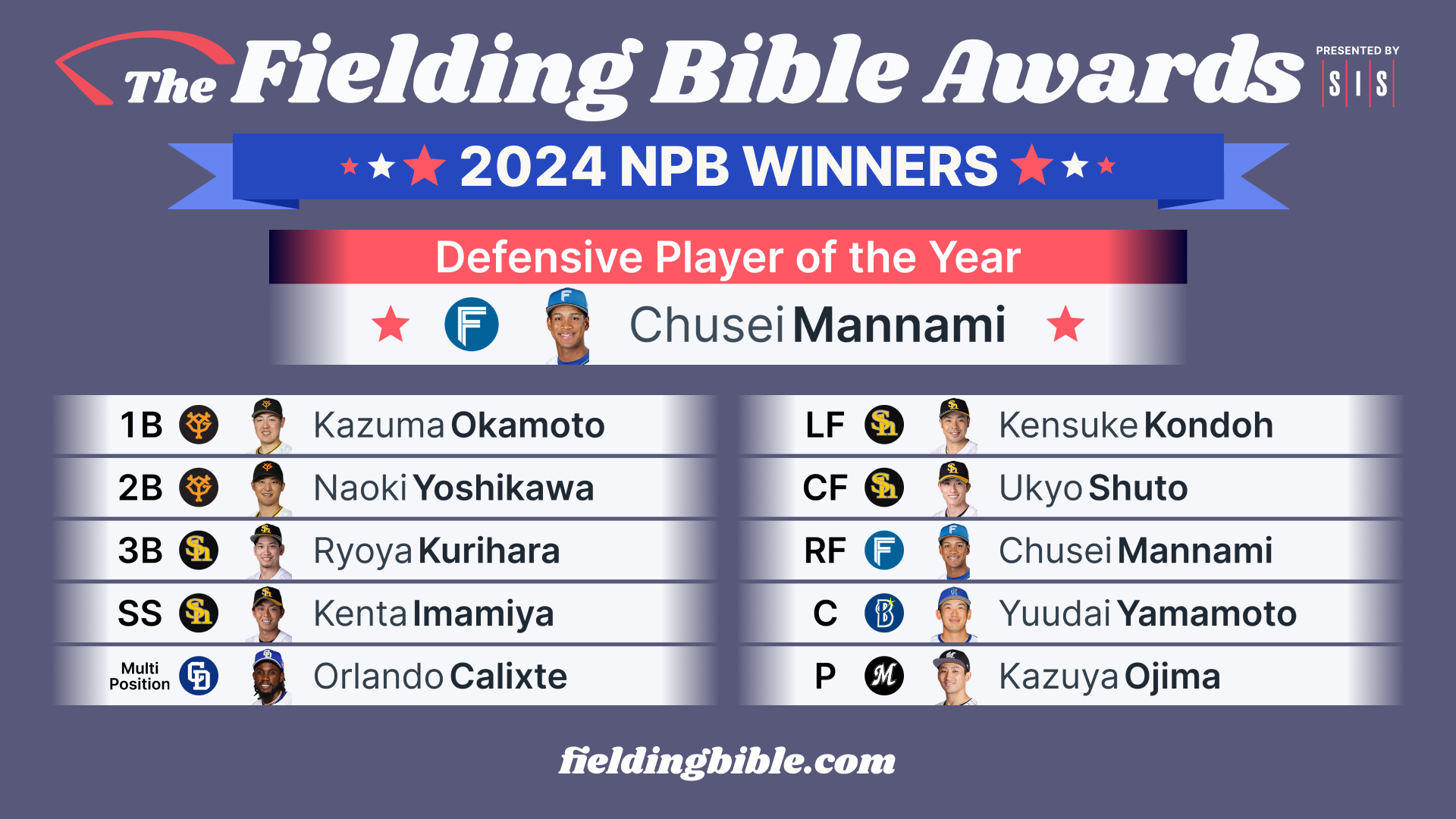
    SIS is pleased to announce the winners of the 2024 NPB Fielding Bible Awards.

    This marks the 5th season that we have honored the best defensive players in NPB. The awards are chosen by a panel of experts who consider statistical analysis, the eye test, and any other factors that they wish to utilize.

    We are also announcing the winner of the NPB Defensive Player of the Year award.

    This year’s winners are:

    Position Name Team
    Player of the Year Chusei Mannami Nippon-Ham
    1B Kazuma Okamoto Yomiuri
    2B Naoki Yoshikawa Yomiuri
    3B Ryoya Kurihara Softbank
    SS Kenta Imamiya Softbank
    LF Kensuke Kondoh Softbank
    CF Ukyo Shuto Softbank
    RF Chusei Mannami Nippon-Ham
    C Yuudai Yamamoto Yokohama
    P Kazuya Ojima Chiba Lotte
    Multi-Position Orlando Calixte Chunichi

    Defensive Player of the Year

    Nippon-Ham Fighters right fielder Chusei Mannami won the Defensive Player of the Year award for the second consecutive year. As good as Mannami was in 2023, he was even better in 2024.

    He improved upon his already amazing 12 Outfield Arm Runs Saved in 2023 by totaling an NPB-best 18 in 2024. He had 8 assists that did not involve the use of a cutoff man. Only one other NPB right fielder had even half that many. And only 29% of runners took an extra base on balls he fielded (NPB average is 38%). Mannami’s presence was felt daily. He played in 136 out of 143 regular season games.

    “The numbers and the eye test, he’s the whole package,” said Awards voter John E. Gibson of the Japan Baseball Weekly Podcast. “His cannon arm rivals that of Ichiro Suzuki and Yoenis Céspedes.”

    Added voter Yuri Kurasawa, who runs a popular YouTube and Twitter (X) account covering Japanese baseball: “He runs good routes and doesn’t let balls get behind him. And if a ball hits the wall, he has a Mookie Betts-ness to him in that he can field the carom off the wall and throw the ball right back in to hold baserunners.”

    Other winners

    The Softbank Hawks had four Fielding Bible Award winners – third baseman Yuri Kurihara, shortstop Kenta Imamiya, left fielder Kensuke Kondoh, and center fielder Ukyo Shuto.

    Softbank led NPB in Defensive Runs Saved, our stat measuring overall defensive value. Imamiya, Kondoh and Kurihara all led at their respective positions.

    The Yomiuri Giants, who led the Central League in Defensive Runs Saved, had two winners – first baseman Kazuma Okamoto and second baseman Naoki Yoshikawa.

    The Yokohama Bay Stars (catcher Yuudai Yamamoto), Chiba Lotte Marines (pitcher Kazuya Ojima) and Chunichi Dragons (multi-position Orlando Calixte) had one winner each. Calixte, whose MLB career spanned 31 games over two seasons with the Royals and Giants in 2015 and 2017, played at least 15 games at first base, third base, center field, and left field this season.

    Kondoh and Yoshikawa each also won a Fielding Bible Award in 2023. Shuto also won once before, taking the multi-position Award in 2020.

    Our expert panel consisted of NPB media: Jim Allen (Japan Baseball Weekly), John E. Gibson (Japan Baseball Weekly), and Yuri Karasawa (Yakyu Cosmopolitan), with oversight from Mark Simon, editorial lead at Sports Info Solutions.

    “We are honored to once again reward the best defensive players in NPB,” Simon said. “Defensive excellence is a foundational component of success in baseball worldwide and we can use both our metrics and the eye test to assess it in a way that wasn’t possible just a few years ago.”

    The NPB Fielding Bible Awards have been presented by SIS since 2020. SIS’ mission is to enhance and optimize the decision-making process for sports teams, sportsbooks, and sports fans. It has been an industry leader in baseball since its founding in 2002.

  • 2023 Fielding Bible Awards Voting

    2023 Fielding Bible Awards Voting

    Below we show the final point tally for The Fielding Bible Awards in the 2023 season. We asked a panel of experts to complete a 10-man ballot ranking players from 1 to 10 based on their defensive abilities. We show the ranks in the tables below. We then awarded 10 points for a first place vote, 9 for second, etc., down to 1 point for 10th place. We cover all nine positions, looking at only their fielding work for the 2023 season. Position players are eligible if they played at least 600 innings while catchers require a minimum of 500 innings. Either can qualify with 10 Runs Saved, as well. Pitchers require a minimum of 120 innings pitched or 5 Runs Saved. 

    In 2014, we introduced a Multi-Position Award for fielders who are excellent defensive players but do not call any one position their home. Eligible players include those who exhibit a high degree of positional versatility and value; players who usually play many positions over the course of the season, might move from position to position within a game, and have demonstrated the ability to handle high leverage positions when the team needs him to.

    In 2023, we added an award for Defensive Player of the Year. All players eligible for a Fielding Bible Award can be voted on for this award. All voters ranked players from 1 to 3, with 5 points for a first place vote, 3 for a second place vote, and 1 for a third place vote.

    Voters were Alyson Footer (MLB.com), Bill James, Bill Ladson (MLB.com), Bobby Scales (SIS), Chris Dial, Dani Wexelman (MLB Network Radio), Daniel Alvarez-Montes (El Extra Base), Eduardo Perez (ESPN), Hal Richman (Strat-O-Matic), Joe Sheehan, John Dewan, Mark Simon (SIS), Peter Gammons, Travis Sawchik (The Score), Tyler Kepner (The Athletic), and the Sports Info Solutions Video Scouts.

  • 2022 Fielding Bible Awards Preview (Part 1)

    2022 Fielding Bible Awards Preview (Part 1)

    For the next two weeks, this space will feature a two-part series on the top candidates for The Fielding Bible Awards, which will be announced later this month.

    The Fielding Bible Awards are voted on by a panel of experts who can vote based on whatever criteria they choose, including observation and subjective judgement, as well as statistical analysis. Each position has one overall winner, different from the Gold Gloves, which has one in each league.

    This week, Part I of our preview looks at catchers and infielders.

    (Defensive Runs Saved totals in parentheses)

    Catcher

    Fielding Bible Favorites: Jose Trevino (21), Adley Rutschman (18)

    NL Gold Glove Favorite: J.T. Realmuto (11); AL Favorite: Trevino 

    Other Top Contenders: NL: Yadier Molina (9), Tomás Nido (8); AL: Cal Raleigh (14), Christian Vazquez (11)

    Trevino was obtained by the Yankees just before the season started and was one of the primary reasons the Yankees posted the most Defensive Runs Saved in the 20-year history of the stat. He led all catchers in our pitch framing stat, Strike Zone Runs Saved, and was also among the leaders in Stolen Base Runs Saved. Rutschman, recalled in May for his MLB debut, kept pace with Trevino and starred as both pitch framer and pitch blocker.

    First Baseman

    Fielding Bible Award Favorite: Christian Walker (17)

    NL Gold Glove Favorite: Walker; AL Favorite: Vladimir Guerrero Jr. (3)

    Other Top Contenders: NL: Matt Olson (6);  AL: Ty France (2)

    Walker ran away with the Defensive Runs Saved lead at first base, as he was 11 runs better than the next-closest first baseman. What separated Walker from his peers was how good he was on balls hit to his right. He was the only first baseman to convert more than 50% of opportunities on those balls into outs (minimum 50 plays with a >0% out probability). The AL Gold Glove is very much up for grabs. A much-improved Guerrero Jr. may have the inside track.

    Second Baseman

    Fielding Bible Award Favorites: Brendan Rodgers (22), Andrés Giménez (16)

    NL Gold Glove Favorite: Rodgers; AL Favorite: Giménez

    Other Top Contenders NL: Gavin Lux (3), Jeff McNeil (3); AL: Marcus Semien (11), Gleyber Torres (9), Jonathan Schoop (8)

    Rodgers made his way to the top of the Runs Saved leaderboard at second base with an aggressive style. He led all second base in diving plays with 19, using them to extend his range and make near-impossible plays possible. Giménez is a formidable foe on the Fielding Bible Awards ballot. His 10 sliding plays ranked second among all second basemen. His 8 jumping plays tied for the MLB lead there.

    For those wondering about Tommy Edman, he qualified as a shortstop this season by way of his number of innings played there. Edman would have been a strong contender at second base if he were eligible. Look for more on him next week when we preview the multi-position award.

    Shortstop

    Fielding Bible Award Favorites: Jeremy Peña (16), Miguel Rojas (15)

    NL Gold Glove Favorite: Rojas; AL Favorite: Peña

    Other Top Contenders: NL: Nico Hoerner (10), Ha-Seong Kim (10), Willy Adames (9), Dansby Swanson (9); AL: Jorge Mateo (14), Andrew Velazquez (11)

    This is a very crowded field without a large statistical gap between the top candidates. Peña, a rookie, had little trouble replacing Fielding Bible Award winner Carlos Correa at shortstop in 2022. He led all shortstops in the range and double play components of Runs Saved.

    Rojas passed the statistical test and the eye test. He led all shortstops with 30 Good Fielding Plays and was one run shy of the shortstop lead in Runs Saved.

    Third Baseman

    Fielding Bible Award Favorites: Ke’Bryan Hayes (24), Nolan Arenado (19), Ramón Urías (14)

    NL Gold Glove Favorites: Hayes, Arenado; AL Favorite: Urías

    Other Top Contenders: NL: Ryan McMahon (10); AL: Josh Donaldson (7)

    Hayes has shown himself worthy of a second straight Fielding Bible Award. Hayes’ 24 Runs Saved were the most total Runs Saved for any player in 2022. In 2021, Hayes excelled on balls hit to his left. In 2022, it was the other direction, as he converted 75% of opportunities on balls hit to his right into outs, against an expected out rate of 62%.


    Arenado, who has won four Fielding Bible Awards, is the one player who could prevent Hayes from taking a second straight. His 19 Runs Saved were a 13-run improvement from 2021.


    Next week’s Stat of the Week will preview outfielders, pitchers, and the multi-position award.

  • Going Deeper: How Brandon Crawford won a Gold Glove in 2021

    Going Deeper: How Brandon Crawford won a Gold Glove in 2021

    By MARK SIMON

    Giants shortstop Brandon Crawford won his fourth career Gold Glove Award last week and while he might not have had the best defensive statline among the NL finalists, we’ll say that it was a deserved honor.

    Crawford had a great season at the plate and a very good one in the field for a division-winning team. He’s going to finish strongly in the MVP voting on Thursday.

    I was on the conference call that Crawford did with the media the night he won and I was amused because there was a Michael Jordan touch of “And I took that personally” to some of his comments.

    Crawford first said that winning this Gold Glove felt better than his previous three, saying that he was “kind of being told by everyone basically that my defense is falling off, that I’m not the same guy anymore, that I’m getting old, that kind of stuff.”

    He then later added “I don’t think in 2019 that I became some kind of terrible defender, even though the analytics didn’t like me.”

    Reading between the lines here, it sounds like Crawford’s awareness of stats like his -10 Defensive Runs Saved from 2019 (only one shortstop rated worse) or similar numbers from other sources were at least a little bit of a motivating force for him these last two seasons.

    I think that’s pretty cool.

    I’m sure plenty of hitters are motivated by numbers in their batting statline. I think it’s good to see them motivated by their fielding numbers too.

    Feeling Fitter

    In acknowledging what made him a better defender in 2021 than past years, Crawford pointed out that he put less wear-and-tear on his body.

    The numbers bear that out.

    Our Video Scouts track how often a player slides, dives, and jumps. This data actually gets factored into our proprietary injury prediction model. We’ve determined that players who slide, dive, and jump more often have a higher risk of getting injured.

    Makes sense, right?

    Crawford did go all out for plays less often than he did two seasons ago in a similar number of innings.

    Crawford’s slides, dives, jumps
    2019 63 instances
    2021 45 instances

    So having a little bit of a healthier body could have played some part in the improvement.

    But I wanted to see what was tangibly better about Crawford in 2021, particularly as it applied to his range and throwing. He went from -8 Runs Saved in those areas in 2019 to +7 Runs Saved in 2021.

    One thing that Crawford referenced was that he took fewer risks on throws. I couldn’t find anything to bear this out within the throwing component of his Runs Saved total, though he did have six throwing Defensive Misplays or Errors in 2019 compared to just two in 2021, so there appears to be some truth to that.

    But by our measures, 2021 was all about Crawford’s range being considerably better than 2019 and something more resembling his prime years.

    Range Review

    One thing SIS can do is tally out conversion rates for players based on where batted balls are hit.

    Here are Crawford’s from 2019 and 2021:

    How Often Did Brandon Crawford Convert An Out On Balls Hit …

    Season To His Left Straight-On To His Right
    2019 57% 90% 55%
    2021 61% 92% 54%

    The improvements are as high as 4% on balls hit to his left, with a 1% drop on balls hit to his right.

    Those numbers sound small, so let’s give a little context around them.

    In terms of actual plays made, the difference between 2019 and 2021 on balls hit to his left is notable because shortstops make plays on balls hit to their left most often.

    Had Crawford fielded the 251 balls hit to his left with the same out rate as he had in 2019, he would have turned 10 fewer batted balls into outs.

    That’s a considerable number, especially when you think of it like you’d think of a hitter.

    Imagine being a hitter who went 80-for-250. That’s a .320 batting average.

    Now imagine that hitter going 70-for-250. That’s a .280 batting average.

    The differences on straight-on balls and balls hit to his right are less stark. The +2% and -1% gaps don’t have the same impact, both because they’re smaller percentages and because there are fewer opportunities on those balls.

    So we’ve ascertained that Crawford being better to his left was key to his Runs Saved improvement.

    We should note that he improved to a similar out rate on balls to his left in the smaller sample of the 2020 season…so this was about making an improvement and maintaining it for a 162-game season.

    But why would he be better to his left?

    In 2020 the Giants brought in a largely new coaching staff, with Gabe Kapler replacing Bruce Bochy as manager. And we talked with bench coach Kai Correa, who works with infielders, on The SIS Baseball Podcast in April.

    Citing Evan Longoria as an example, Correa said that as infielders aged, it was up to coaches to provide ways to adapt to their lessened foot speed and arm strength. Options to do so are presented to the player like a menu of suggestions to give the player ownership in the process.

    In Crawford’s case, we’re guessing the option he chose involved something that moved him back a step or two, to give him more time to react to a hard-hit ground ball.

    We say that because these are the average Statcast fielder depths for Crawford.

      From Home Plate
    2019 147 Feet
    2021 149 Feet

    The couple-feet differential in average depth was consistent whether the Giants were shifting or not.

    Also, when Kapler was hired as Giants manager, one of the points he made to Andrew Baggarly of The Athletic about Crawford was that he needed to be “more consistent in his pre-pitch routine.”

    That took a little more digging and some hunting through camera angles that showed those moments. It’s video we can’t share here, though I’ll try to describe it. The contrast between 2019 and 2021 was in Crawford’s movement as the pitcher was about to make his pitch.

    It wasn’t as dramatic as the crow hop that Kevin Newman of the Pirates used but more of what was described in Baggarly’s article–a slight adjustment in positioning followed by his coming set in a centered position.

    He also moved slightly in one direction, which allowed him to move more quickly in the opposite direction (I highly recommend the article linked two paragraphs up to learn more about this). As a result, Crawford was less likely to be caught flat-footed, as he sometimes was in 2019.

    The last aspect of this was that the Giants defensive positioning was on-point in 2021, particularly in defensive shifts. They led the majors in our Shift Positioning Runs Saved stat. The good positioning likely made for easier balls to handle AND less need to slide, dive, and jump.

    Film Review

    So what does the difference in Crawford 2019 and Crawford 2021 look like on film?

    Let’s see if we can sum it up in two sets of plays.

    Here’s one from 2021 that he made:

    It best shows the benefit of playing a little deeper, as Crawford was at 152 feet, three feet deeper than average, with Anthony Rizzo at-bat.

    This is a play worth about 0.6 runs because our out probability for it is only 20%.

    It’s very difficult to find plays that are identical, but let’s contrast that with this one:

    This play had an out probability over 90%–and we’re making an educated guess that a lot of those outs came on plays where the fielder was positioned a little deeper (our positioning model accounts for lateral position, not depth). On this play, Crawford was positioned a full ten feet shallower than his average in 2021.

    And then let’s look at two balls with a lot of zip on them to illustrate the difference in how he reacted to balls.

    Here’s one he made in 2021, again worth 0.6 runs.

    And here’s one he missed from 2019, for which he was dinged the same 0.6 runs.

    And here’s a chart to go with it — showing how much better Crawford was in 2021 on hard-hit balls. It’s not close.

    Brandon Crawford On Hard-Hit Balls

    (In All Directions)


    Plays Made – Opportunities Out Conversion Rate +/- vs Expected Plays Made
    2019 63-134 47% 11 plays below expected
    2021 67-125 54% 6 plays above expected

    In summary:

    Crawford and the Giants did a good job in working together to address the issues that came up as Crawford aged. They identified a weakness and turned into something closer to a strength. And data appears to have played a role in helping out.

    Though Crawford has been quoted as saying that he’s not out to improve his defensive metrics, he just concerns himself with winning games, given the Giants’ success, it’s fair to say that the two go hand-in-hand here, no?


  • The 2021 Fielding Bible Award Winners

    The 2021 Fielding Bible Award Winners

    SIS is pleased to announce the winners of the 2021 Fielding Bible Awards. This marks the 16th season that we have honored the best defensive players in MLB. The awards are voted on by a panel of experts who consider statistical analysis, the eye test, and any other factors that they wish to consider.

    This year’s winners are:

    Position Name Team
    1B Paul Goldschmidt Cardinals
    2B Whit Merrifield Royals
    SS Carlos Correa Astros
    3B Ke’Bryan Hayes Pirates
    LF Tyler O’Neill Cardinals
    CF Michael A. Taylor Royals
    RF Aaron Judge Yankees
    C Jacob Stallings Pirates
    P Dallas Keuchel White Sox
    Multi-Position Kiké Hernández Red Sox


    Paul Goldschmidt was the anchor of the infield, as he won his fourth Fielding Bible Award. Only Albert Pujols (5) has more. Goldschmidt finished tied for the MLB lead in Defensive Runs Saved at the position.

    The Cardinals infield led MLB at turning ground balls and bunts into outs, both because Goldschmidt could make plays and because he helped his teammates make plays by catching their throws.

    Whit Merrifield won a close vote, edging out Marcus Semien of the Blue Jays to win his first Fielding Bible Award. He ended a three-year run at second base by Kolten Wong. After playing a considerable amount of center field in 2019 and 2020, Merrifield was basically the Royals’ everyday second baseman in 2021 (save for a few cameos in the outfield).

    Everyday is the optimal word for Merrifield, who has played in every game the Royals have played the last three seasons. Merrifield’s MLB-leading 14 Runs Saved were 11 more than his previous high at second base. He led all second basemen in Good Fielding Plays and in double plays turned.

    Carlos Correa won his first Fielding Bible Award, with a breakthrough season in which his 20 Defensive Runs Saved at shortstop were five more than the next-closest player. Correa ranked third in Good Fielding Plays per 1,000 innings and had the fourth-fewest Defensive Misplays & Errors per 1,000 innings.

    Over the last three seasons, he has the second-highest rate of Good Plays and the second-lowest rate of Misplays & Errors. Correa is the second Astros player to win this award at shortstop, joining Adam Everett, who won in 2006, our first year of voting.

    Ke’Bryan Hayes dethroned Matt Chapman and Nolan Arenado as Fielding Bible Award winners to win for the first time. It was the first not won there by those two other guys since Josh Donaldson won in 2014.

    Hayes ranked first in Defensive Runs Saved at third base while ranking 17th in innings played. He finished with a three-run lead in DRS, which probably would have been more had he not been injured earlier in the season. But when he was on the field, he wowed. And now he’s the new standard setter.

    Tyler O’Neill became the first repeat winner in left field since Starling Marte in 2015 and 2016. O’Neill received the highest vote total of any player, with 14 of a possible 17 first place votes. O’Neill was the only left fielder to reach double figures in Defensive Runs Saved and had the best combination of Range Runs Saved (tied for first) and Outfield Arm Runs Saved (tied for second).

    O’Neill’s arm numbers improved considerably. He had seven assists without the aid of a cutoff man in 2021 (tied with Raimel Tapia for the most at the position) after having none in left field in 2020.

    Michael A. Taylor went 3-for-5 with a home run and two outfield assists in his Royals debut on Opening Day against the Rangers. That game didn’t set a tone for his season as a hitter, but it did set one for his season as a fielder. Taylor led all center fielders with 19 Defensive Runs Saved and he edged out Harrison Bader by one point in the voting to win his first Fielding Bible Award.

    Taylor was rewarded for having the second-best Range Runs Saved as a center fielder and the second-best Outfield Arm Runs Saved. His eight assists without the help of a cutoff man were the most at the position.

    Aaron Judge is best known for his bat, but he’s an excellent defender too. He won his first Fielding Bible Award in an interesting way, as he edged out his teammate, Joey Gallo, in a tight vote (Gallo did his work in right field for the Rangers). Judge’s defensive strength in 2021 was the deterrent value of his arm. His 5 Outfield Arm Runs Saved tied for second most by a right fielder.

    Judge also tied for the MLB lead with two home run–robbing catches and had a third robbery where he didn’t catch the ball but got his glove on it to turn a would-be home run into a triple. Our record-keeping is sophisticated enough to reward Judge for that play. Little things like that helped him win the award.

    Jacob Stallings ended the two-year run of Roberto Pérez of the Indians with a dominant defensive season and his first Fielding Bible Award. Stallings’ 21 Defensive Runs Saved were nine better than second place Austin Hedges. Stallings’ nine-run margin was the biggest for any positional winner.

    Stallings’ strengths in pitch blocking AND pitch framing were what carried him to that advantage. He led all regular catchers with a 95.5% block rate and ranked second in pitch blocks overall. He also ranked tied for fourth in our pitch-framing metric, Strike Zone Runs Saved.

    Dallas Keuchel won his fifth Fielding Bible Award and passed Mark Buehrle for the most won by a pitcher since SIS first gave out the award in 2006. Keuchel did this with a career-high 12 Defensive Runs Saved, the most by a pitcher since Buehrle had 12 in 2012, and three shy of Kenny Rogers’ record 15 in 2008.

    Keuchel’s 41 assists were the most by a pitcher in 2021. He also led MLB in Range Factor per 9 Innings. And as has been standard for him, he limited the running game, allowing only two stolen bases in six attempts.

    Kiké Hernández won the multi-position award for the second straight year. What’s impressive is that in 2020, Hernández was a second baseman who sometimes played the outfield or other spots. In 2021, he was a center fielder who sometimes played second base.

    Hernández has shown that he can handle either of those two primary spots very well. In 2020 he tied for the MLB lead in Runs Saved at second base. In 2021, he finished third in that stat among center fielders, no easy feat given the complexities of playing the outfield at Fenway Park.

    The awards are determined by a panel of 17 baseball experts, who ranked the top 10 players at each defensive position (including the multi-position players left out of Gold Glove voting) on a scale from one to 10. A first-place vote gets 10 points, second place gets nine points, third place gets eight points, etc. Total up the points for each player, and the player with the most points wins the award. A perfect score is 170 points.

    Our voting panel consisted of SIS chairman John Dewan and baseball stat pioneer Bill James, along with Emma Baccellieri (Sports Illustrated), Dan Casey (SIS), Chris Dial (sabermetrician), Peter Gammons (MLB Network/The Athletic), Christina Kahrl (San Francisco Chronicle), Zach Kram (The Ringer), Moses Massena (MLB Network), Eduardo Perez (ESPN), Hal Richman (Strat-O-Matic), Meg Rowley (FanGraphs), Travis Sawchik (The Score), Joe Sheehan (longtime writer), Mark Simon (SIS), Chris Singleton (ESPN), and the SIS Video Scout staff.

    “This year’s Fielding Bible Award winners are an impressive and well-deserving group,” said SIS chairman, John Dewan. “We expanded our voting panel to include a broader cross-section of people covering baseball and I’m confident that their vote has produced a standout collection of honorees.”

    A complete list of ballots and the history of the Fielding Bible Awards (which began in 2006) can be found online at FieldingBible.com and in The 2022 Bill James Handbook, which is available at ACTASports.com.