Tag: Saquon Barkley

  • Running Backs Matter … Again?

    Running Backs Matter … Again?

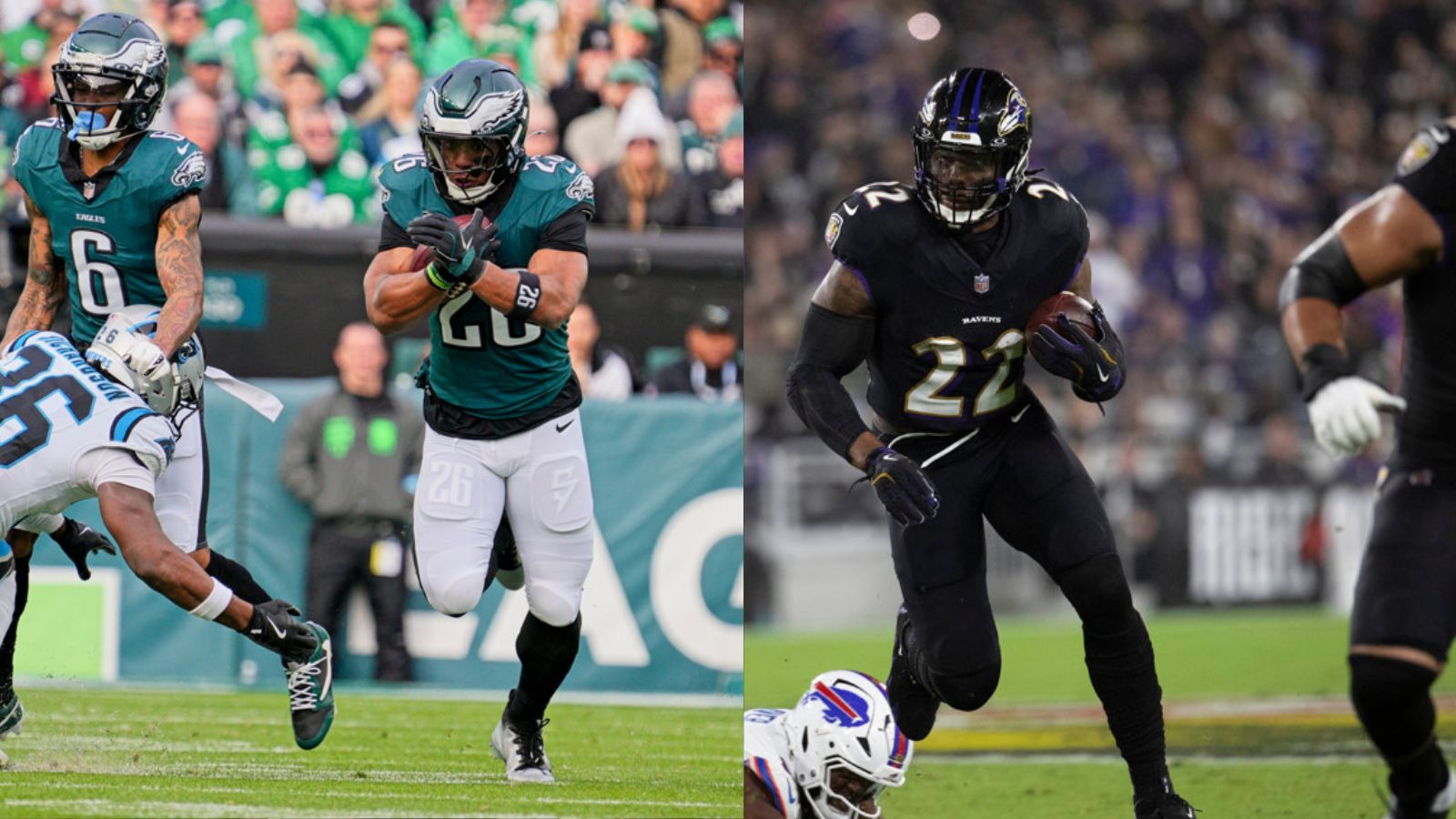
    Photos: Andy Lewis, Charles Brock/Icon Sportswire

    Year after year, the narrative gets louder and louder about the diminishing value of running backs in today’s NFL. This has led to diminishing contract values across the position as teams have been convinced that granting a running back a second contract with significant value is unadvisable.

    In an attempt to slay the dragon, over the offseason Derrick Henry, Saquon Barkley, Josh Jacobs, Austin Ekeler, Nick Chubb, and Christian McCaffrey met to discuss this suppressed market and potential solutions on fixing this. Not much, other than supporting one another, staying healthy, and increasing the level of play came out of the meeting, but Henry, Barkley, Jacobs, and Ekeler all signed with new teams and were looking to prove their worth elsewhere. 

    On average, running back production does drop with age. This isn’t unique to running backs, but the aging curve is most clear at that position.

    A graph showing the decline in performance of running backs as they age

    From a Total Points perspective, this drop-off is apparent at the start of a running back’s second contract. At the age 26 season, running backs start to dip below 0 in Rusher Points Above Average and never get above the mark throughout the duration of their career. And this doesn’t account at all for the attrition of players leaving the player pool, who do so generally as below-average players.

    On average, the production drops over time. This year, the problem is that we aren’t looking at average at the top of the running back totem pole.

    Barkley (27), Henry (30), and Jacobs (26) are all having career years with Barkley on pace to surpass Eric Dickerson’s rushing record (with an extra game). All three signed with new teams over the offseason and are all focal points to their new offenses, a rare occurrence for free agent running backs.

    How have these three made such a massive impact on their new teams? Let’s take a look!

    An MVP…Running Back?

    Not only has Saquon come to the Eagles and led the league in rushing thus far at 1,623 yards, but he is getting serious consideration for league MVP from the betting market. He currently sits as the second favorite behind only Josh Allen at +550 odds on FanDuel. He is also the odds-on favorite for Offensive Player of the Year at -450.

    At this rate, Barkley is on pace for 2,122 yards, which would break Dickerson’s single season rushing record*. He has the most attempts in the league with 266 and also leads the league in yards per attempt at 6.1 (minimum 100 attempts).

    In regards to Total Points, however, Saquon finds himself sitting at 14th in Rusher Points Above Average. Part of this low total can be attributed to his low broken and missed tackle rate which sits at only 10%, the 5th-lowest among RB’s with 100 carries.

    The other factor contributing is how good his offensive line is. The Eagles O-line has accumulated the most run blocking Total Points and has the 3rd-lowest blown block percentage on run plays.

    Saquon has accumulated outstanding production this season, and a lot of that has to do with the team around him. MVP will be tough with Allen playing as well as he is, but Offensive Player of the Year is well within his grasp.

    King Henry

    Somehow, someway, Derrick Henry might be having the best year of his career at age 30. He is averaging a career-best 5.9 yards per carry and is 3rd in the league in positive run percentage at 50%.

    Additionally, Henry is 1st in Rushing Total Points and has proved his individual value beyond team success. The Ravens are a top 3 team when it comes to Run Blocking Total Points as well, but Henry’s 3.2 yards after contact per attempt and 19% broken and missed tackles per attempt percentage prove that he is still one of the best running backs in the league. He has also carried the ball about twice as often into a heavy box than into a light box, which is a much higher ratio than others we’re talking about.

    He is not on pace to break Dickerson’s record like Saquon is, but he is on pace for an 1,800-yard season which would be the second-most yards gained of his career. He also leads the league with 13 rushing touchdowns and can tie his career high if he can get one per game the rest of the season.

    It is no secret what King Henry is all about, but the mystery remains how he can produce at such a high level at this stage of his career. Hopefully, cutting the signature dreads does not have any biblical effects on his powers.

    Run Pack Run!

    Josh Jacobs has come to Green Bay and provided stability and power to the Packers backfield, producing the 3rd-most rushing yards and 2nd-most Rushing Total Points so far this season. His elusiveness and power are also on display regularly, as he is in the Top 10 in yards after contact per attempt and broken and missed tackle rate.

    The offense he is working in has also contributed to his success. His offensive line has been solid, ranking in the Top 10 in Run Blocking Total Points. The passing attack is also potent enough (Top 10 in EPA) to allow for more light boxes, and the Packers have the best rushing success rate against light boxes this year.

    Jacobs will be an important piece of a potential Super Bowl push for the Packers down the stretch, ensuring balance and power from an offense that still has room to improve.

    Honorable Mentions

    Two other players worth noting:

    James Conner is still humming at age 29 for the Cardinals. He is 7th in Rushing Total Points and is 2nd among running backs with a 25% broken and missed tackle rate.

    David Montgomery, in his age 27 season, has fit into a prominent role with his second team in the Lions. “Knuckles” is tied for the 2nd-most rushing touchdowns and leads the league in positive run percentage.

    Conclusion

    The running-backs-don’t-matter crowd is really having a rough go of things in 2024. The three top rushers are all guys on their second contracts and one of them is looking to break the rushing record. There are plenty more that are making significant impacts on their respective teams as well.

    Can we expect this phenomenon to happen in future years? If there is a focal point to add a talented running back when the rest of the roster is in place, then – as proven this year – there can be success. The fight against father time is always against us, and even more so for running backs. 

    However, they are beginning to fight back.

  • The Sniff Test: What Metrics From 2022 Provide A Signal For 2023?

    The Sniff Test: What Metrics From 2022 Provide A Signal For 2023?

    On the latest episode of the Off the Charts Football Podcast, Matt Manocherian and James Weaver dove into the SIS Data Hub ($) and uncovered some of the most surprising stats from the previous season.

    The question they asked themselves was: Does this stat pass the sniff test?

    They wanted to figure out if if these stats provide a signal going into the future or if they are just a noisy occurrence.

    Here’s a look at the stats they went through. See if they pass your version of the sniff test.

    Jared Goff was 3rd in Passing Wins Above Replacement (WAR) with 3

    Pass the Sniff Test? – Yes

    Given Goff’s track record of taking an offense to the Super Bowl and how the Lions finished in 2023, James bought into this stat and believed it had staying power.

    “I kind of believe it,” said Matt, who noted Goff was worth only 1.2 WAR in 2021. “It does pass the sniff test for me. But in order for that to repeat this year, a lot of the ancillary items like having a low sack number and having interception luck will have to happen again this year.”

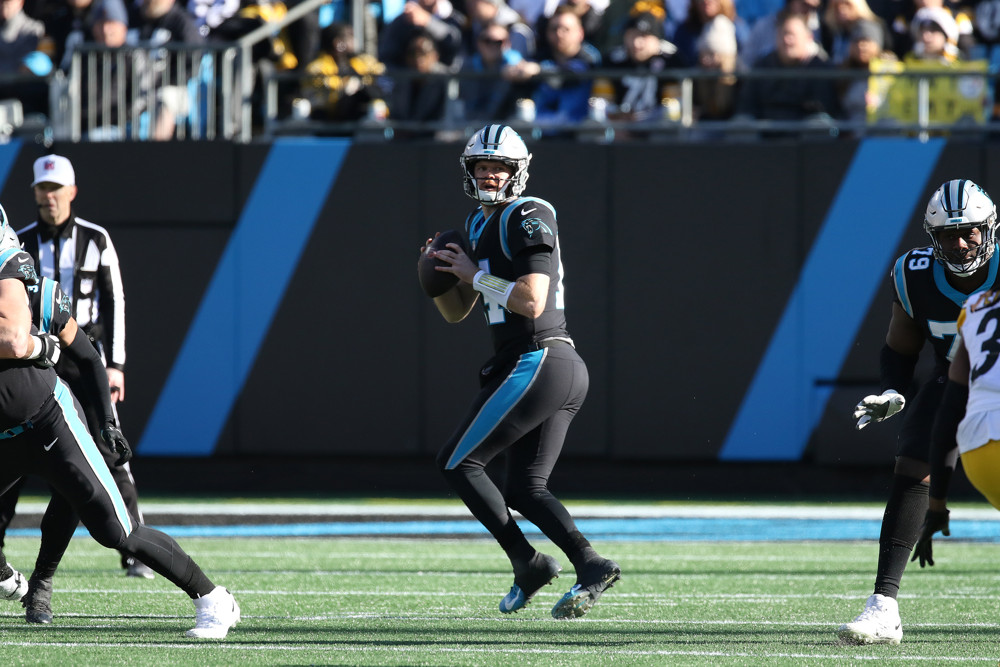
    Sam Darnold was 2nd in the league in IQR from Week 12 onward with 108.1

    Pass the Sniff Test? – Split

    Matt was taken aback when he heard this and does not think this passes the sniff test. He believes that the simplification of the Panthers offense made Darnold’s efficiency look good.

    James responded with some other metrics that support that Darnold might have found something at the end of last season.

    Darnold ranked:

    – 3rd in On-Target Percentage

    – 7th in Average Throw Depth

    – 2nd in Yards per Attempt

    – 4th in Boom Percentage.

    “The sample size was small and he was playing for an interim coach at the end of the season, but he very well might have played the best football of his career,” James said.

    Jawaan Taylor lead all Offensive Tackles in Total Points with 42.8

    Pass the Sniff Test? – No

    “I couldn’t believe he was the leader among all tackles. I thought it would be someone like Tristian Wirfs,” Matt said. “Every year, he has shown out as somebody who is better than we thought he was and if Total Points is right, then him fitting in with Mahomes can be something really good.”

    Matt also discussed the state of the Chiefs offensive line, as they brought Taylor and Donovan Smith in to protect Mahomes on the bookends after the departure of Orlando Brown Jr.

    He doesn’t think Taylor passed the sniff test to be the leader among all tackles but believes that he can be a cornerstone for the Chiefs moving forward.

    The Texans were 4th in Pressure Rate at 37.8%

    Pass the Sniff Test? – Undetermined

    This was another stunner for Matt and it was left for James to counter.

    He pointed out that Christian Kirksey ranked 11th overall in pressure rate, and players like Ogbonnia Okoronkwo and Jerry Hughes contributed positively to that number. The Texans ranked 13th in sack percentage and 26th in Pass Rush Points Saved.

    “So they were generating pressure, but couldn’t bring down the quarterback when they got to him,” James said.

    Matt brought up that the roster has a lot of good young players, including Will Anderson who can absolutely make an impact this season.

    In terms of deciding if this sticks, James thought that it will be hard to find a signal in this stat due to the turnover in Houston, as the team looks very different compared to a year ago.

    Josh Uche led all players in Pressure Rate at 20% among players with 100 Pass Rushes

    Pass the Sniff Test? – Yes

    “Interestingly, even with the limit set at 100, he had 256 rushes. I definitely would not have expected that,” Matt said.

    James thought that this might be due to having a Defensive Player of the Year candidate in Matt Judon on one end and that Uche might be a beneficiary of that. However, he does believe that Uche is a solid player.

    Matt thinks this has a big signal and has a big upwards arrow heading into 2023.

    The Pittsburgh Steelers were 7th in Blocking Total Points

    Pass the Sniff Test? – Yes

    Overall, the Steelers were 4th in Blown Block Percentage and 9th in Wins Above Replacement,

    “Not a lot of people thought that this was a Top 10 offensive line last year.” James said.

    The Steelers were a super-heavy zone running team and had a positive EPA when doing so. The system credits the o-line for all the yards before contact that the RB’s accrue in this scheme.

    Matt noted that they protected better than expected, but he wasn’t blown out of the water by that No. 7 ranking.

    On an individual basis, James Daniels (14th in Total Points), Mason Cole (40th in Total Points), and Kevin Dotson (18th in Total Points) were a solid trio on the interior of the line that helped the Steelers achieve that ranking.

    The Philadelphia Eagles allowed 0.07 EPA/A against the Run and -0.16 EPA/A against the Pass

    Pass the Sniff Test? – Maybe

    Both James and Matt were blown away that there was such a great discrepancy between the two. James pointed out that after the Commanders game, the Eagles brought in Ndamukong Suh to fill in on the D-line and that they don’t pay linebackers.

    Matt said “They really want you to rush against them so that you can’t pass efficiently against them. The only way you can keep up with their offense is to be really effective passing against them, so they will defend that more than the run. You can’t beat us at our game, you can’t out run us.”

    The Baltimore Ravens were 30th in Receiving Total Points

    Pass the Sniff Test? – Undetermined

    There was no receiver over 1.5 Yards Per Route Run on Baltimore, with Demarcus Robinson coming the closest at 1.4, 25th in Yards Per Target, the 6th-highest Drop Percentage, and 18th in On-Target Catch Percentage.

    “The receivers did the quarterbacks no favors in helping them out,” James said

    Matt pointed out that this won’t tell us anything going forward, as Zay Flowers and Odell Beckham Jr. should erase what happened the year before.

    Saquon Barkley led the NFL in using the Designed Gap

    Pass the Sniff Test? – Yes

    Matt brought up how Barkley would never hit his gap in college or in the early years of his career, so it was interesting to see him doing so regularly in the NFL.

    “It is good to see that from a player who is that powerful and that strong that can hit the gap as quick as he can,” James said.

    Matt provided more context behind Saquon’s changes. Barkley was hit at the line 41% of the time, which he gauged to be a little high

    “He is still not high on the Yards Before Contact per Attempt leaders. He’s still responsible for a whole lot of what he’s earning out there. But he got his Stuff Percentage down to 17% which is good to see.”

    Matt believes that a part of the Giants success can come down to Saquon hitting the gap in his contract year for this upcoming season.

    To listen to the episode and hear more of Matt and James’ thoughts, check out the podcast link below.

  • Scouts vs Stats: Top 10 NFL Running Backs

    Scouts vs Stats: Top 10 NFL Running Backs

    Over the spring/summer, the SIS R&D staff is convening on the Off the Charts Podcast to talk about their top ten players at a position. To do this, we pit two methodologies against each other: 

    • The “Scouts,” which comes down to the film-based opinions of Matt Manocherian* and Bryce Rossler, each of whom has a lot of experience breaking down film and scouting players (Matt having done it for NFL teams).
    • The “Stats,” which involves James Weaver and Alex Vigderman devising a ranking based on a suite of metrics, and having that ranking speak for itself.

    *This week, Matt called for some backup, so we brought in Jeff Dean from our Football Ops department

    Officially, Sports Info Solutions does not condone the dichotomy between scouting and statistical analysis. Each of them provides data in their own way and should inform our evaluation of a player. 

    When we originally produced the Football Rookie Handbook before transitioning that content to our NFL Draft site, we put the scouting reports and stats side-by-side with the idea that the reader would bounce back and forth between them and leverage both to come to a conclusion about a prospect.

    So, without further ado, let’s get to these ‘Best Running Backs in the NFL’ lists and then do a deep dive on why each group ranked as it did.

    Scouts’ Opinion Statistical Analysis
    1. Josh Jacobs 1. Nick Chubb
    2. Christian McCaffrey 2. Derrick Henry
    3. Nick Chubb 3. Christian McCaffrey
    4. Derrick Henry 4. Tony Pollard
    5. Jonathan Taylor 5. Josh Jacobs
    6. Dalvin Cook 6. Rhamondre Stevenson
    7. Rhamondre Stevenson 7. Javonte Williams
    8. Aaron Jones 8. A.J. Dillon
    9. Kenneth Walker III 9. Aaron Jones
    10. Saquon Barkley 10. Cordarrelle Patterson

    The Stats List Methodology

    The stats-based ranking includes a two-year recency-weighted average of a player’s results across several different metrics, with the following weights applied to each:

    • 35% Rushing Total Points
    • 15% Receiving Total Points
    • 5% Pass Blocking Total Points
    • 10% Broken + Missed Tackle Rate
    • 10% Heavy Box %
    • 10% Positive% (when hit at the line)
    • 5% Average Depth of Target
    • 5% Positive% Balance – Gap/Zone
    • 5% Positive% Balance – Inside/Outside

    Once again, the stats team leans heavily into Total Points. This catch-all metric incorporates many of the elements that we would care about when evaluating a player’s performance. In this case, receiving impact is less relevant than rushing, but has a sizable impact for certain players in the Top 10. A key element of passing game impact for running backs is the ability to threaten the defense with more than just dump-offs, which is captured in Average Depth of Target.

    Multiple stats measure the back’s ability to make people miss and to get past initial contact at the line. This is particularly relevant when the box is stacked, which is perhaps as relevant a contextual factor as any when it comes to rushing productivity.

    The Positive% Balance stats take Positive%—the rate of successful plays from an EPA standpoint—and compare their performance across different splits. The players get rated on whichever is the lower of the two (gap vs. zone, or inside vs. outside). This basically gives credit to players who are good regardless of what they’re asked to do, as opposed to being a scheme specialist.

    What the Stats Showed

    4 out of the top 5 players on the stats list came in the Top 5 in Rushing Total Points. The outlier was Christian McCaffrey, who was the most productive receiver in the sample and ranked in the Top 3 on each list.

    The player who stands out at the top of the stats-based list is Tony Pollard, who has been excellent in limited usage and exemplifies the challenge of evaluating running backs in this era. The Stats list ranked Pollard No. 4. The Scouts list did not put him in their Top 10. Often running backs are being given a limited scope of opportunities that helps them be successful, and it’s difficult to identify statistically if a player is only excelling because he’s being kept away from suboptimal run contexts.

    Josh Jacobs was No. 5 on the Stats list and No. 1 on the Scouts list. He probably has the most polarizing statistical profile. He ranked in the Top 10 in Rushing Total Points, Broken + Missed Tackle Rate, and both Positive% Balance metrics. He ranked in the bottom half of the rest of the metrics.

    The bottom half of the stats-based list was less solid due to questions about role, age, and health. No. 7 Javonte Williams was outstanding in 2021 and was set to have a good follow-up until he suffered a devastating knee injury. We elected to give him credit for what he did in a season-plus, acknowledging that it’s unlikely he maintains that performance going forward.

    In that same vein, Cordarrelle Patterson makes the list at No. 10 in part because of excellent receiving production in 2021. His age and the direction of the roster make it extremely unlikely that he could make this list next year, but he was still acceptably productive as a rusher while seeing a ton of heavy boxes in an offense that struggled in the passing game.

    Both Packers backs make the stats list, in an order that most people would probably disagree with. No. 8 A.J. Dillon had a much more successful 2021 than 2022 and failed to unseat No. 9 Aaron Jones in the way that some might have expected, producing a lot fewer eluded tackles than expected given his frame. But Jones has run into a lot of light boxes and didn’t differentiate himself in terms of passing game impact relative to Dillon.

    What the Scouts Thought

    The scouts were wowed by what their No. 1, Josh Jacobs, has put on film, not just in his 2022 campaign. Per Bryce, the things that stand out are his elusiveness and the contact balance. He’s extremely hard to tackle and runs with great leverage and tempo, and also brings speed in the open field. 

    Their second pick went to Christian McCaffrey, who stands out compared to the other top choices because of, as Jeff put it, his “gravity as a receiver,” with defenses having to account for him in multiple ways.

    The scouts admit that their top three choices were pretty interchangeable, and that mostly aligns with how the stats list worked out. 

    No. 4 Derrick Henry falls just short of that group, in part because of his age (which proved to be a distinguishing factor between the lists, because the stats didn’t build in any sort of projection going forward). Bryce jokingly notes that his reduced broken and missed tackle rate compared to his reputation is partly because defenders just don’t want to get in his way once he builds up momentum.

    The most notable discrepancies between the lists come in the middle of the scouts’ rundown, with Jonathan Taylor and Dalvin Cook.

    Taylor came out 12th on the stats list because of a very unproductive 2022, but he cracks the scouts’ list at No. 5 as maybe one of the three best pure rushers in the league. He combines speed, vision, and elusiveness that few runners do, as shown in what he put on film in 2021. Jeff noted that the 2022 film was not great, but he gets a fresh start this year to show which of those two seasons to believe.

    No. 6 Cook has been the topic of a lot of discussion with his release from the Vikings. According to Jeff (who just wrote an article about the flaws in Minnesota’s offseason plan), he brings breakaway ability that NFL teams value a lot, and he could be a bigger asset in the passing game for a team that uses him in more dynamic ways. He does have ball security issues at times and doesn’t always express that breakaway ability, but the tools are there to be a lead back.

    The last name on the scouts’ list—Saquon Barkley—was debated on their end, which aligns with the stats in the sense that he does not have the statistical profile that his talent suggests. 

    Per Jeff, “The talent is obvious…when he’s on the field, he’s a difference maker. He’s a guy that provides value as both a receiver and a rusher, and when he’s in your backfield, you consider running back a ‘plus’ position.” Bryce pointed out that he’s gotten more disciplined as a runner—and the numbers back that up—which was a point of concern when he was coming out of college.

    Overall, the lists aligned on six out of 10 players, with a couple players from each list being “off the board” for the other. However, four of the top five players on each list matched up, which says a lot for what those players have been able to put on film and the stat sheet the last couple years.

    Want to hear more discussion and debate? Check out this episode of the podcast: