Tag: St. Louis Cardinals

  • Fielding Bible Awards History: Brendan Ryan Put Himself in the Best Position to Win

    Fielding Bible Awards History: Brendan Ryan Put Himself in the Best Position to Win

    Photo: John Cordes/Icon Sportswire

    On Thursday, we’ll announce the winners of The 2025 Fielding Bible Awards for defensive excellence. This will be the 20th annual announcement recognizing the best defensive players in baseball at each position, as well as the best team.

    I thought it would be interesting to talk to two players who won Fielding Bible Awards for whom the Award might mean a little bit more: Brendan Ryan, who won as a shortstop for the Mariners in 2012, and Jeff Mathis, who won as a catcher for the Diamondbacks in 2018. Each won a Fielding Bible Award but did not win the more well-known Gold Glove Award.

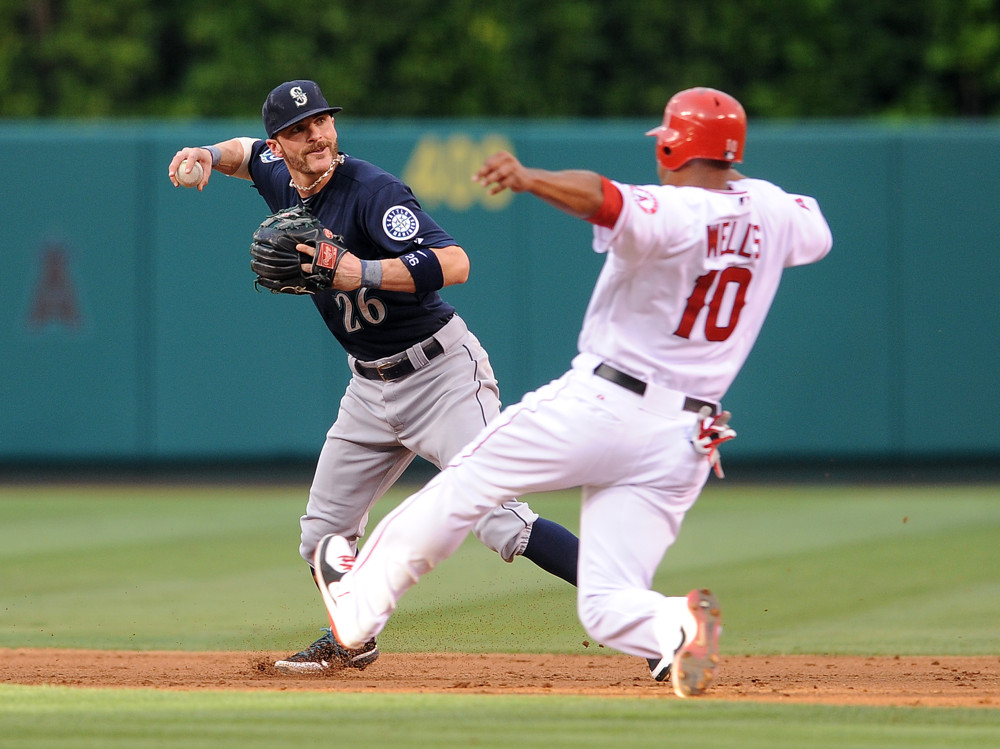
    Brendan Ryan took his defensive positioning as a shortstop very seriously. He played at a time when defensive shifting was just starting to become a major part of the game and players still had the ability to move well off of where teams positioned them. By 2012 the Mariners were giving him the ability to move not just himself but also the third baseman and second baseman to where he felt they needed to be.

    “Let’s say Ian Kinsler was coming up,” said Ryan in a recent conversation from his home in Los Angeles. “I know he’s not hitting the ball up the middle, so that’s going to be a backhand opportunity for me. But I don’t want to be in the backhand lane. I want to be straight up and moving into the backhand so that I could get a head start. The bounces would work in my favor. I felt in complete control that way.”

    It’s this approach and Ryan’s own positioning (“I just tried to play as far back as I could”) that made him so adept in the field, which culminated in 2012 with an MLB-best 27 Defensive Runs Saved and a Fielding Bible Award.

    As Sports Info Solutions wrote in its Awards announcement at the time: “Brendan Ryan is the best defender in baseball. Period. Make that double period.”

    From 2009 to 2012, Ryan is credited with 93 Runs Saved. The next-most by a shortstop is 46. Ryan lapped the field!

    A lot of credit for that goes to Ryan’s days with the Cardinals, for whom he totaled 22 and 24 Runs Saved in 2009 and 2010, respectively, prior to his trade to the Mariners. Coaches George Kissell, who invented “The Cardinals Way” and Jose Oquendo, the longtime Cardinals infield coach.

    “Those two guys were on me,” said Ryan, who entered his pro career as a second baseman. “Kissell with discipline and detail and Oquendo put me in position where he made some things easier, detailed things like where to catch a ball on a double play to make it easier to transition and make an accurate throw. The confidence comes behind that.”

    And yet, in the days prior to the existence of the Sabermetric Defensive Index, which now accounts for 25% of the vote, as good as Ryan was, he couldn’t win a Gold Glove. (Let’s be fair, he probably could have won more than one Fielding Bible Award too). His lack of offense (he had a .555 OPS in 2012) may have had something to do with that, as there was a perception that better hitters had a better chance at winning the Award.

    “I was so lost at the plate and I couldn’t find my way, but I knew I had value because they kept running me out there and I knew they valued defense,” Ryan said.

    Ryan thought for sure that he’d win a Gold Glove in 2012 and even had fleeting thoughts about winning a Platinum Glove. He got beat out by J.J. Hardy, who wasn’t a bad choice, though Ryan had a decisive Runs Saved edge.

    Ryan was aware of The Fielding Bible Awards. His brother and his agent both tipped him off that SIS stats viewed him favorably and he was familiar with an article Bill James wrote comparing Derek Jeter and Adam Everett. The trophy he received is prominently placed in his man cave.

    “I certainly cherish it,” he said.

    The Mariners understood something about how valuable Ryan was and that that award meant something. Ryan’s salary nearly doubled from 2012 to 2013, his fifth season of service time. He played professionally for five more seasons. Now happy in retirement, he and his family live almost next door to where he grew up and he coaches his three sons in different sports.

    “I still love talking defense,” he said. “I love how far this [statistical analysis] has gone and that they’re really getting an accurate assessment of who guys are and what they do outside of the batter’s box. It’s awesome.”

  • MLB Draft Scouting Report: Liam Doyle (Cardinals Pitcher)

    MLB Draft Scouting Report: Liam Doyle (Cardinals Pitcher)

    MLB Draft Scouting Report: Liam Doyle

    Skill Grade
    LHP
    Fastball 70
    Slider 50
    Slurve 50
    Splitter 55
    Control/Command 50/50
    Future Value 55

    Name: Liam Doyle

    College: University of Tennessee

    Bio: R/L 6-2, 220 lbs.

    DOB: 06/03/2004

    Written by Brandon Tew

    Analysis:

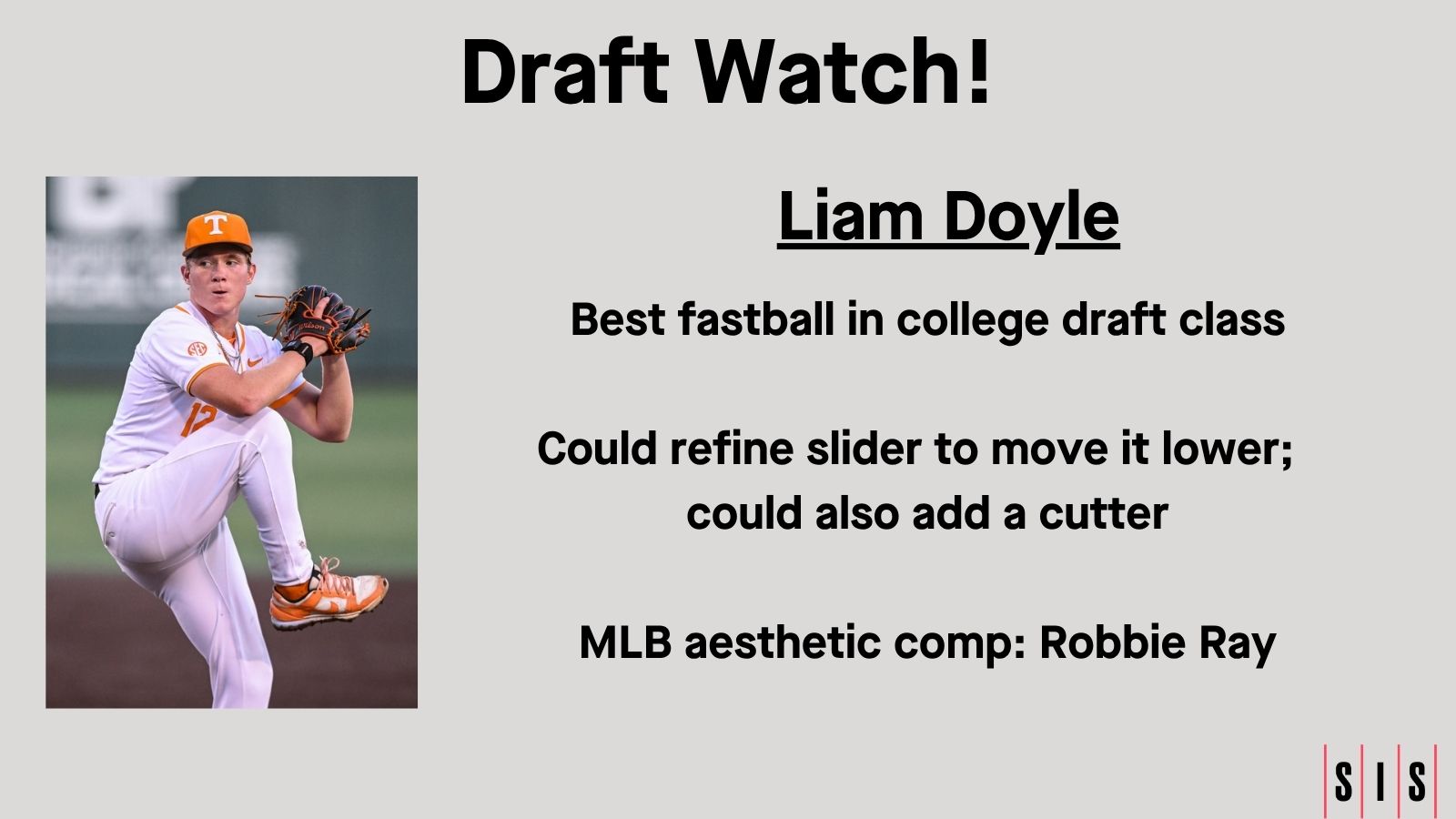
     Liam Doyle, picked 5th overall by the Cardinals, pitches like he just crushed multiple energy drinks in the dugout before his outing, taking the mound like he has a personal feud with every batter. He’s jittery, and his delivery is up-tempo and high energy. His arsenal is fueled by a high-octane fastball that explodes through the top of the zone. The pitch is a legit high-velocity four-seam with carry from an average release height.

    If Doyle succeeds in MLB as a starter, it’s with the rest of his arsenal woven in and out of the fastball usage at an effective rate. He gives off the look of a reliever with a high-effort delivery and snappy movements. However, he zones all his pitches and throws strikes at a high enough rate to be in the starter mold right now.

    If Doyle lands on more of the relief pitcher track, it will be his secondaries not improving from their current shapes, and his control and command backs up to more fringe-average and below.  

    College Career:

    Liam Doyle began his career at Coastal Carolina, posting a decent ERA and a respectable number of strikeouts. After transferring to Ole Miss for his sophomore season, there was an uptick in strikeouts, even through a rocky season in and out of the bullpen as a starter and high-leverage reliever.

    Doyle then found his way to Knoxville, where he pitched with more confidence and improved his conditioning, turning himself into one of the best Friday starters in the SEC. 

    Doyle began throwing his fastball at a higher velocity. While also holding that velocity deep into starts, and still throwing all his pitches at a decent zone rate.

    Year ERA IP K% BB%
    2023 4.15 56 1/3 29% 9%
    2024 5.73 55 35% 9%
    2025 3.20 95 2/3 43% 8%

    Pitching Mechanics:

    In the windup, Doyle starts with his glove at his stomach. He brings the glove up to his nose before stepping back with his glove foot, bringing the glove back down to his belt as he turns to settle on the third base side of the rubber.

    With high-tempo, he enters leg lift with an aggressive move forward, drifting down the mound. There is significant counter-rotation in his front side and hips as he reaches peak leg lift, with the bottom of his cleat pointing out to second base.

    He enters a drop-and-drive move, holding his front side into landing, and he turns his glove hand into his body. As he lands at front foot strike, he pulls his glove arm fully into his chest, and his arm flips up to a solid position as he shifts weight to his front side into a lead leg block.

    His head pulls off to the right with high effort as he spins out to third base to finish his delivery, falling off hard. It’s high-effort and high-tempo, but Doyle gets the most out of his body to throw hard from his high three-quarters slot. 

    There might be less room for projection in terms of adding velocity. Still, Doyle has maintained the high-effort delivery and velocity deep into his outings, so keeping that sustained velocity into a full pro ball season of starts will be key.


    Arsenal

    4s: 94-98 mph avg, 19” IVB, 11” Arm-side | Release: 5.9’

    Doyle’s fastball is a blitzball shape in the mid-to-upper 90s; the pitch whizzes through the top of the zone and has an insanely high 40% zone whiff rate. He keeps the fastball up in the zone and pushes the location of it up and away from right-handed hitters.

    When he gives up damage on the pitch, it usually is on more 94-95 mph fastballs in the heart of the zone. The attack plan, armside from righties, has worked and should continue to work, leaning into the natural run of the pitch.

    Doyle’s fastball profile and velocity made it the best fastball of the college draft class. The rest of the development of his arsenal will honestly decide how good he can be as a starter. Still, Doyle should have no issues handling right-handed hitters with his fastball, and the four-seam up can also protect his secondaries against left-handed hitters, too.


    Slider: 85-90 mph avg, 5” IVB, 4” Sweep

    Doyle’s shorter slider lives in the slider to cutter range in terms of velocity and break. He landed the pitch more middle than pushing the location to the glove side, even to left-handed hitters.

    When the velocity exceeds 87+, it is a better offering. He can build on the arsenal and push more of a true cutter 90-92 mph, and have a possible gyro slider shape play off of the cutter. He uses the cutter more inside to righties and using the cutter and slider away from lefties.

    Overall, his feel for zoning the slider is good, but refining the command and moving the location more down in the zone, while also having a more vertical cutter, would be ideal.

    Slurve: 78-82 mph avg, -3” IVB, 10” Sweep

    Doyle’s slurve is an interesting pitch. As a pronator, he throws with his hand and wrist turning over as he stays more behind the ball to apply force to the ball. This allows Doyle to create good backspin and carry on his four-seam.

    The downside is he can’t effectively create a sweep on pitches like a sweeper or slider as easily when getting to the side of the ball. When he forces this shape, it leads to a bigger and significantly slower breaker that should be categorized as more of a slurve than a sweeper because of the depth of the pitch.

    You could have Doyle lean into a more vertical curveball or even a more gyro slider shape, and classify it as a curveball in a “death ball” shape.

    The death ball is a pitch that has the bullet-like spin of a slider but sits with more depth than a traditional bullet slider. Pete Fairbanks, Ben Brown, and Kumar Rocker throw hard death balls that perform well.

    I think the pitch plot above from Lance Brozdowski’s pitcher notes on Bryce Miller’s death ball last season illustrates a possible shape Doyle could get to with a mid-80s breaker.

    A left-hander that gets to this shape and has expanded his arsenal is Cole Ragans, so if Doyle can figure out this bullet-slider shape, he could pair it with the bigger slurve.

    The slurve does create timing issues for both right-handed and left-handed batters and induces swings as well. There’s probably just a harder breaking ball Doyle can get to inside of his mix.


    Splitter: 84-89 mph  Specs: 2” IVB, 10” Arm-side

    Doyle’s splitter is almost purely a two-strike pitch for him, but he will drop offspeeds early in the count if he feels a hitter is on his fastball. (Not many hitters are on his fastball even if they know it’s coming.) 

    In its current form, it’s probably a below-average splitter, but Doyle should be able to get to an above-average offspeed pitch at a hard velocity. The offspeed would most likely be used for opposite-handed hitters, but if he can find more of a breaking ball glove side there’s less concern about the splitter or changeup because of how well his fastball performs against righties.

    An offspeed for the 2nd and 3rd time through the order would be nice as a wrinkle inside of his arsenal for usage purposes.


    Projection:

    Doyle’s fastball is a true double-plus pitch, performing at elite rates in college. The Cardinals are banking on the fastball being a true weapon in his arsenal. Building off a dominant fastball like Doyle’s makes him an intriguing prospect.

    His success as a starter will hinge on continued strike throwing and solid command of his pitches, a foundation he already has in being able to zone multiple offerings at a good rate. 

    Overall, Doyle should be able to add a harder breaking ball to his arsenal to combat left-handed hitters; the fastball’s performance against right-handed hitters should continue if he gets the offering up in the zone.

    The Cardinals are currently evaluating a starter profile with a higher upside due to his fastball, but with a wider variance in his profile if his control and command dip below average. That was something control-wise that didn’t appear to be an issue for Doyle for most of the 2025 college season. 

    Doyle has an exceptional fastball, but the rest of his arsenal will be the driving force behind his success in MLB.

    Aesthetics Comp: Robbie Ray (Body Comp, Up-tempo delivery)

  • May’s MLB Defensive Players of the Month

    May’s MLB Defensive Players of the Month

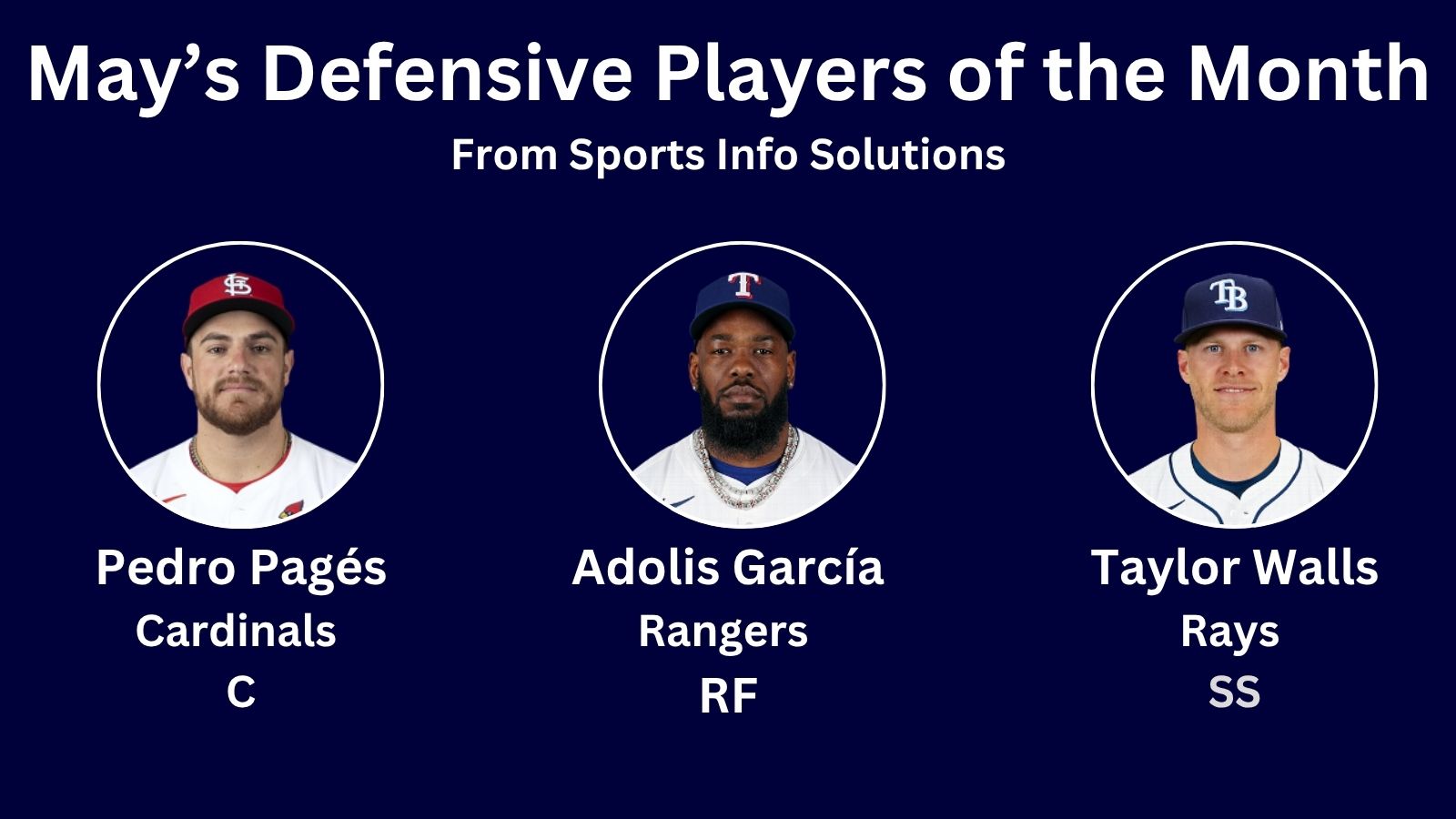
    Sports Info Solutions went three deep in our Defensive Player of the Month selections for May and there was no shortage of credible candidates to choose from.

    In the end, we picked a catcher who helped his team to a 19-8 record in May, a right fielder whose numbers look a lot different from last season, and a shortstop who took advantage of the abundance of ground balls to come his way.

    These are our three selections:

    Pedro Pagés, Cardinals C

    Pedro Pagés led all catchers with 8 Defensive Runs Saved in May. He entered the month with -2 Runs Saved for the season and finished it with 6 Runs Saved. Only Patrick Bailey (8) and Alejandro Kirk (7) have more for the season.

    For the season, Pagés has added value in Stolen Base Runs Saved as well as our stats for pitch blocking and pitch. framing

    He’s thrown out 8 of 32 baserunners attempting to steal (25%) and picked off two others. The average caught stealing rate for a catcher is 18%.

    He’s successfully blocked 94% of potential wild pitches. The average block rate is typically around 91% or 92%.

    Staff ace Sonny Gray seems to enjoy pitching to Pagés. Gray had six starts in May. His three scoreless ones featured 28 strikeouts and 3 walks. Pagés caught all three. For the season, Gray has a 2.32 ERA in 9 starts with Pagés catching. He’s allowed 14 runs in 14 2/3 innings with others catching.

    Adolis García, Rangers RF

    Adolis García led all right fielders with 7 Defensive Runs Saved in May. His 8 this season are tied for the MLB lead at the position with 2023 Fielding Bible Award winner, Fernando Tatis Jr.

    Garcia has engineered a major turnaround when it comes to his Range stats. Last season he had a career-worst -8 Range Runs Saved. This season, he already has 7 Range Runs Saved. He’s never finished a season with more than 6.

    Our Data Scouts award Good Fielding Plays based on their observation of specific defensive moments in games. García has 10 and has already exceeded his 2024 total of 9.

    Those include two terrific plays going to the right field line and diving to make a catch (see them here and here).

    Additionally, García has racked up most of his Runs Saved on shallow fly balls. The Rangers have played Garcia at an average depth of 294 feet in Globe Life Field this season, compared to 299 feet last season.

    He’s also improved considerably in MLB’s jump stats from last year to this year, going from ranking 70th among outfielders to placing in the Top 10 in terms of how much ground he covers above an average right fielder.

    Taylor Walls, Rays SS

    Taylor Walls has been a dominant defensive shortstop by Runs Saved since he first came up in 2021. He actually leads shortstops in Runs Saved in that time despite ranking 29th in innings played.

    Shorter term, he had the most Runs Saved of any shortstop in May with 7. He’s been very good this season both fielding balls hit to his left and to his right.

    Walls has also been given more of an opportunity to stand out. Rays pitchers have yielded many more ground balls, ranking 8th in ground ball percentage compared to 29th last season. He’s handling an average of 5 chances per 9 innings played compared to last year’s rate of 3.7.

    Sports Info Solutions has been naming Defensive Players of the Month since 2012 (with ESPN from 2012 to 2017 and then on its own since then), using a combination of statistical analysis and the eye test. Defensive Runs Saved has tracked MLB player defensive value since the 2003 season and is considered one of the industry-leading defensive stats.

  • Are The Cardinals A Good Defensive Team?

    Are The Cardinals A Good Defensive Team?

    Photo: Mark Goldman/Icon Sportswire

    Part of a series of articles previewing the defensive performance of all 30 MLB teams by asking the question … are they good? To see the full series, click here.

    2024 Defensive Runs Saved Rank: 13th

    Team Strengths

    If Nolan Arenado is still on the team, he’s a strength, though not close to what he once was. Pre-pandemic, he’d recorded eight straight seasons of double-digit Runs Saved. Post-pandemic, he’s had seasons of 9, 20, 0, and 6, with the latter being boosted largely by his play in September.

    Masyn Winn led shortstops in Defensive Runs Saved and won a Fielding Bible Award last season. Though not every defensive metric holds him in that high a regard, we view Winn as excellent, and particularly great at turning double plays.

    Michael Siani is going to have to earn a spot in center field, after a year in which he hit .228 with a .570 OPS. But Siani has the potential to be spectacular. He had 8 Runs Saved there last season and was particularly good at chasing down deep fly balls.

    Team Weaknesses

    With Willson Contreras now entrenched at first base (where he’s an unknown, with only 11 MLB games), Ivan Herrera is the starting catcher. Herrera threw out 2 of 57 runners trying to steal against him, which accounted for almost all of his -7 Runs Saved. His one plus is that he’s a good pitch blocker.

    Jordan Walker has not been good in either of his two years in right field, tallying -13 Runs Saved. Same for Nolan Gorman at second base in his three years (-11 Runs Saved). 

    Other Things To Know

    Besides Contreras and how he handles first base, a wild card for the Cardinals will be how Lars Nootbaar fares in center field. In 109 career games in center field, he’s basically been league-average. He’s been very good in right field, with 13 Runs Saved in 213 games.

    One of the reasons the Cardinals finished 13th in Runs Saved was defensive positioning. They netted the 3rd-most Runs Saved of any team in Outfield Positioning area, but that’s not something they can count on again (-1 in 2023). If we looked solely at Runs Saved from defensive skill, they ranked 17th.

    Are The Cardinals A Good Defensive Team?

    If they trade Arenado and don’t play Siani much, it’s going to be a hard sell to say they’re a good defensive team (unless they get a great defender back in trade). Average, probably. Good, probably not. But if they keep both of them, and Arenado plays to past form, they could be pretty good.

  • Stat of the Week: Which Teams Have The Best Defensive Reputations?

    Stat of the Week: Which Teams Have The Best Defensive Reputations?

    Photo: Brian Rothmuller/Icon Sportswire

    We just started a series on our website in which we’ll be asking the question for all 30 teams: Is this a good defensive team heading into 2025?

    You can find the articles here.

    But which teams have the best defensive reputations?

    To answer that, we noted each team’s average rank in Defensive Runs Saved over the last four seasons.  

    Two teams tied for the best average ranking: The Brewers and the Dodgers.

    The Brewers are the only team to rank in the top 6 in Runs Saved in each of the last four seasons. They placed 6th in 2021 and 2022, 2nd in 2023, and 4th in 2024.

    They’re in strong position to do that again. The have four very good defensive outfielders (though Blake Perkins is hurt at the moment), and a Platinum Glove winner at second base in Brice Turang, who led the position in Runs Saved last season.

    The Dodgers have ranked in the top 10 in each of the last four seasons. They’ve finished 10th in 2021, 2nd in 2022, and 3rd in both 2023 and 2024.

    The Dodgers’ success last season was more rooted in the positioning of their players than defensive skill. One of their other biggest strengths is their defensive versatility, with several prominent players (Mookie Betts and Tommy Edman among them) able to play multiple positions.

    Rounding out the top 5 in average rank are the Blue Jays, Guardians, Cardinals, and Rangers, with the latter two teams tied for 5th.

    The Blue Jays are the two-time reigning season leaders in Runs Saved and though Daulton Varsho may play the field less often due to season-ending rotator cuff surgery last season, they added another Platinum Glove winner, second baseman Andrés Giménez.

    The Guardians ranked 3rd in Runs Saved in 2022 and 2nd in 2024, but lost Giménez. They still have a terrific left fielder, Steven Kwan, an impressive young shortstop, Brayan Rocchio, and an improving catcher, Bo Naylor. The Guardians take their defensive play seriously. Both their Triple-A and Double-A affiliates led their respective leagues in Runs Saved last season.

    The Cardinals ranked 1st in 2021 and 5th in 2022, but have slipped to 20th and 13th the last two seasons. The Rangers have three finishes in the top 11, including a 2nd-place standing in 2021.

    Five teams finished with an average rank of 25 or worse. They were the Phillies, Nationals, A’s, Reds, and White Sox.

    Below are the full team rankings:

    Average Rank in Defensive Runs Saved

    Last 4 MLB Seasons

    Team Avg Rank
    Brewers 5
    Dodgers 5
    Blue Jays 6
    Guardians 9
    Cardinals 10
    Rangers 10
    Braves 11
    Astros 11
    Rockies 12
    Yankees 13
    Cubs 13
    Diamondbacks 13
    Rays 13
    Mariners 14
    Orioles 14
    Tigers 15
    Twins 15
    Mets 16
    Padres 16
    Red Sox 18
    Royals 18
    Marlins 18
    Angels 19
    Pirates 21
    Giants 21
    Phillies 25
    Nationals 25
    Athletics 26
    Reds 27
    White Sox 28


  • Masyn Winn Has Been One Of the Best On Defense in 2024

    Masyn Winn Has Been One Of the Best On Defense in 2024

    Photo: Marc Goldman/Icon Sportswire

    There are a lot of terrific young shortstops in MLB, with Bobby Witt Jr. and Gunnar Henderson being the first that come to mind.

    But you know who’s climbing up that list? Twenty-two year old Masyn Winn of the Cardinals.

    Winn currently ranks in the top 10 in the NL in Baseball-Reference’s Wins Above Replacement. His defense has a lot to do with that.

    Winn handily leads all shortstops in Defensive Runs Saved. His 14 Runs Saved are 6 more than the next-closest player. No other Runs Saved leader has that large of an advantage.

    Most Defensive Runs Saved – Shortstops

    Player Team Runs Saved
    Masyn Winn Cardinals 14
    Zach Neto Angels 8
    Brayan Rocchio Guardians 7
    Bobby Witt Jr. Royals 6
    Gunnar Henderson Orioles 6

    Since he’s the best at one of the most important positions on the field, it’s not surprising that he leads MLB in Defensive WAR.

    Winn is good at going both to his left and to his right. Very good, actually. He has the 4th-highest rate among shortstops at turning opportunities* into outs on balls hit to his left and the 2nd-highest rate on balls hit to his right.

    * Opportunity = any ball on which a player has a >0 chance to record an out based on our out probability data


    Winn’s also had an abundance of opportunities. His range factor ranks 2nd at the position. He plays the position aggressively (examples here and here).

    But the separator for Winn has been effectiveness at turning the double play, something that Runs Saved credits in addition to playmaking. Winn has converted the most double plays of any shortstop in the majors. With the volume of plays he’s made and the difficulty of them, he gets an additional MLB-best 4 Runs Saved just from double plays.

    Here’s a fun punchline on Winn and double plays. He’s not just valuable for being able to turn them better than most, he’s also good at avoiding them at the plate. He’s batted 370 times this season, the most of anyone in the majors who has not grounded into a double play.

    Most of the double plays Winn turns look routine. But he’s got a few impressive ones like the one below. I’ve watched baseball for more than 40 years and I don’t mind saying that one was an Ozzie Smith-like play.

    The Cardinals have had a weird year. They have a negative run differential and their two veteran stars, Paul Goldschmidt and Nolan Arenado have floundered. And yet they’re winning enough to be in the hunt for a playoff spot. With this team, you can’t spell ‘winning’ without the Winn.


  • Stat of the Week: 2024’s NL Defensive Stories

    Stat of the Week: 2024’s NL Defensive Stories

    BY MARK SIMON

    With Opening Day approaching, we wanted to preview the 2024 season from a defensive perspective. So to be fair to all 30 teams, we’ve got a stat-driven theme or story to watch for each team. Here’s our look at the National League teams after we did our tour through the American League last week.

    Braves – The Braves were generally average or better through much of their defensive lineup last season. The big exception was shortstop, where Orlando Arcia and Vaughn Grissom didn’t do well. Arcia had -6 Runs Saved last season due to poor range numbers. He is back for another go and looking to return to the form he showed in 2018 when he totaled 8 Runs Saved.

    Brewers – The Brewers ranked 2nd in MLB in Defensive Runs Saved last season but they’ve got some unknowns on this year’s roster with Jackson Chourio in right field and Joey Ortiz at third base. Last year’s Brewers rookies played very well (Brice Turang, Joey Wiemer, Blake Perkins) and the defensive success of this year’s team may hinge on their young players again.

    CardinalsNolan Arenado went from overwhelmingly awesome to decidedly average at third base overnight (from 20 Runs Saved in 2022 to 0 in 2023). So the big question this season is whether he can return to the standard-setting level of excellence of years past.

    Cubs – The Cubs have the best double play combination in baseball with shortstop Dansby Swanson and second baseman Nico Hoerner. Given that they also have two-time Gold Glove winner Ian Happ in left field, Mike Tauchman and Cody Bellinger in center field, with Bellinger likely also at first base, the Cubs could be pretty good defensively. They finished tied for 8th in Defensive Runs Saved last season and could better that.

    Diamondbacks – It’s reasonable to suggest that the Diamondbacks are the NL’s best defensive team. They finished 4th in Defensive Runs Saved last year and have very good defenders at catcher (Gabriel Moreno), first base (Christian Walker), and center field (Alek Thomas). Shortstop and third base may determine whether that suggestion becomes reality. Runs Saved has not viewed Geraldo Perdomo or Eugenio Suárez favorably, so those are the positions to watch entering 2024.

    Dodgers – The Dodgers have been a Top 10 team in Defensive Runs Saved in each of the last 8 seasons. They always seem to make the right moves and in 2024 they’re making a bold one by making Mookie Betts their everyday shortstop. Betts, who won the Fielding Bible Award last year for multi-position play, handled second base very well last season. The Dodgers do have some flexibility here. They could move Betts back to second and play one of the game’s best defensive shortstops, Miguel Rojas, if things don’t work out.

    Giants – In theory, the Giants should be a lot better defensively than they were last season. Their 3 weakest defensive positions by Runs Saved were shortstop, third base, and center field. They signed 2 standout infield defenders in Matt Chapman and Nick Ahmed and signed Jung Hoo Lee, who led all KBO center fielders in Runs Saved last season. Those could be a boon to pitchers like Blake Snell and Logan Webb.

    Marlins – What can infield coach Jody Reed do for Tim Anderson? The new Marlins shortstop has totaled -22 Runs Saved the last 2 seasons, which ranks 2nd-worst at the position. Reed will do his best to maximize what Anderson can do. The Marlins ranked as one of the best-positioned infields in MLB last season.

    Mets – One year after signing Brandon Nimmo to a long-term contract, they’ve moved him from center field to left field and attempted to turn a defensive weakness into a strength by signing Harrison Bader as their new primary center fielder. Bader has twice totaled at least 15 Runs Saved in a season in center field. His 5 Runs Saved there the last 2 years are 16 more than Nimmo in that span.

    Nationals – The Nationals have finished 29th and 28th in Runs Saved the last 2 seasons and need a few things to happen in order to improve on that in 2024. One would be to see some improvement from catcher Keibert Ruiz. The Nationals ranked last in MLB in Runs Saved from their catchers. It would also behoove them to find playing time for minor league Gold Glove winner Trey Lipscomb, who can play any of the infield positions (read our interview with him here).

    Padres – Two things: One is whether Fernando Tatis Jr. can replicate his 2023 season, when he blew away everyone else at the position with 29 Runs Saved. Two, the position switch of Xander Bogaerts to second base so as to put their best infield defender, Ha-Seong Kim, at shortstop. Bogaerts has managed a positive Runs Saved total once in the last 10 years. Second base may be a better fit for him but time will tell.

    Phillies – Johan Rojas didn’t have a particularly good spring training with his bat but he’s arguably too valuable to even consider sitting. He’s by far the Phillies’ best defensive player. Rojas ranked 4th in Runs Saved among center fielders despite ranking 37th among them in innings played.

    Pirates – The Pirates ranked 28th in Defensive Runs Saved from their center fielders last season, but that could change significantly if Michael A. Taylor hits enough to stay in the lineup there. Taylor leads all center fielders in Runs Saved over the last 3 seasons.

    Reds – The Reds ranked 27th in Defensive Runs Saved last season. They’re running out most of the same players this season, save for Jeimer Candelario at third base, which could be a small improvement in Defensive Runs Saved. But they may be a bottom-10 team again.

    Rockies – The most watchable thing the Rockies have right now is their defense. They have Fielding Bible Award-caliber players at second base (Brendan Rodgers), shortstop (Ezequiel Tovar), third base (Ryan McMahon), and center field (Brenton Doyle), and a left fielder with a terrific arm (Nolan Jones). This will probably be the team with the biggest difference between the quality of its defense and its win-loss record.

  • Defensive Excellence Q&A: Cardinals Outfield Prospect Victor Scott II

    Defensive Excellence Q&A: Cardinals Outfield Prospect Victor Scott II

    Cardinals outfield prospect Victor Scott II was one of the stars of the Arizona Fall League with a .388 on-base percentage and 18 steals in 23 games. That came after a very strong year split between High-A and Double-A in which he hit .303 and stole a combined 94 bases. Baseball America just named him the Cardinals No. 3 prospect, as well as their best defensive outfielder, fastest baserunner, and best athlete among their minor leaguers. On Tuesday, he was named the winner of a Rawlings Minor League Gold Glove Award.

    We spent a good part of 2023 talking to coaches about teaching defensive excellence. So it makes sense that we start talking to players about what it looks like to learn defensive excellence. Victor is the first in what we hope will be an ongoing series of interviews.

    Mark: Where did it all start for you defensively?

    Victor: I was probably 10 to 12 years old and my dad would take me to a local park.

    He would hit fungos, ground balls, fly balls, but he would hit them everywhere. It could be a pop to left center. It could be ground balls. If I ever bobbled it or dropped it, it would be a 50-push-up penalty.

    That made me start taking pride in my defense, because I didn’t want to do 50 push-ups every single time I made a mistake or if I didn’t get to it, or if I didn’t get the best jump to it, I didn’t want to do 50 push-ups. I organized myself so that I could get to the ground ball, or the fly ball that was 20 or 30 yards away.

    Mark: What was the hardest thing to learn as a kid?

    Victor: That with defense, speed is a big factor, but you’re going to need to be able to get a good jump and be able to read a swing. The first stage for me was understanding how a swing works or where the pitch is going to be and how to move off that.

    Mark: You learned the ins and outs of center field in Little League?

    Victor: Yeah, and then also I was just using sheer athleticism at that point.

    I like to refer to the center fielder as a point guard. You’ve got control pretty much over the whole field from a bird’s eye view because you’re behind everybody.

    You’re the last line of defense. Essentially, you’re just the general. You can call off anybody. Nobody has rank over the center fielder.

    Mark: When you made the transition from college to the pros, what’s the difference in terms of how you are as a center fielder now?

    Victor: I would say A, reading swings, and B, knowing the game more. Knowing situations, knowing where to throw the ball before it even is hit. It’s the imagination component. Because I know in college, I was just out there being athletic, playing the game, still like refining what it means to be like a center fielder, and then as I got to pro ball just working on different things, being able to really then understand what I was doing, how to get the best jumps, game situations, all those things put a blend together in order to form a pretty decent year

    Mark: How did you figure out how to use your speed such that you wouldn’t overuse it?

    Victor: Yeah, it’s just learning how to control your body essentially. With fly balls and ground balls, it’s normally getting to a spot. So you would be technically underusing it if you drifted to the ball and then you would be overusing it if you were to sprint to the wrong spot.

    It’s just making sure that you have a feel for where the ball is going to end up and how you’re going to get there.

    Mark: Who were your favorite players?

    Victor: Andrew McCutchen, Byron Buxton, Mookie Betts. As I kept growing up Byron became one of my favorites.

    Victor finished 2023 with 18 Good Fielding Plays, 1 shy of the minor league lead for center fielders. Good Fielding Plays are what it sounds like — including things like home run robberies and Web Gem-type catches, as well as plays like cutting a ball off in the gap to prevent a runner from taking an extra base. 

    Mark: I typed your name into YouTube and there were a lot of great defensive plays you made in the last couple of years.

    Let me ask you about one game where you had a home run robbery and another one that was close to a home run robbery. When you’re making catches like that, what do you see?

    Victor: The first thing is probably ball flight. The second thing is the sound of the ball off the bat. That tells me, especially if a ball is drilled, where to go. On both of those I could tell it was going to be hit to the wall.

    So the order for me is find the ball, find the wall, and then refind the ball. I was essentially running without seeing the ball and just getting to a spot in both cases Especially at a new field, because you don’t necessarily know the dimensions. Knowing how many steps it takes in order to get to the track, is not as great as it would be if you were at your home stadium.

    Mark: When you make mistakes in the field, what are the most common ones that you seem to find that you’ve had trouble with?

    Victor: I know I’ve made a few mistakes. Looking up before I field the ball to ensure that a runner was running. If it’s a first to third situation and the ball was hit, in the left center gap and I’m getting to a spot there and I’m looking up to see if that runner’s gonna round second. I may look up and bobble the ball. That has happened to me probably two or three times. I’m just trying to enhance my focus in that area.

    Mark: Who are the people that have been most instrumental in teaching you defense?

    Victor: My dad, Victor. My personal trainer, Michael Butler. Another coach, Lawrence Pelletier. And Steve Sabins, the outfield coach at West Virginia (where Scott went to school). A lot of the drills and skill-related components of what we would do helped me learn the fundamentals of moving and understanding communication and how to move your other outfielders. That came from him.

    Mark: Okay. How about in the minors the last couple of years?

    Victor: Ryan Ludwick and Patrick Anderson, who was my High-A manager with Peoria.

    They taught me about being on the go before the pitch is swung at, essentially, so you can get that first step jump. Understanding the mechanics that go into hit a ball in the right center gap and where that pitch has to be located in order for a hitter to drive that ball there.

    So that way you’re not guessing, but you have a pretty good thought of where that ball would go. You take a step in that direction before he even makes contact. That and communication, pulling the outfielders with you so they’re covering the ground that you’re losing.

    Mark: Do you prefer coming in on the ball or do you prefer going back on the ball?

    Victor: I would say I prefer coming in on the ball.

    Mark: Do you play deeper then?

    Victor: Yeah normally I play a little deeper for sure.

    Mark: Why do you prefer one over the other?

    Victor: I prefer coming in because normally it’s an easier path to the ball. There’s not many times that you have to flip over your hips and try to sprint backwards, lose the ball and then find the ball again.

    But with the coming in on the ball you normally have sight of it.

    Mark: How far do you think you are from being Major League-ready defensively?

    Victor: I would say I’m there defensively. I feel like a lot of like the instinctual things preparation wise, and I feel like it’s put me in a good position to, to play defense at a Major League level, competitively every day.

    Mark: If you were going to give the kid that is practicing with his father on fungoes and asked to do 50 push-ups advice, what advice would you give him about playing center field?

    Victor: Go 100 percent for every ball, bcause you never know what could happen. The push-ups are gonna help out one day.

  • Negative Nolan: What’s Up With Arenado’s Defensive Runs Saved?

    Negative Nolan: What’s Up With Arenado’s Defensive Runs Saved?

    What Nolan Arenado did at third base from 2013 to 2022 was extraordinary. If it were easy to average 15 Defensive Runs a season at the hot corner, lots of players would do it. But Arenado stands alone with his skill and has the hardware in Gold Gloves (10) and Fielding Bible Awards (5) to back it up.

    But this 2023 season has been befuddling in many ways for the Cardinals. One of those ways is that Arenado’s defense has not been close to its usual standards.

    Arenado enters Thursday with -1 Runs Saved. That’s -1 as in negative-1.

    He’s not anywhere close to his usual spot near the top of the MLB leaderboard. The top three are currently Arenado’s division rival, Ke’Bryan Hayes, who is tied at the top with Arenado’s replacement with the Rockies, Ryan McMahon, followed by Arenado’s former high school teammate, Matt Chapman.

    Now, we’re only a little more than 40% of the way through the season and there are reasons that awards are given out for 162 games rather than 60 to 70. Arenado could easily rip off a great defensive stretch and make up a lot of ground in a short amount of time.

    That would mean believing in his track record over the small sample.

    The track record is fantastic. The small sample is … not.

    What’s Going On?

    What’s missing from Arenado’s play this year is that he’s not making the great play AND he’s on pace to do worse on the easier ones as well.

    We could cherrypick this any number of ways, but for the purposes of simplicity, let’s look at plays Arenado made that were worth at least a half-run in Defensive Runs Saved—these are generally the toughest balls on which to get outs.

    And then we’ll look at plays that cost him at least a half-run. These are generally easy plays on Arenado’s ledger.

    Nolan Arenado Plays Made – By Value of Play

    Season >=0.5 Runs <=-0.5 Runs
    2020 11 8
    2021 15 26
    2022 19 24
    2023 3 15

    This is a good mix of seasons. In the shortened 2020 season, Arenado was otherworldly. He led all third basemen in Runs Saved. In 2021, he dipped a bit and had his worst season to date, finishing it with 6 Runs Saved. In 2022, a few more really nice plays and fewer mistakes led to a much better season.

    Even Arenado’s previous “bad” year is pretty far from what he’s been in 2023. What stands out is that Arenado is lacking the jaw-dropping play.

    Video Review

    Here are some of the plays that made Arenado so valuable in 2022.

    The charge and throw has always been a big part of his repertoire. Here are two of them.


    Arenado has also mastered going to his left, cutting off balls that would be tough plays for his shortstops and taking care of them himself.

    These occasionally require dives


    Quick moves and spins


    And sometimes they’re just “ho-hum”


    There were so many of these last year that were “ho-hum” and beyond. His top 20 defensive plays by Run Value consisted almost entirely of charge-and-throws and cut-off balls hit to his left.

    What’s most noticeable about Arenado when watching these is that he can make a throw from any angle and adjust his velo as needed to get the batter at first base.

    That’s why Cardinals broadcaster Chip Caray would have such confidence that Arenado was going to make a play like this one against Mookie Betts and the Dodgers on May 19.

    Entering that day, Arenado seemed reasonably on track from a statistical perspective. He had 4 Defensive Runs Saved. But since May 19, Arenado has -5 Runs Saved, the worst total for anyone playing the position in that time.

    Since then, Arenado has had a collection of botches uncharacteristic of his defensive nature, not just on the balls he typically vacuums up, but on other kinds of plays too. Nine of the 15 plays that cost him at least a half-run have come in this time. Here are 3 of them.


    There’s More

    I want to point out two other things that I noticed in my video and data study. First, from 2018 to 2022, Arenado has ~400 more touches on his forehand than on his backhand. His ratio of forehand touches to backhand touches is about 1.6-to-1.

    This season, that ratio of opportunities is almost exactly 1-to-1 (72 backhand touches, 71 forehand touches). As an infielder you’d ideally want as many forehand chances as possible. Arenado has consistently converted them at about a 94% rate. Backhands, as you can see here, are harder.

    Nolan Arenado – Backhand Play Success Rate

    Plays Made/Touches Backhand Out Rate
    2018-2022 570/641 89%
    2023 58/72 81%

    The other thing I wanted to note is that in looking at Arenado’s season, it seems lacking in the kinds of chances that Arenado typically makes the most of: barehand plays.

    The last four full seasons, Arenado has attempted a barehand 37, 36, 28, and 21 times, converting 56 of 122 into outs. This season, he’s had only 5 opportunities, converting 2. We’re not attempting to create an excuse for Arenado but I think a lack of opportunities is coming into play here, thus giving Arenado fewer chances to raise his Runs Saved total.

    In sum, you might say that we should cut Arenado some slack, given that this is primarily a one-month funk. That’s fair.

    But if you want to post 15 Runs Saved in a season at third base and win Fielding Bible Awards, chances are your season’s going to need some of the kinds of plays that Arenado has yet to make. And if the Cardinals want to make up the ground necessary to be in the playoff race, they’re going to need their third baseman to defend like his old self.

  • Stat of the Week: NL Team Defensive Previews

    Stat of the Week: NL Team Defensive Previews

    BY MARK SIMON

    Continuing what we started last week with the AL, we’ve got a stat-driven defensive theme or story to watch for each NL team. Play ball!

    Braves – We’re curious to see what Michael Harris II’s defensive ceiling is. Harris has already won a Minor League Gold Glove and at times showed the potential to be the best defensive center fielder in MLB. His 8 Runs Saved tied for 4th-most. We wouldn’t be surprised if he led MLB in 2023.

    Brewers – Said manager Craig Counsell of rookie second baseman Brice Turang: “He showed us this camp that he is going to win games playing defense.” Counsell knows of what he speaks. His 30 Runs Saved at second base in 2005 are tied for the most by anyone at the position.

    Cardinals – The most intriguing thing to watch will be how Willson Contreras steps into the shoes of Yadier Molina as the team’s new catcher. Contreras’ throwing and blocking stats are typically top-notch but he’s historically a below-average pitch framer.

    Cubs – The Cubs seemed to prioritize defense in their offseason maneuvers. The team has the potential to be great up-the-middle, as new acquisitions Tucker Barnhart, Dansby Swanson, and Cody Bellinger all come with solid defensive pedigrees and Nico Hoerner’s move from shortstop to second base should be seamless.

    Diamondbacks The Diamondbacks will start perhaps the fastest outfield in the game with Corbin Carroll in left field, Alek Thomas in center, and Jake McCarthy in right (all three rank Top-50 in 90-foot speed). If the Diamondbacks are going to contend for a playoff spot, they’re going to need these three to turn a lot of potential extra-base hits into outs.

    Dodgers 53% of ground balls and short line drives versus the Dodgers last season were hit against full infield shifts (those with three defenders on the pull side), the highest rate in MLB. In fact, the Dodgers led the majors in how often they full shifted in each of the last four seasons. They’ll have an adjustment to make to baseball’s new rules.

    Giants – For much of last season, the Giants defense was hard to watch. The team finished last in the majors in Defensive Runs Saved. But if they can play some combo of Mike Yastrzemski, Michael Conforto, Mitch Haniger, and Bryce Johnson in the outfield, their outfield defense should be much improved from the -47 Runs Saved that it combined for last season.

    Marlins Can Jazz Chisholm make the transition from middle infield to center field without it being too costly defensively? We love Chisholm the athlete, but we’re a little skeptical based on past history of others trying to make the move (which we wrote about).

    Mets – As good as the Mets were last season, they had a defensive weakness. They ranked 26th in turning groundballs and bunts into outs. Francisco Lindor has said he doesn’t like shifts. He had -11 Runs Saved in them last season. He’ll get a chance to play straight-up a lot more in 2023.

    Nationals – The Nationals set a 20-year MLB low for Defensive Runs Saved at shortstop last season (-34). But they looked a lot better once they put C.J. Abrams there and moved Luis Garcia to second base. They’ll get a chance to grow together for a full season in 2023.

    Padres – Fernando Tatis Jr. is going to find a spot somewhere and for now that looks like it will be right field. We know from Tatis’ history at shortstop that he has great arm strength but has a hard time throwing accurately. The Padres and their fans will find out how Tatis acclimates to his new spot together.

    Phillies – Only three teams finished worse in Defensive Runs Saved by their shortstops than the Phillies did last season. They signed Trea Turner for $300 million for his bat and his speed, but watch how his glove should help too. The last two seasons, he’s played exactly average defense at shortstop, which would be a considerable step up for the Phillies.

    Pirates – Oneil Cruz can get outs that other shortstops can’t get because of his arm strength (per Statcast, his throws average nearly 94 MPH – no other shortstop exceeds 90). He just needs to limit his mistakes. On a per-inning basis, he made a lot (4.3 Defensive Misplays & Errors per 100 innings, the 6th-highest rate at the position).

    Reds – With Aristides Aquino now playing in Japan, the Reds are lacking for interesting defensive players, as the ones to watch are in the minors (top prospects Elly De La Cruz and Cam Collier). For now, the attempted bounceback of second baseman Jonathan India (-14 Runs Saved last season) serves as one notable story.

    Rockies – Top prospect Ezequiel Tovar will be the starting shortstop. The position was a problematic one for the Rockies last season (-12 Runs Saved), but the future looks bright. Tovar played close to average shortstop in the minors per our data and Fangraphs’ Eric Longenhagen gives Tovar a 60 future fielding grade on the 20-80 scouting scale.