Month: August 2019

  • New baseball podcast: Talking with a top prospect

    On this episode, Sports Info Solutions senior research analyst Mark Simon (@MarkASimonSays) details the story of the success of Yankees outfielder Mike Tauchman, who has had an unexpectedly impressive season in the field (0:59). Mark is also joined by minor league third baseman Ke’Bryan Hayes (@KeBryanHayes), who is ranked among the top infield prospects in the minor leagues. Ke’Bryan explains where he learned to play defense (3:15), the challenge of not taking a hitting slump into the field (8:03), how minor league teams provide scouting information on where players should position themselves (9:19) and the famous catches made by his father, former major league third baseman Charlie Hayes (12:24). Eric Longenhagen (@longenhagen) of FanGraphs.com adds a brief scouting report on Hayes (15:29).

    Mark then welcomes senior research analyst Alex Vigderman (@VigManOnCampus) and Andrew Kyne (@Andrew_Kyne), who share what they learned from the Saberseminar Conference in Boston. They share information about a biomechanic study at Wake Forest university (17:54), women working in MLB front offices (19:40), how the Red Sox hitting coaches work with their hitters (20:30), re-imagining the strike zone (22:02), C-Flap helmets (23:29), and the importance of outfielder jumps (24:16).

    The three then answer listener mail on umpires (25:44), stats to measure pitch effectiveness (27:41), and the best stats for predicting “Beat the Streak” success (30:34) and try to stump listeners with Ridiculous Numbers of the Day trivia (32:44).

  • How does Mike Tauchman have 14 Defensive Runs Saved?

    By Mark Simon

    The New York Yankees outfield has been overwhelmed by injuries this season. At various times, Aaron Judge, Aaron Hicks, and Giancarlo Stanton have been sidelined. In looking for someone who could fill in at all three spots off the bench, they turned to 28-year-old Mike Tauchman as a replacement.

    Tauchman has been great, both at the plate and in the field, and it’s the latter that we’ll focus on here.

    Tauchman has saved 14 runs with his defense, which ranks tied for sixth among outfielders this season. Of the outfielders ranked in the top 17, Tauchman has the third-fewest innings played. He’s made the most of his time in the field.

    How has Tauchman reached such lofty numbers, normally reserved in the Yankees outfield for Brett Gardner?

    He has nine Runs Saved in left, one in center and four in right.

    Let’s focus specifically on left field and right field.

    Sports Info Solutions divides each outfield into three sections – shallow, medium, and deep. Tauchman gets a statistical credit or debit on any ball hit to those spots in which he has a greater than zero percent chance at making the catch. The credit or debit is based on the historical probability of each batted ball being caught.

    If Tauchman makes a catch on a ball that is typically caught by a left fielder 40 percent of the time, he gets a credit of 0.6 (1 minus 0.4). If he misses it, he gets a debit of 0.4 (for the 40 percent of the time the ball is caught). Credits and debits are added up to get a player’s Range and Positioning rating, which is converted into Runs Saved.

    Here’s how Tauchman has done on shallow, medium, and deep balls in the two corner outfield spots.

    You can read this as (for example): “Mike Tauchman has 29 outs on 44 plays in which he had a greater than zero percent chance to make the play. The average player would have recorded 24 outs (29 minus 5).”

    Mike Tauchman – 2019 Season (LF & RF)
    Outs Plays with >0%

    out probability

    Plays Made

    Above Average

    Shallow Balls 29 44 5
    Medium Balls 41 50 3
    Deep Balls 36 45 3

    Of note, Tauchman has 15 catches on balls with an out probability of 50 percent or less and has failed to make the play in only five instances with an out probability of less than 50 percent. That number of high-value catches and the lack of high-value misses leads to a combined run value of nine runs at the corner outfield spots.

    Now why is Tauchman making those catches? Surveying the video of those plays found two common themes. One was that he was well positioned, likely by a combination of the Yankees coaches and the analytics department. Tauchman’s most valuable play is this catch on a ball hit by Tommy La Stella of the Angels. It doesn’t look like a difficult catch, but given where the ball was hit (the right-center gap) and how long it was in the air for, that’s a ball that is caught by the right fielder only six percent of the time.

    That play does show something else that holds up. Tauchman is good at reading the low line drive and closing ground on it quickly. This catch against Cavan Biggio of the Blue Jays came on a ball that is turned into an out 13% of the time. He has another catch of that ilk on a ball hit by Yonder Alonso of the White Sox. That ball had an out probability of 26%.

    SIS Video Scouts chart Good Fielding Plays and Defensive Misplays & Errors, and players have a chance to gain or lose Defensive Runs Saved based on how they fare in each of those areas. Tauchman has 9 Good Fielding Plays and only 4 Misplays & Errors. Converting each of those plays to a run value gives Tauchman a net of three more Runs Saved. He receives his biggest spike (1.2 Runs Saved) for having a home run robbery against Pedro Severino of the Orioles.

    Lastly, let’s look at the deterrent value of his arm.

    Tauchman doesn’t have a large sample of plays involving baserunner advancement in center or right field. But in left field, he’s recorded three assists without a cutoff man and allowed 17 out of 38 baserunners to advance on base hits on balls he’s fielded. The 45 percent advancement rate is around MLB average.

    The bigger deal is those three instances in which he erased a baserunner (the value in doing so is significant). For that, he receives two runs of credit. The best of the plays he’s made with his arm might be this one nailing Garrett Hampson of the Rockies at home plate.

    Putting it all together, Tauchman gets:

    • +10 Runs Saved for his Range & Positioning (9 for the corners, 1 for centerfield),
    • +3 Runs Saved for his Good Fielding Plays
    • and +1 Run Saved for the deterrent value of his arm.

    That combination makes him one of the most valuable defensive outfielders and one of the best stories in MLB (for more on Tauchman check out either of those links).

    Most Defensive Runs Saved – Yankees
    Mike Tauchman 14
    Aaron Judge 11
    Brett Gardner 8

    For more stories like this that go inside the numbers, check out our Stat of the Week and the SIS Baseball Podcast.

  • What Happened to JaCoby Jones’ Defense?

    By Lindsay Zeck

    In 2018, JaCoby Jones led all outfielders in Defensive Runs Saved with 21. He was featured in a blog last October as a multi-position standout with his 11 runs saved in 452 innings in left field and 10 in 558 innings in center field. This season, however, he cost the Tigers 13 runs before suffering a season-ending injury to his wrist. The only outfielders who have cost their teams more are Ian Desmond (-20), Domingo Santana (-16), Shin-Soo Choo (-15), and Melky Cabrera (-13).

    So, what was the cause of Jones’ terrible numbers?

    Sure, he has played the entire season in center field, whereas last season he split his time between both left and center. However, as evidenced above by his 10 runs saved in center field , it wasn’t just his play in left field bolstering his numbers last season.

    The biggest decline in his defense came from his range and positioning, particularly on shallow and medium hit balls, costing nine runs this season and saving seven last season.

    In 2019, he cost nine bases on balls hit to shallow outfield and six bases on balls hit to a medium depth of the outfield, as opposed to costing one and saving two in center field, respectively, in 2018.

    Per Baseball Savant, Jones was playing deeper this season — starting an average of eight feet deeper in center field at Comerica Park this season than he did last season. He was playing an average of 335 feet from home plate as opposed to 327 in 2018. That eight feet clearly made it more difficult for him to make plays on shallower balls.

    It didn’t, however, help him to make plays on balls hit to deep center field. He saved six bases last season on those balls and only three bases this season, despite playing nearly 168 more innings in center field in 2019.

    This chart illustrates the difference in Jones’ performance in center field the last two seasons.

    JaCoby Jones
    Plays Made Opportunities Out Rate
    2018 Shallow 44 66 67%
    2019 Shallow 34 74 46%
    2018 Deep 62 74 84%
    2019 Deep 75 101 74%
    >> Opportunities: Balls on which he had >0% chance to get an out

    His arm is also partly to blame. While baserunners were running on him with about the same frequency as last season (61 percent of the time), he threw out one baserunner without the help of the cutoff man, as opposed to five baserunners last season.

    Jones also had 11 Defensive Misplays, the highest number of his career with nearly two months left in the season. His most common issues, with three misplays of each type, are failing to anticipate the wall and failing at his attempts of diving for a fly ball or line drive.

    The Tigers are hoping that when he does return from injury, he comes back as his 2018 defensive self. He is the biggest reason why the Tigers outfield is the worst in the American League and the second worst in all of baseball in Defensive Runs Saved with -34. Only the Rockies outfield is worse with -47. You can read about the Rockies’ woes here.

    It is worth noting that while Jones’ defensive performance decline, his offensive numbers got better.

    Jones greatly improved his slash line against fastballs, hitting .302 with a .470 slugging percentage and .847 OPS in 2019. This is a vast improvement over his .187 batting average and .623 OPS slash line against fastballs in 2018. This is due in part to his improved contact, swinging and missing only 18 percent of the time against fastballs this season as opposed to 25 percent last season.

    You could say that though he didn’t get to more balls in the field, at least he got to more of them at the plate.

  • New football podcast: Let’s talk 2nd-year QBs

    Listen Here

    Former NFL scout Matt Manocherian (@mattmano) of Sports Info Solutions and football analytics pioneer Aaron Schatz (@FO_ASchatz) of Football Outsiders (@fboutsiders) welcome members of the SIS R&D staff to the show to discuss their articles on three of last year’s rookie quarterbacks. Mark Simon (@MarkASimonSays) kicks things off by discussing his research on Sam Darnold (0:46), and he’s followed by Nate Weller (@natewellerr) talking about Josh Allen (6:30) and Alex Vigderman (@VigManOnCampus) talking about Josh Rosen (13:34).

    For more, check out:

    sportsinfosolutions.com

    footballoutsiders.com

    sportsinfosolutionsblog.com

    SISDataHub.com

    Read more at http://offthechartsfootball.libsyn.com/darnold-and-allen-and-rosen-oh-my?tdest_id=789830#MQOy2LWlk7R8dXde.99

  • Joe Panik: Not a big deal, however …

    By Mark Simon

    The Mets signed Joe Panik today. That’s not a signing that would be thought of as much of a big deal. However …

    Panik is hitting .235 with three home runs and a .627 OPS this season.

    However, he misses on only 10% of his swings (the third-lowest rate in MLB). Also, his expected numbers indicate that he was underachieving with the Giants.

    Based on batted ball type, location and velocity, Panik’s expected numbers by our metrics are a .281 batting average with eight home runs and a .774 OPS.

    Note that our inputs are different from Statcast’s, which aren’t as bullish on him, but still indicate a 36-point difference in expected and actual slugging percentage and a 23-point difference between expected and actual wOBA.

    Panik grades out as an average defender by Defensive Runs Saved this season.

    However, average is an upgrade for the Mets, given Robinson Cano’s struggles both at the plate and in the field for much of the season. Panik also has 18 Good Fielding Plays, based on review from our Video Scouts. That’s tied for fourth by a second basemen this season. He also ranked in the top-third among second basemen in most Good Fielding Plays per 100 Innings and fewest Defensive Misplays & Errors per 100 innings this season.

    Panik contributed -0.4 Wins Above Replacement (Baseball-Reference version) to the Giants this season.

    However, things tended to go better when he played than when he didn’t. The Giants are 46-39 when he started this season. They’re 11-20 when he didn’t.


  • Who are the hottest teams and hitters?

    By Mark Simon

    Several years ago, Bill James established a formula to determine the hottest teams in baseball (subscription required to view), with the idea being that every team starts the season at room temperature (72 degrees) and then tracks upward or downward with the result of each game.

    He also devised a formula for hitters using a similar scale but based on each plate appearance. Positive results produce an increase in temperature. Negative results produce a decline.

    The hottest team in baseball at the moment is the Mets, and that’s largely a product of their winning 13 of 14 games against the Padres, Pirates, White Sox, and Marlins. The schedule gets much tougher for the Mets beginning Friday when they start a three-game series with the NL Wild Card-leading Nationals.

    The Mets also have two of the hottest hitters in baseball at the moment. Michael Conforto and Jeff McNeil rank second and third behind only Giovanny Urshela of the Yankees. Conforto is hitting .338 with eight home runs and 17 RBI in his last 21 games. He reached 100 career home runs in a win over the Marlins on Wednesday.

    McNeil has been a hot hitter all season. He went 0-for-3 on Opening Day but since then his batting average has been at least .327 at the end of every day this season. McNeil excels because he hits the ball all over the field. He’s one of the best in baseball at finding holes in an opposing defense, as evidenced by his .397 batting average when hitting a ground ball or short line drive against a defensive shift.

    The AL’s hottest team at the moment is the Astros, who have won 16 of 19 games, with their four most recent wins coming from Aaron Sanchez (the combined no-hitter), Justin VerlanderZack Greinke, and Gerrit Cole.

    The Astros are a complete team. They rank in the top three in the American League in all three slash line stats. They have two hitters currently in the top 10 on the hottest hitters list in Alex Bregman and Yuli Gurriel. Bregman is 11-for-23 with eight runs scored and seven RBIs during the Astros’ current six-game winning streak. Gurriel was the AL Player of the Month in July. He has 45 RBIs in his last 31 games, including eight in a win over the Rockies on Wednesday.

    Their starting rotation includes three of the game’s top pitchers in Verlander, Greinke, and Cole. Their bullpen is strong with Will Harrisand Ryan Pressly setting up Roberto Osuna. And their defense leads the American League in Defensive Runs Saved.

    The way the Astros are playing, it wouldn’t be surprising if they’re at or near the top of the hottest teams list throughout the rest of the season. But whether or not they finish the year there will depend if they can maintain that all the way through October.

    Hottest Teams in MLB
    By Bill James Formula
    Entering Friday
    Mets 119°
    Astros 118°
    Yankees 117°
    Dodgers 109°
    Indians 107°


    Hottest Hitters in MLB
    By Bill James Formula
    Entering Friday
    Giovanny Urshela 115°
    Michael Conforto 106°
    Jeff McNeil 104°
    Cameron Maybin 103°
    Nicholas Castellanos 101°

    For more baseball content like this, check out Bill James Online.comand the Sports Info Solutions blog.

  • New football podcast: Duke Johnson, Icing the Kicker & More

    Check out this week’s episode of the Off the Charts football podcast hosted by Matt Manocherian (@MattMano) and Aaron Schatz of Football Outsiders (@fboutsiders)

    Click here to listen

  • NFL Rookies to Watch on Thursday Night

    NFL Rookies to Watch on Thursday Night

    By John Shirley

    Football season officially kicked off last Thursday with the Hall of Fame Game, but tomorrow night is the first night with multiple games to watch and analyze.

    And nothing is more fun to analyze in the Preseason than all the new rookies. Some of these rookies are expected to take the league by storm right out of the gate, some will be trying to quiet critics that have already deemed them a bust, some will be trying to make a solid impact on their new team, and others will just be trying to prove they belong in the NFL.

    Here are 8 rookies to watch for tomorrow that range in draft status and expectations, along with stats and an excerpt from their scouting reports in the Sports Info Solutions (SIS) Football Rookie Handbook (click the link to purchase):

    Trying to live up to expectations:

    Arizona Cardinals QB Kyler Murray – The Cardinals offense will be interesting to watch all season, and this will be the first look at their new franchise QB. In his lone season as a starter at Oklahoma, Murray could not have been better. Among QBs in the Handbook, he ranked first in Yards / Attempts (11.6), On-Tgt% (79%), Independent QB Rating (143.2), Expected Points Added (EPA)/ Dropback (.47), and Rushing EPA (61.4). He also compares well to last season’s No. 1 overall pick, Baker Mayfield.

    Detroit Lions TE T.J. Hockenson –  During the lead up to the Draft there was debate about whether Hockenson or fellow Iowa TE Noah Fant was the top player at the position. The Lions ended up making Hockenson the highest drafted TE since Vernon Davis (6th pick in 2006). If last season is any indication, Hockenson should have no trouble living up to those lofty expectations. He led all Handbook tight ends in Receiving EPA (47.4) and ranked 5th in both Target Share% (17%) and Yards per Route Run (2.3 yards). And he did all of this while sharing the field with another first round talent at TE.

    Trying to quiet the critics:

    New York Giants QB Daniel Jones – This will be the first in-game look at the Giants top pick and heir apparent to Eli Manning. The Giants have taken criticism for what some saw as reaching for Jones with the sixth pick, but he can quiet the critics with a strong preseason. That said, he will need to show an understanding of the offense and improve upon his 75% On-Target Throw Percentage (On-Tgt%) as a junior, which ranked ranked 8th out of 13 qualified Rookie Handbook QBs (Murray was best at 79%).

    Denver Broncos QB Drew Lock – Lock is another QB that was drafted as an heir apparent, though he has faced less criticism as a second round pick. Similar to Jones, Lock will need to improve his accuracy moving forward as he had an even worse On-Tgt% of 73% his senior season. One of the bright spots for Lock in college was his deep passing ability. He thrived on these throws and had an IQR of 135.4 on deep throws last season (IQR is scaled the same as QB Rating, but doesn’t penalize a QB for dropped passes or reward him for dropped potential interceptions)

    Trying to make an impact:

    Buffalo Bills RB Devin Singletary – Singletary will be trying to stand out in a crowded Bills backfield that includes veterans LeSean McCoy, Frank Gore, and T.J. Yeldon. To do that he will need to show the same ability to break tackles and excel on off-tackle runs that he showed in college. Last season he broke tackles at a rate of 41 per 100 touches, which led all Handbook running backs. Over the last three seasons he averaged 7.2 yards per carry on off-tackle runs.

    Green Bay Packers LB Rashan Gary – The Packers spent big on free agent pass rushing help this off-season and then also drafted Gary with the 12th overall pick. During training camp, Gary has impressed with the physical traits that made him such a high pick, as he tries to become a big part of the Packers edge rotation. When he does get on the field he should make an impact in the passing game (13% Pressure Percentage last season) and in the running game (opponents averaged only -0.38 EPA per rush attempt when running towards him). Another interesting aspect to watch in the preseason is how Gary performs when asked to stand up as an OLB. Last season at Michigan, he had his hand on the ground 99% of the time and rarely dropped into coverage. 

    Trying to make a name for himself:

    New England Patriots QB Jarrett Stidham – Unlike Jones and Lock who were higher picks, Stidham will need to audition for the role of heir apparent. Stidham is also coming from a college offense that is very different than what he will be running in the NFL. These points mean that the preseason will be vitally important for him to showcase his ability. Although his completion percentage declined by six percentage points from his junior to senior seasons, his Catchable Throw% actually increased from 80% to 81% and he had a higher On-Tgt% (77%) than Jones or Lock. He also showed an ability to read zone coverage in college by posting an IQR of 124.1 versus zone last season.

    Miami Dolphins CB Nik Needham – Needham was a favorite among all the SIS Video Scouts who studied his tape. He is an under-the-radar undrafted prospect from UTEP, but has already spent some time practicing with the Dolphins first team defense in camp. During the next four games he will attempt to showcase the coverage skills that led our scouts to rank him the fourth best CB in the Draft. Over the last three seasons Needham allowed a Completion% of only 44% on 126 targets and an EPA / Target of only -0.14.

    For more football content, check out the new episode of the Off the Charts podcast. Click here for the link

  • Which Crosstown Team Would Be Best?

    By JON BECKER

    Yesterday, SNY’s Andy Martino tweeted a question to his followers: Would an All-New York team, made up of players from the Mets and Yankees, win the World Series?

    I tend to think yes, and pretty easily to boot. But would the New York Mankees (Yets? Metsees?) be best of the crosstown teams? Let’s find out by making three teams, one for each of the three cities with two teams, and comparing. Let’s start with the offenses:

    STARTING LINEUPS

     New YorkLos AngelesChicago
    CGary Sanchez (NYY)Will Smith (LAD)Willson Contreras (CHC)
    1BPete Alonso (NYM)Cody Bellinger (LAD)Anthony Rizzo (CHC)
    2BGleyber Torres (NYY)Max Muncy (LAD)Yoan Moncada (CWS)
    3BGio Urshela (NYY)Justin Turner (LAD)Kris Bryant (CHC)
    SSAmed Rosario (NYM)Corey Seager (LAD)Javier Baez (CHC)
    LFJeff McNeil (NYM)Alex Verdugo (LAD)Kyle Schwarber (CHC)
    CFAaron Hicks (NYY)Mike Trout (LAA)Jason Heyward (CHC)
    RFMichael Conforto (NYM)Kole Calhoun (LAA)Nicholas Castellanos (CHC)
    DHAaron Judge (NYY)Shohei Ohtani (LAA)Jose Abreu (CWS)

    We’re aware that we’re cheating by putting Moncada at second base,  where he hasn’t played all season. But he played there last year, so it works in that regard.Here’s where each offense ranks in some macro-level stats this year:

    ADDENDUM: We’d also add DJ LeMahieu, David Fletcher and Tim Anderson as utility players if we had such a spot; Fletcher and LeMahieu have been excellent while playing multiple positions, and Anderson has been very good but not quite as good as Baez.

    Hard-Hit Rate

    Note that our hard-hit rate, unlike others’, uses all balls in play and strikeouts as the denominator, not just balls in play.

    1. Los Angeles (35%)
    2. New York (31%)
    3. Chicago (29%)

    Defensive Runs Saved

    This only includes DRS at the player’s position listed, not their total. Most notably, this removes all of Bellinger’s DRS as a right fielder.

    1. Los Angeles (28)
    2. Chicago (-15)
    3. New York (-24)

    The LA team didn’t have any eye-popping numbers, but they did have a positive Runs Saved from every single player, led by Verdugo’s +6 in left field. They would also get a spike if we added in the Dodgers and Angels combined work in shifts (the Dodgers lead the majors in Shift Runs Saved)

    The Chicago team was brought down by Heyward (-6) and Castellanos (-6), and Moncada (who was -5 in 2018). New York’s only positive contributor is McNeil (+1) with Rosario (-14) and Torres (-5) its biggest detractors. Neither New York team has performed well in defensive shifts this season.

    Wins Above Replacement (Baseball-Reference)

    Only offensive WAR is considered for the DHs

    1. Los Angeles (27.7)
    2. New York (19.6)
    3. Chicago (18.4)

    Unsurprisingly, having Mike Trout and Cody Bellinger on your team certainly helps your overall production. In fact, 1B and CF are the only two positions where the LA team leads in WAR. New York has a stronghold in LF (4.5 WAR to LA’s 3.2) and Chicago dominates up the middle on the infield (a combined 8.1 WAR to LA’s 5.2 and NY’s 3.6).

    So it’s a clean sweep for Los Angeles on the hitting side–let’s see if other teams can make up ground with pitching.

     New YorkLos AngelesChicago
    SP1Jacob deGrom (NYM)Clayton Kershaw (LAD)Lucas Giolito (CWS)
    SP2Noah Syndergaard (NYM)Walker Buehler (LAD)Kyle Hendricks (CHC)
    SP3Marcus Stroman (NYM)Hyun-jin Ryu (LAD)Cole Hamels (CHC)
    SP4Domingo German (NYY)Kenta Maeda (LAD)Yu Darvish (CHC)
    SP5Zack Wheeler (NYM)Rich Hill (LAD)Jon Lester (CHC)
    RP1Aroldis Chapman (NYY)Kenley Jansen (LAD)Alex Colome (CWS)
    RP2Adam Ottavino (NYY)Hansel Robles (LAA)Aaron Bummer (CWS)
    RP3Zack Britton (NYY)Ty Buttrey (LAA)Brandon Kintzler (CHC)

    Different group of players, same exercise: let’s compare some stats:

    Hard-Hit Rate Allowed

    1. New York (24%)
    2. Chicago (25%)
    3. Los Angeles (28%)

    It was really hard to cobble together a rotation for Los Angeles made up entirely of Dodgers–the Angels really have no starting pitchers of note. That lack of depth really hurt the LA team, namely with the inclusion of Buttrey, whose hard-hit rate is 34%. Surprisingly, Maeda leads the LA pitchers with a 21% hard-hit rate allowed, and Kershaw brings up the rear of the rotation with a 31% rate.

    Wins Above Replacement (Baseball-Reference)

    1. New York (18.7)
    2. Chicago (18.5)
    3. Los Angeles (14.5)

    0.2 WAR is well within the margin of error for Wins Above Replacement, so you really can’t go wrong when deciding between New York or Chicago for which pitching staff has been best this year. The lack of depth for Los Angeles hurts it once again, with the last two starting pitcher spots combining for just 2.2 WAR, compared to 2.5 for Chicago and 3.9 for New York.

    And now, the three hybrid groups ordered by who has the most total Wins Above Replacement:

    1. Los Angeles (42.2)
    2. New York (38.3)
    3. Chicago (36.9)

    This is pretty close! Keep in mind we haven’t added in bench players yet — we’ve focused on who the primary players would be — so perhaps New York or Chicago could make up a little ground there (as one reader pointed out, D.J. LeMahieu fits best as a New York utility man). I don’t think you could go wrong with picking any of the three teams. But for me personally, it’s hard to go against the team that has Mike Trout and Cody Bellinger, who could very well end up as the MVPs of their respective leagues. But that’s just who I’d pick right now.

    Looking ahead, I’d be very tempted to pick the New York team, whose position players are all young, and whose pitching staff is loaded with potential. Contrasted with the Chicago team (which has a fairly aged pitching staff) and the Los Angeles team (whose pitching staff is rife with injury concerns even for its younger players), it wouldn’t be a surprise to see the New York collection of players end up being the best a few years down the line.

    For more MLB content, take a look at some of our other MLB blog posts and for more information about Sports Info Solutions, visit our website.

  • A rocky outfield situation in Colorado

    A rocky outfield situation in Colorado

    By Will Hoefer

    A lot has been made of “The Coors Effect.” Some liken it to a hangover, though any Coors drinker will tell you that requires a lot of Coors to get you in such a state of disrepair. The phrase has usually been deployed to describe a dramatic road and home effect on Rockies’ hitters, but I’d like to focus on a different subject matter as it relates to how Colorado players perform differently in their constantly shifting environs.

    Outfield defense, in particular range and positioning, has been subject to vastly differing levels of performance by Rockies outfielders depending on if they are in Denver or not.

    The charts below show how many plays the Rockies outfielders were above or below an average defense on balls hit to different parts of the outfield. The higher the number, the better the team is. The lower the number, they worse the outfield was at catching balls.

    Rockies Plays Made Above/Below Average

    All stats below are entering Tuesday

    Coors 2016-2018  Shallow  Deep  Total
    Plus-Minus
    3-Year Plus-Minus Total -35 2 -34
    Road 2016-2018
    3-Year Plus-Minus Total 17 -11 8
    Coors  2019  Shallow  Deep Total

    Plus-Minus

    Home Pace -21 -7 -49
    Road 2019
    Road Pace -5 10 15

    As you can see, the Rockies as a team struggled with shallow hit fly balls and line drives into the cavernous confines of Coors from 2016 to 2018. However, they mostly corralled the deeper hit balls in Denver, which makes sense conventionally– singles turn into doubles and doubles turn into triples.

    The downside is that playing the outfielders so deep ceded so many plays in front of the Rockies’ outfield that there ended up being 34 fewer plays made than the league average.

    On the road, it was a different story; the Rockies outfielders ended up preventing a significant amount of plays in front of them while ceding some plays on deep flies.

    They had above average range and positioning on the road and were a whopping 40 plays better away from Coors from 2016-2018. Going into 2019, the Rockies seemingly made an effort to get better at reaching shallow balls into the outfield at Coors and deep balls on the road.

    That’s reflective in the 2019 tables above, but as you can see they ceded so many more plays on the opposite ends of the spectrum–deep flies at Coors and shallow flies and liners on the road–that they’ve been worse overall at preventing runs with their outfield range and positioning.

    There are additional reasons that the Rockies’ range and positioning has declined at Coors in 2019 apart from decisions about where to position their outfielders. The choice to make Ian Desmond the everyday center fielder has been much maligned by about every advanced metric available to evaluate defensive performance.

    Desmond ranks toward the bottom of the list in outfielder jump and outs above average among qualifying outfielders on Baseball Savant, and he is dead last in Defensive Runs Saved (-19 Runs Saved) to date in 2019.

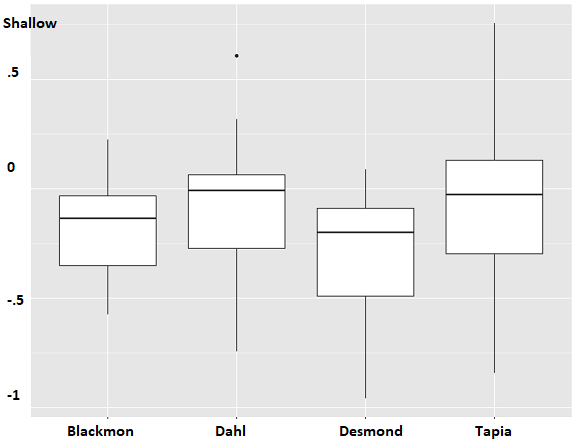
    On the box and whisker plots below, the whiskers represent the overall range of the plays made or not made, and the line in the box is the average (mean) run value for a player on balls hit to him.

    CoorsShallow2019 for blog


    Coors Deep for Blog

    You can see that Desmond has essentially failed to make any play on shallow balls at Coors, and as a result, he loses about a run defensively on every five balls hit in front of him.

    Conversely, younger and more fleet-of-foot outfielders David Dahl (who recently went on the IL with a sprained ankle) and Raimel Tapia have more or less held their own in making plays on deep and shallow balls at Coors. Neither are perfect fits; Dahl has a -10 DRS and Tapia has a -8 DRS on the year.

    This speaks to a larger point about Coors; it’s an extraordinarily hard place to prevent runs, both on the mound and in the field. Over the 17 years Baseball Info Solutions has been keeping track of DRS, Rockies’ outfielders have been 371 runs below league average. That encompasses everything we calculate — range, throwing, and making good defensive plays while avoiding mistakes.

    That’s the worst, and it’s not even close; the White Sox outfielders are 29th with 191 runs below league average, which is a 180-run difference. By Range and Positioning, the Rockies do move up two spots to a tie for 27th.

    It’s always going to be an uphill battle to save runs in the outfield for Colorado at home, but it’s also imperative that they make the best decisions possible with so many runs at stake. While Dahl and Tapia aren’t going to be topping the DRS leaderboards, they could be better options to track down balls at a premium position than Desmond. The Rockies tried a different look in the outfield on their last road trip, moving Desmond to left and Dahl to center (Dahl subsequently got hurt and others have played center since then). It may be worth making that a permanent change.