Category: Football

  • Preseason All-American Team: Cornerbacks

    Preseason All-American Team: Cornerbacks

    As we approach the start of the college football season, we will be releasing our 2022 Preseason All-American team throughout this month and next. Among our selections were three cornerbacks, along with six honorable mentions. 

    Check out our previous articles in these links:

    Offense: QB RB

    Defense: Edge

    Entire series

    The cornerbacks selected are…

    CB Kelee Ringo – Georgia

    CB Cam Smith – South Carolina

    DB Malachi Moore – Alabama

    After sitting out his first year in Athens due to an offseason surgery, Kelee Ringo quickly proved that he is one of the top cornerbacks in the nation and that NFL teams should be drooling over the possibility of having him at the next level.

    Listed at 6’2” and 205 lbs., Ringo looks more like a Will linebacker than a college cornerback. Ringo uses his physicality like a seasoned veteran and blends it with fluidity and speed that you don’t see from players that size. Though he made his name known to all with a stellar National Championship game, Ringo was that dude all year. He allowed only a 37% completion rate when targeted, along with a 47.5 QB Rating.

    With Georgia losing nearly its entire defense to the NFL, Ringo will need to become a leader and be the face of a defense that wants to prove that its predecessors were no fluke.

    Cam Smith is a physical cornerback with good size and mirror abilities. He projects as a high-level press-man cornerback at the next level. Smith shows speed to run with receivers, early eyes lead him to the ball, and he can take the ball away from an intended receiver. He is on a rising South Carolina defense that could lead the Gamecocks to a surprisingly successful season.

    Along with the impressive physical traits, Smith shows the technique to contain his opponent, which came through in his numbers. Smith had 3 interceptions, allowed just 5.5 Yards Per Attempt, and had a QB Rating of just 35.4 when targeted. 

    Whether listed as a cornerback or a safety, Malachi Moore is a difference maker. Rated as one of the top safeties in his recruiting class, Moore has become the ideal modern positionless player. Moore lines up primarily in the slot, but has snaps at outside cornerback, deep safety, in the box, and as an edge.

    When in coverage, Moore performed well, allowing a 77.3 QB Rating when targeted and only 5.6 Yards Per Attempt when targeted. Against the run, Moore took the role of a third LB and had an average tackle depth of 2.1 yards. Moore was also able to rush the passer efficiently, generating a pressure on 11.2% of his pass rushes. That number outpaced the 10.1% rate posted by First-Team All-Universe Edge, Will Anderson Jr.

    Honorable Mentions

    CB Eli Ricks – Alabama

    CB Riley Moss – Iowa

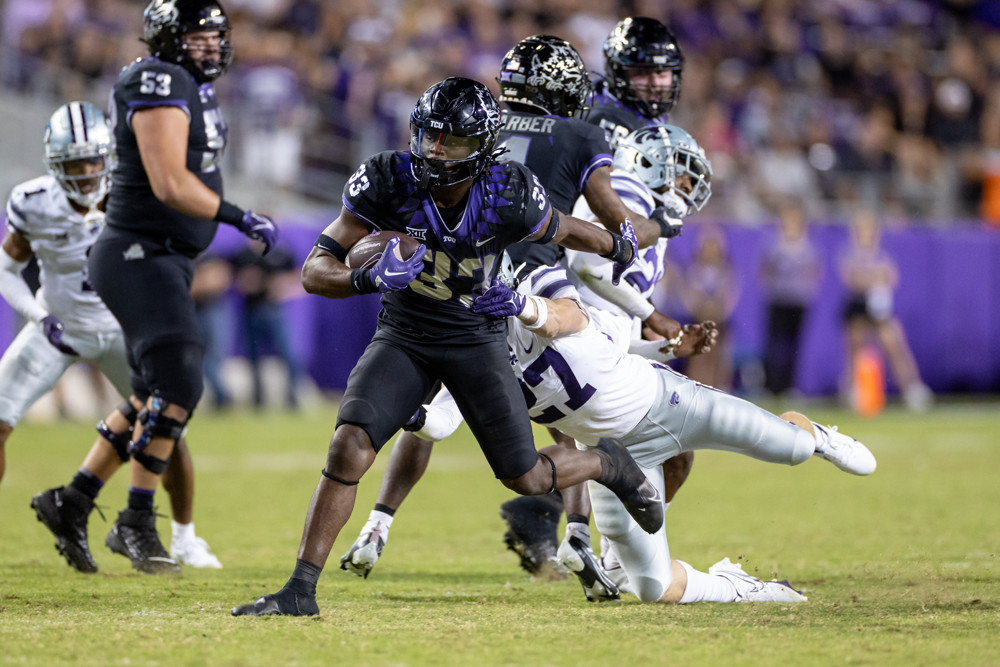
    CB Tre’Vius Hodges-Tomlinson – TCU

    CB Tykee Smith – Georgia

    CB Joey Porter Jr. – Penn State

    Darrell Luter Jr. – South Alabama

    With a plethora of talented cornerbacks across the country, there are multiple flavors to fit everyone’s taste. There’s those like Joey Porter Jr. of Penn State, with prototypical size to translate directly to the next level. There’s also those like Tre’Vius Hodges-Tomlinson of TCU, whose skill set would put them on the top of everyone’s draft board if they had the typical size NFL teams look for.

    When looking at production though, it is impossible to highlight anyone other than Darrell Luter Jr. of South Alabama. Luter put up staggering numbers when targeted in coverage: a 22% completion percentage, 2.9 yards per attempt, and a 0.0 QB Rating when targeted. Luter also performed well based on SIS metrics, leading the nation in Total Points Per Play and Points Above Average per play among cornerbacks.

  • Preseason All-American Team: Edge

    Preseason All-American Team: Edge

    As we approach the start of the college football season, we will be releasing our 2022 Preseason All-American team. Today, we’re adding a pair of Edge rushers, along with some honorable mentions.

    You can check out the previous articles below:

    QB RB Entire series

    The Edge players selected are…

    ED Will Anderson Jr. – Alabama

    ED Will McDonald IV – Iowa State

    The 6-foot-3 Anderson was arguably the best player in college football in 2021, leading all defenders in sacks as well as total pressures, where he was 11 better than the No. 2 pick in the NFL Draft, Aidan Hutchinson, who finished second.

    Anderson won the Bronko Nagurski Trophy (nation’s top defender) and will look to repeat his success in order to solidify himself as the nation’s best player before presumably entering the NFL Draft as a likely Top 5 pick.

    McDonald finally got his chance to start in Iowa State’s 3-3-5 defense and starred throughout the 2021 season, primarily lining up as a 5-technique. Among defensive ends, McDonald led the BIG 12 in total pressures and was third in sack percentage. McDonald did lead all FBS defenders in Points Above Average in 2021, just edging out Anderson, and will look to continue his ascension as one of the best defensive players in the country.

    Honorable Mentions

    ED Myles Murphy – Clemson

    ED BJ Ojulari – LSU

    ED Nolan Smith – Georgia

    ED Nick Hampton – Appalachian State

    ED Isaiah Foskey – Notre Dame

    Myles Murphy was a wrecking ball on Clemson’s defensive line in 2021. He had a team best 14 TFLs and 7 sacks. He is also 2nd among returning ACC Edges in Total Points. His wonderful blend of speed and power, and his nose for the ball, makes him a dangerous threat off the edge in both the pass and run game. 

    BJ Ojulari from LSU is 4th among returning SEC Edge rushers for Total Points behind only Anderson, Nolan Smith, and Brenton Cox Jr. He’s also 2nd among returning SEC rushers in Pressures and Pass Rush Total Points. 

    After the dominant defensive performance of Georgia’s defense during their title-winning 2021 season, Nolan Smith will look to maintain the excellence. He is 2nd among returning SEC Edge rushers in Total Points  

    Nick Hampton of Appalachian State set the Mountaineers FBS-era record for sacks in a season with 11. He was among 7 other rushers with at least 11 sacks in the 2021 season and will be a player to keep an eye on in 2022.

    Isaiah Foskey of Notre Dame led the Irish in sacks with 10 in 2021, and ranked 3rd  in Points Above Average among returning FBS players with a minimum of 30 pressures. He plays with leverage and a good mix of speed and power to work into the backfield and will need to use these traits to be a leader again along the Irish’s line.

  • Preseason All-American Team: Running Backs

    Preseason All-American Team: Running Backs

    The votes are in and we’ve picked our 2022 Preseason All-American team. We’ll announce a couple of positions per week right up to the beginning of the season. You can find all of our selections here.

    We move to running backs today and make two sections, along with five honorable mentions listed below that were discussed in- depth

    Our running back All-Americans are…

    RB Bijan Robinson – Texas

    RB Zach Charbonnet – UCLA

    Bijan Robinson and Zach Charbonnet not only led their respective conferences in Rushing Total Points, but led all FBS running backs returning in Total Points, each accounting for at least 60.

    Robinson had a breakout year in Texas’ offense last season, rushing for over 1,100 yards despite missing the last two games due to injury. He was near the top of the FBS in Broken + Missed Tackle % for all players, and tops among running backs in 2021. He should return healthy, and is primed to have another stellar season. His mix of power, elusiveness, and acceleration make him an all-around threat in the run game. 

    Charbonnet is a bruising back from UCLA and had over 1,100 yards with the Bruins last season. In 2021, he was an SIS FBS leader in Total Points Per Play when facing an overloaded defensive box. He also had a low Bust % which allows him to be a positive force in the Bruins offense. His ability to bounce off tackles and accelerate downfield minimizes the potential for negative plays, when hit behind the line of scrimmage. He is poised to continue his dominant running this season.

    Honorable Mentions

    RB Sean Tucker – Syracuse

    RB TreVeyon Henderson – Ohio State

    RB Jahmyr Gibbs – Alabama

    RB Lew Nichols III – Central Michigan

    RB Rasheen Ali – Marshall

    Sean Tucker will be one of the ACC’s top returning rushers in Rushing Total Points after rushing for nearly 1,500 yards last season.

    Henderson was a Doak Walker Award and Walter Camp Semi-Finalist as a freshman last year. He contributed 42 Total Points during his freshman campaign. He will look to take on a greater role in the Ohio State offense and improve upon his freshman mark with the loss of their top two offensive threats. 

    Alabama transfer Jahmyr Gibbs spent last season at Georgia Tech. Although he was not a 1,000-yard rusher at Georgia Tech, he was a versatile weapon for the Yellowjackets. He will battle for the starting spot at Alabama and is poised for a big year. 

    We also want to highlight Lew Nicholls III from Central Michigan. Last year, he led all FBS rushers in yards and yards per game. He ended the year with over 1,800 rushing yards and 2,100 all-purpose yards. He was a vital part to the Chippewas offense, and his ability to lower his shoulder to fight for extra yards will be vital to maintaining that high mark for the 2022 season.

    Finally, we wanted to give an honorable mention to Rasheen Ali from Marshall. Ali is the returning Total Points leader for running backs in Conference USA. He is a downhill runner that amassed around 1,400 yards last season 

  • 2022 Preseason All-American Team: Quarterbacks

    2022 Preseason All-American Team: Quarterbacks

    As we approach the start of the college football season, we will be releasing our 2022 Preseason All-American team over the next several weeks. Only one quarterback could be selected to the team but we have a few honorable mentions that were discussed in depth as well.

    The quarterback selected was…

    QB Bryce Young – Alabama

    The 2021 All-American and Heisman winner did it all last season. Despite not winning the national championship game, he had an incredible sophomore campaign. With another year under his belt, Young will look to repeat his success after a season in which he finished 2nd in the country in passing yards and touchdown passes, trailing only Bailey Zappe of Western Kentucky.

    Among returning quarterbacks, Young led the FBS with 212 Total Points, finishing 40 points better than his main Heisman rival, C.J. Stroud of Ohio State. With his supporting cast having some turnover, Young will look to create chemistry quickly, throwing early and often as Alabama begins its national title pursuit.

    Honorable Mentions

    QB CJ Stroud – Ohio State

    After missing the CFP in 2021, Stroud looks to lead the Buckeyes to the national championship in 2022. Stroud finished 2nd in Total Points and 3rd in touchdown passes among FBS quarterbacks in 2021, trailing Young in both categories. With a star-studded offense, it would not be surprising to see a Heisman in Stroud’s future.

    QB Grayson McCall – Coastal Carolina

    McCall is the front man for Coastal Carolina’s high octane offense, which averaged 40.9 PPG last season. In 2021 McCall led all FBS quarterbacks in TD% as well as traditional quarterback rating and should continue his dominance in 2022. 

    QB Jake Haener – Fresno State

    Haener seems to be the class of the Mountain West going into the 2022 season. He finished behind only Carson Strong in On-Target% and Completion% in the Mountain West and should be viewed as one of the top non-Power 5 quarterbacks in college football.

  • Reviewing The 2019 NFL Draft Class

    Reviewing The 2019 NFL Draft Class

    While many crave all the NFL Draft Team Grades that publications put out the day after the draft, including us on both accounts, there are many others who can’t stand it. Of course, we all have our own NFL Draft prospect rankings heading into that weekend, but those players have yet to play a single snap in the NFL. So, how can we really grade a team’s draft class if those players haven’t yet stepped onto the field?

    It usually takes at least three years to see how well a draft class turned out. While said publications, including us, don’t want to wait three years before putting out their grades on a draft class, we decided to now do both.

    Three years ago, prior to the 2019 NFL Draft, Sports Info Solutions created its first ever draft guide: The SIS Football Rookie Handbook. This book marked a first for SIS, as it was the first football publication since the company added the sport on the data collection front in 2015. After the 2019 NFL Draft, we, just as many others, posted our NFL Draft Team Grades, which can be seen here.

    I’ve developed a system to evaluate the draft classes using Total Points relative to position as the foundation. Now that three seasons have gone by, let’s use that to truly see how each team did with getting value from their selections in the 2019 NFL Draft.

    How much value did teams get?

    Before we get into the process, let’s take a look at how we ranked teams after the 2019 NFL Draft and then who got the most and least value. See the Appendix below to see how all 32 teams ranked in our 2019 rankings and in TP Score.

    Here are the teams we ranked at the top immediately following the draft back in 2019. To see our scouting grading scale, check out our new NFL Draft site.

    Top 5 Teams in 2019 Post-Draft Rankings
    Team Book Rank Grade
    Titans 1 6.63
    Bills 2 6.50
    Cardinals 3 6.46
    Ravens 4 6.44
    Bengals 5 6.44

    TP Score will be defined below, but here are the top 5 teams based on how much value they received from their draft class.

    Top 5 Teams in TP Score
    Team TP Rank TP Score
    Titans 1 84.64
    Broncos 2 82.81
    Raiders 3 77.23
    Buccaneers 4 67.50
    Jaguars 5 62.18

    The No. 1 team in 2019 (the time of our initial evaluation) and in this ranking both worked out to be the Tennessee Titans. Five of their six draft picks have been above average, all playing in at least 38 games over the past three seasons. The only pick who didn’t hit was D’Andre Walker, who appeared in only one game.

    The top 3 teams, the Titans, Broncos, and Raiders, are at the top for a reason. They drafted good players throughout their entire draft class. They were the only teams to draft above-average players on 75% or more of their draft class.

    Conversely, here are the bottom 5 teams from our 2019 rankings.

    Bottom 5 Teams in 2019 Post-Draft Rankings
    Team Book Rank Grade
    Saints 28 6.12
    Browns 29 6.10
    Seahawks 30 6.03
    Lions 31 6.00
    Chiefs 32 5.90

    Based on TP Score, here are the worst teams in terms of getting value from their 2019 draft picks.

    Bottom 5 Teams in TP Score
    Team TP Rank TP Score
    Chargers 28 16.00
    Panthers 29 14.53
    Bengals 30 12.48
    Eagles 31 12.24
    Seahawks 32 10.12

    Determining Total Points Score

    Now that you’ve seen the rankings, let’s explain the process. When looking back to see how good or bad a specific draft class was, there are two main points to detect:

    1. How productive were the draft picks on the field?
    2. How much talent did the team draft relative to the amount of picks they made? 

    As in: Did they hit on one player or did they hit on multiple players?

    To determine the value of the draft classes, I used Total Points, our flagship player value stat, from across the last three seasons. However, for those of you who are familiar with Total Points, it gives a lot of extra weight to quarterbacks. With that said, Kyler Murray, the No. 1 pick, alone would have had the 5th best draft class with his 286 Total Points if we just used raw Total Points.

    While there is a reason we weigh quarterbacks so much more compared to other positions (they are pretty important), using that raw number in this sense isn’t going to make for a perfect match. Yes, the Cardinals got a lot of value in Murray, but when looking at their draft class as a whole, I think many would agree they didn’t have the best draft class. A fate they would have had if just using raw Total Points.

    Now, answering the second question takes into account how well a team drafted throughout the entirety of the draft class. I found the average Total Points per player from the 2019 class at each position, including UDFAs who have taken at least one offensive or defensive snap, since they were also available to be selected.

    The positional averages are shown in the table below.

    Pos TP per Player
    QB 38.1
    RB 8.8
    WR 15.7
    TE 11.2
    OL 25.3
    ED 29.1
    DT 19.8
    LB 23.5
    CB 23.2
    S 30.2


    The TP Score, as referenced earlier, is what’s used to rank the teams. It is calculated as follows:

    1. Add up the Total Points from the entire team’s draft class

    2. Divide that number by the number of selections the team had

    3. Multiply that number by the percentage of draft picks that were above the average Total Points for their given position

    4.Add that to the original Total Points per draft pick

    In these 4 steps, we are essentially answering how productive the draft class was and how many picks were “hits”.

    Let’s run through an example using the Chicago Bears.

    Here is their Draft class:

    Pos Player Total Points
    RB David Montgomery 45
    WR Riley Ridley 4
    CB Duke Shelley 21
    RB Kerrith Whyte Jr. 2
    CB Stephen Denmark 0
    1. Add up the Total Points from the entire team’s draft class
    72
    2. Divide that number by the number of selections the team had
    72 Total Points divided by 5 selections equals 14.40
    3. Multiply that number by the percentage of draft picks that were above the average Total Points for their given position
    David Montgomery was the only player whose Total Points were above average
    14.40 times 20% (1 out of 5) equals 2.88
    4. Add that to the original Total Points per draft pick
    14.40 plus 2.88 equals 17.28, which is their TP Score


    So, to summarize, we took the team’s Total Points gained from these players, dispersed it throughout the entire class and then gave a bump based on how many above-average players they drafted.

    Now that we know how the teams ranked and how the TP Score is calculated, let’s dive into some of the details.

    Other Key Takeaways

    – The Raiders “hit” on 7 of their 9 picks. It is interesting to note that all three of their 1st-Round picks, Clelin Ferrell, Josh Jacobs, and Johnathan Abram, had their 5th-Year Options declined. However, they still played well enough to be above-average players. Plus, that doesn’t include gems they found later in the draft in Maxx Crosby and Hunter Renfrow.

    – Every team drafted at least one player who has played above the positional average compared to the rest of the draft class. However, Dallas (Trysten Hill), New England (N’Keal Harry), Philadelphia (Andre Dillard), Seattle (L.J. Collier), and Washington (Dwayne Haskins) were the only teams whose first draft selection wasn’t an above-average player.

    – The Cardinals draft class accumulated the most Total Points with 446, though as mentioned before, Kyler Murray accounted for 286 of them. They hit on 3 of 11 draft picks on their way to a No. 7 ranking. It’s worth noting that their Supplemental Draft selection of Jalen Thompson and his 73 Total Points isn’t included, as he isn’t part of their original draft class.

    – The fewest Total Points came from the Eagles. They garnered only 51 Total Points across their five draft picks, with 43 coming from Miles Sanders.

    – Hitting on quarterbacks is pivotal to winning in the NFL, as seen by Kyler Murray in 2019. Conversely, missing on quarterbacks can set teams back. Carolina and Cincinnati both took quarterbacks who severely hurt their Total Points number and pushed them down the rankings, even in minimal games played.

    Will Grier accounted for -26 Total Points out of Carolina’s 89 total. Funny enough, Brian Burns had 91 himself. Ryan Finley was even worse for Cincinnati with -39. In nine games in which Grier and Finley played and threw at least one pass, they combined for a 1-8 record.

    It’s possible the teams had a better chance of winning if neither played. If both had never played and accumulated 0 Total Points, Carolina would have improved four spots in the rankings and Cincinnati would have improved three spots.

    How do our Initial Grades Compare?

    56% (18/32) of our initial ranks were in the correct half. Meaning a team we ranked between 1 and 16 or 17 and 32 was ultimately in that tier. And before I get too much further, I want to make sure it’s understood that 2019 was our first year of the Handbook which meant there were plenty of growing pains. Major changes took place beginning in 2020 after studying our initial process.

    The biggest differences in our initial grades and these final rankings were the Bengals (25 spots), Eagles (23 spots), and the Ravens (23 spots). We rated these teams near the top immediately following the draft, but they finished near the bottom based on these rankings.

    For Cincinnati, we’ve already talked about Ryan Finley (who was our No. 4 QB), but they also drafted two running backs. Rodney Anderson (SIS No. 4 RB) has battled injuries his entire career and Trayveon Williams (SIS No. 5 RB) has been buried on the depth chart and has seen minimal playing time.

    The Eagles took four of five players who were featured in the Handbook, with Miles Sanders and Andre Dillard both grading out as a 6.7. As mentioned earlier, Dillard was one of the top picks who has failed to be an above-average player. For Baltimore, all eight selections were in the Handbook, and we graded six of them at 6.4 or higher. They clearly have underperformed based on our initial grading.

    What were some of our biggest misses elsewhere? Not including Mecole Hardman or Sean Murphy-Bunting proved to be a big miss. As mentioned before, immediate action was taken to improve upon our process to make sure we weren’t missing good players and early draft picks.

    Additionally, we ranked Wisconsin OG Beau Benzschawel as our No. 4 guard and New Mexico State LB Terrill Hanks as our No. 5 linebacker. Neither have played a snap in the NFL.

    Nik Needham is first and foremost when we talk about our NFL Draft wins. He’s been a big talking point around the company for the past three years. We ranked him as our No. 4 corner going into the draft, and he currently ranks third in Total Points among 2019 CBs (we were higher on him than any other mainstream draft analyst). His 85 Total Points tops all UDFAs from the 2019 class and ranks 12th overall.

    The table below shows the top Total Points earners across the past three seasons and how we graded and ranked them in the Handbook.

    Rank Position Player Total Points SIS Grade SIS Pos Rank
    1 QB Kyler Murray 286 6.8 2
    2 ED Nick Bosa 120 7.0 1
    3 LB Devin White 99 7.0 1
    4 CB Jamel Dean 97 6.7 6
    T-5 ED Maxx Crosby 96 6.5 11
    T-5 CB Byron Murphy 96 6.9 3
    T-5 WR Deebo Samuel 96 6.7 4

    While we were a little low on Dean and Crosby, all eight of these guys were tabbed as starters in some form by our scouts.

    Conclusion

    Nobody really knows how a draft class is going to turn out immediately after the draft, as stated before, yet it still makes sense to grade and rank the teams based on player grades for an initial reaction. Post-draft grades are great in a sense, but they should be taken with a grain of salt. Once three years go by and we’ve seen what these players have done in the NFL, we can get a better sense of how good the team drafted.

    These rankings are all about finding which teams drafted the best draft class as a whole, not just who got the best player. While there are some players who didn’t play for the team that drafted them for the entirety of the past three seasons, that wasn’t taken into account since those decisions came after the initial drafting of these players, which is what this is based off of. It’s not a perfect science, but it does a good job at pulling player value and seeing how well teams drafted as a whole class.

    Three years later, the comparison between our initial rankings and these rankings aren’t terrible for Year 1 (in both our grading and our scouting process). Though, we hope this article next year takes a large positive swing given the process changes we made heading into the 2020 cycle.

    As with everything we do here, we hope this improves year over year and can look back and say we kept getting better every day.

    Appendix

    2019 SIS Post-Draft Rankings based on the SIS Football Rookie Handbook

    Team Book Rank Grade
    Titans 1 6.63
    Bills 2 6.50
    Cardinals 3 6.46
    Ravens 4 6.44
    Bengals 5 6.44
    Raiders 6 6.40
    Broncos 7 6.38
    Eagles 8 6.34
    Jaguars 9 6.33
    Cowboys 10 6.30
    Patriots 11 6.30
    Rams 12 6.30
    Falcons 13 6.29
    Giants 14 6.28
    Panthers 15 6.24
    Packers 16 6.24
    Dolphins 17 6.22
    Steelers 18 6.21
      Commanders 19 6.21
    49ers 20 6.20
    Buccaneers 21 6.20
    Jets 22 6.20
    Texans 23 6.17
    Vikings 24 6.14
    Bears 25 6.14
    Chargers 26 6.13
    Colts 27 6.12
    Saints 28 6.12
    Browns 29 6.10
    Seahawks 30 6.03
    Lions 31 6.00
    Chiefs 32 5.90

    TP Rank based on TP Score and how much value each team got from their draft picks over the last three seasons

    Team TP Rank TP Score
    Titans 1 84.64
    Broncos 2 82.81
    Raiders 3 77.23
    Buccaneers 4 67.50
    Jaguars 5 62.18
    49ers 6 60.19
    Cardinals 7 51.60
    Packers 8 48.38
    Saints 9 48.16
    Chiefs 10 44.50
    Commanders 11 43.68
    Dolphins 12 41.00
    Giants 13 40.80
    Texans 14 37.96
    Bills 15 36.00
    Rams 16 34.72
    Jets 17 32.89
    Browns 18 30.00
    Colts 19 29.25
    Lions 20 27.77
    Falcons 21 25.16
    Vikings 22 22.00
    Cowboys 23 21.72
    Steelers 24 18.81
    Patriots 25 18.60
    Bears 26 17.28
    Ravens 27 16.25
    Chargers 28 16.00
    Panthers 29 14.53
    Bengals 30 12.48
    Eagles 31 12.24
    Seahawks 32 10.12


  • Why Kansas Should Embrace The Triple Option

    Why Kansas Should Embrace The Triple Option

    Kansas football over the last decade has been, to put it mildly, less than stellar. Since the end of the 2009 season, Kansas has gone 23-118 overall and 7-99 in the Big 12. The Jayhawks had lost 56 consecutive Big 12 road games, before beating Texas this past season, and 44 consecutive games against AP-ranked teams. 

    During this stretch, they also set the FBS football record for most consecutive road losses with 46 until they beat Central Michigan in 2018. Lance Leipold is the sixth head coach of the program since Mark Mangiano resigned and inherited a program that hasn’t been ranked since 2009. 

    Leipold has his work cut out for him as Kansas struggled in just about every area in 2020 and continued to do so in 2021. The Jayhawks were outscored by almost 22 points per game in 2021.

    They averaged 3.8 yards per rush while allowing 6.0. They’ve completed 61% of their passes to their opponents 70%. It’s a rough watch.

    Kansas has become the laughingstock of college football and is a non-threat year in and year out.

    So how does a team that has gone winless in two of the last seven seasons compete in the high-octane Big 12? 

    Embrace the triple option

    The triple option is not a glamorous offensive scheme, but it can still be highly effective. Kansas doesn’t attract the same level of recruits as the more successful Big 12 teams so it can’t play the same game at their level. Instead, Kansas should slow the game down and run the ball in a conference historically known for poor, or at least exposed, defenses. 

    Let’s start with some of the triple option principles.

    Triple option offenses need their linemen to get after the opposing defensive linemen, a smart quarterback who can make the correct read, and several effective running backs. The entire offense needs to be well-disciplined, but because players aren’t asked to win one-on-one battles in space often, the scheme can help eliminate some of the talent gap. 

    Offenses move at a slower pace in the triple option, which will allow the Kansas defense to rest more and take the ball out of the opposing quarterback’s hands. Running this scheme will result in some negative plays, but they aren’t as prevalent and are usually minor losses, putting the offense in a lot more short-yardage third-down situations.

    Since 2017, triple option runs have averaged more yards per carry (5.5) than non-triple option designed runs (4.9). In addition, they have a significantly higher positive yard percentage and a significantly lower negative yard percentage.

    Triple Option Runs  Non-Triple Option Runs
    Positive Yardage 87% 80%
    Negative Yardage 7% 12%
    No gain 6% 8%

    Triple Option in the NCAA Today

    Army, Navy, and Air Force are some of the most recognizable triple option teams in college football and have had a lot of recent success running the scheme. Army has had at least 8 wins in five of the last six years, Navy has had at least 8 wins in 15 of the last 19 years, Air Force has had a winning record in 10 of the last 15 years, and Georgia Tech in the late 90’s and early 2000s had 13 straight seasons with a winning record, running primarily the triple option. 

    Some of the positive effects can be clearly seen with 2021 data.

    Air Force ranked 1st out of 130 FBS teams in time of possession, Army was 2nd, and Navy was 5th, while Kansas was 38th. This keeps the opposing offenses off the field and slows the game down for teams that struggle to stay with high powered offenses.

    Two of the most telling stats are plays per game and opponent plays per game. Air Force, Navy, and Army were 34th, 85th, and 97th respectively in offensive plays per game while Kansas was 124th. 

    Army, Navy, and Air Force were 2nd, 3rd, and 4th respectively in opponent plays per game while Kansas was 43rd. When you combine those numbers, the average Air Force game and Kansas game had about the same amount of plays, but Air Force ran about 10 more offensive plays a game while their defense conversely was on the field for 10 fewer plays.

    Keeping the defense fresh and establishing a running game early are major factors in a triple option offense, and over the course of a season, it adds up.

    Triple Option in the Power 5

    All of these stats are nice, but could it actually work in a Power 5 football conference? 

    Oklahoma had firsthand experience with the difficulty of a triple option team in 2018.

    Oklahoma was ranked 5th in the country heading into a home game with Army. Oklahoma was favored by 28.5 points at kickoff and its fanbase was expecting an easy win. Army had other plans. Though the Sooners ended up winning the game, they needed to go to overtime to defeat the pesky Black Knights. 

    The reason it was so close wasn’t that Oklahoma couldn’t move the ball on offense. The opposite in fact. Oklahoma averaged nearly 9 yards per play, but Army kept the ball out of future Hesiman winner Kyler Murray’s hands. 

    Army had the ball for an unbelievable 45 minutes of game time. It averaged 4.3 yards per play, putting itself in a lot of 3rd-and-short situations. It converted 13-of-21 3rd-down conversions and 4-of-5 4th-down conversions. Oklahoma only had three 3rd downs all game and Army ran 87 plays to Oklahoma’s 40.

    There were a total of 16 possessions, including overtime, in the game. While Army did lose, it did everything right to keep the game within reach and an extra turnover was the only real thing that kept them from winning.

    Even in games where the time of possession is more balanced, triple option teams have a way of hanging around. Michigan was favored by 22.5 points against Army in Ann Arbor in 2019, but still needed double overtime to win the game. 

    While playing sound defense was a major part of this game, Michigan only had two tackles for loss in the game which allowed Army to have 3rd and short frequently. Even when the Army offense was struggling, they took time off the clock and shortened the game which was nearly enough to pull off the massive upset.

    Kansas’ Recruiting Advantage

    While the service academies may not face Power 5 opponents on a weekly basis, they have been generally effective when they do play. Army, Navy, and Air Force have had the luxury of perfecting their offense over a lengthy period of time, where Kansas would be starting from square one, so where can Kansas make up some ground?

    One advantage Kansas could have against the service academies is recruiting. According to 247Sports, Kansas hasn’t finished above 8th in the Big 12 recruiting classes since 2011 and more often than not, finds itself in last. The vicious cycle is tough to break. Kansas doesn’t win so recruits don’t want to go to Kansas. Kansas doesn’t get recruits so Kansas doesn’t win. It perpetuates year in and year out. They can’t offer the national exposure or NFL development that teams like Oklahoma or Texas can offer so it’s tough to compete against those schools. It can offer a few things the service academies can’t however. 

    Service academies don’t award full scholarships for football, Kansas can. The requirements to get into a service academy are much higher than at Kansas. Players looking to play in a triple option offense in college will now have a more difficult choice which could steer a few talented players towards Kansas.

    If recruits are motivated to play at the next level more by football than serving their country, Kansas can be an attractive alternative. Triple option offense can still be found in high school programs and giving those players a familiar offensive scheme can benefit both sides. Kansas should be able to recruit better players than Army, Navy, and Air Force giving them a chance at a high-functioning triple option team despite a lack of tradition.

    The triple option is not the most exciting offense in the world. It’s an old school, lunch pail style offense, but it can give Kansas a chance to compete, something that it hasn’t done for awhile. The road back to relevance is a long and arduous one, but it is achievable. Kansas has had so little success trying the conventional ways so honestly, what does it have to lose?

  • 2022 NFL Draft Team Grades

    2022 NFL Draft Team Grades

    If you want our full thoughts on the players your team has added, you can check out the brand new SIS NFL Draft site for tons of great information. And if you’d like to contribute to next year’s draft cycle, consider applying to our Football Video Scout position.

    After three years of the SIS Football Rookie Handbook, our “Draft Guide” is now a website. However, not much changed with the transition. Actually, it allowed us more time to take the next step and go even bigger and better than the book has ever allowed us to do. With that said, we had 410 players on the site this year. We grade ourselves on how many players were drafted that we had on the site.

    After having 69% (174 of 254) of drafted players in the book in 2019, 78% (199 of 255) in 2020, and 84% (218 of 259) in 2021, we raised that number to 86% (226 of 262) for Year 1 of the website.

    When taking out specialists and fullbacks, which we currently don’t write up, there were only 29 players drafted who weren’t on the site and only 6 of which we didn’t get eyes on. That’s nearly 98% of the NFL Draft covered! Plus, many players who didn’t get drafted have already signed UDFA deals with teams.

    Now using our grades, we attempted to rank each team’s draft class. Just like in our article from last season, we assigned all grades from the site.

    Here are the draft classes ranked in order of their grade:

    Final Rankings

    Rank Team # of Picks Draft Grade
    1 Jets 7 6.53
    2 Eagles 5 6.46
    3 Lions 8 6.45
    4 Ravens 11 6.43
    5 Panthers 6 6.40
    6 Texans 9 6.38
    7 Seahawks 9 6.34
    8 Falcons 8 6.30
    9 Jaguars 7 6.30
    10 Saints 5 6.30
    11 Giants 11 6.28
    12 Packers 11 6.27
    13 Chiefs 10 6.27
    14 Bengals 6 6.23
    15 Commanders 8 6.19
    16 Titans 9 6.17
    17 Raiders 6 6.15
    18 Patriots 10 6.14
    19 Vikings 10 6.10
    20 Cowboys 9 6.10
    21 Browns 9 6.09
    22 Cardinals 8 6.08
    23 Bears 11 6.05
    24 Bills 8 6.04
    25 Broncos 9 6.02
    26 Steelers 7 6.01
    27 Chargers 8 6.00
    28 49ers 9 5.98
    29 Buccaneers 8 5.94
    30 Colts 8 5.90
    31 Rams 8 5.86
    32 Dolphins 4 5.80

    One difference is that we’ve usually assigned all players that weren’t in the book a flat 5.7, but with the number of players who made the site and with dropping some of the grade thresholds, we bumped that number to 5.4 this year, which is the equivalent to a training camp body. We took those grades for each player and divided that by the number of selections the team had. These rankings do not account for the value of where players were drafted or trades teams made; it is literally based on the grades we gave the players who were drafted.

    The 2022 Best Draft Class, with an average grade of 6.53, went to the New York Jets. They had seven draft picks and made the most of them by selecting players who were all featured on the SIS NFL Draft site.

    The Jets draft class is in the table below.

    New York Jets 2022 Draft Class

    Pick Position Player College Grade
    4 CB Ahmad Gardner Cincinnati 6.8
    10 WR Garrett Wilson Ohio State 6.8
    26 ED Jermaine Johnson II Florida State 6.7
    36 RB Breece Hall Iowa State 6.7
    101 TE Jeremy Ruckert Ohio State 6.6
    111 OT Max Mitchell Louisiana 6.3
    117 ED Micheal Clemons Texas A&M 5.8

    It definitely doesn’t hurt the draft grade when you get three 1st-Round picks, especially when they’re all highly graded. The Jets did just that. After selecting Ahmad Gardner at No. 4 (SIS No. 2 CB) and Garrett Wilson at No. 10 (SIS No. 3 WR), they traded back up to No. 26 to grab Jermaine Johnson II (SIS No. 5 Edge).

    Gardner is a long press corner who figures to step into the mix right away. Wilson is an excellent receiver with the traits to be a top receiver option. Johnson has the pass rush ability to be a force getting to the quarterback early and often.

    Beyond that, Breece Hall (SIS No. 2 RB) in the 2nd Round was good value, as he could eventually take over the starting job. Jeremy Ruckert (SIS No. 2 TE) could arguably be the best and most complete tight end in this class.

    Max Mitchell and Micheal Clemons on Day 3 were great value picks who should come in and compete for depth spots within their first couple seasons.

    SIS Top Draft Classes

    Year Team Previous Season Following Season 2nd Season
    2019 Tennessee Titans 9-7 (No Playoffs) 9-7 (L, AFC Champ) 11-5 (L, Wild Card)
    2020 Cleveland Browns 6-10 (No Playoffs) 11-5 (L, Divisional) 8-9
    2021 Detroit Lions 5-11 (No Playoffs) 3-13-1 ?
    2022 New York Jets 4-13 (No Playoffs) ? ?

    Since we grade players based on what they will be at the beginning of Year 2, let’s widen the table of our recent Draft Class winners. After winning in 2019, the Titans made consecutive playoff appearances. While the Browns made the playoffs the next year, the turmoil in that locker room this year forced a fall to 8-9.

    Finally, the Lions did take a dip this season after taking home the No. 1 class last year, but it was Year 1 with a new regime and they were competitive in most games. Look for them to take a step forward in 2022.

    What does that mean for the Jets? They got their franchise quarterback in Zach Wilson last year and have added good pieces around him. If he’s able to show significant development in Year 2, look for them to improve upon their 4-13 record last year.

    Scout’s Choice

    John Todd: Houston Texans (SIS Rank: 6th)

    After not having a 2021 selection until the 3rd Round last year, and only 5 picks overall, the Texans needed to make up for lost time in 2022. Determining if QB Davis Mills will be a hit is the biggest key, but we feel like Houston’s draft class this year did a great job of building up the team around him.

    Each of the Texans first 6 selections this year received a 6.4 grade (role-playing starter) or higher. Their first three choices of Derek Stingley Jr. (6.9, SIS No. 1 CB), Kenyon Green (6.9, SIS No. 1 OG) and Jalen Pitre (6.8, SIS No. 4 S) project to be high-impact players and potential cornerstone choices for the new regime. Their next three mid-round picks are all football-young, upside picks from the SEC in WR John Metchie III, LB Christian Harris, and RB Dameon Pierce.

    They did a great job of finding quality contributors after the first two rounds and made some big splashes with their early picks. There’s a long way to go in Houston, but this was a big step in the right direction.

    Nathan Cooper: Detroit Lions (SIS Rank: 3rd)

    This is a homer pick, but the Lions rank 3rd this season after taking home the top honor last year. That’s two outstanding draft classes in the first two seasons for Brad Holmes and company.

    Aidan Hutchinson was the top player on the SIS board, and one of only three 7.0 players graded this year. Getting him at No. 2 had the Lions War Room as ecstatic as they were to get Penei Sewell at No. 7 last year. Then, instead of sitting back at No. 32, they moved up to No. 12 without having to give up a 2023 1st-Round pick, and took Jameson Williams (SIS No. 2 WR). The Lions need impact players, and they got one on each side of the ball.

    On Day 2, Josh Paschal (SIS No. 10 Edge) is a strong, versatile defensive lineman with heavy hands and the ability to work against both the run and pass. Additionally, Kerby Joseph (SIS No. 5 S) has the range on the back end and is still learning the position.

    If not for an injury early in 2021, James Mitchell (SIS No. 12 TE) could’ve been in the top 5-7 tight ends heading into this year’s draft. The other Day 3 picks of Malcolm Rodriguez, James Houston IV, and Chase Lucas should all compete for depth spots at their respective positions, and at worst fill some holes on special teams.

    Jordan Edwards: Baltimore Ravens (SIS Rank: 4th)

    The Ravens were able to accumulate an abundance of talent with safety Kyle Hamilton, center Tyler Linderbaum, and tight end Isaiah Likely, who were our top ranked players at each of their respective positions. In addition to that, they added players who can make an immediate impact, such as nose tackle Travis Jones (SIS No. 2 NT) and a towering tackle prospect in Daniel Faalele (SIS No. 8 OT), who can fill a void in the offensive line left last year from the Orlando Brown trade.

    Also, looking ahead to the 2023 season they’ll have edge rusher David Ojabo (SIS No. 8 Edge), who is coming off a torn Achilles injury, that should make a very intriguing pass rush pairing with former high school teammate Odafe Oweh.

    Jeff Dean: Kansas City Chiefs (SIS Rank: 13th)

    The Chiefs defense should look a lot different next year with 5 of their top 6 picks going to that side of the ball. Trent McDuffie (SIS No. 3 CB) is a perfect fit in their defense and with half of their draft picks being defensive backs, it was clearly an area of concern. George Karlaftis (SIS No. 4 Edge) and Leo Chenal (SIS No. 3 Mike LB) both add immediate toughness in their front seven and should challenge for starting spots right away.

    While trading away Tyreek Hill created an area of need at wide receiver, the Chiefs didn’t jump up during the early wide receiver run and snagged a dynamic playmaker in Skyy Moore (SIS No. 9 WR). Darian Kinnard (SIS No. 3 OG) was once viewed as a 1st-Round pick and offers extreme value late in the draft. The Chiefs just solidified themselves as an AFC contender again with a strong draft.

    Ben Hrkach: Seattle Seahawks (SIS Rank: 7th)

    The Seahawks draft haul included a blend of easily translatable players that should start early in their career, especially Charles Cross (SIS No. 2 OT), as well as prospects with high-level traits that could excel at their position, such as Boye Mafe (SIS No. 9 Edge), Kenneth Walker III (SIS No. 3 RB), Coby Bryant (SIS No. 5 CB), and Tariq Woolen (SIS No. 14 CB), if they fulfill their potential.

    With what looks to be a strong QB class in 2023, Seattle is situated to replicate their “Legion of Boom” roster with solid starters throughout, all with controllable, salary cap-friendly contracts.

    Bottom of the rankings

    The bottom three teams for 2022, listed 30 to 32, were the Colts. Rams, and Dolphins

    Although the Colts didn’t possess a 1st-Round pick, they were still able to grab Bernhard Raimann (SIS No. 6 OT) in the 3rd Round, which was their best pick according to our grades. Alec Pierce (SIS No. 12 WR) is a solid No. 3 option and Jelani Woods (SIS No. 11 TE) is an athletic freak, but we project him as more of a backup. Additionally, they seemed to go heavy on small-schoolers, taking three FCS players late in the draft, two of which were not featured on the site.

    The Rams took home the worst draft class last year, and look at how that worked out. They won the Super Bowl. It’s apparent Les Snead isn’t worried about draft picks, so when you don’t have many early-round selections, it’s highly likely you’ll find yourself near the bottom.

    With that said, three of their eight selections were players not featured on the site. Their best selection was Derion Kendrick (SIS No. 11 CB) in the 6th Round. He struggled at his Pro Day, but has the tools to be a low-end starting corner at the next level. We view Kyren Williams (SIS No. 14 RB) as a 3rd-down difference maker and Logan Bruss (SIS No. 13 OG), their first selection of the draft, as a versatile backup along the O-Line.

    This year’s worst class goes to the Miami Dolphins. Another team without an early-round pick, their first pick came in the 3rd Round.

    However, it was an awesome one in Channing Tindall (SIS No. 4 Will LB). He’s an absolute missile at the linebacker position with a non-stop motor. After selecting Tindall, they drafted Erik Ezukanma (SIS No. 36 WR) in the 4th Round with Cameron Goode and Skylar Thompson coming in the 7th. Thompson just missed out on making the website.

    With the trade for Tyreek Hill, however, one can argue that he’s part of the draft class and should be a huge weapon for Tua. Can the Dolphins follow in the footsteps of the Rams and win the Super Bowl after having the worst draft class? We’ll see.

    Key Facts

    Ten teams selected players who were all featured on the NFL Draft site. An additional three teams selected all but one, with the one being a special teams player.

    After having the No. 2 Draft Class, the Eagles have reportedly added twelve UDFAs post-draft, with Carson Strong (SIS No. 5 QB), EJ Perry (SIS No. 8 QB), Mario Goodrich (SIS No. 18 CB), and Noah Elliss (SIS No. 5 NT) highlighting the group.

    The Ravens have selected only three players who were not featured in the Handbook or on the site over the last four seasons, and only one wasn’t a fullback or punter (Brandon Stephens).

    Across the past four seasons, the Bengals have the best average SIS Draft Class rank and grade average based on what grades were given in the Handbook and onto the website.

    How the Handbook Compared to the Draft

    Let’s take a look at how the SIS website stacks up to the NFL’s thinking of where players were selected. Outside of the Travon Walker/Aidan Hutchinson situation, SIS’s top player at each defensive position (NT, DT, Mike LB, Will LB, CB, and S) matched the first player of that group taken in the draft.

    However, offensively we saw plenty of differences, only matching the first center (Tyler Linderbaum) and guard (Kenyon Green) taken. We matched with the same group of first five tackles taken, Mike linebackers, and edge rushers in slightly different orders, and matched 4 of the 5 at multiple positions. Every player an NFL team took within the top five at his position was on our website with a worthy grade, which we’re very proud of. The difference of opinion is healthy, and we’ll be interested to see how it shakes out in the years to come.

    Overdrafted?

    Some of the players we believe were taken too early in our estimation were Arnold Ebiketie and Tyquan Thornton, two top 50 selections who received 5.9 grades from our scouts. We liked the traits enough to give them top backup grades, but there’s work to be done to become a starting-caliber player.

    The first round lined up with our grades very well. Again, our methodology of role-based scouting doesn’t lend itself to lining up perfectly with the rounds that players are selected in, but generally speaking, taking a player graded as a backup very early isn’t a good thing, as only 4 of the first 32 did not receive a 6.7 or higher from SIS. 

    However, we did have the Patriots’ selection of Cole Strange as our biggest Day 1 “reach.” With that said, we still did give Strange a lower-end starting grade, so even if it was a bit surprising, we still see him playing early for New England. The other non-6.7s were Kenny Pickett, Quay Walker, and Kaiir Elam.

    Some other players we believe were taken too early for the roles we project them to are Martin Emerson, JT Woods, and Nick Cross, three players taken who were Top-100 selections who received grades a notch below a top backup.

    The first eligible player (non-specialist or fullback) taken who we did not give a strong enough grade to reach the threshold we set for the website was Broncos WR Montrell Washington, taken in the 5th round, 162nd overall. This is the latest a non-website/Handbook player has been taken in the past four years.

    Underdrafted?

    Some Day 3 picks we believe will outperform their draft position include Coby Bryant, Isaiah Spiller, and Kingsley Enagbare. Each player received a universal solid-starting grade of 6.7 from our scouts and were high on our “SIS 101” Big Board. We also liked the Ravens’ two 4th-Round tight end selections of Charlie Kolar and Isaiah Likely, who were each graded a step below at 6.6.

    Later on, there were six players at the 6.5 grade level taken in the 6th Round and later. Those players are Amare Barno, Grant Calcaterra, Cade Mays, Derion Kendrick, Kalia Davis, and Rasheed Walker. We think there’s a great chance these players can contribute in a big way by their second years in the league.

    The only players SIS graded within the top 5 of their position group who were not drafted were Carson Strong, Alec Lindstrom, Dohnovan West, and Noah Elliss. Each of these players has already signed as a priority free agent (including, as noted earlier, two by the Eagles), and we could easily see them finding their way onto a roster this fall.

    Our lone 6.7-level player who wasn’t selected in the draft was Justyn Ross, which has been widely discussed. His medical history (as we’ve noted on his report) is extensive, but we grade the player for who he is on the field. He finally landed with the Chiefs on a UDFA deal Monday afternoon. Similarly, Damone Clark was drafted much later than he possibly should have been, but he recently underwent surgery that will likely keep him from playing his rookie season.

    Handbook Report Card

    Every year the SIS scouting department looks to make improvements, and this year was our biggest leap yet. Transitioning to a website allowed us to remove our strict word count/page restrictions, which led to more thorough report writing and a much larger number of reports. There are 410 scouting reports on the Sports Info Solutions NFL Draft website, compared to 318 in 2021’s third annual edition of the SIS Rookie Handbook, the majority of which are much longer and more readable in their current format.

    The number of drafted non-specialist/fullback players not featured on our site went down, as did the number of players drafted on whom we didn’t have eyes on at all (only 6 out of 262!). As we noted, our 1st-Round evaluations were a big success with 28/32 picks receiving 6.7 grades or higher and none below 6.5. The first player not featured on the website to be drafted was taken almost 90 picks after he was last year and not until the middle of the 5th Round.

    Our scouting process became much more broad and collaborative this season, which can be seen in these results. As more of our contributors take larger ownership of certain regions, and further levels of cross-checks are added, our draft evaluations will only become more comprehensive. Due to the advent of our website, we were able to incorporate Combine and Pro Day performances as slight factors into the process, which was a new strategy for us that led to deeper injury evaluations and some needed triple checking of reports.

    We can’t wait to build off the success of the introduction to our online platform and streamline the process moving forward. Year 2 of the site and Year 5 of the process will no doubt be the best yet, as has every previous edition before it.

    Please continue to check out the SIS NFL Draft website as the offseason continues. If you’d like to be involved in our scouting and charting processes next year, consider applying to our Football Video scout position. We’re taking applications and interviewing for next year’s class now. 


  • What Does Your Team Need in the NFL Draft?

    What Does Your Team Need in the NFL Draft?

    Over the past couple of weeks, we’ve done in-depth pieces looking at what each NFL team needs in the upcoming draft and which players are the best fits to fill those needs.

    If you’re looking for your team, you’ve come to the right place. You can find all of the articles here.

    Team Article Link
    49ers https://ww2.sportsinfosolutions.com/2022/04/26/nfl-draft-pick-analysis-san-francisco-49ers/
    Bears https://ww2.sportsinfosolutions.com/2022/04/26/nfl-draft-pick-analysis-chicago-bears/
    Bengals https://ww2.sportsinfosolutions.com/2022/04/19/nfl-draft-pick-analysis-cincinnati-bengals/
    Bills https://ww2.sportsinfosolutions.com/2022/04/26/nfl-draft-pick-analysis-buffalo-bills/
    Broncos https://ww2.sportsinfosolutions.com/2022/04/22/nfl-draft-pick-analysis-denver-broncos/
    Browns https://ww2.sportsinfosolutions.com/2022/04/25/nfl-draft-pick-analysis-cleveland-browns/
    Buccaneers https://ww2.sportsinfosolutions.com/2022/04/19/nfl-draft-pick-analysis-tampa-bay-buccaneers/
    Cardinals https://ww2.sportsinfosolutions.com/2022/04/27/nfl-draft-pick-analysis-arizona-cardinals/
    Chargers https://ww2.sportsinfosolutions.com/2022/04/15/nfl-draft-pick-analysis-los-angeles-chargers/
    Chiefs https://ww2.sportsinfosolutions.com/2022/04/13/nfl-draft-analysis-kansas-city-chiefs/
    Colts https://ww2.sportsinfosolutions.com/2022/04/13/nfl-draft-pick-analysis-indianapolis-colts/
    Commanders https://ww2.sportsinfosolutions.com/2022/04/14/nfl-draft-pick-analysis-washington-commanders/
    Cowboys https://ww2.sportsinfosolutions.com/2022/04/19/nfl-draft-pick-analysis-dallas-cowboys/
    Dolphins https://ww2.sportsinfosolutions.com/2022/04/27/nfl-draft-analysis-miami-dolphins/
    Eagles https://ww2.sportsinfosolutions.com/2022/04/26/nfl-draft-pick-analysis-philadelphia-eagles/
    Falcons https://ww2.sportsinfosolutions.com/2022/04/27/nfl-draft-pick-analysis-atlanta-falcons/
    Giants https://ww2.sportsinfosolutions.com/2022/04/18/nfl-draft-pick-analysis-new-york-giants
    Jaguars https://ww2.sportsinfosolutions.com/2022/04/08/nfl-draft-pick-analysis-jacksonville-jaguars/
    Jets https://ww2.sportsinfosolutions.com/2022/04/18/nfl-draft-pick-analysis-new-york-jets/
    Lions https://ww2.sportsinfosolutions.com/2022/04/21/2555/
    Packers https://ww2.sportsinfosolutions.com/2022/04/25/sis-nfl-draft-pick-analysis-green-bay-packers/
    Panthers https://ww2.sportsinfosolutions.com/2022/04/12/nfl-draft-pick-analysis-carolina-panthers/
    Patriots https://ww2.sportsinfosolutions.com/2022/04/25/nfl-draft-pick-analysis-new-england-patriots/
    Raiders https://ww2.sportsinfosolutions.com/2022/04/12/nfl-draft-pick-analysis-las-vegas-raiders/
    Rams https://ww2.sportsinfosolutions.com/2022/04/15/nfl-draft-pick-analysis-los-angeles-rams/
    Ravens https://ww2.sportsinfosolutions.com/2022/04/20/sis-nfl-draft-analysis-baltimore-ravens/
    Saints https://ww2.sportsinfosolutions.com/2022/04/27/nfll-draft-pick-analysis-new-orleans-saints/
    Seahawks https://ww2.sportsinfosolutions.com/2022/04/27/nfl-draft-pick-analysis-seattle-seahawks/
    Steelers https://ww2.sportsinfosolutions.com/2022/04/20/nfl-draft-pick-analysis-pittsburgh-steelers/
    Texans https://ww2.sportsinfosolutions.com/2022/04/22/nfl-draft-pick-analysis-houston-texans/
    Titans https://ww2.sportsinfosolutions.com/2022/04/25/nfl-draft-pick-analysis-tennessee-titans/
    Vikings https://ww2.sportsinfosolutions.com/2022/04/21/nfl-draft-analysis-minnesota-vikings/


  • 2022 SIS Ops 7-Round Mock Draft

    2022 SIS Ops 7-Round Mock Draft

    There is still so much uncertainty for much of Round 1 that this could be one of the most unpredictable NFL Drafts in some time.

    Who is the No. 1 overall pick? When does the first quarterback go off the board? How many Georgia players get selected in Round 1?

    Using traditional scouting and analytics in conjunction with the brand new SIS NFL Draft site, the Sports Info Solutions Operations department tried their hand at attempting to answer all of these questions and more in a full 7-Round Mock Draft.

    Where are your favorite players going to land?

    Who is your favorite team going to select?

    Those questions and more are about to be answered. Find out now!

    Round 1
    Pick Team Scout Player College
    1 Jaguars John ED Aidan Hutchinson Michigan
    The Jaguars need building block, reliable, cornerstone players – don’t overthink it.
    2 Lions Nathan ED Kayvon Thibodeaux Oregon
    The Lions need a lot of help and getting to the quarterback is one of them, so expect Thibodeaux to come in and be a force right away.
    3 Texans Nathan CB Ahmad Gardner Cincinnati
    The discussion here is likely between tackle and corner, but Gardner’s length and athleticism is game-changing in the secondary for years to come.
    4 Jets Alec OT Ikem Ekwonu NC State
    Icky gives the Jets much needed insurance for a tackle room that has questions beyond 2022 while adding another dominant run blocker into the fold. Becton the odd man out?
    5 Giants Ben OT Charles Cross Mississippi State
    Cross allows the Giants to move Andrew Thomas to the right side and gives them bookends that will keep Daniel Jones upright in his prove-it year.
    6 Panthers Jordan OT Evan Neal Alabama
    Neal can give the Panthers stability at the left tackle position, and fits their history of drafting high-profile SEC prospects with Top 10 selections in recent years.
    7 Giants Ben CB Derek Stingley Jr. LSU
    Without a proven top-tier corner on the roster, Stingley Jr. will have the opportunity to prove that he truly is an elite prospect and end the negative speculation that arose over his past two seasons at LSU.
    8 Falcons Jordan ED Travon Walker Georgia
    The Falcons can go BPA as they have many positions of need at the moment, and see a top edge rusher fall into their lap at 8 overall.
    9 Seahawks Jeff QB Malik Willis Liberty
    While there are rumors the Seahawks actually like Drew Lock, they decide to swing for the fences without forcing Willis to start from day 1.
    10 Jets Alec ED Jermaine Johnson II Florida State
    The Jets need a rusher opposite Carl Lawson, who is coming off an Achillies tear, and allows this defense to function as it is designed. Don’t be shocked if you see the Jets make a move on draft night to get back into Round 1 for a WR, using picks 35 and 38
    11 Commanders John WR Garrett Wilson Ohio State
    Wilson adds a much needed explosive element to Washington’s passing game
    12 Vikings Jeff S Kyle Hamilton Notre Dame
    One of the best players in the whole draft falls due to positional value, and the Vikings happily add the versatile Hamilton to their new-look defense.
    13 Texans Nathan OT Trevor Penning Northern Iowa
    The Texans need OL help bad, and if selected, Penning has a fairly clear path to the RT job within his first couple years.
    14 Ravens Segev NT Jordan Davis Georgia
    One of the best players available at this point in the draft, the Ravens will gladly take a chance on Davis’s upside to be a game changing interior DL
    15 Eagles Ben ED George Karlaftis Purdue
    After finishing with the second lowest amount of sacks in 2021, The Eagles need to get to the quarterback more frequently and Karlaftis is a player that can do that from various alignments, making him a prime candidate to take over for Brandon Graham.
    16 Saints Jordan WR Jameson Williams Alabama
    Although he is recovering from an ACL injury, Williams’ speed to stretch the field vertically is a need in the Saints WR room.
    17 Chargers John OG Zion Johnson Boston College
    Adding a playmaker in the slot is intriguing, but giving star QB Justin Herbert better protection is crucial.
    18 Eagles Ben CB Trent McDuffie Washington
    McDuffie is a high-floor prospect that will excel as a No. 2 corner immediately and will forces offenses to challenge Darius Slay more frequently.
    19 Saints Jordan DT Devonte Wyatt Georgia
    With all the top tackles gone to this point, the Saints look to go BPA and add to the interior of their DL.
    20 Steelers Jeremy QB Kenny Pickett Pittsburgh
    The Steelers keep Pickett in Pittsburgh to compete for the starting job with Mitchell Trubisky.
    21 Patriots Stephen LB Devin Lloyd Utah
    An athletic and versatile linebacker will fit perfectly into a Bill Belichick defense, especially to an aging linebacker corps.
    22 Packers Jeff WR Treylon Burks Arkansas
    Burks gives the Packers a dynamic playmaker from Rodgers to work with and should alleviate some of the sting of trading away Adams.
    23 Cardinals Ben WR Drake London USC
    Arizona’s offense is in need of young, dynamic skill position players and London has the ability to become a true No. 1 receiver early in his career.
    24 Cowboys Chad OG Kenyon Green Texas A&M
    The Cowboys need to rebuild their offensive line to get back their ground game, and Green provides immediate help at guard.
    25 Bills Evan CB Andrew Booth Jr. Clemson
    The Bills need to fill a hole at their #2 CB spot across from Tre’Davious White and Booth can fill that role for their defense.
    26 Titans Dan LB Nakobe Dean Georgia
    Nakobe Dean brings high FBI and very good range to a position lacking depth and elite athleticism.
    27 Buccaneers Jordan DT Logan Hall Houston
    The Bucs love long and powerful interior defenders and Hall’s physical and athletic makeup fit the profile that Tampa desires making this an ideal fit.
    28 Packers Jeff WR Chris Olave Ohio State
    While double-dipping at a position is rare, the Packers still have a need for receiving threats and have the luxury of not having many other pressing needs so they take the best receiver left on the board.
    29 Chiefs Nathan S Daxton Hill Michigan
    After losing Tyrann Mathieu, Hill would come in and serve a similar role with the hope of being just as productive within just a couple seasons.
    30 Chiefs Nathan WR Jahan Dotson Penn State
    With the trade of Tyreek Hill, they’ve brought in FA receivers, but Dotson will bring more firepower to the position with the athleticism and versatility
    31 Bengals Jeff OT Tyler Smith Tulsa
    The Bengals offensive line was an issue last year, especially in the postseason, and Smith has inside-outside flexibility to help protect their franchise quarterback.
    32 Lions Nathan S Lewis Cine Georgia
    The Lions need athleticism in the secondary, and Cine would pair nicely with Tracy Walker at the safety positions.
    Round 2
    Pick Team Scout Player College
    33 Jaguars John OC Tyler Linderbaum Iowa
    34 Lions Nathan WR George Pickens Georgia
    35 Jets Alec S Jaquan Brisker Penn State
    36 Giants Ben S Jalen Pitre Baylor
    37 Texans Nathan LB Quay Walker Georgia
    38 Jets Alec WR Christian Watson North Dakota State
    39 Bears Jacob CB Coby Bryant Cincinnati
    40 Seahawks Jeff OG Darian Kinnard Kentucky
    41 Seahawks Jeff ED David Ojabo Michigan
    42 Colts Jeremy WR Skyy Moore Western Michigan
    43 Falcons Jordan QB Matt Corral Ole Miss
    44 Browns Ben ED Boye Mafe Minnesota
    45 Ravens Segev CB Kaiir Elam Florida
    46 Vikings Jeff DT DeMarvin Leal Texas A&M
    47 Commanders John RB Kenneth Walker III Michigan State
    48 Bears Jacob OG Dylan Parham Memphis
    49 Saints Jordan OT Bernhard Raimann Central Michigan
    50 Chiefs Nathan CB Kyler Gordon Washington
    51 Eagles Ben S Kerby Joseph lllinois
    52 Steelers Jeremy NT Travis Jones UCONN
    53 Packers Jeff CB Cam Taylor-Britt Nebraska
    54 Patriots Stephen WR Alec Pierce Cincinnati
    55 Cardinals Ben ED Myjai Sanders Cincinnati
    56 Cowboys Chad ED Kingsley Enagbare South Carolina
    57 Bills Evan RB Isaiah Spiller Texas A&M
    58 Falcons Jordan WR David Bell Purdue
    59 Packers Jeff ED Josh Paschal Kentucky
    60 Buccaneers Jordan OG Cole Strange Chattanooga
    61 49ers John CB Roger McCreary Auburn
    62 Chiefs Nathan DT Perrion Winfrey Oklahoma
    63 Bengals Jeff TE Isaiah Likely Coastal Carolina
    64 Broncos Nathan TE Trey McBride Colorado State
    Round 3
    Pick Team Scout Player College
    65 Jaguars John RB Breece Hall Iowa State
    66 Lions Nathan QB Desmond Ridder Cincinnati
    67 Giants Ben QB Sam Howell North Carolina
    68 Texans Nathan TE Jeremy Ruckert Ohio State
    69 Jets Alec LB Chad Muma Wyoming
    70 Jaguars John LB Brian Asamoah Oklahoma
    71 Bears Jacob WR Wan’Dale Robinson Kentucky
    72 Seahawks Jeff ED Nik Bonitto Oklahoma
    73 Colts Jeremy TE Greg Dulcich UCLA
    74 Falcons Jordan S Bryan Cook Cincinnati
    75 Broncos Nathan OT Nicholas Petit-Frere Ohio State
    76 Ravens Segev OG Cade Mays Tennessee
    77 Vikings Jeff LB Leo Chenal Wisconsin
    78 Browns Ben LB D’Marco Jackson Appalachian State
    79 Chargers John WR Khalil Shakir Boise State
    80 Texans Nathan RB Dameon Pierce Florida
    81 Giants Ben OC Dohnovan West Arizona State
    82 Falcons Jordan WR John Metchie III Alabama
    83 Eagles Ben LB Troy Andersen Montana
    84 Steelers Jeremy WR Justyn Ross Clemson
    85 Patriots Stephen CB Tariq Woolen UTSA
    86 Raiders Theo LB Channing Tindall Georgia
    87 Cardinals Ben TE Charlie Kolar Iowa State
    88 Cowboys Chad LB Christian Harris Alabama
    89 Bills Evan OG Ed Ingram LSU
    90 Titans Dan OC Alec Lindstrom Boston College
    91 Buccaneers Jordan TE Cade Otton Washington
    92 Packers Jeff TE Jalen Wydermyer Texas A&M
    93 49ers John ED Arnold Ebiketie Penn State
    94 Chiefs Nathan ED Cameron Thomas San Diego State
    95 Bengals Jeff OT Daniel Faalele Minnesota
    96 Broncos Nathan ED Isaiah Thomas Oklahoma
    97 Lions Nathan LB Terrell Bernard Baylor
    98 Saints Jordan S Nick Cross Maryland
    99 Browns Ben DT Phidarian Mathis Alabama
    100 Ravens Segev OT Max Mitchell Louisiana
    101 Eagles Ben WR Jalen Tolbert South Alabama
    102 Dolphins Alec OC Cam Jurgens Nebraska
    103 Chiefs Nathan OT Rasheed Walker Penn State
    104 Rams Justin CB Cordale Flott LSU
    105 49ers John OC Luke Fortner Kentucky
    Round 4
    Pick Team Scout Player College
    106 Jaguars John OT Joshua Ezeudu North Carolina
    107 Texans Nathan S Verone McKinley III Oregon
    108 Texans Nathan DT Matthew Butler Tennessee
    109 Seahawks Jeff LB Damone Clark LSU
    110 Ravens Segev LB Jeremiah Gemmel North Carolina
    111 Jets Alec RB Tyler Allgeier BYU
    112 Giants Ben ED Sam Williams Ole Miss
    113 Commanders John QB Carson Strong Nevada
    114 Falcons Jordan RB Zamir White Georgia
    115 Broncos Nathan CB Alontae Taylor Tennessee
    116 Broncos Nathan OG Justin Shaffer Georgia
    117 Jets Alec CB Derion Kendrick Georgia
    118 Browns Ben TE Jelani Woods Virginia
    119 Ravens Segev ED Drake Jackson USC
    120 Saints Jordan RB Brian Robinson Jr. Alabama
    121 Chiefs Nathan ED DeAngelo Malone Western Kentucky
    122 Colts Jeremy OT Abraham Lucas Washington State
    123 Chargers John OT Sean Rhyan UCLA
    124 Eagles Ben RB Jerome Ford Cincinnati
    125 Dolphins Alec LB Brandon Smith Penn State
    126 Raiders Theo NT Otito Ogbonnia UCLA
    127 Patriots Stephen OT Zachary Thomas San Diego State
    128 Ravens Segev RB Kyren Williams Notre Dame
    129 Cowboys Chad TE Daniel Bellinger San Diego State
    130 Bills Evan WR Danny Gray SMU
    131 Titans Dan CB Damarion Williams Houston
    132 Packers Jeff OT Spencer Burford UTSA
    133 Buccaneers Jordan RB James Cook Georgia
    134 49ers John CB Marcus Jones Houston
    135 Chiefs Nathan CB Mario Goodrich Clemson
    136 Bengals Jeff NT John Ridgeway Arkansas
    137 Panthers Jordan ED Amare Barno Virginia Tech
    138 Steelers Jeremy OT Zach Tom Wake Forest
    139 Ravens Segev TE Austin Allen Nebraska
    140 Packers Jeff ED Alex Wright UAB
    141 Ravens Segev ED Jesse Luketa Penn State
    142 Rams Justin OT Kellen Diesch Arizona State
    143 Titans Dan WR Tyquan Thornton Baylor
    Round 5
    Pick Team Scout Player College
    144 Panthers Jordan QB Bailey Zappe Western Kentucky
    145 Seahawks Jeff RB Pierre Strong South Dakota State
    146 Jets Alec WR Bo Melton Rutgers
    147 Giants Ben RB Abram Smith Baylor
    148 Bears Jacob OT Obinna Eze TCU
    149 Panthers Jordan OG Thayer Munford Ohio State
    150 Bears Jacob WR Dai’Jean Dixon Nicholls State
    151 Falcons Jordan DT Zachary Carter Florida
    152 Broncos Nathan WR Calvin Austin III Memphis
    153 Seahawks Jeff DT Kalia Davis UCF
    154 Eagles Ben OT Bamidele Olaseni Utah
    155 Cowboys Chad S Yusuf Corker Kentucky
    156 Vikings Jeff TE Grant Calcaterra SMU
    157 Jaguars John CB Zyon McCollum Sam Houston State
    158 Patriots Stephen OG Jamaree Salyer Georgia
    159 Colts Jeremy LB Darrian Beavers Cincinnati
    160 Chargers John CB Kalon Barnes Baylor
    161 Saints Jordan CB Jalyn Armour-Davis Alabama
    162 Eagles Ben DT Neil Farrell Jr. LSU
    163 Jets Jeremy OG Marquis Hayes Oklahoma
    164 Raiders Theo OT Andrew Stueber Michigan
    165 Raiders Theo CB Akayleb Evans Missouri
    166 Eagles Ben OC Keegan Cryder Wyoming
    167 Cowboys Chad WR Velus Jones Jr. Tennessee
    168 Bills Evan S Dane Belton Iowa
    169 Titans Dan QB EJ Perry Brown
    170 Texans Nathan WR Kyle Philips UCLA
    171 Packers Jeff CB Mykael Wright Oregon
    172 49ers John OG Lecitus Smith Virginia Tech
    173 Giants Ben LB Aaron Hansford Texas A&M
    174 Bengals Jeff ED Christopher Allen Alabama
    175 Rams Justin LB JoJo Domann Nebraska
    176 Cowboys Chad OT Braxton Jones Southern Utah
    177 Lions Nathan CB Joshua Williams Fayetteville State
    178 Cowboys Chad CB Josh Jobe Alabama
    179 Colts Jeremy WR Romeo Doubs Nevada
    Round 6
    Pick Team Scout Player College
    180 Jaguars John S JT Woods Baylor
    181 Lions Nathan RB Rachaad White Arizona State
    182 Giants Ben DT Haskell Garrett Ohio State
    183 Patriots Stephen WR Britain Covey Utah
    184 Vikings Jeff CB Tayler Hawkins San Diego State
    185 Bills Evan DT Curtis Brooks Cincinnati
    186 Bears Jacob S Markquese Bell Florida A&M
    187 49ers John RB Ty Chandler North Carolina
    188 Jaguars John OG Luke Goedeke Central Michigan
    189 Commanders John LB Jack Sanborn Wisconsin
    190 Falcons Jordan P Matt Araiza San Diego State
    191 Vikings Jeff OT Austin Deculus LSU
    192 Vikings Jeff OG Logan Bruss Wisconsin
    193 Cowboys Chad K Cade York LSU
    194 Saints Jordan OT Dare Rosenthal Kentucky
    195 Chargers John ED Tyreke Smith Ohio State
    196 Ravens Segev WR Michael Woods II Oklahoma
    197 Jaguars John WR Tre Turner Virginia Tech
    198 Jaguars John TE Jake Ferguson Wisconsin
    199 Panthers Jordan S Tycen Anderson Toledo
    200 Patriots Stephen S Delarrin Turner-Yell Oklahoma
    201 Cardinals Ben RB Hassan Haskins Michigan
    202 Browns Ben WR Reggie Roberson Jr. SMU
    203 Bills Evan OT Matt Waletzko North Dakota
    204 Titans Dan DT Eyioma Uwazurike Iowa State
    205 Texans Nathan CB Jermaine Waller Virginia Tech
    206 Broncos Nathan S Percy Butler Louisiana
    207 Texans Nathan OC Dawson Deaton Texas Tech
    208 Steelers Jeremy S Smoke Monday Auburn
    209 Bengals Jeff CB Chase Lucas Arizona State
    210 Patriots Stephen ED Micheal Clemons Texas A&M
    211 Rams Justin OG Chris Paul Tulsa
    212 Rams Justin NT Noah Elliss Idaho
    213 Falcons Jordan LB Malcolm Rodriguez Oklahoma State
    214 Chargers John RB Tyrion Davis-Price LSU
    215 Cardinals Ben ED Dominique Robinson Miami OH
    216 Colts Jeremy OG Chasen Hines LSU
    217 Lions Nathan LB Tariq Carpenter Georgia Tech
    218 Rams Justin OG Jason Poe Mercer
    219 Titans Dan RB Kennedy Brooks Oklahoma
    220 49ers John S Leon O’Neal Texas A&M
    221 49ers John DT Matt Henningsen Wisconsin
    Round 7
    Pick Team Scout Player College
    222 Jaguars John LB Kyron Johnson Kansas
    223 Browns Ben S Kekaula Kaniho Boise State
    224 Dolphins Alec WR Kevin Austin Jr. Notre Dame
    225 Steelers Jeremy RB ZaQuandre White South Carolina
    226 Bengals Jeff OC Brock Hoffman Virginia Tech
    227 Raiders Theo TE Derrick Deese Jr San Jose State
    228 Packers Jeff NT Marquan McCall Kentucky
    229 Seahawks Jeff TE Armani Rogers Ohio
    230 Commanders John DT Demetrius Taylor Appalachian State
    231 Bills Evan LB Nephi Sewell Utah
    232 Broncos Nathan LB Kana’i Mauga USC
    233 Chiefs Nathan S Joey Blount Virginia
    234 Broncos Nathan RB Tyler Badie Missouri
    235 Jaguars John DT Myron Tagovailoa-Amosa Notre Dame
    236 Chargers John WR Jaquarii Roberson Wake Forest
    237 Eagles Ben QB Cole Kelley Southeastern Louisiana
    238 Rams Justin ED Ali Fayad Western Michigan
    239 Colts Jeremy DT Thomas Booker Stanford
    240 Commanders John CB Decobie Durant South Carolina State
    241 Steelers Jeremy CB Damarri Mathis Pittsburgh
    242 Panthers Jordan TE Jeremiah Hall Oklahoma
    243 Chiefs Nathan LB Josh Ross Michigan
    244 Cardinals Ben OC Derek Schweiger Iowa State
    245 Patriots Stephen RB Jerrion Ealy Ole Miss
    246 Browns Ben OT Ja’Tyre Carter Southern
    247 Dolphins Alec DT Jayden Peevy Texas A&M
    248 Buccaneers Jordan CB Tariq Castro-Fields Penn State
    249 Packers Jeff LB Jake Hansen Illinois
    250 Vikings Jeff ED Jeffrey Gunter Coastal Carolina
    251 Chiefs Nathan ED Luiji Vilain Wake Forest
    252 Bengals Jeff FB Connor Heyward Michigan State
    253 Rams Justin TE James Mitchell Virginia Tech
    254 Chargers John ED Tyree Johnson Texas A&M
    255 Chargers John CB DaRon Bland Fresno State
    256 Cardinals Ben OT Nick Zakelj Fordham
    257 Cardinals Ben WR Erik Ezukanma Texas Tech
    258 Packers Jeff RB BJ Baylor Oregon State
    259 Chiefs Nathan WR Josh Johnson Tulsa
    260 Chargers John DT Eric Johnson Missouri State
    261 Buccaneers Jordan S Jaylan Foster South Carolina
    262 49ers John WR Samori Toure Nebraska

    The members of the SIS Operations staff who took part in this Mock Draft are: Nathan Cooper, John Todd, Jeff Dean, Ben Hrkach, Jordan Edwards, Alec Mallon, Chad Tedder, Jeremy Percy, Stephen Marciello, Evan Butler, Theo Fornaciari, Jacob Halleen, Dan Foehrenbach, Segev Goldberg, and Justin Stine.

  • STUDY: Athleticism vs Production – What is Valued in the NFL?

    STUDY: Athleticism vs Production – What is Valued in the NFL?

    Throughout the draft process, the words continue to echo: production profile, athletic freak, stats dominator, elite testing numbers. But what actually matters to NFL teams? Looking at athleticism through the lens of NFL Combine testing, as well as the production found through our proprietary stat, Total Points, can we identify what NFL teams value?

    The Data

    Using the data available, college stats and combine metrics all are between 2016-2020 (as the 2021 class did not have a combine). For these 4 classes, production was measured as their stats from the preceding year (for many, their senior year).

    Every position has different stats, but at SIS we invented Total Points, a measure to explain a player’s value in the scale of points on the scoreboard. This has been tracked from 2018 onwards for college. Knowing our draft sample is of multiple years before Total Points was tracked, I had to come up with a solution to retroactively fit production metrics to a Total Points stat. 

    I built a regression model for each position using the 2019 and 2020 classes as my training set. 2021 was ignored due to the differences in schedule lengths, and the many obstacles players experienced that season. Attempting to predict the percentile rank of a player’s Total Points, I used the player’s percentile rank in each of many selected statistics relevant to the position. Rather than averaging these percentiles, this regression model gives weights to the stats more related to Total Points. This allows us to approximate their Total Points as a measure of production from any season.

    This predicted Total Points gives a “Production Score”, between 0 (bad) and 100 (good). To illustrate what it looks like, these are the top 5 WRs:

    Rank Player Production Score
    1 Andy Isabella 95
    2 Justin Jefferson 94
    3 Taywan Taylor 94
    4 Zay Jones 94
    5 Keke Coutee 93


    With a lack of sufficient stats for seasons prior to 2018, offensive linemen were excluded from the analysis.

    The athletic scores get a little bit trickier, as not every player accrues scores. It’s not uncommon for players to skip the combine for a multitude of potential reasons. Among those that do compete, some choose selective tests they have trained and know they will perform well in, while others participate in everything they are eligible for. 

    Using a similar percentile ranking format as for production, players are compared on their tests among others at their position. Players are first checked to make sure they completed 3 different tests, then their lowest percentile score is dropped to eliminate the ambiguity of selective testing, missing for injuries, or common issues like a slip. The remaining scores are averaged to get an “Athletic Score”, also between 0 and 100. To illustrate what that looks like, here are what the top RBs look like:

    Rank Player Athletic Score
    1 Justice Hill 75
    2 Saquon Barkley 71
    3 Darrynton Evans 68
    4 A.J. Dillon 66
    5 Justin Jackson 65

    This isn’t a gauge of what translates into the NFL, it’s a study into what we can learn from teams’ draft trends. We are observing how they compare to each other through the lens of athleticism and their production profiles, and seeing how they translate to draft pick overall.

    What Helps a Player Get Drafted Higher?

    The simple answer is obvious: both. But we can do better than that. In the following charts, we can see the correlation of each of the production and athletic profiles with the draft position, as well as the two together.


    So what do these tell us?

    There are a few positions that see little correlation between either score and where they end up getting drafted (Cornerback, Defensive End, Quarterback, Safety). These are positions you could consider as “film positions,” as teams may look more for traits and on-field abilities rather than their overall performances in various metrics. The non-correlation between draft pick overall and production score for these positions tell me these metrics are not an ultimate decider of whether they are picked or not.

    Five positions really jump out, and are worthy of their own breakdowns.

    There is a gigantic difference between production and testing for running backs. While looking at production (which offers both rushing and receiving stats), there is almost no correlation. But when it comes to testing, that is the higher driver of draft capital. Only one player was drafted in the top 100 that didn’t have an above average athleticism score (Devin Singletary). Regardless of college production, the NFL is looking for good combine testing in running backs.

    Tight ends weigh in similarly to running backs. Production profiles are a bit scattered and all over the place, but when it comes to athletic testing, it stabilizes. However, the combined two metrics paint a good picture as to how high a tight end may get drafted, as seen in the combined (third) chart.

    Defensive tackles come with little predictability of production and athleticism, but when paired together, there’s a better vision. Neither work as individual metrics to predict draft position, but together, they help identify the higher-valued players.

    Linebackers have the highest correlation of any position to a production score. A productive LB is more likely to be selected before a less productive player, compared to the other positions. Being athletic is also highly desirable, so the two scores together fill out a very solid predictive line. 

    Wide receivers follow a similar style, while the metrics are strong individually, they work very well when combined together. When a WR performs on the field, and backs that up with a solid combine, they get selected high.

    Generally, it seems like the combine matters more than production. Which it does, as a random player’s athleticism score compared to their overall selection number has a correlation score of 0.25, where the same metric for production is at 0.24. The two r correlation scores are so similar, a conclusion of either mattering more than the other cannot be made, and these r values are relatively low and suggest more of a non-correlation. 

    The bottom line is, no, we cannot confidently guess a player’s overall draft pick number using these scores, but together, their r correlation score comes to a respectable 0.33.

    What do Teams Value?

    One especially interesting way to use these numbers is to evaluate how teams draft. We can look to see what teams are looking for in prospects. Can you guess what a team is going to look for in a  prospect? If so, does it hold value to you as a competitor?

    In all of these charts, trending to the top right is a team who likes their selections to be proven on paper, both by production and combine testing. In the bottom left, those are teams that are more likely to look for traits on film, rather than what can be seen by metrics.

    Where a team falls on these charts is not to be taken as a positive or a negative, as there are varying degrees of success all over. It is highly likely that there are teams somewhere in the middle that don’t especially value production or the combine, but have drafted toward the league average while not paying extra attention to these inputs.

    The value in the following charts is from looking at the extremes, not the centers.

    When looking at how teams draft, there are a few teams who really like high combine testers in the Packers, Saints, Titans, Eagles, Chargers, and Jaguars. There are teams that really value college production in the Colts, Saints, Titans, Broncos, Cardinals, Chargers, and Browns.

    But that’s the whole draft—what if I only care about the early picks? Those come with some wildly different results (albeit small samples of only 4 drafts), where the 49ers and Packers seem to really stress the combine performances along with many of the teams mentioned above, except for the Eagles, who fall to the middle. The Colts, Broncos, Saints, Titans, and Cardinals are very high in looking for college production in early picks of drafts (Jonathan Taylor an example).

    When looking only at days 1 and 2, the most surprising metrics to me are the amount of teams drafting players with below-average athletic scores. 12 teams have averaged drafting sub-par athletes based on combine metrics. To be fair, the Kansas City Chiefs won a Super Bowl as one of those teams, but many of the other teams below the threshold are recent bottom-dwellers (Jets, Lions, Dolphins, Bears).

    While the entire league drafts above average producing players in these early rounds, the Chiefs, 49ers, Packers, and Texans have each taken average-producing players. 

    When the draft hits the later rounds, the emphasis turns from finding starters to more dart throws. Looking for upside, teams are trying to find low-cost players who could return in-game value, and we see teams shift their emphasis as they get to this later stage.

    The Packers, Eagles, and Titans are the only teams to draft above-average athletes at this stage. These are teams that historically bank on players’ athletic traits. The Titans, Browns, and Rams are teams that look for production in college for their picks. The Panthers, Bills, Lions, 49ers, and Steelers evidently have little emphasis on combine results. The Giants, Bears, and Panthers evidently do not care for college production. 

    The red dotted lines indicate the average/average prospect, which matches across all plots. Comparing teams over each of these charts holds some interesting results, as the Chiefs and Rams tend to draft more productive players later in the draft, and the 49ers go from a combine-heavy team to a team that doesn’t care for it as the draft progresses.

    Another big takeaway is how athleticism tails off as we approach the later stages of the draft, where production remains a bit steadier. This implies teams emphasizing the combine early, and keeping the same emphasis on production throughout. 

    Overall, the teams drift from the highly productive and highly athletic players, to the ones who don’t measure up as well. The overall takeaway and the study’s bottom line is that college production and combine results BOTH matter to NFL teams.