Category: Baseball

  • How Good Is Naoyuki Uwasawa? An NPB Free Agent Scouting Report

    How Good Is Naoyuki Uwasawa? An NPB Free Agent Scouting Report

    Naoyuki Uwasawa was posted this off-season by the Nippon-Ham Fighters after 9 NPB seasons. He amassed a decent NPB career, racking up 1,118 innings pitched in 173 games and 50 starts.

    Here’s a look at his last two seasons with the Fighters:

    Season IP ERA Strikeouts Walks K/BB Ratio
    2022 152 3.38 127 50 2.7
    2023 170 2.96 124 41 3

    He compiled a 7.5% walk rate and a modest 20% strikeout rate in his NPB career, with a 18% strikeout rate last season. He uses finesse over power to complement a deep arsenal of pitches, relying more on velo difference and changing of speeds than actual movement.

    What does he do well?

    As a right-hander, Uwasawa pounds the strike zone with his varied pitches and has been a reliable innings eater since 2020. Since returning from a 2019 injury-shortened season, he has thrown at least 152 innings in the last three seasons. 

    He doesn’t have the most potent stuff, but he threw strikes at a 66% strike rate in 2023; all his pitches can be thrown in and out of the zone. With slightly above-average command, he can change speeds and mixes his pitches well. 

    He has some promising pitch shapes but teams will buy in on his control and hopefully better command to soak up innings. To be reliable stateside, he must hit his spots.

    Mechanics

    Uwasawa and NPB posting mate Shōta Imanaga have similar setups and movements in their deliveries. Going straight into a leg lift, Uwasawa brings his knee up to his chest before adjusting down to his belt. 

    He then pauses his leg lift and creates counter-rotation in his hips by turning his foot towards the rubber, just like Imanaga. Uwasawa lands with a solid lead leg and his shoulders are level as his right arm gets to a 90-degree angle at foot strike.

    via GIPHY

    At times, Uwasawa deploys a tiny hop off his front foot after ball release, especially on fastballs he throws a little harder, thus showing some athleticism and freedom in how he finishes his movements.

    via GIPHY

    The Arsenal (2023 usage and Average Velocity)

    Fastball 44%, 90 MPH

    Uwasawa exhibits subpar fastball velocity for MLB and didn’t garner high whiff rates on the pitch in NPB, but was decent in 2023 at 18%. He threw his four-seam at about 41% and his two-seam at 3%. The four-seam is his go-to pitch, as he tries to spot it in different parts of the zone.

    His command of the pitch fluctuates between average to above-average. At its very best, it’s a good pitch on the edges of the zone. He has some really interesting fastball characteristics as well.

    He can get swings and misses at the top of the zone and creates foul balls in less desirable places. The lack of velocity is worrisome, but with good spin and carry his fastball can still work in MLB. He will most likely have to move away from a heavy fastball reliance though, and can’t leave the pitch in bad spots at its current velocity.

    Curveball 14%, 75 mph

    Uwasawa’s curve shows good movement when snapped off and he can throw the pitch harder when needed, but he will often use the slower end as a strike-stealer early in counts. The harder version is used more as a chase pitch below the zone against free swingers.

    Although he can throw the curveball for a strike, it has his lowest strike rate of any pitch at 62 % compared to his fastball at 68% in 2023. The lower strike rate is due to some of the curves slipping out of his hand and missing the arm side or being spiked in the dirt.

    He mainly uses the curve as a change-of-pace and will even mess with timing at points on all his pitches, but the curve is helped by this as he delays his movement down the mound after leg lift. An excellent example of this is an at-bat vs Yakult slugger Munetaka Murakami:

    via GIPHY

    Slider 13%, 81 mph

    Uwasawa throws both a sweeper and a harder slider, grouped above when referring to pitch usage. The sweeper sits around 78 mph and the slider can get up to around 84 mph but the shape of the two pitches is key.

    At times, Uwasawa’s sweeper gets loopy, morphing into a slurve, with more depth rather than horizontal movement. If he’s able to fix the movement and consistently make it more horizontal away from his curve, that could help the pitch become more distinct.

    Sweeper:

    via GIPHY

    As with most pitches, more velocity would be nice but even getting the shape consistent would help his slider, sweeper, and curveball separate not only in velocity but also in movement.

    Against right-handed batters Uwasawa uses his sweeper and slider as his second-most used pitch. If he’s able to throw more consistent sweepers, then his fastball will play up as a result. 

    This plate appearance below against Maikel Franco shows how Uwasawa might mix his pitches in MLB, illustrating how he doesn’t need heavy fastball reliance to pitch to hitters. While this plate appearance ended in a walk, Uwasawa broke off some nice breaking balls and had buy-in from Franco on almost all of them.

    via GIPHY

    via GIPHY

    Uwasawa will also backdoor his slider to left-handed batters and will even double up or triple up throwing the pitch consecutively. His slider and sweeper generated a modest 25% whiff rate in 2023. Uwasawa is ultimately trying to limit hard contact rather than pick up whiffs. His slider and sweeper accomplished that.

    via GIPHY

    Splitter 13%, 86 mph

    Uwasawa’s splitter is probably his best secondary and one that he should use more against left-handed batters. He surrendered only a .490 OPS against his splitter, but it was only his third most-used pitch to lefties, behind his fastball and curve. It might have been a case of Uwasawa relying on more velocity difference to keep the hitter’s timing off of his fastball. 

    If he lessens his fastball usage and upticks the splitter (especially to lefty hitters), it will help him stay competitive at the bottom of the zone. With a 53% GB rate on his splitter and a 57% rate on his curveball, those will be his money pitches in terms of keeping the ball on the ground.

    His fastball had a meager 30% ground ball rate and a 46% fly ball rate so using his splitter more should help bump up his career-low 40% ground ball rate in 2023. 

    Cutter 10%, 87 mph

    Uwasawa’s cutter is inconsistent and almost blends with his four-seam, being thrown just as hard at times. If you look at grips and well-thrown ones, the pitch has decent movement but is inconsistent. 

    Uwasawa occasionally leaves cutters in the middle of the plate and has them leak back because of minimal cut. This one below is followed by two sliders so the velocity difference saves him: 

    When he throws the cutter well though the pitch has decent movement and could fit inside of his arsenal as a weapon against against hitters on both sides of the plate.

    Here’s a slider and cutter away from a righty:

    via GIPHY

    Sitting around 87 mph the cutter is a below-average pitch overall, but with more consistency and location there’s still a fit inside of his arsenal.

    Changeup 6%, 81 mph

    To round out Uwasawa’s deep pitch mix is a changeup that he throws with distinct spin and velocity from his splitter. However, the changeup is a pitch that either needs to be scrapped entirely or needs a drastic overhaul in movement and shape.

    While the pitch performed well in 2023, there are just too many instances of the pitch being left in a hittable spot and or up in the zone. The pitch also doesn’t have as much depth as his splitter, and it mainly works because of the velocity difference catching hitters out on their front foot.

    There are a lot of examples of Japanese pitchers throwing both a splitter and changeup with far better velocity differential and movement profiles than Uwasawa. Understanding his identity as a finesse pitcher he wants the velo difference if only by about 5 mph. However, slimming down his arsenal, and going with only a changeup or splitter is Uwasawa’s best bet at an effective offspeed pitch in the long run.  

    What to Expect

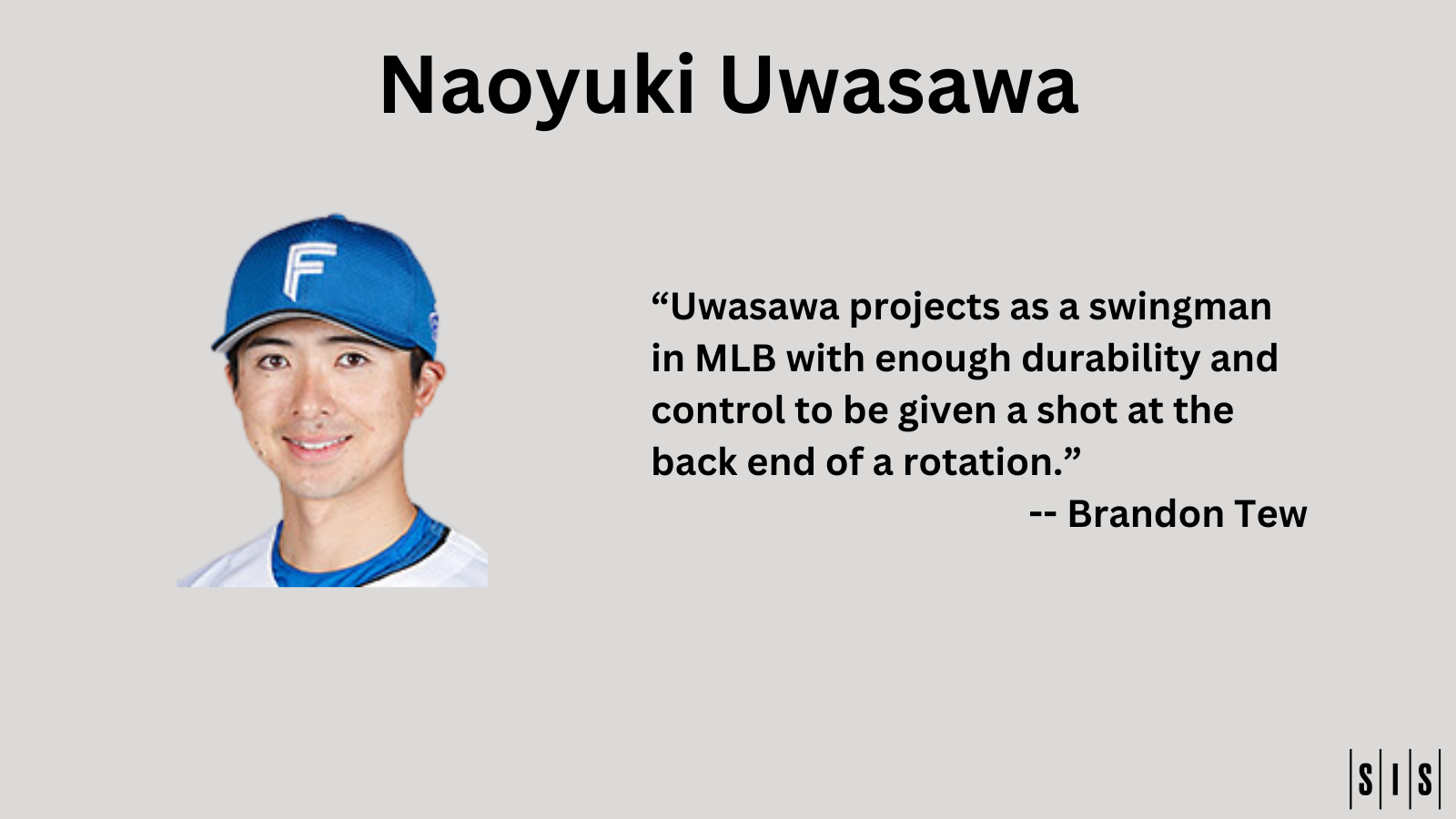
    Uwasawa projects as a swingman in MLB with enough durability and control to be given a shot at the back end of a rotation. His four-seam characteristics and splitter have him standing a decent chance at some sort of valuable production for an MLB team, if he consistently hits spots, but the lack of velocity and overall stuff will limit his ceiling to that of a Kyle Gibson-type pitcher.

  • Stat of the Week: 2023 MLB Year-End Awards

    Stat of the Week: 2023 MLB Year-End Awards

    Happy holiday season!

    Every year at this time we do some supplemental, statistically-driven MLB awards. These will salute some of the leaders in specific areas of our recordkeeping. Here are the 2023 winners:

    The Hard Hitter Award

    Sports Info Solutions charts every batted ball as hard-, medium- or soft-hit, based on the ball’s location and velocity (note that this differs from how Statcast tracks hard-hit rate).

    The winner of the Hard-Hitter Award is the player who had the highest percentage of batted balls that were hard-hit among batters with a minimum of 350 plate appearances in 2023.

    Yankees outfielder Aaron Judge won the award for the 2nd straight year, recording a hard-hit ball in 53.8% of his at-bats. No one else reached 50%. J.D. Martinez (49.0%), Corey Seager (48.4%), Ronald Acuña Jr. (46.1%), and Yordan Álvarez (45.0%) ranked 2nd through 5th. For those curious, recent Dodgers signee Shohei Ohtani ranked 8th (42.9%).

    The top 5 teams were the Braves (38.3%), Rangers (36.7%), Rockies (34.8%), Cardinals (34.6%), and Dodgers (34.5%).

    The Contact Minimizer Award

    The Contact Minimizer goes to the pitcher who most limited hard contact in 2023 (minimum 100 innings pitched).

    The winner was Cubs starter Kyle Hendricks, who allowed a hard-hit ball in 24.9% of at-bats against him. He was followed by Nick Martinez (25.1%), Kyle Bradish (26.9%), Mike Clevinger (26.9%), and Justin Steele (27.8%). Perhaps the most interesting finish was Zack Greinke placing 9th (29.0%) despite posting a 5.06 ERA in 2023.

    The team leaders were the Padres (29.6%), Orioles (31.0%), Mariners (31.0%), Mets (31.0%), Phillies (31.3%), and Cubs (31.3%).

    The Flat Bat Award

    The Flat Bat Award is given annually to the best bunter of the year. To determine the winner, we look at run value–run expectancy gained or lost–for both successful and unsuccessful sacrifice bunt and bunt-for-hit attempts for each player.

    The runaway leader this year was Reds outfielder T.J. Friedl, who had an MLB-best 17 bunt hits (against 5 failed attempts) and 8 successful sacrifices (versus 1 failed sacrifice).

    The runner-up for the 2nd straight year was Blue Jays outfielder Daulton Varsho, who had 11 bunt hits (5 failed attempts) and 1 sacrifice (no failed attempts).

    Click here to read about the methodology behind the Flat Bat Award.

    The Vacuum Cleaner Award

    SIS Video Scouts also track what are known as “Good Fielding Plays,” which are often those that lead to the unlikely recording of an out. Those can be broken up into different subtypes, including one just for groundballs. The leader in Good Fielding Plays on groundballs is the winner of our Vacuum Cleaner Award.

    This year’s winners are Guardians second baseman Andrés Giménez, and Mets first baseman Pete Alonso. Each had 19 such Good Fielding Plays, one more than Cubs second baseman Nico Hoerner and Brewers/Pirates first baseman Carlos Santana. Giménez was rewarded at season’s end with a Fielding Bible Award and the Platinum Glove Award.

     The Fly Swatter Award

    The Fly Swatter Award is a similar award to The Vacuum Cleaner, except it’s for Good Fielding Plays resulting in outs on fly balls and line drives.

    This year’s winners were Rockies center fielder Brenton Doyle and Cardinals outfielder/infielder Tommy Edman, who each had 17 Good Fielding Plays on flies and liners. That’s one more than Blue Jays outfielder George Springer. Doyle won a Gold Glove Award this season and finished 2nd to Kevin Kiermaier in Fielding Bible Award voting for center field.

    Stolen Base Stopper

    The award for the Stolen Base Stopper goes to the catcher and pitcher who had the most Stolen Base Runs Saved in 2023. This year’s winners were Diamondbacks catcher Gabriel Moreno (7 Stolen Base Runs Saved) and Mets pitcher David Peterson  (4 Stolen Base Runs Saved).

    Moreno threw out 21 baserunners and had 2 pickoffs, netting a caught stealing percentage of 38% in a season in which it became much more challenging to throw out potential basestealers. That was a big reason why he won the Fielding Bible Award as baseball’s best defensive catcher.

    Peterson allowed 4 stolen bases, but his catchers caught 2 would-be basestealers and he caught 3 himself. He also had 3 successful pickoffs.

     The Hall of Framer

    The Hall of Framer award goes to the catcher who had the best pitch-framing numbers in 2023. In our world, that means the catcher who had the most called strikes above expectations (Strike Zone Plus-Minus).

    We split this award between 2 catchers. Francisco Álvarez of the Mets had an MLB-leading 92 more called strikes than expected. So did Pirates and Rangers catcher Austin Hedges, who had the most on a per-pitch basis (1.82 per 100 pitches).

    To learn more about our pitch-framing methodology, read the paper from our award-winning presentation at the Sloan Sports Analytics Conference.

  • Defensive Excellence Q&A with Braves Prospect Sabin Ceballos

    Defensive Excellence Q&A with Braves Prospect Sabin Ceballos

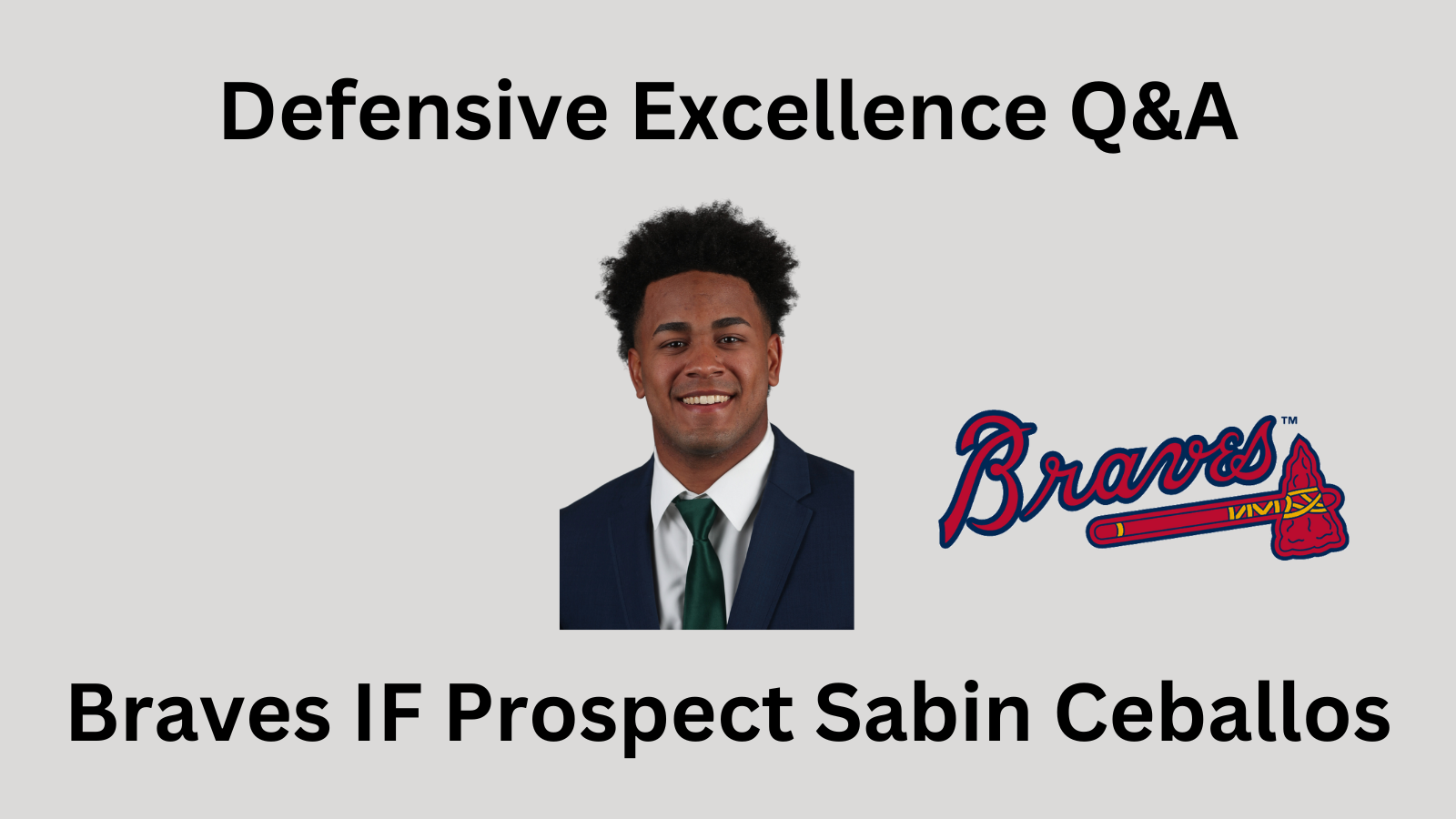
    Sabin Ceballos won a Rawlings College Gold Glove Award last season at Oregon and was drafted in the third round of the MLB Draft by the Braves. The San Juan, Puerto Rico native has aspirations of being a great infielder, whether it be at third base (his college position) or possibly at shortstop (which he’s played in the past). We talked to him as part of our series of interviews with minor league and college Gold Glove winners about learning defensive excellence. Click here to see other pieces in the series.

    The conversation has been edited for clarity and length.

    Mark: What does defensive excellence mean to you?

    Sabin: Defensive excellence starts days before the game, preparing myself for the team we’re gonna play. We do scouting reviews where I sit with my coach about who the good baserunners and bunters are. Then, I like to apply everything I’ve been practicing before the game. Then when the game comes, just have fun.

    Mark: Were did learning defense really start for you?

    Sabin:  When I was 12 years old, my first infield coach was Luis Avila. He was my head coach from when I was 12 to 14.

    With him, I started to see the difference, that there’s a second part of the game and an important part of the game. And I started to take defense a little more seriously.

    Mark: What position did you start out at?

    Sabin: I was playing center field when I was three (confirmed, he said age 3). The first position I played seriously was shortstop.

    Mark: So, what has been the hardest things you’ve had to learn?

    Sabin:  A few years ago, some people were telling me they thought I had the talent to catch in the big leagues. I had been playing infield all my life. So, I said yeah, let’s try it. That was the hardest part. But when I got to Oregon they said, don’t worry about catching, you’re going to be a nice third baseman.

    At third base, it’s about being consistent on defense, minimizing the little things, recognizing when I miss a little thing. Sometimes a little thing is not making an error, it’s having the baseball sense to anticipate things.

    Mark: What’s an example of a little thing?

    Sabin: Knowing the scouting reports. We have the cards in our hands now. That’s going to help me for the rest of my life. Being able to anticipate, knowing a guy could hit the ball to my side. That makes defense easier.

    Little things are also mental things, like not carrying at-bats over to the defensive side. Sometimes you can end an inning with a bases-loaded at-bat and then the next pitch of the next half-inning, the ball is coming to you while you’re thinking about that past at-bat.

    Mark: What kind of drills have helped you out the most?

    Sabin: So right now, I’ve been doing middle infield drills because I want to have the agility to move like a shortstop. I’m bigger now and I’m supposed to be slower, but I want to still move like a middle infielder.

    So, I’ve been doing some legwork. We’ve been doing short hops, and picks, and barehands, fielding ground balls in the middle of the infield so I can go to both sides.

    Mark: Do you have a favorite defensive play?

    Sabin:  This past year at regionals against Vanderbilt. They had bases loaded in the seventh inning. The batter, Alan Espinal (coincidentally also from Puerto Rico), I played baseball for his dad (Rafael). He hit a chopper to me. I made the play. Crazy things happened for me at Oregon after that play (you can read about how he became a campus celebrity here).

    Mark: When you’re watching that play develop in the field, what do you see?

    Sabin: Before that pitch came, I was anticipating what I was going to do. If it’s hit right at me, I step on the bag. If it’s hit to my left, throw to second. If it’s a chopper, my only chance is barehanded.

    [People think] oh, he improvised. No, I worked for it. That’s why I’m talking with my coaches. If I’m not practicing it, I’m not going to be able to make it. Coaches are hitting me choppers before games and I’m barehanding them.

    We prepare for that kind of thing coming at the right moment. It was a crazy play.

    Mark: Who are the people that have been most helpful to you in coaching you on defense? And what did they teach you?

    Sabin: Luis Avila was the first one to show me how you can win games by playing defense. And then Marcus Hinkle at Oregon was one who pushed me to come in early for fielding and to be better every day in the field during drills.

    Mark: What are you working on?

    Sabin: The organization’s plan is to see if I can play shortstop again. I want to prove to them that I can make that move and be the defender that I was at Oregon at third base.

  • How Good is Jung-hoo Lee? Here’s Our Scouting Report

    How Good is Jung-hoo Lee? Here’s Our Scouting Report

    Jung-hoo Lee is a 25-year-old outfielder who after seven seasons playing for the Kiwoom Heroes in KBO was posted for MLB teams to sign. Lee has been one of the best players in Korea winning Rookie of the Year in 2017 and a league MVP in 2022 with 5 Gold Gloves during his 7 seasons.

    Lee has posted some gaudy offensive numbers in the last few seasons: 

    Season AVG OBP SLG OPS WRC+
    2020 .333 .397 .524 .921 139
    2021 .360 .438 .522 .959 162
    2022 .349 .421 .575 .996 175
    2023 .318 .406 .455 .860 139

    In comparison, Lee’s former teammate Ha-Seong Kim had a 141 WRC+ in 2020 in his last season in KBO. While Kim had more power in his swing before leaving Korea, Lee still drives the ball. His 150 doubles since 2020 are the most in KBO in that time.

    Lee had his 2023 season cut short after a fractured left ankle in July playing just 86 games but he did come back for one at-bat in October after surgery.

     What does he do well?

    Lee doesn’t have outlandish exit velocities but since March 2022, according to our Synthetic Statcast data, he has the highest average exit velocity of any KBO player at 89.6 mph. He consistently touches low-end hard-hit velocities as well. His 561 hard hits since 202 are easily the most in KBO. Lee also has high bat-to-ball skills and rarely strikes out with a 5.1% and 5.9% strikeout rate the last two seasons.

    Hitting Mechanics

    via GIPHY 

    Lee’s setup is unusual. Starting with an open stance with his feet shoulder-width apart. Lee then loads into his backside, storing energy and putting almost no weight on his front foot. He gets to this position early, before the pitcher’s hands break.

    He then has his head fully turned to the mound with both eyes fixated on seeing the ball early. With this move, he also loads his hands back slightly and puts his bat at an acute angle behind his helmet.

    As he moves forward he unleashes this energy with a short and quick swing finishing with high hands and either a one-handed or two-handed finish. His barrel control is impressive and his ability to spoil pitches and adjust his posture and bat head is an asset.

    Offensive Profile

    Lee is a patient hitter who tries to hit the ball hard and gets full swings off even in two-strike counts, and he’s a really good two-strike hitter. His contact in and out of the zone deep in counts lets him look for certain pitches early and work the count.

    Lee likes the ball on the inner-third and many teams in Korea tried to pitch him away because of this. He punished pitches on the inner third of the plate.

    Since 2020 he has hit .320  with a .616 slugging percentage and 1.071 against inner-third pitches with 27 HRs on those pitches. He understands his best chance to drive the baseball in the air is on inside pitches.

    Teams tried to pitch Lee away to neutralize his power but he takes his base hits the other way as well.

    via GIPHY


    Season Pull% Center% Oppo%
    2020 39% 35.5% 25%
    2021 46% 33% 22%
    2022 40% 38.5% 21%
    2023 44% 32% 24%


    He keeps the ball up the middle to his pull side for the most part but is disciplined enough to stay on off-speed pitches and fastballs away, displaying gap power to both left and right field. With a 37% hard-hit rate in 2023 and 32% in 2022, it makes sense that Lee wants to inflict damage on the pull side.

    via GIPHY

    Even though he doesn’t cut down on his swing often, he makes a lot of contact with only an 8% whiff rate since 2020. His ability to put the bat on the ball, especially in the zone, stands out. While he will ultimately face better pitching in MLB, the contact ability should translate.

    With a 41% swing rate he hunts pitches early in the count and while he does have some chase his knack for making contact out of the zone is also impressive. He has only 84 swinging Ks in 1,888 at-bats since 2020.

    Lee hits the ball on the ground a lot, sometimes hard enough to get it through the infield. With a ground ball rate of 58% in 2022 and 59% in 2023, it can explain his lack of power production. A 59% ground ball rate would have ranked 3rd in MLB among those with at least 300 plate appearances last season.

    via GIPHY

    This also led to Lee being “Full Ted” shifted (what we at SIS call three infielders on one side of the field.) As well as shaded up the middle (or what we call Partial Shifts) with two infielders on the weak side playing closer to 2nd base. To put this into perspective Lee was shifted on 55% of the balls he put in play in 86 games last season. That was second in the league behind Jose Rojas at 56%.

    With the limits placed on shifting in MLB Lee could still try and pull the ball even on the ground, but to tap into his power potential he will need to get the ball in the air more.

    With a high finish to his swing, when he gets the right pitch, he can backspin the ball out of the park. Lee hunts pitches to lift and pulls both when he has an advantage in the count and early on first and second pitches as well.

    via GIPHY

    via GIPHY

    Lee also does his most damage on fastballs, with a .358 batting average and .991 OPS, and 27 home runs against them since 2020. KBO fastballs sit more high-80s and low-90s so as with any player making the jump to MLB he will have to deal with consistently higher velos.

    He “struggles” against sliders and cutters if you can even call it that, still slashing .290 BA/.840 OPS against sliders and .273 BA/.724 OPS against cutters since 2020. Easily his worst performance against pitch types although he faced only ~300 cutters and ~1,600 sliders in that time frame compared to ~ 4,200 fastballs.

    His biggest adjustment will most likely come against not only higher velocity fastballs, more mid-90s than low-90s, but also more quality sliders and sweepers. Lee will probably be tested by high velocity early in MLB and then teams will start to mix in breaking balls and off-speeds if he shows the ability to routinely handle high velocity.

    Defense

    Lee’s defense is interesting. In 2022 Lee had -13 DRS in CF but would still flash moments of highlight-type grabs. Inconsistency and forcing throws contributed to this number. In his 2023 shortened season he had an outstanding 9 DRS. KBO players are judged using an MLB out probability basis and he performed very well last season.

    via GIPHY

    This huge fluctuation probably leaves Lee somewhere in the middle, as someone who can hold his own in CF for an MLB team, and with his athleticism he can make the plays he needs to. He profiles better as a corner outfielder though and with a strong enough arm to play RF over LF but he might get some run in CF for whatever MLB team he signs with.

    He’s comfortable going back or coming in. One quirk I noticed watching him is that he routinely tries to get around the ball to catch fly balls on backhands even when going to his forehand side and displays comfort in tracking the ball.

    OF Jumps:

    via GIPHY

    Backhands:

    via GIPHY

    With his above-average speed and solid ball tracking, he should be average to slightly above depending on what position he plays. He also uses his speed on the base paths but more to take extra bases rather than rack up stolen bases, with only 69 swiped bags in his KBO career. Although, the “Grandson of the Wind” can scoot when he needs to.

    via GIPHY

    The nickname is an homage to his legendary father Jong-Beom Lee, who won an MVP award in 1994. The older Lee also holds the record for the most stolen bases in a season with 84 during his MVP campaign, earning him the nickname “Son of the Wind”.

    What to Expect

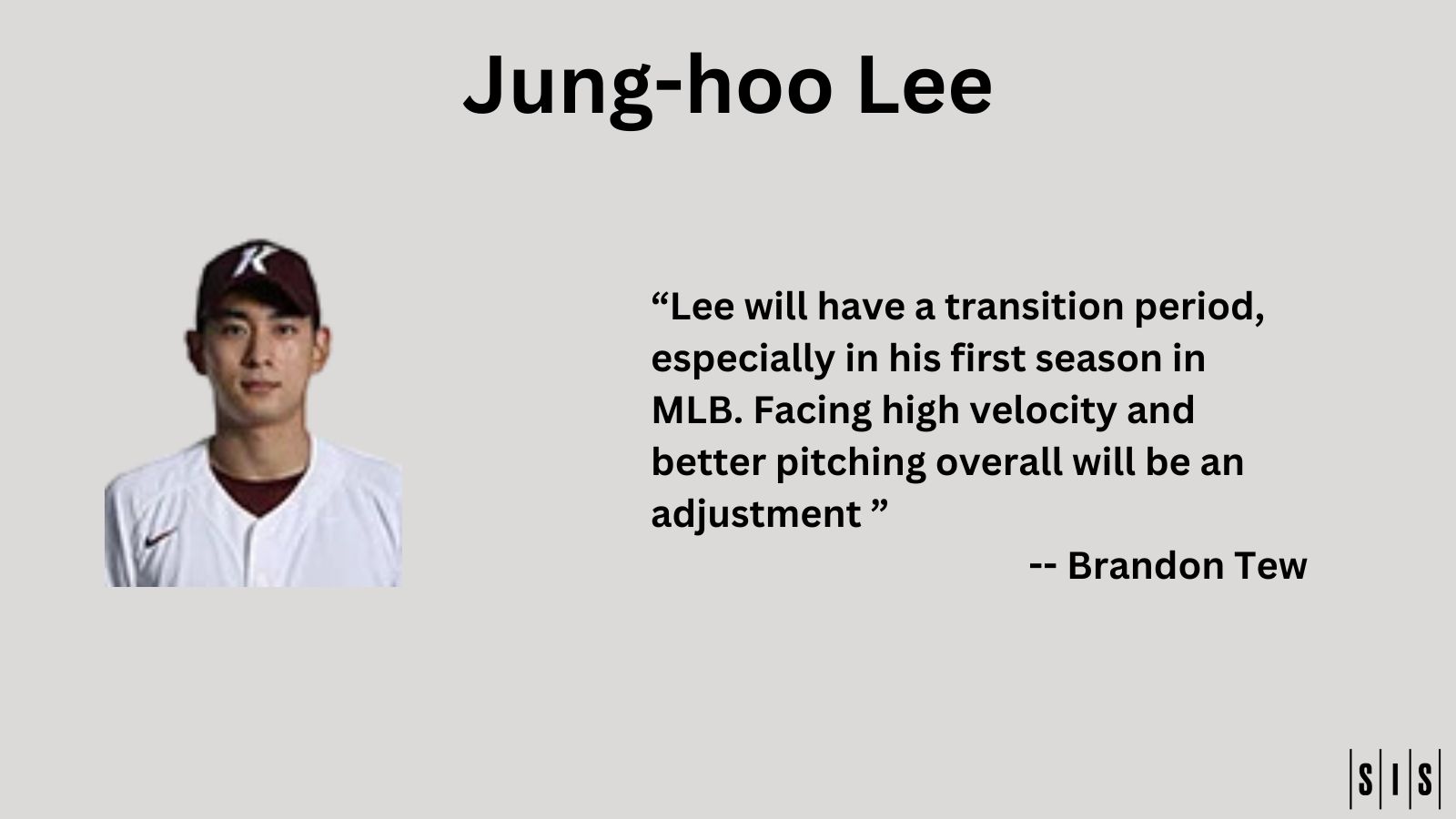
    Lee will have a transition period, especially in his first season in MLB. Facing high velocity and better pitching overall will be an adjustment. While he might never hit for much power, if he’s able to lift the ball a little bit more he can still pull the ball for home runs but might have modest homer totals overall.

    Lee projects as a high average and on-base leadoff hitter who is just entering his prime. He has the contact skills and batter’s eye to make an impact along with the defensive acumen and athleticism to hold his own at any of the outfield spots, with left field probably being his best fit.  Lee should turn into a solid to above-average player with some upside, a la Jeff McNeil, if he hits for more power.

  • Stat of the Week: The Availability Of The Yankees Outfield Additions

    Stat of the Week: The Availability Of The Yankees Outfield Additions

    We often talk about innings eaters when it comes to a pitching staff. What about the innings eaters among position players? Specifically pertinent to today, let’s talk about innings-eating outfielders.

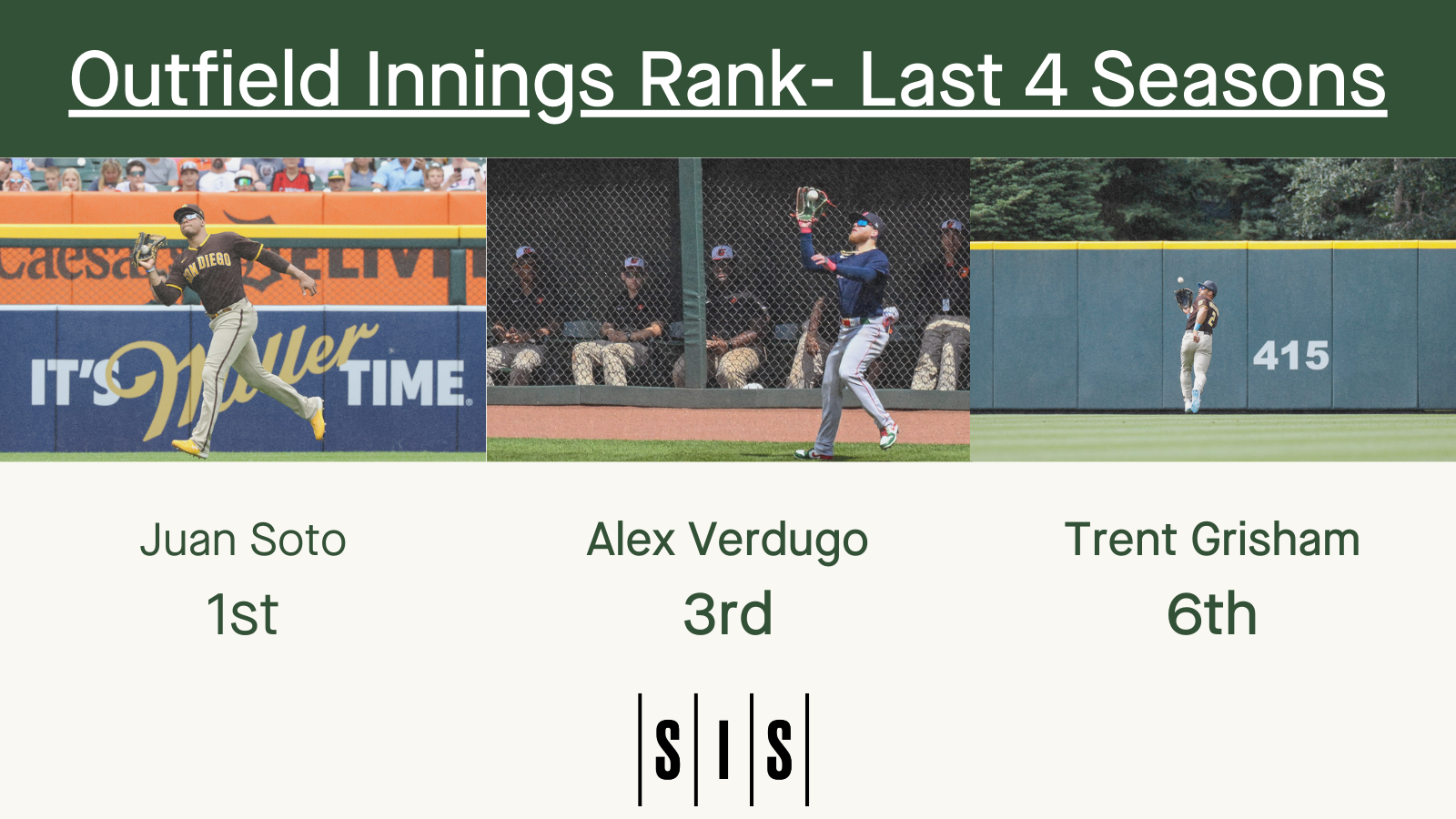
    These are the players who have logged the most innings in the outfield over the last 4 seasons.

    Most Innings Played In Outfield – Last 4 Seasons

    Player Innings
    Juan Soto 4,202
    Kyle Tucker 4,159
    Alex Verdugo 4,086
    Myles Straw 4,068
    Ian Happ 4,023
    Trent Grisham 3,959

    What’s interesting here is that the Yankees just traded for 3 of the players on this list: Juan Soto, Alex Verdugo, and Trent Grisham.

    Soto’s performance speaks for itself. He’s an elite offensive player with 35-homer power and one of the best batting eyes in the sport. What’s scary is that he’s only 25 years old, is entering his walk season, and may not have peaked yet. As good as he was in 2023, he was only a 5.5 bWAR player. He has room to be better as a baserunner and fielder, two areas in which he ranked below average in 2023.

    Verdugo may have gotten benched by the Red Sox last year for lack of hustle but he still found his way onto the field for 142 games. He’s basically been an average hitter by OPS+ standards and an average player by bWAR standards the last 3 seasons. But being consistently average has value because it usually means that below-average options were kept off the field.

    Grisham is an interesting one. The last 2 seasons he’s hit .184 with a .626 OPS and .198 with a .666 OPS, respectively. But he also played 148 and 153 games in the field in those two seasons. He’s clearly valued for his defense and his baserunning. He ranks 5th in Defensive Runs Saved among center fielders over the last 4 seasons and ranks 4th in our Baserunning Gain stat over the last 2 seasons, which measures how often a runner takes an extra base, how often he makes outs on the bases, and how he fares at avoiding double plays.

    Verdugo and Grisham won’t have to be everyday players in the Yankees lineup so long as both Aaron Judge and Giancarlo Stanton are healthy. But one of the key reasons Grisham is a desirable option is how often Judge and Stanton have missed time. Judge played only 106 games last season (and DH’d in 38 of them). Stanton rarely plays the outfield anymore, only 71 games the last 2 seasons.

    The Yankees essentially took care of two needs with this combination of deals. One is that they needed better players than they had last season, when their outfield ranked last in Wins Above Average. They got that, with Soto being the marquee addition. But they also needed players with a track record of simply playing, and though past performance doesn’t guarantee future results, they did well in acquiring that as well.

  • Yankees and Astros Both Make Defensive Upgrades

    Yankees and Astros Both Make Defensive Upgrades

    That the Yankees finished 10th in MLB in Defensive Runs Saved disguised a significant defensive issue. Their corner outfielders rated terribly in that stat last season.

    The Yankees’ left fielders finished with -14 Runs Saved and their right fielders finished with -14 Runs Saved. They ranked tied for last with the Phillies in left field and next-to-last ahead of only the White Sox in right field.

    It was a rough go for almost everyone. The only one of their 10 left fielders to finish with a positive Runs Saved was Everson Pereira (2 Runs Saved in 27 games). None of their 9 right fielders finished with a positive Runs Saved total, not even usual standout Aaron Judge, who tallied -3 in his 54 games there.

    The eye test vindicates the numbers. There were plenty of just misses, miscommunications, and bad botches to go around.

    That’s why the acquisition of Alex Verdugo in a trade from the Red Sox was significant. Verdugo had fallen out of favor in Boston and was benched once due to what manager Alex Cora termed a lack of hustle. But his defensive numbers are good.

    Verdugo had 9 Runs Saved in right field last season, tied for second at the position. He also has a strong track record in right field with 21 Runs Saved in just over 1,900 career innings, though he totaled 0 as the Red Sox most-used left fielder in 2022. Still, 0 would be a major upgrade over what the Yankees had in 2023.

    Verdugo should play one of those two spots regularly depending on whether the Yankees make a bigger acquisition like Juan Soto.

    Another team to make a defensive upgrade was the Astros, who agreed to a deal with catcher Victor Caratini to a 2-year contract. Caratini replaces the team’s primary starting catcher the last 3 seasons, Martín Maldonado, though he’s projected as the backup to Yainer Diaz.

    Maldonado was both a fan favorite and a pitcher favorite who won a Fielding Bible Award in 2017. He was beloved by Astros manager Dusty Baker for his pitching staff work. We don’t dispute that on his best days he was very good. But it’s fair to wonder what he’s got left. Maldonado totaled -10 Runs Saved last season. He still rated as a good pitch blocker, but by our pitch framing stat (Strike Zone Runs Saved), he ranked next-to-last among catchers.

    Caratini has a considerable defensive flaw. He threw out only 3-of-47 runners attempting to steal last season. But even with that, he still got to 0 Runs Saved last season and had 2 Runs Saved in 2022. He’s an adept pitch framer. Over the last 2 seasons he ranks 8th in Strike Zone Runs Saved per 1,000 innings among the 40 catchers who caught the most. 

    Diaz will get an increase in playing time. He totaled 4 Runs Saved in roughly 400 innings last season. Within that small sample, he had the highest block rate on potential wild pitches (96.2%) and totaled 3 Runs Saved for stolen base prevention (only 4 catchers had more). 

    Like Maldonado, Diaz didn’t fare well in pitch framing but Diaz did enough other things his total defensive package was a positive. He finished the season with 4 Runs Saved. Diaz and Caratini bode – at least on paper – as a better defensive combination than the Astros had last season.

  • Stat of the Week: MLB’s Most Improved Defenders

    Stat of the Week: MLB’s Most Improved Defenders

    Between social media and our website we lauded the Blue Jays outfield frequently in 2023 because they were so good defensively. But there was another big reason besides the outfield as to why the team led the majors in Defensive Runs Saved this past season. The Blue Jays had MLB’s most improved defensive player by that stat.

    Shortstop Bo Bichette went from -16 Runs Saved in 2022 to 5 Runs Saved in 2023. The 21-run improvement was the largest for anyone who played at least 500 total MLB innings in each of the last 2 seasons.

    Biggest Improvement in Defensive Runs Saved – 2022 to 2023

    Minimum 500 innings played in each season


    Player DRS Improvement
    Bo Bichette 21
    Nicky Lopez 20
    Andrew Vaughn 17
    Bobby Witt Jr. 16
    Wander Franco 16
    Thairo Estrada 14
    Alex Verdugo 14
    Yandy Díaz 14

    Bo Bichette

    Bichette’s improvement was most prominent specific to one aspect of his game – making plays on balls hit to the left of where he was initially positioned.

    Bo Bichette On Balls Hit To His Left

    Season Plays Made/Opportunities Out Rate (Plays Saved)
    2022 137/304 45% (-15)
    2023 129/219 59% (10)

    >> Opportunities = plays with a >0% out rate for the shortstop.

    To explain this chart:

    In 2022, Bichette made 137 plays on 304 balls that had a >0% out rate for the shortstop (that’s how we define an “opportunity”). According to our calculations, he made 15 fewer plays than an average shortstop would have on those balls (hence the -15 in the 3rd column of the chart).

    In 2023, he made 129 plays out of 219 opportunities. According to our calculations, he was 10 plays better than the average shortstop.

    You can see the difference in the out rates. Bichette went from a 45% out rate on balls hit to his left to 59%.

    Bichette’s throwing improvements may have played a role here. He went from 18 throwing errors and misplays (misplays being plays that weren’t scored errors but could have been) in 2022 to 7 in 2023.

    For more on Bichette, check out this Twitter thread from SportsNet Blue Jays producer Chris Black.

    Nicky Lopez

    Lopez, a utility player traded from the Braves to the White Sox this offseason, had been known as a good glove in the past but had a drop-off in 2022, particularly at second base, where he accrued -8 Runs Saved. He totaled 4 runs there in 2023 and fared better on balls hit to his right than he ever had before. Lopez also went from 1 Run Saved at third base to 5 Runs Saved there in a comparable though limited number of innings.

    Andrew Vaughn

    Vaughn’s improvement is the result of both a position switch (from corner outfield to first base) and improvement at his new full-time position. Vaughn totaled -17 Runs Saved in 2022, with -14 of those coming from his combined total in left field and right field. At first base in 2023, Vaughn rated MLB average, with 0 Runs Saved.

    Vaughn handed first base better than he did in the roughly 300 innings he played there in 2021 and 2022 when he amassed a combined -5 Runs Saved.

  • Defensive Excellence Q&A: Endicott College Catcher John Mulready

    Defensive Excellence Q&A: Endicott College Catcher John Mulready

    Photo by David Le

    John Mulready is one of the best college catchers you probably don’t know much about. The Peabody, Mass. native is a senior at Endicott College, a Division III program in Massachusetts that last year went to that level’s College World Series. Mulready won a ABCA/Rawlings College Baseball Gold Glove Award for his work behind the plate.

    We spent a good part of 2023 talking to coaches about teaching defensive excellence. So it makes sense that we also talk to players about what it’s like to learn defensive excellence. John is the third interview in our series.

    Mark: What does defensive excellence mean to you?

    John: Defensive excellence sums up the way you win baseball games. Having a sound defense both in front of and behind the plate is the key to winning championships.

    Since a young age, I’ve always heard pitching and defense wins championships. And growing up playing a bunch of different sports, playing soccer, football and obviously baseball, I’ve always heard defense is one of the most important things on the field because if you can’t protect your own goal, net, plate, whatever sport it is, you’re not really gonna have a good chance to win that game,

    Mark: Where did it all begin for you defensively?

    John: My father got me involved at a really young age and baseball was something that clicked with me early. I fell in love with the game really fast and it fell in love with me at the same time. Every day I’d be in the backyard playing catch. He’d be throwing balls in the air, hitting me ground balls.

    When I was 9 years old, he signed me up for an AAU program and every skills camp they had to offer. So aside from being in the backyard with him every day or going down to the batting cages with him for offensive work, he’d be signing me up and driving me to defensive clinics every day. And I’d just grind, defensive rep after rep. Kevin Kelly, now the head coach at our rival, Roger Williams University, used to run all of the defensive skills clinics.

    Mark: When did you start catching?

    John: I always wanted to be the pitcher or the shortstop as a kid. But one day we needed a catcher, and nobody wanted to step up, so I was like, I’ll do it.

    I shied away from catching for a bunch of years and focused on pitching. When I got to high school, I went to St. Mary’s and played for Derek Dana, who got drafted as a catcher by the Giants. Having a catcher as a coach in high school is amazing.

    Coach Dana knew that I caught here and there growing up, and we talked and decided that I would transform back to being a catcher after a couple of injuries to my shoulder.

    And then coach (Bryan) Haley and (Harry) Oringer at Endicott have been a big part of my development since I got to college.

    Mark: What was the hardest thing to learn as you were getting into it?

    John: Getting back into it was definitely difficult because I didn’t know everything that went into it.

    When I was younger, everything was easy. I was always one of the bigger kids, always had a strong arm.

    High school, You’re taking foul balls off the mask, you’re blocking balls in the dirt, you’re throwing just as much as the pitcher is, which takes a toll on your arm. Understanding the amount of endurance and physical preparation that goes into being able to catch a full season was eye opening to me, but something I was able to adjust to well by being with such an experienced coach. I’ve worked on knowing that it’s not always gonna be pretty, but that you’ve gotta be a beast behind the plate.

    Mark: You’ve gotta be a beast behind the plate. What does that mean?

    John: The way I look at it is if any ball gets by me, it’s my fault and I don’t want to let my teammates down. You give your team the best chance to win by working hard on every pitch, getting your eyes behind the ball to give the umpire the best chance to call a strike. You want to be a beast in every aspect of the position.

    Mark: Explain some of what you do technique wise in the different aspects of catching.

    John: The catchers call ourselves Team 2. And we’ll dedicate certain days of the week to receiving. We’ll dedicate certain days of the week to blocking, so on and so forth. We’re putting our full attention and focus into that day and really taking everything that we can from that day and translating that to game scenarios.

    If we’re blocking balls, we’re not just blocking balls right at us, we’re trying to block the balls that nobody should be able to get to. Preparing ourselves for real game scenarios, things that probably aren’t going to happen but might, that’s really important to me.

    With framing we have different training mitts that we use, always catching the ball in between your pointer finger and thumb, right in the pocket of the glove, always keeping your eyes behind the ball, and shifting your shoulders rather than dropping the arms or reaching to a side.

    Framing is rhythmic. It’s just something that you get into a rhythm of doing. It just becomes second nature after so many reps.

    Before a game we work to get our eyes loose, just like we get our bodies and arms loose.

    Mark: What do you do to get your eyes loose?

    John: Just progressions of receiving, working from bare hands to gloves, working up to the pitching machine, working on footwork and transfers from glove to hand.

    Photo by David Le

    Mark: What does your pre-game routine look like?

    John: The catchers will be off to the side, playing receiving games like two ball to work on our hand-eye coordination.

    With two ball, you have a ball in your hand, you’re in a circle of four or five people, everybody has a ball in their hand, and then there’s one other ball that you throw around the circle.

    If a ball’s coming at you, you’ve got to catch it with your empty hand and throw the ball that’s in your other hand at somebody else. And it’s just like a speed reaction, hand-eye coordination drill. Then, after batting practice is over, some guys will go into our field house and work on light blocking. Working your breath. Exhaling while blocking has really helped me. It softens up your chest and kills the ball when it hits you and leaves the ball right in front of you.

    We’re always working our hands. Another thing we do is throw a ball up in the air and just work on finding that four-seam grip to give us the best chance of throwing a strike down to second base.

    Mark: What’s an example of something you do to manage a pitching staff?

    John: I’m fortunate to be given the ability to call the game from behind the plate. I put myself in the shoes of the batter and with the count in mind, thinking of where they are in the batting order, what type of hitters are at the plate. The first time through the lineup, especially for a team we haven’t played in a while or never played before, it’s just about feeling it out and trying to get on the same mental wavelength as the pitcher.

    Mark: Is there one play you’ve made that stands out?

    John: We were playing Pomona-Pitzer on our California trip over spring break. It was a dogfight. We go ahead by a run in the ninth inning and in the bottom of the ninth, man on second, base hit up the middle, the guy’s rounding third, our center fielder comes up firing. It’s a tweener-hop and it takes a funny hop but I’m able to stay down. There’s a pretty big collision at home plate and I hang on to the ball (watch the play here).

    That’s a thing I struggled with in high school. I can remember my sophomore year, the same type of play in a tie game, and throw is a tweener hop that squeaks by me. They end up walking us off.

    Taking pride and taking care of the ball and the little things like short hops, tweener hops, long hops working on those for so long, I feel like it translated into finding success on that play.

    Mark: When there’s a play like that, what do you see?

    John: I’m able to see the whole field, which is obviously one of the main reasons I love the position. But in my head, I’m trying to think two plays ahead, if this guy hits it here what am I calling? Where am I going? Is the play coming home? Is the play going to second? Do we not have a chance for this guy?

    I see a guy on second base who’s got a short lead, so we end up going fastball, we challenge the guy up, and he ends up turning it right around, up the middle, I’m thinking, oh boy, there we go, because it wasn’t hit too hard, we were playing kind of shallow. So I’m like, alright, we’ve got a chance here.

    And having the center fielder we did, Caleb Shpur has an absolute cannon for an arm. I threw my mask off. I’m thinking, all right, I’m checking in with the runner on third. He’s rounding third. And I’m thinking all right, we’ve got a chance.

    We have calls whether to cut off the ball or throw straight through. And so I saw the ball. It’s a nice low throw looking like it’s gonna be a nice long hop. So I’m screaming ‘let it go.’ I see the guy digging. He tried to dive on the inside of the plate, but the ball took me that way.

    From where the hop was coming, I was able to grab the ball with my glove and I immediately put my hand onto the ball obviously, just trying to hold the ball through contact. The kid’s shoulder goes in between my legs and knocks my glove off my hand, but I held onto the ball with my throwing hand and was able to show that to the umpire.

    I got up and spiked the ball and we had a little celebration on the mound. There’s just so many thoughts going through my head. But at the same time it was completely shut off and I was just so focused on tracking that ball from the tweener hop into my glove and just so focused on holding on to the ball

    Mark: Are there catchers who you model your game after?

    John: I model part of my game after coach Dana with the things he taught me. In terms of major league catchers, J.T. Realmuto is one of my favorites. Everything he does is smooth as silk. A 1.8 pop time (on stolen base attempts) is ridiculous. All the catching coaches I follow on Twitter and Instagram are preaching ‘be like J.T.’ He plays the game smooth and fast.

    Mark: If a kid said that they wanted to catch the way that you caught, what advice would you give them.

    John: Obviously the first step is just to work hard and every day you show up, don’t just be there to be there or be there to show somebody else you’re there. You have to want to be successful. It’s not one of those things like hitting where you can stick your bat out and find a hole. Being behind the plate you’re involved in every pitch and can’t take a pitch off.

    Everybody’s looking at you to tell them what to do because you can see what they can’t see. There’s just as much of a mental aspect to it as there is a physical aspect.

  • NPB Free Agent Scouting Report: Shōta Imanaga

    NPB Free Agent Scouting Report: Shōta Imanaga

    Shōta Imanaga was posted by the Yokohama Baystars after spending eight seasons pitching in NPB’s Central League. He is coming off his two best seasons as a pro and heads into free agency at 30 years old.

    Season IP ERA Strikeouts Walks SO/W
    2022 143 2/3 2.32 132 29 4.6
    2023 148.0 2.80 174 24 7.3

    Imanaga is listed at the same height and weight as fellow NPB posting mate Yoshinobu Yamamoto, at 5-10 and 176 pounds. The lefty possesses some of the best pure stuff in the world. His 68% strike rate would have been in the top 10 in MLB among qualified starters in 2023. 

    This final list of Stuff+ leaders from the World Baseball Classic is a mix of notable MLB and NPB pitchers:

    What does he do well?

    Imanaga’s arsenal is as deep as it is potent, highlighted by a high-carry four-seamer with over 20 inches of induced vertical break (IVB). The pitch cuts through the zone staying on plane and causing swings and misses over the top of barrels. 

    Imanaga also has multiple variations of pitches that make him a tough at-bat for hitters. He led NPB in K rate at 29% and was the strikeout leader in the Central League with 174. Imanaga has multiple chase pitches, with sources such as Deltagraphs noting that hitters chased outside of the zone over 35 percent of the time against him in 2023. A 35% chase rate would likely rank in or around the Top 20 among MLB starters if Imanaga could do that in MLB. 

    Mechanics

    via GIPHY

    Imanaga deploys a paused leg lift, as many Japanese pitchers do. This allows him to create rhythm and balance in his delivery. Imanaga brings his leg up towards his chest before quickly settling around waist height with a tiny pause. He then slightly turns his foot towards the rubber, creating counter-rotation in his hips as he shifts his weight and momentum forward. 

    Imanaga sinks deep into his lower half and back leg before pushing down the mound. He has solid repeatability and good extension relative to his height because of his lower-half use.

    The Arsenal (2023 usage and Average Velocity)

    Fastball   59%, 91.8 mph

    Imanaga relied heavily on his fastball, throwing his four-seamer close to 54% of the time and his two-seamer around 5%. The four-seam has elite fastball characteristics as mentioned earlier and even though Imanaga loved to work down in the zone more than up, batters swung underneath his fastball in both areas of the zone.

    Up

    via GIPHY

    Down

    via GIPHY

    The pitch racked up 96 Ks in 2023 and performed well with a .234 opponents’ batting average. But even in Japan’s dead ball era, Imanaga has been plagued by the HR ball. In the last two seasons, he finished with 14 and 19 HR against, respectively, including playoffs, with 26 of them surrendered on a fastball in that span.

    The likely culprit of this is throwing too many fastballs in hitters’ counts, with shaky command at times and high fly ball rates.

    Less reliance on his four-seamer as well as pitching more up in the zone could help him out with his high-carry fastball. He also throws the pitch for a strike 73 percent of the time, so working it out of the zone could mitigate the damage as well. Still, he needs better command of the pitch to accomplish this. He has above-average command of the pitch overall, but there are examples of fastballs leaking to the middle of the plate.

    Here’s a dotted fastball in the 9th inning of his no-hitter last season:

    via GIPHY

    Slider 16%, 81.5 mph

    Imanaga throws two variations of a slider that are grouped together when we refer to his pitch usage. His sweeper is used less often, though he has fluctuated its usage from game to game the past two seasons. His sweeper is on the lower end of velocity in the mid-70s, and what I would call his “true slider” sits closer to 80 mph.

    Here are the two variations:

    Sweeper: 

    via GIPHY

    Slider:

    via GIPHY

    His sweeper and slider have good shapes to them and while more velocity would be nice they still fit well in his arsenal, giving him three varieties of speed moving away from LHBs with the inclusion of his cutter. 

    The sliders combined for his second-most strikeouts. They should continue to be valuable weapons for him, versus LHBs.

    Splitter 12%, 83.2 mph

    Probably the most intriguing pitch Imanaga throws is his splitter. He actually throws with two different splitter grips to go along with his changeup. 

    Here are the three pitch grips all from the same game. They have slight differences in grip most noticeable at the bottom of his arm swing. 

    You can see with the modified split Imanaga puts his middle, ring, and pinky finger together. With the traditional splitter, he has his pinky and ring finger tucked behind the ball. He’s thrown the two different splitter grips at different times from what we have charted since the middle of July 2022 but he’s gone back to more of the modified splitter in 2023.

    With MLB baseballs being slightly larger and less tacky than NPB balls, it will be worth following what grip he might find most comfortable. Masahiro Tanaka famously battled with finding a comfortable splitter grip throughout his MLB career.

    The splitter is a real swing-and-miss pitch for Imanaga with over a 40% whiff rate in 2023. The velocity separation of the pitch from his fastball causes batters to not only whiff but also hit a fair amount of ground balls (a 50% ground ball rate)

    via GIPHY

    The velocity dip from his fastball also causes a lot of weird swings and weaker contact even on fly balls.

    via GIPHY

    Curveball 7%, 73 mph

    Imanaga’s curve is a slow loopy pitch in the 70s with some sweep to it. It has a lazy arc and he primarily uses it as a change of pace pitch to keep hitters off of the rest of his arsenal. 

    via GIPHY

    Imanaga also has a very slow curveball (in the 50s in terms of MPH) that he breaks out on rare occasions (5 times in 2022, 8 in 2023). The pitch is used to freeze batters. He might up the usage of this slower curve in MLB just to keep hitters honest.

    via GIPHY


    Cutter 4%, 86.7 mph

    Imanaga’s cutter was his worst-performing pitch in 2023, though only 21 at-bats ended with one. He actually abandoned the pitch for the first couple of months of the season before returning to use it in June with 5% usage the rest of the season. In 2022 he actually was throwing more cutters than sliders and the pitch was much more useful for him then than in 2023.

    He throws a harder version of his slider that is tagged as a cutter. It’s more of a hybrid and he routinely will use it more in slider situations, throwing it down and away. That’s something I noticed when I wrote up his 2022 no-hitter vs Nippon-Ham in June 2022. He threw 24 cutters that night with no sliders or sweepers.

    via GIPHY


    Changeup 2%, 81.5 mph

    Imanaga’s changeup is his least-used pitch. He threw 32 of his 52 in one game against Rakuten in May.

    If Imanaga can’t grip his splitter with an MLB ball maybe he goes to more of a changeup grip or he finds a way to mix the change in more. He also had no fear throwing the pitch left on left, which speaks to his pitchability but that is still probably the toughest pitch to execute in baseball.

    Here’s back to back changes against Maikel Franco with an 8-mph difference:

    via GIPHY


    via GIPHY

    Just another example of Imanaga’s pitchability.

    What to Expect

    Imanaga is a strike-throwing lefty with some of the best pure stuff in the world because of his pitch movement and ability to spin the baseball. Even without high-end velocity or command, Imanaga throws strikes and punches tickets which should lead to success in MLB. 

    He has mid-rotation upside right now. His spot in an MLB rotation will be determined by whether he can keep the ball in the ballpark. 

  • Bill James Handbook Excerpt: Baserunning In Its Own Self

    Bill James Handbook Excerpt: Baserunning In Its Own Self

    Photo: Manny Flores/Icon Sportswire

    The following is an excerpt from The Bill James Handbook, Walk-Off Edition, which is available for purchase now at ACTASports.com.

    In my youth, baserunning was mostly a field of conjecture. In 1960 those in the game and those into the game would have known that Maury Wills was very good at going from first to third on a single; Wills, or Aparicio, or Willie Mays or Bill Bruton or Jimmy Piersall or Minnie Miñoso or any other player who was observed to be a fast runner. They would have known that Joe Adcock was poor at going from first to third on a single, or Dick Stuart or Elston Howard or Jerry Lynch or Ted Kluszewski or anyone else who could be observed to be a slow runner.

    There was a general understanding, unconnected to specific facts. Billy Bruton was said to be the fastest man in baseball, perhaps. But how often did he go from first to third on a single? 90% of the time, or 50%? No one knew. How many times a year was Bruton on first base when a single was hit? 30 times, or 200? No one knew. Since Bruton was past his 20s, had his ability to go from first to third on a single declined with age? No one could know.

    What of his ability to score from second? What of his ability to move up when a pitch was in the dirt? What of his ability to score from first on a double? Unknown, unknown, unknown…. None of this was given to Heywood Hale Broun to understand. Heywood Hale Broun was a sportswriter of the time—an
    actor, songwriter, author, sportswriter and broadcaster; look him up. A randomly chosen 1960s sportswriter. He knew many things that I will never know, old HHB, but how often Orlando Cepeda might score from first on a double was not one of them. Not wanting the conversation to suffer from this oversight, the sportswriters of the time would just make stuff up to fill in the gaps. I’m not suggesting that Heywood Hale Broun would make anything up, and the sportswriters and broadcasters who did would not make up specific facts. They would not tell you that Chico Fernández was 21 for 37 at moving from first base on a single, because they had never hit the realization that there was an underlying fact there that could actually be counted.

    They would not tell you specific phony facts, but they would offer deep insights based on their experience. They might tell you, if they were broadcasting for the St. Louis Cardinals, that Julian Javier did not lead the league in stolen bases, but he was better than anybody in baseball at going from first to third on a single.

    The broadcaster from the Philadelphia Phillies might tell you that Tony Taylor was the best baserunner in the league, and the broadcaster from the Cincinnati Reds might tell you that Vada Pinson was the best baserunner in the league, and the broadcaster for the Pittsburgh Pirates might make the same claim for Bill Virdon, and all of these people were telling you the truth as they saw it. And the guy who would tell you that no one ever went from first to third against Rocky Colavito, he was telling you his truth as well, and the guy who would tell you that Joe DiMaggio was never in his career thrown out on the bases trying to stretch a hit, he was telling you what many other people had told him.

    That one was actually very common; old sportswriters from the 1940s were very fond of saying that Joe DiMaggio was never thrown out on the bases in his career. Seriously, they would say that. It was part of the DiMaggio-vs.-Willie Mays dispute. Sportswriters of the 1940s would say that Joe DiMaggio was the greatest all-around player of all time, while sportswriters of the 1950s would say the same about Willie Mays and would argue that Mays did everything that DiMag did and stole more bases in a year than DiMaggio did in his career. The 1940s guys would respond that DiMaggio didn’t steal bases, but he was never thrown out on the bases in his career. The fact that DiMaggio made four unforced outs on the bases in World Series games did not bother them, because what’s too awkward to remember, you simply choose to forget (October 2, 1936, 1st inning; October 3, 1947, 3rd inning; October 9, 1951, 7th inning; and October 10, 1951, 8th inning).

    One time I heard an announcer say that Roger Maris prevented two baserunners a game from moving to third base on a single. Who’s going to argue with him? There’s no data. There’s no facts; you can say anything you want. If you liked Ellis Burks better than Barry Bonds, you could say that Burks was a better baserunner than Bonds, and nobody could prove you were wrong. It was a Rorschach space; you could see what you believed was there.

    Our battle to replace speculation with knowledge began in the 1990s and began to get traction about 2004. A huge roadblock was getting people to let the facts speak for themselves. I started arguing for counts of how often a runner went from first to third on a single about 1996, I think, but for several years the discussion was backed by people who wanted to not count this and not count that. Obviously, they would say, you can’t count situations when the play starts with a runner on second base, because maybe the runner can’t go to third. (Actually, a runner from first goes to third a little bit MORE often when there is a runner on second, because he sometimes has an opportunity to move up on the throw home.) Obviously, you can’t count infield singles, and obviously singles to right field are very different from singles to left field. Singles that are hit directly at the fielder are obviously different; there’s no chance to move up on those, and wouldn’t the numbers be very different with no one out than they would be with two out?

    All statistics group together unlike things to a certain extent, and I agree that it is important to recognize those differences. All doubles are not the same. A ball hit down the line is different from a hustle double in shallow center is different from a ground rule double is different from a ball that hits the wires supporting the catwalk in Tampa Bay.

    But in this case, if you count EVERYTHING, count every situation in which there is a runner on first base and a single is hit, you wind up with good, meaningful data. Elvis Andrus in his career through 2022 was 74 for 111 at scoring from second base on a single, 67%, while Carlos Santana was 43 for 119, 36%.

    If you just count everything, the data will speak for itself. The process of accumulating the data will even out MOST of the “bias” problems, not all of them, of course. If you throw out cases when there is a runner on second base, and you throw out infield singles, and you throw out the cases when the ball is hit right at the fielder, and then you divide the data into subgroups of one out and two out and three out and subgroups of balls hit to left, right and center, you don’t have meaningful data, you just have a lot of 3-for-6s and 2-for-4s. In retrospect, it is obvious that the data works if you just leave it alone and let it speak for itself, but it took me several years to get past the resistance from people who didn’t think that we should count these and didn’t think that we should include those.

    Conceptual clarity. The point I am trying to make is that there is a big difference between the job of a statistician, which is to count things, and the job of a researcher, which is to figure out what should be studied, what should be counted, and how it should be counted. Conceptual clarity means that you have a clear, clean definition of what you are counting. You should be able to explain it in one simple, easily understood sentence. In studying baserunning, we had to focus on what was most helpful for us to count. Runners going from first to third on a single, but what else? We settled on seven major categories to describe baserunners, granting that those seven categories don’t get everything that makes one baserunner different from another. The things we published in this section in the past are:

    (1) Runners going from first to third on a single. The major league norm is 28%.

    (2) Runners scoring from second on a single; the norm is 59%.

    (3) Runners scoring from first on a double, the norm is 44%.

    (4) Batters making outs on the bases, of which there are two basic types, runners thrown out advancing and runners doubled off,

    (5) Grounding into a double play vs. double play opportunities, an opportunity being any time there is a runner on first and less than two out,

    (6) The Net Gain on stolen bases, meaning Stolen Bases above the level of two stolen bases per caught stealing, which is more or less a break-even percentage, and

    (7) Bases Taken

    Bases taken had to fight their way through the same kind of edge-definition issues as runners going from first to third on a single. A Base Taken is a base on which the runner moves up on a documented event. Certain baserunning occurrences are documented as defensive failures or offensive accomplishments, but not otherwise documented as a baserunning event. A Wild Pitch or a Passed Ball occurs when the pitch gets away from the catcher, but also when the baserunner is alert enough, aggressive enough and fast enough to get his butt in gear and move along to the next little white square before he is thrown out. It’s a failure by the pitcher or catcher AND a success by the baserunner. Successes and failures are like that in sports; they tend to balance. What one player does, some other player has allowed.

    A limited and specific list of documented events, because an unlimited list introduces too many problems of conceptual clarity. Wild Pitches, Passed Balls, Balks, Sacrifice Flies and Defensive Indifference are all situations in which a baserunner moves up if he has the speed and daring to move up, but which are not otherwise documented as baserunning events. OK, Balks are a little bit different, but good baserunners FORCE balks to occur. In 2022 there were 2,486 stolen bases in the major leagues, but 4,385 Bases Taken. The 2023 rules brought baserunning closer to the level of Bases Taken (3,503 steals, 4,594 Bases Taken). It doesn’t make any sense NOT to account for them, and then fill in the blank spaces with speculation.

    Nonetheless, as it did for runners going first to third on a single, it took me several years to get them added to the record because a lot of people have opinions about the subject but have no respect for conceptual clarity. We had several years of battles with people who would say “What about if a runner reaches on a single but moves to second base on a throwing error? Shouldn’t that be counted, too?”, or “What about sacrifice bunts?”, or “What about runners moving from second to third on a fielder’s choice, or first to second on a fielder’s choice, or third to home?”, or “What about runners who score from third on a double play ball?”, or “What about a runner who moves from second to third on a fly ball?” Shouldn’t those be counted, too?

    Sure; count them. But give your categories sharp edges. In the 1890s, an official scorer had discretion to credit a baserunner with a stolen base if he went from first to third on a single, or in other situations. Sometimes he or she would, sometimes he or she wouldn’t (there were female official scorers in that era, yes). That’s fuzzy-edge record keeping. Define your concepts so that you know what it is you are counting. If you start including things like runners moving from second to third on a ground ball to the second baseman, you’re not balancing the scales by crediting the baserunner’s side of an already-documented event, you’re creating a new category. You’re losing focus, losing conceptual clarity. Go ahead if you want to do that, but try to present the reader with clear concepts which have known parameters.

    Though the Handbook is coming to a close, there are resources, such as Baseball-Reference, where you can find this information. Baserunning is too important to be allowed to sink back into a tar pit of speculation. We have done what we could do to replace conjecture with understanding.