Category: Baseball

  • Which teams allow hard-hit balls least often?

    By Jon Becker

    In the final installation of our hard-hit balls series at the Sports Info Solutions Blog, we’ll take a look at which teams’ pitchers have allowed the lowest hard-hit rates.

    Note that this version of hard-hit rate is calculated as Hard-hit balls/(At-Bats + Sacrifice Flies). Our denominator rewards a pitcher for strikeouts. The denominator on Statcast and FanGraphs is “Batted Balls” which does not reward the pitcher for a strikeout.

    The number you get from the calculation allows you to say “Team X’s pitchers have allowed a hard-hit ball in Y% of the at-bats against them.”

    1. Nationals (24.4%)

    It figures that the team with the third-lowest starting pitcher ERA in baseball would do well by this metric, with Washington just edging out the next-closest team in hard-hit rate by two-tenths of a percentage point. As Mark Simon noted on Wednesday, Stephen Strasburg leads the majors with a ridiculously low 18.3% hard-hit rate. Max Scherzer (23.3%) is surprisingly not at the top. He’s actually a bit behind rotation-mate Anibal Sanchez (11th overall at 22.6%).

    2. Red Sox (24.6%)

    Boston may not have Stephen Strasburg’s MLB-best hard-hit rate, but they do have Chris Sale in fourth place (21.0%) and Eduardo Rodriguez in 6th place (21.5%). The BoSox are the best in baseball at limiting hard contact from right-handed batters, holding them to a 23.8% hard-hit rate. Matt Barnes is third-best among relievers with a 15.0% hard-hit rate allowed.

    3. White Sox (25.7%)

    Now this team sure is surprising. The White Sox have the fifth-highest ERA in baseball (5.04) and yet they’re in the 90th percentile at limiting hard contact. It sure helps that they have Lucas Giolito’s 20.1% hard-hit rate, leading the American League and behind only Strasburg in all of Major League Baseball. Lefty reliever Aaron Bummer doesn’t qualify for the individual pitcher leaderboard (he doesn’t have 200 AB against), but if we reduced the minimum to 100 AB against, he’d rank 5th in baseball (16.5%).

    4. Rays (25.9%)

    Tampa Bay might be unorthodox with how it uses its pitching staff, but they are getting good results out of it. Blake Snell leads their qualified pitchers with a 21.8% hard-hit rate, but all five of their qualifiers (Snell, Yonny Chirinos, Charlie Morton, Ryan Yarbrough, Jalen Beeks) all come in under 30%. Tyler Glasnow was under 20% before landing on the IL with a forearm strain, and reliever Emilio Pagan clocks in at 20.5%.

    5. Mets (26.6%)

    It’s been a season to forget for the Mets, but at least its pitching staff is elite at preventing rockets off the bat. Noah Syndergaard (21.6%) is ahead of ace Jacob deGrom (23.7%), with Zack Wheeler not too far behind at 24.8%. Oft-maligned closer Edwin Diaz is at 29.5%, almost double his 15.2% from 2018.

    Here’s where all 30 teams rank.

    1Nationals24.4%
    2Red Sox24.6%
    3White Sox25.7%
    4Rays25.9%
    5Mets26.6%
    6Cubs27.3%
    7Reds27.4%
    8Yankees27.6%
    9Astros27.7%
    10Brewers27.9%
    11Orioles27.9%
    12Indians28.1%
    13Dodgers28.3%
    14Pirates28.4%
    15Braves28.7%
    16Twins28.8%
    17Mariners29.0%
    18Marlins29.1%
    19Cardinals29.2%
    20Blue Jays29.3%
    21Rockies29.3%
    22Athletics29.5%
    23Phillies29.6%
    24Tigers30.1%
    25Diamondbacks30.3%
    26Padres30.4%
    27Angels30.8%
    28Royals30.9%
    29Giants31.3%
    30Rangers32.1%
  • MLB Leaderboard: Who allows hard contact least often?

    By Mark Simon

    Minimizing hard contact in 2019 is a significant challenge for a pitcher, given the rate at which balls are flying outfield fences. But there are still pitchers who are quite good at it.

    Let’s take a look at the top five starting pitchers in limiting hard-hit balls.

    Note that this version of hard-hit rate is calculated as Hard-hit balls/(At-Bats + Sacrifice Flies). Our denominator rewards a pitcher for strikeouts. The denominator on Statcast and Fangraphs is “Batted Balls” which does not reward the pitcher for a strikeout.

     The number you get from the calculation allows you to say “Pitcher X has allowed a hard-hit ball in Y% of the at-bats against him.”

    1. Stephen Strasburg, Nationals (18.3%)

    Stephen Strasburg probably deserves a little better than his 3.64 ERA. His strikeouts, walks, home runs combination produces a FIP of 3.18 and his MLB-best hard-hit rate seems to validate that he’s getting the most out of his pitches this season.

    Strasburg has done this with a fastball that has declined in velocity, to an average of 94 MPH. But his curveball and changeup have produced excellent results, giving him three pitches that he can use to limit damage.

    2. Lucas Giolito, White Sox (20.1%)

    It took Lucas Giolito a few years, but he’s finally fulfilling his promise after being heralded as one of the top pitching prospects in MLB. After repeatedly getting hit hard in 2018, Giolito has turned it around with a fastball, changeup and slider, all of which have played among the best of their type. The contact rate against him has dropped 11 percentage points from last season to this season, and as such, the hard-hit rate has dipped too.

    3. Dylan Bundy, Orioles (20.3%)

    That Dylan Bundy is on this list is a surprise, given that he’s allowed 20 home runs in 91 innings pitched this season. But what might explain it is that Bundy is giving up a lot of contact that doesn’t meet our classification of “hard” but can still do damage. His “medium-contact” rate is 40%, which is sixth-highest. By comparison, Giolito has allowed a medium-contact ball in 33% of the at-bats against him and Strasburg 36%.

    4. Chris Sale, Red Sox (21.0%)

    Despite an ERA of 4.04, Chris Sale is still a presence here because of the volume of hitters he eliminates via strikeout (153 in 107 innings). Of the hitters that are left, more have caught up to Sale’s fastball, which he’s throwing at 93 MPH on average these days, two MPH slower than he did in his dominant 2018.

    5. Yu Darvish, Cubs (21.0%)

    Another surprise. Darvish has allowed a home run on 25 percent of the fly balls against him this season, so when he’s been hit hard, he’s paid the price considerably. But this rate could be showing that he’s still got something left if he can find a way to harness pitches to supplement a cutter that is pretty sharp.

    Rank Name Nickname HHRate
    1 Stephen Strasburg Nationals 18.3%
    2 Lucas Giolito White Sox 20.1%
    3 Dylan Bundy Orioles 20.3%
    4 Chris Sale Red Sox 21.0%
    5 Yu Darvish Cubs 21.0%
    6 Eduardo Rodriguez Red Sox 21.5%
    7 Noah Syndergaard Mets 21.6%
    8 Blake Snell Rays 21.8%
    9 Gerrit Cole Astros 21.9%
    10 Kenta Maeda Dodgers 22.0%
    11 Anibal Sanchez Nationals 22.6%
    12 Max Scherzer Nationals 23.3%
    13 John Means Orioles 23.5%
    14 Jacob deGrom Mets 23.7%
    15 Luis Castillo Reds 23.7%
    16 Yonny Chirinos Rays 24.2%
    17 Charlie Morton Rays 24.5%
    18 David Price Red Sox 24.7%
    19 Chris Bassitt Athletics 24.8%
    20 Zack Wheeler Mets 24.8%
    21 James Paxton Yankees 25.5%
    22 Mike Minor Rangers 25.6%
    23 Matthew Boyd Tigers 25.7%
    24 Brandon Woodruff Brewers 25.7%
    25 Joey Lucchesi Padres 26.0%
    26 Caleb Smith Marlins 26.2%
    27 Patrick Corbin Nationals 26.2%
    28 Zack Greinke Diamondbacks 26.4%
    29 Robbie Ray Diamondbacks 26.5%
    30 Pablo Lopez Marlins 26.5%
    31 Cole Hamels Cubs 26.6%
    32 Kevin Gausman Braves 26.7%
    33 Justin Verlander Astros 26.7%
    34 Ross Stripling Dodgers 26.8%
    35 Drew Pomeranz Giants 26.8%
    36 Jon Gray Rockies 26.8%
    37 Trent Thornton Blue Jays 26.9%
    38 Spencer Turnbull Tigers 26.9%
    39 Marcus Stroman Blue Jays 26.9%
    40 Martin Perez Twins 27.0%
    41 Jordan Lyles Pirates 27.0%
    42 Aaron Nola Phillies 27.0%
  • MLB Leaderboard: Which teams hit the ball hard most often?

    By Jon Becker

    On Monday, Mark Simon investigated which hitters have hit the ball hard most often, unsurprisingly discovering that really good hitters hit the ball really hard quite often. Now, let’s zoom out and see which teams are crushing the ball on a consistent basis. Here’s a look at the top five teams.

    Note that this version of hard-hit rate is calculated as Hard-hit balls/(At-Bats + Sacrifice Flies). Our denominator penalizes a hitter for strikeouts. Those you would see from Statcast and on FanGraphs use a denominator of “Batted Balls” which does not incorporate strikeouts.

    The number you get from our calculation allows you to say “Team X has recorded a hard-hit ball in Y% of their times at bat.

    1. Dodgers (33.1%)

    This shouldn’t come as much of a surprise if you read Mark’s article; the Dodgers have both of the top two hitters in individual hard-hit rate (Cody Bellinger and Justin Turner) , another in the top ten (Alex Verdugo) and one more in the top 40 (Joc Pederson). The team feasts on changeups, with their 33% hard-hit rate against those pitches tops in the majors as well.

    2. Twins (32.9%)

    The team affectionately known as the #BombaSquad broke the MLB record with 166 home runs before the All-Star Break, and are on pace to become the first team in MLB history to hit 300 homers over a full season. Their highest-ranked hitter, Max Kepler, is just 24th in hard-hit rate, but it’s their top-to-bottom depth that has kept them just behind the Dodgers: they have three players (Kepler, Eddie Rosario and Jorge Polanco) in the top 51. They’re also best in the league at crushing fastballs and sinkers, ranking first in MLB with a 36.3% hard-hit rate on those pitches.

    3. Angels (31.6%)

    Mike Trout’s the best player of this generation. Shohei Ohtani’s the best two-way player since Babe Ruth. Tommy La Stella parlayed his newfound power stroke into his first All-Star selection. So, here’s a surprising team leader for you: Albert Pujols. The future Hall-of-Famer bested all of his qualified teammates with a 37.83% hard-hit rate, just ahead of La Stella’s 37.81%. It’s a fairly small sample, but the team as a whole leads MLB with a 34.0% hard-hit-rate on splitters (17-for-50).

    4. Cardinals (31.3%)

    They haven’t gotten what they wanted out of Paul Goldschmidt and Matt Carpenter in terms of actual production, but they’ve gotten resurgent seasons from Paul DeJong, Marcell Ozuna and Dexter Fowler. Ozuna leads the way with a 37.4% hard-hit rate, though Yadier Molina is (quite surprisingly considering that he only has four homers and a .654 OPS) not far behind at 35.5%.

    5. Braves (31.2%)

    Now we’re back to a team with a more typical team leader in hard-hit rate, with Freddie Freeman leading the way (and 6th overall in the majors) with a hard-hit rate just under 40%. Six of their seven qualified hitters are over 30%, with Austin Riley coming up short at 27.3%. Atlanta has no problem hitting curveballs, as they’re the only team in baseball with a hard-hit rate above 30% against them.

    Here’s the full 30-team leaderboard.

    1Dodgers33.1%
    2Twins32.9%
    3Angels31.6%
    4Cardinals31.3%
    5Braves31.2%
    6Astros30.9%
    7Athletics30.8%
    8Brewers30.4%
    9Rangers30.4%
    10Diamondbacks29.9%
    11Rays29.0%
    12Giants28.6%
    13Indians28.6%
    14Phillies28.5%
    15Reds28.4%
    16Marlins28.1%
    17Blue Jays28.0%
    18Red Sox28.0%
    19Padres27.8%
    20Pirates27.7%
    21Tigers27.6%
    22Yankees27.6%
    23Royals27.0%
    24Rockies26.8%
    25Mets26.5%
    26Nationals26.4%
    27Cubs26.4%
    28Mariners25.5%
    29Orioles23.6%
    30White Sox23.3%
  • MLB Leaderboard: Who’s hitting it hard most often?

    By Mark Simon

    There have been a lot of hard-hit balls this season and a lot more figure to be hit tonight in the Home Run Derby.

    With that in mind, it got us to wondering: Who is hitting the ball hard most often this season? We can answer that rather easily in this age of sabermetrics. Here are the top five players in hard-hit rate in 2019 among those with at least 200 at-bats.

    Note that this version of hard-hit rate is calculated as Hard-hit balls/(At-Bats + Sacrifice Flies). Our denominator penalizes a hitter for strikeouts. Those you would see from Statcast and on Fangraphs use a denominator of “Batted Balls” which does not incorporate strikeouts.

     The number you get from our calculation allows you to say “Player X has recorded a hard-hit ball in Y% of his times at bat.”

     1. Cody Bellinger, Dodgers (42.7%)

    What’s scary about Bellinger’s numbers at the All-Star Break is that our system of assessing expected performance believes Bellinger could have been even better. He had a .353 expected batting average and .738 slugging percentage based on where and how hard-hit his batted balls were hit. Those were bumps of 17 and 46 points from his batting average and slugging percentage.

    Bellinger probably deserved a few more breaks against breaking pitches. Last season, he had 37 hard-hit balls and totaled 36 hits against them. This season, he’s recorded 35 hard-hit balls against curves and sliders, but has “only” 19 hits to show for it.

    2. Justin Turner, Dodgers (42.3%)

    Justin Turner has ranked in this top 10 virtually all season, which isn’t a surprise given that he led the majors in this stat in 2018 (38%) and ranked second in 2017 (34%). His consistency has been impressive. Turner and Christian Yelich are the only players in this top 10 who had a hard-hit rate of 35% or higher last season.

    3. Christian Yelich, Brewers (42.0%)

    There hasn’t been any drop-off for Christian Yelich, who leads the majors with 31 home runs this season. The difference between Yelich this season is that despite a bit of a dip in production against breaking balls, he’s been all over changeups. He’s hitting .440 when an at-bat ends in one. In 2018 he had 25 hard-hit balls in 81 at-bats ending with that pitch. This season, he’s had 23 in 50 changeup-ending at-bats.

    4. Anthony Rendon, Nationals (40.8%)

    Anthony Rendon has been awesome in the final year of his contract and should be one of the top free agents this offseason if the Nationals don’t sign him to an extension. That there has been an abundance of home runs for Rendon isn’t that big a surprise if you look at the jump in his fly ball rate – about six percentage points from 2018 to 49% and his average launch angle, which has shot up two degrees to 20.1.

    5. Matt Olson, Athletics (39.8%)

    Matt Olson has the lowest batting average on this list (.250), a figure comparable to how he fared in 2018 with similar hard-hit rate and exit velocity numbers (he ranks in the top 10 percent in MLB). What’s hurting Olson this season is that he’s 7-for-45 when hitting a ground ball or line drive through a defensive shift (.156 batting average). Figuring out how to counter how defenses align against him might net Olson a few more hits. Though if he continues to drive the ball as he has, the Athletics probably will be willing to live with a few fewer.

    The top 50 players at the All-Star Break are in the chart below.

    Rank Name HardHitRate
    1 Cody Bellinger 42.7
    2 Justin Turner 42.3
    3 Christian Yelich 42
    4 Anthony Rendon 40.8
    5 Matt Olson 39.8
    6 Freddie Freeman 39.6
    7 Alex Verdugo 39.3
    8 Nelson Cruz 38.5
    9 Josh Bell 38.1
    10 Carlos Santana 38
    11 Howie Kendrick 38
    12 Albert Pujols 37.8
    13 Tommy La Stella 37.8
    14 Bryan Reynolds 37.7
    15 Yasmani Grandal 37.6
    16 Marcell Ozuna 37.4
    17 Shohei Ohtani 37.3
    18 Michael Brantley 37.1
    19 Tommy Pham 36.9
    20 Hunter Renfroe 36.7
    21 Nomar Mazara 36.6
    22 Ketel Marte 36.5
    23 Max Kepler 36.1
    24 Hunter Dozier 35.9
    25 Matt Chapman 35.8
    26 J.D. Martinez 35.8
    27 Andrelton Simmons 35.7
    28 Ozzie Albies 35.6
    29 Giovanny Urshela 35.5
    30 Eddie Rosario 35.5
    31 Yadier Molina 35.5
    32 Elvis Andrus 35.3
    33 Hunter Pence 35.2
    34 Mike Moustakas 35.2
    35 Francisco Lindor 35.2
    36 Eugenio Suarez 35
    37 George Springer 34.9
    38 Mookie Betts 34.8
    39 Scott Kingery 34.7
    40 Paul Goldschmidt 34.7
    41 Joc Pederson 34.6
    42 Danny Jansen 34.6
    43 Jeff McNeil 34.6
    44 Franmil Reyes 34.5
    45 Yandy Diaz 34.5
    46 Kendrys Morales 34.5
    47 Miguel Cabrera 34.5
    48 Shin-Soo Choo 34.4
    49 Evan Longoria 34.4
    50 Mike Trout 34.4
    51 Jorge Polanco 34.4
  • Which hitters reach favorable counts?

    Which hitters reach favorable counts?

    By Andrew Kyne

    On the most recent episode of the SIS Baseball Podcast, our guest Mike Ferrin talked about analyzing ball-strike count management among hitters.

    Specifically, which hitters get themselves in favorable counts, like 2-0, 3-0, and 3-1? And which hitters then do damage in those plate appearances? Let’s try to find out.

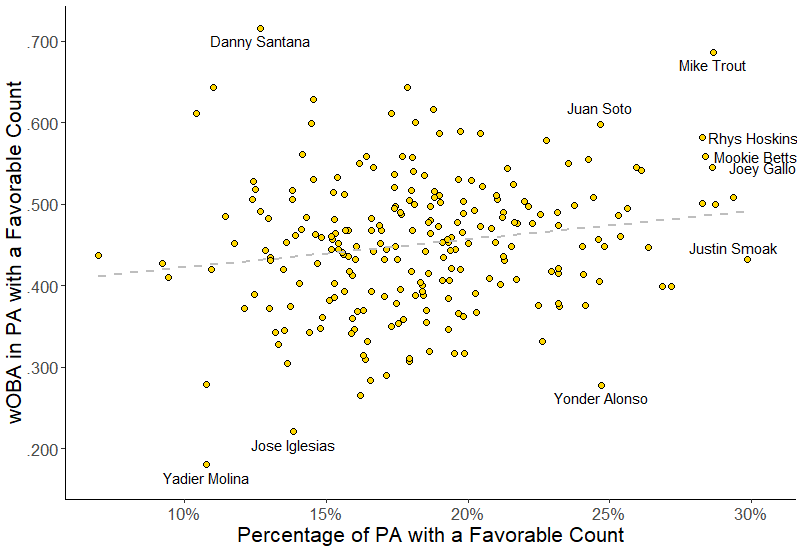
    For 2019, here are the ten players who have reached 2-0/3-0 or 3-1 in the highest percentage of their plate appearances (minimum 200 PA).

    BatterOverall PAPA w/ HCPct.wOBA
    Justin Smoak2617829.9%.432
    Cody Bellinger3379929.4%.508
    Carlos Santana3419828.7%.499
    Mike Trout34910028.7%.685
    Joey Gallo2276528.6%.544
    Mookie Betts37710728.4%.558
    Daniel Vogelbach3048628.3%.500
    Rhys Hoskins3509928.3%.581
    Tyler White2065627.2%.399
    Kendrys Morales2015426.9%.398

    The wOBA column represents their weighted on-base average in those plate appearances in which they got to a favorable count (but didn’t necessarily end the PA in one of them). So, in the 100 plate appearances in which Mike Trout got to a 2-0/3-0 or 3-1 count, he has an absurd .685 wOBA.

    Being a power hitter with exceptional plate discipline is a good way to make this list. But not everyone has ended up doing damage in those plate appearances, as you can see with Tyler White (who has a 91 wRC+ overall on the year) and Kendrys Morales (who has a 63 wRC+ overall and was just designated for assignment by the Yankees). Justin Smoak tops the list in terms of getting into favorable counts, but his wOBA is lagging a bit behind the others as well.

    The other seven players have been among the best at not only getting into hitter-favorable counts, but also finishing with success, all recording a wOBA of .499 or better in those PA. Trout, Rhys Hoskins, Mookie Betts, and Joey Gallo have been especially good.

    Here’s a look at the relationship in 2019 between getting into favorable counts and then having success:

    Getting into counts like 2-0 and 3-1 is certainly good for hitters, but is it a repeatable skill? Between 2017 and 2018, there was a strong year-to-year correlation (r = 0.76) for hitters with 400+ PA in each season.

    Between 2018 and 2019, Gallo has had one of the most significant increases in generating plate appearances with favorable counts, going from 20% to 29%. Pitchers are surely fearful of his power, and it helps that he’s cut his chase rate from 32% to 23%.

    On the other side, Cleveland’s Jose Ramirez has had one of the sharpest declines, going from 29% to 22%. After turning in consecutive seasons with a 146 wRC+, Ramirez is hitting just .216/.310/.329 in 2019.

    Finally, what about the ability to repeatedly do damage in plate appearances with a favorable count? The correlation isn’t as strong here (r = 0.33) but still positive.

    It’s good for hitters to be in favorable counts, and there’s evidence that being able to get into those situations may be consistent from year to year. That’s perhaps not a surprising conclusion, given batter quality and plate discipline, but it’s ultimately another important piece in hitter evaluation.

  • What’s The Deal With Bryce Harper?

    By Jon Becker

    All stats current through 6/26

    13 homers: pretty good! .364 OBP: pretty good! 23 doubles: pretty good! But, when your name is Bryce Harper, and you own the biggest free agent contract in major-league history … not too long after having one of the best seasons in major-league history … not too long after being perhaps the most hyped draft prospect in major-league history, that feels like a disappointment.

    It’s only been 80 games, and Harper can certainly be allowed something of a grace period as he adjusts to a new clubhouse, city and coaching staff, but regardless, his trends are alarming. Looking at the surface-level stats, when compared to last year, his triple-slash stats are down across the board; his slash-line in 2018 was .249/.393/.496, and it’s down to .246/.364/.457 this year. You probably knew that, though, and I’m not here to tell you what you already know! Let’s get a little more advanced.

    By the “plus” stats, each of which set the league average at 100, with those above 100 being better than league average (110 would be 10% better than league average, for example), Harper’s worsened as well:

    StatSource20182019
    OPS+Baseball-Reference134112
    wRC+ (Weighted Runs Created)FanGraphs135114
    DRC+ (Deserved Runs Created)Baseball Prospectus126105

    OPS+ and wRC+ both evaluate a batter’s results, whereas DRC+ attempts to be more predictive, and the latter stat shows that Harper’s performance has genuinely declined and isn’t just the result of bad luck. So, we’ve established that, no matter where or how you look, Harper’s output has decreased. Those are the results on a holistic, every plate-appearance level, and they’re worse but not hugely so. Let’s zoom in a little.

    Hitters see four-seam fastballs more than any other pitch, and that’s no exception even for a guy as feared as Harper. He’s seen 509 four-seamers this season–over one-third of the pitches he’s faced. His change in performance on those pitches? Now that’s staggering.

    Bryce Harper vs. Fastballs

    Stat20182019
    Slugging Percentage.645.505
    Isolated Power (SLG – AVG).340.222
    Batting Average on Balls in Play.355.414
    HR/FB%32.1%18.2%
    Miss%28.0%27.5%
    K%24.3%31.1%
    Hard-Hit Rate35.7%34.0%

    The chart above shows that despite squaring the ball up nearly as well on fastballs, and actually being more lucky on balls in play, Harper’s performance against fastballs has plummeted. It probably wasn’t fair to expect one out of every three fastballs hit to the outfield to continue to sail over the fence, but a HR/FB% of 18.2% is still above league average (15% this season). So, we can’t just expect a positive regression here. The results being what they are, what’s differed in the approach to change those results as compared to last season?

    Harper’s swinging at considerably more fastballs than last season, whether they’re inside the zone or outside of it. His Z-Swing% on fastballs is up from 67.0% to 72.1%, and his O-Swing% on fastballs has increased as well, from 18.6% to 22.8%. On those inside-the-zone swings, he’s making contact at almost exactly the same rate, so he’s not missing hitters’ pitches. What he is doing is swinging through far more pitches off the plate; his O-Contact% has tumbled to 51.0% after it was 73.0% last season. Sometimes it can be beneficial to swing and miss and give yourself another shot against a better pitch, but hitters as good as Harper are typically good at knowing their outside-the-zone strengths, and Harper’s missing a lot more pitches that he’s presumably swinging at because he thinks he can do damage, despite those pitches being out of the zone.

    It’s easy to sit here and say “Bryce, you’ve just got to make contact against fastballs more often!” But, when poring over the data and determining that’s the obvious answer, there’s not really much else to say. Whether Harper–known for changing his swing often–thinks that more tinkering is in order, or if he believes that his struggles will just sort themselves out with time, one thing’s for sure: he’s got to do more damage against the easiest pitch to hit in Major League Baseball.

  • Which Teams Are Best at Drafting, Developing and Displaying DRS?

    Here at Sports Info Solutions, we have lots of data. One subset of data we have is MLB Draft data. In exploring it, it got me thinking: which teams are the best at drafting players who end up producing lots of Defensive Runs Saved for the team that drafted them?

    Here are the top five and bottom five teams since we began tracking DRS in 2003.

    TeamDRS
    Cardinals412
    Braves366
    Blue Jays294
    Red Sox293
    Giants277
    —–—–
    Rockies-58
    Tigers-61
    Phillies-77
    Yankees-122
    Pirates-182

    A lot of this checks out; the Cardinals are known for prioritizing good defense and also home-grow lots of players. On the other side of things, the Pirates have had a lot of really bad teams since 2003, and really bad teams tend to have really bad defenses.

    Now, let’s take a look at who the main contributors and culprits are for the top and bottom teams. Let’s start with the good: who’s padded that Cardinals number? Keep in mind there are plenty of other players who’ve posted a positive DRS, and also a handful whose DRS is negative.

    PlayerPosition(s)DRS
    Yadier MolinaC169
    Albert Pujols1B/3B/LF/RF119
    Brendan RyanSS/3B/2B52
    Kolten Wong2B/CF42
    Harrison BaderCF/RF27

    Just about every national broadcast–and Cardinals broadcast to boot–finds a way to talk about how good Molina’s defense is, and with good reason: he’s really good! More than any other aspect of his game, Molina’s value has come from throwing out runners on the bases, having saved 54 runs doing so. But he also excels at making Good Fielding Plays without making many Defensive Misplays or Errors (46 GFP/DME Runs Saved) and framing pitches (41 Strike Zone Runs Saved).

    Now with the Angels, Pujols is no longer the relatively fleet-of-foot multi-positional star he once was, but back in the day, he was the guy on defense. His 2007 season, in which he saved 31 runs, remains the single-season DRS zenith for a first baseman. Since DRS started in 2003, we’ll never know what Pujols’ all-over-the-diamond rookie season was like, but, for what it’s worth, most of his value came from his time at first base: he’s at -4 in left field from his time there in 2003, and at a net zero at 3B (-1 in his last season with the Cardinals, +1 in his first season with the Angels). Even without Pujols, though, the Cardinals would still be the sixth-best team; that’s how good they’ve been at drafting MLB-quality bats who can also produce positive defense.

    And now, for the not so good. Here are the five biggest culprits of the Pirates’ league-low defensive drafting.

    PlayerPosition(s)DRS
    Andrew McCutchenCF-68
    Jose Bautista3B/RF/CF-45
    Pedro Alvarez3B/1B-40
    Ryan DoumitC/RF/1B-36
    Nate McLouthCF/RF/LF-25

    McCutchen was a perfectly adequate center fielder in his first five years in the majors, with a DRS of -5; not good, but not horrible. It’s his last four years as a Pirate that really tanked his defensive value, with seasons of -13, -8, -28 and -16. He wasn’t even close to average in any direction in those last four seasons in Pittsburgh; his total Plays Saved in that time was -14 on shallow fly balls, -15 on medium fly balls, and a staggeringly low -28 on deep fly balls.

    For Bautista–the very same player who ended up slugging hundreds of memorable home runs while finding a home in right field as a Blue Jay–the main issue was in his time at third base. From 2006-07, he played about 1,300 innings at the hot corner, and combined to put up a -34 Plays Saved, including -11 on just 82 total defensive chances in 2006. His time in center field didn’t help either, where his DRS in 2006 was -10.

    Teams draft players based on not just offense, but projected defensive contribution as well, and while teams may be willing to give up a little bit on the defensive side of the ball when they have hitters as good as McCutchen, most teams can’t afford to. When looking at all 30 teams, it’s no surprise that the Cardinals are competitive just about every year, racking up homegrown DRS like nobody else. On the flip side, the teams at the bottom of the list are going to need better defense from their draftees.

  • New baseball podcast episode: Mike Ferrin wants to be Byron Buxton

    New baseball podcast episode: Mike Ferrin wants to be Byron Buxton

    In this episode of the SIS Baseball Podcast (click here to listen), Mark Simon (@MarkASimonSays) begins by marveling at Zack Greinke’s defense (1:05). Mark then talks to MLB Radio and Arizona Diamondbacks broadcaster Mike Ferrin (@Mike_Ferrin). Mike makes his case for the best team in baseball (3:25) and discusses how much organizations value defense in this era (4:51). He also makes his pick on which defensive player he’d most like to be (11:15) and who’s the best defensive shortstop in the NL (15:35). Mike then comes up with a stat he’d like the BIS crew to work on (19:43). 
    Mark is then joined by Andrew Kyne (@Andrew_Kyne) and the two discuss Matt Carpenter, Jeff McNeil and the shift (24:24), how much outfielders benefit from changing positions (26:58), which players should have made the All-Defense All-Star team (29:58), and which defensive player they would most like to be (33:17). They then answer a listener question about which players have made the most different kinds of Good Plays (35:01) and try to stump each other with the Ridiculous Stats of the Day (36:42).

    Tune in, and please rate and review if you listen!

    ITunes – click here

    Stitcher – click here

    Google – click here


    I


    I

  • Visualizing Home Runs by Pitch Location

    Visualizing Home Runs by Pitch Location

    By Andrew Kyne

    Home runs are being launched at unprecedented rates in Major League Baseball. In 2019, there has been a home run hit once every 28 plate appearances — which if maintained would be the highest frequency for a season in history, followed by 2017 (1 every 30), 2016 (1 every 33), and 2018 (1 every 33).

    My colleague Mark Simon and I were curious about what home run heat maps look like in today’s MLB compared to several years ago. Let’s take a look, using methods similar to what Jim Albert has demonstrated.

    The following heat maps show the probability of a swing resulting in a home run, given a pitch’s location. It excludes bunts, as well as pitchers hitting.

    The colored areas begin at a 1.5% probability, and darker red indicates a higher likelihood. Locations are from the pitcher’s perspective.

    First, for left-handed batters in 2018 and 2019:

    Pitches right down the middle/over the inner-third generate the most homers per swing. Pitches low in the zone tend to generate more HR compared to high or outside.

    But that’s intuitive — you could probably picture that one without even seeing it. What we’re more interested in is how that’s changed from when home runs weren’t so common.

    Here’s what it looked like for left-handed batters in 2013 and 2014:

    This heat map uses the same scale as the previous one, so not only is the area much smaller, but the red isn’t as dark (indicating lower probability).

    Here’s a GIF to compare them back-to-back:

    Now, here’s the heat map for right-handed batters recently:

    And right-handed batters five seasons ago:

    And in GIF form:

    Hitter hot zones are certainly expanding. And while differences may seem small — 4 home runs per 100 swings rather than 3 per 100 in the best spots to hit, or 2 per 100 rather than 1 per 100 on the edges — they add up considerably in the aggregate.

  • Ball off the Wall: Which outfielders make mistakes, which have not?

    By Max Greenfield

    In last Sunday’s Blue Jays-Astros game, Eric Sogard hit a fly ball to deep right center field that looked like it could go out of the park. Astros right fielder Josh Reddick made a leap for the ball, but couldn’t get it. Sogard ended up at third base with a triple.

    At SIS, our Video Scouts (of which I’m one) track plays like that regularly. We chart them as Defensive Misplays for either “Failure to Anticipate the Wall” or “Wall Difficulties” resulting in a batter or runner gaining an extra base.

    Recently, Mike Petriello wrote an article about two new Statcast measures released on Baseball Savant that measure “reaction” and “burst” to help measure the jump a player gets on the ball.

    The work from Petriello and Savant led me to an idea on another way to evaluate outfield defense that isn’t thought about much: How well a player plays a ball off the wall.  I looked at which outfielders fare best and worst.

    Here are some takeaways from looking through the data:

    The first things that caught my attention was how Cardinals outfielder Harrison Bader fared in his full-time position, center field. Bader is an aggressive outfielder who gets great jumps on balls. He entered Thursday with 1,036 innings played in center field this season without a “Failing To Anticipate the Wall” or “Wall Difficulties” misplay (he had two in right field).

    Bader ranks third on Savant’s leaderboard measuring jump. Seeing him on the list shows he’s getting a good read on balls he both can and can’t reach. He’s aggressive, but not overaggressive. Bader’s teammate, Dexter Fowler, has the most innings of any outfielder with no Failing to Anticipate Misplays (1,150), including 963 in his primary position, right field.

    Pirates outfielder Gregory Polanco making the list could be more a factor of the park he plays in than anything else. Polanco deals with a large wall in right field at PNC Park making it more difficult to read the ball off the wall. He leads the majors with 11 such Misplays, a rate of 8 per 1,000 innings. By comparison, Andrew Benintendi, dealing with a similar wall situation in left field, averaged 3.6 Defensive Misplays per 1,000 innings

    Christian Yelich was unscathed in right field until this past week when he committed his first such misplay in the last two seasons. Yelich’s defensive ability can often get lost with how great of an offensive player he is. Yelich is already an above average defender and he’s very good at knowing how to play the wall in Miller Park. He has one wall-related misplay in 1,091 innings in right field and one in 615 innings in left field.

    Leaderboards for the stats we looked at are below. To qualify for the Most Wall Misplays Per 1,000 leader list, an outfielder must have at least 500 innings in one outfield position over the last two seasons. Calculating the rate of misplays as a per 1,000 innings scale gives us a number that is closer to a season total of innings in an outfield.

    Most Innings at Position, 0 or 1 Wall Misplays – Last 2 Seasons

    CF

    Name Innings Misplays
    Aaron Hicks 1,372 1
    Albert Almora 1,364 1
    Harrison Bader 1,036 0

    LF

    Name Innings Misplays
    Alex Gordon 1,679 1
    Joc Pederson 1,088 1
    Tommy Pham 820 0

    RF

    Name Innings Misplays
    Kole Calhoun 1,738 1
    Andrew McCutchen 1,244 1
    Christian Yelich 1,091 1

    Most Wall Misplays Per 1,000 Innings at Position

    Name Position Misplays
    Gregory Polanco RF 8.0
    Michael Conforto RF 7.8
    Cedric Mullins II CF 7.4
    Melky Cabrera RF 7.2
    Trey Mancini LF 7.3
    Teoscar Hernandez LF 6.0
    Joey Gallo LF 5.9

    The average outfielder committed 3 per 1,000 innings