Category: 2025 NFL

  • 2025 SIS NFL All-Pro Team

    2025 SIS NFL All-Pro Team

    Sports Info Solutions, a leader in the football analytics space, is pleased to announce its 2025 NFL All-Pro Teams. 

    The teams were selected using a combination of advanced stats and the eye test, with emphasis placed upon SIS’ player value stat, Total Points.

    Total Points attempts to capture everything that happens during play. It’s based on the work of our Data Scouts, who watch and chart every play of every game, and our Research & Development team. Value for successful and failed plays is divvied up among all players on the field based on what happened (for a comprehensive explanation on Total Points, click here).

    Here are the 2025 Sports Info Solutions All-Pro Teams:

    1st-Team Offense
    Position Player Team
    Quarterback Matthew Stafford Rams
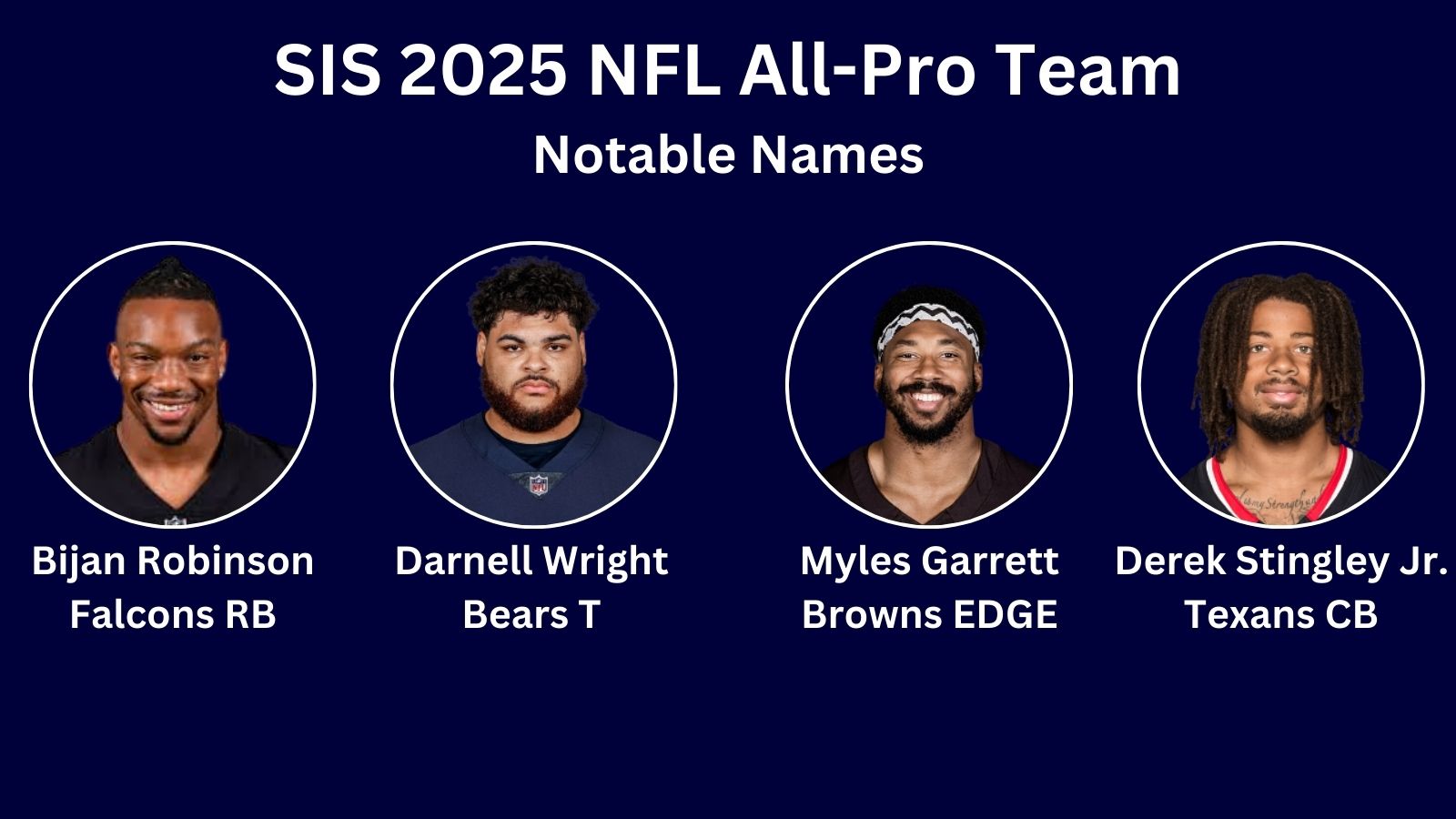
    Running Back Bijan Robinson Falcons
    Wide Receiver Puka Nacua Rams
    Wide Receiver Jaxon Smith-Njigba Seahawks
    Wide Receiver Ja’Marr Chase Bengals
    Tight End Trey McBride Cardinals
    Tackle Darnell Wright Bears
    Tackle Penei Sewell Lions
    Guard Joe Thuney Bears
    Guard David Edwards Bills
    Center Zach Frazier Steelers


    Quarterback: Matthew Stafford, Rams

    Matthew Stafford was on another level in 2025. He led the NFL in passing yards (4,707) and passing touchdowns (46). Among all QBs with at least 250 attempts, he had the highest touchdown rate (7.7%), was 3rd in IQR (109.2), and tied for the 3rd-lowest interception rate (1.3%) all while tying for the deepest average throw depth (9.0 yards). It’s not a surprise he’s the front runner for the MVP and has led the Rams back into the playoffs. -Nathan

    Running Back: Bijan Robinson, Falcons

    Bijan Robinson cemented himself as the best all-around running back in the NFL this season. He finished 4th in the NFL in rushing yards with 1,478 and was 2nd in receiving yards among all running backs with 820. He finished the season with an outstanding 81 Total Points which was 40 more points than the next two running backs. What also makes Robinson special is his ability to make defenders miss. He led all running backs with a 29% broken and missed tackle rate on rushing attempts (minimum 100 carries). -Jordan

    Wide Receiver: Puka Nacua, Rams

    Puka Nacua put together another incredible season, leading the NFL with 129 receptions and finishing 2nd with 1,715 receiving yards. He led the league in receiving first downs (80) as well as 20+ yard receptions (27).  Nacua led all receivers with 22 broken tackles on his receptions, plus an additional 6 missed tackles just for good measure. His Receiver Rating of 128 led all NFL wide receivers with at least 50 targets, and his 76 Total Points were the 2nd-most of any non-QB in the NFL. Finally, he won our NFC Player of the Week four times this season, the most of anybody. -Jeff

    Wide Receiver: Jaxon Smith-Njigba, Seahawks

    Jaxon Smith-Njigba led the NFL in receiving yards with 1,793 in 2025. What’s most impressive, is he had only one drop on the season. You have to go all the way down to Dalton Schultz, who was 38th in receiving yards with 777, to find someone with only a single drop. Additionally, Smith-Njigba’s 43 Receiving Total Points and 31 Points Above Average both ranked 2nd among all NFL WRs. -Nathan

    Wide Receiver: Ja’Marr Chase, Bengals

    Ja’Marr Chase stacked another phenomenal season to his NFL career, even with juggling multiple QB’s for the Bengals in 2025. He led the NFL in targets with 186, and was 2nd in receptions among WR’s with 125. He also finished 2nd in YAC (649) and defensive pass interferences drawn (9) among WRs. He finished tied 3rd in Total Points among all WRs with 40. -Jordan

    Tight End: Trey McBride, Cardinals

    Trey McBride had a historically good season on his way to setting the single-season, tight end reception record (126) and doing it within the first 16 games. His 1,239 receiving yards were over 300 yards better than the next-best tight end. His 25 broken and missed tackles forced were tops among tight ends as were his 63 first downs. Unsurprisingly, his 56 Total Points were the most among tight ends and 20 better than second place. -Jeff

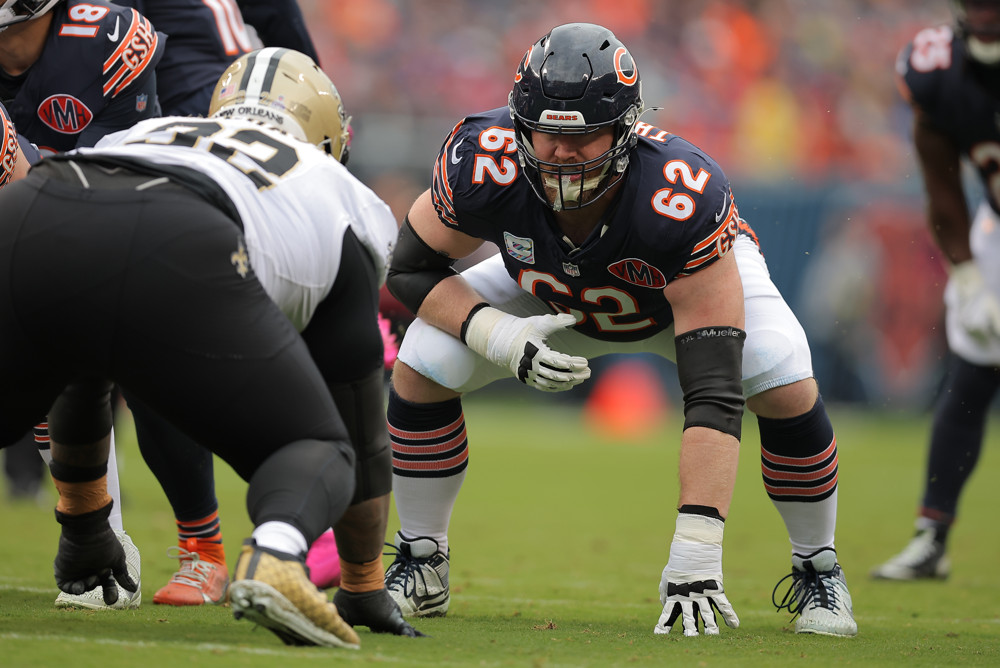
    Tackle: Darnell Wright, Bears

    Darnell Wright had a fantastic 2025 season, leading all tackles in Total Points with 42. He was an iron man in his own right, having logged over 1,000 total snaps this season, which only 11 other tackles in the NFL were able to do. He also had a 2.4% blown block rate, and is one of only two tackles in the 2025 season to log over 1,000 total snaps and have a blown block rate below 2.5%. He was also an elite pass protector, who led all tackles in Pass Block Total Points with 23. -Jordan

    Tackle: Penei Sewell, Lions

    Penei Sewell having an All-Pro season is nothing new, but this was arguably the best season of his career. Some of the deficiencies he’s had in pass protection in recent years have been overlooked due to how good the Lions OL has been. However, in 2025, that wasn’t the case. Sewell had to be good, and he was. His 1.7% blown block rate was best among all NFL tackles who played at least 500 snaps with a 2.3% rate in pass pro and a miniscule 0.8% as a run blocker. His 22 Total Points as a pass blocker ranked 2nd among all tackles, and was the best ranking of his career. -Nathan

    Guard: Joe Thuney, Bears

    Joe Thuney was a major contributor to the Bears offensive improvements from last season. He led NFL guards with 44 Total Points and 15 Total Points Above Average. He was one of only two offensive linemen to earn at least Total Points as both a run blocker and as a pass blocker, Zach Frazier being the other. Thuney’s 1.1% blown block rate was the best among NFL guards as was his 0.9% blown block rate on runs (minimum 500 snaps). -Jeff

    Guard: David Edwards, Bills

    David Edwards earned the competitive second guard spot due to his reliability and impact. He was second among NFL guards in Total Points (40) and Total Points Above Average (13). His 1.5% blown block rate was tied-3rd among guards as he helped pave the way for the best rushing offense in the NFL this season. -Jeff

    Center: Zach Frazier, Steelers

    Zach Frazier had a fantastic second season in his NFL career, ranking 1st in Total Points among centers with 43. He was balanced in both the pass and run game, finishing 2nd  in Pass Block Total Points and 1st in Run Block Total Points among centers. He also finished with an outstanding 1% total blown block rate which ranked 2nd among all centers (minimum 500 snaps). -Jordan


    1st-Team Defense
    Position Player Team
    Defensive Tackle Jeffery Simmons Titans
    Defensive Tackle Quinnen Williams Cowboys
    Edge Will Anderson Jr. Texans
    Edge Myles Garrett Browns
    Linebacker Jack Campbell Lions
    Linebacker Devin Bush Browns
    Cornerback Derek Stingley Jr. Texans
    Cornerback Pat Surtain II Broncos
    Safety Kevin Byard III Bears
    Safety Talanoa Hufanga Broncos
    Defensive Back Cooper DeJean Eagles


    Defensive Tackle: Jeffery Simmons, Titans

    While the Titans struggled for much of the 2025 season, the defense, led by Jeffery Simmons, was a bright spot. Simmons’ 69 Total Points blew all other defensive tackles out of the water (Chris Jones was 2nd with 42). He led all DTs in sacks with 11 and pressures with 63, which ranked 13th in the entire league, no matter the position. His 15.5% pressure rate also led all DTs with at least double-digit pressures. -Nathan

    Defensive Tackle: Quinnen Williams, Cowboys

    Quinnen Williams had a fantastic season for both the New York Jets and Dallas Cowboys, having been traded midseason. He finished the season ranked 3rd in Total Points among defensive tackles with 40. He also ranked at the top of Run Defense Total Points among defensive tackles with 24. While he only had 2.5 sacks this season, he finished 4th in total pressures among defensive tackles with 49. -Jordan

    Edge: Will Anderson Jr., Texans

    Will Anderson Jr. has gotten better each year and he ended this season tied for 1st among edge players with 70 Total Points. He was 2nd in the NFL in pressures (94) on his way to gathering 12 sacks. His pressure rate of 23% was 2nd-best in the NFL (minimum 100 pass rushes) as was his 57 Pass Rushing Total Points. He did not slack off against the run either, finishing 4th in the NFL with 22 tackles for loss. Anderson showed why the Texans traded up to draft him, and he may have had his first Defensive Player of the Year trophy if it were not for the player below… -Jeff

    Edge: Myles Garrett, Browns

    It was a record setting year for the future Hall of Famer, Myles Garrett. He broke the single-season sack record with 23 total sacks, a mark Michael Strahan had for 24 years (though it took Garrett a 17th game to set the mark). He finished the season with a 5% sack rate on his pass rush snaps, which led all defenders (minimum 30 pressures). He also finished 3rd among defensive ends in Pass Rush Points Saved with 55 and 4th in total pressures with 83. -Jordan

    Linebacker: Jack Campbell, Lions

    The defensive leader in Total Points in 2025 was Jack Campbell, who amassed 74. Not only did that lead all defensive players, it was 17 points higher than Devin Bush’s 57 for 2nd among LBs. He also wasn’t one-dimensional. He filled up the stat sheet to the tune of 168 tackles, 5 sacks, 19 pressures, and 3 forced fumbles. His 32 Total Points against the run were most among all LBs, and his 42 Total Points in the pass game ranked 3rd. -Nathan

    Linebacker: Devin Bush, Browns

    Devin Bush may not get the same love as some of the other Browns defenders, but he was excellent this season. His 57 Total Points and 28 Total Points Above Average were both 2nd-best among linebackers. He was one of only two linebackers to earn 35+ Pass Defense Total Points and 20+ Run Defense Total Points, along with Campbell. Bush had a pair of pick-sixes this year, including a 97-yard return in the final week of the season. -Jeff

    Cornerback: Derek Stingley Jr., Texans

    Derek Stingley Jr. had another fantastic season as one of the primary defenders on a star-studded Texans defense. He led all cornerbacks in Total Points Saved with 42 on 60 total targets. He finished the season with 4 interceptions and 11 pass breakups. He also finished the season with a 61.4 Passer Rating Against, which ranked 17th-lowest among cornerbacks with at least 25 targets. -Jordan

    Cornerback: Pat Surtain II, Broncos

    The Pat Surtain effect was in full force in Denver during the 2025 season. Surtain saw 62 targets come his way, tied for 19th-most in the league. However, Riley Moss, his teammate and opposite corner, saw 103 targets, 15 more than anyone else in the league. His 38 Total Points in pass coverage and 21 Points Above Average were both 2nd-best behind Stingley. Additionally, among the 100 CBs to see at least 25 targets, his 56.1 Passer Rating Against was 12th-best. -Nathan

    Safety: Kevin Byard III, Bears

    Kevin Byard III led the NFL with 7 interceptions this season as part of a much-improved Bears defense. He led NFL safeties in Total Points (56), Coverage Total Points (32), Points Above Average (22), and was tied for the lead in Run Defense Total Points as well (24). His all-around play helped the Bears reach the postseason and solidified Byard as a ball hawk. -Jeff

    Safety: Talanoa Hufanga, Broncos

    One of the most balanced safeties in the league, Talanoa Hufanga’s 54 Total Points ranked 2nd among all safeties, 30 of which came against the pass and 24 against the run. His 13 Points Above Average in the run game were tops among all safeties. Hufanga secured over 100 total tackles, 8 of them came for a loss, and his 9.4% broken and missed tackle rate ranked in the top 25% of all safeties with at least 25 solo tackles. -Nathan

    Defensive Back: Cooper DeJean, Eagles

    Cooper DeJean was part of a great defensive back tandem in Philadelphia this season. Despite being targeted 60 times in coverage, he did not allow a touchdown as the primary defender. His 14 passes defensed were 4th-best among all defenders, and he snagged an additional 2 interceptions. He was 4th among cornerbacks in Total Points (48) and Coverage Total Points (37). -Jeff

    1st-Team Specialists
    Position Player Team
    Kicker Ka’imi Fairbairn Texans
    Punter Ryan Rehkow Bengals
    Returner Chimere Dike Titans

    Kicker: Ka’imi Fairbairn, Texans

    Ka’imi Fairbairn led all kickers in Total Points with 25 this season. He also finished the season 44-of-48 on field goal attempts, with a 91.7 FG%, which led all kickers in the NFL. He additionally finished 28-of-28 on extra point attempts. -Jordan

    Punter: Ryan Rehkow, Bengals

    Ryan Rehkow finished with the 4th-highest punting average of 50.5 and pinned 28 punts inside the 20. Underappreciated aspects of the punting game also favor Rehkow with only 4 punts going out of bounds and 10 punts being downed by his own team. These factors helped him lead all punters in both Total Points (20) and Points Above Average (11). -Jeff

    Returner: Chimere Dike, Titans

    Chimere Dike burst onto the scene as the primary returner for Tennessee in 2025 on both kick and punt returns. As a kick returner, all he did was secure the 2nd-most return yards in the entire league, 1,562 on 62 returns. As a punt returner, his 394 yards were good for 3rd-most, plus he added three returns for touchdowns, including a 90-yarder that tied for the longest punt return of the season. -Nathan

    Below, you can find our All-Pro 2nd Teams which include big names like Drake Maye, Jahmyr Gibbs, Garrett Bolles, Creed Humphrey, Chris Jones, Aidan Hutchinson, Quinyon Mitchell, and Kyle Hamilton.

    2nd-Team Offense
    Position Player Team
    Quarterback Drake Maye Patriots
    Running Back Jahmyr Gibbs Lions
    Wide Receiver Amon-Ra St. Brown Lions
    Wide Receiver George Pickens Cowboys
    Wide Receiver Stefon Diggs Patriots
    Tight End Hunter Henry Patriots
    Tackle Garrett Bolles Broncos
    Tackle Dion Dawkins Bills
    Guard Peter Skoronski Titans
    Guard Tyler Smith Cowboys
    Center Creed Humphrey Chiefs


    The 2nd-Team Offense featured some big-time names that could’ve easily found their way onto the top team. Drake Maye had an incredible year for New England, leading the Patriots back to the playoffs. His 113.5 Passer Rating and 139.6 EPA gained were best in the league among QBs with at least 250 attempts. 

    Jahmyr Gibbs and Amon-Ra St. Brown both had stellar seasons once again in Detroit. A two-time SIS NFC Player of the Week winner, Gibbs’ 25% broken and missed tackle rate as a runner ranked 2nd among RBs with at least 100 carries, and St. Brown’s 11 receiving touchdowns were 2nd in the NFL. Finally, Creed Humphrey continued his dominance in the middle of the Chiefs offensive line, leading all offensive linemen with at least 500 snaps with a 0.8% blown block rate overall and 0.4% rate in pass pro. -Nathan


    2nd-Team Defense
    Position Player Team
    Defensive Tackle Chris Jones Chiefs
    Defensive Tackle Derrick Brown Panthers
    Edge Aidan Hutchinson Lions
    Edge Danielle Hunter Texans
    Linebacker Carson Schwesinger Browns
    Linebacker Devin Lloyd Jaguars
    Cornerback Quinyon Mitchell Eagles
    Cornerback Deommodore Lenoir 49ers
    Safety Jaylinn Hawkins Patriots
    Safety Kyle Hamilton Ravens
    Defensive Back Jamel Dean Buccaneers


    The 2nd-Team Defense features some phenomenal individual seasons, who almost made the cut for 1st Team honors. The defensive line is highlighted by Aidan Hutchinson, who led all defenders in the league with 99 total pressures. Chris Jones stacked another great season to his Hall of Fame career, finishing 2nd in Total Points Saved among defensive tackles with 35. 

    Carson Schwesinger is one  of only two rookies to make either the 1st or 2nd Team selections, finishing 3rd in Total Points among all linebackers. Devin Lloyd also finished the season leading all off-ball linebackers with 47 Pass Defense Total Points. Patriots safety Jaylinn Hawkins also had a fantastic season, leading all safeties with 33 Pass Defense Total Points. -Jordan


    2nd-Team Specialists
    Position Player Team
    Kicker Will Reichard Vikings
    Punter Tommy Townsend Texans
    Returner Isaiah Williams Jets

    The 2nd-Team Specialists all have worthy cases to be on the 1st Team. Will Reichard hit 33-of-35 field goals this season, with both misses coming from 50+ yards. He went 11-of-13 on 50+ yard field goals. Tommy Townsend had 30 punts inside the 20 with only 5 touchbacks to highlight his precision.

    Finally, Isaiah Williams was a rare bright spot for the Jets with two punt return touchdowns to go along with the 2nd-best kickoff return average in the NFL (minimum 20 kickoff returns). -Jeff


    Honorable Mentions
    Position Player Team
    Quarterback Bo Nix Broncos
    Running Back De’Von Achane Dolphins
    Wide Receiver Zay Flowers Ravens
    Tight End Tucker Kraft Packers
    Tight End Tyler Warren Colts
    Guard Damien Lewis Panthers
    Defensive Tackle Jalen Redmond Vikings
    Defensive Tackle Tommy Togiai Texans
    Edge Josh Hines-Allen Jaguars
    Edge Maxx Crosby Raiders
    Linebacker Ernest Jones IV Seahawks
    Cornerback Christian Benford Bills
    Cornerback Nahshon Wright Bears
    Safety Antoine Winfield Jr. Buccaneers
    Kicker Cam Little Jaguars
    Punter Daniel Whelan Packers


    We want to highlight some of the close calls and honorable mentions who didn’t quite make the cut, but were very much in the running.

    Bo Nix led all quarterbacks in Total Points with an outstanding 142 points. De’Von Achane was tied with 2nd Team selection Jahmyr Gibbs with 41 Total Points. Tucker Kraft was well on his way to having a career year and giving Trey McBride a run for 1st Team honors before suffering a season-ending knee injury. He only played in 8 games in 2025, but still finished 3rd in Receiving Total Points among all TE’s with 27. 

    Maxx Crosby also had another great season, finishing with 35 Run Defense Total Points, which led all defenders regardless of position in the NFL, proving again he is one of, if not, the best run defenders in the league. -Jordan

    The Lions and Texans tied for the most picks with 5 selections apiece across the two teams. The Patriots weren’t far behind with 4 selections of their own.

    Stats and ranks accurate as of 1/13/2026

  • Why Does Our Player Value Stat Rank Bo Nix No. 1?

    Why Does Our Player Value Stat Rank Bo Nix No. 1?

    In sum: Broncos QB Bo Nix ranks No. 1 in our all-encompassing player value stat, Total Points. That contrasts with Nix’s poor ranks in many measurable quarterback skills.

    Our system is primarily rewarding him for two things that paint over those flaws: 1) his avoidance of sacks, and 2) his high volume of short high-floor throws.

    The Denver Broncos are set to host the Buffalo Bills in the divisional round, and while I’m sure many articles will be devoted to previewing the matchup, we’re instead taking the opportunity to do some housecleaning and investigate something that’s been bothering us for the last several weeks: Bo Nix ranking 1st in our Total Points metric.

    Total Points Leaders – NFL Quarterbacks

    Player Total Points
    Bo Nix 142
    Matthew Stafford 127
    Patrick Mahomes 120
    Jared Goff 119
    Caleb Williams 118
    Josh Allen 107
    C.J. Stroud 107

    For the uninitiated, Total Points is our proprietary player value stat that divides credit for the EPA value on a play among the players involved based on our charting data.

    A full primer on Total Points is beyond the scope of this article, but a quick example might be that Total Points will evaluate a quarterback who throws an interception because a receiver dropped a pass and it caromed into the arms of a defender very differently from one who throws an interception because he overthrew an open receiver, even if the EPA value on the play is the same.

    Because the metric theoretically focuses on process over results, why, then, does it seem to think so highly of Bo Nix? But perhaps the better question to ask – at least initially – is, ‘Why does SIS seem to think this is a problem?’ I’m glad you asked!

    Across most measures, Nix is not very good. In expected on-target rate +/- (xOnTgt+/-), which calibrates quarterback accuracy based on throw location, he ranks 29th. 

    He’s 25th in independent quarterback rating (IQR), an enhancement of passer rating that controls for drops, dropped interceptions, and throwaways, and which the last several MVPs have ranked very highly in.

    He’s also between 18th and 28th in touchdown rate, success rate, explosive play rate, adjusted net yards/attempt (ANY/A), turnover-worthy play rate, and average depth of target (ADoT).

    That’s not No. 1 QB caliber.

    So, what gives? Well, for starters, it’s not all bad. Nix gets a lot of credit for avoiding sacks; his 3.3% sack rate is the lowest in the NFL and he consequently generates more Total Points on sack avoidance than any other player – roughly 20% more than the next. 

    We’re generally comfortable with the principle of giving quarterbacks credit for this because sacks are indeed a quarterback stat, but perhaps we could modulate it in a way that accounts for play design. 

    We’ll elaborate on Nix’s ADoT more shortly, but suffice it to say there’s a difference between a quarterback having a low sack rate because he’s getting the ball out quick by design vs. having a low sack rate because he’s navigating the pass rush well (which is the spirit of the principle).

    With offensive linemen, for example, they receive more credit for sustaining blocks the longer they are expected to hold them given the design of the play. 

    However, there is an existing interaction between blocker credit and passer credit by which QBs get slightly less credit for the result of the play if the offensive line performed well (all else being equal). This would complicate such a revamp given the fact that the credit has to go somewhere, because that’s just how accounting works.

    Nix also avoids highly negative plays reasonably well, largely owing to the fact that a whopping 61% of his throws are attempted 5 yards or fewer downfield. From a Total Points perspective, this means that he is spamming high-floor value propositions as a baseline. 

    Most Total Points – On Throws 5 Yards or Fewer Downfield

    Player Total Points
    Bo Nix 83
    Matthew Stafford 36
    C.J. Stroud 30

    The biggest chunk of Total Points value in general is what we call the throw value, which is an estimate of the average value of a throw with similar distance, route, and receiver openness. Any assessment of accuracy, catching, or yards after catch happens as a modulator to this initial estimate.

    But, on top of that, he’s also getting more credit than league average on these throws – about 50% more – and that adds up over such a large sample.

    Some of this is his targeted receivers having a higher rate of openness than most quarterbacks, but there are also just slight, compounding effects across several situational factors which feed into the throw value component of Total Points. Nothing in particular stands out as a smoking gun, but they do add up.

    Lastly, we believe we’ve identified a potential improvement to how we’re penalizing quarterbacks for inaccurate throws. At SIS, we track both if a throw was accurate and if it was catchable, and we recently implemented the aforementioned xOnTgt+/- into how we evaluate quarterback accuracy from a Total Points perspective.

    The problem, though, is that an uncatchable throw is worse than an inaccurate throw, and we’re not differentiating between the two as much as we’d like in general.

    In Nix’s specific case, we’re talking about a poor deep passer (29th in catchable rate on throws 15+ yards downfield) who also has the sixth-most attempts. That’s a lot of attempts for which we could be penalizing him more severely, and for which he’s receiving a lot of credit in the throw value because it’s a high value proposition (i.e. deeper downfield). Look at his numbers compared to MVP candidates Matthew Stafford and Drake Maye.

    Stafford, Maye, Nix – Pass Attempts, 15+ Yards Downfield

    Player Pass Attempts Catchable %
    Matthew Stafford 145 83%
    Drake Maye 114 76%
    Bo Nix 115 67%

    This combination of small things adds up over the course of a full season, and even if we were able to make enhancements to the model overnight, Nix still probably wouldn’t be as low as we would expect him to be based on other metrics and the eye test. We’re always looking to improve Total Points and we learn as much from the case studies of surprisingly-well-rated players as we do anything else.

    I don’t know that Nix will finally turn into a pumpkin this weekend, but, if he does, please don’t hold our feet to the fire on him ranking higher than his counterpart, Josh Allen. Because rest assured, we’re working on it.

  • 2025 SIS NFL All-Rookie Teams

    2025 SIS NFL All-Rookie Teams

    Sports Info Solutions, a leader in the football analytics space, is pleased to announce its 6th annual NFL All-Rookie Teams. 

    The teams were selected using a combination of advanced stats and voting among members of our football operations staff, with emphasis placed upon SIS’ player value stat, Total Points.

    Total Points attempts to capture everything that happens during play. It’s based on the work of our Data Scouts, who watch and chart every play of every game, and our Research & Development team. Value for successful and failed plays is divvied up among all players on the field based on what happened (for a comprehensive explanation on Total Points, click here)

    As we do every year, we adjust the positional structure of this team to make sure to honor as many top performers as possible from this season.

    Here are the 2025 Sports Info Solutions award winners and All-Rookie Teams:

    Rookies of the Year

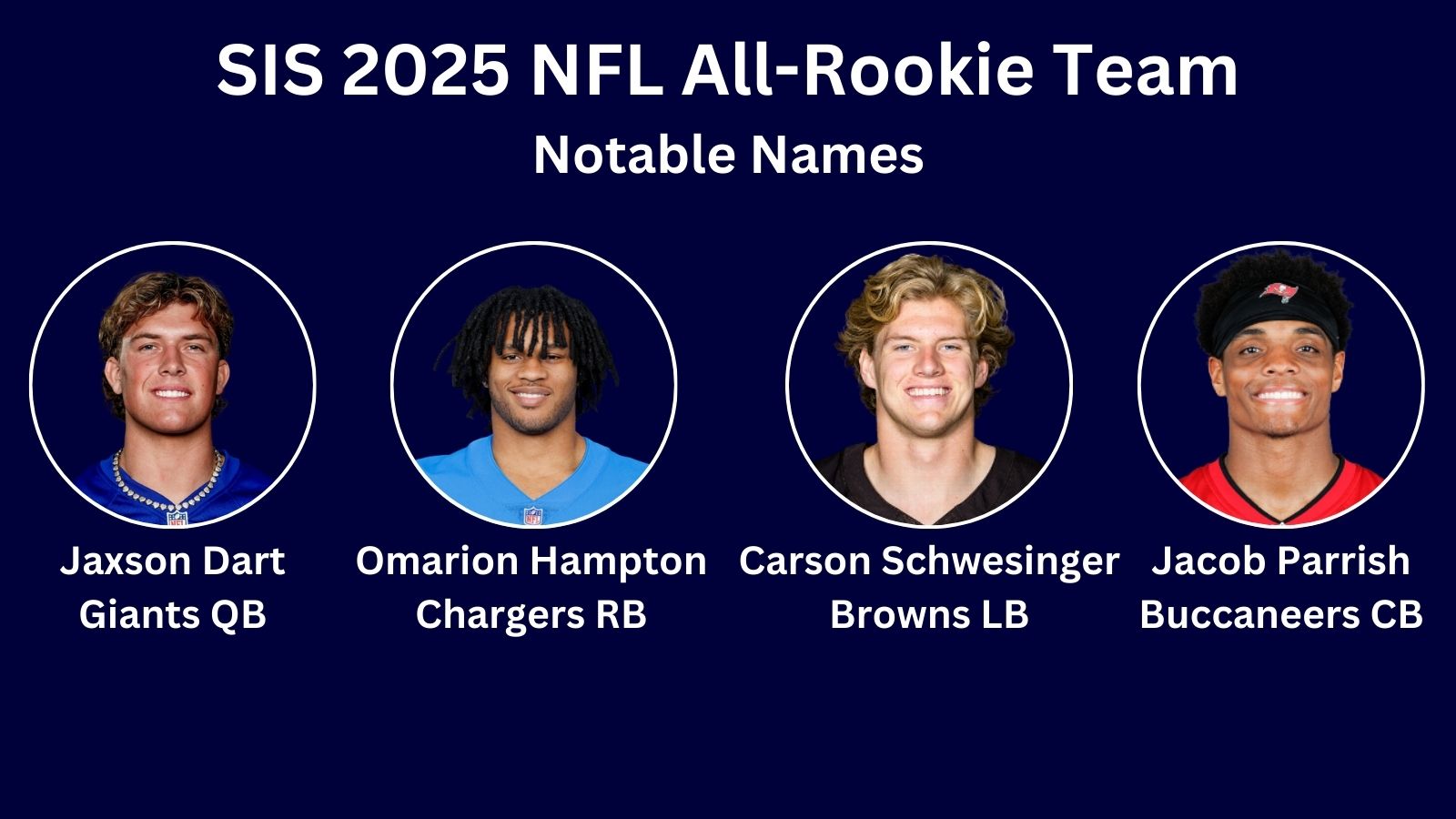
    Offensive Rookie of the Year could’ve gone a few different ways and there were multiple players deserving, but ultimately Jaxson Dart of the Giants takes the crown.

    Defensive Rookie of the Year goes to Carson Schwesinger of the Browns after a year in which he led all non-QB rookies in Total Points.

    Chimere Dike was one of the few bright spots on a dismal Titans team, making his presence felt on special teams as both a kick and punt returner, earning our Special Teams Rookie of the Year.

    This year’s Rookie Class of the Year goes to the New England Patriots. This was another close call, but with five players making our two teams, most of any team, they got the nod. They hit on players all throughout the Draft, including 4th round pick Craig Woodson, who led the team with 30 Total Points.

    1st-Team Offense
    Position Player Team
    Quarterback Jaxson Dart Giants
    Running Back Omarion Hampton Chargers
    Running Back Ashton Jeanty Raiders
    Wide Receiver Tetairoa McMillan Panthers
    Wide Receiver Luther Burden III Bears
    Tight End Tyler Warren Colts
    Tackle Aireontae Ersery Texans
    Tackle Kelvin Banks Jr. Saints
    Guard Tate Ratledge Lions
    Guard Grey Zabel Seahawks
    Interior Offensive Lineman Donovan Jackson Vikings

    Quarterback: Jaxson Dart, Giants

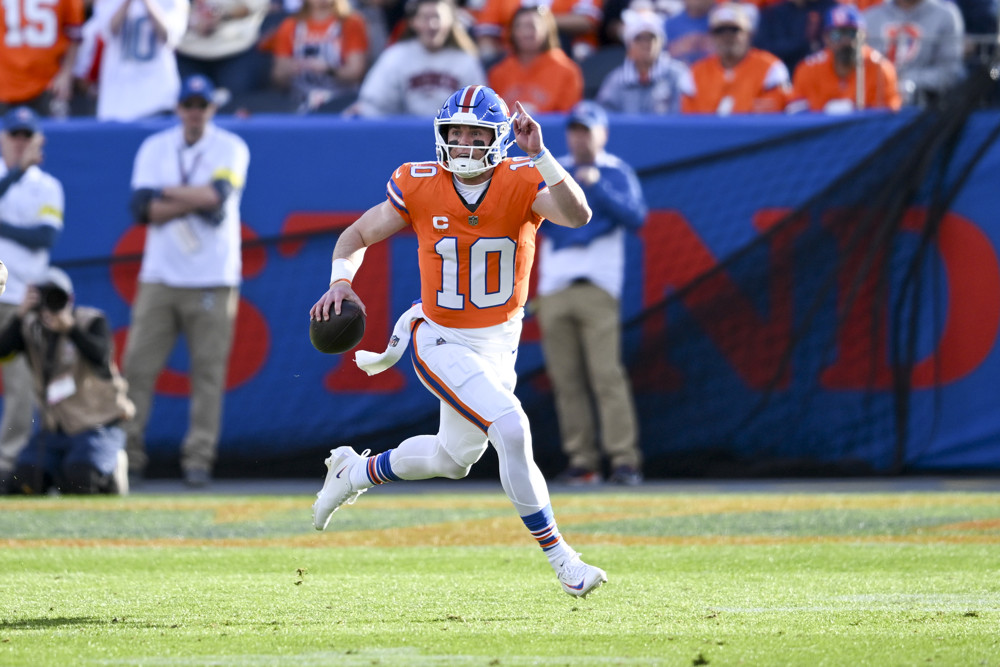
    Jaxson Dart showed off his athleticism and ability as a rookie in 2025. In 13 games, Dart threw for 2,272 yards, 15 touchdowns, and 5 interceptions. On the ground, his 487 yards were 3rd among all QBs, and his 9 rushing touchdowns tied for 2nd. His 14 Total Points as a rusher were 9th-best at the position. With all the questions surrounding his early selection in the NFL Draft, he showed that he has the ability to be someone New York builds around for the future.

    Running Back: Omarion Hampton, Chargers

    Had Omarion Hampton not gotten hurt and missed 7 games, he likely tops 1,000 yards and makes a much bigger impact for the Chargers than he did. His 20 Rushing Total Points were 8th-most among RBs in the league, and his 16 Total Points Above Average as a rusher ranked 5th. Additionally, his broken and missed tackle rate of 21% ranked in the top 20% among RBs with at least 100 carries.

    Running Back: Ashton Jeanty, Raiders

    Ashton Jeanty had to work for all his production this season. Jeanty racked up 975 rushing yards, which topped all rookie runners in 2025. The Raiders’ offensive line issues were evident, as he was hit at the line on over 52% of runs, 3rd-most among RBs with at least 100 carries. Despite that, he put together a 24% broken and missed tackle rate, good for 3rd in the league. In the passing game, his 55 receptions and 347 yards were both top 10 at the position.

    Wide Receiver: Tetairoa McMillan, Panthers

    Tetairoa McMillan stepped up as Bryce Young’s top target for Carolina in 2025, on the way to its first division title in 10 years. He was the only rookie receiver to top 1,000 yards this season, compiling 1,014 to go along with 7 touchdowns. His 26 Total Points easily led all rookie wideouts, and his 24 Receiving Total Points were in the top 10% of all WRs.

    Wide Receiver: Luther Burden III, Bears

    While Luther Burden III was utilized some early in the season, he found his stride in the Chicago offense beginning in Week 8 when he caught at least three passes on at least four targets in every game the rest of the season. For the season, Burden placed 4th in yards per route run (2.8), 4th receiver rating (123.1), 8th in broken and missed tackle rate (28%), and tied-10th in Total Points Above Average per Route (0.045) among WRs with at least 25 targets.

    Tight End: Tyler Warren, Colts

    Tyler Warren helped revitalize a Colts team that shot out of the gate in 2025 by winning 8 of its first 10 games. Warren put up 817 receiving yards this season, good for 3rd-most among all rookie pass catchers. While his 20 Receiving Total Points were 3rd-best among rookie TEs (8th-best overall), his 32 Total Points overall led the group. His blocking made a difference, as he earned 10 Total Points as a blocker with 9 coming in the run game.

    Tackle: Aireontae Ersery, Texans

    Aireontae Ersery was one of only 11 tackles who played 1,000 snaps in 2025. With that, he quickly solidified himself as the blind side blocker for C.J. Stroud and the Texans offense. His 28 Total Points led the way for rookie tackles and ranked just outside the top 25% in the NFL. Additionally, he held a 4.2% blown block rate, which ranked middle of the pack among all tackles.

    Tackle: Kelvin Banks Jr., Saints

    One of the other 11 tackles with 1,000 snaps this season was Kelvin Banks Jr. Banks garnered 23 Total Points with a 4.2% blown block rate for a Saints team that was one of the better teams across the final month plus of the season.

    Guard: Tate Ratledge, Lions

    For an interior offensive line that was shaky-at-best for the Detroit Lions in 2025, Tate Ratledge proved to be the right guard of the future. He was reliable, playing 1,040 snaps across all 17 games, and stout, allowing only 17 blown blocks this season. That equated to a 1.6% blown block rate, which sat tied for 8th-best among guards that played at least 500 snaps. Additionally, his 34 Total Points were tops among all rookie offensive lineman and in the top 20% among NFL guards.

    Guard: Grey Zabel, Seahawks

    Grey Zabel played nearly 1,000 snaps for a Seahawks team that earned the No. 1 seed in the NFC heading into the playoffs. While he had a 2.7% blown block rate overall, he held a better blown block rate in the run game (2.4%) than he did in pass pro (3.1%). Despite that, he earned more Total Points as a pass blocker than run blocker (14 to 12) and his Points Above Average in pass pro were 1.3 compared to -4.2 in the run game.

    Interior Offensive Lineman: Donovan Jackson, Vikings

    Donovan Jackson needed only 746 snaps to generate 26 Total Points for the Vikings in 2025. Of those, 15 came as a run blocker, where his 3.0 Points Above Average ranked in the top 25% among all guards who played at least 500 snaps. His 2.9% blown block rate is something that can be cleaned up, as he sat middle of the pack among the position.

    1st-Team Defense
    Position Player Team
    Defensive Tackle Mason Graham Browns
    Defensive Tackle Deone Walker Bills
    Edge Abdul Carter Giants
    Edge James Pearce Jr. Falcons
    Linebacker Carson Schwesinger Browns
    Linebacker Jihaad Campbell Eagles
    Cornerback Jacob Parrish Buccaneers
    Cornerback Will Johnson Cardinals
    Safety Xavier Watts Falcons
    Safety Jonas Sanker Saints
    Defensive Back Craig Woodson Patriots


    Defensive Tackle: Mason Graham, Browns

    Mason Graham was part of a vaunted Browns defensive line, filling the role nicely during his rookie season. His 27 Total Points led all rookie defensive linemen and ranked 10th among all true DTs. His 49 tackles, 0.5 sacks, and 28 pressures will all be marks he looks to improve upon going into his second season.

    Defensive Tackle: Deone Walker, Bills

    One of the biggest boom-or-bust candidates of the 2025 Draft had to be Deone Walker. Judging on his rookie season, he’s looking like a boom candidate and a steal in the 4th round by the Bills. While he’ll need to develop as a pass rusher, getting only a sack and 19 pressures on the season, he looked strong against the run where he captured 14 of his 23 Total Points.

    Edge: Abdul Carter, Giants

    Arguably the best player in the draft class, Abdul Carter found his stride late in the season. From Week 11 on, he played in at least 80% of the defensive snaps in all but one game, and compiled 3.5 of his 4 sacks during the final 5 weeks of the season. Carter’s 25 Total Points led all rookie edge defenders. Additionally, he finished the season with 66 pressures, good for 10th-most in the league.

    Edge: James Pearce Jr., Falcons

    James Pearce Jr. showed that he has what it takes to be the next great pass rusher in Atlanta. He led all rookies and was tied-13th in the NFL with 10.5 sacks in 2025. He also added 40 pressures on a 12.9% pressure rate. With his pass rush looking like it’ll approach elite status sooner rather than later, he’ll have to improve in the run game. He accumulated 20 Total Points overall this season, with 21 coming in the pass game, meaning he lost points in run defense.

    Linebacker: Carson Schwesinger, Browns

    Our clearcut Defensive Rookie of the Year, Carson Schwesinger patrolled the middle of one of the league’s best defenses in Cleveland. His 52 Total Points led all non-QB rookies, and he wasn’t too far behind Dart and Tyler Shough, either. It also ranked 3rd-best among all LBs in the NFL. While his Total Points spread was fairly split with 27 in run defense and 25 in pass defense, his 27 against the run was 4th-best at the position. With 145 tackles (8th-most), a 29.4% pressure rate (6th-most among LBs with at least 10 pressures), and just a 9.4% broken and missed tackle rate against the run, he looks to be a staple in that defense for years to come.

    Linebacker: Jihaad Campbell, Eagles

    It wasn’t a sure thing that Jihaad Campbell would be ready to start the season for the Eagles, yet he was in the lineup for Week 1 and played in every game. Campbell produced 14 pressures as a pass rusher on a 27.5% pressure rate (11th-highest among LBs with at least 10 pressures). He also collected 12 Total Points in coverage. While he was more productive against the pass, his mere 7.3% broken and tackle rate in the run game ranked in the top 15% of all linebackers with at least 25 solo tackles. He sure looks like another late-1st round gem for Howie Roseman in Philadelphia.

    Cornerback: Jacob Parrish, Buccaneers

    Jacob Parrish led all rookie corners with 27 Total Points in 2025, and he did it with an all-around game, as 18 of his Total Points came against the pass and 10 against the run. Parrish grabbed two interceptions and defended five passes for the Buccaneers defense. He also finished the season with 68 tackles, 8 being for loss which tied 3rd-most among CBs.

    Cornerback: Will Johnson, Cardinals

    Will Johnson played in 12 games for Arizona in 2025, seeing 86% of the defensive snaps in those games. On 53 targets, he allowed only 33 catches, and while he didn’t come down with an interception, he broke up 10 passes and committed just one pass interference penalty.

    Safety: Xavier Watts, Falcons

    The Falcons look to have hit on at least two of their draft picks in James Pearce Jr. and Xavier Watts (that’s not to mention Jalon Walker or Billy Bowman Jr.). Watts filled up the stat sheet in 2025, picking off 5 passes (tied 2nd-most among safeties), breaking up 5 more, and making 92 tackles with a mere 8.0% broken and missed tackle rate (top 15% of safeties with at least 10 solo tackles). Overall, his 43 Total Points far and away led all rookie safeties.

    Safety: Jonas Sanker, Saints

    Jonas Sanker proved to be a solid cover safety for the Saints defense this season. On 21 targets, he allowed only 10 completions and 107 yards (5th-fewest among safeties with at least 15 targets), while collecting 2 interceptions and 5 pass defenses. However, he’ll need to improve as a tackler, as his 20.4% broken and missed tackle rate puts him 9th-worst among all safeties with at least 10 solo tackles.

    Defensive Back: Craig Woodson, Patriots

    As a 4th-round pick for New England, Craig Woodson stepped in and started 15 of 17 games, playing over 93% of the defensive snaps in 2025. His 30 Total Points trailed just Watts among rookie safeties. He was productive as a tackler, finishing with 74 tackles, 6 TFL, and an average tackle depth of 3.2 yards, but will need to improve in coverage, as he allowed 5 touchdowns on just 25 targets.

    1st-Team Specialists
    Position Player Team
    Kicker Ryan Fitzgerald Panthers
    Punter Jeremy Crawshaw Broncos
    Returner Chimere Dike Titans


    Kicker: Ryan Fitzgerald, Panthers

    Ryan Fitzgerald was good on 24-of-29 field goals in 2025 for the Panthers, and he also added 27 made extra points. His 12 Total Points led rookie kickers.

    Punter: Jeremy Crawshaw, Broncos

    As there were only two rookie punters this season, Jeremy Crawshaw didn’t make it particularly close on who should take home 1st Team honors. Despite Denver winning 14 games this season, Crawshaw punted 75 times, 3rd-most in the league. He put 30 of them inside the 20 and forced 23 fair catches, both also tied for 3rd-most.

    Returner: Chimere Dike, Titans

    Chimere Dike burst onto the scene as the primary returner for Tennessee in 2025 on both kick and punt returns. As a kick returner, all he did was secure the 2nd-most return yards in the entire league, 1,562 on 62 returns. As a punt returner, his 394 yards were good for 3rd-most, plus he added three returns for touchdowns, including a 90-yarder that tied for the longest punt return of the season.

    In our first year announcing Player of the Week awards, which includes a Rookie of the Week, Ashton Jeanty and Tetairoa McMillan were 2-time winners in 2025. Jeanty also garnered runner-up AFC POTW honors following his Week 4 performance in which he ran for 138 yards and a score plus caught 2 passes for 17 yards and 2 touchdowns.

    You can follow us online via Twitter and Bluesky to keep up with our Rookie of the Week selections during the season.

    In all, seven offensive 1st Teamers and six defensive 1st Teamers received a 6.7 final grade or higher from us in our draft rankings last season, suggesting those players will at least be high-end three-down starters beginning their second season. Additionally, only one of the 22 offensive or defensive players didn’t receive a grade of at least 6.4 (Craig Woodson). We’ll see if they begin 2026 the way they played this season to warrant those final grades, but we like their chances.

    Below, you can find our All-Rookie 2nd Teams which include big names like Tyler Shough, TreVeyon Henderson, Emeka Egbuka, Colston Loveland, Will Campbell, James Pearce Jr., and Malaki Starks..

    2nd-Team Offense
    Position Player Team
    Quarterback Tyler Shough Saints
    Running Back TreVeyon Henderson Patriots
    Running Back RJ Harvey Broncos
    Wide Receiver Emeka Egbuka Buccaneers
    Wide Receiver Elic Ayomanor Titans
    Tight End Colston Loveland Bears
    Tackle Will Campbell Patriots
    Tackle Armand Membou Jets
    Guard Dylan Fairchild Bengals
    Guard Tyler Booker Cowboys
    Interior Offensive Lineman Jared Wilson Patriots


    2nd-Team Defense
    Position Player Team
    Defensive Tackle Walter Nolen III Cardinals
    Defensive Tackle Yahya Black Steelers
    Edge Donovan Ezeiruaku Cowboys
    Edge Jack Sawyer Steelers
    Linebacker Teddye Buchanan Ravens
    Linebacker Demetrius Knight Jr. Bengals
    Cornerback Upton Stout 49ers
    Cornerback Nohl Williams Chiefs
    Safety Malaki Starks Ravens
    Safety Nick Emmanwori Seahawks
    Defensive Back Andrew Mukuba Eagles


    2nd-Team Specialists
    Position Player Team
    Kicker Andres Borregales Patriots
    Punter Kai Kroeger Saints
    Returner Myles Price Vikings


    Some of these players could’ve very easily found their way onto the 1st Team. Tyler Shough and Emeka Egbuka just missed out on making our top team. In most years, Colston Loveland, Donovan Ezeiruaku, and Teddye Buchanan are easy 1st teamers, but were blocked by some strong players this year.


    Honorable Mentions
    Position Player Team
    Quarterback Cam Ward Titans
    Running Back Jacory Croskey-Merritt Commanders
    Running Back Kyle Monangai Bears
    Running Back Cam Skattebo Giants
    Running Back Quinshon Judkins Browns
    Wide Receiver Jayden Higgins Texans
    Tight End Harold Fannin Jr. Browns
    Tackle Josh Conerly Jr. Commanders
    Tackle Ozzy Trapilo Bears
    Defensive Tackle Darius Alexander Giants
    Edge Nic Scourton Panthers
    Cornerback Quincy Riley Saints
    Returner Jaylin Noel Texans


    We want to highlight some of the close calls and honorable mentions who didn’t quite make the cut.

    Cam Ward had a tough season for Tennessee, but played well despite being the most sacked and 2nd-highest pressured QB in the league. We had four running backs who had strong seasons this year who didn’t make the cut but were worth mentioning. It’s notable that while Quinshon Judkins ran for 827 yards and 7 touchdowns, his -18 Total Points were worst among all RBs. Harold Fannin Jr. also performed well in Cleveland and nearly took our 2nd Team Tight End spot.

    On the defensive side of the ball, Darius Alexander, Nic Scourton, and Quincy Riley nearly made the Second Team but were edged out.

    As mentioned earlier, each year we change some of the positions to account for the depth at certain areas specific to this draft class. This year, there were no starting rookie centers, so that spot is designated as an Interior Offensive Lineman to include more of the strong group of guards. Additionally, with the secondary as packed as it was, we went with the 5th DB position again instead of a normal hybrid position, which ultimately led to six safeties making the two teams.

    You can check out last year’s article here to see how we structured the teams. Again, the entire idea of these teams is to highlight the best players across the league, and we feel we did that.

    With all but just five teams represented among these selections, this once again signifies that plenty of talent is being dispersed throughout the league. Over our six years of selecting these teams, the Steelers have the most total selections with 17, two more than the Lions and Patriots. On the flipside, the Bills, Cardinals, Commanders, and Panthers have just 6.

    Additionally, nine teams kept their streak alive this year as having a player making one of the two teams in each of the six seasons. They are the Bengals, Broncos, Chargers, Chiefs, Giants, Jets, Lions, Saints, and Steelers.

    This was another fun draft class to watch, and we’re excited to see their growth each year in the league. Stay tuned to see what we’ll have to say about the next generation of NFL stars as they head into the 2026 NFL Draft.

    Stats and ranks accurate as of January 8, 2026

  • Optimistic and Pessimistic Takeaways for the Seahawks and Rams After Week 16

    Optimistic and Pessimistic Takeaways for the Seahawks and Rams After Week 16

    Photo: David J. Griffin/Icon Sportswire

    Arguably the biggest game of the year so far took place last Thursday night and it did not disappoint. History was made, with us witnessing the first NFL game to end with a walk-off 2-point conversion. The Seattle Seahawks got their revenge and defeated the Los Angeles Rams 38-37, gaining the inside track to representing the NFC as the first seed in the process. 

    The Rams will be kicking themselves for letting go of the game that was all but theirs, but all is not lost. They should still feel confident in their chances come January, backed by the fact that they rank 1st overall in our team Total Points metric.* 

    *For a refresher, here is our primer on Total Points.

    The Seahawks came into the match ranking 2nd themselves, and the two bouts between them so far have further emphasized how neck and neck the two clubs are, well summarized by this stat

    Let’s take a deeper look into why each team should and shouldn’t feel confident about its chances to win it all.


    Why the Seahawks can win the Super Bowl: Improving rushing attack, special teams advantage

    In my previous article, I covered why the Seahawks should still feel like they’re in the mix due to their defense but in order to truly contend, they will need to answer questions about both their running and passing games, especially against elite defenses in high-stakes moments. 

    While they still have more to prove to completely quell those concerns, especially in their passing attack, their showing last Thursday was a step in the right direction. 

    The Seahawks entered the game with the 2nd worst rushing EPA per attempt in the league. Given that placement, it may seem odd that they ranked 14th in rushing Total Points per attempt, but that can be explained by them ranking as the worst run blocking unit in the same metric. 

    They arguably had their best rushing performance of the season so far, gaining 171 yards on 25 carries, with two of those resulting in touchdowns. The numbers matched what our eyes were telling us, improving across the board:

    Rushing EPA/A Rushing TP/A Run Blocking TP/A
    Weeks 1-15 -0.10 0.05 0.15
    Week 16 0.24 0.27 0.25

    Seattle must continue to demonstrate that it can punish opposing defenses on the ground and take pressure off Sam Darnold and the receiving corps. Teams that end up lifting the Lombardi trophy are often the best at problem solving and have other pitches to go to when their fastball is compromised, so to speak.  

    An area they have already proven to be among the league’s elite throughout the season is special teams. The Seahawks rank 6th in special teams Total Points per play, backing up that ranking with top 5 rankings in both punt and kickoff average return yards. 

    The momentum-shifting punt return touchdown by Rashid Shaheed upped Seattle’s combined punt and kick return touchdown total to three, tied for most in the league. They also have three combined punt and field goal blocks, again tied for most in the league, showcasing their penchant for making plays in all phases of special teams.


    Why not the Seahawks: Passing questions remain, turnovers

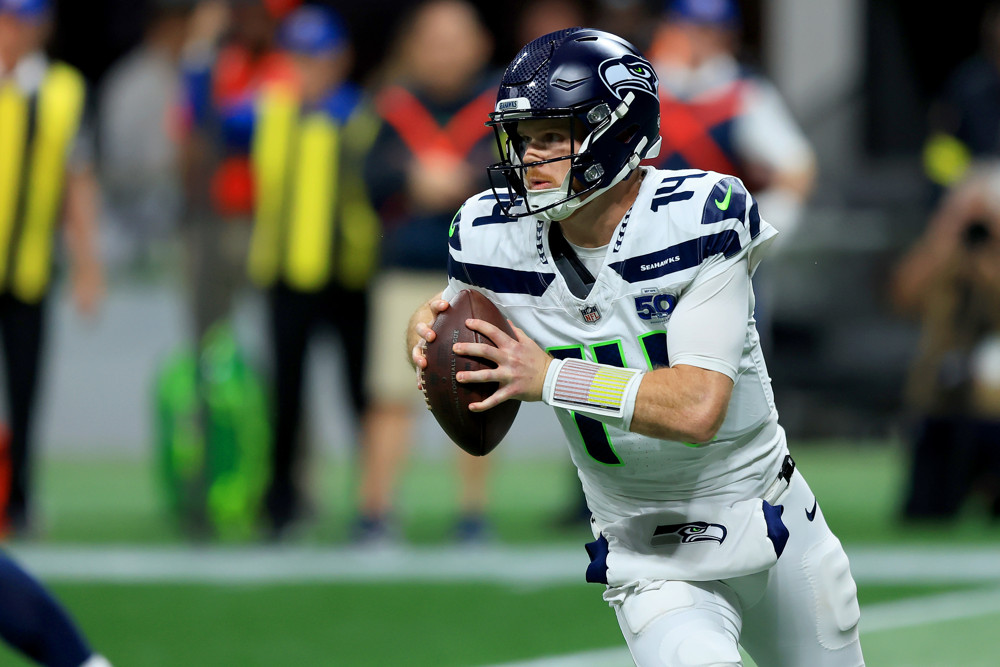
    To Sam Darnold’s credit, he demonstrated that he could deliver when the team needed him to and win a game with massive stakes, particularly against a team who has given him the most trouble the past couple of seasons. 

    For the last half of the fourth and overtime, Darnold went 8 for 11 (excluding a spike) for 91 yards and two touchdowns, in addition to completing two 2-point conversions. At least for one game, he was able to get the proverbial monkey off of his back. 

    For the first three-and-a-half quarters however, things didn’t seem that way, with Chris Shula and his defense seemingly flummoxing Darnold at every turn and forcing two back-breaking picks, both with disguised coverages. 

    I noted previously that up through Week 11, the Seahawks had a negative passing EPA for the season when facing dime personnel (6+ defensive backs). Things were more of the same last Thursday, with them posting a 10% success rate and -13 EPA against dime (-5 EPA against nickel as well).

    There is still time for Darnold and the Seahawks to establish whether they can perform consistently when in obvious passing down situations, but for now things don’t look fixed.

    In addition to the two aforementioned interceptions, Cooper Kupp also lost a fumble to his former team, bringing Seattle’s turnover total up to 26, second-most in the league. Denver, San Francisco, and Seattle are the only teams over .500 with a negative turnover differential. 

    Teams who have lost the turnover battle are a combined 41-143-1 so far in the 2025 season.  Needless to say, the Seahawks need to turn things around in that department to give themselves the best chance come January.


    Why the Rams can win the Super Bowl: Complete team on offense

    In a lot of ways, the Rams are who the Seahawks want to become on offense. They are 1st in offensive team Total Points per play, in large part due to having top 5 players at both quarterback and wide receiver in Matthew Stafford and Puka Nacua. 

    Even having to face an elite defense, Stafford lit up the Seahawks, throwing for 457 yards and three touchdowns with no picks. Nacua accounted for 12 of those completions, racking up a ludicrous 225 yards and two touchdowns. 

    If that wasn’t enough, they also employ the receiving touchdowns leader, Davante Adams, though it may take a while for him to return to form, as detailed in this piece by Alex Vigderman.

    The passing attack is counterbalanced by a solid run game led by Kyren Williams and Blake Corum, ranking 3rd in rushing success rate and 4th lowest in percentage of runs hit at the line. 

    Since Week 9, the midway point of the season, among tailbacks, Williams ranks 1st in rushing EPA per attempt and 11th in Total Points per play, while Corum ranks 12th and 6th in those same categories respectively. 

    Their offensive line is nothing to sneeze at either, ranking 3rd in blocking Total Points per play. They have the 4th lowest blown block percentage in the league and rank 2nd and 4th in sack and pressure percentage allowed, respectively. The Seahawks couldn’t bring Stafford down even once. 

    Over the full season, both the Rams and Seahawks are among the best teams in keeping the quarterback clean (and doing so without spamming quick game).

    Scatterplot of blown block rate and pressure rate allowed, with a slight trend between them. The Seahawks and Rams are in the bottom-left (good) end.

    * Bottom left is best


    Why not the Rams: Defensive slippage, special teams mistakes

    Honestly a bit of a nitpick here, as I would consider the Rams to employ a good defense. But no team is perfect and they are no exception. 

    The Rams are quietly 19th in run defense Total Points per play. They have allowed over 120 rushing yards in four of their past six games, and two of those four have resulted in losses, including Thursday night. 

    Against play action, they came into the game ranked T-7th-worst in EPA allowed per dropback, 8th-worst in boom percentage allowed, and 2nd-worst in bust percentage forced (where boom plays gain the offense 1 EPA or more and bust plays lose the offense 1 EPA or more). The Seahawks exploited this, with Darnold completing 10 of 13 passes for 167 yards and two touchdowns when in play action. 

    If opposing teams can establish their attacks on the ground and make hay with play action, the Rams have shown themselves to be susceptible. 

    A not-so-quiet underperforming phase of their team that reared its head in this game is special teams, and this proved to be the straw that broke the camel’s back with the firing of their special teams coordinator, Chase Blackburn. 

    The Rams rank 23rd in special teams Total Points per play. Special team blunders played a crucial role in three of their four losses this season, which include allowing two blocked field goals—one of which was returned for the game-deciding touchdown—against the Eagles, allowing a blocked extra point against the 49ers, and then giving up the punt return touchdown to the Seahawks.

    Final Words

    The Seahawks should be feeling great after wrestling away control of the NFC, but they know the job is not finished. They have questions they will need to continue to address through the end of the regular season and into the playoffs. 

    On the other side, even though they lost, the Rams have a solid argument for being the NFC’s best and most complete team. Their questions may prove to be more easily addressable as well. 

    Both the Seahawks and the Rams are top five teams by almost any overall measure of team quality. They are evenly matched through two, and there is a decent chance the two will meet again for a third and final match. 

    The winner may well represent the NFC in Santa Clara. Which of the two will come out victorious? I, for one, can’t wait to find out.  

  • What To Expect From Davante Adams and Micah Parsons Coming Off Their Injuries

    What To Expect From Davante Adams and Micah Parsons Coming Off Their Injuries

    Photos: John McLoughlin (l) and Jevone Moore (r)/Icon Sportswire

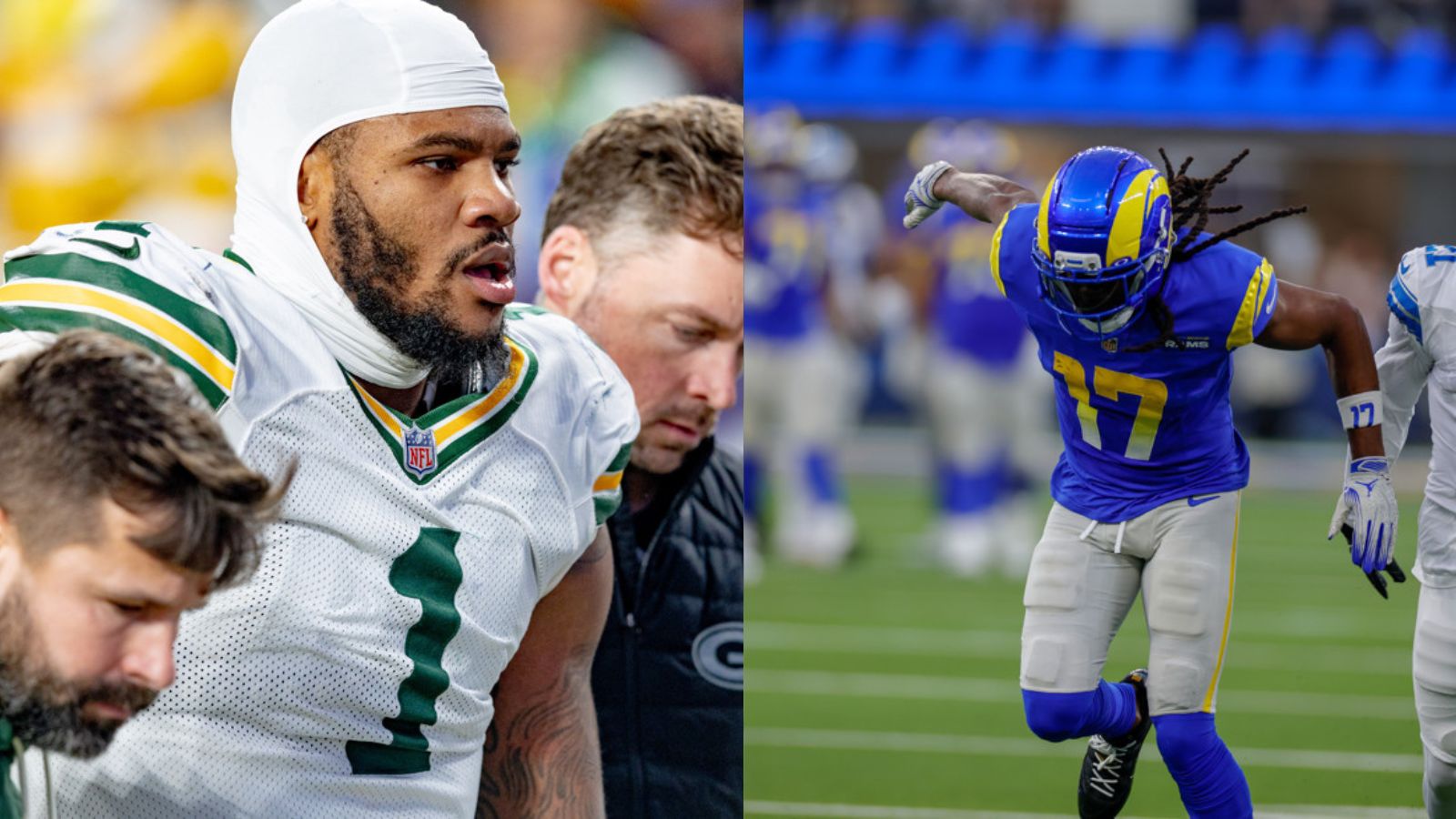
    It was a rough week for high-profile injuries, with Patrick Mahomes and Micah Parsons tearing their ACLs and Davante Adams aggravating a hamstring injury. 

    There can be a whole conversation about what Mahomes’ injury means for his career and the Chiefs’ place in history, but situations like this are once-a-decade so there isn’t much to judge from historically. Instead I want to focus on what we could learn about the Parsons and Adams injuries and their return (next year for Parsons, this year for Adams).

    Davante Adams

    The Rams’ No. 2 receiver aggravated a mild hamstring injury in the win over the Lions. He had been playing through it, continuing a strong campaign in which he easily leads the league with 14 receiving touchdowns. 

    The touchdowns are a bit of a distraction from the fact that he ranks 34th in receptions, 25th in yards, and 46th in EPA, but his individual contributions have been notable in that they’ve somewhat unlocked Puka Nacua as well.

    Rams Receiving Production, 2024-25

    Targets EPA Total Points
    Cooper Kupp 2024 100 4 7
    Davante Adams 2025 113 22 18
    Puka Nacua 2024 106 62 36
    Puka Nacua 2025 128 89 51

    Remember that Total Points is our total player value metric that operates in the same currency as EPA. So Adams is outperforming Cooper Kupp’s 2024, but his individual contribution isn’t as extreme as the total productivity of his targets (taking into account the play of others). Nacua was excellent last year, but he’s been otherworldly this year. And there are three games left to pad these totals.

    As for what to expect for the rest of Adams’ season, the Rams’ playoff standing is relevant. Depending on the severity of the strain, hamstring injuries could linger for a few weeks, and there are also ramifications on Adams’ productivity once he does return. 

    Taking a sample from our injury data, the average games missed for a Grade 1 strain is around one game, while a Grade 2 strain is closer to three games. But it should also be noted that even the first game or two back from the injury could be a problem.

    I looked at about 30 wide receiver hamstring injuries over the last several seasons and how much/well they played upon their return, compared to their previous year’s average.

    The results (as seen in the 2 images below) suggest that we should expect Adams to see a slight drop-off in playing time in his first several games, and his per-play output will take a couple games to return to normal.

    Micah Parsons

    The preseason trade of Parsons was one of the stories of the year, and he was having a strong season up until his knee injury this past weekend. Parsons was second in the NFL in pressures and third in sacks despite being eighth in pass rush snaps, unsurprisingly ranking as one of the best pass rushers in the NFL per Total Points.

    In terms of the overall impact to the team, the Packers gained about 4 percentage points on their team pressure rate over last year. Parsons continued to be a weak run defender (below-zero Total Points, which is roughly replacement-level), but Green Bay roughly treaded water in terms of run defense EPA per play and success rate (improved in the former, declined in the latter).

    In looking at a recent sample of 11 edge rushers who tore their ACLs and played at least 9 games after the injury, we can expect a pretty meaningful productivity drop-off in the year following Parsons’ return.

    Edge rusher productivity changes following an ACL tear

    Difference Difference (as %)
    Snaps per G -5 -12%
    Total Points per play -0.01 -25%
    Snap-to-Pressure time +0.23 s -20%*

    * If we assume a floor of 1.5 seconds on this metric

    The average age for this group at the time of the injury was 26, same as Parsons, so we don’t have a strong reason to suspect his recovery will be notably better. And the late injury opens up the possibility that he’ll miss time to start off 2026, let alone the above concerns once he does suit up.

    For now, the Packers will have to make do without their top defensive player, and that’s coming on the heels of losing DT Devonte Wyatt for the season. For Rashan Gary, the pressure is on (pun not intended), especially since his first seven games were worth 25 Total Points compared to just 6 over his last seven games.

  • Who Are The Frontrunners For NFL Protector Of The Year?

    Who Are The Frontrunners For NFL Protector Of The Year?

    Awards races are won and lost down the stretch, and that’s exactly where we are right now. Most people will be paying close attention to the MVP race, but there are plenty of other ones that deserve recognition as well. One of which is the NFL’s newest player award, the Protector of the Year.

    If you are tired of awards season being mostly about quarterbacks, then this is the award for you. Let’s take a look at our current frontrunners for the 2025 Protector of the Year, as well as some players who have been surprisingly good or bad. We’ll use a couple of metrics to compare different linemen, including our all-encompassing player value stat, Total Points (click the link to learn more).

    Total Points Leaderboard – Offensive Linemen

    Player Position Team Total Points Blown Block %
    Joe Thuney LG Bears 36 0.9%
    Darnell Wright RT Bears 34 2.2%
    David Edwards LG Bills 32 1.4%
    Penei Sewell RT Lions 32 1.4%
    Zach Frazier C Steelers 32 0.8%
    Drew Dalman C Bears 31 1.6%
    Creed Humphrey C Chiefs 30 0.6%
    Peter Skoronski LG Titans 30 1.2%
    Damien Lewis LG Panthers 30 1.5%
    Patrick Mekari RG Jaguars 29 2.0%

    For a little context on these metrics, let’s start with blown block rate. SIS charts blown blocks as cases where a defender physically beats a blocker and disrupts the play within a few seconds of the snap. The typical rate for a player might be 3-5 percent.

    Total Points takes blown block rate into account but also incorporates relevant details about the play beyond that. For rushing, we consider which blockers a run went behind and the balance of yards before and after contact. For passing, we consider the dropback type and how much time the quarterback had to operate.

    Chicago’s offensive line has taken a massive step forward this season. Caleb Williams was sacked a league-leading 68 times in 2024, but his sack rate has dropped by more than half thanks in part to Joe Thuney, Darnell Wright, and Drew Dalman. Thuney is leading the pack in Total Points, and he doesn’t have any holding penalties on the year either. As a unit, the Bears also rank first in run blocking Total Points (105).

    Dion Dawkins was one of the biggest advocates for the Protector of the Year award, and his teammate David Edwards is a top candidate so far in 2025. Dawkins also ranks first among left tackles in Total Points, slightly ahead of Philadelphia’s Jordan Mailata.

    Penei Sewell is one of the best players in the NFL, regardless of position. It’s not a surprise that he’s one of the leaders after 14 weeks. Our very own Nathan Cooper picked him to win this year when I wrote about who would’ve won Protector of the Year in 2024, and he’s well within striking distance.

    Zach Frazier and Creed Humphrey have been two of the top centers in all of football this year. Frazier has the slight edge in Total Points, but Humphrey has the lowest blown block rate of all linemen. It’s worth noting that interior linemen tend to have lower blown block rates on average.

    Tennessee’s offensive line has struggled as a whole (28th in Total Points), but Peter Skoronski has been playing very well in his 3rd season. In fact, he’s at the top of the list for pass blocking Total Points. Having a young and talented left guard will do wonders for Cam Ward’s development.

    The Panthers rank 4th in run blocking Total Points (84), and Damien Lewis is a big reason why. He also has just 2 blown blocks on 418 pass blocking snaps. Lewis ranks 12th as a pass blocker and 19th as a run blocker across the league.

    Jacksonville is averaging 20 more rushing yards per game than they were last season. They have also already surpassed their run blocking total points with time to spare. Their right guard, Patrick Mekari, leads the unit in Total Points, and 4 of their 5 starters rank within the top 50.

    Landon Dickerson was the SIS-voted winner of the 2024 Protector of the Year, but he’s taken a step back in 2025. He has been dealing with several injuries this season, and his production has taken a hit.

    Predicting The Winner

    It’s shaping up to be a very close race for the inaugural Protector of the Year. Not only are there tons of offensive linemen having great seasons, we also don’t know how the committee is going to vote.

    The left tackle position is widely regarded as the most important, but does the committee think the same? If they do, perhaps they don’t think a left tackle is deserving simply due to the position he plays. It’s also incredibly difficult to compare the value of a guard or tackle on one side of the line to the other, in addition to the center position.

    Luckily for us, Total Points is an all-encompassing statistic that allows us to compare players that don’t play the same position.

    Joe Thuney is the current leader and has been a model of consistency throughout his career. He’s been a major reason why the Bears’ offensive line has significantly improved in both pass protection and run blocking. My prediction is for Thuney to win, but like I said earlier, awards are won and lost down the stretch.

  • Which NFL Teams Were Most and Least Affected by Injuries in 2025

    Which NFL Teams Were Most and Least Affected by Injuries in 2025

    Photo: Jeff Moreland/Icon Sportswire

    Updated 1/7/26

    The narrative about teams most affected by injury this year shifted over time as key players exited and returned, but this year’s conversation started with the 49ers.

    They already knew they were going to be missing Brandon Aiyuk for much of the season (which turned out to be the whole season), and from that point also sustained injuries to Nick Bosa, George Kittle, Fred Warner, Ben Bartch, Brock Purdy, and Ricky Pearsall, among others.

    However, the subsequent return of many of these players caused them to be surpassed in the injury accumulation department. And they ended the season pretty functional, at least offensively.

    Most Value Lost To Injury, 2025 NFL season

    Team Games Missed Total Points Missed
    Cardinals 296 266
    Commanders 222 230
    49ers 262 200
    Bills 297 190
    Dolphins 248 182
    Falcons 202 176
    Giants 278 172
    Saints 234 162
    Bengals 161 160
    Lions 326 159
    Buccaneers 250 154
    Chargers 261 148
    Steelers 279 145
    Packers 237 136
    Chiefs 199 132
    Colts 243 126
    Panthers 182 125
    Bears 336 124
    Jets 224 105
    Texans 241 101
    Ravens 183 100
    Vikings 166 99
    Titans 176 97
    Jaguars 150 94
    Browns 194 89
    Eagles 176 84
    Raiders 94 82
    Broncos 180 77
    Cowboys 236 75
    Seahawks 216 75
    Rams 145 70
    Patriots 154 59

    The value we’re measuring here is each injured player’s Total Points per game over his previous 17 games, multiplied by the number of games missed due to injury. This only counts injuries sustained since August 1.

    For those new to our work:
    Total Points is a measure of how valuable each player was to his team’s ability to score or prevent points, using Expected Points Added as the currency. Dozens of charting data points go into it: an offensive lineman blows a block, a receiver drops a pass, a defender makes an unlikely tackle, a quarterback throws into a tight window, etc. All of these successes and failures can be measured in terms of how the team’s results changed relative to what we’d expect on average, and those play-to-play values can be bundled up into a single measure of player value that can work across all positions.

    The Walking Wounded

    Kyler Murray’s injury did not affect the Cardinals’ fortunes as much as you’d think because backup Jacoby Brissett was serviceable and Murray was not lighting it up, but Murray still ranks among the most impactful injuries of the year by Total Points. Running back James Conner has been a favorite of Total Points for a little bit now because of his tackle-breaking ability, so his absence also loomed relatively large. 

    The Commanders are at the top of this list because of Jayden Daniels’ injury-plagued season. But they also missed wide receiver Terry McLaurin, running back Austin Ekeler, safety Will Harris, and defensive end Deatrich Wise.

    The Bills have more total games missed than any of the teams above them, but the names were not as big as they could have been. They are notable in that just 20 of their 190 Total Points Missed came on the offensive side of the ball, which was the second-fewest offensive points lost.

    Others Receiving Votes

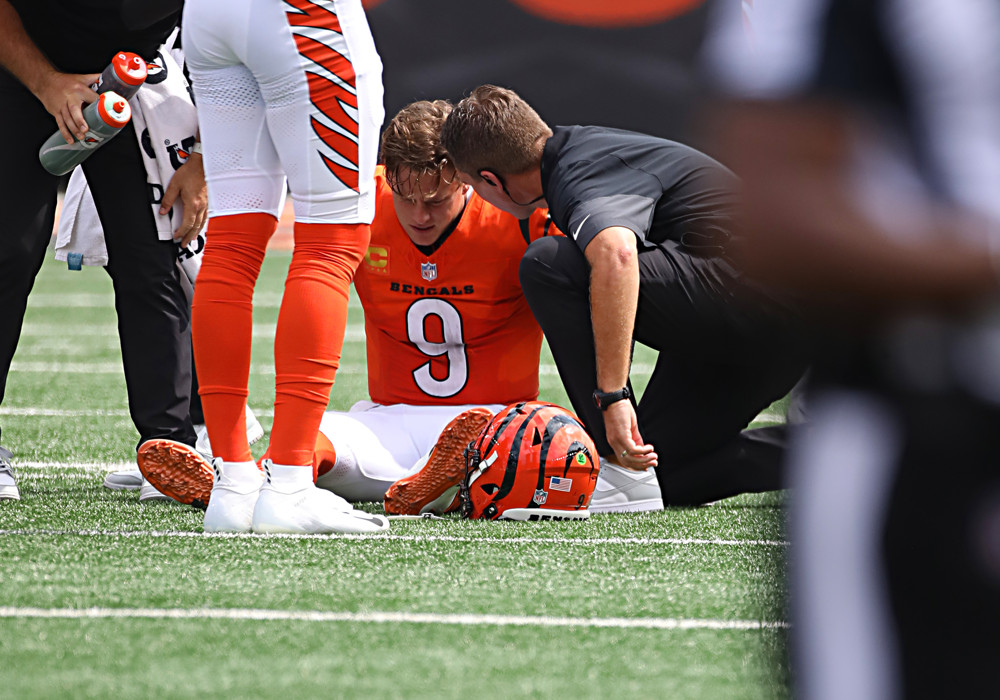
    The Bengals had substantially fewer total games missed to injury than other teams with high-profile quarterback injuries. Joe Burrow’s missed time alone cost them as many points as many of the teams in the NFL suffered in total this year, but without that injury they’d rank among the most fortunate teams.

    The Lions and Bears have the most games missed due to injury in the league, but they rank just 10th and 18th respectively in Total Points missed. They were fortunate to not have their biggest names go down this year.

    Dodging Raindrops

    The Patriots, Rams, and Seahawks were the most fortunate teams in terms of health, which sheds a little light on their strong showings this year. The five teams with the fewest Total Points missed due to injury (adding in the Cowboys and Broncos) were a combined 61-23-1, compared to 39-46 from the five most injured teams.

  • Dissecting The Returns of Lamar Jackson & Joe Burrow

    Dissecting The Returns of Lamar Jackson & Joe Burrow

    The AFC North has been playing a game of musical chairs at quarterback this season outside of the Steelers who have maintained some stability. The Browns, Ravens, and Bengals have all started three different QBs due to injury and insufficient performance from their backups. This has set up a dramatic division race to end the season as Lamar Jackson and Joe Burrow have returned from early season injuries.

    The Bengals and Ravens met on Thanksgiving night, and the Ravens squandered a prime opportunity to solidify their position and knock the Bengals out of the division race. Fortunately for the Ravens, they will have the chance to avenge their loss in two weeks in Cincinnati.

    Let’s take a look at how these top signal callers have fared in their returns.

    Lamar Jackson

    Lamar suffered a right hamstring strain in Week 4 against the Chiefs that caused him to miss three games. Unfortunately, Jackson continues to pop up on the weekly injury report since his return with knee, ankle, and toe designations. He does not look fully healthy and his performance is suffering because of it. 

    Part of what makes Jackson such a dynamic QB is his rushing ability, and that has suffered since the lower body injuries piled up. The table below shows the rushing stats for Jackson on designed QB runs (run plays that aren’t QB sneaks, kneels, or scrambles):

    Lamar Jackson on Designated QB Runs

    Pre-Injury Post-Injury
    Att/G 3.0 1.8
    Yds/Att 6.3 3.5
    BT+MT/Att 0.25 0.11
    Total Points 2 -2

    The Ravens are calling designed QB runs at a slightly lower rate and understandably so. Jackson’s efficiency in the run game has been almost cut in half and his inability to make defenders miss seems to be a driving factor. His effectiveness on scrambles has also taken a hit:

    Pre-Injury Post-Injury
    Att/G 2.3 2.8
    Yds/Att 10.0 5.4
    BT+MT/Att 0.33 0.29
    Total Points 9 3

    Jackson has had to scramble a bit more since his return, but without the same impact when healthy. It’s definitely a good thing that he hasn’t avoided scrambling altogether as it shows he still has faith in his legs, despite all the injuries. The threat of him being able to extend plays and scramble opens up things in the passing game. 

    However, Jackson has been struggling throwing the ball, as well. Among 36 QBs with 50 or more pass attempts since Week 9, Jackson ranks 2nd-worst in On-Target% at 61%. The only QB worse than him? JJ McCarthy. 

    The Ravens will need Jackson to step up his play at the end of the season if they want to win the AFC North. Their defense has struggled against the pass this season, ranking in the bottom half of our Total Points player value stat. Their inability to sack the QB has been a big issue, as they rank in the bottom 5 in both pressure rate and sack rate. The Ravens have not been able to rely on their defense like they have in the past.

    Joe Burrow

    Burrow made his return from a Grade 3 turf toe injury that required surgery and will look to build upon a huge Thanksgiving win to make an improbable comeback to win the division. Burrow wore a “hard plate” to protect his injured left toe, so it does seem like he is still battling the injury to some extent.

    Looking at the table below, we can compare Burrow’s Week 1 performance to his recent Thanksgiving performance: 

    Joe Burrow – 2025 Season

    Pre-Injury Post-Injury
    Dropbacks 28 48
    On-Target% 91% 79%
    Total Points/Play 0.19 0.17

    The Bengals didn’t limit Burrow at all in his return as he dropped back to pass 48 times in a game they won comfortably in the second half. His accuracy dropped a bit in his first game back, but his effectiveness only dropped marginally. He doesn’t appear to be having issues throwing to any one side of the field as the On-Target% remains similar to both directions. 

    Similar to the Ravens, the Bengals will need their star QB to carry the load as the Bengals defense against the pass has been putrid. They rank last in Total Points in pass coverage with 24. For comparison, the Commanders are the next worst with 45 Total Points. That’s a  concerning difference. They also have not been able to rush the passer at an effective rate, with pressure and sack rates right in line with the aforementioned Ravens. 

    It wasn’t a vintage Burrow performance by any means, but it was an encouraging first game back after missing a significant portion of the season. My colleague, Bryce Rossler, wrote an article last year about QB performance when returning from a significant injury. A key takeaway is that it takes about four games for a QB to return to his pre-injury form. Lamar Jackson doesn’t quite meet the threshold of missing at least four games that this article is based on, but I think it is still useful for what to expect for the rest of the season.

    AFC North Ramifications

    While talking about the AFC North division race, we’d be remiss not to mention the Pittsburgh Steelers. After a hot start to the season and a commanding lead in the division, they now sit tied with the Ravens at 6-6. Aaron Rodgers has gotten banged up recently dealing with a left wrist injury that caused him to miss a game before re-injuring it upon his return. They desperately need him to stay healthy to try and right the ship, which says something because he has been below-average on the whole this year. 

    This division race might come down to whichever QB can find their pre-injury form the fastest. Historical data says Jackson should have the advantage there, but lingering lower-body injuries may prevent us from seeing Jackson at his best the rest of this season. 

    Can Burrow, the two-time Comeback Player of the Year, lead the Bengals to an improbable division comeback? They will need Burrow to buck the four-game trend as they head to Buffalo this week before a rematch at home against Baltimore that may decide their fate.

  • The Seahawks Are Down, But Their Defense Has Shown They’re Not Out

    The Seahawks Are Down, But Their Defense Has Shown They’re Not Out

    Photo: Lee Coleman/Icon Sportswire

    The Seattle Seahawks did not get what they were looking for when they visited Los Angeles, leaving town with a loss to an excellent Rams team and taking a significant blow to their odds of capturing the NFC West crown. Much has been made about Sam Darnold’s poor performance in big time games – rightfully so – and that will continue to be the case until he can flip the script. 

    All is not lost in the Emerald City, however. Despite all four interceptions ending up giving the ball back to the Rams in Seattle territory, the Seahawks managed to somehow still have a chance to win it with a kick as time expired, mostly thanks to their defensive unit. 

    Let’s take a deeper look into what makes them one of the best defenses in the league and why they still have a shot to make some noise come January. 

    The Rams came into the matchup ranked as the 2nd-best offense in our Total Points Per Play metric and had been on a heater, dropping 34 points or more in each of their previous three games. The Matthew Stafford MVP campaign was in full swing, with him tossing 13 touchdowns against no interceptions in that span. 

    Stafford had a much less enjoyable time this past Sunday, mustering just 130 yards on 28 pass attempts. 

    Stafford was pressured on 46% of those dropbacks, more than 10 percentage points above his season average. His on-target rate was also down more than 10 percentage points below his season average when pressured, and his average throw depth was four yards shallower than usual. 

    A graph showing the jump in pressure rate and the drop in on-target rate for Matthew Stafford Pressure Rate vs Stafford Through Week 10 35% Week 11 46% On-Target Rate Week 1- 10 67% Week 11 58%

    In a press conference a few days before the game, Seahawks head coach Mike Macdonald said he “agreed to a large extent” when asked about Greg Olsen’s comments on how he would deploy defensive units based on down and distance tendencies rather than match up based on personnel. 

    The Rams deploy 13 personnel (1 running back and 3 tight ends) more than any other team in the league, which is something that could be awkward for a defense to handle if it were inclined to sub players to match. From Weeks 1 to 10, the Rams had both quantity and quality when passing out of 13 personnel, posting a top five success rate.

    So one could think that the deployment based on down and distance approach is better suited to stopping this sort of attack, but it is not so simple. The Rams also posted a top five rushing success rate out of 13 personnel before Week 11. They want to dictate the terms of the matchup. 

    If the opponent tries to meet size with size, they will get those bigger bodies out in space and pressure them to cover. If the defense goes lighter with nickel or dime to defend the pass, they will force those defensive backs to make tackles and defend the run. 

    The Seahawks do have the personnel to win with this aforementioned approach. They play in nickel more than any team in the league, including against 13 personnel. They rank 1st in passes defensed, sacks, and pressures. And in this game, the Rams were able to gain only 4 yards on 6 pass attempts in 13 personnel against the Seahawks (the Rams did score a passing touchdown).

    A graph showing where teams stand in pressures and passes defensed in nickel. The primary point of the chart is to show that the Seahawks have the most in both statistical categories

    Perhaps more impressively, against the run, Seattle ranks 2nd in EPA per carry allowed and 7th in run stuff rate (rushes resulting in 0 or fewer yards).  Kyren Williams did break a 30-yard run, but outside of that, he and Blake Corum were held to 15 yards on 10 carries while in 13 personnel. With Uchenna Nwosu, DeMarcus Lawrence, Leonard Williams, and Byron Murphy II, Seattle has a four-man front capable of stopping the run even when in nickel. 

    A player to keep an eye on is Nick Emmanwori, the South Carolina safety the Seahawks traded up for to take at near the top of the second round in last year’s draft. Emmanwori came into the league with a bit of that athletic but raw stereotype, but he has shown he can still be an all-around playmaker as he continues to develop his game. 

    In seven games, he has already recorded seven passes defensed and five tackles for loss against the run, showcasing the type of versatility necessary to make Macdonald’s scheme soar. They are stylistically different, but one can see what type of impact they envision him to be capable of when you think back about Macdonald’s deployment of a certain All-Pro safety he coached in Baltimore, Kyle Hamilton. 

    In order for the Seahawks to truly be taken seriously and considered among the league’s elite, they must prove that they can dictate the terms on offense. 

    Seattle has enjoyed offensive success up to this point in large part due to its ability to complete explosive plays against base defenses. The Seahawks rank 1st in passing EPA and boom rate when facing base. However, last week’s game showed that teams will not make it so easy for them going forward.

    The Rams invited the Seahawks to try to run on them, primarily playing in dime and nickel. Though not a poor showing overall, Seattle could not truly take advantage when the Rams brought in lighter bodies, gaining only 20 yards on six carries against their dime defense. 

    On the season, Seattle ranks in the bottom 10 in rushing EPA per attempt against both dime and nickel. Teams will continue to encourage the Seahawks to run the ball until they can prove they can punish defenses on the ground.

    Until that happens, Seattle will continue to have to be overly reliant on its passing game to make up ground, which in this matchup turned out to be its death knell. The Seahawks had the most pass attempts versus dime personnel in Week 11. They have a negative passing EPA for the season when facing dime. Darnold needs to demonstrate he can perform consistently when in obvious passing down situations. 

    The Rams visit Seattle for another clash in Week 16. The Seahawks defense will be ready. The question is will the offense be? The answer to that will determine whether or not the result will be different for their rematch that could decide the NFC West crown.

  • Find Us A Good Stat on J.J. McCarthy … Believe Me, We’ve Tried

    Find Us A Good Stat on J.J. McCarthy … Believe Me, We’ve Tried

    I’m not quite sure how we got here. 

    In the summer of 2023, Jonathan James McCarthy, 22, of Evanston, Illinois, was not a player very many people considered to be a future first-round pick. Third-wheeling it on Michigan’s run-first national championship team was probably part of his rise, and he appeared 30th on the consensus mock draft five days after the Wolverines hoisted the CFP Trophy. He’d eventually be taken 10th overall by the Vikings and go on to miss his entire rookie season with a torn right meniscus, but you probably already know all this. 

    What you might not know is: What has inspired the bizarre mythmaking about this particular player? And, furthermore, is there any reason to believe he’ll ever be any good?

    Let’s first set the stage here. Among 37 quarterbacks with 100+ attempts, McCarthy currently ranks 33rd in passing Total Points per play with a number that rounds to 0 from the nearest hundredth. 

    What this means, effectively, is that he has been a replacement-level passer through the first four games of his career (minimum 20 snaps each game), something that can be said of just 24 other quarterbacks in the SIS era (2015-present). 

    This list is filled with names like Nathan Peterman, Josh Rosen, Paxton Lynch, DeShone Kizer, Dorian Thompson-Robinson, Ryan Finley, and Mitch Trubisky. Just two of them ever became long-term NFL starters: Jared Goff and Josh Allen, with the former playing on a hapless Rams team under Jeff Fisher and the second being a consensus developmental guy with freakish physical ability. Neither of those things can be said about McCarthy.

    The highs have been low and the lows have been really low. On plays with an above average Total Points value, he ranks 27th on a per-play basis; on plays with a zero or negative Total Points value, he ranks 34th. Furthermore, his overall positive play rate ranks 32nd at 38%. If your starting quarterback is going to be inconsistent down-to-down with low valleys, these are not the peaks you want. 

    In aggregate, this produces a quarterback who’s 35th in both boom rate (producing high EPA plays) and bust rate (limiting low EPA plays).

    McCarthy has the highest sack rate in the NFL at 11% and the second-highest interception rate at 6%. If those hold, he would be the only player in the SIS era (2015-present) with a sack rate above 10% and an interception rate above 5% in a single season. Before this year, only 11 players ever had a season in which their sack rate was above 8% and their interception rate was above 4%. The last player to do that was Will Levis last season. He was subsequently replaced after just 21 starts.

    It’s not readily apparent what he has to hang his hat on. I’ve seen people claim he’s a good athlete and that he’s been good under pressure, but the numbers certainly don’t bear that out. He turns pressures into sacks 26% of the time, 3rd-worst in the league, and his Independent Quarterback Rating under pressure of 32.5 is 2nd-worst in the league. The only QB with a lower positive play rate on scrambles this year (minimum 5 attempts) is his teammate, Carson Wentz.

    McCarthy’s expected on-target throw rate +/-, which accounts for factors like throw depth, is the worst in the NFL at an atrocious -13%. (For context, -5% is enough to make you one of the worst any given year).

    He barely has a dozen reps of quick game this year, so who’s to say if he’s any good at something his coaching staff isn’t really asking him to do much of? Quick game is typically thought of as easy-to-execute but requires quick processing, touch, and good ball placement, and I think people should be reluctant to prescribe it as a cure-all for struggling, young quarterbacks.

    He has the worst Total Points per play on deep throws (20+ yards) besides a 32-year-old Marcus Mariota.

    So, what’s the excuse? Kevin O’Connell just won Coach of the Year, if that means anything to you.

    The three-deep at wide receiver is one of the best in the NFL with Justin Jefferson, Jordan Addison, and Jalen Nailor; as a group, they rank 6th among top receiving trios in receiving Total Points per route run. 

    The offensive line is missing Ryan Kelly but has four other veterans holding down the fort, and that unit ranks 19th in pass blocking Total Points per snap. Their blown block rate is 9th-worst, but that’s counterbalanced by the fact that McCarthy faces one of the slowest average times to pressure in the NFL and is just one of four QBs who average 3 seconds or more before pressure arrives on their pressured dropbacks.

    It is true that there are things advanced stats can’t capture in McCarthy’s game, like his pre-snap cadence being so bad that the Vikings committed eight false starts at home, the most by any home team in 16 years, per ESPN’s Kevin Seifert.

    More seriously, a lot of these splits are admittedly small sample or, in the case of throwing performance vs pressure, statistically volatile. The point is more so that the film says he’s been bad, the stats say he’s been bad, and that there’s currently nothing encouraging to point to outside of the fact that it’s only been four games. 

    People say that ‘stats don’t lie,’ but if you do enough filtering, you can usually find a split that reflects well on a player. That’s been really difficult to do with McCarthy. For example: on un-pressured throws between 10-19 yards – something a quarterback should look really good at under Kevin O’Connell – he’s 38th in Total Points/pass among 39 quarterbacks with 10 or more attempts.

    We’ve seen people make points about his rookie year injury and even about his recent fatherhood, but caveats like that aren’t that unique, and even with that it should be easier to find a slice of success from his statistical record. We’ve looked at this from a few different angles that should afford him some grace, but so far there isn’t anything too encouraging. All Vikings fans really have right now is mythmaking and wishcasting positive regression.