Category: NPB

  • NPB Aces Scouting Report: Liván Moinelo

    NPB Aces Scouting Report: Liván Moinelo

    Liván Moinelo has been one of the best pitchers in NPB for the SoftBank Hawks for eight seasons. The Cuban played a pivotal role in the Hawks bullpen for multiple seasons as one of the most effective relievers in Japan. When Moinelo was the full-time closer in 2022, he shined with a 1.03 ERA, the second-lowest ERA among pitchers with at least 50 innings, just behind fellow Cuban Raidel Martinez, who has also established himself as one of the best closers in NPB.

    In 2023, Moinelo pitched only 27 2/3 innings after arthritis in his left pitching elbow shut him down for the rest of the season in July. He underwent surgery to help fix the inflammation in his joint. For most of the 2023 offseason, the Hawks left him in limbo, contemplating moving him to the starting rotation.

    After much debate, around January 2024, SoftBank decided to make the move official, and Moinelo began preparing as a starter.

    Moinelo’s Recent Seasons (2022-2024)

    Season IP SV ERA ERA+ K-BB
    2022 52. 2/3 24 1.03 312 87-20
    2023 27 2/3 5 0.98 327 37-5
    2024 163 0 1.88 161 155-47

    Moinelo’s first season as a starter did not disappoint as he dazzled and showed durability, pitching deep into games and working his way through NPB lineups with his four-pitch mix. Moinelo, with a new starter’s mentality, was not blowing batters away like he had out of the bullpen. He pitched his way to a Pacific League ERA title with a 1.88 ERA in 163 innings pitched.

    Notably, his 1.88 ERA was the fifth-best in NPB among qualified starters in both leagues. Nonetheless, Moinelo made one of baseball’s best transitions from reliever to starter last season.

    Biggest Strength?

    Moinelo is a smaller pitcher, at 5-10 154 pounds, but the left-hander throws with a smooth, unhurried delivery with some effort at the end. He also pronates and supinates well, opening up a wide array of options for him in terms of an arsenal.

    With a standard four-pitch mix, Moinelo’s pitches are anything but standard with some of the gaudiest stuff in the baseball world. Moinelo had absurd pitch shapes and velocity out of the bullpen. 

    While he lost some shape and velocity, he reined in his effort this past season to try to pitch deep into games. Moinelo paced himself more than in the past. Only four of his 27 starts were fewer than six full innings.

    Moinelo has continued to improve his control over the years. He posted a decent 7% walk rate in 2024 after a 10% in 2022. His K rate was an enormous 43% in 2022, dropping to 24% in 2024. Along with the velocity drop, he pitched to more contact and even ground balls over strikeouts, with a slight dip in his stuff this past season.

    If there was an argument in 2022 and 2023 that Moinelo had a plus fastball and change to go with at least two plus or better breaking balls, then in 2024, he had more of a 55 on his changeup and fastball on the 20-80 scouting scale, with a plus curve and above-average slider. Moinelo’s biggest strength is that his arsenal is potent, and he has a feel for all four pitches, throwing enough strikes to be highly effective.

    Moinelo sprays the zone more than he possesses command throughout a start. He does have moments when he can concentrate his locations in a specific part of the zone but doesn’t always get to those locations unless he’s locked in.

    You can check out the heatmaps and other relevant stats from this NPB Pitch Profiler. Moinelo elevates the four-seam but tries to keep the rest of his arsenal at the knees, though he does have locations that leak up in the zone.

    RHB

    PITCH USAGE 2024 (2023)
    FASTBALL  42% (44%)
    SLIDER 19% (13%)
    CHANGEUP 24% (24%)
    CURVEBALL 15% (19%)

    LHB

    PITCH USAGE 2024 (2023)
    FASTBALL  51% (60%)
    SLIDER 24% (25%)
    CHANGEUP 10% (3%)
    CURVEBALL 15% (12%)


    Pitch Velocity (MPH)

    PITCH 2024 2023
    FASTBALL  93  95
    SLIDER 86 87
    CHANGEUP 83 84
    CURVEBALL 78 80

    Mechanics

    Moinelo starts with his feet shoulder-width apart, and his first move is a step backward and to the side with his right foot as he slides his left foot across the rubber, settling on more of the 3rd base side. Moinelo will vary his timing and use more of a quick-pitch slide step out of this position or even slow down and twist or dip as he starts his leg lift.

    Front Side with dip:

    via GIPHY

    His initial move into the leg lift and slight drift of forward momentum are consistent when he brings his leg up to chest height. Out of the lift, he turns his lower half back to second base with a slight counter-rotation of his hips as he moves down the slope fluidly, delaying the opening on his front side and hips. Into the front footstrike, Moinelo gets into a strong power position, with his arm and elbow creating a nice, almost 90-degree angle as he flips his arm up from his longer arm swing and loads his power.

    Open Side:

    via GIPHY

    Moinelo lands in an odd position, with his front foot landing slightly open instead of more closed. Hence, he clears his front side and hips more than most pitchers. Energy flows through his body and the kinetic chain really well, and his throwing motion and delivery consistently look relaxed out of his high 3/4s slot. He will even “pimp the finish” with his leg swing coming through, and he will recoil his arm like a whip bringing back slack.

    via GIPHY

    He can also control his effort and tempo down the mound. As a reliever, he threw with much more effort and an abrupt head snap at the end of his delivery, which impacted his control. As a starter last season, Moielo felt more under control, and while there was still some head snap, it lessened. Even though his velocity diminished overall, he had better control and command and could pound the zone more than before, throwing enough strikes to be successful.

    Front Side:

    via GIPHY

    The Arsenal (2024 usage and Average Velocity)

    Four-seam Fastball  45%, 93 mph   CSW% 27%   STRIKE% 66%

    Moinelo throws a four-seam with great ride. He targets the top part of the zone mainly against RHBs but also tries to throw his four-seam up and away from LHBs, coming across his body. Moinelo’s move to the rotation came with a loss of two ticks in his fastball velo as he sat more 91-93 rather than 95. Moinelo is most comfortable throwing cross-body to LHBs, making it hard for hitters to turn on his fastball.

    via GIPHY

    Righties, as suspected, had a way more comfortable at-bat against Moinelo, hitting all 7 of the home runs that Moinelo allowed.

    Opponents vs Moinelo Fastball

    LHB RHB
    OPS .569 .727
    HR 0 7

    via GIPHY

    Moinelo’s four-seam is susceptible to home runs, especially to righties, because of his lack of command at times, as he will yank a pitch down and in to a right-handed batter or have a pitch leak more arm side and middle. He also often goes to the four-seam in both first-pitch and two-strike counts.

    2024 Count Usage

    Pitch 1st Pitch Usage 2-Strike Usage
    Fastball  46% 43%
    Slider 15% 22%
    Changeup 17% 21%
    Curveball 22% 14%

    He leans on the pitch, which returns a plus 19% whiff rate and a plus 18% putaway rate despite below-average locations. Moinelo would rather live with some damage than give in during certain at-bats. However, with the depth of his arsenal, it is a specific choice given his overall average control and command. 

    Considering that the rest of his arsenal produces more ground balls, he would still rather lose on his fastball late and early in counts than on one of his other pitches. It gets hit hard the most as hitters sit on the pitch. He had a 29% hard-hit rate on the fastball in 2024 but a 40% hard-hit rate against righties, compared to 15% for lefties.

    With an average 27% called strike and whiff rate, he gets fewer called strikes than most pitchers because his 19% whiff rate is above-average to plus for NPB. So, hitters are either swinging underneath his fastball or doing decent damage. However, his fastball still has great vertical movement out of his high 3/4 slot. He needs to be more fine with the pitch and his release point. He could fix this damage issue by getting the fastball into the upper part of the zone more.

    via GIPHY

    Slider 21%, 86 mph  CSW% 31%   STRIKE% 69%

    Moinelo’s slider is a tight gyro slider that he can manipulate and turn more into a cutter rather than a slider with depth. He almost exclusively targets down and glove side, trying to bury the pitch back foot to righties and use the movement away from lefties. 

    He will sprinkle backdoor sliders to RHBs, but the pitch is at its absolute best when he can throw it with depth under the barrel—creating a problematic tunnel to navigate as a hitter. when he can also spot the glove-side fastball. With a 31% whiff rate on the pitch last season, Moinelo can miss up with the pitch and still get a swing and miss. His distribution in terms of usage and variety makes it hard to key in on both of his breaking pitches.

    via GIPHY

    Moinelo throws the pitch so that he turns the ball and seams, ripping through the two seams on the side of the ball with a tiny spike of his pointer finger and putting pressure on the middle finger and the outside seam. It looks like this:

    Moinelo can create a tight circle and a lot of gyro spin, but the depth of his slider depends on how it comes off his fingers. If he gets the release point right, his higher slot and release height allow him to drive the ball toward the lower part of the zone more easily, creating a tough angle as the ball enters the zone.

    This angle and the movement away from same-handed hitters make his slider a valuable weapon vs. LHBs since he can pick up whiffs and get hitters to hit the ball down into the ground, with a 60% ground ball rate against lefties on the pitch in 2024.

    via GIPHY

    Curveball 15%,  78 mph   CSW% 38%   STRIKE% 65%

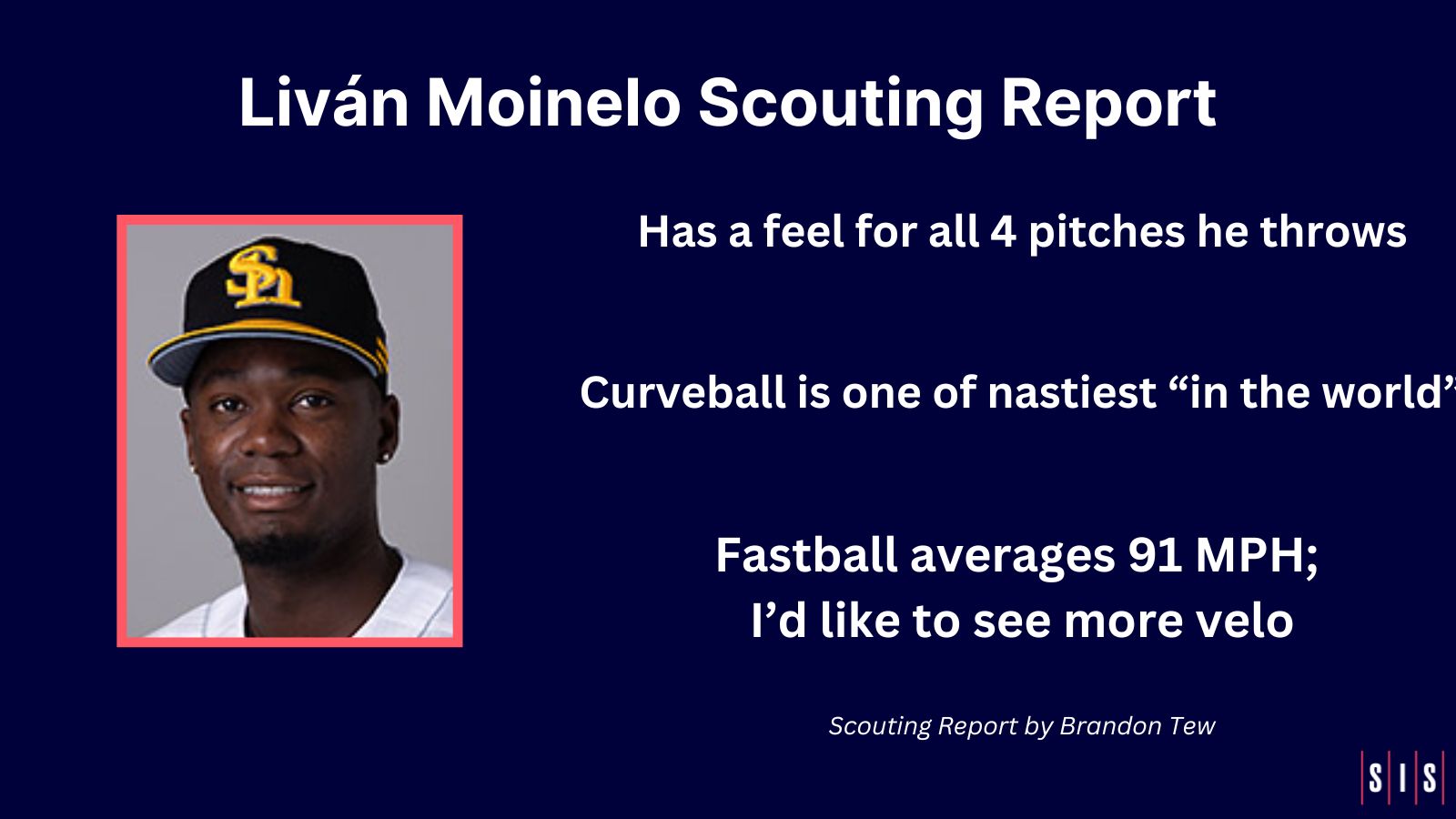
    Moinelo’s curveball is one of the nastiest pitches in the world. With unbelievable bend, it is a topspin menace in the upper 70s and lower 80s. The pitch doesn’t have a significant loopy quality but is an actual top-to-bottom curve.

    Moinelo’s superpower on this type of pitch is his ability to get to the front of the baseball and get the pitch to go over the top of his fingers, creating downward movement from topspin. 

    Moinelo has a real feel for spinning the baseball and can throw breakers that rival his teammate Carter Stewart Jr. in terms of RPMs. With numbers flashing north of 3,000 RPMs, the pitch has incredible drop, and he can bury it for a chase or drop it in the zone for either strike one or strike three.

    The pitch has a 20% putaway rate and a 29% whiff rate, so he can throw it for a chase if needed, especially with two strikes. With a 38% CSW rate, he steals a lot of strikes early in the count, too. He can zone the pitch and has an excellent feel for it given the amount of drop. It has a 65% strike rate. 

    Being able to zone the pitch is incredibly valuable because of the high fastball and curve tunnel he tries to create with the pitch. He gets a lot of swings in the zone and also freezes hitters with it. When there is a swing, it’s most likely a miss over the top of the ball or results in a groundout, as the pitch had a 77% ground ball rate in 2024.

    In comparison, Framber Valdez, who deploys a similar curveball as a lefty and is the ground ball king in MLB, had a 63 GB% on his curve in 2024 with a 40% whiff rate. The two pitchers throw heavy top spin curves around 78-80 mph. Moinelo loves to go to his curve more early than late, but the way he attacks hitters throughout a game will change as he goes deeper, giving batters different looks.

    Changeup 19%, 83mph   CSW% 35%   STRIKE% 65%

    The pitch that made Moinelo’s transition to starter a success was his changeup, which is a good combo of depth and horizontal run. Moinelo can turn the pitch over and pronate, getting the pitch to sink from batters and getting weak swings with batters out on their front side. Some swings are silly, with hitters falling over themselves as they tried to ambush a fastball but got the string pulled on them instead.

    via GIPHY

    With a 55% ground ball rate on the pitch in 2024, he gets a lot of roll-over ground balls to the middle of the infield. Relying on grounders should be a sustainable attribute whether the NBP ball stays dead or not.

    Around the horn, SoftBank’s infield had 20 Defensive Runs Saved in 2024, which outpaced every other NPB team by a wide margin, as did its 65 Runs Saved overall. 

    Moinelo uses his entire arsenal, specifically his curve, and changeup, to induce ground balls, and he has no issue letting his stellar defense behind him gobble up grounders. Moinelo didn’t give up much damage on his changeup. The OPS against it was only .524.

    Moinelo can have the pitch come off his hand wrong and hang in the zone more, which is where any damage comes from. 

    via GIPHY

    As a starter, his changeup usage stayed almost identical against RHBs, around 24% the last two seasons, but he increased it against LHBs to 10% in 2024. That was up from 3% in his shortened 2023 and 6% in 2022. Backing off the four-seam a bit and replacing it with his changeup kept Moinelo less predictable deep into games. At its best, the changeup is suitable for either left-handed or right-handed hitters

    via GIPHY

    Here’s an instance where Moinelo used his changeup against one of the better contact hitters in NPB, Koji Chikamoto, before overpowering him with a fastball, showing a change of pace in this at-bat.

    via GIPHY

    2025 Season Outlook

    Moinelo brilliantly shined as a first-year starter, and with his loud four-pitch mix and propensity for not only strikeouts but ground balls, he is one of the best pitchers in NPB. The next step for Moinelo would be building up his workload and possibly finding the two or so ticks he lost in velocity as a converted reliever.

    It’s also worth noting the diminished effort in his delivery helped him throw strikes. There were times when Moinelo tried to get quicker outs with an early curveball or well-located changeup to keep his pitch count down. 

    You will never see me argue against increasing his curveball usage in favor of his four-seam. I adore the pitch, and he should throw it more. Still, next season will be about adjusting to the league after it adjusts to him. 

    There are different circumstances surrounding Moinelo’s move to MLB, as he’d need to defect from Cuba to pitch in the majors. But he has the stuff and command to be an impact starter someday if he chooses to make the move. 

  • NPB to MLB Scouting Report: Shinnosuke Ogasawara

    NPB to MLB Scouting Report: Shinnosuke Ogasawara

    Shinnosuke Ogasawara requested that the Chunichi Dragons post him this offseason after nine seasons with the club and the team obliged. He’s still a free agent, available for any MLB team to pursue.

    Ogasawara, once considered a top prospect in NPB, has had up-and-down results for the Dragons but has shown glimmers of promise as a stocky lefty. I saw almost all of his starts from the last two seasons and this is my scouting report for him.

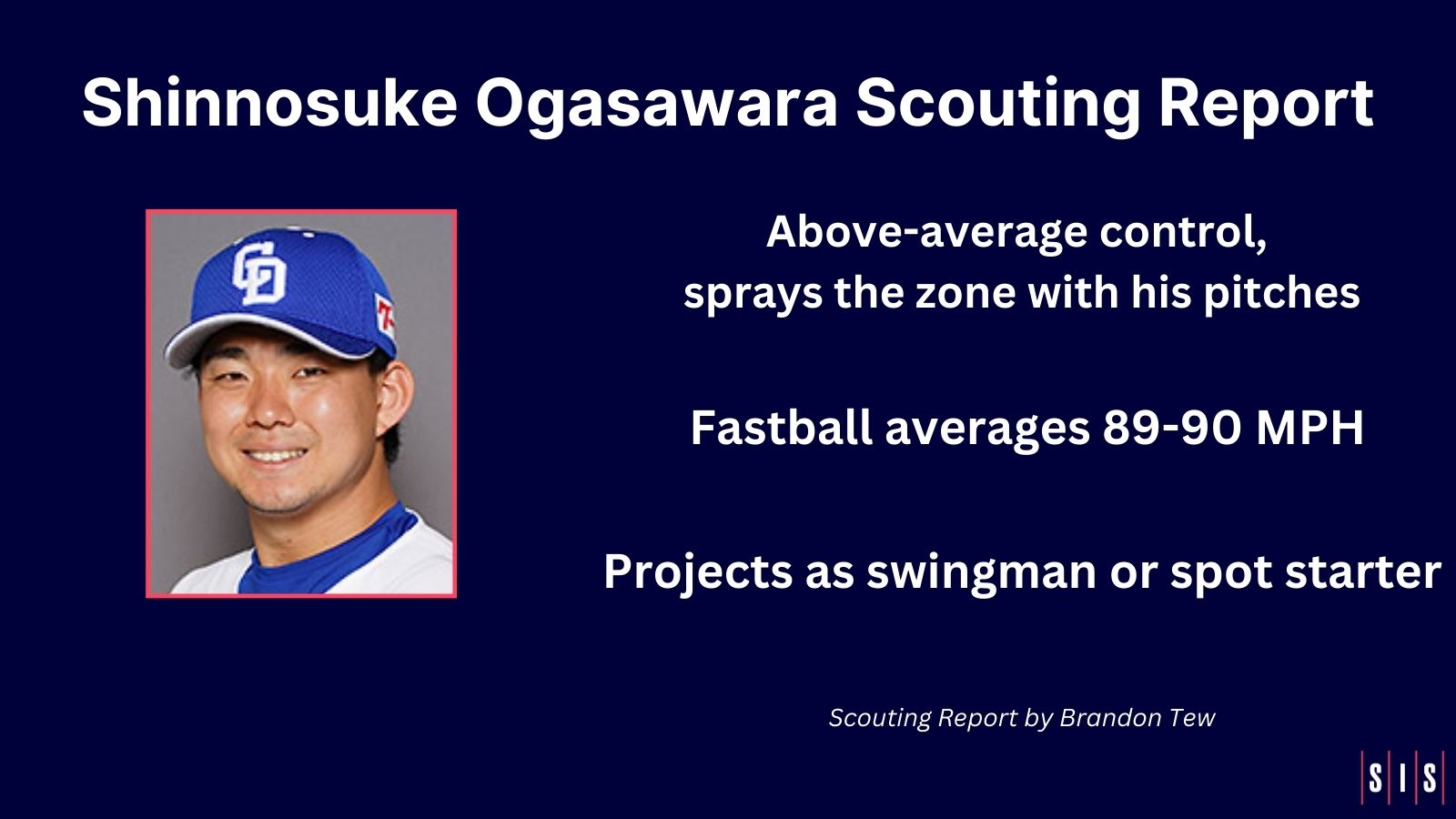
    In sum: Ogasawara projects as a swingman or spot starter in MLB but will get the opportunity, as a strike-throwing lefty, to compete for a rotation spot.

    Ogasawara’s Recent Seasons (2022-2024)

    Season IP ERA ERA+ K-BB
    2022 146.2 2.76 111 142-39
    2023 160.2 3.59 82 134-41
    2024 156.2 3.12 88 82-22

    Ogasawara is 5’11’’ and 185 pounds with a strong lower half. He is similar in build to Shota Imanaga. While some might want to compare the two Japanese lefties, the gap between Ogasawara’s stuff and Imanaga’s is significant. He’s more Kolby Allard than Imanaga. Though Imanaga and Ogasawara both have high IVB (induced vertical break) lower-slot fastballs, Ogasawara’s secondary pitches and command lag behind Imanaga’s. 

    Ogasawara did post a slightly higher K% than Imanaga in 2022, with a 24% strikeout rate to Imanaga’s 23.6%. He has not captured that type of swing-and-miss production since, dropping to 20% in 2023 and 14% this past season.

    And note that while ERAs of 3.59 and 3.12 the last two seasons may not look bad, context matters. He had a below-average ERA+, as NPB’s deader baseball keeps ERAs low.

    Biggest Strength?

    Ogasawara possesses above-average control and sprays the zone with his pitches. He mixes speeds well with his six- to seven-pitch arsenal, though he really focuses on just four pitches, with three of those secondaries. 

    He uses his four-seam about 50% and splits the rest of his usage between his knuckle curve, changeup, and slider – with less usage of his changeup against right-handed hitters.

    Since he possesses fringe-average stuff throughout most of his arsenal, Ogasawara must pound the zone with first-pitch strikes and mix speeds.

    Mechanics

    via GIPHY

    Ogasawara has dabbled with a rhythmic foot move at points in the last two seasons, but he primarily throws out of the stretch. Starting with his glove at his belt, he raises it to his hat brim. He pulls the ball out of his glove with a tiny tap back into the mitt during his initial move forward.

    via GIPHY

    Pushing his hip towards the plate, he stays closed down the mound, Ogasawara uncoils his energy as he shows the bottom of his cleat into front foot strike. Landing in a solid power position, he uses his lower half to drive energy through his lead leg block.

    via GIPHY

    He’s under control and will vary his finish now and then, but he usually lands in a similar position ready to field. Ogasawara throws with tempo and timing more in mind than aggressively transferring energy into his delivery. His timing and sequencing create consistency and repeatability in his mechanics. He will also vary his arm angle, dropping it slightly in a given at-bat.

    An overlay showing one arm angle that is more three-quarters and one that is more overhand

    Pitch Velocity (MPH):

    Pitch 2024 2023
    Fastball  89 MPH 90 MPH
    Knuckle Curve 70 MPH 73 MPH
    Changeup 78 MPH 83 MPH
    Slider 79 MPH 79 MPH
    Splitter 82 MPH 81 MPH
    Hard Slider/ Cutter 84 MPH 84 MPH

    Pitch Usage:

    Pitch RHB: 2024 (2023) LHB: 2024 (2023)
    Fastball  48% (49%) 54% (55%)
    Knuckle Curve 17% (21%) 17% (21%)
    Changeup 24% (25%) 4% (8%)
    Slider 5% (5%) 23% (15%)
    Splitter 5% (<1%) 1% (<1%)

    The Arsenal (2024 usage and Average Velocity)

    Fastball  52%, 89 mph   CSW% 26%   Strike% 75%

    Ogasawara features a high-ride, low-slot fastball though it lacks Imanaga’s 2023 specs in NPB.  The two fit the same mold in terms of usage though. Ogasawara throwing over 50% four-seam is unsurprising given the spin and IVB around 19 inches with an NPB ball from a lower slot. The problem is that the two ticks in velocity Imanaga has on him are vital. Thus, Ogasawara’s fastball command must be cleaner to attack the zone.

    via GIPHY

    In 2024, Ogasawara sprayed his fastball locations more than in 2023, when he was more glove-side with his command. The heat maps from this NPB Pitch Profiler show how spray-heavy his entire arsenal was in 2024.

    Ogaswara sprinkled in a few sinkers with 3 percent usage in 2023, although he basically scrapped the pitch in 2024. He may need to throw the pitch more often in MLB given the sheer velocity of his fastballs; he needs a change in movement between his four-seam and two-seam. Ultimately, he will likely shrink his four-seam usage in MLB, mixing speeds even more. When he does throw his fastball, he will need to stay out of the middle of the plate and get over the top of the ball to drive it to his glove side more.

    via GIPHY

    Knuckle Curve 17%, 70 mph  CSW% 32%   Strike% 58%

    Ogasawara’s slow and loopy knuckle curve is not impressive in velocity or stuff metrics but it is a vital pitch to his arsenal. He needs the slow knuckle curve as a change of pace for his fastball, to survive being in the zone as much as he is.

    Ogasawara utilizes it around 20% of the time on the first pitch to steal strikes and keep hitters honest. While he might drop its usage in MLB, around 15% usage will be important for Ogasawara since he lacks a whiff-pitch glove side.

    2023 Count Usage

    PITCH 1st Pitch Usage 2-Strike Usage
    Fastball  53% 47%
    Knuckle Curve 21% 30%
    Changeup 13% 15%
    Slider 11% 6%
    Splitter 1% 2%
    Harder Slider/Cutter 1%

    2024 Pitch Usage

    PITCH 1st Pitch Usage 2-Strike Usage
    Fastball  52% 45%
    Knuckle Curve 20% 18%
    Changeup 14% 15%
    Slider 11% 13%
    Splitter 2% 9%
    Harder Slider/Cutter 1%

    As seen in the count usage charts above, Ogasawara’s big drop from 2023 to 2024 in two-strike counts was in his use of his knuckle curve late in the count. His two-strike knuckle curve usage plummeted from 30% to 18% between the last two seasons. His curve did provide relief in a high ground-ball rate at 70% in 2024.

    Ogaswara’s curveball has a loopy quality causing batters to swing over the top and pound it in the dirt, because of the velocity differential and mixing speeds rather than pure pitch shape. He also locates the curveball below the zone leading to more grounders. 

    Ogasawara must avoid doubling up on the pitch. If he does, location will be key. These back-to-back curves to Munetaka Murakami display poor location on consecutive pitches.

    via GIPHY

    via GIPHY

    Changeup 16%, 78 mph   CSW% 34%   Strike% 70%

    Ogasawara’s changeup and splitter are his two best pitches. Ogasawara leans heavily on his changeup to righties, throwing it around a quarter of the time the last two seasons. He throws the pitch as more of a straight change with a tiny amount of fade. Throwing it with a two-seam grip he’s able to sink it down and away from right-handed hitters.

    His catcher doesn’t just sit on the outside corner either. There are a lot of times when Ogasawara’s catcher will set up more in the middle of the zone and will try to sink the change below the zone off of a knuckle curve that was middled or a pitch that looks juicy as a middle fastball.

    via GIPHY

    via GIPHY

    Splitter 3%, 82 mph   CSW% 34%   Strike% 63%

    Ogasawara’s splitter is his most intriguing pitch because its characteristics make it a slightly harder offspeed pitch than his changeup. The two pitches will overlap in velocity, though, and the splitter has more sidespin than the backspin of his two-seam change.

    via GIPHY

    The small percentage of pitches he has thrown creates a cause for concern if he can consistently command the pitch and even zone the splitter. There is way more comfort in throwing the changeup with his three-fingered grip rather than the splitter, where he’s splitting more across the horseshoe. His middle finger is not stabilizing in the middle of the ball with his splitter grip.

    Finding more consistency in throwing his splitter and even constant velocity separation could help Ogasawara drop his fastball usage and throw more offspeed. Having an offspeed around 84 mph with a slower one around 79-80 mph could be a valuable weapon for a pitcher who doesn’t have much going for him stuff-wise.

    via GIPHY

    Slider 13%, 79 mph   CSW% 34%   Strike% 57%

    Ogasawara throws a sweeper with a two-seam grip and it hovers in the upper 70s in velocity; it’s an average pitch, in shape and velocity. 

    Living in the glove-side shadow zone, Ogasawara tries to nail the bottom corner at the knees against righties but also pushes the locations more thigh and belt high with the pitch. Ogasawara exclusively throws the pitch away from left-handed hitters, using the sweep he gets on the pitch as a contact suppressor rather than a strikeout pitch. Though he generates some whiffs on the pitch, he throws it late in counts as a putaway pitch.

    via GIPHY

    A close-up of how he throws the slider, with his first 2 fingers touching both sets of seams.

    In MLB, Ogasawara’s slider will need either refinement in his sweeper shape or he could add a harder cutter or slider-type pitch. In fact, Ogasawara threw a rare glove-side breaking ball that was about 84 mph and resembled a cutter-like shape. He throws it with a four-seam grip on the outer side of the ball but he tries to pull down on the top seam heavily. A team could push the harder breaking pitch alongside his sweeper to get more usage out of a pitch other than his four-seam and knuckle curve.

    MLB Projection and Future

    Ogasawara has been a steady performer in NPB since making his debut as an 18-year-old, providing solid yet unspectacular production in Chunichi’s rotation. With lesser velocity and more average to fringe-average pitches, Ogasawara’s control of the zone and mixing of speeds gives him a fighting chance at production stateside.

    In 2022 he got more strikeouts and whiffs, but since then he has not been able to bottle that recipe of success with more of a contact-minimizing and grounders formula the past two seasons. As I noted atop the article, Ogasawara projects as a swingman or spot starter in MLB but will get the opportunity, as a strike-throwing lefty, to compete for a rotation spot.

    His signing with a team might hinge on his promises of starting opportunities, though with his ability to mix speeds and change pace in at-bats, he could be successful in a more prominent bullpen role.

    MLB comparison: Kolby Allard

  • NPB/MLB Scouting Report: Tomoyuki Sugano

    NPB/MLB Scouting Report: Tomoyuki Sugano

    Tomoyuki Sugano is one of the best Japanese pitchers of the past decade. The 35-year-old had spent his professional career with Japan’s most recognizable baseball brand the Yomiuri Giants. 

    After 12 seasons in Tokyo, Sugano exercised his rights as an international free agent and signed a one-year-deal. Sugano previously tested MLB waters during the winter of 2020, when he was posted by the Yomiuri Giants, but ended up signing a player-friendly contract with Yomiuri, where his uncle, Tatsunori Hara, was manager.

    The decision to move to MLB comes as somewhat of a surprise but there’s less holding Sugano in Tokyo now than there used to be, after Hara resigned after the 2023 season.

    Having watched and charted every Sugano start in the last two seasons my evaluation of him is more tied to pitchability and command rather than overall stuff. You can also check out my report on Roki Sasaki from last month.

    Sugano’s Recent Seasons (2022-2024)

    Season IP ERA Strikeouts Walks K-BB%
    2022 147.0 3.12 104 26 13%
    2023 77.2 3.36 54 15 12%
    2024 156.2 1.67 111 16 16%

    A two-time Sawamura award winner (NPB’s Cy Young award equivalent), Sugano also won four Central League ERA titles and a 2018 pitching triple crown, He also has three Central League MVPs including a recent 2024 one. While past his prime, Sugano’s 2024 resurgence gives some hope that he can stick with the Orioles.

    Biggest Strength

    Sugano is a command artist who paints both edges and paints masterpieces on his canvas that is the pentagonal plate. He spots the ball with precision, or, at the very least, keeps it out of dangerous spots with his misses. While Sugano’s stuff has diminished over the years, he has a knack for cutting and sinking the ball to miss barrels.

    He utilizes the breadth of his arsenal and mirrors the locations of some pitches both to righties and lefties  Sugano’s plan of attack each outing is clear to him and there’s a confidence with which he pitches. The heat maps, which you can find on NPB Pitch Profiler, illustrate the command of his secondary pitches.

    Against same-handed hitters, Sugano peppers the glove side exclusively with his cutter and slider. The two pitches tunnel well, with a slight velocity difference between each and similar shapes. The pitches work in tandem on the left side of the plate.

    Against opposite-handed hitters, Sugano seems more comfortable throwing his cutter and slider in the zone and will backdoor both pitches around the thighs. Sugano occasionally sprinkles traditional cutters up and in to keep hitters from leaning out over the plate. This also protects him for when he goes inside with four-seam fastballs. 

    His command at times borders on exceptional, as he stays on the outer edges of the plate when he needs to and tries to keep the ball out of the middle third unless he is significantly behind in the count.

    via GIPHY

    via GIPHY

    Mechanics

    Sugano starts in a slightly open position with his feet and his body turned slightly to his right. As he steps to the side with a slower pace he pauses for a beat in his windup before raising his left leg.

    There’s not a lot of momentum built up in his delivery but he counter-rotates his pelvis a tiny bit right after peak leg lift, around chest height. He drives his momentum to the plate with his back pocket facing the batter ever so slightly. Sugano opens earlier than most and doesn’t sink deep into his lower half, rather throwing from a more upright position. 

    As he lands into front foot strike, his arm is up at a close to 90-degree angle and he sequences his movements well. With a firm lead leg block, his chest is out over his knee in a solid position, driving his energy down the slope of the mound. With smooth and repeatable actions and consistency in his arm swing, Sugano never looks rushed or off, timing-wise. Sugano also keeps his head incredibly quiet with minimal movement, which plays a big part into his command.

    via GIPHY

    Sugano rarely quick-pitched to throw the timing off of the hitter, something he might try more with the Orioles if he feels like timing is more valuable to MLB hitters.

    via GIPHY

    Pitch Usage (2023-2024):

    Pitch 2024 2023
    Fastball  34% 40%
    Cutter 21% 20%
    Slider 20% 17%
    Splitter 16% 11%
    Curveball 9% 12%

    Pitch Velocity (MPH):

    Pitch 2024 2023
     Fastball  92 MPH 91.5 MPH
    Cutter 87 MPH 87 MPH
    Slider 82 MPH 83 MPH
    Splitter 86 MPH 86 MPH
    Curveball 77 MPH 78 MPH

    Against Right-Handed Batters (RHB):

    Pitch 2024 2023
     Fastball  39% 45%
    Cutter 25% 22%
    Slider 21% 16%
    Splitter 12% 10%
    Curveball 3% 7%

    Against Left-Handed Batters (LHB):

    Pitch 2024 2023
     Fastball  30% 35%
    Cutter 18% 18%
    Slider 19% 18%
    Splitter 20% 12%
    Curveball 13% 17%

    The Arsenal (2024 usage and Average Velocity)

    Fastball   34%, 92 mph   CSW% 30%   STRIKE% 68%

    Sugano throws both a sinker and a four-seam fastball, the usage of which is grouped above, but he throws his sinker about 8% of the time and the four-seam 26%. His four-seam is not spectacular in shape or velocity but he pounds the zone with the pitch against righties and-as mentioned-dots the edges of the zone against lefties.

    The Orioles may utilize Sugano more in a five-and-dive role, rather than the innings eater he was in NPB. With this outcome, there’s a possibility of throwing one or two ticks harder stateside. I would bet on him trying to eat innings some outings and provide value going as deep as he can into games.

    Sugano’s biggest path to success is superb fastball command. When he gets hit hard, he usually leaves fastballs more middle, where he’s susceptible to the long ball. He allowed 6 home runs last season, 3 on fastballs (it was a lot harder to hit a home run in Japan due to the deadened ball there).

    In contrast, he allowed 10 home runs in less than half the innings pitched in 2023. Home run suppression will be vital to his success since he doesn’t produce a lot of strikeouts.

    via GIPHY

    via GIPHY

    Cutter 21%, 87 mph  CSW% 32%   STRIKE% 68%

    Sugano’s cutter is the key pitch in his arsenal; it helps his other pitches out when it’s thrown well and spotted well. While attacking the glove side away from right-handed hitters he slices the outside edge of the zone with the pitch. 

    via GIPHY

    The pitch is a setup for his slider. He starts the tunnel with the cutter and then follows up with his slider in a similar spot that’s competitive but just a little more off the edge. This creates options for him to either go to a different pitch or ride the same rail with his fastball for a take. Sugano will then change the looks batters get throughout a game. He changes up the variety at which he throws his slider and cutter, especially to righties.

    2024 Count Usage

    Pitch 1st Pitch Usage 2-Strike Usage
    Fastball  39% 31%
    Cutter 26% 12%
    Slider 19% 20%
    Splitter 7% 25%
    Curveball 9% 12%

    2023 Count Usage

    Pitch 1st Pitch Usage 2-Strike Usage
     Fastball  46% 35%
    Cutter 19% 20%
    Slider 13% 18%
    Splitter 15% 12%
    Curveball 7% 15%

    Sugano upped his first-pitch usage of the cutter this season. While individually the pitch performed possibly worst out of all his pitches, the upping of the usage, especially early in the count, helped his slider perform better later in the count. He used the slider as a whiff pitch and a two-strike pitch in 2024. The cutter produces a decent amount of ground balls, utilized primarily down in the zone. Its ground ball rate was 56% in 2024 and 49% in 2023.

    Slider 20%, 82 mph   CSW% 34%   STRIKE% 71%

    While his cutter is key against right-handed batters, Sugano’s slider is his bread and butter. While a barrage of glove-side cutters and fastballs establishes the eye level and attack zone, Sugano uses his slider to stay in that same attack zone. With a bit more sweep and lower velocity than his cutter, it stays in that outer lane to righties before sweeping and dropping more as it approaches the plate.

    When Sugano rips a beautifully-located slider it’s become harder for hitters to stay disciplined. Last season his whiff rate jumped to around 25% on the pitch whereas in 2023 and even 2022 his slider whiff rate hovered around 20%.

    via GIPHY

    Sugano started using the cutter and slider in tandem, throwing both pitches around the same usage in 2021. However, his concerted effort to throw more cutters early in the count last season shows a shift in his thinking that he needs to tunnel both the cutter and slider more to protect his fastball and improve his slider’s performance.

    He loves the glove-side cutter and slider tunnel though and has for the last five seasons or so. His propensity to throw his slider and even his cutter more in the zone and backdoor to left-handed hitters also creates a tunnel for his arm-side sinker.

    He also honed his slider and cutter command more this season than in past years, which could explain his boost in success with both pitches.

    Splitter 16%, 86 mph   CSW% 22%   STRIKE% 57%

    A mainstay in Sugano’s arsenal has been his splitter, which he has always been able to pinpoint below the zone. There’s the occasional miss up with the pitch but Sugano has a feel for keeping the pitch just below the zone to try and get grounders and swings over the top of the pitch.

    The bump in usage from Sugano in 2024 compared to 2023 is significant enough with a 5 percentage-point  overall usage bump in 2024 on his splitter and an 8-point bump against left-handed hitters. He threw his splitter the least of any pitch in his shorter 2023 season. However, Sugano started to lean on his splitter in putaway situations in 2024.

    Sugano’s decision to throw his best pitch more in high-leverage situations was a welcomed change. Even increasing the usage of the pitch versus same-handed hitters returned good results.

    Sugano’s walk rate did not spike either, in fact, it lowered from 4.8% in 2023 to 2.6% in 2024, and his splitter, just because of the nature of the pitch, has the lowest strike rate in his entire arsenal. Deciding to throw more cutters and sliders in the zone when behind in the count, and then attack with a splitter when he has a chance to put both righties and lefties away garnered real success for him.

    The pitch doesn’t drop below the zone as violently as other splitters but with its spin and characteristics, it mimics his sinker a lot, with backspin but at lower spin rates, causing more drop to the pitch. He loves to throw the pitch when he needs a whiff or a double-play ball.

    via GIPHY

    via GIPHY

    Curveball 9%, 77 mph   CSW% 27%   STRIKE% 63%

    Sugano’s least-used pitch last season in terms of secondaries was his curve. While he dropped the usage of his curveball in 2024  it was thrown with better spin, and a tick harder velocity, which improved the overall performance of the pitch.

    He did expand the usage of the pitch against same-handed hitters last season, again using the pitch as a first-pitch strike stealer but also burying it down and away from righties to keep hitters off of his cutter and slider tunnel.

    There’s a real possibility that Sugano lessens his fastball usage in the majors, especially the four-seam, and leans more on his breaking balls away from right-handed hitters while dropping the occasional in-zone or backdoor curve to left-handed hitters.

    It will be intriguing to track his curve next season and if it even takes another step forward as a possible putaway pitch after performing quite well in 2024. This is not only because of the wrinkle it provides in his repertoire but also because the velocity disparity keeps hitters off balance. He will need to continue to locate the pitch well and can’t just loop in breaking balls unless he protects it with his other pitches beforehand.

    MLB Projection and Future

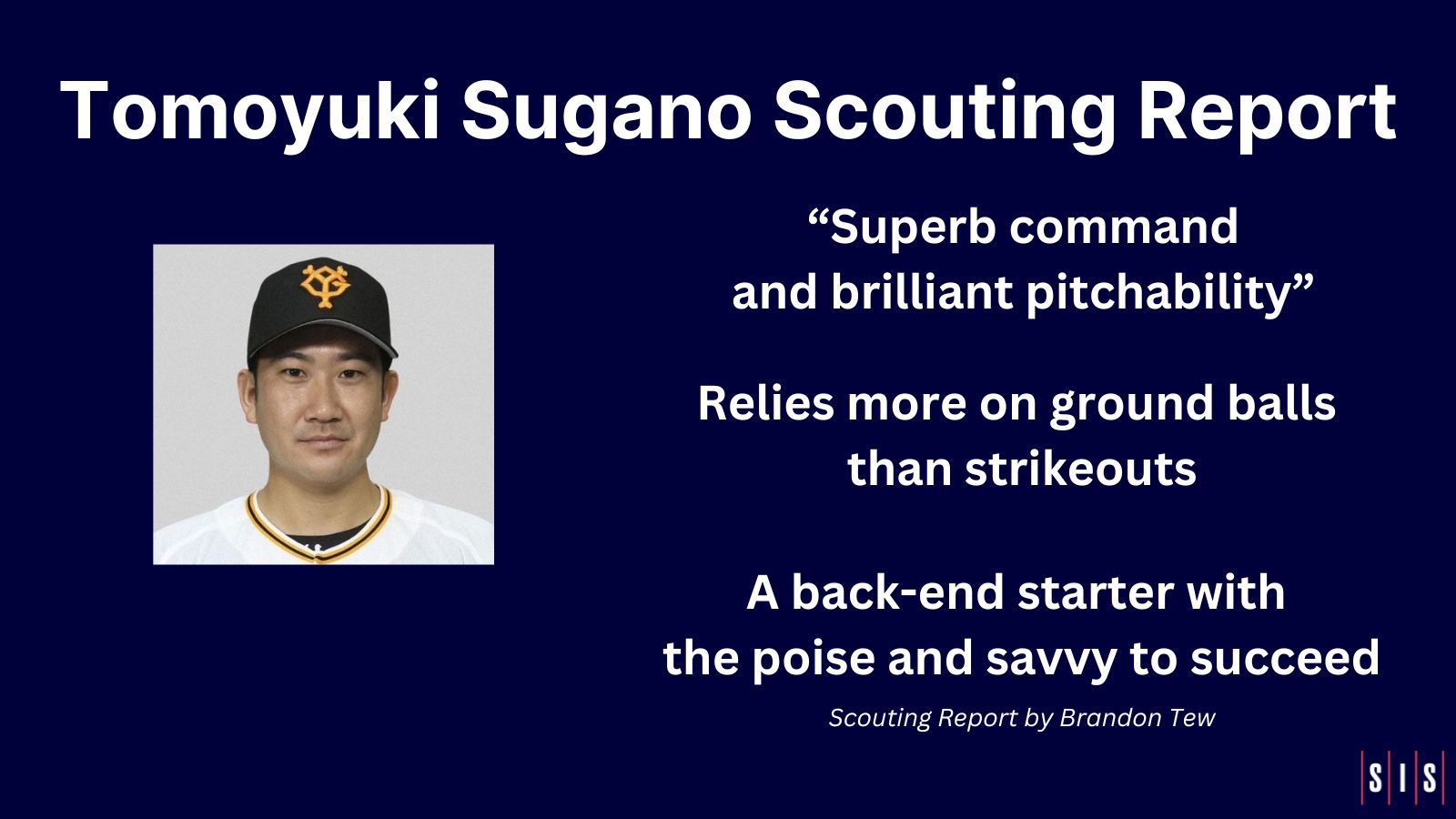
    Sugano has been a mainstay at the top of Yomiuri’s rotation and it will be odd to see him don a different uniform. A command specialist with just enough stuff to get hitters out, Sugano projects as a back-end starter with the poise and savvy to succeed as a rotation piece for the Orioles.

    He relies more on ground balls than strikeouts needs to mix speeds and tunnel his pitches well, showcasing his superb command and brilliant pitchability. Sugano is one of the most accomplished Japanese pitchers and should be in the conversation as a Top 10 all-time NPB pitcher. At the tail end of his career, there’s some skepticism, but an outstanding 2024 season provides hope that he has enough left in the tank to yield solid value as he moves stateside.

    MLB comparison: Paul Blackburn, but with Zack Greinke-like command

  • Roki Sasaki Scouting Report (Updated!)

    Roki Sasaki Scouting Report (Updated!)

    Let me start by saying: Rōki Sasaki is one of the most talented young pitchers on the planet.

    I say that having watched each of his NPB starts from 2022, 2023, and 2024.

    He started to turn heads as a high school pitcher in Japan. On April 10, 2022 he threw a perfect game against the Orix Buffaloes in which he struck out 19 batters, including 13 in a row. I wrote about his perfect game later that summer. He followed up perfection with another eight innings a week later, capping off possibly the greatest two-game stretch in major professional baseball. Sasaki has mesmerizing talent and has continued to put up gaudy stats in NPB.

    Sasaki’s Recent Seasons (2022-2024)

    Season IP ERA Strikeouts Walks K%-BB%
    2022 129 1/3 2.02 173 23 31%
    2023 91 1.78 135 17 34%
    2024 111 2.35 129 32 22%

    The Lotte Marines announced they would post the ace, even though he does not meet the current Japanese posting system requirements, as he is under 25. His contract will be restricted by international bonus pool money, limiting how much he can sign for as an international “amateur.” This opens his posting to every MLB team, many of which will surely pursue the young pitcher.

    What makes him so special?

    Sasaki’s arsenal includes a high-velocity, two-plane fastball, and a devastating splitter, both of which have tormented NPB hitters for years. He’s recently increased the use of his slider, turning it into a reliable weapon against both righties and lefties.

    Sasaki is a control-over-command pitcher, but when he’s dialed in he can spot his fastball on the edges of the zone. Here are some well-located fastballs from Sasaki’s 2024 playoff start.

    via GIPHY

    via GIPHY

    His splitter location is exceptional when it needs to be. Look at these heat maps from this NPB Pitch Profiler that show Sasaki’s command of the pitch.

    vs Left-handed batters 

    vs Right-handed batters  


    With a 56.5% whiff rate in 2024, Sasaki’s splitter is among the best in baseball. His ability to induce swings and misses, especially when the pitch darts below the strike zone, has made it a devastating strikeout pitch.

    A mechanical tweak in 2024?

    via GIPHY

    I wrote up a detailed breakdown of Sasaki’s mechanics in my last report on him and still think it captures a lot of what he does as a mover on the mound. However, in 2024 Sasaki added over 6 inches of extension to his delivery.

    2022

    2024

    The increase in stride length down the mound is noticeable. As noted by Lance Brozdowski in his breakdown, Sasaki’s extension increased but his release height stayed almost identical at 6 feet. As Lance suggests, he might have kicked up his arm angle just a tiny bit which is not as clearcut on video but can be seen. There’s possibly a slight overextension in his stride that played a role in his downtick in velocity.

    There’s a sweet spot in terms of mechanics for Sasaki, and an MLB team will try to find the bullseye. They’ll be trying to unlock more of his 2023 pitch shapes while also balancing injury risk and efficient throwing.

    It’s important to note that the big question mark surrounding Sasaki is his health as he has battled various injuries throughout the last three seasons, including an oblique injury and shoulder fatigue.

    Pitch Usage (2022-2024):

    Pitch 2022 2023 2024
    Fastball 56% 50% 46%
    Splitter 34% 35% 28%
    Slider 5% 13% 26%
    Curveball 5%

    Average Pitch Velocity (MPH):

    Pitch 2022 2023 2024
    Fastball 98.3 98.9 96.9
    Splitter 89.1 89.5 88.2
    Slider 87.7 87.5 83.6
    Curveball 79.6 79.5 76

    Against Right-Handed Batters (RHB)

    Pitch 2022 2023 2024
    Fastball 54% 46% 40%
    Splitter 29% 27% 21%
    Slider 12% 26% 39%
    Curveball 5%

    Against Left-Handed Batters (LHB)

    Pitch 2022 2023 2024
    Fastball 57% 53% 50%
    Splitter 36% 41% 33%
    Slider 1% 4% 18%
    Curveball 5%

    The Arsenal (2024 usage and Average Velocity)

    Pitch Grades (20-80 Scale):

    Fastball: currently a 70, was an 80 in 2023

    Splitter: Currently an 80

    Slider: Currently 55, could rise to 60

    Breaking down the pitches:

    Fastball   46%, 97 mph  

    CSW% 26%, 

    Strike% 71%

    Sasaki’s drop in fastball velo has been a topic of conversation for most of the year. In May I speculated that Sasaki was more or less gas pedaling through starts. In other words, easing his way through starts because he was trying to pitch deep into games for the Marines. He was backing off at that point and then would run his fastball up to the upper 90s or triple digits.

    Most notably May 10 in a start vs Nippon-Ham Sasaki produced one of the most disappointing starts of his NPB career,  5 2/3 innings and 5 earned runs. His next start would come seven days later. Against the same Fighters team, he threw his fastest average fastball velocity of the season, averaging 98.4 MPH.

    Sasaki looked like his old self again until he dealt with a couple of injuries that sidelined him for two starts to begin June. Then he suffered another injury that cost him almost two more months. He was up and down with his velocity throughout the season but there were points where he was averaging 98 mph in some starts.

    While having a dip in velocity, Sasaki also lost some movement both horizontally and vertically. He averaged around 16 inches of vertical movement on his fastball rather than the 18 inches he was averaging in 2024.

    His fastball was still good in 2024. It just was not the unicorn-type pitch it had been the previous season. The whiff rate dropped from 24% in 2023 to 13% in 2024. The pitch in this new shape failed to miss as many bats in the zone.

    Now as I have pointed out before, NPB hitters would sit on Sasaki’s fastball and try to foul off the pitch or shoot it the other way for minimal contact but try to get a base hit. There’s a decent chunk of emergency hack foul balls and swings that are late on his heater.

    He allowed an OPS against of .740 on his fastball in 2024 compared to a .595 OPS against it the season prior. A lot of these hits were singles the other way or weaker contact singles blooped into the outfield.

    Not many hitters in NPB squared up Sasaki’s fastball at any point in his career. He’s allowed a total of 6 home runs with it in the last three seasons, and just 2 all last season. Even with the dead balls in Japan, that’s impressive. Compare that to the 26 homers surrendered on fastballs by Shota Imanaga in his last two seasons in Japan. 

    You can see how good Sasaki’s four-seam is at limiting hard contact. In 2024, Sasaki was less sporadic with his four-seam command. He’s a pitcher who tries to cut the plate in half and work one side or the other with more control than command. However, he will still miss in the middle occasionally, which might lead to more damage on this pitch in MLB outside of normal changes in conditions between the two leagues.

    via GIPHY

    Sasaki was more middle-third vertically than the upper part of the zone with his fastball this season. 

    This could explain why he also gave up more contact and had fewer whiffs to go along with the shape change. He was either choosing to be more efficient as a pitcher or the shape change just didn’t carry his pitches routinely to the upper third of the zone as it had in the past.

    One thing that is likely to change as Sasaki comes stateside is the use of his four-seam at the top part of the zone. In the image below, which shows the heights were the catcher target was set for his pitches last season, the black squares are fastballs. Sasaki’s catcher rarely sets up high. Almost all of those dots are plotted in an area close to where the batter’s knees were. 

    The catcher’s mitt is towards the bottom and shades to both corners. This isn’t to say he doesn’t target the catcher’s mask at times but there’s not a concerted effort to throw high fastballs. Even with his two-plane shape, an MLB team will want a higher percentage of top-shelf fastballs especially if he can harness more of the fastball shape he had at the WBC and during the 2023 season.

    Sasaki’s fastball induces a lot of ground balls because of its horizontal movement. He had a 52% ground ball rate on his four-seam last season. Sasaki can keep the ball out of the air, which is always positive, and while there might be a slight uptick in home run production, don’t expect too much unless he starts to miss more in the middle of the plate. This means his command worsens, and his one big miss command-wise is usually high and arm side, with his fastball rather than yanking or pulling it.

    Whichever MLB team gets Sasaki will want to try and bottle the magic of his 2023 fastball shape but it’s still a double-plus pitch in its current state.

    Splitter 28%, 88 mph 

    CSW% 35% 

    Strike% 53%

    Sasaki’s splitter is an oddity compared to other splitters. It’s the best splitter I’ve ever seen on video. It is a buzzsaw that knifes through the bottom of the zone and darts below it at the last possible second. As previously mentioned, his whiff rates on the pitch are astronomical. The way he throws the pitch and how it moves plays into its brilliance.

    Sasaki throws the pitch with gyro spin but also can create a knuckling appearance on it.  Sasaki can almost cut and fade the pitch based on handedness, as I noted previously.

    In what I have decided is intentional to some extent, Sasaki will cut the splitter to his glove side away from right-handed batters, and pronate more to fade it away from lefties. He does this often enough to almost have a feel for his finger pressure on the pitch, though I can’t confirm this. The pitchability he displays with this specific pitch makes him unique in baseball, and his consistency with it is just as impressive.

    What truly intrigues me is that in 2022 he was throwing his splitter with a different orientation and grip.

    2022

    Sasaki's 2022 splitter grip has the seams of the baseball running across the ball

    2024

    Sasaki's splitter grip has the baseball such that the seams have a horseshoe appearance 

    He now splits across the horseshoe with his fingers more down on the ball and has the pitch slip out of his hand, creating a knuckling or tumble effect while still maintaining hard velocity.

    He still cuts and fades the pitch from time to time possibly by using different finger pressure. He’s opted for this type of movement that is closer to (0,0) on a pitch plot and more gyro.

    via GIPHY

    Sasaki pairs his fastball with his splitter exceptionally well. It’s a wicked offering with almost magic-like qualities as it performs a disappearing act below the zone. Sasaki does have a knack for stealing strikes with it in the zone but does occasionally give up hits on hanging splitters that catch way too much of the plate, though that happens more to lefties than righties.

    His ground ball rate on the pitch was near 71% the last two seasons but this past season it dipped to a still-impressive 57%, which bares out the greater number of line drives and fly balls on the pitch when it’s up in the zone. Sasaki’s splitter is one of the best pitches in all of baseball and will likely continue to be that.

    One last note on the splitter is that Sasaki loves to use the rosin bag provided in NPB games and with no pitch clock he routinely goes to the bag, almost as if it’s part of his routine. He’ll be throwing with a different ball in MLB and it will be fun to see what grip he goes with and how he navigates using the rosin bag behind the mound within the confines of the pitch clock. 

    Slider 26%, 84 mph  

    CSW% 39%  

    STRIKE% 62%   

    A pitch that took a massive leap forward is Sasaki’s slider. He’s been workshopping the pitch for some time now, even having fellow countryman Yu Darvish help him during the World Baseball Classic. Love this video below:

    <#Sasaki’s slider has become different, sharper & dominant

    after receiving coaching from #Darvish !! It has improved
    in vertical movement. pic.twitter.com/S4HTnB5I8s

    — Joseph Kim (@blackwings2011) November 13, 2024

    He upped the usage of the pitch considerably and in certain starts would throw his slider more than his fastball. It’s not yet a polished gem like his splitter but he would turn to the pitch against right-handed batters early in counts and then put away both left-handed batters and right-handed batters with his splitter.

    Against RHBs, he tries to hit the opposite corner with the pitch, and while he will have it back up arm side, he is still working through the kinks with it. But his confidence in the pitch has blossomed.

    While facing LHBs, he can drop backdoor sliders in the zone,  especially early in counts as a first-pitch strike-stealer. The table below illustrates that he upped his first pitch slider usage from 13% in 2023 to 40% in 2024, which was most likely to combat hitters sitting on first-pitch fastballs. The fact he could zone the pitch also helped as the season pressed on.

    2024 Count Usage

    Pitch 1st Pitch Usage 2-Strike Usage
    Fastball 46% 34%
    Splitter 14% 48%
    Slider 40% 18%

    The slider is good and even flashes plus. He throws two slider shapes at times. I think it’s mostly manipulation of a slower one with more drop and the other is a true gyro one. But there’s some inconsistency there. 

    The more vertical one used to go backdoor mainly to left-handed batters but he also uses the vertical shape to both sides as well dropping it below the zone. Japanese pitchers will talk about varying shapes a lot more than most. I think a pitcher like Imanaga also has a wider variance on his slider, though he gets more sweeper movement than a pitcher like Sasaki.

    Harder Slider:

    via GIPHY

    Slower Slider:

    via GIPHY

    Overall, the pitch is good and flashes plus at times, but the inconsistency in shape, whether intentional or not, is something an MLB team might look to refine. Based on pure spin rate numbers he lacks some ability to spin the baseball. It’s hard to be amazing at everything, but he does have a slider that has turned into a weapon that hitters must respect.

    His growth on this particular pitch alone signals a chance to at least mold some fashion of a plus third pitch which would be outstanding for a guy who already obliterates hitters with his other two pitches.

    He could opt for a harder slider like he had in the past, increasing the whiff rate on it. He’s most likely chasing more movement rather than velocity since he already sat around the velo of his splitter with his previous iteration of the pitch. 

    Sasaki might believe this new slider helped him stay in the zone more while having the manipulation factor to get more whiffs below the zone. The harder slider is likely better just from a pure pitch standpoint but comfortability in throwing it should play a massive part as well.

    What about another pitch?

    Well as seen in the above tables Sasaki in 2022 featured a curve that he threw about 5% percent of the time that was used sparingly along with his slider, which was also around 5%. He has thrown just three curveballs in the last two seasons, all but phasing the pitch out of his arsenal. He could bring it back though.

    via GIPHY

    His slider at times would get more in the curve territory though. But it did not look exactly like his previous offering in 2022. Again, that’s going back to his manipulation of the slider. 

    An MLB team will likely experiment with a hard arm-side pitch, probably a sinker, although his two-plane fastball creates grounders already. It might not be worth a real development unless he struggles with right-handed batters. 

    Other options include upping velocity on his slider or maybe adding a cutter in the low-to-mid 90s, which could be fun! He could add a harder glove-side pitch to pair with his current slider if there’s not a complete rework of that pitch. He could have-in theory- a cutter and slider to use against right-handed batters although I expect the splitter to uptick in usage anyway.

    There’s clay to mold here and while Sasaki can be dominant with just his splitter and fastball, he knows how valuable more pitches are to him as a pitcher. He’s likely going to add at least one more pitch, if not two, for right-handed batters.

    MLB Projection and Future

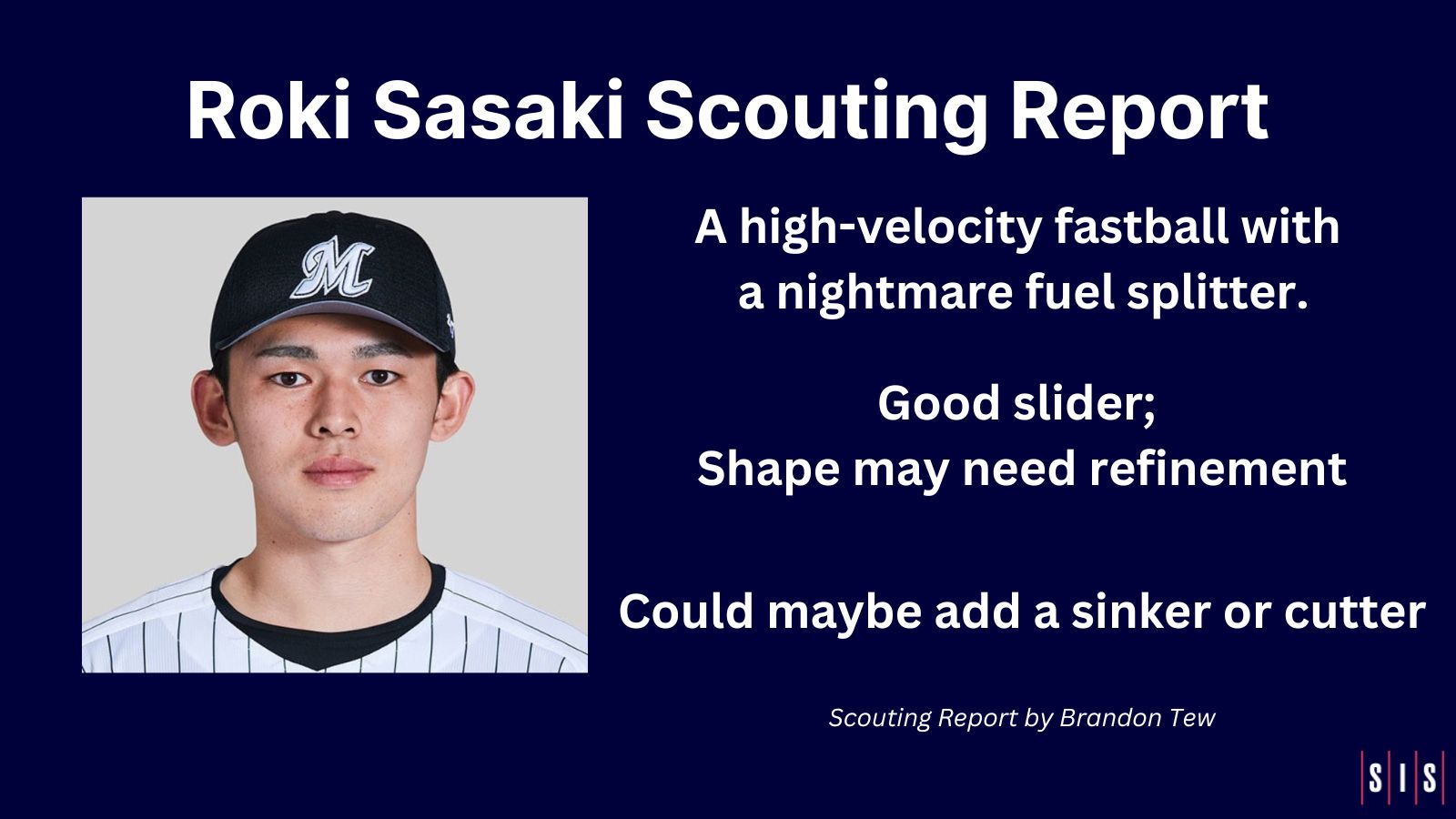
    You can count on one hand how many pitchers have as much talent as Sasaki. He has a high-velocity fastball with a nightmare fuel splitter. Add in a possible plus third pitch and he’s got all the tools to succeed.

    His NPB career did not end in any major award wins and there was frustration with his health. He dazzled in his brief stint in NPB though, and like a shooting star streaking across the sky, his time there was too brief.

    Sasaki’s ceiling is as high as any pitcher and while he’s not a finished product he has true ace potential and the chance to be one of the best pitchers in baseball. He’s one of the best pitching talents of my lifetime.

  • 2024 NPB Fielding Bible Awards

    2024 NPB Fielding Bible Awards

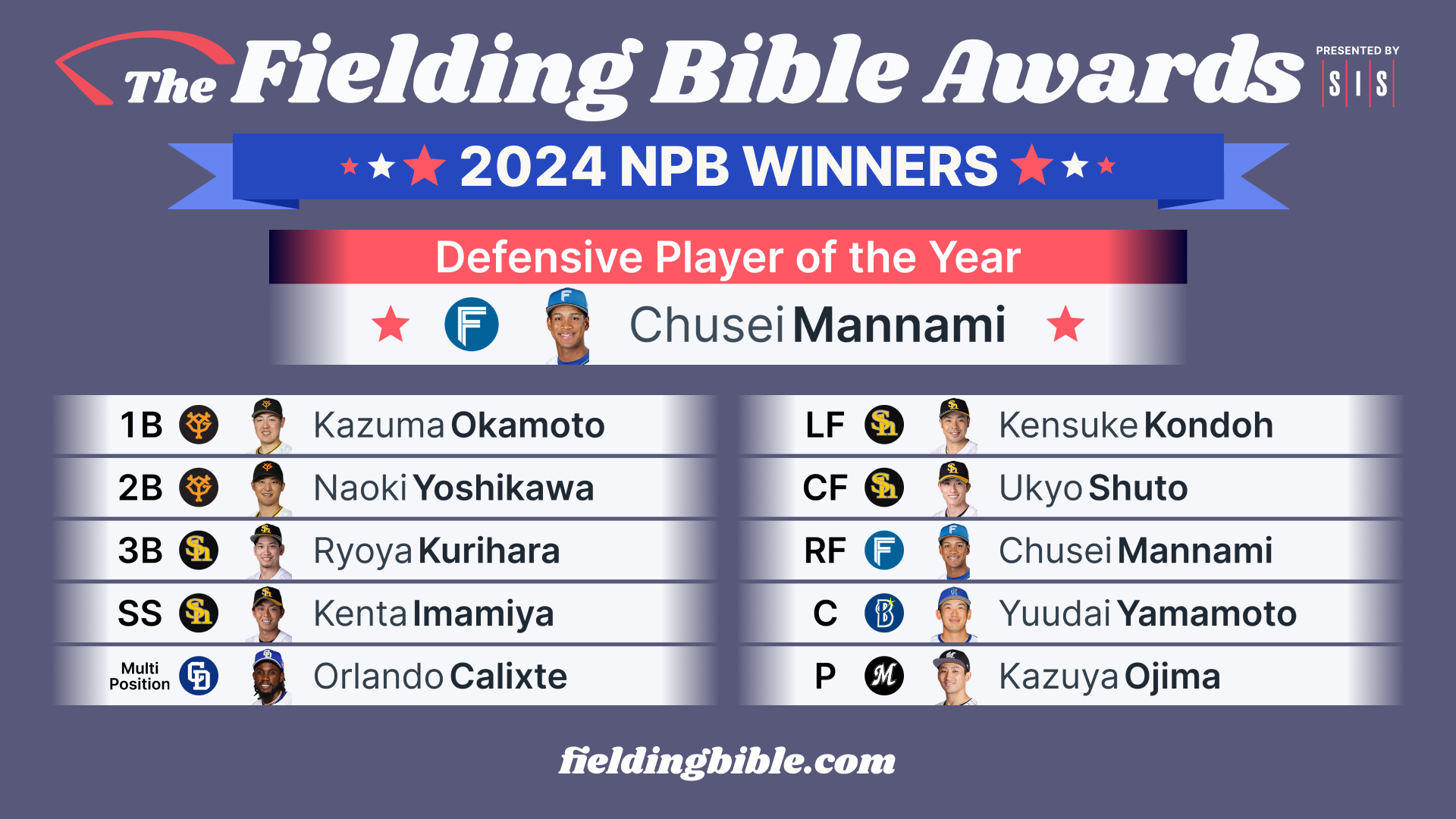
    SIS is pleased to announce the winners of the 2024 NPB Fielding Bible Awards.

    This marks the 5th season that we have honored the best defensive players in NPB. The awards are chosen by a panel of experts who consider statistical analysis, the eye test, and any other factors that they wish to utilize.

    We are also announcing the winner of the NPB Defensive Player of the Year award.

    This year’s winners are:

    Position Name Team
    Player of the Year Chusei Mannami Nippon-Ham
    1B Kazuma Okamoto Yomiuri
    2B Naoki Yoshikawa Yomiuri
    3B Ryoya Kurihara Softbank
    SS Kenta Imamiya Softbank
    LF Kensuke Kondoh Softbank
    CF Ukyo Shuto Softbank
    RF Chusei Mannami Nippon-Ham
    C Yuudai Yamamoto Yokohama
    P Kazuya Ojima Chiba Lotte
    Multi-Position Orlando Calixte Chunichi

    Defensive Player of the Year

    Nippon-Ham Fighters right fielder Chusei Mannami won the Defensive Player of the Year award for the second consecutive year. As good as Mannami was in 2023, he was even better in 2024.

    He improved upon his already amazing 12 Outfield Arm Runs Saved in 2023 by totaling an NPB-best 18 in 2024. He had 8 assists that did not involve the use of a cutoff man. Only one other NPB right fielder had even half that many. And only 29% of runners took an extra base on balls he fielded (NPB average is 38%). Mannami’s presence was felt daily. He played in 136 out of 143 regular season games.

    “The numbers and the eye test, he’s the whole package,” said Awards voter John E. Gibson of the Japan Baseball Weekly Podcast. “His cannon arm rivals that of Ichiro Suzuki and Yoenis Céspedes.”

    Added voter Yuri Kurasawa, who runs a popular YouTube and Twitter (X) account covering Japanese baseball: “He runs good routes and doesn’t let balls get behind him. And if a ball hits the wall, he has a Mookie Betts-ness to him in that he can field the carom off the wall and throw the ball right back in to hold baserunners.”

    Other winners

    The Softbank Hawks had four Fielding Bible Award winners – third baseman Yuri Kurihara, shortstop Kenta Imamiya, left fielder Kensuke Kondoh, and center fielder Ukyo Shuto.

    Softbank led NPB in Defensive Runs Saved, our stat measuring overall defensive value. Imamiya, Kondoh and Kurihara all led at their respective positions.

    The Yomiuri Giants, who led the Central League in Defensive Runs Saved, had two winners – first baseman Kazuma Okamoto and second baseman Naoki Yoshikawa.

    The Yokohama Bay Stars (catcher Yuudai Yamamoto), Chiba Lotte Marines (pitcher Kazuya Ojima) and Chunichi Dragons (multi-position Orlando Calixte) had one winner each. Calixte, whose MLB career spanned 31 games over two seasons with the Royals and Giants in 2015 and 2017, played at least 15 games at first base, third base, center field, and left field this season.

    Kondoh and Yoshikawa each also won a Fielding Bible Award in 2023. Shuto also won once before, taking the multi-position Award in 2020.

    Our expert panel consisted of NPB media: Jim Allen (Japan Baseball Weekly), John E. Gibson (Japan Baseball Weekly), and Yuri Karasawa (Yakyu Cosmopolitan), with oversight from Mark Simon, editorial lead at Sports Info Solutions.

    “We are honored to once again reward the best defensive players in NPB,” Simon said. “Defensive excellence is a foundational component of success in baseball worldwide and we can use both our metrics and the eye test to assess it in a way that wasn’t possible just a few years ago.”

    The NPB Fielding Bible Awards have been presented by SIS since 2020. SIS’ mission is to enhance and optimize the decision-making process for sports teams, sportsbooks, and sports fans. It has been an industry leader in baseball since its founding in 2002.

  • NPB Scouting Report: Kona Takahashi

    NPB Scouting Report: Kona Takahashi

    Kona Takahashi put up the best two seasons of his nine-year NPB career in 2022 and 2023. These seasons vaulted him into the conversation of the next Japanese pitchers primed to move stateside. After the Seibu Lions denied his off-season request to be posted, he will assuredly be posted come the winter of 2024 if he puts up another productive season at age 27.

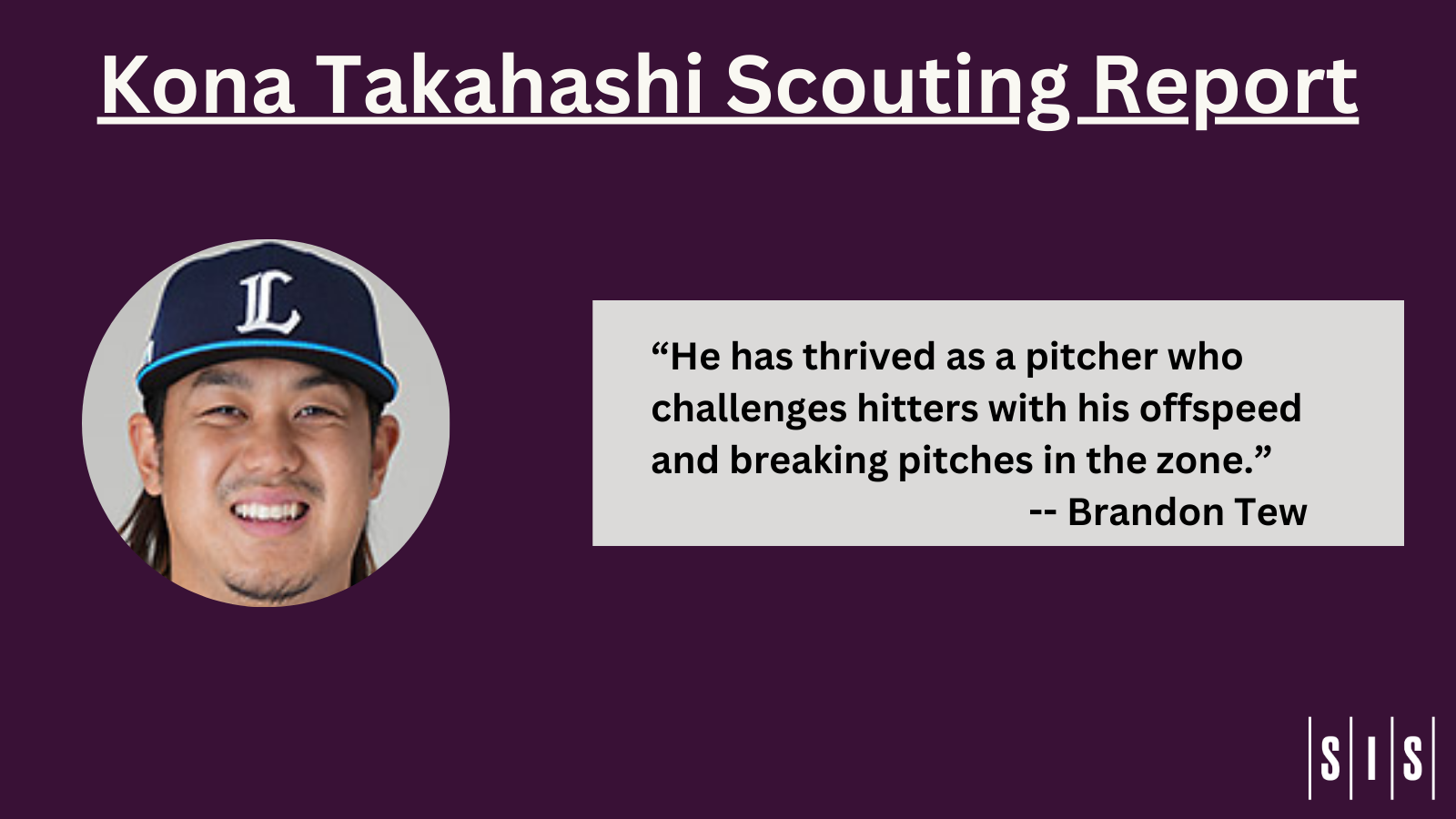
    While Takahashi doesn’t post the strikeout numbers of other top pitchers in NPB, he prevents runs as well as nearly anyone. And in the lower run-scoring environment, he has thrived as a pitcher who challenges hitters with his offspeed and breaking pitches in the zone.

    Season IP ERA Strikeouts Walks K-BB%
    2022 175.2 2.20 128 51 10.9 %
    2023 155.0 2.21 120 47 11.6 %

    Why he’s good

    Takahashi throws enough strikes to pepper the zone and minimize walks with around a 7% BB rate the last two seasons. In 2023, he had a 63% strike rate working the ball in and out against hitters to stretch the plate. 

    He does not give in when behind in the count, especially later in the year when he went to his slider and splitter in 2-1 and 2-0 counts. Here’s a splitter to Kensuke Kondoh to get back into the at-bat when down 2-0.

    via GIPHY

    Mechanical changes and velocity increase

    After training at Driveline before the 2023 season, Takahashi cleaned up his mechanics with his arm action and lead leg block. He started throwing harder, sitting around 93 mph on his fastball instead of 91 mph, and touched the upper 90s deep into games.

    At times especially in July when he threw back-to-back shutouts, he threw all of his pitchers harder. Getting better as the game went on, fueled by adrenaline, and seeing the finish line, he ripped this 87 mph slider for a sword.

    While his fastball garnered modest whiff rates at about 11% last season, his splitter and slider became real weapons with a solid whiff rate of around 32% on both of the pitches last season. He mixed those pitches in during two-strike counts when he wasn’t trying to sneak a fastball underneath the hands of a batter.

    via GIPHY

    The Arsenal (2023 usage and Average Velocity)

    Fastball  39 %  93.3 mph 

    Juicing a couple of clicks out of his fastball last season elevated his game and helped his slider and splitter perform better. With above-average command of the pitch, he tries to stay out of the middle of the zone. 

    He also doesn’t lean on fastball usage like most Japanese pitchers. He might throw any of his pitches to start an at-bat and use the fastball more as a surprise. 

    Here is another example of bringing the ball back over the plate armside as he throws this four-seam at 95.6 mph to get the freeze and finish the game:

    via GIPHY

    The four-seam has decent run and he uses the horizontal movement to his advantage both in looking for strikes but also missing barrels moreso than creating the swing and miss. He can dial up the fastball high in the zone when needed and it performs best when sequenced with his other pitches.

    via GIPHY

    Splitter 25%   87.5 mph

    Takahashi’s splitter is his next best pitch as he not only gets chases on it but also limits damage with a .460 OPS against, and a .161 opponents’ batting average in 2023. His grip works both seams with his fingertips and as he pronates, creating either a slight dip to the pitch as it moves arm side or a sharper dive away from hitters. 

    He can steal a strike against batters in the zone but the pitch is at its absolute best when it’s darting towards the dirt. Here’s an at-bat against Kondoh, the best pure hitter in NPB. Takahashi uses two different looks at his splitter to get the swinging strikeout.

    via GIPHY

    The pitch had an outrageous 78% ground ball rate last season, so even when batters make contact they just pound it into the dirt. This means it’s hard to get singles up the middle even on turf fields. Takahashi uses the defense to his advantage and will keep the splitter at the bottom of the zone to get ground balls.

    Slider 20% 82.8 mph    Slurve 3.4% 79 mph

    Takahashi has two slider variations, one that’s more horizontal and gyro spin-based that he will use at any point to get a strike. Along with what I would classify as a slurve with some horizontal sweep but a lot of depth to it at a lower velocity.

    Slider:

    via GIPHY

    Slurve: 

    via GIPHY

    The slight variation is enough to call it two separate pitches. He also uses two separate signs for both pitches as well. He will use the slurve as a wrinkle but heavily leans on the slider in situations where he needs a strike. He also throws the slider at his highest strike rate with a 67.5% rate last season. 

    The velocity of the pitch will fluctuate, but when he wants he can rip some gnarly sliders with higher-end velocity and sweep. He makes the pitch a bat-misser and weak-contact merchant. 

    Cutter 11%    88 mph 

    Takahashi’s cutter is an intriguing pitch he uses to get himself back into count leverage and as a putaway pitch at times. He will bury the pitch on the hands of left-handed hitters in a more traditional sense but will also try to dot the pitch away from right-handed hitters, glove side. 

    There’s enough variance from his slider that the pitch has more carry and stays vertical along with the velocity difference. However, there are times that he will have the pitch leak back over the plate, arm side.

    via GIPHY

    The cutter is a pitch that Takahashi will throw with enough confidence and conviction that he might ride the pitch for a few innings, even more than his slider in some games.

    Curveball 2%  75 mph  (Knuckle Curve 76.5 mph)

    This is a pitch that Takahashi might look to incorporate more into his arsenal, especially to lefties. He threw a more traditional curve in 2023 with a 12-6 shape but also dabbled with a knuckle curve. He threw the traditional one 25 times and the spiked grip 23 times in 2023. 

    via GIPHY

    He threw the knuckle curve a little harder than the traditional one but tried to find consistency with the pitch to add another offering. He is primarily trying to steal a strike with the pitch as a first-pitch offering, and that’s all he needs right now. It serves as  something to keep in the back of hitters’ heads or a way to get up early in the count.

    via GIPHY

    What to expect this season.

    Takahashi has been an excellent run-preventer for the last two seasons. His jump in velocity last season helped produce more whiffs, but he will never be a high-end strikeout guy. 

    What makes him great is his bulldog mentality along with good control of his slider and splitter. He seems to raise the level of his pitching as he gets deeper into games. If he’s able to provide another successful season for the Lions they may have a tough decision coming next winter about whether he should be posted.

  • NPB スカウティングレポート:佐々木朗希

    NPB スカウティングレポート:佐々木朗希

    Translation by Yuri Karasawa and @takumabbetc

    世界トップクラスのピッチャーの一人が、なるべく早くMLBでプレーすることを希望している。現時点で彼はどのようなピッチャーなのだろうか。弊誌のライター、ブランドン・テューは、すべての登板を観察し、評価を行った。

    佐々木朗希は、理想的な球種と優れたコントロールを兼ね備えた、世界で最高の投手の一人だ。彼は競争力の高い日本プロ野球において三年連続で圧倒的な投球を見せている。今オフ山本由伸がロサンゼルス・ドジャースと契約した後、佐々木はNPBで最高の投手と言えるだろう。

    佐々木はMLBでプレーする意志をロッテ球団に知らせているが、今のところ、彼は日本で少なくとも2024年シーズン、打者たちを苦しめ続けることになる。佐々木の最大のハードルは、シーズン全体を通じて健康を維持し、ローテーションを守ることだ。昨年佐々木は、7月下旬に左斜筋の怪我で2か月間欠場し、9-10月の先発登板はわずか3度だった。過去2シーズンの佐々木の先発を全て観た私の評価は以下の通りである。

    Season IP ERA Strikeouts Walks K-BB%
    2022 129 1/3 2.02 173 23 30.6%
    2023 91 1.78 135 17 34.2%

    佐々木の卓越した速球とフォークにより、 100マイル (160キロ) を超えるストレートから鋭く落ちるフォークボールを使い、2つの球種で相手を圧倒する投手だ。佐々木は2023年に質の高いスライダーを加えたが、半分以上はストレートに頼り続けた。

    佐々木のストレートのコントロールと、ストライクゾーンの下にフォークを投げる安定性により、打者から多くの空振りを奪うことができる。 昨シーズンの彼のフォークの空振り率51.5%は、日本だけでなく、世界の全投手が投げるあらゆる球の中でも最高の球種の一つだと言える。

    メカニクス

    via GIPHY

    佐々木は、常にセットポジションから投げ、細い体から爆発的な運動能力を発揮する。 右腕の彼はピッチャープレートの三塁側から前足を拾い上げ、膝を肩の高さ近くまで上げ、その背丈は188cmを誇る。

    足を前に出して膝を軽く曲げ、空に向かってつま先を上げる。彼は足と膝を胸へと引き戻すことで、マウンドから降りる際に勢いを生み出す。この最初の前進動作中、彼は腰をとぐろを巻いて逆回転させている。足をセンターに向けて、前腰で体重を落として後ろ足を曲げるような動きをする。これは「ドロップアンドドライブ」と呼ばれる。

    足が地面に着くとき、腕は必ずしも 90 度になるわけではないが、胸を三塁側に向け、腰を打者の方に向けることで、腰から肩までの距離は理想的である。彼のシーケンスは非常に理に適っていて、エネルギーがうまく流れるようになっている。車のアクセルを踏むかのような脚の動きにより、エネルギーを腕に伝えることができる。スムーズかつリズミカルな投球フォームにより、身体がアスリートのように流れ、スリークォーターのスロットから引き裂くような球が放出される。マウンドから降りるまで体が開かない。

    球種別

    ストレート 50.3%、 99 マイル (159.3 キロ)

    佐々木の速球は彼の2つの傑出した球種のうちの1つである。 彼のフォーシームは、昨シーズン規定投球回数をクリアしたMLBの先発投手の中では、平均時速99.1マイルを記録したボビー・ミラーに次いで2位だ。 佐々木のストレートも最高時速162.5マイルを記録した。 彼は昨年3月のWBCで、世界の舞台でその豪快なストレートを披露した。

    球速だけでなく、縦と横の変化も相まって、打者にとっては大きな凶器となる。 彼の速球には19 インチを超える Induced Vertical Break (速球の垂直変化量) と 15 インチの arm side run (投げ手側への横の変化) がある。彼はゾーンの上部に速球を投げ込むことで、理想的な一球を生み出すことができる。

    佐々木は通常、ストライクゾーンの上部3分の1に向かってストレートを投げ、打者はボールの下を振ってしまう。彼がゾーン下部に投げる時、速球の横変化が打者のソフトコンタクトを生み、ゴロを打たせることができる 。彼がアームサイド(投手の投げ腕側、右投手の場合右側)の低めに制球できれば、右打者は詰まらされ、左打者にとってはボールが外角に逃げていく。

    昨シーズンのストレートの空振り率は24%、ゴロ率は56%だった。打者は、ヒットを打てる唯一のチャンスと見て、ストレートに山を張って待つだろう 。 それでも、佐々木は昨シーズン、本塁打を1本しか許しておらず、彼のストレートは被打率.222、被OPS.592を記録した。

    佐々木は通常、ストレートを打者から遠ざけようとし、たとえシュート回転があるとしても、グラブ側(右投手から見て自身のグラブがある左側)に一貫して投げ続ける。 より優れた左打者に対しては、打者の腕の下、つまり内角を狙うこともある。 彼はゾーンから数インチ離れた位置で投球を開始し、ゾーンの隅に戻そうとする。

    佐々木に必要なのは、それなりのコントロールのみだ。。彼はゾーンの隅にストレートを完璧に配置する能力はある。 しかし、試合のほとんどで、彼はゾーン内で打者に挑戦し、ベース上を垂直または水平に二分割するように投げ分ける。速球の球速と変化は信じられないほどで、とにかくストライクを多く投げ込むだけで抑えることができる。彼の捕手は、捕手は、彼にただストライクゾーンに投げさようと、ストライクゾーンのど真ん中に構えることもあった。

    フォーク 33.9%、89.7 マイル (144.3 キロ)
    佐々木のフォークは彼の最高の球種であり、世界最高のスプリットかもしれない。千賀滉大選手のゴーストフォークに匹敵し、打者が空振りしたり追いかけたりする確率は驚異的に高い。佐々木選手のフォークの 2023 年の空振り率は 51.5% だった。比較すると、2022 年の NPB シーズンの千賀選手のフォークボールの空振り率は 52.3% であった。
    佐々木のフォークは、ストレートと同じ角度で打者へ向かい、最後の瞬間で地面に向かって急降下する。彼のスプリットが生み出すトンネル効果により、特に低めのストレートとの見分けが非常に困難だ。メキシコ代表のランディ・アロサレーナ選手は、WBC で佐々木選手と対戦したときにこれを経験した。

    佐々木は主にゾーン低めにフォークを集めるが、時折左打者に対して見逃しストライクを狙って高めに投げたり、ボールが抜けてしまってゾーン甘めに入ってしまうこともある。変化の仕方は不安定ながらも、佐々木はスプリットに対して一貫した感覚を持っているようだ。

    ある程度意図的に行っていると思われるのは、右打者に対してはグラブサイドにカット気味に変化させ、左打者に対してはシュート気味に逃げてるように変化させるということだ。 彼はこれを頻繁に行っているため、スプリットの投球の際に指先で加える圧力を調整していると思われるが、意図的に行っているという確証は得られていない。彼がこの特定の球種で見せる投球術は、彼を野球界で唯一無二の怪物にしており、その投球に対する一貫性も同様に印象的である。

    Pitching Ninja によるこのビデオでは、佐々木がフォークで生み出すカットの動きと、右打者としてその球捉えるのがいかに難しいかを見ることができる。

    ゴロ率70.5%、被OPS.272という驚異的な数字と、被打率.101を誇る投球は特別な武器だ。

    スライダー 14%、87.5 マイル (137.9 キロ)

    佐々木が頼もしい3球目として取り組んでいる球種はスライダーだ。 2022年にはカーブとスライダーをそれぞれ5パーセント程度使用していたが、昨シーズンはスライダーの使用率を14パーセントに増やし、カーブを廃止した。

    彼は主にスライダーでゾーンの底、グラブ側をターゲットにし、主に右打者にそれを使用して投球構成を多様化した。スライダーの制球が定まらなかったこともあったが 、それは秘密兵器として試合を通して定期的に登場するピッチとなった。

    Sequence to LHH (Slider backdoor, Fastball in, Splitter Down):

    via GIPHY

    彼のスライダーはより大きな可能性を秘めている。2023年の空振り率は47%で、横変化と球速を兼ね備えた素晴らしいオフスピードピッチになる可能性がある。彼に必要なのは、スライダーに対して自信を持ち続けることだ。 最初の 2 球が非常に優れているため、現状から使用頻度をそれほど増やす必要はない。

    佐々木も球速80マイルのカーブボールを持っていることは注目に値するが、昨シーズン彼が投げたのはわずか2回だった。 以前はカウントの早い段階で時折サプライズ投球として投げていたが、それはほぼ廃止された。

    今シーズンに期待できること

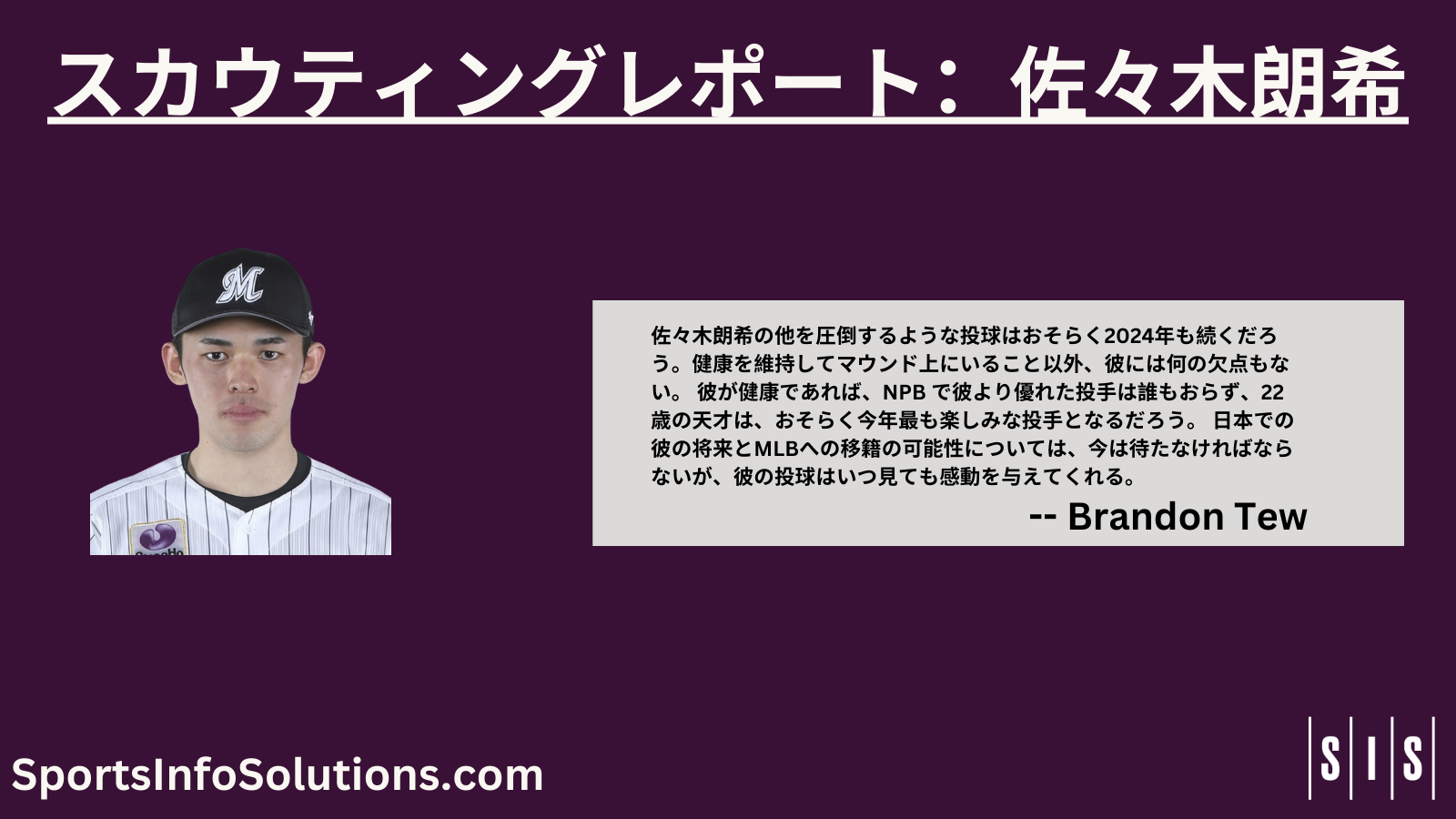
    佐々木朗希の他を圧倒するような投球はおそらく2024年も続くだろう。健康を維持してマウンド上にいること以外、彼には何の欠点もない。 彼が健康であれば、NPB で彼より優れた投手は誰もおらず、22 歳の天才は、おそらく今年最も楽しみな投手となるだろう。 日本での彼の将来とMLBへの移籍の可能性については、今は待たなければならないが、彼の投球はいつ見ても感動を与えてくれる。

  • NPB Scouting Report: Rōki Sasaki

    NPB Scouting Report: Rōki Sasaki

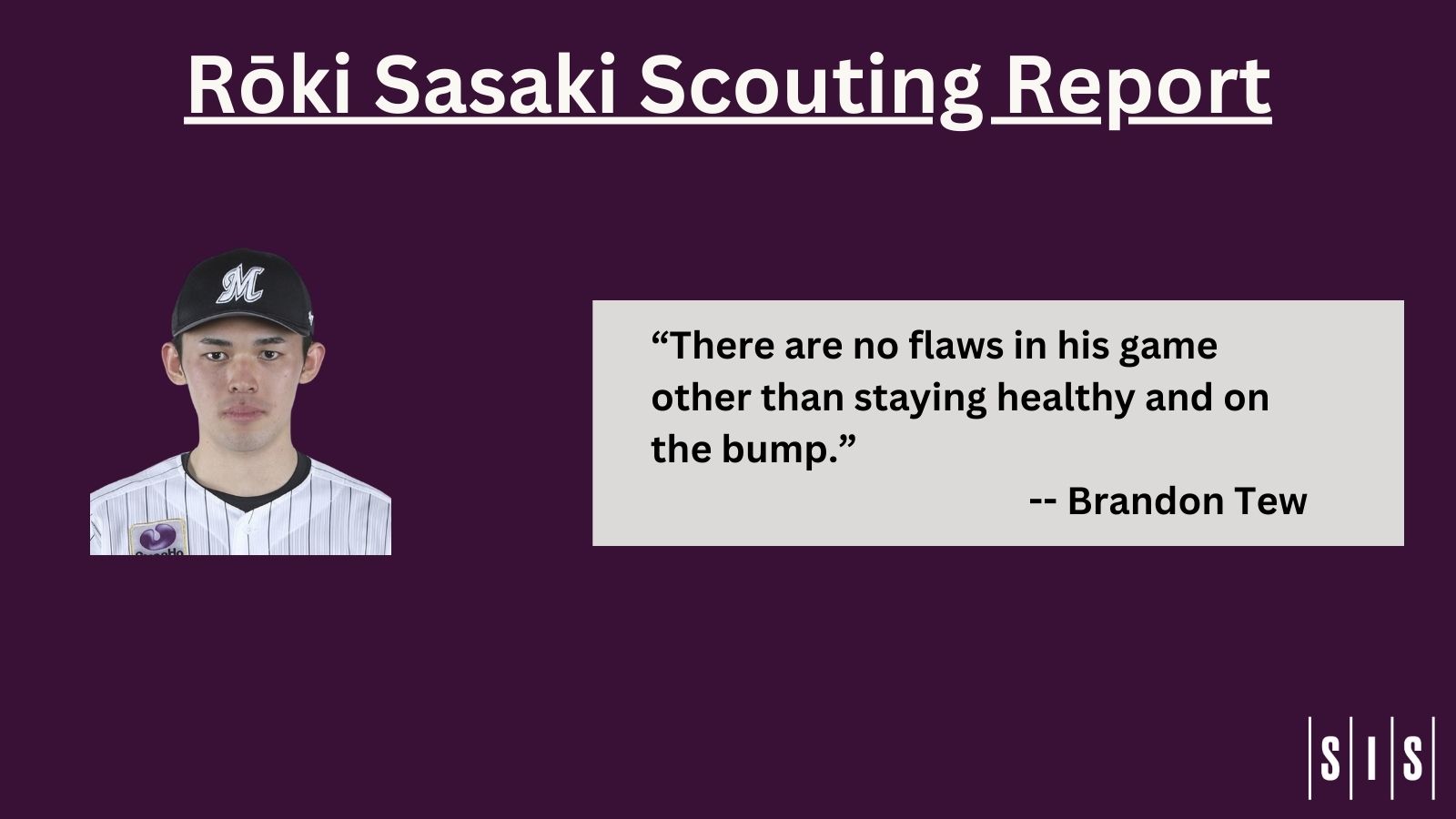
    Rōki Sasaki is one of the best pitching talents on the planet with a combo of nasty stuff and good command. He has obliterated his competition in Japan for three seasons now. He firmly holds the title of the best pitcher in NPB after Yoshinobu Yamamoto signed this offseason with the Los Angeles Dodgers.

    Season IP ERA Strikeouts Walks K-BB%
    2022 129 1/3 2.02 173 23 30.6%
    2023 91 1.78 135 17 34.2%

    Sasaki has made his MLB aspirations known to the Lotte Marines, but for now, he will continue to torment hitters for at least one more season in Japan. Sasaki’s biggest hurdle is staying healthy throughout an entire season and continuing his stellar production. Sasaki most recently missed two months with a left oblique injury in late July before pitching sparingly with 3 more starts in September and October.

    I’ve watched all of Sasaki’s starts the last 2 seasons and from that I’ve made the following evaluation:

    What makes him so special?

    Sasaki’s exceptional fastball and splitter allow him to be a dominant two-pitch pitcher using his devastating splitter off of his triple-digit fastball. Sasaki added in a good slider during 2023 but continued to lean on his fastball over half the time.

    His command of the fastball and consistency in throwing his splitter below the zone have batters guessing and whiffing a bunch. With a 51.5% whiff rate on his splitter last season it’s one of the best pitches in Japan, if not all of baseball.

    Mechanics

    via GIPHY

    Sasaki shows explosive athleticism out of a wiry frame on the mound while throwing exclusively out of the stretch. Working from the third base side of the rubber as a right-hander he picks up his front leg and brings it high into the air with his knee finishing close to shoulder height for his 6’2” frame. 

    With his leg and foot out in front of him and a slight knee bend, he points his toes to the sky. He creates momentum down the mound with his leg and knee returning to his chest. He’s coiling and counter-rotating his hips during this initial move forward. With his foot turned towards center field, he leads with his front hip in a drop-and-drive delivery sinking into his back leg. He stays closed throughout this move down the mound.

    At foot strike his arm doesn’t always get to 90 degrees, but the hip-to-shoulder separation he creates with his chest facing third base and his hip towards the plate is good. He sequences extremely well, letting the energy flow. A firm lead leg block, allows him to transfer energy to his arm. Throwing with a smooth and rhythmic delivery, he’s letting his body flow athletically to rip the baseball from a 3/4 arm slot.

    The Arsenal (2023 usage and Average Velocity)

    Fastball   50.3%, 99 mph

    Sasaki’s fastball is one of two unicorn-type pitches for him. The average velocity is hard to match, as his four-seamer would have put him second among qualified starters in MLB last season behind only Bobby Miller who averaged 99.1 mph on his four-seamer last season. Sasaki’s fastball has also touched 102.5 mph. He showcased his electric fastball on the world stage during the World Baseball Classic last March.

    To go along with the velocity is a deadly combo of vertical movement and horizontal run. The pitch has over 19 inches of IVB (induced vertical break) and 15 inches of horizontal movement arm side. He can carry the ball through the top of the zone, creating an elite pitch. 

    Sasaki routinely throws his fastball toward the upper third of the zone, with hitters swinging underneath the pitch in all quadrants of the zone. When he does pitch down in the zone the run on the pitch creates weak-contact grounders as well. The pitch is jamming righties, or moving away from lefties as he spots it down and arm side. 

    The fastball garnered a 24% whiff rate last season and a 56% GB rate. Hitters would sit on the pitch as it was their only chance to pick up a hit. He surrendered only 1 home run with it all last season and his fastball had a .592 OPS against with a .222 batting average against.  

    Sasaki will usually try to keep his fastball away from hitters and, even with the run he gets, he locates the pitch glove-side on the outer part of the plate consistently to righties. Against better left-handed hitters he will also target the inside part of the plate underneath the hands. He starts the pitch a couple of inches off the plate and tries to bring it back to the edge.

    Sasaki just needs decent command of the pitch. When he wants to, he can dot a fastball on the corner. However, most of the game he challenges hitters in the zone and will split the plate in half vertically or horizontally. 

    The pitch has ridiculous velocity and movement, and he just needs to fill up the zone like a buffet plate. His catchers sometimes set up in the middle of the plate just to get him back into the zone.

    Splitter 33.9%, 89.7 mph

    Sasaki’s splitter is his best pitch and it might be the best splitter in the world. It rivals Kodai Senga’s ghost fork and racks up the whiffs and chases at an astronomical rate. Sasaki’s splitter had a 51.5% whiff rate in 2023. By comparison, Senga had a 52.3% whiff rate on his forkball in his 2022 NPB season.

    Sasaki’s splitter darts toward the ground at the last second, as it holds plane with his fastball. It creates a tunnel effect that is hard to decipher, especially down in the zone with his four-seam. Randy Arrozarena experienced this when Sasaki faced him in the WBC.


    Sasaki peppers the bottom of the zone with the pitch but also will leave it up versus left-handed batters occasionally trying to steal called strikes or just throwing a pitch that slips and catches too much of the zone. Sasaki still has a consistent feel of the pitch, even with its volatile nature in movement.

    In what I have decided is intentional to some extent, Sasaki will cut the splitter to his glove side away from right-handed batters, and pronate more to fade it away from lefties. He does this often enough to almost have a feel for his finger pressure on the pitch, though I can’t confirm this. The pitchability he displays with this specific pitch makes him a unique oddity in baseball and his consistency with it is just as impressive.

    This video from Pitching Ninja earlier shows the cut Sasaki can create on his splitter and how hard it is to barrel the pitch as a right-handed batter.

    With a 70.5% GB rate and an absurd .272 opponents’ OPS along with a .101 batting average against, the pitch is an unhittable menace.

    Slider 14%, 87.5 mph

    A pitch that Sasaki has been working on as a reliable third pitch is his slider. In 2022, he used his curveball and slider at around 5 percent each, but last season he upped his slider usage to 14 percent and scrapped his curveball. 

    He mainly targeted the bottom of the zone, glove side with his slider, and used it primarily to righties to keep them off of his splitter and fastball. He did have inconsistent command of the pitch at times but it became a pitch that he would routinely feature throughout a game as a wrinkle.

    Sequence to LHH (Slider backdoor, Fastball in, Splitter Down):

    via GIPHY

    The pitch has great projectability and when he snaps one off it can be a nasty breaker with sweep and velocity, with a 47% whiff rate in 2023. The next step for him is continued belief in the pitch. With how good his first two pitches are, he doesn’t need to up the usage that much more from where it currently sits in his repertoire.

    It’s worth mentioning that Sasaki has a curveball that sits at 80 mph but he threw the pitch only twice last season. He used to throw it more as a strike stealer early in counts but has all but scrapped it.

    What to Expect this season.

    Sasaki’s utter dominance should likely continue in 2024. There are no flaws in his game other than staying healthy and on the bump. When he’s pitching there’s nobody better than him in NPB and the 22-year-old phenom will likely be the most exciting pitcher to watch come this spring. As for his future in Japan and possible move to MLB, that will have to wait for now, but he’s sensational to watch every time he pitches.

  • How Good Is Naoyuki Uwasawa? An NPB Free Agent Scouting Report

    How Good Is Naoyuki Uwasawa? An NPB Free Agent Scouting Report

    Naoyuki Uwasawa was posted this off-season by the Nippon-Ham Fighters after 9 NPB seasons. He amassed a decent NPB career, racking up 1,118 innings pitched in 173 games and 50 starts.

    Here’s a look at his last two seasons with the Fighters:

    Season IP ERA Strikeouts Walks K/BB Ratio
    2022 152 3.38 127 50 2.7
    2023 170 2.96 124 41 3

    He compiled a 7.5% walk rate and a modest 20% strikeout rate in his NPB career, with a 18% strikeout rate last season. He uses finesse over power to complement a deep arsenal of pitches, relying more on velo difference and changing of speeds than actual movement.

    What does he do well?

    As a right-hander, Uwasawa pounds the strike zone with his varied pitches and has been a reliable innings eater since 2020. Since returning from a 2019 injury-shortened season, he has thrown at least 152 innings in the last three seasons. 

    He doesn’t have the most potent stuff, but he threw strikes at a 66% strike rate in 2023; all his pitches can be thrown in and out of the zone. With slightly above-average command, he can change speeds and mixes his pitches well. 

    He has some promising pitch shapes but teams will buy in on his control and hopefully better command to soak up innings. To be reliable stateside, he must hit his spots.

    Mechanics

    Uwasawa and NPB posting mate Shōta Imanaga have similar setups and movements in their deliveries. Going straight into a leg lift, Uwasawa brings his knee up to his chest before adjusting down to his belt. 

    He then pauses his leg lift and creates counter-rotation in his hips by turning his foot towards the rubber, just like Imanaga. Uwasawa lands with a solid lead leg and his shoulders are level as his right arm gets to a 90-degree angle at foot strike.

    via GIPHY

    At times, Uwasawa deploys a tiny hop off his front foot after ball release, especially on fastballs he throws a little harder, thus showing some athleticism and freedom in how he finishes his movements.

    via GIPHY

    The Arsenal (2023 usage and Average Velocity)

    Fastball 44%, 90 MPH

    Uwasawa exhibits subpar fastball velocity for MLB and didn’t garner high whiff rates on the pitch in NPB, but was decent in 2023 at 18%. He threw his four-seam at about 41% and his two-seam at 3%. The four-seam is his go-to pitch, as he tries to spot it in different parts of the zone.

    His command of the pitch fluctuates between average to above-average. At its very best, it’s a good pitch on the edges of the zone. He has some really interesting fastball characteristics as well.

    He can get swings and misses at the top of the zone and creates foul balls in less desirable places. The lack of velocity is worrisome, but with good spin and carry his fastball can still work in MLB. He will most likely have to move away from a heavy fastball reliance though, and can’t leave the pitch in bad spots at its current velocity.

    Curveball 14%, 75 mph

    Uwasawa’s curve shows good movement when snapped off and he can throw the pitch harder when needed, but he will often use the slower end as a strike-stealer early in counts. The harder version is used more as a chase pitch below the zone against free swingers.

    Although he can throw the curveball for a strike, it has his lowest strike rate of any pitch at 62 % compared to his fastball at 68% in 2023. The lower strike rate is due to some of the curves slipping out of his hand and missing the arm side or being spiked in the dirt.

    He mainly uses the curve as a change-of-pace and will even mess with timing at points on all his pitches, but the curve is helped by this as he delays his movement down the mound after leg lift. An excellent example of this is an at-bat vs Yakult slugger Munetaka Murakami:

    via GIPHY

    Slider 13%, 81 mph

    Uwasawa throws both a sweeper and a harder slider, grouped above when referring to pitch usage. The sweeper sits around 78 mph and the slider can get up to around 84 mph but the shape of the two pitches is key.

    At times, Uwasawa’s sweeper gets loopy, morphing into a slurve, with more depth rather than horizontal movement. If he’s able to fix the movement and consistently make it more horizontal away from his curve, that could help the pitch become more distinct.

    Sweeper:

    via GIPHY

    As with most pitches, more velocity would be nice but even getting the shape consistent would help his slider, sweeper, and curveball separate not only in velocity but also in movement.

    Against right-handed batters Uwasawa uses his sweeper and slider as his second-most used pitch. If he’s able to throw more consistent sweepers, then his fastball will play up as a result. 

    This plate appearance below against Maikel Franco shows how Uwasawa might mix his pitches in MLB, illustrating how he doesn’t need heavy fastball reliance to pitch to hitters. While this plate appearance ended in a walk, Uwasawa broke off some nice breaking balls and had buy-in from Franco on almost all of them.

    via GIPHY

    via GIPHY

    Uwasawa will also backdoor his slider to left-handed batters and will even double up or triple up throwing the pitch consecutively. His slider and sweeper generated a modest 25% whiff rate in 2023. Uwasawa is ultimately trying to limit hard contact rather than pick up whiffs. His slider and sweeper accomplished that.

    via GIPHY

    Splitter 13%, 86 mph

    Uwasawa’s splitter is probably his best secondary and one that he should use more against left-handed batters. He surrendered only a .490 OPS against his splitter, but it was only his third most-used pitch to lefties, behind his fastball and curve. It might have been a case of Uwasawa relying on more velocity difference to keep the hitter’s timing off of his fastball. 

    If he lessens his fastball usage and upticks the splitter (especially to lefty hitters), it will help him stay competitive at the bottom of the zone. With a 53% GB rate on his splitter and a 57% rate on his curveball, those will be his money pitches in terms of keeping the ball on the ground.

    His fastball had a meager 30% ground ball rate and a 46% fly ball rate so using his splitter more should help bump up his career-low 40% ground ball rate in 2023. 

    Cutter 10%, 87 mph

    Uwasawa’s cutter is inconsistent and almost blends with his four-seam, being thrown just as hard at times. If you look at grips and well-thrown ones, the pitch has decent movement but is inconsistent. 

    Uwasawa occasionally leaves cutters in the middle of the plate and has them leak back because of minimal cut. This one below is followed by two sliders so the velocity difference saves him: 

    When he throws the cutter well though the pitch has decent movement and could fit inside of his arsenal as a weapon against against hitters on both sides of the plate.

    Here’s a slider and cutter away from a righty:

    via GIPHY

    Sitting around 87 mph the cutter is a below-average pitch overall, but with more consistency and location there’s still a fit inside of his arsenal.

    Changeup 6%, 81 mph

    To round out Uwasawa’s deep pitch mix is a changeup that he throws with distinct spin and velocity from his splitter. However, the changeup is a pitch that either needs to be scrapped entirely or needs a drastic overhaul in movement and shape.

    While the pitch performed well in 2023, there are just too many instances of the pitch being left in a hittable spot and or up in the zone. The pitch also doesn’t have as much depth as his splitter, and it mainly works because of the velocity difference catching hitters out on their front foot.

    There are a lot of examples of Japanese pitchers throwing both a splitter and changeup with far better velocity differential and movement profiles than Uwasawa. Understanding his identity as a finesse pitcher he wants the velo difference if only by about 5 mph. However, slimming down his arsenal, and going with only a changeup or splitter is Uwasawa’s best bet at an effective offspeed pitch in the long run.  

    What to Expect

    Uwasawa projects as a swingman in MLB with enough durability and control to be given a shot at the back end of a rotation. His four-seam characteristics and splitter have him standing a decent chance at some sort of valuable production for an MLB team, if he consistently hits spots, but the lack of velocity and overall stuff will limit his ceiling to that of a Kyle Gibson-type pitcher.

  • NPB Free Agent Scouting Report: Shōta Imanaga

    NPB Free Agent Scouting Report: Shōta Imanaga

    Shōta Imanaga was posted by the Yokohama Baystars after spending eight seasons pitching in NPB’s Central League. He is coming off his two best seasons as a pro and heads into free agency at 30 years old.

    Season IP ERA Strikeouts Walks SO/W
    2022 143 2/3 2.32 132 29 4.6
    2023 148.0 2.80 174 24 7.3

    Imanaga is listed at the same height and weight as fellow NPB posting mate Yoshinobu Yamamoto, at 5-10 and 176 pounds. The lefty possesses some of the best pure stuff in the world. His 68% strike rate would have been in the top 10 in MLB among qualified starters in 2023. 

    This final list of Stuff+ leaders from the World Baseball Classic is a mix of notable MLB and NPB pitchers:

    What does he do well?

    Imanaga’s arsenal is as deep as it is potent, highlighted by a high-carry four-seamer with over 20 inches of induced vertical break (IVB). The pitch cuts through the zone staying on plane and causing swings and misses over the top of barrels. 

    Imanaga also has multiple variations of pitches that make him a tough at-bat for hitters. He led NPB in K rate at 29% and was the strikeout leader in the Central League with 174. Imanaga has multiple chase pitches, with sources such as Deltagraphs noting that hitters chased outside of the zone over 35 percent of the time against him in 2023. A 35% chase rate would likely rank in or around the Top 20 among MLB starters if Imanaga could do that in MLB. 

    Mechanics

    via GIPHY

    Imanaga deploys a paused leg lift, as many Japanese pitchers do. This allows him to create rhythm and balance in his delivery. Imanaga brings his leg up towards his chest before quickly settling around waist height with a tiny pause. He then slightly turns his foot towards the rubber, creating counter-rotation in his hips as he shifts his weight and momentum forward. 

    Imanaga sinks deep into his lower half and back leg before pushing down the mound. He has solid repeatability and good extension relative to his height because of his lower-half use.

    The Arsenal (2023 usage and Average Velocity)

    Fastball   59%, 91.8 mph

    Imanaga relied heavily on his fastball, throwing his four-seamer close to 54% of the time and his two-seamer around 5%. The four-seam has elite fastball characteristics as mentioned earlier and even though Imanaga loved to work down in the zone more than up, batters swung underneath his fastball in both areas of the zone.

    Up

    via GIPHY

    Down

    via GIPHY

    The pitch racked up 96 Ks in 2023 and performed well with a .234 opponents’ batting average. But even in Japan’s dead ball era, Imanaga has been plagued by the HR ball. In the last two seasons, he finished with 14 and 19 HR against, respectively, including playoffs, with 26 of them surrendered on a fastball in that span.

    The likely culprit of this is throwing too many fastballs in hitters’ counts, with shaky command at times and high fly ball rates.

    Less reliance on his four-seamer as well as pitching more up in the zone could help him out with his high-carry fastball. He also throws the pitch for a strike 73 percent of the time, so working it out of the zone could mitigate the damage as well. Still, he needs better command of the pitch to accomplish this. He has above-average command of the pitch overall, but there are examples of fastballs leaking to the middle of the plate.

    Here’s a dotted fastball in the 9th inning of his no-hitter last season:

    via GIPHY

    Slider 16%, 81.5 mph

    Imanaga throws two variations of a slider that are grouped together when we refer to his pitch usage. His sweeper is used less often, though he has fluctuated its usage from game to game the past two seasons. His sweeper is on the lower end of velocity in the mid-70s, and what I would call his “true slider” sits closer to 80 mph.

    Here are the two variations:

    Sweeper: 

    via GIPHY

    Slider:

    via GIPHY

    His sweeper and slider have good shapes to them and while more velocity would be nice they still fit well in his arsenal, giving him three varieties of speed moving away from LHBs with the inclusion of his cutter. 

    The sliders combined for his second-most strikeouts. They should continue to be valuable weapons for him, versus LHBs.

    Splitter 12%, 83.2 mph

    Probably the most intriguing pitch Imanaga throws is his splitter. He actually throws with two different splitter grips to go along with his changeup. 

    Here are the three pitch grips all from the same game. They have slight differences in grip most noticeable at the bottom of his arm swing. 

    You can see with the modified split Imanaga puts his middle, ring, and pinky finger together. With the traditional splitter, he has his pinky and ring finger tucked behind the ball. He’s thrown the two different splitter grips at different times from what we have charted since the middle of July 2022 but he’s gone back to more of the modified splitter in 2023.

    With MLB baseballs being slightly larger and less tacky than NPB balls, it will be worth following what grip he might find most comfortable. Masahiro Tanaka famously battled with finding a comfortable splitter grip throughout his MLB career.

    The splitter is a real swing-and-miss pitch for Imanaga with over a 40% whiff rate in 2023. The velocity separation of the pitch from his fastball causes batters to not only whiff but also hit a fair amount of ground balls (a 50% ground ball rate)

    via GIPHY

    The velocity dip from his fastball also causes a lot of weird swings and weaker contact even on fly balls.

    via GIPHY

    Curveball 7%, 73 mph

    Imanaga’s curve is a slow loopy pitch in the 70s with some sweep to it. It has a lazy arc and he primarily uses it as a change of pace pitch to keep hitters off of the rest of his arsenal. 

    via GIPHY

    Imanaga also has a very slow curveball (in the 50s in terms of MPH) that he breaks out on rare occasions (5 times in 2022, 8 in 2023). The pitch is used to freeze batters. He might up the usage of this slower curve in MLB just to keep hitters honest.

    via GIPHY


    Cutter 4%, 86.7 mph

    Imanaga’s cutter was his worst-performing pitch in 2023, though only 21 at-bats ended with one. He actually abandoned the pitch for the first couple of months of the season before returning to use it in June with 5% usage the rest of the season. In 2022 he actually was throwing more cutters than sliders and the pitch was much more useful for him then than in 2023.

    He throws a harder version of his slider that is tagged as a cutter. It’s more of a hybrid and he routinely will use it more in slider situations, throwing it down and away. That’s something I noticed when I wrote up his 2022 no-hitter vs Nippon-Ham in June 2022. He threw 24 cutters that night with no sliders or sweepers.

    via GIPHY


    Changeup 2%, 81.5 mph

    Imanaga’s changeup is his least-used pitch. He threw 32 of his 52 in one game against Rakuten in May.

    If Imanaga can’t grip his splitter with an MLB ball maybe he goes to more of a changeup grip or he finds a way to mix the change in more. He also had no fear throwing the pitch left on left, which speaks to his pitchability but that is still probably the toughest pitch to execute in baseball.

    Here’s back to back changes against Maikel Franco with an 8-mph difference:

    via GIPHY


    via GIPHY

    Just another example of Imanaga’s pitchability.

    What to Expect

    Imanaga is a strike-throwing lefty with some of the best pure stuff in the world because of his pitch movement and ability to spin the baseball. Even without high-end velocity or command, Imanaga throws strikes and punches tickets which should lead to success in MLB. 

    He has mid-rotation upside right now. His spot in an MLB rotation will be determined by whether he can keep the ball in the ballpark.