Category: College Football

  • Army, Navy, and Their Continued Adaptations of the Flexbone

    Army, Navy, and Their Continued Adaptations of the Flexbone

    The 123rd edition of the Army-Navy game will look unlike any other game this season. Aside from the tradition of the rivalry, the offenses on display will attempt to pound the defenses into submission using triple option football. While nearly every offense uses option principles within their system, very few base out of the triple option, and only these two do so out of the flexbone.

    To the uninitiated viewer, the offense will look not only unfamiliar, but intricate and complicated. 

    But a deeper dive into the system will reveal not only the simplicity of the flexbone, but also how Army head coach Jeff Monken and Navy head coach Ken Niumatalolo have modified it over the years. Both men served under the flexbone’s most notable proponent in Paul Johnson for a combined 28 years, and a look at his final offense at Georgia Tech provides a good place to start this dive.

    For the 2018 season, Georgia Tech used the 4th fewest number of formations in the FBS, and four formations alone accounted for just under 70% of its plays. The Yellow Jackets used two-wide formation (base) for 34% of their’ plays, and would call “Tight”, “Heavy”, and “Trips” to manipulate the defense into suboptimal looks.

    Caption: From Top Left, presented in clockwise order: Base, Tight, Heavy, and Trips formations

    Running the ball 83% of the time, the Yellow Jackets would run a form of the triple, usually either veer or midline, on 51% of their snaps. To supplement the base, Johnson would call trap, zone, or belly to attack within the tackle box. To get outside he would rely on QB sweep, counter option, wing counter or rocket/FB toss to get to the periphery. The drive posted below shows Johnson’s offense at its best, scoring 7 of Georgia Tech’s 66 points in a rout of Louisville.

    When the Yellow Jackets did choose to pass, their offense bore a striking resemblance to the Run and Shoot. Both offenses share the same base formation, and Run and Shoot concepts such as 4 Verts and Switch comprised the bulk of Johnson’s passing attack. Johnson occasionally used the slot motions used in the Run and Shoot, and in his days at Hawaii he would even roll out the quarterback as the original Run and Shoot prescribed.

    Paul Johnson eschewed many of the conventions common throughout football during his coaching career. He rarely used a tight end, instead bringing a receiver in tight when he went “Heavy,” and never went out of the gun. More than even other option attacks, his offense ran through the quarterback, who in 2018 accounted for 50% of Georgia Tech’s carries and 44% of its rushing yards

    Johnson built a philosophical foundation upon which Monken and Niumatalolo have added. But like any member of a coaching tree, each has taken the system and adjusted it to fit both the personnel present each year and his own personal preferences. While each has taken the offense in different directions, they do share a few changes in common from Johnson’s base flexbone.

    Personnel-wise, Army and Navy now use a tight end. On 56% of their plays the Black Knights use a tight end, an essential piece of their offense. The Midshipmen meanwhile use one 22% of the time as extra blockers and to create unbalanced lines for certain packages. With the multiple personnel packages comes a wider variety of formations, with both offering nearly 20 more looks for which the defense must prepare

    Each academy has also snapped out of the gun this season. Army has only done so 5% of the time as part of a special package, while Navy has done so on nearly 13% of its snaps. As for the main play in the offense, both the Black Knights and Midshipmen have strayed from the triple. Neither runs it at the often as Johnson did, with Army running it 35% of the time and Navy 43%.

    Despite the similarities in some of the changes, each program has made them for different reasons. Army wishes to misalign the defense and gain numerical advantages using personnel and formations so that it can run plays even simpler than the triple option. In lieu of the triple, Army emphasizes the quarterback keep and the fullback dive. Quite often the quarterback will option on the dive and belly, but the wing usually serves as an extra blocker in those instances. The wingback gets involved via jet sweeps, traps, and counters. Facing Coastal Carolina, Army chewed up nearly 10 minutes of clock in the second quarter en route to a touchdown by creating advantages through their personnel and formations and executing the simple plays designed to utilize its talents.

    Navy, on the other hand, wants to run the traditional flexbone, but mix in a few different looks to enhance the plays they have. Their flexbone does vary slightly from the original, as the fullback, not the quarterback, gets the plurality of carries at 44%. However, the injuries at quarterback this season for the Midshipmen have likely influenced this number. But Navy will use the tight end, unbalanced looks, and even the occasional I-formation or Shotgun snap to dress up its flexbone plays, forcing the defense to make adjustments on the fly.

    In the second quarter against UCF, Navy mixed old and new with their use of base and trips looks along with the tight end and unbalanced sets to march to the end zone in their upset victory.

    Between its simplicity and obscurity, the flexbone has given disadvantaged teams the opportunity to compete against superior opponents. Though it began with Paul Johnson, Jeff Monken and Ken Niumatalolo have adjusted the flexbone to fit both the circumstances of their respective programs and their own tastes. With the help of the flexbone, both coaches have brought their programs prolonged success and made the fight to sing second a must-watch game.

  • How One Play Changed Boise State’s Season

    How One Play Changed Boise State’s Season

    The beginning of Week 5 looked like the end for head coach Andy Avalos at Boise State. In his first season with the Broncos, Avalos had won 7 games, which constitutes success at nearly every mid-major not named Boise State. Four games into year 2, he had gone 2-2, fired his offensive coordinator, and lost his three-year starting quarterback to the transfer portal.

    Game 5 did not look any better. Through 30 minutes the Broncos had scored 0 points under new offensive coordinator Dirk Koetter and gone through two quarterbacks. Down 13-0 to San Diego State, Avalos stood on rocky ground.

    But then Boise State opened the second half with this play:

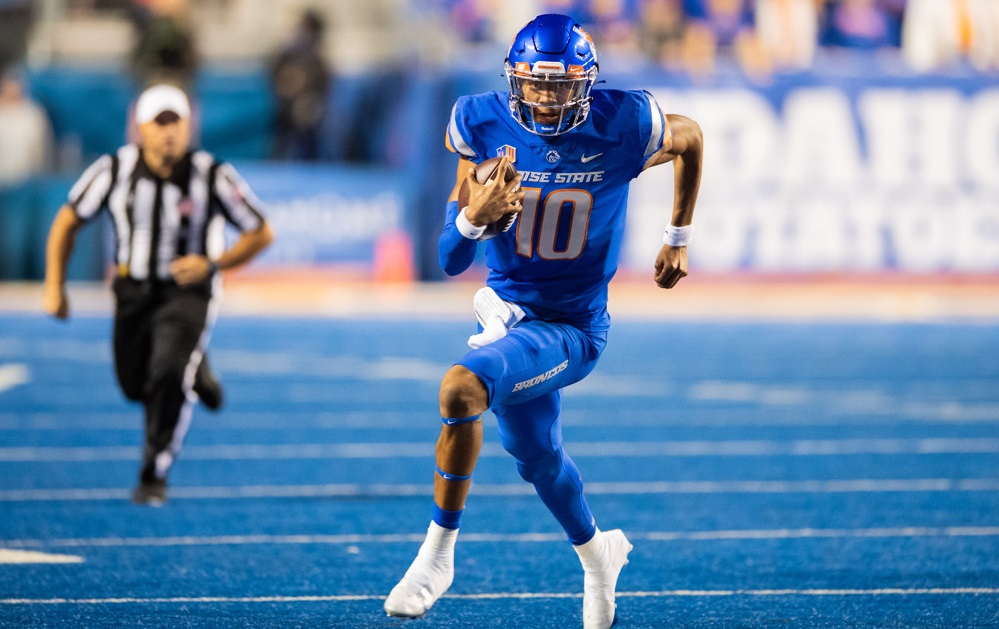
    With one quarterback keeper, the entire offense changed. In 3+ years as Boise State’s quarterback, Hank Bachmeier had kept the read option only 18 times. He posed no threat running the football, and defenses gameplanned accordingly. But with Taylen Green now under center, the Broncos now had an effective runner at quarterback.

    Following the success of this run, Koetter called the read option again, which Green pulled once more as he ran 17 yards for a touchdown. He would keep the option four more times this game for 61 additional yards, including this 39-yard scamper to put the Broncos up by two scores.

    With the defense unable to focus on the base run and ill-prepared to defend the option, the rest of the running game flourished as well. The Broncos rushed for 276 yards on 30 carries in the second half, scoring 35 unanswered points en route to defeating the Aztecs. 

    While a simple offensive adjustment would not normally result in such a momentum shift, adding the quarterback keeper put the Aztec defense on skates, unsure of who had the ball and where. two runs in the middle of the 3rd quarter illustrate the conundrum San Diego State now faced.

    On the first play, the defense swarmed to the running back, leading to an easy pull by Green for a gain of 12. The next play, the defense, afraid of the quarterback pulling the ball again, flew to Green, leaving six blockers for five defenders in the box. Green gave the ball to Ashton Jeanty, who found the open hole on the stretch and rushed for 24.

    This massive rushing performance marked only the beginning. Since running over the Aztecs, Boise State has won 7 of 8 and will now host the Mountain West Championship game. With Green at the helm, the Broncos have averaged over 12 more points per game, 2 more yards per play, and jumped 103 spots in their Total Points Per Play ranking. With one play, as well as some simple adjustments and scheming around it, Green and Koetter have turned around not only this season, but Avalos’ tenure as well.

    Before its offensive renaissance, Boise State passed slightly more than it ran, based its run game off of outside zone, and ran a variety of drop back passes designed to attack all parts of the field. With this philosophy the offense sputtered, ranking 114th in Total Points Per Play.

    But with a new quarterback, Koetter adjusted the main scheme to take advantage of Green’s abilities. Boise State operates out of the gun 24% more than before, and runs the read option more than twice as often. With the read option, the Broncos normally run duo and inside zone out of the pistol and outside zone out of their regular shotgun sets. Boise State does also run outside zone out of the pistol, but with Green carrying out the bootleg he remains a threat to run.

    With the passing game, Koetter has settled into a few concepts that Green throws well. With the running game’s increased efficacy, the play action game has drastically improved in turn. The Broncos gain .21 pass points per throw when dropping back from play action, up from -.35 before Green became the starter. Off of play action, the post and dig have done the most damage, including this strike to open the game against Nevada:

    Green also excels when rolling out, as he throws flat and out routes quite well. Koetter mainly calls Cross and Flood with the bootleg, but no matter the concept the Broncos add .54 total points when Green rolls out without even faking the run, up from -.08 in their first four weeks of the season.

    With the increase in rushing, play action, and rolling out comes a decrease in the dropback game the Broncos used a lot their first four games. Nevertheless, even Boise State’s Total Points when dropping back has gone up since the change in philosophy, with particular efficiency throwing the curl, fly, post, and out. Green reads defenses fairly well, but Koetter has also helped by simplifying some of the reads.

    Against BYU, Koetter called two separate concepts, one to each side of the field. With two high safeties, Green would have looked to the wide side of the field, where either one safety covered two receivers or the running back ran free in the flat. Instead, Green saw one, so he threw the short side 5-step slant in between the curl and flat defenders for a gain of 24.

    Green’s ability to run has fundamentally changed the Boise State offense. Working with the talent at hand, Koetter has adjusted the offense to emphasize those skills while calling constraints and counters to continually keep defenses on their heels. With this mixture of talent and scheme, Avalos and the Broncos have seen their prospects go from poor to promising as they shoot for their 10th win in the Mountain West Championship game.

  • How South Carolina put up 63 points on Tennessee

    How South Carolina put up 63 points on Tennessee

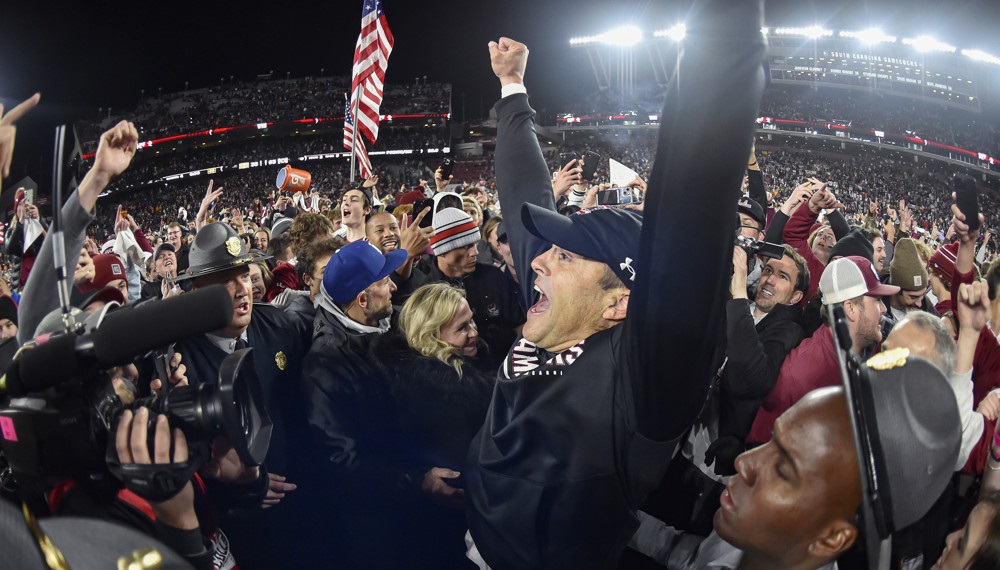
    At 6-4 and playing the No. 5 team in the country, South Carolina’s chances of an upset appeared bleak. Having only one healthy running back made them look even worse. But by creatively packaging its personnel and plays, South Carolina turned its shorthanded offense into a juggernaut, scoring 63 points in its upset of Tennessee.

    Though short running backs, head coach Shane Beamer and offensive coordinator Marcus Satterfield had plenty of tight ends at their disposal. South Carolina would play as many as four at a time, had 2 on over 50% of its snaps, and 3 on over 25%. The Gamecocks also put one at running back. Jaheim Bell made the transition beginning this season, but has carried the ball more than 12 times in each of the past three games due to the lack of depth in the backfield. With 17 carries for 82 yards, Bell gave the Gamecocks enough of a conventional run game to convert short-yardage situations and open up the rest of the offense.

    As another running option, South Carolina lined up in the Wildcat, playing Dakereon Joyner at quarterback. While the Wildcat made good use of the talent at hand, it also took advantage of what the Tennessee defense does poorly. With five defensive backs, the Volunteer defense has a defensive back to cover every receiver. But with a quarterback unlikely to throw, this leaves fewer men to defend the run.

    Within the Wildcat set, the Gamecocks used motion to open up the running lanes further. But in the passing game as well, the offense used motion hoping the defense would either overreact to the motion, or lacks the numbers sufficient to defend against a play to the motion side.

    With such motions, as well as certain formations, the offensive coordinator can reduce complex reads into simple if/then functions. For example, if the defense reacts one way, then throw the front-side route; else, throw the back-side route. Satterfield took this a step further by running a few plays out of only one look.

    If an offense runs one play out of several different formations and motions, the quarterback will need to decipher the entire defense every time he takes a snap. But with only one formation per play, he can trust the defense will present nearly the same front and shell each time, and he needs only to confirm his suspicions once the offense gets aligned. With a consistent picture of the defensive structure, the quarterback can make quicker, sounder decisions than if he had to read the entire defense every play.

    Additionally, the quarterback and offensive coordinator can prepare such packaged formations and plays specifically for their opponent. While an offense does not want to run only one play per formation for the season, game-by-game it can exploit the flaws of its weekly opponent, in this case Tennessee.

    Three times out of quads South Carolina put the running back in motion, and each time it ran the same play. The first time, quarterback Spencer Rattler saw the shift to the back side and threw the front-side bubble. The final two times, in seeing the defense, most notably the backside linebacker, shift with the motion, he took one step and fired the ball to the backside hitch, gaining a first down each time.

    On South Carolina’s first drive, on crucial third and fourth downs, the Gamecocks ran a curl flat concept with two stacked receivers and a tight end. The first time Rattler hits Traevon Kenion in the flat, the second he nails Antwane Wells Jr. on the curl, both for first down conversions to keep the drive alive. Two more times Satterfield would call this concept, both ending in Rattler scrambles, but the first two added 5 expected points to a drive that set the tone for the rest of the game4.

    Twice in long-yardage situations the Gamecocks went with the empty backfield. Both times they called the same passing concept. Two receivers ran mesh routes, two went deep, while one ran the dig targeting the middle of the field. Each time the safeties followed the deep routes, leaving the middle of the field open for the dig and the first down conversion.

    South Carolina went trips many times throughout the night, but only twice did the Gamecocks shrink their splits. When doing so, they ran a double mesh concept similar to the one they ran out of empty, only in this case looking for Jalen Brooks underneath the defense. The first time the concept did not work, forcing Rattler to scramble. But Satterfield went back to this concept late in the fourth quarter, and Brooks iced the game with his 20-yard score.

    Though their one-play formations proved plenty effective, the Gamecocks also prepared a few looks with multiple possibilities. Eight times South Carolina aligned with a tight end to one side and trips to the other, excluding its Wildcat sets. Twice it ran to the tight end, twice it threw the bubble screen, and four times it threw the switch concept to the trips. With three plays, only one of which required a read, the Gamecocks could attack all parts of the field.

    With simple plays also come simple adjustments. Notice the first time South Carolina ran out of this set in the video above, pulling two linemen yet unable to climb and block the linebackers. The next time they ran to the tight end, the Gamecocks pulled only one, successfully blocked the second level of the defense and gained 11 yards and a first down.

    South Carolina’s gameplan does not completely explain its win over Tennessee. Spencer Rattler played a fantastic game, Jaheim Bell ran the ball better than ever, and the offensive line put forth a performance unlike any other this season. But the gameplan helped unlock its potential, focusing on execution rather than sophistication. With the optimal packaging of concepts and players, Shane Beamer and Marcus Satterfield got the most out of the Gamecocks in their biggest upset victory since 2010. 

  • How UNC’s Offense Stays Ahead of the Game

    How UNC’s Offense Stays Ahead of the Game

    As football’s popularity and professionalism have grown over the past century, so too has the centralization of power by its coaches.  Descended from a time where quarterbacks called one of six plays, modern offenses contain hundreds of plays for hundreds of situations, chosen by one person hundreds of feet away. Designed and practiced over hundreds of hours, these plays detail precise instructions for all eleven players, giving such control to the coach and restriction of the players to make the Panopticon appear as free as the Garden of Eden.

    With a change in dynamics comes the establishment of orthodoxy. One coach’s success results in the creation of rules and methods detailing the one true way to win. The rest of the profession falls in line, with members looking to replicate someone else’s success instead of creating their own.

    Even as coaches continually fail by following the conventional wisdom, they will not change, lest they do things “the wrong way.” The paradigm can change, but only when a coach proves his way far superior to the current practices.

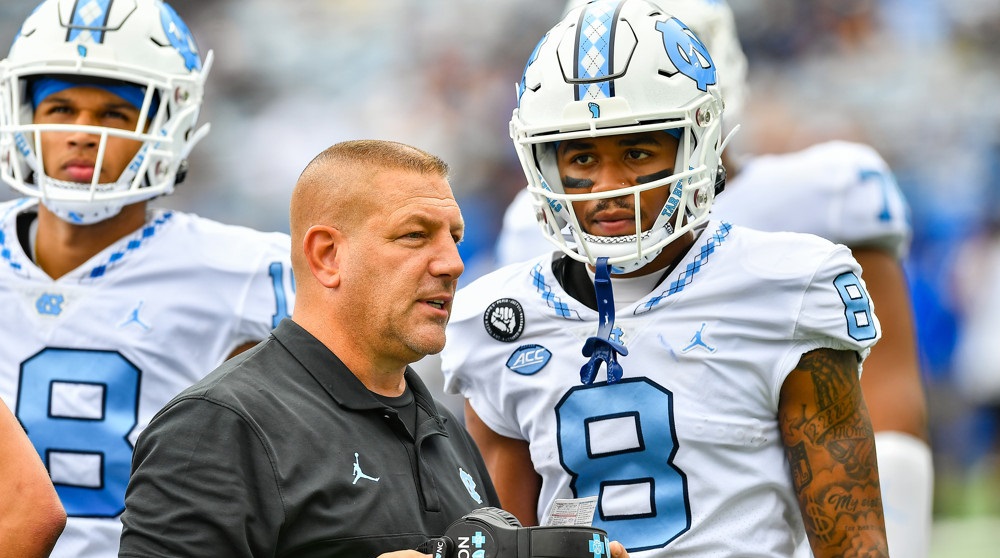
    Enter Phil Longo, a career high school and lower division college coach who did not reach the FBS until the age of 48. The offensive coordinator for the North Carolina Tar Heels, his offense appears like any other at first glance. Labeled an Air Raid coach, his offenses feature the standard fare of four verticals, mesh, snag, and so on. But Longo’s “throw to grass” philosophy differs from nearly every other offense. 

    For most modern passing plays, the receivers run specific routes executed with precise spacing and timing. The quarterback, in turn, must read the defense and interpret from its look which receiver will get open and when, operating in four dimensions and forced to decide in under four seconds.

    Longo’s offense inverts the decision making process, having the receivers read the defense and running to the open space on their path. The quarterback needs only to find the open area and trust that a receiver will fill the void. 

    With receivers, and not the play call, responsible for creating opportunities, each can diverge from the typical programming that coordinators install to get open. While vaguely reminiscent of the Run and Shoot, Longo’s offense employs slighter adjustments of stems and routes, instead of wholesale changes on the fly.

    Josh Downs, a potential first-rounder come April (read my other piece this week), reads defenses phenomenally and displays how these adjustments work in practice. On curls he finds the seams between underneath defenders. On out routes he blows past the curl zone while stopping before running into the flat defender.

    Longo’s philosophy lends itself to better practice as well. Contemporary passing drills train receivers and quarterbacks to follow instructions in a closed environment. This rote repetition and memorization of skills, often practiced against no defender, does not transfer to the game whatsoever, even within such planned offenses. It fails to replicate the chaos taking place on Saturdays, leaving those who practice such drills unprepared. 

    But an offense that emphasizes decision making in reaction to the opposition must practice in a different manner. Periods and drills must emphasize the speed and space in which the players must act in order to train the receivers to think. As a result of the offensive philosophy, practice methods invoked will more accurately represent the game.

    To summarize the optimal practice philosophy as it stands today, Rob Gray stated on the Just Fly Performance podcast, “Being skillful is not about repeating the same solution to the problem, it’s about repeating coming up with solutions to problems.”

    Between the obvious logic of finding space in the defense and practicing in a way representative of the actual game, Longo appears ahead of the curve. Thus far this season, North Carolina’s offensive production backs this assertion.

    The Tar Heel offense scores over 40 points per game and averages .25 Total Points per play, second in the FBS. The passing offense, where the philosophy presents itself the most, ranks first in both Total Points (.49)  and Expected Points (.48)  per play. In Longo’s first three years, the Tar Heels ranked 9th, 2nd and 25th in Total Points per passing play as well, making this year hardly an outlier. Even before Longo arrived in Chapel Hill, his offense at Ole Miss ranked 11th in Passing Expected Points Per Play in 2018.

    Even as Longo sustains his success, defenses have no answer. A look at coverages of UNC’s opponents from 2021 and 2022 show a wise increase in man coverage and a foolish increase in two-high coverages. More notable than the coverage calls, even the lowest PE Per Play values based on coverage (.27 vs Man Cover 2) would still rank in the top third of all passing attacks in Passing PE Per Play6.

    Man vs Zone Coverage

    Coverage % of Plays-2021 PE Per Play-2021 % of Plays-2022 PE Per Play-2022
    Man 34% .17 39% .43
    Zone 66% .29 61% .47

    Middle of Field Open vs Closed

    Coverage % of Plays-2021 PE Per Play-2021 % of Plays-2022 PE Per Play-2022
    MOFO 56% .18 47% .38
    MOFC 44% .33 53% .52

    Specific Coverages

    Coverage % of Plays-2021 PE Per Play-2021 % of Plays-2022 PE Per Play-2022
    Cover 0 4% .21 11% .60
    Cover 1 25% .19 21% .40
    Man Cover 2 6% .05 7% .27
    Cover 2 4% .34 13% .70
    Cover 3 31% .18 26% .37
    Cover 4 31% .40 22% .46

    But even attempting to adjust the coverage based on one year of data looks more foolish. 

    A data set of all ACC offenses since 2019 with the same coordinator in consecutive years produces the following correlations of defensive coverage calls and offensive production against certain coverages.

    R2 of Coverages Called and Performance Against Them

    Coverage Split Coverage Called Percentage PE Per Play
    Man vs Zone .28 .12
    MOFO vs MOFC .05 .13
    Specific Coverages .84 .07
    Specific Coverages (min. 50) .02 .19

    On a macro scale, defenses display opponent-dependent trends in whether they call man or zone, but offenses have little ability to perform better compared to the other year-to-year. Defenses show less of a tendency when it comes to open and closed coverages, and offenses appear similarly incapable of sustained performance here as they do against man and zone. The R2 for calling certain coverages looks strong at first, but filtering for little-used coverages by each defense, primarily Cover 0, 2, and Man Cover 2, shows that defenses seldom call coverages according to their opponent’s weaknesses. The replication of performance against each, however, increases slightly.

    Straying from the conventional wisdom, Longo has created an offense that takes advantage of the philosophical flaws in modern defense. With his system, his offense prepares and performs better than any other. Short of a change in general defensive strategy or preparation, Longo will continue to reside on the bleeding edge of offensive football.

  • Marshall’s Modern Take On Defense

    Marshall’s Modern Take On Defense

    Since the earliest days of football, defenses have prided themselves on stopping the run. The run served as the predominant means to move the football, and the ground game a mark of toughness amongst the men who played the sport. Without it, offenses had to resort to the pass, a risky, wimpy proposition almost certain to fail. As Straight T aficionado Woody Hayes said, “Three things can happen when you throw the ball, and two of them are bad.”

    With the run as the method du jour, coaches designed defenses prioritized to stop it. The 6-2 and 5-3 ran rampant throughout college and professional football, putting a minimum of eight players in the box to stop the Single Wing, T formation, and other ground attacks thrown their way. Defending the pass came in a distant second for all defensive coaches, as evidenced by the paltry three players in the secondary for those predominant schemes.

    But as the game aged the orthodoxy changed. With Don Coryell, Bill Walsh, Lavell Edwards, and many others as head coaches, passing proliferated. As the years went by, teams threw the ball more and more, setting records for yards and points year after year. Defenses gradually adjusted to their new reality, moving from the 6-2 and 5-3, to the 4-3 and 3-4, and currently continuing to migrate into the 4-2-5 and 3-3-5.

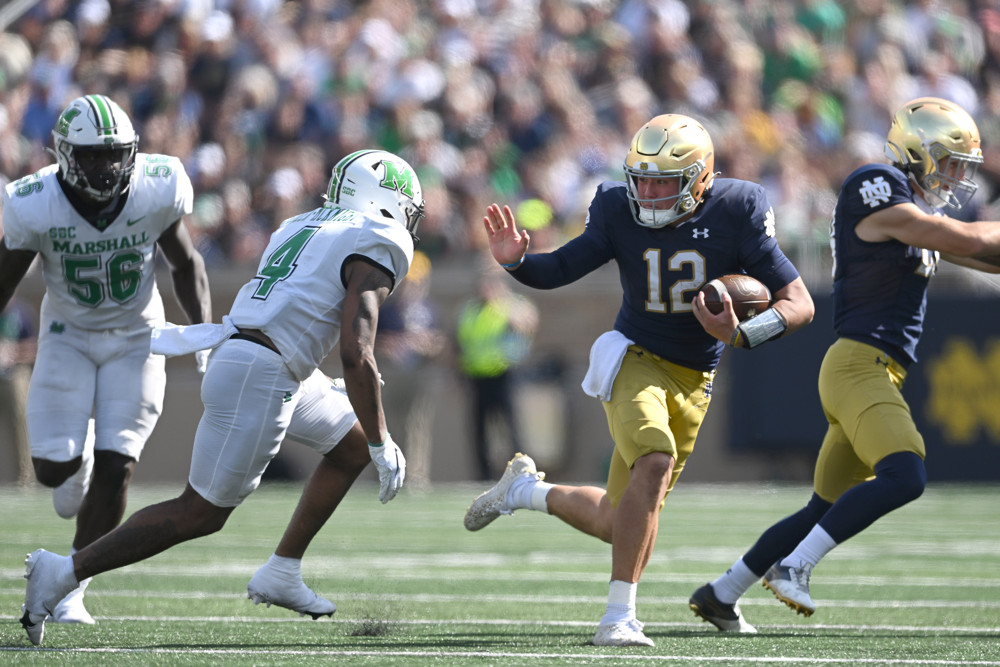
    But even as the pass reigns supreme in the modern game, coaches still fear the inability to stop the run. More defensive backs means fewer defensive linemen, and fewer defensive linemen means fewer bodies to fill the gaps, disrupt the run, and physically prove the defense’s dominance over the offense. Defenses designed to combat the pass have received, and in some instances rightfully earned, this fear as a reputation. But with a defense ranked 2nd in Total Points per play (PS Per Play) against the run and the pass, Marshall has proven that this need not be the case.

    To emphasize defending the pass, Marshall defensive coordinator Lance Guidry has built the defense to have a variety of looks from similar personnel. The Herd play their base defense with five defensive backs 70% of the time, with a linebacker taking the 5th defensive back’s place the another 28%. The scheme hardly changes even as the personnel does, Guidry uses substitutions to match the offense’s players more than to run different plays.

    Perhaps most jarring to the traditionalist, the Herd play with only two down linemen 69% of the time, the 3rd highest rate in the FBS. Contrary to the conventional wisdom, defenses playing a majority of snaps with two defensive linemen added more expected points than those with three against the run. Even more bizarrely, those with three did better than those with four.

    Nickel defenses with two down linemen should not have enough box players to defend the run. But the Herd have the 7th highest average of men in the box, at 6.73. Through their coverage scheming, Marshall can defend the pass first while still stifling the run at an elite level.

    Marshall runs Cover 1, 3, and 4 over 20% of the time and has the ninth-highest variance in terms of coverages called. Cover 1 serves as the primary man coverage and Cover 3 the primary zone, while Cover 4 uses skills from both. All three do well in their own right defending the pass, ranking in the top-11 in PS Per Play when ranked among similar coverages from other FBS teams. For Marshall, Cover 1 does the best, saving .45 Points Per Play. Cover 3 saves .25 Points Per Play and Cover 4, .42.

    But for how well each coverage does against the pass, Marshall’s alignment within them all allows the Herd to also defend the run at such a high level. Within the one-high shell, the Herd have a man and zone coverage they can execute while also matching the offense’s personnel in the box. With Cover 1, the Herd can align and cover all receivers while still having more in the box than the offense can handle:

    Playing Cover 3, Marshall’s secondary can align either over receivers or space, as well as have a wider read of the offense, while the rest of the defense will have the requisite numbers to stop then run.

    Though Cover 4 typically has two deep safeties instead of one, it does have the safeties play closer to the line of scrimmage, enabling them to play the run better than in other coverages. Additionally, with the half-field split coverages the Herd utilize within their Cover 4 looks, they can adapt to uneven formations that the offense offers, able to keep a full box while soundly matching passing patterns.

    Praising the scheme does not tell the whole story. Marshall has both fundamentally sound and talented players. The Herd’s rate of broken or missed tackles ranks 2nd in the FBS (5.6%), and when only rushing four or fewer they rank 9th in sack percentage (14.8%). Football intelligence runs high too, as shown here when Micah Abraham (#6) fools the quarterback by faking coverage in the flat, only to turn and undercut the throw to the corner for an easy interception.

    Between the array of coverages and the players at his disposal, Lance Guidry has married scheme and talent to produce great results. Even as Marshall’s offense underwhelms, the defense continues to perform, allowing only 15.6 points per game. Should Guidry’s unit play its final three games as strongly as its first nine, Marshall will likely go bowling for the sixth straight year thanks to the defense alone.

  • Exploiting the Matchups: How The Run Has Helped Resurrect the Horned Frogs

    Exploiting the Matchups: How The Run Has Helped Resurrect the Horned Frogs

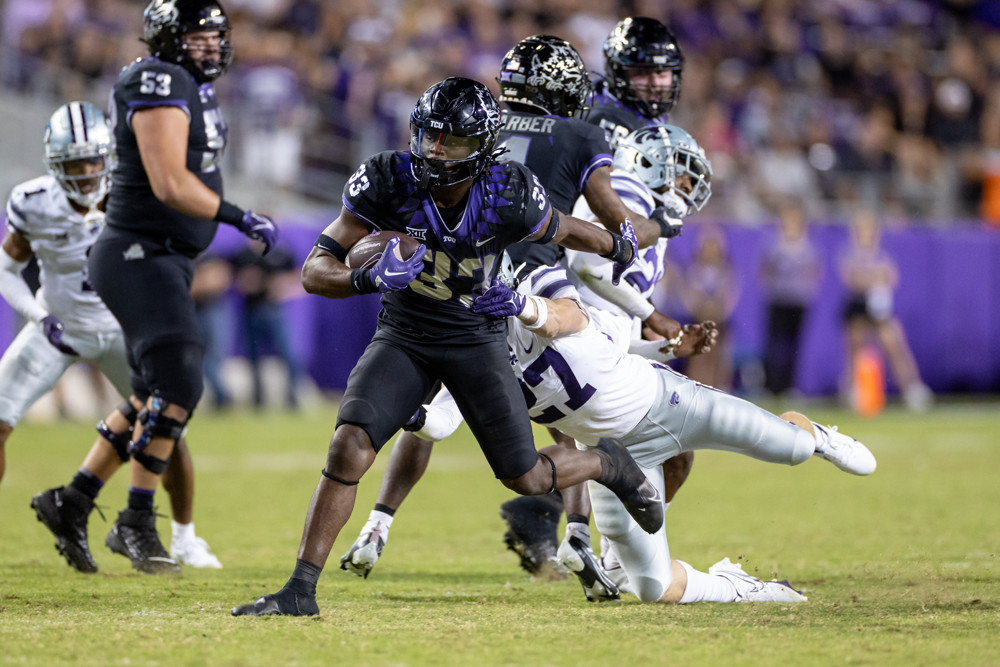
    Sitting behind Alabama in the CFP rankings despite its better record, TCU has inspired the masses to rage against this supposed injustice. But lost in this collective outcry is how TCU even got into this position in the first place.

    Coming off four consecutive unranked seasons, the Horned Frogs hired Sonny Dykes to resurrect the program. Dykes, most recently employed just a few miles away at SMU, had come off three consecutive bowl appearances paired with top-15 scoring offenses in the FBS. Only eight games into his tenure in Fort Worth, he has already exceeded expectations with an 8-0 record and the third-ranked scoring offense, at 44.3 points per game.

    Cracking the top 25 in each of the past three seasons at SMU in Passing Points Earned Per Play (PE per play), TCU’s No. 13 ranking comes as no surprise. But Dykes’ inaugural TCU offense runs the ball better than any of his SMU teams did, ranking 3rd in PE per play through 9 weeks

    But given the circumstances of the 2022 team, the success of the Horned Frogs rushing attack makes sense.

    Individually, the Horned Frogs have talent to run the ball. Running back Kendre Miller ranks 5th in Broken and Missed Tackles per carry (0.3) and T-10th in yards after contact per carry (3.5) among FBS running backs with over 100 carries. Backup Emari Demercado averages 6 yards per carry and only slightly fewer yards after contact than Miller (3.4).

    Quarterback Max Duggan can tote the rock too. Duggan averages 7.6 yards per carry and 0.3 PE per play on QB Designed runs and draws, both top-20 values among quarterbacks with 10 or more carries. Though not deliberate runs, his .63 PE per scramble ranks in the top-108, further illustrating his mobility. Playing alongside an offense consisting entirely of upperclassmen, Duggan and company also have plenty of experience, both good and bad, against Big XII defenses.

    Playing in the premier passing conference in the country, Big XII defenses have adjusted their schemes to match how their opponents move the ball. Nearly all these defenses play most snaps with at least five defensive backs, such as Baylor’s 4-2-5 and Iowa State’s 3-3-5. The conference’s defenses on average have only 6.1 players in the box and play 21.7% of their downs with five or fewer in the box, both the lowest figures among FBS conferences.

    But Dykes and offensive coordinator Garrett Riley, brother of Lincoln, exploit these nickel defenses even further. With their ability to craft formations and their capable passing attack, Dykes and Riley force defenses to play with 5 or fewer box defenders 28.4% of their snaps, well above the Big XII average.

    But TCU’s formations do not just take defenders out of the box, but also put poor run defenders back in it. With such looks the Horned Frogs can block corners and safeties with tight ends and running backs, creating mismatches in favor of the running game.

    Of the various formations Dykes and Riley use, a few stand out as particularly suited to breaking nickel defenses. Stacking 2 receivers on each side of the ball puts the linebackers and safeties in a conundrum. The linebackers fear straying too far from the box, unable to stop the inside run. The safeties fear aligning too wide, exposing the middle of the field, or too shallow, allowing the deep ball. In the Big XII, and frankly most of college football today, the defense chooses to stop the pass.

    Having to stop the pass, the defense must stretch a thin box even thinner, opening up the run between the tackles. TCU has achieved great results from this look, averaging 14.7 yds and .6 EPA per carry out of the stack, including this play where TCU blocks four with five en route to a 70-yard touchdown run.

    Split backs out of 20 personnel has given TCU 9.5 yards per rush this season. Nickel defenses struggle aligning to it, as the defensive back alignment can leave the defensive end and linebacker isolated. In one such case, TCU blocks zone with the second back leading through the backside of the line, and Kendre Miller cuts through the hole for 6.

    To get the corner and safety involved in the run game, the Horned Frogs will align with two tight ends to one side and two receivers to the other. Limited by the structure of their scheme, most defenses must align to this with either the corner, the safety, or both in the box to fill the gaps and cover the tight ends. With the size and ability mismatch, TCU gains 8.5 yards per play out of this set. In this play complete with jet motion, the secondary stands no chance at defeating the blocks and adjusting to the chaos thrown their way, as Kendre Miller dashes for a 63-yard touchdown.

    Beyond the numbers, TCU’s rushing attack opens up the passing attack, and vice versa. When TCU pulled 2 out of 21 personnel for a gain of 7, West Virginia immediately packed the box. Anticipating this response, the Horned Frogs put their leading receiver Quentin Johnston in the slot to get open against the safety. When the safety gazes too long at the play action, Johnston races past him on his way to a 55-yard touchdown catch and run.

    Against Kansas State, TCU appeared to run to the short side, only for Duggan to pull the ball and throw to Geor’Quarius Spivey for a gain of 16. Showing this same action in the fourth quarter, Kansas State’s linebackers and secondary flow less quickly towards the run, fearful of the prior pass. Duggan then hands to Miller, who trots into the end zone to stretch a lead the Horned Frogs would never relinquish.

    By putting talented players in positions to succeed, Sonny Dykes has quickly revitalized the TCU program. Given its continued success on the ground, TCU should not only win the Big XII, but challenge for a spot in the College Football Playoff.

  • How Illinois’ Simple Schematics Have Maximized Its Talent

    How Illinois’ Simple Schematics Have Maximized Its Talent

    Coaches don’t win games. Players do. Many coaches create intricate, elaborate playbooks with dozens of fronts, stunts, blitzes and coverages in the hopes of turning their defense into the next Steel Curtain. But few win by putting scheme ahead of personnel.

    Conversely, teams with better players usually win. Tactically-inept coaches have won with the talent advantage. But they never win as much as they should. Great coaches put their personnel first with a scheme that maximizes each player’s abilities. No defense does that better than Illinois.

    With five games left in the season, Illinois has already surpassed all expectations. Predicted to finish 6th in the Big Ten West, Bret Bielema and his Fighting Illini currently lead the division. For the first time in 11 years, Illinois is ranked. In under two years at the helm, Bielema has the program rolling, largely thanks to its defense.

    Illinois’ defense, coordinated by Ryan Walters, leads the FBS in both points (8.9) and yards (221.1) allowed this season. But the advanced metrics treat Walters’ defense just as well. The run and pass defense rank 15th and 3rd in Points Saved Per Play (PS Per Play) and 3rd and 1st in Expected Points Added Per Play (EPA/Play), respectively for Power 5 teams. With a simple scheme that prioritizes its players’ abilities, Illinois appears to have turned a corner.

    The Illini most commonly-used look shares a resemblance to the 46 defense, also known as the Bear front. Illinois normally plays with three down linemen and 2 outside linebackers on the line of scrimmage, with a middle linebacker and five defensive backs.

    In passing situations, Illinois will occasionally go to a 4-2 or even a Psycho look:

    The Illini stunt and blitz often, which is not uncommon for teams with limited talent. This season they send five or more pass rushers 49% of the time, 3rd most in the FBS, and pressure the quarterback 49% of the time, which ranks 6th. Even when they send four or fewer, the Illini pressure the quarterback 39% of their pass rushes, best in the FBS.

    On the back end, the Illini typically have one deep safety sitting up to 25 yards from the line of scrimmage. The rest of the defensive backs align as if in man coverage.  The alignment is usually true to the assignment, as they play Cover 1 on 67% of non-screen passes. Cover 3 gets called the second most at 14%, with the occasional Cover 2 called as well, sometimes even from the 1-high shell. 

    Even with the blitzing, Illinois does not have a complex defense. Because of its simplicity, the Illini can adjust its personnel within the structure of the defense to best counter the offense. Facing 10 personnel, the Illini align in their base.

    Given 11 or 20, the Illini sub in a linebacker into the box to the tight end side, or move Sydney Brown (30) to that spot.

    Against 12 or 21, the Illini bring in Isaac Darkangelo (38) as the extra linebacker to match the muscle.

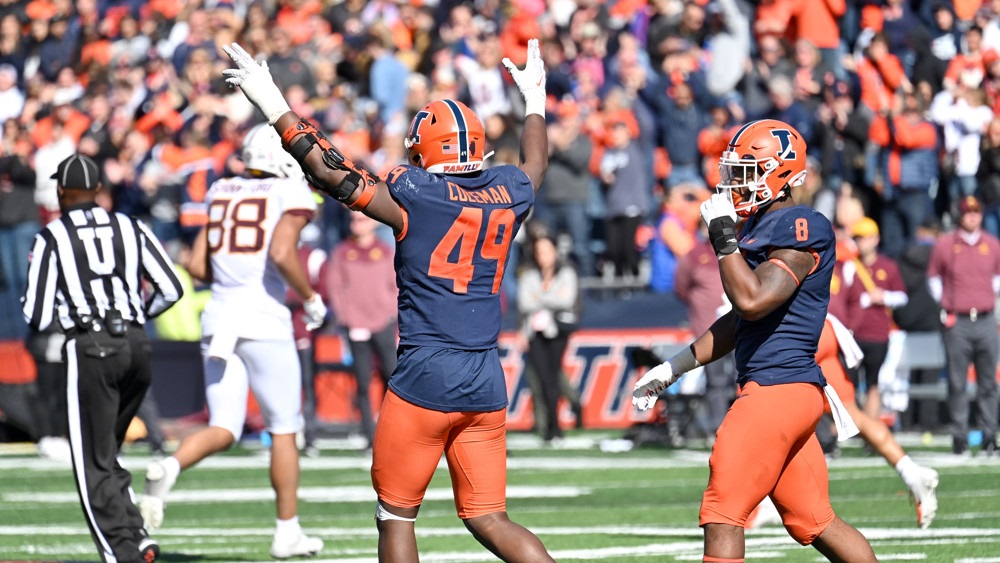
    The specialization does not stop there. For the front, the wide side of the field determines the formation strength and in turn where everyone aligns. Keith Randolph Jr. (88), their best interior lineman with .096 Points Saved Per Play against the run, lines up across the field-side tackle, while Jer’Zhan Newton (4) faces the boundary tackle. At outside linebacker, Calvin Hart Jr.(5) goes to the field, Seth Coleman (49) to the boundary. The linebackers take it even further than the defensive line. When Gabe Jacas (17) or Alec Bryant (90) come into the game, the starter still in the game plays to the field.

    In the defensive backfield, rather than using the wide side of the field to determine matchups, the Illini use individual skills, much like a basketball defense. Tahveon Nicholson (10) and Devon Witherspoon (31), both in the top 10 in Points Saved Per Play against the pass, cover the wideouts. If the two primary wideouts align on the same side opposite a nub, the corner follows the receiver:

    In some instances the corners follow specific receivers no matter where they align. Tahveon Nicholson followed Indiana’s DJ Matthews Jr. (7) in the closing minutes of their matchup, covering him in the slot despite normally playing wide.

    Jartavius Martin (21) covers the third receiver and Sydney Brown the fourth. Kendall Smith (7) plays the deep safety unless the offense goes heavy, in which case Darkangelo subs him out and Martin plays deep. Despite the reputation of the specialized skills of the free safety, the Illini perhaps treat this position the most interchangeably.

    In addition to beneficial personnel matchups, a few other factors have contributed to Illinois’ strong defensive performance. Ranking 2nd in time of possession this season, the Illini offense has kept the defense off the field, giving the opposition fewer chances to score against a well-rested defense. Additionally, the Illini have benefitted from soft scheduling.

    Illinois played five of its first seven games at home, and the rest of the division has disappointed this season. Wisconsin came out so poorly it fired its coach (with some credit due to Illinois), and Iowa may have the worst offense in the FBS. In spite of the opportunity, none of Illinois’ division foes has stepped up to take over for either.

    But given that the Illini allowed nearly 35 points per game in 2020 en route to a 2-win season, Bielema and Walters cannot get enough credit for the turnaround. With only three seniors in the defensive starting lineup, the defense could even improve in the coming years. Illinois’ simple scheme has its players confident in both their abilities and assignments. Combined with the best possible matchups at every position, the defense has found a way to lead the team into the driver’s seat of the Big Ten West.

  • How Georgia Southern’s Offensive Gameplan Delivered James Madison Its 1st Loss

    How Georgia Southern’s Offensive Gameplan Delivered James Madison Its 1st Loss

    Heading into Statesboro last Saturday, James Madison won its first five games as members of the FBS, allowing only 15 points per game this season. Using Expected Points Added per Attempt (EPA/A) the defense ranked 1st in stopping the run and 16th in stopping the pass. Facing a rebuilding Georgia Southern coming off a loss to rival Georgia State, the Dukes had reason to feel confident about beating the Eagles.

    But the defense allowed 45 points in Madison’s first loss of the season. The Dukes underperformed, but that sells Georgia Southern short. The Eagles clearly had a plan to utilize the offense’s strengths to exploit the defense’s weaknesses.

    James Madison bases out of a 4-2-5, playing with four down linemen and five defensive backs over 83% of the time going into this game. The overhang safeties excel at forcing the run inside, with the Dukes ranked 1st in EPA/A on outside runs (-.49). On the inside, Jalen Green and James Carpenter rank in the top 10 of Total Points Per Play among all defensive tackles with 5 or more tackles.

    In the secondary, Madison flips its personnel, positioning its cornerbacks and safeties to the field and boundary, rather than left and right or strong and weak. Against the pass, the Dukes play single-high coverage on over 74% of non-screen passes. They perform better in Cover 3 than Cover 1, scoring -.46 EPA/A in Cover 3 versus -.09 in Cover 1.

    As for Georgia Southern, it passes nearly 60% of the time, ranking 70th in the FBS at 0.13 Total Points Per Play. The run does worse, clocking in at 0.04 Total Points Per Play. Georgia Southern prefers to use a tight end, doing so on almost 65% of snaps, and unsurprisingly runs better with a tight end and passes better without one (0.06 vs 0.01 Total Points Per Play on Runs, 0.07 vs 0.16 Total Points Per Play on Passes).

    For this matchup, Georgia Southern adjusted both its packages and run/pass mix. 68% of its plays came from 10 personnel, and in total the Eagles passed 80% of the time. With an extra receiver on the field, the Eagles could focus on airing the ball out, avoiding the mismatch between their mediocre running attack and Madison’s elite run defense.

    While the Eagles did not refuse to run the ball, they mostly did so to keep the Dukes honest. To get the secondary out of position, Georgia Southern came out several times in trips to the field. In response, Madison would rotate its defensive backs to the field, to which the Eagles would run into the boundary. Twice the offense ran a sweep around a boundary tight end away from trips.

    Their other runs fared no better, as the Eagles ended the day with only 12 yards on 16 attempts.

    The run failed the offense, but the jet sweep did not, netting 44 yards for the Eagles. Not only did the quick pass confound the defense, but the constraint from the jet motion did as well. Georgia Southern ran its first jet sweep with 7:03 left in the third quarter, breaking outside for 33 yards. Under five minutes later, the Eagles used the same motion, to which the Dukes overpursued. Instead of pitching to the man in motion, the Eagles fake the jet and throw to Jalen White in the opposite flat, resulting in a 37-yard touchdown. In the fourth quarter, Georgia Southern goes back to the same motion against a wary defense and gains 11 yards off the sweep.

    The motioning did not stop here. Twice in the third quarter the Eagles gashed the Dukes deep on motion plays. The first forced James Madison to play one high safety against the crossing concept. The second expanded the secondary previously aligned to a tight set, exposing the seams.

    Three times Georgia Southern motioned a man into trips to the field, looking to hit him for a quick pass outside. The Dukes once brought the safety down to the motion man, giving away their coverage, and twice played it straight, leaving too few defenders to cover the flat. Despite breaking the coverage shell, the first solution forced an incompletion, while the second forfeited six yards on each attempt.

    Despite the motions and formations presented to the Madison defense, it hardly adjusted its coverage calls. The Dukes resorted more to their strengths than normal, playing 25% more Cover 3 this game than in its previous five games. Even when Georgia Southern went away from trips, the Dukes still went Cover 3 on 11 out of 19 pass snaps.

    Even facing Madison’s best coverage, the Eagles found ways to move the ball. Regardless of whether Madison rolled their Cover 3 toward or away from trips, Georgia Southern could break Madison’s coverage. When rolling to, Kyle Vantrease hit Amare Jones on his bender in front of the high safety for a 29-yard gain. When rolling away, Vantrease hit Jeremy Singleton on an out route for 19 yards. The Dukes’ reliance on Cover 3 did not pay off, as the defense allowed 5.6 EPA in this coverage.

    But Georgia Southern’s greatest advantage came from putting its receivers in positions to succeed against Madison’s weaker defenders. The Eagles targeted the boundary cornerback 11 times, completing 8 of those passes for 190 yards and two touchdowns. From motioning away, to running man-beater concepts, to isolating him by aligning trips to the field, Georgia Southern attained the mismatches it desired.

    Prior to Week 7, James Madison looked to have a top-10 defense. Georgia Southern, on the other hand, appeared to have a middling offense. But by exploiting the Dukes’ defensive flaws, both with scheme and personnel, the Eagles piled on the points and pulled off the upset.

  • How 1-Personnel Defenses Defend Diverse Offenses

    How 1-Personnel Defenses Defend Diverse Offenses

    Diverse offenses cause mismatches for defenses. With a variety of talents in different personnel packages, the offense has multiple ways to move the ball. Teams like USC, Kansas, and TCU, by adjusting the players on the field by the situations presented, find themselves among the top 10 FBS offenses in EPA/A this season.

    Defenses such as those at Illinois, UAB, and Boise State attempt to match the offense’s abilities by matching its substitutions. They meet more receivers with more defensive backs and more tight ends and running backs with more defensive linemen and linebackers. Other defenses leave the same 11 players on the field, trusting those already playing to adjust to whatever the offense throws their way.

    Intuitively, the second solution makes no sense. Defenses failing to counter the offense’s personnel gives the offense the mismatches it so desperately desires. But comparing the 20 teams that use the most and least diverse packages, the results look roughly the same. Using the standard deviation in percentage of each package used to determine the most and least diverse defenses, the table below shows the average rank of each group within the FBS:

    Metric/Diversity in Personnel Most Diverse Least Diverse
    PS/Play 63.5 58.2
    PAA/Play 63.3 55.7
    EPA/A 63.0 57.3

    Among the least diverse defenses lives Troy, Baylor, and New Mexico. All use one personnel group over 94% of the time, and offenses with multiple packages, such as Western Kentucky, BYU, and UTEP, have failed to take advantage of the mismatches. A look at each game reveals not only how each one succeeds in stopping such offenses, but how differently they do so.

    Troy vs Western Kentucky

    With consistent personnel comes consistent alignment for the Troy defense. The two cornerbacks stay on their respective sides, two safeties play high while the third aligns to the wide side of the field close to the line of scrimmage. The linebackers play in the box, while the weak-side defensive end stands to the boundary. The remaining linemen play with their hands in the dirt, usually occupying the center and tackles. 

    To get Troy out of its base defense, Western Kentucky used 10 and 00 personnel 65% of the game (55 snaps out of 85), up from its usual 40%. To cover the extra receivers, Troy either moved a linebacker or the standup end out wide to cover a receiver. This left them shorthanded against the run:

    But by keeping the base in place, Troy could still disguise its myriad of blitzes and coverages from one look. Though the Trojans have rushed five or more defenders only 33 times this season, ranked 103rd in the FBS, they regularly change which four rush the passer. Troy typically rushes the four linemen, but at times will substitute the standup end for the strong safety or even the boundary cornerback.

    Troy aligns with two high safeties, but from this look Troy has played Cover 1, 2, 3, and 4 at least 25 times each this season. On this snap, what looks like Cover 2 shifts into Cover 3 Cloud, and the weak-side linebacker, catching the quarterback by surprise, jumps the pass for an interception.

    Varying the defense played from the base displayed, Troy held Western Kentucky to its lowest point total and yards per play average this season.

    Baylor vs BYU

    In Baylor’s 3-3-5, one linebacker functions as a standup defensive end, while the defensive line almost always plays with interior linemen in 3 and 2i techniques. The five defensive backs play in a two-high shell with the third safety shifted down near the line of scrimmage on the strong side of the formation.

    Within this one look, Baylor plays their base defense as often as possible. Not including screens, the Bears run Man and Zone Cover 2 48% of the time, 15% more than the 2nd highest team (Memphis). They have rushed five or more players only 15 times this season, almost always going with the front four.

    Baylor can play this way due to its defenders’ versatility. Among other skills, the secondary can close down on runners in space:

    While the linebackers can cover receivers man-to-man:

    With defenders able to carry out an assortment of assignments, the Bears can focus less on having many schemes and instead on perfecting one. 

    The hybrid nature of Baylor’s defense does not completely immunize it from all personnel and formation adjustments. Empty and unbalanced looks put the Bears in a bind throughout the game. BYU’s empty sets forced the Bears to apex a linebacker or end, resulting in 2.7 additional expected points for the Cougars.

    Off a trick play from an unbalanced set the Cougars scored their final touchdown in regulation.

    Even with BYU’s counters, the Bears’ reliance on execution rather than scheme kept them in this game, allowing only 20 points in regulation.

    New Mexico vs UTEP

    The advent of the spread offense has rapidly increased the popularity of the 3-3-5. But Rocky Long has run his own version since his first tenure at New Mexico, beginning in 1998. His style relies on chaos more than order, and he creates it with his fifth defensive back known as the “Lobo.”

    The Lobo has a variety of potential alignments and assignments, from starting close to the line of scrimmage as a defensive end, to playing 7 yards away as a linebacker, to lining up as a deep middle safety. 

    He can rush the passer, act as a seventh box defender against the run, or cover a deep zone, among other roles. With such a flexible player, New Mexico can not only adjust to other offenses, but force other offenses to adjust to it.

    UTEP runs the most diverse set of personnel packages in the FBS. The Miners use 10, 11, 12, 20, and 21 personnel at least 10% of their snaps. But only plays with 20 personnel increased UTEP’s expected points this game, doing so by a measly .96. The 11 personnel plays fared the worst, losing 23.5 expected points on 32 plays with three turnovers.

    Despite failing to counter UTEP’s offensive personnel, New Mexico presented a defense the Miners could not match en route to a 27-10 victory.

  • The Air Raid Fights On

    The Air Raid Fights On

    The Air Raid has left its fingerprints on modern college football like no other offense. From its passing concepts such as mesh to its jettison of the huddle, the Air Raid has found its way into nearly every offensive coordinator’s playbook in one way or another. 

    For as fast as its concepts spread, its coaching tree grew faster. The Air Raid began in the 1990s at Iowa Wesleyan with Hal Mumme and Mike Leach as a way for the talentless to compete. Thirty years later, blue bloods have fully embraced the system, notably USC under its last two head coaches.

    Under Clay Helton, Mike Leach’s former quarterback Graham Harrell assumed offensive coordinator duties in 2019. Upon changing coaches in 2022 and with Harrell off to West Virginia, another former Leach player in Lincoln Riley took charge of the offense. Despite running the same system by name, Riley’s Trojan offense could hardly look more different than Harrell’s.

    Some of that comes with the change in personnel between regimes. Riley has made the most of the transfer portal, restocking the skill positions with elite talent across the board. He also has the benefit of four returning starters on the offensive line. Such talent explains much of the two-touchdown difference in points per game between the two offenses and allows Riley to implement a greater playbook, both in size and complexity.

    Even with the personnel changes, each coach approaches the game differently. Neither runs the true Air Raid, despite their backgrounds. In fact, no team runs the true Air Raid, minus Mike Leach’s Mississippi State Bulldogs. 

    Like any innovation, a few adopt the original while the majority wait for the product to either become mainstream or for its worthwhile functions to be incorporated into everyday products. Nobody carries a GPS, an mp3 player, and a palm pilot; the smartphone has all of those features in one device.

    Coaches behave the same way. In the Air Raid’s youth, earlier adopters such as Bob Stoops, who hired Mike Leach upon taking the Oklahoma job, reap the benefits while the rest of the industry carefully picks and chooses the features it likes.

    Now that the Air Raid has reached 30 years old, the inverse happens. Riley and Harrell began with the original Air Raid, an offense with few plays and fewer formations designed to attack all parts of the field. Graham Harrell focuses on the former, Lincoln Riley the latter.

    Graham Harrell departs most from his roots in his preferred personnel. The traditional Air Raid never uses a tight end. Harrell used at least one on 98% of USC’s snaps in 2021. With different personnel come different concepts, but Harrell keeps them to a minimum.

    Harrell ran zone on 79% of USC’s 2021 runs, the 15th highest percentage in the FBS. To stress the defense’s perimeter, USC called screens 72 times in 2021, 6th most in FBS. Screens also provided a convenient way to get Drake London the ball. He averaged the 5th-most PAA per route on wide receiver screens (0.011) among those targeted on screens at least 20 times. USC’s downfield game consisted mostly of flies, seams, and fades, as it ran those routes 433 times in 2021, 8th-most in the FBS. The Trojans had the most success however when attacking the middle of the field, averaging 0.037 PAA per play on posts and digs.

    Harrell keeps it simple, whereas Riley brings variety. He changes between 10, 11, and 20 personnel regularly, and runs zone only 39% of the time. Instead, he bases his running game off of gap schemes, such as the double pull he opened with against Oregon State.

    Like his predecessor, Riley screens early and often with 39 thrown already this season. But with the increased emphasis on the run and screen comes a reduction in the vertical game. Through five games the Trojans have targeted routes longer than 20 yards 21 times, ranked in the top half of the FBS but fewer than the 36 thrown in the first five games of 2021.

    While both Harrell and Riley differ considerably in their scheme, the mobility of each coach’s quarterbacks displays their differences in execution. Riley, from Baker Mayfield to Caleb Williams, has always had a mobile quarterback at his disposal. This opens up concepts in the run game, takes pressure off the offensive line, and turns broken plays into big gains with regularity. Under Graham Harrell, only Mason Fine has exceeded 100 yards rushing in a season as his quarterback, doing so in 2016. 

    Without a running quarterback, Harrell could only pair his runs with screens. Riley can not only match his base runs with the screen and quarterback keep, but can also go play action, threatening all parts of the field from one look.

    The contrast between Harrell and Riley shows the most in their up-tempo approaches. After a successful play, both coaches like to hurry the team to the line and run another play against the disoriented defense. Harrell will trot out a simple formation and play, trusting his players to execute their assignments.

    Riley opens up the playbook in such situations, having the personnel on the field fill almost any position. Receivers will play tight and running backs wide, as they do on the second and third plays of this series of downs, so long as he can call the perfect play. 

    Harrell uses a simple scheme to get his players into positions to succeed. Riley attacks all parts of the field by creating positionless chaos only his players can exploit. While both have similar backgrounds and share concepts to get to their respective ends, the results look as though each came from opposite poles of the coaching world.