Category: NFL

  • Which Teams Had The Best Draft Classes: 2019-2022?

    Which Teams Had The Best Draft Classes: 2019-2022?

    Photo: Scott Winters/Icon Sportswire

    Overall Total Points Score Rankings from 2019-2022

    In 2019, we began the SIS Football Rookie Handbook. Every year since, we have written scouting reports and graded players for the NFL Draft. While it’s not a bad thing to grade draft classes immediately after the draft each year, it’s much more productive and accurate to wait until they’ve played for three years in the NFL. With that, we’ve now been able to grade each of the 2019, 2020, 2021, and 2022 draft classes’ first three seasons.

    To catch the first part of the article which lays out how the 2022 draft class did specifically, click here.

    Overall TP Score Ranks

    Now that we’re four years into this, we can begin to take a broader look across seasons. 

    – With that, the Chiefs have the highest average TP Score across the last four seasons with 64.41, over ten points higher than the Jaguars (54.08) in 2nd. The Lions, with 51.08, round out the top 3. Check out the entire list in the Appendix.

    – Conversely, the Rams are the only team with an average ranking in the bottom 6, and they also rank dead last with an average TP Score of just 23.47, though the Vikings are on their heels thanks to their  No. 31 ranking this year. Like the past three years, the Rams haven’t made a 1st-round pick in any of these seasons, so it’s likely they aren’t going to get a high-end impact player, but it’s telling that they’ve struggled to find much value in the later rounds of drafts.

    Now the real question is how do our initial rankings compare to those numbers? 

    – The Chiefs have had the highest average TP Score in four years, but we’ve given them the 3rd-worst cumulative ranking post-draft. Omitting L’Jarius Snead in 2020 played into that, and that’s clearly the biggest miss on our part. However, it’s worth noting that they’ve been able to take players who fit their scheme perfectly and make them work when those same players may not fit elsewhere.

    – Additionally, our average top 10 post-draft teams who also have an average TP Score rank in the top 10 include the Jaguars, Lions, and Bengals. Conversely, matches in the bottom 10 include Steelers, Vikings, and Rams. Teams we match in the middle 12 include the Cowboys, Bills, Dolphins, Packers, Commanders, and Titans.

    – While we’ve been way too low on the Chiefs post-draft each year, conversely, we’ve been way too high on the Panthers. We’ve averaged giving them the 3rd-best (tied) class across the four seasons immediately after the draft, but they have just the 29th-best TP Score. Aside from ranking 5th in 2020, they’ve ranked exactly 29th the other three years. Panthers fans hope Bryce Young and team can improve their ranking next season.

    How do we compare to the consensus?

    Rene Bugner, @RNBWCV on X, puts out a consensus report card based on many of the post-draft grades each year to find a consensus ranking of the teams. His post for the 2022 draft class grades can be found here. Using this, we can determine how our post-draft rankings compared to the consensus three years later based on TP Score.

    If we compare ourselves against the consensus for the 2022 draft class, we were closer on 15 of the teams, the consensus was closer on 11, and both either had the same consensus ranking or tied in terms of differential for the remaining six teams.

    Our post-draft ranking agreed with the consensus for the Jets (No. 1), Browns (No. 21), 49ers (No. 28), and Rams (No. 31).

    Some of our biggest misses, as referenced in the other article, were the Panthers, Colts, and Cowboys.

    The consensus felt the Panthers would be middle of the pack (No. 15), which was much closer to their No. 29 ranking than our No. 5.

    The Colts ranked No. 12 by the consensus and finished No. 13, much closer than us at No. 30.

    Finally, while the Cowboys had the 3rd-best TP Score, we ranked them No. 20 and consensus felt they were No. 24.

    The biggest wins for us compared to the consensus were the Saints, Jaguars, and Titans.

    The consensus felt New Orleans had the 25th-best class, but we hit them exactly at No. 10.

    The Jaguars finished No. 12 in TP Score, and we had them No. 9 against the consensus at No. 22.

    Finally, the Titans finished ranked 24th in TP Score, and we had them ranked No. 16 while the consensus felt they had the No. 7 class.

    While our grades and rankings are far from perfect, they have stacked up well against the consensus. Considering ties count as a half-point, only one year have we not equaled or bettered the consensus, and that was our first season in 2019 (48%). We were closer on 59% of teams in 2020, we tied the consensus in 2021 at 50%, and we were at 56% in 2022.

    If you want to see each individual year’s article, you can find 2019 here, 2020 here, 2021 here, and 2022 here.

    Our scouting and grading process is much different than most non-NFL team evaluators out there, and one could argue that TP Score isn’t a sufficient means for grading the classes, but we’ll stack our numbers up against any of them.

    Appendix

    Average TP Score and ranking across all four seasons (the 2019-2022 draft classes each after their first three seasons in 2021-2024)

    Team Avg TP Rank Avg TP Score
    Chiefs 1 64.41
    Jaguars 2 54.08
    Lions 3 51.08
    Saints 4 47.90
    49ers 5 47.10
    Chargers 6 46.86
    Broncos 7 46.70
    Bengals 8 45.45
    Jets 9 45.21
    Buccaneers 10 44.70
    Cowboys 11 44.32
    Bears 12 43.76
    Bills 13 43.47
    Dolphins 14 41.13
    Packers 15 40.87
    Seahawks 16 40.81
    Commanders 17 39.50
    Falcons 18 38.59
    Titans 19 38.52
    Ravens 20 36.95
    Colts 21 36.49
    Cardinals 22 36.37
    Steelers 23 36.14
    Eagles 24 36.11
    Giants 25 35.85
    Texans 26 35.84
    Browns 27 35.77
    Raiders 28 35.46
    Panthers 29 28.15
    Patriots 30 27.90
    Vikings 31 23.55
    Rams 32 23.47


  • Reviewing Our Grades for the 2022 NFL Draft Class

    Reviewing Our Grades for the 2022 NFL Draft Class

    Photo: Brandon Sloter/Icon Sportswire

    Introduction

    While many crave all the NFL Draft Team Grades that publications put out the day after the draft, including us on both accounts, there are a lot of unknowns at that point. Of course, we all have our own NFL Draft prospect rankings heading into that weekend, but those players have yet to play a snap in the NFL. So, how can we really grade a team’s draft class if those players haven’t yet stepped onto an NFL field?

    It usually takes at least three years to see how well a draft class turned out. While said publications, including us, don’t want to wait three years before putting out their grades on a draft class, we do both. This is the time that teams must decide on 5th-year options for their 1st-round picks. Additionally, this gives these players a rookie season and two full years after that to get settled in and playing time under their belt.

    Three years ago, Sports Info Solutions published our very first NFL Draft website. After three years in book form, we moved our reports, articles, stats, leaderboards, and team pages onto the web for the first time. After the 2022 NFL Draft, we, just as many others, posted our NFL Draft Team Grades, which can be seen here. It’s worth noting we don’t give out letter grades like most. We rank the teams from 1 to 32 in terms of how much talent they got as an entire class based on our pre-draft player grades.

    Just as I did last year, in the article you can see here, I’ve developed a system to evaluate the draft classes using Total Points relative to position as the foundation. Three seasons have now gone by since the 2022 NFL Draft. So, let’s use that to truly see how each team did with getting value from its selections and draft class as a whole.

    Our TLDR Top Things to Know

    1. We ranked the Jets No. 1 in our 2022 post-draft ranking. Three years later, the Seahawks rank No. 1 according to our stat for assessing it, Total Points Score (TP Score), followed by the Jets, Cowboys, Lions, and Packers.
    2. The Dolphins ranked last both in our original rankings in 2022 and in TP Score three years later.
    3. The Seahawks, Packers, and Chiefs accrued the most raw Total Points from their draft classes.
    4. Brock Purdy, Kerby Joseph, and Kyle Hamilton were top 3 in Total Points across the past three seasons.

    How much value did teams get?

    Let’s take a look at how we ranked teams after the 2022 NFL Draft and then who got the most and least value. See the Appendix at the bottom to see how all 32 teams ranked in our 2022 rankings and in TP Score.

    Here are the teams we ranked at the top immediately following the draft back in 2022. To see our scouting grading scale, check out our NFL Draft site.

    Top 5 Teams in 2022 Post-Draft Rankings
    Team Book Rank Grade
    Jets 1 6.53
    Eagles 2 6.46
    Lions 3 6.45
    Ravens 4 6.43
    Panthers 5 6.40

    TP Score will be defined below, but here are the top 5 teams based on how much value they received from their draft class.

    Top 5 Teams in TP Score
    Team TP Rank TP Score
    Seahawks 1 76.67
    Jets 2 75.43
    Cowboys 3 66.96
    Lions 4 66.00
    Packers 5 64.54

    In our post-draft rankings in 2022, we tabbed the Jets as the No. 1 draft class, and they just got edged out by the Seahawks for No. 1 three years later. The Jets drafted the two Rookies of the Year in Garrett Wilson and Sauce Gardner, not to mention adding Jermaine Johnson, all in the 1st round.

    While we felt the Seahawks drafted a strong class post-draft, we ranked them 7th, we were a little low on Riq Woolen (6.4) and Abraham Lucas (6.3) compared to how they performed. Not only did the Seahawks accumulate the best TP Score, they also had the most raw Total Points among the class with 414.

    Seattle Seahawks

    Player College Grade Total Points 2022-2024
    OT Charles Cross Mississippi State 6.9 67
    ED Boye Mafe Minnesota 6.6 73
    RB Kenneth Walker III Michigan State 6.6 79
    OT Abraham Lucas Washington State 6.3 45
    CB Coby Bryant Cincinnati 6.7 45
    CB Riq Woolen UTSA 6.4 97
    ED Tyreke Smith Ohio State 5.9 0
    WR Bo Melton Rutgers 5.9 6
    WR Dareke Young Lenoir-Rhyne 5.8 2

    We also had the Lions in our top 5, and they ended up there again three years later. Despite a midseason injury in 2024, Aidan Hutchinson has been dominant and has only continued to improve each year he’s been in the league. Additionally, drafting Kerby Joseph in the 3rd round was arguably one of the biggest steals of the draft. His 136 Total Points over the past three seasons was 2nd-most overall and most among all non-QBs. It’s easy to see how the Lions are up here after drafting two players who were top 5 in Total Points.

    As for the Cowboys, we were high on Tyler Smith (SIS No. 5 OT), Damone Clark (SIS No. 2 MLB), and Jalen Tolbert (SIS No. 16 WR), as all received 6.4 or above grades from us, but Sam Williams (33 TP), Jake Ferguson (51 TP), DaRon Bland (91 TP), and John Ridgeway (20 TP) were also above-average players and big-time contributors who we had graded as backups.

    The Packers rounded out the top 5 in TP Score with the 2nd-most raw Total Points (411). We ranked them 12th immediately following the 2022 Draft, having given 6 of their 11 picks a 6.3 grade or better. However, we were a little lower on Romeo Doubs (SIS No. 32 WR) and Zach Tom (SIS No. 16 OT), who combined for 97 Total Points.

    Conversely, here are the bottom 5 teams from our 2022 rankings.

    Bottom 5 Teams in 2022 Post-Draft Rankings
    Team Book Rank Grade
    49ers 28 5.98
    Buccaneers 29 5.94
    Colts 30 5.90
    Rams 31 5.86
    Dolphins 32 5.80

    Based on TP Score, here are the worst teams in terms of getting value from their 2021 draft picks.

    Bottom 5 Teams in TP Score
    Team TP Rank TP Score
    Rams 28 23.13
    Panthers 29 19.44
    Raiders 30 14.97
    Vikings 31 13.97
    Dolphins 32 1.50

    The big bullseye here was the Dolphins. We were very low on their draft class initially, and they haven’t done anything to disprove that. Even though they had only four picks in the draft, and none until late in Round 3, only one of them was one we had graded above a 5.8. We graded Channing Tindall a 6.6, but he has only accumulated 1 Total Point in the past three seasons, as he’s hardly played any defense and mainly been a special teams player. Erik Ezukanma was our top 5.8 receiver (SIS No. 36 WR) and has only 2 Total Points. Their other two picks we didn’t have on the site and have combined for 3 Total Points. So, the grand total for Miami’s draft class was 6 Total Points.

    While we ranked the Rams (31st) low initially, we were a little off on the Raiders (17th) and Vikings (19th) and completely missed on the Panthers (5th).

    The Panthers have gotten 100 Total Points from their six draft picks. Ikem Ekwonu (SIS No. 3 OT) and Cade Mays (SIS No. 6 OG) have been about what we expected, but they haven’t gotten much of anything from the rest of their class, especially Amare Barno (SIS No. 14 ED), who only has 8 Total Points despite our 6.5 starting grade.

    Determining Total Points Score

    In case you missed previous articles, let’s explain the process of creating each team’s TP Score. When looking back to see how good or bad a specific draft class was, there are two main points to detect:

    1. How productive were the draft picks on the field?
    2. How much talent did the team draft relative to the amount of picks they made? 

    As in: Did they hit on one player or did they hit on multiple players?

    To determine the value of the draft classes, I used Total Points, our flagship player value stat, from across the last three seasons. However, for those of you who are familiar with Total Points, it gives a lot of extra weight to quarterbacks. With that said, Brock Purdy alone would have had the 17th-best draft class with his 195 Total Points if we just used raw Total Points.

    While there is a reason we weigh quarterbacks so much more compared to other positions (they are pretty important), using that raw number in this sense isn’t going to make for a perfect match. While getting your franchise quarterback is a huge win, especially with the last pick of the draft, it doesn’t automatically give you a top class. This year, San Francisco ended up 18th in TP Score, and I think most would agree they had an average-at-best class aside from Purdy.

    Answering question 2 takes into account how well a team drafted throughout the entirety of the draft class. I found the average Total Points per player from the 2022 class at each position, including UDFAs who have taken at least one offensive or defensive snap, since they were also available to be selected.

    The positional averages are shown in the table below.

    Pos TP per Player
    QB 36.4
    RB 12.3
    WR 12.1
    TE 15.3
    OL 27.1
    DE 22.1
    DT 7.1
    LB 17.6
    CB 35.9
    S 29.3

    The TP Score, as referenced earlier, is what’s used to rank the teams. It is calculated as follows:

    1. Add up the Total Points from the entire team’s draft class
    2. Divide that number by the number of selections the team had
    3. Multiply that number by the percentage of draft picks that were above the average Total Points for their given position
    4. Add that to the original Total Points per draft pick

    In these 4 steps, we are essentially answering how productive the draft class was and how many picks were “hits”. Let’s run through an example using our No. 2 team, the New York Jets.

    Here is their draft class:

    Pos Player Total Points
    CB Sauce Gardner 112
    WR Garrett Wilson 53
    DE Jermaine Johnson 45
    RB Breece Hall 41
    TE Jeremy Ruckert 10
    OL Max Mitchell 17
    DE Micheal Clemons 30


    Add up the Total Points from the entire team’s draft class

    308

    Divide that number by the number of selections the team had

    308 Total Points divided by 7 selections equals 44.00

    Multiply that number by the percentage of draft picks that were above the average Total Points for their given position

    Gardner, Wilson, Johnson, Hall, and Clemons all accumulated a Total Points number that was above average compared to their position groups

    44.00 times 71.4% (5 out of 7) equals 31.43

    Add that to the original Total Points per draft pick

    44.00 plus 31.43 equals 75.43, which is their TP Score

    So, to summarize, we took the team’s Total Points gained from these players, dispersed it throughout the entire class and then gave a bump based on how many above-average players they drafted.

    Now that we know how the teams ranked and how the TP Score is calculated, let’s dive into some of the other details.

    Other Key Takeaways

    – The Cowboys and Eagles hit on at least 75% of their picks in 2022. Dallas hit on 7 of 9 picks, while Philadelphia hit on 4 of 5. Interestingly enough, none of the three players who weren’t hits among the teams accumulated any Total Points. Additionally, the Packers, Giants, and Jets get shoutouts for being just under 75%. The Packers and Giants hit on 8 of their 11 picks, while the Jets hit on 5 of their 7.

    – The Packers and Giants having eight hits were the most of any team. The Packers ranked 5th in TP Score and the Giants ranked 11th. Both were top 7 in raw Total Points. Of Green Bay’s eight hits, all but 1 had more than 32 Total Points, suggesting massive contribution from their draft class. Funny enough, the same can almost be said for the Giants, as only one hit was under 31 Total Points. The kicker in the difference between these two teams is that the Packers had four players with 56+ Total Points, while the Giants only had two.

    – The Dolphins were the only team to not draft at least one player who has played above the positional average compared to the rest of the draft class. Additionally, the Vikings drafted only 1 in their 10 picks and the Raiders had just 1 in their 6 selections. Furthermore, in addition to Miami (Channing Tindall) and Buffalo (Kaiir Elam), the Vikings (Lewis Cine), 49ers (Drake Jackson), Rams (Logan Bruss), and Titans (Treylon Burks) were the only teams whose first draft selection wasn’t an above-average player. This is now the third year in a row that’s been the case for Tennessee and Los Angeles.

    – The three teams with the most raw Total Points are the Seahawks (414), Packers (411), and Chiefs (408). It’s funny how things change, as Seattle accumulated the least amount of Total Points with their 2021 class. Green Bay and Kansas City ranked 5th and 6th, respectively. We detailed Seattle and Green Bay already, so for the Chiefs, they hit a huge home run with Trent McDuffie (SIS No. 3 CB), in addition to getting huge contributions from George Karlaftis (SIS No. 4 ED), Bryan Cook (SIS No. 7 S), Leo Chenal (SIS No. 3 MLB), and Jaylen Watson (SIS No. 41 CB). That’s not to mention Joshua Williams (SIS No. 28 CB), whose 34 Total Points actually just missed the average in a deep cornerback class.

    – The Dolphins (6), Raiders (77), and Panthers (100) totaled the least amount of Total Points from their draft class. For Las Vegas, it received 73 of their 77 Total Points from Dylan Parham (SIS No. 4 OG), their first selection. Thayer Munford (SIS No. 9 OG) did get 21 Total Points, but Zamir White (SIS No. 5 RB) has been a huge disappointment, accumulating -19 Total Points during his time.

    – Of the 18 players whose options were picked up, minus Derek Stingley Jr. since he received an extension, the only two who didn’t rank in the top 8 of their position group among the class were Ikem Ekwonu, whose 65 Total Points placed him 10th among offensive linemen, and Daxton Hill, whose 44 Total Points placed him 11th among safeties.

    How do our Initial Grades Compare?

    75% (24/32) of our initial ranks were in the correct half, meaning a team we ranked between 1 and 16 or 17 and 32 was ultimately in that tier, which is a huge success compared to last season and our best percentage ever. Not only did we get three direct hits, 12 teams were within three spots and 24 teams were only a single-digit difference from post-draft to now.

    The biggest differences in our initial grades and these final rankings were the Panthers (24 spots), Cowboys (17 spots) and Colts (17 spots). While we were way too high on Carolina post-draft, as previously mentioned, we were far too low on Dallas and Indianapolis. We had the Cowboys 20th post-draft and they ended up 3rd, whereas the Colts were initially ranked 30th and ended up 13th.

    For Indianapolis, Bernard Raimann (SIS No. 6 OT) and Alec Pierce (SIS No. 12 WR) were the only players we graded above a 5.9. We missed on including Rodney Thomas II and Drew Ogletree on the site at all, as they combined for 73 Total Points. Additionally, we graded Nick Cross (SIS No. 19 S) as a 5.8 backup, but he’s accumulated 59 Total Points himself.

    Some other players we unfortunately omitted from the site were Christian Benford, Kader Kohou, and Tony Adams. Benford’s 93 Total Points is tied for 6th-most among CBs in big-time CB class and not too far outside the top 10 overall. Kohou and Adams each have accumulated 90 and 64 Total Points, respectively.

    What were some of our biggest misses elsewhere? Brock Purdy is one of the biggest names in the class. While he’s a bit of an anomaly as the last selection in the draft, we graded him as a 5.8 and the 10-best QB in the class, yet he led all 2022 draftees in Total Points. Additionally, Martin Emerson Jr. was our 37th-ranked CB, but his 103 Total Points put him in the top 10.

    Let’s take a look at some of our biggest wins.

    Four of our top 5 safeties going into the draft ended up top 5 in Total Points at the position, with only Daxton Hill (SIS No. 3 S) missing out and Reed Blankenship (SIS No. 28 S) in his place. Additionally, Rasheed Walker (SIS No. 7 OT), who was drafted in the 7th round, has accumulated 56 Total Points for the Packers which is 13th-best among all OL.

    Tyquan Thornton was our 27th-ranked WR and was drafted in the 2nd round, but has only 12 Total Points in 28 games. Velus Jones Jr. (SIS No. 25 WR) was drafted in the 3rd round and has just 3 Total Points in 29 games. JT Woods, our 30th-ranked safety, was also drafted in the 3rd round and has only accumulated 1 Total Point in 13 games. Finally, Montrell Washington, who was the first non-ST player drafted that we didn’t get a formal look on, was drafted in the 5th round and has just 1 Total Point in 22 games, primarily as a returner on special teams.

    The table below shows the top Total Points earners across the past three seasons from the draft class and how we graded and ranked them on our site pre-draft.

    Rank Position Player Total Points SIS Grade SIS Pos Rank
    1 QB Brock Purdy 195 5.8 10
    2 S Kerby Joseph 136 6.7 5
    3 S Kyle Hamilton 120 7.0 1
    4 DE Aidan Hutchinson 116 7.0 1 (ED)
    5 CB Derek Stingley Jr. 115 6.9 1
    6 CB Trent McDuffie 113 6.8 3
    7 CB Sauce Gardner 112 6.8 2
    8 CB Martin Emerson Jr. 103 5.8 37
    9 C Tyler Linderbaum 97 6.8 1
    10 CB Riq Woolen 97 6.4 14

    As mentioned before, we were a bit low on Purdy, Emerson, and Woolen. However, the other seven were in our top 5 at the position, including our top 3 cornerbacks. It’s easy to see why the Lions and Ravens ranked so high in TP Score and in our post-draft rankings, as each has two players on this list. That’s not to mention each of our top 2 in TP Score, the Seahawks and Jets, having a player here as well.

    Conclusion

    Nobody really knows how a draft class is going to turn out immediately after the draft, yet it still makes sense to grade and/or rank the teams based on player grades for an initial reaction. 

    Post-draft grades are great in a sense, but they should be taken with a grain of salt. Once three years go by and we’ve seen what these players have done in the NFL, we can get a better sense of how good the team drafted.

    These rankings are all about finding which teams drafted the best draft class as a whole, not just who got the best player. While there are some players who didn’t play for the team that drafted them for the entirety of the past three seasons, that wasn’t taken into account since those decisions came after the initial drafting of these players, which is what this is based on. 

    An example of that from this class is Jack Jones. He was drafted by the Patriots and has 93 Total Points, but played only 18 games and 575 snaps for them across 2022 and part of 2023 before playing 24 games and nearly 1,400 snaps across the past season and a half for the Raiders, where he had five interceptions and three pick-sixes.

    It’s not a perfect science, but it does a good job at pulling player value and seeing how well teams drafted as a whole class relative to the amount of selections they were afforded.

    Three years later, the comparison between our initial rankings and these rankings are the best they’ve ever been (in both our grading and our scouting process). Considering this was the first year of our new website, we were afforded more time during the draft process. Previously, the Handbook was completed by the end of January, so we didn’t have the luxury of factoring in Combine or Pro Day results. Having a website allowed us to also spend February, March, and April finalizing these reports and grades and using all the data available up to the draft to be sure they were the best they could be. With that extra time, we were able to add 92 more players to the site for a total of 410 compared to just 318 in 2021. That also allowed us to get 8 more players featured on the site who were drafted.

    We hope this article next year continues to show the growth we made in Year 2 of our website and Year 5 overall. As with everything we do here, we hope this improves year over year and can look back and say we kept getting better every day.

    Appendix

    2022 SIS Post-Draft Rankings based on the SIS NFL Draft site

    Team Site Rank Grade
    1 Jets 6.53
    2 Eagles 6.46
    3 Lions 6.45
    4 Ravens 6.43
    5 Panthers 6.40
    6 Texans 6.38
    7 Seahawks 6.34
    8 Falcons 6.30
    9 Jaguars 6.30
    10 Saints 6.30
    11 Giants 6.28
    12 Packers 6.27
    13 Chiefs 6.27
    14 Bengals 6.23
    15 Commanders 6.19
    16 Titans 6.17
    17 Raiders 6.15
    18 Patriots 6.14
    19 Vikings 6.10
    20 Cowboys 6.10
    21 Browns 6.09
    22 Cardinals 6.08
    23 Bears 6.05
    24 Bills 6.04
    25 Broncos 6.02
    26 Steelers 6.01
    27 Chargers 6.00
    28 49ers 5.98
    29 Buccaneers 5.94
    30 Colts 5.90
    31 Rams 5.86
    32 Dolphins 5.80

    TP Rank based on TP Score and how much value each team got from their draft picks over the last three seasons

    Team TP Rank TP Score
    Seahawks 1 76.67
    Jets 2 75.43
    Cowboys 3 66.96
    Lions 4 66.00
    Packers 5 64.54
    Chiefs 6 61.20
    Ravens 7 54.37
    Eagles 8 54.00
    Bills 9 53.81
    Saints 10 53.44
    Giants 11 50.88
    Jaguars 12 49.80
    Colts 13 48.14
    Buccaneers 14 45.38
    Texans 15 42.05
    Bengals 16 41.75
    Falcons 17 41.06
    49ers 18 39.52
    Steelers 19 36.73
    Chargers 20 32.83
    Bears 21 28.69
    Commanders 22 26.06
    Cardinals 23 25.71
    Titans 24 25.63
    Patriots 25 24.18
    Browns 26 24.15
    Broncos 27 23.26
    Rams 28 23.13
    Panthers 29 19.44
    Raiders 30 14.97
    Vikings 31 13.97
    Dolphins 32 1.50


  • Future First Round Pick Trades Are Back In The NFL Draft!

    Future First Round Pick Trades Are Back In The NFL Draft!

    Photo: Brian Lynn/Icon Sportswire

    The first handful of picks in the 2025 NFL Draft were pretty chalky in terms of who was picked in what order, but not in terms of which teams took those picks.

    The Jaguars offered up essentially a 2026 first round pick and a second rounder (with some late-round picks going both directions as well) for the privilege to select Colorado’s Travis Hunter with the second overall pick. 

    A lot had been made about the fact that each team owned its first round pick at the start of the draft, which hadn’t happened in modern NFL history. I know at least one person (me) thought that there had been somewhat of a reckoning with how teams had viewed those picks, because there had been only one draft-pick-for-draft-pick trade involving a future first rounder over the previous three drafts (the Texans moving up for Will Anderson Jr.)

    However, this first round featured both the Hunter deal and a later trade where the Falcons landed edge rusher James Pearce Jr. Atlanta moved up 20 spots to get back into the first round, which cost them next year’s first.

    Why might I have taken the relative lack of such deals as an indication that teams have re-evaluated their stance on trading future first round picks? In part because the math is pretty hard to reconcile.

    At SIS we have a model for draft pick value, which is based on our Total Points player value system. Using that model, we can compare the projected four-year value of each pick to approximate how fair a draft-pick-only trade was.

    Models of draft pick value generally agree that trading up is bad practice. Teams pay a premium over a fair deal to “get their guy”, when there isn’t that much certainty about whether any one player will pan out over another (with similar grades at least). 

    Taking the first round trades over the last handful of drafts, the average trade involving only current picks involved moving up 5 slots and cost 24 Total Points of excess expected production over the next four years. That’s the equivalent of what you’d expect for the 109th pick, an early fourth-rounder. If a team truly had more certainty in the production or fit for a player, then that extra value should exceed that premium they’re paying compared to a fair deal.

    For the purposes of this article, I’m going to ignore the potential imbalance there, the whole “always trade down” thing. Let’s just say that’s the cost of doing business if you want to trade up.

    Those trades are apples-to-apples though. Future picks have an (understandable) implied discount relative to current picks, so the math gets funkier.

    There have been nine trades in the first round involving future picks over the last five drafts. We can’t do the same math as we did for the other trades, because there’s a discount rate that we need to build in, but we don’t know what that is. 

    What we can do, though, is try to infer what the discount rate would need to be to make the deal fair by the standards of trades teams make. 

    One way we might conceive of this (using the data we have available) is to say that a future pick is worth one less year of production than the equivalent pick in the current year. If we compare pick values over four years to those over three years for the same pick, first rounders are worth about 72 percent of their current value a year later.

    But if we use a discounting function like that, the excess value given by teams trading up is much higher than that of current-pick-only trades. Instead of a fourth-rounder, teams would be averaging giving up an early second-rounder in value. And that checks out, considering trading anything close to an additional current first round pick to move up a handful of spots is excessive.

    So what rate are teams actually using (roughly)? If we try to tune the discount rate so that the excess value for future-pick trades matches with what we see with current-pick trades, future picks are discounted to just one-third of their current counterparts. 

    In a world where a front office doesn’t have a ton of confidence that they’ll be around for more than a year or two it does make sense to discount the future a bit, but to assume a loss of more than half the value in the span of a year feels like a bit much.

    To me, teams trading next year’s first round pick should have to answer multiple of these questions in the affirmative:

    – Are you acquiring a known-quantity star player?

    – Are you a great team with a high chance of that pick being in the back end of the round?

    – Are you getting a top 10 pick, and moving up more than 10 picks?

    – Are you getting additional value back that mitigates the cost?

    That last bit I added to account for the Falcons’ trade for Pearce, because by our math this deal actually works out in favor of Atlanta, which is the only one in this sample that can claim such a thing.

    Of course, the market bears what the market bears, and the team moving down has to agree to it. But that’s the sort of calculus I’d want to see teams adopting when mortgaging the future.

  • A Comparison of the Top 3 QBs in the 2025 NFL Draft Class

    A Comparison of the Top 3 QBs in the 2025 NFL Draft Class

    Photos: David Rosenblum (left, right), David Buono (middle)/Icon Sportswire

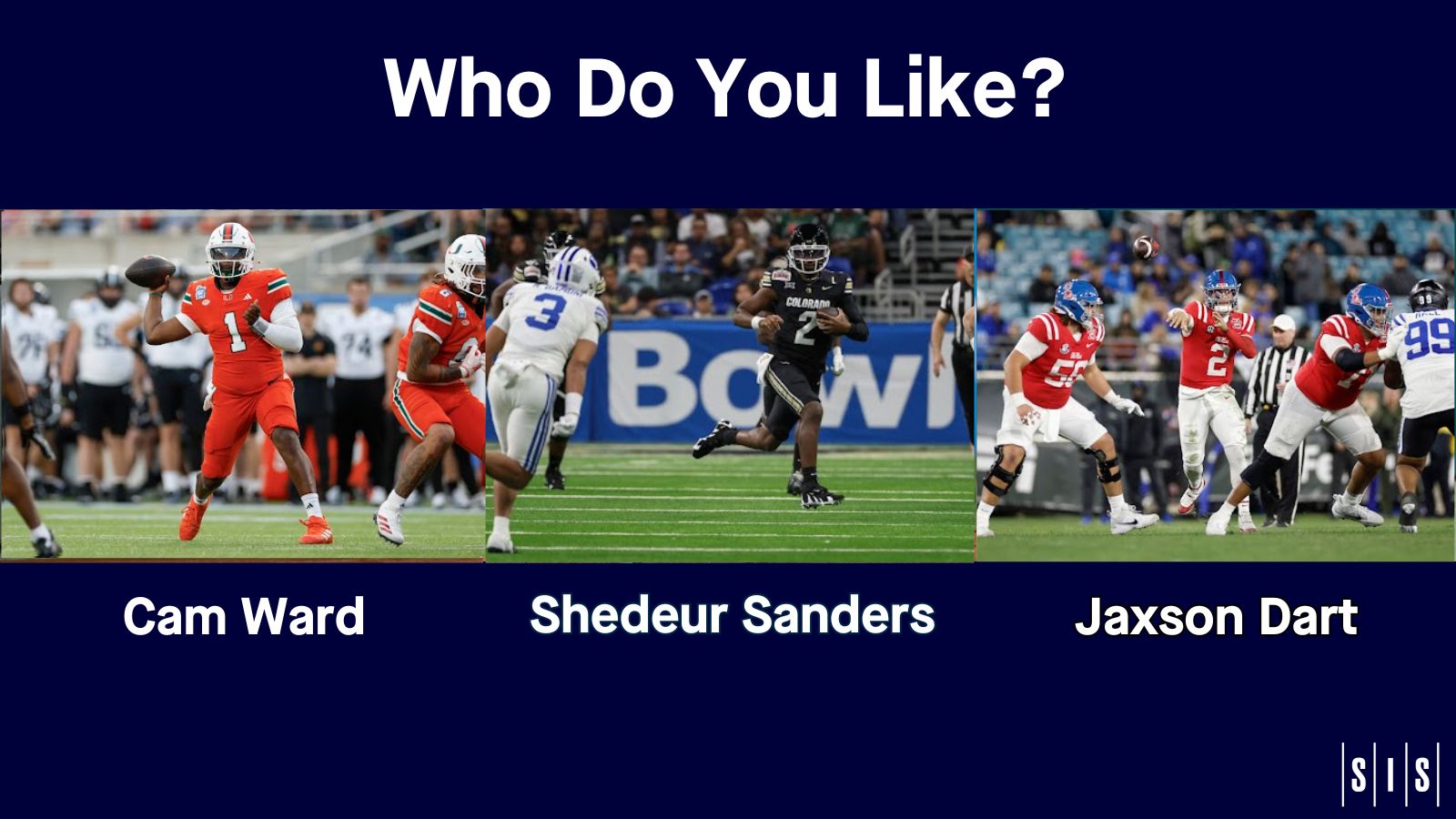
    It will be years until we determine what prospects pan out to be the best of this upcoming class, but that isn’t going to stop us from making predictions. Cam Ward, Shedeur Sanders, and Jaxson Dart are projected to be the top 3 quarterbacks taken in this class, but we don’t know the order in which they’ll be selected.

    What we do know is how they performed in their collegiate careers from a statistical and scouting perspective, and that is what will be used to project them forward. 

    Without a true consensus No. 1 like we have seen in past seasons (e.g. Trevor Lawrence, Joe Burrow), teams will have to look at the fit in their schemes to see which one will have the best potential to succeed. 

    A quick pass RPO scheme? Dart would be the look. 

    A more mobile playmaker? Ward’s your guy. 

    Someone who can avoid pressure and throw on the move? That would be Sanders. 

    Using the reports from our scouting department and the metrics from our charting operation, let’s take a look deeper into how these three compare (and contrast) and why we think each fits as they do.

    Overall

    From a statistical perspective, Dart had the better season in yards per attempt, interceptions, and SIS’ Independent Quarterback Rating (IQR, an SIS quarterback metric that builds on the traditional Passer Rating formula by considering the value of a quarterback independent of results outside of the his control such as dropped passes, dropped interceptions, throwaways, etc.). His success is all the more impressive when considering he also had the higher average depth of target by 2 yards over Ward and almost 4 higher than Sanders.

    Under Pressure and On the Move

    Most of Dart’s success comes from a clean pocket, as his IQR dips significantly when under pressure and falls behind his two counterparts. As Max Nuscher and Brandon Tew highlighted in Dart’s scouting report, When under pressure, he throws too often off his back feet and will put the ball in dangerous places.”

    Sanders is the one who led the pack in IQR when pressured, but Ward led in accuracy with a 73% on-target percentage. Dart’s was a measly 61%, which was 44th in FBS among 116 QBs with 50 attempts under pressure (put another way, he was in the 63rd percentile of those QBs).

    All three of these guys have talent on the move according to our scouts…

    “He does a good job with his accuracy on the move and has shown the ability to make good throws across his body and down the field if can’t get set.”

    – Max and Brandon on Dart


    “He is accurate on the move as long as he can get enough into the throw.”

    – Matt Manocherian on Sanders


    “His ability to extend plays is phenomenal. He scrambles with a pass-first mindset, constantly keeping his eyes downfield on broken plays.”

    – Zach Somma and Vincent Shipe on Ward

    IQR and On-Target Percentage while on the move

    Player IQR On-Target Percentage
    Shedeur Sanders 125.8 78%
    Jaxson Dart 112.9 68%
    Cam Ward 75 71%

    However, Sanders has the advantage while on the move, leading in both IQR and on-target percentage on those passes. Ward is accurate but made too many poor decisions that resulted in 4 interceptions, the most out of the three. Dart’s accuracy was better when on the run than it was while pressured, meaning he can benefit from having better pocket awareness and escaping when able.

    Accuracy on Throws to Different Areas of the Field

    My colleague Chris Lee wrote a great piece projecting accuracy from college to the pros and highlighted the on-target percentages of the quarterbacks of this year’s class. He found that, out of the three, Dart had the best accuracy on intermediate throws at 74%, followed by Sanders at 69% and Ward at 67%. On deep throws, Sanders had the edge at 55% with Dart at 51% and Ward at 46%.

    Ward’s deep ball accuracy being worse than 50% is at the low end of the spectrum. The vast majority of those misses are on overthrows, over 70 percent of them. The trend is less stark on intermediate throws, but he is still more prone to sailing a throw when he misses. According to our scouts, his footwork may be the main culprit.

    “Mechanically, Ward has decent footwork, but relies upon an extra hitch often in order to fully set his feet rather than throwing at the top of his drop consistently. Additionally, he often fails to transfer his weight toward his target, throwing off his back foot or while falling to one side or the other.”

    – Zach and Vincent on Ward’s mechanics

    Inside vs. Outside Throw On-Target Percentage

    When comparing accuracy on inside and outside throws, Dart’s is 7 percentage points higher on outside throws than the next closest in Sanders.

    Player Middle On-Target Percentage Outside On-Target Percentage
    Cam Ward 85% 64%
    Jaxson Dart 82% 80%
    Shedeur Sanders 82% 73%

    Dart shines on a specific sideline throw according to our scouts:

    “He throws with good accuracy throwing to the back shoulder along the sideline where only his receiver can get to it.”

    – Max and Brandon

    Snap to Throw Times

    All of these guys had clean-pocket snap-to-throw times in 2024 ranging between 2.43 and 2.49 seconds.  Ward had the fastest at 2.43 seconds followed by Dart at 2.47 seconds and Sanders at 2.49 seconds. However, the way that they got to those numbers differs considerably.

    In 2023, Cam Ward recorded the fastest clean-pocket snap-to-throw time we have recorded at 2.13 seconds, following up the 8th-fastest in 2022 at 2.20 seconds. The jump this year is certainly notable given that he played in a new offense in Miami. 

    Part of the reason might be a change in his drop type distribution. The number of deep drops he had last season increased to 49 in 2024 from 31 in 2023 while his short drops decreased to 351 in 2024 from 395 in 2023.

    Shedeur had nearly 3 times the amount of deep drops than the other two in 2024. According to our scouts, deep drops can get him into trouble…

    “However, he tends to hold the ball for much too long on deep drops. He doesn’t always trust his reads and will miss some on-schedule opportunities, extending plays unnecessarily and getting himself into trouble.”

    – Matt on Shedeur’s deep drops

    His 3.1 second snap-to-throw time on deep drops is roughly average. However his on-target percentage on deep drops falls to 63.4%, the lowest out of the group.

    Conclusion

    This quarterback class certainly is more up-in-the-air than ones in the past. Ward, Sanders, and Dart each have plenty of strengths and flaws. If one is provided a system that highlights their best traits (the ones we’ve noted here), we think they’ll have a better chance to thrive. There is a long time until we know the answer of who is the best, so set your predictions now and see where they take you.

  • Analytics Scouting Report: Travis Hunter, Wide Receiver

    Analytics Scouting Report: Travis Hunter, Wide Receiver

    Photo: Chris Leduc/Icon Sportswire

    Usually, the saying goes that players who are athletes but can’t catch the ball play cornerback. Well, a cornerback who won the Chuck Bednarik Award as the nation’s best defender also took home the Fred Biletnikoff Award as the nation’s best receiver (and something else called the Heisman Trophy).

    Travis Hunter is an incredible athlete whose versatility reached unprecedented levels while playing at Jackson State and Colorado. In his final year, Hunter played 700-plus snaps on both offense and defense, rarely coming off the field at any point in time.

    Even though Hunter’s intentions are to play both sides of the ball 100% of the time in the NFL, it will be rather difficult to excel at both on a full-time level. Covering the best receivers in the world AND trying to become one of the best receivers in the world is something nobody has seen and would be a monumental task to achieve. 

    Assuming he will pick one side as primary, our scouting department believes he will provide the most value as a cornerback and scouted him as such. But to capture the full picture of who Hunter is, we wanted to break down his receiving ability from a metrics perspective to find where his best part-time value can be applied on the offensive side of the ball. Playing both sides all the time may be impossible, but there will come opportunities that having one of the freakiest athletes on the field can pay dividends on the scoreboard.

    Here is what his Stats Overview would look like on our draft site if he were coming out as a receiver.

    Stat Value Rank (out of 22) Percentile
    TPTS Per Game 2.5 4 87th
    TPTS RTG Overall 91 9 57th
    TPTS Per Gm Slot 0.9 8 65th
    TPTS Per Gm Wide 1.5 3 87th
    Catchable Catch % 94% 2 96th
    Target% +/- 5.7% 11 57th
    Target Share 27% 8 61st
    Deep Route% 26% 22 0
    Unique Routes 31 17 30th
    YAC Per Rec 5.0 18 26th
    Brk+Miss Tkl Per Rec 0.28 7 74th

    Hunter comes into the draft with some of the surest hands we have seen since we started collecting data in 2016. Hunter’s 2024 ranked 14th in catchable catch percentage at 94% and 19th in on-target catch percentage at 97% among the nearly 1,200 receivers with 75 or more targets in a season since 2016. Not too bad for a corner! 

    From a Total Points perspective, Hunter led the Buffaloes with 31 Receiving Total Points, which was also good for 9th in FBS last season. The majority of this production was from out wide, notching 21 Receiving Total Points on 103 targets compared to only 9 Receiving Total Points on 22 targets from the slot, with the former being good for 6th in FBS last season.

    Travis Hunter’s Top 10 Routes Run

    Route Type Percent of Routes Percent of All Completions
    Curl 32% 25%
    Fade 10% 3%
    Slant 9% 8%
    Dig 9% 16%
    Screen 6% 19%
    Post 5% 3%
    Deep Cross 4% 4%
    Out 4% 5%
    Go/Fly 3% 4%
    Drag 2% 4%

    Hunter’s route tree is pretty concentrated to the curl route, accounting for about one-third of his routes in 2024. Colorado had to get the ball out quick with a below-average pass protection unit, so throwing to your best player on a simple curl route with hands as sure as his proved to be successful. This also could help explain his low rate of running deep routes generally.

    Even though he ran more fades and slants, the percent of his completions are lower than digs and screens. Fades make sense, as that is a lower catch probability than others and can be used as a clearout route for underneath targets. However, the gap between slants and the others is significant given that was his third most common route, but was only targeted 9 times.    

    Given that the majority of his receptions come on the curl route, it isn’t a shock that his yards after catch per reception were so low (18th out of 22 qualifying players SIS scouted this year). His ability to make people miss and break tackles is above average, so hitting him more in space where he can show that athleticism can help his YAC.

    Hunter starred on both sides of the ball in college, both with his production (most Total Points among receivers and corners in FBS in 2024) and pure athleticism. He made plenty of highlight reel catches and has sure hands in got-to-have-it situations. He has room to grow as a receiver and was not fully unleashed at Colorado on that side of the ball. It will be intriguing to see if a team lets him play both sides in some capacity, as there is a path to success with his profile.

  • Evaluating How A Quarterback’s College Accuracy Projects To The NFL

    Evaluating How A Quarterback’s College Accuracy Projects To The NFL

    Photo: Andy Altenburger/Icon Sportswire

    The NFL Draft is always a tricky thing to figure out. Drafting well can propel a franchise for sustained success, but whiffing on picks, especially at the top of the draft, can set a team back for years. This applies even more so when it comes to quarterbacks. Teams are constantly trying to find the slightest edge over their competition, and so there is great value in discerning if an aspect of a player’s play in college can reliably indicate how they will perform in that same aspect in the NFL.

    For that purpose, we wanted to investigate how strong of a correlation existed between a quarterback’s accuracy in college and in the NFL. To give it a little more specificity, we compared on-target percentage between college and the NFL at three specific depths. When running correlation and linear regression tests, we got results that are in line with what one would have expected, in terms of on-target percentage for short passes having the strongest correlation between college and the NFL.

    On-Target Percentage Depth Correlation Coefficient Adjusted R2
    Short (< 11 yards) 0.73 0.50
    Intermediate (11-20 yards) 0.36 0.09
    Deep (> 20 yards) 0.34 0.07

    The above table shows how career college on-target percentage at different depths predicts NFL on-target percentage in the first 2 to 3 years (at least 2 years and 300 passing attempts, at most 3 years). SIS started tracking college football in 2016 and 22 quarterbacks qualified by these criteria since then.

    While the order of correlation may not be the most exciting discovery, just how strong the correlation is for short passes is worth paying attention to. At the very least, a prospect’s college on-target percentage for short passes is a good piece of context to include when considering how accurate he could be at that depth at the next level.

    When observing the graph above, there are other interesting bits of information to take away. Let’s take a moment to compare Josh Allen and Zach Wilson. Both came out of college being described as boom-or-bust prospects with big arms and a penchant for big plays, but questionable accuracy, decision making, and reliance on hero ball at times. We can see that in college they had similar accuracy on short throws (and intermediate throws as well, as seen in the graph below), but at the next level Allen has been able to deliver accuracy above expectations while Wilson’s accuracy has been underwhelming. This offers insight on one potential factor out of many for why their careers have taken different directions.

    Results for correlation testing at the intermediate and deep levels are not as strong, though not insignificant and therefore still worth mentioning. One note to take away from all three charts is that Baker Mayfield was the most accurate at all three depths in college and that has translated into him now being one of the more accurate passers in the NFL, a trait that belies his gunslinger reputation.

    On-Target Percentage and Overall QB Performance

    With these results in mind, we wanted to discover whether they could tell us anything in terms of performance, and therefore we performed correlation testing between on-target percentages and IQR (Independent Quarterback Rating, an SIS quarterback metric that builds on the traditional Passer Rating formula by considering the value of a quarterback independent of results outside of the his control such as dropped passes, dropped interceptions, throwaways, etc.).

    NFL Accuracy by Depth Correlation with NFL IQR
    Short (< 11 yards) 0.55
    Intermediate (11-20 yards) 0.74
    Deep (> 20 yards) 0.24

    First, we wanted to test with NFL accuracy numbers because if there was no significant correlation, then there would not be much reason to check for correlation between college on-target percentage and NFL IQR. We can see that short and especially intermediate accuracy share a strong correlation to QB performance and therefore being more accurate on intermediate throws could be a little more valuable when evaluating prospects than at other depths.

    College Accuracy by Depth Correlation with NFL IQR
    Short (< 11 yards) 0.34
    Intermediate (11-20 yards) 0.38
    Deep (> 20 yards) 0.16

    When testing with college accuracy numbers, the results are understandably not as strong. However, the strength of correlation follows the same order with intermediate on-target percentage coming in first, followed by short, and then lastly deep. Deep accuracy showing weak correlation to QB performance makes some sense on an intuitive level even if solely because long throws are rarer and more volatile in nature.

    2024 Draft Class

    The 2024 draft class was not included in the study above due to having only one season under its belt. However, evaluating their rookie seasons against their college careers (both with a minimum of 300 attempts) could prove useful in terms of identifying bounce back or regression candidates. Among these players, when taking a look at Caleb Williams, his intermediate on-target percentage had the largest drop off at any depth between college and the NFL. If his intermediate accuracy bounces back, we could see better production from him in year two.

    Stats Bo Nix Caleb Williams Drake Maye Jayden Daniels
    Coll OnTgt% Short 83% 84% 79% 78%
    NFL OnTgt% Short 83% 81% 83% 80%
    College OnTgt% Intermediate 60% 63% 63% 63%
    NFL OnTgt% Intermediate 61% 48% 55% 64%
    College OnTgt% Deep 52% 47% 50% 49%
    NFL OnTgt% Deep 44% 40% 43% 54%
    NFL IQR 92.7 88.0 84.8 104.6

    2025 Draft Class

    Looking ahead to the 2025 draft class, outside of Riley Leonard and Tyler Shough, the other eight prospects are fairly bunched together in terms of their short accuracy in college, so making any meaningful predictions for how they will compare to each other at the next level could prove difficult. One nugget to file away is Jaxson Dart’s lead in accuracy on intermediate throws, potentially one positive indicator for his overall performance if he is able to replicate that level of precision in the NFL.

    Player OnTarget% Short OnTarget% Intermediate OnTarget% Deep
    Cameron Ward 82% 67% 46%
    Dillon Gabriel 84% 64% 58%
    Jalen Milroe 82% 56% 51%
    Jaxson Dart 84% 74% 51%
    Kurtis Rourke 83% 62% 51%
    Kyle McCord 81% 61% 55%
    Quinn Ewers 82% 66% 48%
    Riley Leonard 79% 59% 45%
    Shedeur Sanders 83% 69% 55%
    Tyler Shough 79% 58% 47%
    Will Howard 81% 60% 49%

    Conclusion

    While recognizing the limitations of sample size and various factors outside of a quarterback’s control, our study shows there is some value in considering a quarterback’s accuracy in college, especially on short throws, when projecting how accurate he may be at the same distances in the NFL.

    Separately, we found that accuracy on intermediate throws had the strongest correlation with a quarterback’s overall performance, with short throw accuracy coming in second. Deep accuracy had a significantly weaker correlation, presumably due to deep throws inherently being more volatile, at least in part. While dropping a 60 yard bomb right into a receiver’s hands may draw the most applause, a quarterback’s accuracy at shallower depths may prove to be more insightful when projecting how he might perform in the NFL.

  • What Do Analytics Show For Edge Rushers In NFL Draft?

    What Do Analytics Show For Edge Rushers In NFL Draft?

    Quarterbacks, tackles, edges, and corners – those are the premium positions in the NFL right now. The consensus seems to be that, among those positions, this year’s edge group is the deepest, with ESPN ranking six edge prospects in its top 32 and sixteen in its top 100. Both are the highest among any position group, and there are lots of flavors to be had within this class.

    Penn State’s Abdul Carter and Tennessee’s James Pearce Jr. are finesse rushers with a lot of burst off the edge. Texas A&M’s Shemar Stewart and Georgia’s Mykel Williams are long, explosive ends with questions about their production. Mike Green of Marshall is a short, bendy player who led the FBS in sacks. The point of this article is not to give detailed reports on each of these players, but to look at how this year’s edge class fares in some of our advanced metrics, so let’s get into it.

    Pressures Above Expectation

    In the 2020, and 2023, 2024 NFL drafts, the NCAA leader in Expected Pressure Rate +/- (xPressure Rate +/-) among draft prospects was the first EDGE off the board (and in 2022, Aidan Hutchinson was the 2nd EDGE off the board.)

    Player Draft Year xPressure Rate +/-
    Chase Young 2020 +12%
    Tyree Wilson 2023 +11%
    Laiatu Latu 2024 +14%

    For the uninitiated, xPressure Rate +/- (and its analog Pressures Above Expectation) is a metric that measures the probability of a player generating a pressure on a play given factors like down and distance and alignment, and then compares that to whether or not they actually generated a pressure. 

    Were the aforementioned trend to repeat this year, Pearce, Jr. (+8%) would be the first EDGE taken, although that seems unlikely considering Carter is the consensus best player at the position (at least among media).

    Player School Rank Expected Pressure Rate +/-
    James Pearce Jr. Tennessee 2nd +8%
    Mike Green Marshall 4th +8%
    Princely Umanmielen Ole Miss 11th +7%
    J.T. Tuimoloau Ohio State 12th +7%
    Donovan Ezeiruaku Boston College 13th +6%
    Josaiah Stewart Michigan 14th +6%
    Abdul Carter Penn State 16th +6%

    Snap to Pressure Times

    Carter also holds the distinction of having the fastest average time to pressure of any draft-eligible player with at least 20 pressures at a blistering 2.31 seconds, a testament to his get-off and explosiveness. The second-fastest player was at ‘just’ 2.45 seconds. 

    Of course, things aren’t as easy in the pros, but the best NFL pass rushers in this metric any given year typically hover at around 2.5 seconds. Furthermore, the 2023 collegiate leader was Carter’s former teammate Chop Robinson at an insane 2.11 seconds.He averaged 2.69 seconds in his rookie season with the Dolphins (still good for top 15).

    Player School Pressures Avg. Snap to Pressure
    Abdul Carter Penn State 52 2.31s
    Shemar Stewart Texas A&M 21 2.45s
    Mike Green Marshall 50 2.52s
    James Pearce Jr. Tennessee 32 2.54s
    Princely Umanmielen Ole Miss 32 2.55s

    Stewart is a notable inclusion here considering that he’s been knocked for his lack of production. The length, size, and explosion flashed both on tape and at the combine, but it hasn’t shown up in the stat sheet – he had just 11 TFLs and 4.5 sacks in three seasons – and these advanced stats don’t exonerate him either.

    At the other end of this is Arkansas’ Landon Jackson, the only one of the group to exceed an average snap to pressure time of 3 seconds. On top of that, his xPressure Rate +/- is negative. That’s not a great combination, and his pass rush Total Points/snap rank was good but not great (57th among qualifying edge players last season).

    Total Points

    Some notable players from the 2024 draft class fared pretty well in Total Points in 2023. Robinson (1st), Laiatu Latu (2nd), Jared Verse (6th), and Dallas Turner (30th) are sure to be familiar names. It might also be noted that Pearce Jr., who was extremely hyped at the beginning of last fall, trailed only Robinson and Latu in this metric that year. As for the 2024 leaderboard:

    Player School Pass Rush Points/Snap Rank
    Princely Umanmielen Ole Miss 0.16 2nd
    Josaiah Stewart Michigan 0.15 3rd
    Mike Green Marshall 0.14 6th
    Abdul Carter Penn State 0.13 7th
    Donovan Ezeiruaku Boston College 0.11 12th

    Meanwhile, Pearce Jr. lurks at 54th and Stewart lags behind at 168th among qualifying players at their positions after ranking 3rd and 29th last year, respectively.

    It’s not a good year to need a quarterback, but it is a good year to need someone to affect the quarterback. While there’s not a blue chip like a Myles Garrett in this class, there are lots of traitsy, high-upside players. And when you’re dealing with players who you have to project a bit more, advanced stats like the ones we’ve laid out can help paint a more complete picture.

  • New Podcast Episode: NFL Draft’s Top Defenders

    New Podcast Episode: NFL Draft’s Top Defenders

    David Rosenblum /Icon Sportswire

    On this week’s Off The Charts Football Podcast, members of the SIS football operations team analyzed some of the defensive players they liked the most in this year’s NFL Draft.

    Here are some excerpts from their analysis. Click the links to see the individual player scouting reports from our NFL Draft Website.

    Mason Graham, DT- Michigan

    “ He wins late in the down with his effort. He can win early with his hand technique. Overall, again, he’s just one of those players that he’s just gonna come in and be a starter from day one … no matter what team gets ’em, they’re gonna get a stud in the middle. He, again, he’s gonna play all three downs right off the bat and he’s gonna be a player that your team loves and you’re gonna be very happy you get ’em.”

    – Jeff Dean

    Abdul Carter, EDGE- Penn State

     ”He has probably the highest ceiling in this entire draft. I’ve never seen anybody get off the snap under control in his manner. He beats anybody to the edge and jumps across a lineman’s face. I compare it to Jalen Green in transition basketball. He’s just so smooth and so explosive. He could go in any direction at any moment.” 

    – Ben Hrkach

    Will Johnson, CB, Michigan

     ”I think this is a No. 1 corner. The instincts are really there. Being able to play in a zone coverage scheme will benefit him the most, playing in a heavy man coverage scheme will be a little more volatile for him.”

    – Jordan Edwards

    The crew also talked about Jihaad Campbell, Derrick Harmon, and Shemar Stewart. Tune in to hear what they had to say (click here and pick your podcast app) and find all our scouting reports, rankings, and stats at NFLDraft.SportsInfoSolutions.com.

  • Analyzing Ashton Jeanty’s Eye-Popping & Head-Scratching Stats

    Analyzing Ashton Jeanty’s Eye-Popping & Head-Scratching Stats

    Photo: Steve Nurenberg/Icon Sportswire

    If you haven’t already, check out the SIS NFL Draft website at NFLDraft.SportsInfoSolutions.com. You can find scouting reports, stats, and rankings for the top NFL prospects. Click the hyperlinked names here to see the scouting reports for those players.

    Former Boise State running back Ashton Jeanty set the world aflame with his 2024 performance, starting the year with a six-game stretch of over 200 yards per game and 10 yards per attempt. He finished up with a pedestrian 180 yards per game and 7 yards per attempt, which were good enough to be a finalist for the Heisman.

    He might not be the “generational” talent that caused people to drool over the likes of Saquon Barkley and Bijan Robinson in recent years, but he is plenty exciting and still given a strong starting grade by our scouting staff.

    Of course, with all that hype comes some extra scrutiny, the perennial nitpicking that convinces people not to take a player as high as some might want. I’m here to offer just a little dab, a splash, of cold water based on how others with his rushing profile have performed at the next level.

    Elusiveness

    Jeanty showcased an incredible ability to break tackles in his college career, with a per-carry rate eclipsed by only Javonte Williams among rushers from the 2020 Draft to now with at least 100 NFL carries. His overall elusiveness (broken and missed tackles per attempt) puts him behind only Williams and Bijan Robinson.

    That said, his missed tackle rate is in the middle of the pack, at least among NFL-caliber prospects. And that’s relevant because the results are a bit discouraging for players who had at least 5 percentage points more broken tackles than missed tackles in college (admittedly arbitrary), with worse performance measures and more injuries forcing missed time.

    College Elusiveness Similar (+/- 5%) BT/A > MT/A
    Players 26 14
    EPA per 100 att -2.4 -6.6
    Total Points per 100 att 6.1 3.7
    Games per injury 20.0 14.7

    (For more info on Total Points, see our primer here.)

    Dominance on outside runs

    Jeanty had incredible success rates on outside runs in his last two years at Boise State, roughly 10 percentage points above average. On the flip side, he was less and less successful running between the guards each year.

    Ashton Jeanty Success Rate on inside vs. outside runs

    Inside Outside
    2022 53% 34%
    2023 50% 55%
    2024 42% 57%
    Career 47% 49%

    I’m not sure if you’d expect this, but in general inside runs and outside runs have roughly the same success rate. So when a player shows a tendency to be out of balance with that, it feels like something we should look a little deeper into.

    Jeanty’s outside-inside profile—namely, his success coming more from outside runs—suggests that he might underperform, although he might also be a little healthier. Among players in the last several drafts with at least 200 college carries and 100 NFL carries in their first two years, outside-favoring players in college have been a little worse on a per-carry basis with slightly fewer injuries that have caused missed time.

    College Success% Inside better Similar (+/- 2%) Outside better
    Players 18 9 13
    EPA per 100 att -1.1 -5.5 -5.8
    Total Points per 100 att 5.9 6.0 4.3
    Games per injury 17.1 16.2 21.0

    So you’re out on this guy?

    I’ve somehow put this really exciting player into two buckets that suggest he’s less exciting. That doesn’t mean I’m out, but it does mean I’m glad we’re not hearing top-5-pick level hype.

    Of course, sample size is something we need to be mindful of; we just don’t have a ton of backs to judge on (at least over the years SIS has charted everything above). Have to mention that.

    And not all of these players had the same overall grade coming out. Jeanty’s comps in terms of the combination of these splits are J.K. Dobbins, Javonte Williams, Kenneth Gainwell, Dameon Pierce, Zamir White, and Cam Akers. None of them had the high-level projection that Jeanty does.

    But by the same token, the characterization we’re looking at is stylistic, and not about performance. Yes, we’re using success rate and broken and missed tackles, all of which express skill, but it’s the relative success across splits that we actually care about here. So I think we’re at least justified in bringing some suspicion to the table.

    Little bonus nugget

    To whatever extent you buy what I’m selling above, you might be interested in which of this year’s backs fall into the cluster that has the best historical production. The one that features Jonathan Taylor, Bijan Robinson, Jahmyr Gibbs, Devon Achane, Kyren Williams, Jaylen Warren, and Bucky Irving.

    North Carolina’s Omarion Hampton is in there, although just barely. His career broken tackle rate is 4.9 percentage points higher than his missed tackle rate. He has the same grade from our staff as Jeanty.

    Similar story with Arizona State’s Cam Skattebo, except with a 4.8 and a low-end starter grade from our staff.

    If you want someone who clears the thresholds easily, Oklahoma State’s Ollie Gordon II fits the bill. He has a three-down backup grade, along with a lot of other backs on our board.

  • What Does The Data Show About Patrick Mahomes and Favorable Officiating?

    What Does The Data Show About Patrick Mahomes and Favorable Officiating?

    Photo: Scott Winters/Icon Sportswire

    With Kansas City on the precipice of making NFL history – a Super Bowl threepeat – some NFL fans are feeling a bit of Mahomes fatigue. The 29-year-old signalcaller has already won three Super Bowls, is about to compete for his fourth, and seems poised to be the league’s boogeyman for the foreseeable future. And just like Brady before him, grumbling about favoritism he gets from officiating crews has emerged from those who deny or downplay his greatness.

    This largely seems like infantile coping – it doesn’t take a veteran NFL scout to see that Mahomes is extremely talented – but we at SIS are morbidly curious about whether or not there’s any validity to the idea that Mahomes is the NFL’s favorite son. 

    Fortunately, we track officiating crews as far back as our database goes (2016). We could tell you which crews call the most Defensive Pass Interferences, which crews are more liable to throw flags on the visiting team, which crews throw flags in late-game situations, or which crews get overturned on review the most, and we can also tell you whether or not the Kansas City offense benefits disproportionately from officiating.

    It’s first important to acknowledge that each ref crew officiates a bit differently in a given year. For example, in 2024, Clay Martin’s crew called offensive holding penalties almost twice as often as the NFL average, whereas Tra Blake and company came in below the NFL average and rarely flag holds on passing plays. 

    From here, we can set a baseline for each crew across multiple categories (e.g. home/away, offense/defense, penalty type, situation, etc.) and compare that to a team’s penalty profile in aggregate. If a team consistently sees more (or fewer) penalties than would be expected based on the crews that officiated them, then there’s at least something to talk about.

    There are, of course, other factors that could reasonably result in an officiating crew deviating from their baseline in a given game. For example, a team may have a handsy corner who creates a lot of contact and draws a lot of DPI calls. A quarterback might be really good at drawing offsides or pass interference.

    Even with that in mind, Kansas City’s offense doesn’t stand out in a meaningful way.

    They are one of eight offenses in 2024 who were both penalized below expectation and drew defensive penalties above expectation, but neither of these rates were to an egregious extent. The Chiefs ranked 9th in offensive penalty rate against crew average (-7%) and 12th in defensive penalty rate (+7%), but the latter figure doesn’t compare to the Joe Burrow-led Bengals (+24%) or Josh Allen’s Bills (+26%). Nor does it come even close to the rate at which defenses playing the 2020 Super Bowl champion Buccaneers were penalized (+29%).

    In fact, if anything, Mahomes is enjoying fewer flags against the defense than he ever has. In the beginning of his career, defenses playing Kansas City were consistently penalized at a very high rate relative to expectation. There was a run from 2018-2022 where Kansas City saw opposing defenses flagged at a pretty high rate, ranging from +24% at the low end to +38% at the high end. They’re in no way notable over the last two seasons, though. 

    Graphic showing where the Chiefs ranked in Defensive Penalties Gotten BY Offense. In 2016, they were middle of the league with just below 50. In 2017, 2018, and 2019 they ascended in each year, peaking at the #1 spot with 70 drawn in 2019. They also had the most in the league in 2020, though with just over 60 in a shortened season. Over the next 3 seasons, the total declined each year. The last 2 years they've been in the top-third of the league with around 50.

    How impactful is that imbalance in penalties? The net EPA gained on penalties never exceeded 0.65 EPA per game in any season during that window. That may seem high, but it barely cracks the top 50 of single team seasons over the past 9 years, and it pales in comparison to the 2020 Bucs who were 1st at +1.8 per game. The EPA in and of itself admittedly cannot account for wiping big, negative outcomes off the board, but the number isn’t so high in and of itself.

    Now, is any of this hard evidence that the NFL issued some kind of officiating mandate or that the referees otherwise showed favoritism to Kansas City? No. You’d need a more rigorous model to control for other variables (including the teams and players themselves) and do some investigative reporting to be able to responsibly conclude such a thing. But, is it interesting enough to throw out there and instigate some discourse while remaining on the fence? Yes, and it’s certainly not what we expected to find, either.

    If you’ve already got your tin foil hat on, you’ll have to take it up with the NFL referees’ union, who recently shot down assertions that the Chiefs get favorable calls. That, at the very least, seems to be true the last couple of years, in which penalties have leaned against them on average (in terms of EPA per game). Beyond that, we’re staying out of this for now, and we leave the rest to those of you who are more given to conspiracy theories.