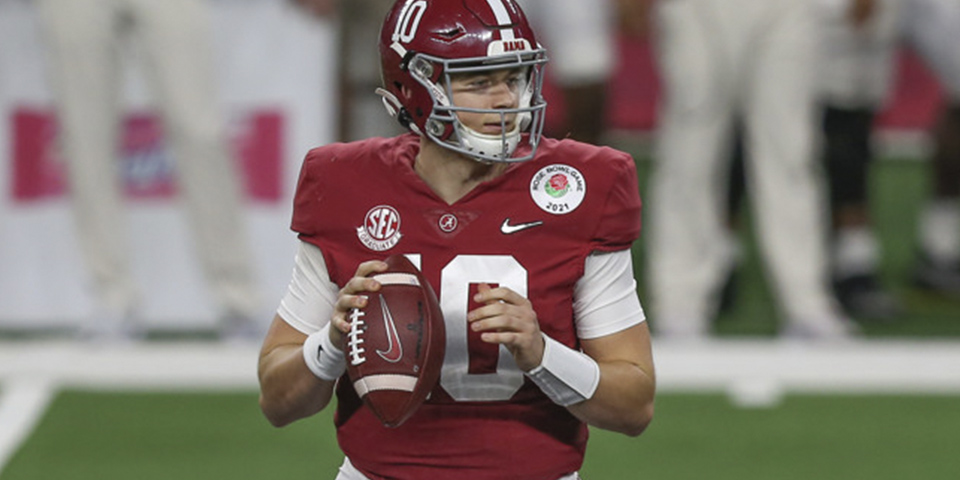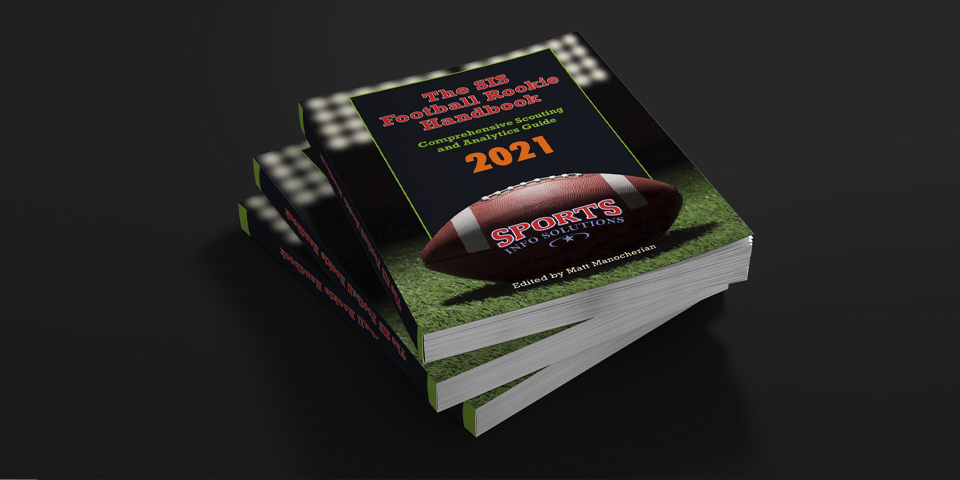
On this episode, Matt Manocherian (@mattmano) and Mark Simon (@MarkASimonSays) are joined by SIS Senior Research Analyst Alex Vigderman (@VigManOnCampus) to discuss the statistical side of the SIS Football Rookie Handbook, including a breakdown of Total Points (1:23), a look at some of the other advanced stats in the book (6:14), how difficult it can be to project college numbers to the NFL (10:45), and some of the most interesting articles, including work on injuries (15:13) and press coverage (18:16).
Category: NFL
-

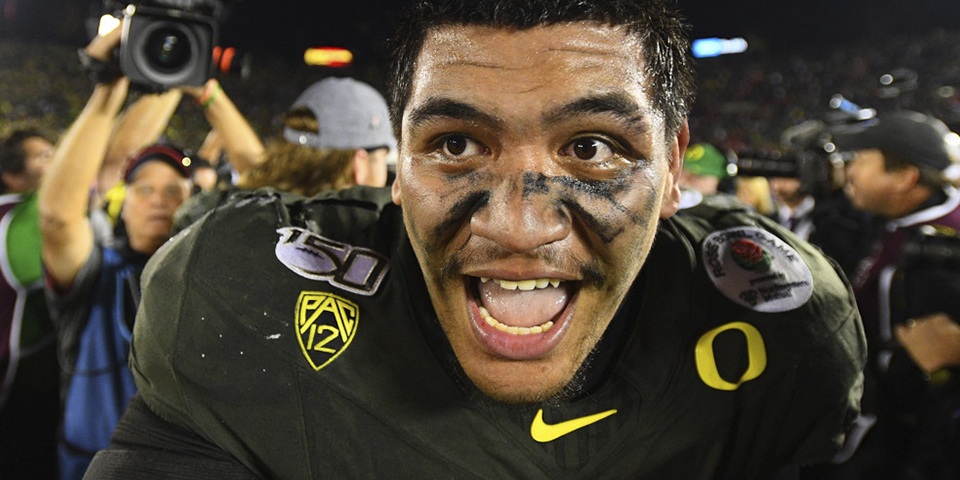
Football Rookie Handbook Scouting Report: Penei Sewell
The following is an excerpt from The 2021 Football Rookie Handbook, which is available now at ACTA Sports. The Kindle edition can be found here.
Scouting Report by John Todd
Penei Sewell: 6-5, 330 pounds – Tackle – Oregon
Final Grade: 7.2
Sewell will immediately upgrade an NFL team’s running game with his strength and fundamentals at all levels, and with minor upper-body refinements as a pass protector will be a more than reliable blind-side protector for years to come.
Penei Sewell was the left tackle for Oregon’s zone offense for 2 years before opting out of the 2020 season. He had shoulder labrum surgery in 2017 before enrolling but then started as a true freshman from Day 1 for 20 of 21 career games.
He missed 6 games his first year due to a high ankle sprain that needed surgery, but returned for his bowl game. He was a teenager for every collegiate game he played. He’s high-waisted with ideal size for the position. He’s a very fluid athlete for his size and is abnormally comfortable in space. He’s a physical presence up front who sets a tone and will finish opponents at all levels of the field.
Pass Game
As a pass protector, Sewell is difficult to work past, but he isn’t without his faults. He kicks off the ball with fundamentally sound short steps and square footwork to all set levels. He tends to bend at the waist slightly but he sits with good knee flexion and strafes to and through contact beautifully. He seeks work and senses moving parts up front well.
He’s not a quick-twitch athlete and has shown to be a bit rigid in pass pro with the occasional issue changing direction in tight quarters. Sewell’s biggest issue is his wide hands in his initial punch. He consistently attacks rushers’ shoulder pads instead of keeping his elbows tight and latching onto their chest plate. He can extend early and leave himself open to finesse moves inside.
However, his anchor strength, sound, quick base, and body control at awkward angles keep him from losing most battles. Additionally, he’s an exceptional blocker ahead of screen passes, stalking and swallowing up smaller defenders in space with ease.
Strengths Weaknesses Dominant run blocker Wide hands 2nd-Level and space blocking Slight rigidity in pass pro Core strength Run Game
The most notable facet of Sewell’s game, however, is his dominance in the run game. He was the anchor of Oregon’s ground attack and a force in any scheme to any run direction. He fires off with good pad level for his size and his core strength and wide base and feet regularly walk defenders off the ball and reset the line of scrimmage.
On the front side of wide zones he excels at exploding his hips through a straight arm and locking out after contact to clear running lanes. He skip-pulls inside fluidly and arrives with force, and pulls outside into space like a freight train. He sustains well with great grip strength and heavy feet, but he’s at his best combination blocking up to the second level. Sewell’s ability to knock off a lineman in a double team, then advance up to and engulf linebackers is phenomenal and was the staple concept of much of Oregon’s inside run game.
He still attacks with wide hands too often and can get caught hugging, but the rest of his elements in the run game add up to an ideal road grader.
Last Word
Sewell projects as an elite NFL tackle in any offensive scheme. There’s no reason to move him from the blind side, but he’d make for a dominant right tackle or guard if necessary. Sewell can stand to refine his upper-body technique in pass protection with more patience and a tighter punch, but he’s an immediate game-changer in the run and screen games.
-

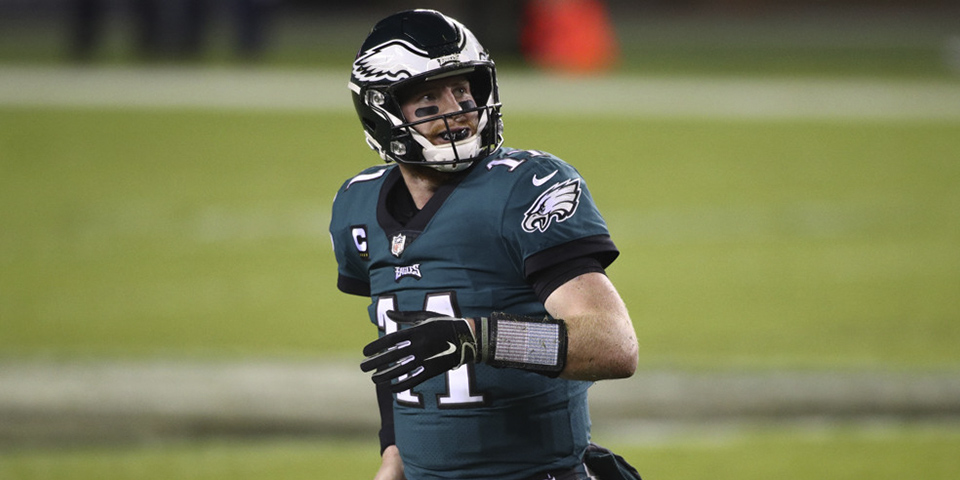
The challenge ahead in returning Carson Wentz to past success
By BRYCE ROSSLER
Carson Wentz has become such a morbid subject. His early career arc and the bitterness with which his time in Philly ended has made him one of the greatest sources of NFL schadenfreude in recent memory.
By now, we’re all familiar with the story. Second-year breakout and MVP favorite blows his knee out, watches his backup win a Super Bowl, and thus begins a slow descent that culminates in a departure that costs his team $34 million. The Carson Wentz that existed in 2017 has since been turned to stone by the gorgon that is Philadelphia sports, and now, the only statue to commemorate Wentz’s tenure in Philly is a bronze tribute to his former backup, Nick Foles. The Eagles traded Wentz to the Colts for a 2021 third-round pick and a conditional 2022 second-round pick that could become a first-round pick based on playing time.
Wentz is something of a fixer-upper at this point. It feels obvious to say that this will go down as a good deal for the Colts if he can be restored to his former glory, but 2017 Wentz is probably a mirage from both a statistical and a practical sense. For the Win’s Steven Ruiz pointed out that Wentz’s MVP campaign was largely fueled by unstable third down and red zone splits. Indeed, our Total Points metric suggests that he wasn’t that good in 2017. He was also so bad in 2020 that it seems like a Sisyphean task to get him back there.. And while his peak has been exaggerated, his downfall has not been.

It doesn’t help that Wentz has a good chance to fulfill the playing-time criterion—70% if the Colts make the playoffs (while playing in a pretty bad division), 75% if they don’t—that would escalate the 2022 pick to a first-rounder. While the Colts have ultimate control over whether or not Wentz meets that threshold, it’s unlikely that he will miss it due to injury. The general public’s hypochondriac perception of Wentz doesn’t comport to the fact that he played in 83% of possible regular season snaps during his Eagles tenure. In fact, he’s only dipped below the 70% threshold once in his five-year career—in 2018, when he was on the field for two-thirds of Philadelphia’s offensive plays.
Our in-house injury coordinator John Verros reviews every injury that occurs at the FBS and NFL levels and isn’t particularly concerned about Wentz reaggravating any of his battle scars in 2021. “He tore his ACL in 2017 and instability in his other knee didn’t follow suit, and he didn’t require surgery on the vertebrae he fractured in 2018,” Verros said.
As for the concussion he sustained in the 2019 playoffs? “Usually players are at elevated risk for subsequent concussions for about a year after the initial brain injury, but he wasn’t listed as having accumulated further concussions this past season,” Verros said. “He should only carry a baseline level of risk moving forward.”
All told, our predictive injury model gives Wentz just an 11% chance of sustaining an injury which would land him on injured reserve (IR) or require him to miss at least one game in 2021.
So we should expect the Colts to escalate the conditional 2022 2nd-rounder.
That is, of course, if we’re basing this on availability.
It is not particularly helpful to wax poetic about Wentz’s reunion with former offensive coordinator Frank Reich. As much as we might like it to be, football isn’t some feel-good human-interest story. Of course, there exists the possibility that Reich is able to successfully reverse Wentz’s decline, but it will be difficult.
For example: last year, Wentz ranked 41st out of 44 qualifying quarterbacks (minimum 100 attempts) in Time to Throw Over Expectation (TTOE).
This statistic helps contextualize time to throw by using factors like offensive line performance, the quarterback’s drop, and the use of play action to set a baseline for how quickly the ball should come out. Wentz’s TTOE of +0.22 was a half-second worse than his predecessor’s. Philip Rivers, who ranked first in 2020 with -0.31 TTOE. There are notable stylistic differences at play here, but that’s a pretty large gap.
At Sports Info Solutions, we have limited historical throw time data, but Next Gen Stats suggests that Wentz’s base Time to Throw has been pretty consistent regardless of whether Reich has been there (2.65 in 2016, 2.72 in 2017) or not (2.72 in 2018, 2.71 in 2019), with 2020 (2.91) being the obvious outlier. If Reich’s departure indeed impacted this facet of Wentz’s game, why did it take several seasons to manifest?
Furthermore, Reich cannot be blamed for Wentz seemingly forgetting how to throw a football. Wentz’s On Target Rate Over Expectation has been trending downward since it was +2.3% in 2018 to -1.8% in 2019 and then an abysmal -6.9% in 2020. This gradual decline provides hope for a renaissance, but the onset occurred well after Reich left and suggests repairs will have to occur incrementally.
Perhaps the most compelling argument for a hypothetical Carson Wentz redemption story is not about the coordinator he lost, but the receivers he’s played without. Looking at his Total Points through the lens of on-off splits for Alshon Jeffery and Zach Ertz might be helpful in this regard.
Carson WentzÔÇÖs Passing Efficiency With and Without Alshon Jeffery and Zach Ertz, 2018-19
Split Passing Total Points Per 60 Snaps Jeffery & Ertz 9.9 (891 snaps) Only Ertz 6.5 (626 snaps) Only Jeffery 4.7 (135 snaps) Neither 1.5 (137 snaps) Before Wentz fell off the cliff that was 2020, when he couldn’t seem to do much of anything right, he had been extremely reliant on his top two targets in order to perform efficiently.
Greg Ward (778 snaps) and Travis Fulgham (541) got the most use in 2020. Rookie first-rounder Jalen Reagor (505) came in at third, while 2019 second-round pick JJ Arcega-Whiteside got just 137 snaps. Ideally, you would like top-64 picks to start over former undrafted free agents and sixth-rounders, and this upside-down sourcing of wide receiver contributions is a testament to the franchise’s recent failures to infuse a once lush roster with talent.
2020 may not have been an ideal situation for Wentz, but he very much earned the criticism he has received from both a national audience and an admittedly vitriolic fanbase. He struggled to operate with timing and precision, he took sacks at a league-worst rate (9.8%), and he threw interceptions at the fourth-worst rate in the NFL (3.4%). Colts fans are likely hoping for the best, but it will take a Coach-of-the-Year type performance from Frank Reich to rescue Wentz, the embellished MVP candidate of days of yore who performed like a fringe starter in 2020.
-

Sports Info Solutions 2020 NFL All-Rookie Teams
Now that the football season is over and the work for The SIS Football Rookie Handbook is behind us, it’s time to combine those two things together and give you the 2020 Sports Info Solutions All-Rookie Teams.
Using SIS’s Total Points metric as our guide, we have come up with the All-Rookie 1st and 2nd Teams, consisting of one quarterback, three wide receivers, one running back and tight end, and a full offensive line on offense, and four defensive linemen/edge rushers, two off-ball linebackers, two cornerbacks, two safeties, and one hybrid player on defense.
While Total Points was used in most of the decision making, we also factored in playing time and a few other advanced stats to break any ties or close calls.
Here are the 2020 Sports Info Solutions All-Rookie Teams:
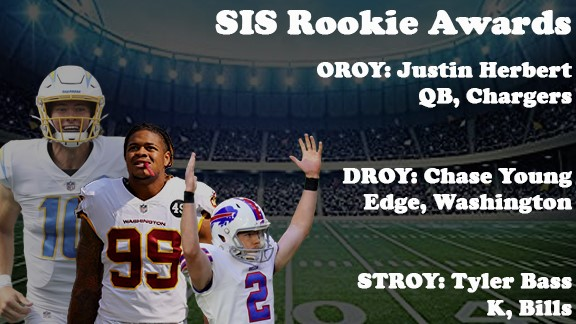
Let’s begin with our overall Offensive, Defensive, and Special Teams Rookies of the Year. With 116 Total Points, far and away above any other rookie, Justin Herbert takes home Offensive Rookie of the Year. With 38 Total Points, No. 2 overall pick Chase Young is the Defensive Rookie of the Year. Finally, with 13 Total Points to lead all rookie special teamers, Tyler Bass is crowned Special Teams Rookie of the Year.

Sports Info Solutions All-Rookie 1st-Team Offense
Position Player Team Total Points Quarterback Justin Herbert Chargers 116 Running Back Jonathan Taylor Colts 37 Wide Receiver Justin Jefferson Vikings 45 Wide Receiver Tee Higgins Bengals 24 Wide Receiver Brandon Aiyuk 49ers 23 Tight End Cole Kmet Bears 10 Tackle Tristan Wirfs Buccaneers 36 Tackle Jedrick Wills Browns 21 Guard Michael Onwenu Patriots 29 Guard Cesar Ruiz Saints 25 Center Lloyd Cushenberry III Broncos 14 Kicker Tyler Bass Bills 13 Quarterback: Justin Herbert, Chargers
- After having to make a surprise start Week 2 against the reigning Super Bowl champs, Justin Herbert never looked back. Herbert’s 116 Total Points ranked 7th among all quarterbacks and 4,336 yards ranked 6th. His 6-9 record and one 4th-quarter comeback weren’t indicative of his overall play as he led the team down for a score or a chance to win multiple times, but to have the kicking game or defense falter behind him. Herbert broke nearly every rookie passing record and looks to be a star in the making in Los Angeles.
Running Back: Jonathan Taylor, Colts
- Jonathan Taylor was outside the NFL’s top 20 in rushing and had logged only one broken tackle through Week 10 of the 2020 season. But despite missing a game and a week of practice due to COVID protocols down the stretch, only Offensive Player of the Year Derrick Henry gained more rushing yards and first downs the rest of the regular season than Taylor, who also broke 11 tackles in that six-game period.
Wide Receiver: Justin Jefferson, Vikings
- When the Vikings threw to Justin Jefferson, good things happened. He finished his rookie season third among all receivers and tight ends in Points Earned (behind only Travis Kelce and Stefon Diggs). After being bound to the slot his final year at LSU, 41% of his rookie year receptions came from wide alignments, he received the third-most Air Yards in the NFL, and he was one of only four players with over 100 targets to average at least 10 Yards per Target. His 45 Total Points were the most of all non-QB rookies.
Wide Receiver: Tee Higgins, Bengals
- In the 2021 NFL Draft, Tee Higgins fell to the second round and was paired with No. 1 overall pick Joe Burrow in Cincinnati. Even with a healthy A.J. Green, Higgins was targeted 108 times (one behind Tyler Boyd for the team lead) and led the team with 908 yards on 67 receptions. Higgins’ 1st-Down Rate of 77.6% ranked 6th among all receivers with at least 50 targets. Additionally, his 137 Yards After Contact ranked 19th among wide receivers.
Wide Receiver: Brandon Aiyuk, 49ers
- For a team riddled with injuries, the 49ers found consistency with their first-round pick Brandon Aiyuk. Aiyuk made 11 starts, saw 96 targets and caught 60 of his 71 catchable targets for a team-leading 748 yards and 5 touchdowns. Not only did he make plays as a receiver, but he also added 77 yards and 2 touchdowns on the ground.
Tight End: Cole Kmet, Bears
- After beginning the year third on the Bears’ tight end depth chart, Kmet played over 70% of snaps in each of the team’s final eight games of the season, including playoffs. Coinciding with Mitchell Trubisky’s return to the lineup, Kmet was third on the team in targets and receptions in that final stretch, and he was second among all tight ends in On-Target Catch Rate for the season (minimum 40 targets).
Tackle: Tristan Wirfs, Buccaneers
- Tristan Wirfs was a clear first-place finisher in rookie OL Total Points this year, largely due to his ability to assist Tom Brady and the Buccaneers’ passing game, from which 24 of his 36 Total Points came. Wirfs didn’t miss a snap at right tackle all season, including the Super Bowl run. Tampa Bay finished second in the NFL in sack rate, a testament to the 43-year-old Brady as much as it is to Wirfs and his linemates. Wirfs received the 3rd-most votes among right tackles in All-Pro voting as a rookie.
Tackle: Jedrick Wills, Browns
- Jedrick Wills was one of the key pieces to the Browns’ success this year and a big reason Cleveland saw their first playoff appearance since 2002. As Baker Mayfield’s blind-side protector, Wills helped Mayfield to the 5th-best On-Target% and 6th-best IQR in the second half of the regular season. On the ground, Wills ranked 23rd among offensive linemen who started at least 10 games with 2.6 Yards Before Contact on runs to his gap.
Guard: Michael Onwenu, Patriots
- While Onwenu spent 12 of his 16 starts at right tackle, we’re bending the rules a bit to get our best groups represented. The Patriots’ sixth-round pick was expected to back up along the interior but earned immediate playing time and rotated at both guard spots and jumbo tight end before settling in at right tackle in Week 7. He was second in his rookie class in Run and Pass Total Points, respectively.
Guard: Cesar Ruiz, Saints
- Although Cesar Ruiz was a center at Michigan and Erik McCoy was already on the roster, the Saints still drafted Ruiz with the No. 24 overall pick. After missing Week 1 due to injury and easing into action Week 2, Ruiz slotted in at right guard and played at least 60% of the offensive snaps in 12 of the final 14 games with 9 starts, including playing 100% of the snaps in each playoff game. He made his name as a run blocker, with positive plays 48.5% of the time on runs to his gap, and his 15 Total Points on run plays ranked 21st among all offensive linemen.
Center: Lloyd Cushenberry III, Broncos
- Cushenberry was the only Broncos offensive player to not miss a snap in 2020. He led the NFL in Blown Blocks on run plays, but his 12 Total Points and zero holding penalties on pass plays give him the nod among rookie centers.
Kicker: Tyler Bass, Bills
- A sixth-round pick in the 2020 NFL Draft, Tyler Bass went 2-for-4 against the Jets in his NFL debut but finished 33-for-39 the rest of the way, including playoffs. The next meeting with the Jets, Bass went 6-for-8 scoring all 18 Bills points in a 18-10 win. Additionally, his 57 made extra points tied for the most in the NFL with Wil Lutz.
Sports Info Solutions All-Rookie 1st-Team Defense
Position Player Team Total Points Edge Chase Young Washington 38 Edge Alex Highsmith Steelers 23 Interior Defensive Lineman Derrick Brown Panthers 21 Interior Defensive Lineman Javon Kinlaw 49ers 16 Linebacker Patrick Queen Ravens 34 Linebacker Jordyn Brooks Seahawks 27 Linebacker/Defensive Back Jeremy Chinn Panthers 29 Cornerback Cameron Dantzler Vikings 43 Cornerback Jaylon Johnson Bears 32 Safety Kamren Curl Washington 36 Safety Antoine Winfield Jr. Buccaneers 29 Punter Joseph Charlton Panthers 11 Edge: Chase Young, Washington
- Not only did Chase Young lead the 2020 rookie defensive end class in pressures and sacks, he also led the group in tackles and TFLs on run plays. He tied for the overall NFL lead in forced and recovered fumbles, was top-10 in pressures after Week 10, and fully lived up to his lofty draft status, earning Defensive Rookie of the Year honors.
Edge: Alex Highsmith, Steelers
- Despite logging only two sacks on the season and not getting significant game time until the final 5 games of the year, Highsmith actually led the 2020 rookie class with a 12.4% Pressure Rate for the year (minimum 20 pressures). His 19 total pressures over those final five regular season games were tied for 8th in the entire league in that stretch among all defensive ends and linebackers.
Interior Defensive Lineman: Derrick Brown, Panthers
- The 7th overall pick in the 2020 NFL Draft, Derrick Brown finished in the top 15 of all NFL defensive tackles in QB hurries and tackles for loss. He played over 50% of snaps in all 16 games, and he was credited with 8 Points Saved against the pass and 9 against the run, validating his true three-down ceiling as a prospect.
Interior Defensive Lineman: Javon Kinlaw, 49ers
- Javon Kinlaw stamped his ticket to the first round during an outstanding week at the Senior Bowl and then continued that production for the 49ers in 2020. Kinlaw played in 14 games with 12 starts and was on the field for 53% of the overall defensive snaps. He finished the season with 34 tackles, 1.5 sacks, 15 pressures, and even had 3 passes deflected at the line. He also showed off his athleticism picking off Jared Goff and returning it 27 yards for a touchdown against the Rams in late November.
Linebacker: Patrick Queen, Ravens
- Patrick Queen started every game for the Ravens and proved his range by finishing in the top 10 in tackles on designed off-tackle and outside runs league-wide. He also added 18 pressures and 3 sacks as a pass rusher. He’ll need to improve his tackling efficiency (5th-worst Broken/Missed Tackle Rate among LBs with at least 5 tackles/game) and his coverage rates could be better, but overall Queen was easily the top rookie LB in Total Points.
Linebacker: Jordyn Brooks, Seahawks
- Jordyn Brooks didn’t rush the passer much, but he teamed up with Bobby Wagner at the heart of the Seahawks run defense. Brooks actually tied his teammate with 13 Run Defense Points Saved which ranked him 17th in the league among all linebackers. Brooks totaled 57 tackles and ranked third in the league among linebackers with only a 3.4% Broken + Missed Tackle Rate despite being on the field for only 32% of snaps over 14 games.
Linebacker/Defensive Back: Jeremy Chinn, Panthers
- Jeremy Chinn immediately contributed as a late second-round pick in 2020 and lined up just about everywhere in his 15 starts. Chinn saw 40% of his snaps as an off-ball linebacker, 25% at safety, 23% in the slot, and 8% on the edge. He also saw nine snaps as an outside corner. As far as numbers go, he filled up the stat sheet. His 117 tackles tied for 17th-most in the league. Chinn also gave up the 2nd-fewest yards per attempt from the slot behind only Minkah Fitzpatrick (among 66 safeties who saw at least 10 targets while defending receivers from the slot).
Cornerback: Cameron Dantzler, Vikings
- For the first eight weeks of the season, Dantzler had the league’s 6th-worst Passer Rating Against among cornerbacks (minimum 15 targets) and had allowed 4 touchdowns. However, after returning in Week 11 from a scary midseason neck injury, Dantzler led all NFL corners in Passing Points Saved and was third-best in Passer Rating Against the rest of the season, logging 2 interceptions and conceding no further touchdowns. He finished with the most Total Points of the 2020 defensive rookies.
Cornerback: Jaylon Johnson, Bears
- There were concerns about Jaylon Johnson’s shoulder injury history coming into the NFL and another one forced him to miss the final 3 games of the season. However, before that, Johnson started all 13 games, never seeing less than 85% of the snaps except for the game he got injured. Johnson gave up the 29th-most yards, but he tied for the 2nd-most passes defended with 15 and the 7th-best Deserved Catch Rate at just 70% among cornerbacks who saw at least 25 targets their way.
Safety: Kamren Curl, Washington
- Seventh-round pick Kam Curl rotated as Washington’s nickel back for the first 7 weeks of the season before safety Landon Collins ruptured his Achilles. Curl stepped into his role full-time and, from that point on, led all secondary defenders in tackles and was a top-10 safety in Run Defense Points Saved. He wasn’t lacking in coverage, either. For the season, he had the 7th-best Passer Rating Against among safeties (minimum 20 targets) and tallied 3 interceptions and 2 sacks, adding up to a Draft-Day steal and the clear No. 1 rookie safety in Total Points.
Safety: Antoine Winfield Jr., Buccaneers
- Size and durability concerns led to Antoine Winfield Jr. falling to the middle of the second round in the Draft. However, he went on to start 19 games (only missing the NFC Championship Game against Green Bay with injury), play 97% of the regular season defensive snaps, and win a Super Bowl. He finished the regular season with 92 tackles, 3 passes defended, and an interception, even adding a second against Patrick Mahomes in the Super Bowl. Winfield also ranked top 25 among safeties in Passer Rating Against (minimum of 20 targets).
Punter: Joseph Charlton, Panthers
- Joseph Charlton showed off his leg at South Carolina and then the Senior Bowl before landing with the Panthers as an Undrafted Free Agent. Charlton had the 3rd-fewest punts of any full-time punter in 2020 with 45, yet he still managed 21 punts inside the 20, 9 punts inside the 10, forced 16 fair catches, and only had 3 touchbacks. His 46.2 raw punt average ranked 10th and his 42.2 net average ranked 15th.
In all, six offensive 1st-Teamers and five defensive 1st-Teamers received a 6.7 final grade or higher from us in the 2020 edition of The SIS Football Rookie Handbook, suggesting those players will at least be high-end three-down starters beginning their second season. We’ll see if they begin 2021 the way they played in 2020 to warrant those final grades, but we like their chances.
Below, you can find our All-Rookie 2nd Teams which still included big names, such as Joe Burrow, Clyde Edwards-Helaire, Mekhi Becton, Yetur Gross-Matos, and Isaiah Simmons.
Sports Info Solutions All-Rookie 2nd-Team Offense
Position Player Team Total Points Quarterback Joe Burrow Bengals 49 Running Back Clyde Edwards-Helaire Chiefs 13 Wide Receiver Chase Claypool Steelers 21 Wide Receiver Darnell Mooney Bears 17 Wide Receiver Laviska Shenault Jaguars 12 Tight End Adam Trautman Saints 5 Tackle Mekhi Becton Jets 21 Tackle Robert Hunt Dolphins 21 Guard Jonah Jackson Lions 24 Guard Solomon Kindley Dolphins 19 Center Tyler Biadasz Cowboys 8 Kicker Rodrigo Blankenship Colts 7 Sports Info Solutions All-Rookie 2nd-Team Defense
Position Player Team Total Points Edge Alton Robinson Seahawks 15 Edge Yetur Gross-Matos Panthers 13 Interior Defensive Lineman DaVon Hamilton Jaguars 14 Interior Defensive Lineman Tershawn Wharton Chiefs 14 Linebacker Willie Gay Chiefs 15 Linebacker Tae Crowder Giants 11 Linebacker/Defensive Back Isaiah Simmons Cardinals 15 Cornerback Michael Ojemudia Broncos 25 Cornerback Trevon Diggs Cowboys 21 Safety Jordan Fuller Rams 25 Safety Kyle Dugger Patriots 14 Punter Tommy Townsend Chiefs 7 There were a few close calls on both teams and honorable mentions we’d like to highlight.
The 1st-Team tackle spot next to Wirfs was a neck-and-neck three-way tie in Total Points between Wills, Becton and Hunt, the 1st-Team guard spot next to Onwenu was tight between Ruiz and Jackson (If you’re a stickler who would have wanted us to stick to players with a majority of games at their selected position, Jackson of the Lions would have ascended to First Team and Onwenu would have moved to 1st-Team tackle) and Michael Pittman Jr. and Gabriel Davis are deserving of a mention for 2nd-Team wide receiver consideration. Defensively, Mykal Walker had a good case for a 2nd-Team linebacker selection, as did Jeff Gladney at cornerback.
The Carolina Panthers (three 1st-Team & one 2nd-Team) and the Kansas City Chiefs (four 2nd-Team) tied with the most selections at four apiece. Additionally, all but six teams were represented, suggesting there was a lot of talent in the 2020 Draft class that was dispersed throughout the league.
Be sure to grab your copy of this year’s SIS Football Rookie Handbook to get a leg up on who we think could vie for the 2021 All-Rookie Teams. It’s available for pre-order now at this link with an expected release date of March 1.
-
World’s No. 1 QB Rankings: Post-Super Bowl Update
By Alex Vigderman & Mark Simon
Patrick Mahomes stood atop the World’s No. 1 Quarterback Ranking post-Super Bowl even after a game in which, by the basic numbers, he was significantly outplayed by the current No. 3 quarterback, Tom Brady.
What may surprise you is that by Points Above Average, which serves as the statistical underpinning of our evaluation system, Mahomes actually scored higher than Brady did.
Anybody watching the game could see that Mahomes was put in a bad spot by his teammates. Let’s start with the offensive line. The Chiefs blew 16 blocks on a Mahomes dropback, compared to the Bucs’ 2 on a Brady dropback.
Most quarterbacks that have to play behind 16 blown blocks would amass a large number of sacks and throw several interceptions. Mahomes was sacked three times and intercepted twice. It could have been a lot worse. In most of those ‘scrambling like crazy’ moments, he gave his receivers a chance to make plays, often with throws from awkward angles. Under the circumstances, he performed at an above-average level..
On those plays alone, Mahomes was worth 4 Points Above Average compared to -1 for Brady.
The Chiefs receiving corps also had some head-scratching (head-smacking?) drops in the game, which Total Points treats as a completion for the purpose of evaluating the quarterback.
Chiefs receivers had three drops, on which we awarded Mahomes 5 Points Above Average for the value of those throws. Brady suffered only one drop, and he was awarded 1 point for it.
In sum, on plays with either a blown block or a drop, Mahomes was worth 7 PAA to Brady’s 0, and on other plays it was 1 PAA for Brady compared to -5 for Mahomes. So Mahomes edged out Brady in PAA, 2-1.
The post-Super Bowl top five in the World’s No. 1 QB Ranking are:
1. Patrick Mahomes
2. Aaron Rodgers
3. Tom Brady
4. Deshaun Watson
5. Russell Wilson
A reminder that The World’s No. 1 Quarterback Ranking is based on a model devised by Bill James to evaluate The World’s No. 1 Starting Pitcher. Bill’s model was based on cumulative evaluation of individual starts over an extended time period using the metric Game Score.
The World’s No. 1 Quarterback Ranking uses our player value stat, Total Points to make a cumulative evaluation of game performance over a three-year period. The key to our calculation is PAA, which as we previously noted, is the statistical underpinning of Total Points that is centered at zero so that positive numbers are above average and negative numbers are below average.
Success over time is key to maintaining a good ranking. Prolonged inactivity results in a ranking drop. The most recent performances carry the most weight.
Trade Talk
Looking ahead to the offseason, there’s a prominent amount of quarterback movement expected in both trades and free agency. The Colts, whose starting quarterback, Philip Rivers (ranked No. 11 in The World’s No. 1 QB Ranking), just retired, just traded for Carson Wentz, who ended the season ranked second-to-last at No. 85 in our rankings, one spot ahead of Sam Darnold.
Wentz will be playing behind an offensive line that had the third-lowest pressure percentage allowed in the league last season (the Eagles ranked last), so if that holds, he’ll have room and time to throw. He’ll need to be better than his ranking 32nd in on-target percentage from a clean pocket in 2020.
Darnold may also be out of a job depending on which direction the Jets go with the No. 2 pick in the NFL Draft.
The Wentz move followed the swap of Matthew Stafford (No. 14 in our rankings) and Jared Goff (No. 27) by the Lions and Rams. Goff had actually been one spot ahead of Stafford in the QB rankings entering the season but tumbled from No. 15 to 27 in 2020.
A couple of our highest-ranked quarterbacks could be involved in future deals. The most notable of those is No. 4 Deshaun Watson, who has asked to be traded from the Texans. Watson had an MVP-caliber season in terms of statistical value, but the Texans sputtered mostly due to a poor-performing defense. The price for Watson will be steep given the caliber of the player being traded in the prime of his career and the price established by the Stafford-Goff swap.
The No. 6 quarterback in our rankings, Derek Carr, is a tempting option for teams to try to acquire, though the Raiders have rejected any efforts so far. Carr is the quarterback whose high ranking was questioned most often when we revealed our rankings. But he ranked 10th among quarterbacks in Points Earned this season after ranking 5th in that stat in 2019. His complete body of work warrants his current position and the Raiders will be challenged to find someone better.
The post-Super Bowl rankings are below.
Rk Player PAA/60 Last Rk Start Of Season 1 Patrick Mahomes 7.2 1 1 2 Aaron Rodgers 6.7 2 2 3 Tom Brady 5.6 3 11 4 Deshaun Watson 5.2 4 14 5 Russell Wilson 3.8 5 3 6 Derek Carr 3.4 6 5 7 Josh Allen 3.2 7 24 8 Kirk Cousins 2.4 8 8 9 Ryan Tannehill 2.2 9 23 10 Matt Ryan 2.2 10 10 11 Philip Rivers 2.1 11 12 12 Lamar Jackson 2.1 12 6 13 Justin Herbert 2.0 13 N/A 14 Matthew Stafford 1.0 15 16 15 Drew Brees 1.0 14 4 16 Baker Mayfield 1.0 16 35 17 Kyler Murray 0.7 17 17 18 Dak Prescott 0.0 18 7 19 Ryan Fitzpatrick 0.0 19 13 20 Teddy Bridgewater -0.7 20 22 21 Jacoby Brissett -1.0 21 9 22 Taysom Hill -1.0 22 18 23 Cam Newton -1.0 23 28 24 Joe Burrow -1.5 24 N/A 25 Jimmy Garoppolo -1.8 25 20 26 Drew Lock -2.0 26 53 27 Jared Goff -2.0 27 15 28 John Wolford -2.0 28 N/A 29 Marcus Mariota -2.2 29 40 30 Chad Henne -2.3 30 N/A 31 Mason Rudolph -2.3 31 66 32 Taylor Heinicke -2.4 32 72 33 Matt Moore -2.4 33 25 34 C.J. Beathard -2.4 34 54 35 Gardner Minshew -2.5 35 41 36 Jeff Driskel -2.5 36 31 37 Chase Daniel -2.6 37 26 38 Brett Hundley -2.6 38 32 39 Matt Schaub -2.6 39 33 40 Blaine Gabbert -2.6 40 60 41 Blake Bortles -2.6 41 34 42 DeShone Kizer -2.7 42 49 43 Josh McCown -2.7 44 55 44 Sean Mannion -2.7 45 51 45 Joshua Dobbs -2.7 46 52 46 Joe Webb -2.7 47 59 47 Ben Roethlisberger -2.7 43 36 48 Andy Dalton -2.7 48 57 49 Tua Tagovailoa -2.7 49 N/A 50 AJ McCarron -2.8 50 58 51 Matt Barkley -2.8 51 64 52 Kyle Allen -2.8 53 76 53 Jameis Winston -2.8 52 30 54 Nate Sudfeld -2.8 54 44 55 Nathan Peterman -2.8 55 77 56 Garrett Gilbert -2.8 56 N/A 57 Tyler Huntley -2.9 57 N/A 58 Case Keenum -2.9 58 38 59 Tyrod Taylor -2.9 59 63 60 Colt McCoy -3.0 60 71 61 David Blough -3.0 61 43 62 Devlin Hodges -3.0 62 70 63 Chris Streveler -3.0 63 N/A 64 Brian Hoyer -3.1 64 69 65 Joe Flacco -3.1 65 62 66 Robert Griffin III -3.2 66 61 67 Brett Rypien -3.3 67 N/A 68 Jarrett Stidham -3.3 68 N/A 69 Phillip Walker -3.3 69 N/A 70 Josh Rosen -3.4 71 78 71 Ben DiNucci -3.4 70 N/A 72 Jalen Hurts -3.5 72 N/A 73 Nick Mullens -3.5 73 37 74 Kendall Hinton -3.6 74 N/A 75 Mike Glennon -3.6 75 39 76 Will Grier -3.6 76 79 77 Daniel Jones -3.7 77 73 78 Alex Smith -3.7 78 21 79 Brandon Allen -3.8 79 67 80 Nick Foles -3.9 80 27 81 Dwayne Haskins -4.4 81 29 82 Ryan Finley -4.4 82 80 83 Jake Luton -4.7 83 N/A 84 Mitchell Trubisky -5.0 84 68 85 Carson Wentz -5.2 85 19 86 Sam Darnold -5.7 86 42 -
New football podcast: Diversity & Inclusion in the NFL
On this edition of the Off The Charts Football Podcast, Matt Manocherian (@mattmano) and Mark Simon (@MarkASimonSays) are joined by N. Jeremi Duru (@NJeremiDuru), an author and law professor who is an expert on the NFL and its head coach hiring practices as relates to People of Color. The group discusses how the NFL is doing in that regard (2:56), how owners often rush head coach hiring decisions and don’t know what they’re looking for (4:42), the Tampa Bay Buccaneers as a model for putting together a coaching room (9:31), and the idea of a hiring moratorium during the playoffs (14:24). With this being Black History Month, they also touch on the importance of knowing who Fritz Pollard is (21:04).
You can email the show with feedback at offthecharts@ww2.sportsinfosolutions.com and don’t forget to follow on Twitter @SportsInfo_SIS and Instagram @sportsinfosolutions. For more, check out: sportsinfosolutions.com footballoutsiders.com sportsinfosolutionsblog.com SISDataHub.com
-
New football podcast: Why The Bucs are Best
Former NFL scout Matt Manocherian (@mattmano) of Sports Info Solutions and football analytics pioneer Aaron Schatz (@FO_ASchatz) of Football Outsiders (@fboutsiders) break down the Tampa Bay Buccaneers’ 31-9 beatdown of the Kansas City Chiefs in Super Bowl LV. The episode opens with a throwback to last year’s prediction by FO readers that the Bucs would be the surprise team of the 2020 season (0:48) before moving on to why we shouldn’t be surprised that the Bucs won and dominated up front (2:35), the Mahomes-Brady matchup (9:50), and Brady’s legacy after winning his 7th Super Bowl at age 43 (13:25).
You can email the show with feedback at offthecharts@ww2.sportsinfosolutions.com and don’t forget to follow on Twitter @SportsInfo_SIS and Instagram @sportsinfosolutions. For more, check out: sportsinfosolutions.com footballoutsiders.com sportsinfosolutionsblog.com SISDataHub.com
-
New football podcast: Trey Wingo previews Super Bowl, QBs, and more
Former NFL scout Matt Manocherian (@mattmano) of Sports Info Solutions and football analytics pioneer Aaron Schatz (@FO_ASchatz) of Football Outsiders (@fboutsiders) welcome Trey Wingo (@wingoz) to the show to discuss numerous NFL-related topics.
The group opens with a talk about last week’s conference championship games (1:02) before transitioning to a look at the Super Bowl matchup between the Chiefs and Buccaneers (10:56). The episode closes with discussion about which quarterbacks could be on the move (19:20), how Trey watches the game differently after spending time with both former players and Stats & Info people (25:42), and his favorite unheralded Super Bowl performer (27:22).
Check out “Trey Wingo Presents: Half-Forgotten History” wherever you get your podcasts as well as on YouTube. You can email the show with feedback at offthecharts@ww2.sportsinfosolutions.com and don’t forget to follow on Twitter @SportsInfo_SIS and Instagram @sportsinfosolutions. For more, check out: sportsinfosolutions.com footballoutsiders.com sportsinfosolutionsblog.com SISDataHub.com
-
New football podcast: Conference Championship Preview
Former NFL scout Matt Manocherian (@mattmano) of Sports Info Solutions and football analytics pioneer Aaron Schatz (@FO_ASchatz) of Football Outsiders (@fboutsiders) look at the two games for the NFL Conference Championship Round this weekend. Matt and Aaron go deep with breakdowns of the NFC Championship game between the Buccaneers and Packers (3:22) and the AFC title game between the Bills and Chiefs (11:21).
You can email the show with feedback at offthecharts@ww2.sportsinfosolutions.com and don’t forget to follow on Twitter @SportsInfo_SIS and Instagram @sportsinfosolutions. For more, check out: sportsinfosolutions.com footballoutsiders.com sportsinfosolutionsblog.com SISDataHub.com
-
New football podcast: Upsets on the horizon?
Former NFL scout Matt Manocherian (@mattmano) of Sports Info Solutions and football analytics pioneer Aaron Schatz (@FO_ASchatz) of Football Outsiders (@fboutsiders) look at the four games for the NFL Divisional Round this weekend. The show opens with a brief discussion about the use of analytics during broadcasts (1:02) before moving on to preview this weekend’s matchups: Rams-Packers (3:12), Ravens-Bills (9:30), Browns-Chiefs (15:08), and Buccaneers-Saints (21:12).
You can email the show with feedback at offthecharts@ww2.sportsinfosolutions.com and don’t forget to follow on Twitter @SportsInfo_SIS and Instagram @sportsinfosolutions. For more, check out: sportsinfosolutions.com footballoutsiders.com sportsinfosolutionsblog.com SISDataHub.com