Category: NFL

  • Stat of the Week: The Eagles Have A Game-Changing Defense

    Stat of the Week: The Eagles Have A Game-Changing Defense

    If you haven’t figured it out by now, we like defense here and the tone of what we write about often reflects that.

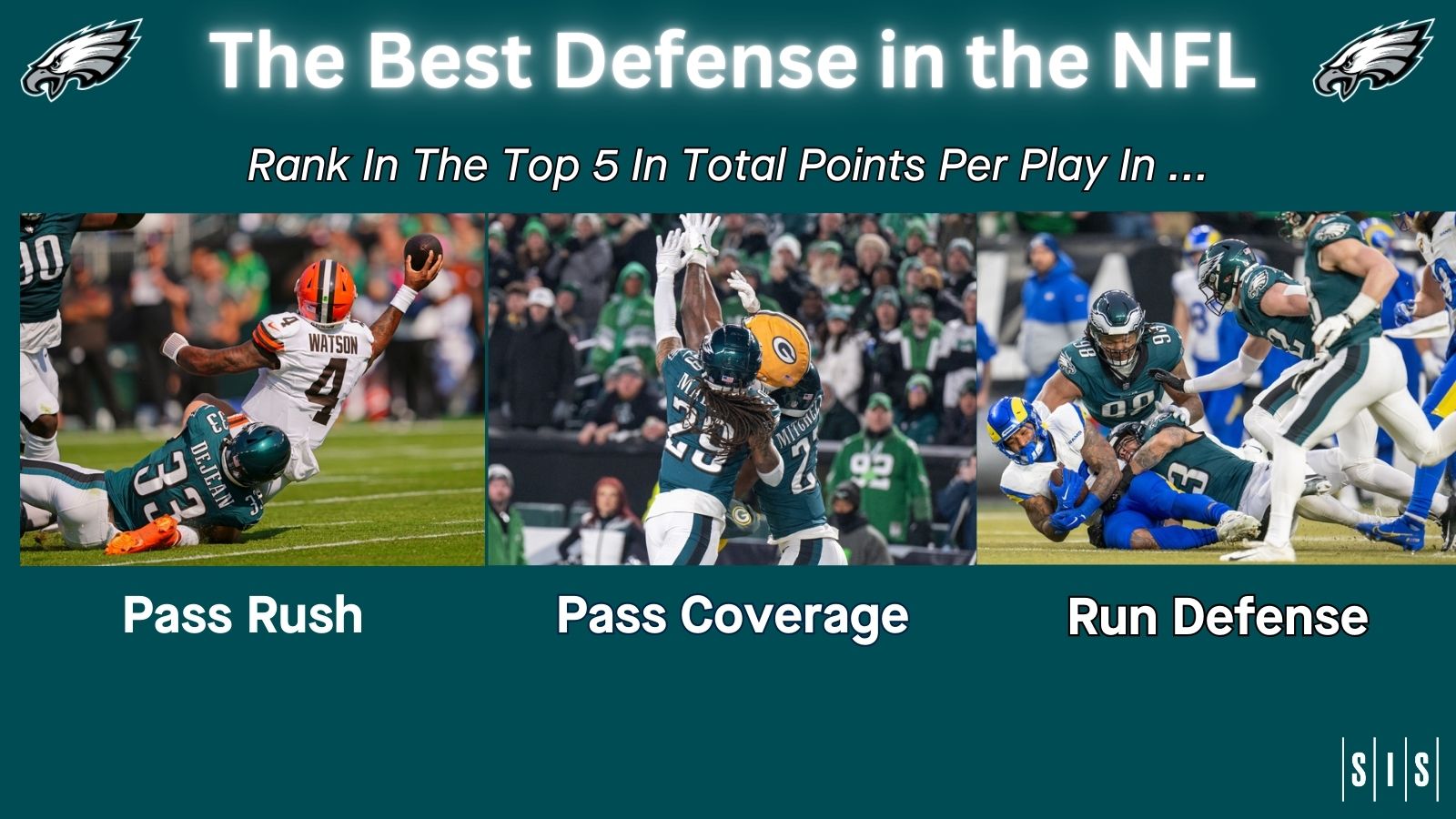
    This year’s Super Bowl is ripe for talk about defense because the best defensive team in the NFL is in it, the Philadelphia Eagles.

    The Eagles defense has everything you could ask for. We measure team performance utilizing our player value stat, Total Points, an explanation of which can be found here. By our measure, the Eagles have a top five run defense, pass coverage, and pass rush unit. No other team this season was in the top five in more than one of those areas.

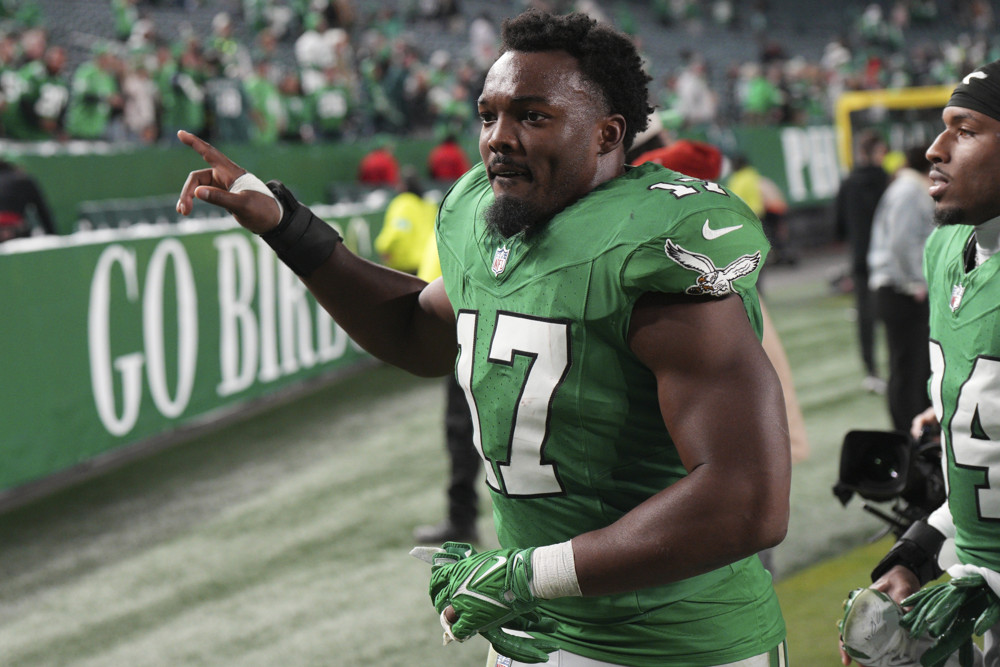
    Philadelphia’s most valuable defensive player by Total Points was linebacker Zach Baun. Baun led the Eagles in tackles and nearly halved his broken and missed tackle percentage from last season when he was with the Saints, going from 18% to 11%. He became one of the league’s best run defenders by Total Points and was a solid defender whether rushing the passer or in coverage (he ranked 9th among linebackers in Pass Coverage Total Points). In sum, he had the most Total Points of any player at his position during the regular season.

    Defensive tackle Jalen Carter ranked 4th at his position in Total Points this season. He was a top five defensive tackle at rushing the passer and ranked just outside the top five in run defense. Another defensive tackle, Milton Williams, specializes in pass rush. Though he doesn’t play as much as Carter, he’s a smidge more effective than Carter at getting pressure and in doing things that provide value to his team.

    The Eagles’ top defender in pass coverage is safety C.J. Gardner-Johnson, partly a product of his team-high 6 interceptions. Cornerback Darius Slay has a 42% completion percentage against when targeted, the 5th-lowest of any cornerback targeted at least 30 times. Remember too that we noted that Baun, at linebacker, was also a standout in pass coverage during the regular season.

    The Eagles will be challenged by Chiefs tight end Travis Kelce but they can feel confident going into that matchup. On a per-play basis, they were a top five team in pass coverage against each of the receiving position groups, running back, wide receiver, and tight end.

    We haven’t mentioned the Chiefs defense yet and that’s because it’s OK, but nothing to write a full-fledged article about. Kansas City ranks 13th defensively in Total Points Per Play. Where the Chiefs have the edge in this game is with a spectacular player who can be a good defense’s kryptonite, Patrick Mahomes.

    The Chiefs winning this game on the back of their defense would be surprising, though admittedly not impossible. But as our COO Matt Manocherian pointed out on The Off The Charts Football Podcast, the Eagles have more “wreck the game” players, particularly on the defensive line.

    For those wondering, a No. 1 ranked defense has not won a Super Bowl since we started tracking the NFL in 2016 (the 2020 Buccaneers came closest, 2nd). The last time the No. 1 team in Defensive Runs Saved won the World Series was in 2016, when the Cubs did it. We’ll get back to baseball next week.

  • Andy Reid’s Best Coaching Job and Other Things We Learned From Coaching Wins Over Expected

    Andy Reid’s Best Coaching Job and Other Things We Learned From Coaching Wins Over Expected

    Photo: John Byrum/Icon Sportswire

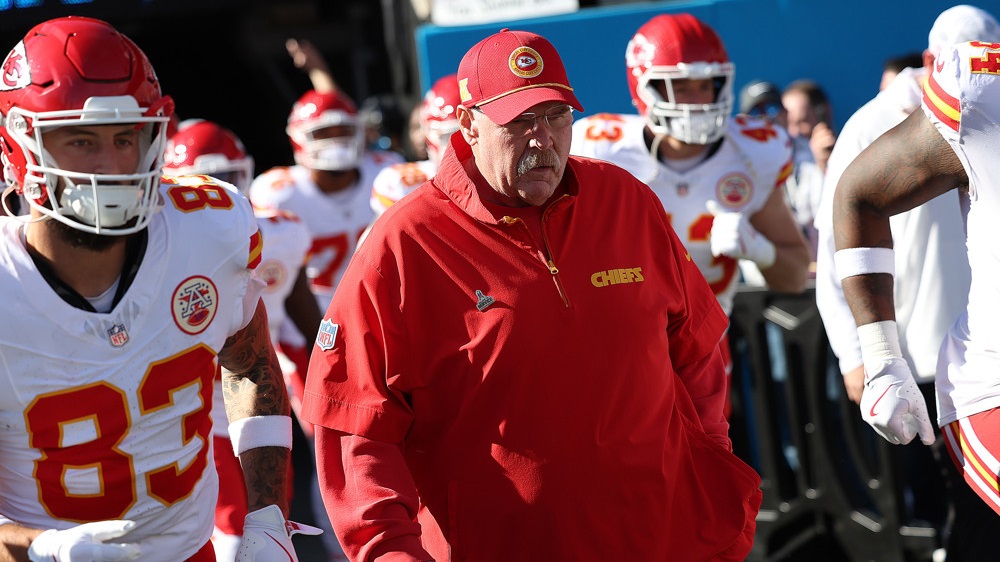
    When you win 15 games in the regular season, as the Chiefs did in 2024, you need a lot of things to go right. But things going right has been a trademark of the Andy Reid regime, Patrick Mahomes or no Patrick Mahomes (we’ll explain in a second).

    SIS has created an expected wins stat that measures how many games a team should have won based on the comprehensive suite of things that we measure from every play of every game. It utilizes a summed version of each player on a roster’s Wins Above Replacement (WAR, which emanates from our player value stat, Total Points).

    To restate, this is not a projection of future wins—this is using the players’ performance on the field as a measure of the team’s quality and converting that to an expected wins number.

    By those measures, these Chiefs were expected to win 9.8 games this season. They won 15. That’s a 5.2-win gap between actual and expected wins, which we’ll call Wins Over Expected (and somewhat-contradictorily shorten to WOE). That’s the biggest differential between actual and expected wins of any team back to 2016, the first year we started tracking football.

    The next-best is the 4.4 Wins Over Expected by Reid’s Chiefs in 2016, the year before Mahomes joined the team. Reid has three of the top six seasons in that time.

    Admittedly there are some limitations when using this stat to evaluate coaches. It can’t capture everything a head coach does. It can help show how influential timeouts, challenges, substitutions, playcalls, etc. can be, but it does not incorporate the coach’s influence in practices, drafting, free agency acquisitions, etc.

    Top Coaching Seasons

    Here are the seasons in which a team most surpassed its expected win total.

    Top Individual Seasons since 2016

    Season Coach Wins Over Expected
    2024 Chiefs Andy Reid 5.2

    (15-9.8)

    2016 Chiefs Andy Reid 4.4

    (12-7.6)

    2022 Vikings Kevin O’Connell 4.4

    (13-8.6)

    2016 Texans Bill O’Brien 4.3

    (9-4.7)

    2019 Texans Bill O’Brien 4.0

    (10.0-6.0)

    2020 Chiefs Andy Reid 3.7

    (14-10.3)

    As noted, Reid, who often polls as one of the NFL’s best coaches, has three of the top six seasons in that time (two with Mahomes). Kevin O’Connell led the Vikings to a very surprising finish in 2022 and received heaps of praise for his immediate impact during his first season as a head coach.

    The coach that is not thought of in the same breath as Reid and O’Connell is Bill O’Brien. Off-the-field issues are not a part of the metric, but during his first six seasons as the Texans head coach he finished at least two games above .500 every year except one. Additionally, our metric suggests that the Texans lacked a lot of high-end valuable players and were expected to finish at or under .500 every year, making what they did under O’Brien all the more impressive.

    Worst Coaching Seasons

    The bottom of the list is interesting for different reasons.

    Worst Individual Seasons since 2016

    Season Coach Wins Over Expected
    2019 Cowboys Jason Garrett -5.2

    (8-13.2)

    2016 Saints Sean Payton -4.2

    (7-11.2)

    2023 Bills Sean McDermott -4.1

    (11-15.1)

    2016 Chargers Mike McCoy -4.0

    (5.0-9.0)

    2016 Panthers Ron Rivera -4.0

    (6.0-10.0)

    2017 Browns Hue Jackson -3.9

    (0-3.9)

    One of the first things that stands out is that almost all of these teams were supposed to be good or even exceptional based on player performance (except the Browns). Of the top coaches, there were a mix of teams that were supposed to miss the playoffs as well as playoff teams.

    Sean McDermott is the only coach on this list still with his team. On the other side, Jason Garrett was fired after the 2019 season, Mike McCoy was fired after the 2016 season, and Hue Jackson was fired midway through the following 2018 season.

    This data set is certainly interesting to look at, but coaches and teams have ups and downs. Sean Payton followed up a 2016 season in which the Saints were four wins below expectations with four straight playoff berths, and Ron Rivera made the playoffs the year after his Panthers were four wins below expectations as well. To look at coaches, it makes sense to look at their career in cumulative terms.

    Most and Fewest Total Wins Over Expected since 2016


    Coach Total Wins Over Expected
    Mike Vrabel 10.1
    Mike Tomlin 9.9
    Pete Carroll 9.7
    Kevin O’Connell 8.1
    Bill O’Brien 7.9
     

    Coach Total Wins Over Expected
    Doug Marrone -9.6
    Bruce Arians -9.2
    Anthony Lynn -7.7
    Hue Jackson -7.1
    Doug Pederson -6.5

    As noted earlier, O’Brien and O’Connell had multiple seasons where they greatly exceeded expectations, so it is not a surprise to see them at the top of the list of coaches with the most excess wins. Mike Tomlin and Pete Carroll are both Super-Bowl-winning head coaches with sustained success.

    New Patriots coach Mike Vrabel being No. 1 may be a little bit of a surprise, but he overperformed his team’s expected wins in five of his six seasons as the Titans head coach. The only season the team underperformed was his last. If you hear anyone say that Vrabel gets the most out of his players, think back to his presence atop the list here.

    Reid actually didn’t make this list, as despite those three great seasons for exceeding expectations, the sum of his other six dropped him below the top five. He’s 7th at + 7.3.

    The bottom coaches are a wild mix. Doug Marrone and Hue Jackson are not surprises as they both had a lot of losses in a short amount of time and were quickly shown the door. Anthony Lynn had ups and downs, but his team underperformed in his final two seasons. The other two coaches are very interesting as they both won the Super Bowl. Bruce Arians lost a lot of wins due to some really high expectations for his teams. Even the 2021 Buccaneers, who were expected to win 13.8 games, technically underperformed with 13 wins. Also, the 2020 Buccaneers were expected to win 14.7 games, and won only 11 during the regular season, the biggest ding on Arians’ ledger.

    Doug Pederson has eight seasons of coaching in the dataset and is split with four seasons with positive Wins Over Expected and four seasons with negative Wins Over Expected. While the total number of seasons on each side of the ledger is equal, the impact is not. Pederson’s highest WOE was with the 2018 Eagles, who finished 1.2 Wins Over Expected. On the other side, in all four of Pederson’s negative seasons his team finished at least -1.8 Wins Over Expected, the worst being the 2024 Jaguars at -3.3 WOE.

    One interesting coach who was JUST off the bottom is Kyle Shanahan, who has -6.3 Wins Over Expected. Shanahan is often thought of as one of the greatest coaches in the NFL currently, but, according to the metric, he often underperforms. His teams are often loaded with top-end skill position players, and despite how highly one would rank Brock Purdy in terms of NFL quarterbacks, he is not a negative asset to his teams.

    Shanahan has eight seasons in the dataset as well, but amazingly, only two are above zero. As is the case with some other coaches, the expected wins for some of his teams were really high. His worst season was with the 2023 49ers, whose expected wins were 14.6, and they won “only” 12 games (-2.6 WOE), but his next three worst seasons had lower expectations. The 2020 and 2024 49ers were expected to win roughly eight games, they only won six each year, and the 2018 49ers were expected to win five when they only won four.

    One issue with that current list is it does not account for time. Bad coaches are usually fired and good coaches are usually with a team for longer. The final list helps control for that by averaging the Total Wins Over Expected across three seasons. So for everyone with at least 16 games coached, this is what we’d expect from them in 3×17 = 51 games. 

    Most and Fewest Total Wins Expected per Three Seasons since 2016


    Coach WOE/3 Seasons
    Kevin O’Connell 8.1
    Dave Canales 7.4
    DeMeco Ryans 7.0
    Brian Flores 5.5
    Bill O’Brien 5.2
     

    Coach WOE/3 Seasons
    Mike McCoy -12.9
    Hue Jackson -7.6
    Lovie Smith -7.4
    Brian Callahan -7.3
    John Fox -6.3

    O’Brien makes the list again with two highly-thought-of young coaches, O’Connell and DeMeco Ryans, joining him on the list. Dave Canales has only one season under his belt so there is still plenty to figure out, but he did earn 2.5 WOE from this past season with the Panthers. Also included in the top-five is Brian Flores who earned positive WOE in each of his three seasons as the Dolphins head coach.

    Most of the bottom coaches do not have a robust dataset since 2016 for the reason mentioned earlier: head coaches with bad results tend to get fired quickly. Mike McCoy and Lovie Smith have only one season in the dataset and both performed well under expected. Titans head coach Brian Callahan also has one season, but it was only his first so there may be time to turn things around, especially if they hit on their 2025 NFL Draft picks. John Fox and Hue Jackson both have three seasons, although Jackson did not finish his third, but both were shown the door.

    It is not easy to try and determine what makes a good NFL head coach. There are so many intangibles that make it difficult to separate out the raw data coupled with an uneven player talent pool. But nonetheless, we try with Wins Over Expected to measure some of it in aggregate.

    Reid has turned productive Wins over Expected seasons into Super Bowl trophies, which is why, even if the metric makes it seem close, people do not think about Andy Reid in the same manner as Bill O’Brien.

  • Examining The Super Bowl Injury Storylines

    Examining The Super Bowl Injury Storylines

    Photos: Kyle Ross (left) and Mark Albert (right)/Icon Sportswire

    This week is the first weekend without an NFL game since the preseason, signaling we are winding down on a thrilling season, hopefully capped by an exhilarating Super Bowl next weekend. With only two teams left standing we are left with only a few injury storylines heading into the big game. 

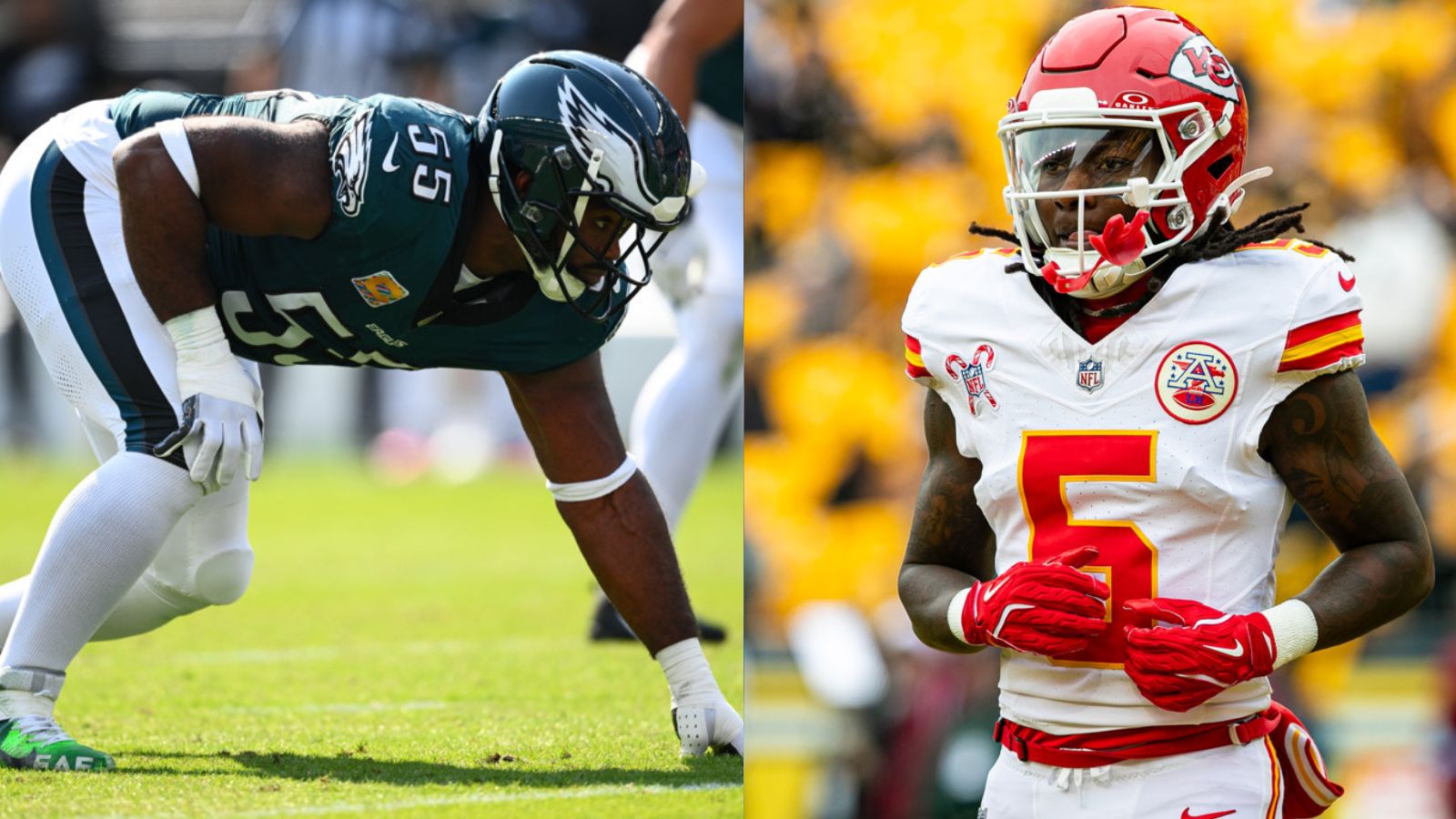
    The Eagles played with a shuffled offensive line in the NFC Championship. It didn’t seem to negatively affect them too much against Washington, but are still dealing with injury issues on that front. We highlighted the loss of Nakobe Dean in the divisional round, but his replacement has done a nice job filling the hole that he left. Finally, a 36 year-old defensive end who was a hero in Super Bowl LII looks to potentially make a comeback for the biggest game of the season.

    On the other side, Kansas City looks to be going into the game relatively healthy. The most notable injury storyline for the Chiefs is how the return of a few players who missed a majority of the season has positively impacted their team on both sides of the ball.

    Landon Dickerson

    For the Eagles, Landon Dickerson suffered a left knee injury in the NFC Championship game. He was playing center as opposed to his normal left guard spot, filling in for Cam Jurgens who went into the game with a back injury. Dickerson toughed it out until halftime but couldn’t continue, and the already injured Jurgens stepped in. 

    It would be a big loss if either of them can’t suit up, it’s a small sample size (under 200 snaps), but without Landon Dickerson on the field for the Eagles, the team’s rushing metrics take a big hit.

    Dickerson On The Field Dickerson Off The Field
    Rushing EPA/60 Plays 6 -7
    Team Blown Block % 12.8% 21.0%
    Rushing Yards Before Contact 2.6 0.9
    Rushing Yards Per Attempt 5.7 3.6

    Saquon Barkley specifically has 20 carries for only 69 yards when Dickerson is on the sideline this season. These metrics all trend the same way if the team has missed Cam Jurgens this season as well. If he’s limited or unable to play, Dickerson could draw another start at center for the Super Bowl if his knee allows it.

    Tyler Steen was playing left guard last week when Dickerson and Jurgens were rotating at center. For the season he’s given up 9 blown blocks in 173 snaps, good for 5% of the time. On the other hand Dickerson has only given up 14 in 1,049 snaps at left guard, 1.3% of the snaps. 

    As the Eagles portrayed in the NFC Championship, they can be successful mixing and matching their offensive line, but when trying to lift the Lombardi Trophy, and going against a Chiefs team who hasn’t allowed a 100 yard rusher in their last 18 playoff games, having their best players in their best position is vital to their chances. 

    Nakobe Dean’s Replacements

    We highlighted how Oren Burks has had some experience filling in for injured players in big games before. In the last 2 games where he’s started for the injured Dean at linebacker, he’s filled up the stat sheet.

    Over those two games, Burks is tied for the playoff league lead in tackles for loss. He is 4th in combined tackles with 15, and among defenders with at least 3 targets against he’s tied with teammate Quinyon Mitchell for 2nd in Pass Coverage Total Points. He’s rushed on only 10% of his pass snaps but has mixed in 2 pressures with a sack. He’s filled the gap left by losing Dean nicely, and his well-rounded game is part of the reason the defense hasn’t missed a beat.

    Brandon Graham Returning?

    Brandon Graham was having a resurgence this season, having a monster impact on the Eagles defense, until he tore his tricep in Week 12. After what was deemed to be a season-ending injury, the Eagles have opened his practice window from IR, leaving the door slightly open for him to make a comeback. 

    Brandon Graham On/Off Splits in 2024

    On The Field Off The Field
    Opposing Offense Passing EPA/60 Plays -12 1
    Opposing Offense Rushing EPA/60 Plays -16 -5
    Eagles Sack % 9.6% 5.8%

    While the Eagles have missed his experience and tenacity for the back half of the season, his injury has allowed for the emergence of Nolan Smith, who is coming into his own in his second season. His snap count jumped drastically after Graham went down and he’s taken advantage of the opportunity. Since Week 13, the first game Graham missed, he’s 22nd in Pass Rush Total Points per play among the 124 pass rushers with at least 100 rush snaps. Teammates Moro Ojomo and Jalen Carter are right in that neighborhood, with opponents Chris Jones and George Karlaftis higher up. You probably need some dominant pass rushers if you want to be playing in February. 

    Chiefs key returnees

    While there aren’t any glaring injury issues for Kansas City going into the Super Bowl, they had to endure their fair share during the regular season leading up to this point. 

    Losing Rashee Rice for the year to a knee injury in Week 4, combined with the preseason clavicle injury that sidelined offseason acquisition Hollywood Brown, left the Chiefs thin at WR early on. The growth of Xavier Worthy, the addition of Deandre Hopkins, and adding Brown back into the fold now leaves them with a wealth of playmakers for the Super Bowl. 

    Brown came back for his first game as a Chief in Week 16, as he’s gotten more acclimated in this offense we can see what effect he’s had on it as a whole.

    Brown On The Field Brown Off The Field
    Total Offense EPA/60 Plays 11 2
    Passing EPA/60 Plays 15 6
    Rushing EPA/60 Plays 4 -4

    While not directly correlated, an interesting fact this season is that Patrick Mahomes has yet to throw an interception with him on the field, after he threw 11 in the first 10 games of the season. 

    Since Xavier Worthy is so fast, people think he’s the field stretcher, but he sits 4th on the Chiefs in average depth of target, behind Justin Watson, the aforementioned Brown, and even Hopkins. The Chiefs look to get the ball in his hands quickly and then let him do the rest with his legs, instead of launching the ball to him downfield. He leads the team in yards after catch as 482 of his 768 yards this year have happened after the ball was in his hands. 

    So it’s actually Brown who helps stretch the field, and this gives a player like Travis Kelce more room to operate. Kelce averages 9.3 yards per reception sharing the field with Brown compared to 6.5 when he’s been sidelined. This offense has gotten more complete, efficient, and dynamic since Brown entered the lineup and we’ll see if Andy Reid has any tricks up his sleeve for the Super Bowl.

    On the other side of the ball, CB Jaylen Watson missed the last 11 games of the regular season with a broken leg but returned for the playoffs. It’s been a welcome return for the Chiefs’ defense. For the season he ranks 3rd in the entire league in completion % allowed (38.5%). Interestingly enough the team’s overall pressure percentage on QB’s jumps to 43%, up from 35%, when he’s on the field.

    Not only has his presence improved the defense as a whole, but individually his running mate Trent McDuffie sees a bump in his performance as well. McDuffie gave up 5.7 yards per target when Watson wasn’t on the field, that goes down to only 3.6 when they’re on the field together. As Watson has gotten more reps under his belt during the playoffs coming off a serious injury, he’s getting more comfortable making an impact for this defense and making everyone around him better. We’ll see how well he and the whole unit can perform against the Eagles’ punishing offense.

  • What Two Statistical Mismatches Tell Us About Football Analysis

    What Two Statistical Mismatches Tell Us About Football Analysis

    This weekend the Eagles play the Commanders in the NFC Championship Game. One of the big questions is Jalen Hurts’ health, which primarily matters because in theory the Eagles should have an advantage through the air.

    Here are a couple of compelling schematic splits to make the argument.

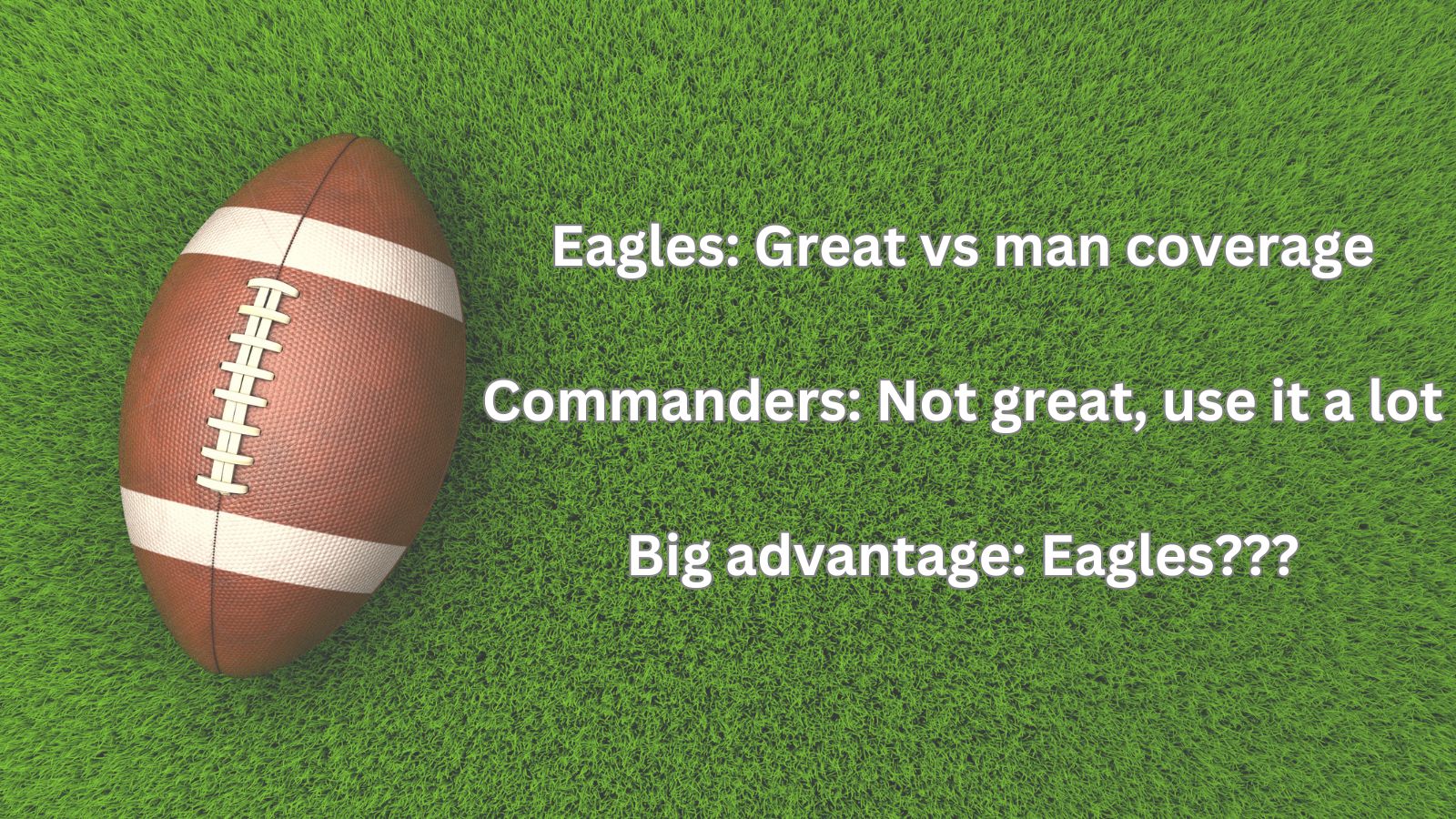
    The Commanders defense is 3rd in man coverage usage this year. The Eagles offense is 2nd in success rate* against man coverage, conveniently enough. And Washington’s 23rd defensively. 

    The Commanders are 7th in middle-of-the-field closed (MOFC, i.e. single-high) coverage usage. The Eagles are 3rd in success rate against single-high, and Washington is 19th defensively.

    Success rate = The percentage of plays where the offense’s expected points improved as a result of the play (explanations of expected points can be found in many places, including this article explaining our Total Points stat)

    Huge mismatch alert, right? Welllll…

    Over the last four seasons, there have been a handful (or three) of examples each of similar mismatches late in the year (big gap in ranks, common split for the defense). In those spots we’d expect the offense to feast, potentially with a higher success rate than their average because they’re playing a below-average defense. 

    But that’s not what we find. The in-game success rate is a good bit lower than what both teams had produced prior.

    Results in games with mismatches significantly favoring the offense, 2021-24 Weeks 13+

      Vs Man Coverage Vs MOFC
    Games 11 15
    Offense Previous Success% 51% 52%
    Defense Previous Success% 47% 52%
    Game Success% 41% 47%

    And this isn’t just an isolated phenomenon. I identified dozens of splits—coverage, blocking scheme, run direction, personnel, etc.—and looked for late-season mismatches based on previous performance. This includes games where the defense should be expected to dominate. And the results look similar, albeit a bit tempered.

    Results in games with mismatches, by mismatch type. 2021-24 Weeks 13+

    Favors Offense Favors Defense
    Games 1632 1453
    Offense Previous Success% 51% 40%
    Defense Previous Success% 50% 40%
    Game Success% 47% 41%

    I take three interpretations from this. I’ll lead with the simplest one that is worth mentioning in lots of situations.

    Sample size, regression, etc.

    All of the included mismatches and splits had reasonably robust sample sizes associated with them. Each individual team’s history in a given split might not be super large, but aggregated over the whole league we get hundreds and thousands of plays to work with. 

    However, everything in football is to some extent a small sample. Each team only gets a few dozen passes and a couple dozen runs a game. To analyze anything, you either have to take those results in aggregate and bundle up a bunch of dissimilar plays, or you have to isolate more homogenous but smaller splits. Even having 12 weeks of data in-season and some 50 plays in a fairly refined split is a pretty small amount. So it’s fair to assume that simple regression to the mean plays a big part in mismatches not manifesting in the aggregate.

    Football is a cat-and-mouse game

    Coaches and players engage in constant retooling week to week. Most of these advantages and disadvantages are known to both teams, so they’re each accounting for it (and expecting their opponent to do the same). Highlighting your strengths, nudging away from your weaknesses, avoiding your opponent’s strengths, attacking their weaknesses, all of these tactical gambits happen each week to jumble up the puzzle of figuring out what’s going to happen in a given game.

    Stats don’t stand on their own

    I think this finding emphasizes the value of the interaction of data analysis and film study. I was able to programmatically identify thousands of mismatches between teams in the span of a few minutes. But each of those mismatches has a story behind it, an understanding of the personnel and coaching that can inform the extent to which those findings are bankable going forward.

    Take the Eagles/Commanders passing game splits from above. We know that these teams have played twice already this year. In those games, the Commanders ran Cover 1 (man coverage with a single high safety) 52% of the time. That was nearly double their rate from other games. And in the game that mostly featured a limited passing game (Kenny Pickett at quarterback), they were even more Cover-1-heavy. So we can feel more confident this split will be prevalent in this matchup.

    But the Commanders also had substantially different performances in Cover 1 from game to game. The Eagles had a 57% success rate against it in their Week 11 win, which contributes substantially to their overall excellence in the man and single-high splits (and the Commanders’ struggles). But in the Pickett game they had just a 39% success rate, and even if Hurts plays, his recent performance suggests that his effectiveness will be closer to that of Kenny Pickett.

    So while the above splits are informative of what the game might look like, they’re not necessarily informative of how it’ll work out in a single game. Each time we do any research or cite any stat, we should take it as a conversation starter rather than as a conversation ender

  • How Nakobe Dean’s Absence Will Impact the Rams-Eagles Game

    How Nakobe Dean’s Absence Will Impact the Rams-Eagles Game

    Photo: Andy Lewis/Icon Sportswire

    Winning the Super Bowl is one of the hardest achievements in sport, if not the hardest. With the recent addition of a 17th regular season game, teams will have to play 20 or 21 games to earn the right to hoist up the Lombardi Trophy. 

    Nobody is ever at 100 percent come playoff time due to the sheer physical nature of the NFL. In the playoffs, the margins are as slim as ever and injuries can derail a team’s dreams. We saw it this past weekend when the Packers were decimated with in-game injuries on offense at wide receiver and offensive line. That’s definitely not the only reason why they lost, but it never felt like the Packers could make a late game comeback that shorthanded. 

    However, the most impactful injury from that game was when Eagles linebacker Nakobe Dean tore his patellar tendon late in the 2nd quarter that will sideline him for the rest of the playoffs, and potentially, part of the 2025 season. 

    Dean had a breakout 2024 season in his first season under defensive coordinator Vic Fangio where he beat out veteran free-agent Devin White for the starting Mike LB position. Dean finished the season ranked as the 7th-best LB in Run Defense Total Points with 20. Among all LBs with 50 tackles, he ranked 4th in Run Defense Total Points Per Play.

    Against the Rams in Week 12, he was a force to be reckoned with, registering 8 tackles, 2 tackles for loss, 1 sack, and 1 fumble recovery in a performance that generated 3 Total Points. 

    It’s hard to draw conclusions from a one-game sample size, however, against the Packers, the Eagles were clearly better at stopping the run before Dean exited the game. The table below shows the rushing splits for when Dean was on and off the field:

    Packers Offense With Nakobe Dean …

    On-Field Off-Field
    Attempts 12 11
    Yards/Attempt 3.8 5.6
    Yards After Contact/Attempt 3.1 5.2

    Despite facing a similar amount of rushes, the Packers were able to find more success on the ground with Dean sidelined. Now, some of this could be attributed to game flow, however, I don’t think that’s the only reason. 

    Take for instance, Josh Jacobs’ 31-yard run to end the 3rd quarter on an outside zone run concept. On this play, Dean’s replacement, Oren Burks, gets caught overpursuing, allowing Jacobs to cut back. Burks is able to track back before Jacobs ultimately breaks his attempted tackle before bulldozing through another couple defenders before getting brought down at the 1. 

    Now, that is just one individual play that included an incredible individual effort by Jacobs. However, Sean McVay, one of the league’s best game-planners and play-designers is going to try and exploit the absence of Dean in a number of ways. 

    McVay loves to use motion and play action as the Rams rank 2nd and 10th in motion and play action usage, respectively. Utilizing motion and play-action puts a lot of stress on opposing defenses, especially LBs, as McVay crafts unique ways to create leverage advantages for his blockers. 

    McVay and the Rams utilize a zone-heavy running scheme to set up easy rushing lanes off of the leverage advantage mentioned above. The table below shows the EPA Per Play for the Rams offense and Eagles defense when running or facing zone runs this season: 

    On Zone Runs

    Rams Offense Eagles Defense
    Zone Run EPA/Play -0.05 (12th) -0.04 (22nd)

    This is where McVay and the Rams will have their best chance to take advantage of Dean’s absence. Zone-running schemes are built around setting up cut-back lanes to take advantage of over-pursuing LBs. Sound familiar to the Jacobs play above? 

    McVay will look to cause confusion pre-snap against the Eagles defense as the players in the  Eagles back 7 will need to be on point with their communication. That is a lot more difficult when the heart and soul of the middle of your defense is sitting on the sidelines. 

    Luckily for the Eagles, Burks should have some familiarity with facing McVay’s Rams as he was a member of the 49ers for the past two seasons. He’s also all too familiar with replacing an impact LB in the playoffs, as he filled in for Dre Greenlaw in last year’s Super Bowl after Greenlaw suffered a freak Achilles injury running on to the field. That was another reminder of how one injury can change a playoff game and leave a franchise and its fanbase asking “What if?”

    Burks is accustomed to this situation and was also able to get some much-needed experience as he started the final two games of the season with Dean sidelined with an abdominal injury. He also was the one to force the fumble on the opening kickoff that totally flipped the script of the Wild Card game. 

    The Eagles will need to rely on Zack Baun, another breakout LB that earned All-Pro honors in his first year with the Eagles. He’ll be tasked with the responsibilities of relaying play-calls and handling all communications, although he does have experience this year, as he wears the green dot during dime packages when Dean would get subbed off. 

    Replacing Dean’s play on the field will be difficult enough, but replacing the intangibles that he brings day-in and day-out as a leader of the defense will be even more paramount as they try and make a run to the Super Bowl.

  • 2024 SIS NFL All-Pro Team

    2024 SIS NFL All-Pro Team

    It’s time to unveil our All-Pro team for the 2024 NFL season. We used our all-encompassing player value stat, Total Points, along with other metrics and our scouting work as leading references in putting together our selections.

    A brief explanation of Total Points:

    Total Points takes nearly everything that SIS measures about a play and uses it to evaluate each player on a scale that allows you to compare them more easily. It’s always useful to be able to understand the different ways in which players can be valuable. Does he break a lot of tackles? Does he get a lot of yards after the catch? Does he make the best out of a poor offensive line? Does he get more pressures than expected? Does he break up a lot of passes? Total Points offers the opportunity to take all of those elements and get a quick picture of how well a player is performing overall.

    You can learn more about Total Points and the statistics referenced within this piece here.

    1st Team Offense

    Position Name Team
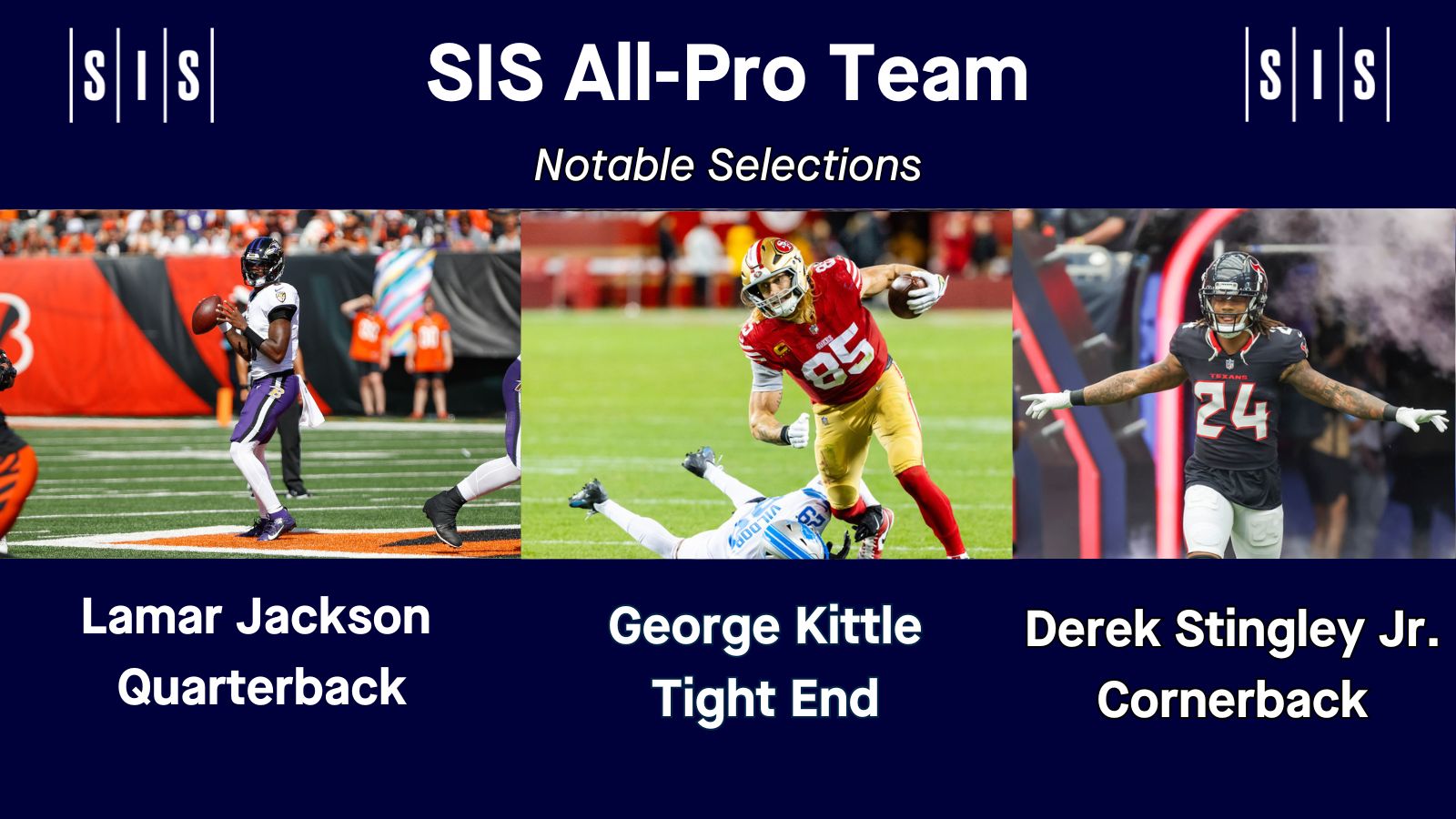
    QB Lamar Jackson Ravens
    RB Derrick Henry Ravens
    RB Jahmyr Gibbs Lions
    WR Justin Jefferson Vikings
    WR Ja’Marr Chase Bengals
    TE George Kittle 49ers
    T Brian O’Neill Vikings
    T Tristan Wirfs Buccaneers
    G Landon Dickerson Eagles
    G Kevin Zeitler Lions
    C Hjalte Froholdt Cardinals

    QB – Lamar Jackson – Ravens

    Jackson had yet another MVP-caliber season, and unlike previous years, he did most of his damage in the air. He led the NFL in Passing Total Points per Play, EPA, Boom%, and Points Above Average. Only Joe Burrow had more Passing Total Points than Jackson, but Jackson easily outperformed Burrow as a rusher. – Anthony Haage

    RB – Derrick Henry – Ravens 

    Henry added on to his Hall of Fame career in his first season with the Ravens. Not only did he lead the league with 46 Rushing Total Points, he led the league in yards after contact with 1,096 yards, which accounts for more than half of his total rushing yards on the season. While he finished second in total rushing yards with 1,921, behind only Saquon Barkley, he finished the season atop the RB leaderboard with 94 1st Downs gained, and 66 total broken and missed tackles combined. – Jordan Edwards

    RB – Jahmyr Gibbs – Lions

    Gibbs, also known as “Sonic”, capped off a breakout second season with a 4-TD performance in the season finale against the Vikings where he showed his capabilities as a lead back after splitting the workload with David Montgomery. Gibbs led all running backs in Total Points. Among all RBs with at least 50 carries, he led the league in Total Points per Play and Points Above Average per Play. – JD Allen

    From our R&D team: If you’re wondering why Gibbs was picked over over Barkley, from a statistical perspective, Gibbs has several advantages

    –  More rush EPA on considerably fewer attempts 

    – A better first down rate

    –  A little better boom/bust ratio 

    (“boom” being plays worth at least 1 EPA, “bust” being plays worth -1 EPA). 

    – Gibbs also had a 14-point edge in Total Points on plays in which the offensive line blew a block (there were 34 plays for him, 36 for Barkley). That’s a significant differential.

    WR – Justin Jefferson – Vikings

    Jefferson was one of the easier selections on this team as he torched the NFL this season. His base stats are extremely impressive with 103 receptions, 1533 yards, and 10 TDs, but diving into the stats makes them look even better. He had an NFL-leading 28 receptions of 20+ yards (7 better than 2nd place), led the NFL in air yards, and pass interference calls drawn. – Jeff Dean

    WR – Ja’Marr Chase – Bengals 

    Chase had a monumental season for the Bengals, finishing 1st among all pass catchers with 1,708 receiving yards and 17 TDs. In terms of Receiving Total Points, he finished 2nd among all WRs in the league with 35. – Jared Maslin

    TE – George Kittle – 49ers

    Kittle had the definition of an All-Pro season for a tight end in 2024. He easily led all tight ends in Total Points, led all players in Receiving Total Points, and he also was the league’s best run-blocking tight end. He did so while being the only receiver with less than 100 targets (94) in the Top 5. Rashod Bateman was the only player who outperformed Kittle in Boom%. – Anthony Haage

    T – Brian O’Neill – Vikings

    An unheralded stud on the Vikings offense was their right tackle, O’Neill. He tied for the most Total Points among tackles with 38, and he was remarkably balanced, finishing Top-12 in both Pass Blocking Total Points and Run Blocking Total Points. His standout 1.9% Blown Block Rate further cemented his place as one of the top tackles in the NFL. – Jeff Dean

    T – Tristan Wirfs – Buccaneers

    Wirfs had yet another stellar season for the Buccaneers. He led all left tackles in Pass Blocking Total Points and Points Above Replacement. Given his pass blocking prowess combined with elite penalty avoidance and a top tier blown block rate, there is no debate over Wirfs’ inclusion in our All-Pro 1st team. – Conner Hrabal

    G – Landon Dickerson – Eagles

    Dickerson reinforced his elite status by leading all offensive linemen with 40 Total Points. He was particularly dominant in regards to his run blocking and his 11.5 Run Blocking Total Points, which landed him at the top of the NFL for the second consecutive season. Among left guards, he had the lowest Blown Block Rate, highest Total Points per Snap, and highest Points Above Replacement. – Kyle Shatto

    G – Kevin Zeitler – Lions

    Zeitler had a tremendous first season with the Lions as he finished 2nd among all offensive guards in Total Points with 39. He was the lone guard to finish inside the Top-5 in Pass Blocking Total Points and Run Blocking Total Points, finishing 2nd and 5th, respectively. The veteran guard has shown no signs of slowing down in his 14th NFL season. – JD Allen

    C – Hjalte Froholdt – Cardinals

    Froholdt was a rock for the Cardinals this season. He led all centers in Total Points, Total Points per Snap, Points Above Average, Points Above Average per Snap, and Points Above Replacement (minimum 700 snaps). While one of the more surprising selections, he absolutely earned it. – Conner Hrabal

    1st Team Defense

    Position Name Team
    DT Jeffery Simmons Titans
    DT Cameron Heyward Steelers
    EDGE Jonathan Greenard Vikings
    EDGE Myles Garrett Browns
    LB Zach Baun Eagles
    LB Kaden Elliss Falcons
    CB Derek Stingley Jr. Texans
    CB Pat Surtain II Broncos
    CB Marlon Humphrey Ravens
    S Kerby Joseph Lions
    S Julian Love Seahawks

    DT – Jeffery Simmons – Titans

    Simmons absolutely toyed with offensive linemen this season. He finished the season with 51 Total Points, tops among defensive tackles. He finished 4th in Pass Rush Total Points per Snap and 1st in Run Defense Total Points per Snap, showing extreme effectiveness in all areas of the game. Simmons is truly one of the best players in the game today. – Jeff Dean

    DT – Cameron Heyward – Steelers 

    Heyward put together another great season on the Steelers defensive line. He finished 2nd for all DTs in Pass Rushing Total Points with 28 and 4th in Run Defense Total Points with another 18. He also finished T-4th with 47 pressures and 5th in Tackles per Game with 4.2 Tkl/G for all DTs. – Chad Tedder

    ED – Jonathan Greenard – Vikings

    The Vikings defense took a big step forward this season, and while his teammate Van Ginkel may get a little more attention, Greenard was a force on the edge all season. He finished the season with 12 sacks, 18 tackles for loss, 4 forced fumbles, and 3 passes batted/deflected. His 50 Total Points led Edge players. He finished T-7th in pressures with 68. – Jeff Dean

    ED – Myles Garrett – Browns

    Garrett was second in the league in sacks this year with 14. He also had tied for the 5th-most pressures in the league with 69. Garrett is as consistent as they come year after year, as this was his seventh year in a row with 10 or more sacks and his fourth consecutive year with a Pressure Percentage over 16%. – Ryan Rubinstein

    LB – Zach Baun – Eagles

    Yet another Howie Roseman success story, Baun made a key position switch to linebacker this past offseason and hasn’t turned back since. He ranked 2nd among linebackers with 23 Total Points against the run, he took a monumental step forward in solidifying his role in the NFL as a premier linebacker. – Kyle Shatto

    LB – Kaden Elliss – Falcons 

    Elliss put together a quietly good season for the Falcons, coming in at 6th among all LBs with 148 total tackles. He finished 6th in Pass Defense Total Points with 20. Elliss also contributed to the Falcons pass rush as he finished T-5th among all LBs with 11 knockdowns on opposing passers. – Jared Maslin

    CB – Derek Stingley Jr. – Texans 

    Stingley Jr. had his best season yet in his young NFL career. The former top-5 pick ranked 3rd at cornerback with 35 Pass Defense Total Points only trailing the other two 1st-Team selections, Marlon Humprey and Patrick Surtain respectively. He also was tied for 3rd among cornerbacks in total interceptions with 5. He led all cornerbacks with 16 passes defended and was not called for any pass interference penalties all season. – Jordan Edwards

    CB – Patrick Surtain II – Broncos

    One of the easiest selections for the team was Surtain. He led all CBs with 52 Total Points, and was also effective on a per-snap basis, finishing 2nd in Pass Defense Total Points per Snap. He had a QBR Against of just 68.4 when targeted, and his 32 Points Above Replacement were one of the highest among all NFL defenders this season. – Jeff Dean

    CB – Marlon Humphrey – Ravens 

    Humphrey continues to impress as he put together yet another stellar season for the Ravens. The star corner led all of their defenders with 47 Pass Defense Total Points, and he had an EPA of -25 when targeted. He proved that he can also take the ball away as he finished T-2nd in the league for Interceptions with 6 total, including a pick-6.  Jared Maslin

    S – Kerby Joseph – Lions

    Joseph cemented himself as one of the elite safeties in the NFL with 55 Pass Defense Total Points, thanks to a league-leading 9 interceptions. He blew away the safety competition with the next-closest safety having 38 Pass Defense Total Points. To compare, the difference between him and 2nd is the same as between 2nd and 20th. He proved he’s not just a ball-hawk this season, finishing 14th in Run Defense Total Points among all safeties. – JD Allen

    S – Julian Love – Seahawks 

    Love finished 2nd to Joseph in Total Points among safeties. He ranked 7th among all safeties in Pass Defense Total Points with 32 points. While he finished the season with only 3 INTs, he was tied with second place among safeties in passes defended with 8. Not only was Love one of the best pass defenders at the position, he also led all safeties in Run Defense Total Points with 28. – Jordan Edwards

    1st Team Specialists

    Position Name Team
    K Chris Boswell Steelers
    P Tommy Townsend Texans
    Returner KaVontae Turpin Cowboys

    K – Chris Boswell – Steelers

    Boswell was next to automatic this year, hitting 93% of his FG Attempts. He did not miss a single extra point this season, going a perfect 35/35. He missed 3 kicks all season (2 from 50+yards), and ranked second in the league in 50+ yard FG made with 13. – Ryan Rubinstein

    P – Tommy Townsend – Texans 

    Townsend was a weapon this season in setting up the defense for success. He led the league in punts inside the 20 with 31. He also finished 4th in net average punt yards with 44.9 yards per punt. – Chad Tedder

    RET – KaVontae Turpin – Cowboys

    Turpin had another dominant year as a returner, specifically on kickoffs where he took full advantage of the new kickoff rules by accumulating 904 yards and a touchdown. He tacked on another 188 yards on punt returns as well, making him the only player to have over 1,000 return yards in the 2024 season. He was also the only player this season to score both a kickoff return touchdown and a punt return touchdown. – Chad Tedder

    2nd Team Offense

    Position Name Team
    QB Joe Burrow Bengals
    RB Saquon Barkley Eagles
    WR Amon-Ra St. Brown Lions
    WR Drake London Falcons
    WR Brian Thomas Jr. Jaguars
    TE Trey McBride Cardinals
    T Dion Dawkins Bills
    T Lane Johnson Eagles
    G Joe Thuney Chiefs
    G Quinn Meinerz Broncos
    C Creed Humphrey Chiefs

    QB – Joe Burrow – Bengals

    Burrow returned from his 2023 wrist injury with a career year. He topped the charts in the traditional counting stats, throwing for a league-leading 4,918 yards and 43 touchdowns, while also leading the league in Total Points at quarterback. – Conner Hrabal 

    RB – Saquon Barkley – Eagles

    Barkley’s historic season was one to remember, as he was just the 9th running back to eclipse 2,000 rushing yards in NFL history. If the absurd backwards hurdle wasn’t enough to make our All-Pro 2nd Team, Barkley also broke out for at least 150 rushing yards in five separate games this season, the most for a running back since Adrian Peterson in 2012. – Kyle Shatto

    WR – Amon-Ra St. Brown – Lions 

    St. Brown produced another great season in 2024, finishing T-3rd among receivers with 34 Total Points. He led all WRs in Total EPA with 81, and led the league in EPA Per Target, among all WRs with at least 50 targets. He finished 2nd in Positive Play Percentage at 69%. – JD Allen

    WR – Drake London – Falcons 

    London was yet another young wide receiver to follow the trend of making the jump to great in their 3rd season. He finished the year 4th in the NFL with 1,271 receiving yards while finishing top-8 among wide receivers in receiving touchdowns (9) and Total Points (30). – Jeremy Percy

    WR – Brian Thomas Jr. – Jaguars

    Fellow SIS All-Rookie 1st-Team members Brock Bowers and Malik Nabers got most of the spotlight for pass-catching rookies this season, but Thomas gets the nod for our All-Pro 2nd-Team. Only Ja’Marr Chase and Justin Jefferson had more receiving yards than Thomas, and they had 42 and 21 more targets than him, respectively. Thomas ranked 5th in Total Points among all receivers, which is even more impressive considering Trevor Lawrence played only about half the season. – Anthony Haage

    TE – Trey McBride – Cardinals

    McBride had a stellar season for Arizona and ended as the 11th-best receiver in terms of Total Points and ranked 10th in EPA. He didn’t get into the end zone until the final two games of the season, but he finished with 13 games played with either 5+ receptions or 70+ receiving yards. In addition to his receiving totals, he ranked as the 3rd-best blocking tight end overall for Blocking Total Points, and he ranked first in Points Above Replacement. – Anthony Haage

    T – Dion Dawkins – Bills 

    Dion Dawkins was spectacular this season as the blind side protector for the Bills’ high-powered offense. Dawkins led all offensive tackles in Total Points this season with 38. He finished top-5 among left tackles in Pass Blocking Total Points and 2nd at his position in Run Blocking Total Points. – Jeremy Percy

    T – Lane Johnson – Eagles

    Johnson continued to be a reliable force on the stout Eagles’ offensive line, limiting Blown Blocks to a lowly 1.6% rate, good for second best among all tackles (minimum 100 snaps). He amassed 32 Total Points and earned a spot on our All-Pro 2nd Team. – Kyle Shatto

    G – Joe Thuney – Chiefs

    Thuney has been a constant along the interior for the Chiefs since joining them in 2021. Thuney ranked 2nd in Pass Blocking Total Points and finished top 10 in Total Points and Points Above Replacement among left guards. – Conner Hrabal

    G – Quinn Meinerz – Broncos

    Meinerz put together another great year in the Broncos offensive line. He finished 6th among all OL in Total Points (3rd among all guards) with 37. He also finished top 10 for all OL (4th among all guards) in Points Above Replacement and limited his Blown Block Rate to 1.6% as well. – Chad Tedder

    C – Creed Humphrey – Chiefs

    Humphrey was an anchor on the Chiefs interior line. He was first among all linemen in Passing Blown Block Rate with 0.6% (minimum 400 pass blocking snaps). He was also top-10 in Rushing Blown Block Rate among centers (minimum 200 run blocking snaps), and 5th in Total Points among centers. – Ryan Rubinstein

    2nd Team Defense

    Position Name Team
    DT Chris Jones Chiefs
    DT Jalen Carter Eagles
    EDGE Jared Verse Rams
    EDGE Trey Hendrickson Bengals
    LB Zaire Franklin Colts
    LB Bobby Wagner Commanders
    CB Christian Gonzalez Patriots
    CB Kenny Moore II Colts
    S Xavier McKinney Packers
    S Kyle Hamilton Ravens
    S Geno Stone Bengals

    DT – Chris Jones – Chiefs

    It’s no surprise to see Chris Jones on one of the SIS All-Pro teams again. He led all defensive tackles in Pass Rush Total Points with 30. Additionally, while he finished with only 5 sacks in the regular season, the nine-year veteran once again wreaked havoc against offensive line units as he tied Osa Odighizua of the Cowboys for the lead among defensive tackles with 61 pressures. – Jordan Edwards

    DT – Jalen Carter – Eagles

    Carter terrorized offensive lines all season. He finished 4th among defensive tackles in Total Points and finished in the top-5 among all DTs in both Run Defense Total Points and Pass Rush Total Points. His unique, violent pass rush style allowed him to accumulate 47 pressures on the year. – Kyle Shatto

    ED – Jared Verse – Rams 

    The rookie Verse took the league by storm and put together an All-Pro caliber season. He finished 2nd in pressures among all defenders with 72, trailing only All-Pro Trey Hendrickson. He seemed to always find a way to get to opposing quarterbacks. He also was a force against opposing rushers, as he finished 1st among all DEs with 21 Run Defense Total Points. – Jared Maslin

    ED – Trey Hendrickson – Bengals 

    Hendrickson put together another stellar season, as he seemed to terrorize opposing quarterbacks. He finished 1st in Pass Rush Total Points with 39, while leading all defenders in pressures with 85, 13 more than 2nd place. Hendrickson was also the league leader in sacks with 17.5, which was 3.5 more than 2nd place. – Jared Maslin

    LB – Zaire Franklin – Colts 

    Zaire Franklin was a tackling machine this season, pacing the entire league in total tackles with 173, 10 tackles more than the next highest defender. He also finished tied for 2nd in the NFL in forced fumbles with 5. Franklin picked off 2 passes, which is tied for the league lead at his position, and contributed 21 Pass Defense Total Points, good for 5th among linebackers. – Jeremy Percy

    LB – Bobby Wagner – Commanders 

    Wagner proved again why he is headed to the Hall of Fame with another fantastic season in year 13. Wagner finished 5th among linebackers in Total Points. He ranked third in Run Defense Total Points among linebackers. He also led all linebackers with 91 of his 132 tackles being short of the 1st down marker. – Jordan Edwards

    CB – Christian Gonzalez – Patriots

    As a second-year pro, Gonzalez ranked 3rd among cornerbacks in Total Points. He had 29 Pass Defense Total Points and 12 Points Above Average which ranked Top-8 among CBs. He was also sixth with 77 targets against him, but held opponents to a measly -0.01 EPA Per Target. – Ryan Rubinstein

    CB – Kenny Moore II – Colts 

    Kenny Moore II has been one of the premier slot corners in the league for the past several years, and this year was no different. Moore ranked 5th among cornerbacks in Total Points. He was an all-around demon on the field this year, finishing top-10 among cornerbacks in interceptions (3), tackles for loss (7), Pass Defense Total Points (27), and returned a fumble for a touchdown. – Jeremy Percy

    S – Xavier McKinney – Packers 

    After making a move to the Packers in the offseason, McKinney put together a great season in their secondary. He forced 8 interceptions (2nd most in the league) and totaled 32 Pass Defense Total Points which ranked 5th for all safeties. He also finished Top-10 in Points Above Replacement. – Chad Tedder

    S – Kyle Hamilton – Ravens 

    Kyle Hamilton has quickly become widely regarded as one of the best three-level players in the NFL, making his presence felt all over the field. He finished the 2024 season 7th among safeties in Pass Defense Total Points with 26. He also ranked 4th at his position with 12 pressures (2 sacks) and tied for 3rd in Pass Rush Total Points with 8. – Jeremy Percy

    S – Geno Stone – Bengals

    In a down season for safeties across the league, Stone was a consistent piece in the secondary for the Bengals. He finished 2nd in Coverage Total Points and 2nd in Coverage Points Above Replacement at the safety position to go along with 4 interceptions. His availability was key in his inclusion here with him being 1 of 8 safeties to play more than 600 coverage snaps this season. – Conner Hrabal

    2nd Team Specialists

    Position Name Team
    K Brandon Aubrey Cowboys
    P Matthew Hayball Saints
    Returner Kalif Raymond Lions

    K – Brandon Aubrey – Cowboys

    Aubrey has solidified his place as one of the top kickers in the league, and a lot was asked of him as his 46 FG attempts led the league. Not only was he perfect on extra points, but he also led the league in 40+ and 50+ yard FGs. – Ryan Rubinstein

    P – Matthew Hayball – Saints

    Hayball had a phenomenal season punting for New Orleans, ranking first in the NFL with 27 fair catches, and he had the second-most punts inside the opponents 20 (28). Only Tommy Townsend had more punts inside the 20, but Hayball had less touchbacks than the All-Pro first teamer with just 3 on the year. – Anthony Haage

    RET – Kalif Raymond – Lions

    Raymond led the league with 413 punt return yards while he also added a punt return touchdown to his tally. He had a career-game against the Titans as he recorded 190 PR yards and a TD, and he played a huge part in that Week 9 showdown at Ford Field. – JD Allen

  • Chalk Talk!: NFL Playoff Team Offensive Schemes

    Chalk Talk!: NFL Playoff Team Offensive Schemes

    The Wild Card Round is upon us, and perhaps the only team you were able to keep up with religiously during the season was your own. A lot goes on in the NFL every week, and you’ve likely caught some glimpses at other teams here and there, maybe during island games, but might not have as good a grasp on the other 31 teams as you do your own. 

    That’s where this scheme primer comes in. Here, we’ll be providing you with a brief crash course on the offenses of the Wild Card Round teams, packed with advanced tendency stats and football terms you may want to use to flex on your friends in the group chat this weekend. Without further ado, let’s get started.

    AFC

    #2 Seed Buffalo Bills

    The Bills do some interesting stuff on offense. They put their running backs in motion more than any team but the Dolphins, and their backs have the second-highest ADoT of any team in the league. They get their backs out into the pattern at a high rate, but they’ll get them into corner routes and seams rather than just out into the flats or over the ball, which is symptomatic of a passing game that is generally downfield-oriented with high horizontal stretches (e.g. double post) and outside vertical stretches. 

    They are zone-run heavy (like most teams), which are well-suited to James Cook’s skillset, but they have moving parts gap schemes to supplement it, and will, needless to say, use Josh Allen on designed runs out of these looks. 

    Lastly, they rank sixth in both RPO and screen rate, which is their form of quick game because they rank 24th in traditional short dropbacks.

    Re’stat’ing for emphasis: The Bills’ put their running backs in motion the second-most of any team and have the second-highest ADOT.

    #3 Seed Baltimore Ravens

    This is the bullyball team of the AFC. Two-thirds of the Ravens’ offensive snaps are played in heavy personnel groupings, and they rank last in 11 personnel usage. 

    They run well no matter the design, ranking in the top five in success rate in both gap and zone schemes. Lamar Jackson obviously makes this easier. Teams have tried stacking the box (second-highest rate in the league) but the Ravens rank first in stacked box run success rate. 

    The juice in the passing game comes from intermediate and deep concepts, with Jackson having the second-highest ADoT in the NFL and 30% of his throws targeting verticals, post, corners, and crossers. As a result, he’s the quarterback with the highest Boom Rate in the NFL (plays gaining an expected point or more).

    Re’stat’ing for emphasis: Two-thirds of the Ravens offensive snaps are in heavy personnel

    #4 Seed Houston Texans

    The Texans’ offense has used condensed formations more than any other team in the NFL this year (about 27 plays per game). They don’t make great use of the space this affords, with C.J. Stroud throwing out-breakers at the third-highest rate and about twice as often as crossers. 

    These condensed formations also tend to draw more defenders into the box and contribute, in part, to the top ten rate at which they run into a loaded box. Furthermore, they typically don’t do it very well, ranking sixth-worst in success rate on such carries. 

    Like other Shanahan offenses tend to be, they’re a zone-heavy team and use a lot of motion, but unlike other Shanahan offenses, they disproportionately use motion to pass and run at the fifth-lowest rate in the league on plays with motion.

    Re’stat’ing for emphasis: The Texans use condensed formations more than any other team.

    #5 Seed Los Angeles Chargers

    The arrival of Jim Harbaugh has brought old school football to Los Angeles. This is a gap-scheme, play action-heavy offense that orients itself around power and counter runs and play action shot plays; the Chargers rank 1st in play action rate, 5th in gap run rate, and Justin Herbert is tied for second in ADoT (8.7). 

    With an interior offensive line that ranks 24th in run blocking Total Points, the Chargers haven’t fully grown into their new identity, ranking 24th in rushing success on gap concepts. They’re largely reliant on the play action game to push the ball downfield, ranking 3rd in net passing EPA with play action and 16th without.

    Re’stat’ing for emphasis: The Chargers rank 1st in play action rate.

    #6 Seed Pittsburgh Steelers

    The Russell Wilson offense is the same as ever, and the Steelers’ offense is built around the go-ball. Wilson threw verticals at the 2nd-highest rate in the NFL this year, and outs and flats at the 3rd-highest rate. In fact, half of non-screen attempts by Wilson have targeted a vertical or something relatively short and outbreaking. 

    Considering Wilson averages a paltry 0.02 EPA/attempt against Cover 3 and that the Steelers are a bottom five team in rushing success against stacked boxes, the key to playing them seems to be stacking the box and playing Cover 3. Let them run boot Flood and check it down to the flat for 5 yards every play, who cares.

    Re’stat’ing for emphasis: Russell Wilson threw verticals at the 2nd-highest rate in the NFL this year, and outs and flats at the 3rd-highest rate.

    #7 Seed Denver Broncos

    This is a training wheels offense that relies heavily on screens and boots/sprintouts, ranking 4th and 1st in the NFL in those categories, respectively. Furthermore, they rank dead-last in quick game usage – which makes sense considering Bo Nix wasn’t particularly adept at that in college. 

    This is a static—last in motion rate—point-and-shoot operation that’s overreliant on screens and scrambles to move the ball in the passing game. They’ve generated 28 EPA on scrambles and screens, which is higher than the EPA they’ve netted across all pass plays (23.6).

    Re’stat’ing for emphasis: The Broncos rank 4th in screen usage and 1st in boot/sprintout usage.

    NFC

    #2 Seed Philadelphia Eagles

    The Eagles used more 2×2 formations than anyone in the NFL this year and are more generally motored by West Coast staples which create low, horizontal stretches in zones (think double slants and slant-flat) and triangle reads (like snag), RPOs, and AJ Brown iso concepts. 

    Their run game is a little zone-heavy but is mostly Saquon-heavy. They haven’t benefitted from Jalen Hurts’ legs like they have in the past; he hasn’t averaged a meaningfully positive EPA per attempt on designed non-sneak runs since 2022. This unit is powered more by its personnel at the skill positions than anything else.

    Re’stat’ing for emphasis: The Eagles used more 2 x 2 formations than any team in the NFL in 2024.

     #3 Seed Tampa Bay Buccaneers

    The Buccaneers generated the second-most EPA and the most yardage on screen plays of any team in the SIS database (2015-present). They just generally like to throw near the perimeter, with lots of concepts that feature outbreakers like two-man stick, smash variants, and flood, generally with in-breakers coming into Baker Mayfield’s vision from the other side late in the down. 

    In the running game, they’re the most efficient gap scheme team in the NFL, which was not on anyone’s bingo card headed into the year. They were 27th last season.

    Re’stat’ing for emphasis: The Buccaneers generated the most yardage and second-most EPA on screens of any team in the last 10 seasons.

    #4 Seed Los Angeles Rams

    The Rams don’t look a whole lot different than they have throughout the Stafford era. They’re still running a lot of zone, motion, and play action, and they’re still under center a lot. 

    The passing game has a lot of high low concepts, outside vertical stretches, and crossing patterns, but their receiving corps doesn’t have a legitimate speed element and they’ve struggled mightily against man coverage this year. They rank 28th in success rate against man coverage, but 1st against zone coverage.

    Re’stat’ing for emphasis: The Rams crush it against zone coverage (highest success rate), but rank 28th vs man.

    #5 Seed Minnesota Vikings

    The Vikings are a zone-heavy run team that likes to operate from under center (31st in shotgun usage. However, unlike the Chargers they aren’t aggressive in their pursuit of play action from under center.

    The passing game operates in the intermediate-to-deep area of the field, with 54% of Darnold’s passes landing somewhere between 5 and 20 yards downfield, the 3rd-highest rate in the league. Darnold’s 8.7 ADoT is tied with the previously-mentioned Jackson and Herbert.

    They work the ball to the outside and over the middle in relatively equal measure, with Darnold hunting crossing routes at one of the higher rates in the league.

    Re’stat’ing for emphasis: 54% of Sam Darnold’s passes go 5 to 20 yards downfield, the 3rd-highest rate in the league.

    #6 Seed Washington Commanders

    The upstart Commanders are notable for their varied and successful run game. They’re the most efficient zone running team in the league, but they are 5th-lowest in usage. They are 6th in gap run rate, but their success on such concepts has waned down the stretch. 

    They’re one of the teams that’s tapped into 3×1 gun strong and setting the back to the tight end in 3x1Y formations, ranking third in the usage of such formations to create unbalanced defensive structures. 

    The core passing game is pretty standard Air Raid fare like Y Cross and Stick variants, but to supplement that they’ve just generally tapped into some of the more common ‘cheat codes’ and rank 4th in both RPO and play action rate, and 10th in screen rate.

    Re’stat’ing for emphasis: The Commanders are the most efficient zone running team in the league, but have the 5th-lowest usage rate.

    #7 Seed Green Bay Packers

    The Packers’ offense is interesting because this is largely an offense that stretches you horizontally and creates a lot of conflict with fast motion, but they don’t really run a lot of true quick game. Their ‘quick game’ is being 2nd in RPO rate and screen rate. 

    The quarterback is a big play hunter though, and so this is all spiced up with a dose of shot plays whenever LaFleur needs to appease Jordan Love’s urge to launch the ball. 

    In the run game, they’re a zone-heavy team but rank top 8 in both zone and gap success rate. 

    They line up in 11 personnel most often (as most teams do), but they’re much more balanced out of it than most teams. They led the league with a 41% run rate.

    Re’stat’ing for emphasis: The Packers rank 2nd in RPO rate and screen rate.

  • 2024 SIS All-Rookie Team

    2024 SIS All-Rookie Team

    Sports Info Solutions, a leader in the football analytics space, is pleased to announce its 5th annual NFL All-Rookie Teams. 

    The teams were selected using a combination of advanced stats and voting among members of our football operations staff, with emphasis placed upon SIS’ player value stat, Total Points. 

    As we do every year, we adjust the positional structure of this team to make sure to honor as many top performers as possible from this season.

    Here are the 2024 Sports Info Solutions award winners and All-Rookie Teams:

    Rookies of the Year

    This could’ve gone a few different ways, but Jayden Daniels of the Commanders showed the consistency all season to take home our Offensive Rookie of the Year.

    Defensive Rookie of the Year goes to Jared Verse of the Rams after a season in which he led all rookies and ranked second among all players in pressures.

    Cam Little was one of the few bright spots for the Jaguars, as he kicked his way to earning our Special Teams Rookie of the Year.

    For the second year in a row, the Rookie Class of the Year goes to the Los Angeles Rams. This was another close call, but with Verse leading the way, four Rams made our two teams and six total rookies accumulated double-digits in Total Points, most in the NFL.

    1st-Team Offense
    Position Player Team
    Quarterback Jayden Daniels Commanders
    Running Back Bucky Irving Buccaneers
    Running Back Ray Davis Bills
    Wide Receiver Brian Thomas Jr. Jaguars
    Wide Receiver Malik Nabers Giants
    Tight End Brock Bowers Raiders
    Tackle Joe Alt Chargers
    Tackle Taliese Fuaga Saints
    Guard Dominick Puni 49ers
    Guard Jackson Powers-Johnson Raiders
    Center Beaux Limmer Rams

    Quarterback: Jayden Daniels, Commanders

    Jayden Daniels led all rookies this year with 113 Total Points. He looked calm and poised as a passer this season, ranking in the top 10 in completion percentage (69%), Catchable Pass Percentage (87.6%), and IQR (105.9), but he stood out as a runner. Daniels’ 891 yards rushing was 2nd only to Lamar Jackson’s 915 among quarterbacks. However, when looking at value, Daniels earned the most rushing Total Points among QBs with 41.

    Running Back: Bucky Irving, Buccaneers

    Not only did Bucky Irving lead all rookie running backs in Total Points by a wide margin, he was 3rd in the entire NFL. His 32 rushing Total Points ranked 3rd and his 16 receiving Total Points ranked 5th at the position. He led all NFL RBs with 26 missed tackles and was stuffed at the line the least amount of any back with at least 200 carries (29 times). A true 3rd-down back, Irving caught 47 of his 52 targets for 392 yards (9th-most) and dropped only 1 pass.

    Running Back: Ray Davis, Bills

    As a Bills backup running back, Ray Davis ran for 442 yards in 2024. Of that, 323 of those yards came after contact. Davis averaged 2.9 YAC per attempt with a 17% broken and missed tackle rate. As a receiver, he caught 17-of-19 targets for 189 yards and 3 touchdowns with a 2.1 yards per route run, which ranked 3rd among RBs with at least 10 targets.

    Wide Receiver: Brian Thomas Jr., Jaguars

    LSU really does seem to be WRU in the NFL as four of the top seven WRs in receiving yards hail from there, with Brian Thomas Jr. being one of them. Thomas led all rookies in just about every category. He ranked 3rd at the position in receiving yards (1,282), 4th in Receiving Total Points (34), tied-5th in receiving touchdowns (10), and tied-7th in yards per route run (2.6).

    Wide Receiver: Malik Nabers, Giants

    One of the other LSU receivers is Malik Nabers. Nabers didn’t trail too far behind Thomas in most categories. His 109 receptions ranked 3rd among NFL WRs and his 1,204 receiving yards ranked 7th. He also added a 16.5% broken and missed tackle rate and all this combined gave him 21 Receiving Points Earned.

    Tight End: Brock Bowers, Raiders

    After Sam LaPorta broke almost all of the rookie tight end records last year, Brock Bowers came in and broke most of LaPorta’s records this year. He recorded 112 catches for 1,194 yards and 5 touchdowns in 2024. His 112 receptions led all tight ends and was 3rd-most among all players. Additionally, his 1,194 yards ranked tied for 8th among all pass catchers. Bowers also drew 4 defensive pass interference calls as a rookie, which was 2nd-most among all TEs.

    Tackle: Joe Alt, Chargers

    Joe Alt lived up to the expectations of being the first offensive lineman drafted in the 2024 NFL Draft and a 7.0 grade from us on our NFL Draft site. Alt led all rookie tackles with 32 Total Points and was 10th among all OTs in that stat. Additionally, his 6 Total Points Above Average ranked 11th overall and his 2.7% blown block rate ranked tied-20th among OTs with at least 500 snaps.

    Tackle: Taliese Fuaga, Saints

    Taliese Fuaga wasn’t far behind Alt in most categories. His 31 Total Points ranked 14th and his 17 Pass Block Total Points ranked 16th. He also added a blown block rate of just 3.8%.

    Guard: Dominick Puni, 49ers

    Dominick Puni finished 2024 with a 3.2% blown block rate while his 30 Total Points ranked 23nd among OGs with at least 500 snaps (1st among rookies) and his 2 Total Points Above Average as a pass blocker ranked 23rd.

    Guard: Jackson Powers-Johnson, Raiders

    Jackson Powers-Johnson proved to be an interior force for the Raiders in a down 2024 season, adding 21 Total Points (3rd among rookies. His 2.3% blown block rate was tied-28th best among OGs with at least 500 snaps (1st among rookies).

    Center: Beaux Limmer, Rams

    Beaux Limmer won out as 1st Team center among 4 viable candidates. His 29 Total Points was tied-3rd among rookie OCs and 15th among all OCs. His 5 Total Points Above Average ranked 11th and his 2.0% blown block rate ranked tied-15th among OCs with at least 500 snaps.

    1st-Team Defense
    Position Player Team
    Interior Defensive Lineman Braden Fiske Rams
    Interior Defensive Lineman T’Vondre Sweat Titans
    Edge Jared Verse Rams
    Edge Laiatu Latu Colts
    Linebacker Edgerrin Cooper Packers
    Linebacker Tyrice Knight Seahawks
    Cornerback Kamari Lassiter Texans
    Cornerback Tarheeb Still Chargers
    Defensive Back Cooper DeJean Eagles
    Safety Calen Bullock Texans
    Safety Malik Mustapha 49ers

    Interior Defensive Lineman: Braden Fiske, Rams

    After moving from Western Michigan to Florida State, Braden Fiske’s play continued to improve. That can also be said about his move from Florida State to the NFL. Fiske’s 8.5 sacks led all rookies, regardless of position, and ranked 3rd among NFL DTs. He accumulated 45 pressures, which was 7th-best among DTs, and his 22 Total Points against the pass ranked 6th. He’ll need to improve against the run, but he’s already proven to be a strong interior pass rusher.

    Interior Defensive Lineman: T’Vondre Sweat, Titans

    There was no question T’Vondre Sweat would be a stalwart run defender in the middle of a defensive line in the NFL, but the biggest knock was if he could rush the passer enough to be considered a high-end nose tackle. He may have only gotten home for 1 sack, but his 21 pressures was tied for 36th among all DTs. While his run defense was solid, he had only 7 Total Points in the run game compared to 14 as a pass rusher.

    Edge: Jared Verse, Rams

    Our pick for Defensive Rookie of the Year, Jared Verse was a complete player all year long. Not only did he lead rookie edges with 46 Total Points, he led all rookies in Total Points outside of quarterback. While he may have had only 4.5 sacks, his 72 pressures was 2nd-best in the NFL. Additionally, his 17% pressure rate ranked 9th among all DE/LB with at least 20 pressures. Even though he was a menace as a pass rusher, he was a standout against the run. Among all DE/LB, his 21 Total Points against the run ranked 7th and his 11 Points Above Average ranked 5th.

    Edge: Laiatu Latu, Colts

    Laiatu Latu used his big bag of tricks to get 36 pressures on quarterbacks this season, 3rd-most among rookie EDGEs. Among his 18 Total Points, he gained 13 as a pass rusher. His 4 sacks also ranked just behind Jared Verse.

    Linebacker: Edgerrin Cooper, Packers

    Edgerrin Cooper was known for his versatility to line up on the edge and off the ball coming out of Texas A&M, and he did just that in Green Bay as well. Not only did he rack up 77 total tackles, he also had 3.5 sacks, a forced fumble, 2 fumble recoveries, and 17 tackles for loss. In coverage, Cooper allowed only 9 completions and added an interception and 2 pass defenses. 

    Linebacker: Tyrice Knight, Seahawks

    Tyrice Knight accumulated 87 tackles in the middle of the Seahawks defense in 2024. With that, he had a broken and missed tackle rate of only 5.4%. In coverage, he allowed only 6 catches and gave up -8.2 Expected Points Added, 5th among all LBs.

    Cornerback: Kamari Lassiter, Texans

    Kamari Lassiter’s 41 Total Points tied for tops among rookie CBs. Additionally, Lassiter’s 28 Total Points in coverage ranked 8th among all CBs. His 14 Total Points Above Average ranked 5th, just behind his teammate, Derek Stingley Jr. Lassiter also added 3 interceptions and 7 pass breakups. Lassiter and Stingley give Houston a 1-2 punch at cornerback that should make it difficult for opposing offenses for years to come.

    Cornerback: Tarheeb Still, Chargers

    While Tarheeb Still had a strong overall season, he didn’t play until Week 4. His breakout game came against the Falcons in Week 12 when he picked off Kirk Cousins twice, including returning one for a touchdown. Still’s 41 Total Points overall tied Lassiter for most among rookie CBs and his 32 Total Points in pass defense ranked 4th among all CBs. While he did pick off 4 passes in 2024, he did give up 4 touchdowns.

    Defensive Back: Cooper DeJean, Eagles

    In 14 defensive games, Cooper DeJean allowed only 21 completions on 37 targets his way. His 175 yards allowed was 4th-fewest among all CBs with at least 25 targets and the three players with fewer all played in fewer games, played fewer snaps, and saw fewer targets than DeJean. While he didn’t record an interception, he didn’t allow a touchdown either, and he forced a fumble, and recovered three more.

    Safety: Calen Bullock, Texans

    Calen Bullock led all rookie safeties with 43 Total Points in 2024. Additionally, his 31 Total Points against the pass ranked 7th among all safeties. Bullock finished the season with 5 interceptions, one more than he had completions allowed. His 4 completions allowed (on 17 targets) were tied for 10th-fewest among safeties with at least 5 targets. Those that allowed fewer than 4 completions all were targeted less and played way fewer snaps than Bullock.

    Safety: Malik Mustapha, 49ers

    Speaking of one of the safeties with fewer completions allowed than Bullock, Malik Mustapha allowed only 1 catch on 11 targets this season and that play netted only 1 yard. He added an interception, 2 dropped interceptions, and 4 pass breakups. A much more balanced safety, Mustapha accumulated 19 Total Points against the pass and 16 against the run. He finished the season with 71 total tackles and 3 tackles for loss.

    1st-Team Specialists
    Position Player Team
    Kicker Cam Little Jaguars
    Punter Tory Taylor Bears
    Returner Brandon Codrington Bills

    Kicker: Cam Little, Jaguars

    Cam Little finished the 2024 campaign going 27-of-29 on field goals and a perfect 27-of-27 on extra points for Jacksonville. He also hit 5-of-6 field goals from 50+. Overall, Little’s 27 made field goals were 13th-most in the NFL. His 19 Total Points were 12 better than Will Reichard among rookies.

    Punter: Tory Taylor, Bears

    For someone who wasn’t supposed to do much punting this year, Tory Taylor sure did a lot of it. It’s a good thing he’s pretty good at it. His 82 punts and 3,911 punt yards were both 2nd-most in the NFL. While he didn’t have a huge average (47.7 gross), he forced 23 fair catches (tied-6th), knocked 22 punts inside the 20 (tied-5th), and 7 punts inside the 10 (tied-8th).

    Returner: Brandon Codrington, Bills

    Brandon Codrington went from being undrafted out of North Carolina Central to making our 1st Team as a returner. He saw only 69 snaps the entire season on the defensive side of the ball, but he made the most of his 126 special teams snaps. On 11 kick returns, he accumulated 306 yards for an average of nearly 28 yards per return. As a punt returner, he returned 27 punts for 313 yards. His 11.6 yards per punt return was 5th-most of any returner with at least 10 punt returns. His 619 total return yards ranked 2nd-most among rookies and 7th-best in the entire NFL.

    In all, seven offensive 1st Teamers and three defensive 1st Teamers received a 6.7 final grade or higher from us in our draft rankings last season, suggesting those players will at least be high-end three-down starters beginning their second season. Additionally, all eleven offensive players and eight defenders received a grade of at least 6.2. We’ll see if they begin 2025 the way they played this season to warrant those final grades, but we like their chances.

    Below, you can find our All-Rookie 2nd Teams which include big names like Bo Nix, Ladd McConkey, Chop Robinson, and Renardo Green.

    2nd-Team Offense
    Position Player Team
    Quarterback Bo Nix Broncos
    Running Back Isaac Guerendo 49ers
    Running Back Tyrone Tracy Jr. Giants
    Wide Receiver Ladd McConkey Chargers
    Wide Receiver Xavier Worthy Chiefs
    Tight End AJ Barner Seahawks
    Tackle JC Latham Titans
    Tackle Brandon Coleman Commanders
    Guard Mason McCormick Steelers
    Guard Isaiah Adams Cardinals
    Center Zach Frazier Steelers
    2nd-Team Defense
    Position Player Team
    Interior Defensive Lineman Leonard Taylor III Jets
    Interior Defensive Lineman Jer’Zhan Newton Commanders
    Edge Chop Robinson Dolphins
    Edge Dallas Turner Vikings
    Linebacker Payton Wilson Steelers
    Linebacker Omar Speights Rams
    Cornerback Terrion Arnold Lions
    Cornerback Renardo Green 49ers
    Defensive Back Nate Wiggins Ravens
    Safety Tyler Nubin Giants
    Safety Evan Williams Packers


    2nd-Team Specialists
    Position Player Team
    Kicker Will Reichard Vikings
    Punter Ryan Rehkow Bengals
    Returner Jha’Quan Jackson Titans


    We want to highlight some of the close calls and honorable mentions who didn’t quite make the cut.

    Some players on offense who just missed out include Trey Benson (RB), Tip Reiman (TE), Amarius Mims (OT), Roger Rosengarten (OT), Olu Fashanu (Jets), Layden Robinson (OG), Graham Barton (OC) and Cooper Beebe (OC). Centers Graham Barton and Cooper Beebe were more than deserving of making the teams and would have just about any other year, but unfortunately only two could make it.

    Some players on defense who just missed the cut include Marist Liufau (LB), Mike Sainristil (CB), Quinyon Mitchell (CB), Kameron Kinchens (S), and Tykee Smith (S).

    On special teams, the kicker and punter spots were clearcut, but we had 11 different returners with votes for the two spots. Codrington and Jackson made the teams, but there was some competition. Like Brandon Aubrey last year, we wanted to mention Jake Bates this year. While he’s not eligible by NFL’s standards to be a rookie, Bates deserves a shoutout here. A former college soccer player turned UFL kicker, Aubrey went 26-of-29 in his first NFL season, including hitting 6-of-8 attempts from 50+.

    While there was some clear delineation between both teams, there were a couple close calls between the two. There was a heavy conversation for the second 1st-Team guard spot between Jackson Powers-Johnson and Mason McCormick.  Also, Cooper DeJean and Renardo Green were neck-and-neck for the defensive back (No. 3 CB) spot, but DeJean won out.

    Last year, it was Ivan Pace Jr. (No. 51 on our Big Board) who made 1st-Team LB. This year, it’s Leonard Taylor (No. 46) who made it as 2nd-Team IDL.

    As mentioned earlier, each year we change some of the positions to account for the depth at certain areas specific to this draft class. This year, there was a fair amount of talent across the board, so we didn’t have to adjust much. Additionally, with the secondary as packed as it was, we went with the 5th DB position again instead of a normal hybrid position.

    You can check out last year’s article here to see how we structured the teams. Again, the entire idea of these teams is to highlight the best players across the league, and we feel we did that.

    With all but just five teams represented among these selections, this once again signifies that plenty of talent is being dispersed throughout the league. Over our five years of selecting these teams, the Pittsburgh Steelers have the most selections with 15, one more than the Detroit Lions. On the flipside, the Arizona Cardinals and Carolina Panthers have just 4.

    This was another fun draft class to watch, and we’re excited to see their growth each year in the league. Stay tuned to see what we’ll have to say about the next generation of NFL stars as they head into the 2025 NFL Draft.

    Stats and ranks accurate as of 1/9/2024

  • Stat of the Week: No. 1 Team Entering NFL Playoffs: The Ravens

    Stat of the Week: No. 1 Team Entering NFL Playoffs: The Ravens

    Photos: Ian Johnson (left), Mark Goldman (center), Leslie Plaza Johnson (right)/Icon Sportswire

    Let’s take a one-week break from baseball to touch on something going on in one of the other sports we cover, the NFL Playoffs.

    Much like SIS devised Defensive Runs Saved as a way to get a better understanding of what was going on in the sport, so too did it create Total Points, a stat that puts a value to almost everything that happens on a football field, taking things into account such as broken tackles, yards after the catch, and blown blocks.

    Total Points uses the Expected Points Added (EPA) framework. EPA works by taking any given situation and finding the odds that each different scoring possibility comes next.

    Total Points is a player level stat, but similar to Wins Above Replacement in baseball, it can be summed to create an overall team value, which we do on a per-play basis.

    A much more comprehensive explanation can be found on our website here.

    So let’s apply this to the NFL playoffs. Here are the playoff teams listed with their 2024 season ranking in Total Points Per Play.

    Team Total Points Per Play Leaderboard – 2024 Season

    Team Total Points Per Play Rank
    Ravens 1st
    Lions 2nd
    Bills 3rd
    Packers 4th
    Eagles 5th
    Broncos 6th
    Chargers 7th
    Vikings 8th
    Chiefs 11th
    Steelers 13th
    Buccaneers 15th
    Commanders 17th
    Rams 19th
    Texans 22nd

    One important thing to note here: These numbers are based on the entire season, meaning that a game in which a team rests its starters counts as much as any other game.

    Case in point: The Chiefs dropped from 7th to 11th after getting shut out by the Broncos. While 11th may not be a reflection of Kansas City’s true talent, it’s worth noting they weren’t dominant in this statistic prior to that, standing about even with the Chargers and Broncos.

    The Ravens, not the top-seeded Chiefs and Lions, are the No. 1 team in Total Points Per Play. Between Lamar Jackson’s overall excellence passing (41 touchdowns, 4 interceptions) and rushing (915 yards) and the dominance of running back Derrick Henry and his 1,921 rushing yards and 6 yards per carry, the Ravens have the No. 1 offense by Total Points Per Play.

    In fact, they’re No. 1 in the Passing, Rushing, and Receiving Components, and No. 6 in Blocking. Jackson is the No. 1 QB on a per-play basis. Henry is the 3rd-ranked running back and Justice Hill ranks 5th.

    Defensively, the Ravens rank 12th in Total Points Per Play allowed and they’re trending in the right direction. They allowed only 43 points in the last four games of the season.

    The defense does have some imperfections. The Ravens allowed 10 points to the Bills in Week 4 but also yielded 31 to the Buccaneers and 38 and 34 in two meetings against the Bengals, so they’re at least a little susceptible to a good offensive team. Baltimore faces Pittsburgh this weekend, a team against whom it allowed 18 and 17 points, respectively, in their two meetings.

    The weakest offense among postseason teams belongs to the Texans, who rank 25th. Quarterback C.J. Stroud took a step back this year, though the Texans were still good enough to win a weak AFC South.

    The top-ranked defense by Total Points Per Play belongs to the Eagles. The Eagles ranked 3rd in all three defensive components – Run Defense, Pass Rush, and Pass Coverage. They just edged out the Broncos, who ranked 7th, 6th, and 2nd in those stats, respectively, as the top defensive team.

    Philadelphia turned it up a notch at the season’s quarter-point. The Eagles allowed 24 points per game in their first four games and 16 points per game in their last 13 games. Their top contributor by Total Points was Zack Baun, who led all NFL linebackers in that stat.

    The weakest defense in the playoffs– by these numbers– belongs to the Commanders, who rank 25th overall, 27th in Run Defense, 21st in Pass Rush, and 19th in Pass Coverage. Washington’s best defense would be to keep its top 10 offense and superstar quarterback Jayden Daniels on the field as much as possible.

    To see the full team Total Points rankings, click here for our final regular season report.

  • NFL Advanced Stat Leaders Entering Week 18

    NFL Advanced Stat Leaders Entering Week 18

    Photo: Matthew Huang/Icon Sportswire

    Hi!

    Welcome to this week’s edition of the SIS StatPack, our weekly look at leaderboards for Total Points and some of our charting stats. 


    You can e-mail mark@ww2.sportsinfosolutions.com for a free one-week subscription to our DataHub Pro, which allows you access to a wealth of information about NFL team and player performance.
    Total Points Leaderboards
    Highlights from the leaderboards in our flagship stat, Total Points, which attempts to measure everything that happens on the field (full primer here):

    * What a weird season for the NFC West. The division-leading Rams rank 20th in our overall Total Points Per 60 Plays rankings. They rank 18th in Offense Total Points Per 60 Plays and 18th in Defense Points Saved Per 60 Plays. The Cardinals (10th) are the highest-ranking team overall. The Seahawks are 11th and the last-place 49ers are 12th.


    Meanwhile, in the NFC South, the Falcons and Buccaneers are just about even at 15th and 16th, respectively, and their fates will be determined by what happens this weekend.

    * Though Saquon Barkley and Derrick Henry are the decisive leaders in rushing yardage, it’s Jahmyr Gibbs who leads all running backs in Total Points. Gibbs made quite a jump from 2023 (24 Total Points, which ranked 11th) to his 59 this season. He’s No. 2 among running backs in both Rushing Total Points and Receiving Total Points.

    * At receiver, Puka Nacua jumped a couple of spots into the lead in Total Points at the position, something made all the more impressive by his playing only 11 games.

    Nacua has caught nearly 75% of his targets this season, up from 66% in 2023 and reduced his number of drops from 14 to 1.

    * Let’s hear it for the offensive line Total Points leaders: Tristan Wirfs of the Buccaneers and Dion Dawkins of the Bills are basically even among offensive tackles. Landon Dickerson (Eagles) leads at guard, followed by Kevin Zeitler (Lions). The top center is Hjalte Froholdt (Cardinals).

    * On the defensive side, Rams rookie Jared Verse now leads all defensive ends in Total Points, just ahead of Jonathan Greenard and Myles Garrett. Jeffrey Simmons now leads Defensive Tackles in both overall Total Points and Total Points on a per-snap basis. Zach Baun is the No. 1 linebacker in Total Points. Patrick Surtain II has taken over the lead at cornerback and Kerby Joseph is the runaway leader at safety.


    Total Points Power Rankings

    The Top 10 teams in the NFL when taking into account Total Points Per Play for offense, defense, and special teams.

    1. Ravens
    2. Bills
    3. Lions
    4. Packers
    5. Eagles
    6. Vikings
    7. Chiefs
    8. Chargers
    9. Broncos
    10. Cardinals 

    Top 5 Offenses

    1. Ravens
    2. Bills
    3. Lions
    4. Packers
    5. Buccaneers

    Top 5 Defenses

    1. Eagles
    2. Broncos
    3. Seahawks
    4. Packers
    5. Vikings 

    Total Points Leaders: Quarterbacks

    1. Joe Burrow
    2. Lamar Jackson
    3. Josh Allen
    4. Patrick Mahomes
    5. Jayden Daniels

    Total Points Leaders: Running Backs

    1. Jahmyr Gibbs
    2. Derrick Henry
    3. Bucky Irving
    4. Josh Jacobs
    5. James Conner

    Total Points Leaders: Wide Receivers

    1. Puka Nacua
    2. Amon-Ra St. Brown
    3. Brian Thomas Jr.
    4. Ja’Marr Chase
    5. Jameson Williams

    Total Points Leaders: Defensive Ends

    1. Jared Verse
    2. Jonathan Greenard
    3. Myles Garrett
    4. T.J. Watt
    5. Leonard Williams

    Total Points Leaders: Linebackers

    1. Zack Baun
    2. Brian Burns
    3. Kaden Elliss
    4. Fred Warner
    5. Bobby Wagner


    Total Points Leaders: Cornerbacks

    1. Pat Surtain II
    2. Marlon Humphrey
    3. Christian Gonzalez
    4. Keisean Nixon
    5. Derek Stingley Jr.


      Total Points Leaders: Safeties

    1. Kerby Joseph
    2. Julian Love
    3. Amani Hooker
    4. Jessie Bates
    5. Nick Cross


    Note: These rankings are based on unrounded totals which virtually eliminates ties between players or teams

    E-mail mark@ww2.sportsinfosolutions.com for a free one-week subscription to our DataHub Pro, which allows you access to a wealth of information about NFL team and player performance.

    Charting Leaderboards

    Leaderboards in various statistical categories based on video review by our staff, including long passes, yards after contact, and pressures.


    Leaderboards in various statistical categories based on video review by our staff, including long passes, yards after contact, and pressures.

    * Entering the final week of the season, Sam Darnold is the only quarterback to complete more than half of his pass attempts thrown at least 20 yards downfield. He’s 32-of-58, 55%. 
    However, Josh Allen has actually produced the most Passing Points Earned on those throws, despite a 33% completion percentage. Allen ranks 20th among 25 quarterbacks with at least 35 such attempts in completion percentage, but 4th in catchable pass percentage. In other words, he’s given his receivers chances to make big plays even as he’s been pressured on those attempts at a high rate (45%, 3rd-highest).

    * Trey Hendrickson leads the NFL in pressures. The overall team leader is the Broncos with 266 and an NFL-best pressure percentage of 39.2%. And the Eagles lead the NFL in Points Saved from their pass rush.


    Most Completions, Pass Attempts 20+ Yards Downfield

    1. Sam Darnold 32
    2. Geno Smith, Jordan Love 25
    4. Justin Herbert 24
    5. Josh Allen, Bo Nix 23 

    Most Receptions, Targets 20+ Yards Downfield

    1. Justin Jefferson, Darnell Mooney, George Pickens 14
    4. DK Metcalf 13
    5. Jordan Addison, Alec Pierce, Jayden Reed 11

    Most Yards After Contact (Rushing)

    1. Derrick Henry 971
    2. Saquon Barkley 966
    3. Josh Jacobs 909
    4. Kyren Williams 854
    5. Bijan Robinson 845

    Most QB Pressures

    1. Trey Hendrickson 77
    2. Jared Verse 70
    3. Maxx Crosby, Zach Allen 68
    5. Jonathan Greenard, Myles Garrett 65 


    Most Pressures Above Expectation

    1. Osa Odighizuwa 22.6
    2. Micah Parsons 21.2
    3. Chris Jones 18.8
    4. Myles Garrett 17.7
    5. Trey Hendrickson 17.6

    Click here for our full Charting StatPack featuring deeper lists on these stats

    E-mail mark@ww2.sportsinfosolutions.com for a free one-week subscription to our DataHub Pro, which allows you access to a wealth of information about NFL team and player performance.

    Matchups and Mismatches

    When we look at matchups by unit and compare the teams playing a particular game, there are intriguing matchups and mismatches each week.

    Find your own matchups and mismatches here. You can also find much of this information at the SIS DataHub Pro.

    Here are some we noticed:

    (All references to rankings are in the context of Total Points Per Play)

    * The Buccaneers are in the playoffs with a with or tie against the Saints. They have decisive edges against New Orleans in Rushing, Receiving, and Blocking and rank in the top six in the NFL in all three. The Saints rank in the bottom half of the league in every defensive unit. The one scary thing that could hinder the Bucs: their 32nd-ranked pass coverage.

    * Meanwhile the Falcons need a win and help to edge out the Buccaneers. The Falcons should be able to take advantage of a Panthers team that ranks last in the NFL in both Run Defense and Pass Rush.

    * In the Vikings-Lions winner-takes-the-NFC North matchup, things to watch include how the Lions’ No.3 Blocking unit handles the Vikings’ No. 5 Run Defense and No. 8 Pass Rush. The biggest vulnerabilities for each team are the Vikings No. 22 Blocking unit and the Lions No. 23 Run Defense and Pass Rush.