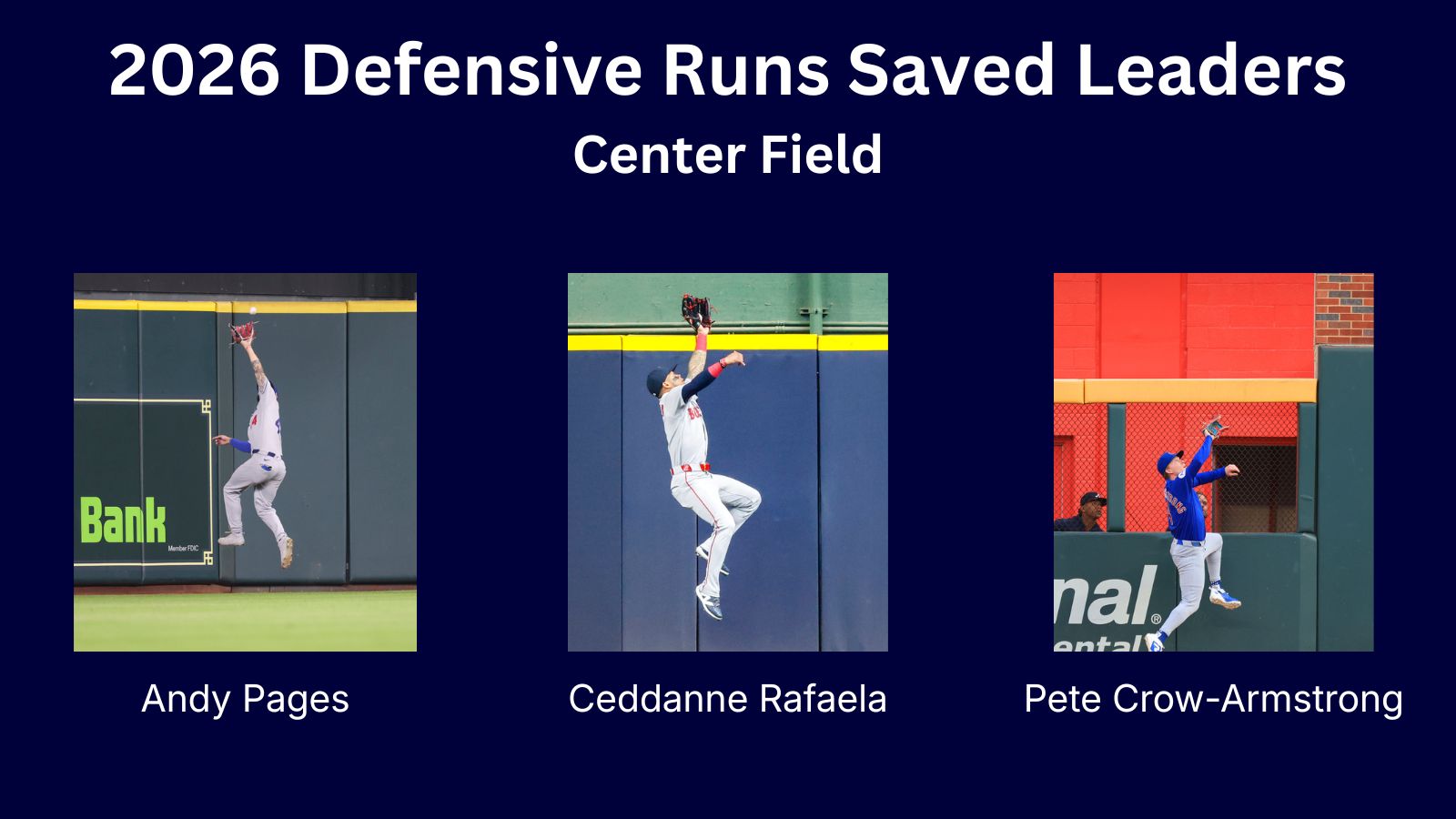
On Thursday I got asked on Reddit why Dodgers center fielder Andy Pages was the Defensive Runs Saved leader at the position and Cubs center fielder Pete Crow-Armstrong was not.
2026 Defensive Runs Saved Leaders- Center Fielders
| Player | Runs Saved |
| Andy Pages | 17 |
| Ceddanne Rafaela | 16 |
| Pete Crow-Armstrong | 12 |
I’m going to share the answer provided and incorporate Ceddanne Rafaela as well because he’s just about even with Pages entering the second half of the season.
There are three components for outfielders for Defensive Runs Saved – Range, Arm, and Good Fielding Plays/Misplays
Range is how well you do at turning batted balls into outs and is based on out probabilities and run values. Out probabilities are based on the type of batted ball, where it’s hit, where the fielder was positioned, and whether the ball was hit within 3 feet of the outfield fence.
In terms of run value, a deep fly ball is worth more than a shallow one because of a higher likelihood of that ball being an extra-base hit.
Arm is based both on how many runners you throw out and how often a runner advances on a hit that you fielded.
Good Fielding Plays/Misplays attempts to capture what basic out probabilities and outfield arm stats cannot. You can gain value for things such as cutting a ball off in the gap to hold a batter to a single instead of a double. You can lose value for an overthrow of the cutoff man. The big value gainer here is home run robberies, which are worth 1.6 runs no matter how many players are on base.
In range, Crow-Armstrong and Rafaela each have 12 Runs Saved. Pages has 6.
In arm, Pages has 8 Runs Saved, Rafaela has 5, Crow-Armstrong has 1.
In Good Plays/Misplays, Pages has 3 Runs Saved, Rafaela and Crow-Armstrong have -1.
Looking more closely at the difference in arm value:
Pages has 7 assists without a cutoff man, Rafaela has 4, Crow-Armstrong has 2.
Rafaela has allowed 43% of runners to advance on hits, Pages 51%, Crow-Armstrong 54%.
Now I’m guessing you’d say there’s not much difference between 51% and 54%, but Runs Saved also takes into account where the outfielder is when he made the throw. I’m going to take an educated guess that Pages has an edge on Armstrong (and Rafaela) with regards to the depth of his throws too.
Looking more closely at Good Plays/Misplays:
Pages’ 3 runs are related to his throw-outs. Arm Runs Saved doesn’t capture the full value of throw-outs, so Good Plays/Misplays helps in that regard.
Crow-Armstrong -1 is the product of 5 instances of “mishandling ball after safe hit” that allowed a runner to take an extra base (Rafaela has 2, Pages has none), 2 wasted throws, and 1 instance of misplaying a ball hit off the ball that resulted in a batter or runner advancing an extra base.
Rafaela’s -1 is the product of 4 misplays on balls hit off the wall (not surprising given his home ballpark is Fenway Park), 2 mishandles of hits, and 3 wasted throws.
Pages has greatly cleaned up his defensive game in center field. Last year he totaled 22 Misplays & Errors there. This year, he’s been charged with only 7. Crow-Armstrong and Rafaela each have 15.
In Sum
Here’s the breakdown in tabular form
| Player | Range | Arm |
| Andy Pages | 6 | 8 |
| Ceddanne Rafaela | 12 | 5 |
| Pete Crow-Armstrong | 12 | 1 |
| Good Plays/Misplays | |
| Andy Pages | 3 |
| Ceddanne Rafaela | -1 |
| Pete Crow-Armstrong | -1 |
Crow-Armstrong and Rafaela have much better range than Pages does. This might make you think that they’re both much better center fielders than Pages.
BUT
Pages has had a more complete defensive season because of everything else he’s done as a defensive player, particularly his arm.