Author: Andrew Kyne

  • The Effectiveness of “Infield In” Defense

    The Effectiveness of “Infield In” Defense

    By ANDREW KYNE

    Since 2015, Baseball Info Solutions has tracked situational defensive alignments like “infield in” and the rare five-infielder defense, among several other variations.

    The “infield in” strategy is particularly interesting. You might hear commentators mention how substantially batting averages increase when the infielders are all pulled in. But what do the numbers show?

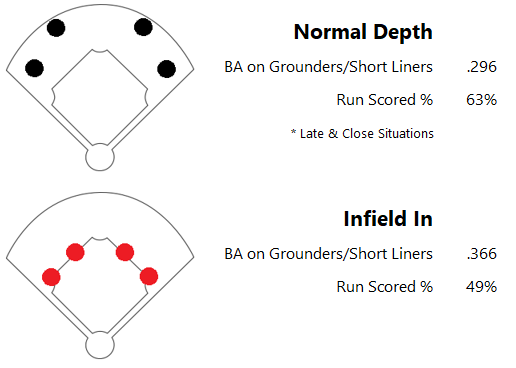
    First, let’s consider groundballs and short line drives (since those are the types of balls in play affected by the infield’s alignment here) hit against “infield in” alignments with fewer than two outs since the beginning of 2015. The batting average on those balls in play: .366.

    The overall goal in these situations, though, is to cut down the runner scoring from third. On grounders and short liners with the infield in, the batting team scored at least one run 49% of the time.

    Now, how does that compare to when the defense plays a traditional alignment in similar game contexts?

    Let’s consider grounders and short liners hit against a normal infield defense in similar situations where it would be beneficial to prevent the runner on third from scoring: seventh inning or later; tied or one-run game; fewer than two outs with a runner on third (and possibly second, but not first — so a double play is not in order). Because that’s not the most common situation (only 35 since the start of 2015), we’ll take any of these late-and-close balls dating back to 2010.

    In those situations, batters hit .296 on grounders and short liners — about 70 points worse than against a drawn-in infield.

    However, the batting team scored at least one run on 63% of these plays — compared to 49% with the infield in.

    So, there’s clearly a trade-off here for the defense. Bringing the infield in will increase the likelihood of a hit on a groundball or short line drive, as the infielders have less time to react. But playing the infield in will do a better job of preventing runs. Even regular groundouts can score the runner when the infield is back; meanwhile, a ball fielded in a drawn-in infield can stop the runner from trying to score, or he can be more easily thrown out at home.

    In 2018, the teams that played the most balls in play with “infield in” were the Padres (98), Phillies (93), and White Sox (82). The teams that played the fewest were the Angels (32), Brewers (32), and Mariners (34).

  • Quantifying Aaron Nola’s Early Season Command

    Quantifying Aaron Nola’s Early Season Command

    By ANDREW KYNE

    Aaron Nola was one of baseball’s best pitchers in 2018, but currently has a 6.84 ERA and 6.05 FIP through five starts in 2019. His walk rate, which sat around 6 to 7 percent in his first few seasons, is currently north of 10 percent.

    After his April 15th start against the Mets, Nola’s manager Gabe Kapler said the following (via MLB.com):

    “I’m concerned about his command. His command is his calling card. He’s got movement, deception, life, and those things are still there. He just needs to put the ball where he wants to throw it.”

    As part of our pitch charting operation at Baseball Info Solutions, we chart not only the location of the pitch, but also the location of the catcher’s mitt. Comparing the distance between the pitch location and mitt location gives us, on average, a pretty good proxy for a pitcher’s command.

    For the entire league, we take all of those distances from the mitt and divide pitches into four buckets, based on percentiles:

    • Closest to Mitt (25th percentile and lower)
    • Close to Mitt (26th to 50th percentile)
    • Far from Mitt (51st to 75th percentile)
    • Farthest from Mitt (76th percentile and higher)

    Some of the leaders in 2018 in throwing close to the catcher’s target (combining the Closest to Mitt + Close to Mitt buckets) were names you would probably expect: Dallas Keuchel, Kyle Hendricks, Zack Greinke, etc.

    Nola was pretty good, too. Among the 100 pitchers who threw the most innings last year, Nola ranked 18th in “close percentage” (Closest to Mitt + Close to Mitt).

    This year, however? Among the 100 pitchers who have thrown the most innings so far, Nola ranks 75th in close percentage.

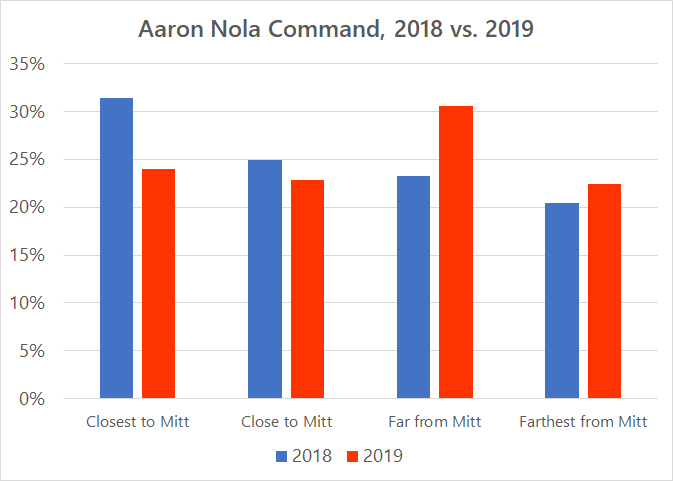
    Here’s a look at his distribution of pitches in terms of proximity to the catcher’s target, using those league-wide percentile buckets:

    SeasonClosestCloseFarFarthest
    201831%25%23%21%
    201924%23%31%22%

    Last year, 31 percent of Nola’s pitches were in the Closest to Mitt category, but that percentage is down to 24 percent so far this year. Additionally, he’s seen a big jump in the Far from Mitt pitches (those that fall in the 51st to 75th percentile across the league).

    That said, Nola’s start against Colorado on Saturday may have been a step in the right direction. He struck out nine and walked only one, and the command numbers were much better than his previous outings:

    DateClosestCloseFarFarthest
    3/28 (ATL)19%21%39%20%
    4/3 (WSH)29%18%25%29%
    4/9 (WSH)19%28%28%24%
    4/15 (NYM)19%11%40%30%
    4/20 (COL)35%33%20%12%

    Perhaps he’s shaking off some early season rust or still getting acclimated with his new catcher, but Nola’s command will be something to keep an eye on as the Phillies look to make a push for the NL East.

  • The Cost of Defensive Mistakes

    The Cost of Defensive Mistakes

    By ANDREW KYNE

    As mentioned on our podcast this week, one of my biggest takeaways from the first few weeks of the season was how the Mariners were winning in spite of their defensive performance.

    Seattle started 13-2 before a six-game losing streak this week. The team’s offense is cooling off after its hot start, but the defense has been poor the entire way.

    The Mariners currently have the worst Defensive Runs Saved in Major League Baseball (-27) and have committed the most Defensive Misplays (49).

    Our Defensive Misplays system at Baseball Info Solutions tracks all mistakes in the field, beyond your typical fielding or throwing errors. Defensive Misplays range from dropping flyballs to taking poor routes to missing the cutoff man. A Defensive Misplay must have a cost to the defense — either the loss of a base, an out, or the opportunity to make an out.

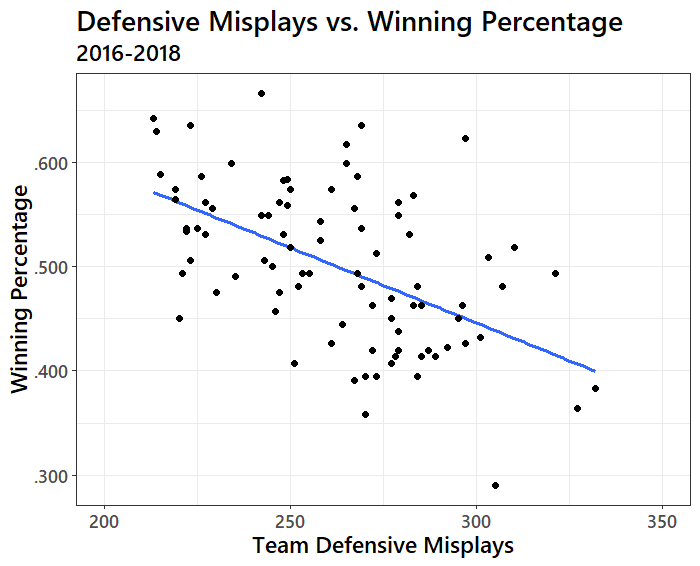
    Do Defensive Misplays correlate with winning? Similar to Scott Lindholm’s Baseball Mistake Index, let’s see if our defensive mistakes correlate with team success.

    The above plot shows a team’s Defensive Misplays correlated with its winning percentage for seasons between 2016 and 2018. Not a super strong correlation (R-squared = 0.28), but clearly a trend where, on average, teams with fewer misplays tend to win more games and teams with more misplays tend to win fewer games.

    What if we look at net Defensive Misplays? Let’s look at opponent misplays minus team misplays (so a higher number is favorable).

    The correlation is stronger here (R-squared = 0.40). Over the course of the season, it generally helps to have your opponents making more defensive mistakes than you do.

    But what about in individual games? Here’s how teams fared over the last three seasons when making different amounts of Defensive Misplays in a game:

    Of course there are many variables that decide a baseball game, but when teams didn’t make a Defensive Misplay, they won almost 63 percent of the time. And as teams made more and more misplays, they won less and less.

    And here are the net Defensive Misplays, again presented as opponent misplays minus team misplays. These are the winning percentages on the favorable side of it — when your opponent makes more mistakes than you do:

    When two teams had the same amount of Defensive Misplays in a game, they went exactly .500. But as the balance of misplays tipped in one team’s direction, the team’s winning percentage went up and up.

    Needless to say, it pays to limit your mistakes — and helps to have your opponent making mistakes, too.

  • Breaking Down Plate Discipline by Pitch Type

    Breaking Down Plate Discipline by Pitch Type

    By ANDREW KYNE

    Last week, I presented a way to visualize plate discipline, referencing some of the numbers on FanGraphs like O-Swing% and Z-Swing% that make use of Baseball Info Solutions’ pitch charting data.

    For each player, those plate discipline metrics obviously come at an aggregated level across pitch types. When we see that Joey Votto swung at 16 percent of pitches thrown outside the strike zone last year, that’s his total performance — against fastballs, curveballs, sliders, changeups, etc.

    But what if we split those out? What kind of discipline does Votto — and the rest of the league — have against different types of pitches?

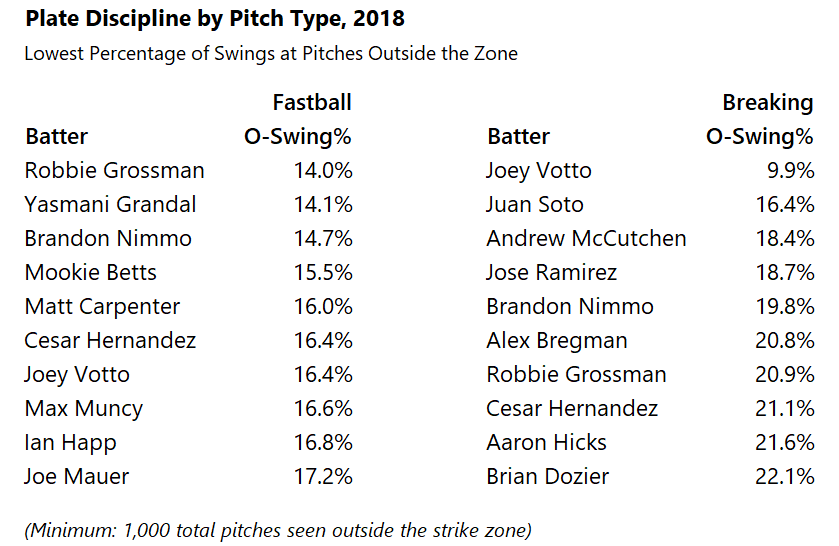
    Let’s consider the chase rates — the percentage of swings taken on pitches outside the zone (O-Swing%) — for the 179 batters who saw at least 1,000 total pitches out of the zone in 2018. For now, let’s just break it down by O-Swing% on fastballs and O-Swing% on breaking balls (curves and sliders).

    Here’s a look at the leaderboard for each:

    And here’s the correlation between those two metrics for these players:

    And some takeaways:

    — There’s a positive relationship, which is expected — batters who chase (or don’t chase) fastballs probably also chase (or don’t chase) a lot of breaking balls.

    — However, the rate of chasing breaking balls is, understandably, higher. Using the trend line on the graph, note that a 20 percent fastball O-Swing% corresponds with something more like a 26 percent breaking ball O-Swing%, on average.

    — Overall, the batters in this sample swung at out-of-zone fastballs 27 percent of the time, compared to 33 percent for out-of-zone breaking balls.

    — Of the 179 batters, 29 had a lower O-Swing% against breaking balls than against fastballs. Three notables are those labeled on the graph: Votto, Juan Soto, and Jose Ramirez. All three showed excellent discipline against all pitch types, but were particularly impressive against breaking balls. And all three are great offensively.

    — On the other side of that is Yasmani Grandal. Overall, he had a very good O-Swing% at 23 percent. But he was outstanding against fastballs (14 percent), and only about average against breaking balls (33 percent). Last season, he hit .279 with a 1.046 OPS in at-bats ending with a fastball, but only .210 with a .555 OPS in at-bats ending with a slider or curveball.

  • Visualizing Plate Discipline

    Visualizing Plate Discipline

    By ANDREW KYNE

    Baseball Info Solutions’ pitch charting data allows for many interesting applications — one being as a way to evaluate a player’s plate discipline.

    By checking out the plate discipline leaderboards at FanGraphs, we can do things like confirm that Joey Votto rarely swings at pitches out of the strike zone or learn that Freddie Freeman swings at a ton of pitches in the strike zone. (O-Swing% shows how frequently hitters chased pitches out of the zone; Z-Swing% shows how frequently hitters swing at pitches in the zone.)

    We can put a number on it. But what does it actually look like? Where are hitters taking their swings, and how far do they extend their zones?

    Using methods similar to what Jim Albert has demonstrated on the Exploring Baseball Data with R blog with generalized additive models and what FanGraphs has on its site, let’s visualize the swing tendencies of baseball’s most and least disciplined hitters.

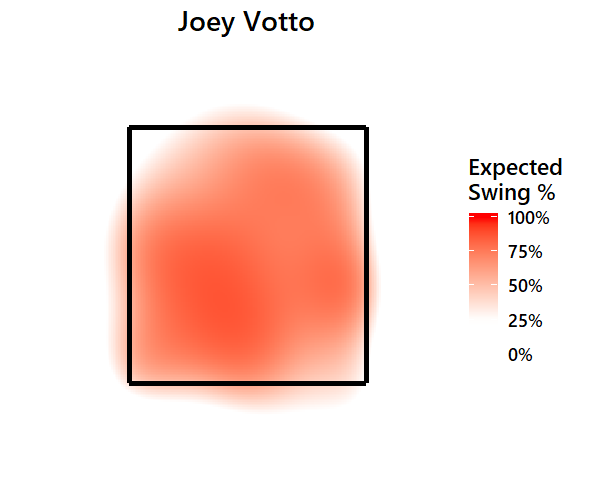
    The plots below show how likely a batter is to swing if a pitch is thrown in a certain location, using data from the 2018 season. As the legends show, anything above a 25% expected swing rate is colored in red, with darker red indicating a higher swing rate. All plots are from the pitcher’s perspective.

    Out-of-Zone Differences

    First, let’s compare some of the extreme hitters who either swung a little or a lot at pitches out of the zone last year.

    Low O-Swing%: Joey Votto

    The stat: Swung at 16% of pitches outside the zone in 2018 (lowest among qualified batters)

    Votto’s plate discipline has long been elite, and his expected swing rate locations almost perfectly fit the strike zone borders. While he covered all in-zone pitches to some degree in 2018, it appears that there’s a bit higher expected swing rate on down-and-in pitches (like this pitch he got from Edgar Santana).

    Low O-Swing%: Andrew McCutchen

    The stat: Swung at 19% of pitches outside the zone in 2018 (second-lowest among qualified batters)

    McCutchen followed Votto among the O-Swing% leaders last year. His 19.4% O-Swing was a career-best. There’s a small patch of dark red there in the heart of the zone, about belt-high, that appears to have been his most likely swing (like this one against Andrew Chafin).

    Now, a couple players who do extend beyond the zone…

    High O-Swing%: Salvador Perez

    The stat: Swung at 48% of pitches outside the zone in 2018 (highest among qualified batters)

    He’ll miss the 2019 season after undergoing Tommy John surgery, but Perez’s tendency is too extreme not to include here. The plot shows how willing he was to swing at anything within the vicinity of the zone.

    High O-Swing%: Javier Baez

    The stat: Swung at 46% of pitches outside the zone in 2018 (second-highest among qualified batters)

    Baez extends the zone in similar fashion, though maybe not as much on far outside pitches as Perez. Interestingly, the up-and-in pitch looks like one that he offers at a lot (or at least did in 2018). Here are some examples of that: a swinging strike against Brandon Woodruff; a popup against Luke Weaver; a home run against Gerson Bautista.

    Votto and Baez each had a 131 wRC+ in 2018, but took different approaches to get there. Here’s a GIF to show their swing rate differences back-to-back:


    In-Zone Differences

    Next, let’s look at two batters who were at the extremes of swinging at pitches in the zone.

    High Z-Swing%: Freddie Freeman

    The stat: Swung at 85% of pitches inside the zone in 2018 (highest among qualified batters)

    If a pitch is anywhere in the strike zone, Freeman is likely to swing. Prior to his 85% rate last year, he swung at 84% of pitches in the zone in 2017 and 81% in 2016.

    Low Z-Swing%: Brett Gardner

    The stat: Swung at 53% of pitches inside the zone in 2018 (second-lowest among qualified batters, behind the now-retired Joe Mauer)

    Gardner’s plot features a much lighter shade of red all around, indicating how much less likely he is to swing at pitches in the zone than Freeman. His Z-Swing% has consistently hovered in the 50-55% range for his career. There appears to be a slightly darker band of red across the middle of the zone, but Gardner is definitely willing to let pitches pass through everywhere.

    And here’s a GIF to compare Freeman and Gardner:

  • What we can learn from Rougned Odor’s bunts against the shift

    What we can learn from Rougned Odor’s bunts against the shift

    By ANDREW KYNE

    With a new season upon us, teams are hoping that 2019 is the year they can beat the infield shift. Consider this out of Mets camp last week, via MLB.com’s Anthony DiComo:

    From the Dominican Summer League on up to the Majors, the Mets’ new front office is placing increased emphasis on bunting and situational hitting. When teams employ defensive overshifts on their Minor Leaguers, the Mets — for the first time — are encouraging their players to bunt to beat them.

    Bunting against the shift isn’t a new idea, but hitters haven’t really embraced it as a strategy.

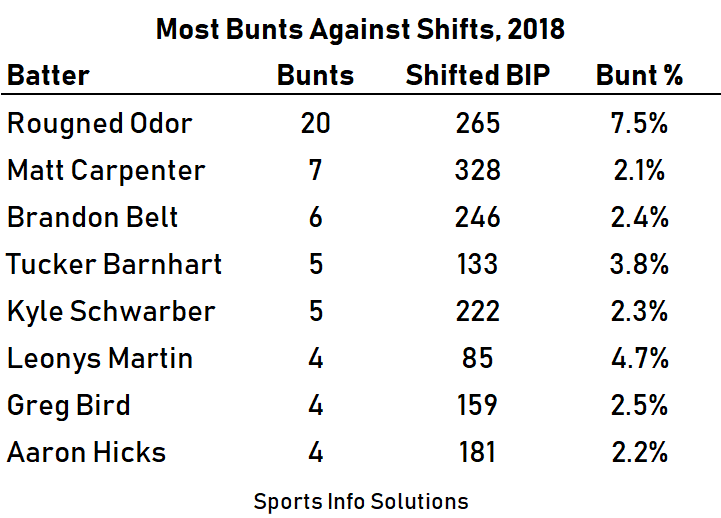
    One batter, however, did it far more than most in 2018: Rougned Odor of the Texas Rangers. Odor’s 20 bunts against infield shifts were by far the most in MLB:

    So, I decided to watch those 20 bunts and figure out what I could learn. Does it work? How do teams react? Let’s find out.

    It’s not foolproof

    First, how often was Odor actually successful?

    It turns out that he only went 7-for-18 on these bunts. (Two of the outs had men on base and went down as sacrifices.)

    Of course, .389 isn’t a bad batting average to own, but you have to consider these are only going for singles, and therefore providing nothing in the slugging department.

    The league as a whole hit .584 (122-for-209) on bunts against shifts last season. Not bad, but it’s not perfect and relates to a point Matt Carpenter made to ESPN.com last summer. Though he’s specifically talking about hitting grounders to the left side, it also applies to dropping down a bunt:

    “Let’s just say I sell out tonight, and I try it four times. The likelihood of me hitting four straight ground balls to short and ending up 4-for-4 are very slim. If I succeed once or maybe twice, at best I’m going to go 2-for-4 with two singles, where if I just play the game, I might go 2-for-4 with a homer and a double.”

    The accuracy needs to be pinpoint

    So how do you improve on Odor’s .389 average or even the league’s .584? The execution needs to be strong.

    Consider a play like this one against the White Sox. Odor bunts it to the third base side, yet Reynaldo Lopez gets off the mound and throws him out with relative ease.

    Ideally, the bunt will be further away from the pitcher than that one, and preferably as close to the third base line as possible. That obviously requires great accuracy.

    Here’s a look at a spray chart of all the bunts against shifts from left-handed hitters in 2018. The red points represent hits, and the blue points represent outs. There are a lot of hits down the third base line, especially if it can get past the pitcher.

    But even then, you can find pitchers who are able to get off the mound and make plays. Check out this play by Jose Berrios, who would have thrown out Odor here if Joe Mauer held onto the ball at first base.

    The defense will be ready

    This was my biggest takeaway from watching these plays. I think a lot of times when people talk about beating the shift and they suggest laying a bunt down, they’re imagining a defensive alignment like this:

    Either the shortstop or third baseman moves over to the right side, and the one who stays on the left side plays where the shortstop would traditionally be.

    Yet out of these 20 Rougned Odor bunts, this one against Baltimore was the only one I saw that didn’t have a fielder on the left side of the infield playing up near the edge of the infield dirt, protecting against the bunt. (And he still didn’t get a hit on it!)

    Kyle Seager mentioned this in the same ESPN.com article that’s referenced above: “I’ve tried to bunt a few times, and I’ve had a few successes. But the third baseman is usually still in there for the first two strikes, so the bunt is not as big a factor as it could be.

    This appears to be true for Odor as well. Our company charts the starting positions of infielders on grounders and short liners.

    Here’s a look at where third basemen, when in a shifted alignment, played against Odor in 2018 when he put grounder/liner into play with fewer than two strikes:

    3B Positioning vs. Odor: < 2 Strikes

    And here’s a look at where third basemen, when in a shifted alignment, played against Odor when he put a ball in play with two strikes:

    3B Positioning vs. Odor: 2 Strikes

    (The straight lines represent the base lines, rather than the true edges of the infield grass.)

    You can see that with fewer than two strikes, the 3B typically stayed at home to protect against the bunt. But with two strikes — and the threat of a bunt all but eliminated — the 3B would more often move back.

    The case of Rougned Odor shows that there’s difficulty in bunting against the shift. Perhaps the Mets will gain an edge by emphasizing it at the minor league level and developing accurate bunters, but opposing defenses will continue protecting against it to some degree.

  • Which catchers get strikes at the top of the zone?

    Which catchers get strikes at the top of the zone?

    The Houston Astros have long valued pitch framing. Over the last five seasons, only one team — the Dodgers — have saved more runs via framing than the Astros. (You can now find this and the rest of our Strike Zone Runs Saved data on FanGraphs, under the rSZ column within the Fielding leaderboards.)

    So it was noteworthy when Houston signed Robinson Chirinos to a one-year contract in December. Chirinos has historically rated as a negative pitch framer, including -6 Strike Zone Runs Saved in 2018.

    Even more interesting is what part of the strike zone Chirinos has struggled to frame. From Chandler Rome’s profile on Chirinos for the Houston Chronicle last month:

    “I told A.J. [Hinch] this (that) last year the pitch I was struggling (with) was the high pitch,” Chirinos said Thursday. “When I signed here in December, I knew from facing all these guys how they like to pitch. That high pitch is a pitch they use a lot.

    Gerrit Cole and Justin Verlander were among the league leaders at throwing fastballs in the upper-third of the zone and above in 2018. Yet it’s an area that Chirinos may not be comfortable with.

    So where does Chirinos rank among other backstops at getting high strikes?

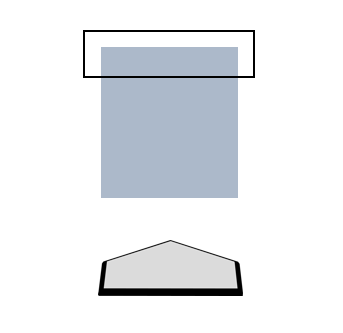
    Using BIS’s pitch-charting data and standard strike zone, let’s consider called pitches (balls and called strikes) in approximately the top-fifth of the zone, plus a little above it and off the edges — essentially the area bordered in black here:

    The pitches in this area have a borderline called-strike expectation. Anything higher or further outside is very likely to be a ball; anything lower (in the zone) is very likely to be a strike.

    Among the 35 catchers with the most pitches caught in this area in 2018, here were the ten best at getting called strikes:

    RankCatcherStrikesPitchesStrike Rate
    1Yadier Molina521116744.6%
    2Sandy Leon31472043.6%
    3Wilson Ramos38392541.4%
    4Austin Hedges36790040.8%
    5Luke Maile21352940.3%
    6Chris Iannetta31277940.1%
    7Max Stassi22857939.4%
    8Kevin Plawecki24963839.0%
    9Omar Narvaez25566038.6%
    10Christian Vazquez26769238.6%

    And here were the ten worst:

    RankCatcherStrikesPitchesStrike Rate
    35J.T. Realmuto24689527.5%
    34Yan Gomes21778927.5%
    33Manny Pina18364828.2%
    32Tucker Barnhart29495630.8%
    31Jonathan Lucroy26284830.9%
    30Francisco Cervelli25682131.2%
    29Devin Mesoraco18558831.5%
    28Kurt Suzuki22469932.0%
    27Willson Contreras30493432.5%
    26Robinson Chirinos26981033.2%

    Chirinos does, in fact, appear among the trailers here. Meanwhile, Houston’s other catcher, Max Stassi, rates near the top. Stassi was tied with Yasmani Grandal and Tyler Flowers for the Strike Zone Runs Saved lead in 2018.

    The Red Sox, Cardinals, and Mets all appear to be taking advantage here. Those teams ranked first, second, and third, respectively, in throwing the highest percentage of overall pitches in the area we outlined. (The Astros were eighth.)

    And their catchers were strong at getting strikes there. Boston’s Sandy Leon and Christian Vazquez were both among the top ten at getting strikes in that area in 2018. The Cardinals’ Yadier Molina was the very best. And although the Mets traded Kevin Plawecki (8th) to Cleveland, they signed Wilson Ramos (3rd) to play behind the plate. (Pitching up in the zone was a key for Jacob deGrom in his Cy Young season.)

    Finally, we can also visualize how catchers differ in framing various parts of the zone. Here’s a look at Chirinos:

    This image compares Chirinos’ ability to get called strikes in each location to the league average. The red areas are where he’s better than average, and the blue areas are where he’s worse than average. As expected, we see a lot of blue at the top of the zone.

    And here’s a look at Molina, who ranked first on the above leaderboard and excels at getting high strikes (but not so much at low ones):

  • Finding Candidates for a Four-Man Outfield

    Finding Candidates for a Four-Man Outfield

    By ANDREW KYNE

    Four-man outfields have been in the news this week, with Bryce Harper facing them in Grapefruit League play and acknowledging afterwards that he hoped he wouldn’t see them again.

    We began tracking four-man outfields on balls in play at Baseball Info Solutions last season, with Lucas Duda (12), Matt Olson (6), Joey Gallo (6), and Justin Smoak (5) being the most impacted sluggers.

    This could be a strategy that we see a lot more of in 2019. So who are some other top candidates to face a four-man outfield? August Fagerstrom went through a similar exercise for FanGraphs in 2016, and Devan Fink did so for Beyond the Box Score in 2017.

    Using BIS charting data for 2018, let’s find batters who hit few groundballs to the non-pull side of the infield (so you can leave that side of the infield vacated) and also hit a lot of balls in the air to the outfield (so your fourth infielder might be more useful out there). Those on both lists are bolded for emphasis.

    Lowest percentage of batted balls that were grounders/short liners to the non-pull side (2018 batters, minimum of 200 batted balls)
    1. Matt Carpenter (2.2%)
    2. Jay Bruce (2.5%)
    3. Joey Gallo (3.1%)
    4. Curtis Granderson (3.8%)
    5. Mike Zunino (4.0%)
    6. Rhys Hoskins (4.1%)
    7. Logan Morrison (4.2%)
    8. Jose Bautista (4.9%)
    9. Brian Dozier (4.9%)
    10. Kyle Seager (4.9%)

    Highest percentage of batted balls that were in the air and hit at least 250 feet (2018 batters, minimum of 200 batted balls)
    1. Matt Carpenter (47.6%)
    2. Brandon Belt (45.2%)
    3. Daniel Descalso (43.9%)
    4. Khris Davis (43.9%)
    5. Joey Gallo (43.7%)
    6. Mike Trout (43.6%)
    7. Max Muncy (42.9%)
    8. Teoscar Hernandez (42.7%)
    9. Rhys Hoskins (42.2%)

    10. Justin Turner (42.2%)

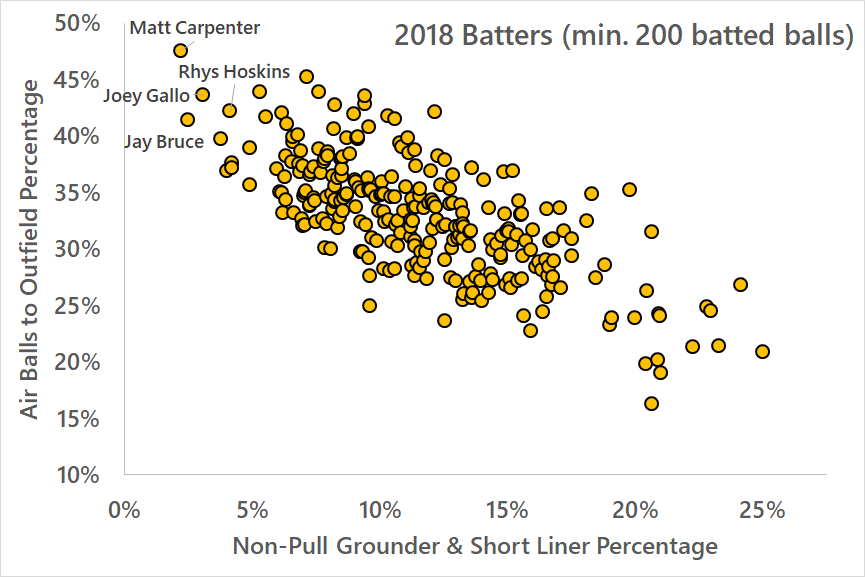
    Obviously there’s a correlation between those two variables. But which players are among the most extreme? Take a look at the hitters in the upper left of this graph.

    Besides Gallo (who, as noted, faced a handful of four-man outfields last year and will likely see more in 2019), it appears that Matt Carpenter, Jay Bruce, and Rhys Hoskins are among the most extreme examples and could be candidates to see the strategy. Others near the top include Curtis Granderson (who saw one four-man outfield last season) and, interestingly, Daniel Descalso (who notably changed his swing and hit far fewer grounders in 2018).

    Carpenter is perhaps a very obvious example. He had the lowest groundball percentage among qualified batters last season, and almost all of those grounders were pulled. Check out his spray chart:

    (The blue contour lines track the density of balls hit in the infield; the red lines track the density of balls hit to the outfield.)

    Carpenter barely hits any grounders to the left side of the infield, while hitting a high volume of balls all over the outfield.

    The Cubs tried a four-man outfield against Carpenter last year … and he responded with a bunt single. Yet taking away the possibility of an extra-base hit was a result the Cubs were likely okay with.

    Hoskins understands that and may not be one to change his approach. When asked about the four-man outfields that Harper has been seeing, Hoskins told Matt Breen of The Inquirer: “It doesn’t make you do anything different, because as soon as you try to do something different, they win. If I’m trying to hit a ground ball to the right side, then they’ve done their job and I’m not doing mine. You don’t want me to bunt, I promise you.”

    Hoskins very much looks like a four-man outfield candidate himself. While Carpenter had the lowest groundball rate in baseball, Hoskins was right behind him and also pulled an extreme amount of those balls.

    Of course, extreme infield shifting of right-handed hitters can be difficult. The first baseman can’t venture too far away from the bag, or else a significant hole can be created on the right side. Yet Hoskins almost never hits grounders over there, and he yanks a ton to where the third baseman and shortstop typically play. Given his high volume of balls to the outfield, it could be something that his opponents consider.

    As for Harper, if you were to find him on the scatter plot above, he’d be in the mix of players between 5-10 percent for non-pull grounder and liner rate and 35-40 percent for outfield air ball rate. He’s among the players who fit the mold, though not necessarily an extreme by this rudimentary methodology.

  • Stat of the Week: How Good is Kyler Murray?

    By Sports Info Solutions Staff

    Last week’s Stat of the Week covered the SIS rankings and stats for the top players available in this year’s NFL Draft. There’s another player who generated headlines this week who was not at the top of those rankings. Oklahoma quarterback Kyler Murray announced he would pursue a career in the NFL rather than in professional baseball.

    Murray is the No. 2 ranked quarterback in The SIS Football Rookie Handbook behind Ohio State’s Dwayne Haskins. But Murray is the most impressive quarterback from a statistical perspective.

    There are concerns that Murray is too small to succeed in the NFL (he’s 5’9½”). But Murray leads this year’s top quarterback prospects in all of the leaderboards listed in our book.

    Kyler Murray Leads QB Prospects In …

    CategoryValue
    Pass Yards Per Attempt11.6
    On-Target Percentage79.2
    Independent QB Rating (IQR)143.2
    Expected Points Added Per Dropback0.47
    Rushing Expected Points Added61.4
    Total Expected Points Added236.9

    * Independent QB Rating (IQR) builds on the traditional Passer Rating formula by considering the value of a quarterback independent of results outside of his control such as dropped passes, dropped interceptions, throwaways, etc.

    ** Expected Points Added (EPA) is the change in Expected Points for the offense on a play.

    In several of these categories, Murray has a sizable advantage. He leads West Virginia’s Will Grier by nearly two yards per attempt, 16 points in IQR and nearly 97 Total Expected Points Added.

    Murray also mostly passes the eye test. In The SIS Football Rookie Handbook, Murray is described as “a rare playmaker at the quarterback position with the requisite mental capacity to maximize his arm talent and mobility but may need to rework his release as a pro to mitigate size concerns.”

  • Preview: NFC Divisional Round – Eagles vs. Saints

    Let’s take a brief look at some statistical notes ahead of the NFC Divisional Round playoff game between the Eagles and Saints.

    Saints Passing vs. Eagles Pass Defense

    • Drew Brees on passes of at least 20 yards downfield: 52 percent completion percentage (1st among QBs with at least 30 such throws), 66 percent on-target rate (1st), 18 percent touchdown rate (1st).
    • On throws of 20-plus yards downfield, Eagles’ opponents recorded a positive play (based on Expected Points Added) 41 percent of the time. That was tied for sixth-worst among NFL defenses.
    • One key for Brees and the Saints: avoiding sacks. Brees’ 3.5 percent sack rate in the regular season was tied with Tom Brady for third-lowest in the NFL, behind Andrew Luck (2.7%) and Ben Roethlisberger (3.4%).
    • Saints left tackle Terron Armstead was the only lineman to play at least 100 pass-blocking snaps and not have a blown block credited to him. However, he has missed time due to a pectoral injury and sat out in Week 17.
    • Philadelphia’s Michael Bennett (58) and Fletcher Cox (56) ranked tied for fourth and sixth, respectively, in quarterback pressures this season.

    Saints Rushing vs. Eagles Run Defense

    • Both members of the Saints’ backfield can be found among the top ten running backs (min. 100 carries) in positive play percentage: Alvin Kamara at 47 percent and Mark Ingram at 46 percent.
    • The Eagles’ run defense tightened things up late in the season. In Weeks 15 through 17, Philadelphia allowed only 3.4 rush yards per attempt (3rd in NFL) and 1.7 yards after contact per attempt (1st).
      • Similarly, the Eagles surrendered only 65 rushing yards on 18 attempts (3.6 YPA) in Chicago last weekend.

    Eagles Passing vs. Saints Pass Defense

    • Among quarterbacks who attempted 60+ passes in Weeks 15 through 17, Nick Foles ranked first in completion percentage (77 percent), on-target rate (86 percent), and yards per attempt (8.5).
    • Among receivers with at least 15 targets in that same time, Alshon Jeffery ranked first in yards per target (16.7) and Nelson Agholor ranked first in Receiver Rating (148.3).
    • The Saints allowed 8.2 yards per pass attempt in the regular season, which ranked fifth-worst in the NFL.
    • New Orleans can bring pressure, having ranked third in pressure percentage (35.4%) – led by Cameron Jordan’s 58 QB pressures.
    • That said, it doesn’t always rattle Foles. Among QBs with 50+ attempts under pressure, he ranked first in on-target rate (82.4 percent) and sixth in yards per attempt (7.5) when pressured this season.

    Eagles Rushing vs. Saints Run Defense

    • The Saints’ run defense was excellent in the regular season: second in yards per attempt (3.6), second in yards after contact per attempt (1.9), fourth in broken tackle percentage (6.7%), and tied for fourth in positive play percentage (40%).
    • The Eagles have not had great success running the football, especially with the injuries to Jay Ajayi and Corey Clement.
      • Over the last six weeks of the regular season (since they last played New Orleans), Philadelphia ranked last in the NFL with an average of 3.6 yards per attempt and tied for 25th with a 38 percent positive play rate on rushes. Of course, they still managed five wins in those six weeks.