Author: Bryce Rossler

  • What’s Wrong With Joe Burrow And The Bengals Offense?

    What’s Wrong With Joe Burrow And The Bengals Offense?

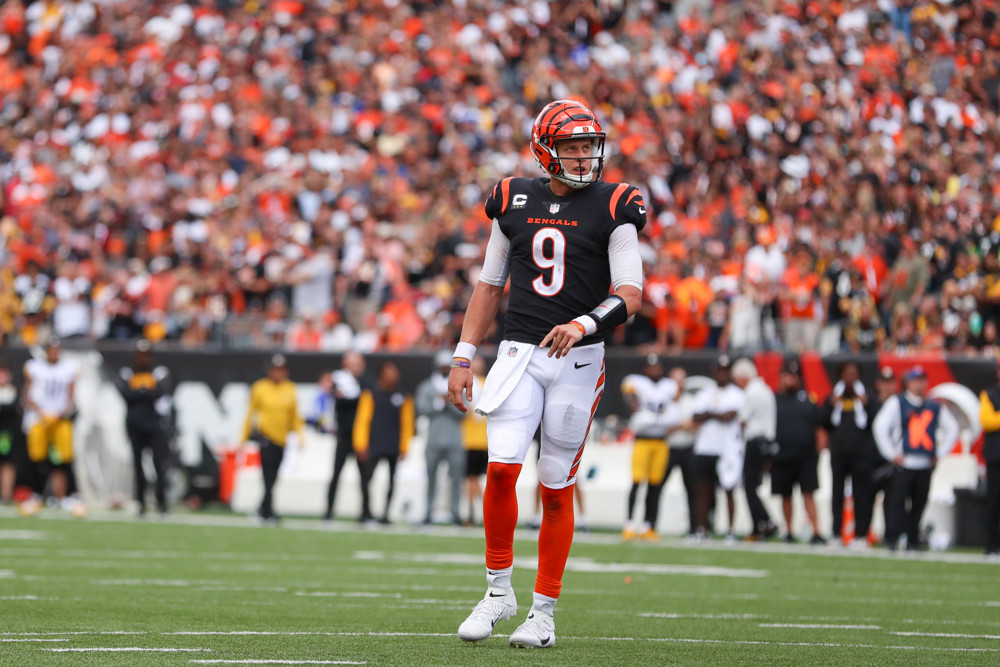
    As improbable as the Bengals’ Super Bowl run was last year, I don’t think anybody expected them to be this bad in 2022. A cadre of analysts had been trumpeting their impending regression, but consecutive losses to Mitchell Trubisky and Cooper Rush to begin the season have everyone wondering – what the hell is going on in Cincinnati?

    Last year’s Cinderella has quickly turned into a pumpkin, and much of the blame is to be placed on an offense that has been highly dysfunctional through two games.

    One of the company lines for the Bengals this offseason was that they could both run on two-high structures and pass against single-high coverage. Survey says that was a lie. 

    The Bengals have seen the most two-high snaps (101) of any team this season, and they have failed to punish defenses on the ground and force them out of those looks. Part of that has been for lack of trying – they run the ball into two-high just 23% of the time, the second-lowest rate in the league – but they also simply haven’t done it well. They average -0.19 EPA/carry into light boxes and a meager 1.0 YBC on those plays, second-worst in the NFL. 

    Perhaps leveraging RPOs more frequently would help; they’ve dialed up an RPO on only 3% of their offensive snaps, which is well below the league average of 8%.

    It should be unsurprising then that the Bengals haven’t generated big plays through the air like they did last year. Coverage dictates where the ball is thrown, and two-high structures generally force underneath throws. As a result, Cincinnati’s average depth of target (ADOT) is down to 6.5 yards from 8.0 last year, and their boom rate – big plays that generate >1 EPA for the offense – has also dropped from 24.3% to 20.6% year-over-year. 

    Practically speaking, that’s about two big throws a game they’re missing out on. This is a huge deal for an offense that generated negative EPA in 2021 despite ranking 1st in EPA (435) on such plays. Every other team in the Top 10 produced positive EPA on the year. For better or worse, they were something of a glass cannon last year, and we’re currently noticing the extent to which they’ve been reliant on explosives.

    Offenses don’t have to chuck it deep to pick up big yards throwing, though. That helps, of course, but teams with YAC threats are often able to rip off chunks in spite of a low ADOT. Unfortunately for Cincinnati, its receivers haven’t been as dynamic with the ball in their hands as they were last year. In 2021, the Bengals pass catchers ranked 5th in the league in broken and missed tackles/reception; this year, they rank just 26th through two games.

    This is not to place the blame entirely on the receiving corps. Pass protection woes have certainly compounded Cincy’s issues in the passing game, but they have also been somewhat unlucky in terms of the impact it’s had on them. Although nobody is arguing the Bengals offensive line is one of the best in the game, their league-worst 13 sacks belies some less-atrocious advanced metrics:

    Bengals Offensive Line Advanced Stats

    First 2 Weeks of 2022

    Metric Stat Rank
    Pressure Rate 30% 14th
    Blown Block Rate (Passes) 2.3% 16th
    Avg time to pressure 2.61s* 25th

    * League average is 2.76

    So, while this unit has been less-than-good, they’re not as bad as the pummeling of Joe Burrow would lead you to believe. The problem here is largely that their mistakes have seldom gone unpunished. In 2021, pressures turned into sacks 19% across all 32 teams. So far, the Bengals opponents’ have converted a whopping 45% of their pressures into sacks. Only the Saints have been worse in this regard. Sacks typically kill about 80% of drives historically. Cincinnati has failed to convert another set of downs after 10 of its sacks so far.

    Offensive playcalling hasn’t helped, either. The Bengals have shown some pretty stark run-pass tells that opposing defenses are starting to key on. The passing rate disparity between their shotgun and under center splits was 59 percentage points in 2021, second to only the 2019 Jaguars (61 percentage points) over the past four seasons. (Please take a moment to note that Jacksonville offense was led by John DeFilippo, who had three one-year stints as an NFL offensive coordinator, and is now out of work.) 

    That’s not great company Zac Taylor is keeping, but it’s gotten worse. That figure has ballooned to 69 percentage points this year. That is – if Cincinnati is in shotgun, they pass 87% of the time; if they’re under center, they pass 18% of the time.

    It’s admittedly somewhat myopic to view offensive playcalling binarily. It’s also naive to think it’s abnormal for offenses’ modus operandi to change based on whether they are in the gun or under center. However, these splits are pretty staunch and there is some correlation between a playcaller’s tendencies and his offense’s performances within these splits. The defense still has to get into the right call – defending a stick concept is a lot different from defending four verts – but splits this big are not nothing.

    In the past, two losses to start the season has been a death knell for a team’s playoff hopes, though one might expect those odds to be a bit better under the new 17-game season. Still, Cincinnati’s season hangs in the balance this weekend, and a loss might bring the team’s honeymoon period to an abrupt end. At 1-2, they’d still be behind the 8-ball, but each win buys them more time to fix some of their systemic issues and right the ship.

    Unless you’re Tom Brady, NFL championship windows close awfully quickly, and Burrow – despite his strengths and all the cosmetic surgeries he’s undergone – is no Tom Brady. It’s still early and the Bengals have the talent to turn things around, but they’d better do so quickly, lest their window closes. Maybe it already has.

  • The not-so-curious case of Mac Jones

    The not-so-curious case of Mac Jones

    By BRYCE ROSSLER

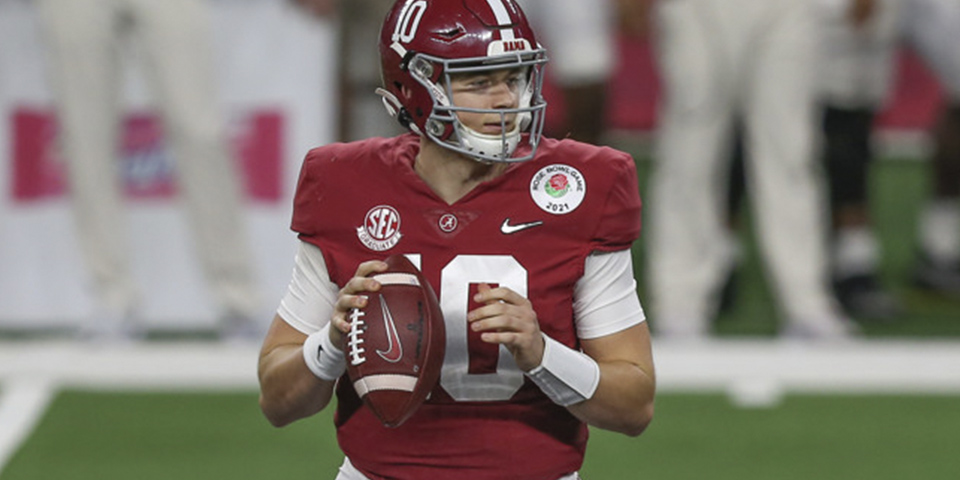
    It’s strange that a prospect as unassuming as Mac Jones has become so polarizing. It would be disingenuous to call his beginnings ‘humble’—Alabama’s out-of-state tuition barely outpaces what his high school alma mater charges—but it is fair to say that he’s been an afterthought for much of his football career.

    The Jacksonville native was glossed over by G5 grassroots recruiters UCF and USF and inexplicably wound up at Alabama despite being a three-star with the physique of a seventh-grader who swims with their shirt on. While less-coveted recruits aren’t quite dead on arrival in Tuscaloosa, just 8% of the last 120,000+ NFL snaps played by Alabama alumni have been played by former three-stars.

    Nevertheless, David joined Goliath and was seemingly on the fast track to a graduate assistant gig as a Saban-adjacent career backup. But, an unprecedented offseason resulted in a failure to launch for the incoming top quarterback recruit, Jones impressed during camp, and the rest is history.

    Now, with the NFL Draft approaching, Jones has become something of a Rorschach test. Many analysts have become enamored with his rhythm, his precision, and his high-volume, high-efficiency production, and we can sympathize with that. Jones’ 2020 campaign was the third-best passing season by volume, and the second-best on a per-snap basis, in the last three years.

    There are also those who see a physically limited prospect reminiscent of early Saban-era game managers.

    So, it would seem that statistical evaluation and traditional evaluation are at odds again, but that’s not really the case. Although numbers and film often induce cognitive dissonance in those who believe in the value of both, they’re actually two sides of the same coin in Jones’ case.

    For example, there are concerns about Jones’ mobility. The NFL is experiencing a changing of the guard at the quarterback position, and there are questions about whether Jones is well-suited for a league that is increasingly featuring some of its best athletes behind center. Only 17% of Jones’ throws in 2020 were made off-platform, one of the lowest rates among Power 5 quarterbacks. That kind of stationary play style is tough to reconcile when you consider the way the pro game is trending. Since 2019, about 27% of NFL throws occurred from a compromised throwing base. Pure pocket passers have been viable in the past, but the trend has been shifting towards mobility for some time now.

    Concerns about Jones’ pedestrian arm are validated by how long his passes spent in flight. Over expectation stats are all the rage nowadays, and we can devise such a method here. Contextualizing air time data with throw depth, where the ball is hashed relative to the target, and the quarterback’s throwing platform creates a baseline we can use to evaluate the relative quickness with which a quarterback’s passes arrive.

    In this category, Jones was dead average for a college quarterback, which is not particularly reassuring. Comparatively, the passes of Zach Wilson (-0.08), Trevor Lawrence (-0.07), Justin Fields (-0.03), and Trey Lance (-0.02) all arrived ahead of schedule. But, because it’s difficult to conceptualize how meaningfully different a few hundredths of a second are, this can be put in more practical terms. If Lawrence and Jones both throw a pass that travels 15 yards, we can expect Lawrence’s throw to win that race by about a yard and a half.

    There are other proxies by which we can judge Jones’ arm talent. His reluctance to throw to the outermost receiver in trips is one of them. A curiosity of the college-to-pro transition is the change in the playing dimensions. The fields are the same width, but the hashes are nearly twice as wide in college as they are in the pros. As a result, throwing the ball to the wide side of the field is more difficult in college, at least in a Pythagorean sense.

    In light of both this phenomenon and the relative inferiority in arm talent, defensive coaches at the college level generally like to know if they need to respect the outside receiver in trips. Wilson (27%), Fields (20%), and Lawrence (17%) came in above the average target rate (15%) to varying degrees, but Jones (11%) fell short of the mark. While this specific aspect is not directly translatable to the NFL, the fact that Jones targeted this alignment at a below average rate could be seen as a feather in the cap of his detractors.

    More generally, his low average depth of target (ADOT) of 8.3 yards is another stat we can use to judge his arm strength. Of course, this is admittedly simplistic and is confounded by the rate at which he threw RPOs and screens. 27% of his dropbacks were RPOs or screens, and while that’s comfortably above the NCAA average of 20%, it is less conspicuous than the players hovering in the 35-50% range. This is, however, a good opportunity to segue into more systemic concerns.

    A whopping 58% of Jones’ dropbacks were RPOs, screens, or play action passes.

    A whopping 58% of Jones’ dropbacks were RPOs, screens, or play action passes. That was the third-highest rate among eligible Power 5 quarterbacks (minimum 100 attempts) and can make evaluating Jones difficult, regardless of whether you choose to do so statistically or traditionally. While he might have been effective outside of this split (0.51 Total Points/Snap), 181 plays is not a lot to work with, especially considering how good his supporting cast at Alabama was.

    Although it is nowhere near as precise as tracking data, yards after the catch before contact (YACBC) is a crude instrument that can give us a sense for how open a quarterback’s receivers generally were. Jones’ receivers averaged 5.4 YACBC, which ranked 3rd among FBS teams and 2nd among Power 5 teams. This is likely unsurprising considering his connection with Heisman winner Devonta Smith.

    Furthermore, Jones was hurried six percentage points below the average rate, and when he was hurried, pressure arrived a tenth of a second later than the average. Of course, a quarterback owns some of his pressure rate, but things won’t be so easy in the NFL.

    Thus far, much of this article has been spent focusing on the criticisms of Jones, but advanced stats also convey the strengths he shows on film. He took great care of the football, as his turnover-worthy throw rate was just 2.0%—good for 7th in the country among the 134 players with at least passes. 

    He also processes quickly and gets the ball out in a timely manner. Time to Throw Over Expectation (TTOE) is a metric that considers drop type and play action to set a benchmark for how quickly the ball should come out. Jones’ TTOE of -0.24 ranked 14th among the aforementioned group, but he was far more productive. The thirteen players who ranked ahead of him combined for 244 Total Points. Jones himself accounted for 196.

    Lastly, he is very accurate by basically any statistical measure. He ranked first in the oft-misleading completion percentage (77.3%), but also placed first in On-Target Rate (85.1%) and fifth in *On-Target +/- (8.8%).

    *On-Target +/- is similar to NextGen’s CPOE, except that passes are judged by whether or not they were thrown accurately when compared to expectation. Read more about this in The SIS Football Rookie Handbook 2021.

    So, what do the stats indicate? They tell us that Jones is a statuesque mover who will need to prove he can be comfortable in NFL pockets after being royally protected in college.

    They tell us that he doesn’t have the juice to make all the throws and that tight windows may be a problem in the pros after making a lot of wide open throws at the college level.

    They also tell us that he avoids mistakes, is accurate, and sees the field and gets the ball out quickly.

    Witnesses to Jones’ play tell similar tales. So, we’ve achieved consensus on who Mac Jones is as a player. The red flags do indeed manifest themselves statistically. The question now is: who will bank on Jones continuing to overcome his physical limitations after leaving the nest?

  • Reactive Playcalling in the NFL

    Reactive Playcalling in the NFL

    By Bryce Rossler

    About a year ago, I became interested in the idea of “reactive offense,” a concept invented by Bill Walsh which he eventually detailed in his manifesto Finding the Winning Edge. The late, great 49ers coach was notoriously obsessive in his preparation and believed that it was valuable to understand how playcallers might behave differently following a particular outcome on a play.

    “Defensive coaches base much of their game plans on the offensive tendencies of their opponents,” he wrote, “Such tendencies typically evolve from the offense’s reaction to such fundamental factors as down, distance, field position, personnel, situational circumstances, and contingency plans…Collectively, these special plays are commonly referred to as a team’s “reactive offense.”

    Walsh asserted that the conventional reactive situations were:

    • A first down call after getting a first down rushing.
    • A first down call after getting a first down passing.
    • A first down call after the completion of an explosive pass.
    • A first down call after an explosive run.
    • A first down call after a positive penalty (i.e., 1st and 5).
    • A second down call after a sack.
    • The next first down call to start a series after your team has lost the ball on a fumble or interception.
    • A first down call to start a series after your opponent’s loss of a possession due to a turnover.

    For the purposes of this piece, we will not examine first down calls after a positive penalty. Instead, we’ll replace it with an idea set forth by our friend Warren Sharp: a team’s tendency to throw the ball after an incompletion on 1st & 10. We’ll also tack on possession-and-10 (P & 10), which is just a fancy way of saying ‘the first play of a drive.’

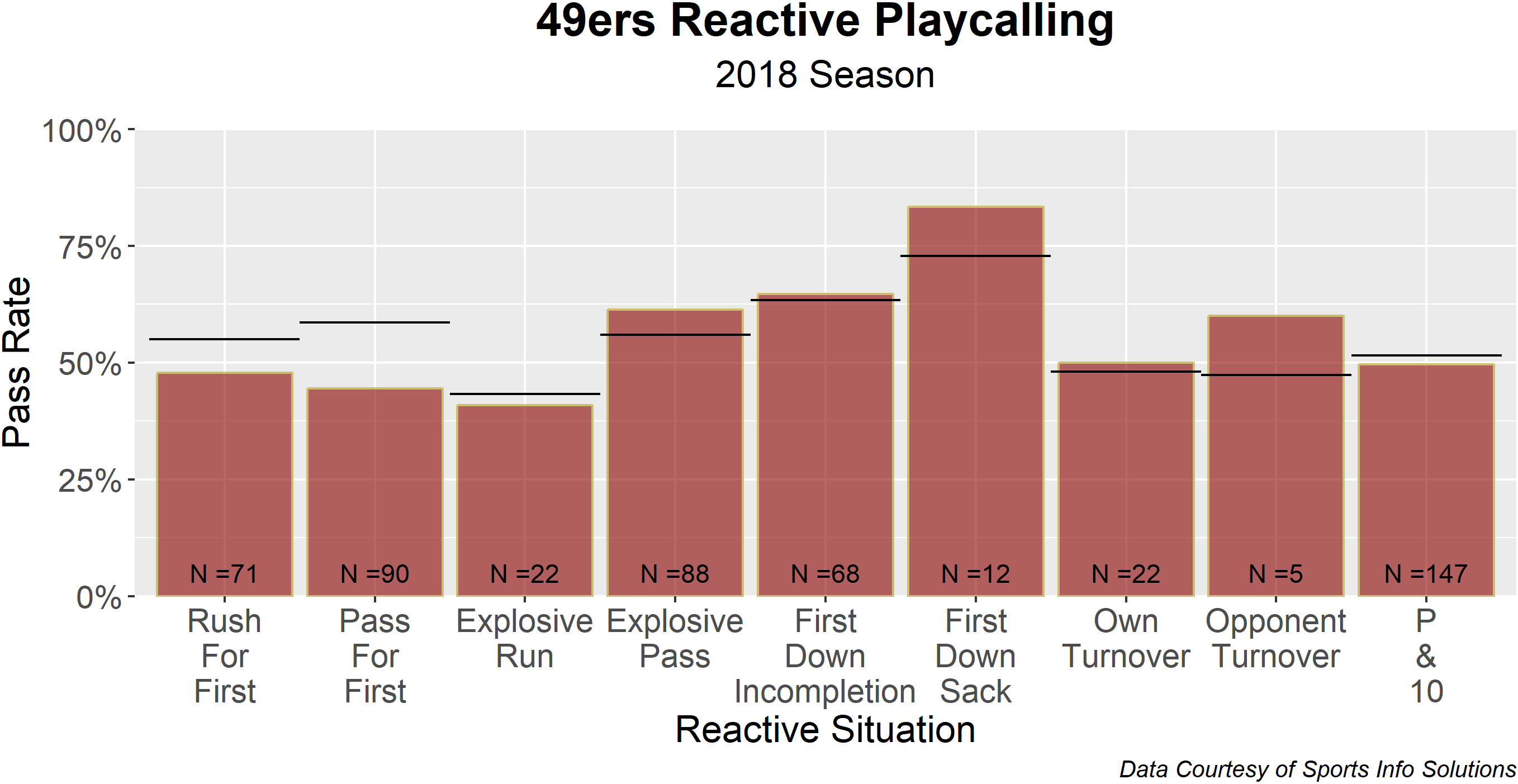
    Rather than scribe out each team’s tendencies and waste your time with wordy prose and analysis you’re likely to skip over anyway, I’ve made something of a picture book. Below are 32 charts, one for each team’s reactive playcalling in 2018. But first, let’s go over some ground rules before we get started.

    The black lines represent the league average rate for each reactive situation. “N =” indicates the number of times a team found itself in the specified reactive situation. Quarterback kneels were removed from the sample, so a team that kneeled the ball after hitting an explosive run to seal the game won’t have its pass rate watered down by such plays.

    It should also be noted that explosive (15+ yards) passes and runs weren’t double-counted in passes and runs for firsts respectively, just as turnover-related opening plays are excluded from the P & 10 sample. Lastly, pass rate is based on the intent of the play, so scrambles and backwards passes are considered passes for the purpose of these calculations.

    Without further ado, please enjoy and watch your step for small samples!

  • And Then There Were Three: a Statistical Comparison of Haskins, Lock, and Jones

    The combine is a distant memory, pro days are all but over, and it seems all that’s left to do is twiddle our thumbs as teams make their final preparations for the NFL Draft. But, arguing amongst ourselves about quarterbacks is a rich tradition, so perhaps that is the best way to occupy our time as we countdown to April 26th. From an analytical perspective, the search for QB1 begins and ends with Kyler Murray, who dominated the advanced stats leaderboards in our inaugural Rookie Handbook. Murray is widely expected to go first overall to the Arizona Cardinals, but prognosticators are less certain about how the rest of the chips will fall.

    Three other quarterbacks – Ohio State’s Dwayne Haskins, Missouri’s Drew Lock, and Duke’s Daniel Jones – are also receiving first round consideration, and there’s no shortage of potential landing spots. The Giants, Broncos, Bengals, Dolphins, and Redskins are franchises with long-term uncertainty at the position who pick within the top half of the first round.

    From an Expected Points Added (EPA)/attempt perspective, Haskins (0.3) is head and shoulders above Lock (0.13) and Jones (-0.04). He’s also considerably more accurate, having delivered an on-target ball on 77% of his throws in 2018, whereas roughly 30% of passes thrown by Lock (71.4%) and Jones (71.6%) were uncatchable or required an adjustment.

    Haskins’ detractors will point to his low average depth of target (ADOT) of 7.9 yards and cite that he made lower-difficulty throws, but he targeted shallow routes at a rate comparable to the other two. Although Lock (8.8) and Jones (8.2) had higher ADOTs, their throws traveled five yards or less at virtually the same rate as Haskins:

    Quarterback Shallow Throw Rate
    Haskins 49.1%
    Jones 49.2%
    Lock 48.6%

    Perhaps this is more symptomatic of a concern about Haskins’ mechanics as they pertain to the deep ball. However, our metrics indicate that he was still one of the better passers in the nation at throwing catchable balls to depths of 20+ yards. Out of 151 college quarterbacks who threw twenty or more such passes in 2018, Haskins ranked 15th at 64.9%. That’s notably a tenth of a percentage point better than Alabama’s Tua Tagovailoa, who is, for all intents and purposes, the incumbent 2020 QB1. It also represents a substantial demarcation from Jones, who ranked 47th at 56.8%. That said, he ranked lower than Lock, whose biggest selling point may be his vertical passing acumen. The Missouri signal-caller ranked 6th in the country by throwing a catchable deep ball 67.8% of the time.

    By this point, you’ve probably noticed that Jones doesn’t compare favorably to his counterparts, and his case is a curious one. First and foremost, it should be noted that he played most of the season with a plate and screws in his left clavicle to fuse together a broken collarbone he suffered on September 8th. Nevertheless, the Blue Devil captain played himself into first round consideration and is regarded by some as the most pro-ready quarterback in the draft. However, the numbers don’t necessarily back that assertion up.

    Jones was primarily asked to execute 0/1-step drops, RPOs, screens, and rollouts, concepts that generally indicate simpler, or even singular, reads. He did so on a whopping 72.6% of his dropbacks, the eighth-highest rate among 164 quarterbacks who dropped back 100+ times in 2018. To give you an idea of how that might translate to the NFL, Nick Foles had the highest rate of 43 NFL quarterbacks at 58.3%. Only two other quarterbacks did so at a rate above 50%, and the average rate among quarterbacks who dropped back at least 100 times was 33.8%.

    Fit will be important for all of these quarterbacks, but it seems that Jones’ projection requires a bigger leap of faith than the others. Whereas the numbers can point to ways in which Haskins and Lock win, the statistical picture for Jones is cloudy. For a more in-depth look at each of these quarterbacks, the aforementioned Rookie Handbook has comprehensive stats and scouting reports on each, and can be purchased here.