Author: John Shirley

  • Will the Packers free agent spending be more impactful than a draft and develop strategy?

    Will the Packers free agent spending be more impactful than a draft and develop strategy?

    By John Shirley

    During the Ted Thompson era in Green Bay, the Packers were notoriously inactive in free agency. That trend has changed under second year General Manager Brian Gutekunst. Will that help maximize Green Bay’s contending window?

    This off-season alone, Gutekunst has already handed out contracts worth a total of $182 million per Spotrac. For comparison, Thompson handed out only $77.5 million worth of contracts over his last 7 years as GM combined. Gutekunst’s signings so far have been focused on defense, as he’s signed safety Adrian Amos and edge rushers Preston Smith and Za’Darius Smith, while also signing offensive lineman Billy Turner.

    The three defensive signings should immediately fill positions of need, and importance, for the Packers. That is always a good thing for a team with an aging quarterback. But is spending on large free agent contracts now better than their previous draft and develop strategy?

    With four draft picks in the top 75 selections and a draft loaded with pass rushers, it might seem like the Packers overspent on the two Smith’s in free agency. However, when analyzing how edge rushers at different points in their careers perform based on SIS’s Total Points metric, Green Bay probably made the right move to maximize its contending window.

    How Edge Rushers and Safeties of Different Tenures Perform in the NFL:

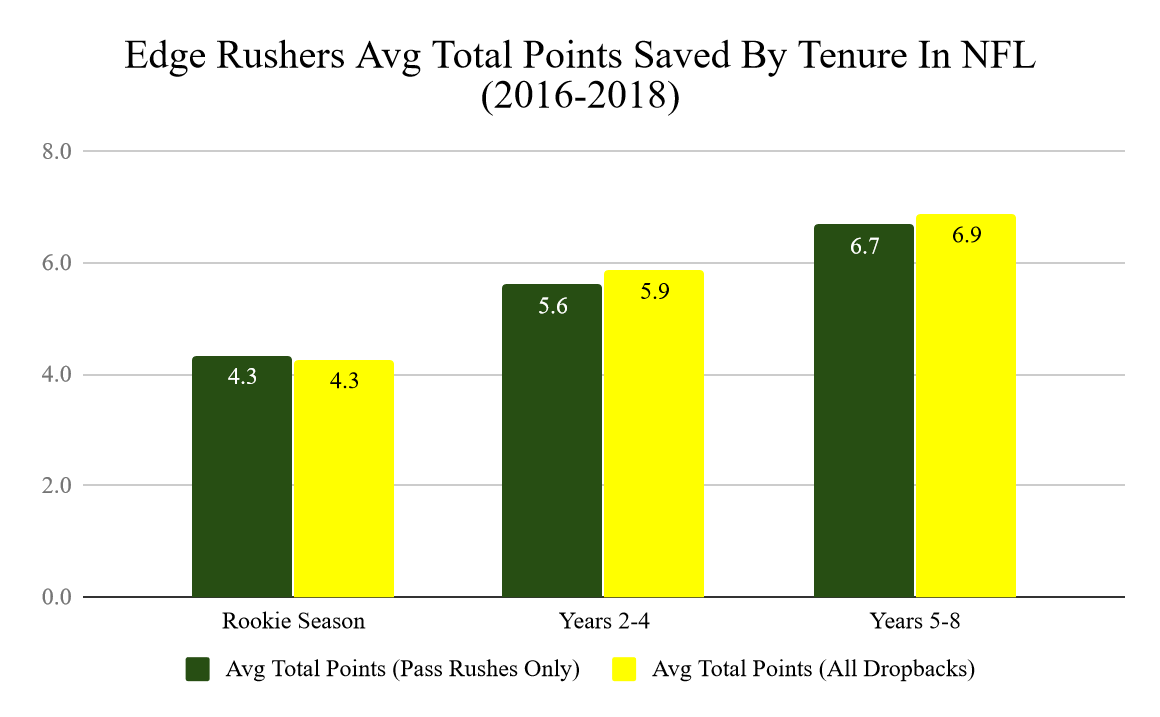
    We analyzed how edge rushers performed over the past three seasons based on how many years they have been in the NFL. Only edge rushers (DE or LB who rushes at least 70 percent of his snaps) who had at least 100 pass play snaps in a given season from 2016-2018 were included. Their performance was broken up by two major milestones in a player’s development and contract situation.

    The first grouping only includes a player’s rookie season since rookies generally have a learning curve to adjust to from college. The second group is second through fourth year players. The third group is fifth year through eighth year players. This group is made up of players who are mainly playing on their second contract.

    In looking at the average Total Points Saved that edge rushers create, there is an unsurprising positive jump after a player’s rookie season. There is also a positive jump as they enter into their second contract.

    This doesn’t mean that free agency is a better way to build a team, especially once finances are included into the equation. It also doesn’t mean that players linearly improve as they age—there are survivor biases to consider when comparing rookies to eighth-year players. It just means that teams can generally expect more immediate results from older players that have proven they can perform in the NFL. And if the Packers are looking to maximize Aaron Rodgers’ prime seasons, that’s a big factor.

    The same analysis was applied to safeties, with only safeties who played at least 100 pass play snaps in a given season from 2016-2018 included. The results show the same trend of a positive jump after a player’s rookie season and a second jump after a player’s fourth season in average Total Points Saved.

    Both of these tables bode well for the Packers’ need for immediate impact players on defense. They show that safeties, such as Amos, and edge rushers, such as the two Smith’s, who make it too their second contract perform better on average than younger players and rookies.

    How Adrian Amos, Preston Smith, and Za’Darius Smith will Help the Packers:

    How their positions perform by tenure is not the only positive for the Packers when analyzing the signings of Amos and the two Smith’s.   

    Last season the Packers ranked 26th in EPA allowed per designed pass play (pass plays plus scrambles and minus screens).  This was primarily due to their inability to create pressure on opposing quarterbacks and their below-average safety play. That is a major problem for a team that played the 4th-most man coverage and blitzed the 7th most in 2018. Teams with those tendencies need to have good pass rushers and reliable safeties on the back end to clean up plays.

    • Packers players ranked 27th in Coverage Success Rate (41%) when lined up at safety. (Coverage Success Rate is the percent of targets that result in a negative EPA for the Offense )
    • The Packers defense ranked 24th in Pressure Percentage on non-blitz plays (25%)
    • Only one Packer defender with at least 100 pass rushes had a pressure percentage of at least 10%, and that was interior defensive lineman Mike Daniels.

    Adrian Amos:

    • Ranked 2nd in Coverage Total Points Saved (27) among safeties in 2018
    • Ranked 3rd in Coverage Success Rate (67%) on targets from the safety position among defenders targeted at least 15 times.
    • Ranked 1st in Man Coverage Success Rate (85%) on targets from the safety position among defenders targeted in man coverage at least 7 times.

    Preston Smith and Za’Darius Smith:

    • Both have had a Pressure Percentage of at least 10% each of the last two years.
    • Za’Darius Smith (11%) and Preston Smith (10%) would have ranked 1st and 2nd, respectively, in Pressure Percentage among Packers edge rushers last season.
    • Preston Smith ranked 3rd in Pass Rush Total Points Saved among LB in 2017 with 23. He had 15 Pass Rush Total Points Saved in 2018, which was more than double the most by a Packers edge rusher.

    The Packers’ need to maximize the window they currently have with Aaron Rodgers at quarterback. Going into free agency they targeted defensive players that could help them right away, while also still having some upside. They came away with Adrian Amos, Preston Smith, and Za’Darius Smith on that side of the ball.

    Even though they come with large contracts, the statistics and Total Points by tenure analysis show that these signings have a good chance of working out. So although the draft and develop strategy is generally thought of as more efficient, signing free agents can be a good way to supplement a roster with immediate impact players.

    For the Packers, it also doesn’t hurt that they still have plenty of draft capital to continue a draft and develop strategy for the future.

  • Will Jason Witten’s Return Provide a Spark for the Cowboys?

    By John Shirley

    Earlier today, Jason Witten decided to postpone his career in the broadcast booth and return to the football field. He is coming out of retirement for his 16th season with the Cowboys. But will his return be a success and help the Cowboys return to the playoffs and compete for a title?

    Witten’s 2017 season (the last season he played) was, by just about every statistical measure, his worst in the NFL since his rookie year. Outside of his rookie year, 2017 saw him produce a career low in receptions, yards, and yards per reception. So it’s fair to wonder how much he has left, especially after spending last season in the booth.

    Comparing his stats to the Cowboys’ TE unit from last season also paints a negative picture of his potential value in 2019.

    Jason Witten Vs Cowboys’ TE’s in 2018

    SeasonPlayerRecYdsYds/TgtTDs
    2016Jason Witten696737.13
    2017Jason Witten635606.45
    2018All Dal TE’s687107.84

    The Cowboys’ TE’s basic stat production was better in 2018 than with Witten in 2016 and 2017. When compared to Witten, the group of Blake Jarwin, Geoff Swaim, Dalton Schultz, and Rico Gathers accounted for a similar number of receptions, more yards, more yards per target, and a similar amount of touchdowns in 2018. It should be noted that during 2016 and 2017 seasons, Witten accounted for 87.5% of the Cowboys’ targets towards a TE and TE’s other than Witten combined for only 19 receptions over those two years. A big factor in this is Witten’s decreased production after the catch as he aged. In 2017, he only averaged 1.7 yards after the catch, while the 2018 group of TE’s averaged 5.5 yards after the catch.

    A common narrative surrounding Witten during his last two seasons was that he provided a good safety net for a young Dak Prescott. While this may have been the case, it seems that the 2018 group provided an even better safety net. The table below shows that Prescott’s production when targeting a TE increased in 2018 after Witten retired.

    Dak Prescott when targeting a TE

    SeasonPlayerAttComp%On-Tgt%Y/A
    2016Dak Prescott10572.4%81.9%7.1
    2017Dak Prescott9771.1%78.4%6.9
    2018Dak Prescott9174.7%85.7%7.8

    Along with replacing him as a receiver, the 2018 group also did a good job of replacing him as a blocker. In both 2016 and 2017, Witten was asked to block on more plays than any other TE in the NFL. He was solid as a blocker, but the 2018 group of TE’s was even better, blowing only 5 blocks all season.

    SeasonPlayerBlocking SnapsBlown Block %
    2016Jason Witten5141.3%
    2017Jason Witten4881.6%
    2018All Dal TE’s6250.1%

    In 2017, Jason Witten had 17.7 Total Points Earned (SIS’s overall value metric) from his receiving production. Cowboy’s TE’s in 2018 combined for 27.6 Total Points Earned from their receiving production.

    Based on the numbers Witten had clearly declined during the last few years of his career, which should be expected of a TE in his late 30’s. So expecting him to provide much of a spark to the Cowboy’s offense in 2019 is a stretch, especially since the group that collectively replaced him has fared pretty well last season.

  • Super Bowl Preview: Patriots vs. Rams

    Super Bowl Preview: Patriots vs. Rams

    By John Shirley

    Tale of the Tape

    It should be unsurprising that both the Rams and Patriots rank highly on offense. Both teams rank in the top ten in both EPA/Called Pass (includes scrambles and excludes spikes) and EPA/Called Run (excludes scrambles and kneel downs). The weakest unit based on average EPA is the Rams’ run defense, which could be in for a long day facing the fifth-ranked Patriots’ rushing offense.


    RamsRkPatriotsRk
    EPA/Called Pass0.184th0.147th
    EPA/Called Run0.151st0.075th
    EPA Allowed/Called Pass0.0313th0.0312th
    EPA Allowed/Called Run0.0220th-0.055th

    Tendency Report

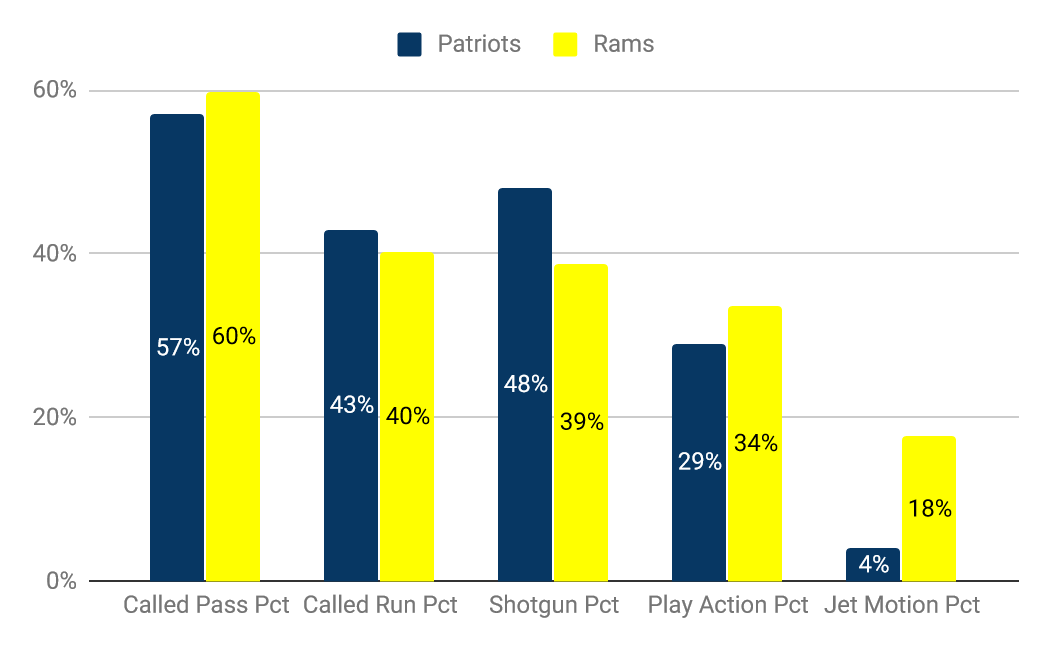
    The Rams and Patriots have similar tendencies based on overall pass/run percentage and the use of shotgun and play-action. Both teams are on the low end of the league in shotgun usage, but they rank highly in play-action usage. One tendency in which they differ is in the use of jet motion. The Rams lead the league by using jet motion on 18 percent of their plays, while the Patriots only use it on 4 percent of plays.

    Personnel Usage

    The Rams use of 11 personnel (1 RB, 1 TE) since Sean McVay arrived has been well documented over the past two years. They used 11 personnel on 92 percent of their offensive snaps in 2018. However, they started to use 12 personnel (1 RB, 2 TE) a little more often after Cooper Kupp was injured.

    The Patriots’ offense also favors 11 personnel, but they mix up their packages much more often. When they are not in 11, they prefer to bring in another running back (usually FB James Develin).

    Key Matchups

    Patriots’ Short Passing Game vs. Rams’ Pass Defense

    • The Patriots throw the ball within five yards of the line of scrimmage on 54 percent of their attempts, which ranks 13th-highest. They also target their running backs the second most often in the league.
    • The Rams’ defense is the best at defending against short passes (5 yards or fewer), only allowing a positive percentage of 38 percent on them.

    Patriots’ Guards vs. Aaron Donald

    • The Patriots’ offense line has been phenomenal this season both in pass protection and run blocking. Their guards, Joe Thuney (1st) and Shaq Mason (8th), both rank highly among all offensive linemen in SIS’s Total Points metric.
    • Aaron Donald primary lines up in either the 3-technique or 4i-technique in the Rams defense. Teams on average allow pressure (a hurry, hit, knockdown, or sack) from either of these two positions on 9 percent of dropbacks. Donald generates pressure on 16 percent of his pass rushes from these positions.
    • The Patriots’ offensive line ranks first in the league by allowing pressure from a player lined up at the 3-technique or 4i-technique on only 5 percent of their snaps.

    Rams’ Rush Offense vs. Patriots’ Rush Defense

    • The Rams running game was successful during the regular season, no matter if it was Todd Gurley or CJ Anderson in the backfield. That success followed them into the Divisional Round of the playoffs, but they struggled against the Saints in the NFC Championship. That was due to the Saints having the third best run defense in the NFL, allowing only -0.07 EPA/Called Run Play.
    • The Patriots have the fifth-best run defense in terms of EPA/Called Run Play, allowing an average of only -0.05. They also rank fifth in run defense versus 11 personnel, still allowing an average of only -0.05 EPA/Called Run Play.

    Rams’ Passing Game vs. Patriots’ Man Coverage

    • The Patriots use man coverage on defense 58 percent of the time, which is the highest percentage in the league.
    • Unfortunately for the Rams, their best receiver vs. man coverage, Cooper Kupp, is injured. Kupp led the league (min. 10 targets) in yards per target against man coverage with 14.6 yards per target.
    • Fortunately for the Rams, they still have solid options at receiver. Brandin Cooks ranks sixth averaging 11.9 yards per target against man coverage. Also, TE Tyler Higbee has the third-highest positive percentage of all players (min. 10 targets) against man at 81 percent, albeit on only 11 targets.
  • Preview: NFC Championship – Rams vs. Saints

    By John Shirley

    Let’s take a brief look at some statistical notes and story lines ahead of the NFC Championship game between the Rams and Saints

    Lots of Motion and Play-Action, but not much Shotgun

    • The Rams’ offense ranks first in the use of jet motion, using it on 17 percent of their plays. The Saints also use jet motion quite a bit, using it on 6.5 percent of plays, which ranks fifth highest.
    • When the Rams are on offense get ready to see a lot of play-action. They use play-action on 32 percent of their dropbacks, which is the highest usage in the league. The Saints’ offense is on the other end of the spectrum as they only use play-action on 19 percent of their dropbacks, which ranks 26th.
    • While there will be a lot of play-action and motion in this game, there probably won’t be much use of shotgun. The Rams use shotgun the least of any team in the league at only 38 percent. The Saints, who use shotgun on only 49 percent, are also one of just four teams that use shotgun under 50 percent of the time.

    The Saints use of Michael Thomas

    • During the regular season Saints receiver Michael Thomas was responsible for 29 percent of his team’s targets. This was the second highest target share in the league next to DeAndre Hopkins’ 33 percent target share.
    • In the first meeting between the Saints and Rams, Thomas’ target share was an incredibly high 42 percent.
    • The Rams will need to contain Thomas this time around. It will help that they will have corner Aqib Talib this time.

    The Rams Running Game vs the Saints Defense:

    • The Rams running game has been impressive this year ranking third in yards per carry at 4.9 yards. They also ranked first in positive percentage (the percentage of running plays with a positive EPA) at 51 percent. This success continued into the playoffs last week as both CJ Anderson and Todd Gurley ran for over 100 yards.
    • The Rams will have a tough matchup this week when they face a Saints run defense. The Saints defense ranked second by only allowing 3.6 yards per carry. They only allowed 1.9 yards after contact per carry, which also ranked second best in the league.

    The Offensive Lines vs the Defensive Lines:

    • The Rams offensive line ranks fifth (6 percent) in blown block percentage, while the Saints offensive line ranks sixth (6.4 Percent). The Rams defense ranks fourth (11.3 percent) in forced blown block percentage, while the Saints defense ranks 11th (9.5 percent).
    • The Saints offense ranks second in percentage of pass plays with a pressure (hit, hurry, knockdown, or sack) allowed at 27 percent. The Rams offense ranks seventh, allowing a pressure on 30 percent of pass plays.
    • The Rams defense ranks second in pressure percentage, getting pressure on 40 percent of opponents pass plays. The Saints defense ranks sixth, getting pressure on 36 percent of opponents’ pass plays