Category: MLB

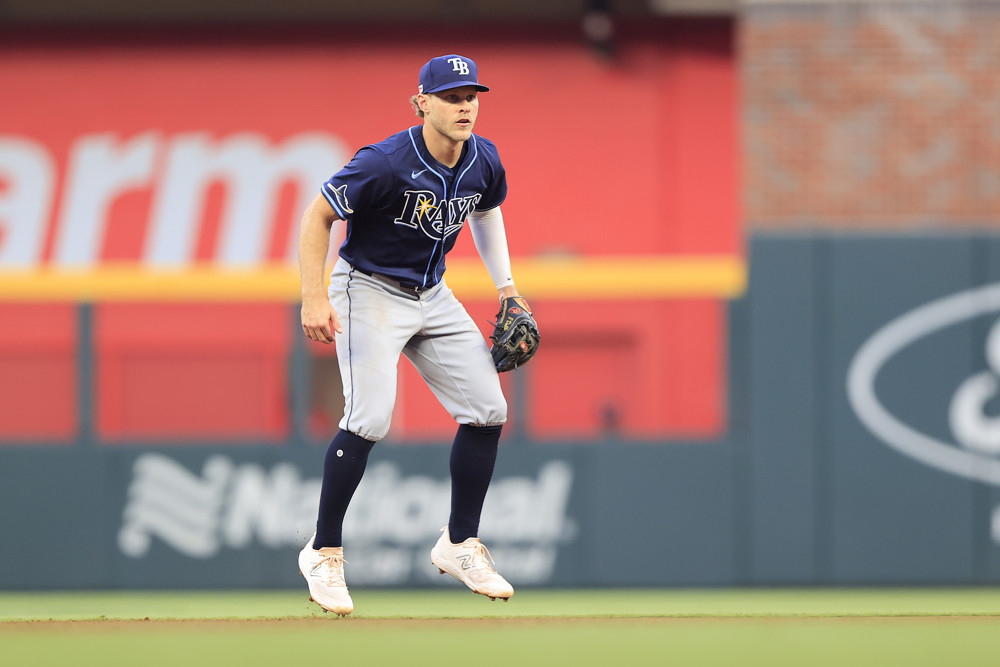
  • Are the Rays A Good Defensive Team?

    Are the Rays A Good Defensive Team?

    Photo: David J. Griffin/Icon Sportswire

    Part of a series of articles previewing the defensive performance of all 30 MLB teams by asking the question … are they good?

    To see the full series, click here.

    2024 Defensive Runs Saved Rank: Tied for 21st

    Team Strengths

    The Rays have an abundance of talented middle infielders. Shortstop Taylor Walls is challenged as a hitter(.188 BA in 1,080 career at-bats) but his terrific glove keeps him on the field. He ranked 2nd in Runs Saved at shortstop last season despite ranking 28th in innings played.

    Most Defensive Runs – Shortstops in 2024

    Player Runs Saved
    Masyn Winn 14
    Taylor Walls 12
    Brayan Rocchio 11
    Zach Neto 11

    Once Ha-Seong Kim gets fully healthy from October surgery to fix a torn labrum, he’ll be a plus defender wherever the Rays place him. He saved 10 runs at second base in 2023, so he’d be an easy fit there.

    Team Weaknesses

    With the trade of center fielder Jose Siri to the Mets, the Rays don’t have much else to be excited about defensively. The best Rays defenders are in the minor leagues, as you’ll read below.

    Danny Jansen is projected to be the starting catcher but the formerly good ex-Blue Jay totaled -11 Runs Saved last season and rated poorly at both strike throwing and stopping basestealers.

    Yandy Diaz is a much, much better hitter than fielder He finished with -5 Runs Saved at first base last season, a dip from 0 in 2023. In 2022, he totaled -14 at third base.

    Other Things To Know

    It looks like Jonny DeLuca is going to play center field rather than a corner spot. Of the current Rays projected outfield starters, DeLuca would seem to have the highest ceiling given that he’s one of the fastest players in baseball, which allows him to chase down a lot of balls. But being a great center fielder is difficult given how good even an average center fielder is. DeLuca had -1 Run Saved in about a quarter-season in center last year and posted 6 Runs Saved in slightly more time in right field.

    The Rays have two of the best defensive prospects in the minor leagues, though you may not see them this season. Shortstop Carson Williams tied for 2nd among minor league shortstops in Runs Saved in 2024. The Rays have given him a full year at all three levels he’s played at, so he might spend the whole season or close to it in Triple-A.

    First baseman Tre’ Morgan finished with 1 Run Saved there last season but got an 80 future grade on the 20-80 scouting scale in FanGraphs’ evaluation of the top 100 minor league prospects. He’s still a bit away from the majors, as he’s played only 21 games above A-ball.

    Are The Rays A Good Defensive Team?

    Not now, but in a year they could be a lot closer to being a good one than they are at the moment.

  • Are The Brewers A Good Defensive Team?

    Are The Brewers A Good Defensive Team?

    Photo: Randy Litzinger/Icon Sportswire

    Part of a series of articles previewing the defensive performance of all 30 MLB teams by asking the question … are they good?

    To see the full series, click here.

    2024 Defensive Runs Saved Rank: 4th

    Team Strengths

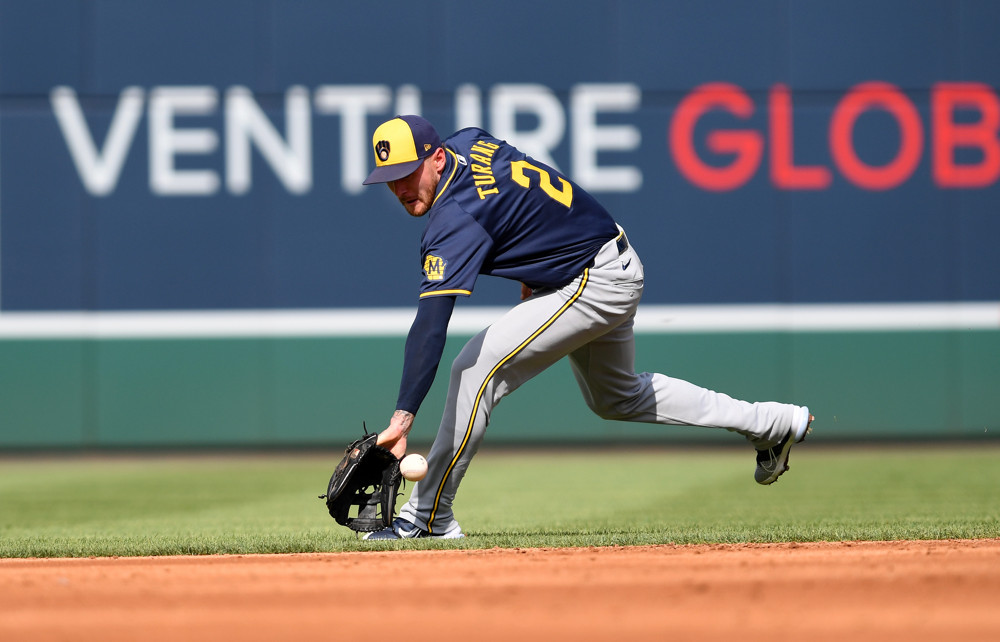
    Brice Turang led second basemen in Runs Saved in 2024, and though he didn’t win a Fielding Bible Award, he won the Platinum Glove for the National League. Turang has a great highlight-reel collection of difficult plays, particularly those in which he went to his right to take away a base hit.

    The Brewers have four very good defensive outfielders between Gold Glove winner Sal Frelick, Jackson Chourio, Garrett Mitchell, and Blake Perkins, though Perkins is out until May with a fractured shin. 

    Brewers right fielders led the majors in Defensive Runs Saved last season and their center fielders finished 3rd. 

    The team also knows what it’s getting from catcher William Contreras, who is a good pitch framer and saved 5 and 6 runs the last two seasons.

    Notable Brewers Defensive Runs Saved Ranks – 2024

    Position Rank
    Right Field 1st
    Second Base 1st
    Center Field 3rd
    Shortstop T-29th

    Team Weaknesses

    Christian Yelich is the weak spot in the defense. Yelich has posted a negative Runs Saved in each of the last five seasons in left field, including last year when he played only 48 games. As the roster currently stands, he’s likely to DH, so his defense shouldn’t impact the team too much.

    Defense has never really been Rhys Hoskins’ forte and he limited the damage to -3 Runs Saved last season. Hoskins has had seasons with a positive Runs Saved in the past so he’s not necessarily a huge liability.

    Other Things To Know

    The Brewers actually lost the weakest link in last year’s defense when Willy Adames, who plummeted to a positional worst -16 Runs Saved at shortstop, signed with the Giants. 

    They’ll move Joey Ortiz from third base, where he was pretty good, to shortstop, which was his primary position in the minors. Ortiz had a minor league-best 14 Runs Saved at shortstop in 2022, though he dipped to -2 in 2023. Oliver Dunn replaces Ortiz at third base. He looked alright in 27 games there last year, with no errors and only 1 Defensive Misplay.

    Are The Brewers A Good Defensive Team?

    Yes, the Brewers have a good mix of athleticism and skill. They were the most skilled defensive team in the NL last season and though they might not rack up home run robberies like they did last season (when they had an MLB-best 10 and Perkins had 5 of them), if healthy, their Runs Saved total should be among the best in the majors.   

  • Are The Blue Jays A Good Defensive Team?

    Are The Blue Jays A Good Defensive Team?

    Photo: Cliff Welch/Icon Sportswire

    Part of a series of articles previewing the defensive performance of all 30 MLB teams by asking the question … are they good? 

    To see the full series, click here.

    2024 Defensive Runs Saved Rank: 1st

    Team Strengths

    When healthy, Daulton Varsho is the best defensive outfielder in baseball and Defensive Runs Saved doesn’t have it as particularly close over the last three seasons. He’s recovered from shoulder surgery more quickly than expected, and is currently functioning as a designated hitter in spring training. We’ll find out if that injury cuts into how aggressively he goes crashing into fences to make catches and how he throws once he returns to the outfield. 

    While the Blue Jays wait for Varsho, Myles Straw, a Gold Glove winner two years ago, or Joey Loperfido (5 Runs Saved in left field) could take his place.

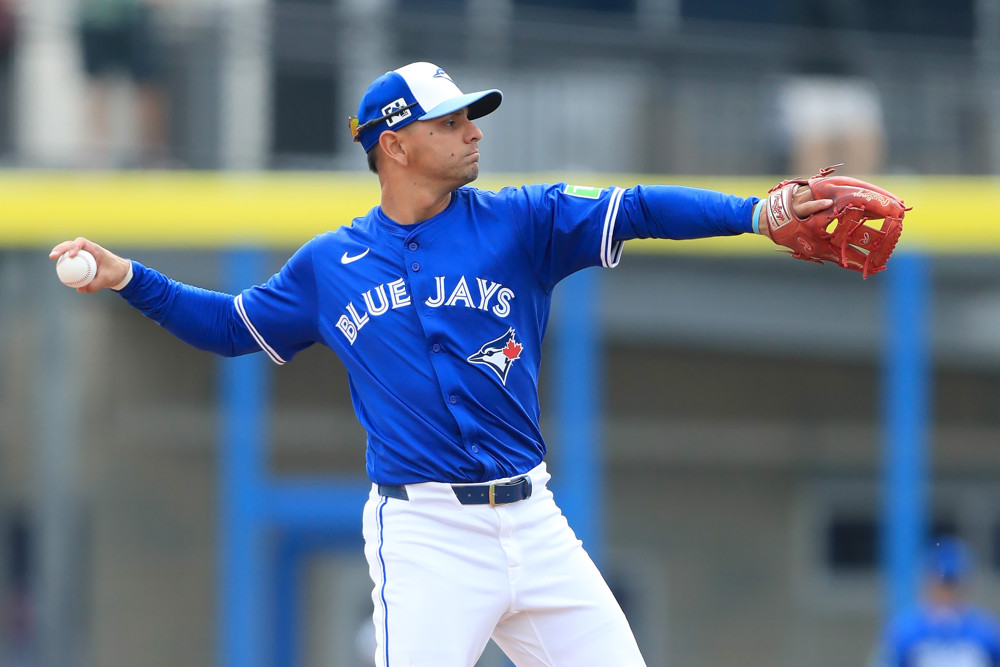
    The Blue Jays traded for the best defensive second baseman, Andrés Giménez, who is a wizard when it comes to making plays. He’s still in his prime at age 26 and is the runaway leader in Runs Saved at the position over the last three seasons.

    Ernie Clement isn’t Matt Chapman but by Runs Saved he was pretty good. He led all American League third basemen with 9 Runs Saved last season and was also pretty good at shortstop too.

    Alejandro Kirk is good at a lot of things that catchers do – pitch framing, pitch blocking and throwing out basestealers. He’s first among catchers in Runs Saved over the last three seasons.

    Blue Jays Players Leading MLB in Defensive Runs Saved – Last 3 Seasons

    Player Position
    Daulton Varsho CF
    Andres Gimenez 2B
    Alejandro Kirk C

    Team Weaknesses

    The Blue Jays have a few players who fall into the category of “They were at one time a decent defender but maybe not anymore.”

    That encompasses first baseman Vladimir Guerrero Jr., shortstop Bo Bichette, right fielder George Springer, and left fielder Anthony Santander among others. Each of them finished 2024 with a negative Defensive Runs Saved but has much better seasons in their respective histories.

    Other Things To Consider

    Last year’s midseason trade of Isiah Kiner-Falefa to the Pirates was a notable one because of how few players have the defensive versatility that he has. IKF had good Runs Saved totals at second base, shortstop and third base. Clement is the closest thing the team has to that at the moment.

    Are The Blue Jays A Good Defensive Team?

    Yes, particularly at three spots up the middle. Are they still best-in-baseball good? They could be, particularly if Varsho came back performing at a similar skill level to the last couple of years.

  • Are The Guardians A Good Defensive Team?

    Are The Guardians A Good Defensive Team?

    Photo: Scott Winters/Icon Sportswire

    Part of a series of articles previewing the defensive performance of all 30 MLB teams by asking the question … are they good?

    To see the full series, click here.

    2024 Defensive Runs Saved Rank: 2nd

    Team Strengths

    Left fielder Steven Kwan is the best defender at his position by a good margin since making his debut in 2022.

    Most Defensive Runs Saved – Left Field

    Last 3 Seasons

    Player Runs Saved
    Steven Kwan 46
    Ian Happ 24
    Daulton Varsho 22
    Brandon Marsh 20
    Lourdes Gurriel Jr. 18

    First baseman Carlos Santana has remade himself as a defensive first basemen and has been among the best in the game the last two seasons (20 Runs Saved ranks 2nd). Should anything happen to him, the team’s likely DH, Kyle Manzardo, had a good track record in the minor leagues. 

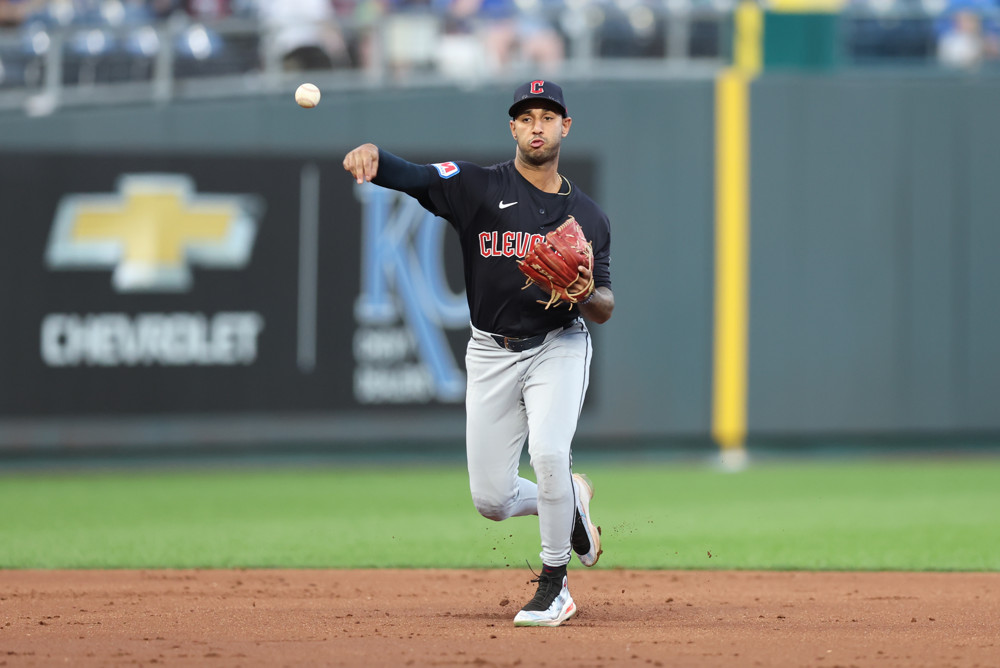
    Shortstop Brayan Rocchio had a very good rookie season, ranking 3rd among shortstops in Runs Saved. He was particularly good on the double play and it will be interesting to see how he works with a new second baseman on that, with Andrés Giménez traded to the Blue Jays.

    Speaking of remakes, Bo Naylor made vast improvements to his pitch framing last season and jumped from -3 Runs Saved overall in 2023 to 11 Runs Saved in 2024.

    Team Weaknesses

    Center field could be problematic if that’s Lane Thomas’ primary position. He has -6 Runs Saved there in his career and had -11 in right field last season. Will Brennan had -6 Runs Saved in right field, so the outfield outside of Kwan looms as the biggest weakness.

    Other Things To Consider

    We didn’t mention José Ramírez as a strength, though we could have. He’s totaled 8, 1, 1, and 6 Runs Saved in the last four seasons playing about the same number of innings each year at third base. He’s an above-average defender.

    There seems to be a clear path for Travis Bazzana to become the team’s regular second baseman pretty quickly. We have only a 27-game sample size to go on, in which he had 2 Runs Saved at High-A Lake County last season. We’ve seen 20-80 grades of 40 (Eric Longenhagen, FanGraphs) and 50 (MLB Pipeline) on his glove, so it doesn’t seem like he’ll be at Giménez’s level.

    Are They A Good Defensive Team?

    If the Guardians had Giménez, it’s fair to say they’d have entered 2025 as the best defensive team in the majors. Without him, they’re still pretty good. The spots where they are strong, they are quite strong.

  • Stat of the Week: Most Impactful Defensive Moves This Offseason

    Stat of the Week: Most Impactful Defensive Moves This Offseason

    Photos: Kevin Abele (left), Frank Jansky (middle), Joe Robbins (right)/Icon Sportswire 

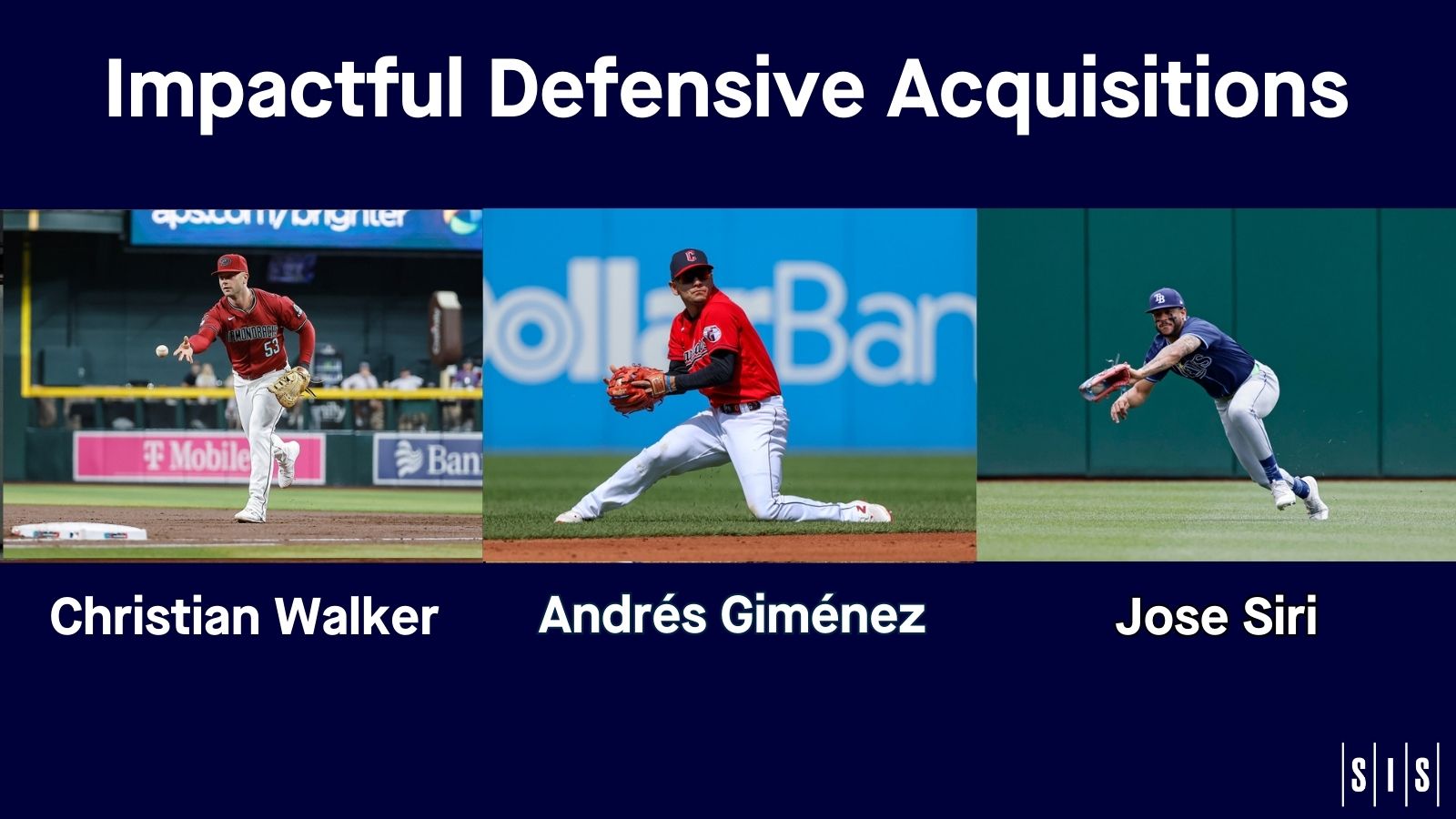
    New Astros first baseman Christian Walker has averaged 11 Defensive Runs Saved per season over the last three seasons. He tallied 9 and 7 Runs Saved in each of the last two seasons, respectively.

    The Astros ranked last with -14 Runs Saved from their first basemen in 2024. In fact, they’ve recorded negative Runs Saved at that position in each of the last three seasons.

    If you look at all of the offseason moves, the Astros’ signing of Walker has a chance to be the most impactful from a defensive perspective. A potential 25-run improvement is huge …

    Except that Walker was held out of a spring training game on Wednesday with a sore oblique. Obliques are tricky injuries. Walker has missed time due to oblique injuries before. The Astros have others who could play first base on their roster but none of them have Walker’s skill.

    Thinking about this some more leads to the question, what were some of the other most impactful acquisitions from a defensive perspective?

    The other one that most stands out is the Blue Jays’ trade for second baseman Andrés Giménez. Gimenez has 58 Runs Saved at that position the last three seasons, 20 more than the next-closest player (Marcus Semien). Second base was a logjam for the Blue Jays last season, with six players playing between 21 and 56 games there. Their combined defensive output was 1 Run Saved. Giménez represents a big upgrade.  

    The Guardians may dip a bit at second base, but first base got an upgrade with the trade of Josh Naylor and the reacquisition of Carlos Santana.

    First base was the Guardians’ weakest defensive position last season (-6 Runs Saved). Santana’s 20 Runs Saved at first base the last two seasons were one run shy of most in MLB there. There is some risk in Santana’s age. He turns 39 on April 8.

    The Mets’ willingness to swap out Harrison Bader for Jose Siri as their primary center fielder makes us think that the team bought into what Runs Saved showed – that Bader, despite his rep and his penchant for terrific plays, wasn’t as good as he looked in the past. 

    The Mets finished with -6 Runs Saved in center field last season, their 3rd straight season with a negative total there. Bader tallied -2 Runs Saved. Siri had his best year in center field last season, finishing with 12 Runs Saved. It’s just a question of whether he’ll hit enough to stay in the lineup and be fully impactful.

    The Rays lost Siri but gained middle infielder Ha-Seong Kim, signing him this offseason despite a shoulder surgery. From a defensive perspective the big upgrade would come at second base, where Kim saved 10 Runs in 2023 and Brandon Lowe has totaled -6 Runs Saved the last two seasons. Kim can also play shortstop, though the Rays have a very good defender there, albeit one whose offense struggles, in Taylor Walls. 

    One under-the-radar move that boosted a team’s defense was in Cincinnati, where the Reds traded for catcher Jose Trevino. Trevino is good enough defensively – 16 Runs Saved in 125 games over the last two seasons, 21 the year before that – that he may move Tyler Stephenson, who is not a good defender, into more time at first base or designated hitter. Trevino is another one whose hitting is needed to give his defense a chance to be impactful.

    Honorable Mentions: Kyle Tucker (Cubs), Isiah Kiner-Falefa (Pirates), Michael A. Taylor (White Sox), Josh Rojas (White Sox), Kevin Newman (Angels), Kyle Higashioka (Rangers)

  • Stat of the Week: 2025’s Rising Defensive Stars

    Stat of the Week: 2025’s Rising Defensive Stars

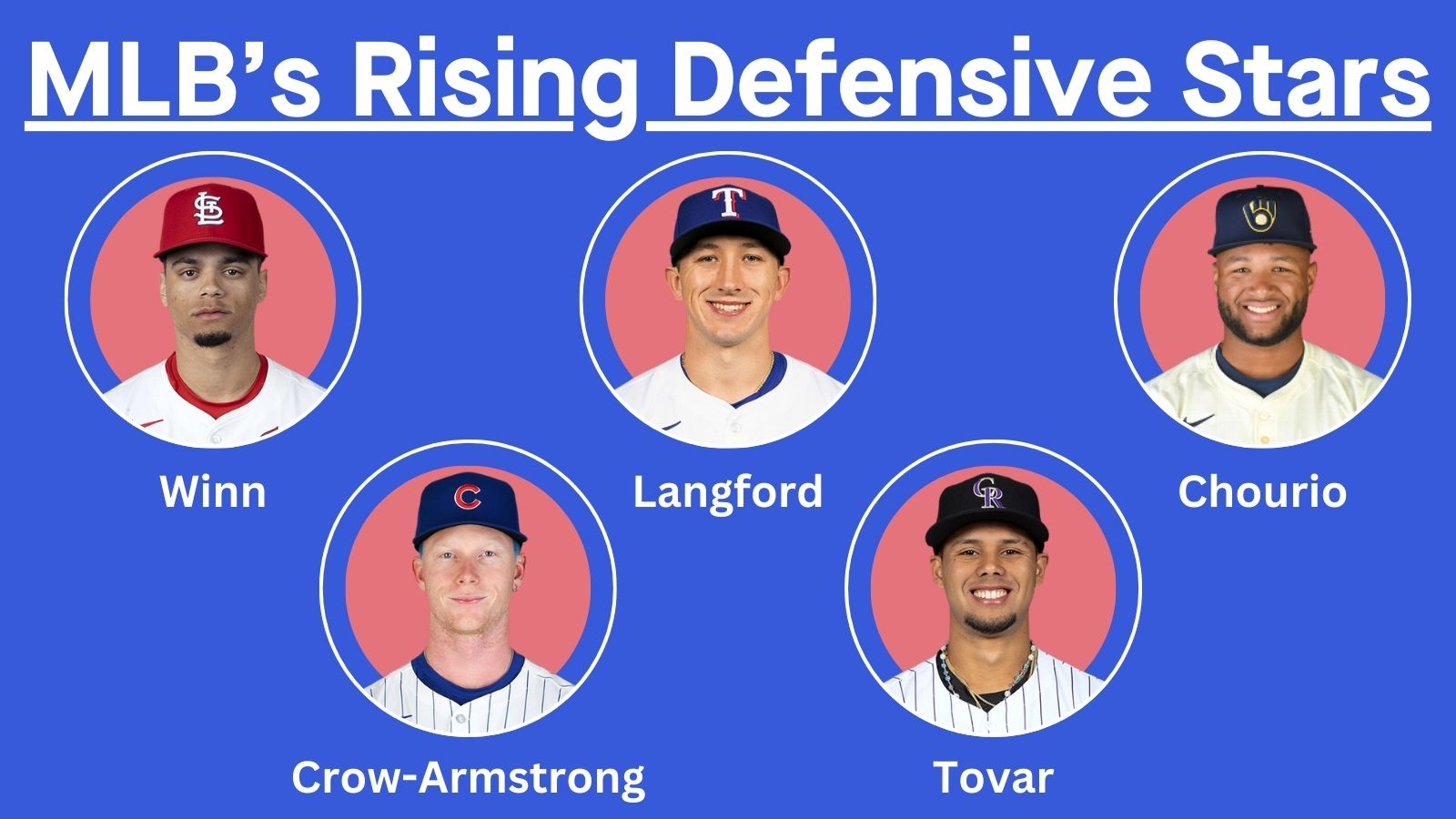
    For the third straight year, let’s talk about MLB’s rising defensive stars. Last year, we defined a rising star as a player who is in their age-23-or-younger season for the upcoming year who had at least 10 Defensive Runs Saved in the major leagues the previous season.

    Five players fit the description. Let’s run through each of them.

    Cardinals shortstop Masyn Winn won a Fielding Bible Award as a 22-year-old last year. He led all shortstops with 14 Runs Saved. Winn didn’t have the best range among shortstops last season, but combined good range with fantastic work on double plays, and came out as the best at a position with many young standouts.

    Rangers outfielder Wyatt Langford won both MLB’s Player of the Month for September, when he hit .300 with a .996 OPS, and was our co-Defensive Player of the Month for recording 11 Runs Saved, 9 in left field. Langford finished with 12 Runs Saved for the season at his primary position and led left fielders in the Outfield Arm component of Runs Saved. Something to watch: He’s been hindered by an oblique injury this spring.

    Brewers outfielder Jackson Chourio was great in his debut season as a 20-year-old in 2024. Chourio saved 9 runs in right field and 3 runs in left field despite playing 28 more games at the latter position. His range was fine in both spots though his arm played better in right field. Brewers manager Pat Murphy told reporters that Chourio will see some time in center field this year as well, so it will be a challenge for him to duplicate his 2024 numbers.

    Cubs center fielder Pete Crow-Armstrong finished 3rd in the Fielding Bible Awards at the position last year, and I think if you polled our voting group, he’d be the preseason favorite for 2025. Armstrong wowed with his defense, though mostly away from Wrigley Field. He actually had -4 Range Runs Saved at home but led center fielders with 9 on the road (and had 6 Runs Saved for things other than range).

    Last but not least on the list is Rockies shortstop Ezequiel Tovar, who makes it for the second year in a row. He had the best defensive season among those on last year’s list (Anthony Volpe, Johan Rojas, and Gunnar Henderson were the others).

    Tovar had 10 Runs Saved last season and his 22 Runs Saved over the last two seasons trails only Dansby Swanson’s 24 among shortstops. Similar to Winn, he’s excellent at turning the double play and he’s also very good (relative to other shortstops) at getting outs on balls hit to his right.

    Last year I also picked an honorable mention (C.J. Abrams) and I’ll do this again this time. Let’s go with Abrams’ teammate, Nationals outfielder Dylan Crews, who had 4 Runs Saved in 31 games as a major leaguer. Crews also had 2 Runs Saved in 79 games as a minor league center fielder. It’s hard to have a positive Runs Saved as a minor leaguer given that the out probabilities that SIS uses judge them against MLB players. But Crews was able to have a good defensive season.

    Keep an eye on these players in 2025. The expectations are high, but deservedly so.

  • Stat of the Week: Defensive Standouts Among The Top 100 Minor League Prospects

    Stat of the Week: Defensive Standouts Among The Top 100 Minor League Prospects

    Earlier this week, FanGraphs published its Top 100 Prospects list and with it, current and future scouting grades. There is an overall Future Value (FV) grade on the 20 to 80 scouting scale, and then there are grades relative to skills, such as hitting, raw power, speed, and the one we’re most concerned with, fielding.

    We’re partial to these rankings given that their primary author, Eric Longenhagen, is a Sports Info Solutions alum.

    Eric and his staff had 20 prospects among their Top 100 with a Future Value in fielding of 55 or higher. These are the players that FanGraphs views as having the most defensive promise.

    In addition to charting every major league game, SIS charts the minor leagues, in full or nearly in full from Single-A to Triple-A, though we have slightly less comprehensive data for these levels, most notably outfield positioning.

    Nonetheless, we have Defensive Runs Saved totals for players using an MLB basis for evaluation (in other words, all plays are based on MLB out probabilities). Most minor leaguers have negative Defensive Runs Saved because they’re being judged against MLB players. But not all of them do.

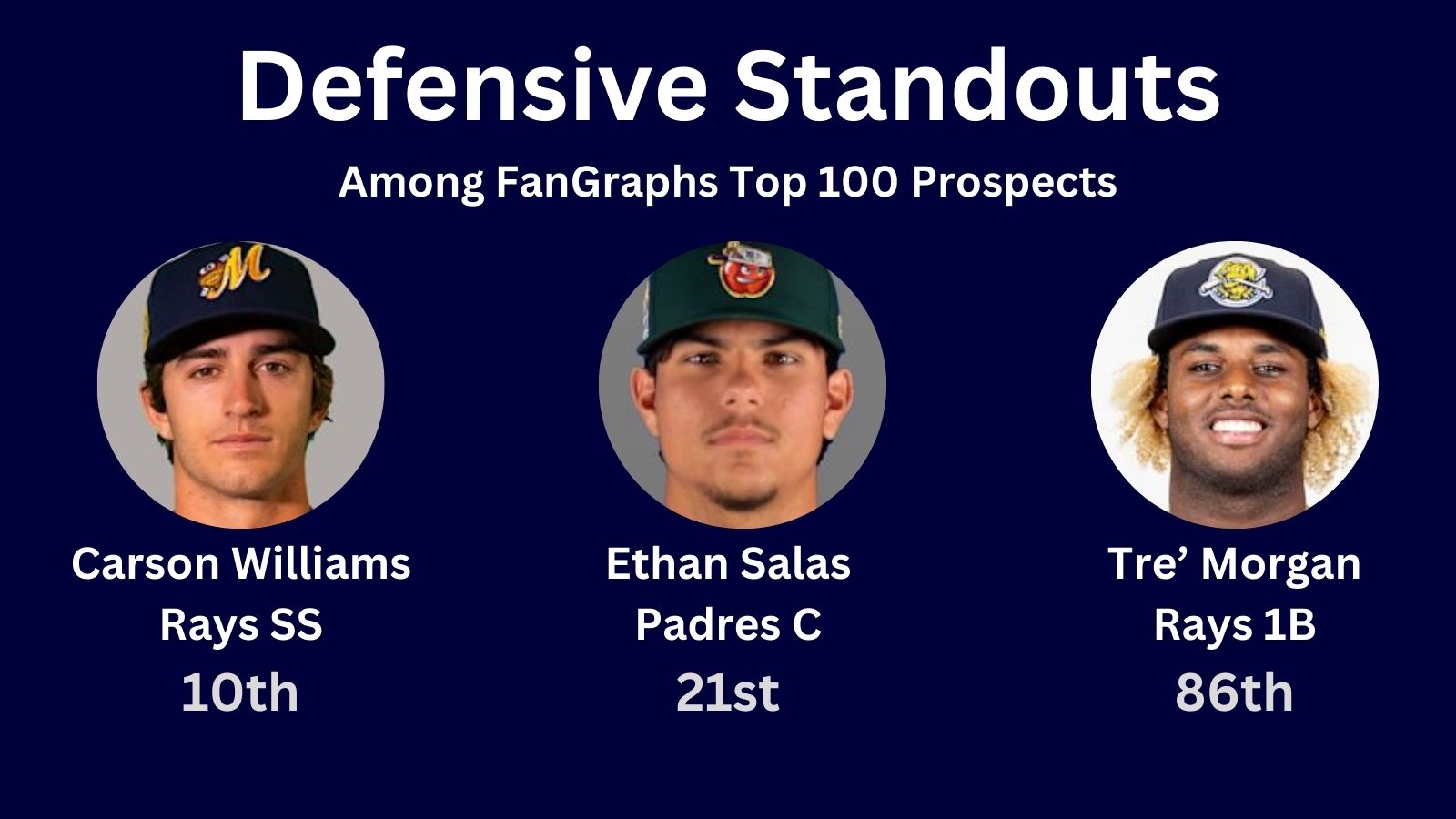
    One of the game’s top prospects is Rays shortstop Carson Williams, whom we’ve referenced here before. He totaled 6 Runs Saved, the most by any minor league shortstop prospect last season. FanGraphs gave Williams a current grade of 60 for his defense and a Future Value grade of 70. They think Williams is “a future Gold Glove shortstop” and peg him as a major leaguer in 2026. Williams ranks as the No. 10 prospect in MLB.

    The only other infielder or outfielder in the Top 100 prospects to get a 55 or higher Future Value grade for defense from FanGraphs and have a positive Runs Saved in 2024 was first baseman Tre’ Morgan. Morgan, whom we interviewed when he was playing for LSU, had 1 Run Saved at first base last season and has an 80 future grade for his defense from FanGraphs.

    Longenhagen also likes Padres catching prospect Ethan Salas—another player who may be a year away from debuting—ranking him No. 21.

    Salas fared well in both the strike-getting and limiting-basestealing components of Runs Saved last season. His 12 Runs Saved ranked in the 95th percentile among catchers in A/High-A.

    Catchers tend to post higher Runs Saved in the minor leagues than other positions do. Of the five catchers other than Salas with good scouting grades, the two with the best Runs Saved totals were Cardinals prospect Jimmy Crooks (77th) and Marlins prospect Joe Mack (69th). Crooks has a future grade of 60 for his defense. He spent 2024 with Double-A Springfield and led catchers at that level with 24 Runs Saved. Right behind him was Mack, who has a 55 future grade for defense. Mack spent 2024 with Double-A Pensacola and totaled 18 Runs Saved.

    This is not to say that these catchers will post Runs Saved totals that high in the majors—after all, single-season defensive metrics are only so predictive, and strike zone enforcement in the minors is different from the majors. But the fact that all three fared so well bodes promising for their future success.

  • Stat of the Week: Alex Bregman Fills A Big Hole Amid Position Switch

    Stat of the Week: Alex Bregman Fills A Big Hole Amid Position Switch

    Photo: Frank Jansky/Icon Sportswire

    The Red Sox signing of Alex Bregman takes the most prominent remaining free agent position player off the board and sets up an intriguing scenario in Boston for 2025.

    The Red Sox will not play Bregman at third base, where he won a Gold Glove last year, but will instead play him at second base, where he’s played 32 professional innings and none since 2018. The game will play a bit slower for Bregman, as being farther from home plate will give him more time to make plays. He’ll also need to be adept at turning the double play with a baserunner coming towards him or sliding into the base.

    There actually aren’t a lot of great recent examples of a player making the third base to second base move with almost no second base experience (most players who have done this in the last 15 to 20 years had at least 40 prior games at the hot corner).

    The best example we could find was Akinori Iwamura, who played third base full time for the Rays in 2007 then moved to second base in 2008. He went from -6 Runs Saved at third to 2 Runs Saved at second.

    In 2012, Daniel Descalso played second base for the Cardinals with only 18 games experience there after playing most of the previous season at third base. He went from -6 Runs Saved at third base to 0 Runs Saved at second base.

    Two examples doesn’t provide enough sample for any sort of prediction, though given Bregman’s skills, you’d expect him to be able to adapt to the position.

    It is worth noting that we did a study for a presentation at the 2020 SABR Analytics Conference that found second base to be a slightly more difficult position on average. A player who plays both positions in the same year is on average measured as 2 runs per 1000 Innings better at third base.

    Should the Red Sox eventually decide to play Bregman at third base, he’d represent a considerable defensive upgrade there. In the last four seasons, he’s totaled 9 Runs Saved there. Red Sox third baseman Rafael Devers ranks tied for last at the position with -38 Runs Saved.

    And speaking of upgrades …

    Biggest Positive: A HUGE Upgrade Offensively

    The move to sign Bregman and play him at second base was made more with offense in mind. Because of how poorly Red Sox second basemen hit last season, he’s more valuable to them than he would be to other teams.

    Red Sox second basemen had a .533 OPS last season, the lowest OPS at the position by 60 points. In fact, the only position groups with lower OPS’ than Red Sox second basemen in 2024 were Marlins and White Sox catchers.

    Lowest OPS – Second Basemen in 2024

    Team OPS
    Red Sox .533
    Angels .593
    Giants .603
    White Sox .620
    Orioles .628

    Bregman’s .768 OPS in 2024 was a career low but still 18% better than MLB average (adjusting for ballpark). Only three teams got a higher OPS than that out of their second baseman. As a group second basemen had a .684 OPS last season. Only catchers (.678) had a lower OPS.

    Bregman’s batting average and slugging percentage have been consistent the last three seasons. He’s hit .259, .262, and .260, and slugged .454, .441, and .453.

    Red Flag: OBP Plummeted

    The one red flag in Bregman’s game is that his on-base percentage dipped to .315 in 2024. It had been .350 or higher every year from 2017 to 2023.

    He was a more willing swinger in 2024 than he was in any of the previous six seasons and his 26.5% chase rate was his highest of any season in his career other than his debut year, 2016.

    Bregman struck out 86 times and walked only 44, a far cry from his 87 and 92 walks the previous two seasons in similar playing time (years in which he had more walks than strikeouts). Bregman’s walk rate dropped by nearly 6 percentage points from 2023, the biggest decline of any hitter in MLB.

  • Stat of the Week: Top 10 Defensive Players in MLB

    Stat of the Week: Top 10 Defensive Players in MLB

    Photos: Mark Goldman (left), Frank Jansky (middle), Randy Litzinger (right)/Icon Sportswire

    BY MARK SIMON

    During one of its MLB Top 10 Right Now shows this week, MLB Network ran a segment on the Top 10 defensive players in baseball right now.

    Speaking for myself, I’m not the biggest fan of that type of list. There are a lot of apples-to-oranges comparisons within it. Ideally, players should be compared to each other at their respective positions. It’s tricky to compare a second baseman, right fielder, and catcher within the same statistical plane. We know this from the challenge of voting for the SIS Defensive Player of the Year.

    But nonetheless, we indulge such lists because it’s the end of January and there’s not a lot going on right now baseballwise.

    Jayson Stark, who was part of the segment along with host Brian Kenny, reached out to me for suggestions for players to select and I gave him a pool of 29 names to consider. I also gave him some questions to think about as he made his picks.

    For example:

    How much does recent performance matter compared to track record? This is pertinent when considering the merits of Nolan Arenado, Mookie Betts, and a few others.

    What do you do about someone like Fernando Tatis Jr., who was great in right field in 2023 and meh there in 2024?

    I thought about those things and took a shot at making my own Top 10 list.

    The elite

    1. Daulton Varsho

    2. Andrés Giménez

    3. Ke’Bryan Hayes

    This was the easy part. Daulton Varsho leads all center fielders in Defensive Runs Saved over the last three seasons and ranks third among left fielders in that time too. The sum of his efforts is well better than the sum of anyone else’s over the last three seasons. And he was the SIS Defensive Player of the Year in 2024.

    Andrés Giménez has put up three straight spectacular seasons. He’s 20 Runs Saved better than any other second baseman in that span. He plays the position with the skills of a shortstop and the movement of a dancer (we talked to him about the latter).

    Similarly, there’s a 19-run gap between Ke’Bryan Hayes and any other third baseman over the last three seasons. When he’s healthy, he sets the standard at the position and makes the hard play look routine. He was the SIS Defensive Player of the Year in 2023.

    Second tier

    4. Brenton Doyle

    5. Patrick Bailey

    6. Matt Chapman

    Fielding Bible Award winner Brenton Doyle is by far the best defensive center fielder in Rockies history. He has the franchise’s top two seasons in Defensive Runs Saved in center field.

    In fact, there’s only one other instance of a Rockies player playing at least 700 innings in center field in a season and finishing with a positive Runs Saved total.

    Patrick Bailey just missed winning a Fielding Bible Award as a rookie and then won it last year when he led catchers in Defensive Runs Saved. He’s the best strike-getter in the game and also one of the best at limiting stolen bases.

    Matt Chapman looked fully healthy last season, and his 2024 season looked like something resembling when he was a young up-and-comer with the Athletics. Chapman led all third basemen in Runs Saved in 2024 and was nearly a unanimous Fielding Bible Award selection.

    The section where there are 20 good candidates and we’re gonna get second-guessed

    7. Steven Kwan

    8. Brice Turang

    9. Matt Olson

    10. Michael A. Taylor and Miguel Rojas (tie)

    Steven Kwan has posted three straight seasons with at least 10 Runs Saved and it might’ve been three straight 15s had he not gotten injured last season. Admittedly there are probably a few center fielders who could do what Kwan does, but we feel he deserves credit for the standard of excellence he’s demonstrated in his first three seasons playing that position.

    Brice Turang has posted back-to-back standout seasons at second base and led the majors with 22 Runs Saved at the position in 2024. Turang goes to his right to make plays about as well as anyone in the major leagues and is a fun watch.

    I wanted a first baseman to make the list and the best in the game right now is Matt Olson, who won his 4th Fielding Bible Award there in 2024. Olson led all first basemen in Runs Saved last season and excels both at covering ground and handling throws. He’s everything you’d want in a first baseman.

    Baseball is a young person’s game and most of the best defensive players are the young stars. But I wanted to include a couple of seasoned veterans, which meant including Michael A. Taylor and Miguel Rojas.

    In both cases, I’m favoring their track record over those two being in their mid-30s and perhaps slowing down. Taylor has the most Runs Saved among center fielders over the last four seasons. Rojas has the most among shortstops in that span. They’ve both had excellent defensive careers and are still going.

    I could very easily put center fielder Pete Crow-Armstrong or shortstops Francisco Lindor, Bobby Witt Jr., Dansby Swanson, or Ezequiel Tovar in those spots, but that’s too easy. They’ll have their turn and be recognized plenty by others. Other honorable mentions not referenced yet include Cal Raleigh, Christian Walker, Marcus Semien, Masyn Winn, Ryan McMahon, Jacob Young, Ian Happ, Sal Frelick, Wilyer Abreu, and Jose Trevino.

    I used to vote in a small-school Top 25 college basketball poll, and I liked using the bottom of my ballot to reward those whom others might not recognize, to make sure they got their props. That was the point of the Taylor and Rojas selections. I hope it got you thinking about them in a positive light. Jayson did something similar, honoring a career Defensive Achievement team of Salvador Perez, Arenado, Manny Machado, Betts, and Jason Heyward. 

    Here are our selections compared to Jayson’s and Brian’s.

    Mark Simon Jayson Stark Brian Kenny
    1. Daulton Varsho 1. Andrés Giménez 1. Dansby Swanson
    2. Andrés Giménez 2. Daulton Varsho 2. Daulton Varsho
    3. Ke’Bryan Hayes 3. Brenton Doyle 3. Patrick Bailey
    4. Brenton Doyle 4. Marcus Semien 4. Andrés Giménez
    5. Patrick Bailey 5. Dansby Swanson 5. Ezequiel Tovar
    6. Matt Chapman 6. Brice Turang 6. Pete Crow-Armstrong
    7. Steven Kwan 7. Ezequiel Tovar 7. Jacob Young
    8. Brice Turang 8. Matt Chapman 8. Cal Raleigh
    9. Matt Olson 9. Pete Crow-Armstrong 9. Matt Chapman
    10. Michael A. Taylor/

    Miguel Rojas

    10. Bobby Witt Jr. 10. Mookie Betts
  • Stat of the Week: Active Players & The Baseball Hall of Fame

    Stat of the Week: Active Players & The Baseball Hall of Fame

    Who are the current top Baseball Hall of Fame candidates among active players?

    A few years ago, Bill James devised a formula that works well hand-in-hand with Jay Jaffe’s JAWS system. Bill called it Hall of Fame Value (HOF-V) and it was simply the sum of a player’s Win Shares* and four times his Wins Above Replacement (Baseball-Reference version).

    * Win Shares is a player value stat that was shared publicly by Bill in 2002. You can learn more about it here and find individual player totals here. 

    After studying the data, Bill noted that an HOF-V of 500 was generally a good indicator of a player being Hall-worthy (with a caveat that, in most cases, the system evaluates position players better than pitchers). The more a player’s HOF-V is over 500, the more deserving the player is of election.

    Here are the active leaders in HOF-V:

    Player HOF-V
    Mike Trout 708
    Freddie Freeman 603
    Justin Verlander 594
    Paul Goldschmidt 567
    Clayton Kershaw 557
    Mookie Betts 547
    Max Scherzer 534
    Andrew McCutchen 530
    Jose Altuve 504
    Manny Machado 500
    Bryce Harper 483
    Nolan Arenado 459
    José Ramírez 453

    The players at the top of this list feel like locks for induction or very strong candidates: Players like Mike Trout, Freddie Freeman, Justin Verlander, Paul Goldschmidt, Justin Verlander, Clayton Kershaw, Mookie Betts, and Max Scherzer.

    The intrigue within this list is among those players who are in the 450 to 530 range. Let’s do a quick review of those.

    Andrew McCutchen (530) – HOF-V likes McCutchen better than any of the publicly available Hall of Fame evaluation systems. His 333 Win Shares are better than (among others) recent Hall inductees Todd Helton, Larry Walker, Scott Rolen, and Ichiro Suzuki.

    What hurts McCutchen from a WAR perspective is his defense. He ranks 16th in the offensive component of WAR among those whose primary position was center field, but bad defensive numbers drag him down to 32nd overall at the position.

    Jose Altuve (504) – Altuve will be in his age 35 season in 2025. He’s shown he can still hit but he too has defensive deficiencies to address. And he’s also got the residual effects of the Astros cheating scandal to deal with whenever he does retire, though Carlos Beltrán’s likely Hall election next year may help clear a path for Altuve too.

    Manny Machado (500) – Machado is 32 years old and seems to still have some skill left. Another couple of good years could push him to the 600 range in which case he’d be a very strong candidate.

    Bryce Harper (483) – Barring an injury or something unusual happening, Harper will clear 500 HOF-V this season and is probably headed to a 600-plus career total. In any event, he’ll probably be undervalued by this system given that it doesn’t recognize awards and his being one of the faces of baseball.

    Nolan Arenado (459) – After a spectacular 2022, Arenado’s last two years have been blah, both as a hitter and fielder, and he’s probably going to be traded by the Cardinals before the season starts. He may need a resurgence to make himself a little more Hall-viable.

    José Ramírez (453) – Ramírez is trending up. He has a streak of four straight seasons with at least 5 WAR. Another good year at age 32 should push him past the 500 threshold and at the rate he’s going, 600 isn’t out of the question within a few years. Two years ago he was well behind Arenado in the third base pecking order, but the gap between them is much closer now.