Category: MLB

  • Adam Eaton is Quietly Becoming a Star

    Yes, you read that correctly.  Adam Eaton, the minuscule 5′ 8″ leadoff hitter for the Chicago White Sox, is one of the best right fielders in all of baseball.  Sounds crazy, right?  Most think of Eaton as a solid, speedy outfielder for a White Sox team that has been rather underwhelming for the past several seasons.  Few think of him as a star, especially at a position that features real star power in players like Giancarlo Stanton and Bryce Harper.  Eaton’s power numbers don’t match up with those heavyweights, but he’s a different type of player.  Jason Heyward showed us this past offseason that you don’t have to hit 40 home runs to be considered an elite player.  So, let’s take a look at how Eaton stacks up to the $184-million man who plays right field some 10 miles to the north of Eaton’s home park.

    Below is a table that compares each player’s stats since Eaton’s first full season in 2014 (per FanGraphs):

    [googleapps domain=”docs” dir=”spreadsheets/d/1ORay82T4nEH-BDgQ3-oCbvCVofz6xkpiI583o_bj6bU/pubhtml” query=”widget=true&headers=false” width=”928″ height=”133″ /]

    As you can see, Eaton’s numbers are at least as impressive as Heyward’s when it comes to most offensive categories.  Eaton even has a higher slugging percentage despite hitting fewer home runs.  Heyward is widely regarded as one of the better baserunners in the league, and FanGraphs’ Ultimate Base Running (UBR) metric shows that Eaton is an even better baserunner than Heyward.

    The number that jumps out at me is that Heyward’s Wins Above Replacement total is a win and a half better than Eaton’s, and that is mostly because of Heyward’s elite defensive ability.  In 2014 and 2015, Eaton played center field for the White Sox, and he was, statistically, one of the worst defensive outfielders in all of baseball during that time.  In fact, according to Baseball Info Solutions, only 10 outfielders had a worse Scout’s Defensive Rating than Eaton’s -7.4 from 2014 to 2015.  Meanwhile, Heyward posted a Rating of +19.2 in those two years, second only to four-time Gold Glove winner Alex Gordon.

    In this past offseason, the White Sox signed free agent center fielder Austin Jackson and decided to move Adam Eaton to right field.  Players’ defensive metrics almost always improve when they move from center field to right field, and Eaton has been no exception to that trend.  Through the first two months of the season, Eaton has actually been one of the best defensive outfielders in all of baseball. He currently owns the third best Scout’s Defensive Rating among outfielders this season (+5.7), while also leading baseball with 15 Defensive Runs Saved.

    Unlike many of my fellow Cubs fans, I still believe that Heyward is one of the better right fielders in baseball.  But, I also remember receiving a text message from a White Sox fan who is a friend of mine after the Cubs signed Heyward.  He pointed out that Eaton’s offensive numbers rivaled those of Heyward in recent seasons, and the White Sox are only paying him $4.7 million per year, a fraction of the $23 million the Cubs put into Heyward’s bank account each season.  At the time, I believed that Heyward separated himself from Eaton defensively, but if Eaton can continue to play defense the way he has so far in 2016 and still produce offensively the way he has over the course of his career, he will soon be known as one of the best all-around players in baseball and a true star in this league.
  • Money Driven

    Major League Baseball teams are more invested in their players today than ever before. In 2015, player salaries jumped to an all-time high of over $3.5 billion, a raise north of $320 million (and over 10 percent) from 2014 alone. And now that they give out contracts of upwards of $30 million a year, teams are more protective of their starting pitchers today than in the past. That has led to fewer complete games and more innings limits.

    Focusing on the last 31 seasons, from 1985 to 2015, I looked to see how drastic this trend has become. I also limited the study to pitchers with at least five starts and no more than two relief appearances to limit it to full-time starters. The below graph illustrates the declining length of starts year by year for our specified group of pitchers.

    https://mattducondi.files.wordpress.com/2016/06/year-v-innings-pitched-per-start-1985-2015.png?w=900

    As you can see, the average length of a start was roughly 6 2/3 innings pitched per game started in 1985. Last year, the average length of a start was down to a tick above 6 innings, which is an all-time low. That trend does not necessarily indicate that teams are relying on their starters less and less. It’s possible that an increase in offense could have created the trend with pitchers needing more pitches per inning, leading to a shorter average start. However, a look at the change in ERA by season, a proxy for offensive change, suggests otherwise.

    https://mattducondi.files.wordpress.com/2016/06/era-v-year-1985-2015.png?w=900

    This graph highlights the steroid era, likely peaking in 2000 with a 4.61 ERA. However, recent seasons show cooling offenses. In 2014, the 3.57 league ERA was the lowest since 1989. As such, the decreasing average length of starts must reflect a change in how teams use starters as opposed to a change in the context of their use.

    When you combine the decreasing length of starts with the dramatic increase in player salaries, the average price per inning pitched has skyrocketed over the last three decades.

    https://mattducondi.files.wordpress.com/2016/06/salaryip.png?w=900

    In 1985, Major League teams paid just under $3,000 per inning in each game started. In 2015, that number was nearly $50,000 per inning. And while there may be factors other than the increasing salaries of pitchers such as the rise in Tommy John surgeries and teams’ increasing reliance on analytics, the offensive environment does not seem to be one of them. Or…maybe offense is on the rise?

    https://mattducondi.files.wordpress.com/2016/06/giphy.gif?w=900

  • Quantifying 2016’s Most Dominant Pitches

    Quantifying 2016’s Most Dominant Pitches

    What makes a dominant pitch dominant? Sometimes all we need is the eye test. That upper-90s heater elevated above the letters for a whiff? Yep, that is dominant. That mid-80s slider thrown down and away to a right-handed batter for a hapless swing and equally hapless chopper? No doubt, that’s nasty. Perhaps that late-breaking cutter, fading changeup, hammer curve or Hector Neris-esque splitter that delivers a routine popup for the infield? You know the drill.

    Of course, in the saber-slanted era in which we currently find ourselves, we know there are other methods to determine what is (and what isn’t) a dominant pitch. Velocity aside, PITCHf/x data gives us insight into the precise movements of every pitch. And that’s certainly a key to a dominant pitch, right? Vertical drop, horizontal tilt, spin rate and perhaps even deception—though we don’t quite know how to quantify it, yet—are all required for a pitch to be considered, well, dominant.

    Another thing that’s important: results. No, we’re not talking batting average or home runs allowed here. Those factors are important, but they are not as important as the underlying causes of those results, the pitch attributes. BIS President Ben Jedlovec wrote about the most dominant pitches in baseball for ESPN a few years back, and in his research, he used three attributes to evaluate an offering’s dominance: whiffs, groundballs and popups. I’m going to use the same criteria now to identify the most dominant pitches in 2016 this season.

    Here are the details of my research. For whiffs, I’m using whiffs per swing. For groundballs, I’m using groundballs per batted ball. And for popups, I’m using popups per batted ball. In addition, I’ve set a minimum of 100 total pitches thrown through the games on Sunday, May 8, 2016, so qualifiers can be starters or relievers.

    I’ve used z-scores to formulate pitch values for each of the three categories. Z-scores are a great way to measure a score’s relationship to the average in a set of data. A “0” z-score means that a pitch was equal to the mean; anything below zero means is was below-average, and anything above zero shows that the pitch was above-average, with “1” indicating that it was one standard deviation above (or below) the mean, and so on. So, each pitch here is assigned three z-scores. I then added them up to formulate what I’m going to call a “Dom-Score”, an abbreviated version of “Dominance Score.”

    (All data courtesy Baseball Prospectus’ PITCHf/x Database)

    [googleapps domain=”docs” dir=”spreadsheets/d/1V0T3gFJCB2f0J_8vJM4J1lf6QjluSDihoPIhFdX72bk/pubhtml” query=”widget=true&headers=false” width=”650″ height=”600″ /]

    You’ll note that most of the top pitches by Dom-Score this season are thrown by relievers, particularly 4-seamers and 2-seamers. That’s not too much of a surprise given that fastballs and their velocities tend to play up for relievers in their shorter outings. Of course, Stephen Strasburg’s changeup gives those relievers a decent run for their money; his 3.27 Dom Score means his changeup is a whole three standard deviations above the mean changeup in our three categories. If you click on the “change” section of the table, you can see just how much of a gulf there is between Strasburg’s change and the next closest. Guess we know why the Nationals are extending him, huh?

    Still, let’s not forget the leader, who quite clearly wields the best pitch in baseball this year: Zach Britton. Once again, not particularly surprising—it’s been good for a while. But you’ll notice that the offering absolutely excels in generating whiffs above the standard for 2-seamers; overall, opponents have missed on 42.6 percent of their swings against it this year. By comparison, the league-average 2-seamer in 2016 had generated misses at just a 13.8 percent clip entering play Monday night. Sinkers are typically thrown low in the zone for weak contact purposes, so the fact that it’s missing barrels at such a pace is nothing short of jaw-dropping. Let’s all enjoy it while its still here.

    On the opposite end of the spectrum, we find Jered Weaver’s fastball. Shocked? I know I am. Seriously, though, perhaps it is a bit shocking to see Felix Hernandez’s curve in the cellar. We know his fastball has lost a tick or two early this season, but from the looks of it, the hammer has already lost about an inch of vertical movement from just two years ago. Similarly, it does look a bit ominous that Adam Wainwright has two pitches—his 2-seamer and curve—checking in at nearly -2 in Dom Score this year. Perhaps that’s partially to blame for his slow start?

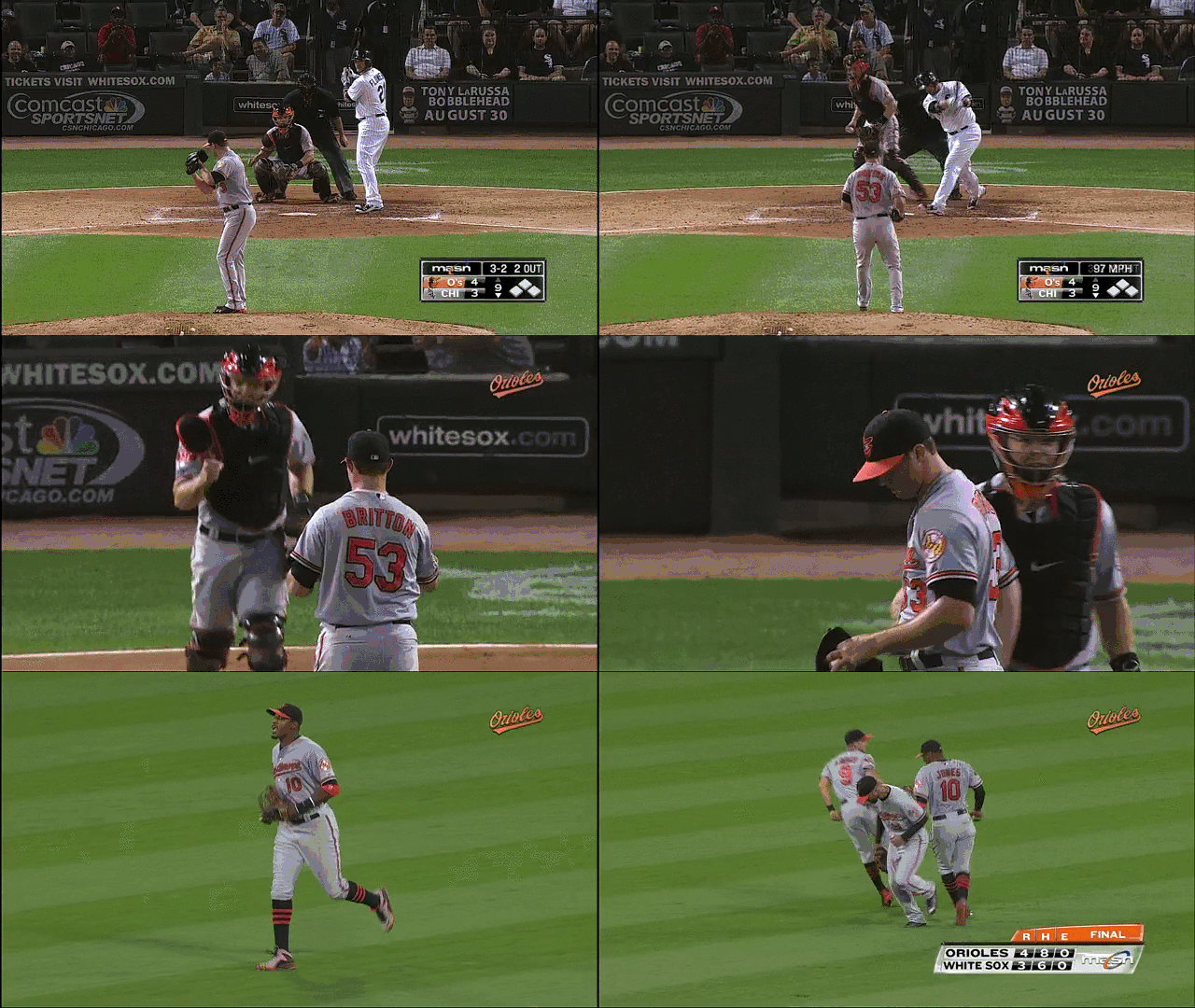
    We will continue to update this list throughout the season. Until then, though, we leave you with this Zach Britton sinker, doing what it does best:

    Britton2Seamer


  • Starting Pitcher Command Report: April 2016

    Starting Pitcher Command Report: April 2016

    Major League Baseball officially flipped its calendar from April to May this past weekend, which means we’ve arrived at a juncture of the season—roughly 15 percent through 2015’s total plate appearances, if you want to get overly specific—where player performance, trends and adjustments can be dissected with a certain amount of legitimacy and conviction.

    So with that in mind, why not pose the question that seems to be increasing in its importance: who’s commanding the baseball most efficiently? Walk rates in April jumped to 8.3 percent league-wide for starting pitchers, a healthy buoy from 7.1 percent last season, and, notably, the highest single-season mark for rotation arms since the turn of the millennium. Indeed, the season remains relatively young, but that increase might serve to explain why offensive production has witnessed an early rebound.

    Of course, there are better ways to evaluate command than simply a passing glance at walk rates. One example? Hitting the catcher’s target. Video scouts at Baseball Info Solutions (BIS) track the location of each pitch relative to catcher setup in (or out of) the strike zone, after which the analysts in BIS’s Research and Development department compile and formulate the data into easy-to-understand metrics with which to evaluate command.

    BIS categorizes all pitches thrown into four categories of precision: A.) Pitches “closest” to the mitt, B.) “close” to the mitt, C.) “far” from the mitt, and D.) “farthest” from the mitt. Generally speaking, the league-average pitcher will throw roughly 25 percent of his total pitches within each category. In other words, pitchers will hit the target with precision about as often as they miss badly, and vice versa.

    So without further ado, here are the top five and bottom five command leaders from April 2016 based on our “closest” to the mitt category. (All starting pitchers who qualified for the ERA title last month—100 in total, as luck would have it—were included in this sample.)

    Best “Mitt Rates”, April 2016
    Pitcher Hit Mitt %
    Kyle Hendricks 35%
    Aaron Nola 32%
    Mike Pelfrey 31%
    Noah Syndergaard 30%
    Alex Wood 30%
    Chase Anderson 29%
    Zack Greinke 29%
    Mike Leake 29%


    Worst “Mitt Rates”, April 2016
    Pitcher Hit Mitt %
    Rich Hill 9%
    Danny Salazar 10%
    Steven Wright 11%
    R.A. Dickey 12%
    Taijuan Walker 12%
    A.J. Griffin 13%
    Max Scherzer 13%
    Edison Volquez 13%

    Kyle Hendricks is far from a stranger to employing exceptional command. In fact, no right-handed starter who qualified for the ERA title last season located a higher percentage (36 percent) of his total pitches “closest” to the mitt. Neither is Aaron Nola, for that matter. At just 21 years young in 2015, Philadelphia’s budding ace pounded the leather at a 30 percent frequency. That number is up a healthy 2 percent this season, perhaps due in large part to his April 11 start against San Diego, during which he located an absurd 51 percent of his offerings “closest” to the glove.

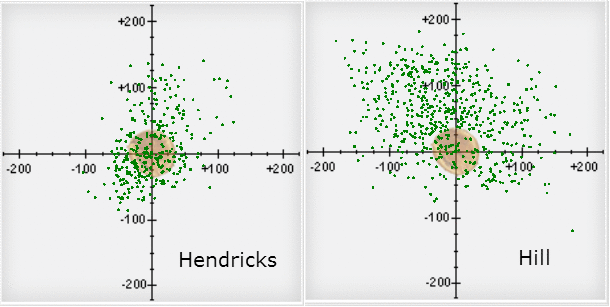
    Max Scherzer isn’t used to being at or near the bottom of this list, but he is this season, having placed just 13 percent of his pitches closest to the catcher’s setup thus far (which could explain why his walk rate has more than doubled last year’s total). The same goes for Oakland’s Rich Hill, who found himself at the cellar of April’s Mitt-Rate leaderboard, with only 9 percent of his pitches closest to the glove, down from 15 percent last season and perhaps partially to blame for his surging walk rate to open up the 2016 campaign.

    Along with supplying the raw data to evaluate command, BIS also has visually means to represent and compare command over specific spans. So, how do Hendricks and Hill—pitchers with the best and worst command, respectively, during the month of April—compare visually? To wrap up our April 2016 report, here’s a look:

    Command Comparison

  • The Story Nobody is Talking About

    Last week, Colorado Rockies shortstop Trevor Story set the Major League record by hitting seven home runs in his team’s first six games of the 2016 campaign, passing hall of famers Mike Schmidt and Willy Mays, along with former Rockies great, Larry Walker, each of whom had hit six home runs in the first week of a season. What makes his barrage of round trippers even more impressive is that those six games just happened to be his first six games in a Major League uniform. This torrid start to his MLB career has certainly garnered plenty of media attention; any time you break a record held by all-time greats like Schmidt, Mays, and Walker it should absolutely be talked about.

    During his first week in Major League baseball, the 2011 first round draft pick collected a .333 batting average with those seven home runs and slugged a whopping 1.111.   If you’re more into the sabermetric numbers than the traditional numbers, Story’s start to the season isn’t any less remarkable: His weighted runs created plus (wRC+) stands at 243 according to Fangraphs, meaning that he more than doubled the average league production last week, and his weighted on base average (wOBA) currently stands at .598 (anything over .400 is considered excellent). All in all, Trevor Story’s start to his career has surely been one to remember. But what if I told you that another rookie actually outproduced him last week?

    While Story exploded onto the scene with his seven home runs last week, Astros first baseman Tyler White was quietly having a statistically more productive week. No, he didn’t hit more than a half-dozen home runs, but, after his first six games, White had a higher batting average (.556) and a higher slugging percentage (1.167) than Story. Just take a moment to appreciate that: Tyler White had a better slugging percentage through his first six games than a player who hit seven home runs. The advanced metrics tip the scale in White’s favor even more as he has produced a .690 wOBA and a wRC+ of 383. wRC+ measures a player’s offensive performance, with 100 being average, so, while Story was more than doubling league average last week, Tyler White almost quadrupled the Major League average over the past week.

    All in all, I am not trying to deny the fact that Trevor Story’s seven home runs to start his career are remarkable, but I believe that White has been the better hitter over the past week, and he has not gotten near the attention that Story has. Chicks do dig the long ball, so it makes sense why Story has captured the attention of so many people across the nation, but if I had to pick one to have on my team, based solely on their first six games, I would take White in a heartbeat.

  • Defensive Scouting Report: Maikel Franco

    Range and Positioning:

    Franco is able to read the ball off the bat very well, but often fails in completing the play because he is inexperienced and still learning to field the position.  Franco’s range is a bit inconsistent, depending on his effort at attempting to make more difficult plays.  Franco tends to play deeper in the hole leaving him susceptible to soft grounders and bunts.

    Footwork:

    Franco’s footwork has played to become his biggest strength thus far, often giving him an opportunity to make an out. However, his footwork can still be a tad inconsistent, which can impact his release point on throws.

    Hands:

    Franco often mishandles balls when he is forced to attempt the play while in motion (jogging and sprinting).  Franco often bobbles the ball or loses it in transferring from his glove to his throwing hand.  As a result, despite getting an exceptional read on a play, Franco can turn a routine play into a more difficult play.  Franco often makes off-kilter throws because he is not able to consistently repeat his fielding mechanics.

    Arm:

    Franco’s throwing arm strength is as strong as the best in the game, but he struggles mightily with his accuracy. Franco’s arm strength allows him to position himself deeper in the infield.  When making plays in motion Franco’s throws often sail left or right because he does not compensate for his momentum on the throw nor his inconsistent fielding mechanics.

  • The Rise of Logan Forsythe

    Coming into the 2015 MLB season, Logan Forsythe was set to be the right-handed half of a second base platoon with Nick Franklin, a role that seemed to fit him well. He had been an above-average hitter against left-handed pitching but failed to finish a year with a wRC+ above 73 against right-handed pitching. From his debut with the Padres in 2011 through the end of the 2014 season with the Rays, He had a modest .235/.303/.343 slash line in 1,098 plate appearances with just 18 home runs.

    Forsythe’s 2015 has been a completely different story. Franklin strained his oblique in spring training, giving Forsythe a chance to start the season as the everyday second baseman, and he hasn’t looked back. Although he has continued to perform significantly better versus left-handed pitching, he has become a better than league average hitter against right-handed pitching as well (115 wRC+). In total, Forsythe has hit an impressive .280/.362/.440 in 445 plate appearances this season. He’s found himself tied for the 22nd most valuable offensive player in the majors according to fWAR, and his 130 wRC+ is good for third among qualified second basemen. He’s already doubled his previous career high with 13 home runs, and he still has almost two months remaining to add to that total.

    So what is Forsythe doing differently? Since being traded from the Padres to the Rays in January 2014, his flyball rate has jumped significantly. In San Diego, 34 percent of his balls in play were flyballs. Since joining the Rays, that number is up to 41 percent. Although that increase in flyball rate did not manifest itself in improved performance last year, it has this year. Forsythe has a robust .612 SLG and .403 ISO on his flyballs in 2015, huge improvements compared to his .453 SLG and .285 ISO on flyballs from 2011 to 2014. His home run per flyball rate is up a modest two percent since the trade, which is likely a result of the move out of the pitcher-friendly Petco Park.

    Forsythe has also made changes in his hitting approach this season. In zero-strike counts, he’s been taking more pitches in the middle and outer thirds of the zone than he has in previous seasons. His swing rate in this area of the zone has dropped from 31 percent through 2014 to 26 percent so far this season. Despite this drop-off, his swing rate in zero-strike counts for pitches in the inner third of the zone and inside has held constant. This change has been reflected in Forsythe’s massive improvement on balls he’s pulled. Through 2014, on balls hit to the pull side, Forsythe hit .313 and slugged .503. So far this season, he’s hit .417 with a .783 slugging percentage on pulled balls. This improvement has come with a .355 BABIP on balls hit to the pull side of the field which, although likely due for a slight regression, isn’t alarmingly high.

    Forsythe’s improvements have not been limited to his batted balls. His walk rate is a career high, and his strikeout rate is well below his career average. He is also having a career year defensively. He has saved the Rays ten runs at second base according to Defensive Runs Saved, trailing only Ian Kinsler at the position. While this may prove to be a career year for Forsythe, his variety of positive contributions makes it more likely that he will continue to be a solid starter for the Rays in future seasons.

  • Visualizing the Range of MLB’s Best and Worst Outfielders

    Visualizing the Range of MLB’s Best and Worst Outfielders

    Baseball Info Solutions’ Defensive Runs Saved (DRS) metric measures a player’s total defensive contribution at a given position, compared to league average. The primary component, as outlined in The Fielding Bible, is the company’s Range & Positioning system, which rates each fielder’s success at converting batted balls into outs.

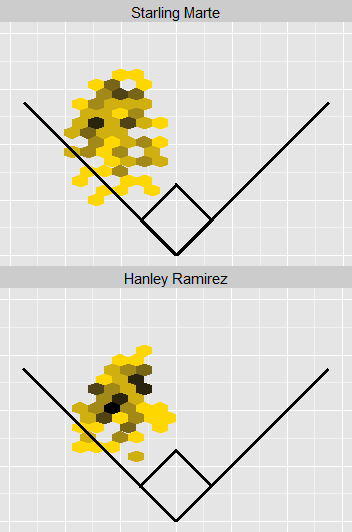
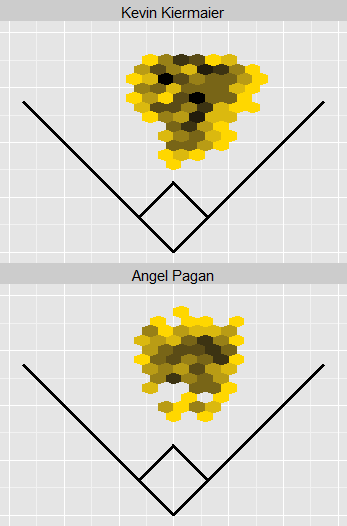
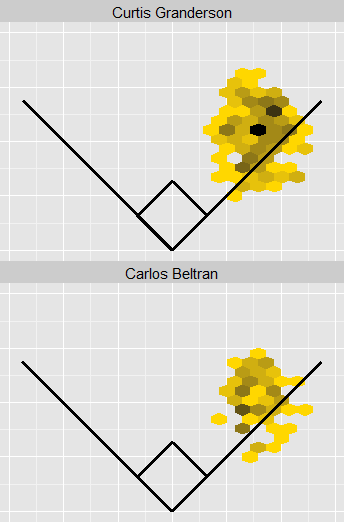
    Using BIS’s batted ball locations, we are able to compare the range covered by some of the best and worst outfielders in baseball. In doing so, we can visualize a piece of the DRS puzzle by seeing how well these players convert batted balls into outs (in this particular case, flyballs). Let’s take a look.


    Left Field

    LeftFieldAnimation

    Poor: Hanley Ramirez (-16)
    Excellent: Starling Marte (+8)

    While the Red Sox managed to sign both Pablo Sandoval and Hanley Ramirez in the offseason, it has not worked out as they would have hoped. Neither player has performed up to offensive expectations; both have killed the Sox on the defensive end. Ramirez, in particular, has endured an uncomfortable experience in left field; his -16 DRS is the second worst for any player at a single position. Even though the Green Monster in Fenway Park limits the amount of ground he has to cover, it is clear that Ramirez is limited in his range and unable to reach many balls in the corner.

    The Pirates’ groundball-heavy pitching staff limits some of the action in the outfield for Starling Marte, Andrew McCutchen, and Gregory Polanco, but they show off a great deal of range when flyball opportunities arise. Marte has settled in nicely to PNC Park’s spacious left field, combining his instincts, speed, and throwing arm to become one of the league’s most solid defenders. Since 2013, his 33 Runs Saved in left field ranks second to only Kansas City’s Alex Gordon (47). With Gordon currently on the shelf, Marte is among the favorites for his first Fielding Bible Award.


    Center Field

    CenterFieldAnimation

    Poor: Angel Pagan (-13)
    Excellent: Kevin Kiermaier (+24)

    The San Francisco Giants have turned into one of baseball’s best defensive teams, as their 36 Runs Saved ranks second in the National League behind the Arizona Diamondbacks (39). In fact, they have played average or better defense at every position… except for center field. After a few solid seasons in the Mets’ outfield, Pagan has not registered an above-average DRS since 2010. He has cost the Giants a total of 32 runs since joining the team in 2012. BIS’s Scott Spratt recently identified San Francisco’s center field as one of the biggest defensive holes on contending teams.

    Meanwhile, the Rays’ Kevin Kiermaier has become the gold standard for defense this season, leading Major League Baseball with 24 Runs Saved. A year after saving 14 runs in 108 games, Kiermaier is proving his worth through defense this season. His heatmap above shows almost no holes, with a high volume of plays made all over center field. Kiermaier’s ability to close the right-center gap aids the Rays’ defensive deficiency in right field, where Steven Souza and Brandon Guyer, among others, have cost the team four runs.


    Right Field

    RightFieldAnimation

    Poor: Carlos Beltran (-10)
    Excellent: Curtis Granderson (+11)

    Carlos Beltran missed time earlier this month due to an oblique injury, so he has not had as many opportunities as other right fielders. Yet the 38-year-old Beltran owns the worst DRS total at the position, exhibiting a clear and considerable decline in his defense. Slowed by injuries and aging effects, the eight-time All-Star simply does not have the range he once did when roaming center field for the Royals, Astros, and Mets.

    While the Yankees employ baseball’s worst defensive right fielder, the team across town employs the best. The Mets’ Curtis Granderson has bounced back both offensively and defensively in 2015. After a below-average defensive showing in his first season with the team, Granderson’s 11 Runs Saved barely edges out Jason Heyward (10) and Bryce Harper (10) for the time being. With steady center fielder Juan Lagares to his right, Granderson doesn’t have to worry much about the right-center gap, but he has the rest of right field under control.

  • Defensive Scouting Report: Brandon Crawford

    Range/Positioning:

    Brandon Crawford has plus agility and quickness, which provides him with above average range for the shortstop position. He glides on the infield, making the difficult plays look easy. Entering 2015, he had 21 Range and Positioning Runs Saved over his career. Crawford also entered 2015 having made 28 more plays throughout his career than the league average shortstop.  He looks most comfortable on balls hit to his left, especially when jogging or sprinting.

    Hands:

    Crawford’s hands are quick and smooth, giving him one of the fastest glove-to-hand transfers in the Majors. This especially helps when turning the double play and, over the last three years, Crawford is fourth among all shortstops in GDP Runs Saved with five. He also excels when fielding balls backhanded. Since the start of the 2013 season, the league average success rate for shortstops when fielding a ball backhanded is 69.1 percent. Crawford’s backhanded success rate during that time frame is 74.3 percent, ranking first among all shortstops with at least 800 opportunities.

    Footwork:

    Crawford has smooth and efficient footwork combined with a solid lower half. Due to his tremendous body control, he consistently gets in the best position to field the ball. His footwork is highlighted when moving to his left or backwards. When Crawford’s first movement is back, he has a success rate of 53.0 percent, which is second highest among all shortstops with at least 800 opportunities since the start of 2013 according to BIS.

    Throwing Arm:

    Crawford’s strongest defensive tool is his fantastic throwing arm. He has proper arm action for an infielder, to go along with well-above average arm strength. His arm is quick and his throws have solid on-line carry, allowing him to make strong throws in the hole and on the move. Crawford’s arm is also one of the most accurate at the shortstop position. Since 2013, he has an Infield Good Throw Rate of 95.4 percent, which is highest among all shortstops with at least 700 opportunities.

  • Flame Thrower Pitches Backwards?

    In today’s baseball world there are a handful of guys on every team that throw absolute gas. In 2015, Nathan Eovaldi, has the highest average velocity for starting pitchers so far this year at 96.0 mph. However, Eovaldi’s past results have been rather inconsistent compared to other top flame throwers like Garrett Richards, Gerrit Cole, and Matt Harvey. Maybe changing scenery from sunny Miami to pitching in the Bronx under the tutelage of Larry Rothschild and Brian McCann could guide the unpredictable hard thrower in the right direction.

    Friday night I sat down to watch the Yankees game and, like any other Yankees fan, I didn’t know which Nathan Eovaldi was going to show up that night. The only thing I knew was that I was going to see one of the most powerful arms in the game try to blow it by what has been one of this year’s most exciting lineups in the Houston Astros. Things didn’t start quite how I expected, though, as I watched a 77 mph curveball drop in for a ball on the first pitch of the game. I thought to myself, tonight is going to be different.

    Eovaldi looked great the whole night keeping the Astros hitters off balance. Usually when Eovaldi gets hit hard, it is because the hitters know when the fastballs are coming and gear up for it. This time they were surprised by it, and 98 mph finally looked how a pitch that fast should look when it misses hitters bats. He recorded his lowest FIP of the year at 2.08. He kept hitters off balance the whole night with his lowest hard hit percentage of the year at only 11.8 percent. Eovaldi’s  outing went 6 IP, 5 H, 6 K, and 2 BB. Both of the runs he gave up could have gone either way with a missed catch and tag by McCann and a bloop RBI single in the 6th inning.

    Eovaldi threw 33 fastballs this start, which is his lowest this season (besides one very short outing in Miami). He threw 25 changeups, which was his second highest this season, and he mixed in a number of curveballs and sliders as well. When Eovaldi’s changeup is working, it is dangerous, which it definitely was this night. He faced 25 batters and started 17 of them off with an offspeed pitch, which is 68 percent. His career average is 33 percent. For a man who throws 98, that just does not happen.

    Has Eovaldi slowly begun to reinvent himself as a crafty hard throwing righty? Way too soon to tell. We will see if he keeps throwing like this for his next couple outings, and if it works then we may have something here.