Category: Baseball

  • Defensive Excellence Q&A: Petr Baroch, Czech National Baseball Teams

    Defensive Excellence Q&A: Petr Baroch, Czech National Baseball Teams

    What is it like to coach defensive excellence in European baseball?

    Petr Baroch helps run the Czech Republic national baseball program for ages 15 to 21. Petr, now 41 years old, previously played professionally for three years in the Netherlands. He talked to us about his experience in coaching baseball in his home country. The interview has been edited for clarity and length.

    Click here to see our other 7 interviews in this series of pieces about coaching defensive excellence.

    Mark: Where are you located and what is your baseball background?

    Petr: I’m the director of the Czech national baseball teams and I’m based in Kladno (a mining city in the north central part of the country, one that produced NHL legend Jaromir Jagr).

    I take care of the Czech national teams under-12, under-15, under-18, and under-23, seniors. I help with the tournaments for the guys and the European championships. If it’s possible, then I can help the team as an infield coach and hitting coach. Last year, I worked with the under-15 team. Mike Griffin was the head coach.

    Mark: Ok. So you do coach defense, right?

    Petr: Yeah. I’m the defense coach and the hitting coach. I can be the pitching coach too sometimes.

    Mark: Okay. So what does defensive excellence mean to you?

    Petr:  With a good defense, you have a better chance to win. So it’s important to the team and it’s important to me.

    When I will talk about the players, I want the guys who have the correct positioning, who read the ball and have the right timing for making plays. And I want guys that have some athletic skills and that are smart.

    Mark: So how do you teach that to people?

    Petr: I have videos of basic drills that we want for the guys. We want them all to be on the same page. We want them to be making better decisions every day.

    Mark: How much do these kids know when they come to you? Were they playing another sport or are we to a point where they’ve been playing baseball their whole life?

    Petr: When I was young, I played so many other sports. I never saw guys playing baseball when they were under 7. Now, I’ve seen a lot of change. So many players are playing only one sport. That’s not good for us because we want guys who are athletes.

    With our Kladno team, we have so many people who could make it in another sport. I think it’s important for young guys to play basketball or hockey. We have two guys who play hockey and they’re different because they can move, they’re more athletic and smarter than the other guys.

    But so many kids don’t have time for [multiple sports] because they go to school and then are running to practice and then they come home and study. They don’t have practice and games at their school. Everything we do is done in a hurry and that’s not good for us.

    Mark: Do the kids that grow up in the Czech Republic, do they all wanna be like (NHL star) David Pastrňák or are they familiar with current baseball players?

    Petr: Everybody wants to be like Pastrňák, or Jagr maybe some want to be a goalkeeper. Their family may be thinking that baseball is great for you and your body, but you will enjoy it for a couple of years and then you have to go to work, because you won’t make money for it.

    When someone asks me if it’s possible to make baseball your job, I tell them yes, but you have to go to Japan or the United States and go to school there. But even if he doesn’t get a contract, it will be very good for his life. He’ll learn to speak English and he’ll be a better person. He will know more people.

    Baseball is a big community. I’m very glad that I was a player and now I am a coach and I hope that I will be helpful for the young players.

    We have programs with the Czech Baseball Association that help guys go to the United States, pay for flights and look for contacts for them. Mike Griffin knows people who ask if our players can come to the U.S. I help them make the decisions.

    Mark: What’s the hardest thing about trying to teach the kids?

    Petr: The mentality, because baseball is very hard for kids When you have 10 times at bat, and you’re good three times, you’re hitting .300 and you’re viewed as good. But seven times out of 10, you’re bad. But that’s normal in baseball.

    But I think that the baseball and life is almost the same because sometimes you can mess up a situation in baseball, but that situation can help you for the future.

    Defense is the same because the goal is to not make so many errors and mistakes. And if you make mistakes, you have to be better next time.

    Mark: What are their favorite things to do on defense?

    Petr: Almost everyone wants to play shortstop, pitcher, and catcher because they understand that it’s very important. When they’re younger, they think that they play outfield because they’re bad. But I always said no, you’re very important to us. I think that’s an important job for a coach, make everyone feel they’re important. When you’re older, you understand the importance of playing the outfield.

    Mark: What are the things that you teach them in the outfield to kind of get them started?

    Petr: How to catch the ball, first step moving back, how to do a transfer from glove to hand, hitting the cutoff man with a four-seam throw.

    Mark: What do you teach them about shortstop right at the start?

    Petr: It’s different by age. At first, basic skills, like initial move, first step, throwing. As they get older, we make the drills harder, where they’ll get on their knees and have to catch and field balls while on their knees. And also, how to line up the ball with their chin and their eyes.

    Mark: Okay. When the kids watch video of players making plays, who are the fielders they want to be?

    Petr: Everyone wants to be Shohei Ohtani. Everybody here liked the World Baseball Classic.

    On defense they want to be Derek Jeter.

    Mark: What’s everyone’s favorite drill?

    Petr: They like playing “21 outs” [you have to make plays on ground balls, a combination of single-out plays and double plays to move on to the next inning]. It’s fun for the players but it can take a long time. Everyone likes it when you make it like a game.

    Mark: What kind of resources do you have? Do you have enough fields and equipment?

    Petr: For our older kids, almost every big city has a baseball field and that is very important for us. We’ll be hosting the European championship and we have enough fields. For the young players, I think that we have enough fields but practice sometimes is a problem because it’s tough to fit everyone on one field.

    Mark: What defensive thing do you like teaching most?

    Petr: Bunt defense, and also how to handle and first and third situations.

    This is hard for the kids. They have to understand when to go to second base, and then to always go to first base. The players have to understand their spots on the field and what they have to do in each situation.

    Mark: What do you specifically like most about coaching kids?

    Petr: I like teaching situations, like if there’s nobody on base you have to stay here. If it’s a stronger hitter, you have to move two steps to this side or that side

    You can say, “Okay, this guys is very fast,” you have to make two steps and a strong throw to first [on a ground ball].

    I also love that we have tablets [IPads] now and that I can tell kids “I will show you how to fix your problems.”

    Mark: What does the future of baseball look like for the Czech Republic?

    Petr: I think that we are going the right way. Since the WBC, we’ve been having people ask us – this sport you play, is it the same sport as in Japan? Every year we have more and more people in baseball. Once you know it, it becomes your life. Every day you see different situations. Every game is different.

  • Stat of the Week: Pitcher Injuries On Comebackers On The Rise

    Stat of the Week: Pitcher Injuries On Comebackers On The Rise

    Pitcher injuries are always a frequent topic and 2023 is no different with Robbie Ray, Germán Márquez, and Drew Rasmussen all out with significant elbow injuries. Ray and Marquez will miss the season after Tommy John surgery. Rasmussen is out for multiple months with a strained tendon in his elbow.

    But there’s a different type of pitcher injury that’s worth noting, too.

    An abundance of pitchers have been hit by line drives early this season relative to the last few years.

    Most recently Royals pitcher Ryan Yarbrough and Rockies pitcher Ryan Feltner were hit in the head by line drives. Yarbrough suffered facial fractures. Feltner suffered a skull fracture and a concussion. Both will be out for an extended period of time.

    Sports Info Solutions tracks injury events in all the sports it covers. We document everything, even foul balls off a catcher’s mask or off a batter’s foot. Every injury event receives a grade ranging from 1 (least severe) to 5 (most severe).

    Injury events graded ‘4’ and ‘5’ are generally significant. A 4 grade is for an injury with a trainer’s visit, where the player is shaken up and needs time to recover and move around on his own power. A 5 grade is an injury that requires an immediate visit, in which the player may be immobile and/or bleeding. Severities are based on what happens immediately following the injury, not knowing what the diagnosis or prognosis is

    There have been 10 instances of a pitcher being hit by a ground ball or line drive this season and receiving a 4 or 5 injury grade from our Video Scouts. In addition to Yarbrough and Feltner, Josh Fleming (Rays), Casey Legumina (Reds), Kyle Bradish (Orioles), Luis Castillo (Mariners), Stephen Nogosek (Mets), Gus Varland (Brewers), Cal Quantrill (Guardians), and Kenta Maeda (Twins) got drilled by hard-hit batted balls. 

    Castillo, who got hit above the back of the shoulder by a 96 MPH line drive on Opening Day, was the only one of these 10 pitchers to stay in the game (after getting hit in the 3rd inning, he pitched three more innings).

    Besides Yarbrough and Feltner, Legumina is also out with an ankle injury, Nogosek (bone bruise in elbow) missed a week earlier this season, Varland (injury to chin and arm) missed a week-and-a-half, and Bradish (foot) missed a week-and-a-half.

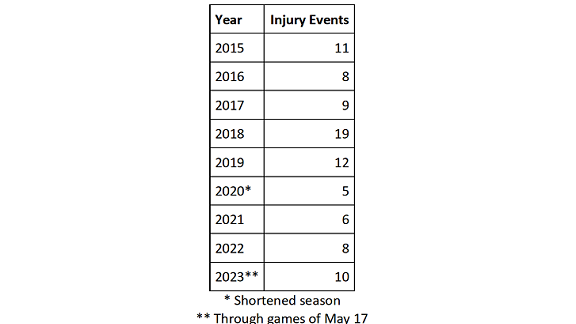
    That there have been 10 of these incidents already is notable in this regard: There were only 8 instances of a pitcher getting a 4’ or 5 injury grade on a comebacker all of last season and only 6 such instances in 2021.

    We’ve tracked injury events back to 2015. Here are the year-by-year totals for these types of injuries.

    Pitcher Injured Being Hit By Line Drive or Ground Ball

    Received Injury Grade of ‘4’ or ‘5’

    Year Injury Events
    2015 11
    2016 8
    2017 9
    2018 19
    2019 12
    2020* 5
    2021 6
    2022 8
    2023** 10

    * Shortened season

    ** Through games of May 17

    In total, there have been 48 injury events for pitchers on comebackers this season (with the others receiving a grade from 1 to 3). In 2021 there were 163, in 2022 there were 171.

    The 48 is a near-match for the 50 in the shortened 60-game 2020 season (most teams in 2023 just passed the 40-game mark).

    The 2023 number is definitely concerning. It’s one worth keeping an eye on, while crossing our fingers that no one else suffers injuries like Feltner and Yarbrough did.

  • Defensive Excellence Q&A: Alex Oglesby on Coaching Girls’ & Women’s Baseball

    Defensive Excellence Q&A: Alex Oglesby on Coaching Girls’ & Women’s Baseball

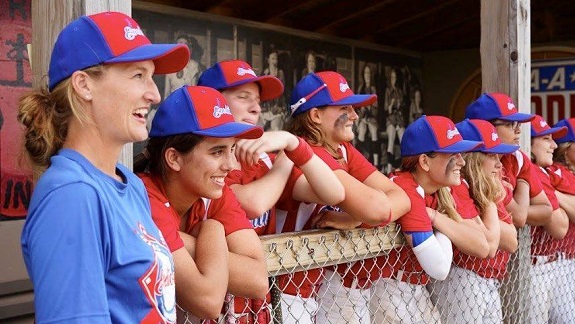
    Alex Oglesby has 25 years experience coaching baseball so she’s the ideal person for us to talk to in our latest Q&A about teaching defensive excellence.

    Alex is the first in our group who works largely with girls and women’s players, coaching them from Little League to the national level. She’s the president of Evolution Girls Baseball in the San Francisco area and is also an assistant coach for Team USA’s Women’s Baseball Team.

    Alex played boys’ high school baseball then played two years in the late 1990s in the Ladies Professional Baseball League. As a 17-year-old catcher, she was league Rookie of the Year and Defensive MVP.

    Alex shared her origin story and lessons she’s learned that she passes along to the next generation. The interview has been edited for clarity and length. Click here to see our other interviews.

    Alex: I actually did start with girls softball and a little bit opposite of most girls these days. They start with baseball and transition over to softball.

    I did the opposite and I started with softball and then got the opportunity to play high school baseball. And from there, I just fell in love with it. I declined some college scholarship offers, which in hindsight probably wasn’t really smart, but it worked out great for me. And then right out of high school there was a women’s professional league that started.

    I was lucky to get to play in that. At the beginning of my college years I met a lot of different people playing women’s baseball that I had no idea even existed. And then I got to represent the USA Baseball National Team for the first World Cup.

    Mark: When you were first learning to play, how did you learn the defensive side? 

    Alex: I started playing softball because my friends were doing it.

    Nobody raised their hand to be a catcher. And I thought, I guess I can catch the ball. I really had no idea what I was getting into. And I put the gear on, they put me back there and I started catching and I went home and told my dad and then found out that my dad actually was a catcher.

    My dad (Ed Sickinger) played minor league baseball with the Giants. And he had a huge baseball background, but I just never really was interested enough, I guess, to ask all the right questions of him. As I started catching, he really truly just had an old school train of thought and didn’t know girls what girls could play or what they did in athletics.

    So it was new to him too. He was my first true coach in the sense of teaching me the skills I needed, and I just really loved it. I loved being in the action of the game. The first thing he taught me was you just don’t let the ball get by.

    You just, whatever you do, your job is to block that ball. Whatever after you have to use, whether it be your arms, your mask, your legs, your glove, whatever it is, you just know, don’t let the ball go by you. I think that was my first lesson in defense as a catcher and as a ballplayer.

    And then it just blossomed from there. I just always will remember my dad telling me a passed ball is a run, a passed ball’s a run. That was forever drilled into my head. And even if there were no runners on and the ball got by me, in my head, that was a passed ball.

    So it could be a wild pitch, it could be whatever you want to call it. And it didn’t even have to go down in the scorebook as such in my head. Somehow a run was gonna score if that ball got by me. I’m not gonna let my team down, and that ball was not gonna be by me.

    Mark: You were the defensive player of the year when you were 17 in that women’s professional league.

    Was that for your blocking, was that for your basestealing prevention? Was that for your framing? What was it for? 

    Alex: I think my blocking was my strong point. Having a passed ball was like the end of the world to me. 

    With that, I gained a huge trust in my pitchers. And they knew that they could keep the ball low, right? I framed really well. I received really well. I think runners didn’t really steal off me, but it wasn’t because of my arm’s strength as much as just my quickness and agility.

    But my strength was for sure my blocking and receiving. 

    Mark: How do you now teach defense to kids? 

    Alex: Relearning how to coach catching took a lot of research on my end because it’s changed so much over the last five years. However, one thing remains the same. You don’t let the ball go by you.

    So your goal is to not let the ball go past you and to help your pitchers through the game. I’m really trying to pass that on. My son actually catches as well. I’ve had a fun time getting to have similar conversations with him as I have my dad.

    With every kid that I coach that catches, it’s really a lot of conversations about, okay, if this, then what? And helping them to think through the game. 

    My background is in teaching physical education. And I love teaching and coaching through guided discovery in the sense of letting them figure it out and guiding them towards the answer versus just telling them what to do.

    Your best catcher is one that really knows the game. They’re your eyes and ears and they’re your other coach out there, essentially. Being able to get them to start thinking about the game in that perspective is going to be one of the best things that you can teach them.

    If they can think on their feet, if they can direct the game, if they can handle a pitcher and help them through the game without you having to do all of that that’s gonna make them ultimately the best. 

    You are to not let that ball get past you. We want to block the ball even when there aren’t runners on, because we want your pitcher and your umpire to trust you. And then teaching the skills that go with that. 

    Mark: Do you coach infielders or outfielders too or are you almost exclusively catchers? 

    Alex: I do coach other positions. I have two sons. I coach their Little League teams as well as help out with their travel ball team. And then I also have our Girls u-18 team.

    And then I coach with the USA national team. With the women’s national team, I’m predominantly the catching coach, although we all really work together in that environment. With infielders and just overall defense, let’s just say team defense.

    Mark: What does defensive excellence mean to you?

    Alex: That aspect, is as much to do with mental as it is physical, really talking to the players about knowing the play ahead, being ready every pitch, and wanting the ball to be hit to you. And then just consistently making the routine plays.

    So that the physical side of it being the how do you make those routine plays consistently, but also not being afraid to fail on the extraordinary ones. And I teach this with the catchers as well, I really feel like if they’re afraid to take risks out there and try new things they’re never gonna grow from good to great.

    So take the chance, charge the ball, throw on the run, backhand the ball, dive for the ball, do the things that are gonna push you out of that comfort zone. As catchers, it might be back picks to first base and things like that. Even pickoffs at third. I want them to try those things, especially when they’re younger.

    They can get good at it in a situation where either the game’s not on the line or your livelihood isn’t on the line as a professional player. I want them to practice those things. I want them to fail or know it’s okay to fail because that’s just gonna get you closer to success.

    Mark: Do you have any favorite drills? 

    Alex: Blocking drills and just going through progressions all the way through. Whether they are very beginner stages or advanced, I think it’s important to make sure that you start and progress up. Obviously a more advanced player is going to be able to progress quicker through those.

    But I think it’s important to make sure that they get their work in and don’t forget the basics. With the younger players, pushing them a step past what they’re capable of, so that they have something to work towards in the progression. 

    When it comes to infield, I guess the easiest way to say it without showing it, is getting them to imagine the field less in the line from second to third. Getting them understanding they can get depth on the field and take different routes to the play that aren’t just straight-across right and straight-across left. Getting them to understand that they can work the field in a different way and imagine it less linear is huge for the younger player and then that allows you to work on different routes and paths and footwork to the ball. 

    I really feel like teaching them from the feet up is huge. So if you’re able to teach them good footwork, usually their throws are gonna be more accurate, their glove’s gonna be more relaxed. I love doing footwork drills and working on the path to the ball. 

    Mark: Okay. Is there something that someone who coaches boys could learn from watching someone who is coaching girls?

    Alex: That’s a really interesting question. We have some different girls’ events with MLB and USA Baseball, where we have a mix of female coaches, whether they are with USA Baseball, or MLB players that coach with us.

    We always say that we are the the hidden gem of baseball just because they just don’t know about us. They come out there and they absolutely love it and are blown away by how much these girls want to learn and how driven they are.

    The one thing that I find myself having to teach some of the girls is how aggressive they can be. And if I were only coaching boys and then going over to coach girls, I think having that same expectation of the girls that I have for the boys is important. Not just setting the bar lower, keeping that bar high for the girls. Always put the bar up higher versus just being like, oh, it’s a girl.

    I think the guys never know what to expect when they come over and they leave elated because these girls want to play, they want to push and they’re good. Then they realize, wow (the girls) are great students of the game.  They want to learn, they want to get better and they are already really good.

    Mark: Is there a player or former player you’d like to shout out?

    Alex: LaTroy Hawkins has been one of our biggest fans and biggest advocates. His approach with the women and the girls and just holding them in a high regard. while at the same time having the utmost respect for them. He’s the former player that would stick out for me.

    He’s approachable and open to helping us learn when we have questions. I’ve seen him do that at multiple events.

    Mark: What’s the hardest thing to teach?

    Alex: With the girls I think most of the girls are playing with boys. When the girls come out, they’re used to being in this position where they can’t mess up. If they mess up on the field, it’s because ‘she’s a girl.’ 

    Letting them not be afraid to fail. They don’t need to be perfect out there. The hardest thing is to get them away from that [be perfect] mindset.

    Mark: How do you coach the catchers on the women’s national team?

    Alex: A lot of them have been playing at a very high level for a long time, and with them it’s about fine tuning and also working with them completely differently.

    A lot of it is, how are you feeling? What things would you like to work on? Where can we, how can we work together? Maybe it’s hey, I saw this, or would it be helpful if we took this approach?

    You’re still gonna work through the fundamentals of doing drills and doing things that are gonna sharpen their skills and keep ’em sharp.

    We only get to be with them for a very short amount of time. We have our tryouts and trials, and then we get a week to train together as a team before we’re off into competition. There’s not a ton of time to get a lot of work in, but we continue our relationships off the field.

    Throughout the year. We see each other at different events as coaches together. For example, at the USA Baseball Trailblazer event. That is an event where we have girls who are 11 to 13 years old coming out, and a lot of our USA National Team are there as coaches.

    And we can have conversations throughout the year or send videos. I’ll get videos of some of our catchers saying to check out what they’ve been working on.

    Mark: Have you seen or learned anything from international baseball coaches of women’s teams? Like, did you learn anything by watching the Japanese women’s baseball team or the other countries that are involved? 

    Alex: I’m always a student of the game and I love watching. I love people watching in general, but especially in baseball and when there’s a language barrier, it’s interesting how much you can pick up.

    I recently got to go to Australia to coach. And there were players and coaches from Japan players, players from the Netherlands, and players and coaches from Australia. The girls were mixed up on the teams, so you had girls from Japan, Australia and the U.S. together. It was really fun. What I enjoyed was seeing how much everyone values the teamwork aspect. A ‘we game’ versus a ‘me game’ was consistent across the board.

    Mark: Last question: What advancements do you think we’ll see from this generation of young women’s and girls baseball players?

    Alex: I’ve definitely noticed the level of play has risen across the board. It’s not so much that the top player now is higher than the top player 10 years ago. It’s more that we’ve got 20 players at the top level versus one.

    I think that it’s become more accepting for girls to be on the field. There’s still a lot of work to be done to educate people on how many opportunities there are for girls in baseball, but I think as that education continues and as more girls continue to play longer, into high school and into college I think that we’re going to just see that level of play go up.

    Click here to see the other interviews in this series.

  • Stat of the Week: Which Defenses Have Best Supported Their Pitchers?   

    Stat of the Week: Which Defenses Have Best Supported Their Pitchers?  

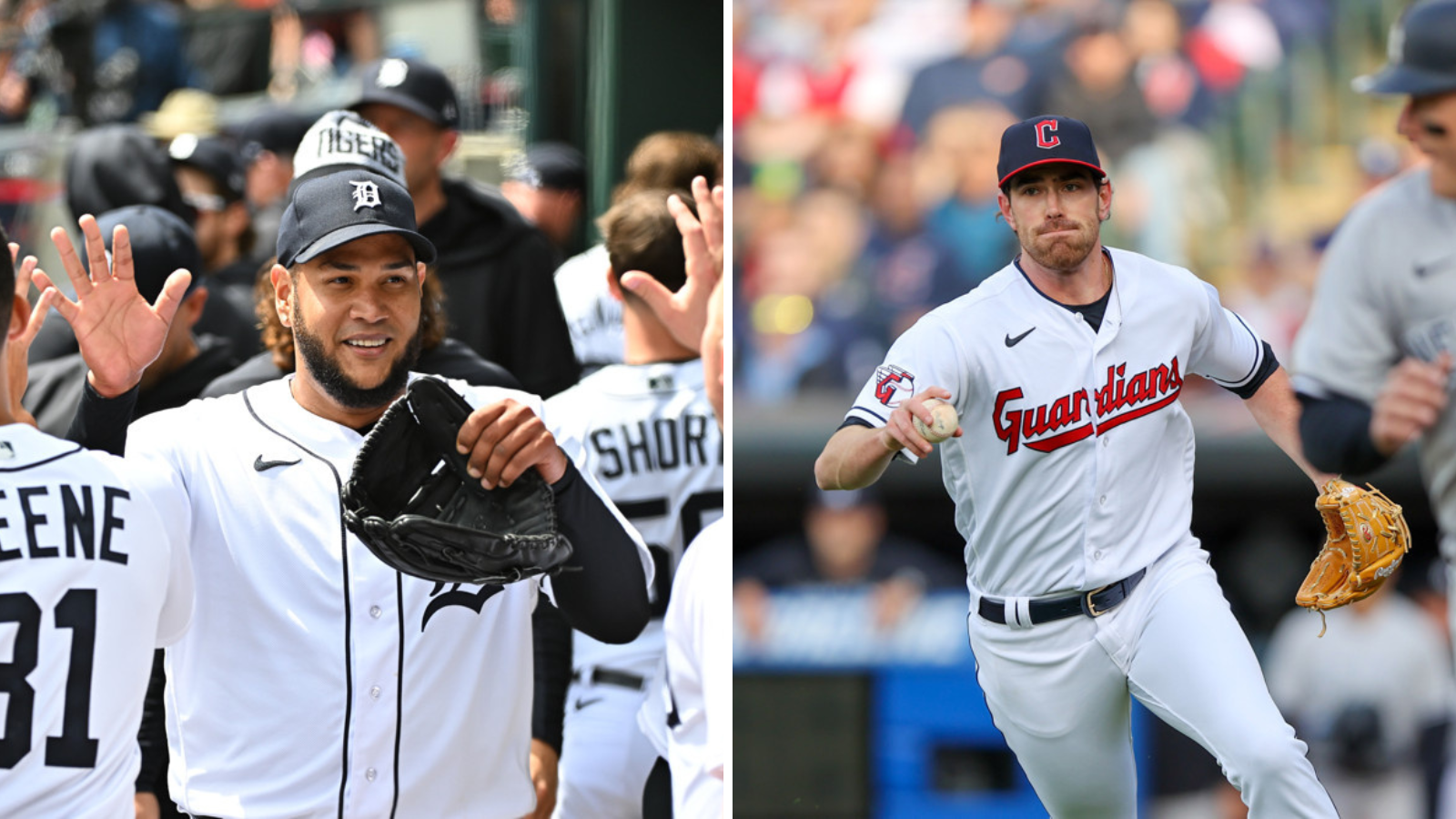
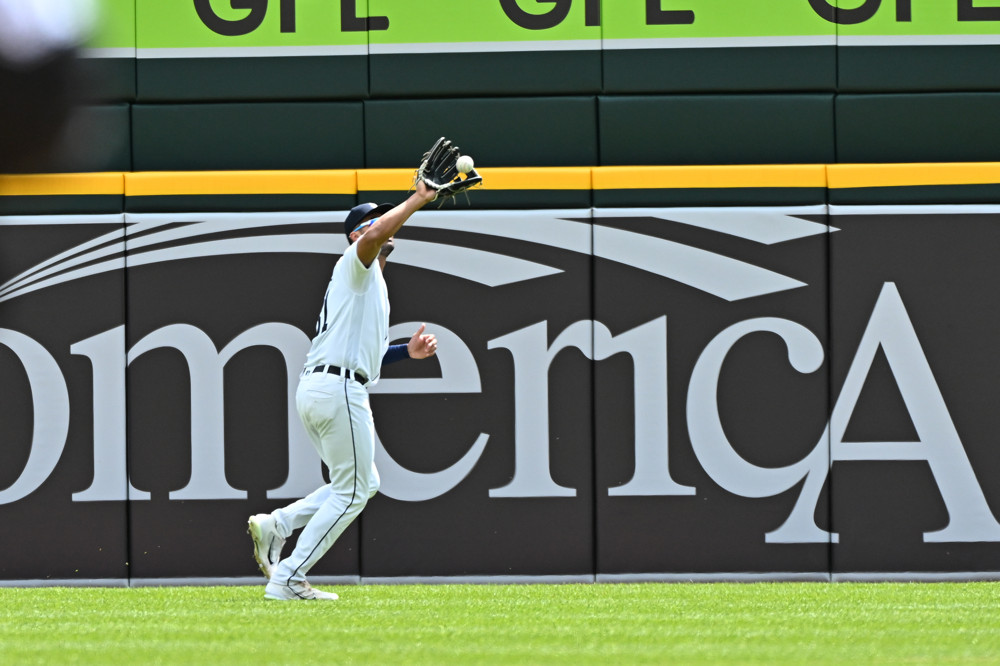
    In the fifth inning of Eduardo Rodriguez’s start against the Guardians on April 18, Josh Naylor hit a bolt to right field that looked like it was going to be a go-ahead home run. But Matt Vierling raced back, leapt, reached over the wall as he banged into the fence, and made the catch.

    Rodriguez ended up pitching eight scoreless innings in a 1-0 Tigers win. He’s been one of the best pitchers in baseball this season, pitching to a 1.57 ERA, and his team’s defense has been a huge reason why.

    Vierling’s catch is one of 11 times that the Tigers defense recorded what we call a “Good Fielding Play” behind Rodriguez this season. The Tigers outfield has turned 83% of balls hit in the air against Rodriguez into outs this season, the 3rd-highest rate in MLB.

    But it’s not just those plays. Besides the homer-robbing catch, other highlights have included a couple of base-hit takeaways by second baseman Jonathan Schoop, and a couple of throw-outs on the bases in an early start vs the Blue Jays.

    Only one pitcher has had his defense record more Good Fielding Plays behind him this season. Ryan Feltner of the Rockies has had 13. Jake Woodford of the Cardinals also has had 11. Clarke Schmidt (Yankees), Corbin Burnes (Brewers), Anthony DeSclafani (Giants), and David Peterson (Mets) have all had 9 behind them.

    In looking at how good defense has impacted other pitchers, we can turn our attention to Guardians starter Shane Bieber. Whether through positioning or playmaking, the Guardians defense has been solid behind him in 2023. Bieber has a 3.62 FIP but a 2.61 ERA.

    The plays made aren’t nearly as flashy as the ones behind Rodriguez, though here’s a Good Fielding Play by Myles Straw. Most of them are just “nice plays” like this one by Amed Rosario.

    He’s well at the front of the line in this stat. The Guardans have saved 10 runs for him with their batted ball defense.

    Dustin May (Dodgers), Marcus Stroman (Cubs), Yonny Chirinos (Rays), Kyle Freeland (Rockies), and Yusei Kikuchi (Blue Jays) have all had their teams record 6 Runs Saved on batted balls behind them.

    This isn’t to say that the success of Rodriguez and Bieber this season is undeserved or that it won’t last throughout the season. It’s just to point out that there are lots of factors in play that make a pitcher successful. Rodriguez and Bieber should be first in line to tell you how important defense can be.

  • Why The Tigers Outfield Rates So Well Defensively

    Why The Tigers Outfield Rates So Well Defensively

    Early this season, we’ve gotten a few surprised reactions when we noted that the Tigers outfield leads the majors in how often they turn a ball hit in the air to the outfield into an out and were leading the majors in Defensive Runs Saved (they’re now tied in the latter with the Mariners)

    The Akil Baddoo, Riley Greene, Matt Vierling combo wasn’t on anyone’s radar as being the best outfield in baseball entering the season. But so far, they’re faring pretty well compared to everyone else.

    So let’s explore this a little bit:

    We do batted-ball classifications a little differently than others who chart baseball games every day. Sure, we chart balls hit in the air as you traditionally would, as fly balls, line drives, and popups. But we also have two categories, ones that cover the in-betweeners.

    We call them fliner-fly, and fliner-liner. We’re not going to give exact definitions to preserve our proprietary system, but we can tell you that fliners are balls that are in-between fly balls and line drives. A fliner-fly follows an arc close to a traditional fly ball, but not quite. A fliner-liner is that ball that more closely resembles a line drive in arc, but isn’t quite one. Our Video Scouts evaluate which classification each batted ball belongs in based on its hang time and arc.

    We bring this up because this Tigers outfield happens to be pretty good at catching fliners, particularly fliner-liners.

    Here’s Baddoo making a fantastic catch on Joey Ortiz. This one was worth 0.8 runs

     Matt Vierling snagged this one, which is worth 0.75 runs.


    Brief aside: Though the Tigers catch rate on fliner-flies is about league-average, Vierling has been quite good at those too, including this HR robbery

    Here’s Kerry Carpenter catching a ball worth 0.7 runs.

    And Greene pulled this one off the turf to net himself an out and 0.6 runs saved

    In all, the Tigers have caught 40 of 82 fliner-liners this season. That’s nearly 50%. The MLB average catch rate of fliner-liners this season is about 33%. The Tigers are much better than that … so far. There’s some skill involved. You’ve seen the video. There’s also been some good or fortunate defensive positioning that has allowed these catches to be made. The Tigers lead all teams in Defensive Runs Saved from Outfield Positioning.

    Is the Tigers early-season success related to skill or just an aberration? I don’t know and it’s too early to tell. My biggest takeaway is that fliner-liner catches are fun to watch. And the Tigers being good in them so far makes the team a bit more watchable than they were expected to be in 2023.

  • An Appreciation of Ha-Seong Kim’s Defense

    An Appreciation of Ha-Seong Kim’s Defense

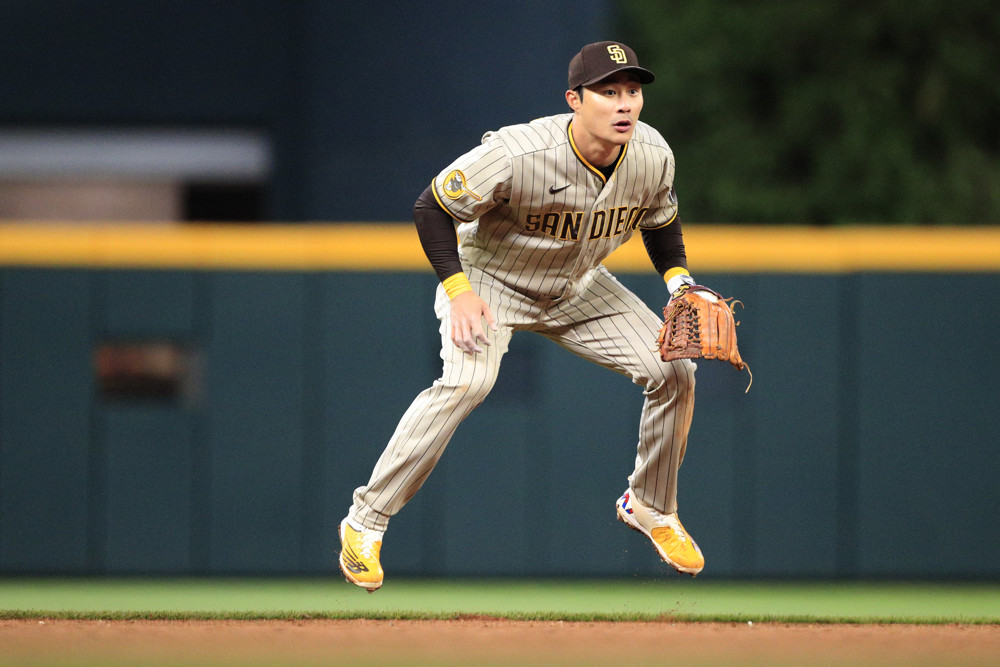
    Ha-Seong Kim started three games the last three days for the Padres against the Reds, going from second base to shortstop to third base.

    Though Kim didn’t merit our recently-awarded Defensive Player of the Month honors, some props are due Kim’s way for his fine defensive play and versatility.

    Since coming over from South Korea beginning in 2021, Kim has proven both adept and adaptable. Wherever he’s been put, he’s performed to a high standard, ranking second overall in Defensive WAR behind Ke’Bryan Hayes. These are his Defensive Runs Saved totals by position.

    Position DRS Innings Played DRS Rank
    2B 10 352 7th
    SS 19 1,371 T-5th
    3B 8 366 T-10th

    >> Ranks outside the Top 25 in innings played at each position

    There’s a common thread to what has pushed Kim’s Runs Saved numbers up regardless of position. He’s very good going to his left. Here are three examples from this season.

    Here’s one at second base.

    Here’s one at shortstop.


    And here’s one at third base. This play just happened yesterday and happened so quickly you don’t get the full effect of the effort Kim made to catch this 99-MPH rocket. 

    In his three seasons, Kim has made 183 plays on 308 opportunities going to his left while playing shortstop*. He was expected to make 166 based on out probabilities for those 308 balls.

    So he’s made 17 plays above the expected total (think of that as our version of Outs Above Average. We’ve been tracking our version since 2003). His +17 is the best for any shortstop on balls hit to his left since the start of 2021. If we pro-rate that to look at who is best on a per-play basis, Kim ranks third behind Edmundo Sosa and Taylor Walls.

    *An opportunity is any play on which the out probability is >0%

    Additionally, Kim has 52 plays made on 72 opportunities going to his left as a second baseman. He’s +6 on those plays. Kim isn’t going to rank in the Top 40 in opportunities, but +6 on 72 balls is pretty good for a small sample. So is his +9 on 75 balls at third base.

    In September 2020, while Kim was still playing in the KBO, our Ted Baarda wroteKim has quick reflexes, smooth actions and good situational awareness on the field … Kim appears to have a well-rounded skillset and provides defensive versatility that fits well into today’s MLB game.”

    Though the adjustment from the KBO to the majors can be a challenge for many, Kim’s defense has translated without issue. And where and how well he plays may get overshadowed by the Padres potent lineup (or lack thereof to this point), but don’t underestimate its importance.

  • MLB Defensive Player of the Month for April

    MLB Defensive Player of the Month for April

    Ke’Bryan Hayes lost a very close vote for The Fielding Bible Award at third base last season, missing a chance to win the honor for the second straight year.

    But in a vote among Sports Info Solutions staff, Hayes handily won Defensive Player of the Month honors for April. He beat out White Sox center fielder Luis Robert Jr.

    Hayes topped all third basemen with 6 Defensive Runs Saved in April. In fact, no one else had more than 3 Runs Saved at the position.

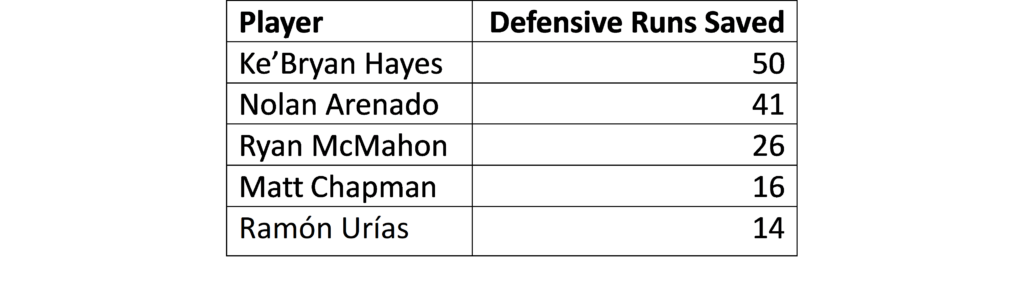
    Since his debut in 2020, Hayes has saved 50 runs at third base. The next-closest player is Nolan Arenado with 41. Hayes has played just over 2,300 innings in that time. Arenado has played more than 3,000 innings.

    This month was as much one of reliability and keeping busy as flashy plays for Hayes, though he did have some pretty good ones.

    Hayes has 61 assists, second-most among third basemen (Jeimer Candelario has 63), 20 putouts, and only 2 Defensive Misplays & Errors. Last year, we wrote about how amazing Hayes was on his backhand, and he’s off to a good start there, making 18 of 20 plays on balls he’s fielded that way. He’s also made 58 of 60 plays on his forehand, a success rate of nearly 97% (MLB average is about 90%).

    The Pirates have been arguably baseball’s biggest surprise going 20-9, and both their hitting and pitching have been great. But the defense has been a notable part of the latter’s success. The Pirates finished 22nd in Defensive Runs Saved last season. This season, they rank 12th. Hayes hasn’t been a part of the offensive success yet, but so long as he keeps playing as he has in the field, he’ll be a major contributor.

    Robert Jr., the runner-up for the award, co-leads MLB with 7 Runs Saved (he’s tied with Royals center fielder Kyle Isbel). Others considered for the award include Brewers catcher William Contreras, Padres infielder Ha-Seong Kim, Brewers outfielder Joey Wiemer, and Red Sox catcher Connor Wong.

    Most Defensive Runs Saved By Third Baseman – Since 2020

  • Stat of the Week: Nick Gordon and Starling Marte: Perhaps Deserving A Better Fate

    Stat of the Week: Nick Gordon and Starling Marte: Perhaps Deserving A Better Fate

    BY MARK SIMON

    Let me call your attention to two hitters whose numbers currently don’t match their track records and explain something that’s going on for each of them.

    Twins utility man Nick Gordon is 6-for-52 to start the 2023 season. In his first two years in the majors, Gordon hit .261 with a .711 OPS, the latter right in line with MLB average. He’s a decent hitter, one for whom a 6-for-52 slump is possible but a bit unnerving when it happens.

    Look closer at Gordon’s batted balls and they show a different story for his season. SIS calculates “expected” offensive numbers based on a set of characteristics about each batted ball – most notably where the ball was hit and how hard it was hit.

    Gordon has 6 hits. By our expected numbers, based on where and how hard he’s hit balls, he should have 14 (or to be precise with our system, 14.2).

    Two examples: 

    This ground ball against the White Sox, on which Gordon was thrown out, had a 52% hit probability.

    This bloop, on which Chas McCormick of the Astros got a nice jump to make the catch, had a hit probability of 76%.

    Gordon’s expected batting average is .273 compared to the actual .115 he’s hitting. The 158-point difference is the largest in MLB to this point in the season.

     The other player to look at is Mets right fielder Starling Marte, who is 5-for-35 in his last 9 games, during which he’s been bothered by a neck strain. We’re going to look at his numbers from a slightly different perspective.

    Marte’s irritation could be compounded by the knowledge that he’s the MLB leader in being robbed by Good Fielding Plays (GFPs).

     These plays are the ones you’d see on baseball highlight shows like Quick Pitch or Baseball Tonight. Our Video Scouts note approximately 30 types of GFPs, with our list for this article specific to ones that rob potential base hits.

     For perspective, Amed Rosario led the majors in being robbed last season – 20 instances. Eugenio Suarez and Kevin Newman had the most instances in 2021, 16.

    Marte has also not been gifted any hits yet this season by another thing we track, Defensive Misplays (in this case, we look for plays that weren’t scored errors that could have been outs), so there’s been little to offset the great defensive work against him.

     The point of showing you both Gordon and Marte’s numbers is to reiterate an important point: it’s extremely early in the season. Though you are what your record says you are, there’s sometimes a lot more to your stats than just what’s shown within a small sample size.

  • Stat of the Week: Brewers Living Up To Their Reputation

    Stat of the Week: Brewers Living Up To Their Reputation

    BY MARK SIMON

    When we wrote our NL defense preview a few weeks ago, we referenced Brewers manager Craig Counsell and his high expectations for Brewers rookie second baseman Brice Turang.

    Turang has lived up to the billing so far – just check out the nice plays he made against Jarred Kelenic on Wednesday (click here and here) and his relay throw to nail Jake McCarthy earlier this month (click here).

    But there were a few other guys we should have been paying attention to as well within the Brewers’ strong start to the year.

    The Brewers outfield has looked great through the first 19 games of the season and is the primary reason Milwaukee leads MLB with 18 Defensive Runs Saved. They’ve caught 64% of balls hit in the air to the outfield that stayed in the ballpark, the second-highest rate of any team. Christian Yelich has 2 Good Fielding Plays for catches (here’s one), as does another rookie, Joey Wiemer (if he can make a better one than this, we’ll be really impressed).

    Let’s take a moment to explain Good Fielding Plays. These include the great defensive plays (the ones you’d expect to see on ESPN’s Web Gems or Top 10 Plays) but also things like cutting a ball off in the gap or keeping the ball on the infield to prevent a baserunner from taking an extra-base.

    Speaking of Good Fielding Plays (we call them GFPs for short), we should take note that Brian Anderson, who’s split time between third base and right field after signing with the Brewers this past offseason, has 4 in 12 games at third base already (heck of a play here). He totaled 3 in 48 games last season. The Brewers infield is one spot behind the outfield. It ranks 3rd in how often it turns groundballs and bunts into outs, doing so 79% of the time.

    Anderson has been a somewhat unexpected defensive stud. So has catcher William Contreras, who was obtained from the Braves in a three-way trade last December.

    Contreras did not have a good reputation as a pitch framer. He’d accrued -6 Strike Zone Runs Saved (our framing stat) combined in 2021 and 2022. But so far this season, his pitch framing has graded well and Brewers pitchers have pitched to a 2.50 ERA in 13 games with him behind the plate (they ranked 6th in the NL last season with a 3.83 staff ERA). Captip to Brewers radio pre-game broadcaster Dom Cotroneo for his breakdown of what Contreras is doing differently now.

    There’s a precedent for the Brewers taking a catcher with poor framing numbers and making him into a good pitch framer. They did it previously with Omar Narváez.

    There’s precedent for the Brewers being a good defensive team too. In Counsell’s first seven full seasons as manager, spanning 2016-2022, the Brewers have the 4th-most Defensive Runs Saved in MLB.

    We’re starting to like their chances for being good in 2023 too.

    Most Defensive Runs Saved – 2016 to 2022

    Team Defensive Runs Saved
    Dodgers 435
    Astros 412
    Cubs 324
    Brewers 303
    Cardinals 276


  • It’s Early … But A Few Thoughts on Team Defensive Runs Saved Leaders

    It’s Early … But A Few Thoughts on Team Defensive Runs Saved Leaders

    It’s early!

    We’ve heard and read a lot of references to Defensive Runs Saved in the first couple of weeks and that’s great. We appreciate our data being consumed.

    But looking at Defensive Runs Saved numbers now is kind of like looking at a hitter who is 15-for-45 or a team that is 9-6 to start the year. You hope it means something, and if the track record is good, you think it’s going to mean something, but you can’t attach much certainty to it.

    Nonetheless, the small sample size does give you at least a small indication of what did happen and from that, we can make a few observations.

    You can find the team leaders in Defensive Runs Saved here and the individual leaders here at FieldingBible.com.

    In the meantime, here’s a look at some of the top teams in the stat so far.

    Diamondbacks

    The Diamondbacks have been gobbling up ground balls and bunts at the highest rate of any team, 80.4% (the season leader usually ends up at 77-78%). Let’s not forget that they have two Fielding Bible Award winners out there in first baseman Christian Walker and shortstop Nick Ahmed and fellow shortstop Geraldo Perdomo is off to a good start.

    But it’s not just that.

    Arizona has not just run rampant on the bases (18-of-20 in stolen base attempts), it has shut down the opposing running game. Gabriel Moreno hasn’t hit, but he’s thrown out 4-of-7 attempted basestealers.

    Brewers

    A couple of things have happened here. For one, catcher William Contreras looks a lot better than he did the last two seasons, when he combined for -6 Strike Zone Runs Saved (our framing metric). He’s been stealing strikes very well so far.

    For another, the Brewers outfielders – specifically Joey Wiemer, Garrett Mitchell, and Christian Yelich – have made some nifty catches. Wiemer in particular has 5 Good Fielding Plays, 3 on catches, 2 on throws.

    Blue Jays

    Before the season started, we noted that the Blue Jays had an abundance of defensive talent, albeit aging defensive talent.

    Center fielder Kevin Kiermaier was one of those guys. He’s looked pretty spry, as has a younger guy, outfielder Daulton Varsho.

    And Vladimir Guerrero has shown that his improvements last season are no fluke.

    Twins

    There’s not a lot of flash or pizazz out there. The Twins have the fewest Good Fielding Plays in MLB. But they also have the lowest opponents’ batting average on balls in play.

    Twins outfielders have the best out rate on fly balls and line drives in MLB. They’ve caught what they’re supposed to and maybe a couple that they weren’t supposed to.

    Additionally, catcher Christian Vazquez came with a sterling defensive reputation and he hasn’t disappointed. Twins pitchers have a 2.20 ERA and a nearly 5-to-1 strikeout to walk ratio with Vazquez catching.

    Mets

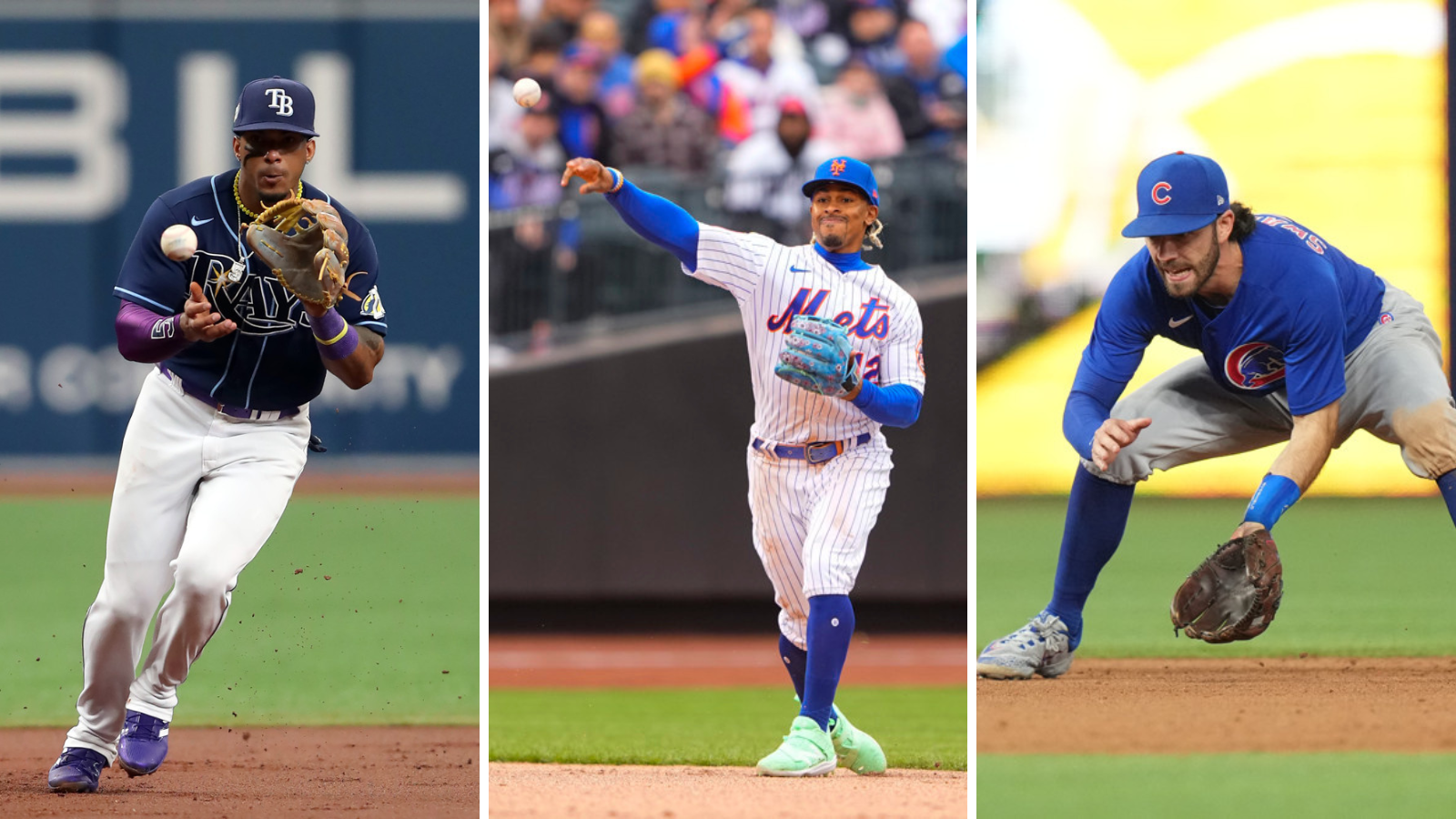
    Defensive Runs Saved didn’t rate Francisco Lindor well last season, largely attributing that to how he fared when the Mets used a defensive shift.

    This year, with full shifts (3 infielders on the pull side of second base) abolished and the Mets using partial shifts (2 infielders moved distinctly from straight-up positioning) less often than they used any shift last season, Lindor has thrived. He’s made a host of good plays on ground balls and line drives.

    The Mets have turned grounders and bunts into outs at an 80.3% rate, which ranks 3rd in MLB, a smidge behind the Diamondbacks and Yankees.

    Yankees

    Speaking of ground ball defense, the Yankees are off to a great start after finishing second in ground ball and bunt out rate last season. As noted above, they rank second this year as well. Anthony Volpe has had a few bumps but has handled shortstop alright so far.

    At the corners, Anthony Rizzo has played his usual solid first base and displaced and maligned shortstop Isiah Kiner-Falefa has slid back to third base to fill in for Josh Donaldson’s injury without issue.

    Mariners

    If you had Teoscar Hernández as the Mariners’ best defensive player before the season started, congratulations. He’s never finished with a positive season in Defensive Runs Saved but is off to a great start this year and is basically the reason why we’re even acknowledging Seattle here. He’s already got an MLB-best 7 Good Fielding Plays (he totaled 10 last season) and has 3 assists without the cutoff man.

    As Mariners broadcaster Dave Sims says here, “Well done!”

    You’d like to believe that this is the start of a defensive renaissance for him but, as we noted it the beginning of the piece, it’s way too early to determine if that’s the case.