Category: Baseball

  • Pirates defense could be a spoiler down the stretch

    Pirates defense could be a spoiler down the stretch

    By MARK SIMON

    The Pirates have a chance to play postseason spoiler in the last two weeks with nine games remaining against the Reds and Phillies.

    Pittsburgh ranks last in the NL in OPS and their pitchers rank in the bottom four in the league in strikeouts and walks. The best chance for the Pirates to spoil might be with their defense.

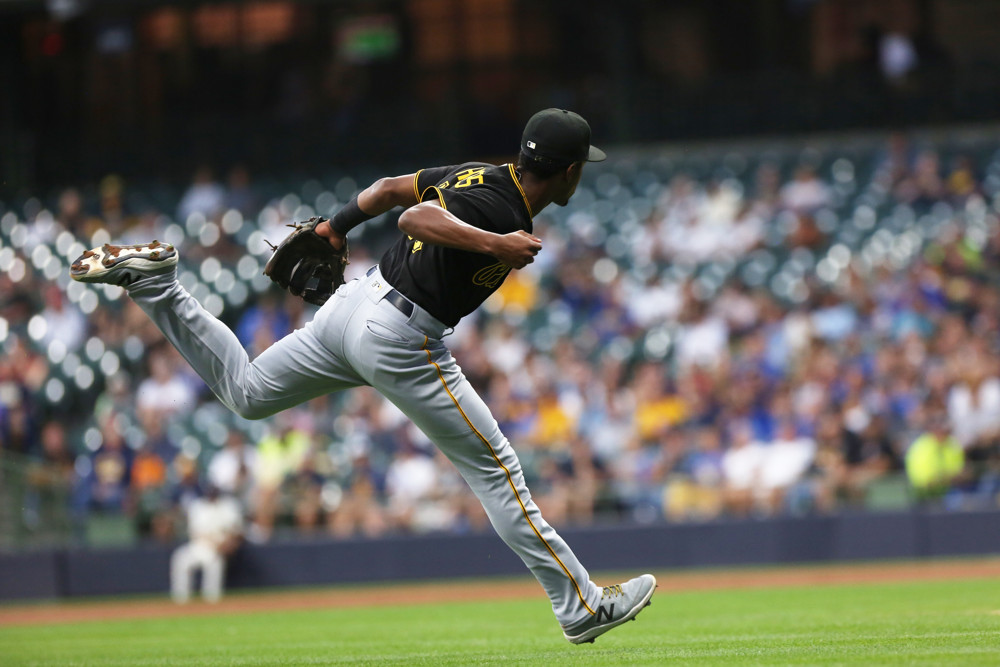
    Yes, the Pirates are a middle-of-the-pack team in Defensive Runs Saved, but they have three players who can significantly impact a game with how they play in the field – catcher Jacob Stallings, third baseman Ke’Bryan Hayes, and shortstop Kevin Newman.

    Stallings is the runaway Runs Saved leader at catcher with 21. In fact, he’s one run shy of Ryan McMahon of the Rockies for the overall MLB lead. Stallings ranks in the top five in Runs Saved from pitch framing and is one of the top catchers in pitch blocking.

    Here’s a good recent example of his value in framing, with two strikeouts gotten against Marlins infielder Jazz Chisholm, one that was on the outside corner, one that was just a little off.

    Stallings has the highest block rate among the 40 catchers who have blocked the most pitches this season (a few guys in the top 50 edge him out).

    Here’s a comparison of Stallings against two catchers who have won a combined 14 Gold Gloves, Yadier Molina and Salvador Pérez. He’s considerably better than both.

    Name Blocked Pitches Passed Balls Wild Pitches Block Rate
    Jacob Stallings 635 0 31 95%
    Yadier Molina 544 6 44 92%
    Salvador Pérez 694 1 64 91%

    Additionally, Stallings has 635 blocks and no passed balls. The next-most blocks by a catcher with no passed balls is Michael Perez with 276.

    Here’s where Stallings’ pitch blocking comes in handy, with the tying run on third base in the ninth inning of this past Sunday’s game.

    Stallings has sustained this success for an extended period. He ranked fourth in Runs Saved among catchers in 2019 (in which he played less than half the season) and second in 2020 (his first as a regular starter). He’ll definitely be a strong candidate to win a Fielding Bible Award in 2021.

    Hayes could win one as well. After missing two months to a thumb injury, Hayes has been the defensive standout he was expected to be upon his recall in 2020. He leads all third basemen with 17 Runs Saved. Yep, his total is one run more than Nolan Arenado and Matt Chapman combined. Had Hayes been healthy in April and May, there’s a good chance he’d be leading all players in Runs Saved. And maybe we’d have seen another play like this one.


    Hayes’ left side mate, Newman, isn’t going to make the highlight reels often. He has only 8 Good Fielding Plays this season. On a per-inning basis, he has the third-lowest per inning rate among the 40 shortstops that have played the most innings this season.

    But Newman finds himself in the right spot at the right time more often than not. He ranks 5th among shortstops with 8 Runs Saved. That’s a huge improvement from 2018 to 2020 when he totaled -14 runs in just under 1,200 innings (the equivalent of close to a full season).

    A pre-pitch crow hop, often not seen on camera (though visible in the stands), has helped Newman in that it’s made plays that were hard to make when he was flat-footed, possible, and it’s made most plays routine. In particular, Newman seems a little nimbler than he’d previously been on balls hit to his left, as Alcides Escobar learned a little more than a week ago.

    Little things tend to matter a lot at this time of year. One block or good frame by Stallings, a Web Gem by Hayes, or a nifty play by Newman could make a huge difference. Keep an eye out for their piracy these next two weeks.

  • Stat of the Week: Cardinals Lead The Way … Again

    Stat of the Week: Cardinals Lead The Way … Again

    By MARK SIMON

    In the ninth inning of a tie game against the Royals on August 8, Cardinals first baseman Paul Goldschmidt threw away a sacrifice attempt, an error that led to the go-ahead run eventually scoring.

    The Cardinals ended the day 55-56, 10 1/2 games out of the NL Central lead and 8 games back of the Padres for the second Wild Card spot.

    A pair of deals at the trade deadline for pitchers J.A. Happ and Jon Lester seemed like an attempt at feigning a level of postseason contention that didn’t exist.

    Per FanGraphs, their playoff odds entering August 9 were 1.3%.

    Just over five weeks later, the Cardinals have new life. They’ve soared into the second Wild Card spot with a 20-13 surge.

    The Cardinals defense has been a huge part of that. The Cardinals lead MLB with 73 Defensive Runs Saved this season.

    If the Cardinals finish the season with the most Runs Saved, they’ll be the first team to lead the majors in that stat in consecutive years.

    SIS has been tracking Runs Saved since 2003.

    This is a team loaded with defensive talent. The team’s catcher (Yadier Molina), first baseman (Goldschmidt), third baseman (Nolan Arenado) and left fielder (Tyler O’Neill) have all won at least one Fielding Bible Award for defensive excellence.

    Our Defensive Player of the Month for August, center fielder Harrison Bader, leads the Cardinals with 18 Runs Saved, 2 shy of Michael A. Taylor of the Royals for the lead among all outfielders.

    Three other players have at least 10 Runs Saved. O’Neill leads MLB left fielders with 11. Goldschmidt leads all first basemen with 10. Rookie infielder Edmundo Sosa also has 10.

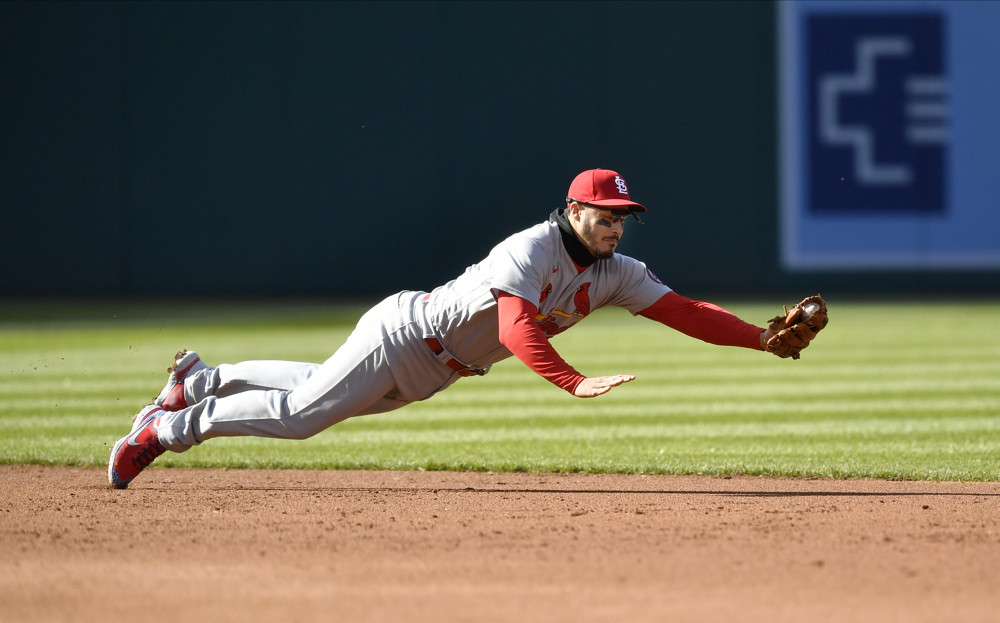
    There’s so much depth on the roster that Arenado, who has won four Fielding Bible Awards, ranks fifth on the Cardinals with 7 Runs Saved. Molina, one of the top defensive catchers in MLB history, ranks eighth on the team with 4 Runs Saved.

    Another player worth noting is utility man Tommy Edman, who has 6 Runs Saved in playing time split primarily between second base and right field. Edman leads the Cardinals and ranks tied for fifth in MLB with 28 Good Fielding Plays (Web Gems and heads-up plays such as cutting off a base hit to prevent a baserunner from advancing an extra base).

    The Cardinals infield of Goldschmidt, (usually) Edman, Sosa (or Paul DeJong), and Arenado has converted 78% of ground balls and bunts into outs this season, the highest rate in the majors.

    Lastly, Cardinals pitchers have done their part too. They rank second at the position in Defensive Runs Saved with 7. Four different pitchers on the team lead the way with 3 Runs Saved.

    The Cardinals entered August 9 ranked 9th in Runs Saved with 35. Since that day, the Cardinals have 38 Runs Saved, 10 more than the next-closest team, the Dodgers.

    That the Cardinals are tops in the majors isn’t that much of a surprise. Our projection in spring training was that they would finish as the MLB leader. They’ve lived up to the billing so far.

    Most Defensive Runs Saved – 2021 Season

    Team Runs Saved
    Cardinals 73
    Astros 66
    Rockies 62
    Brewers 59
    Rays 58
    Rangers 55
    Marlins 54
    Dodgers 48
    Mets 48
    Braves 41

    To read about the Cardinals penchant for great plays behind Adam Wainwright, visit the SIS Blog and to learn more about Tommy Edman’s defensive play this season, check out his interview on The SIS Baseball Podcast.

  • Baseball Podcast: Robo Umps, Baseball Music & Larry Walker’s Favorite Play

    Baseball Podcast: Robo Umps, Baseball Music & Larry Walker’s Favorite Play

    On this episode, Mark Simon (@MarkASimonSays) is joined by Angels catcher Max Stassi (@MaxStassi10) to talk about what goes into his defensive work.

    Max talks about his defense origin story (he was born into catching) and what he focuses on when he frames pitches ().

    Max also discusses what it’s like to catch Shohei Ohtani and offers a strong take on the potential of robot umpires and how that would change catching forever (imagine catchers working entirely from their knees) ().


    Also, we asked Hall-of-Fame inductee and 7-time Gold Glover Larry Walker on his favorite type of defensive play ().


    Mark is then joined by former Baseball Info Solutions Video Scout, and singer-songwriter Matt Halvorson (@HalvyHalvorson), whose songs are often about prominent (and lesser-known) baseball players (you’ll hear a brief excerpt from his latest album, which you can find here) ().Thank you for listening. Stay safe and stay well.

  • The surprising key to the Brewers outfield success

    The surprising key to the Brewers outfield success

    By MARK SIMON

    The Brewers enter Friday ranked fourth in the majors in Defensive Runs Saved and their outfield ranks No. 1 in that stat.

    I suppose that isn’t a surprise given the presence of Jackie Bradley Jr. and Lorenzo Cain. Except that while Bradley has done as he does and saved 9 runs with his defense, he’s tied for the team lead not with Cain, but with right fielder Avisail Garcia.

    Garcia got some props nationally for this home run-robbing catch against Max Schrock on Wednesday, the play on which he gained the most Runs Saved value this season.


    Part of Garcia’s story is that of a defensive progression.

    From 2012 to 2018, he cost his teams 17 runs with his outfield defense. Simply put, Garcia didn’t catch as many balls as he was expected to in right field, based on where they were hit and how hard they were hit.

    But something happened when Garcia signed with the Rays prior to the 2019 season. Tampa Bay’s coaching staff found a player eager to get better.

    When I went to Yankee Stadium to track a game in the life of the Rays defense, the team’s outfield coach, Ozzie Timmons, made it a point to tell me how much better Garcia was than he previously had been.

    “People underestimate him based on his size,” Timmons said that day. “He covers a lot of ground. One thing he said when he got here was ‘I like to play defense.’ He takes pride in it.”

    Timmons’ words bore out that night as Garcia made a knee-high catch on a line drive in the game I covered.

    They bore out for the season in which Garcia totaled a career-best 5 Defensive Runs Saved as a right fielder, all coming from his range.

    With Cain opting out in 2020, Garcia was moved to center field and, from a defensive perspective, it didn’t go great. He cost the Brewers 5 runs and his range numbers were poor.

    But back in his normal spot in 2021, Garcia has been just fine. His range numbers are tracking comparably to those of 2019. He’s gotten to what he should get to, and in a few cases, maybe gotten to what he shouldn’t get to.


    The other aspect of Garcia’s numbers come from something else we track: baserunner advancement on balls that outfielders field.

    The average right fielder this season has allowed just under half of the baserunners running against him to take an extra base (47.5% to be exact).

    Garcia’s year-to-year percentage as a right fielder has typically been in the low 50s. His numbers have been boosted by throwing runners out. He’s had as many as 9 assists without the help of a cutoff man.

    This season, it’s not so much those assists (3) as the runners he’s held in place. Only 17 of 59 baserunners have taken an extra base on balls Garcia has fielded. At 29% (remember the MLB average is near 50%), that rate ranks second-best in the majors trailing only perennial standout Adam Duvall.

    The value of Garcia’s baserunning deterrence accounts for 5 Runs Saved.

    I went through about a dozen instances in which a baserunner took only one base on a hit that Garcia fielded. They don’t make for particularly exciting video. In watching Garcia, I saw someone who got to balls at a reasonable speed. There were a few instances of runners reluctant to test his arm, like this one from a week ago.


    But the assists are a little more fun.

    Here are two of Garcia’s three unaided assists. It’s kind of funny that in both cases, the director cut away from a potential play, and had to quickly adjust to get a shot of the play at home. Perhaps they, like us, weren’t ready for Garcia’s good work.


    They know now. So do we.

  • Giants Are Well-Positioned To Make Their 2021 Run

    Giants Are Well-Positioned To Make Their 2021 Run

    By MARK SIMON

    Last Monday, Mets second baseman Jeff McNeil took an 0-for-5 against the Giants. He struck out once, lined out once and grounded out three times.

    The last two ground outs, one to shortstop Brandon Crawford and another to third baseman Evan Longoria shared a common thread. Neither infielder had to move laterally to make the play. They were in the perfect spot.

    This is one of the subtle keys to success for the Giants this season. Their infield defense, specifically when the team uses a defensive shift, seems to always be in position to make an out.

    Our company can track and put a value on this as part of our PART system for evaluating defense. PART stands for Positioning, Air Balls (Flies, Popups and Liners), Range, and Throwing.

    While a defensive player is evaluated for the ART portion, his team gets assessed a credit or debit based on where its players were stationed relative to where the ball was hit. You can learn more by reading this piece. Simply put, if a fielder’s positioning gives him a better chance to make the play, even if he doesn’t make it, he’s getting a credit.

    This system is largely about small-value credits and debits but those add up over time. By our count, the Giants have saved 27 runs just based on where they’ve stationed their infielders in a shift, the most in MLB.

    The Giants are a middle-of-the-pack team when it comes to shift usage and use full shifts (three infielders on one side) at a rate that ranks 22nd in MLB. But they’ve been so good at it. They’ve turned 80% of ground balls into outs when using a full shift. Only the Padres are better (81%).

    Most Positioning Runs Saved on Defensive Shifts

    Team Runs Saved
    Giants 27
    Angels 26
    Tigers 22
    Marlins 21
    Braves 20

    * Average MLB team has 13 Runs Saved from Shift Positioning (full list here)

    Here are some examples of the Giants’ excellence.

    * This is a play that was helped by the combination of a nimble fielder and a non-nimble baserunner, but also based on where Donovan Solano was to start. That play isn’t being made if the Giants are in a standard defense.

    * Another Diamondbacks frustration and another Giants success. Here’s Crawford handling a rocket from Stephen Vogt. Crawford doesn’t have to move at all. His entire effort goes into fielding the ball.

    * When a right-handed pull hitter like Paul DeJong is up and a team moves its second baseman to the other side of the field, it leaves the first baseman alone on an island. Here, they play Lamonte Wade Jr. well wide of first base and it pays off.

    * Wilmer Flores and Tommy LaStella are below-average infielders defensively for their careers, so in order to maximize what you get out of him, you need to put him in good spots. The Giants did so here and got a Giants-killer, Max Muncy, and a dangerous hitter, Omar Narvaez, out as a result.

    * And to show one example on which a play was not made, but the Giants still got a statistical boost for good positioning:  Here’s one from that same Mets game as was referenced atop the piece, a ball hit by Brandon Nimmo on which the positioning was sound but the execution was not.

    The Giants don’t have a perfect defense. But they have a very good one, one influenced significantly by where they put their players. It’s another piece among their many components that have put them in position (pun fully intended) to have a big season.

  • Brewers defense is a boon to Brandon Woodruff

    Brewers defense is a boon to Brandon Woodruff

    By MARK SIMON

    Brewers starter Brandon Woodruff has a 2.18 ERA, a 4.5-to-1 strikeout to walk ratio,  and has allowed only 11 home runs in 140 1/3 innings pitched.

    Much of his dominance is self-created. But not all of it.

    In total accumulated value, Woodruff has benefited more from his defense (including himself) turning batted balls into outs the second-most of any pitcher in baseball. We previously wrote about the pitcher who has benefited the most, Adam Wainwright.

    By our tabulation, Brewers fielders have saved nearly 14 runs for Woodruff, combining their positioning, plays made on balls in the air, range on balls in the air, and infield throwing.

    By comparison, Woodruff’s teammates, Freddy Peralta and Corbin Burnes, have gotten 11 and 3 runs of support from their defense, respectively. This makes Burnes’ numbers in particular more impressive, but the topic here is how the Brewers have risen to the occasion for Woodruff.

    Woodruff hasn’t gotten the great plays at the volume that Wainwright has, but he’s had a few rather impressive ones behind him.

    The Brewers infield has turned 82% of ground balls and bunts hit against Woodruff into outs. That’s among the highest rate for any pitcher in baseball (just below Wainwright’s 83%). It should be noted that Woodruff’s balls actually had a lower expected out rate (76%) than Wainwright’s (79%), making the work of the Brewers infield a little more impressive.

    Where Woodruff also has the advantage over Wainwright is in positioning. In some instances, Wainwright got great plays behind him because players weren’t put in spots conducive to making plays. In Woodruff’s case, the Brewers have been well-aligned behind him.

    Take a look at a couple of fly balls. This one was caught easily by Jackie Bradley Jr and was not a difficult play. Bradley got a small credit of 0.15 Plays Saved.

    But the team received 0.58 Plays Saved of credit for positioning. Because Bradley was where he was, he had an 85% catch probability on that ball. But had he not been where he was, his catch probability would have been 27%

    Similarly, Christian Yelich was playing well over towards the left field line here, making this fly ball hit by Josh Bell a routine one.

    That play is something closer to a 50-50 proposition if Yelich is positioned where an average outfielder is stationed.

    Good positioning is a little more obvious with some of the “at-em” balls hit against defensive shifts, like this one.

    Quarterbacks are known to buy something for their offensive line to reward them for their work during a season. Woodruff might want to do the same for his guys.

    Most Defensive Runs Saved For Pitcher By Team

    Specific To Turning Batted Balls Into Outs

    Name Team Runs Saved
    Adam Wainwright Cardinals 16.1
    Brandon Woodruff Brewers 13.9
    Walker Buehler Dodgers 13.6
    Dallas Keuchel White Sox 13.6
    German Márquez Rockies 13.0
  • McMahon + Fuentes > Arenado on D — By A Lot

    McMahon + Fuentes > Arenado on D — By A Lot

    By MARK SIMON

    A few days ago, a couple of our Twitter followers were surprised when they noticed the difference between the Defensive Runs Saved totals for the Rockies third basemen and the Cardinals third basemen.

    Ryan McMahon and Joshua Fuentes have played Nolan Arenado-like defense at third base. But Arenado hasn’t been Arenado-like this season, at least not by our measures. Fuentes and McMahon are ranked 2nd and 3rd in Defensive Runs Saved at the position. Arenado is only slightly above average.

    At SIS, we have the ability to break this down and look at how an infielder is doing on balls hit to their left, right at them, and to their right. We can look at plays on which the chance to record an out is greater than zero (we’ll call that “opportunities”) and see how often the player recorded at least one out on the play.

    And in doing that, that can help to explain why the gap between McMahon, Fuentes, and Arenado is large this season, specifically as relates to one area – balls hit to their left.

    Comparing them on balls hit to their left

    The thing that most drove Nolan Arenado’s Defensive Runs Saved numbers throughout his Rockies career was how he fared on balls hit to this left.

    You got used to seeing plays like this

    From 2013 to 2020, he averaged being 14 plays above average on balls hit to this area In other words, if there were 200 balls hit to his left, and the average fielder got an out on 100 of them, Arenado was 14 better than that … in other words, 114.

    But in his first season with the Cardinals, he’s only 2 plays above average on balls hit to his left.

    In simplest terms, there has been a little more of this:

    and less of this

    But what McMahon and Fuentes have done is replicate Arenado’s past performance on balls hit to their left.


    McMahon & Fuentes vs Arenado – On Balls Hit To Their Left- 2021 Season

    Player Outs Made/Opp Plays Above Avg
    McMahon/Fuentes 126/218 (58%) +19
    Arenado 84/180 (47%) +2

    (All stats entering Wednesday)


    They’re not just better than Arenado this season. They’re a lot better.

    Here’s two nifty plays by Fuentes (now in the minors) going in that direction


    and here’s one from McMahon, who ranks second in Defensive Runs Saved at the position and first in Defensive Runs Saved overall because he’s been just as good at second base.

    There are other anecdotal numbers that illustrate the stark difference this season.

    – McMahon and Fuentes have combined for 25 Good Fielding Plays at third base this season (think “Web Gems”). Arenado, who typically leads third basemen in the stat, has 16.

    – Arenado also has 21 Defensive Misplays & Errors, meaning this could be the first time in his career that he’s had more Misplays & Errors than Good Plays (the Rockies duo has 24 Misplays & Errors).

    – Additionally, Arenado has converted 8-of-28 double play opportunities (29%). His conversion rate is usually 60% or higher. McMahon and Fuentes have converted 21-of-29 (72%).

    – Lastly, when Arenado plays in a defensive shift, he’s had considerably more difficulty getting outs than he usually does. He’s at -5 Runs Saved on shifts. He saved 22 runs on shifts from 2018 to 2020.

    McMahon and Fuentes have saved 7 runs combined on shifts at third base this season.


    It would be wholly unfair to write off Arenado though, so let’s point out a couple things. He’s having his best year saving runs as relates to bunt defense (3 Runs Saved). He’s also fared better than McMahon and Fuentes on “straight-on” balls. There’s a long track record of success that makes us think that Arenado is still a great glove.

    But the gaps created in all the other areas make it pretty clear that the Rockies have not missed a beat defensively at third base and their pair has outperformed Arenado in that regard this season.


  • Digging Deeper: On Bryan Reynolds’ Defensive Runs Saved

    Digging Deeper: On Bryan Reynolds’ Defensive Runs Saved

    By MARK SIMON

    There was an article in the Pittsburgh Post-Gazette last week, the gist of which was a couple of Pirates players wondering why center fielder Bryan Reynolds’ Defensive Runs Saved total was so low (-2 runs entering Monday).

    This is a common question, one we seem to get more on center fielders than any other position. We get it. Everyone thinks their center fielder is a good center fielder, if not the best one, because center fielders are great athletes who often make extraordinary plays in the field. Almost every center fielder looks good.

    But in the world of Defensive Runs Saved, not everyone can be the best center fielder, or even rate in the top 10. The stat maintains order, just as it does at every other position, grading the entirety of each position on a curve.

    Reynolds’ history is that of a good outfielder. He had 7 Runs Saved in 116 games in left field, 3 Runs Saved in 42 games in center field and 3 Runs Saved in 31 games in right field.

    Here is a breakdown from the Fielding Bible website.

    In 2021, Reynolds has played 90 games in center field and 17 games in left field (where he’s at 0 Runs Saved). Given the sample sizes, we’ll focus on center field.

    You can find a nice breakdown of Reynolds’ defensive performance on the Fielding Bible site.

    There are a lot of numbers here. We’ll try to focus on the important ones.

    You can see under the Runs Saved header that as a center fielder in 2021 Reynolds is at -1 for R&P (Range & Positioning), -2 for Throws, and +1 for GFP/DME (Good Fielding Plays & Defensive Misplays), giving him a total of -2 Runs Saved.

    Reynolds’ Range

    We can split things up even further into shallow, medium, and deep categories, indicating how well a player did on balls hit to those parts of the field.

    Reynolds is +8 on shallow fly balls. That’s great. In fact, it’s the best of any center fielder in baseball.

    Reynolds has gotten there by making plays like this. He gets a .83 credit to his “shallow” rating for making a catch on this ball, which had 17% out probability.

    There have been 80 balls classified as shallow on which Reynolds had a >0 chance of making the catch. He’s turned 61 of those into outs.  By our calculations, the average outfielder would have caught 53 of them.

    61 minus 53 equals 8, so that is where that +8 rating comes from.

    Alas, most of those balls have high probabilities of being singles, so while they help Reynolds’ Runs Saved total some, the conversion from Plays Saved to Runs Saved gives him relatively little credit compared to deeper plays.

    And the -5 plays saved under “Deep” offsets those shallow-ball successes.

    Here are three examples balls hit to deep center that Reynolds couldn’t quite catch.

    Defensive Runs Saved doesn’t award any sort of consolation points for being close to catching a ball. It’s all or nothing. You either make the play or you don’t. And every play counts.

    Michael A. Taylor probably would have caught some of them. So would Kevin Kiermaier, Harrison Bader, Jackie Bradley Jr. and some of the other outfielders who rate as standouts on deep fly balls.

    Again, the grading curve in center field is steeper than in left or right because there are so many good players.

    Reynolds is 66-of-93 on catching deep balls. By our calculations, the average center fielder would have caught 71 of them.

    66 minus 71 equals -5, which gives you his Plays Saved on Deep fly balls and line drives. The -5 is tied for the second-worst of any center fielder in MLB.

    Most Plays Saved on Deep Balls, 2021 Center Fielders

    Player Team Plays Saved
    Jackie Bradley Jr. Brewers +7
    Harrison Bader Cardinals +6
    Kevin Kiermaier Rays +6
    Michael A. Taylor Royals +5
    Byron Buxton Twins +4
    Myles Straw Cleveland +4

    The conversion of Plays Saved to Runs Saved on deep flies and liners hurts Reynolds more than the positive conversion on shallow flies and liners helped him. Those plays missed hurt a player’s Runs Saved total, because they result in doubles and triples and have a higher penalty than the shallow plays do.

    Though Reynolds Plays Saved of +8 on shallow balls, 0 on medium balls, and -5 on deep balls adds up to +3,  it converts to -1 Range Runs Saved. That’s just below MLB average.

    What could be the issue here?

    Specific to Reynolds and his not making these plays, we noticed this:

    On Statcast’s leaderboards that measure outfielder jumps, Reynolds ranks fifth-worst in terms of ground covered within the first 1.5 seconds after the ball hits the bat (known in Statcast terminology as “burst”).

    On defense, every millisecond and every inch counts. Though Reynolds rates above average in the other Statcast components, it’s tough to make up for bad initial jumps on balls.

    We also checked in on the depth at which he plays, because unsurprisingly if you play shallower you’ll make more shallow plays and fewer deep plays. But this year Reynolds is actually playing deeper than in 2020, and similar to where he played in 2019 if we compare specifically to PNC Park.

    A disappointing Runs Saved total isn’t surprising

    That Reynolds’ numbers aren’t as good as they were when he was an everyday left fielder isn’t that much of a surprise.

    Our Andrew Kyne studied positional changes by outfielders and found that the average change for a corner outfielder moving to center field was a 7-run drop in Defensive Runs Saved (you can read his study here). That’s not as much about the player getting worse as his peers in center field being better than left fielders as a whole.

    Throws and other items

    I’ll address a couple other numbers here.

    Reynolds is at -2 Runs Saved for throws because runners have taken an extra base on him 44 times in 68 opportunities.

    That’s a 65% advance rate against an MLB average of 55% for center fielders.

    That’s not good.

    Factoring in Reynolds’ two assists without a cutoff man helps a little, but still puts him at -2 Runs Saved for his outfield arm.

    The 1 Run Saved Reynolds records for Good Fielding Plays/Defensive Misplays & Errors measures a number of things, the most important of which in this case were this home run robbing catch against Tyler Naquin and four instances in which Reynolds didn’t cleanly handle balls hit off the wall.

    Summary

    These are some of the takeaways you should have from reading this article.

    1) Bryan Reynolds rates well at fielding shallow fly balls this season.

    2) Bryan Reynolds rates poorly at fielding deep fly balls this season.

    3) Rating poorly on deep balls hurts a player’s defensive stats more than rating well on shallow ones helps them.

    4) Reynolds’ Runs Saved may be a product of his not reacting quickly to balls off the bat.

    5) More baserunners are advancing against Reynolds than an average center fielder.

    Is there a player whose defense you’d like us to dissect more closely?

    Tweet at us at @SportsInfo_SIS and we’ll see what we can do.

  • Adam Wainwright owes a big thank you to his defense

    Adam Wainwright owes a big thank you to his defense

    By MARK SIMON
    Adam Wainwright has done great work for his Cardinals teammates for much of his 16-year major league career. He’s a three-time All-Star who was on the mound to close out an NLCS and a World Series and who has pitched to a 3.39 ERA over 2,300-plus innings.

    Now, they’re the ones doing great work for him.

    Sports Info Solutions Video Scouts track what we call Good Fielding Plays. These are the kinds of plays that make YouTube highlight videos or are referred to as Web Gems on ESPN, as well as things like cutting a ball off in the gap or keeping a ball on the infield to prevent a runner from taking an extra base.

    No one has been the recipient of more Good Fielding Plays this season than Adam Wainwright. The Cardinals have made 26 for him.

    Most Good Fielding Plays For Pitcher By Defense


    Pitcher Team Good Plays
    Adam Wainwright Cardinals 26
    Kyle Hendricks Cubs 24
    Luis Castillo Reds 23
    Patrick Corbin Nationals 22
    Chris Bassitt Athletics 21
    Kyle Gibson Rangers-Phillies 21
    Garrett Richards Red Sox 21
    Merrill Kelly Diamondbacks 21


    We’ll take up the subject of which team has played the best defense behind a pitcher this season at another time. That isn’t quite what we’re doing here. We’re looking at which pitchers have been helped by great defense.

    And we focus on the great defensive plays that the Cardinals have made for Wainwright.

    Perhaps the most important of those is one that came in his second start of the season on April 8 against the Brewers.

    Wainwright got drubbed for six runs in 2 2/3 in his season debut against the Reds. And in the first inning against the Brewers, he loaded the bases on a walk, single, and hit by pitch.

    That brought up Lorenzo Cain, who hit this deep fly ball on which Dylan Carlson did his best Cain impersonation.

    Instead of a three-run double, the Brewers didn’t score. Wainwright allowed only one run, rather than four or more, in five innings.

    A somewhat similar instance took place against the Cubs on July 21. Willson Contreras thought he hads a two-run home run in the first inning. Harrison Bader had other ideas.

    This was another instance of a first-inning play getting Wainwright on the right track. He allowed only one run (instead of three) in seven innings and the Cardinals won 3-2 in 10 innings.

    Though much of the defensive goodness for Wainwright came in the outfield, his infielders helped too. Like on this double play started by Nolan Arenado

    Remember too, that it’s not just about the catch, but also about the throw. Like this relay peg home by Tommy Edman to get Tyler Stephenson out at the plate.

    There’s another component to this. We track Defensive Misplays & Errors too. In addition to the 26 Good Fielding Plays made behind Wainwright, there have also been 10 Misplays & Errors.

    The defense has helped him far more than it has hurt him. The 2.6-to-1 Good Play-to-Misplay & Error ratio is the highest among the top 100 pitchers in balls in play allowed.

    Wainwright’s ERA entering his Saturday start is 3.53. If not for the work of the eight guys on the field with him, it would almost surely be considerably worse.

  • Help!  3 Playoff Contenders Have Defensive Challenges

    Help! 3 Playoff Contenders Have Defensive Challenges

    By MARK SIMON

    As Friday’s trade deadline approaches, there are three contending teams in the bottom 10 in MLB in Defensive Runs Saved. The Phillies, Yankees, and White Sox all seem to be playing for 2021, so it seems a worthwhile exercise to check out where their needs lie.

    Phillies

    MLB Rank in Defensive Runs Saved: Last

    The Phillies enter Wednesday within 3 ½ games of the Mets in the NL East. Recent reports indicate ownership’s willingness to go for the division and make big moves to do so.

    It would behoove them to acquire a shortstop and third baseman, not just because Didi Gregorius and Alec Bohm haven’t hit well this season. They haven’t fielded well either.

    Shortstop defense has cost the Phillies 17 runs. Third base defense has cost them 13. Those are worst-in-MLB numbers at both spots. You could make a good case that no team would benefit more from trading for Javier Baez (or Trevor Story) and Kris Bryant than the Phillies would.

    Those two positions aren’t the only problematic ones but the Phillies are locked in at both catcher (J.T. Realmuto, -4 Runs Saved) and left field (Andrew McCutchen, -7) given that both are mainstays and have hit more than enough such that they aren’t budging in the lineup.

    Yankees

    MLB Rank in Defensive Runs Saved: 25th

    The Yankees trail the Athletics by 2 ½ games for the second Wild Card spot, close enough for them to at least consider being a buyer.

    Their defense isn’t quite as problematic as the Phillies, but it has notable holes up the middle.

    Shortstop Gleyber Torres, who saved 5 runs at second base as a rookie in 2018, has never come close to matching that at either infield spot. His defense has cost the Yankees 6 runs at shortstop.

    Neither Rougned Odor nor normally reliable infielder DJ LeMahieu have put up good numbers at second base. Each has cost the Yankees 3 runs there and Tyler Wade has cost them 4.

    The Yankees have one good defensive catcher in Kyle Higashioka. But Gary Sánchez plays the most there and he’s at -5 Runs Saved. This could be the third straight season that he finishes with a negative Defensive Runs Saved total.

    Getting an outfielder would also fill a need as someone like Starling Marte could slot into center field, allowing Brett Gardner to play left field more often. Though Gardner is currently at -3 Runs Saved in left, his track record indicates that he’s likely the best defensive option ahead of Miguel Andujar and injured outfielder Clint Frazier (who has cost the Yankees 6 runs with his defense in left field).

    White Sox

    Defensive Runs Saved Rank: 22nd

    The White Sox might be able to get around most of their defensive deficiencies without having to make a deal. Two of their key defenders, center fielder Luis Robert and catcher Yasmani Grandal are recovering from injury. Robert is in Triple-A getting ready to come off the injured list. His injury was a hip injury. Grandal is recovering from a torn tendon in his knee.

    Still, there are fillable spots. Grandal’s backup, Zack Collins, hasn’t had a good time of it this year. He ranks last among catchers in Runs Saved at -14 and the stats indicate he’s not a good pitch framer or pitch blocker.

    And at second base, the White Sox have tried Nick Madrigal, Leury García, and Danny Mendick, but the three have combined for -10 Runs Saved and Madrigal is out for the season with a hamstring injury.

    If the White Sox can convince the Blue Jays that they’re out of the race (a hard sell), perhaps there’s a match for converted shortstop Marcus Semien, who is not only hitting like a superstar (.870 OPS) but fielding like one as well. He leads second basemen in Runs Saved with 11. More realistic might be a deal with a division rival, like the Tigers, for Jonathan Schoop, who is also having a great offensive season and has three years with at least 10 Runs Saved at second base to his credit.

    Such a move wouldn’t just improve their defense. It might put the White Sox at the front of the line among AL teams to go to the World Series.

    MLB Contenders Defensive Runs Saved Ranks

    Team DRS
    Rays 2nd
    Astros 3rd
    Brewers T-4th
    Mets T-4th
    Giants T-8th
    Blue Jays T-10th
    Red Sox 12th
    Dodgers 13th
    Braves T-15th
    Padres 17th
    Mariners 18th
    Athletics 19th
    White Sox 22nd
    Yankees 25th
    Phillies 30th