Category: Baseball

  • Stat of the Week: Who is the World’s No. 1 Starting Pitcher?

    By Mark Simon

    The role of the starting pitcher in 2019 is a little different than it was 20, 10, or even five years ago. Pitchers are rarely asked to go long into games as deep bullpens allow managers to pursue the most favorable matchups at the end of games.

    But the role of starting pitcher is still important. Aces are still a notable part of the game. But who are the best of the best?

    The Bill James World’s No. 1 Starting Pitcher Rankings attempt to answer that question. The rankings are based on the Game Score metric and a pitcher’s sustained excellence over a lengthy body of work. You can read more about the methodology here and here.

    There is a tight race for the No. 1 spot with Nationals ace Max Scherzer trying to hold off former teammate Justin Verlander of the Astros. Scherzer has slipped with a couple of bad starts. His average Game Score is 57 this season. It was 66 in each of the previous two seasons. Verlander’s average Game Score is 63 thanks to a run of four straight starts in which he allowed one run.

    Jacob deGrom, Chris Sale, and Trevor Bauer round out the top five, with Gerrit Cole just behind Bauer in the No. 6 spot. Zack Greinke may find his way into the top five soon. He’s currently No. 7, supported by a recent streak of three straight starts allowing one run or fewer.

    Moving Up

    The intrigue in this list is in pitchers who have made big jumps early in the season. These may be your future aces. The most notable of those is Reds starter Luis Castillo, who ended the 2018 regular season ranked No. 53, but now ranks 28th. Castillo has a 1.97 ERA in his first eight starts, including two starts with a Game Score of 75 or higher.

    Castillo’s success has come because his changeup has been elite. His 52 percent miss rate (79 misses on 151 swings) is the highest of any starting pitcher who has thrown at least 100 changeups this season. Opponents are 8-for-79 (.101 batting average) in at-bats ending with a Castillo changeup.

    Another big mover is Tigers starter Matthew Boyd, who ranked 58th at the end of the 2018 season but has jumped to 33rd. Six of his eight starts have had a Game Score of 60 or higher. He’s also the AL leader with a 2.30 FIP.

    Boyd has two pitches that rate elite so far in 2019 – his fastball (.198 opponents’ batting average) and his slider (.176). That he can throw both for strikes has allowed him to maintain a strikeout-to-walk ratio of nearly 6-to-1.

    One last big mover is Rangers starter Mike Minor who has gone from 102nd at the end of the 2018 regular season to 53rd. Another good start on Thursday night might vault Minor into the top 50. Minor has had three highly-impressive starts this season – a three-hit shutout of the Angels, a 13-strikeout game against the Mariners, and eight scoreless innings versus the Blue Jays.

    Minor is one out away from averaging seven innings in his first seven starts. His winning combination has been fastball-changeup. Opponents are hitting .185 against the former and .140 versus the latter.

    It’s pitchers like Minor who show that having someone who can go deep into games is a major benefit.

    Player Team Current Score
    1. Max Scherzer Nationals 525.9
    2. Justin Verlander Astros 525.2
    3. Chris Sale Red Sox 513.0
    4. Jacob deGrom Mets 512.0
    5. Trevor Bauer Indians 481.7
    6. Gerrit Cole Astros 480.3
    7. Zack Greinke Diamondbacks 478.1
    8. Stephen Strasburg Nationals 476.4
    9. Clayton Kershaw Dodgers 472.7
    10. Corey Kluber Indians 471.5

    The Bill James World’s No. 1 Starting Pitcher rankings are updated daily here

  • Visualizing Shortstop Range

    Visualizing Shortstop Range

    By ANDREW KYNE

    As noted in last month’s look at Rougned Odor’s bunting against shifts, Baseball Info Solutions charts the starting positions of infielders on groundballs and short line drives.

    Combining those starting positions with batted ball information, let’s try to visualize the range of some of baseball’s best and worst defensive shortstops. We’ll focus on lateral range here (a good proxy for overall range). If a ball is hit 20 or 30 feet to a player’s left, how likely is he to field the ball? (What happens afterwards isn’t considered here; we’re just checking if it was fielded by the shortstop. How many balls can he get to?)

    This requires a few steps and filtering. Here was my approach:

    • Grounders measured between 1.25 and 2.00 seconds from the time it was hit to the time it was either fielded or reached the outfield grass. This gives us balls that aren’t hit too slowly (and would require an extreme charge), but also not super hard (and thus impossible to field unless perfectly positioned).
    • Excluding balls fielded by other infielders. The shortstop had to have had an opportunity to make the play.
    • To determine the lateral distances, I calculated the chord length between the fielder’s starting position and the path of the ball. Essentially, it’s the straight-line distance the shortstop would have to move between his starting position and the path of the ball at the same depth. Charging the ball can obviously impact this calculation/distance, but the 2.00-second cutoff is meant to limit those opportunities.
    • All applicable plays since 2016 to get a large enough sample.
    • For plotting, I bucketed balls in bins of 10 feet in either direction. And on the images below, negative distances are to the player’s right (into the SS/3B hole, if traditionally positioned) and positive distances are to the player’s left (up the middle).

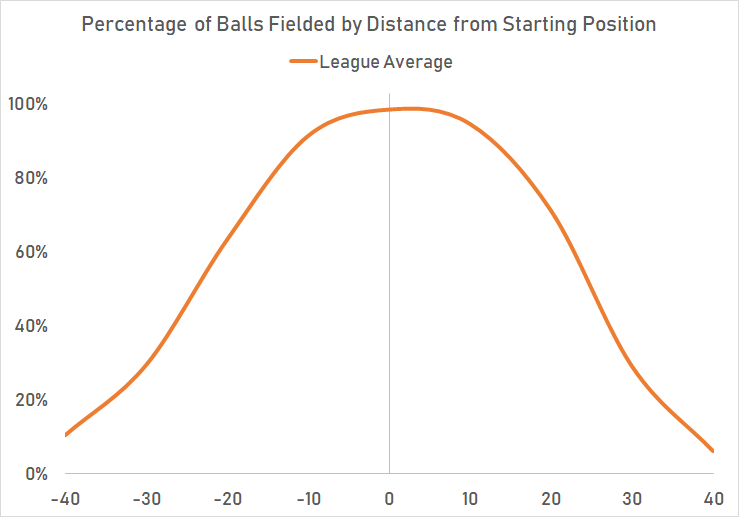
    With that said, here’s the league average distribution for these balls in play.

    These balls in play, when hit right at the shortstop, are fielded nearly 100% of the time. Balls hit about 10 feet in either direction are still above 90%. It dips to about 60-70% at 20 feet from the starting position, then down to about 30% at 30 feet away. And around 40 feet and beyond is where the rate of being fielded drops to 10% and below.

    Let’s compare that with Arizona’s Nick Ahmed, who has the most Range & Positioning Runs Saved at shortstop since the start of 2018.

    Ahmed (blue line) has been consistently above average to his left/up the middle (and can make highlight-reel plays like this one). He’s fielded a similar amount of balls as his peers going 10-20 feet to his right, but has reached more than the typical shortstop beyond that (like this one). And in addition to range, Ahmed’s arm helps separate him from other shortstops in converting outs.

    How about Andrelton Simmons?

    Interestingly, he tracks pretty closely with all shortstops, with the exception of a boost in the 30-foot bucket to his right. Like Ahmed, Simmons boasts a great arm to complement his range, elevating him further above other shortstops.

    But instead of comparing him to all shortstops, what about comparing him to one with poor range? Here’s Simmons (blue line) versus Jordy Mercer (orange line).

    Mercer has fielded a high percentage of balls hit within 10 feet in either direction, but Simmons has been better than him beyond that. Mercer has cost his teams 25 runs by our Range & Positioning system since the start of 2016.

    The only shortstop who has lost more Range & Positioning runs in that time is Boston’s Xander Bogaerts (-39). Our system has significantly penalized Bogaerts for balls hit to his right (SS/3B hole), and his limited range on those balls is confirmed here.

    Bogaerts has been close to his peers on balls hit to his left, but well below average at reaching balls hit to his right.

    The margins here are pretty small. After all, those who play shortstop — and stay there — tend to have the necessary range to reach enough batted balls in their zones. But since shortstops have a high volume of balls hit to them, those small differences can add up over the course of a season.

  • 2019 Top College Baseball Draft Prospects: Middle Infield (Part 1)

    Over the next month leading up to the 2019 MLB Amateur Draft, Baseball Info Solutions will be publishing a series of position-by-position scouting reports from our Video Scouts for the top-50 collegiate draft prospects. Each player is graded by the 20-80 scouting scale, given a comprehensive evaluation, and assigned a floor and a ceiling comparison, which indicate–if a player makes the Major Leagues–the range of the type of player into which he can develop.

    Full coverage:
    Catchers
    Corner Infield (Part 1)
    Corner Infield (Part 2) 
    Middle Infield (Part 1)
    Middle Infield (Part 2)
    Outfield (Part 1)
    Outfield (Part 2)
    Left-Handed Pitching (Part 1)
    Left-Handed Pitching (Part 2)
    Right-Handed Pitching (Part 1)
    Right-Handed Pitching (Part 2)

    This post covers the first half of a group of 10 middle infielders, with the second half to follow later this week. As was the case with the corner infielders, all 10 of these players should hear their names called early — perhaps even in the first three rounds.

    Four of these five infielders were predominantly shortstops in college, but only two are likely to stick at the position. Bryson Stott and Logan Davidson have a clear future at short, while Will Wilson projects as a second baseman and Braden Shewmake could really play anywhere but catcher. Chase Strumpf, the only second baseman of the bunch, figures to stay at the keystone, but could also find himself playing the outfield. Additionally, each of these players has surprising pop for the middle infield position.


    Bryson Stott, SS
    UNLV (JR, 2019)
    L/R 6-03, 200 lbs.
    Date of Birth: 10/06/1997

    Hit- 55 (60) Power- 50 (55) Run- 55 (55) Arm- 55 (55) Field- 50 (55)

    Written by Dominic Asta

    Analysis
    Bryson Stott is the headliner of the shortstop position for the 2019 college draft class. He is in the midst of a fantastic junior season at UNLV. He has answered the questions about his lack of power this year by hitting 10 home runs so far. Stott has a strong, large frame that fits with the growing size of current MLB shortstops. He has average to above-average tools across the board, and some projection left in his power and fielding tools. He has a track record of success with wood bats in the Northwoods League and Cape Cod League. He should be the first college shortstop drafted, and has the chance to be the highest UNLV player drafted since Matt Williams went third overall in 1986.

    Stott uses a wide, open stance with his hands at his head. He has an opposite-field approach and great power to left field. He keeps his hands back at the plate, which allows him to utilize the opposite field, and has great feel for barreling pitches. He excels at making contact, and has kept his strikeout rate to 6 percent last season and 14 percent this year. He has begun to pull more balls, increasing his home run totals in 2019. He led all of college baseball with 30 doubles last season and is beginning to turn more doubles into home runs. He is a patient hitter who has produced a 20 percent walk rate and a .494 on-base percentage in 2019. Stott hit a total of five home runs his first two years at UNLV, but has doubled that amount this year and has been driving the ball more frequently. He has a level bat plane which produces mostly line drives right now, but has the frame, strength and bat speed to have above-average power at the next level.

    He is not the most agile athlete at shortstop and struggles with first-step quickness. He has an above-average arm and makes accurate throws to first base. Stott is strong around the bag and looks smooth turning double plays. He doesn’t have great range, but he looks stronger to his right side on the backhand. He has above-average speed out of the box, routinely posting sub-4.2 second times from home to first. Stott has been a successful base-stealer in college, swiping 31 bags in 38 attempts. He has enough speed and baserunning ability to steal double-digit bases at the next level.

    Outlook
    Stott is an offensively-polished shortstop with average to above-average tools across the board. Some question his defensive future, but he should be able to stick at his current position with hard work and development. He shows the ability to make highlight-reel plays, and his strong arm will help him stay there. His power is developing to go along with an above-average bat.

    Projection: All-Star-caliber shortstop with above-average tools across the board.
    Ceiling: Corey Seager
    Floor: Stephen Drew
    Draft expectation: Top-10 pick


    Logan Davidson, SS
    Clemson University (JR, 2019)
    S/R 6-03, 190 lbs.
    Date of Birth: 12/26/1997

    Hit- 40 (50) Power- 50 (55) Run- 55 (55) Field- 50 (55) Arm- 60 (60)

    Written by Dominic Asta

    Analysis
    Logan Davidson was a highly sought-after prep player who comes from strong baseball bloodlines — his father, Mark Davidson, played six seasons in Major League Baseball. He burst onto the college scene with a fantastic freshman year at Clemson, hitting 12 home runs and producing an .861 OPS. He has an exciting combination of speed and power that has resulted in 40 home runs and 36 stolen bags so far in his college career, but has struggled with strikeouts and does not have a good track record with wood bats in two summers in the Cape Cod League. Davidson should still be a first-round pick though, based on his college production and exciting tools across the board.

    Davidson has a tall, lanky frame with long limbs and room to add weight. The switch hitter has similar swings from both sides of the plate, with bent knees and quick hands, but has a little more power and a smoother swing from the right side. He will drop his hands too much in his pre-swing load, which causes his barrel to not stay in the strike zone. His swing can get a bit long and loopy, mostly from the left side, which makes him late on pitches and contributes to his concerning high strikeout numbers — he has produced a strikeout rate over 20 percent in each of the last two seasons.

    A great athlete with above-average speed, Davidson possesses the ability to stick at shortstop. He has greatly improved his defense since his freshman year, and will have to continue to develop defensively because of his big frame. His strong arm allows him to make plays deep in the hole and on the run, and would profile well at third base. He is also a good enough athlete to handle a corner outfield spot. That athleticism and speed should allow him to steal 20-plus bags at the next level, and his long strides allow him to be faster once he is going max effort.

    Outlook
    Teams should be wary of Davidson and his hit tool. His track record with wood bats is concerning, as are his strikeout numbers. He will need to get stronger physically to handle the transition to wood bats and better pitching. He should be able to stick at shortstop because of his athleticism and arm, but his power would play well at the hot corner. Davidson’s exciting combination of power, speed and switch-hitting ability should make him a first-round pick.

    Projection: Switch-hitting shortstop with 20-20 potential.

    Ceiling: Ian Desmond
    Floor: Brad Miller
    Draft expectation: Round 1


    Braden Shewmake, SS
    Texas A&M University (JR, 2019)
    L/R 6-04, 190 lbs.
    Date of Birth: 11/19/1997

    Hit- 55 (60) Power- 45 (50) Run- 55 (50) Arm- 50 (55) Field- 50 (55)

    Written by Harris Yudin

    Analysis
    Braden Shewmake has been one of the more consistent college hitters over the last three years, managing an .869 OPS with 21 home runs and 29 stolen bases over that span. Following a slow start to his junior campaign, the Aggies’ shortstop has picked up the pace, hitting .333 over his last 192 plate appearances.

    A wiry frame and unconventional swing mechanics allow Shewmake to stand out from the crowd. He stands open at the plate and deep in the batter’s box, taking a long stride towards the mound. He uses his long arms to get good extension and cover the whole strike zone, showing excellent hand-eye coordination and the ability to spray the ball to all fields. He displays solid plate discipline — 53 walks and 65 strikeouts throughout his collegiate career — but does have a tendency to chase some left-on-left breaking balls. At times, he can pull his body out and drop his hands, producing a flat swing.

    Shewmake is certainly hit over power, and is likely to maintain that profile as he moves towards pro ball. There is a reasonable expectation that he could bulk up and develop some more power, but the fact that he’s only packed on about 10 pounds since arriving in College Station is mildly concerning — as is his inability to replicate his freshman season home run totals (11 in 2017, 10 combined in 2018 and ‘19).

    While he doesn’t necessarily have blazing speed, Shewmake is a threat on the basepaths, demanding immediate attention from opposing pitchers. His long strides, good instincts and aggressiveness allow him to take extra bases and swipe a decent amount of bags.

    Defensively, Shewmake shows good range both up the middle and in the hole. He has an above-average arm, but is inconsistent with his throws, occasionally rushing and throwing off-balanced to first. He is capable at shortstop, but may outgrow the position, and is more likely to end up at either second or third base. There’s even an outside shot that he lands in the outfield, where his athletic ability could shine.

    Outlook
    Shewmake’s body type, swing and uncertain defensive future could make any team hesitant to pull the trigger on draft day, but he offers a steady track record of production and above-average athleticism wherever he plays in the field. He could develop into a player with double-digit homers and steals, and profiles similarly to Luis Gonzalez, who, despite being known for his late-career power surge and postseason heroics, was a contact hitter with moderate power and speed for the first half of his career.

    Projection: Well-rounded, everyday major leaguer who could provide defensively versatility.

    Ceiling: Luis Gonzalez
    Floor: Ryan Flaherty
    Draft Expectation: Rounds 1-2


    Will Wilson, SS/2B
    North Carolina State (JR, 2019)
    R/R 6-00, 184 lbs.
    Date of Birth: 07/21/1998

    Hit- 40 (50) Power- 45 (55) Run- 40 (40) Arm- 45 (50) Field- 50 (50)

    Written by Mitch Glessner

    Analysis
    After receiving numerous accolades as a freshman and sophomore, Will Wilson has garnered plenty of attention at the top of NC State’s lineup in his junior campaign. The 2018 second team All-American climbed up draft boards after hitting .307 with 15 home runs as a sophomore. His combination of raw power and solid glove work in the middle of the field makes for an intriguing skill set as the 2019 draft approaches.

    Wilson is a bat-first middle infielder. He stands straight up in the box with lower hand position around chest height. He finds his rhythm and timing with a slight hand wiggle and a high leg kick, and will shorten up his leg kick and overall movement when hitting with two strikes. He is a natural low-ball hitter, and is at his best when hunting pitches middle-away in the zone.

    Raw power is Wilson’s biggest strength at the plate. His hands are quick, but he tends to let his shoulders dominate his rotational swing. His bat path can get long, leaving him susceptible to velocity on the inner third. He will fight for extension on the inner third which can lead to early hand roll. Wilson occasionally lacks aggression to hunt pitches that play to his strengths middle-away. He is at his best when he attacks middle-to-outer-third pitches, and when he is aggressive with those areas of the plate, he is one of the most dangerous hitters in the country.

    Wilson provides a smooth glove in the middle of the field. He has soft enough hands to adjust for bad hops, and does a really good job of getting around the ball consistently. He prefers to throw on the run rather than with his feet planted to compensate for what he lacks in arm strength. Due to the lack of carry on his throws, he will likely move to second base at the next level.

    Outlook
    Wilson’s glove is talented enough to allow him to play everyday at second base at the professional level, and there’s no denying the raw power in his bat. Finding the ability to translate the raw power into game power, while making solid consistent contact, will be vital in his development as a professional.

    Projection: Low-ceiling middle infielder with limited athleticism but above-average power.

    Ceiling: Rich Aurilia
    Floor: Sean Rodriguez
    Draft Expectation: Rounds 1-2


    Chase Strumpf, 2B
    UCLA (JR, 2019)
    R/R 6-01, 191 lbs.
    Date of Birth: 03/08/1998

    Hit- 50 (55) Power- 50 (55) Run- 45 (45) Arm- 45 (50) Field- 50 (55)

    Written by Quinn Ireland

    Analysis
    Chase Strumpf burst onto the national scene as a sophomore at UCLA by being in the top 100 nationally in basically every important offensive statistical category. An All-American in 2018, Strumpf posted a slash line of .363/.475/.633 with 12 home runs and 23 doubles. The numbers from his current season are down, which was expected given that his BABIP last year was over .400, but he still owns an impressive line of .311/.452/.509.

    Strumpf’s strongest tool is his advanced approach at the plate. With almost a walk per game, he has a very keen eye that should lead to a high on-base percentage, regardless if he ends up hitting for a high average. That being said, he is an excellent hitter who should at least be average at the next level with decent power, to boot. His power has increased greatly since his days as a freshman, and he should develop into at least a plus power hitter– he has the potential to be a consistent 20-homer bat in the pros.

    He will never be a speed demon, but Strumpf has been known to swipe a base or two and should be able to reach most of the balls hit his way in the field. An excellent fielder at second base, his profile lends well to either the keystone or left field, where he would probably be a slightly below-average fielder but his  arm would play better.

    Outlook
    Strumpf, who hits third for the top-ranked UCLA Bruins, is one of the top college bats — and probably the top second baseman — in the 2019 class. A bit of his sparkle has worn off because of the slight regression this year, but that should not shy teams away from a guy who could be a spectacular everyday player with on-base skills, power and a solid glove.

    Projection: Bat-first second baseman with utility player potential.

    Ceiling: Aaron Hill
    Floor: Logan Forsythe
    Draft Expectation: Rounds 2-3


    Other middle infielders to keep an eye on:
    Ethan Paul, Vanderbilt University
    Tanner Morris, University of Virginia
    Cam Shepherd, University of Georgia
    Tyler Fitzgerald, University of Louisville

  • The Effectiveness of “Infield In” Defense

    The Effectiveness of “Infield In” Defense

    By ANDREW KYNE

    Since 2015, Baseball Info Solutions has tracked situational defensive alignments like “infield in” and the rare five-infielder defense, among several other variations.

    The “infield in” strategy is particularly interesting. You might hear commentators mention how substantially batting averages increase when the infielders are all pulled in. But what do the numbers show?

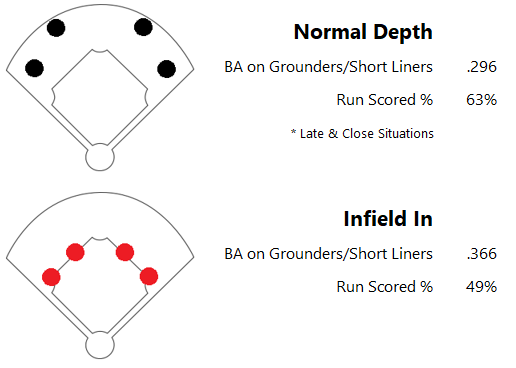
    First, let’s consider groundballs and short line drives (since those are the types of balls in play affected by the infield’s alignment here) hit against “infield in” alignments with fewer than two outs since the beginning of 2015. The batting average on those balls in play: .366.

    The overall goal in these situations, though, is to cut down the runner scoring from third. On grounders and short liners with the infield in, the batting team scored at least one run 49% of the time.

    Now, how does that compare to when the defense plays a traditional alignment in similar game contexts?

    Let’s consider grounders and short liners hit against a normal infield defense in similar situations where it would be beneficial to prevent the runner on third from scoring: seventh inning or later; tied or one-run game; fewer than two outs with a runner on third (and possibly second, but not first — so a double play is not in order). Because that’s not the most common situation (only 35 since the start of 2015), we’ll take any of these late-and-close balls dating back to 2010.

    In those situations, batters hit .296 on grounders and short liners — about 70 points worse than against a drawn-in infield.

    However, the batting team scored at least one run on 63% of these plays — compared to 49% with the infield in.

    So, there’s clearly a trade-off here for the defense. Bringing the infield in will increase the likelihood of a hit on a groundball or short line drive, as the infielders have less time to react. But playing the infield in will do a better job of preventing runs. Even regular groundouts can score the runner when the infield is back; meanwhile, a ball fielded in a drawn-in infield can stop the runner from trying to score, or he can be more easily thrown out at home.

    In 2018, the teams that played the most balls in play with “infield in” were the Padres (98), Phillies (93), and White Sox (82). The teams that played the fewest were the Angels (32), Brewers (32), and Mariners (34).

  • What has happened when 4-man outfields were used this season?

    By NICHOLAS BEHRENDT

    Stats through April 29

    Sports Info Solutions began tracking the four-man outfield shift in 2018, but the result was only 37 balls in play against it for the season. It gained some attention in Spring Training this year, and Andrew Kyne wrote about candidates for the unusual defensive approach. Now the 2019 MLB season is more than a month old, so let’s look at the status of the four-an outfield so far.

    Batters have already put a ball in play against a four-man outfield 34 times this season despite it being used by only three teams, down from five last year. The Minnesota Twins, who led MLB with 27 four-man outfield uses in 2018, have yet to show it against a ball in play this season. The Cincinnati Reds, on the other hand, have gone from using it zero times in 2018 to leading the majors with 22 usages versus balls in play this season.

    What’s most interesting between these two teams is the difference in their overall shift tendencies. The Twins were among the league leaders in defensive shifts used in 2018 with 1,723, presumably making them more willing to experiment with different alignments. Three of the top four teams to use the four-man outfield last year ranked first, third, and fourth in total defensive shifts.

    The Reds, however, don’t follow this pattern. They ranked 18th in defensive shifts with 1075 in 2018. This year, they are on pace to increase shift usage by only about nine percent and rank 19th among teams. It doesn’t appear that this more aggressive approach from the Reds has influenced a major increase in overall shift usage.

    The Tampa Bay Rays (11) and San Francisco Giants (1) are the other teams to deploy the four-man outfield this season. The Rays are the only team to use the shift in both 2018 and 2019, showing it twice last season. Like the Reds, an increase in four-man outfield usage has not correlated with a more aggressive overall shift increase for the Rays. They are on pace for about 300 fewer defensive shifts after leading MLB in 2018.

    The four-man outfield has become more common in the first month of the 2019 season, but how is it fairing against batters? It’s difficult to assess something that is still used so infrequently and by so few teams, but let’s look at the numbers anyway. Last year, batters posted a batting average on balls in play (BABIP) of just .189, well below the league average of .296. This season, batters have had much greater success, posting a BABIP of .441, well above the league average of .293.

    Of course, there are many factors that determine the result of a ball in play. Perhaps the best way to assess the four-man outfield shift is to watch every ball in play against it. Luckily, that’s easy to do when it’s only happened 34 times. Here are some of the balls in play that I found to be most notably affected, all against the Reds:

    Yasmani Grandal, April 1

    Max Muncy, April 16

    Freddie Freeman, April 24

    Matt Carpenter, April 26

    The four-man outfield allows the defense to cover more open space in the outfield. With an extra player, the defense can position itself closer to both the left field and right field line without sacrificing open space in the middle of the field. That doesn’t just increase the chance of turning fly balls and line drives into outs, but also holding runners to fewer bases on any ball hit into the outfield. The Reds have taken advantage.

    Yasmani Grandal, Freddie Freeman, and Matt Carpenter have all placed line drives down the right field line against the Reds this season. All three resulted in a single for the batter. The well positioned right fielder (second baseman against Freeman) was able to cut the ball off and keep the batter out of scoring position. A win for the defense.

    The result isn’t always so favorable. When a team uses the four-man outfield it must decide where to leave a gap in the infield. This isn’t always a problem as the batter is usually a heavy pull hitter and would attract a full Ted Williams shift (three infielders to the pull side of second base) in a typical situation.

    This is true of Max Muncy of the Dodgers. He has pulled over 90 percent of ground balls and short line drives to the right of second base this season and has seen 149 full Ted shifts on balls in play since the beginning of 2018, including seven by the Reds.

    However, when the Reds elected to play four outfielders against him on April 16 with a runner on base, they were forced to keep their third baseman within a reasonable distance of third base and only two infielders on the pull side. A ground ball up the middle went for a single where the shortstop likely would have been playing with a full Ted Williams shift. A win for the offense.

    Any team that elects to use defensive shifts of any kind is going to see both positive and negative consequences. But with a more unusual shift like the four-man outfield, there are new consequences that teams must consider before positioning its players.

    It will be interesting to see if the Reds keep up this pace for the remainder of the season, and if any other teams will begin to experiment with the four-man outfield. As I mentioned earlier, the Twins haven’t deployed the shift after leading MLB last season. However, players they used it on last season have had only 15 at-bats against them this season, so maybe they just haven’t found it necessary yet.

    With nearly five months remaining in the 2019 MLB season, we’ll just have to wait and see.

  • 2019 Top College Baseball Draft Prospects: Corner Infield (Part 2)

    Over the next month leading up to the 2019 MLB Amateur Draft, Baseball Info Solutions will be publishing a series of position-by-position scouting reports from our Video Scouts for the top-50 collegiate draft prospects. Each player is graded by the 20-80 scouting scale, given a comprehensive evaluation, and assigned a floor and a ceiling comparison, which indicate–if a player makes the Major Leagues–the range of the type of player into which he can develop.

    Full coverage:
    Catchers
    Corner Infield (Part 1)
    Corner Infield (Part 2) 
    Middle Infield (Part 1)
    Middle Infield (Part 2)
    Outfield (Part 1)
    Outfield (Part 2)
    Left-Handed Pitching (Part 1)
    Left-Handed Pitching (Part 2)
    Right-Handed Pitching (Part 1)
    Right-Handed Pitching (Part 2)

    This next piece covers the remaining corner infielders. There are 10 total first and third basemen in our top 50, all of whom are likely to come off the board in the first four or five rounds of the draft.

    As with the first group of corner infielders, these players all possess a robust offensive profile, albeit with less upside. However, as a whole, these five players exhibit stronger defensive skills and more versatility. Kody Hoese and Nick Quintana can play all over the infield; Michael Toglia projects as an above-average defender at first base or in left field; and Aaron Schunk’s plus arm is valuable no matter where he plays. Spencer Brickhouse is the lone exception here, but even he could be a passable defender at first.


    Kody Hoese, 3B
    Tulane University (JR, 2019)
    R/R 6-04, 200 lbs.
    Date of Birth: 07/13/1997

    Hit- 40 (55) Power- 55 (65) Run- 45 (50) Arm- 50 (55) Field- 50 (60)

    Written by Quinn Ireland

    Analysis
    Kody Hoese is perhaps the highest and quickest riser in the college ranks this year. His main appeal comes from his ability to hit the ball all over the field while having a great feel for the strike zone. He has shown steady improvement each year at Tulane, and currently boasts an impressive .415/.500/.872 slash line. While those numbers won’t be realized at the next level, he should continue to hit for average and power as he moves up the ranks.

    Hoese is a strong-bodied guy with a hit tool that could push him into the late first round. More likely to be a compensation round pick, he does most of his damage with extra-base hits all around the park. Not a pull-dominant player, he has shown gap-to-gap power as well as over-the-fence ability — he has 20 homers already this year, and 52 percent of his hits have gone for extra bases. Hoese is never going to be a burner on the base paths, but has shown an ability to swipe bases (four steals in four attempts this year) and could potentially keep that up at the next level. His competition has not been exceptional this year in the American Athletic Conference, which does leave some question marks, but his whole body of work seems to speak for itself.

    The size/power combo he is showing currently would generally push him into a corner of the infield. At third base, he looks to move well (he was a shortstop in high school) and has a decent feel for the position. His arm hasn’t impressed, but with progression, it should at least be average, and maybe even a step above. His glove is solid, and with traditional progression could turn into a plus as well. Hoese should stick at third, but be could probably slide over to the keystone and be above-average.

    Outlook
    A team that is looking for an impact bat at a corner infield spot is going to have to take a long, hard look at Hoese. Should the recent power surge turn out to be more than a one-year wonder, he could turn into a top-flight offensive third baseman. Even if the power production is unsustainable, Hoese walks more than he strikes out and should get on base at a high rate, making him a valuable player at either second or third base.

    Projection: Offensive-minded third baseman with on-base skills and decent power.

    Ceiling: Mike Lowell
    Floor: Hunter Dozier
    Draft Expectation: Rounds 1-2


    Nick Quintana, 3B
    University of Arizona (JR, 2019)
    R/R 5-10, 190 lbs.
    Date of Birth: 10/13/1997

    Hit-  40 (50) Power- 50 (60) Run- 50 (50) Field- 60 (65) Arm- 60 (60)

    Written by Dominic Asta

    Analysis
    Nick Quintana has been on the radar of scouts for a long time. He was drafted in the 11th round by the Red Sox in the 2016 MLB Draft. He has been a regular in the Wildcats lineup for three years and has been a force with the bat his last two seasons. Quintana has a pretty right-handed swing that has produced great power in college. He looked good in the Cape Cod League last summer and has improved his walk percentage in his junior year. He has some swing-and-miss in his offensive game but his power combined with a good glove at third should make him very appealing on draft day.

    Quintana gets the most out of his small frame at the plate. He has a big stride and leg kick as he transfers his weight forward that produces hard-hit balls and swings-and-misses. He gets up on his front foot too often and his hands do not stay back, which makes him off balance in his swing. He will make the pitcher work and get himself into deep counts that will lead to some of his strikeouts. Quintana has great bat speed. Quintana could benefit from quieting his approach and focusing more on contact than power. A jump in his BB% has been very encouraging even though he is still striking out at a 23 percent clip. His pitch recognition needs work and his struggles with breaking pitches needs improvement.

    Quintana has played third base while in college but has the athleticism and glove to play at second base and shortstop. He will most likely be a third baseman at the next level, but could fill in at second or shortstop if need be. He has fluid actions at third and arm strength to make throws on the run and deep in the hole. He will make Web Gem-like plays and looks very comfortable at the hot corner, but will need to improve his lateral range and consistency if he wants to be a plus-plus defender.

    Outlook
    Nick Quintana has an exciting package of tools and is a player that makes it look easy at times. He is also a player that has some concerning question marks. His strikeout numbers and lack of contact are concerns that he has not addressed in Cape Cod or in his junior year. He should be a plus defender with good athleticism and above average power at the next level.

    Projection: Versatile infielder with good power and potential Gold Glove defense.

    Ceiling: Brandon Inge
    Floor: Brett Lawrie
    Draft Expectation: Rounds 2-3


    Michael Toglia, 1B/OF
    UCLA (JR, 2019)
    S/L 6-05, 226 lbs.
    Date of Birth: 08/16/1998

    Hit- 45 (55) Power- 55 (65) Run- 50 (45) Arm- 50 (50) Field- 55 (60)

    Written by Harris Yudin

    Analysis
    Following an ice-cold start to the 2019 season, Michael Toglia began Pac-12 play on a torrid pace. As of April 29, the 20-year-old switch hitter owns a 1.112 OPS with eight home runs and 31 RBI across his last 133 plate appearances. He has a history of slow starts and streaky play — slashed just .209/.307/.388 in 36 games in the Cape Cod League in 2018 — but the upside is enormous.

    Toglia flaunts a big, projectable frame with huge power upside from both sides of the plate. He has filled out a bit in his junior, but there should be even more to come in terms of physical development. He utilizes an open stance from both sides, striding towards the plate and getting his foot down before the pitch arrives. He generates good bat speed and turns on the ball well by shifting his weight, making consistent hard contact to all fields and finishing with good extension. His stroke is a bit smoother from left side — there’s a habit of occasionally dropping his hands from the right side, leading to a less direct path to the ball — but there are no concerns about his being a switch hitter at the next level.

    A patient hitter, Toglia prefers to attack high pitches, and is much more selective on lower pitches, which helps him draw walks but also leads to too many strikeouts looking. While he is adept at driving fastballs up, he can sometimes pull his body out, lose his balance and not stay in on the ball, causing him to whiff or foul off pitches he’d normally crush. Additionally, he has a tendency to get out ahead of breaking balls.

    Toglia doesn’t possess much speed, but he can move on basepaths due to his long strides and athleticism. That athleticism helps him play an above-average first base, where he has good footwork around the bag and uses his length to stretch for throws from infielders. Despite his size, he can get low to field grounders and snag throws in the dirt. A move to a corner outfield spot could be an option — his average arm would play better in left — but UCLA’s first baseman should be able to stick at his natural position in pro ball.

    Outlook
    Toglia is a streaky hitter and, overall, still a bit raw, but the combination of athleticism, patience and power points to a future of high offensive production. He will likely fall outside the first round on draft day, but has the upside to provide a ton of value in the second or third round.

    Projection: Athletic, switch-hitting first baseman with plus power and defense.

    Ceiling: Brandon Belt
    Floor: Ike Davis
    Draft Expectation: Rounds 2-3


    Spencer Brickhouse, 1B/DH
    East Carolina University (JR, 2019)
    L/R 6-04, 235 lbs.
    Date of Birth: 04/10/1998

    Hit- 45 (55) Power- 50 (60) Run- 40 (30) Field- 40 (50) Arm- 50 (50)

    Written by Dominic Asta

    Analysis
    Spencer Brickhouse has displayed some of the most consistent power out of any hitter in the 2019 draft class. Based on his power numbers and his strong 6-foot-4, 235-lb. frame, he can be described as a slugger. He has launched double-digit home runs in each of his three years as a starter. He is not only a power hitter, though — he also has a patient offensive approach and an ability to make contact. Brickhouse has been a first baseman, left fielder and designated hitter at East Carolina, and has shown a solid arm and soft hands at first. The 2018 Cape Cod All-Star Game MVP has continued his climb up draft boards with a very impressive junior campaign. He has improved each year at ECU, and should be one of the first college first basemen taken in the draft.

    Brickhouse has a unique swing that has no stride and very little lower body movement. He has a stiff upper body with his hands at his head and a wide, crouched stance. He lifts his front heel and sets it back down as he loads his hands forward. He uses his upper body strength to drive the ball to all fields and good bat speed to make consistent hard contact. His pull-side power is plus, and most of his home runs this season have been to right field. His power numbers have increased in his junior year, with 12 home runs and a .348 isolated power. Brickhouse is short to the ball with an uppercut swing path. He doesn’t utilize his lower body in swing and struggles with plate coverage because of his stiff upper half. As a result, he may be exposed at the next level with velocity up in the zone. His swing does allow him to recognize pitches and keep his head on the ball, however, and he has improved his plate discipline each year at East Carolina– he is currently sporting an impressive 19 percent walk rate.

    Brickhouse will need to maintain his weight and body if he intends to stick at first base and not be relegated to designated hitter. He is a good enough athlete currently to stick at first, but doesn’t have the range or lateral movement to be a plus defender. A move to left field would be an aggressive position switch. He has only played left field a couple of times his junior season. His below-average speed and agility would make him a below-average defender in left. Although he derives most of his value from his bat, a move to DH would place even more pressure on his offensive game.

    Outlook
    Brickhouse has shown the ability to be a high on-base, slugging first baseman this year at ECU. His upper body strength has allowed him to be a great power hitter at the college level, but he could struggle at the next level when he faces stiffer competition and higher velocity. His swing may be modified after he gets drafted to help incorporate his lower body more. He will most likely be limited to first base unless a team wants to be aggressive and put him in left field, where his below-average speed would be tested. His advanced bat should help him rise through the minors fairly quickly and provide a team with a powerful lefty bat.

    Projection: Patient slugger with potential for 20-plus homers per year.

    Ceiling: Ryan Klesko
    Floor: Justin Bour
    Draft Expectation: Rounds 3-4


    Aaron Schunk, 3B
    University of Georgia (JR, 2019)
    R/R 6-02, 205 lbs.
    Date of Birth: 7/24/1997

    Hit- 45 (50) Power- 55 (55) Run- 50 (45) Arm- 60 (60) Field- 45 (45)

    Written by Will Hoefer

    Analysis
    Aaron Schunk has had a breakout year at the hot corner in his junior season at Georgia. He currently owns a .908 OPS with seven home runs on the season. He has also been a very reliable closer for the Bulldogs, posting a 2.14 ERA with 11 saves. His future will be as a hitter regardless of what position he ends up playing. Schunk has greatly improved his draft stock this year and should hear his name called in the first five rounds.

    Schunk is a large-framed, thick third baseman who has finally tapped into his raw power during his junior year at Georgia. A fairly aggressive contact hitter at the plate (only 16 percent of his plate appearances end in a walk or a strikeout), he demonstrates decent hand speed and a bit of length in his swing, but controls the bat well. He generates above-average bat speed and should continue to generate above-average power at the professional level.

    Unsurprising for a relief pitcher, Schunk has a plus arm but slightly below-average range at third base. With good positioning he could stick at the hot corner, and that’s starting to become less of a specific fit as organizations learn how to use defensive data to place their infielders. His skillset in the field, despite strong instincts at third, projects better in right field where his plus arm plays very well amidst a decline in foot speed.

    Outlook
    Schunk has solid tools across the board, with intriguing raw power and a plus arm that buoys some of his limitations in the field. He’s a tweener in about every sense of the word; if he can get some more power out of his aggressive approach as a pro then there’s a strong chance he sticks as a starter in either RF or 3B. Even if he doesn’t, there’s a solid floor here as a right-handed platoon bat who isn’t a liability on defense.

    Projection: Power bat and power arm profiles best at third or right field.

    Ceiling: Chase Headley
    Floor: Brandon Guyer
    Draft Expectation: Rounds 3-4


    Other corner infielders to keep an eye on:
    Tristin English, Georgia Tech
    Brandon Lewis, UC Irvine
    Edouard Julien, Auburn
    Evan Edwards, North Carolina State

  • Which players do the most good & bad things on the bases?

    By PATRICK ROWLEY

    Baserunning continues to be an overlooked part of baseball that is often viewed as an ancillary aspect of the game. There tends to be an oversimplification in the narrative around good baserunning that speed and talent on the bases are one and the same. Although foot speed is certainly beneficial, it is not the best way to truly evaluate play on the bases.

    That is why at Sports Info Solutions, we evaluate baserunning on a plus/minus scale, with Good Baserunning Plays (GBP) resulting in a plus and Bad Baserunning Plays (BBP) resulting in a minus. GBP and BBP are based on review by our Video Scouts, who use specific criteria in determining good and bad baserunning. There are eight types of good plays and 16 types of bad plays.

    The most common GBP is “Baserunner takes an extra base” which is essentially just being aggressive in taking one more base in a situation where most wouldn’t. There are other, more nuanced GBPs such as “avoiding the tag” or “quick reaction to pitch in dirt/dropped pitch.”

    Here are the leaders in Good Baserunning Plays since the start of 2018:

    Player Good Baserunning Plays
    Javier Baez 15
    Ozzie Albies 10
    Billy Hamilton 9

    What is remarkable about Javier Baez’s total is that six of his GBPs have come in 2019 alone, as many as or more than the 2018 total of all but 19 baserunners (and with one more GBP, that number will shrink to six).

    Of those six GBPs, five have been from plays where Baez took an extra base. The sixth GBP was credited for avoiding a tag, which he managed to do five times in 2018 helping to reinforce his moniker as “El Mago.”

    Another way to provide value on the bases is to simply not make mistakes, or Bad Baserunning Plays. As you can see in the table above, Albies has more GBP since the start of 2018 than anyone except Baez, but the BBP leaderboard may give some insight as to why he is not heralded as one of the most disruptive baserunners.

    The most Bad Baserunning Plays since the start of 2018:

    Player Bad Baserunning Plays
    Francisco Lindor 13
    Ozzie Albies 12
    Bryce Harper 12
    Ketel Marte 12
    Willson Contreras 12

    Most of Albies’ BBP have been on plays in which he attempted to stretch a base hit an extra base or was caught trying to advance on a ground ball (which fall into two of the BBP categories). Between his GBP and BBP, Albies was one of the most aggressive players on the bases and, with slightly better decision-making, could rise the ranks and be a real nuisance on the base paths.

    Due to some players, like Albies, driving up their GBPs (or BBPs) with volume, it is best to look at Good and Bad Baserunning Plays through the context of Net Good Baserunning Plays. Looking at this leaderboard, you really start to see some of the names you would expect to see on this list based on the eye test.

    Player Good BR Plays Bad BR Plays Net
    Javier Baez 15 8 7
    Byron Buxton 6 1 5
    Jason Heyward 6 1 5
    Billy Hamilton 9 5 4
    Kolten Wong 6 2 4

    Despite being tied for 24th for BBP since the start of 2018, Baez remains the most dangerous player on the bases, due to having more than double the number of GBPs as all but three players over that same time frame.

    This year, Baez has 6 GBP already, more than double the next-closest baserunner, but also is tied for the most BBP. Still, after taking the difference, Baez is in sole possession of first place atop the Net Good Baserunning Plays in the majors.

    After finishing second in this metric behind Mookie Betts in 2017, Baez’s start has him in a good position to pace the league for a second straight year.

  • 2019 Top College Baseball Draft Prospects: Corner Infield (Part 1)

    Over the next month leading up to the 2019 MLB Amateur Draft, Baseball Info Solutions will be publishing a series of position-by-position scouting reports from our Video Scouts for the top-50 collegiate draft prospects. Each player is graded by the 20-80 scouting scale, given a comprehensive evaluation, and assigned a floor and a ceiling comparison, which indicate–if a player makes the Major Leagues–the range of the type of player into which he can develop.

    Full coverage:
    Catchers
    Corner Infield (Part 1)
    Corner Infield (Part 2) 
    Middle Infield (Part 1)
    Middle Infield (Part 2)
    Outfield (Part 1)
    Outfield (Part 2)
    Left-Handed Pitching (Part 1)
    Left-Handed Pitching (Part 2)
    Right-Handed Pitching (Part 1)
    Right-Handed Pitching (Part 2)

    The next installment in this series covers corner infielders, which will be split into two articles. There are 10 total first and third basemen in our top 50, all of whom are likely to come off the board in the first four or five rounds of the draft.

    Both corner infield spots offer a ton of offensive upside, but many of these players leave a bit to be desired defensively. California’s Andrew Vaughn, arguably the nation’s top hitter, projects to be the highest college first baseman drafted since 1996, when Travis Lee was selected second overall by the Twins out of San Diego State. Beyond Vaughn, Josh Jung and Logan Wyatt have bats that profile well at the corners. Michael Busch and Drew Mendoza should contribute at the plate regardless of where they end up on the diamond.


    Andrew Vaughn, 1B
    University of California (JR, 2019)
    R/R 6-0, 214 lbs
    Date of Birth: 04/03/1998

    Hit- 60 (70) Power- 60 (70) Run- 40 (40) Arm- 50 (50) Field- 50 (50)

    Written by Mitch Glessner

    Analysis
    In 2017, Vaughn burst onto the college scene with a freshman slash line of .349/.414/.555. His sophomore campaign was even more impressive, as he went on to win the prestigious Golden Spikes Award for 2018. The consensus All-American hit .402 with 23 HR and 63 RBI as a sophomore, and has continued to rake as a junior, with a 1.214 OPS and 11 HR through 177 plate appearances. He has the chance to solidify his reputation as one of the best players in the country by being one of the top picks in the 2019 draft.

    Vaughn possesses the most explosive bat in his class, with plus power to all fields. He has a rare ability to drive balls that weren’t hit squarely. Vaughn has boasted a 12.0 at-bat per home run rate so far in his junior season, down from an incredible 8.7 last year. He generates power by utilizing his strong lower half and extremely quick hands. His set up in the box is very simple with minimal wasted movement. Vaughn finds his rhythm and timing in his loading phase by cocking the bat upward upon the pitcher’s release (hand movement and mechanics are similar to those of Javier Baez). This puts his hands in a good launch position, and allows them to work on plane and in the zone for a long time. His exceptional hand usage in his swing gives him complete plate coverage.

    Vaughn has a very patient approach at the plate. He’s in no rush early in the count and rarely chases pitches. His good feel for the strike zone allows him to work deep into counts and walk at a high rate. He has increased his BB% from 17 percent last season to over 22 percent this season.

    His short, stocky frame doesn’t fit the traditional first baseman mold, but he has tremendous footwork around the bag to make up for what he lacks in length. He has a great feel for digging out bad throws, as he works through the ball from the ground up, much like a middle infielder. He handles the in-between hop by letting the ball get deep into his hips.

    Outlook
    Vaughn’s offensive polish is rare, and he possesses more than enough ability to hit at a high level in the majors. While his bat overshadows his defense, he has the skills to be an average, everyday defender. He has the quality makeup to be a potential franchise player at the Major League level.

    Projection: Elite offensive first baseman who should hit for both average and power.

    Ceiling: Paul Goldschmidt
    Floor: Mike Napoli
    Draft Expectation: Top-3 Pick


    Josh Jung, 3B
    Texas Tech University (JR, 2019)
    R/R 6-02 215 lbs
    Date of birth: 02/12/1998

    Hit- 55 (65) Power- 50 (60) Run- 45 (40) Arm- 60 (60) Field- 50 (50)

    Written by Dominic Asta

    Analysis
    All Josh Jung has done at Texas Tech in his three years is hit, hit, and hit. He slashed .392/.491/.639 as a sophomore and smacked 12 homers and 17 doubles. He has continued that offensive prowess in his junior year, and has looked solid defensively at third. He was a first-team All-Big 12 honoree, a member of the USA Collegiate National Team, and hit .429 at the 2018 College World Series. He is looking to solidify himself as a top-10 draft pick in his junior season.

    Jung has an upright stance with a big leg kick and a level swing that produces many hard-hit line drives. He moves quite a bit before the pitch is delivered, but has a very balanced swing with good weight shift and momentum going forward with his leg kick. He excels at keeping inside the ball and shooting it to the opposite field and up the middle. He doesn’t try to do too much with the pitch, and is content to spray line drives across the field. His frame and hard contact would make you believe that he has above-average power, though he has yet to tap fully into his power potential. He has the pure strength, bat speed and swing to produce above-average power, but needs to pull and lift the ball more to realize this potential. He also displays good patience at the plate and his bat-to-ball skills help him keep his strikeouts down. He has increased his BB% from just over 12 percent his sophomore year to over 19 percent this season. He should be able to produce a high OBP at the next level.

    Jung is not a great athlete and some have doubts on whether he will need to switch to first base in pro ball. He gets the most out of his athleticism and has great hands and instincts at third base. Texas Tech has even started playing him at shortstop in the second half of the season. He will probably never win a Gold Glove or have great range, but he should be able to stick at the hot corner. His arm is above-average and he is strong at moving forward or back on grounders and using his strong arm to throw on the run or make a deep throw from third. He will need to improve his flexibility and agility if he wants to expand his range and defense. Although he has below-average speed, he is not a base clogger and has good instincts on the basepaths, allowing him to go first-to-third and even swipe a few bags.

    Outlook
    Josh Jung has one of the highest floors in the draft with his above-average offensive game that could skyrocket if he starts to hit for more home run power. He should be able to stay at the hot corner with his cannon arm and strong instincts for the position. He is a proven player who has performed his entire college career, as well as at the College World Series his sophomore year. It will be a surprise if he is not picked in the first round when the draft rolls around in June.

    Projection: Above-average-hitting third baseman with a high floor and developing power.

    Ceiling: Ryan Zimmerman
    Floor: David Freese
    Draft expectation: Top-20 pick


    Michael Busch, 1B/OF
    University of North Carolina (JR, 2019)
    L/R 6-00, 207 lbs
    Date of Birth: 11/09/1997

    Hit- 55 (60) Power 50 (55) Run- 45 (45) Arm- 45 (45) Field- 50 (50)

    Written by Harris Yudin

    Analysis
    A three-year starter at North Carolina, Busch has been an on-base machine since stepping foot in Chapel Hill. To date, he owns a .286/.434/.497 slash line with 124 walks and only 91 strikeouts in his collegiate career, tacking on 28 home runs and 29 doubles. Through his first 210 plate appearances this season, he owns a 1.051 OPS, with 23 of his 48 hits going for extra bases.

    Busch boasts an advanced approach and excellent bat control. He is extremely patient and doesn’t chase many pitches out of the zone, but also isn’t afraid to attack first-pitch fastballs. He also protects the plate well, rarely whiffing at would-be strikes. The Tar Heels’ No. 2 hitter stands slightly open and utilizes a small leg kick, staying balanced and keeping his head on the ball all the way through his smooth, effortless swing. He uses the whole field, often beating the shift with line drives.

    Busch has displayed above-average in-game power, but that is more a result of his pure hitting ability and knack for making opposing pitchers pay for mistakes than it is of natural, raw power. He mainly uses a gap-to-gap approach, but there is room for additional pop if he were to add more lift to his swing.

    Carolina’s current roster situation has forced Busch, typically a first baseman, to play a lot of left field this season. He has fared relatively well out there; while his range is limited, he gets decent reads and hasn’t been a liability getting to balls in the gap. His mediocre arm is best suited for left, but he could be serviceable in either corner. A lack of size may force him into the outfield more regularly in pro ball, and while he may not have a true position at which he could thrive, he is athletic enough to handle a number of spots on the diamond and should provide some defensive versatility — he also played second base in the Cape Cod League in 2018.

    Outlook
    Concerns over his future defensive home may give teams reason to hesitate on draft day, but his athleticism should alleviate some of those concerns. His feel for hitting and exceptional on-base skills should help provide him a seamless transition to the next level, and a little added power could turn him into a dynamic major league hitter.

    Projection: Undersized player with no true position but a polished offensive profile.

    Ceiling: J.D. Drew
    Floor: Matt Joyce
    Draft Expectation: Rounds 1-2


    Logan Wyatt, 1B
    University of Louisville (JR, 2019)
    L/R, 6-04, 230lbs
    Date of Birth: 11/15/1997

    Hit- 50 (60) Power- 50 (60) Run- 30 (30) Arm- 45 (50) Field- 45 (50)

    Written by Shawn Larner

    Analysis
    As a freshman, Logan Wyatt spent most of his days behind a future top pick in Brendan McKay. He saw a mere 18 at-bats and struggled. He may have learned a thing or two from McKay, however, because once he left Wyatt stepped right in and put his talent on full display. He went on to have an OPS over 1.000 and was one of the premier hitters in college baseball. While he hasn’t quite matched that so far in 2019, he is certainly capable.

    Wyatt is generally a pull hitter from the left side, but he does display excellent bat control and likes to choke up a bit on the bat in all situations. His simple, quiet stance leads him into his smooth lefty swing that can also be powerful. While he hasn’t shown off tremendous power, he is a big kid and when paired with his mechanically-sound swing, the power will come. Wyatt has increased his isolated power numbers from .183 last season to .218 in his junior campaign.

    The tool that stands out most for Wyatt is his plate discipline. He is a very patient hitter, drawing many walks and waiting for a pitch to which he can do damage. Logan has an incredible 25 percent walk rate and has walked over 50 times already this season. His pitch recognition skills go right along with the discipline, and he shows an ability to identify pitches and lay off. This is another reason he could find more power with more repetition. He also walks more than he strikes out thanks to his patience, and he brings a presence with him every time he steps into the box.

    Defensively, Wyatt is not going to wow anybody, but he will make the plays he needs to make over at first base. He’s athletic enough to provide a little bit of range and should continue to improve. He has also flashed soft hands to help out his teammates on throws in the dirt.

    Outlook
    A move to left field seems far-fetched, and he should be able to contribute every day at first base given his ability at the plate. His on-base abilities will get him an opportunity, but tapping into his power will make him stick.

    Projection: On-base machine with potential 20-home run power.

    Ceiling: Justin Morneau
    Floor: James Loney
    Draft expectation: Rounds 2-3


    Drew Mendoza, 3B
    Florida State University (JR, 2019)
    L/R, 6-05, 225 lbs
    Date of Birth: 10/10/1997

    Hit- 40 (50) Power- 55 (65) Run- 40 (35) Arm- 55 (55) Field- 40 (40)

    Written by Will Hoefer

    Analysis
    Mendoza is an extra large third baseman who has performed akin to a four true outcomes guy at Florida State — walk, strikeout, home run, double. Over 50 percent of his collegiate plate appearances have ended in one of those four outcomes. Naturally, this leads to excitement over his power potential, and concern over his ability to tap into it.

    Mendoza keeps his hands high and features a bit of a leg kick. He has above-average bat speed, while staying balanced and using his length throughout his swing. He has plus raw power that he has yet to fully tap into. He has a pretty left-handed swing and a swing path that keeps the barrel of his bat in the zone. He has a very passive approach at the plate that allows him to work the count and draw a good amount of walks. Mendoza has produced walk rates of 16 percent in 2017, 16 percent in 2018, and a whopping 25 percent currently in his junior season. He will always have swing and miss in his game, through his combination of long levers and average-at-best athleticism. But he has worked hard in 2019 on controlling his body at the plate, and has developed decent bat control while maintaining plus bat speed.

    Most of his time in the garnet and gold has been spent as a third baseman, but Mendoza has, at best, average footwork and hands at the hot corner. Below-average speed in a large frame bodes poorly for his future at the position. Lacking plus arm accuracy all but dooms him to a future at first base or in the corners of an outfield.

    Outlook
    Mendoza, whose development was delayed by injuries his freshman year, has yet to fulfill his lofty expectations, but his tantalizing tools still remain. Even with a below-average glove, his strong arm and offensive upside will help keep his overall profile in Day 1 discussions.

    Projection: Big raw power and patience with an uncertain defensive future.

    Ceiling: Aubrey Huff
    Floor: Greg Bird
    Draft expectation: Rounds 2-3


    Other corner infielders to keep an eye on:
    Andrew Daschbach, Stanford University
    Davis Wendzel, Baylor University
    Ryan Kreidler, UCLA

  • 2019 Top College Baseball Draft Prospects: Catchers

    Over the next month leading up to the 2019 MLB Amateur Draft, Baseball Info Solutions will be publishing a series of position-by-position scouting reports from our Video Scouts for the top-50 collegiate draft prospects. Each player is graded by the 20-80 scouting scale, given a comprehensive evaluation, and assigned a floor and a ceiling comparison, which indicate–if a player makes the Major Leagues–the range of the type of player into which he can develop.

    Full coverage:
    Catchers
    Corner Infield (Part 1)
    Corner Infield (Part 2) 
    Middle Infield (Part 1)
    Middle Infield (Part 2)
    Outfield (Part 1)
    Outfield (Part 2)
    Left-Handed Pitching (Part 1)
    Left-Handed Pitching (Part 2)
    Right-Handed Pitching (Part 1)
    Right-Handed Pitching (Part 2)

    The first installment in this series is at catcher. While the position may be incredibly strong at the top, it doesn’t offer much in the form of depth.

    Adley Rutschman and Shea Langeliers are likely to hear their names called within the first 15 to 20 picks, but odds are against another backstop coming off the board on Day 1. Both guys were projected top-five picks heading into the college season, but a midseason hand injury to Langeliers hindered his stock a bit. Regardless, they are both extremely well-regarded and possess the ability to rise through the minor league ranks rather quickly.


    Adley Rutschman, C
    Oregon State University (JR, 2019)
    S/R 6-02, 216 lbs
    Date of birth: 02/06/98

    Hit- 55 (60) Power- 55 (60) Run- 40 (40) Arm- 60 (60) Field- 55 (60)

    Written by Noah Gatsik

    Analysis
    Adley Rutschman has dominated NCAA baseball for the past two seasons. His 2018 numbers were impressive, with a slash line of .408/.505/.628 (1.133 OPS) in 67 games. He also hit nine home runs and walked 53 times with only 40 strikeouts. In 2019, his numbers have been even more absurd. Through only 38 games (as of April 24), his slash line sits at .415/.576/.797 (OPS of 1.373). He also has displayed an increase in power, hitting 13 home runs while maintaining his advanced strike zone awareness and plate discipline — 51 walks to only 26 strikeouts.

    Rutschman has a large frame and a mature build with broad shoulders. He has a thick and muscular lower half while displaying above-average athleticism and body control. He was selected in the 40th round of the 2016 MLB draft by the Seattle Mariners but did not sign.

    Rutschman is a legitimate switch hitter. He is very sound mechanically. From the left side he has an open stance with his hands low, but keeps his shoulders square towards the pitcher. He uses a medium leg kick that squares off his stride while slightly dropping his hands at first movement. His lower half stays balanced and he transfers his weight well, displaying explosive hips. He leads with his top hand and stays inside the ball very well while generating plus bat speed. He displays a slight uppercut swing and generates good extension. From the right side, he uses more of a slightly open stance with his hands held higher sitting just above shoulder level while keeping his shoulders square to the pitcher. He takes his hands back and slightly wraps his bat at first movement while using a medium leg kick that squares off his stride. He delivers the barrel similarly with more of a true uppercut swing. He displays minimal head movement, and keeps his eyes on the same plane throughout the entirety of his swing from both sides.

    Rutschman uses a gap-to-gap line drive approach, displaying the ability to hit for power to all fields. He is a confident and patient hitter with well above-average plate discipline and advanced strike zone awareness. He consistently barrels the ball, making hard contact and generating above-average carry and backspin. He sometimes shows a tendency to pull his hips too quickly, cutting off the outer half of the plate and causing himself to roll over on balls. He can also struggle with high velocity up in the zone.

    Defensively, he is very solid behind the plate. He displays above-average athleticism and does an excellent job getting down and manipulating his body quickly to block pitches in the dirt. He also displays a plus arm and is aggressive in showing it off with an above-average transfer, and his pop times have reportedly ranged from 1.88-1.97 seconds. He does have a tendency to stab at the ball occasionally when receiving, but has made strides over the course of his college career at becoming a more patient receiver– which helps him profile favorably as a pitch framer.

    Outlook
    Rutschman is a catcher with no concerns at all about a possible position change in the future. He has the all-around skill set at catcher that is extremely rare, and his performance has put him in position to be the first player selected in the 2019 MLB Draft.

    Projection: Everyday MLB starting catcher with the potential to be a top-five player at his position.

    Ceiling: Buster Posey
    Floor: Matt Wieters
    Draft expectation: Top-3 selection


    Shea Langeliers, C
    Baylor University (JR, 2019)
    R/R 6-00, 190 lbs
    Birth Date: 11/18/1997

    Hit- 40 (50) Power- 45 (55) Run- 40 (40) Arm- 70 (70) Field- 60 (65)

    Written by Harris Yudin

    Analysis
    After a disappointing sophomore campaign, Langeliers has rebuilt his draft stock despite missing a chunk of the 2019 season with a hand injury. Across 137 plate appearances this year, he has posted a .331/.404/.496 slash line with four home runs and three stolen bases. He carries a nine-game hitting streak into a weekend series against TCU, collecting 12 hits in 26 at-bats with three homers over that span.

    The 21-year-old doesn’t have any standout tools offensively, but he has the potential to be at least an average hitter with above-average power. He stands crouched at the plate with his feet parallel to the pitcher, employing a small load and staying balanced through his swing. He keeps his hands tight, his weight back and his head on the ball, delivering a short, compact stroke and finishing with good arm extension. A quick bat and a good eye allow Langeliers to turn on fastballs inside and go the other way with pitches on the outer third, although he occasionally gets out in front of breaking balls. While he is not afraid to wait for his pitch, he can be a bit too selective at times.

    He doesn’t possess overwhelming speed on the basepaths, but he’s not a liability and is athletic enough to warrant attention from the pitcher. That athleticism helps him behind the plate as well, where he projects to be a difference maker at the next level. He’s very agile, dropping down quickly to block balls with both his body and his glove. He keeps everything in front of him and absorbs the ball to not let it bounce away.

    Langeliers is comfortable behind the plate, and while he doesn’t call his own games at Baylor, he has been lauded for his leadership and rapport with his pitchers. He offers up a clear target, receives the ball effortlessly and steals extra strikes with framing ability. His best tool is his plus-plus arm.

    He controls the running game incredibly well, throwing out 33 of 53 potential base stealers (62.6 percent) since the start of his sophomore season. He possesses a lightning quick transfer with elite arm strength and accuracy, and even the threat of his arm is often sufficient enough to keep runners stationary. He is also adept at blocking the plate, securing the ball to make quick tags on incoming runners.

    Outlook
    It is reasonable to believe that Langeliers could develop into a solid hitter with 15-homer pop, but even if his bat doesn’t make enough strides at the next level, the nation’s second-best catching prospect should have no trouble carving out an extended role in Major League Baseball given his defensive prowess. He is expected to come off the board in the first round, and could even hear his name called within the top 15 picks.

    Projection: Elite defensive catcher who could move quickly through minor leagues.

    Ceiling: Mike Lieberthal
    Floor: Austin Hedges
    Draft Expectation: Top-20 pick


    Other catchers to keep an eye on:
    Carter Bins, Fresno State
    Kyle McCann, Georgia Tech
    Maverick Handley, Stanford University

  • Cody Bellinger is Having a Plate Discipline Renaissance

    Cody Bellinger is Having a Plate Discipline Renaissance

    BY ALEX VIGDERMAN

    Sunday’s game between the Dodgers and Brewers featured a nice little moment between the two players dominating the National League with the bat, Christian Yelich and Cody Bellinger. Yelich, who would go on to win NL Player of the Week honors for his eight homers the rest of the week, was robbed of a ninth by Bellinger himself. I guess he’s really taking the early MVP race seriously.

    After that performance (in a game which also included Bellinger hitting an un-robbed home run), the Dodgers right fielder sits with five Defensive Runs Saved (one of those at first base) and a .424/.500/.882 slash line. One could have expected him to have an excellent defensive season in right given that he patrolled center field for nearly 500 innings at an above-average rate in 2018. But after a remarkable rookie campaign in ’17 and a merely above-average year to follow it up, it wasn’t clear what to expect from him at the dish.

    Let’s review the ups and downs through the lens of Defense Independent Batting Statistics (DIBS). Sports Info Solutions uses several pieces of information about each batted ball—from distance and hang time to handedness and whether there was a shift on—to determine the expected rate of singles, doubles, triples, and home runs for each batted ball. Add all those up and you get an expected batting line that corrects for things like bad luck and good defense.

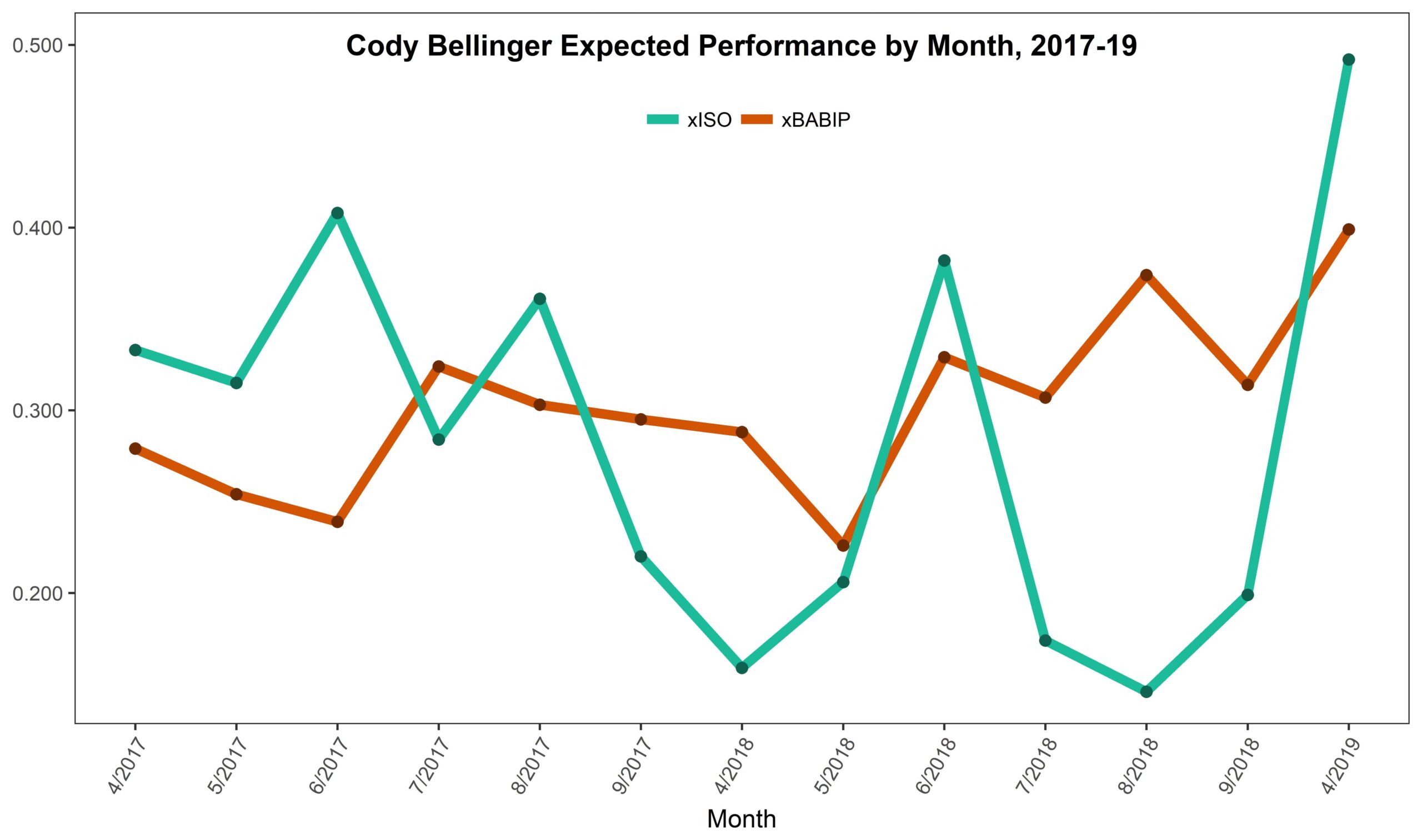
    In this plot, we’ll show Bellinger’s expected Batting Average on Balls in Play (BABIP) and expected Isolated Power (ISO, or slugging percentage minus batting average). These two metrics focus only on balls in play, helping to show his overall hitting ability as well as his power specifically.

    Besides a surge in power last June, Bellinger’s xISO was higher in every month in 2017 than it was in any month in 2018. In fact, there was a downward trend in his power profile even within 2017. As 2018 wore on, though, Bellinger was able to maintain a positive trend in his xBABIP, suggesting that he was still hitting the ball hard, just not in a way that generates a lot of power. It’s worth pointing out here that, even at those low points around a .200 expected Isolated Power, we’re still looking at an above-average power profile. Just not otherworldly.

    Through the first few weeks of the 2019 season, Bellinger has been demolishing the ball, to the tune of nearly a .400 xBABIP and .500 xISO. Because we’re still only a few weeks into the season and Bellinger’s only hit so many balls in play, we can feel comfortable that those rates won’t last long. But there are reasons to believe he could be back to his 2017 form, and perhaps better.

    In particular, his batting eye has improved substantially. Plate discipline stats are really useful this early in the season because they’re on a per-pitch level instead of a per-plate-appearance level, and that’s where Bellinger’s made an obvious leap.

    After chasing 28 percent of balls outside the strike zone the previous two years, he’s chased only 22 percent this year. He’s swung and missed at just 5 percent of pitches this year (21 out of 418) after whiffing on 13 percent in his first two seasons.

    Teams have tended to stay on the outer edge of the plate against Bellinger, trying to avoid him yanking one out to right field and instead trying to get him to weakly ground into the shift. Eventually they have to come inside, though, and Bellinger has really made the most of those opportunities. On those pitches, he’s been incredibly selective, particularly in spitting on pitches too far inside.

    Cody Bellinger Plate Discipline, Inner Third and Inside, 2018-19

    What has he gotten out of that improved selectivity? How about a 2.134 OPS on 29 plate appearances ending with a pitch on the inner third and in, compared to .681 in 2018. That’s also more than 900 points higher than his performance against pitches on either the outside or middle.

    Not only has he addressed what was a hole in his game last year, he’s taken advantage of pitches he should crush. In 2018, he whiffed on 18 percent of his swings and had a .914 OPS against pitches in the zone and belt-high. This year, he’s only whiffed once in 35 swings and has a 2.429 OPS against those same pitches.

    Sure, Christian Yelich has an MVP trophy in his case already and is on an incredible home run pace. But if early returns are any indication, the guy who robbed him of a home run on Sunday might rob him of something else come October.