There are a lot of terrific young shortstops in MLB, with Bobby Witt Jr. and Gunnar Henderson being the first that come to mind.
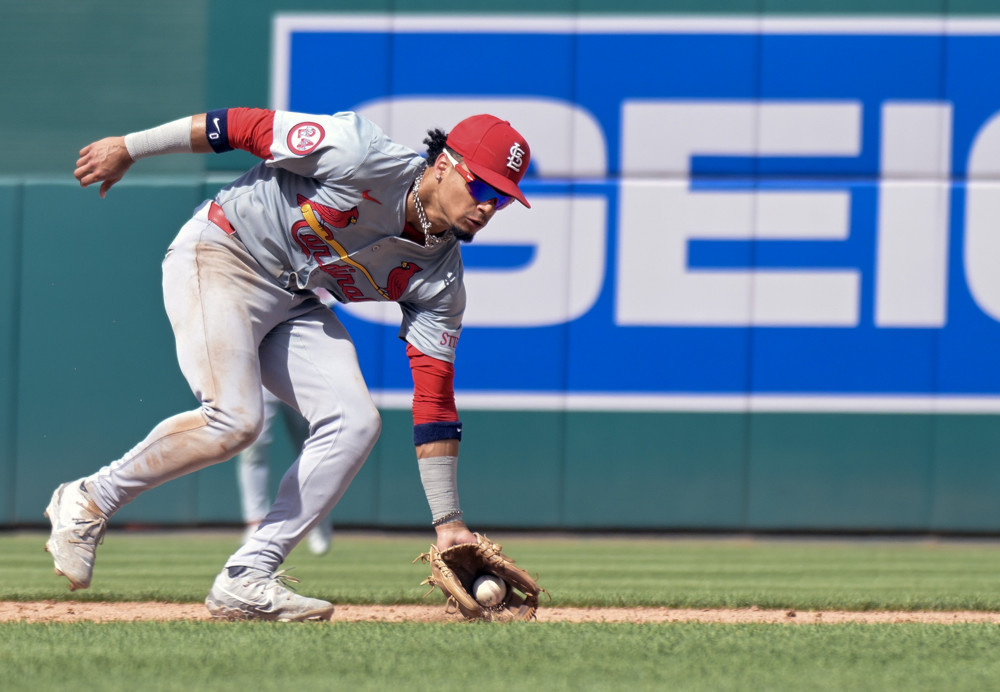
But you know who’s climbing up that list? Twenty-two year old Masyn Winn of the Cardinals.
Winn currently ranks in the top 10 in the NL in Baseball-Reference’s Wins Above Replacement. His defense has a lot to do with that.
Winn handily leads all shortstops in Defensive Runs Saved. His 14 Runs Saved are 6 more than the next-closest player. No other Runs Saved leader has that large of an advantage.
Most Defensive Runs Saved – Shortstops
Player
Team
Runs Saved
Masyn Winn
Cardinals
14
Zach Neto
Angels
8
Brayan Rocchio
Guardians
7
Bobby Witt Jr.
Royals
6
Gunnar Henderson
Orioles
6
Since he’s the best at one of the most important positions on the field, it’s not surprising that he leads MLB in Defensive WAR.
Winn is good at going both to his left and to his right. Very good, actually. He has the 4th-highest rate among shortstops at turning opportunities* into outs on balls hit to his left and the 2nd-highest rate on balls hit to his right.
* Opportunity = any ball on which a player has a >0 chance to record an out based on our out probability data
Winn’s also had an abundance of opportunities. His range factor ranks 2nd at the position. He plays the position aggressively (examples here and here).
But the separator for Winn has been effectiveness at turning the double play, something that Runs Saved credits in addition to playmaking. Winn has converted the most double plays of any shortstop in the majors. With the volume of plays he’s made and the difficulty of them, he gets an additional MLB-best 4 Runs Saved just from double plays.
Most of the double plays Winn turns look routine. But he’s got a few impressive ones like the one below. I’ve watched baseball for more than 40 years and I don’t mind saying that one was an Ozzie Smith-like play.
The Cardinals have had a weird year. They have a negative run differential and their two veteran stars, Paul Goldschmidt and Nolan Arenado have floundered. And yet they’re winning enough to be in the hunt for a playoff spot. With this team, you can’t spell ‘winning’ without the Winn.
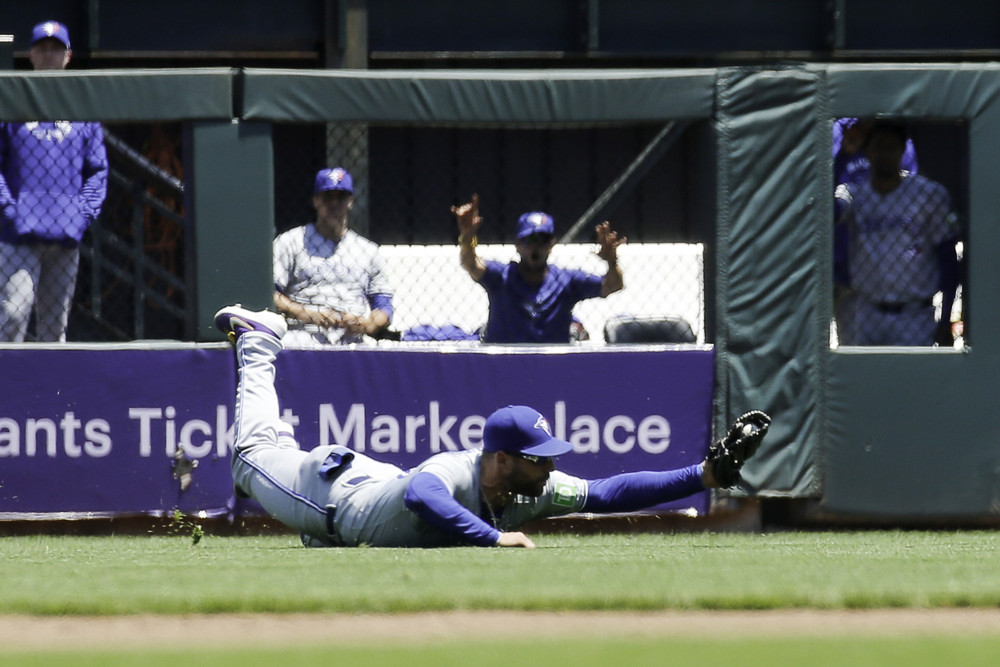
Kevin Kiermaier didn’t make MLB Trade Rumors’ list of its Top 50 Trade Candidates. When the Blue Jays put him on waivers, no one claimed him, likely because that would mean paying what’s left on his $10.5 million contract for this season.
But we have to think there’s some contending team out there for whom Kiermaier could play a prominent role.
We say this even though Kiermaier is hitting .189 with a .540 OPS in just under 200 plate appearances for the disappointing Blue Jays this season. That OPS is a 201-point dip from last season, a good year that earned Kiermaier his latest one-year deal.
Kiermaier has value on a good team, which the Blue Jays are not, because he is still a very good defensive center fielder who can impact a game in any inning. Kiermaier won a Fielding Bible Award at that position last year. He’s been very good this year too.
Kiermaier’s 7 Runs Saved rank tied for 5th among center fielders in 2024. His three-year total of 27 there is topped only by Daulton Varsho (31) and Michael A. Taylor (31).
Player
Team
Runs Saved
Pete Crow Armstrong
Cubs
10
Jarren Duran
Red Sox
9
Ceddanne Rafaela
Red Sox
8
Daulton Varsho
Blue Jays
8
Kevin Kiermaier
Blue Jays
7
Michael Siani
Cardinals
7
Jacob Young
Nationals
7
In terms of MLB-tracked stats, Kiermaier’s 90-foot split time, his sprint speed, and his jumps are near matches for what they were last season. He ranks in the 97th percentile for arm strength (averaging 93.7 MPH). The skills are still there.
Admittedly, if you look at most of the contending teams, they’re pretty well set in center field for all 9 innings (for example, the Mariners and Padres aren’t likely to displace Julio Rodriguez or Jackson Merrill at the end of a game for a defensive replacement).
But there are a couple of spots where Kiermaier could fit. One example would be with the Dodgers where James Outman just came back to try to stabilize the position, though Kiermaier’s a better defender than he is. The Orioles (Cedric Mullins), Guardians (Tyler Freeman), Giants (Heliot Ramos), and Rangers (Leody Taveras) are others that have center fielders that aren’t as good defensively as Kiermaier is.
These teams could install Kiermaier as their ‘defensive closer,’ bringing him into the game in the 8th or 9th inning to save the game with his glove. As an added wrinkle, they could even give Kiermaier a light-show entrance a la Edwin Díaz, with John Fogerty’s “Center Field” as his entrance music (alright, maybe that’s a little much).
There are other players who will be switching teams in the next couple of weeks who are good defensively. But none have Kiermaier’s reputation for defensive excellence. His value has the potential to be priceless.
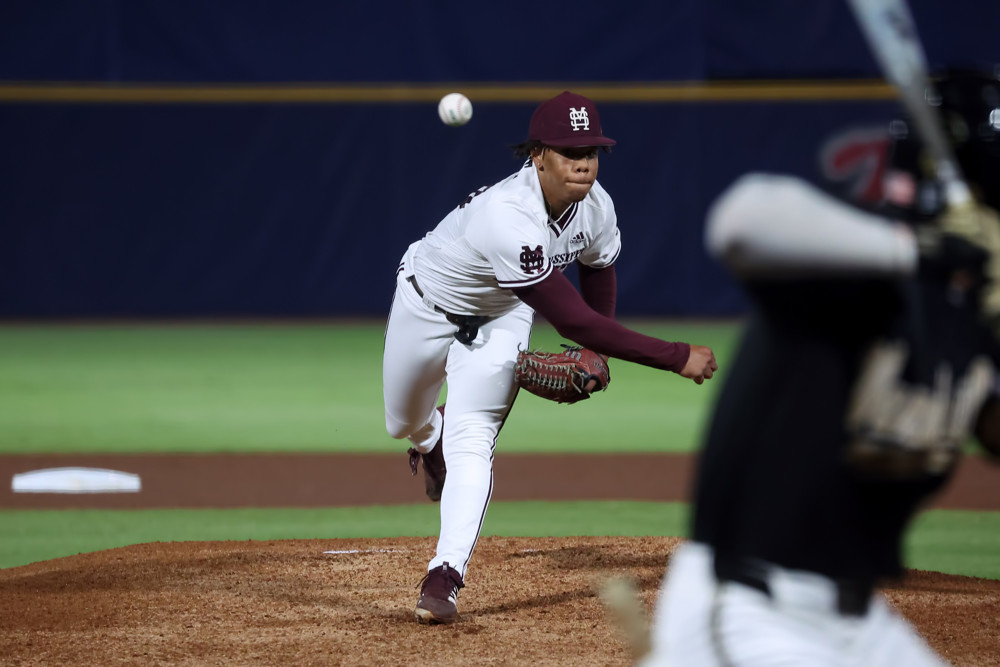
Jurrangelo Cijntje is the most unique pitcher in baseball, throwing hard mid to upper-90s fastballs with his right arm and low-90s fastballs with his left. The switch-pitcher has incredible talent and is just starting to scratch the surface of his potential.
Born in the Netherlands and raised in Curaçao, Cijntje learned to throw with both arms at a young age when his dad would drive nails into a baseball and have him throw the DIY weighted ball at a tire. He often left his left-handed glove at home so he could use his father’s catcher mitt and work on throwing from right-handed. Cijntje must have been onto something because he blossomed into a talented right-handed pitcher.
Cijntje continued to hone his craft with both arms and added arm strength and command. After high school in Miami he unleashed his talent on the SEC where he took a major step forward in his sophomore season on the mound.
College Career:
Cijntje pitched for the Mississippi State Bulldogs for two seasons. He had up-and-down moments during his freshman season, but while starting in the weekend rotation he would flash potential. A 5 ⅔ innings start of 1-run ball against Ole Miss was the real standout performance during SEC play in 2023.
However; Cijntje finished with an ERA north of eight and while supremely talented, he could never get his walks down enough to be effective (34 in 50 innings).
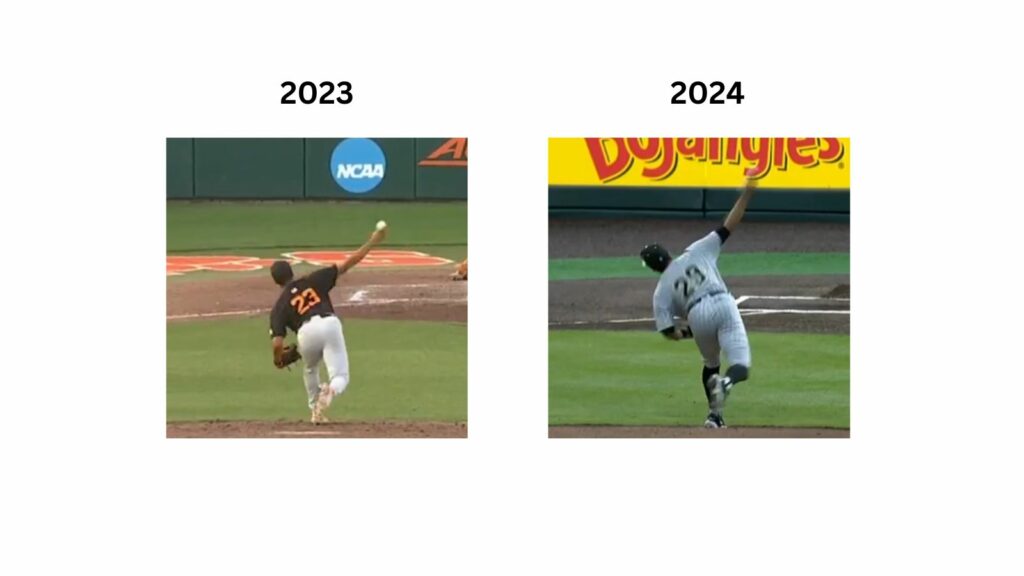
Fast forward to 2024 and Cijntje started to dial in his mechanics from both sides of the plate and was more direct to the plate from the right side. He consistently threw more strikes allowing his pitches to play inside the zone. He had a few starts with more walks, but down the stretch of SEC play Cijntje began to throw more from the right side. He used the left arm only as a matchup problem for left-handed hitters.
While he limited home run damage more frequently in his sophomore campaign, cutting his HR/9 from 2.2 to 1.1 in 2024 there’s still a susceptibility to the long ball. This can be ironed out but T Mobile Park is a pitcher’s ballpark, Cijntje should enjoy pitching in.
Year
ERA
IP
K%
BB%
K-BB%
2023
8.10
50.0
26.5%
14%
12%
2024
3.67
90 2/3
30%
8%
22%
Pitching Mechanics:
Jurrangelo Cijntje is an ambidextrous pitcher for Mississippi State
Cijntje starts with his body and feet angled comfortably standing with his feet shoulder-width apart and his glove in front of his belt. As he steps with his left foot he turns, facing third base.
Then he turns his back foot parallel and in rhythm with tiny taps as he pauses his left foot. Moving into his leg kick he creates a significant weight shift forward during his drift. He also counter-rotates his hips as he slightly turns his front half toward second base.
His lead leg reaches peak lift around his chest and straightens out fully as he brings it down. He then stacks his weight over his backside. Although he does not get into a deep hinge position, he still rides his back hip down the slope.
Coming into a landing position his shoulders are level and his arm is a tad late at times to get to the flip-up position. (With an arm at a 90-degree angle at the footstrike). However; what Cijntje does very well is pulling his glove across his body, creating a good rotation of his front side. As his foot fully braces the impact, he gets his arm to 90 degrees eventually with this tiny delay in the sequence.
Even if his arm is a little behind, he clears his body well and then brings the arm through. He has a great amount of hip-shoulder separation and he unwinds the energy his body has coiled up efficiently.
Cijntje lands in a tiny cross-body action with his front foot barely closed. The separation and stretch allow him to transfer positive energy to ball release. Cijntje could clean up some of the checkpoints in his delivery but he does look natural and the delivery from both the right and left looks smooth.
There are also very similar movement patterns from both sides displaying his athleticism. From the left, he is more cross-fire rather than directionally towards the plate.
Cijntje’s fastball has great traits in terms of movement with good carry and arm-side movement from a lower slot. As a pitcher shorter than six feet in height, he’s throwing out of a traditional ¾ arm slot and still has a low release height that helps his fastball stay flat at the top of the zone.
From his right arm the pitch profiles more at 94-95 mph but he did run the pitch up to 97 and even 98 mph. The pitch shape plays best at the top of the zone where it stays above the barrel of hitters and he held velo deep into starts.
The command of the pitch fluctuates more because of the timing of his delivery as he sprays the fastball both down and up, but in 2024, he threw strikes with the pitch more consistently, flashing average control.
It’s more about getting the ball up in a good spot rather than down and middle of the zone. The more Cijntje pitches the better the control should get. Once he fully understands his movement patterns, especially from the right side, his control should continue to improve.
Cijntje has also dabbled with a sinker that could be useful in towards righties but it sits in the same velocity band as his changeup. Moving it more consistently into the 93 mph range rather than 90-92 mph and having his changeup sit 88 mph might provide a wrinkle for hitters.
The Mariners have an entire rotation of plus fastballs and all of them have attempted to add a sinker. Cijntje should have the usage of that pitch jump up if Seattle finds it useful to incorporate.
Slider:
Cijntje’s slider is very intriguing for the Mariners’ pitching development. He has a feel for spinning the ball and would throw lower-end sliders around 85 mph with more depth. He also flashes more of a cutter with lift at 89-90 mph.
This sometimes felt like intentional manipulation depending on matchups and pitch-to-pitch variance during a start. He threw more of a cutter early to RHHs in his last collegiate start against Virginia in game two of the Super Regionals.
This feel for the slider could create a separation in the pitch either creating a sweeper to go with a gyro slider, or trying to squeeze out a sweeper, gyro, and cutter.
His propensity for spin should help him create above-average offerings no matter what Seattle decides to do and more consistent shapes could help his command as well.
Changeup:
Cijntje’s changeup is odd in that it gets a lot of in-zone whiffs, rather than chases. With his hand speed and deception, he gets hitters to swing over the pitch consistently. He also uses the pitch early in counts to speed up the bat, at times following the changeup with a fastball increasing the margin of error for fastball misses.
He doesn’t throw the pitch for enough strikes right now but does zone the pitch sometimes. Confidence in throwing the pitch right on right is impressive for a college arm. There’s at least an above-average changeup, maybe even plus, as a real weapon to both righties and lefties.
Curveball:
It’s important to point out that Cijntje does have a slower breaking ball he throws occasionally. The curve was sprinkled throughout his starts but you can see in the video below that when the Bulldogs were using traditional signs with no one on base the catcher would flash a two-sign.
Curveball usage was more matchup-dependent than anything but it’s at least an average offering in the future, and if the Mariners wants to continue to develop it, maybe they can get more out of the breaker. This will give Cijntje a vertical pitch for opposite-handed hitters as an RHP.
If Cijntje solely focuses on being an RHP he should improve his pitch shapes and maybe even add velo, which would raise the floor of all his pitches including the curve. Cijntje has more untapped potential than most college arms making him a fun pitching prospect to develop in terms of pitch shapes and velocity.
Arsenal LHP:
Fastball:
Cijntje’s fastball from the left sits more 90-91 mph and doesn’t have the same zip through the zone being more dead-zone in shape from a low slot. The fastball mainly sets up his sweeper. Cijntje also lacks control from the left even as a natural lefty. The cross-body mechanics lead to him being off with the fastball more from the left side than the right.
Sweeper:
A low-80s sweeper bending into the zone from out behind left-handed hitters is Cijntje’s calling card as a southpaw. It’s his putaway pitch when he gets to two strikes. He will also throw the pitch over the plate more than working it out of the zone away. He’s mainly a two-pitch pitcher as a left-handed pitcher but it’s an average fastball and above-average sweeper.
Cijntje cut down on the number of batters faced as an LHP and saved his unique talent for hitters who struggled against breaking balls mightily. Also, if he’s in a groove as a righty he will let it ride in terms of facing the opposite handedness.
Projection:
Cijntje is a freak athlete on the mound with a unicorn skillset. Pat Venditte laid the foundation for ambidextrous pitching but he would have dreamed about having the arm talent Jurrangelo has.
As a righty Cijntje has massive upside and the Mainers seemed to love the potential and the fastball traits. Seattle should be able to carve out an MLB role for Cijntje as a solid starter but his switch-pitching is also intriguing as a bullpen option if he never commands the baseball enough to start.
You can find all our MLB Draft scouting reports here.
Photo: Bryan Lynn/Icon SportsWire
Skill
Grade
Fastball
65
Slider
70
Curveball
55
Changeup
55
Control
50
Future Value
60
Name: Chase Burns
College: Wake Forest University
Bio: R/R 6-3, 210 lbs.
DOB: 01/16/2003
Written by Brandon Tew
Analysis:
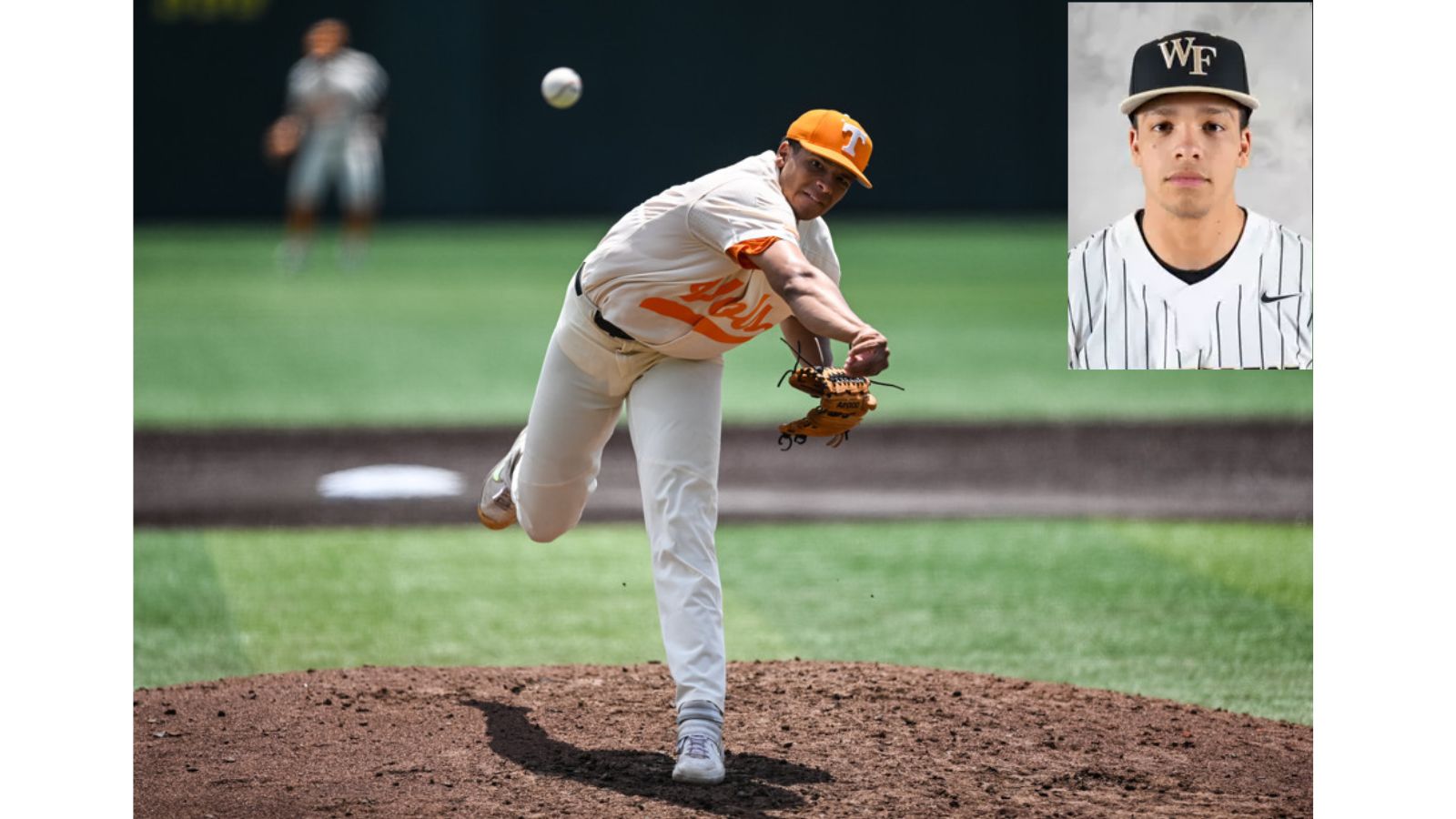
Chase Burns is an electrifying pitching talent who exudes emotion and energy on the mound coupled with gaudy stuff that puts him in a classification of must-watch. He’s a big presence on the mound, throwing hard fastballs touching 100 mph and a slider that elicits whiffs at a high clip.
College Career:
Chase Burns started his collegiate career at the University of Tennessee where he shined at times during his freshman and sophomore years. However; an up-and-down end to his time in Knoxville and a move to the bullpen caused him to hit the transfer portal.
Burns decided upon Wake Forest as his next destination. Their famous pitching lab was a lure in hopes of stepping up his game during his junior season. He did not disappoint, posting one of the best pitching seasons in the country. The ACC Pitcher of the Year posted great numbers throughout the season and during the beginning of his campaign looked nearly unhittable at times.
Year
ERA
IP
K%
BB%
K-BB%
2022
2.91
80.1
31.2
7.6
23.6
2023
4.25
72.0
38.4
7.4
31
2024
2.70
100.0
48.8
7.7
41.1
Yes you read that right. Burns led the country with a 48.8% strikeout rate this season striking out 191 hitters in 100 innings. This put him a fraction ahead of the other top arm in this draft class, Hagen Smith, who had a 48.6% strikeout rate.
Burns makes batters look foolish at the plate. He had three pitches in the 90th percentile in terms of Whiff% this season. His slider is a hellacious pitch that he can manipulate the shape on. He pairs that with a downer curveball that he can bury in the dirt. His four-seam fastball has exceptional ride and high velocity, which makes it a menacing pitch to face.
Pitching Mechanics:
Multiple Camera Angles: The Foundation of Accurate Analysis
A single camera angle can be misleading, often leading to incorrect assumptions about an athlete’s mechanics. To conduct a thorough analysis, multiple angles are essential:
Burns starts his windup with his body slightly turned at an angle towards the third base dugout with his back foot more turned and his front foot at a 45-degree angle and his glove in front of his belt. His initial move is a tiny step toward first and minuscule toe taps with his rubber foot for rhythm.
Burns then goes into his leg lift with an aggressive drift forward for momentum. His left knee stops at peak height around his chest with his foot turned slightly toward second base, creating a closed front side in a stacked position.
As he enters the hinge phase he drops his body, shifting his weight and breaking his hands as his arm glides down to behind his right knee. He then rides down the mound with his leg kicking out, staying in that stacked position. He delays the rotation of his hips until a few moments before the foot strike, while also creating a stretch by keeping his chest back and getting upright.
He has an extreme trunk tilt to create a high arm slot, but he does a great job of not leaking energy to get to that position. Of note, his arm slot was a little higher this season for Wake Forest because of his more upright posture and more tilt in his delivery.
At foot strike his arm is on time and at a 90-degree angle. As he comes into his lead leg block he drives energy through his leg up his body as he whips his arm through.
It’s a LOT of hip-shoulder separation creating a lot of energy into ball release. To finish the delivery his right leg swings through – even at times straightening out – as he recoils his arm with an athletic finish.
You can tell by the way Burns moves on the mound that he is an explosive athlete who gets into outlier positions, which translates into explosive stuff. He will lift his back foot off the ground before ball release. Sometimes it affects his command of pitches if he overextends his back leg too much and loses timing in his body.
Burns fastball is a hard cut-ride pitch with minimal arm-side movement. He is a supinator who throws from a high slot and gets the ball to explode through the top of the zone. The pitch is thrown hard with an average velocity of 98 mph but he has touched 102 mph, with multiple 101s and 100s this season from him.
The biggest wart for Burns is the amount of slug he allows on the pitch.
Against left-handed hitters it can get crushed. His opponents slugging percentage was much higher versus lefties than righties. Burns’ four-seam works best up in the zone where he can take advantage of the riding action and slight cut. For lefties, Burns’ fastball might be seen well by hitters out of his hand because of the high arm slot.
Burns is also super aggressive with his locations. Wake Forest would have the catcher sit ‘middle’ often and he would throw the pitch in the middle of the zone a lot. His command of the fastball is something to improve in pro ball. The pitch is still terrific in shape and velocity, and improved command with better locations should help minimize hard contact.
Slider:
Burns’ slider is the whiff monster that you don’t want to see behind your closet door. The pitch is nightmare fuel for batters and makes all kinds of hitters look silly at the plate. It has a plus shape, but what stands out the most is Burns’ manipulation of it.
Against left-handed hitters, he can throw more of a pure gyro slider below the zone. Pitch tracking will blend both the curve and slider but most of the season Wake Forest would use traditional signs for Burns. When the catcher put down three fingers, the slider could get as low as 85 mph with depth and as high as 92 mph and more horizontal.
He appears to be blending shapes with what he possibly threw at Tennesee to what works best against left-handed hitters spinning the ball below the barrel and into the dirt for chase.
Here’s a sampling of some sliders he threw to both lefties and righties:
The fact he can throw a pitch with more sweep to right-handed hitters while getting more on top and ripping down on the ball to throw a more vertical gyro pitch to lefties makes it a demolisher against both handedness.
Curveball:
Burns’ curveball is a legitimate hammer of a breaking ball, living in the 80-84 mph range. The pitch is a nice change of pace from the rest of his arsenal but he can throw the pitch harder when he wants. He will throw it for an occasional strike stealer but for the most part, he’s trying to bury the pitch on top of the plate.
When Burns is pumping fastballs by you, the curve – working out of the same tunnel – is hard to lay off. He will throw the pitch to both right- and left-handed hitters but since the slider is so nasty, the curveball just plays off of it as a different shape. But it’s really more of a different spin and velocity look.
Chase Burns got bored throwing 99-101 with a 92 mph slider against the first 5 batters he saw. So he decided to whip out a mid-80s hammer to end the 6th AB. 5 Ks already.
When Burns gets into pro ball he could play with the shape of the curveball but in its present form it will be a nice above-average pitch to throw as a wrinkle. He gets some gnarly swings at it.
Changeup:
Burns possesses an above-average changeup that he throws sparingly. The pitch has a decent separation from his fastball velocity-wise, sitting around 90 mph. He doesn’t make the pitch fade into the lower part of the zone and below it for swings.
Instead, he zones the pitch, and it will just stay firm in the zone. It Induces weak contact over whiffs. Playing around with a different changeup, even experimenting with a splitter out of his high slot like Trey Yesavage, might be worth trying out. But there’s enough currently as a fourth pitch to manufacture good results. He has some feel for it.
Energy and Demeanor:
When talking about Burns you can’t leave out the raw emotion he exhibits on the mound throughout a game. Pitching with pent-up energy and competitiveness, Burns will let you know when he’s excited about a pitch or big strikeout.
Burns shows so much emotion on the mound to where you can’t take your eyes off of him. He’s simply a lightning rod of energy each time he pitches.
Projection:
Chase Burns is an electrifying righty with traits and tools that teams want. He’s nowhere near a finished product but he has frontline rotation stuff. Couple that with extreme competitiveness and you have yourself a potential all-star.
Burns has an excellent feel for spin while using his athleticism on the mound to obliterate the zone with high-velocity pitches. If he can get his command to a decent level he will be a true force on the mound for whatever team drafts him.
Photos: Leslie Plaza Johnson and John Bunch/Icon Sportswire
Did you happen to catch Nathan Eovaldi’s seven innings of one-hit ball last Tuesday against the Padres?
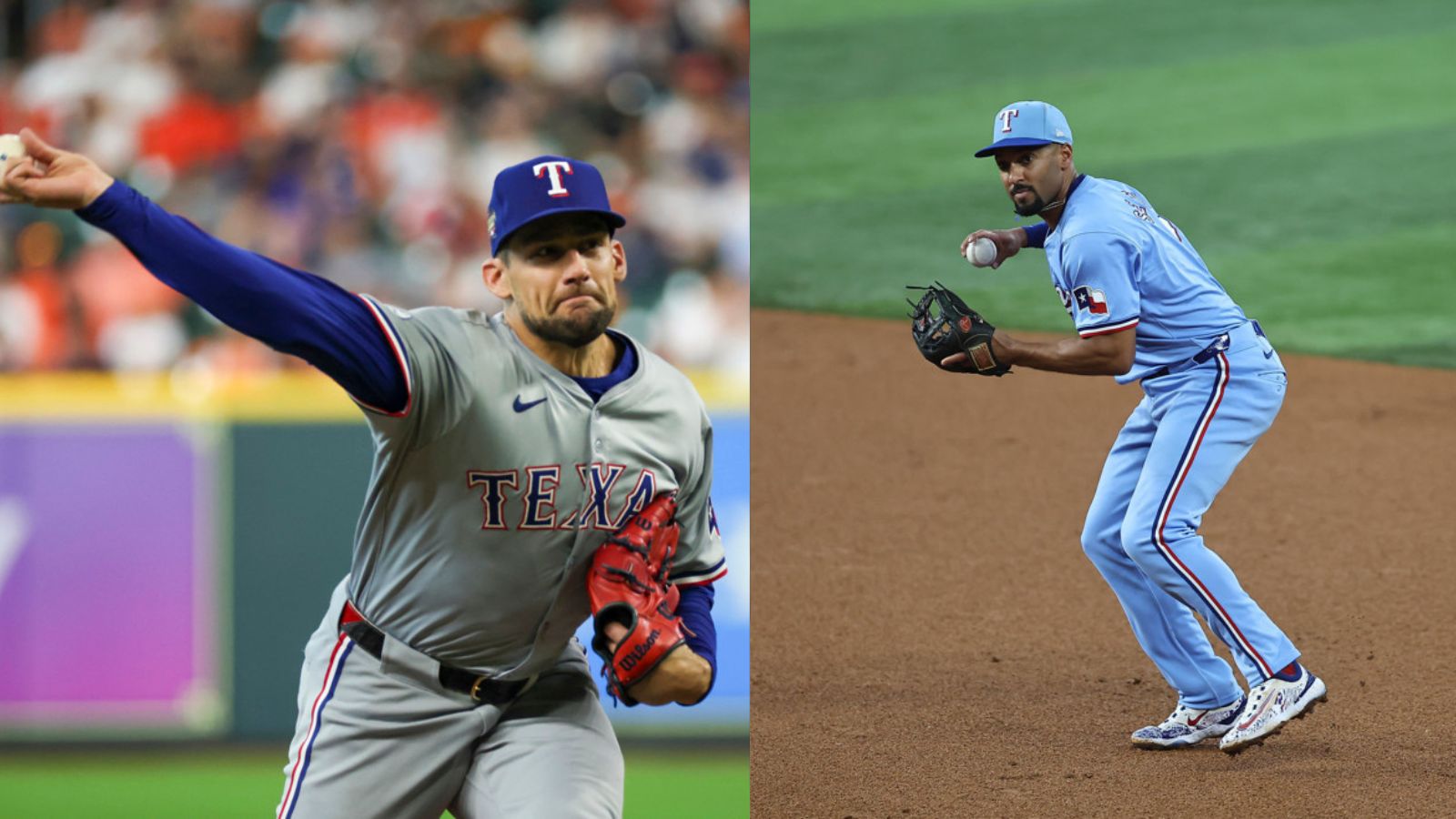
If you did, you saw not only Eovaldi pitch a gem, but the Rangers field some gems. Their combined defensive effort on the batted balls against Eovaldi was worth 2 Runs Saved.
There was some impressive range.
Some smart defensive positioning
And some good luck.
With a few other niceties mixed in.
This isn’t unusual.
By our measures the Rangers have saved 17 runs on the batted balls hit against Eovaldi this season, the most by any team for any pitcher in 2024.
It’s often thought that the difference between a pitcher’s ERA and FIP can be attributed to either luck, performance with runners in scoring position, or the caliber of a team’s defensive play. In Eovaldi’s case, it seems like the difference between his 3.10 ERA and 3.74 FIP is a product of the Rangers’ defense. There are pitchers with lower BABIPs than Eovaldi who have not received this kind of defense behind them.
Two other things we’ve noticed about the Rangers’ defense behind Eovaldi.
One would be how good Marcus Semien has been. Four of his 10 Runs Saved on batted balls have come when Eovaldi’s pitched. The whole Rangers infield has been great. It has turned 83% of the grounders and bunts against him into outs, the 5th-highest rate in MLB (minimum 60 grounders and bunts) and a rate 10 percentage points higher than MLB average.
The other would be that the Rangers have played mistake-free. In addition to tracking errors, our Video Scouts also track Defensive Misplays. These incorporate things like if a fielder slipped and fell, or if a potential double play was botched by a poor glove-to-hand exchange. We have more than 60 categories of Misplays.
The Rangers have had only 3 Defensive Misplays and Errors with Eovaldi on the mound. Eovaldi’s teammates, Andrew Heaney and Jon Gray, each been victimized by 11 Misplays & Errors, Jose Urena 8, and Michael Lorenzen by 7 in a comparable number of innings. Dane Dunning is the one other pitcher in their rotation for whom the Rangers have limited their misplays. They’ve committed 4 for him.
Eovaldi next pitches for the Rangers on Saturday against the Astros.
Here are the MLB leaders in most Defensive Runs Saved support on batted balls against them.
You can find all our MLB Draft scouting reports here.
Photo: Nicholas Faulkner/Icon Sportswire
Name: Jacob Cozart
College: North Carolina State University
Bio: L/R 6-3, 222lbs.
DOB: 01/09/2003
Scouting Grades on 20-80 Scale
Skill
Grade
Hit
40
Power
50
Run
30
Arm
55
Field
50
Future Value
50
Analysis:
Jacob Cozart comes from a family of baseball players. His dad was an accomplished player at the University of Central Florida and his brother, Caleb, is a senior and played UNC-Greensboro this past season.
Cozart’s athletic traits shine in his movements behind the plate. He is explosive in his movements from the crouch which enhances his skills as a blocker and allows him to control the run game when coupled with his plus arm.
He shows some solid tools in the batter’s box with a strong lower half that he’s able to tap into to produce solid power numbers in game.
College Career:
Cozart amassed 150 starts over his three years at North Carolina State after immediately stepping into a starting role during his freshman year. He provided more defense than offense in 2022, putting up a respectable .240/337/.377 as a newcomer in the ACC before breaking out during his sophomore year.
In 2023, Cozart cemented himself as an all-conference performer, earning All-ACC second-team honors as he saw a significant offensive improvement. His newfound power stroke led him to belt 10 home runs and 14 doubles on his way to a .301/.392/.546 line. Increasing his OPS by over 200 points while maintaining his defensive prowess caught the attention of scouts heading into the summer of 2023. He also competed in the USA collegiate national team trials that summer before heading to fall camp at NC State.
Year
ISO
K%
BB%
2022
.137
15%
10%
2023
.245
17%
11%
2024
.296
17%
19%
2024 was another impressive year for Cozart. He helped lead NC State back to Omaha for the first time since 2021. He had another jump offensively, increasing his OPS by another 100 points on his way to a .305/.437/.601 line for the season. He socked 19 home runs this past year, but what may be a more impressive development is his plate discipline. He walked more than he struck out this season, raising his walk rate from 11% in 2023 to 19% in 2024. He was a key cog in Pack9’s run to Omaha with timely hits like this:
— Peter Flaherty III (@PeterGFlaherty) June 15, 2024
Stance
Cozart does a great job creating favorable angles with his setup to maximize his power and simplify his swing.
With his lower half, he starts with a wide base and a slightly open stance. He internally rotates his lead leg and sinks into his back hip, stacking most of his weight onto his backside and creating tension in his legs.
On top, he closes his shoulders to the pitcher, allowing you to see a glimpse of his number from a normal center field camera. This allows him to create some tension across his midsection as he waits for the pitcher to move toward the plate. He keeps the bat almost completely flat as he holds his hands a few inches behind his left ear.
As the pitcher breaks his hands there is almost no movement from Cozart’s upper half. His hands and head stay remarkably still as he starts a medium-sized leg kick. He squats a little further into his legs during his load and as he shifts his weight toward the pitcher he gets into a strong launch position and he fires his hands.
When he is swinging well, this is a very compact operation that can do serious damage to his pull side against all pitch types.
Between Jacob (NC State) and his brother Caleb (UNCG) the Cozart brothers have mashed 13 home runs since April 16th which is really rad pic.twitter.com/oZ5IVb6xKa
Cozart likes to pull the ball in the air so he looks for pitches middle-in early in counts. These are the pitches he can do the most damage on and he does a great job at punishing mistakes in this zone.
Using our “Synthetic Statcast” tool, we can see that when he got his pitch this year, he made the most of it.
Name
Barrel % (percentile)
Average Launch Angle
Hard Hit %
Jacob Cozart
10% (85th)
16° (87th)
37.9 (76th)
He does a good job limiting his chase below the zone on offspeed pitches and has proven that he is willing to take a walk. However, he did have some struggles this season chasing fastballs that ride above the zone above his bat path. Cozart doesn’t have top-of-the-line hand speed like others in this class and struggles to get to the top rail at times.
His tendency to want to wrap the barrel around the ball and drive it to right field also leaves him susceptible to spin in and out of the zone. If he gets fooled and gets onto his front foot too early he can’t always delay his hands enough to make contact and that can also result in weak ground balls to the first and second basemen.
His offensive profile will take a back seat to his defensive responsibilities as a pro given his position, but Cozart should be able to tap into his raw strength at a high enough level to be a factor at the plate with a slightly refined approach.
Defense:
Much like shortstops and centerfielders, the most important factor in evaluating a catcher is whether or not they can handle the position in the major leagues.
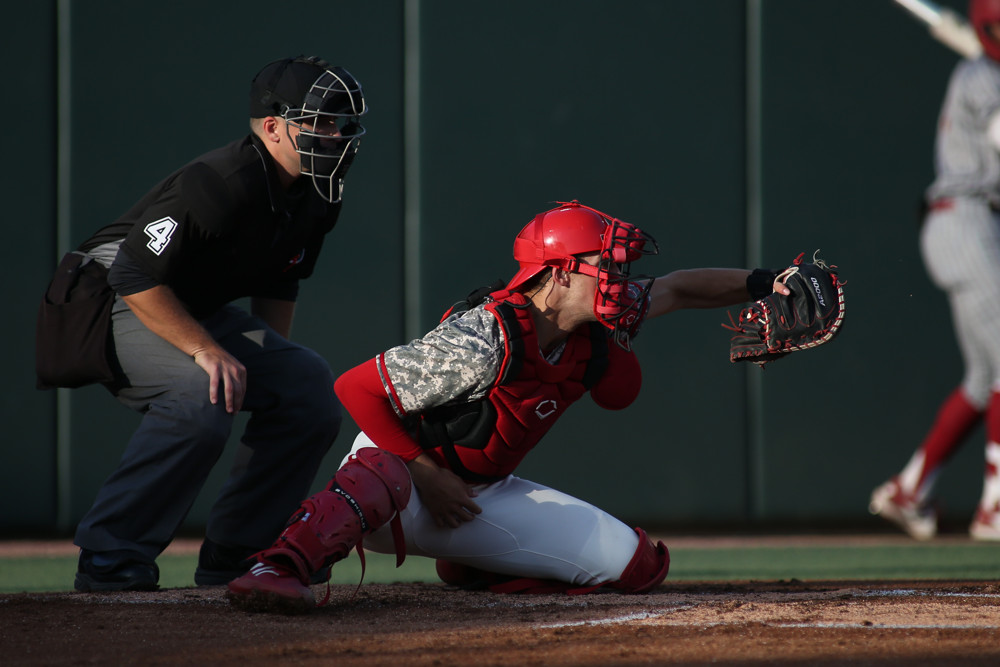
Cozart gained the reputation of being one of the top defensive catchers in all of college baseball over his three years in Raleigh. He is a great framer who is adept at stealing strikes in all parts of the zone. He does very well at beating the ball to its spot and has soft hands when receiving.
Cozart is a very good athlete and does a great job moving from his preferred one-knee-down stance, but blocking is the area where he has the most room for improvement. His larger-than-average frame and good mobility allow him to pull off acrobatic stops like this:
Some kind of emergency pick of a yanked slider by North Carolina State’s catcher Jacob Cozart with the bases loaded & one out in 5th inning of a 4-2 game. pic.twitter.com/HbCrX9dESC
At his best, he has great blocking range and deadens the ball right in front of his body allowing him to easily recover and prevent advancements. However, he did get caught this year lifting his glove off the ground on blocks to both sides, allowing the ball to slip underneath his glove and get to the backstop.
Cozart’s other calling card is his arm and his ability to slow down the run game. He threw out 33% of base stealers in 2024 and has consistently produced sub-two second pop times on throws to second base. His plus arm speed and mobility allows him to throw from multiple windows with authority. He generates good carry on his throws like the one you see here:
NC State catcher Jacob Cozart has two home runs in as many days, but he’s also gotten a chance to show off his arm behind the plate. Here he is catching a runner stealing. pic.twitter.com/zxOXs4hq4n
One of the trademark stats that we curate in the major and minor leagues is Defensive Runs Saved, a wholesale evaluation of a player’s defensive performance.
We calculate the DRS for college players in power conferences as well. Here is how the top catchers in this years draft class compare defensively:
Name:
Defensive Runs Saved
Innings
Malcolm Moore
2
415
Jacob Cozart
1
428
Caleb Lomavita
-2
402
*Our college Runs Saved calculations do not include a framing component
**These calculations are scaled to MLB fielding averages.
Projection:
He doesn’t have eye-popping hand speed but does a good job punishing mistakes and can tap into his raw power consistently. He will likely see an uptick in his strikeout rate in pro ball as he sees better offspeed offerings, but his improved plate discipline should help him get on base consistently.
His carrying tool will be his defense and he already showcases above-average framing ability. Cozart projects as an above-average defensive catcher with solid run-producing potential.
This is the time of year when people select their first half MVPs and Cy Young Award winners. But nobody ever asks “Who was the first half Defensive MVP?”
Not until now anyways. I just asked. And now I’ll answer.
It’s an easy call for me. My choice would be Blue Jays outfielder Daulton Varsho.
Varsho has 12 Defensive Runs Saved in left field (most in MLB) and 7 Runs Saved in center field (1 run shy of the MLB lead). Adding 12 and 7 isn’t necessarily the best way to assess defensive value but if you do, he’s No. 1 in baseball with 19 Runs Saved (he tied Fernando Tatis Jr. for No. 1 last year too). He’s also No. 1 in 2024 in Baseball-Reference’s Defensive WAR, which takes the difficulty of playing the position into account.
Varsho is on the small side and he’s a little burly. He’s listed at 5-foot-8, 207 pounds. That’s an odd combination for an MLB outfielder in 2024 and one more appropriate for his former position, catcher. In fact, there aren’t even any other semi-regular outfielders who are 5-9 or shorter and 200 pounds or heavier.
Magicians will sometimes describe a trick as packing small and playing big. That’s a good way to describe Varsho too. He goes after fly balls without fear or hesitation both coming in and going back to make catchers that other outfielders don’t make.
In April, it felt like he was in Quick Pitch’s “Premier Play” highlights every night. It’s a little less regular these days but still evident. He leads all outfielders with 18 Good Fielding Plays* Much like a good magic trick, you don’t know he can surprise you with how good he is.
* Good Fielding Plays, awarded by our Video Scouts, encompass great catches, throws resulting in an out, and plays like cutting a ball off to prevent a batter or runner from taking an extra base.
Our Video Scouts have credited Varsho with a Good Fielding Play on 15 fly ball or line drive catches this season. You can see what makes Varsho so good by watching some of them.
This one from April 28 against the Dodgers rates higher in fear factor than out probability. Bonus points because Shohei Ohtani was the hitter. Watch it again and listen to the impact. Props to the SportsNet production team for having the wall mic’d.
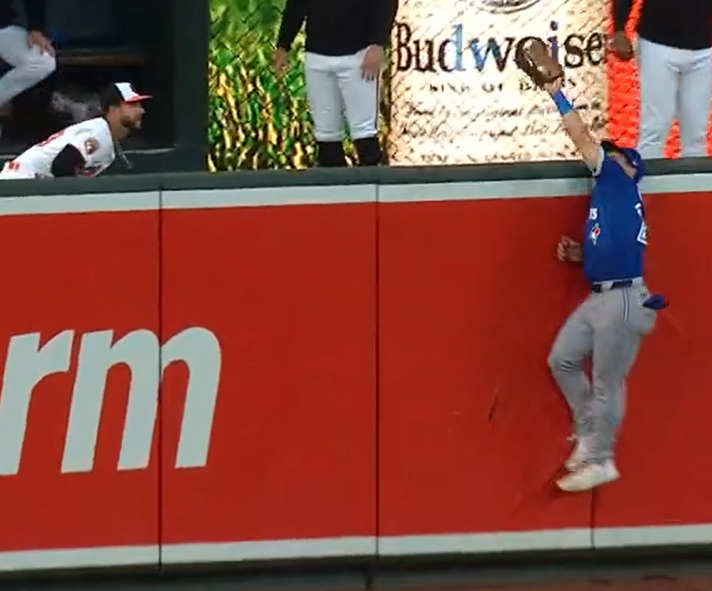
By our count, Varsho has caught 4 balls on which he’s crashed into a fence this season, tied with Stuart Fairchild and Jazz Chisholm Jr. for most in MLB.
If you want to see one that rates higher out probability wise, check out Varsho’s 40-yard dash-and-crash on this one on July 5 against the Mariners and Luke Raley.
and another of the same nature on April 19 against the Padres and Xander Bogaerts.
Ouch.
Sometimes Varsho does approach the wall carefully. Like here on May 13 against a would-be home run hit by Ryan O’Hearn of the Orioles.
I’m going to do something I don’t usually do here and publish a still shot because this one is just perfect at showing how high he got. Love that an Orioles reliever got a nice close-up of it. He’ll probably never see a better catch.
You’ve now gotten a pretty good look at what Varsho is like when going back to make a difficult play.
But what about other types of catches?
Varsho ranks No. 1 in MLB – per Statcast – when assessing how much more ground he covers than the average outfielder within the first 3 seconds of the ball coming off the bat. He’s shown he can go in any direction to make a play.
This one is our No. 1 play by out probability for Varsho, a liner to right center by Bobby Witt Jr. on April 26. We gave Varsho only a 7% chance of making the catch. Royals broadcaster Rex Hudler realized right away how good it was.
His No. 2 play is also a low liner, this one to left field by Anthony Rizzo, which checked in with a 12% out probability.
And more recently, there’s this catch and double play against Ty France of the Mariners on July 6. It looks like he actually snagged this one with the heel of his glove and then squeezed it while tumbling over.
Varsho has split his time between left field and center field almost evenly this season. His 7 Runs Saved in center field are boosted by the bonus he got for the home run robbery plus a couple for limiting baserunner advances on base hits. He’s made 96 catches on 133 opportunities*, 5 more than the summed out probabilities from those 133 chances indicated he’d make
* Opportunities = plays with a >0% out probability
He’s been a very good center fielder. But he’s been a dominant left fielder. There, he’s made 93 catches on 109 opportunities, 12 more than his expected number of catches. He’s far better than the rest of the field in the range component of Runs Saved.
Varsho’s basically eliminated mistakes from his game. In 2023 he had 11 Defensive Misplays & Errors in just over 800 innings. In 2024 he has 1 Misplay and no errors in just shy of 350 innings.
We’ve heard from a lot of angry Blue Jays fans on social media who feel that Varsho’s excellence goes unrecognized. That’s not the case here. We’re well aware of just how good he’s been.
We track college baseball in some ways that are similar to how we track the major leagues. One set of data points that we chart is batted ball data that allows us to make estimates on a couple of Statcast stats, like hard-hit rate, barrel rate, average launch angle, and average exit velocity.
We call our tool for doing so Synthetic Statcast and it’s a useful way to look at a player’s underlying skills.
Below is a list of the batters who ranked in the 95th percentile or better in hard-hit rate in major college conferences for 2024 (ACC, Big Ten, SEC, PAC-12, Big 12).
2024 Hard-Hit Rate Leaders (% of Batted Balls 95+ MPH)
Player
Team
Hard-Hit Rate
1. Jared Jones
LSU
62.9%
2. Nolan Schubart
Oklahoma
58.1%
3. Braden Montgomery
Texas A&M
55.2%
4. Jac Caglianone
Florida
53.9%
5. Jace Laviolette
Texas A&M
53.6%
6. Daniel Cuvet
Miami (FL)
52.4%
7. Carson DeMartini
Virginia Tech
51.9%
8. Charlie Condon
Georgia
51.6%
9. Gavin Turley
Oregon State
51.4%
10. Mason White
Arizona
51.4%
11. JJ Wetherholt
West Virginia
50.0%
12. Vance Honeycutt
North Carolina
50.0%
13. Zac Morris
Duke
49.5%
14. Dakota Jordan
Mississippi State
49.0%
15. Reed Chumley
West Virginia
48.8%
16. Hayden Travinski
LSU
48.4%
17. Cooper McMurray
Auburn
48.3%
18. Jimmy Obertop
Clemson
48.2%
19. Michael Snyder
Oklahoma
48.1%
20. Nick Kurtz
Wake Forest
48.0%
21. Cole Messina
South Carolina
47.8%
22. AJ Gracia
Duke
47.6%
23. Gavin Grahovac
Texas A&M
47.1%
24. Ben Miller
Duke
47.0%
25. Corey Collins
Georgia
46.9%
26. Tyler Shelnut
Florida
46.6%
27. Kyle West
West Virginia
46.6%
Some notes on the top 6 on the list:
In two seasons at LSU, Jared Jones has shown massive power, hitting 14 and then 28 home runs. At the draft combine last month he recorded exit velos as high as 113 MPH.
There may be a lot of strikeouts in Nolan Schubart’s game, but there’s a lot of pop too, as evidenced by his 59% hard-hit rate and 20% barrel rate (tied with Cameron Leary for the highest among college players we tracked). He hit 17 home runs as a freshman and 23 as a sophomore this season to offset 137 strikeouts in 389 at-bats.
Braden Montgomery suffered a rough-looking leg injury prior to the College World Series putting a damper on a season in which he hit 27 home runs and slugged .733. He made a smooth transition after playing the previous two years at Stanford.
Jac Caglianone’s presence here isn’t surprising given the two-way star’s 35-homer, .875 slugging season. What is interesting is that Caglianone’s average launch angle was 11.9 degrees, making him more line drive-friendly than any of the other Top 10 hitters (yes, we estimate average launch angle too).
Montgomery’s teammate, Jace Laviolette, announced last week that he’ll be staying at Texas A&M rather than pursuing a new school through the transfer portal. Laviolette bettered Montgomery’s 27 homers with 29 of his own in his sophomore season and should enter 2025 as a candidate to be taken near the top of the MLB Draft.
Daniel Cuvet, aka Danny Dingers, crushed the ball in his first year at Miami (24 homers, 1.165 OPS) on the way to being a freshman All American and is continuing to hit the ball with authority in the Cape Cod League.
You can find all our MLB Draft scouting reports here.
Photo: David Jensen/Icon Sportswire
Name: Vance Honeycutt
College: University of North Carolina
Bio: R/R 6-3, 205 lbs.
DOB: 05/17/2003
Skill
Grade
Hit
45
Power
60
Run
70
Arm
55
Field
70
Future Value
60
Written by Brandon Tew
Analysis:
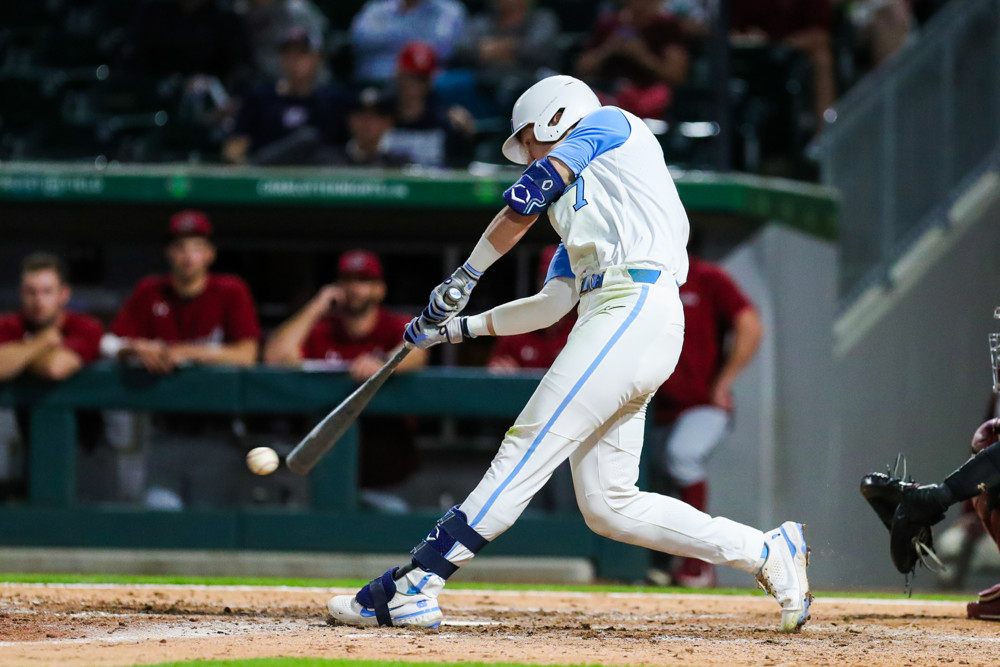
Vance Honeycutt is the most exciting and most volatile player in the country. He’s one of the best athletes in the draft. He possesses the best physical tools with a combo of speed and strength that is hard to find. He’s built like an NFL safety and runs like a deer with long strides.
Honeycutt put his supreme athleticism on display for three seasons in Chapel Hill and impacted games in multiple ways. Ultimately, Honeycutt’s biggest flaw is his inconsistency as a hitter which will decide his future in pro ball.
College Career:
The career home run king for the Tar Heels mashed 65 dingers which he paired with 76 stolen bases, becoming the first Division I player in the career 60-70 club.
He strikes out too often (with a 26.5% career strikeout rate), but in 2024 he posted a slash line of .318/.410/.714.
In the table below, you can see the dichotomy of Honeycutt who in 2024 decided to revert to his pulling and lifting ways to increase production. However, this upped his strikeout rate and his aggressiveness led to his lowest walk rate in college.
Year
HR
SB
WRC+
OPS
K%
BB%
2024
28
28
151
1.124
27.5%
11.9%
2023
12
19
121
.910
20.4%
19.6%
2022
25
29
146
1.082
29.7%
13.5%
Honeycutt capped off his North Carolina career with an absolute heater of a run. He put on an aircraft carrier performance for the Tar Heels, accounting for 38% of their offense in the NCAA tournament. His launching 6 big flies during the postseason run is the definition of clutch.
Honeycutt starts his stance with his feet and weight distributed in a comfortable position with his front foot a smidge outside of his left shoulder. As the pitcher breaks his hands, Honeycutt starts his leg lift, a simple medium-height lift that allows him to shift his weight into his back hip as he stacks his lower half.
At the peak of his leg kick, Honeycutt moves his hands back, turning his front shoulder closed and shifting his front foot to show the bottom of his cleat. Moving forward he creates a stretch in his swing and extends his front arm back with his barrel snapping into an almost 45-degree angle behind his head.
He brings his barrel through with quick hand speed that translates to the bat as he stops the momentum in his swing on his front leg decelerating his swing and momentum after contact
At times, there is extra movement in Honeycutt’s swing with his lower half and hands not being fully synced. When he is on time with a good hand path, he impacts baseball as well as any other prospect. He also can produce damage in different parts of the zone but loves to get his hands extended.
Approach:
Here’s Honeycutt explaining his approach at the plate:
As a hitter, Honeycutt tries to get his “A Swing” off as much as he can, pulling and lifting the ball but can adjust and manipulate or delay his swing to stay on breaking pitches.
His walk-off against Virginia in the College World Series is a great at-bat as he stays on this slider after getting doubled up on the pitch. He is a little out in front but does well to get his bat to this ball and hook it into left field.
A walk off by North Carolina’s Vance Honeycutt in game one of the College World Series?!
Honeycutt is a definite guess-hitter which leads to some terrible-looking swings and non-competitive at-bats. His low swing percentage numbers both in and out of the zone suggest he’s looking for specific pitches early in at-bats.
His chase and whiff percentages especially on breaking balls further illustrate this point. Since Honeycutt is aggressive he will swing at spin hard. In certain at-bats, Honeycutt can look overmatched or in-between on his decisions, but he can deposit a ball over the fence at any point in a game if given a mistake pitch.
Honeycutt crushes these mistake pitches, on both badly located fastballs and hanging changeups or breaking balls. He also pulls the ball a lot. By keeping the ball off the ground, the loft in his swing takes full advantage of his plus power on bad pitches.
The biggest strides Honeycutt must make in his offensive profile is limiting swings and misses while still producing power. Improvement will come if his spin recognition improves and he stays in good-hitter counts in pro ball.
In 2023, Honeycutt was getting pitched around at points and was a much more patient hitter in the box taking a high amount of walks (19.6% rate) and cutting his strikeout percentage to 20.4%.
However; a team might decide that the best version of Honeycutt generates a threat from a power standpoint even if it comes with swing and miss. Honeycutt provides hard contact when he squares the ball up and drives the ball from foul pole to foul pole.
We track college baseball data across Division I, charting as many games as we can. That allows us to use what we call our “Synthetic Statcast” tool to calculate some statistics that you normally wouldn’t be able to get. Here’s where Honeycutt ranks in Hard-Hit Rate and Barrel Rate among players in major conferences
Hard Hit %
Barrel %
49.4% (97th)
12.8% (93rd)
Defense:
Honeycutt is the best defender in college baseball. He won the Rawlings Gold Glove for Division I outfield last year and led the college center fielders we tracked with 7 Runs Saved in 2024. He’s a converted infielder who spent a couple of days on the dirt in Chapel Hill before moving to the outfield and then began patrolling centerfield a short time after that.
There’s a natural ease at which Honeycutt moves and tracks the baseball. Not many base hits fall when Honeycutt is roaming in center and his ball-tracking skills have improved with time. His superb jumps and closing speed allow him to catch balls that other center fielders don’t come close to.
Here’s a video of some of the outstanding plays Honeycutt made in his freshman and sophomore seasons.
Using our “Defensive Misplays” stat that we track for every game we chart throughout the season, we can take a closer look at what types of misplays each fielder is making. We define defensive misplays as “any play on which the fielder surrenders a base advance or the opportunity to make an out when a better play would have gotten the out or prevented the advancement.”
We also track “Good Fielding Plays” where a fielder prevents an advance or records an unexpected out. He’s an excellent fielder and sometimes will dive or try to make plays that no one else can, and these numbers reflect that. Here’s a breakdown of Honeycutt’s last two seasons.
GFP Fly ball
GFP Hr Robbery
GFP OF Assist
DM on Throw or Allowing Advance
DM For Dropped Fly Ball or Bad Route
10
2
3
9
3
Honeycutt had a combined 15 Good Fielding Plays and 12 Defensive Misplays of those types. By comparison, Enrique Bradfield Jr., an Orioles first-round pick last year had 11 Good Plays and 7 Misplays in the games we tracked for him last season. So Honeycutt may be a little more high-risk, high-reward than Bradfield, who currently leads minor league center fielders in Defensive Runs Saved.
Honeycutt uses his excellent timing, jumps, route efficiency, athleticism, as well as, a plus arm to make what feels like every play. With Gold Glove defense in center field that should take him to the big leagues at some point even if he doesn’t consistently hit.
Projection:
As an uber-athletic center fielder, Vance Honeycutt has star potential and on any given day can be the best player on the field. Impacting the game with his power, speed, and defense. When it comes down to it when he’s locked in his hit tool is a 50 and other days he might look bad with it showing more 40 and below.
His tools and raw talent are something to behold and his propensity to come up big in the big moments makes me think he can be a good enough hitter to thrive at the next level.
MLB Comp: Trea Turner production and speed. (Brenton Doyle with more power)
You can find all our MLB Draft scouting reports here.
Photo: John Bunch/Icon Sportswire
Kaelen Culpepper is a versatile player with sound athletic traits and a solid offensive skill set whose future defensive position is a bit of a question mark.
Name: Kaelen Culpepper
College: Kansas State University
Bio: R/R 6-0, 190lbs.
DOB: 12/29/2002
Scouting Grades on 20-80 Scale
Skill
Grade
Hit
50
Power
40
Run
60
Arm
55
Field
45
Future Value
45
Analysis:
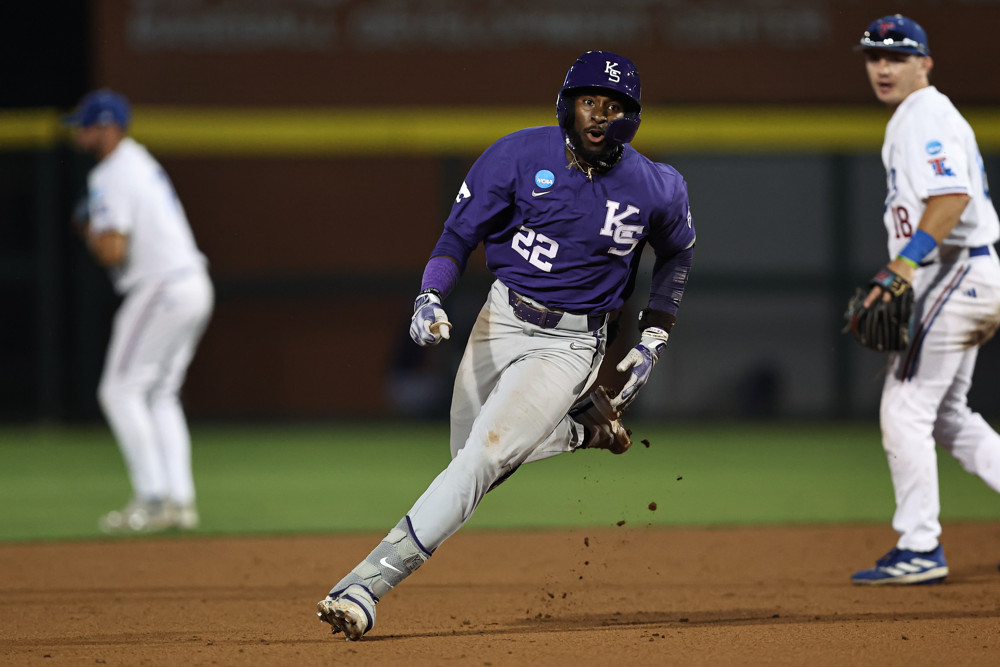
Culpepper stepped into a starting role immediately at Kansas State, playing third base during his freshman and sophomore years before becoming the everyday shortstop in 2024. He logged over 150 games over his three years for the Wildcats and earned All-Big 12 Second Team honors this past season.
He’s an excellent athlete who makes everything he does on the diamond look smooth. Whether it’s making a sliding stop on a ground ball or bat-flipping a towering homerun, Culpepper never looks like he’s in a hurry.
Goodness gracious, Kaelen Culpepper. He crushes this elevated FB WAY out to LF. Explosive, in-sync operation. Big time bat speed, hands quick enough to get the barrel to the top of the zone. Back hip really fires. Potential 1st round pick this July. pic.twitter.com/HD3nrE2Ugp
Culpepper showed consistent improvement year over year at Kansas State. In 2022, he slashed .283/.356/.428 before making a significant offensive leap his Sophomore year. He upped his slash line to .325/.423/.576 and had a significant increase in his power production by doubling his home run total. His improved offensive profile saw him earn an invite to the Team USA collegiate national team trials in the summer of 2023 where he led the team with a .853 slugging percentage over 9 games.
His exposure with the national team vaulted him up draft boards coming into 2024, and he produced another good season at the plate and in the field. He put up a .324/.416/.570 line and led the Big 12 in triples, all while making the transition to being a full-time shortstop.
Year
OPS
K%
BB%
2022
.784
14%
6%
2023
.999
15%
9%
2024
.985
14%
12%
Stance:
He sets up at the plate with a slightly open stance and almost no bend in his knees. He keeps his feet wider than shoulder-width apart and evenly distributes his weight between them.
Culpepper keeps his hands by his right ear while waiting for the pitcher to come to the plate. The first move in his action is a short leg kick that helps him stack his weight over his back leg. At the same time, he bends slightly at the hips and knees which allows him to get his upper body in a more natural hitting position. As his weight shifts back towards the pitcher his hands drift slightly back which helps him get into a powerful launch position.
He likes to keep his hands close to his body as he fires them through the zone, allowing him to keep his barrel in the strike zone for as long as possible. He always finishes his swing on balance as his hands bring the bat over his left shoulder.
Approach:
Culpepper developed into a disciplined hitter over his three years at Kansas State, doubling his walk rate throughout his collegiate career. His advanced approach led him to walk almost as much as he struck out in 2024.
He has a line-drive approach and likes to spray the ball to all parts of the field, and his tendency to keep his hands inside the baseball allows him to stay on pitches in any part of the zone. He likes to drop the barrel on the baseball and hunts pitches low in the zone, which can leave him susceptible to breaking balls that fall out of the zone late.
He is not very explosive with his lower half and can struggle a bit to create optimal home run launch angles on pitches down in the zone which has limited his power production in college, but his plus hand speed allows him to catch up to velocity higher in the zone. The height of the pitch allows him to generate a little more lift and launch the ball out of the park like this:
(Hello again Hagen Smith…)
KAELEN CULPEPPER ARE YOU SERUOUS🔥🔥🔥
A 6 run 5th inning off of Hagen Smith for Kansas State. Something about purple Big 12 teams in the Fayetteville Regional recently pic.twitter.com/Drj8DUApke
— 11Point7 College Baseball (@11point7) June 2, 2024
We track college baseball data across Division I, charting as many games as we can. That allows us to use what we call our “Synthetic Statcast” tool to calculate some statistics that you normally wouldn’t be able to get.
Here’s a snapshot of his batted ball numbers from this year:
Name
Barrel % (percentile)
Average Launch Angle
Hard Hit %
Kaelen Culpepper
9% (84th)
10° (41st)
33% (54th)
Defense:
The biggest question when drafting a shortstop is whether will they be able to stick at the position in the major leagues.
Culpepper made the move to shortstop from third base this past year and proved that he could be more than a corner infielder at the next level. He has good lateral quickness and average range, coupled with soft hands which will allow him to be a solid defender at several positions in the major leagues.
The biggest area for development in his game defensively will be improving his arm accuracy. He shows great arm strength from his low ¾ arm slot but tends to lose the ball high over the first baseman’s head.
Using our “defensive misplays” stat that we track for every game we chart throughout the season, we can take a closer look at what types of misplays each fielder is making. We define defensive misplays as “any play on which the fielder surrenders a base advance or the opportunity to make an out when a better play would have gotten the out or prevented the advancement.”
We can see the disparity between Culpepper and other top draft-eligible shortstops in this class when it comes to misplays credited to bad or offline throws compared to fielding misplays:
Name
Fielding DMs
Throwing DMs
Kaelen Culpepper
4
9
Griff O’Ferrall
4
4
Colby Shelton
7
1
Projection:
Culpepper is a smooth mover who has a knack for making every movement on the baseball field seem easy. He won’t have a gaudy offensive profile like some of the other players in this draft class, but his simple approach and reluctance to chase will allow him to consistently get on base at any level. His plus speed and athletic traits make him a factor on the basepaths and in the field, giving him the ability to play multiple spots across the infield. He projects as a utility infielder in the major leagues who can provide average defense at three positions.
Comp: J.P. Crawford
Draft Projection: Late 1st round/Competitive Balance Round A