Category: MLB

  • Stat of the Week: 2023’s Leading Underachiever

    Stat of the Week: 2023’s Leading Underachiever

    BY MARK SIMON

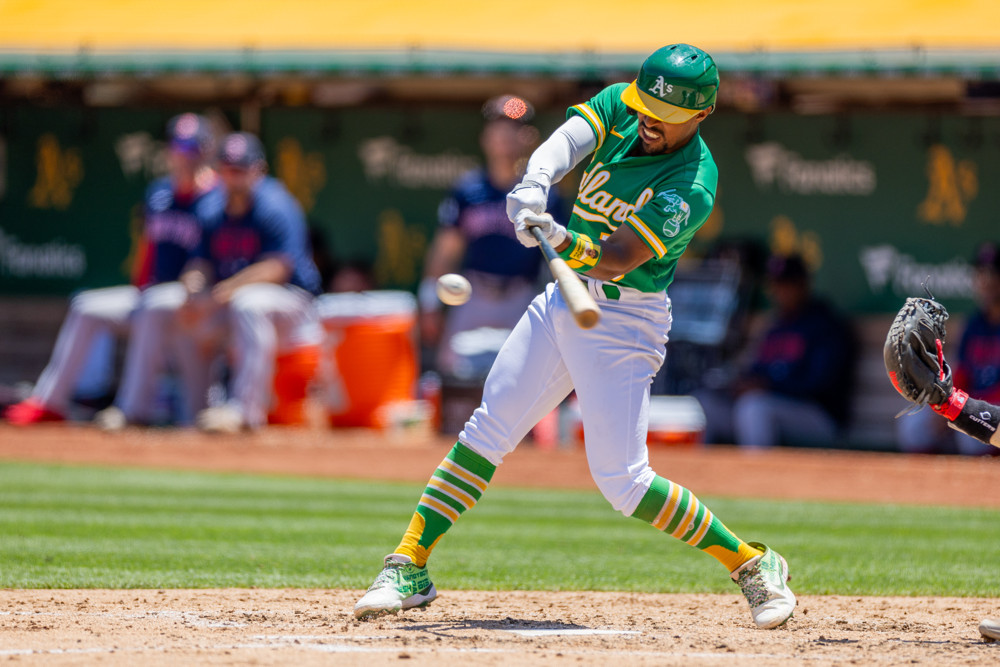
    Tony Kemp had a really, really rough go of it in 2023. Kemp, one of the veteran leaders of an Athletics team that lost 112 games, hit .209, slugged .304, and had a .607 OPS.

    But it probably shouldn’t have been anywhere near that bad.

    Last week, we explained how Luke Raley was 2023’s leading overachiever, posting an OPS 123 points higher than his expected OPS.

    Kemp was 2023’s leading underachiever. His .607 OPS was 136 points lower than his .743 expected OPS

    A brief point of explanation:

    Sports Info Solutions tracks its own version of a player’s expected stats (similar to what you can find on Baseball Savant). Rather than basing a player’s hit probability (and subsequently single, double, triple, and home run probability) on a batted ball’s exit velocity and launch angle, SIS’ version estimates probabilities based on where balls are hit, how hard they are hit, and how long they spend in the air.

    This allows us to compare a player’s actual stats to his expected stats.

    Here’s the list of players with the largest negative differential between their 2023 OPS and their expected OPS. This stat is the other end of the list that we presented last week.

    Biggest Negative Differential – 2023 OPS and Expected OPS

    Minimum 250 Plate Appearances in 2023

    Kemp’s ledger consists of a fair number of instances in which he hit a line drive that hung up long enough (for example: here and here). There were also some nice defensive plays both on fly balls and ground balls (here and here), and a couple instances of balls that hit the pitcher and caromed right to a fielder (here and here).

    There’s also an instance of losing a would-be hit to a force play (here). And, of course, he got bit by the abundance of foul territory in his home ballpark (though not often; only here).

    Here is what Kemp’s actual batting line looks like compared to his expected batting line.

    There is a huge difference between what Kemp was and what he could have been. By his performance, Kemp was one of the worst-performing hitters in baseball. By his expected performance, Kemp’s OPS would have been better than the average second baseman (.724) and almost a match for an average-hitting left fielder (.751).

    This graph shows the range of outcomes in expected BABIP differential and expected OPS differential. Kemp’s stats are outliers. They’re represented by the blue dot in the lower left of the graph.

    One more example on how Kemp’s hit total was less than expected: If you take all the batted balls he hit with an expected hit rate of between 20% and 60%, Kemp was expected to net 42 hits. He totaled only 26, a 16-hit difference.

    There are some prominent players among the others on the underachievers list. Among them is Vladimir Guerrero Jr. who hit .264 and slugged .444. His expected numbers would have made his season look a lot different. He tallied a .302 expected batting average and .507 expected slugging percentage.

    Guerrero Jr.’s loss of hits on those 20% to 60% balls isn’t quite as extreme as Kemp’s but was still prominent. He was expected to net 72 hits on those batted balls. He totaled 62.

    The usual disclaimer applies: We’re not necessarily saying that Kemp’s or Guerrero’s numbers will be better such as to make up for what happened in 2023 (though the Steamer projection on FanGraphs suggests a nice bounceback). We’re just pointing out that it would be difficult for an average player to put up Kemp’s line and Guerrero’s line, much like it would be tough to put up Raley’s overachieving line.

  • New Padres Pitchers: Yuki Matsui and Woo-suk Go Scouting Reports

    New Padres Pitchers: Yuki Matsui and Woo-suk Go Scouting Reports

    The San Diego Padres signed two relievers this off-season to bolster its bullpen, bringing in Yuki Matsui and Woo-suk Go. Matsui comes to MLB as an international free agent after 10 seasons with NPB’s Rakuten Eagles, while the more recent signing of Go came as a surprise after Go was posted by KBO’s LG Twins. Both will be pieces in a revamped Padres bullpen.

    Yuki Matsui

    Season IP ERA Saves/Save Opp. Strikeouts Walks K-BB%
    2022 51 2/3 1.92 32/34 83 19 33%
    2023 57 1/3 1.57 39/42 72 13 26%

    What does he do well?

    Standing at 5’8”, Matsui is on the smaller side for MLB pitchers (he’d have been the 3rd-shortest pitcher in the majors last season) but uses his small stature to create some good pitch-shape characteristics. His fastball creates some carry from a lower release point due to his height, especially through the top of the zone. 

    His splitter is a nasty platoon-neutral pitch that disappears at the bottom of the zone, with an insane 56% whiff rate in 2023. He used the pitch more down and away from RHHs, but he can also throw it below the zone to left-handed batters with good results. 

    Mechanics

    Matsui also has a glove tap as he gathers himself at the top of his delivery. Creating a weight shift back as he lifts his leg, there’s a little pause as he balances. With a tiny pat of the ball in his glove he then comes forward and extends his leg out as his hip leads.

    One quirk is that Matsui darts his eyes up to the sky as he comes into foot strike, and the eyes don’t fixate back on the target until after the ball is released.

    via GIPHY

    The Arsenal

    Pitch Type Usage Velocity Strike % Whiff %
    Fastball 52% 92.5 mph 66% 23%
    Splitter 35% 87.5 mph 64% 56%
    Slider 11% 86 mph 69% 35%
    Curve 2% 76 mph 74% N/A

    Matsui’s go-to pitches are his fastball and splitter. He works the fastball up and away from right-handed batters, tunneling his splitter out of that same spot the majority of the time, throwing the two pitches on the outer part of the plate. 

    via GIPHY

    via GIPHY

    Against left-handed batters, his splitter works more middle of the zone down and he still tries to spot his fastball away from lefties on the glove side. One weapon for Matsui, especially against lefties, is Matsui’s slider. With good movement, he’s able to pound the bottom of the zone glove side. He would usually break out the slider and curve against the better left-handed hitters in Japan.

    Here’s a slider and fastball against Kensuke Kondoh, the best pure hitter in Japan:

    via GIPHY

    The video below is a splitter and curveball followed by a slider. I cut out some pitches in the at-bat for the sake of time, but this seven-pitch at-bat against Yuki Yanagita displayed Matsui’s full arsenal. 

    via GIPHY

    The pitch becomes an offering that moves away from lefties, but he is unafraid to bury the pitch down and in toward righties knees. With flashes of above-average command last season, Matsui found a formula that worked for him. 

    While he has displayed below-average control in some past seasons, he might have turned the corner with a 5.9 BB% in 2023. You don’t become the youngest player in NPB history to 200 saves without having some control and nasty offerings.

    What to Expect

    Matsui will compete for the closer role in San Diego but also could work well as a setup man or seventh-inning guy to start the season. He has two above-average to plus secondaries that should help against both right and left-handed hitters. He might alter his pitch usage slightly, but his high carry four-seam should prove a weapon even if thrown more 92-93 mph.

    Matsui struggled to adjust to using a different ball during the WBC, so his acclimation to the league, like Go, might take some time. Still, if he can keep his walks down like he did in 2023 success as a high-leverage reliever should follow.

    Woo-suk Go

    Season IP ERA Saves/Save Opp. Strikeouts Walks K-BB%
    2022 60 2/3 1.48 42/44 80 21 24%
    2023 44 3.68 15/17 59 22 19%

    After seven seasons with the LG Twins, Go was posted with a more shallow market for his services after an injury-plagued 2023 in which he missed time in May and his ERA ballooned after some bad outings. The most notable clunker came on April 30 when he walked two and gave up a weird high chopper for an RBI single. Then, three pitches later, he threw his slowest fastball of the year on a three-run home run. He was lifted and didn’t pitch again until June 4 due to an injury in his lower back. 

    He compiled a 31% strikeout rate last season to go with a high 12% walk rate. Go is a power pitcher who aggressively sprays the ball in and out of the zone and is an uncomfortable at-bat when he’s hitting his spots.

    What does he do well?

    Go is the hardest-throwing reliever in KBO, touching 98 mph on his fastball and comfortably sitting around 95 mph. His fastball gets flat at times, but he still has decently loud stuff for an MLB bullpen.

    Go’s arsenal is MLB caliber but with spotty control and command; he must consistently harness his secondary pitches and keep his fastball out of the middle of the zone. At times, he tries to be too fine with his pitches instead of trusting his stuff to play in the zone.

    There are numerous examples of cycling through pitch types with the catcher and trying to spot pitches perfectly on the edges.

    LG combatted by having their catcher set up in the middle of the zone and letting him rip pitches. Middle-of-the-zone fastballs won’t play as well in MLB, but he still throws 95 mph with a decent curve.

    via GIPHY

    Go pitches and feeds off of emotion and confidence so when he’s rolling he becomes even better. Bad outings can get away from him quickly because of walks. His stuff in KBO would just overpower lineups but stateside he needs to limit the walks for success.

    via GIPHY

    Mechanics

    Go has tinkered with his windup mechanics in terms of rhythm and timing. At points, he incorporated a glove tap into his movements and then he would completely scrap it during some outings or lessen it. To end 2023, he went back to a more substantial glove tap at the top of his leg lift.

    The Arsenal 

    Pitch Type Usage Velocity Strike % Whiff %
    Fastball 57% 94.5 mph 60% 25%
    Cutter 24% 91 mph 64% 28%
    Curve 15% 83 mph 65% 49%
    Slider 3% 85 mph 50% 46%

    Go tunnels his arsenal best when he works the zone vertically. Peppering the top of the zone with fastballs and then snapping off sharp breakers below the zone for chase. His curve has a baby spike grip and he can work the pitch both in and out of the zone.

    Curveball Grip

    via GIPHY

    He gets some gnarly chase swings at pitches and uses his curve to both righties and lefties. Against lefties, he will backdoor curves deeper into counts as well.

    via GIPHY

    Go primarily uses his cutter to keep hitters off his fastball. He is comfortable throwing the pitch glove so that it’s in on the hands of lefites or down and away to righties. He  occasionally throws it arm side on the edge versus left-handed batters.

    via GIPHY

    via GIPHY

    He also has a slider that he will use against better hitters. His cutter and slider have very similar grips. 

    Slider

    Cutter


    With the cutter, Go stays behind the ball, and on the slider, he tries to get to the outside of the ball. There are subtle differences in movement and velocity but based on signs he has thrown both pitches. 

    via GIPHY

    In San Diego, the team might try to tweak his slider and play around with grips to get even more horizontal movement, and with pitchers like Darvish on the team who helped Rōki Sasaki with his slider, Go might find a tunnel horizontally that works for him.

    With his sporadic control, a more consistent slider could help Go pitch not only north and south but also east and west so he doesn’t have to be as fine and can still generate whiffs.

    What to Expect

    Go projects as a middle relief option who has experience at the back of a bullpen and if he can gain confidence and trust his stuff, could see his role expand during the season. With his fastball and curveball, he should have no issues facing both lefties and righties out of the pen.

  • Stat of the Week: 2023’s Leading Overachiever

    Stat of the Week: 2023’s Leading Overachiever

    Photo: Cliff Welch/Icon Sportswire

    BY MARK SIMON

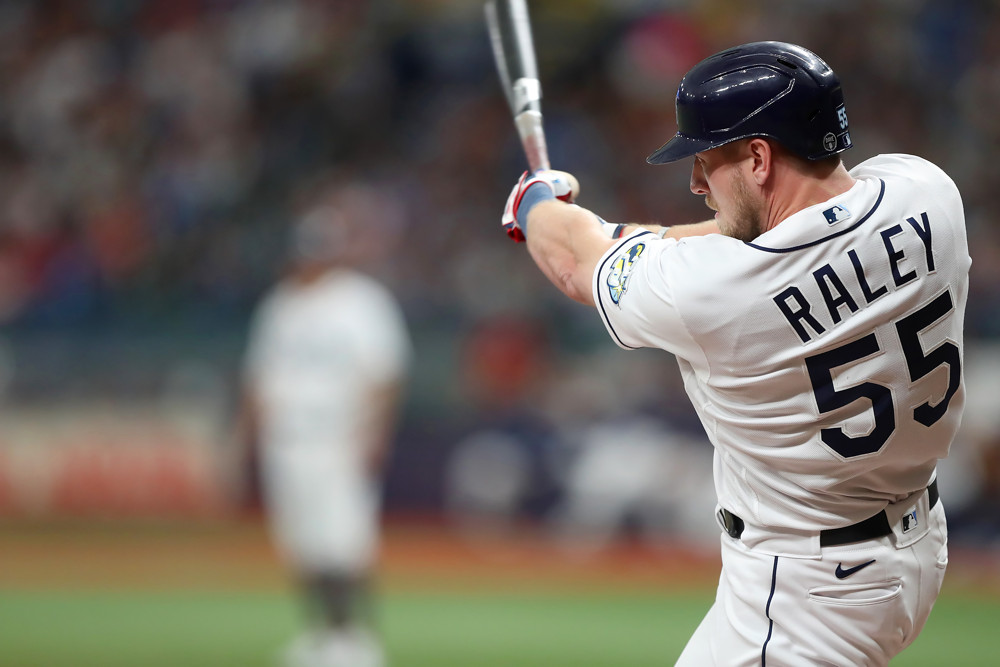
    Luke Raley missed on 36% of his swings last season, the 4th-highest rate of any player with at least 250 plate appearances last season.

    So in order for Raley to be a productive major league hitter, he had to get the most out of the swings on which he did make contact.

    And he did.

    Raley, traded by the Rays to the Mariners last week, produced a .330 BABIP, a .249 batting average, .490 slugging percentage, and .823 OPS in 2023.

    But by our measures, he overachieved.

    A brief point of explanation:

    Sports Info Solutions tracks its own version of a player’s expected stats (similar to what you can find on Baseball Savant). Rather than basing a player’s hit probability (and subsequently single, double, triple, and home run probability) on a batted ball’s exit velocity and launch angle, SIS’ version estimates probabilities based on where balls are hit, how hard they are hit, and how long they spend in the air.

     This allows us to compare a player’s actual stats to his expected stats.

    Raley had the biggest differential between his actual OPS and his expected OPS of any player with at least 250 plate appearances last season. He tallied an .823 OPS against an expected OPS of .700.

    Biggest Differential – 2023 OPS and Expected OPS

    Minimum 250 Plate Appearances in 2023

    Player OPS Expected OPS Differential
    Luke Raley .823 .700 .123
    Brandon Belt .859 .742 .117
    Adam Duvall .834 .721 .113
    Aaron Hicks .738 .631 .107
    Brandon Marsh .828 .728 .100
    Ryan Jeffers .859 .759 .100
    Jason Heyward .813 .715 .098
    Ryan O’Hearn .802 .705 .097

    An .823 OPS makes Raley a well above-average offensive player. A .700 OPS (his expected number) would be below MLB’s average OPS in 2023 (.734).

    Here’s what Raley’s 2023 batting line looked like compared to his expected batting line.

      BA SLG BABIP Doubles Home Runs
    Actual .249 .490 .330 23 19
    Expected .210 .401 .264 15 16

    And here’s another perspective on Raley’s outlier status. This graph shows the range of outcomes in expected BABIP differential and expected OPS differential. Raley is the blue dot in the upper right of the graph.

    As far as examples of Raley’s overachieving go, here are two balls that Raley hit against the Mariners last season (click here and here). The first is a double, one with a 30.5% hit probability. The other is a home run with a 19% home run probability.

    A player can outperform his expected OPS for a number of reasons. Luck can be a part of it (we found multiple examples of Raley hitting doubles that were barely fair) but there are other factors too. A player’s other skills can play a role. For example, in Raley’s case, a look at video showed that his speed allowed him to leg out a few unexpected hits.

    Another factor could be a player’s home ballpark providing dimensions that are friendly to that hitter. Raley did not play in a particularly hitter-friendly park (Tropicana Field). Something like this is more applicable for another player on this list, Adam Duvall, and how well he hit at Fenway Park last season (.596 slugging, .933 OPS).

    We’re not necessarily saying that Raley will fall back to the pack this season (though the Steamer projection on FanGraphs assesses that he will). We’re just pointing out that it would be difficult for an average player to put up Raley’s line given the distribution of his batted balls and his strikeout rate.

    We’ll look at 2023’s underachievers in the near future.

  • Stat of the Week: 2023 Hall of Fame Ballot

    Stat of the Week: 2023 Hall of Fame Ballot

    Photo: Ed Wolfstein/Icon Sportswire

    Happy holidays and happy Hall of Fame voting season. Hall of Fame ballots are due on December 31 and there’s plenty of debate and discussion to be had in the week leading up to them being turned in.

    As we’ve done each of the last few years, let’s present the top candidates by Bill James’ Hall of Fame Value system (HOF-V).

    Player HOF-V
    Alex Rodriguez 961.1
    Adrián Beltré 747.0
    Manny Ramírez 685.2
    Gary Sheffield 672.2
    Carlos Beltrán 649.4
    Bobby Abreu 596.7
    Joe Mauer 590.4
    Todd Helton 565.0
    Chase Utley 549.2
    Andruw Jones 526.8
    Jimmy Rollins 493.4
    Torii Hunter 479.6
    Andy Pettitte 464.9
    Omar Vizquel 464.3
    David Wright 463.6
    Adrián González 460.0
    Mark Buehrle 456.2
    Matt Holliday 444.1

    The formula for HOF-V is a player’s Win Shares plus 4 times his bWAR. A HOF-V of 500 generally represents a player worthy of Hall election.

    Three newcomers to the ballot meet the criteria this year – Adrián Beltré, Joe Mauer, and Chase Utley. Beltre in particular has impressive numbers both as a hitter (477 home runs, 1,707 RBI) and as a fielder (200 Defensive Runs Saved are tied for the most since SIS began tracking the stat in 2003). We saluted both Beltre’s and Utley’s defensive excellence in this space a few weeks ago. Mauer was a great hitter who won 3 batting titles as a catcher before moving to first base because of injury concerns.

    In all, 10 players clear the 500 HOF-V standard, though the value system does not take into account alleged PED usage, cheating scandals, or off-field behavior. For those looking for Billy Wagner, his score checks in below 300. Bill James noted when he devised this system that it doesn’t necessarily handle relief pitchers well, so take that into account when looking at this list (even Mariano Rivera didn’t reach a 500 HOF-V).

    This may be a happy election season for Todd Helton. He received 72.2% of the vote last year, just under 3 percentage points shy of the 75% needed for election. Helton’s vote total has jumped by at least 7 percentage points in each year he’s been on the ballot since he garnered 16.5% of the vote in 2019. He took a 20-percentage point jump from 52% in 2022 to his current percentage in 2023, perhaps aided by the election of another prominent Rockies player, Larry Walker, in 2020.

    As we’ve noted multiple times, Bobby Abreu continues to head the “he was better than you think” section of the ballot.

    Abreu’s value was– in part– a product of his showing up – his 2,425 career games are more than any active player. His 13 seasons of at least 150 games are bettered only by Rafael Palmeiro among those whose careers began in the last 40 years. And when he showed up, he played well. His career OPS was 28% better than MLB average when adjusted for ballpark and era. He ranked in the Top 10 in his league in on-base percentage 8 times.

    Abreu actually has a higher HOF-V than Helton but doesn’t have anywhere near the support. He got just over 15% of the vote in 2023. But he’s still on the ballot, so we’ll see how many voters change their minds this time around.

  • Stat of the Week: 2023 MLB Year-End Awards

    Stat of the Week: 2023 MLB Year-End Awards

    Happy holiday season!

    Every year at this time we do some supplemental, statistically-driven MLB awards. These will salute some of the leaders in specific areas of our recordkeeping. Here are the 2023 winners:

    The Hard Hitter Award

    Sports Info Solutions charts every batted ball as hard-, medium- or soft-hit, based on the ball’s location and velocity (note that this differs from how Statcast tracks hard-hit rate).

    The winner of the Hard-Hitter Award is the player who had the highest percentage of batted balls that were hard-hit among batters with a minimum of 350 plate appearances in 2023.

    Yankees outfielder Aaron Judge won the award for the 2nd straight year, recording a hard-hit ball in 53.8% of his at-bats. No one else reached 50%. J.D. Martinez (49.0%), Corey Seager (48.4%), Ronald Acuña Jr. (46.1%), and Yordan Álvarez (45.0%) ranked 2nd through 5th. For those curious, recent Dodgers signee Shohei Ohtani ranked 8th (42.9%).

    The top 5 teams were the Braves (38.3%), Rangers (36.7%), Rockies (34.8%), Cardinals (34.6%), and Dodgers (34.5%).

    The Contact Minimizer Award

    The Contact Minimizer goes to the pitcher who most limited hard contact in 2023 (minimum 100 innings pitched).

    The winner was Cubs starter Kyle Hendricks, who allowed a hard-hit ball in 24.9% of at-bats against him. He was followed by Nick Martinez (25.1%), Kyle Bradish (26.9%), Mike Clevinger (26.9%), and Justin Steele (27.8%). Perhaps the most interesting finish was Zack Greinke placing 9th (29.0%) despite posting a 5.06 ERA in 2023.

    The team leaders were the Padres (29.6%), Orioles (31.0%), Mariners (31.0%), Mets (31.0%), Phillies (31.3%), and Cubs (31.3%).

    The Flat Bat Award

    The Flat Bat Award is given annually to the best bunter of the year. To determine the winner, we look at run value–run expectancy gained or lost–for both successful and unsuccessful sacrifice bunt and bunt-for-hit attempts for each player.

    The runaway leader this year was Reds outfielder T.J. Friedl, who had an MLB-best 17 bunt hits (against 5 failed attempts) and 8 successful sacrifices (versus 1 failed sacrifice).

    The runner-up for the 2nd straight year was Blue Jays outfielder Daulton Varsho, who had 11 bunt hits (5 failed attempts) and 1 sacrifice (no failed attempts).

    Click here to read about the methodology behind the Flat Bat Award.

    The Vacuum Cleaner Award

    SIS Video Scouts also track what are known as “Good Fielding Plays,” which are often those that lead to the unlikely recording of an out. Those can be broken up into different subtypes, including one just for groundballs. The leader in Good Fielding Plays on groundballs is the winner of our Vacuum Cleaner Award.

    This year’s winners are Guardians second baseman Andrés Giménez, and Mets first baseman Pete Alonso. Each had 19 such Good Fielding Plays, one more than Cubs second baseman Nico Hoerner and Brewers/Pirates first baseman Carlos Santana. Giménez was rewarded at season’s end with a Fielding Bible Award and the Platinum Glove Award.

     The Fly Swatter Award

    The Fly Swatter Award is a similar award to The Vacuum Cleaner, except it’s for Good Fielding Plays resulting in outs on fly balls and line drives.

    This year’s winners were Rockies center fielder Brenton Doyle and Cardinals outfielder/infielder Tommy Edman, who each had 17 Good Fielding Plays on flies and liners. That’s one more than Blue Jays outfielder George Springer. Doyle won a Gold Glove Award this season and finished 2nd to Kevin Kiermaier in Fielding Bible Award voting for center field.

    Stolen Base Stopper

    The award for the Stolen Base Stopper goes to the catcher and pitcher who had the most Stolen Base Runs Saved in 2023. This year’s winners were Diamondbacks catcher Gabriel Moreno (7 Stolen Base Runs Saved) and Mets pitcher David Peterson  (4 Stolen Base Runs Saved).

    Moreno threw out 21 baserunners and had 2 pickoffs, netting a caught stealing percentage of 38% in a season in which it became much more challenging to throw out potential basestealers. That was a big reason why he won the Fielding Bible Award as baseball’s best defensive catcher.

    Peterson allowed 4 stolen bases, but his catchers caught 2 would-be basestealers and he caught 3 himself. He also had 3 successful pickoffs.

     The Hall of Framer

    The Hall of Framer award goes to the catcher who had the best pitch-framing numbers in 2023. In our world, that means the catcher who had the most called strikes above expectations (Strike Zone Plus-Minus).

    We split this award between 2 catchers. Francisco Álvarez of the Mets had an MLB-leading 92 more called strikes than expected. So did Pirates and Rangers catcher Austin Hedges, who had the most on a per-pitch basis (1.82 per 100 pitches).

    To learn more about our pitch-framing methodology, read the paper from our award-winning presentation at the Sloan Sports Analytics Conference.

  • Defensive Excellence Q&A with Braves Prospect Sabin Ceballos

    Defensive Excellence Q&A with Braves Prospect Sabin Ceballos

    Sabin Ceballos won a Rawlings College Gold Glove Award last season at Oregon and was drafted in the third round of the MLB Draft by the Braves. The San Juan, Puerto Rico native has aspirations of being a great infielder, whether it be at third base (his college position) or possibly at shortstop (which he’s played in the past). We talked to him as part of our series of interviews with minor league and college Gold Glove winners about learning defensive excellence. Click here to see other pieces in the series.

    The conversation has been edited for clarity and length.

    Mark: What does defensive excellence mean to you?

    Sabin: Defensive excellence starts days before the game, preparing myself for the team we’re gonna play. We do scouting reviews where I sit with my coach about who the good baserunners and bunters are. Then, I like to apply everything I’ve been practicing before the game. Then when the game comes, just have fun.

    Mark: Were did learning defense really start for you?

    Sabin:  When I was 12 years old, my first infield coach was Luis Avila. He was my head coach from when I was 12 to 14.

    With him, I started to see the difference, that there’s a second part of the game and an important part of the game. And I started to take defense a little more seriously.

    Mark: What position did you start out at?

    Sabin: I was playing center field when I was three (confirmed, he said age 3). The first position I played seriously was shortstop.

    Mark: So, what has been the hardest things you’ve had to learn?

    Sabin:  A few years ago, some people were telling me they thought I had the talent to catch in the big leagues. I had been playing infield all my life. So, I said yeah, let’s try it. That was the hardest part. But when I got to Oregon they said, don’t worry about catching, you’re going to be a nice third baseman.

    At third base, it’s about being consistent on defense, minimizing the little things, recognizing when I miss a little thing. Sometimes a little thing is not making an error, it’s having the baseball sense to anticipate things.

    Mark: What’s an example of a little thing?

    Sabin: Knowing the scouting reports. We have the cards in our hands now. That’s going to help me for the rest of my life. Being able to anticipate, knowing a guy could hit the ball to my side. That makes defense easier.

    Little things are also mental things, like not carrying at-bats over to the defensive side. Sometimes you can end an inning with a bases-loaded at-bat and then the next pitch of the next half-inning, the ball is coming to you while you’re thinking about that past at-bat.

    Mark: What kind of drills have helped you out the most?

    Sabin: So right now, I’ve been doing middle infield drills because I want to have the agility to move like a shortstop. I’m bigger now and I’m supposed to be slower, but I want to still move like a middle infielder.

    So, I’ve been doing some legwork. We’ve been doing short hops, and picks, and barehands, fielding ground balls in the middle of the infield so I can go to both sides.

    Mark: Do you have a favorite defensive play?

    Sabin:  This past year at regionals against Vanderbilt. They had bases loaded in the seventh inning. The batter, Alan Espinal (coincidentally also from Puerto Rico), I played baseball for his dad (Rafael). He hit a chopper to me. I made the play. Crazy things happened for me at Oregon after that play (you can read about how he became a campus celebrity here).

    Mark: When you’re watching that play develop in the field, what do you see?

    Sabin: Before that pitch came, I was anticipating what I was going to do. If it’s hit right at me, I step on the bag. If it’s hit to my left, throw to second. If it’s a chopper, my only chance is barehanded.

    [People think] oh, he improvised. No, I worked for it. That’s why I’m talking with my coaches. If I’m not practicing it, I’m not going to be able to make it. Coaches are hitting me choppers before games and I’m barehanding them.

    We prepare for that kind of thing coming at the right moment. It was a crazy play.

    Mark: Who are the people that have been most helpful to you in coaching you on defense? And what did they teach you?

    Sabin: Luis Avila was the first one to show me how you can win games by playing defense. And then Marcus Hinkle at Oregon was one who pushed me to come in early for fielding and to be better every day in the field during drills.

    Mark: What are you working on?

    Sabin: The organization’s plan is to see if I can play shortstop again. I want to prove to them that I can make that move and be the defender that I was at Oregon at third base.

  • How Good is Jung-hoo Lee? Here’s Our Scouting Report

    How Good is Jung-hoo Lee? Here’s Our Scouting Report

    Jung-hoo Lee is a 25-year-old outfielder who after seven seasons playing for the Kiwoom Heroes in KBO was posted for MLB teams to sign. Lee has been one of the best players in Korea winning Rookie of the Year in 2017 and a league MVP in 2022 with 5 Gold Gloves during his 7 seasons.

    Lee has posted some gaudy offensive numbers in the last few seasons: 

    Season AVG OBP SLG OPS WRC+
    2020 .333 .397 .524 .921 139
    2021 .360 .438 .522 .959 162
    2022 .349 .421 .575 .996 175
    2023 .318 .406 .455 .860 139

    In comparison, Lee’s former teammate Ha-Seong Kim had a 141 WRC+ in 2020 in his last season in KBO. While Kim had more power in his swing before leaving Korea, Lee still drives the ball. His 150 doubles since 2020 are the most in KBO in that time.

    Lee had his 2023 season cut short after a fractured left ankle in July playing just 86 games but he did come back for one at-bat in October after surgery.

     What does he do well?

    Lee doesn’t have outlandish exit velocities but since March 2022, according to our Synthetic Statcast data, he has the highest average exit velocity of any KBO player at 89.6 mph. He consistently touches low-end hard-hit velocities as well. His 561 hard hits since 202 are easily the most in KBO. Lee also has high bat-to-ball skills and rarely strikes out with a 5.1% and 5.9% strikeout rate the last two seasons.

    Hitting Mechanics

    via GIPHY 

    Lee’s setup is unusual. Starting with an open stance with his feet shoulder-width apart. Lee then loads into his backside, storing energy and putting almost no weight on his front foot. He gets to this position early, before the pitcher’s hands break.

    He then has his head fully turned to the mound with both eyes fixated on seeing the ball early. With this move, he also loads his hands back slightly and puts his bat at an acute angle behind his helmet.

    As he moves forward he unleashes this energy with a short and quick swing finishing with high hands and either a one-handed or two-handed finish. His barrel control is impressive and his ability to spoil pitches and adjust his posture and bat head is an asset.

    Offensive Profile

    Lee is a patient hitter who tries to hit the ball hard and gets full swings off even in two-strike counts, and he’s a really good two-strike hitter. His contact in and out of the zone deep in counts lets him look for certain pitches early and work the count.

    Lee likes the ball on the inner-third and many teams in Korea tried to pitch him away because of this. He punished pitches on the inner third of the plate.

    Since 2020 he has hit .320  with a .616 slugging percentage and 1.071 against inner-third pitches with 27 HRs on those pitches. He understands his best chance to drive the baseball in the air is on inside pitches.

    Teams tried to pitch Lee away to neutralize his power but he takes his base hits the other way as well.

    via GIPHY


    Season Pull% Center% Oppo%
    2020 39% 35.5% 25%
    2021 46% 33% 22%
    2022 40% 38.5% 21%
    2023 44% 32% 24%


    He keeps the ball up the middle to his pull side for the most part but is disciplined enough to stay on off-speed pitches and fastballs away, displaying gap power to both left and right field. With a 37% hard-hit rate in 2023 and 32% in 2022, it makes sense that Lee wants to inflict damage on the pull side.

    via GIPHY

    Even though he doesn’t cut down on his swing often, he makes a lot of contact with only an 8% whiff rate since 2020. His ability to put the bat on the ball, especially in the zone, stands out. While he will ultimately face better pitching in MLB, the contact ability should translate.

    With a 41% swing rate he hunts pitches early in the count and while he does have some chase his knack for making contact out of the zone is also impressive. He has only 84 swinging Ks in 1,888 at-bats since 2020.

    Lee hits the ball on the ground a lot, sometimes hard enough to get it through the infield. With a ground ball rate of 58% in 2022 and 59% in 2023, it can explain his lack of power production. A 59% ground ball rate would have ranked 3rd in MLB among those with at least 300 plate appearances last season.

    via GIPHY

    This also led to Lee being “Full Ted” shifted (what we at SIS call three infielders on one side of the field.) As well as shaded up the middle (or what we call Partial Shifts) with two infielders on the weak side playing closer to 2nd base. To put this into perspective Lee was shifted on 55% of the balls he put in play in 86 games last season. That was second in the league behind Jose Rojas at 56%.

    With the limits placed on shifting in MLB Lee could still try and pull the ball even on the ground, but to tap into his power potential he will need to get the ball in the air more.

    With a high finish to his swing, when he gets the right pitch, he can backspin the ball out of the park. Lee hunts pitches to lift and pulls both when he has an advantage in the count and early on first and second pitches as well.

    via GIPHY

    via GIPHY

    Lee also does his most damage on fastballs, with a .358 batting average and .991 OPS, and 27 home runs against them since 2020. KBO fastballs sit more high-80s and low-90s so as with any player making the jump to MLB he will have to deal with consistently higher velos.

    He “struggles” against sliders and cutters if you can even call it that, still slashing .290 BA/.840 OPS against sliders and .273 BA/.724 OPS against cutters since 2020. Easily his worst performance against pitch types although he faced only ~300 cutters and ~1,600 sliders in that time frame compared to ~ 4,200 fastballs.

    His biggest adjustment will most likely come against not only higher velocity fastballs, more mid-90s than low-90s, but also more quality sliders and sweepers. Lee will probably be tested by high velocity early in MLB and then teams will start to mix in breaking balls and off-speeds if he shows the ability to routinely handle high velocity.

    Defense

    Lee’s defense is interesting. In 2022 Lee had -13 DRS in CF but would still flash moments of highlight-type grabs. Inconsistency and forcing throws contributed to this number. In his 2023 shortened season he had an outstanding 9 DRS. KBO players are judged using an MLB out probability basis and he performed very well last season.

    via GIPHY

    This huge fluctuation probably leaves Lee somewhere in the middle, as someone who can hold his own in CF for an MLB team, and with his athleticism he can make the plays he needs to. He profiles better as a corner outfielder though and with a strong enough arm to play RF over LF but he might get some run in CF for whatever MLB team he signs with.

    He’s comfortable going back or coming in. One quirk I noticed watching him is that he routinely tries to get around the ball to catch fly balls on backhands even when going to his forehand side and displays comfort in tracking the ball.

    OF Jumps:

    via GIPHY

    Backhands:

    via GIPHY

    With his above-average speed and solid ball tracking, he should be average to slightly above depending on what position he plays. He also uses his speed on the base paths but more to take extra bases rather than rack up stolen bases, with only 69 swiped bags in his KBO career. Although, the “Grandson of the Wind” can scoot when he needs to.

    via GIPHY

    The nickname is an homage to his legendary father Jong-Beom Lee, who won an MVP award in 1994. The older Lee also holds the record for the most stolen bases in a season with 84 during his MVP campaign, earning him the nickname “Son of the Wind”.

    What to Expect

    Lee will have a transition period, especially in his first season in MLB. Facing high velocity and better pitching overall will be an adjustment. While he might never hit for much power, if he’s able to lift the ball a little bit more he can still pull the ball for home runs but might have modest homer totals overall.

    Lee projects as a high average and on-base leadoff hitter who is just entering his prime. He has the contact skills and batter’s eye to make an impact along with the defensive acumen and athleticism to hold his own at any of the outfield spots, with left field probably being his best fit.  Lee should turn into a solid to above-average player with some upside, a la Jeff McNeil, if he hits for more power.

  • Stat of the Week: The Availability Of The Yankees Outfield Additions

    Stat of the Week: The Availability Of The Yankees Outfield Additions

    We often talk about innings eaters when it comes to a pitching staff. What about the innings eaters among position players? Specifically pertinent to today, let’s talk about innings-eating outfielders.

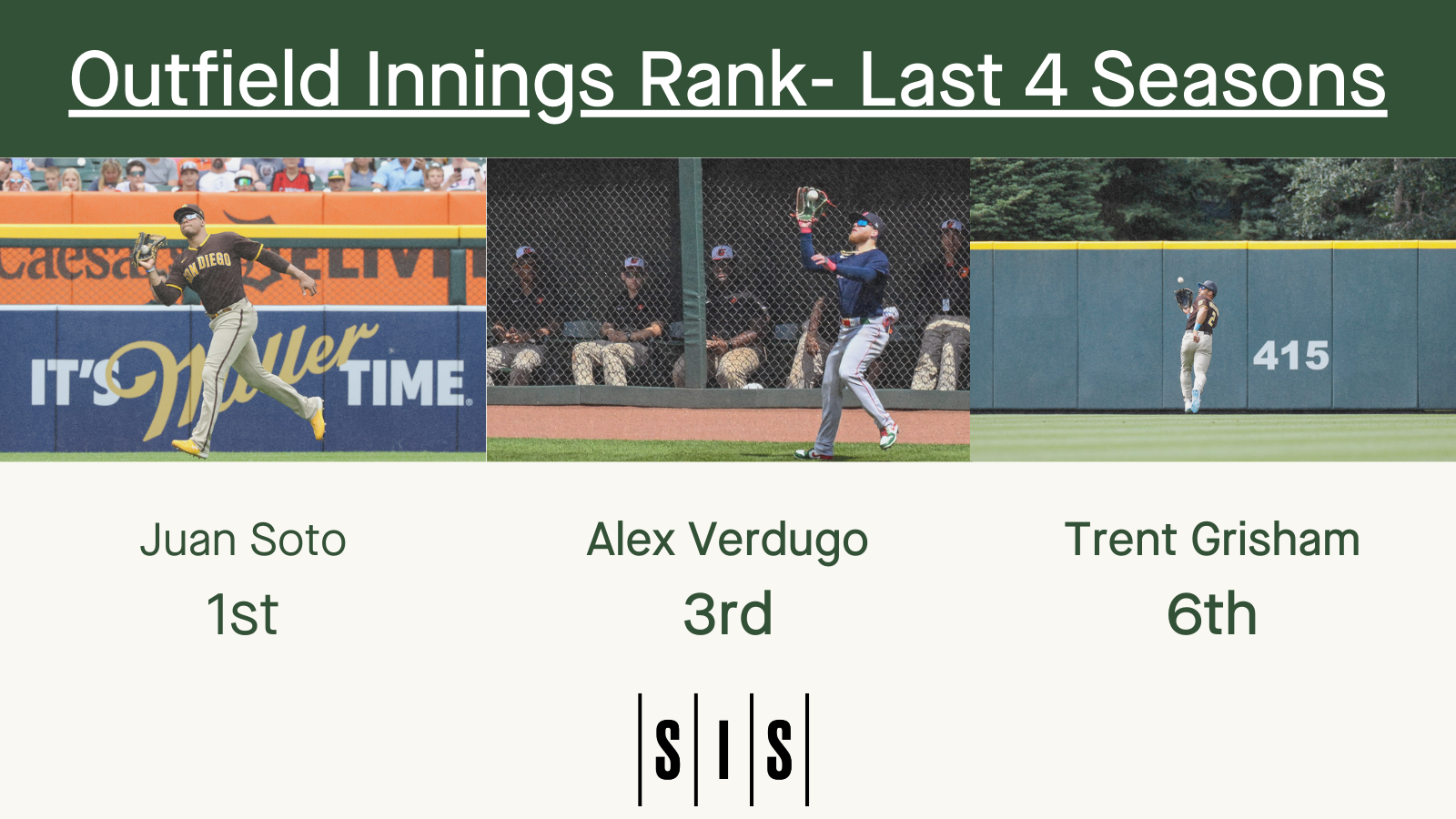
    These are the players who have logged the most innings in the outfield over the last 4 seasons.

    Most Innings Played In Outfield – Last 4 Seasons

    Player Innings
    Juan Soto 4,202
    Kyle Tucker 4,159
    Alex Verdugo 4,086
    Myles Straw 4,068
    Ian Happ 4,023
    Trent Grisham 3,959

    What’s interesting here is that the Yankees just traded for 3 of the players on this list: Juan Soto, Alex Verdugo, and Trent Grisham.

    Soto’s performance speaks for itself. He’s an elite offensive player with 35-homer power and one of the best batting eyes in the sport. What’s scary is that he’s only 25 years old, is entering his walk season, and may not have peaked yet. As good as he was in 2023, he was only a 5.5 bWAR player. He has room to be better as a baserunner and fielder, two areas in which he ranked below average in 2023.

    Verdugo may have gotten benched by the Red Sox last year for lack of hustle but he still found his way onto the field for 142 games. He’s basically been an average hitter by OPS+ standards and an average player by bWAR standards the last 3 seasons. But being consistently average has value because it usually means that below-average options were kept off the field.

    Grisham is an interesting one. The last 2 seasons he’s hit .184 with a .626 OPS and .198 with a .666 OPS, respectively. But he also played 148 and 153 games in the field in those two seasons. He’s clearly valued for his defense and his baserunning. He ranks 5th in Defensive Runs Saved among center fielders over the last 4 seasons and ranks 4th in our Baserunning Gain stat over the last 2 seasons, which measures how often a runner takes an extra base, how often he makes outs on the bases, and how he fares at avoiding double plays.

    Verdugo and Grisham won’t have to be everyday players in the Yankees lineup so long as both Aaron Judge and Giancarlo Stanton are healthy. But one of the key reasons Grisham is a desirable option is how often Judge and Stanton have missed time. Judge played only 106 games last season (and DH’d in 38 of them). Stanton rarely plays the outfield anymore, only 71 games the last 2 seasons.

    The Yankees essentially took care of two needs with this combination of deals. One is that they needed better players than they had last season, when their outfield ranked last in Wins Above Average. They got that, with Soto being the marquee addition. But they also needed players with a track record of simply playing, and though past performance doesn’t guarantee future results, they did well in acquiring that as well.

  • Yankees and Astros Both Make Defensive Upgrades

    Yankees and Astros Both Make Defensive Upgrades

    That the Yankees finished 10th in MLB in Defensive Runs Saved disguised a significant defensive issue. Their corner outfielders rated terribly in that stat last season.

    The Yankees’ left fielders finished with -14 Runs Saved and their right fielders finished with -14 Runs Saved. They ranked tied for last with the Phillies in left field and next-to-last ahead of only the White Sox in right field.

    It was a rough go for almost everyone. The only one of their 10 left fielders to finish with a positive Runs Saved was Everson Pereira (2 Runs Saved in 27 games). None of their 9 right fielders finished with a positive Runs Saved total, not even usual standout Aaron Judge, who tallied -3 in his 54 games there.

    The eye test vindicates the numbers. There were plenty of just misses, miscommunications, and bad botches to go around.

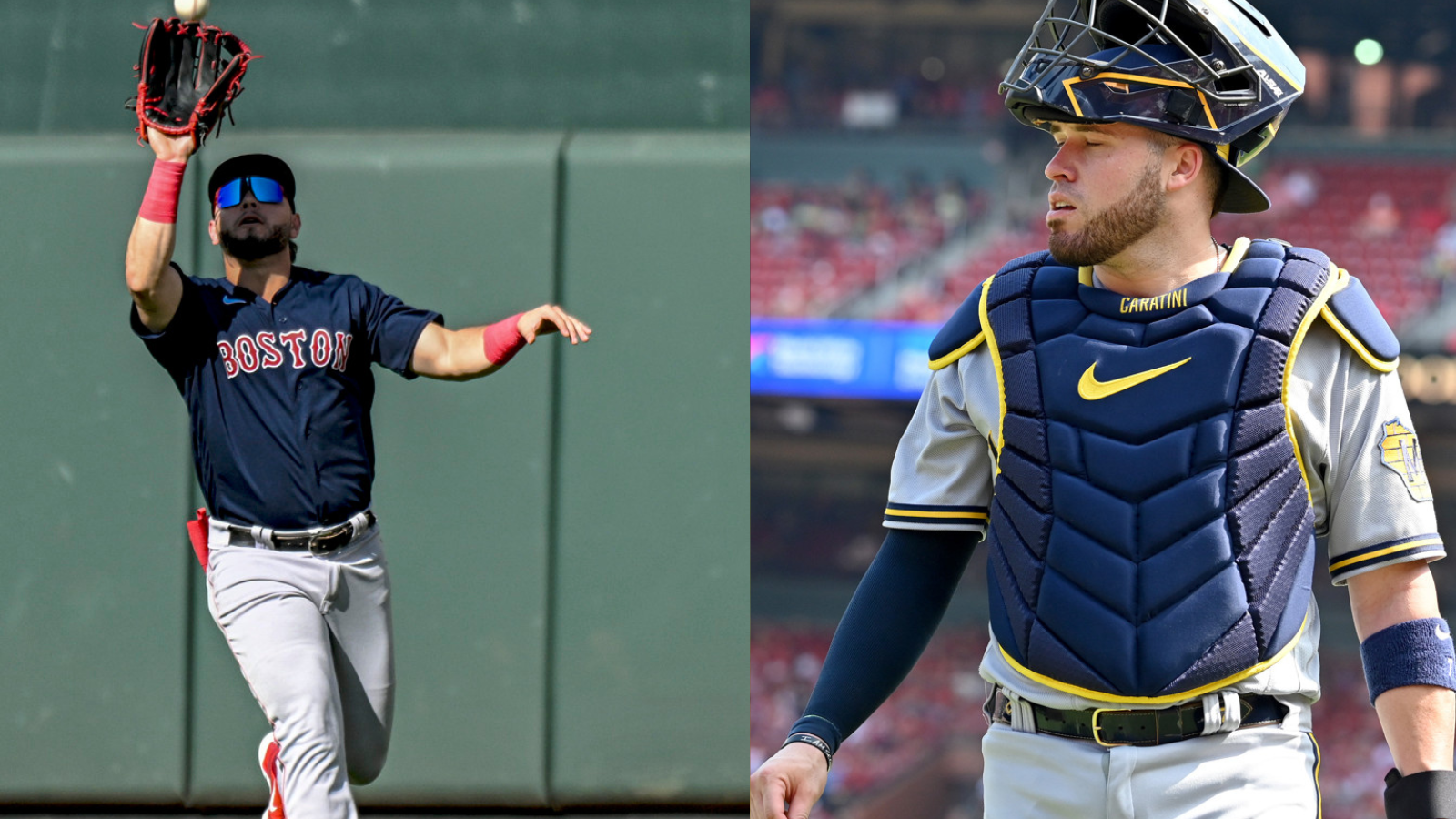
    That’s why the acquisition of Alex Verdugo in a trade from the Red Sox was significant. Verdugo had fallen out of favor in Boston and was benched once due to what manager Alex Cora termed a lack of hustle. But his defensive numbers are good.

    Verdugo had 9 Runs Saved in right field last season, tied for second at the position. He also has a strong track record in right field with 21 Runs Saved in just over 1,900 career innings, though he totaled 0 as the Red Sox most-used left fielder in 2022. Still, 0 would be a major upgrade over what the Yankees had in 2023.

    Verdugo should play one of those two spots regularly depending on whether the Yankees make a bigger acquisition like Juan Soto.

    Another team to make a defensive upgrade was the Astros, who agreed to a deal with catcher Victor Caratini to a 2-year contract. Caratini replaces the team’s primary starting catcher the last 3 seasons, Martín Maldonado, though he’s projected as the backup to Yainer Diaz.

    Maldonado was both a fan favorite and a pitcher favorite who won a Fielding Bible Award in 2017. He was beloved by Astros manager Dusty Baker for his pitching staff work. We don’t dispute that on his best days he was very good. But it’s fair to wonder what he’s got left. Maldonado totaled -10 Runs Saved last season. He still rated as a good pitch blocker, but by our pitch framing stat (Strike Zone Runs Saved), he ranked next-to-last among catchers.

    Caratini has a considerable defensive flaw. He threw out only 3-of-47 runners attempting to steal last season. But even with that, he still got to 0 Runs Saved last season and had 2 Runs Saved in 2022. He’s an adept pitch framer. Over the last 2 seasons he ranks 8th in Strike Zone Runs Saved per 1,000 innings among the 40 catchers who caught the most. 

    Diaz will get an increase in playing time. He totaled 4 Runs Saved in roughly 400 innings last season. Within that small sample, he had the highest block rate on potential wild pitches (96.2%) and totaled 3 Runs Saved for stolen base prevention (only 4 catchers had more). 

    Like Maldonado, Diaz didn’t fare well in pitch framing but Diaz did enough other things his total defensive package was a positive. He finished the season with 4 Runs Saved. Diaz and Caratini bode – at least on paper – as a better defensive combination than the Astros had last season.

  • Stat of the Week: MLB’s Most Improved Defenders

    Stat of the Week: MLB’s Most Improved Defenders

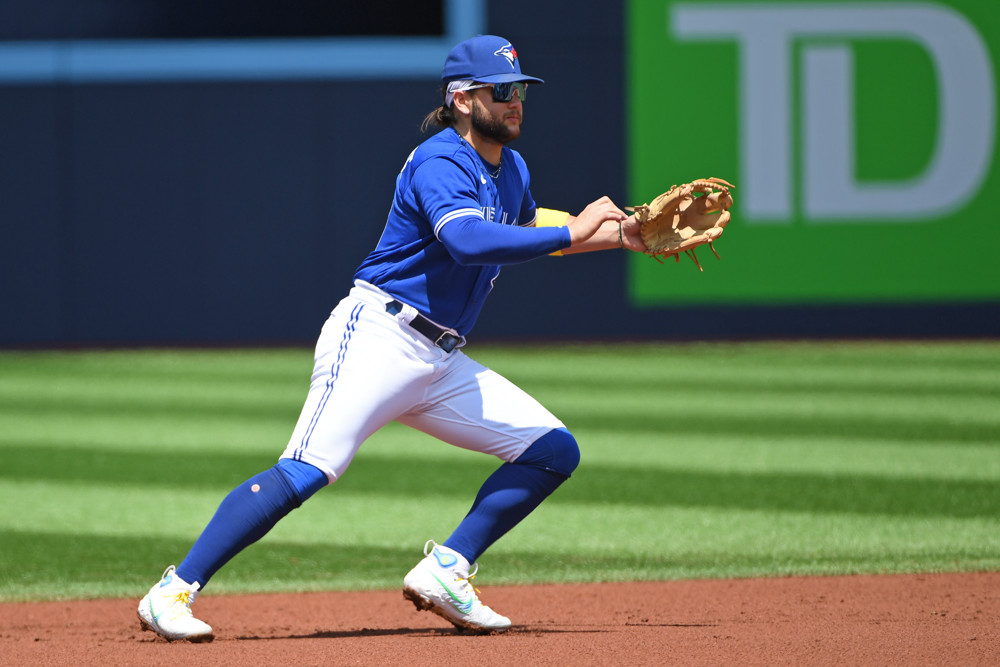
    Between social media and our website we lauded the Blue Jays outfield frequently in 2023 because they were so good defensively. But there was another big reason besides the outfield as to why the team led the majors in Defensive Runs Saved this past season. The Blue Jays had MLB’s most improved defensive player by that stat.

    Shortstop Bo Bichette went from -16 Runs Saved in 2022 to 5 Runs Saved in 2023. The 21-run improvement was the largest for anyone who played at least 500 total MLB innings in each of the last 2 seasons.

    Biggest Improvement in Defensive Runs Saved – 2022 to 2023

    Minimum 500 innings played in each season


    Player DRS Improvement
    Bo Bichette 21
    Nicky Lopez 20
    Andrew Vaughn 17
    Bobby Witt Jr. 16
    Wander Franco 16
    Thairo Estrada 14
    Alex Verdugo 14
    Yandy Díaz 14

    Bo Bichette

    Bichette’s improvement was most prominent specific to one aspect of his game – making plays on balls hit to the left of where he was initially positioned.

    Bo Bichette On Balls Hit To His Left

    Season Plays Made/Opportunities Out Rate (Plays Saved)
    2022 137/304 45% (-15)
    2023 129/219 59% (10)

    >> Opportunities = plays with a >0% out rate for the shortstop.

    To explain this chart:

    In 2022, Bichette made 137 plays on 304 balls that had a >0% out rate for the shortstop (that’s how we define an “opportunity”). According to our calculations, he made 15 fewer plays than an average shortstop would have on those balls (hence the -15 in the 3rd column of the chart).

    In 2023, he made 129 plays out of 219 opportunities. According to our calculations, he was 10 plays better than the average shortstop.

    You can see the difference in the out rates. Bichette went from a 45% out rate on balls hit to his left to 59%.

    Bichette’s throwing improvements may have played a role here. He went from 18 throwing errors and misplays (misplays being plays that weren’t scored errors but could have been) in 2022 to 7 in 2023.

    For more on Bichette, check out this Twitter thread from SportsNet Blue Jays producer Chris Black.

    Nicky Lopez

    Lopez, a utility player traded from the Braves to the White Sox this offseason, had been known as a good glove in the past but had a drop-off in 2022, particularly at second base, where he accrued -8 Runs Saved. He totaled 4 runs there in 2023 and fared better on balls hit to his right than he ever had before. Lopez also went from 1 Run Saved at third base to 5 Runs Saved there in a comparable though limited number of innings.

    Andrew Vaughn

    Vaughn’s improvement is the result of both a position switch (from corner outfield to first base) and improvement at his new full-time position. Vaughn totaled -17 Runs Saved in 2022, with -14 of those coming from his combined total in left field and right field. At first base in 2023, Vaughn rated MLB average, with 0 Runs Saved.

    Vaughn handed first base better than he did in the roughly 300 innings he played there in 2021 and 2022 when he amassed a combined -5 Runs Saved.