Category: NFL

  • New football podcast: All things Kansas City Chiefs

    LISTEN


    Former NFL scout Matt Manocherian (@mattmano) of Sports Info Solutions and football analytics pioneer Aaron Schatz (@FO_ASchatz) of Football Outsiders (@fboutsiders) welcome ESPN’s NFL Nation Kansas City Chiefs reporter and author of the new book “Kingdom: How Andy Reid, Patrick Mahomes, and the Kansas City Chiefs Returned to Super Bowl Glory”, Adam Teicher (@adamteicher) to the show.

    The group talks about Andy Reid and the culture he has cultivated in Kansas City (1:25), the development of Patrick Mahomes (5:02), whether Tyreek Hill or Travis Kelce is more important to the Chiefs success (7:36), what concerns surround the team in their quest for another Super Bowl (11:40), the development of the defense under Steve Spagnuolo (17:28), what to expect from the running backs in the playoffs (20:55), and if the offensive line should be a concern (23:35).

    You can email the show with feedback at offthecharts@ww2.sportsinfosolutions.com and don’t forget to follow on Twitter @SportsInfo_SIS and Instagram @sportsinfosolutions. For more, check out: sportsinfosolutions.com footballoutsiders.com sportsinfosolutionsblog.com SISDataHub.com

  • A Primer on Total Points, Our Total Value Stat for Football

    A Primer on Total Points, Our Total Value Stat for Football

    Below is the living documentation of the Total Points system, which is Sports Info Solutions’ player value metric for football (NFL and CFB).

    As updates get added to the system, we’ll add notes in this font to illustrate the most recent enhancements.

    The most recent set of enhancements were made in August 2024.

    Pass Plays / Run Plays / Additional Adjustments / How to Use It
     

    What does Total Points do?

    Total Points takes nearly everything that SIS measures about a play and uses it to evaluate each player on a scale that allows you to compare them more easily.

    It’s always useful to be able to understand the different ways in which players can be valuable. Does he break a lot of tackles? Does he get a lot of yards after the catch? Does he make the best out of a poor offensive line? Total Points offers the opportunity to take all of those elements and get a quick picture of how well a player is performing overall.

    What does the number mean?

    All of Total Points uses the Expected Points Added (EPA) framework. EPA works by taking any given situation and finding the odds that each different scoring possibility comes next. For example, if the next scoring play is a field goal by the current defensive team two drives from now, you count that as a -3. Average those values across all instances of the same situation and you get its Expected Points. Take the change in Expected Points on any given play and you get its EPA.

    Roughly, you can think of a 0 EPA play as one that “stays on schedule”, an EPA of 1 or more as a big play for the offense, and an EPA of negative-1 or less as a big play for the defense.

    Total Points starts by evaluating each player on that scale, where 0 is average. That’s what we call Points Above Average. Then to both reward players who play full seasons and keep the sum of Total Points around what we’d expect a team to score or allow, we scale the results to the league scoring average (around 22 points per game). So when you see Josh Allen’s 171 leading quarterbacks in 2023, you could take that as a rough estimate that he contributed just about 10 points per game to the Bills’ scoring average on his own.

    On the defensive side, it’s a little bit harder to wrap your mind around, because the scaling is exactly the same but points are bad for the defense. T.J. Watt’s 72 Points Saved in 2023 suggests that he was responsible for reducing his opponents’ scoring by that many points over the season.

    How does it work?

    We won’t go into complete detail here, but let’s run down the different data elements we consider, how they are evaluated in terms of EPA, and how they get bundled together.

    Total Points works on each of the passing game and running game as a whole, so we’ll walk through them that way.

    Pass Plays

    Blocking

    Everything starts up front. We start with identifying who was rushing the passer and who was blocking.

    Then, those players are assigned a base value based on the expected value of the play overall. Starting in 2019, this takes into account drop type. Prior to 2019, this just involved whether the play was a screen pass.

    Next, the line’s value is modulated by how long the play took to develop (starting in 2022). This uses our Expected Snap to Throw metric, and applies a multiplier to the baseline value corresponding to how much the timing of the play typically affects blown block rates (longer blocking, more credit for the line).

    Then, we estimate how likely each person was to either blow a block (offense) or force a blown block (defense). On each play, credit is assigned to each player based on how they performed compared to that expectation, and the resulting blown block plus-minus value is multiplied by the average EPA of a blown block.

    Players are additionally credited or debited if they were involved for good or for bad in a batted pass, deflection, or pressure, based on the average EPA of those events. For the 2019 season and beyond, our Pressures Above Expectation metric modulates the value assigned, with the form ({Pressure, No Pressure} – {Expected Pressure Rate}) x {Value of a Pressure}.


    Pass Attempts

    Each pass attempt gets split into five portions: throw, accuracy, catch, yards after catch before contact, and yards after contact.

    • Throw: We take the value of the route at the intended depth in terms of its completion rate and interception rate. Starting in 2023, throw openness (contested, wide open, or in-the-middle) is incorporated as well.
      • 75% owned by the quarterback, 25% owned by the receiver
    • Accuracy: Comparing actual throw accuracy to expected accuracy, and multiplying the difference by the value of an accurate throw (based on expected catch and YAC rates). Starting in 2020, this uses our Expected On-Target Rate metric. Prior to 2020, it uses catchable throw rate, because we didn’t have enough granular accuracy data.
      • 90% owned by the quarterback, 10% owned by the receiver
    • Catch: Comparing actual completion success to expected catch rate, and multiplying the difference by the value of a completion (with expected YAC). Drops are considered completions for the passer. Uncatchable passes are not evaluated for the receiver.
      • 10% owned by the quarterback, 90% owned by the receiver
      • From 2020-22, this is 30/70 because we don’t have throw openness data. Prior to 2020, this is 50/50 because we don’t have granular accuracy data.
    • Yards After Catch: Expected YAC is based on route, throw depth, and alignment. Starting in 2020, this includes granular throw accuracy. Starting in 2023, this includes throw openness. We give the receiver credit based on the difference in EPA between what he achieved and what was expected.
      • 0% owned by the quarterback, 100% owned by the receiver
      • From 2020-22, this is 40/60 because we don’t have throw openness data (and openness is the biggest driver of YAC). Prior to 2020, this is 50/50 because we don’t have granular accuracy data.
    • Yards After Contact: Expected YACon is based on route, throw depth, and alignment. Starting in 2020, this includes granular throw accuracy. Starting in 2023, this includes throw openness. We give the receiver credit based on the difference in EPA between what he achieved and what was expected.
      • 0% owned by the quarterback, 100% owned by the receiver

    The defense at large takes responsibility for the throw itself because many factors contribute to the throw that’s selected, but the primary defender in coverage is responsible for the catch and yards after catch.

    Any broken or missed tackles are evaluated according to their average EPA impact.

    If the pass is intercepted, the quarterback and defender are equally debited and credited based on where the ball was caught. The defender then gets extra credit for the change in field position from his return.

    All players running routes or defending in coverage have an expected target rate based on the coverage scheme, number of routes being run, route type, and alignment. Each player is assigned a value according to how many targets above expectation they had, scaled according to the EPA value of the potential target.


    Pressure, Sacks, and Fumbles

    Quarterbacks are given full responsibility for the sacks they incur (less the value of any blown blocks by the offensive line). They are given neither credit nor blame for pressure unrelated to blown blocks, with the idea that their throws are made more difficult but they also had some part in the pressure in the first place.

    Sacks or evaded sacks are measured using the EPA of the sack (or potential sack) and an expected sack rate. The sacker(s) get full credit, unless it was deemed a coverage sack, in which case the coverage unit splits the credit. Starting in 2019, expected sack rate uses the Pressures Above Expectation framework.

    Pass rushers are given credit for how well they generate pressures relative to the average of players lined up at the same position, with Pressures Above Expectation used from 2019 forward. Any pressure-related events that might have been debited from the line are given back to the receivers (and quarterback in the case of blown blocks), owing to their having a harder job as a result of the pressure.

    All fumbles, recovered or lost, are evaluated similarly. The value of the potential turnover from that spot on the field is multiplied by the odds that possession will be lost based on whether it was in the backfield or not. Lamar Jackson was docked a lot of value for his 15 fumbles in 2018, even if the Ravens recovered most of them.

    The person who recovers the fumble gets the inverse of the value that would be lost if the offense recovers or the “rest” of the fumble value if the defense recovers (i.e. the value of the turnover multiplied by the odds that it is recovered).

    Pass Plays / Run Plays / Additional Adjustments / How to Use It

    Run Plays

    Blocking

    Like with passing, the first step is to identify the blockers and box defenders. In addition, we use the intended and eventual run direction to identify the key blockers and defenders on the play (based on data elements like defensive techniques).

    From there, we calculate the play’s expected yards before and after contact based on the number of box defenders, the blocking scheme, the run direction, the spot on the field, etc. The blockers are evaluated based on the play’s performance above that expectation, with most of the credit or blame going to the key blockers identified earlier (unless the runner cut the run back or bounced outside, in which case things are more balanced among blockers).

    Starting in 2018, missed tackles (i.e. eluded without meaningful contact) that occur in the backfield are considered to be the point of contact for the purpose of evaluating the line.

    The earlier the back is contacted on the play, the more responsibility the offensive line takes for the result of the play. That ranges from taking on 90% of the responsibility for plays that are blown up to 25% of the yards before contact beyond the first fifteen.

    The same value is distributed among the box defenders, again focusing on the defenders at the intended gap. Blown blocks are evaluated similarly to what’s done in the passing game.

    On plays where the back bounces or cuts the run back, the linemen initially run behind are evaluated differently from those who the back eventually runs behind. The extent of the difference depends on the direction and magnitude of the back’s movement. For example, cutbacks of 3 or more gaps are the most valuable bounce or cutback, so the value lost by the initial linemen is small because the cost of the cutback is small.


    Rushing

    The runner is evaluated against the offensive line’s expected performance calculated above. The rusher is given some credit for yards before contact because elusive runners can generate their own space, but most of his value will come after contact. The back’s responsibility for yards before contact increases the more yards he gains before contact, as it’s more likely he had a role in that result.

    On any play where a broken or missed tackle was charted, we give the back a standard EPA amount based on the average value of a broken or missed tackle, with an adjustment for how likely an eluded tackle is on average. The EPA value is determined by comparing what happens when a tackle is made or eluded at the same yards downfield.

    Fumbles are treated like they are on pass plays.


    Tackling

    Given each defender’s initial alignment, the heaviness of the box, and the run direction, we estimate the probability that each player would make the tackle and the EPA that would be expected if each of the possible defenders made the tackle.

    A plus-minus system is used to combine the expected tackle rate and tackle value for each player and measure that against whether the player actually recorded a tackle. That system is also modified to ensure that making a tackle is always better than not making one, regardless of the value of said tackle compared to expectation.

    Broken or missed tackles are taken independent of where they are on the field, so each one is considered worth the value of an average broken or missed tackle in terms of EPA.

    Pass Plays / Run Plays / Additional Adjustments / How to Use It

    Additional Adjustments

    Play Selection

    At this point it’s common knowledge that run plays are less valuable on average than pass plays. At a basic level we can see this because the average yards per attempt on passes is much higher than it is on runs. In a similar way, play action passing is generally more effective than straight dropback passing.

    At a more granular level, coaches can make inefficient decisions by electing to, for example, run from heavy personnel on second-and-10. 

    In order to more accurately evaluate the players on a play as opposed to the coaches or situations, we implemented a Play Selection Adjustment, which applies to each player on each play. We take the expected value of the play given the run/pass decision—including whether there was a play fake on a dropback—and some personnel and game state information, compare it to an average play, take the difference, and distribute that value among the players involved. That way, a back being run into a heavy box time and again isn’t punished simply for being on the field in a sub-par situation for him.

    This adjustment generally moves a player a handful of points one way or the other depending on how often he was involved in pass or run plays over the course of a season.


    Season Scoring

    As mentioned above, after all of the initial calculations are done, we re-scale everything so that the league total is in line with the league’s scoring average, or just over 22 points per team per game. Because the quarterback represents the most obviously critical position, he’s given 1/3 of this adjustment for the offense, and the rest is split among the other offensive players.

    The Gist

    Let’s say that you read all this stuff and already kind of forget what you read at the beginning. Here’s a quick-and-dirty version:

    • We take Expected Points Added and give individual value to every player on every scrimmage play, starting in 2016
    • You can find it on the SIS DataHub player pages and leaderboards. Here’s the leaderboards for quarterbacks, offensive linemen, defensive linemen, and defensive backs as examples. The SIS DataHub Pro offers more detailed filtering ability and even more in-depth stats.
    • Pass Offense: Quarterbacks and receivers split value for the throw, the catch, after-catch yards, and after-contact yards. Additional considerations for offensive line performance, uncatchable passes, and drops.
    • Pass Defense: Defensive backs are measured on how often they are targeted above expectation, and much of the value that the receivers or QB get on a completion is correspondingly taken away from the defender. Pass rushers are credited for forcing blown blocks and disruptions at the point of attack. 
    • Rush Offense: The offensive line and running back both take responsibility for yards before contact (weighted towards the O-line), while yards after contact beyond what’s expected are totally owned by the back. Broken tackles hold a lot of value.
    • Rush Defense: Preventing yards before contact is the name of the game for the defensive line, while linebackers and defensive backs get value from making tackles that limit yardage compared to expectation and not missing out on easy tackle opportunities. 
    • In general, there’s a lot of value to be gained and lost from turnovers (or turnover-worthy plays) and plays in key spots (e.g. just outside field goal range, third down).

    Pass Plays / Run Plays / Additional Adjustments / How to Use It

    What do we do with it?

    Now that you’re familiar with what goes into Total Points, what do you do with it?

    The first thing you might do is find players whose traditional stats or reputation don’t line up with their rank in Total Points.

    How was Lamar Jackson barely above zero value rushing in 2018? You saw the reason for that above (his propensity to fumble).

    Why was James Conner such a standout in 2023, even above Offensive Player of the Year Christian McCaffrey? He had a worse offensive line and was elite when it came to yards after contact, production that he doesn’t split with anyone.

    Total Points gives us the opportunity to more critically engage with the stats players compile and consider the context in which he compiled them. And as SIS continues to add more data points to its operation, our assessment of those things will only get better.

  • New football podcast: Week 11 Preview

    LISTEN

    Former NFL scout Matt Manocherian (@mattmano) of Sports Info Solutions and football analytics pioneer Aaron Schatz (@FO_ASchatz) of Football Outsiders (@fboutsiders) look at the most important games on the NFL Week 11 schedule. Matt and Aaron dive into exciting matchups between the Titans-Ravens (0:54), Packers-Colts (5:30), Chiefs-Raiders (9:58), and Rams-Buccaneers (14:37).

    You can email the show with feedback at offthecharts@ww2.sportsinfosolutions.com and don’t forget to follow on Twitter @SportsInfo_SIS and Instagram @sportsinfosolutions. For more, check out: sportsinfosolutions.com footballoutsiders.com sportsinfosolutionsblog.com SISDataHub.com

  • (Updated) World’s No. 1 Quarterback Rankings

    By MARK SIMON & ALEX VIGDERMAN

    Week 10 was a heck of a bounceback for Tom Brady.

    Brady went from the basement and the worst Points Above Average (PAA) of Week 9 in a loss to the Saints to the best performance of the week in that stat in Week 10 against the Panthers. He was better at everything, perhaps most notably under pressure where he earned 10 Total Points after going 9-of-14 for 93 yards and a touchdown against the Panthers, but netted only 1 Total Point when he was 7-of-16 for 71 yards and an interception against the Saints.

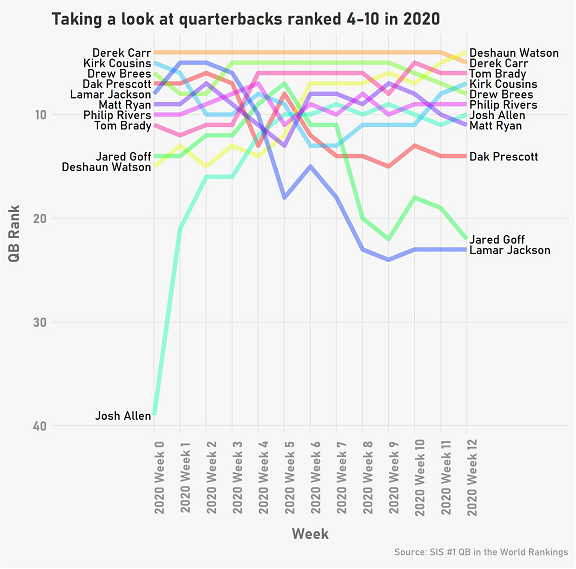
    As a result, Brady moved up three spots to No. 5 in our World’s No. 1 Quarterback rankings. He moved past Drew Brees, Deshaun Watson, and Matt Ryan. He’s in the Top 5 for the first time since he entered Week 14 of last season.

    The new Top 10 is:

    1. Patrick Mahomes

    2. Aaron Rodgers

    3. Russell Wilson

    4. Derek Carr

    5. Tom Brady

    6. Drew Brees

    7. Deshaun Watson

    8. Matt Ryan

    9. Philip Rivers

    10. Josh Allen

    The World’s No. 1 Quarterback Ranking is based on a model devised by Bill James to evaluate The World’s No. 1 Starting Pitcher. Bill’s model was based on cumulative evaluation of individual starts over an extended time period using the metric Game Score.

    The World’s No. 1 Quarterback Ranking uses our player value stat, Total Points to make a cumulative evaluation of game performance over a three-year period. The key to our calculation is Points Above Average, the statistical underpinning of Total Points that is centered at zero so that positive numbers are above average and negative numbers are below average.

    Success over time is key to maintaining a good ranking. Prolonged inactivity results in a ranking drop. The recent performances carry the most weight.

    Minor Adjustments

    There wasn’t much movement among those quarterbacks other than Brady’s ascension. Rivers and Allen switched places after Rivers threw for 308 yards against the Titans and Allen threw two interceptions in a heartbreaking loss to the Cardinals.

    Rivers had the No. 3 game in PAA for the week behind Brady and Kirk Cousins, who remains nestled at the No. 11 spot in our rankings even after a strong showing on Monday Night Football against the Bears.

    Tua passes Lamar Jackson

    Elsewhere, Tua Tagovailoa  continued his rise after a respectable 169-yard, two-touchdown effort against the Chargers, moved up three spots to No. 23, and passed Lamar Jackson, Joe Burrow, and Jimmy Garoppolo.

    Tagovailoa still has room for growth. He ranks 35th in on-target percentage among the 40 quarterbacks with the most pass attempts.

    A rough quarterbacking week

    If it seemed like quarterbacks were off their game in Week 10, that’s a reasonable assessment. A season-high 11 quarterbacks turned in games of -5 PAA or worse. That was the most such games since Week 13 of the 2018 season had 12 (quarterbacks that week included Jeff Driskel, Josh McCown, Cody Kessler, and Mark Sanchez).

    Drew Lock suffered the most, falling from No. 28 to well out of the top 30 after throwing four interceptions against the Raiders.

    Lowest-Scoring PAA Games of Week 10

    PlayerGame PAAOpponent
    Nick Foles-14.0Vikings
    Drew Lock-11.6Raiders
    Jake Luton-9.2Packers
    Joe Burrow-8.0Steelers
    Nick Mullens-7.7Saints
    Teddy Bridgewater-7.3Buccaneers
    Josh Allen-7.0Cardinals
    Carson Wentz-5.8Giants
    Justin Herbert-5.4Dolphins
    Russell Wilson-5.2Rams
    Jameis Winston-5.049ers

    Alex Smith takes a positive from defeat

    Lastly (but no longer last), Alex Smith had the fourth-best game of the week by PAA with a 390-yard effort in a loss to the Vikings. That moved him out of the bottom spot (No. 83) in our rankings, which is now held by Sam Darnold. Carson Wentz’s descent continues. He’s only one spot ahead of Darnold.

    The complete rankings are below.

    World’s No. 1 Quarterback Rankings

    RkPlayerPAA Per 60Last RkStart Of Season
    1Patrick Mahomes7.211
    2Aaron Rodgers6.622
    3Russell Wilson4.833
    4Derek Carr3.944
    5Tom Brady3.8811
    6Drew Brees3.556
    7Deshaun Watson3.5615
    8Matt Ryan3.179
    9Philip Rivers2.21010
    10Josh Allen1.5939
    11Kirk Cousins1.2115
    12Dak Prescott0.6147
    13Ryan Tannehill0.61322
    14Kyler Murray0.51217
    15Matthew Stafford0.31716
    16Teddy Bridgewater0.01521
    17Justin Herbert0.016N/A
    18Ryan Fitzpatrick-0.51813
    19Ben Roethlisberger-0.52135
    20Jared Goff-0.62214
    21Jacoby Brissett-0.61912
    22Taysom Hill-1.02018
    23Tua Tagovailoa-1.326N/A
    24Lamar Jackson-1.7258
    25Joe Burrow-1.823N/A
    26Jimmy Garoppolo-1.82420
    27Baker Mayfield-2.22741
    28Matt Moore-2.32924
    29Chase Daniel-2.43025
    30Matt Schaub-2.73332
    31Blake Bortles-2.73433
    32Jeff Driskel-2.73529
    33Mike Glennon-2.73638
    34Gardner Minshew-2.73730
    35Brett Hundley-2.83840
    36Nate Sudfeld-2.83942
    37Trevor Siemian-2.84044
    38Geno Smith-2.84143
    39Paxton Lynch-2.84245
    40David Fales-2.84346
    41DeShone Kizer-2.84448
    42Joshua Dobbs-2.84549
    43David Blough-2.84751
    44Sean Mannion-2.94852
    45Josh McCown-2.94956
    46Cody Kessler-2.95055
    47Marcus Mariota-2.95147
    48AJ McCarron-2.95258
    49Blaine Gabbert-2.95459
    50Case Keenum-2.95327
    51Jameis Winston-3.03226
    52Matt Barkley-3.05560
    53Robert Griffin III-3.05662
    54Cam Newton-3.07331
    55Nick Mullens-3.03137
    56Garrett Gilbert-3.057N/A
    57C.J. Beathard-3.05853
    58Mason Rudolph-3.15964
    59Drew Lock-3.12836
    60Jarrett Stidham-3.260N/A
    61Brandon Allen-3.26165
    62Nathan Peterman-3.26275
    63Joe Flacco-3.37157
    64Devlin Hodges-3.36367
    65Tyrod Taylor-3.36463
    66Colt McCoy-3.46569
    67Daniel Jones-3.47566
    68Brian Hoyer-3.46668
    69Nick Foles-3.56728
    70Eli Manning-3.56870
    71Kyle Allen-3.66973
    72Jake Luton-3.646N/A
    73Andy Dalton-3.67054
    74Brett Rypien-3.772N/A
    75Alex Smith-3.98323
    76Ben DiNucci-3.974N/A
    77Will Grier-4.17674
    78Josh Rosen-4.17876
    79Mitchell Trubisky-4.17771
    80Ryan Finley-4.47977
    81Dwayne Haskins-4.78134
    82Carson Wentz-4.88019
    83Sam Darnold-5.38250
  • New football podcast episode: Week 10 Preview + Patrick Jones II Scouting Report

    LISTEN

    Former NFL scout Matt Manocherian (@mattmano) of Sports Info Solutions and football analytics pioneer Aaron Schatz (@FO_ASchatz) of Football Outsiders (@fboutsiders) look at the most important games on the NFL Week 10 schedule. Matt and Aaron take in in-depth look at the Seahawks-Rams (1:56), Vikings-Bears (9:26), and Eagles-Giants (19:54) before welcoming SIS Lead Scout Nathan Cooper (@coopaloop08) to give his assessment of Pitt EDGE Patrick Jones II (@P_jones9) (25:15).

    You can email the show with feedback at offthecharts@ww2.sportsinfosolutions.com and don’t forget to follow on Twitter @SportsInfo_SIS and Instagram @sportsinfosolutions. For more, check out: sportsinfosolutions.com footballoutsiders.com sportsinfosolutionsblog.com SISDataHub.com

  • Updated World’s No. 1 QB Rankings (Through Week 9)

    Updated World’s No. 1 QB Rankings (Through Week 9)

    By MARK SIMON AND ALEX VIGDERMAN

    The jockeying for position among the NFL’s elite quarterbacks continued in Week 9.

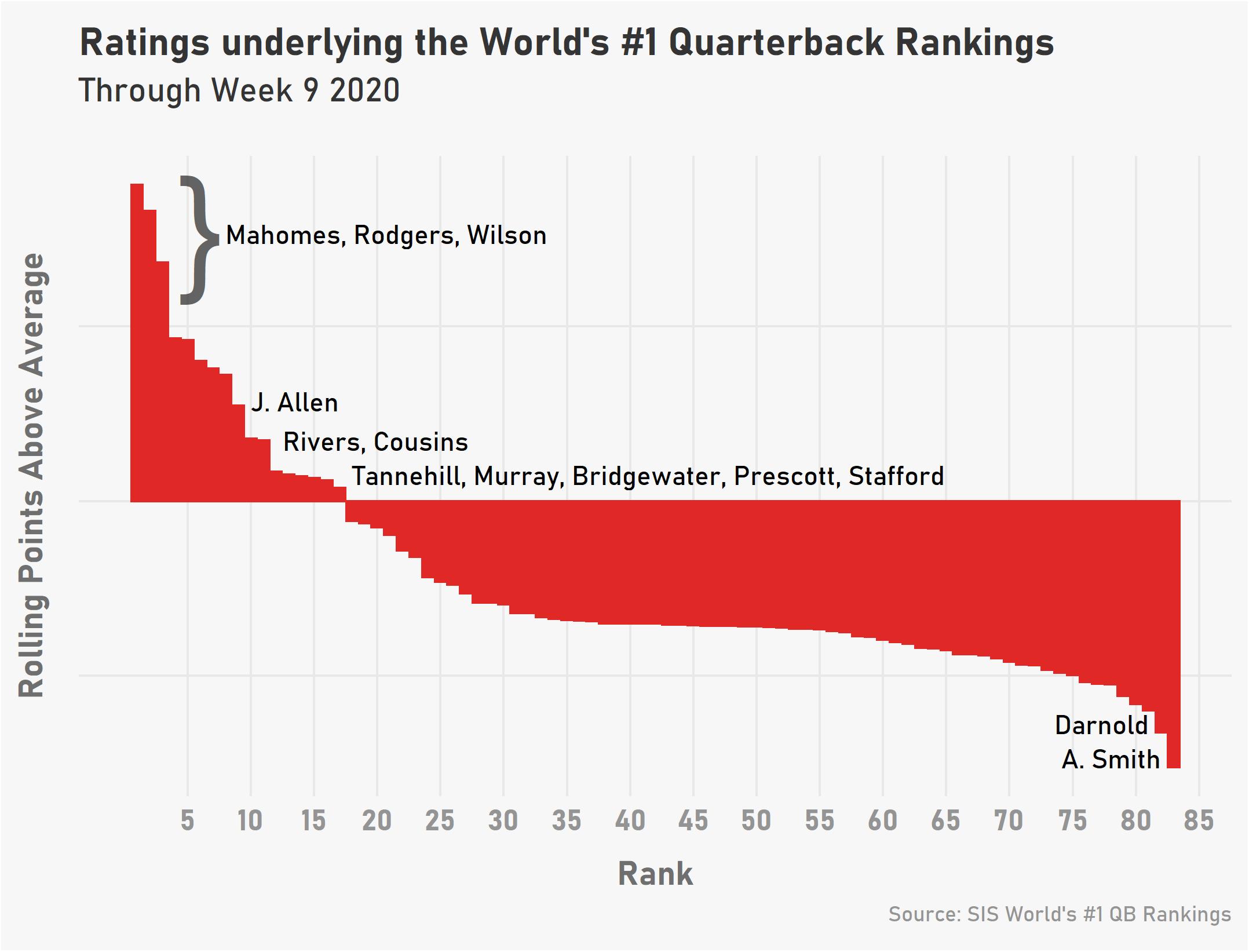
    Aaron Rodgers’ big game against the 49ers bumped him up to the No. 2 position in our World’s No. 1 Quarterback Rankings. Patrick Mahomes remains safely nestled in the No. 1 spot after another huge effort against the Panthers. Russell Wilson dropped from No. 2 to No. 3 after his first negative-scoring game of the season (two interceptions and two fumbles will do that).

    BestQuarterback_AllQB_Wk92020

    A reminder of what this is:

    The World’s No. 1 Quarterback Ranking is based on a model devised by Bill James to evaluate The World’s No. 1 Starting Pitcher. Bill’s model was based on cumulative evaluation of individual starts over an extended time period using the metric Game Score.

    The World’s No. 1 Quarterback Ranking uses our player value stat, Total Points to make a cumulative evaluation of game performance over a three-year period. The key to our calculation is Points Above Average, the statistical underpinning of Total Points that is centered at zero so that positive numbers are above average and negative numbers are below average.

    Success over time is key to maintaining a good ranking. Prolonged inactivity results in a ranking drop. The recent performances carry the most weight.

    Elsewhere, Drew Brees looks to be on the verge of catching Derek Carr for No. 4 in our rankings. Carr had his second straight negative-scoring game in Points Above Average, making way for Brees, who threw for four touchdowns and completed more than 80% of his passes in a win over the Buccaneers, to reach and pass him.

    We should note though that Brees didn’t gain that much. By Points Above Average this was his fifth-best game of the season and didn’t even crack the top ten for any quarterback in Week 9. He rose relative to Carr because the Raiders QB posted his second below-average game in a row.

    No. 6 Deshaun Watson is also within striking distance of Carr’s spot. Watson ranks third in the NFL in Total Points this season behind Mahomes and Josh Allen, tied with Rodgers.

    Watson moved ahead of Tom Brady in the rankings after Brady had the worst Points Above Average game of any quarterback last week. Watson has strung together three statistically-strong games in a row, though his team has won only one of them.

    Josh Allen now ranks No. 9 overall, moving up one spot after Philip Rivers dropped two places (and nearly dropped three spots) to No. 10. Rivers essentially tied with Brady for the worst game of any quarterback last week (one week after we made him the lede in this weekly review).

    The current Top 10 is as follows:

    1. Patrick Mahomes
    2. Aaron Rodgers
    3. Russell Wilson
    4. Derek Carr
    5. Drew Brees
    6. Deshaun Watson
    7. Tom Brady
    8. Matt Ryan
    9. Josh Allen
    10. Philip Rivers

    Kirk Cousins is the line of demarcation

    The top 11 is currently a tough group to crack. Kirk Cousins currently holds that last spot. He’s averaging twice as many Points Above Average per 60 snaps in the weighted calculation than No. 12 Ryan Tannehill.

    Cousins ranks No. 19 in Total Points this season but remains highly ranked in this system because he finished No. 7 last season and No. 10 in 2018. Those give him some staying power, though it won’t help for long.

    Cousins has had an odd season. He leads the league with 8.9 yards per attempt but also ranks second with 10 interceptions. The Vikings rank last in the NFL in pass attempts per game but that doesn’t hurt Cousins since this metric is based on per-snap performance.

    Hello, Tua Tagovailoa!

    The Dolphins QB had a breakthrough game against the Cardinals last week checking off all the boxes. He went 4-of-6 on throws at least 15 yards downfield, 4-of-6 when pressured, and 3-of-3 on third down.  Tagovailoa had the third-highest Points Above Average for a quarterback in Week 9 behind Rodgers and Ben Roethlisberger. One great game allowed him to move from No. 59 to No. 26 (one spot behind Lamar Jackson).

    It will be a battle of the rookies on Sunday afternoon when Tagovailoa goes up against the Chargers, whose rookie QB Justin Herbert ranks No. 17. Herbert’s game this past Sunday against the Raiders ranked No. 6 for the week.

    Herbert has had a slow progression from No. 25 after his debut in Week 2 to his current spot. He’s coming off the best start of his career.

    Here are the updated rankings. We’ve removed any quarterback who hasn’t been on a depth chart in the last year.

    Rank Name PAA Per 60 Snaps Last Wk Rank Start of Season Rank
    1 Patrick Mahomes 7.2 1 1
    2 Aaron Rodgers 6.6 3 2
    3 Russell Wilson 5.5 2 3
    4 Derek Carr 3.7 4 4
    5 Drew Brees 3.7 5 6
    6 Deshaun Watson 3.2 7 15
    7 Tom Brady 3.0 6 11
    8 Matt Ryan 2.9 9 9
    9 Josh Allen 2.2 10 39
    10 Philip Rivers 1.4 8 10
    11 Kirk Cousins 1.4 11 5
    12 Ryan Tannehill 0.7 12 22
    13 Kyler Murray 0.6 15 17
    14 Teddy Bridgewater 0.6 16 21
    15 Dak Prescott 0.5 14 7
    16 Matthew Stafford 0.5 13 16
    17 Justin Herbert 0.3 18 N/A
    18 Jacoby Brissett -0.5 17 12
    19 Ryan Fitzpatrick -0.5 19 13
    20 Taysom Hill -0.6 21 18
    21 Ben Roethlisberger -0.8 25 35
    22 Jared Goff -1.1 20 14
    23 Joe Burrow -1.3 22 N/A
    24 Jimmy Garoppolo -1.7 24 20
    25 Lamar Jackson -1.8 23 8
    26 Tua Tagovailoa -1.9 59 N/A
    27 Baker Mayfield -2.1 26 41
    28 Drew Lock -2.3 28 36
    29 Matt Moore -2.3 29 24
    30 Chase Daniel -2.4 30 25
    31 Nick Mullens -2.6 27 37
    32 Jameis Winston -2.6 31 26
    33 Matt Schaub -2.7 32 32
    34 Blake Bortles -2.7 33 33
    35 Jeff Driskel -2.7 34 29
    36 Mike Glennon -2.7 35 38
    37 Brett Hundley -2.8 36 40
    38 Nate Sudfeld -2.8 37 42
    39 Trevor Siemian -2.8 38 44
    40 Geno Smith -2.8 39 43
    41 Paxton Lynch -2.8 40 45
    42 David Fales -2.8 41 46
    43 DeShone Kizer -2.8 42 48
    44 Joshua Dobbs -2.8 43 49
    45 David Blough -2.8 44 51
    46 Sean Mannion -2.9 45 52
    47 Jake Luton -2.9 N/A N/A
    48 Josh McCown -2.9 46 56
    49 Cody Kessler -2.9 48 55
    50 Marcus Mariota -2.9 47 47
    51 Gardner Minshew -2.9 49 30
    52 Garrett Gilbert -2.9 N/A N/A
    53 AJ McCarron -2.9 51 58
    54 Case Keenum -2.9 50 27
    55 Blaine Gabbert -2.9 52 59
    56 Matt Barkley -3.0 53 60
    57 Robert Griffin III -3.0 54 62
    58 C.J. Beathard -3.1 55 53
    59 Mason Rudolph -3.1 56 64
    60 Jarrett Stidham -3.2 57 NULL
    61 Brandon Allen -3.2 58 65
    62 Nathan Peterman -3.3 60 75
    63 Devlin Hodges -3.4 61 67
    64 Tyrod Taylor -3.4 62 63
    65 Colt McCoy -3.4 63 69
    66 Nick Foles -3.5 71 28
    67 Brian Hoyer -3.5 64 68
    68 Eli Manning -3.5 66 70
    69 Andy Dalton -3.6 67 54
    70 Kyle Allen -3.7 68 73
    71 Brett Rypien -3.7 69 N/A
    72 Joe Flacco -3.8 70 57
    73 Ben DiNucci -3.9 72 N/A
    74 Cam Newton -3.9 73 31
    75 Daniel Jones -4.0 65 66
    76 Will Grier -4.1 74 74
    77 Josh Rosen -4.2 76 76
    78 Mitchell Trubisky -4.2 75 71
    79 Ryan Finley -4.5 77 77
    80 Carson Wentz -4.7 78 19
    81 Dwayne Haskins -4.8 79 34
    82 Sam Darnold -5.3 81 50
    83 Alex Smith -6.1 80 23

  • Who have been the best QBs at throwing long passes in 2020?

    By KYLE RODEMANN

    Completing a deep pass can be a vital turning point in a game. In Week 17 of the 2020 NFL season, the Titans needed to secure a victory against the Texans. They were tied with less than a minute left and it looked like the game would go into overtime. Then Ryan Tannehill completed a deep pass to A.J. Brown that allowed the team to kick a field goal and win the game.

    That wasn’t the only such meaningful deep throw of 2020. There were plenty of them.

    Who were the best NFL QBs at completing the long pass this season? This article will take a look at different stats ranging from usage to overall effectiveness.

    For our purposes, we’re referring to balls thrown at least 20 yards downfield, unless otherwise stated. Minimum of 25 deep pass attempts.

    Most Deep Balls Attempted

    A quarterback who is known as a risk taker will always keep a defense honest. That defense has to plan around the deep shots, leaving safeties back and loading the box at a lower rate.

    Which quarterbacks have thrown deep the most so far in the 2020 season? The answer is in the table below:

    QuarterbackNumber of Throws
    Tom Brady83
    Matt Ryan75
    Aaron Rodgers72
    Patrick Mahomes66
    Josh Allen65
    Ben Roethlisberger65
    Drew Lock64
    Matthew Stafford62

    Buccaneers quarterback Tom Brady ends the year as the league-leader in deep passes attempted. With a head coach in Bruce Arians who loves to take deep shots, and a supporting cast of Mike Evans, Chris Godwin, and Antonio Brown, this does not come as a surprise.

    Falcons quarterback Matt Ryan ended the 2020 season with an NFL-high 626 pass attempts and he likes to throw long, so it’s not shocking that he’s second on this list. Perhaps a surprise in the top eight is Drew Lock of the Broncos, a second-year signal caller, though he was known for his arm in college. While he threw the ball deep often, his on-target percentage of 50% was below league-average (52%) and ranked tied for 19th among our 32 qualifiers.

    Highest On-Target Percentage

    It is one thing to attempt deep passes; it is a whole other thing to be accurate on them. On-Target Percentage looks at the percentage of passes that hit the receiver in stride.

    Below is a table of the season leaders in On-Target Percentage on deep balls for 2020.

    QuarterbackOn-Target %
    Cam Newton70%
    Aaron Rodgers64%
    Kirk Cousins63%
    Baker Mayfield63%
    Derek Carr63%
    Kyler Murray61%
    Daniel Jones61%
    League average: 52%

    Patriots quarterback Cam Newton tops this list partly because of where we set our qualifier (25 attempts). He had 28 deep attempts in 2020 and had an on-target percentage of 70% on them. Among the more prolific deep throwers, it was tight at the top of the leaderboard. Packers QB Aaron Rodgers displayed MVP-like accuracy, while Baker Mayfield of the Browns and Kyler Murray of the Cardinals showed us that their future in this area looks bright.

    For those wondering, Mitchell Trubisky (32%), Joe Flacco (39%) and Carson Wentz (39%) were the bottom three quarterbacks on the list. And for those looking for how each player’s completion percentage compares, check out this tweet from Dan Pizzuta of Sharp Football Analysis.

    Highest Touchdown Percentage

    Touchdown percentage not only can tell you how successful a QB is at throwing deep, but also how successful their receivers are at finishing the explosive plays by scoring.

    These QBs threw a touchdown at the highest rate when throwing the ball 20 or more yards downfield:

    QuarterbackTD% (TDs Thrown)
    Patrick Mahomes18% (12)
    Aaron Rodgers17% (12)
    Derek Carr16% (9)
    Deshaun Watson16% (9)
    Dak Prescott15% (4)
    Russell Wilson15% (9)
    Justin Herbert15% (9)
    League average: 10%

    Having Tyreek Hill and Travis Kelce to throw to has helped Chiefs quarterback Patrick Mahomes top the NFL in TD percentage on long passes. Rodgers makes another appearance on a deep ball leaderboard, and he and Mahomes share the distinction of their receivers being in the top 10 in the league in dropped deep passes, so there were even more touchdowns left on the table.

    A surprising name on this list is Dak Prescott, who missed most of the season due to injury but was incredibly prolific in the early going, leveraging his excellent receiver group and terrible defense.

    Overall

    Points Earned is one way to determine which quarterbacks have made the largest positive impact while throwing the deep ball. Here is a quick explanation of Points Earned, as shared by Alex Vigderman:

    The core assumption of passing Points Earned is that each throw has a certain expected outcome based on information like the route, the depth, and the coverage. From that point, the passer and receiver split responsibility for how well they perform above that expectation. Throwing off-target passes and deserved interceptions (caught or not) will bury a signal-caller, while he will be rewarded for leading receivers to more yards after catch and making something out of a broken pocket.

    A more in-depth explanation can be found here. This stat shows which quarterback has helped his team win the most when throwing the deep ball.

    Of the lists we’ve shown, this is the one that best reflects overall value on long passes. Check out the league leaders below:

    RankPlayerAttemptsPoints Earned
    1Aaron Rodgers7246.5
    2Tom Brady8328.9
    3Derek Carr5628.4
    4Deshaun Watson5826.2
    5Matthew Stafford6220.6
    6Kyler Murray5820
    7Daniel Jones3919.9
    8Russell Wilson6018.9
    9Patrick Mahomes6618.8
    10Justin Herbert6113.5

    If the MVP race was determined by the deep ball, Rodgers would probably win it. He has been lights-out this season when throwing deep, making every leaderboard in this article.

    Who do you think will make this list next year? Any under-the-radar names come to mind? Check back next season to find out!


  • New football podcast: Week 9 preview, breakdown of No. 1 QB

    Former NFL scout Matt Manocherian (@mattmano) of Sports Info Solutions and football analytics pioneer Aaron Schatz (@FO_ASchatz) of Football Outsiders (@fboutsiders) look at the most important games on the NFL Week 9 schedule. Matt and Aaron open with an in-depth breakdown of the Saints-Buccaneers matchup (1:51) before moving on to a look at the Ravens-Colts (9:35), Raiders-Chargers (13:46), and Dolphins-Cardinals (18:45). The show closes with a discussion between Matt and SIS Lead Football Researcher Alex Vigderman (@VigManOnCampus) on a new rankings list: The World’s No. 1 Quarterback (24:44).

    You can email the show with feedback at offthecharts@ww2.sportsinfosolutions.com and don’t forget to follow on Twitter @SportsInfo_SIS and Instagram @sportsinfosolutions. For more, check out: sportsinfosolutions.com footballoutsiders.com sportsinfosolutionsblog.com SISDataHub.com

  • World’s No. 1 QB Rankings Through Week 8

    By MARK SIMON AND ALEX VIGDERMAN

    Don’t write off Philip Rivers just yet.

    As we wrote for Sharp Football a few weeks ago, Rivers was not necessarily as bad as he looked in that Colts Week 5 loss to the Browns. He now checks in as the No. 8 quarterback in our World’s No. 1 Quarterback Rankings, which we introduced last week (click here to read).

    Rivers undid the statistical damage he inflicted upon himself in that Browns loss with by far his best games of the season against the Bengals and Lions, which moved him up to his current spot. In fact, he ranked second in Points Above Average in quarterbacks in Week 8 behind only Patrick Mahomes. That was driven by three touchdown passes and good numbers on passes 10-to-19 yards downfield (5-of-9, 88 yards). That staves off any calls for capable backup Jacoby Brissett for the time being.

    Our current Top 10 in the World’s No. 1 Quarterback Rankings is as follows

    1. Patrick Mahomes

    2. Russell Wilson

    3. Aaron Rodgers

    4. Derek Carr

    5. Drew Brees

    6. Tom Brady

    7.Deshaun Watson

    8. Philip Rivers

    9. Matt Ryan

    10. Josh Allen

    A reminder of what this is: The World’s No. 1 Quarterback Ranking is based on a model devised by Bill James to evaluate The World’s No. 1 Starting Pitcher. Bill’s model was based on cumulative evaluation of individual starts over an extended time period using the metric Game Score.

    The World’s No. 1 Quarterback Ranking uses our player value stat, Total Points to make a cumulative evaluation of game performance over a three-year period. The key to our calculation is how a quarterback performs in Points Above Average Per 60 Snaps in each game over a three year period.

    Points Above Average is the statistical underpinning of Total Points, just centered at zero so that positive numbers are above average and negative numbers are below average. Success over time is key to maintaining a good ranking. Prolonged inactivity results in a ranking drop. The recent performances carry the most weight. Understand too that this list includes some oddities (yes, Taysom Hill is ranked ahead of a bunch of starters) that are products of our ever-evolving system. Also, we’ve kept in anyone who played a snap in the last three years, even 21 QBs who aren’t in the league any more.

    Patrick Mahomes, Russell Wilson and Aaron Rodgers rank No. 1-3. Mahomes widened his lead on Wilson by a smidge after each had a great game in Week 8 (Mahomes with five touchdowns vs the Jets, Wilson with four against the 49ers). Rodgers’ numbers held steady in the No. 3 spot. He’s not likely to quickly jump past either Mahomes or Wilson unless he has a great game and they have a poor one.

    Among the surprises in the initial rankings were how well No. 4-ranked Derek Carr did, which was attributable to excellent performance on third down last season.

    As for Rivers, the competition gets tougher the next several weeks with the Ravens, Titans, Packers, Titans, and Texans up next.

    The top six quarterbacks remained the same as a week ago. Rivers moving up two spots slid Matt Ryan and Josh Allen down one each. Ryan moving down a spot was a product of circumstances. He had the fourth-highest Points Above Average total for Week 8 but that happened to be two spots behind Rivers (though he’s only a hair behind).

    Drew Brees and Tom Brady are in a virtual tie for the No. 5 spot after Brees had the edge entering the week.

    What’s interesting there is that the two had almost identical stat lines in Week 8

    Brees: 31-of-41, 280 yards, 2 TD, 0 INT

    Brady: 28-of-40, 279 yard, 2 TD, 0 INT

    But Brees lost value for a fumble and a dropped interception, and Brady doesn’t suffer any significant demerits.

    Goff and Jackson drop

    Last week, Jared Goff was close to being a Top-10 quarterback. He ranked 11th in our No. 1 QB Rankings. This week he ranks 20th.

    Goff plummeted because he had the second-worst game by a quarterback this season per Total Points Above Average. He was 35-of-63 for 355 yards and compounding a completion percentage (58%) that was about eight percentage points below the NFL average, were two interceptions and two lost fumbles. The only game to score worse in 2020 was Carson Wentz’s similar game (albeit with eight sacks instead of Goff’s two) in Week 1 against the Redskins.

    This was Goff’s third straight game with a negative Points Above Average. He entered Week 6 as the No. 7 ranked quarterback but these struggles have dropped him 13 spots.

    Lamar Jackson’s four-turnover game against the Steelers cost him five spots in our rankings, sinking him to No. 23. This game ranked as the fourth-worst by a quarterback this season. He had the third-worst game of the season in Week 5 against the Chiefs.

    Let’s be fair to Jackson and acknowledge that the two games most responsible for his current ranking are against teams that are a combined 14-1, and that there is currently no adjustment for quality of opponent in our rankings. Had Jackson played at an NFL average level in those two games, he’d be ranked just outside the Top 10.

    Let’s also note that he could have a hard time moving up the rankings as they currently stand. Three of his next four games are against the Colts, Titans, and Steelers.

    The full rankings are below.

    RankPlayerPoints Above Avg Per 60 SnapsLast Wk RkStart Of Season Rk
    1Patrick Mahomes7.111
    2Russell Wilson6.423
    3Aaron Rodgers5.932
    4Derek Carr4.144
    5Drew Brees3.456
    6Tom Brady3.4611
    7Deshaun Watson2.8715
    8Philip Rivers2.71010
    9Matt Ryan2.789
    10Josh Allen1.9941
    11Kirk Cousins1.6125
    12Ryan Tannehill1.01523
    13Matthew Stafford0.91316
    14Dak Prescott0.8147
    15Kyler Murray0.51617
    16Teddy Bridgewater-0.11722
    17Justin Herbert-0.321N/A
    18Jacoby Brissett-0.31912
    19Jared Goff-0.41114
    20Ryan Fitzpatrick-0.42013
    21Joe Burrow-1.125N/A
    22Taysom Hill-1.22318
    23Lamar Jackson-1.5188
    24Jimmy Garoppolo-1.62220
    25Baker Mayfield-1.82744
    26Ben Roethlisberger-1.82437
    27Andrew Luck-1.92621
    28Nick Mullens-2.13839
    29Drew Lock-2.22938
    30Matt Moore-2.32825
    31Chase Daniel-2.43026
    32Jameis Winston-2.63127
    33Matt Schaub-2.73233
    34Blake Bortles-2.73334
    35Jeff Driskel-2.73430
    36Brock Osweiler-2.73536
    37Mike Glennon-2.73640
    38Gardner Minshew-2.73731
    39Brett Hundley-2.73943
    40Matt Cassel-2.84042
    41Tom Savage-2.84145
    42Nate Sudfeld-2.84246
    43Trevor Siemian-2.84354
    44Geno Smith-2.84451
    45Landry Jones-2.84550
    46Drew Stanton-2.84652
    47Paxton Lynch-2.84756
    48Jay Cutler-2.84855
    49David Fales-2.84957
    50Bryce Petty-2.85058
    51T.J. Yates-2.85161
    52DeShone Kizer-2.85260
    53Joe Webb-2.85362
    54Joshua Dobbs-2.85463
    55David Blough-2.95565
    56Sean Mannion-2.95666
    57Josh McCown-2.95870
    58Marcus Mariota-2.95759
    59Cody Kessler-2.95969
    60Sam Bradford-2.96074
    61Mark Sanchez-2.96173
    62Case Keenum-2.96228
    63AJ McCarron-2.96372
    64Blaine Gabbert-2.96476
    65Taylor Heinicke-3.06575
    66Josh Johnson-3.06678
    67Matt Barkley-3.06777
    68Derek Anderson-3.06881
    69Robert Griffin III-3.06979
    70C.J. Beathard-3.17067
    71Mason Rudolph-3.17182
    72Tua Tagovailoa-3.1N/AN/A
    73Jarrett Stidham-3.272N/A
    74Brandon Allen-3.27383
    75Daniel Jones-3.37484
    76Nathan Peterman-3.37693
    77Tyrod Taylor-3.47580
    78Devlin Hodges-3.47785
    79Colt McCoy-3.58087
    80Brian Hoyer-3.58186
    81Eli Manning-3.68288
    82Andy Dalton-3.68368
    83Nick Foles-3.77929
    84Kyle Allen-3.78491
    85Luke Falk-3.88590
    86Joe Flacco-3.88671
    87Brett Rypien-3.887N/A
    88Cam Newton-4.08832
    89Ben DiNucci-4.1N/AN/A
    90Will Grier-4.28992
    91Mitchell Trubisky-4.29089
    92Josh Rosen-4.39194
    93Ryan Finley-4.59295
    94Carson Wentz-4.67819
    95Dwayne Haskins-5.09335
    96Alex Smith-5.39524
    97Sam Darnold-5.49464
  • Who is the World’s No. 1 Quarterback?

    Who is the World’s No. 1 Quarterback?

    Another article will be written about our rankings later this week.

    By Mark Simon and Alex Vigderman

    In 2011, baseball sabermetrician Bill James devised a system to rank starting pitchers with the intention of being able to crown one at any point as the World’s No. 1 Starting Pitcher.

    The system was based on game-to-game pitcher performance over their careers, using a stat he devised, Game Score (which scores starts based on innings, runs, hits, strikeouts, and walks). Recent performance was more valuable than past performance and pitching regularly was necessary to avoid dropping in the rankings.

    The current rankings have been dutifully updated at Bill James Online for several years.

    We thought we’d take the concept and apply it to the NFL. Let’s try to answer the question: Who is the World’s No. 1 Quarterback?

    My colleague Alex Vigderman has worked on a football player valuation stat, Total Points, for several years, and we put it to use here in a similar manner to how Game Score is used for World’s No. 1 Starting Pitcher.

    The key to our calculation is how a quarterback performs in Points Above Average Per Snap in each game over a three year period. Points Above Average is the statistical underpinning of Total Points, just centered at zero so that positive numbers are above average and negative numbers are below average. Success over time is key to maintaining a good ranking. Prolonged inactivity results in a ranking drop.

    Here are the top 10 quarterbacks in our rankings

    1. Patrick Mahomes

    2. Russell Wilson

    3. Aaron Rodgers

    4. Derek Carr

    5. Drew Brees

    6. Tom Brady

    7. Deshaun Watson

    8. Matt Ryan

    9. Josh Allen

    10. Philip Rivers

    Battle for the Top Spot

    Patrick Mahomes, Russell Wilson, and Aaron Rodgers have each taken turns in the No. 1 spot this season.

    Mahomes overtook Wilson after Wilson’s uneven (3 TD, 3 INT) game against the Cardinals in Week 7. Mahomes was good not great in a win over the Broncos (15-23, 200 pass yards, 1 TD). Rodgers, who was a more distant No. 3 after a 46% completion percentage, 2 INT day against the Buccaneers, bounced back with a four-touchdown game against the Texans in Week 7.

    Third-Down Success Drove Carr

    Derek Carr at No.4 probably raises some eyebrows, which is understandable. We should point out that he’s not close to the top three. The gap between Carr and Rodgers is bigger than the gap between him and the No. 7 QB, Deshaun Watson.

    Carr’s position is largely the product of his 2019 season, in which he ranked tied for third with Dak Prescott among NFL quarterbacks in Total Points behind Rodgers and Mahomes.

    It perhaps went under-the-radar that Carr was the best third-down quarterback in the league last season, recording a 78% catchable percentage (second in the NFL), 14 touchdowns (first) and one interception. That put him in the class of “he’s better than you might think” by Total Points. This season, Carr ranks 10th among quarterbacks in Total Points per snap. He’s been just good enough to have some staying power. Carr entered the season at No. 4 and hasn’t budged from that spot.

    A surprise omission

    Lamar Jackson ranks 18th which is an odd place to be for the reigning NFL MVP. Remember though that this is an accumulated ranking over two full seasons plus nearly half of 2020. Jackson’s fumbling struggles in 2018 produced nine straight games of negative Points Above Average. He ranked 80th (yes, 80th) entering 2019 and even an MVP season only took him so far.

    Jackson ranked as high as No. 5 after big games in the first two weeks of the season against the Browns and Texans. The slip began against the Chiefs, when he threw for only 97 yards, was sacked four times and fumbled in a 34-20 loss. But it took greater hold the next two weeks. Jackson comes off the bye week with four straight sub-200-yard games. His 108 rushing yards against the Eagles bumped him up a couple of spots in the rankings, but the play of others during his bye week (no fault of his) dipped him to No. 18 overall.

    The rise of Josh Allen

    Jackson is an example of a quarterback who has experienced some negative volatility. One on a positive ascent is Josh Allen. Allen started the season ranked 41st (yes, he was behind a good number of backups) but quickly moved the needle upward in Week 1 and 2 against the Jets (to 23rd) and Dolphins (to 16th). Allen’s roll has continued save for a stumble last week against the Jets that didn’t inflict considerable damage to his resume.

    Oldies but Goodies

    The “still-hanging-in-there” club, aka Drew Brees, Tom Brady, Matt Ryan, and Philip Rivers.

    Brees ranked No. 1 as recently as Week 14 in 2019. He dipped as low as No. 8 after Week 2 but has since jumped three spots and held in the top five.

    Ryan looked like he was going to drop out of discussion after the first five weeks of this season dropped him to No. 12. But strong games against the Vikings and in a (bizarre) loss to the Lions vaulted him back into the top 10.

    Rivers ranked No. 1 for a stint in 2018, the last instance being through Week 15. He’s hovered between No. 8 and 11 through the latter part of 2019 into 2020.

    Brady has ranked from No. 3 to No. 12 the last three seasons. His 5 TD game against the Chargers in Week 4 bumped him from No. 11 to No. 6, where he’s settled in since. He’s still a top-tier QB.

    A Long Road Back

    Yes, the Steelers are 6-0 but Ben Roethlisberger still has a ways to go to get back to where he used to be. He ended the 2018 season ranked No. 9 but was at No. 14 when he suffered a season-ending injury in Week 2 last season.

    That inactivity dropped him to No. 37 and though the Steelers have played great, Roethlisberger has three games with a positive Points Above Average and three games with a negative mark. As such, he checks in now at No. 27, two spots behind Joe Burrow and one spot behind Baker Mayfield.

    The Trailerboard

    Our list considers any quarterback who has taken a snap in the last three seasons, so there are some retired quarterbacks on the list. But there are some quarterbacks getting significant playing time who (if we’re going to be nice) have a lot of room for improvement.

    That includes Daniel Jones (No. 79), Carson Wentz (No. 84) and Sam Darnold (in last at No. 95).

    Jones and Darnold still look green in many respects. Wentz ranked No. 8 as recently as through 2019 Week 4. Wentz entered 2020 ranked No. 19 but even with that, his plummet would have been hard to predict. But three awful games to start the season dropped him to 90th (Total Points can be harsh on a struggling QB).

    We’ll take another look at the numbers and other quarterbacks next week. Hope you’ll keep up with our rankings.

    RankPlayerPoints Above Avg Per 60 Snaps
    1Patrick Mahomes6.5
    2Russell Wilson6.1
    3Aaron Rodgers6.0
    4Derek Carr4.2
    5Drew Brees3.9
    6Tom Brady3.6
    7Deshaun Watson2.7
    8Matt Ryan2.2
    9Josh Allen1.9
    10Philip Rivers1.8
    11Jared Goff1.3
    12Kirk Cousins1.2
    13Ryan Tannehill1.1
    14Matthew Stafford1.1
    15Dak Prescott0.9
    16Kyler Murray0.4
    17Teddy Bridgewater0.4
    18Lamar Jackson0.0
    19Jacoby Brissett-0.1
    20Ryan Fitzpatrick-0.3
    21Justin Herbert-0.5
    22Jimmy Garoppolo-1.4
    23Taysom Hill-1.4
    24Andrew Luck-1.8
    25Joe Burrow-1.8
    26Baker Mayfield-2.0
    27Ben Roethlisberger-2.0
    28Matt Moore-2.3
    29Chase Daniel-2.4
    30Jameis Winston-2.5
    31Matt Schaub-2.6
    32Blake Bortles-2.7
    33Jeff Driskel-2.7
    34Nick Mullens-2.7
    35Brock Osweiler-2.7
    36Drew Lock-2.7
    37Mike Glennon-2.7
    38Brett Hundley-2.7
    39Matt Cassel-2.8
    40Tom Savage-2.8
    41Nate Sudfeld-2.8
    42Trevor Siemian-2.8
    43Geno Smith-2.8
    44Landry Jones-2.8
    45Drew Stanton-2.8
    46Paxton Lynch-2.8
    47Jay Cutler-2.8
    48David Fales-2.8
    49Bryce Petty-2.8
    50T.J. Yates-2.8
    51Gardner Minshew-2.8
    52DeShone Kizer-2.8
    53Joe Webb-2.8
    54Joshua Dobbs-2.8
    55David Blough-2.9
    56Sean Mannion-2.9
    57Marcus Mariota-2.9
    58Josh McCown-2.9
    59Cody Kessler-2.9
    60Case Keenum-2.9
    61Sam Bradford-2.9
    62Mark Sanchez-2.9
    63AJ McCarron-2.9
    64Blaine Gabbert-3.0
    65Taylor Heinicke-3.0
    66Josh Johnson-3.0
    67Matt Barkley-3.0
    68Derek Anderson-3.0
    69Robert Griffin III-3.0
    70C.J. Beathard-3.1
    71Mason Rudolph-3.1
    72Brandon Allen-3.2
    73Jarrett Stidham-3.3
    74Nathan Peterman-3.4
    75Devlin Hodges-3.4
    76Tyrod Taylor-3.5
    77Colt McCoy-3.5
    78Nick Foles-3.5
    79Daniel Jones-3.5
    80Brian Hoyer-3.6
    81Eli Manning-3.6
    82Andy Dalton-3.7
    83Kyle Allen-3.8
    84Carson Wentz-3.8
    85Luke Falk-3.8
    86Joe Flacco-3.8
    87Brett Rypien-3.9
    88Cam Newton-4.2
    89Will Grier-4.3
    90Mitchell Trubisky-4.4
    91Josh Rosen-4.4
    92Ryan Finley-4.6
    93Dwayne Haskins-5.1
    94Alex Smith-5.2
    95Sam Darnold-5.7