Category: John Dewan’s Stat of the Week

  • Stat of the Week: 2021 Minor League Standouts

    Stat of the Week: 2021 Minor League Standouts

    By MARK SIMON

    The Braves have a long line of excellent defensive center fielders, from Marquis Grissom and Andruw Jones to more recently with Ender Inciarte. There’s another pretty good one in the pipeline in Michael Harris.

    Harris, a 20-year-old who was born in Dekalb, Georgia, not far from Atlanta, led all minor league center fielders with 14 Defensive Runs Saved this season for the Class-A Rome Braves.

    “Defensively, I feel like I can cover a lot of ground, have pretty good instincts out there, a decent arm,” Harris said recently on the SIS Baseball Podcast. “I can typically read where a ball is going to land or how hard it’s hit. I know what spot to get to when the ball is hit.”

    Harris should move up the prospect rankings heading into 2022. He had a .798 OPS, 58 points better than the High-A East league average and ranked tied for third in the league with 27 stolen bases in 31 attempts.

    One of the top minor league prospects, catcher Keibert Ruiz, was traded from the Dodgers to the Nationals in the deal that sent Max Scherzer and Trea Turner to the Dodgers.

    Ruiz, who has gotten a brief look in the majors in 2021, only helped his status in Triple-A this season. His 33% hard-hit rate (percentage of at-bats ending in a hard-hit ball) was the highest of anyone at that level.

    Ruiz hit .310 with a .993 OPS in 72 games in Triple-A this season. He spent much of the season with Oklahoma City in the hitter-friendly Triple-A West, but hit .308 with five home runs in 78 at-bats with Rochester in the less hitter-friendly Triple-A East.

    Ruiz has been in Baseball America’s Top 100 preseason prospect rankings in each of the last four seasons. There will be high expectations for him in 2022.

    If you’ve been paying attention to the Brewers recently, you might have noticed their usage of left-handed pitcher Aaron Ashby, who has a 2.77 ERA and 28 strikeouts in 26 innings in nine games.

    After allowing seven runs in 2/3 of an inning in his MLB debut, Ashby has settled down. In his last three appearances, he’s pitched eight scoreless innings.

    Ashby had a 4.41 ERA at Triple-A Nashville, but perhaps that number was a little deceiving. The 23-year-old had the lowest hard-hit rate in Triple-A at 9%.

    Part of the reason for that – batters weren’t able to hit the ball at all. He had 100 strikeouts in 63 1/3 innings pitched. The SIS version of hard-hit rate uses at-bats as a denominator rather than batted balls, thus rewarding a high-strikeout pitcher like Ashby.

    Ashby’s hard-hit rate so far in the majors is 16%, basically a match for closer Josh Hader. He’s worth keeping on your radar through the end of the season and into October.

  • Stat of the Week: Cardinals Lead The Way … Again

    Stat of the Week: Cardinals Lead The Way … Again

    By MARK SIMON

    In the ninth inning of a tie game against the Royals on August 8, Cardinals first baseman Paul Goldschmidt threw away a sacrifice attempt, an error that led to the go-ahead run eventually scoring.

    The Cardinals ended the day 55-56, 10 1/2 games out of the NL Central lead and 8 games back of the Padres for the second Wild Card spot.

    A pair of deals at the trade deadline for pitchers J.A. Happ and Jon Lester seemed like an attempt at feigning a level of postseason contention that didn’t exist.

    Per FanGraphs, their playoff odds entering August 9 were 1.3%.

    Just over five weeks later, the Cardinals have new life. They’ve soared into the second Wild Card spot with a 20-13 surge.

    The Cardinals defense has been a huge part of that. The Cardinals lead MLB with 73 Defensive Runs Saved this season.

    If the Cardinals finish the season with the most Runs Saved, they’ll be the first team to lead the majors in that stat in consecutive years.

    SIS has been tracking Runs Saved since 2003.

    This is a team loaded with defensive talent. The team’s catcher (Yadier Molina), first baseman (Goldschmidt), third baseman (Nolan Arenado) and left fielder (Tyler O’Neill) have all won at least one Fielding Bible Award for defensive excellence.

    Our Defensive Player of the Month for August, center fielder Harrison Bader, leads the Cardinals with 18 Runs Saved, 2 shy of Michael A. Taylor of the Royals for the lead among all outfielders.

    Three other players have at least 10 Runs Saved. O’Neill leads MLB left fielders with 11. Goldschmidt leads all first basemen with 10. Rookie infielder Edmundo Sosa also has 10.

    There’s so much depth on the roster that Arenado, who has won four Fielding Bible Awards, ranks fifth on the Cardinals with 7 Runs Saved. Molina, one of the top defensive catchers in MLB history, ranks eighth on the team with 4 Runs Saved.

    Another player worth noting is utility man Tommy Edman, who has 6 Runs Saved in playing time split primarily between second base and right field. Edman leads the Cardinals and ranks tied for fifth in MLB with 28 Good Fielding Plays (Web Gems and heads-up plays such as cutting off a base hit to prevent a baserunner from advancing an extra base).

    The Cardinals infield of Goldschmidt, (usually) Edman, Sosa (or Paul DeJong), and Arenado has converted 78% of ground balls and bunts into outs this season, the highest rate in the majors.

    Lastly, Cardinals pitchers have done their part too. They rank second at the position in Defensive Runs Saved with 7. Four different pitchers on the team lead the way with 3 Runs Saved.

    The Cardinals entered August 9 ranked 9th in Runs Saved with 35. Since that day, the Cardinals have 38 Runs Saved, 10 more than the next-closest team, the Dodgers.

    That the Cardinals are tops in the majors isn’t that much of a surprise. Our projection in spring training was that they would finish as the MLB leader. They’ve lived up to the billing so far.

    Most Defensive Runs Saved – 2021 Season

    Team Runs Saved
    Cardinals 73
    Astros 66
    Rockies 62
    Brewers 59
    Rays 58
    Rangers 55
    Marlins 54
    Dodgers 48
    Mets 48
    Braves 41

    To read about the Cardinals penchant for great plays behind Adam Wainwright, visit the SIS Blog and to learn more about Tommy Edman’s defensive play this season, check out his interview on The SIS Baseball Podcast.

  • Stat of the Week: The Fielding Bible All-Decade Team

    By Mark Simon

    Since 2006, Baseball Info Solutions has used The Fielding Bible Awards as its means of honoring the top defensive players in baseball. The Fielding Bible Awards have been voted on by a panel of experts – baseball writers, broadcasters, statistical analysts, and former major league players. Voting is based on both visual observation and performance in objective fielding metrics. With that in mind, we decided to take the voting from past Fielding Bible Awards and use it to come up with a team of the best defensive players in the 2010s.

    Our methodology for picking the All-Decade representatives was to use the Fielding Bible voting that was conducted annually throughout the decade. The player with the highest summed vote total from the 10 seasons was deemed the winner at that position. Note that for the years 2010 to 2012, each player’s vote total was multiplied by 1.2 to account for the use of 10 voters in those years compared to 12 in the other years.

    Fielding Bible Award Vote Leaders, 2010-2019
    PositionPlayer
    First BasePaul Goldschmidt
    Second BaseDustin Pedroia
    ShortstopAndrelton Simmons
    Third BaseNolan Arenado
    Left FieldAlex Gordon
    Center FieldLorenzo Cain
    Right FieldJason Heyward
    CatcherYadier Molina
    PitcherZack Greinke
    Multi-PositionJavier Báez

    Paul Goldschmidt starred for the Diamondbacks for most of the decade. His three Fielding Bible Awards (2013, 2015, 2017) were the most of anyone at first base in the 2010s. Goldschmidt’s 9.5 Scoop Runs Saved rank second to Freddie Freeman among first basemen this decade.

    Dustin Pedroia’s four Fielding Bible Awards (2011, 2013, 2014, 2016) are the most for any second baseman since BIS began presenting the honor in 2006. Known for a distinct and sizable crow hop that he combined with great anticipatory skills, Pedroia twice led the position in Defensive Runs Saved during the 2010s and had four straight seasons with at least 10 Runs Saved.

    Andrelton Simmons is the only player to win a Fielding Bible Award in six straight seasons. He did it in his first six full seasons in the major leagues (2013 to 2018). His 193 Defensive Runs Saved are the most of any player at any position for the decade, 115 more than the shortstop with the next-highest total (Brandon Crawford, 78).

    Nolan Arenado didn’t win a Fielding Bible Award until his third major league season, but once he did, he won three in a row (2015 to 2017). Arenado’s 105 Defensive Runs Saved were the most of any third baseman this decade, even though he didn’t start playing until 2013.

    Alex Gordon has had staying power. His four Fielding Bible Awards (2012, 2013, 2014, 2018) are the most of any left fielder, edging Brett Gardner and Carl Crawford by one. His 45 Outfield Arm Runs Saved this decade were the key to his success. They are the most by any outfielder in the 2010s.

    Lorenzo Cain became the first center fielder to win the Fielding Bible Award in consecutive seasons (2018, 2019) and also won the Multi-Position award in 2014. Cain’s specialty has been chasing down the deep fly ball. In 2019 he tied the single-season mark for home run robberies (5) since BIS began tracking them in 2004.

    Jason Heyward’s consistently excellent defense won him three Fielding Bible Awards (2012, 2014, 2015). He reached double-digits in Defensive Runs Saved in right field in each of the first eight years of the decade. His 141 Runs Saved from Range & Positioning are more than double the next-highest total of any right fielder this decade.

    Yadier Molina won three Fielding Bible Awards in the 2000s and three more in the 2010s, giving him six in total. That ties Andrelton Simmons for the most such awards won. Molina set the mark for most Defensive Runs Saved by a catcher with 30 in 2013 (since tied by Roberto Pérez in 2019). He also totaled 29 in 2012 and 26 in 2010.

    Zack Greinke’s only Fielding Bible Awards came the last two seasons. But he’s been in the hunt frequently, finishing second four times this decade. Greinke’s kept himself in top shape and been a standout athlete throughout his career. That’s allowed him to get off the mound aggressively to make plays that other pitchers don’t make.

    Javier Báez won the Multi-Position award in three consecutive seasons (2016, 2017, 2018) so he comes out on top. This award comes with an asterisk in that it wasn’t given out until 2014. Had it been awarded for the entirety of the decade, there’s a chance that Ben Zobrist, who played excellent defense at second base and in the outfield, would have edged Báez out.

    For more statistical leaders, check out the 2020 Bill James Handbook and the Sports Info Solutions blog.

  • Stat of the Week: Walker, Rolen, Abreu & Hall of Fame Worthiness

    By Mark Simon

    This year’s BBWAA Hall of Fame ballot is headlined by Yankees shortstop Derek Jeter and understandably so, given his excellence in both the regular season and postseason, and his longevity.

    Jeter is a lock for election, perhaps even joining Mariano Rivera in receiving unanimous support.

    In the 2019 Bill James Handbook, Bill James unveiled a new stat (explained here and here) to show a player’s Hall of Fame Value and set the standard for election as receiving a HOF-V score of 500 or higher (the score is based on a combination of a player’s WAR and Win Share totals).

    There are 14 candidates on this year’s ballot who meet that threshold. Putting aside those whose cases are hindered by PED-related issues or other matters, let’s touch on three candidates from that list who have gotten varying levels of Hall of Fame-related support and warrant a closer look.

    Larry Walker

    Larry Walker is also going to get a lot of attention. He’s in his final year on the ballot and has a lot of public support. In the 2020 Bill James Handbook, Bill revealed the results of a study of public support for Hall of Fame candidates. Walker ranked in the top tier. Walker rates worthy of election by Bill’s Hall of Fame Value stat (598.8). He’s 12th all-time in slugging percentage and 66th in Runs Created, and won seven Gold Gloves.

    Walker received 54.6% of the vote last year and needs a bump up to 75% to be elected.

    Scott Rolen

    Scott Rolen got 10% of the BBWAA vote in his first year on the ballot and 17% last year. The Athletic senior baseball writer Jayson Stark recently wrote that Rolen could receive a sizable bounce in his third year on the ballot given that the ballot is less crowded with Hall-worthy players than it had been in recent years.

    Rolen’s offensive numbers were very good (he ranks 10th among third basemen in career Runs Created), but it’s his defensive stats that push him across the Hall of Fame line. Rolen’s 114 Defensive Runs Saved rank second among third basemen to Adrian Beltre’s 202 since Baseball Info Solutions began tracking the stat in 2003. He was the only third baseman to record 30 Runs Saved in a season until Matt Chapman did it in 2018.

    Rolen isn’t the perfect Hall of Fame candidate. Injuries cost him time and likely skill, so his numbers aren’t as eye popping as other players from his era. But he rates as worthy by Bill’s Hall of Fame Value stat (584.8) and made it to the second tier of Bill’s list of the most highly-supported players.

    Bobby Abreu

    Bobby Abreu isn’t going to be shut out of the Hall of Fame voting, but he’s not likely to be a popular choice among voters. His level of fan support in Bill’s Twitter polls was modest (he ranked just outside the top 75 in Support Score).

    However, Abreu’s candidacy is statistically credible. He hit .291/.395/.475 with 2,470 hits, 288 home runs and 400 stolen bases, and ranks in the top 20 in walks. He didn’t just clear the Hall of Fame Value bar, he did so with room to spare (596.1).

    Candidates like these three are what make Hall of Fame voting season such an interesting time. If nothing else, they spark more discussion about baseball excellence, which is always a good topic.

    Highest Hall of Fame Value Score – 2020 Ballot

    NameHOF-V
    Barry Bonds1,355.2
    Roger Clemens995.4
    Derek Jeter702.6
    Manny Ramírez685.2
    Gary Sheffield672.0
    Larry Walker598.8
    Bobby Abreu596.0
    Scott Rolen584.8
    Curt Schilling570.4
    Todd Helton562.8
    Jeff Kent560.6
    Sammy Sosa555.4
    Andruw Jones527.2
    Jason Giambi527.0

    To find your favorite player’s Hall of Fame Value, go to Bill James Online. You can also read about Hall of Fame Value and the Modern Era Committee ballot at the SIS Blog.

  • Stat of the Week: Who does the public want elected to the Hall of Fame?

    By Mark Simon

    The 2020 Baseball Hall of Fame ballot came out on Monday, which will inevitably lead to discussion on who deserves to go into the Hall of Fame and who meets the standards of being a Hall of Famer.

    But what about the question of whom the public would most like to see go into the Hall of Fame?

    Bill James attempted to answer this question in the lead article in the 2020 Bill James Handbook. He made a list of 156 current and retired players whom he felt would receive some suport and had each candidate polled six times over a three-month period this past summer, comparing that player’s Hall of Fame support to three other candidates on each poll.

    That resulted in 234 polls and nearly 290-thousand votes, which were analyzed by 12 formulas to measure each player’s Hall of Fame support.

    The result of all of the polling was that each player received a Support Score, indicative of how much public support they received. From that, Bill grouped players into six levels of Hall of Fame support. There were 14 players who received overwhelming support – a Support Score of more than 200 (an average score is 100). Some of them are still active. Some are long retired. One (Lou Whitaker) is on the Modern Era Committee Ballot. Four who are on the 2020 BBWAA ballot are marked in bold.

    Highest Hall of Fame Support Score
    NameSupport Score
    Barry Bonds1,445
    Justin Verlander772
    Adrián Beltré742
    Clayton Kershaw558
    Roger Clemens473
    Max Scherzer439
    Pete Rose414
    David Ortiz343
    Joe Jackson335
    Larry Walker292
    Alex Rodriguez258
    Lou Whitaker247
    Manny Ramírez223
    Carlos Beltrán220

    “The most striking thing about the list of players most-favored for Cooperstown selection is the concentration on the list of those who have been kicked out of baseball in gambling scandals (two) or kept out of the Hall of Fame in righteous indignation about PEDs or suspended for some period of time for failing a PED test,” Bill wrote, referring to Barry BondsRoger ClemensPete Rose, and Joe Jackson. Further, he pointed out that this isn’t a case of the public being willing to let PED usage slide. The public does care about PED usage, as evidenced by Rafael Palmeiro’s low Support Score (53).

    Granted, the polling system was imperfect because it was only polling Twitter users, but Bill noted that any system is going to have sampling issues, and he thinks this survey is “the largest and most extensive study ever of who the public WANTS to get into the Hall of Fame. That’s the goal, anyway.”

    Clemens, Bonds, and Walker are within sight of the 75% of votes needed to be elected, but still have a ways to go. Clemens received 59.5% on the last ballot, Bonds 59.1%, and Walker 54.6%.

    Clemens and Bonds have inched their way up slowly the last two years, making a gain of about 5 percentage points in that time. They have three ballots left to pick up the remaining votes needed. Walker made a jump of 20.5 percentage points from 2018 to 2019. He needs to do that again this year, in his final year on the ballot, to be elected. Ramirez has much more of an uphill climb, having received 23% of the votes in the last BBWAA balloting.

    If it were up to the Twitter-voting public, those four players would be on their way to Cooperstown. We’ll see if there’s any change among the writers to reflect that sentiment. In the meantime, buy the Handbook and check out the rest of Bill’s article to see how the public feels about the rest of the 156 notable players he included in the study.

    For more baseball content, check out the Sports Info Solutions Blog or the SIS Baseball Podcast.

  • Stat of the Week: Scherzer, Strasburg similarities

    By Lindsay Zeck

    The following is an excerpt from a section on Pitcher Repertoires in the 2020 Bill James Handbook, which is on sale now at ACTA Sports and wherever you buy your books.

    Let’s talk about two pitchers, Max Scherzer and Stephen Strasburg of the Nationals. Their career stats have been circulating this season for being nearly identical. Take a look:

    ERA WHIP K/9 BB/9 H/9 HR/9
    Max Scherzer 3.20 1.092 10.6 2.4 7.4 1.0
    Stephen Strasburg 3.17 1.086 10.6 2.4 7.4 0.9

    It’s amazing to see the similarities in their career stats, but [in this section of the book] we can look at the pitches they threw this season to see if there are similarities here too.

    Both threw fastballs 48% of the time, with Scherzer edging out Strasburg in velocity by one mile per hour (94.9 to 93.9). It’s in their secondary pitches this season that we begin to see a difference. Scherzer’s was the slider which he threw 21% of the time (it was his most effective pitch), whereas Strasburg threw that pitch less than one percent of the time.

    His secondary pitch was a curveball that he threw 31% of the time with great effectiveness. Scherzer threw a curveball only nine percent of the time. Scherzer and Strasburg align again with their tertiary pitch, the changeup. They threw it 14% and 21% of the time, respectively.

    They have both seen a steady decline in their fastball usage. Scherzer threw the heat 72% of the time during his rookie season. Strasburg’s usage peaked at 73% in 2011—right after his Tommy John surgery.

    Speaking of Tommy John surgery—Scherzer is the only pitcher in the 2019 Nationals starting rotation not to have had it. Along with Strasburg, whose season ended abruptly in 2010, Patrick Corbin, Aníbal Sánchez, and sometimes starter Erick Fedde have all had the surgery. Corbin and Fedde both went under the knife in 2014.

    Scherzer’s career numbers give him a good chance at Hall of Fame enshrinement. We’ll see if Strasburg can pitch well enough in his 30s to someday share a common bond with Scherzer there too.

    For more baseball content, check out the Sports Info Solutions Blog or the SIS Baseball Podcast.

  • Stat of the Week: 2019 MLB Defensive Runs Saved Leaders

    By Mark Simon

    With the regular season complete, let’s take a look at the MLB leaders in Defensive Runs Saved for 2019.

    Indians catcher Roberto Pérez headlines the list. His 29 Runs Saved were the most of any player. Pérez ranked first in Adjusted Earned Runs Saved (staff handling), and second in both Strike Zone Runs Saved (pitch framing) and Good Fielding Play Runs Saved (pitch blocking).

    Not surprisingly, the Athletics had the leader at both the corner infield spots. First baseman Matt Olson (14 Runs Saved) and third baseman Matt Chapman (18) each led at his position for the second straight season. In fact, all four infield spots featured repeat leaders. Cardinals second baseman Kolten Wong (14) topped out there. Diamondbacks shortstop Nick Ahmed (19), who shared leader honors with Andrelton Simmons last season, was a solo leader this time around.

    The outfield is a bit crowded. Aaron Judge of the Yankees and Cody Bellinger of the Dodgers tied for the lead in right field with each saving 19 runs. Judge’s total would likely have been higher were he not limited to 92 games there due to injuries. Bellinger might have finished with more had the Dodgers not moved him to first base and center field.

    Nationals rookie Victor Robles saved 22 runs in center field, edging past Lorenzo Cain of the Brewers (20). Left field netted a three-way tie. Michael Brantley of the Astros, Mike Tauchman of the Yankees and David Peralta of the Diamondbacks each saved 10 runs.

    Robles’ 24 Runs Saved (22 in center field, 2 in right field), were the most of any outfielder, two more than Bellinger (who saved 3 runs in center field) and Hunter Renfroe of the Padres (13 Runs Saved in right field, 7 in center field, 2 in left field).

    Braves pitcher Max Fried rounds out the team as the leader there. Fried saved six runs. Among those he edged out were teammates Dallas Keuchel and Mike Soroka, who each had five.

    The Dodgers finished as the leading team with 135 Runs Saved, aided by an MLB-best 47 Runs Saved from shifts. They finished with a positive Runs Saved total at every position except third base.

    2019 Defensive Runs Saved Leaders
    Position Name DRS
     C Roberto Pérez 29
     1B Matt Olson 14
     2B Kolten Wong 14
     SS Nick Ahmed 19
     3B Matt Chapman 18
     LF (tie) David Peralta 10
     LF (tie) Michael Brantley 10
     LF (tie) Mike Tauchman 10
     CF Victor Robles 22
     RF (tie) Aaron Judge 19
     RF (tie) Cody Bellinger 19
     OF (Overall) Victor Robles 24
     P Max Fried 6
     Team Dodgers 135

    We also close out the season by choosing the top defender for September. That honor goes to to versatile Phillies rookie outfielder Adam Haseley.

    Haseley saved 11 runs with his defense in September, the most of any player. He saved four runs apiece in center field and left field and also saved three runs in right field. His 13 Runs Saved this season were the most of any player who made his MLB debut in 2019 and were tied with Alex Verdugo of the Dodgers for second among rookies, trailing only Victor Robles (24).

    Haseley’s signature play of the month was a home run robbery against Freddy Galvis of the Reds on Sept. 4. It was one of seven Good Fielding Plays by Haseley as tracked by Sports Info Solutions Video Scouts. That was the most of any outfielder.

    Haseley was part of a Phillies outfield that showed huge improvement from 2018 to 2019. It went from costing the team 52 runs with its defense to saving 28 runs. The team’s Runs Saved total improved by 197 (from -146 to 51), the biggest year-to-year turnaround since Runs Saved began being tracked in 2003.

    Defensive Players of the Month
    Month Player Team, Pos
    March/April Lorenzo Cain Brewers CF
    May Cody Bellinger Dodgers OF-1B
    June Austin Hedges Padres C
    July Hunter Renfroe Padres OF
    August Javier Báez Cubs SS
    September Adam Haseley Phillies OF

    For more baseball content, check out the Sports Info Solutions Blog or the SIS Baseball Podcast.

  • Stat of the Week: Bellinger, Trout battle for Total Runs lead

    By Mark Simon

    Which player has had the best season in baseball this year?

    That’s a very tough question to answer right now. Cody Bellinger of the Dodgers and Mike Trout of the Angels are basically neck-and-neck in Sports Info Solutions’ measuring stick, the Total Runs leaderboard.

    Total Runs is the sum of a player’s Runs Created (using Bill James’ formula), Defensive Runs Saved, and Baserunning Runs, along with a positional adjustment. The positional adjustment rewards a player for his playing time at a tougher position (for example, it’s harder to be an average shortstop than an average first baseman). For pitchers, Pitching Runs Created are included to account for how much a pitcher has limited opponent scoring.

    Trout has 122 Runs Created, one run better than Christian Yelich and six better than Bellinger. Trout’s edge over Bellinger stems from his big advantage in reaching base (.436 on-base percentage to .409). He also has a six-point edge in slugging percentage (.651 to .645).

    Trout is also eight Baserunning Runs better than Bellinger. He’s credited with six to Bellinger’s negative-two. Trout ranks first in Bill James’ Baserunning Gain stat (+25), which measures how often a runner takes an extra base on hits, wild pitches, and the like, while avoiding outs on the bases.

    Bellinger is hurt by below-average stolen base efficiency. He’s stolen 11-of-16 after stealing 14-of-15 a year ago. He’s also dinged for going second-to-home on a single only six times in 17 opportunities (a 35% rate — the MLB average is about 60%). Trout has scored 12 times from second on 16 singles (75%).

    Summing batting and baserunning gives Trout 128 runs and Bellinger 114 runs.

    Where Bellinger makes up the ground is on defense. His 23 Defensive Runs Saved are tied for most in the majors. Bellinger has taken to right field well in his first full-time season there. He has an MLB-best 19 Runs Saved there, with a combination of outstanding catches and assists (this one and this one are among the best). He also has three Runs Saved in 26 games at first base.

    Trout has saved two runs with his defense, down from eight in 2018. He’s been hindered by 15 Defensive Misplays & Errors as charted by our video scouts. That’s up from seven in 2018.

    Now Bellinger has the advantage, 137 to 130, with only the positional adjustment left to be made.

    Trout narrows the gap there. His adjustment is worth 20 runs. Bellinger’s is worth 15 runs.

    That gives Bellinger 152 Total Runs and Trout 150 Total Runs. Wow, it’s close.

    Here’s the current leaderboard. If you want to keep up to date with this race, follow along at Bill James Online by clicking here.

    Total Runs Leaderboard
    Player Team Total Runs
    Cody Bellinger Dodgers 152
    Mike Trout Angels 150
    Trevor Story Rockies 143
    Ketel Marte Diamondbacks 143
    Ronald Acuna Jr. Braves 138
    Christian Yelich Brewers 136
    Justin Verlander Astros 129
    Marcus Semien Athletics 129
    Mookie Betts Red Sox 129
    Alex Bregman Astros 129
  • Stat of the Week: World’s No. 1 Starting Pitcher

    By Mark Simon

    Max Scherzer is returning to the Washington Nationals
    rotation on Thursday after missing nearly a month with a rhomboid muscle
    strain. This is just in time both for the Nationals’ playoff push and for
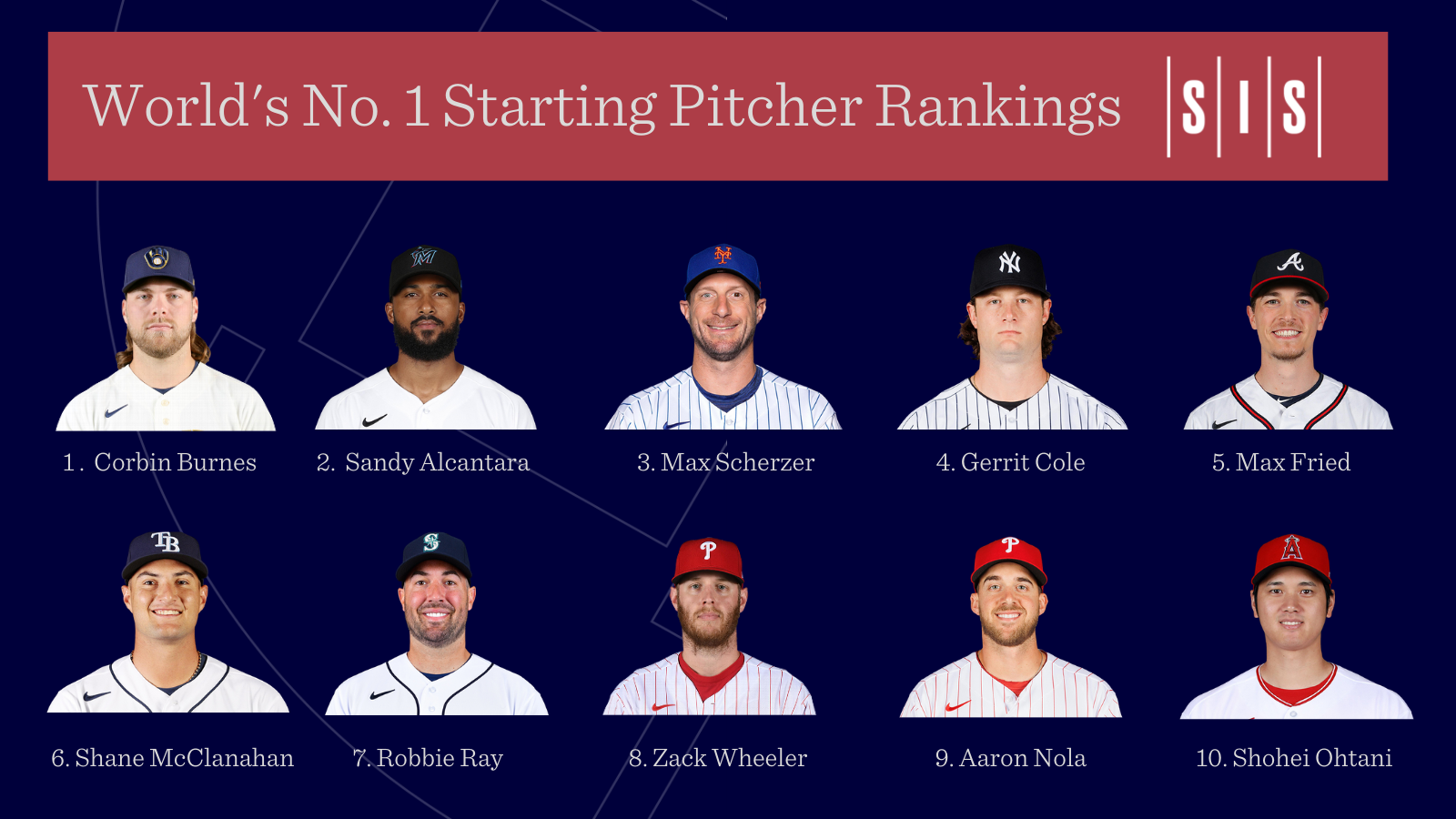
    Scherzer to try to regain his status as the top pitcher in Bill James’ World’s No. 1 Starting Pitcher Rankings.

    Scherzer, who had a 1.17 ERA in 10 starts prior to his injury, was the No. 1 starter in the rankings to begin the year. He had a small lead entering Wednesday, but Justin Verlander passed him with a great start in a loss to the Tigers.

    Here is the current top 10.

    Bill James World’s No. 1 Starting Pitcher Rankings
    Rank Name Team Current Score
    1 Justin Verlander Astros 550.3
    2 Max Scherzer Nationals 547.4
    3 Jacob deGrom Mets 522.6
    4 Gerrit Cole Astros 516.9
    5 Chris Sale Red Sox 504.3
    6 Clayton Kershaw Dodgers 497.0
    7 Zack Greinke Astros 490.9
    8 Aaron Nola Phillies 487.5
    9 Stephen Strasburg Nationals 486.1
    10 Patrick Corbin Nationals 486.0

    The rankings use a system devised by Bill James in which the primary
    component is a pitcher’s Game Score in each game he starts. Daily updates to the rankings and a comprehensive explanation of the methodology can be found
    here.

    Verlander has survived 33 home runs against him to post a 2.77 ERA. He has 14 starts with a Game Score of 70 or higher. No one else has more than 10. He’s one of three Astros pitchers in the top 10. The Nationals also have three pitchers in the top 10.

    Several pitchers have made big jumps to get into the top
    20 (first number indicates ranking entering March 20):

    Charlie Morton (from 34 to 12)
    Lance Lynn (66 to 13)
    Hyun-Jin Ryu (79 to 17)
    Sonny Gray (65 to 16)
    Luis Castillo (52 to 18)
    Walker Buehler (49 to 15)

    Charlie Morton’s ascent has come with a new team, as he signed with the Tampa Bay Rays this offseason. He’s used a dominant curveball to lead the AL with a 2.70 FIP and ranks second in the league with a 2.85 ERA.

    Lance Lynn is also a free agent signing that paid off for the Rangers. He has a 2.84 ERA in his last 18 starts. Hyun-Jin Ryu has a major-league-leading 1.64 ERA. He’s the healthiest he’s been in a long time, has shown a dominant chanegeup, and will likely make his most starts in a season since he had 30 in 2013.

    Sonny Gray had a rough time with the Yankees, but a trade to the Reds has done him good. His ERA is down nearly two full runs from 2018 to 2.92. His teammate, Luis Castillo, has also had a big drop in ERA thanks to one of the best changeups in baseball. Walker Buehler’s ERA is up from 2018, but he’s had two great starts to boost his score, a 16-strikeout complete game against the Rockies and a 15-strikeout complete game against the Padres.

    The pitcher who has slipped the furthest out of the top 10 is Corey Kluber, who dropped from No. 5 to 30 after missing most of the season with a fractured forearm. He was getting close to returning from injury, but had a recent setback. Kluber and Chris Sale (currently No. 5) may continue to drop due to their injury-related inactivity.

    For more baseball content, check out the Sports Info Solutions Blog or the SIS Baseball Podcast.


  • Stat of the Week: Who were July’s top defenders?

    By Mark Simon

    The San Diego Padres have known that Hunter Renfroe could hit for power since he made his big league debut in 2016. But after being known primarily as a home run hitter in the early part of his career, Renfroe is now known for something else: his defense.

    Renfroe is the Sports Info Solutions Defensive Player of the Month for July. He edged out Oakland Athletics utility man Chad Pinder in a very close vote among SIS staff.

    Renfroe is the second consecutive Padres player to win Defensive Player of the Month this season. Padres catcher Austin Hedges took the honor for June. Brewers outfielder Lorenzo Cain (March/April) and Dodgers outfielder Cody Bellinger (May) are the other winners this season.

    Renfroe led all players with 13 Defensive Runs Saved (DRS) for the month. He saved eight runs in right field, four in left field and one in center field. No other player finished the month in double figures in Runs Saved.

    Among Renfroe’s highlights were a diving grab against Alex Verdugo and a leaping catch against Joe Panik of the Giants.

    As documented recently on the Sports Info Solutions blog, Renfroe has made significant defensive improvements this season. He’s saved 17 runs overall and recently overtook Bellinger for the lead for most DRS as an outfielder this season. Renfroe has been excellent at both catching balls and deterring baserunner advancement. His five Outfield Arm Runs Saved are one shy of Bellinger for the MLB lead.

    “I want to win a Gold Glove more than I want to win a Silver Slugger,” Renfroe told The Athletic about a month ago. He’ll make an interesting candidate for our Fielding Bible Awards. His nine DRS in right field rank fourth behind Bellinger. His seven DRS in left field are one off the MLB lead. He could be a candidate for the Fielding Bible Award for best multi-position player.

    So could Pinder, especially given how he played in July. He saved at least one run as a left fielder (3), right fielder (1), second baseman (1), and third baseman (1). Sports Info Solutions Video Scouts credited him with eight Good Fielding Plays, one shy of the most by a non-first baseman (first basemen tend to have the most due to scooped throws). He did this while committing only one Misplay or Error.

    Pinder’s presence makes the Athletics a highly formidable defensive team along with first baseman Matt Olson and third baseman Matt Chapman.

    Among Pinder’s highlights this month were a pretty good impersonation of Chapman at third base to take a hit away from Jorge Polanco, a diving catch in right field to rob Eric Thames of extra bases, as well as this play in left field to take a hit from J.P. Crawford.

    Left field is where Pinder fares best. He’s saved six runs in just over 200 innings there this season. But his ability to make plays at other spots adds considerably to his value.

    For more on defensive excellence, check out the upcoming episode of the Sports Info Solutions Baseball Podcast (available Monday). San Francisco Giants center fielder Kevin Pillar talks about the challenges of making the diving, sliding, and jumping catch.