Tag: Mike Trout

  • Stat of the Week: Active Players & The Baseball Hall of Fame

    Stat of the Week: Active Players & The Baseball Hall of Fame

    Who are the current top Baseball Hall of Fame candidates among active players?

    A few years ago, Bill James devised a formula that works well hand-in-hand with Jay Jaffe’s JAWS system. Bill called it Hall of Fame Value (HOF-V) and it was simply the sum of a player’s Win Shares* and four times his Wins Above Replacement (Baseball-Reference version).

    * Win Shares is a player value stat that was shared publicly by Bill in 2002. You can learn more about it here and find individual player totals here. 

    After studying the data, Bill noted that an HOF-V of 500 was generally a good indicator of a player being Hall-worthy (with a caveat that, in most cases, the system evaluates position players better than pitchers). The more a player’s HOF-V is over 500, the more deserving the player is of election.

    Here are the active leaders in HOF-V:

    Player HOF-V
    Mike Trout 708
    Freddie Freeman 603
    Justin Verlander 594
    Paul Goldschmidt 567
    Clayton Kershaw 557
    Mookie Betts 547
    Max Scherzer 534
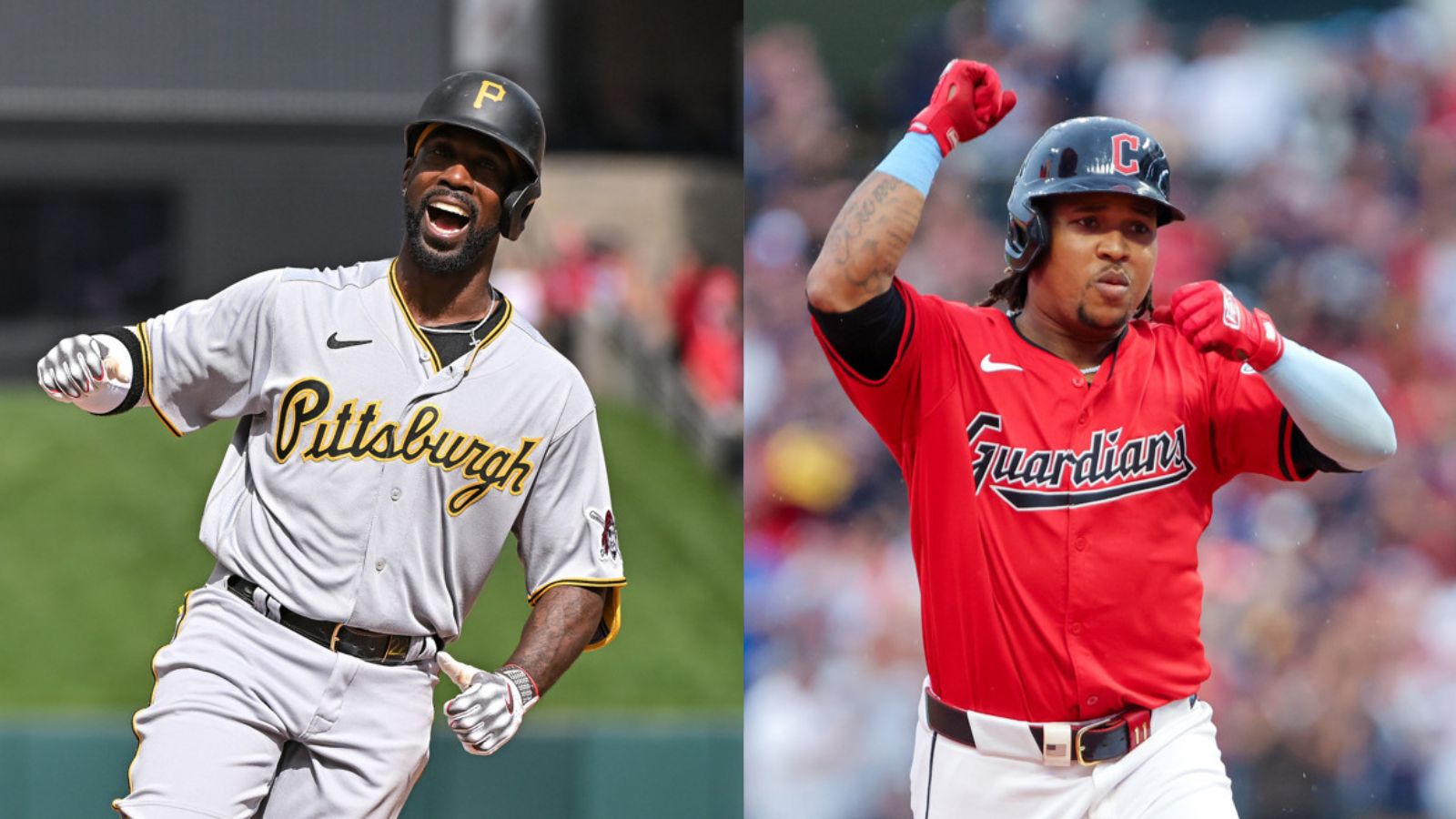
    Andrew McCutchen 530
    Jose Altuve 504
    Manny Machado 500
    Bryce Harper 483
    Nolan Arenado 459
    José Ramírez 453

    The players at the top of this list feel like locks for induction or very strong candidates: Players like Mike Trout, Freddie Freeman, Justin Verlander, Paul Goldschmidt, Justin Verlander, Clayton Kershaw, Mookie Betts, and Max Scherzer.

    The intrigue within this list is among those players who are in the 450 to 530 range. Let’s do a quick review of those.

    Andrew McCutchen (530) – HOF-V likes McCutchen better than any of the publicly available Hall of Fame evaluation systems. His 333 Win Shares are better than (among others) recent Hall inductees Todd Helton, Larry Walker, Scott Rolen, and Ichiro Suzuki.

    What hurts McCutchen from a WAR perspective is his defense. He ranks 16th in the offensive component of WAR among those whose primary position was center field, but bad defensive numbers drag him down to 32nd overall at the position.

    Jose Altuve (504) – Altuve will be in his age 35 season in 2025. He’s shown he can still hit but he too has defensive deficiencies to address. And he’s also got the residual effects of the Astros cheating scandal to deal with whenever he does retire, though Carlos Beltrán’s likely Hall election next year may help clear a path for Altuve too.

    Manny Machado (500) – Machado is 32 years old and seems to still have some skill left. Another couple of good years could push him to the 600 range in which case he’d be a very strong candidate.

    Bryce Harper (483) – Barring an injury or something unusual happening, Harper will clear 500 HOF-V this season and is probably headed to a 600-plus career total. In any event, he’ll probably be undervalued by this system given that it doesn’t recognize awards and his being one of the faces of baseball.

    Nolan Arenado (459) – After a spectacular 2022, Arenado’s last two years have been blah, both as a hitter and fielder, and he’s probably going to be traded by the Cardinals before the season starts. He may need a resurgence to make himself a little more Hall-viable.

    José Ramírez (453) – Ramírez is trending up. He has a streak of four straight seasons with at least 5 WAR. Another good year at age 32 should push him past the 500 threshold and at the rate he’s going, 600 isn’t out of the question within a few years. Two years ago he was well behind Arenado in the third base pecking order, but the gap between them is much closer now.

  • Stat of the Week: Aaron Judge, Blake Perkins, and Home Run Robberies

    Stat of the Week: Aaron Judge, Blake Perkins, and Home Run Robberies

    Photo:Gregory Fisher/Icon Sportswire

    “I’m glad we have a 6-foot-8 guy out there catching balls.”

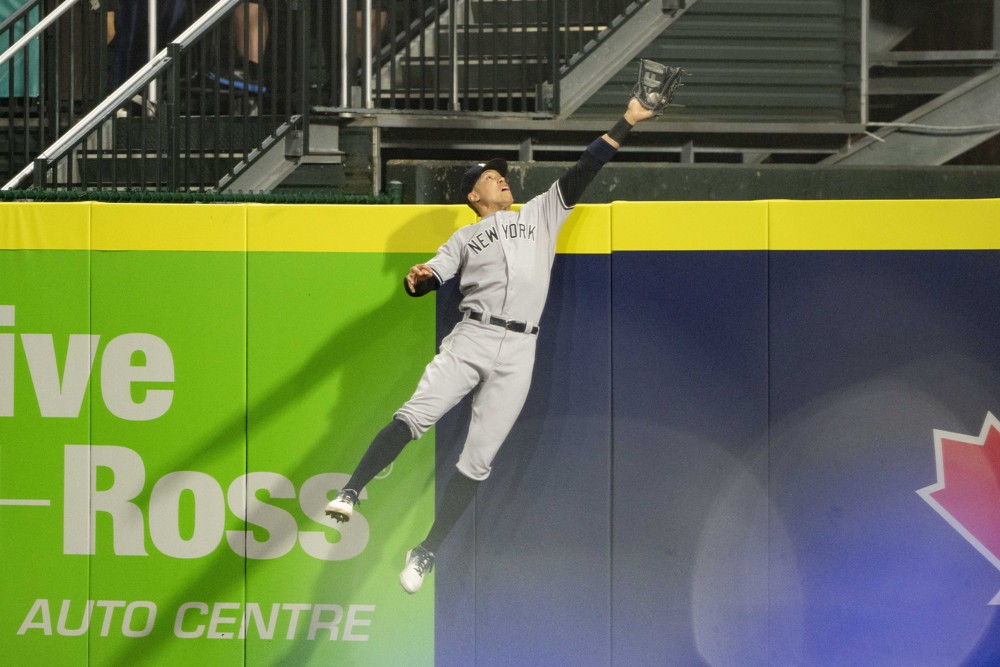
    That’s a postgame quote from Yankees pitcher Nestor Cortes, who may have exaggerated Aaron Judge’s height by an inch, but there was no exaggerating the impressiveness of Judge’s home run-robbing catch and subsequent double play against Andrés Chaparro of the Nationals on Monday night.

    “That was crazy,” said Yankees catcher Austin Wells.

    As for Judge, he simply said, “I was just trying to go out there and make a play,” noting that he was trying to match the energy of teammate Alex Verdugo, who made a nice catch earlier in the game.

    Judge’s play brings to mind this unusual distinction. Since the start of the 2018 season, when he made his first homer-robbing catch, he is both the major league leader in home runs with 252 AND home run-robbing catches with 9.

    If we go back to 2016, Judge’s debut season, he leads the majors in home runs (308) and is tied with Lorenzo Cain for the most homer-robbing catches with those 9.

    But it wasn’t the only highly-impressive home run robbery this week. Brewers center fielder Blake Perkins reached well over the fence in left center field to snag a would-be home run from Thairo Estrada of the Giants on Tuesday.

    For Perkins, it was his 4th home run-robbing catch of the season. That’s one shy of the most in a season since we began tracking every one in 2004. The mark is currently shared by Brewers center fielders Carlos Gómez (2013) and Cain (2019), as well as Astros right fielder Josh Reddick (2019).

    “This is my work,” Perkins told reporters after the game. “I’m just trying to do my best to stay aggressive out there and work for my guys on the mound.”

    Gómez and Cain also show up on another list, players with the most home run robberies since 2004. Mike Trout leads the way with 14. Gómez is second with 13 and is followed by Torii Hunter (12), Cain (11), Adam Jones (11), and Ichiro Suzuki (10).

    The Brewers, who lead MLB with 8 home run robberies this season, are one of five teams with at least 50 home run robberies in the home run robbery tracking era. The team leaderboard since 2004 is Angels (63), Tigers (63), Orioles (55), White Sox (54), Brewers (50).

    Immediately after Perkins’ home run robbery, the next batter, Grant McCray, hit a home run.

    It was the first “potential HR is robbed, next batter in inning hits a homer” in MLB in 2024. It’s happened at least once a year from 2016 to 2024 with the exception of 2020 and 2021.

    The one other time the Brewers were involved was against the Twins on July 4, 2018. Center fielder Keon Broxton made a catch on Brian Dozier that was as good as Perkins’ and then the next batter, Eduardo Escobar, homered.

    It’s one of those things that seems extraordinarily unusual but isn’t necessarily so. It happened four times in 2023.

    Most Home Run-Robbing Catches – Since 2004

    Regular Season

    Player HR-Robbing Catches
    Mike Trout 14
    Carlos Gómez 13
    Torii Hunter 12
    Lorenzo Cain 11
    Adam Jones 11
    Ichiro Suzuki 10
    Aaron Judge 9
    Mookie Betts 9
    Coco Crisp 9
    Josh Reddick 9
    Jason Bay 9
  • Stat of the Week: Updates on HR Robs, Pitcher Injuries, Arenado & More

    Stat of the Week: Updates on HR Robs, Pitcher Injuries, Arenado & More

    Photo: Rick Ulreich/Icon Sportswire

    As the MLB season nears an end there are a lot of things that we wrote about at some point this season that we’d like to update you on. But we only have so much space and so much time with which to work. 

    So rather than try to tell you a lot about one particular thing this week, let’s update you on 5 things that we either wrote about or frequently tweeted about from @sis_baseball this season.

    HR Robberies 

    The 2023 season has had more home run robberies than any season since we began tracking them in 2004. The current tally stands at 73, surpassing the previous mark of 69 set in 2019.

    The individual leaders in home run robberies are Mickey Moniak, Luis Robert Jr., Mike Trout, Cedric Mullins, and Kyle Tucker with 3 apiece. Angels outfielders have 10 home run robberies this season, the most by any team in any year since 2004. The 2005 Tigers had the previous mark with 9.  

    Pitchers Hit By Batted Balls 

    Earlier this season we addressed the number of pitchers being hit by comebackers, resulting in either the pitcher leaving the game or a considerable delay due to injury. 

    The count currently stands at 18 such incidents, an unusual and scary total given that there were 19 from 2020 to 2022 combined. The total number of pitchers hit with a batted ball, regardless of severity of injury, is comparable to the last two seasons – 169 in both 2022 and 2023 and 160 in 2021.

    Hitters Deserving A Better Fate 

    In April we wrote about how Starling Marte and Nick Gordon had been repeatedly denied hits by either good-looking defensive plays or plays that may have been tougher than they looked. 

    Both Gordon and Marte got injured and neither rated among the players most thwarted by defenses in 2023.
    It looks like the best-defensed hitter this season is going to be Lourdes Gurriel Jr. of the Diamondbacks. Opposing defenses have recorded 21 Runs Saved against Gurriel this season. He’s followed by Alec Bohm and Steven Kwan (18 Runs Saved against them).

    Another way of looking at it: the hitter with the most “Good Fielding Plays” against him specific to plays that took away hits is José Ramírez with 21. 

    Nolan Arenado

    Perennial Gold Glove and 5-time Fielding Bible Award winner Nolan Arenado had a disappointing 2023 season as far as his defensive stats went. He spent most of the year with a negative Defensive Runs Saved. 

    But Arenado has looked better of late. After heading into the All-Star Break with -4 Runs Saved, Arenado has since saved 5. With 1 Run Saved, Arenado is not likely to contend for a Fielding Bible Award this season, but he’s shown that he still has some of the skills that made his metrics so good. 

    NPB’s Top Defensive Team 

    You may have noticed us regularly tweeting about Japanese baseball in the latter part of the year as we noticed there’s an avid following and not a lot of defensive data accessible for NPB fans.

    With that in mind, we can tell you that the best defensive team you don’t know about is the NPB’s Hanshin Tigers. The Tigers, who won the Central League title for the first time since 2005, currently have 29 Runs Saved and have a comfortable advantage in Defensive Runs Saved over the next-closest NPB team, the Nippon-Ham Fighters, who have 6. 

    NPB out probabilities are created from the same basis we use for MLB ones. Most NPB team totals are either negative or slightly positive. Hanshin has been the exception.

    Hanshin’s top defensive players are catcher Seishiro Sakamoto (T-1st among C in Runs Saved), second baseman Takumu Nakano (2nd, 2B), center fielder Koji Chikamoto (T-1st, CF), right fielder Shota Morishita (T-4th, RF), and pitcher Koutaro Ohtake (1st, P). 

    Sakamoto in particular is considerably popular among fans because of his pitch-framing skill. (we’ve heard from many on social media). Hanshin pitchers are 49-19 with a 2.12 ERA this season when Sakamoto catches.

  • Bill James Handbook 2023 Excerpt: A Sizable Portion

    Bill James Handbook 2023 Excerpt: A Sizable Portion

    The Bill James Handbook 2023 is more than 600 pages long and thus it is hard to encapsulate what makes the book so interesting within a short summary.

    But nevertheless we try. And we want to give you a full scope of what this book has to offer, in the hopes that you’d consider buying it

    (click here if you wish to purchase)

    With that in mind, here are excerpts from nine sections in the Handbook to give you a better sense of the kind and range of content we provide. You’ll find everything from cerebral discourse to entertaining and unusual anecdotes.

    OPS and Runs Scored (Bill James)

    “The relationship of OPS to Runs Scored by a team is exactly and precisely the same as the relationship of run elements to runs scored. It isn’t loosely a relationship of squares; it is precisely a relationship of squares. If one team has an OPS 10% higher than another team, they will not score 10% more runs. They will score 21% more runs. EXACTLY 21% more, on average.

    “And if a hitter has an OPS+ of 110, he is not creating 10 more runs than an average hitter. He is creating 21% more runs than an average hitter.”

    Predicting Injury Risk (Sarah Thompson)

    Xander Bogaerts rates as the hitter with the highest predicted injury risk entering 2023. He has the best chance of sustaining an IL-worthy injury.

    “Since 2021, Bogaerts boasts the second-highest number of sliding, diving, and jumping attempts at 150. Sacrificing the body to make an out is great from a team-player win-at-all-costs perspective, but not from a health perspective. Given that he’s only made outs on 10 of his last 72 diving attempts, it may be better for all involved if that particular approach started to taper a bit.”

    World’s Best Hitter (Mark Simon)

    “If you’ve seen those pictures of Aaron Judge next to an average-sized player and marveled at how large Judge is, the gap between him and Paul Goldschmidt for World’s Best Hitter is now that large. It’s about the same as the gap between the No. 10 hitter, Jose Ramirez, and the No. 57 hitter, Jorge Polanco.”

    Relief Pitching (Jackson Lewis)

    “I’ll start by giving the Orioles’ relievers props for producing in virtually any scenario. Leading the league in ‘tough save’ opportunities and inherited runners doesn’t exactly make life easy, but nonetheless they delivered, turning in league-leading conversion rates for tough saves (72%) and overall saves (81%).”

    Tough saves are those earned when a reliever enters with the tying run on base.

    The Manager’s Record (Bill James)

    “Brian Snitker was the most successful at choosing his moments for an IBB, giving up 21 of the suckers, of which 18 got the result that Snitker was looking for, which would be getting out of the inning without any more runs being scored.”

    2022 Leaderboards (Alex Vigderman)

    “NL relief opponents batting average vs LHB and vs RHB: The Diaz siblings top each list! So cool.”

    Indeed, left-handed batters hit .101 vs Edwin Diaz and right-handed batters hit .107 vs Alexis Diaz.

    Manufactured Runs, Productive Outs, and Unproductive Outs (Sarah Thompson)

    “The Cleveland Guardians finished the regular season scoring 698 runs, 15th in MLB and just four runs above the MLB average. They also finished the season hitting the second-fewest home runs (127), ahead of only the Tigers (110), who scored the fewest runs in baseball (557).

    “In this current baseball climate, those facts don’t usually add up. So where did the Guardians runs come from? They manufactured them. The Guardians co-led MLB in Manufactured Runs with 170 … What comprises a Manufactured Run is a little complicated, but know that sacrifice bunts, steals, hit and run plays, bunt hits, and infield hits are important.”

    Win Shares (Mark Simon)

    “I’d like to close with my favorite Win Shares stat. Mike Trout is MLB’s overall leader in Win Shares dating back to 2004. His 341 are one more than Joey Votto’s 340.

    “Trout didn’t debut until 2011.”

    Pitcher Fielding & Holding Baserunners & Hitters Pitching (Brian Reiff)

    “Christian Bethancourt, meanwhile, made his long-awaited return to the majors this year – long awaited, that is, by two-way player enthusiasts. In 2017, Bethancourt played in 44 games as a hitter and 34 as a pitcher for the Padres Triple-A affiliate. Five years later, he only managed to make a pitching appearance in four games across stints for the A’s and Rays, but made the most of them, allowing only one run in four innings.”

    We hope you enjoyed these snippets and hope you’ll consider buying the Handbook (click here if you wish to purchase).

  • Stat of the Week: The Angels Are Looking Good

    Stat of the Week: The Angels Are Looking Good

    It’s only 20 games, but the Los Angeles Angels look like a completely different team from last season’s squad in a couple of important areas.

    For one thing, take a look at their chase rate (best known as O-Swing% on FanGraphs). In 2021, the Angels’ chase rate of 33% ranked 25th. To this point in 2022, they rank second-lowest at 26%.

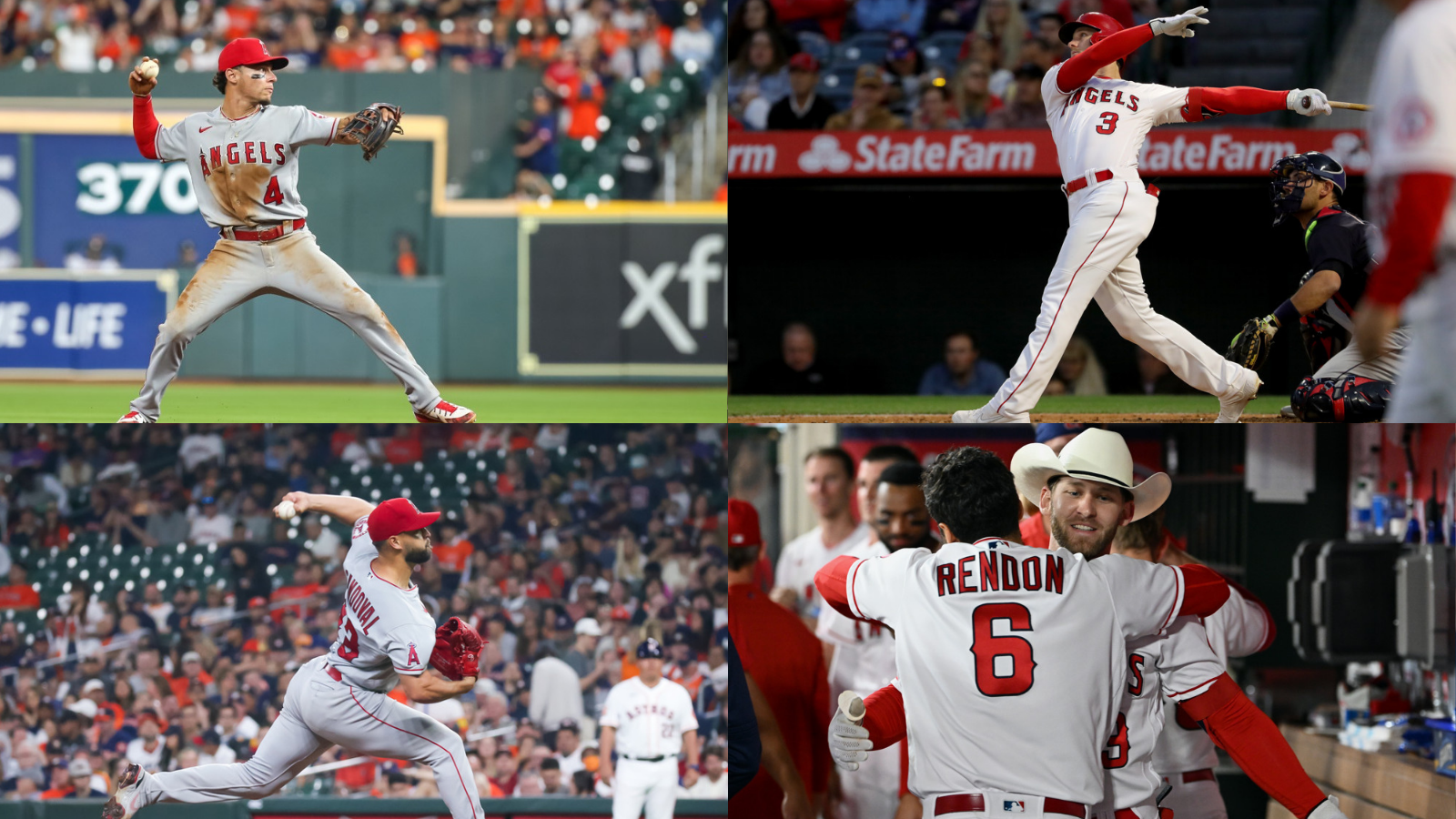
    This can be explained by a few things. For one, two of the team’s most discerning hitters – Mike Trout and Anthony Rendon – are healthy. They’re each at 21%.

    For another, the team’s top chaser among its regulars in 2021, José Iglesias, is now in Colorado. And one other note: a couple of hitters, most notably Taylor Ward, have shown a little more patience than usual within a small sampling of at-bats this season.

    Ward’s chase rate is 20%. His rate last season was 29%. He’s been a big contributor, with a .509 on-base percentage in 53 plate appearances. His 1.271 OPS is 16 points higher than Trout’s. Outfielder Jo Adell’s chase rate is 34%. It was 40% in 2021.

    The reduction in chasing seems to have translated into positive results. The Angels rank first in the American League in batting average (.253), on-base percentage (.333) and slugging percentage (.428). They ranked 6th, 9th, and 7th in those stats, respectively, last season.

    The Angels also have shown themselves to be a good defensive team in 2022. They rank 3rd in the majors in how often they turn a groundball or bunt into an out (nearly 81% of the time) and 5th in how often they turn a ball hit in the air into an out (just over 71% of the time).

    In 2021, they ranked 27th in both out rate on grounders and bunts (72%) and out rate on balls hit in the air (65%).

    What’s noteworthy here is that the Angels plan to move David Fletcher to shortstop was thwarted when Fletcher went out with a hip injury after playing five games.

    Fletcher’s replacement, Andrew Velazquez, hasn’t hit well at all. But he’s been excellent in the field, recording 5 Good Fielding Plays, tied for the most among shortstops.

    We don’t generally advise using 14-game samples as meaningful evaluations, but Velazquez has played good defense at shortstop throughout his career, saving 9 runs in not even a half-season (476 innings).

    Pitching-wise, the Angels’ numbers look considerably better than last season’s, but admittedly, the numbers look better for just about every team. The Angels currently rank 11th in the AL in FIP, after ranking 8th in that stat last season.

    But there have been some bright spots, most notably Patrick Sandoval, who has not allowed an earned run and has 20 strikeouts in 15 innings. Newcomers Noah Syndergaard and Michael Lorenzen also have ERAs under 3.00 thus far. Four of the team’s five most-used relievers have ERAs under 2.00.

    The team’s looked better at the plate and better in the field, and has some bright spots on the pitching staff, but perhaps the best thing that could be said about the Angels start is this:

    The Angels are 13-7 and we didn’t even mention Shohei Ohtani (.691 OPS, 4.19 ERA) until the next-to-last sentence of this article.

    What will the team be like once he gets going?

  • Why Move Mike Trout Off CF? Let’s Look at the Numbers

    Why Move Mike Trout Off CF? Let’s Look at the Numbers

    Why would the Angels want to move Mike Trout off center field?

    It’s likely a simple matter of statistics. Catches like the one above have been the exception rather than the rule.

    Over the last two seasons, Trout ranks 32nd in Defensive Runs Saved per 1,000 innings in center field. That’s out of the 35 players with the most innings played there in that time.

    It goes back farther than that. Trout has posted a negative Defensive Runs Saved total in each of the last three seasons and four of the last five seasons.

    Yes, he does have a 21-Runs Saved season to his credit … in 2012. Since then, he’s cost the Angels 24 runs with his defense, per our measures.

    Trout doesn’t have any statistical strengths on defense anymore. He ranks a little below-average on shallow, medium, and deep fly balls over the last two seasons (though in Trout’s defense, he was slighly above-average on deep balls in his brief stint last season). That adds up.

    And he ranks below-average in throwing. Since 2020, he’s allowed 42 of 61 runners to advance an extra base on balls he’s fielded. That’s a 69% advance rate allowed compared to an average rate of 54% for center fielders last season.

    Getting back to Trout’s range, we have numbers that can show that Trout isn’t what he once was in center field. We can compare his 2020-21 out rates to those he had in 2018, his last season with a positive Defensive Runs Saved.

    Depth 2018 2020-21
    Shallow 58% 48% (88 plays)
    Medium 87% 78% (99 plays)
    Deep 82% 73% (67 plays)

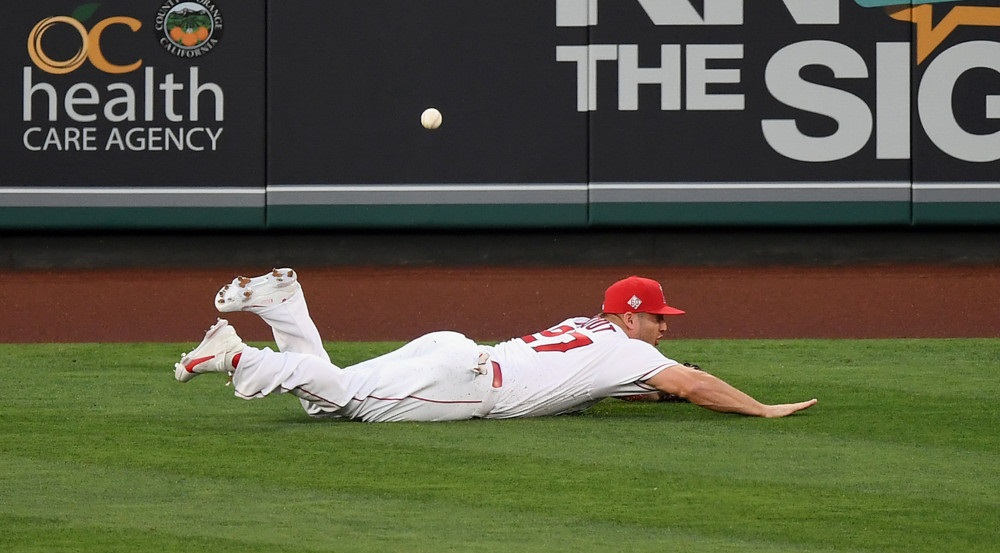
    Trout isn’t making high-value plays and has missed some balls he should have caught.

    Over the last two seasons, he has 5 catches on balls that had an out probability of less than or equal to 30% and missed 14 plays on which the out probability was 70%.

    Here ‘s one example of the latter:

    Comparing ratios of other players with similar innings totals the last two seasons:

    Plays Made/Missed by Out Probability (2020-21)

    0-30% Plays Made >=70% Plays Missed
    Mike Trout 5 14
    Guillermo Heredia 6 6
    Kike Hernandez 5 3

    Worth pointing out: Trout has ranked last and next-to-last in the reaction component of Statcast’s Jump stat the last 2 seasons.

    On average, he’s about 2 feet short of where he should be within the first 1.5 seconds of a ball being hit.

    Trout’s potential replacement in center field, at least for the short term would be Brandon Marsh. He totaled -3 Runs Saved in 70 games there last season. Jo Adell’s experience in center field, both in the majors and minors, is minimal, though his elite speed could come in handy if they were to give him a try.

    That neither player is necessarily a standout would be one reason to keep things as-is.

    The other option the Angels would have if they don’t want to move Trout to left field is to tinker with his positioning. (Per Statcast) Trout played an average of 6 feet shallower at home in 2018 (318 feet) than he did in 2020 and 2021 (324 feet).

    That would seem like the most logical outcome here given Trout’s reluctance to switch positions. What we seem to have here is a case of the numbers indicating one thing, but player comfort pointing in another direction. Such is the push-and-pull an MLB manager has to deal with both in trying to win and keep his players happy.

    The Angels may move Trout around in the outfield – but only within the boundaries of his original position.

  • Who has the best chance to reach MLB milestones? (Bill James Handbook excerpt)

    The following is an excerpt from the 2020 Bill James Handbook, available now at ACTA Sports, Barnes & Noble, Amazon, and wherever you buy your books

    By Andrew Kyne
    Bill James devised “The Favorite Toy” to estimate a player’s probability of breaking a record or reaching a milestone.

    In last year’s Handbook, the highest probability of such an event belonged to Albert Pujols, who was projected to have a 97% chance to someday reach 2,000 career runs batted in. With 1,982 RBI entering the season, Pujols was very likely to not only reach the milestone, but to do so early in 2019. Sure enough, he notched his 2,000th with a solo home run on May 9 in Detroit.

    This year, the highest probability of reaching a career batting target belongs to another generational talent, Miguel Cabrera. He is now estimated to have a 75% chance of reaching 3,000 hits. Although his power numbers were limited this season, Cabrera still hit for a .282 average and added 139 hits to his career ledger. He now sits 185 hits shy of 3,000.

    Some records may never be broken, and the rest of the batting targets feature many longshots. But an obvious player to keep an eye on is Mike Trout, whose name can be found in several places in this section. After hitting a career-best 45 home runs in 2019, Trout is now projected to have a 43% chance to hit 500 home runs, a 29% chance to hit 600 home runs, and a 14% chance to hit more than 762 home runs, the all-time record.

    Additionally, BIS has developed a system, separate from The Favorite Toy, that estimates the likelihood that a pitcher will throw a no-hitter. Free agent pitcher Gerrit Cole is currently the most likely to do so at an astonishing 62%, far ahead of any other pitcher. In 2019, Cole had two outings in which he allowed only one hit and three outings in which he allowed two hits. He also found his strikeout touch with the Astros, recording double-digit strikeouts in 21 starts this year.

    A couple new names to watch on the most likely no-hitter list are Lucas Giolito (27%) and Luis Castillo (21%). Young pitchers Jack Flaherty (23%) and Blake Snell (23%) were featured on last year’s list as well.

    Justin Verlander, Cole’s teammate in Houston, was listed as having a 32% chance at a future no-hitter in last year’s Handbook. Verlander held the Blue Jays without a hit on September 1 for the third no-hitter of his career. Only Nolan Ryan and Sandy Koufax have thrown more than three career no-hitters. With a 26% chance of another, it’s possible that Verlander could join them.

    % Chance to Reach 762 HR
    Name % Chance
    Mike Trout 14%
    Cody Bellinger 6%
    Nolan Arenado 1%
    Pete Alonso <1%
    % Chance to Reach 800 HR
    Name % Chance
    Mike Trout 10%
    Cody Bellinger 3%
    % Chance to Reach 600 HR
    Name % Chance
    Mike Trout 29%
    Nolan Arenado 21%
    Eugenio Suárez 16%
    Bryce Harper 16%
    Manny Machado 15%
    Cody Bellinger 13%
    Francisco Lindor 11%
    Pete Alonso 11%
    Christian Yelich 10%
    % Chance to Reach 500 HR
    Name % Chance
    Miguel Cabrera 68%
    Edwin Encarnación 66%
    Mike Trout 43%
    Nolan Arenado 32%
    J.D. Martinez 31%
    Nelson Cruz 29%
    Giancarlo Stanton 27%
    Bryce Harper 26%
    Manny Machado 24%
    % Chance to Reach 2,298 RBI (Record)
    Name % Chance
    Albert Pujols 7%
    Nolan Arenado 3%
    Bryce Harper < 1%
    % Chance to Reach 2,296 Runs (Record)
    Name % Chance
    Mookie Betts 11%
    Mike Trout 6%
    Francisco Lindor 1%
    % Chance to Reach 793 Doubles (Record)
    Name % Chance
    Nicholas Castellanos 16%
    Xander Bogaerts 14%
    Mookie Betts 11%
    Francisco Lindor 7%
    Rafael Devers 6%
    Alex Bregman 5%
    Ozzie Albies 2%
    José Ramírez 2%
    Anthony Rendon 2%
    Freddie Freeman 1%
    % Most Likely To Throw No-Hitter 
    Name % Chance
    Gerrit Cole 62%
    Robbie Ray 32%
    Chris Sale 29%
    Lucas Giolito 27%
    Justin Verlander 26%
    Blake Snell 23%
    Jack Flaherty 23%
    Max Scherzer 22%
    Luis Castillo 21%
    Yu Darvish 21%
    % Chance to Reach 3,000 Hits
    Name % Chance
    Miguel Cabrera 75%
    Nick Markakis 30%
    Robinson Canó 26%
    Starlin Castro 25%
    José Altuve 24%
    Freddie Freeman 23%
    Elvis Andrus 20%
    Eric Hosmer 20%
    Nolan Arenado 19%
    Manny Machado 17%
    Christian Yelich 16%
    Mookie Betts 15%
    Xander Bogaerts 15%
    Nicholas Castellanos 15%
    Francisco Lindor 13%
    Adam Jones 12%
    Mike Trout 12%
    DJ LeMahieu 10%
    Jean Segura 9%
    Bryce Harper 9%
    Ozzie Albies 7%
    Alex Bregman 7%
    Cody Bellinger 7%
    Rafael Devers 6%
    Anthony Rizzo 6%
    Andrew Benintendi 5%
    Trevor Story 4%
    Anthony Rendon 4%
    Paul Goldschmidt 4%
    Charlie Blackmon 3%
    Javier Báez 2%
    José Ramírez 2%
    J.D. Martinez 2%
    Trea Turner 2%
    Ketel Marte 2%
    Amed Rosario 1%
    Ronald Acuña Jr. 1%
    Eddie Rosario < 1%
    Marcus Semien < 1%
    Michael Brantley < 1%
    Tim Anderson < 1%
    Eugenio Suárez < 1%
  • Which hitters reach favorable counts?

    Which hitters reach favorable counts?

    By Andrew Kyne

    On the most recent episode of the SIS Baseball Podcast, our guest Mike Ferrin talked about analyzing ball-strike count management among hitters.

    Specifically, which hitters get themselves in favorable counts, like 2-0, 3-0, and 3-1? And which hitters then do damage in those plate appearances? Let’s try to find out.

    For 2019, here are the ten players who have reached 2-0/3-0 or 3-1 in the highest percentage of their plate appearances (minimum 200 PA).

    BatterOverall PAPA w/ HCPct.wOBA
    Justin Smoak2617829.9%.432
    Cody Bellinger3379929.4%.508
    Carlos Santana3419828.7%.499
    Mike Trout34910028.7%.685
    Joey Gallo2276528.6%.544
    Mookie Betts37710728.4%.558
    Daniel Vogelbach3048628.3%.500
    Rhys Hoskins3509928.3%.581
    Tyler White2065627.2%.399
    Kendrys Morales2015426.9%.398

    The wOBA column represents their weighted on-base average in those plate appearances in which they got to a favorable count (but didn’t necessarily end the PA in one of them). So, in the 100 plate appearances in which Mike Trout got to a 2-0/3-0 or 3-1 count, he has an absurd .685 wOBA.

    Being a power hitter with exceptional plate discipline is a good way to make this list. But not everyone has ended up doing damage in those plate appearances, as you can see with Tyler White (who has a 91 wRC+ overall on the year) and Kendrys Morales (who has a 63 wRC+ overall and was just designated for assignment by the Yankees). Justin Smoak tops the list in terms of getting into favorable counts, but his wOBA is lagging a bit behind the others as well.

    The other seven players have been among the best at not only getting into hitter-favorable counts, but also finishing with success, all recording a wOBA of .499 or better in those PA. Trout, Rhys Hoskins, Mookie Betts, and Joey Gallo have been especially good.

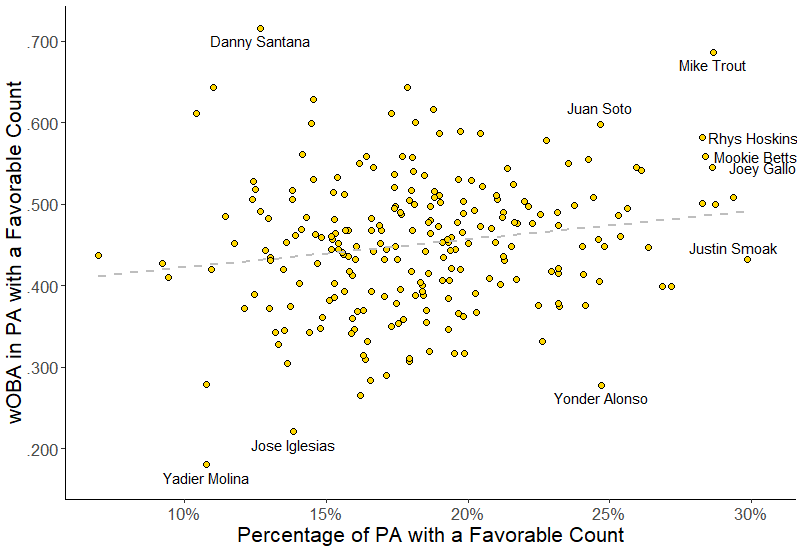
    Here’s a look at the relationship in 2019 between getting into favorable counts and then having success:

    Getting into counts like 2-0 and 3-1 is certainly good for hitters, but is it a repeatable skill? Between 2017 and 2018, there was a strong year-to-year correlation (r = 0.76) for hitters with 400+ PA in each season.

    Between 2018 and 2019, Gallo has had one of the most significant increases in generating plate appearances with favorable counts, going from 20% to 29%. Pitchers are surely fearful of his power, and it helps that he’s cut his chase rate from 32% to 23%.

    On the other side, Cleveland’s Jose Ramirez has had one of the sharpest declines, going from 29% to 22%. After turning in consecutive seasons with a 146 wRC+, Ramirez is hitting just .216/.310/.329 in 2019.

    Finally, what about the ability to repeatedly do damage in plate appearances with a favorable count? The correlation isn’t as strong here (r = 0.33) but still positive.

    It’s good for hitters to be in favorable counts, and there’s evidence that being able to get into those situations may be consistent from year to year. That’s perhaps not a surprising conclusion, given batter quality and plate discipline, but it’s ultimately another important piece in hitter evaluation.

  • Who are the best outfielders at avoiding mistakes?

    Who are the best outfielders at avoiding mistakes?

    By MARK SIMON
    On Monday, we looked at which infielders were the best at avoiding mistakes. Today, we’ll look at which outfielders rank the best at doing the same.

    To recap, Sports Info Solutions does video review of every pitch of every game and tracks both Good Fielding Plays in 30 classifications and Defensive Misplays & Errors in about 60 categories. Mistakes come in many forms, ranging from slipping and falling to dropping a ball, or misreading a ball bounce off the wall.

    Our look back covers since the start of the 2015 season through games played on April 23.

    Left Field: Two of your better left fielders head the list in Alex Gordon of the Royals and Christian Yelich of the Brewers, Gordon averages 1.1 misplays and errors per 100 innings, ahead of Yelich at about 1.4. Gordon also has the highest ratio of Good Fielding Plays to Defensive Misplays & Errors in that span (1.9).

    Center Field: A.J. Pollock of the Diamondbacks doesn’t often get brought up as an elite player at the position, but he does come out as the leader in this metric, a hair ahead of Mike Trout (both 1.3). This goes with Pollock’s defensive ratings in center field. He’s finished in the top 10 in Defensive Runs Saved at the position all five times that he’s played more than a handful of games in a season.

    Trout’s defense is a topic of much debate. There are those who question just how good his range or arm is. But he doesn’t get critiqued often for making mistakes, and rightfully so.

    Right Field: Curtis Granderson of the Blue Jays is known as one of baseball’s good guys. He’s also a good guy when it comes to this stat. His 1.1 Misplays & Errors per 100 innings are the fewest at the position. Granderson has fared well in terms of Defensive Runs Saved in the past, largely because of his ability to chase down fly balls hit to the deepest part of the ballpark.

    J.D. Martinez of the Red Sox ranks second. Often criticized for his defense, Martinez has made only 1.5 misplays per 100 innings in this stretch. However, he’s made so few Good Fielding Plays, that his ratio of good to bad is among the worst in the majors.

    For those wondering where Jayson Heyward is, he’s just behind Martinez and Seth Smith. Heyward has long been the standard-setter at the position and continues to be here.