Tag: New York Yankees

  • Inside the numbers on Urshela’s improvements

    By Joe Conklin

    A couple of weeks ago, Yankees third baseman Giovanny Urshela was facing hard-throwing Mets pitcher Zack Wheeler in the fourth inning of a Subway Series matchup. On an 0-1 pitch, Urshela crushed a 96-MPH four-seam fastball on the inner-third. He hit it 405 feet with an exit velocity (per Statcast) of 105.7 MPH.

    That home run wasn’t just helpful in a Yankees’ comeback win. It showed how far Urshela has come.

    Urshela has been performing well above his career numbers so far this year at the plate. In looking at the causes of his success at the plate, here are some interesting numbers I uncovered.

    Urshela has the reputation of a great defender and a below-average hitter. In 2015 and 2017, which are comparable in at bats and games to this year, his batting average was .225 and .224 respectively.

    Through Sunday, his batting average this season is .306. In some of the advanced stats he is also outperforming his 2015 and 2017 results by a lot.

    Urshela’s BABIP (batting average on ball in play) is .336, almost 100 points higher this year than his 2015 and 2017 years.

    Why the drastic increase in BABIP? Urshela’s hard and soft contact percentage have drastically changed this year.

    Probably the most telling statistic for his offensive increase is Urshela’s hard-contact percentage (Hard%). This is the percentage of time that a hitter makes hard contact on a batted ball. In 2015 and 2017, his hard-hit percentage was 22% and 24% respectively.

    In 2019, his rate of batted balls that are hard hit is 46%, over a 20-point increase from the previous comparable years. The batting average for all of baseball for Hard% contact is .526.

    His soft contact percentage (Soft%, which how often one of his batted balls was hit with low velocity and an unfavorable landing spot) in 2015 and 2017 was about 20%. Soft contact usually always ends in an out for the batter — the batting average for Soft% is .153 for all of Major League Baseball in 2019.

    In 2019, Urshela’s Soft% in is 8%, both a dramatic decrease from previous seasons and the lowest in the majors this season.

    Pairing his increase in Hard% with his decrease in Soft%, it makes sense he’s gotten better results.

    Urshela is also outperforming his previous year’s results on fastballs as well as pitches that are on the inner third of the strike zone.

    His average and slugging percentage are over 100 points higher than his 2017 and 2015 years.


    2015 2017 2019
    BA/Slug Pct vs Fastballs .216/.306 .267/.320 .342/.507
    BA/Slug Pct vs Inside Pitches .261/.326 .220/.322 .346/.654

    One interesting statistic that is unusual for major league hitters is that Urshela has been quite good when he’s behind in the count (as he was versus Wheeler).

    For example, he’s hitting .319 with three home runs in at-bats that end with counts of 0-1 (as the homer versus Wheeler was) or 1-2. He was a .207 hitter in those counts prior to this season.

    In the past, Urshela has been known largely for his glove, but this season his bat his outperformed his mitt. In fact, he’s at -3 Defensive Runs Saved this season, slightly below average for a third baseman. The perception of Urshela as a great defender may be due to a few terrific plays. But overall, he has not shown the success of an elite fielder, like Matt Chapman or Nolan Arenado.

    However, if Urshela continues to hit the ball as hard as he has so far this season, he will continue to fill the void left at 3B when the Yankees lost Miguel Andujar for the season.

    Even with his -3 DRS he will still be an upgrade over Andujar who had a -25 DRS in 2018 and possibly provide just as much value with the bat.

  • MLB’s Best Positioned Infields

    MLB’s Best Positioned Infields

    On the most recent episode of the SIS Baseball Podcast, our guest Joe Sheehan mentioned how teams like the Dodgers and Astros are aggressive in their positioning of defenders, whether they ultimately cross the lines that we draw to measure defensive shifts or not.

    With that in mind, let’s try to measure which teams have put their infielders in the best position to field groundballs.

    As mentioned a few weeks ago, Baseball Info Solutions charts the starting positions of infield defenders on grounders, in addition to batted ball information. Thus, we can calculate both the angle at which the ball was hit and the angle at which the fielders are standing.

    We divide the field into 90 degrees from foul line to foul line. Using the fielder and batted ball information, we can find the angle difference between where the ball was hit and where the closest fielder was standing.

    Since the first baseman will always be positioned near the bag and the other infielders are the ones being moved around, I only evaluated groundballs hit outside the first base area (the rightmost fifth of the infield). Additionally, I only looked at grounders hit at least 100 feet and not fielded by the pitcher or catcher.

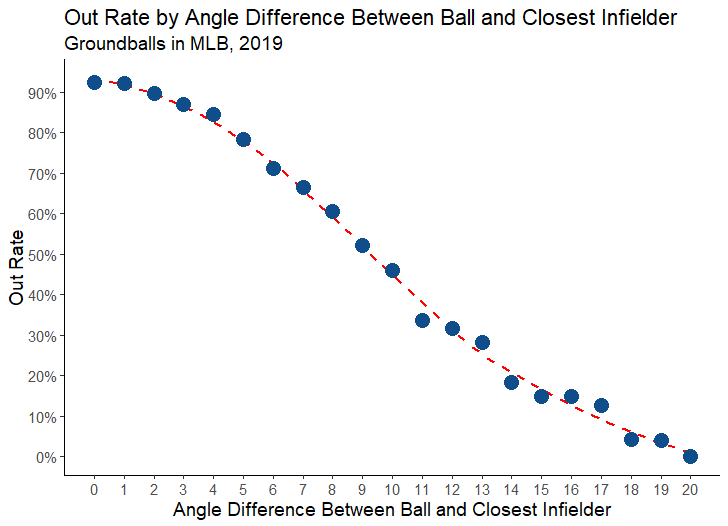
    On a league-wide level, this plot shows the rate of getting an out on a play by how far the closest infielder was from the ball (laterally), in terms of angle difference.

    The trend is obvious: the farther your closest infielder is from the ball, the less likely an out is to be recorded.

    Within three degrees of the ball’s path is where the expected out rate climbs north of 85%. So, based on all of the criteria above, which teams have played the highest percentage of groundballs with an infielder within three degrees of the path of the ball?

    The Astros and Dodgers rank in the top ten (as expected), and other shift-heavy teams like the Rays, Pirates, and Yankees rate well. There are exceptions, however; the Cubs don’t shift much at all but have been well positioned, and the Orioles have rapidly increased their shift usage and rank at the bottom.

    But what if teams played with traditional, straight-up positioning on each of these grounders? With that positioning, what percentage of plays would they have an infielder close to the ball, and how does that compare to their actual percentages? Is there a benefit?

    Overall, teams have had a 2B, 3B, or SS within three degrees of the ball on 39% of these plays. If they played with straight-up positioning (using the average angles of infielders on non-shift plays), teams would have been close on 33% of these plays.

    The Diamondbacks have had the most benefit of moving their infielders around. They would have only been close on 30% of plays with traditional positioning, so their actual 41% rate is a significant boost.

    Consider this play from last week, where the Diamondbacks had the Mets’ J.D. Davis played perfectly. The shortstop and third baseman were positioned similarly to league average, but the second baseman moved over to the left side and the ball was hit right to him.

    The Reds (39% actual vs. 28% with traditional), Yankees (43% vs. 33%), Tigers (40% vs. 30%), and Astros (40% vs. 31%) have also gained significant advantages.

    The important takeaway is that nearly every team has had a higher percentage of close plays with their positioning compared to if they just used traditional positioning. The only team slightly worse off has been Boston, and the difference is basically zero (36.6% vs. 37.2%).

    Of course, this doesn’t speak to fielder quality. Range, arm, and other factors are important to out conversion as well. But from a positioning perspective, teams are doing what they can to put infielders in the proper areas to be as close to potential grounders as possible.

  • Hall of Fame Value Standard shows Mike Mussina’s worthiness

    The Baseball Hall of Fame voters are slowly but surely supporting Mike Mussina’s Hall of Fame candidacy. Mussina isn’t quite there yet, though statistically there’s not much doubt that he belongs.

    This year, Bill James introduced a new Hall of Fame Value Standard in the 2019 Baseball Handbook (excerpted here). The methodology combines James’ Win Shares metric with four times Wins Above Replacement into one number. The cutoff score for Hall of Fame worthiness is 500.

    Mussina clears the bar and then some. He’s at 601.8. That’s better than Hall of Fame pitchers Jim Palmer (587.7), Don Sutton (587.1), and John Smoltz (565.2) among others. Mussina is that high because of consistent excellence. Some say he didn’t dominate like a Roger Clemens or a Pedro Martinez. That’s a poor way to judge Mussina’s performance.

    Here’s a better way:

    James once devised something known as the Gray Ink Test, which rewards pitchers for finishing in the top 10 in wins, ERA, strikeouts, innings pitched, winning percentage, saves, complete games, walks per 9 innings, hits per 9 innings, starts, and shutouts. Each stat is assigned a point value, with wins, ERA, and strikeouts being the most valuable. The stat is actually tougher on contemporary players like Mussina, because they played (and are still playing) in 14-to-16 team leagues and thus have more competition than those players who played pre-expansion.

    Mussina scored 250 points by the Gray Ink test, which ranks tied for 21st among pitchers. Of the top 35 pitchers in this stat, 31 are in the Baseball Hall of Fame, with Mussina, Clemens, and two pitchers from the 19th century (Jim McCormick and Bobby Mathews) being the exceptions.

    Mussina may not have been the best pitcher of his generation. But he certainly was among the best. The numbers indicate he deserves a spot in Cooperstown.

  • Who is baseball’s best backup catcher?

    By EZRA RAWDON

    Having spent most of my career as a backup catcher at the scholastic and collegiate level, I have developed into a fan of MLB backup catchers. In an attempt to satisfy my curiosity on who might be the most valuable in baseball at the moment, I decided to dig in using some of the interesting and illuminating data at Sports Info Solutions.

    The question of how to properly evaluate a backup catcher presents  a challenge. Backup catchers generally provide most of their value on the defensive side of the ball. There are few if any backups who can hit well enough to offset poor defense, especially in a role where defense is valued heavily. One could reasonably say that the ideal catcher would be a strong defensive presence, while also providing some offensive value.

    To find the best backup backstop in the league this season, I first had to determine who qualified as a backup catcher. I looked at all catchers who have appeared this season, and eliminated each team’s leader in games as a catcher, with a few exceptions for career backups having moved into starting roles due to injury. I also eliminated players with less than 10 games at catcher.

    I then decided to evaluate each backup by averaging their ranking among fellow backups across certain statistics I deemed to be representative of a productive and valuable backup catcher.

    I then ranked them among fellow backups by Defensive Runs Saved Per 100 Innings; and Runs Created.

    Defensive Runs Saved tells us how many runs a catcher cost or saved his team, and the per/100 innings rate helps to correct for the different amounts of playing time.

    Runs Created is simply how many runs that catcher has produced on offense this season. It combines the ability to get on base with the ability to hit for power.

    I felt these metrics (basically our Total Runs formula without the positional adjustment) would provide a good picture of the qualities possessed by a productive and valuable catcher, and in turn a desirable backup catcher.

    From that, the top three catchers were Austin Romine, Kurt Suzuki and Luke Maile.

    We’re going to give Romine the nod on two grounds. One is that he’s better on a per-inning basis than Suzuki. The other is that we feel defense should be prioritized for backup catchers and Romine is at his best in that aspect of the game. His seven defensive runs saved rank tied for third among all catchers.

    As we tweeted on Tuesday, Romine rates as the best pitch blocker in baseball. He’s successfully blocked 98 percent of potential wild pitches and passed balls, a rate well higher than the Yankees usual starting catcher, Gary Sanchez (88 percent). He also rates above average in getting extra strikes for his pitchers with the way he frames pitches (2 Strike Zone Runs Saved).

    Suzuki and Romine are comparable hitters, but Suzuki has cost nearly as many as Romine has saved (-6). Maile is on the positive side of things, with 4 Defensive Runs Saved, performing exceptionally well in pitch framing with 5 Strike Zone Runs Saved. He’s just not the hitter that Romine and Suzuki are.

    With Sanchez on the disabled list again with a groin injury, Romine will have his moment in the spotlight to show just how good of a backup he is.

    Top Backup Catchers
    BA OBP Slug Pct DRS
     Austin Romine  .261  .318  .470  7
     Kurt Suzuki  .264  .333  .433  -6
     Luke Maile  .245  .327  .367  4
  • Why does Brett Gardner lead outfielders in Defensive Runs Saved?

    Why does Brett Gardner lead outfielders in Defensive Runs Saved?

    By MARK SIMON
    Age is no hindrance to 34-year-old New York Yankees outfielder Brett Gardner. He currently leads all outfielders with 14 Defensive Runs Saved this season, if you combine his work in center field and left field.

    This is nothing new for Gardner, who saved 20 runs defensively in 2017, his third season with at least 20, but his first since he had 23 in 2011.

    Here are the outfield leaders in Defensive Runs Saved this season.

     Brett Gardner  Yankees  14
     Adam Duvall  Reds  12
     Lorenzo Cain  Brewers  12
     Harrison Bader  Cardinals  11
     Lewis Brinson  Marlins  10

    He’s stayed healthy in a season in which some of the best in the game (Byron Buxton, Kevin Kiermaier, Mookie Betts) have not. And Gardner’s the best, even though most of the game’s top outfielders (Betts, Buxton, Jason Heyward) are five to 10 years younger than he is.

    So how does Gardner keep up?

    Gardner’s defensive numbers are driven by a few things.

    His Range
    Because of how they are positioned, it is hard for an outfielder to excel on both shallow fly balls and deep fly balls. But Gardner has no such trouble.

    Gardner rates 11 plays above average on balls hit to the shallowest parts of the outfield and 14 plays above average on balls hit to the deepest parts of the outfield over the last two seasons.

    In other words, take all the balls hit within catching distance of Gardner in that time. He caught that many more balls than an average player would have.

    Buxton is the only other outfielder to be at least plus-9 in both in that time.

    His Arm
    Over the last two seasons, Gardner has seven Defensive Runs Saved with his arm, including two this season. This year’s came from a combination of three outfield assists that didn’t require the help of a cutoff man, and that 32 percent of baserunners took an extra base on him when he was playing left field and 39 percent (5-of-13) did so when he was in center field (both are slightly better than the major league averages).

    Minimal fanciness
    If you’re having trouble thinking of a great play by Gardner this season, you’re not alone. He has four “Good Fielding Plays” this season, but they’re for his outfield assists and an instance of cutting a ball off to hold a batter to a single.

    Gardner has done what he’s done this season while staying on his feet. He’s rarely slid or dove, and has limited his leaping attempts as well. But in left field, he’s fared well relative to other left fielders when he sprints (we track the fielder’s approach to the ball), recording outs on 40 percent of his sprinting approaches (14-of-35).

    Only Jon Jay, at 41 percent, is better at the position among the 30 players with the most opportunities (82 plays). This was not a Gardner strength last season, but so far it has been one for him in 2018.

    Great defense is not always about diving, sliding or leaping. In this case, it’s just about getting in position to make plays and doing your job. Gardner isn’t the fanciest defender out there. But he’s among the best in the game.