Tag: xander bogaerts

  • Stat of the Week: 10 Seasons Of Strike Zone Runs Saved Part II

    Stat of the Week: 10 Seasons Of Strike Zone Runs Saved Part II

    Last week we looked back at 10 seasons of data for our pitch-framing stat, Strike Zone Runs Saved, which puts a run value on the result of taken pitches, and we looked at which catchers have fared best and worst in those measurements.

    One of the neat things about Strike Zone Runs Saved (SZRS) is its flexibility. It can also be used to evaluate hitters, pitchers, and umpires. We can see which batters and pitchers are getting more or fewer called strikes than expected. We can also see which umpires are calling more or fewer strikes than expected. 

    Batters

    Batters With Most Extra Called Strikes, 2015-2024 (minimum 5 seasons)

    SZRS per season
    Xander Bogaerts 1.0
    Curtis Granderson 0.9
    Wilmer Flores 0.9
    Alcides Escobar 0.9
    Luis Garcia Jr. 0.8

    Batters With Most Extra Called Balls 2015-2024 (minimum 5 Seasons)

    SZRS per season
    Rhys Hoskins -1.5
    Bryce Harper -1.4
    Charlie Blackmon -1.4
    Ryan McMahon -1.3
    Carlos Santana -1.3

    What these tables are showing is that Xander Bogaerts is getting more called strikes against him than he should be (and the most above what he should be of any hitter in the majors in the last 10 seasons). Rhys Hoskins and Bryce Harper are at the other end of the spectrum. They get a more favorably called strike zone than other hitters.

    The scale for batters isn’t mind-blowing, just a run per season at the extremes. And that’s not shocking, considering there isn’t some obvious direct mechanism by which the batter might influence a strike call, other than maybe how close he stands to the plate. 

    However, there does seem to be some kind of a reputation effect at play. You don’t see it as clearly in the top five, but here are the top 20 in each group:

    • Extra strikes: Xander Bogaerts, Curtis Granderson, Wilmer Flores, Alcides Escobar, Luis Garcia Jr., Carlos Correa, Nomar Mazara, Thairo Estrada, Ian Kinsler, Yolmer Sanchez, Mark Canha, Joey Wendle, Logan Forsythe, Isaac Paredes, Brock Holt, Jorge Polanco, Eloy Jimenez, Donovan Solano, Hunter Pence, Domingo Santana
    • Extra balls: Rhys Hoskins, Bryce Harper, Charlie Blackmon, Ryan McMahon, Carlos Santana, Russell Martin, J.P. Crawford, Jed Lowrie, Dustin Pedroia, Cody Bellinger, Freddie Freeman, Yasmani Grandal, Yadier Molina, Nathaniel Lowe, Buster Posey, Carlos Gonzalez, Corey Seager, Shohei Ohtani, Joey Votto, Yonder Alonso

    There are several MVPs and a few near-misses in the hitter-friendly group, and none in the pitcher-friendly group. That seems unlikely to be a coincidence. 

    It’s also notable that there are four catchers in the hitter-friendly group and none in the pitcher-friendly group. At a more macro level, only one player who had at least five years at catcher in the last 10 had more than a quarter of a run per season go against him (Ryan Jeffers). There were 19 catchers on the positive side of that.  

    You often hear about catchers not wanting to get into a tiff with an umpire when they’re batting because they want to get good calls as a catcher, but they seem to get a little bit of favoritism regardless.

    Pitchers

    Pitchers With Extra Called Strikes, 2015-24 (minimum 5 seasons)

    SZRS per season
    Jon Lester 1.6
    Gio Gonzalez 1.2
    Masahiro Tanaka 1.1
    Clayton Kershaw 1.1
    Steven Wright 1.0

    Pitchers With Fewer Called Strikes, 2015-2024 (minimum 5 seasons)

    SZRS per season
    Framber Valdez -1.4
    Zack Wheeler -1.2
    Yusei Kikuchi -0.9
    Eric Lauer -0.7
    Jake Arrieta -0.7

    For those who have believed that Clayton Kershaw gets strike calls because he’s Clayton Kershaw, perhaps his inclusion on the list adds a little something to that belief. He’s among the pitchers who have gotten more calls than expected. That Framber Valdez and Zack Wheeler are still succeeding in spite of having arguably the least pitcher-friendly strike zone is illustrative of their reliance on ground balls and missed swings, respectively.

    We’re not sure what to otherwise make of these lists other than that the strike zone is tighter for current pitchers. The calculation of Strike Zone Runs Saved uses a rolling two-year window, so slight changes to rules are accounted for, but it isn’t going to move immediately when guidelines change.

    Umpires

    More Called Strikes Than Expected (2015-2024, Minimum 5 Seasons)

    SZRS per season
    Doug Eddings 11.7
    Bill Miller 9.5
    Lance Barrett 6.2
    Phil Cuzzi 6.0
    Mike Estabrook 5.3

    Fewer Called Strikes Than Expected (2015-2024, Minimum 5 Seasons)

    SZRS per season
    Alfonso Márquez -6.7
    Edwin Moscoso -6.2
    Mark Wegner -5.3
    Carlos Torres -5.2
    Tom Woodring -4.6

    As we’ve previously noted in Stat of the Week, Doug Eddings and Bill Miller have and have had the most pitcher-friendly strike zones in baseball. They’ve largely gone unchanged over the years. Lance Barrett, Phil Cuzzi, and Mike Estabrook are all big strike zone umpires, though they don’t occupy the same ballpark as Eddings and Miller.

    At the opposite end of things are the umpires with the most hitter-friendly strike zones in baseball. Alfonso Márquez has been known to have a smaller strike zone than most of his peers for years. The spread among the five umpires listed above with the most hitter-friendly zones isn’t as vast as the gap between Eddings, Miller, and their fellow umpires.

    One other note about Eddings, Miller, and Márquez is that though these numbers indicate they favor either the pitcher or hitter more than any other umpires, this does not seem to have impacted how they are viewed by the MLB office. They each been given prominent postseason assignments the last few years. Miller and Márquez worked the 2023 World Series. Eddings was on the World Series crew in 2024.

  • 2023 Defender To Watch: Xander Bogaerts

    2023 Defender To Watch: Xander Bogaerts

    Why is Xander Bogaerts A Defender To Watch in 2023?

    Bogaerts just signed an 11-year, $280 million contract with the Padres, for whom he’ll play shortstop, thus moving Fernando Tatis Jr. to the outfield.

    Bogaerts is coming off the best defensive season of his career. He finished with a positive Defensive Runs Saved for the first time.

    Season DRS at Shortstop
    2014 -5
    2015 -3
    2016 -10
    2017 -11
    2018 -8
    2019 -9
    2020 -4
    2021 -5
    2022 5

    What got better?

    The last two seasons in particular, Bogaerts has been far better in his weakest area – fielding balls hit to his right. From 2017 to 2019, he made 41 fewer plays than expected on balls hit that way. He’s cut that to -3 combined in 2021 and 2022.

    Additionally, of the 35 shortstops who got to the most balls on their forehand in 2022, Bogaerts had the second-highest rate of turning those into outs (94.9%), trailing only Carlos Correa (95.5%).

    Outlook

    As noted in The Bill James Handbook 2023, Bogaerts ranks as the player with the highest injury risk in 2023 by our injury tool’s projections. Bogaerts played in 150 games last season, but left four games early due to injury (hamstring, back) and was taken out of the starting lineup four other times due to lingering back or hamstring issues.

    Also, since 2021 Bogaerts has the second-highest number of sliding, diving, and jumping plays, with 150. Bodily sacrifice is one factor that impacts our injury projections. Given that Bogaerts has recorded an out on 10 of his last 72 dives, keep an eye on whether he changes his approach in that regard in 2023.

  • Bill James Handbook 2023 Excerpt: A Sizable Portion

    Bill James Handbook 2023 Excerpt: A Sizable Portion

    The Bill James Handbook 2023 is more than 600 pages long and thus it is hard to encapsulate what makes the book so interesting within a short summary.

    But nevertheless we try. And we want to give you a full scope of what this book has to offer, in the hopes that you’d consider buying it

    (click here if you wish to purchase)

    With that in mind, here are excerpts from nine sections in the Handbook to give you a better sense of the kind and range of content we provide. You’ll find everything from cerebral discourse to entertaining and unusual anecdotes.

    OPS and Runs Scored (Bill James)

    “The relationship of OPS to Runs Scored by a team is exactly and precisely the same as the relationship of run elements to runs scored. It isn’t loosely a relationship of squares; it is precisely a relationship of squares. If one team has an OPS 10% higher than another team, they will not score 10% more runs. They will score 21% more runs. EXACTLY 21% more, on average.

    “And if a hitter has an OPS+ of 110, he is not creating 10 more runs than an average hitter. He is creating 21% more runs than an average hitter.”

    Predicting Injury Risk (Sarah Thompson)

    Xander Bogaerts rates as the hitter with the highest predicted injury risk entering 2023. He has the best chance of sustaining an IL-worthy injury.

    “Since 2021, Bogaerts boasts the second-highest number of sliding, diving, and jumping attempts at 150. Sacrificing the body to make an out is great from a team-player win-at-all-costs perspective, but not from a health perspective. Given that he’s only made outs on 10 of his last 72 diving attempts, it may be better for all involved if that particular approach started to taper a bit.”

    World’s Best Hitter (Mark Simon)

    “If you’ve seen those pictures of Aaron Judge next to an average-sized player and marveled at how large Judge is, the gap between him and Paul Goldschmidt for World’s Best Hitter is now that large. It’s about the same as the gap between the No. 10 hitter, Jose Ramirez, and the No. 57 hitter, Jorge Polanco.”

    Relief Pitching (Jackson Lewis)

    “I’ll start by giving the Orioles’ relievers props for producing in virtually any scenario. Leading the league in ‘tough save’ opportunities and inherited runners doesn’t exactly make life easy, but nonetheless they delivered, turning in league-leading conversion rates for tough saves (72%) and overall saves (81%).”

    Tough saves are those earned when a reliever enters with the tying run on base.

    The Manager’s Record (Bill James)

    “Brian Snitker was the most successful at choosing his moments for an IBB, giving up 21 of the suckers, of which 18 got the result that Snitker was looking for, which would be getting out of the inning without any more runs being scored.”

    2022 Leaderboards (Alex Vigderman)

    “NL relief opponents batting average vs LHB and vs RHB: The Diaz siblings top each list! So cool.”

    Indeed, left-handed batters hit .101 vs Edwin Diaz and right-handed batters hit .107 vs Alexis Diaz.

    Manufactured Runs, Productive Outs, and Unproductive Outs (Sarah Thompson)

    “The Cleveland Guardians finished the regular season scoring 698 runs, 15th in MLB and just four runs above the MLB average. They also finished the season hitting the second-fewest home runs (127), ahead of only the Tigers (110), who scored the fewest runs in baseball (557).

    “In this current baseball climate, those facts don’t usually add up. So where did the Guardians runs come from? They manufactured them. The Guardians co-led MLB in Manufactured Runs with 170 … What comprises a Manufactured Run is a little complicated, but know that sacrifice bunts, steals, hit and run plays, bunt hits, and infield hits are important.”

    Win Shares (Mark Simon)

    “I’d like to close with my favorite Win Shares stat. Mike Trout is MLB’s overall leader in Win Shares dating back to 2004. His 341 are one more than Joey Votto’s 340.

    “Trout didn’t debut until 2011.”

    Pitcher Fielding & Holding Baserunners & Hitters Pitching (Brian Reiff)

    “Christian Bethancourt, meanwhile, made his long-awaited return to the majors this year – long awaited, that is, by two-way player enthusiasts. In 2017, Bethancourt played in 44 games as a hitter and 34 as a pitcher for the Padres Triple-A affiliate. Five years later, he only managed to make a pitching appearance in four games across stints for the A’s and Rays, but made the most of them, allowing only one run in four innings.”

    We hope you enjoyed these snippets and hope you’ll consider buying the Handbook (click here if you wish to purchase).

  • 3 Free Agents Projected With High Likelihood of IL Stint in 2023

    3 Free Agents Projected With High Likelihood of IL Stint in 2023

    Mark Simon also contributed to this article.

    One of the cool items in the SIS toolkit is our injury prediction model.

    This is something we make available to teams and not the public, though we share an excerpt in The Bill James Handbook 2023 from which I’ll share a little bit here.

    Our projections come from a comprehensive injury database. We log nearly everything deemed significant to a player’s physical health – not only whatever we can glean from media reports, but even something as inconsequential as a batter fouling a ball off his body or a pitcher being struck by a batted ball.

    We take that injury data, factor in a player’s workload, position, body type, and playing style (does he slide, dive, jump a lot) to figure a likelihood of an injury worthy of an IL stint or missing 10 days of playing time. Seven of the top likeliest batters to sustain an IL-worthy injury in 2023 spent time on the IL in 2022.

    If you want to learn more about what goes into the projections, watch our presentation from the 2021 SABR Analytics Conference.


    If you don’t have time to watch the video, among the most important inputs for a hitter are his speed score (a stat combining six indicators, including frequency of steal attempts and double plays, triples, and fielding range), his Body Mass Index (BMI), age, and the number of days since his last injury.

    With all this in mind, who are the free agent position players who rated most likely to need at least one IL stint in 2022?

    Our No. 1 is shortstop Xander Bogaerts. Bogaerts actually ranked third in our injury projections entering 2022 but played in 150 games and avoided the IL. However, most of his games missed were acknowledged as being due to an injury rather than scheduled rest. He left four games early due to injury (hamstring, back) and was taken out of the starting lineup four other times due to lingering back or hamstring issues. These minor injuries do factor into our projections.

    Also, since 2021 Bogaerts boasts the second-highest number of sliding, diving, and jumping plays, with 150. Bodily sacrifice impacts our injury projections. Given that Bogaerts has recorded an out on 10 of his last 72 dives, it may be better for him to taper that approach as he starts his new contract.

    No. 2 on the list is third baseman Justin Turner. This isn’t that surprising given that Turner is old (he just turned 38) and has a history of injuries. He had one IL stint last season, missing 16 games in a 17-game stretch with an abdominal strain. It’s worth noting that Turner hit considerably better after returning from the rest, hitting .314 with an .878 OPS in his last 41 regular season games.

    Turner is another who might be served by cutting back. He’s the oldest player with at least 50 slides, dives, and jumps in the last three seasons (he has 80).

    The No. 3 highest-risk free agent in our projections is second baseman (and former shortstop) Jean Segura and that shouldn’t be that surprising. Segura missed 54 games last season when he broke his finger after getting hit by a pitch. He twice spent time on the IL in 2021, once with a strained groin and once with an injured quad.

    Segura is 5-foot-10 and played at between 205 and 220 pounds the last few seasons. As noted earlier, BMI is one of the most important inputs in our projection tool, so his build joins his recent injury history and age as contributing factors in this projection.

    The 2023 Bill James Handbook has the top 10 hitters and top 10 pitchers in our injury projections (Bogaerts and Turner were No. 1 and No. 2 among all players). You can purchase the book at ACTA Sports or wherever you buy your books.

  • Turning a Negative Into a Positive: 5 Improved Infielders

    Turning a Negative Into a Positive: 5 Improved Infielders

    One thing I’ve garnered from talking to players the last few seasons is that they put a lot of work into infield defense. You might not see players take infield practice before a game anymore, but a considerable amount of time is still spent doing drills each day to keep their techniques sound.

    I’ve tossed around the term “most improved defensive player” and its variants a few times on this website and on our Twitter feed but wanted to look more closely at players who could fit that description. I started with infielders.

    In talking about improvement, I didn’t necessarily want to look at the player who went from being good to great, but rather players who went from below-average to above-average.

    Using arbitrary endpoints, I found four infielders who went from -5 Runs Saved or worse at a position to 5 Runs Saved or better at that position, and added in one player who did something similar, albeit playing one position one year and another position the next.

    Here’s what I uncovered about those players and where the improvement came from.

    Brendan Rodgers

    By our measures, Rodgers has a solid claim for most improved defensive player in MLB. He went from -5 Runs Saved at second base in 2021 to 22 Runs Saved, a Fielding Bible Award and a Gold Glove in 2022.

    We covered where Rodgers’ improved previously in a conversation we had with him late in the season. From early June to the end of the season he made great play after great play and avoided mistakes. He led all second basemen with 19 diving plays.

    Dansby Swanson

    Swanson is one of two free agent shortstops who flipped the script on his defensive numbers from 2021 to 2022.

    Swanson’s defensive history is a mix of good years and bad years and they seem to alternate.

    The Braves’ championship season actually wasn’t a good one for Swanson’s defense. Swanson totaled -7 Runs Saved in 2021. But in 2022, he accrued 9 Runs Saved, matching the career high he set in 2018 and the shortened 2020 season.

    One thing apparent to the eye – Swanson cut back on mistakes. He had 36 Defensive Misplays and Errors in 2021 and that number dropped to 22 in a comparable number of innings in 2022.

    He also had a much better success at converting more outs than expected on balls hit to his right than he had the past three seasons, as shown in this chart.

    Dansby Swanson on Balls Hit To His Right

    Season Plays Made/Opportunities Success Rate Plays Above Expectation
    2019-2021 245/441 55.6% -17
    2022 151/238 63.4% +3

    * Opportunities = Plays with a >0% out probability

    Xander Bogaerts

    Bogaerts is the other free agent shortstop whose defensive numbers improved and, unlike Swanson, there was not a previous track record of success to draw upon. Bogaerts went from costing the Red Sox 5 runs with his defense in 2021 to saving them 5 in 2022, the first time in his career he had a positive Runs Saved at the position.

    Bogaerts numbers going to his left and on his forehand were both much better in 2022 than 2021 (which makes sense, since those should go hand in hand).

    Of the 35 shortstops who got to the most balls on their forehand, Bogaerts had the second-highest rate of turning those into outs (94.9%), trailing only another free agent shortstop (a very good defender), Carlos Correa (95.5%).

    Xander Bogaerts vs Ground Balls Played On His Forehand

    Season Plays Made/Opportunities Success Rate
    2021 266/289 92.0%
    2022 318/335 94.9%

    Amed Rosario

    Rosario and Bogaerts were on similar tracks. Neither had finished a season with a positive Runs Saved at shortstop before 2022 and each got there by improving their play on balls hit to their left.

    Rosario improved by 15 Runs Saved from 2021 to 2022, going from -9 to 6. Again, this was a case of cutting back on self-inflected miscues.

    Rosario totaled 29 Defensive Misplays and Errors in 2022, down from 34 in 2021, 48 in 2019 and 43 in 2018. He was better on a per-inning basis in 2022 than any of those seasons.

    Also of note: The Guardians shifted less often than any other team, but when they did, Rosario fared quite well, netting 7 Runs Saved.

    Gleyber Torres

    Torres benefited from a position change, going from shortstop, where he’d cost the Yankees 9 and 10 runs the previous two seasons, back to second base, where he had success in 2018 before a drop-off the following season.

    Torres, similar to Brendan Rodgers, got it done on balls hit up the middle, making 86 of 156 plays on balls hit to his right. Out probabilities suggested he’d make only 75 of them. Though he didn’t make an abundance of flashy plays, he was instrumental in the Yankees finishing with the second-highest out rate on ground balls and bunts in MLB in 2022.

  • The Improved Playmaking of the Red Sox Infield

    The Improved Playmaking of the Red Sox Infield

    As good as they were in other things in 2021, the Red Sox ranked last in the percentage of ground balls and bunts that their defense turned into outs.

    I worked with Alex Cora at ESPN and know how much he values defensive excellence, so I’m sure that rankled him.

    In 2022, the Red Sox infield has been far better. They’ve converted 76.2% of ground balls and bunts into outs, the eighth-highest rate in MLB and an increase of 5.2% from last season (when they had the lowest rate in the league).

    That’s the highest increase in the majors from last season to this season, one-tenth of a percentage point better than their arch rivals, the Yankees.

    And they’re tied for second overall in Defensive Runs Saved with the Yankees.

    Most Defensive Runs Saved – 2022 Season

    Team DRS
    Guardians 41
    Red Sox 31
    Yankees 31
    Astros 29
    Padres 29

    >> Full list here

    We can divvy up the credit for the Red Sox infield improvements in several different ways:

    1) Trevor Story changed the look and skill level of the defense

    2) Below-average infielders in the past have improved to average levels

    3) The team’s infield positioning gives their players a better chance

    Trevor Story

    The Red Sox signed Story to a huge contract this past offseason and moved him to second base, with Xander Bogaerts staying at shortstop.

    The benefit to putting a Fielding Bible Award-caliber shortstop at second base is that it’s turned the right side of the infield into a brick wall.

    The Red Sox have converted 85% of ground balls and bunts hit between the first base line over to the second base bag into outs. That’s the highest out rate in the majors. For reference, average in this stat is about 77%. The Red Sox finished 28th last season, turning 75% of ground balls and bunts into outs.

    Had the 2022 Red Sox turned grounders to the right side into outs at the same rate as the 2021 team, they would have turned 27 fewer balls to that side into outs, just less than one every two games.

    Story’s defensive success coincided with his offensive success after a rough start to the season. In a stretch from May 16 to June 1, Story had 22 RBI in 16 games AND had 4 Runs Saved from turning batted balls into outs.

    If we were going to pick two plays that best represents Story’s value, it’s these two game-enders, the first of which has a 15% out probability, the second of which has a 35% out probability but literally saved the game.


    Making Negatives Positive

    To solely credit Story doesn’t tell the whole story though (ha). Bobby Dalbec, Xander Bogaerts, and Rafael Devers don’t have great statistical histories on the defensive side, but in 2022, they’ve been alright.

    Dalbec was at -7 Runs Saved at first base in 2021. He’s at 0 in 2022.

    Bogaerts has had eight straight seasons of negative Runs Saved but is holding steady just above league average (1 Run Saved) so far.

    And Devers, who had a negative total at third base in each of his five seasons, including a -13 in 2021, is also at 1 Run Saved for 2022.

    If we were going to pinpoint one point of improvement among them, we’d refer to Devers and how he’s gotten better at what we call finishing plays.

    The way that SIS expected out rates work, we break down out probability at various points, allowing us to look at a fielder’s ability to get to the ball (range) and the fielder’s ability to complete the play.

    Completing the play encompasses a variety of things. Usually it refers to throwing, but it can also mean instances of a fielder getting a glove on the ball but not being able to field it, or a slow roller that is fielded but no throw is made.

    In 2021, Devers had 38 instances in which he was penalized at least .5 plays saved for not completing a play and finished with -9 Runs Saved related to completing plays (on Fielding Bible.com, we refer to that as Runs Saved from throwing).

    This season, he’s only had 6 plays of that nature, and he’s at 2 Runs Saved for completing plays. Much better so far.

    In watching video, we noticed that Devers had trouble last season with slow rollers and other plays on which he had to hurry. But this season, the numbers show that he’s thus far been better at handling those.

    Rafael Devers on “Slow Hit” Ground Balls

      Plays Made-Opportunities Success Rate
    2021 57/111 51%
    2022 29/45 64%

    He’s also been considerably better at completing plays (on balls hit at any speed) when he’s fielded a ball on his backhand.

    Rafael Devers When Backhanding a Ball

      Plays Made-Opportunities Success Rate
    2021 116/138 84%
    2022 53/56 95%

    Here’s a play that Devers made earlier this season that he’s had trouble with in years past.

    Dalbec, Bogaerts, and Devers combined for -26 Runs Saved last season. Right now, they’re at +2. Even if they dipped to -10 the rest of the season and finished with a comparable innings total to 2021, that’s still a sizable bump in defensive performance. And perhaps they’ll be able to hold or better their current numbers.

    Positioning

    The last component in the Red Sox infield improvement is in their defensive positioning. By our crediting, the Red Sox have 10 Runs Saved specific to how they’ve positioned their infielders, with this almost exclusively being in their defensive shifting. Trying to source this can get a little tricky, so we’ll use one player as an example with help from my colleague, Alex Vigderman.

    His work shows that the Red Sox have done their best to put Bogaerts in a pre-pitch spot in which he can get an out, with 37% of his opportunities coming on plays in which the expected out rate (knowing positioning) was at least 80%.

    That’s seven percentage points better than MLB average (30%), which is the largest gap of Bogaerts’ career. Simply put: This season, Bogaerts has been in a notably better spot to make a play than other shortstops.

    The Red Sox just completed a 10-game road trip on which they went 8-2 and their pitching staff allowed three runs or fewer seven times. Yes, their pitching stood out, but infield defense was part of that winning formula, with nearly 80% of ground balls and bunts being turned into outs. It’s a key component of the early-season turnaround that’s pushed them to respectability.

  • Which Players Have High Injury Risk in 2022? (Bill James Handbook Excerpt)

    Which Players Have High Injury Risk in 2022? (Bill James Handbook Excerpt)

    The following essay is an excerpt from The Bill James Handbook 2022, which is available at bookstores now and can be purchased at ACTASports.com. The book features essays, stats, leaderboards, contained within 640 pages of baseball goodness. 

    by ALEX VIGDERMAN

    Orioles center fielder Cedric Mullins wildly outperformed expectations in 2021. You might hear more about that in the Bill James Projections recap later in the book, because he hit for an OPS nearly 200 points higher than what we projected him for, going 30-30 when we projected him for fewer than 30 total homers and steals.

    Yes, Mullins improved a great deal as a hitter. But the reason Mullins was able to put up an MVP-caliber campaign is that he stayed on the field. He appeared in 159 games, which was more than his career total up to that point. Two other AL MVP candidates through the first month of the season, Mike Trout and Byron Buxton, couldn’t say the same.

    Mullins led the league in defensive opportunities as an outfielder, saved runs at a representative rate for a center fielder, and did so with one of the lowest rates of dives, slides, and jumps, which look great on highlights but are big factors in injury risk among outfielders.

    He (literally) outran his projection of being one of the likeliest position players to suffer an IL-worthy injury in 2021, per last year’s Handbook.

    The same could not be said for most of his comrades on those lists. We listed 10 pitchers and 10 position players who our model found to be most likely to suffer an injury and miss at least 10 days in 2021, and seven players on each list endured such a fate. That includes Spring Training losses like Mike Clevinger’s Tommy John surgery.

    How are we going about projecting something as timeless in its unpredictability as physical injuries?

    Well, we have collected and aggregated injury data for some years now. It started with just noting when a player suffered some kind of injury event during a game: getting hit by a pitch, pulling up lame while beating out a groundball, or crashing into the wall on a deep fly.

    We combine that information with Injured List stints and media reports to create as comprehensive an injury history as anyone outside an MLB organization has. And starting in 2020, we began leveraging that data to investigate injury risk.

    If you read last year’s edition of this book, you’ll recall John Shirley’s introduction to the model we built and the different elements involved. In short, we take injury data and combine it with playing time, position, body type, and play style information to create a daily estimate of how likely a player is to suffer an IL stint or miss at least ten days with an injury over the next week, month, two months, and season.

    For more info on the model, its inputs, and the kinds of insights we’ve already gained, check out our presentation from the 2021 SABR Analytics Conference.

    So, who are we most concerned about heading into 2022?

    As of the end of the 2021 regular season, here’s who we have our eye on.

    Pitchers With The Highest Predicted Injury Risk
    Entering 2022

    1. José Alvarado
    2. Ryne Stanek
    3. Max Scherzer
    4. Aroldis Chapman
    T5. Peter Fairbanks & Genesis Cabrera
    T7. Jake Brentz & Michael Kopech
    T9. Edwin Díaz, Diego Castillo & Jonathan Loaisiga

    Alvarado, Stanek, Fairbanks, and Castillo were Rays teammates two years ago, and they have eight IL stints between them in the two years since. Perhaps it’s not a coincidence that only Fairbanks remains with the team.

    Fans of power pitching shouldn’t be surprised to see some favorites on this list given the risks associated, but some of the more compelling pitchers to watch over the last few years have warning signs for missed time in 2022.

    Chapman and Kopech have arguably the fastest fastballs of all time. Scherzer is on the back side of his career (pun intended); he has served time on the IL three times with a back injury over the last three seasons.

    Hitters with the Highest Predicted Injury Risk
    Entering 2022

    1. Alcides Escobar
    2. Kolten Wong
    3. Miguel Cabrera
    T4. Carlos Santana & Salvador Perez
    6. Raimel Tapia
    7. Xander Bogaerts
    8. Aledmys Diaz
    T9. Jorge Soler, Franmil Reyes, Didi Gregorius & Jordy Mercer

    What you should notice from the hitter list is that three big risk factors for injury are playing an up-the-middle position, being a bulky corner player / DH, and failing to discover the Fountain of Youth.

    Alcides Escobar hadn’t played in the majors for two years but has already re-signed for a one-year deal with the Nationals, who gave him a bit more than a coffee this season. He doesn’t have a dramatic injury history, but his position and age make him something less than a sure bet in ‘22.

    Salvador Perez and Xander Bogaerts would be huge losses to their respective teams if they were to miss time.

    Perez missed 2019 to injury and after the short 2020 season was able to start 160 games (120 at catcher) this season. That’s not something we expect to continue in 2022.

    Bogaerts has played in at least 136 games in every full season of his career, so it’d be a turn for the surprising for him to miss a big chunk of time, but he plays a tough position and his mix of size and just-past-his-prime age make for a cocktail of injury risk.

  • Who’s best/worst at going left and right?

    By ALEX VIGDERMAN

    We just finished up our first ever Tournament of Defensive Excellence, with Andrelton Simmons coming out on top as the best defensive player of the 21st century via a series of Twitter polls. He bested Matt Chapman in the finals in a battle of modern titans.

    When you think about players at that level of skill, you don’t find too many aspects of glovework that they struggle with. Neither Simmons nor Chapman have rated as below average in any Defensive Runs Saved (DRS) component over their careers, and that could be said about many of the top defenders who graced that competition.

    Most players, however, have some kind of imbalance in their skill set. They might have an outstanding throwing arm but handle called pitches poorly (in the case of catchers).

    Today we’ll take a look at infielders who do much better going to one side than the other.

    Biggest Differences Between Runs Saved to Left and Right
    2017-19 Infielders 

    PlayerPositionTo His LeftTo His RightDifference
    Xander BogaertsSS1-3839
    Tim AndersonSS-26329
    Nolan Arenado3B29128
    Jean SeguraSS-121325
    Jed Lowrie2B-15924
    Matt Olson1B02323
    Joey Votto1B52722
    Daniel Murphy2B2-1820
    Rougned Odor2B10-1020
    Alcides EscobarSS-21-120

    Red Sox SS Xander Bogaerts is as far from an ambi-turner as you can get. He has cost Boston 38 runs on plays to his right (generally in the SS-3B hole) over the last three seasons.

    Bogaerts’ defensive narrative changed a few years into his career, partially affected by his positioning.

    Xander Bogaerts Career Defensive Runs Saved Splits at SS

    SeasonsTo His LeftTo His RightRangeThrowing
    2013-16-2-1110-26
    2017-191-38-28-8

    Through 2016, he was relatively balanced directionally, while he struggled much more with throwing than range. Since then, he’s performed quite poorly on plays to his right, and his misadventures have been more about range than throwing. Part of that has to do with being positioned more up-the-middle than the average shortstop, making him less likely to even get to balls in the SS-3B hole in the first place.

    One player who’s on the other side of the ledger is Nolan Arenado, who was upset in the second round as a 2-seed in the Tournament of Defensive Excellence. Over his career, Arenado has saved 68 runs on plays to his left, compared to 10 on plays to the right.

    As opposed to Bogaerts, Arenado has been quite consistent in his profile over the years. On just plays to his left, he’s saved at least four runs with range every year, saving as many as twelve (in both his first and most recent season, interestingly). On those plays, he’s saved between two and three runs in all but two seasons.

    Arenado’s excellence moving to his left has to do with his forehand glovework. His 93.7% success rate on forehand plays is the highest among third basemen over the last three seasons.

    Most Successful Third Basemen on Forehand Plays, 2017-19
    Minimum 750 Opportunities

    PlayerSuccess Rate
    Nolan Arenado93.7%
    Todd Frazier93.5%
    Justin Turner92.5%
    Travis Shaw92.3%
    Anthony Rendon91.8%
    Jose Ramirez91.8%

    Fans of Arenado might be a little bit surprised that he only rates as average on plays to his right (typically balls hit down the line). One reason for that might be that he has a flair for the dramatic, making us think he’s more outstanding than he is. He’s attempted to barehand 123 balls over the last three seasons, almost doubling the next third baseman (Travis Shaw, 63), and his 49% success rate on those plays also tops the position.

  • Visualizing Shortstop Range

    Visualizing Shortstop Range

    By ANDREW KYNE

    As noted in last month’s look at Rougned Odor’s bunting against shifts, Baseball Info Solutions charts the starting positions of infielders on groundballs and short line drives.

    Combining those starting positions with batted ball information, let’s try to visualize the range of some of baseball’s best and worst defensive shortstops. We’ll focus on lateral range here (a good proxy for overall range). If a ball is hit 20 or 30 feet to a player’s left, how likely is he to field the ball? (What happens afterwards isn’t considered here; we’re just checking if it was fielded by the shortstop. How many balls can he get to?)

    This requires a few steps and filtering. Here was my approach:

    • Grounders measured between 1.25 and 2.00 seconds from the time it was hit to the time it was either fielded or reached the outfield grass. This gives us balls that aren’t hit too slowly (and would require an extreme charge), but also not super hard (and thus impossible to field unless perfectly positioned).
    • Excluding balls fielded by other infielders. The shortstop had to have had an opportunity to make the play.
    • To determine the lateral distances, I calculated the chord length between the fielder’s starting position and the path of the ball. Essentially, it’s the straight-line distance the shortstop would have to move between his starting position and the path of the ball at the same depth. Charging the ball can obviously impact this calculation/distance, but the 2.00-second cutoff is meant to limit those opportunities.
    • All applicable plays since 2016 to get a large enough sample.
    • For plotting, I bucketed balls in bins of 10 feet in either direction. And on the images below, negative distances are to the player’s right (into the SS/3B hole, if traditionally positioned) and positive distances are to the player’s left (up the middle).

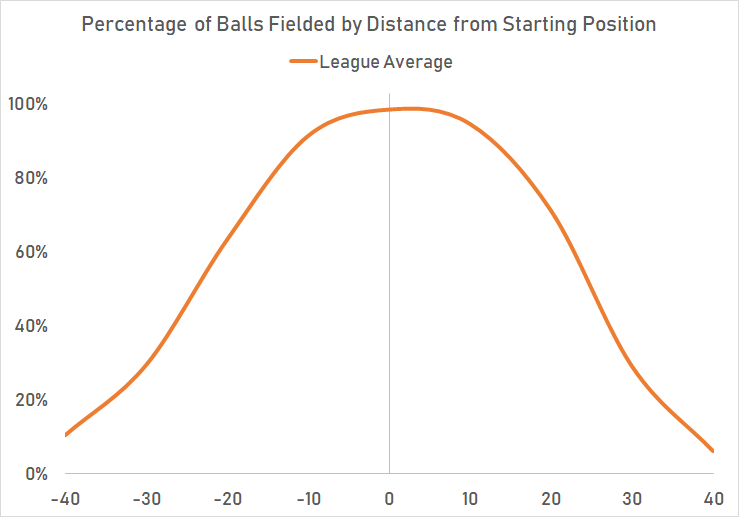
    With that said, here’s the league average distribution for these balls in play.

    These balls in play, when hit right at the shortstop, are fielded nearly 100% of the time. Balls hit about 10 feet in either direction are still above 90%. It dips to about 60-70% at 20 feet from the starting position, then down to about 30% at 30 feet away. And around 40 feet and beyond is where the rate of being fielded drops to 10% and below.

    Let’s compare that with Arizona’s Nick Ahmed, who has the most Range & Positioning Runs Saved at shortstop since the start of 2018.

    Ahmed (blue line) has been consistently above average to his left/up the middle (and can make highlight-reel plays like this one). He’s fielded a similar amount of balls as his peers going 10-20 feet to his right, but has reached more than the typical shortstop beyond that (like this one). And in addition to range, Ahmed’s arm helps separate him from other shortstops in converting outs.

    How about Andrelton Simmons?

    Interestingly, he tracks pretty closely with all shortstops, with the exception of a boost in the 30-foot bucket to his right. Like Ahmed, Simmons boasts a great arm to complement his range, elevating him further above other shortstops.

    But instead of comparing him to all shortstops, what about comparing him to one with poor range? Here’s Simmons (blue line) versus Jordy Mercer (orange line).

    Mercer has fielded a high percentage of balls hit within 10 feet in either direction, but Simmons has been better than him beyond that. Mercer has cost his teams 25 runs by our Range & Positioning system since the start of 2016.

    The only shortstop who has lost more Range & Positioning runs in that time is Boston’s Xander Bogaerts (-39). Our system has significantly penalized Bogaerts for balls hit to his right (SS/3B hole), and his limited range on those balls is confirmed here.

    Bogaerts has been close to his peers on balls hit to his left, but well below average at reaching balls hit to his right.

    The margins here are pretty small. After all, those who play shortstop — and stay there — tend to have the necessary range to reach enough batted balls in their zones. But since shortstops have a high volume of balls hit to them, those small differences can add up over the course of a season.

  • Why does Xander Bogaerts have such a low Defensive Runs Saved total?

    By MARK SIMON
    With one out and nobody on in the second inning of Game 2 of the ALCS, Astros shortstop Carlos Correa hit a ground ball in the shortstop-third base hole. Xander Bogaerts got to the ball, but took his time in making a throw to first base. Correa beat it out for what was scored an infield hit.

    Two batters later, Josh Reddick popped out for what would have been the third out of the inning had Bogaerts made the play. Instead, George Springer doubled, plating two runs in what could have been a huge moment in the game.

    Baseball Info Solutions received a few inquiries on Twitter as to why Bogaerts has the worst Defensive Runs Saved total of any shortstop in the majors (-19).

    Simply put: It’s because he doesn’t make plays like that one. And that’s whether he gets to the ball or he doesn’t.

    Bogaerts rates worse getting outs on balls hit in the shortstop-third base hole than any shortstop in the 16 years that BIS has collected data. He was 36 plays below average, breaking the mark of 34 below set by Jimmy Rollins in 2013.

    In fairness to Bogaerts, some of this is due to where he’s positioned (he often cheats up the middle), it doesn’t factor in how he fares in shifts (which would likely help him a little), and he’s pretty good at fielding balls hit up the middle and the area in which a shortstop typically plays.

    Let’s explain via example: If we divided the area between second base and third base into thirds, it would be important for our purposes to know how Bogaerts gets outs in that middle-third area, which would cover a lot of the shortstop-third base hole. Here’s the answer in context.

    The average team gets an out on a ground ball hit into that middle-third area by a right-handed batter about 77 percent of the time (the Astros are right at the average).

    The Red Sox got an out about 68 percent of the time on the nearly 400 balls hit to that spot. The difference of about nine percentage points accounts for about 35 fewer balls turned into outs than average over the course of the season.

    To the Red Sox and Bogaerts’ credit, they’ve turned 20 of 22 ground balls and bunts hit into that area into outs this postseason.

    But as we saw in Game 2, one missed play can mean a couple of runs that sent Red Sox Nation into a bit of a panic.

    Fewest Defensive Runs Saved – Shortstops in 2018
    Xander Bogaerts Red Sox -19
    Amed Rosario Mets -16
    Manny Machado 2 Teams -13
    Alcides Escobar Royals -12