Month: April 2020

  • Who are the best “Day 2 WR” in the NFL Draft?

    By JOHN SHIRLEY

    The Colts and Steelers were in unfamiliar territory last season. They were both attempting to rally behind an unproven quarterback, after losing their projected starters unexpectedly. After having matching circumstances and similar results in 2019, the two teams find themselves paralleling each other again heading into the 2020 Draft.

    Both teams have traded away their first round pick for defensive help and both need a boost at receiver to help an aging quarterback from the legendary 2004 draft class. Based on SIS’s Total Points metric, only the Eagles currently have a worse receiving corps than the Colts and Steelers.

    Current WR Corps Rankings by 2019 Total Points

    RankTeamWR Total Points
    32Eagles21
    31Colts25
    30Steelers26

    The good news for the Colts and Steelers is that the upcoming NFL Draft is loaded with premier talent at the wide receiver position. While they won’t be in play for the class’s headliners, they will still have high-level players to choose from when they select at 34 and 49, respectively.   

    Colts

    Colts Projected Top 3 WR’s 2019 Stats

    PlayerTgtsCatch%ADoTYAC/RecSlot%Total Points
    Zach Pascal7356%11.75.853%17
    T.Y. Hilton6965%9.94.937.5%9
    Parris Campbell2572%8.06.057%0

    The Colts returning receivers should be better this season if they can stay healthy, as they lost significant time from both T.Y. Hilton and Parris Campbell last season. But, they could still use some help at the position. A deep threat with a large catch radius would be a welcome addition, as Zach Pascal’s team leading ADoT of 11.7 only ranked 55th among receivers with at least 20 targets. New quarterback Philip Rivers is used to getting a lot of help from his receivers

    Potential Targets:

    Tee Higgins, Clemson (SIS Football Rookie Handbook Grade: 6.7)

    • Scouts Take: Higgins has the natural hands, contested-catch ability, and wide catch radius to be a solid No. 2 at the next level, but his rounded cuts and inability to consistently separate against press may hold him back. – Nathan Cooper

    Jalen Reagor, TCU (SIS Football Rookie Handbook Grade: 6.8)

    • Scouts Take: Reagor has the speed, playmaking ability, quickness in and out of routes, and strong hands to be a consistent contributor in the NFL, but will need to win more against physical DB’s and learn an NFL route tree to take his game to the next level. – Nathan Cooper & Matt Johnston. (video analysis here)

    Denzel Mims, Baylor (SIS Football Rookie Handbook Grade: 6.4)

    • Mims is a very athletic, physical wide receiver who is an asset in all areas of the field with a wide catch radius and good blocking ability, but needs to improve his route running and become more consistent in traffic to become a better overall player. – Evan Butler

    Steelers

    Steelers Projected Top 3 WR’s 2019 Stats

    PlayerTgtsCatch%ADoTYAC/RecSlot%Total Points
    Diontae Johnson9165%9.15.224%15
    James Washington7856%15.24.640%13
    JuJu Smith-Schuster7258%9.25.871%-1

    The Steelers receiving corp took a major step back last season due to multiple reasons. The absence of a starting caliber quarterback, after Ben Roethlisberger’s injury, definitely lowered the group’s potential, as did JuJu Smith-Schuster being miscast as a No. 1 receiver.

    The good news for the Steelers is that with Smith-Schuster in the slot, James Washington emerging as a legitimate deep threat, and Diontae Johnson surprising as a third-round pick, they should have some solid pieces this year. Though, they could use some added size on the outside to complement the returning weapons. 

    Potential Targets:

    Laviska Shenault Jr., Colorado (SIS Football Rookie Handbook Grade: 6.8)

    • Shenault is a big-bodied, versatile receiver who wins at the point of attack and has a fierce, competitive attitude, but brings limited play speed and needs to refine his route running before he can become a star. – Cyril Penn

    Grabriel Davis, UCF (SIS Football Rookie Handbook Grade: 6.7)

    • Davis has the tracking, vertical separation, playmaking ability, and physical gifts to be a solid starter in the NFL, but he will need to show more after the catch and learn to run a more diverse route tree to become the complete package. – Alex O’Brian

    Michael Pittman Jr, USC (SIS Football Rookie Handbook Grade: 6.4)

    • Pittman Jr. will succeed in the NFL with his ability to high-point and body-up secondary defenders, but his lack of quickness and lateral athleticism should keep him from becoming a true No. 1 target. – Steve Chang & John Todd

    The 2020 Football Rookie Handbook is available for $15 from ACTASports.com. If you liked this article and like studying the NFL Draft, you’ll surely enjoy the book.

  • Introducing the Total Points System to College Football

    The following is an excerpt from the 2020 SIS Football Rookie Handbook, your guide to this year’s NFL Draft prospects. In the book, we took the Total Points player valuation system we used to evaluate NFL players and put it to use to evaluate college football players, with an emphasis on this year’s draft class. The book is on sale for $15 at ACTASports.com.

    By ALEX VIGDERMAN

    Initially released at the start of the 2018 NFL season, the Total Points system is Sports Info Solutions’ answer to the conundrum of evaluating players at any position using a single framework. Total Points starts by apportioning the Expected Points Added of a play to the different players involved, but also uses the wealth of charting data collected by SIS to adjust as the events of the play dictate.

    For example, take two incomplete passes, which for all intents and purposes are considered equal by most metrics, but would give very different Total Points values (for the quarterback in particular, but to some extent for many players).

    Play 1: On 3rd-and-8, the quarterback drops back to pass and is forced out of the pocket because the left guard blows a block. He throws it to his tight end right at the sticks, but he drops the pass.

    On this play, the left guard is penalized for having blown a block, and the quarterback and intended receiver recoup that value because their job is made more difficult. The throw is on-target and in the hands of the receiver, so the quarterback is credited as though it were completed. The receiver loses a whole bunch of value, especially because the play would have resulted in a third down conversion.

    Play 2: On 1st-and-10, the quarterback drops back to pass and throws a slant eight yards downfield to the tight end, but the throw sails way over the head of the intended receiver.

    Here not only does the down-and-distance affect the value available to the players (the incompletion isn’t as damaging in this case), but the effective blocking by the offensive line and the off-target throw cause the quarterback to take most of the blame for the play’s failure. The offensive line and intended receiver don’t lose any value because (as far as the charting data on the play is concerned) they did their jobs effectively.

    All 22 players on the field are evaluated in this way using a breadth of charting data, and the set of data being used is expanding each year as SIS adds new data points.

    The result of this calculation is a raw Points Above Average value that centers around zero for each season. From there, that value is transformed into Total Points by re-scaling it to center each team’s game-level total around the average points per game instead of around zero.

    FBS Total Points Leaders

    Following are the leaders in Total Points from the 2019 college football season. Unsurprisingly, quarterbacks dominate the list of the most valuable players. As a result, there are three leaderboards: the top quarterbacks, the top non-quarterback offensive players, and the top defensive players.

    Top FBS Players by Total Points, 2019

    Quarterbacks

    Player School Total Points
    Joe Burrow LSU 252
    Anthony Gordon Washington State 180
    Justin Fields Ohio State 170
    Jalen Hurts Oklahoma 162
    Sam Howell North Carolina 153


                                                     Non-Quarterback Offense
    Player Pos School Total Points
    Travis Etienne RB Clemson 84
    Clyde Edwards-Helaire RB LSU 83
    Zack Moss RB Utah 80
    Jonathan Taylor RB Wisconsin 72
    J.K. Dobbins RB Ohio State 71
    Kennedy Brooks RB Oklahoma 65
    Ja’Marr Chase WR LSU 62
    Javian Hawkins RB Louisville 60
    Najee Harris RB Alabama 60
    Jaret Patterson RB Buffalo 58


                                                                Defense
    Player Pos School Total Points
    Isaiah Simmons LB Clemson 76
    Chris Orr LB Wisconsin 74
    Antoine Winfield Jr. S Minnesota 74
    Nick Bolton LB Missouri 68
    James Lynch DT Baylor 67
    Xavier McKinney S Alabama 67
    Derek Stingley Jr. CB LSU 66
    Alijah Halliburton S Wyoming 65
    Kyahya Tezino LB San Diego State 65
    Joseph Ossai LB Texas 65
    Akileis Leroy LB Florida Atlantic 65

    Adjusting for Strength of Opponent

    Much more than is the case in the NFL, the spread of talent across teams in college matters a lot in how we must evaluate a player’s performance. To address this concern within Total Points, a team quality estimate is calculated for both sides of the ball, and then each play is modified using a multiplier that is based on the quality of the unit on the other side of the field.

    This adjustment (done the same way for offense or defense) is calculated over a rolling twelve-week window for each team by combining multiple calculations, all based on Expected Points Added per game (EPA/G):

    • EPAt: The team’s average EPA per game in the 12-week sample
    • EPAo: Their opponents’ performance in the other games in the sample (i.e. excluding games against the original team)
    • EPAoo: Their opponents’ opponents’ performance in the other games in the sample (i.e. excluding games against both the original team and their opponents)
    • EPAavg: The overall average EPA per game

    Each team’s (offensive and defensive) quality rating is based on its EPA per game compared to average, adjusted for strength of schedule. It is calculated by comparing each team’s opponents’ performance (EPAo) to their opponents’ allowances in other games (EPAoo), and then using that to modify the team’s EPA per game (EPAt). Finally, the average EPA per game across all teams (EPAavg) is subtracted out.

    Put mathematically,

    Team Rating = EPAt – (EPAo – EPAoo) – EPAavg.

    From there, the team rating is turned into a multiplier by converting the EPA difference calculated above into a percentage of the average EPA available in a game (i.e. the absolute value of all EPA accumulated in a game on average). The adjustment will range from about a 25% downgrade (e.g. a defensive player facing the Akron or UMass offense) to about a 25% upgrade (e.g. a defensive player facing the Ohio State offense).

    Example Use Cases for Total Points at the College Level

    Total Points is incredibly useful as a quick way to measure players against each other because it distills player value into a single number. This is especially true for defensive players, because it’s not clear how one should compare a tackle in the run game to a sack or a pass defensed, for example. Total Points allows us to discuss players with different roles and statistical profiles apples-to-apples.

    With the strength-of-schedule adjustment added on top of the existing Total Points methodology we can quickly evaluate a player compared to the full swath of college football players, which can help point scouting staffs in the direction of players whose raw statistics don’t tell the full story (for better or for worse).

    One such comparison could be drawn between running backs Zack Moss of Utah and Chuba Hubbard of Oklahoma State. Moss nearly leads the position in Total Points despite only ranking 11th in yards from scrimmage, buoyed by strong performances against above-average defenses. Hubbard, the leader in yards from scrimmage, doesn’t even crack the leaderboard above in part because of a weak set of opposing defenses and in part due to a handful of fumbles and pedestrian output after contact.

    Exploring Total Points Further

    This edition of The SIS Football Rookie Handbook represents the initial release of these Total Points numbers. You can find them in the Deep Dive section of the player pages as well as the leaderboards for each position.

    The Football Rookie Handbook is on sale for $15 at ACTASports.com

  • Minor League Defenders to Watch According to Keith Law

    By ALEX VIGDERMAN

    Monday’s episode of the SIS Baseball Podcast featured The Athletic’s Keith Law, whose book “The Inside Game: Bad Calls, Strange Moves, and What Baseball Behavior Teaches Us About Ourselves” comes out April 21.

    The conversation largely consisted of discussion of some of the cognitive biases that affect all of us to some extent and particularly baseball decision makers in the realm of player evaluation and roster construction (for those wondering about the board game Keith recommended at show’s end, Jaipur, is available virtually in multiple locations).

    The last bit of the interview included Keith mentioning the prospects we should be interested in from a defensive perspective. Two of those names have come up in previous podcast episodes, and another might surprise you given his position.

    Cristian Pache, Braves CF (FanGraphs Prospect Rank: 20)

    We start with a name that I’ve heard a few times in prospect discussions over the offseason in Braves outfielder Cristian Pache. Unfortunately, he isn’t likely to play center field in the majors any time soon because arguably the best young player in baseball is currently manning that spot (Ronald Acuña Jr).

    A move to a corner position should be just fine for Pache, who in his age-20 season split time across all three outfield positions. That included saving nine runs in just 20 games in right field, which was second at the position (he was among the defensive standouts mentioned on the September 4 episode of the podcast).

    Pache’s arm shone in a small sample across Double-and-Triple-A, allowing only five runners to advance and retiring three runners without the use of a cutoff man in just 13 opportunities. Both of those rates were much better than the minor league average in 2019.

    Ke’Bryan Hayes, Pirates 3B (FanGraphs Prospect Rank: 30)

    Ke’Bryan Hayes was the guest on the SIS Baseball Podcast on August 20th, primarily because of his reputation with the glove (he’s won the Minor League Gold Glove at third base three years running). He ranks second in Defensive Runs Saved among minor league third basemen with at least 1,000 innings over the last two seasons, trailing only the Rockies’ Josh Fuentes (who won’t be making much noise at the hot corner any time soon, as he’s blocked by Nolan Arenado).

    One of Hayes’ calling cards defensively is the jumping catch. He recorded the out on 11 plays where our Video Scouts saw him to field the ball over the last two seasons, which was second-most in the minors in the games we charted. His 73 percent success rate (11 for 15) tied for the best among those with at least 10 jumping attempts.

    Evan White, Mariners 1B (FanGraphs Prospect Rank: 64)

    If they say there’s no such thing as a first base prospect, imagine what “they” might say about a first base prospect on defense. Evan White might break that mold, and the Mariners are betting on that. They signed him to a six-year extension that was the first ever for a player without experience above Double-A.

    White won the Minor League Gold Glove at first in 2018 after winning a couple collegiate Gold Gloves while at Kentucky. He followed that up in 2019 by ranking third among qualified minor league first basemen in Defensive Runs Saved.

  • Which is the best defensive team of the 21st century?

    By MARK SIMON

    We covered the best defensive players of the 21st century in a series of articles (and Twitter polls) the last two weeks. But what about trying to figure out which was the best defensive team?

    Doing this with Defensive Runs Saved tends to slant the choices to the last four seasons. That may be due to the increase in awareness about the importance of defensive positioning as much as anything else. So to be fair, we limited our choices in those years to four in total in the interests of giving some other excellent defensive teams their due.

    One thing that was challenging was how to handle the idea of a late-season call-up (Andrelton Simmons for example) who stood out. Do we weigh the team’s performance based solely on when he played or do we consider the year in its entirety for better or worse? We pose the question for you to consider.

    Here’s our list, based on a combination of stats and general observation. Rather than rank them, we’ll list them in reverse chronological order (try ranking teams against each other – it’s really hard!) The links take you to available highlights of the team’s defensive play found on YouTube.

     2019 Dodgers

    The Dodgers led the majors in Defensive Runs Saved on the strength of their positional versatility.  Cody Bellinger became the first player to win two Fielding Bible Awards in a season, as he tied for the MLB lead in Runs Saved in right field and played a solid center field and first base.

    Max Muncy filled in ably at three positions, including a stellar stint at third base when Justin Turner got injured. Kiké Hernández played a Gold Glove-caliber second base (13 Runs Saved) but also got time across the outfield and infield. Joc Pedersen saved six runs at each outfield spot. Alex Verdugo saved eight between right field and center field.

    2018 Diamondbacks

    That this Diamondbacks team finished over .500 was a tribute to how good their defense was. They have the single-season record for Defensive Runs Saved (148) dating to 2003, the first season for which the stat is tracked. Nick Ahmed led all shortstops in Runs Saved with 30 and just missed winning a Fielding Bible Award (he’d win one in 2019).

    Teammate Jeff Mathis did win a Fielding Bible Award behind the plate, which was impressive in that he only played 63 games. But he finished with an MLB-high 20 Runs Saved there, a dominant performance too good to ignore. Mathis’ fellow catchers, John Ryan Murphy and Alex Avila, combined to save 11 more runs in their time share. Ahmed was part of a very strong infield highlighted by second baseman Ketel Marte (12 Runs Saved) and first baseman Paul Goldschmidt (11).

     2017 Red Sox

    The Red Sox got knocked out of the postseason by the Astros in the ALDS, but this laid the groundwork for the World Series win the following season. This team had an outstanding outfield, with three players at their best in Mookie Betts (MLB-leading 30 Runs Saved), Jackie Bradley Jr. (15) and Andrew Benintendi (12). They also had Dustin Pedroia at the end of his run of excellence at second base. He saved eight runs in 98 games and along with Mitch Moreland (9 Runs Saved) made a very formidable right side of the infield.

    But perhaps the most underrated aspect of this Red Sox team was how good its catchers were. Sandy Leon (15 Runs Saved) and Christian Vazquez (10) formed as good a defensive tandem as there was in baseball with each ranking among the top pitch framers in the game.

     2016 Cubs

    The first Cubs team to win a World Series since 1908 was an excellent defensive team, getting at least 10 Runs Saved from five different positions (pitcher, catcher, first base, shortstop, and right field). Anthony Rizzo (first base) and Javier Baez (multi-position) won Fielding Bible Awards, Jason Heyward (third in right field), Kris Bryant (third at multi-position) and Addison Russell (fourth at shortstop) also placed high in Fielding Bible voting.  The Cubs were the best team in the majors when it came to turning ground balls into outs. And it was a ground ball on which Bryant made the play that ended their championship drought.

    2012 Braves

    This is a Braves team with a great outfield, featuring Jason Heyward in right field (17 Runs Saved, which ranked second in MLB), Michael Bourn in center field (MLB-leading 23), and Martin Prado in left field (11, second) regularly.  This was also the debut season for all-world shortstop Andrelton Simmons, who saved 19 runs in only 49 games.

    Consider too that one of their alternatives, Tyler Pastornicky, cost the team 16 runs in 47 games there, making Simmons all the more valuable.  Props also to catcher Brian McCann, whose 13 Runs Saved behind the plate were a career high.

    2008 Phillies

    The World Series-winning Phillies team led the majors with 76 Runs Saved, 58 of which came from second baseman Chase Utley (whose 30 are tied for the most in a season at the position), shortstop Jimmy Rollins (MLB-best 18) and center fielder Shane Victorino (10). This is one of the best teams to point to if you’re going to talk about defensive strength up the middle. And it’s not the only Phillies team in this era to make the list.

    2005 Phillies

    This Phillies team just missed the postseason, but their defense was superb. In fact, they had the most Runs Saved (97) of any team in the first 10 seasons that the stat tracks (2003-2012) The Phillies got a combined 85 of those Runs Saved from their infielders.

    Second baseman Chase Utley and shortstop Jimmy Rollins led the way with 20 and 18 Runs Saved, respectively. David Bell (17 Runs Saved) and Ryan Howard (11) were strong at the infield corners (Howard wasn’t typically this good). What keeps this team from the very top was a couple of weak spots – Bobby Abreu in right field (-9) and Mike Lieberthal (-12) behind the plate).

    2005 Cardinals

    You could pick a number of Cardinals teams from the mid-2000s. This one was pretty good from a statistical perspective, especially on the infield where second baseman Mark Grudzielanek saved 23 runs (second-most at the position that season), a total matched by the Cardinals primary third basemen, Scott Rolen (14 in only 56 games after saving 30 the year before) and Abraham Nunez (9).  Albert Pujols (13) was solid at first base and Yadier Molina (13) was his usual excellent self behind the plate.

    2002 Angels

    This team predates Defensive Runs Saved by a year, so we’re relying on Sean Smith’s Total Zone Runs Saved (a worthy predecessor or companion to our stat) and our recollections.

    The Angels got an all-timer of a year from center fielder Darin Erstad, who recorded 39 Runs Saved (we’re willing to believe in that given that Erstad won a Gold Glove at two positions and had a reputation for excellence). They also had four players in their primes record at least 10 Runs Saved (Garret Anderson, Adam Kennedy, David Eckstein, and Bengie Molina). Troy Glaus also saved seven runs at third base, a spot where he had a stellar rep.

    Perhaps most notably, the Angels didn’t have any position players who could damage a defense. Only one (infielder Jose Nieves) cost the team more than one run in defensive value

    2001 Mariners

    It would be hard to win 116 games without being an elite defensive team, unless you scored an absurd number of runs or struck out a ridiculous number of hitters. The Mariners had six players record at least 10 Runs Saved per Total Zone Runs. Third baseman David Bell led the way with 19. Ichiro Suzuki in his rookie season ranked second with 15. Bret Boone (12), Mike Cameron (11), Carlos Guillen (10) and 37-year-old outfielder Stan Javier (10) each were dynamic on defense. And let’s not forget slick-fielding first baseman John Olerud, who finished with seven Runs Saved.

    Did we miss anyone?  We’re guessing you think we did. Share your thoughts in the comments or on Twitter.


  • Two NFL prop possibilities supported by data

    By Steve Schwarz

    It’s April and there is no baseball. There are no NBA playoffs. There are no NHL playoffs. And the NFL doesn’t start its regular season until September. But because the NFL has stuck to their pre-Coronavirus schedule, we will have an NFL Draft at the end of April.

    OK, it won’t be in front of the usual wild crowds of fans that were expected to swarm over Las Vegas. We won’t get to hear the cheering and jeering of picks, because it will be a “Virtual Draft.” Instead we will see computer hookups between the GMs of the 32 teams and NFL headquarters (I’d like to have the “over” on technical issues, but that’s another story). At least we will have something interesting to watch for three days starting on April 23.

    And thanks to legalized betting in various places around the country, we can bet on the selections. Sure, it’s not like betting on LeBron James and the Lakers against the crosstown Clippers in a playoff series, but it can still be fun … and profitable.

    At the end of the piece you can find a few of the more interesting prop bets from William Hill odds. Let’s see if we can find some profit in those odds. Here are two options supported by SIS data:

    Jordan Love, Utah State, pick 15.5, over -110.

    While Joe Burrow, Tua Tagovailoa and Justin Hebert figure to go to quarterback-needy teams right out of the box, there is no way, based on last season’s statistics, that Love should be anywhere near the top-15 picks.

    Using SIS data in the chart below, Love’s performance last season wasn’t anywhere near elite. In fact, his IQR rating was well below the top-100 quarterbacks for the 2019 season. Anyone selecting Love is doing it based on perceived potential and that usually gets coaches/GMs fired.

    Even assuming a team takes him as a project, No. 15 is far too early. You will only have to sweat out the first Jacksonville pick (currently Gardner Minshew is their starter), but the Jaguars have two first-round selections (9, 20) and if they reach for a quarterback it would likely be with the second pick (the one they got from the Los Angeles Rams for Jalen Ramsey). The Patriots might also be interested, but they are No. 23 and Bill Belichick usually trades down, not up.

    Player College IQR Yards TDs INT
    Tua Tagovailoa Alabama 146.6 2,840 33 3
    Joe Burrow LSU 144.5 5,671 60 6
    Justin Herbert Oregon 117.4 3,471 32 6
    Jordan Love Utah State 81.3 3,405 20 17

    Justin Jefferson, LSU, pick 23.5, under -110.

    Based on most expert mock drafts, three mid-draft teams are expected to go for wide receivers; San Francisco, Oakland and Denver. So by the No. 15 pick, the top-three options will be off the board. And the team who most needs a wideout is Philadelphia (No. 21). Jefferson is a perfect fit for the Eagles. Jefferson ranked No. 1 among all Power-5 receivers from a statistical perspective. Add in his 4.43 40-yard dash, 37.5 inch vertical at the combine, and Jefferson’s work in a pro-style offense and the LSU wideout has everything a team could want.

    Player College WR Rating Catchable Targets Catches Yards TDs
    Justin Jefferson LSU 147.9 121 111 1,540 18
    Henry Ruggs III Alabama 146.8 44 40 746 7
    CeeDee Lamb Oklahoma 144.8 73 62 1,327 14
    Tee Higgins Clemson 138.6 75 59 1,167 13
    Jerry Jeudy Alabama 127.2 86 77 1,163 10

    Sports Info Solutions has been an innovator in the collection and analysis of sports data for almost two decades. SIS specializes in baseball and football data, using professional scouting practices to collect the most detailed and accurate information in both sports. Their data can be found in the majority of team front offices, and on websites such as Fangraphs and Football Outsiders.

    Various 2020 NFL Draft Prop Bet Odds

    Player (WR) College Draft Spot Over Under
    Jerry Jeudy Alabama 12.5 125 -145
    CeeDee Lamb Oklahoma 12.5 -110 -110
    Henry Ruggs III Alabama 14.5 even -120
    Justin Jefferson LSU 23.5 -110 -110
    Tee Higgins Clemson 32.5 -110 -110
    Player (OL) College Draft Spot Over Under
    Mekhi Becton Louisville 7.5 -130 110
    Tristan Wirfs Iowa 8.5  120 -140
    Jedrick Wills Alabama 9.5 -145 125
    Anthony Thomas Georgia 12.5 -120 even
    Player (QB) College Draft Spot Over Under
    Tua Tagovailoa Alabama 3.5 -110 -110
    Justin Herbert Oregon 6.0 120 -140
    Jordan Love Utah State 15.5 -110 -110
    Player (RB) College Draft Spot Over Under
    D’Andre Swift Georgia 31.5 -110 -110
    Jonathan Taylor Wisconsin 36.5 -110 -110
    Player (LB) College Draft Spot Over Under
    Isaiah Simmons Clemson 6.5 105 -125
    Kenneth Murray Oklahoma 24.5 -110 -110
    Patrick Queen LSU 24.5 -110 -110


  • Evaluating offensive line needs for teams that use certain run schemes the most

    By LOGAN KING

    Sports Info Solutions (SIS) brings you the second annual edition of The SIS Football Rookie Handbook, with scouting reports and statistical breakdowns on over 280 college football players who are likely to be drafted or signed as rookie free agents in 2020 (a glossary for the below stats can be found here). New features for this year include unique and informative NFL team pages, research deep-dives by the SIS R&D team, and—for the first time ever—the NCAA version of their flagship football statistic, Total Points

    With the 2020 NFL Draft right around the corner, this article focuses on potential draft targets for the 2019 league leaders in percentage of run plays from zone and man blocking schemes. 

    Each team is examined in terms of its rushing scheme last season, projected rushing scheme for this season (based on coaching changes), and potential draft picks (based on scheme fit, roster needs, and draft position). More information on these prospects can be found in the SIS Football Rookie Handbook.

    The table below displays the league leaders in percentage of run plays from both zone and gap schemes. 

    2019 Rushing Scheme Leaderboards
    Gap Run Zone Run
    Rank Team Percent of Runs Rank Team Percent of Runs
    1 Texans 62% 1 Bengals 76%
    2 Dolphins 59% 2 Vikings 73%
    3 Bills 57% 3 Titans 71%

    Houston Texans

    The Texans lead the league in percentage of gap scheme runs in 2019, finishing just inside the top half of the league in EPA per gap scheme run. The trade of DeAndre Hophins for David Johnson is indicative of Houston’s commitment to establishing the run game, moving forward. Though offensive play-calling responsibilities will be in OC Tim Kelly’s hands this upcoming season, the scheme isn’t expected to drastically change, as Kelly has worked with head coach Bill O’Brien since 2012 at Penn State. 

    Given the return of each of the team’s offensive line starters from 2019, Houston is not hard-pressed to find an immediate starter on the offensive front in this year’s draft. Rather, the Texans can address their need at wide receiver in the early rounds. There are several prospects who project to fit into Houston’s gap blocking scheme which may be available in the later rounds:

    • Robert Hunt, Louisiana Lafayette; Projected Position: T
    • Kevin Dotson, Louisiana Lafayette; Projected Position: G
    • Logan Stenberg, Kentucky; Projected Position: G

    Miami Dolphins

    While the Dolphins called the second most run gap scheme run plays in 2019, next season will likely be a different story, as Chan Gailey is now the offensive coordinator. Gailey’s history with the New York Jets points to a zone running scheme, as his 2015 and 2016 Jets squads ranked 9th and 1st in percentage of zone run plays called. Though only one player in next season’s OL position group finished above 60th in total points per snap at their position in 2019 (Ereck Flowers, 7th), Miami has 12 picks in the 2020 Draft, meaning plenty of opportunities to improve along the line. 

    With three picks in the first round and a total of six in top 70 picks, Miami has the ability to add several top talents to fit into Gailey’s zone scheme, such as the following:

    • Andrew Thomas, Georgia; Projected Position: T
    • Tristan Wirfs, Iowa; Projected Position: T
    • Netane Muti, Fresno State; Projected Position: G

    Buffalo Bills

    The Bills called the third highest percentage of runs from gap schemes in 2019. Buffalo retains their offensive play caller in Brian Daboll and also returns all five starting O-Linemen from last season. Only one of those starters finished outside of the top 26 in total points at their position (T-Cody Ford, 41st). With the ability to focus on other needs in the early rounds of the draft, potential options for Buffalo’s zone scheme include:

    • Robert Hunt, Louisiana Lafayette; Projected Position: T
    • Isaiah Wilson, Georgia; Projected Position: T
    • Tyre Phillips, Mississippi State; Projected Position: G

    Cincinnati Bengals

    In Zac Taylor’s first season leading the team, Cincinnati led the league in percentage of zone runs called. This offseason, the Bengals released guard, John Miller who was second on the team’s OL in terms of total points. Miller was replaced with Xavier Su’a-Filo who played only 307 offensive snaps for the Cowboys at guard, last season. The most dire need for this position group comes at left tackle, where snaps were split between John Jerry, Cordy Glenn, and Fred Johnson. 

    With the first overall pick in hand, the Bengals hold immense leverage; potential options for their zone-heavy scheme include:

    • Andrew Thomas, Georgia; Projected Position: T
    • Jedrick Wills, Alabama; Projected Position: T
    • Matt Hennesy, Temple; Projected Position: C

    Minnesota Vikings

    Of the Viking’s run plays in 2019, 73% were zone scheme runs. Despite former OC Kevin Stefanski’s departure to Cleveland, the team should retain scheme consistency with Gary Kubiak taking the reins. Minnesota returns four starters from last season’s OL, after moving on from RG Josh Kline. 

    After big losses to the defensive back and wide receiver position groups this offseason, the team will likely not address the offensive front early on in the draft. Potential options in for the Viking’s zone scheme include:

    • Netane Muti, Fresno State; Projected Position: G
    • Jonah Jackson, Ohio State; Projected Position: G
    • John Simpson, Clemson; Projected Position: G

    Tennessee Titans

    The Titans ranked third in percentage of zone scheme run plays and ranked 5th in EPA per play on those runs. Tennessee enters the 2020 season with the same offensive play caller and four (three of which finished in the top 14 at their position in total points in 2019) out of five primary starters on the OL from last year, losing Jack Conklin to Cleveland. Dennis Kelly, who earned 10 total points in limited snaps last season, is expected to fill in for Conklin. 

    The Titans are limited to six picks in the draft, with their first one coming at number 29. With limited opportunities to add depth, some players which could fit into the Titans’ zone scheme include:

    • Josh Jones, Houston; Projected Position: T
    • Lucas Niang, TCU; Projected Position: T
    • Shane Lemieux, Oregon; Projected Position: G
  • Jadeveon Clowney is better than he showed in 2019

    Jadeveon Clowney is better than he showed in 2019

    By NATE WELLER

    After a hectic start to the NFL offseason, things have slowed considerably as GMs do their final draft prep and learn how to use Zoom. At some point, though, the market will pick back up, and the biggest non-QB domino left to fall is Jadeveon Clowney.

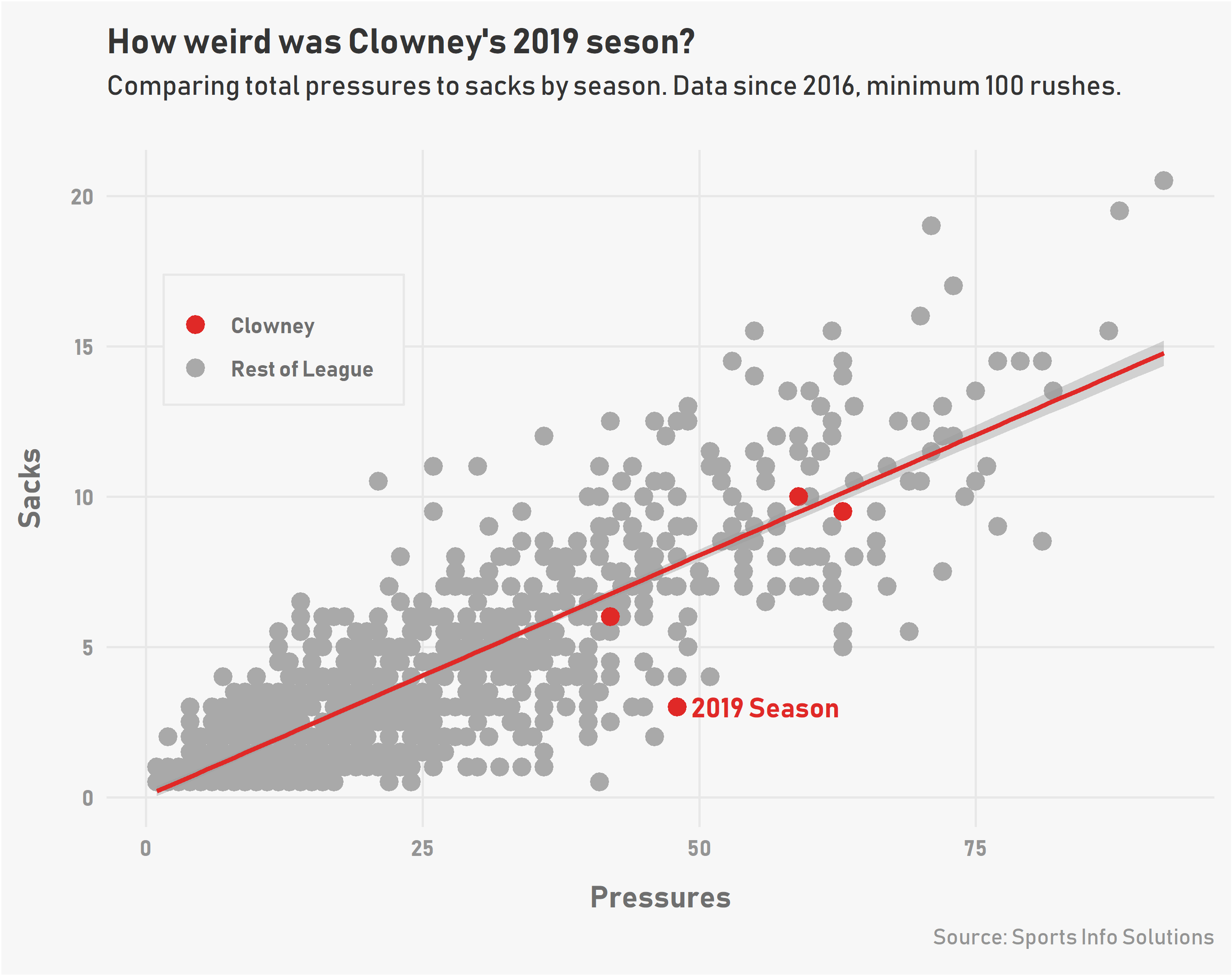
    It’s a weird time to be an NFL free agent, and Clowney is undoubtedly feeling the effects, probably more than any other player. Given his checkered injury history and team’s inability to perform a physical with their own doctors, Clowney has been unable to generate as much of a market as one might expect for a talented 27-year old pass rusher. Beyond that, teams are no doubt hesitant to throw top edge rusher money at a guy coming off of a three-sack campaign, even if that’s not really a fair reflection of Clowney’s performance.

    Clowney generated 48 pressures in 2019, which still ranked him tied for 29th in the league despite missing time. The problem was that Clowney only turned those pressures into sacks a little less than six percent of the time, which ranked him 50th of 51 players with at least 40 pressures. Turning pressures into sacks is an inherently noisy metric, and there’s plenty of reason to believe Clowney will bounce back. Between 2016 and 2018 Clowney ranked 13th in the NFL in pressures with 163, and he turned 16 percent of those into sacks.

    Arguably the best part of Clowney’s game, though, is his ability against the run. Clowney was solid as a run defender 2019. His 13 Run Defense Points Saved in 2019 (a stat explained here) ranked him 12th among defensive ends. But even after a (relatively) down year against the run, Clowney still leads all defensive ends by this metric since 2016, edging out Calais Campbell.

    It’s impossible to say precisely how much of Clowney’s limited market can be attributed to his medical history and how much is a reaction to his stats in 2019. Regardless, Clowney is likely to have a strong market once things return to relative normalcy. And whatever team does pay Clowney will likely be getting production that is much closer to his performance between 2016 and 2018 than what we saw last season

  • Who’s the best defensive player you’ve ever seen?

    Compiled by Mark Simon

    Who’s the best defensive player you’ve ever seen?

    Think about that one for a little bit. It’s thought-provoking and requires considering a lot of factors. But it’s a fun subject.

    We posed the question to as many “baseball people” as we could find. These included former players, broadcasters, journalists, and a few others who work in our industry. We got more than two dozen responses. The respondents ranged in age from 20s to 70s so the baseball-watching inventory varied. Some names come up more than once and deservedly so. Some names will surprise you. These are their answers — if you click on any player’s name, you’ll get a link to video highlights of that player.

    Sean Forman, owner, Sports-Reference.com

    “I’ll go with Andruw Jones.  Everything looked easy when he was going for balls.  I believe the eye test is terrible for assuming the flashy play was the difficult play.  When a ball is hit and I think to myself, ‘Oh, that’s going to be a problem,’ and then the defender fields it easily, that’s an indicator that the player is a great defender.”

    Mike Krukow, former MLB pitcher, current analyst for Giants TV broadcasts

    Barry Bonds did things I never saw anyone do. He never got the accolades for being the player he was. One of the most incredible first steps on the defensive end.

    In 1993, the Giants had John Burkett and Bill Swift, two sinkerball pitchers. There were times I’d see Bonds standing 15 feet from the left field line when a left-handed hitter came up. You could have parked eight semis length-wise in the space between him and the center fielder, Darren Lewis. And he never got burned on a ball in the gap.

    Day-in and day-out, guy would slice fly balls to him. He always said ‘If he tries to hit it to the gap, I alter his swing. And if I alter his swing (by playing where he played) I did something important.’”

    Marty Lurie, KNBR talk-show host, San Francisco

    “Hall-of-Famer Luis Aparicio was the first major league player I saw up close in spring training in Miami in the mid-1960’s. I watched him take infield and to my amazement his hands never moved once he was in position to field a ground ball. The glove was steady. It was so quiet, I couldn’t believe it. That’s when I realized how good a fielder a top flight major league shortstop was. Poetry, quiet glove and hands, completely in control of the ball.”

    Trevor Plouffe, former MLB third baseman, current MLB broadcaster, various sources

    Matt Chapman and Kevin Kiermaier are damn close. Chapman is so strong and quick laterally. His arm is out of this world. His pre-pitch setup is so low that you would think he would be limited in his first step but he isn’t. KK has closing speed. So many balls were hit that I thought he had no chance on. And he would get there. And his ability to work the wall is incredible.”

    Manny Acta, Mariners bench coach

    Adrián Beltré. His reflexes, agility, hands and arm strength were just unbelievable. He even made bunters doubt themselves, because he was so good coming in, it was sick. I am also a big Rolen and Tony Fernández fan. I always prefer an infielder over an outfielder. It’s always tougher to catch a ground ball. There no bad hops in the air.”

    Gary Cohen, Mets TV play-by-play announcer

    “Oh my, Mark!  You’re asking me to pick one?  For short periods of time, Rey Ordoñez and Juan Lagares were state of the art at their positions.

    But for the duration of his career, Keith Hernandez was the best defender I have ever seen.  He re-defined the position, in terms of his range, his fearlessness, but also the command he took of the entire infield (and occasionally the battery), from a position that rarely exudes that kind of on-field leadership.”

    John Thorn, official historian of MLB

    “To the eye, Cal Ripken, Jr. was not an impressive shortstop. But his numbers in 1983-1984 were astounding, indicating that much of defense consisted of positioning before the pitch–that brains were as important as reflexes. Rey Ordoñez looked better than Ripken, and as a Mets fan I saw him more often. But he wasn’t.

    You asked who was the best defensive player I ever saw, and I must preface my answer by saying that watching in two dimensions–on a tv screen–is not the same as seeing in three. Live, it was Ozzie Smith, but at the ballpark it was Jim Edmonds.”

    Vince Cotroneo, Athletics radio play-by-play announcer

    “The best defensive player I saw in the minors was Roberto Alomar, at Double-A Wichita with the Padres in 1987, playing shortstop. Unbelievable range and an absolute magician, from a quality family.

    But ultimately for me, and I know it’s a small sample, Matt Chapman stands alone. Because he has revolutionized the positioning at third, playing so deep with his incredible arm and quick feet. Watching him take bunts away from Dee Gordon has been a sight to behold.

    In St. Louis, Matt Carpenter attempted to bunt to start the game. Matt was alone on the left side in the shift. He charged, grabbed, and beat Carpenter by a full stride to first. To me, it epitomized the one reason for interleague play. The chance to see a player perform at the highest level that you wouldn’t ordinarily get to watch based on schedule.”

    Adam Amin, ESPN Radio play-by-play announcer

    “The fluidity of Nolan Arenado’s glove work and the angles he moves at, to get to balls others don’t, makes me feel he’s the best infielder I’ve ever seen.”

    Len Kasper, Cubs TV play-by-play announcer

    “It’s probably Nolan Arenado. He makes all the plays and has more range than any third baseman I’ve ever seen. He also has maybe the best left-side infield arm I can remember. Javier Baez is 1A for me and I’m lucky I get to watch him every single day. Jason Heyward is the other one. Never ever makes a bad decision in the outfield.”

    Preston Wilson, former MLB player, current TV broadcaster

    Rey Ordoñez was great because there was no play he didn’t think he could make and he was one of the first guys I saw to make off-platform throws look easy.  The other would be Ozzie Smith.  He always knew where he was in relation to everything on the field. When I saw him take ground balls and throw to bases without looking, I was blown away. And it makes total sense because the bases never move, but to see somebody do that with supreme confidence and accuracy is something that you never forget. He might actually be a wizard.

    Derrek Lee was just as good if not better than Keith Hernandez. And I have a good one for you. The best catcher I ever saw was my uncle Collis. The best outfielder was my Uncle Stevie.  Collis was the first catcher I ever saw to throw from his knees. He had a cannon!”

    Jim Duquette, former MLB general manager, current XM MLB radio show host

    Andruw Jones – no one was better at playing shallow CF, and positioned as well and covered as much ground, and knew where the ball was going before anyone else, than Jones. He did it so gracefully, that most of the time it didn’t look like he gave the effort.

    It used to drive me crazy, the ball is headed to the gap and there he is, with his glove open two seconds longer than anyone else, like he’s catching it in his back pocket.”

    Gar Ryness, aka “Batting Stance Guy”

    “Maybe someone in NBA was stronger than Karl Malone but I just assumed he was strongest because of how everyone discussed his strength. Maybe there was a better fielder than Ozzie Smith but my own eyes and everyone else convinced me he was the best fielder.”

    Dave Wills, Rays radio play-by-play broadcaster

    “I was working for the White Sox when Omar Vizquel and Roberto Alomar were working their magic and I’m not sure I’ve seen a better defensive shortstop than Vizquel. But I probably have to stick with the home team and go with Kevin Kiermaier. His jumps on gappers are as good as I’ve ever seen. His routes are also very efficient and on many occasions, he is actually pulling up on balls that most people would have to dive for. He can come in and go back on baseballs very well and has an above-average arm too. He also works at his craft to stay at the top of the defensive charts.”

    Ron Darling, former MLB pitcher, current Mets TV analyst

    “Keith Hernandez and Don Mattingly in the majors. But in the minors, it was Tom O’Malley. It was the first series I ever saw as a professional.  Straight out of Yale.  He was the best player offensively and defensively on the field.  One diving play after another.  He was 19.”

    Note: O’Malley went on to play nine major league seasons for six teams from 1982 to 1990.

    C.J. Nitkowski, former MLB pitcher, current Rangers TV analyst

    Kimera Bartee (who played for the Tigers, Reds, and Rockies from 1996 to 2001). KB had as quick of a first step as anyone who I had ever seen or ever played with. Combine that with his great speed and ability to anticipate and you’ve created the perfect formula for a center fielder with as good as range as you will ever see.”

    Jim Bowden, former MLB general manager, current XM radio host, writer for The Athletic

    Andruw Jones was the best defensive center fielder I ever saw. He took away the singles in front of him and had above-average range to all directions. I’ve never seen another center fielder get to baseballs, let alone catch them like he was able to. He was instrumental in helping get his starting pitchers to the Hall of Fame.”

    Adnan Virk, studio host, DAZN, MLB Network, NHL Network

    Roberto Alomar was magical at second base. He had a flair for the dramatic and the spectacular.”

    John Dewan, owner, Sports Info Solutions

    Ozzie Guillen, who joined the White Sox the year that we started STATS Inc. He was such a character, just a hot dog on the field. But his defensive ability was something to behold. And I always thought, ‘if we could properly measure defensive analytics, we can find out how good he is and how good other defensive players are.’”

    Aaron Goldsmith, Mariners radio play-by-play broadcaster

    “I feel like this may be too easy of an answer, but the first name that comes to mind is Matt Chapman. I obviously see him a lot and he makes EVERY play. Coming in on a Dee Gordon bunt, over the shoulder catch in shallow left near the line, long throw from foul ground near third…dude does it ALL. I also measure it based on the fact that if he DOESN’T make the play, I’m literally shocked.”

    Tom Walter, head baseball coach, Wake Forest University

    Stuart Fairchild, our starting CF, (2015-2017) won a Gold Glove in 2017 and was the 38th overall pick by the Cincinnati Reds.  Stu made one of the greatest catches I have ever seen at any level in the ACC tournament in 2016. You can watch it here.”

    Karl Ravech, host, Baseball Tonight on ESPN

    “I’ll stick my nose out for a lunch-pail grinder named Dustin Pedroia. A four-time Gold Glover who made the play up the middle as well as anyone. He killed rallies while diving left and right. Flipped with his glove, threw sidearm. He did whatever it took to prevent a hit and I want him on every team of mine.”

    Bill Parker, co-host “This Week in Baseball History” podcast

    Boring answer, but it’s definitely Ozzie Smith, and what impressed me most was how quickly the ball could go from entering his glove to leaving his throwing hand. It seems to defy physics, but he could jump to catch a high bounce or line drive and have sent it on its way to first before his feet hit the ground again.”

    Mike Bates, co-host “This Week in Baseball History” podcast

    “I believe very strongly that Ozzie Smith is the best defender, relative to his peers, I have ever seen. Part of it, obviously, was his ability to make so many spectacular plays. He simply seemed to be everywhere. He was well positioned and had incredible range, and he just got to far more balls than anyone else. But even beyond that was his ability to make plays well, even routine ones.

    And, as much as we (mostly) rightfully denigrate fielding percentage as a statistic today as a way to measure defensive performance, here,  his eight times leading the NL in it, in tandem with his overwhelming number of chances, reinforce his greatness. He was just so natural-looking out there, so smooth. Like he had been born to play shortstop. His instincts were unfailing and he had such creativity to add to his overall steadiness.

    Now, I’ll be the first to admit that he was helped by all the turf, and that he likely does not measure up to today’s shortstops athletically 40+ years after his debut. The only reason I would hesitate to choose him is that so much of his prime took place before I was an avid fan. But even after that, I remember being in awe.”

    Joe Block, Pirates radio play-by-play broadcaster

    “I suppose Omar Vizquel comes to mind because of his lightning quick hands and flawless footwork. What makes the greats great IMO is that they make the difficult plays look routine and Omar did that … routinely.”

    Jim Morris, former MLB pitcher (movie, “The Rookie” is based on his life)

    Omar Vizquel, because he was defensively immaculate and looked like he was having fun playing.”

    Chris Singleton, former MLB outfielder, current MLB radio broadcaster, ESPN Radio

    Roberto Alomar because he made great plays look so easy.”

    Kevin Connors, ESPN SportsCenter anchor

    “This will not be an original answer. But for a child of the 70’s, who grew up in the 80’s & has covered baseball professionally since the 90’s, there’s but one answer. Ken Griffey Jr. was spectacular. Don Mattingly exquisite. Omar Vizquel was captivating. But Ozzie Smith was extraordinary. Foolproof fundamentally with a flair for the magical. He was a showman, an illusionist, a wizard…and remains one of baseball’s great ambassadors. Thirteen consecutive Gold Gloves at arguably the most difficult position on the diamond — and yet that only begins to tell the story of Ozzie Smith.”

  • Who is the best defender of the 21st century for each AL team?

    By Mark Simon

     We staged a Tournament of Defensive Excellence last week to pick the top defensive player of the 21st century, which we put to votes on Twitter in an NCAA-style competition. Andrelton Simmons edged out Matt Chapman to win the championship.

    This got us to thinking about individual teams and whom we would select as the top defensive player of this century for each franchise. Using a combination of Defensive Runs Saved, Baseball-Reference’s Defensive WAR, Sean Smith’s Total Zone Runs, and general observation, we made a pick for each team. We did the NL teams yesterday, so we’ll do the AL teams today and include links to highlight videos with the players names where we can.

     Baltimore Orioles

    Third baseman Manny Machado is the choice over shortstop J.J. Hardy. Machado had three seasons with at least 15 Runs Saved, finishing in the top two at the position in each of those years. He peaked with 27 Runs Saved there in 2013.

     Boston Red Sox

    This is another one where a tie is necessary given that second baseman Dustin Pedroia has won four Fielding Bible Awards and Mookie Betts has won three. Pedroia led second basemen in Runs Saved twice and has recorded at least 10 Runs Saved six times. Betts is the only player to record at least 30 Runs Saved at an outfield position in two different seasons.

    Chicago White Sox

    “Alexei!! Yes!!” Yeah, we’ll go with Alexei Ramirez (the first-name reference was a callback to the final out of Mark Buehrle’s perfect game). He had three great years from 2010 to 2012 in which he finished among the top four shortstops in Defensive Runs Saved in each season.

    Our runner-ups are Buehrle and Joe Crede. Buehrle won four straight Fielding Bible Awards at pitcher. Crede ranked top-five in Runs Saved by a third baseman three times with the White Sox.

    Cleveland Indians

    With the sincerest of apologies to Francisco Lindor, we’re going to pick catcher Roberto Perez. Lindor is terrific, but he’s only finished in the top five in Defensive Runs Saved at shortstop once in his five-year career. Perez is coming off the best Defensive Runs Saved season by a catcher not named Yadier Molina. The previous five seasons, he put up fantastic numbers as a backup and stood out in pitch framing, pitch blocking, and shutting down the stolen base.

    Detroit Tigers

    Highly-popular third baseman Brandon Inge was also highly adept at the hot corner. In 2006, the Tigers won the AL pennant. Inge was a key player on that team both with his bat and his glove, as he led third basemen with 21 Runs Saved. Inge followed that up with 17 more the next season. In all, he had four seasons with at least 10 Runs Saved at the hot corner and saved eight at catcher in 2003 before converting to the infield full-time. We’ll take him over Placido Polanco and Austin Jackson.

    Houston Astros

    If you didn’t follow the Astros in the 2000s, you probably didn’t realize how good their shortstop Adam Everett was, because he rarely made the highlights for his hitting. Everett’s 34 Runs Saved in 2006 were the most at the position until Simmons had 40 in 2017. His 110 Runs Saved from 2003 to 2007 were the most of any player. He’s the choice over outfielders Jake Marisnick and Richard Hidalgo.

    Kansas City Royals

    We’re going to pick Alex Gordon and Lorenzo Cain in tandem here, perhaps a cop-out, but also a testament to how good both were. Gordon is a four-time Fielding Bible Award winner in left field, routinely posting great numbers with both his glove and his arm. Cain won the first of his three Fielding Bible Awards with the Royals and had three straight seasons with at least a dozen Runs Saved in center field. Playing side by side, they won a championship with the Royals in 2015.

     Los Angeles Angels 

    We’re going to go Andrelton Simmons here for all the obvious reasons (he won our Tournament of Defensive Excellence, he’s about to pass Adrian Beltre for most Runs Saved, and he has the single-season mark for most Runs Saved, though Darin Erstad makes a compelling case too.

    In the three seasons prior to the invention of Runs Saved, Erstad recorded 29, 14, and 39 Total Zone Runs (a stat that existed prior to DRS). Those are staggering totals. Erstad never replicated that in Runs Saved, perhaps because of injuries and his move to first base (where he did win a Gold Glove).

     Minnesota Twins

    Center fielder Torii Hunter led the position in Runs Saved in 2003 and 2004, the first two years of existence for the stat, and he probably would have led it in one of the three previous seasons had the stat existed then. The choice here was between Hunter and Byron Buxton and the feeling was that Hunter proved his greatness over a longer period of time than Buxton has to this point.

    New York Yankees

    Outfielder Brett Gardner ranks sixth in Defensive Runs Saved, a stat that dates to 2003. That makes him better than all but one outfielder in that span (Jason Heyward) and it’s fair to say that makes him better than any Yankees player within that time. We won’t deny the greatness of Mark Teixeira at first base, but Gardner’s consistent excellence merit his selection here.

    Oakland Athletics

    Third baseman Matt Chapman lost to Andrelton Simmons in the Finals of our Tournament of Defensive Excellence. That he made it that far is probably a tribute to both his greatness and to recency bias. Nonetheless, he’s simply too good not to pick, having led the majors in Runs Saved at third base in each of his first three seasons. He has more Runs Saved the last three seasons than any other third baseman has in the last five. Yes, Mark Ellis and Eric Chavez are also good choices, but it’s Chapman who emerges on top.

    Seattle Mariners

    Ichiro Suzuki won 10 Gold Gloves (and three Fielding Bible Awards) in his illustrious career and currently ranks second in Defensive Runs Saved among right fielders. It’s a close call, but we’ll pick him over Adrian Beltre, Brendan Ryan and Kyle Seager. Perhaps it’s a sentimental choice (it helps that Beltre won for another team), but Ichiro’s numbers help make the pick a little easier. From 2003 to 2006, Ichiro averaged 15.5 Runs Saved per season and totaled 30 in 2004 to lead right fielders. In his prime, his arm was feared for its strength and its accuracy and he made many great plays with his glove.

    Tampa Bay Rays

    On a per-inning basis, you could make the case that there’s no one better or more valuable in the field than Kevin Kiermaier. Staying on the field has been challenging for Kiermaier, but he’s played enough to be labeled the Rays best defender of the 21st century. His 111 Runs Saved in center field are the most in MLB over the last five seasons. You could make cases for Evan Longoria and Carl Crawford but neither has a stat that matches up with that one.

    Texas Rangers

    It’s Adrian Beltre again, and it’s a testament to his excellence that he was a) selected as the defensive face of the 21st century for two teams (Dodgers being the other) and b)was picked here, despite his time here representing the back end of his career. Beltre saved 57 runs in eight seasons manning the hot corner, leading the majors in Runs Saved at the position in 2016. He was a little more consistently good than Ian Kinsler or Elvis Andrus, which is why we put him No. 1.

    Toronto Blue Jays

    There are three worthy options here in second baseman Orlando Hudson, and outfielders Alex Rios and Kevin Pillar. I don’t think there’s a wrong answer here. I’ll go Pillar for an intangible factor – fans of his dress up in Superman costumes as a salute to his defensive excellence. He did save 52 runs in center field in a three-year stretch from 2015 to 2017. Only Kevin Kiermaier saved more there in that time.

  • Evaluating The Downfield Aggression Of Quarterbacks

    By JOHN SHIRLEY

    Quarterbacks are often labeled by their propensity for taking risks down the field. Throw it deep often and you get labeled a “Gunslinger.” Throw it short and rely on your receivers to make plays and you get labeled a “Game Manager.”

    These designations are usually only provided by anecdotal evidence and fans’ feelings towards different players. But, the underlying principle of analyzing quarterback aggression by using throw depth can be a useful tool when predicting certain quarterback metrics and playing styles.   

    Throw depth has been shown to be a major driver in quarterback accuracy metrics and to be relatively stable year to year. Intuitively this makes perfect sense due to the fact that shorter throws are generally easier than throws down the field. This is why throw depth is a key factor in our metrics such as pComp and why average depth of target (ADoT) has been used to compare similarity between college quarterbacks.

    Factoring throw depth into these types of analysis is extremely important, but using raw ADoT to evaluate a quarterback’s downfield aggression ignores the fact that all offensive schemes are not the same. Some offenses are predicated on a quick passing game, while others incorporate more field stretching concepts. This can skew ADoT in either direction and our view of certain quarterback’s downfield aggression.

    In the NFL

    By using ADoT +/- we can see which NFL quarterbacks were the most aggressive (the first five QBs listed on this leaderboard) and which were most conservative (the last five QBs) this past season.

    2019 NFL Quarterbacks by ADoT +/- (Minimum 250 Attempts)

    RankPlayerTeamADoTADoT +/-
    1Ryan TannehillTitans9.51.6
    2Matthew StaffordLions10.81.6
    3Jameis WinstonBuccaneers10.41.4
    4Dak PrescottCowboys9.40.9
    5Baker MayfieldBrowns8.40.8
        
    26Jimmy Garoppolo49ers6.5-0.6
    27Tom BradyPatriots7.5-0.6
    28Lamar JacksonRavens8.6-0.7
    29Derek CarrRaiders6.6-1.2
    30Drew BreesSaints6.5-1.4

    This provides an interesting look at the new quarterback situation in Tampa Bay, as the Buccaneers’ previous starter, Jameis Winston, has consistently been among the league’s most aggressive passers and their new starter, Tom Brady, has consistently been among the league’s most conservative.  

    It also provides nice examples of why ADoT can be misleading in AFC North quarterbacks Baker Mayfield and Lamar Jackson. These are two players who have very similar ADoT’s, with Mayfield averaging 8.4 yards and Jackson averaging 8.6. However, based on their downfield opportunities, Mayfield is the more aggressive passer, as his ADoT +/- is 1.5 yards higher. 

    The 2020 Draft Class

    The same analysis done in the NFL can also be done for college quarterback prospects. Shown here are the ADoT +/- numbers for the Top 10 quarterbacks in this year’s SIS Football Rookie Handbook.  

    Top 10 SIS Football Rookie Handbook Quarterbacks by ADoT +/- 

    PlayerSchoolADoTADoT +/-
    Jordan LoveUtah State9.61.5
    Jalen HurtsOklahoma10.61.3
    Tua TagovailoaAlabama8.31.0
    Justin HerbertOregon8.41.0
    Jake FrommGeorgia9.70.9
    Jacob EasonWashington8.70.5
    Tyler HuntleyUtah8.40.3
    Steven MontezColorado8.0-0.1
    Joe BurrowLSU9.1-0.2
    Anthony GordonWashington State6.7-1.2

    This is one of the few times you will see LSU’s Joe Burrow near the bottom of a leader board. Although he had a relatively high ADoT, his almost even ADoT +/- suggests he was not airing it out or taking risks more than you would expect. The offense he was playing in simply called deeper routes on average. Not surprising considering LSU coaches could put their trust into one of the best offensive lines in the country, high-level NFL prospects at all skill positions, and a historically-accurate quarterback.

    On opposite ends of the spectrum we have Utah State’s Jordan Love and Washington State’s Anthony Gordon. Love aired the ball out more than any other prospect. Though, this aggressive style for Love resulted in the worst On-Target% of the 17 quarterback prospects within the Rookie Handbook at 68%. Gordon was ultra-conservative within the Air Raid offense, which led to the fourth highest On-Target% in the Rookie Handbook at 80%.