Author: Alex Eisert

  • The Mariano Rivera Effect – Or Lack Thereof

    The Mariano Rivera Effect – Or Lack Thereof

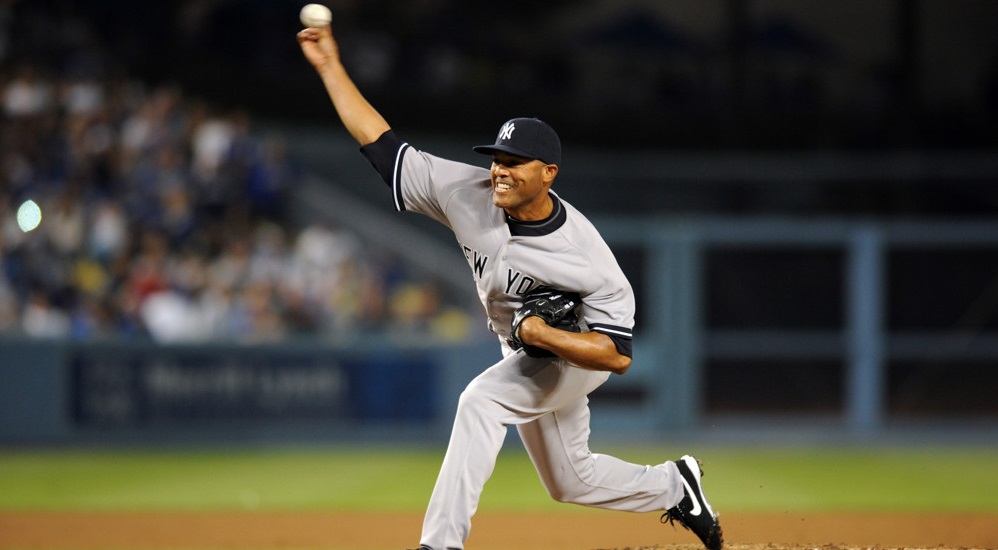
    Growing up a Yankees fan, the term “broken bat” became synonymous with “Mariano Rivera” for me. The Yankees’ close-out artist made a living inducing weak contact with his signature cut-fastball, not necessarily missing bats but certainly missing barrels.  


    Rivera’s signature offering inspired pitchers from Roy Halladay to Mark Melancon. But nobody broke bats like Mo. In fact, our data on broken bats indicates that on average, throwing more cutters has no effect on the number of hitters’ bats a pitcher saws off.  

    Because our data is entered by manual scorers, only the obvious broken bats are captured by the majority of stringers. This is an important stipulation to note before I present my findings.  

    I narrowed the number of pitchers in my analysis down to the 377 who allowed at least 100 instances of contact, or broken bat opportunities, in each of 2021 and 2022 (through August).

    For the 377 pitchers, the raw number of broken bats from 2021 significantly predicted the number of broken bats in 2022. Specifically, each broken bat a pitcher netted in 2021 portended 0.74 more broken bats for them in 2022 on average, explaining 22.3% of the variance in the metric across the seasons.  

    I first looked at cutter percentage as reported by Statcast, which did not significantly predict the number of broken bats in either 2021 or 2022.  

    While I was surprised by this result, it also confirmed something we already knew: Mariano’s cutter was special. To put some numbers on its uniqueness, Baseball Prospectus’ PitchFX leaderboards go back to 2007. Since 2007, 196 pitchers have thrown at least 1000 cutters. Mo’s piece ranks in the top 20 in velocity, horizontal and vertical movement, and fouls per swing. And this is just looking at the last seven years of his career, starting with his age-37 season. 

    Were there any offerings that did significantly increase the number of broken bats on average? For 2021, sinkers did. A 1% increase in sinker usage last year portended 0.03 more broken bats on average. While this effect seems small, it received its statistical significance by showing up consistently throughout the 2021 sample. So far this year, more sinkers have not significantly increased the number of broken bats, but they have continued to significantly increase the rate of broken bats per contact. 

    What’s more, increased four-seam fastball usage led to significantly fewer broken bats on average in 2021. This is likely because sinker usage often increases at the expense of four-seamers, and sinkers were breaking bats aplenty last year. 

    Sinkers, sort of like anti-cutters, similarly mirror fastballs but move to the pitcher’s arm-side in opposition to the typical cutter’s glove-side tilt. Essentially, the traditional maxim that cutters break bats may not be that far off; it just got the direction of horizontal movement wrong.  

    Broken bats are likely more attributable to unanticipated horizontal movement (in on the hands) than any other pitch characteristics. Typically, a broken bat will come when a batter guesses correctly in terms of pitch speed and vertical location but fails to pin down horizontal locale.  

    This will most often occur when a hitter expects a four-seamer but receives a four-seam alternative. Of the two most frequent alternatives, on average, sinkers have far more horizontal movement than cutters. While Mo’s cutter had good rise, its excellent horizontal movement even at the tail end of his career is likely the reason it broke bats.  

    Just don’t expect the typical cutter to do so. 

  • The Meatball: Analyzing Middle-Middle Pitches

    The Meatball: Analyzing Middle-Middle Pitches

    In the sabermetric world, analysts like to differentiate between a pitcher’s command and control. Command denotes a hurler’s ability to hit their targets precisely, their corner-nibbling prowess, while control indicates their walk-limiting capabilities.

    Most major league pitchers can throw a strike when they need to prevent a free pass. What separates the good from the great is the ability to ensure said strike is not a meatball.  

    Here at SIS, we track not only ultimate pitch location, but also where the catcher sets up prior to release. Since we don’t have data that allows us to see into the minds of pitcher-catcher batteries, this data helps us approximate their intended pitch locations.  

    And there are some clear examples of when it comes in handy. Take this 3-0 Brady Singer offering from last month that drifted over the plate, despite a target on the lower outside corner, and enabled Franmil Reyes to crush an opposite-field homer: 

    Because of the catcher’s setup, analysts can blame the miscue on Singer’s lapse in command. On the flip side, sometimes veteran pitchers like Sonny Gray have the confidence and ability to spot a fastball on the lower inside corner in 3-0 counts for swinging strikes: 


    The catcher’s glove hardly has to move an inch. For his career, Gray has a pedestrian 8.5% walk rate (league average this year is 8.2%), but perhaps he is just willing to give up the occasional walk by aiming for corner strikes—where he might not always get the call, even if he hits the target—in hitter’s counts.  

     What I’m getting at here is that while metrics like walks per nine innings and walk percentage can tell us about a pitcher’s control, catcher set-up locations can provide information about command. This way, we don’t have to assume that pitchers are trying to avoid meatball throws; we can know for sure.  

    Yet, pitchers aren’t always trying to avoid pumping a fastball down the middle. The typical example is in fact when the count is 3-0, a situation in which pitchers are known for their “get-me-over” tosses.  

    But what about other counts?  

    When do pitchers really shy away from meatballs, even if they can’t always avoid them in practice?  

    Consider the table below, which looks at pitches in the pitcher-friendliest (0-2, 1-2, 2-2), hitter friendliest (2-0, 3-0, 3-1), and relatively even counts (all others).  

    The second column describes the proportion of pitches in the specified counts for which the catcher set up down the middle. The third column indicates the proportion of pitches that the pitcher actually ended up tossing into the heart of the zone. Numbers across all combinations of rows differ by a statistically significant amount. 


    Count  Middle-Middle Set Up Rate  Middle-Middle Rate 
    Pitcher Friendliest  0.8%  4.1% 
    Relatively Even  1.2%  6.0% 
    Hitter Friendliest  1.8%  7.4% 

    If we are to take set up locations as a proxy for intended locations, it is clear that in general, the battery tries to avoid meatballs, with the catcher only setting up for one 1.1% of the time across all counts.  

    In practice, meatballs happen over five times as often as intended, but still only comprise 5.7% of all pitches. For pitcher-friendly counts, these numbers shrink to 0.8% and 4.1%, respectively.  

    The second column below details, for all pitches that actually ended up down the middle (i.e., pitches counted in the second column above), the proportion that missed the catcher’s target by more than the median miss. The third column below looks at the proportion of all pitches (not just those down the middle) that missed the target for the specified counts. 

    Count  Middle-Middle  

    Miss Target Rate 

    Overall Miss Target Rate 
    Pitcher Friendliest  58.7%  45.9% 
    Relatively Even  55.8%  50.9% 
    Hitter Friendliest  52.3%  55.4% 

    When a meatball is thrown, it seems to be a mistake more often than not, with an average of 56.1% missing the target across all counts. Non-meatballs only fell in the missed-target category 49.6% of the time, a statistically significant difference.  

    For meatballs, the only count with a missed-target rate lower than 49.6% was 3-0 (48.6%). This characterizes a general trend, as middle-middle pitches were misses significantly more often when they came in pitcher-friendly counts, compared to those in even and hitter-friendly counts.  

    This result is in spite of pitches missing significantly less often in pitcher-friendly counts overall.  

    Back to the idea of command vs. control: One of the benefits of adding “command” to the baseball analyst lexicon was that it could be pointed to as a vague explanation for why a pitcher with desirable strikeout and walk rates was failing to limit hard contact. When they missed, they missed badly, and hitters punished them. An especially bad miss in my eyes is an unintentional meatball. 

    To test this theory, I began with a model of middle-middle-miss rate as predicted by a suite of batted-ball metrics. After removing predictors that didn’t improve the model, I was left with xERA, infield-flyball rate, and Barrell%.  

    Yet, the only one that was statistically significant was xERA (in other words, the other predictors may have just been improving the model through overfitting).  

    Specifically on average, among pitchers who threw at least 500 pitches in 2021, every time unintentional-meatball rate increased by 1%, xERA increased by .08.

    This is crucial because xERA is the ERA estimator that takes quality of contact statistics most into account. 

    Interestingly, middle-middle percentage (regardless of whether they were mistakes or not) in pitcher-friendly counts was not a significant predictor of any quality-of-contact statistics, even after removing those that didn’t improve the model.  

    This serves as an important reminder that, while a majority of meatballs are unintentional, sometimes a pitcher opts to “challenge” their foe with an offering in a hittable location, a sort of catch-me-if-you-can.  

    Here, Ohtani hits the glove with 98 right down the pipe, and breakout Mariner Cal Raleigh fails to make contact: 


    If used correctly, middle-middle tosses can be yet another weapon in a pitcher’s arsenal.  

    It’s also possible that wildness can lead to middle-middle throws that surprise a hitter.  

    While not a significant predictor for either model, Barrel% did stick around for both after eliminating other predictors. Higher middle-middle rates in pitcher-friendly counts, as well as higher middle-middle-miss rates, were correlated with lower Barrel rates.  

    Thus, the answer might depend on the pitcher. Our next step as analysts should be to find the threshold of wildness under which it is worth it to nibble at the corners. 

  • Checking In on Checked Swings

    Checking In on Checked Swings

    I’ve long said that my favorite play in baseball is the swinging strike. There’s just something so satisfying about a pitcher hitting their target, the smack of the catcher’s mitt after a ball successfully eludes an outstretched bat by mere inches. For instance, check out this Zack Greinke rainbow hook that gets Amed Rosario fishing:

    That’s right, Greinke’s still striking guys out with his 75 MPH breaker at 38 years old. But there’s more to a swinging strike than just the audiovisual gratification. Each swinging strike is the result of a pitcher emerging victorious from a battle with the batter.

    As impressive as it is that Greinke has maintained—13 years later—even some semblance of the movement that notched him a Cy Young, it’s hard to say whether that Rosario whiff was due more to the quality of the pitch itself or Greinke’s ability to catch him off balance.

    Putting these two facets together, what a swinging strike really represents is the gold standard of pitcher deception; a batter typically swings and misses when a hurler leads them to falsely believe a ball will end up in their wheelhouse.

    But, in terms of deception, why should the swinging strike stand out? Obviously, generating called strikes also requires deception: a hitter often takes a called strike, failing to get the bat off their shoulder, when they think a pitch that ends up down the middle is headed out of the zone. The difference between called and swinging strikes is that swinging strikes require the batter to commit. One important aspect of commitment is that it takes the mercurial umpire out of the equation. For this reason, swinging strike rate (SwStr%) is a lot more indicative of a pitcher’s true ability to fool hitters year-over-year. Consider the table below:

    2019 ~ 2020 R2 2020 ~ 2021 R2
    SwStr% 0.56 0.54
    CStr% 0.22 0.29

    There were 61 pitchers who threw at least 50 innings in each of 2019, 2020, and 2021. R2 in this instance describes the proportion of the variance in some factor y that can be explained by some other factor x.

    Despite the volatility of statistics in the shortened 2020 season, 2019 SwStr% (factor x in this instance) could explain more than half of the variance in 2020 SwStr% (factor y), and 2020 SwStr% (factor x) could explain more than half of the variance in 2021 SwStr% (factor y).

    But the corresponding numbers for called strike rate (CStr%) settled in at around a quarter. This discrepancy between the two forms of strikes can be chalked up to the different degrees of umpire-based luck involved.

    But what about checked swings? They require a degree of commitment from the hitter, but often input from the umpire as well. And they certainly involve pitcher deception. Just look at how ridiculous Pierce Johnson made Darin Ruf look on this curve that bounces way in front of the plate (GIF via  Ben Clemens, FanGraphs):


    To assess the viability of using checked swings as another way to gauge pitcher deception, I created a metric, checked-swing percentage (ChSw%), given by the number of checked swings generated by a pitcher divided by the total number of pitches they threw that season:

    Checked Swing Percentage: 

    Checked Swings Generated/Total Pitches

    Unsurprisingly, the R2s for ChSw% fell in between those of swinging strike rate and called strike rate.

    From 2019 to 2020, the R2 was 0.35, and from 2020 to 2021, the R2 was 0.41.

    This may just be because checked swings include some called strikes—when the hitter successfully checks, but the pitch is a strike—and some swinging strikes—when the hitter fails to hold up.

    ChSw% might have some valuable properties; multiple linear regression analysis indicates that it might correlate with higher chase rates, lower rates of swings on pitches in the zone, and higher strikeout rates. However, it is also correlated with swinging and called strike rates, bringing about the question of whether it has any value separate from those two metrics (or their increasingly-popular sum, known as CSW%).

    My first thought was that there might be some pitchers more adept at turning check swings on balls into swinging strikes. If this were the case, then checked swing “conversion rate” would be useful in predicting swinging strike rate.

    Checked Swing Conversion Rate: 

    # of Times Hitter Failed to Check/Checked Swings on Pitches Outside the Zone

    However, the year-over-year correlations for conversion rate were minuscule and statistically insignificant. Their primary use might just be to determine which pitchers are getting unlucky on checked swing calls. This left me unsatisfied—there had to be more to checked swings than that.

    What about looking exclusively at checked swings on which hitters held up, and the pitches were subsequently ruled balls? This would be a metric entirely separate from both swinging and called strike rates.

    Given that conversion rate is statistically unstable (i.e., its R2s year-over-year were low), having a high rate of checked swings on balls would also not indicate any skills deficit. Rather, it might indicate a degree of misfortune, portending future strikeout rate increases. The formula for checked swings on balls, bChSw%, is below:

    Checked Swings on Balls%  (bCHSW%)

    Checked Swings on Balls/Total

    While at a lower rate than even called strikes (to be somewhat expected given that called and swinging strikes were no longer part of the metric), the checked swings on balls percentage year-over-year correlations were significant, and larger than those of the checked swing conversion rate:

      2019 ~ 2020 R2  2020 ~ 2021 R2 
    ChSw% 0.35 0.41
    Conversion Rate 0.02 0.00
    bChSw% 0.14 0.26

    Further, in a multiple linear regression analysis, bChSw% was associated with a higher K%, despite being negatively correlated with called strike rate (likely due to its exclusion from the metric).

    Additionally, bChSw% was negatively correlated with swinging strike rate on pitches in the zone, even though the swinging strikes bChSw% excludes are those on pitches outside of the zone.

    My biggest takeaway from this work is that this bolsters the theory that more checked swings, even those not providing a pitcher’s desired results, can indicate higher strikeout potential in a meaningfully different manner than SwStr% and CStr% do.

    The 2021 leaders in checked swings on balls percentage provide some face validity to the theory. The ranks below are among the 338 pitchers who threw at least 50 innings in 2021.

    Pitcher  bChSw%  bChSw% Rank  K%  K% Rank 
    Blake Treinen 3.01 1 29.7 T49
    J.P. Feyereisen 2.94 2 22.6 T189
    Josiah Gray 2.89 3 24.8 T140
    Trevor Bauer 2.80 4 31.7 T29
    Craig Kimbrel 2.68 5 42.6 3
    Tyler Matzek 2.54 6 29.2 T54
    Matt Barnes 2.39 7 37.8 8
    Shane Bieber 2.37 8 33.1 22
    Luis Cessa 2.32 9 20.7 T238
    Michael Kopech 2.25 10 36.1 11

    We shouldn’t expect a one-to-one correspondence (despite the statistical significance of the correlation, bChSw% only accounted for 17% of the variance in K%), but it’s telling that eight of the top 10 in balls on checked swings percentage had above average strikeout rates as well.

    Feyereisen, one of the two with a below average K-rate, upped his percentage by 6.5 percentage points this year through 24 1/3 innings in which he didn’t allow an earned run.

    These initial findings should encourage more investigation into the predictive ability of checked swings, especially on pitches ruled balls. Then, perhaps checked swings will get the respect they deserve in the analysis of strikeouts.