Category: MLB

  • Which hitters reach favorable counts?

    Which hitters reach favorable counts?

    By Andrew Kyne

    On the most recent episode of the SIS Baseball Podcast, our guest Mike Ferrin talked about analyzing ball-strike count management among hitters.

    Specifically, which hitters get themselves in favorable counts, like 2-0, 3-0, and 3-1? And which hitters then do damage in those plate appearances? Let’s try to find out.

    For 2019, here are the ten players who have reached 2-0/3-0 or 3-1 in the highest percentage of their plate appearances (minimum 200 PA).

    BatterOverall PAPA w/ HCPct.wOBA
    Justin Smoak2617829.9%.432
    Cody Bellinger3379929.4%.508
    Carlos Santana3419828.7%.499
    Mike Trout34910028.7%.685
    Joey Gallo2276528.6%.544
    Mookie Betts37710728.4%.558
    Daniel Vogelbach3048628.3%.500
    Rhys Hoskins3509928.3%.581
    Tyler White2065627.2%.399
    Kendrys Morales2015426.9%.398

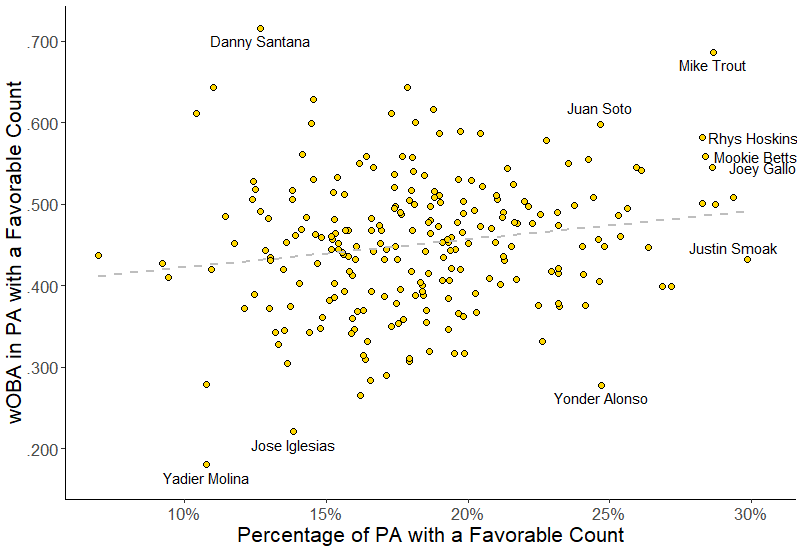
    The wOBA column represents their weighted on-base average in those plate appearances in which they got to a favorable count (but didn’t necessarily end the PA in one of them). So, in the 100 plate appearances in which Mike Trout got to a 2-0/3-0 or 3-1 count, he has an absurd .685 wOBA.

    Being a power hitter with exceptional plate discipline is a good way to make this list. But not everyone has ended up doing damage in those plate appearances, as you can see with Tyler White (who has a 91 wRC+ overall on the year) and Kendrys Morales (who has a 63 wRC+ overall and was just designated for assignment by the Yankees). Justin Smoak tops the list in terms of getting into favorable counts, but his wOBA is lagging a bit behind the others as well.

    The other seven players have been among the best at not only getting into hitter-favorable counts, but also finishing with success, all recording a wOBA of .499 or better in those PA. Trout, Rhys Hoskins, Mookie Betts, and Joey Gallo have been especially good.

    Here’s a look at the relationship in 2019 between getting into favorable counts and then having success:

    Getting into counts like 2-0 and 3-1 is certainly good for hitters, but is it a repeatable skill? Between 2017 and 2018, there was a strong year-to-year correlation (r = 0.76) for hitters with 400+ PA in each season.

    Between 2018 and 2019, Gallo has had one of the most significant increases in generating plate appearances with favorable counts, going from 20% to 29%. Pitchers are surely fearful of his power, and it helps that he’s cut his chase rate from 32% to 23%.

    On the other side, Cleveland’s Jose Ramirez has had one of the sharpest declines, going from 29% to 22%. After turning in consecutive seasons with a 146 wRC+, Ramirez is hitting just .216/.310/.329 in 2019.

    Finally, what about the ability to repeatedly do damage in plate appearances with a favorable count? The correlation isn’t as strong here (r = 0.33) but still positive.

    It’s good for hitters to be in favorable counts, and there’s evidence that being able to get into those situations may be consistent from year to year. That’s perhaps not a surprising conclusion, given batter quality and plate discipline, but it’s ultimately another important piece in hitter evaluation.

  • What’s The Deal With Bryce Harper?

    By Jon Becker

    All stats current through 6/26

    13 homers: pretty good! .364 OBP: pretty good! 23 doubles: pretty good! But, when your name is Bryce Harper, and you own the biggest free agent contract in major-league history … not too long after having one of the best seasons in major-league history … not too long after being perhaps the most hyped draft prospect in major-league history, that feels like a disappointment.

    It’s only been 80 games, and Harper can certainly be allowed something of a grace period as he adjusts to a new clubhouse, city and coaching staff, but regardless, his trends are alarming. Looking at the surface-level stats, when compared to last year, his triple-slash stats are down across the board; his slash-line in 2018 was .249/.393/.496, and it’s down to .246/.364/.457 this year. You probably knew that, though, and I’m not here to tell you what you already know! Let’s get a little more advanced.

    By the “plus” stats, each of which set the league average at 100, with those above 100 being better than league average (110 would be 10% better than league average, for example), Harper’s worsened as well:

    StatSource20182019
    OPS+Baseball-Reference134112
    wRC+ (Weighted Runs Created)FanGraphs135114
    DRC+ (Deserved Runs Created)Baseball Prospectus126105

    OPS+ and wRC+ both evaluate a batter’s results, whereas DRC+ attempts to be more predictive, and the latter stat shows that Harper’s performance has genuinely declined and isn’t just the result of bad luck. So, we’ve established that, no matter where or how you look, Harper’s output has decreased. Those are the results on a holistic, every plate-appearance level, and they’re worse but not hugely so. Let’s zoom in a little.

    Hitters see four-seam fastballs more than any other pitch, and that’s no exception even for a guy as feared as Harper. He’s seen 509 four-seamers this season–over one-third of the pitches he’s faced. His change in performance on those pitches? Now that’s staggering.

    Bryce Harper vs. Fastballs

    Stat20182019
    Slugging Percentage.645.505
    Isolated Power (SLG – AVG).340.222
    Batting Average on Balls in Play.355.414
    HR/FB%32.1%18.2%
    Miss%28.0%27.5%
    K%24.3%31.1%
    Hard-Hit Rate35.7%34.0%

    The chart above shows that despite squaring the ball up nearly as well on fastballs, and actually being more lucky on balls in play, Harper’s performance against fastballs has plummeted. It probably wasn’t fair to expect one out of every three fastballs hit to the outfield to continue to sail over the fence, but a HR/FB% of 18.2% is still above league average (15% this season). So, we can’t just expect a positive regression here. The results being what they are, what’s differed in the approach to change those results as compared to last season?

    Harper’s swinging at considerably more fastballs than last season, whether they’re inside the zone or outside of it. His Z-Swing% on fastballs is up from 67.0% to 72.1%, and his O-Swing% on fastballs has increased as well, from 18.6% to 22.8%. On those inside-the-zone swings, he’s making contact at almost exactly the same rate, so he’s not missing hitters’ pitches. What he is doing is swinging through far more pitches off the plate; his O-Contact% has tumbled to 51.0% after it was 73.0% last season. Sometimes it can be beneficial to swing and miss and give yourself another shot against a better pitch, but hitters as good as Harper are typically good at knowing their outside-the-zone strengths, and Harper’s missing a lot more pitches that he’s presumably swinging at because he thinks he can do damage, despite those pitches being out of the zone.

    It’s easy to sit here and say “Bryce, you’ve just got to make contact against fastballs more often!” But, when poring over the data and determining that’s the obvious answer, there’s not really much else to say. Whether Harper–known for changing his swing often–thinks that more tinkering is in order, or if he believes that his struggles will just sort themselves out with time, one thing’s for sure: he’s got to do more damage against the easiest pitch to hit in Major League Baseball.

  • Which Teams Are Best at Drafting, Developing and Displaying DRS?

    Here at Sports Info Solutions, we have lots of data. One subset of data we have is MLB Draft data. In exploring it, it got me thinking: which teams are the best at drafting players who end up producing lots of Defensive Runs Saved for the team that drafted them?

    Here are the top five and bottom five teams since we began tracking DRS in 2003.

    TeamDRS
    Cardinals412
    Braves366
    Blue Jays294
    Red Sox293
    Giants277
    —–—–
    Rockies-58
    Tigers-61
    Phillies-77
    Yankees-122
    Pirates-182

    A lot of this checks out; the Cardinals are known for prioritizing good defense and also home-grow lots of players. On the other side of things, the Pirates have had a lot of really bad teams since 2003, and really bad teams tend to have really bad defenses.

    Now, let’s take a look at who the main contributors and culprits are for the top and bottom teams. Let’s start with the good: who’s padded that Cardinals number? Keep in mind there are plenty of other players who’ve posted a positive DRS, and also a handful whose DRS is negative.

    PlayerPosition(s)DRS
    Yadier MolinaC169
    Albert Pujols1B/3B/LF/RF119
    Brendan RyanSS/3B/2B52
    Kolten Wong2B/CF42
    Harrison BaderCF/RF27

    Just about every national broadcast–and Cardinals broadcast to boot–finds a way to talk about how good Molina’s defense is, and with good reason: he’s really good! More than any other aspect of his game, Molina’s value has come from throwing out runners on the bases, having saved 54 runs doing so. But he also excels at making Good Fielding Plays without making many Defensive Misplays or Errors (46 GFP/DME Runs Saved) and framing pitches (41 Strike Zone Runs Saved).

    Now with the Angels, Pujols is no longer the relatively fleet-of-foot multi-positional star he once was, but back in the day, he was the guy on defense. His 2007 season, in which he saved 31 runs, remains the single-season DRS zenith for a first baseman. Since DRS started in 2003, we’ll never know what Pujols’ all-over-the-diamond rookie season was like, but, for what it’s worth, most of his value came from his time at first base: he’s at -4 in left field from his time there in 2003, and at a net zero at 3B (-1 in his last season with the Cardinals, +1 in his first season with the Angels). Even without Pujols, though, the Cardinals would still be the sixth-best team; that’s how good they’ve been at drafting MLB-quality bats who can also produce positive defense.

    And now, for the not so good. Here are the five biggest culprits of the Pirates’ league-low defensive drafting.

    PlayerPosition(s)DRS
    Andrew McCutchenCF-68
    Jose Bautista3B/RF/CF-45
    Pedro Alvarez3B/1B-40
    Ryan DoumitC/RF/1B-36
    Nate McLouthCF/RF/LF-25

    McCutchen was a perfectly adequate center fielder in his first five years in the majors, with a DRS of -5; not good, but not horrible. It’s his last four years as a Pirate that really tanked his defensive value, with seasons of -13, -8, -28 and -16. He wasn’t even close to average in any direction in those last four seasons in Pittsburgh; his total Plays Saved in that time was -14 on shallow fly balls, -15 on medium fly balls, and a staggeringly low -28 on deep fly balls.

    For Bautista–the very same player who ended up slugging hundreds of memorable home runs while finding a home in right field as a Blue Jay–the main issue was in his time at third base. From 2006-07, he played about 1,300 innings at the hot corner, and combined to put up a -34 Plays Saved, including -11 on just 82 total defensive chances in 2006. His time in center field didn’t help either, where his DRS in 2006 was -10.

    Teams draft players based on not just offense, but projected defensive contribution as well, and while teams may be willing to give up a little bit on the defensive side of the ball when they have hitters as good as McCutchen, most teams can’t afford to. When looking at all 30 teams, it’s no surprise that the Cardinals are competitive just about every year, racking up homegrown DRS like nobody else. On the flip side, the teams at the bottom of the list are going to need better defense from their draftees.

  • New baseball podcast episode: Mike Ferrin wants to be Byron Buxton

    New baseball podcast episode: Mike Ferrin wants to be Byron Buxton

    In this episode of the SIS Baseball Podcast (click here to listen), Mark Simon (@MarkASimonSays) begins by marveling at Zack Greinke’s defense (1:05). Mark then talks to MLB Radio and Arizona Diamondbacks broadcaster Mike Ferrin (@Mike_Ferrin). Mike makes his case for the best team in baseball (3:25) and discusses how much organizations value defense in this era (4:51). He also makes his pick on which defensive player he’d most like to be (11:15) and who’s the best defensive shortstop in the NL (15:35). Mike then comes up with a stat he’d like the BIS crew to work on (19:43). 
    Mark is then joined by Andrew Kyne (@Andrew_Kyne) and the two discuss Matt Carpenter, Jeff McNeil and the shift (24:24), how much outfielders benefit from changing positions (26:58), which players should have made the All-Defense All-Star team (29:58), and which defensive player they would most like to be (33:17). They then answer a listener question about which players have made the most different kinds of Good Plays (35:01) and try to stump each other with the Ridiculous Stats of the Day (36:42).

    Tune in, and please rate and review if you listen!

    ITunes – click here

    Stitcher – click here

    Google – click here


    I


    I

  • Visualizing Home Runs by Pitch Location

    Visualizing Home Runs by Pitch Location

    By Andrew Kyne

    Home runs are being launched at unprecedented rates in Major League Baseball. In 2019, there has been a home run hit once every 28 plate appearances — which if maintained would be the highest frequency for a season in history, followed by 2017 (1 every 30), 2016 (1 every 33), and 2018 (1 every 33).

    My colleague Mark Simon and I were curious about what home run heat maps look like in today’s MLB compared to several years ago. Let’s take a look, using methods similar to what Jim Albert has demonstrated.

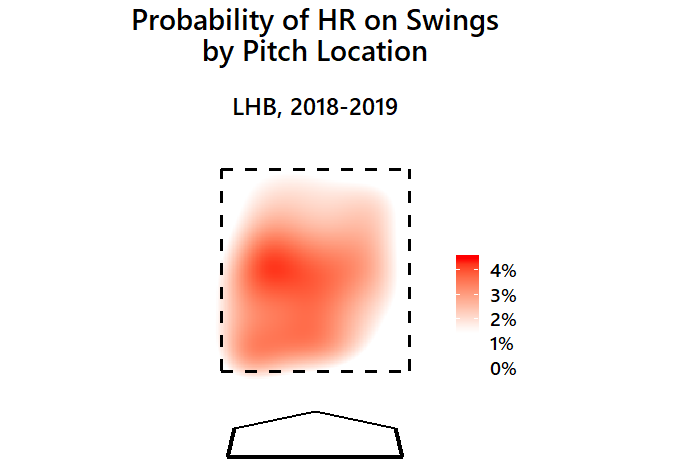
    The following heat maps show the probability of a swing resulting in a home run, given a pitch’s location. It excludes bunts, as well as pitchers hitting.

    The colored areas begin at a 1.5% probability, and darker red indicates a higher likelihood. Locations are from the pitcher’s perspective.

    First, for left-handed batters in 2018 and 2019:

    Pitches right down the middle/over the inner-third generate the most homers per swing. Pitches low in the zone tend to generate more HR compared to high or outside.

    But that’s intuitive — you could probably picture that one without even seeing it. What we’re more interested in is how that’s changed from when home runs weren’t so common.

    Here’s what it looked like for left-handed batters in 2013 and 2014:

    This heat map uses the same scale as the previous one, so not only is the area much smaller, but the red isn’t as dark (indicating lower probability).

    Here’s a GIF to compare them back-to-back:

    Now, here’s the heat map for right-handed batters recently:

    And right-handed batters five seasons ago:

    And in GIF form:

    Hitter hot zones are certainly expanding. And while differences may seem small — 4 home runs per 100 swings rather than 3 per 100 in the best spots to hit, or 2 per 100 rather than 1 per 100 on the edges — they add up considerably in the aggregate.

  • Ball off the Wall: Which outfielders make mistakes, which have not?

    By Max Greenfield

    In last Sunday’s Blue Jays-Astros game, Eric Sogard hit a fly ball to deep right center field that looked like it could go out of the park. Astros right fielder Josh Reddick made a leap for the ball, but couldn’t get it. Sogard ended up at third base with a triple.

    At SIS, our Video Scouts (of which I’m one) track plays like that regularly. We chart them as Defensive Misplays for either “Failure to Anticipate the Wall” or “Wall Difficulties” resulting in a batter or runner gaining an extra base.

    Recently, Mike Petriello wrote an article about two new Statcast measures released on Baseball Savant that measure “reaction” and “burst” to help measure the jump a player gets on the ball.

    The work from Petriello and Savant led me to an idea on another way to evaluate outfield defense that isn’t thought about much: How well a player plays a ball off the wall.  I looked at which outfielders fare best and worst.

    Here are some takeaways from looking through the data:

    The first things that caught my attention was how Cardinals outfielder Harrison Bader fared in his full-time position, center field. Bader is an aggressive outfielder who gets great jumps on balls. He entered Thursday with 1,036 innings played in center field this season without a “Failing To Anticipate the Wall” or “Wall Difficulties” misplay (he had two in right field).

    Bader ranks third on Savant’s leaderboard measuring jump. Seeing him on the list shows he’s getting a good read on balls he both can and can’t reach. He’s aggressive, but not overaggressive. Bader’s teammate, Dexter Fowler, has the most innings of any outfielder with no Failing to Anticipate Misplays (1,150), including 963 in his primary position, right field.

    Pirates outfielder Gregory Polanco making the list could be more a factor of the park he plays in than anything else. Polanco deals with a large wall in right field at PNC Park making it more difficult to read the ball off the wall. He leads the majors with 11 such Misplays, a rate of 8 per 1,000 innings. By comparison, Andrew Benintendi, dealing with a similar wall situation in left field, averaged 3.6 Defensive Misplays per 1,000 innings

    Christian Yelich was unscathed in right field until this past week when he committed his first such misplay in the last two seasons. Yelich’s defensive ability can often get lost with how great of an offensive player he is. Yelich is already an above average defender and he’s very good at knowing how to play the wall in Miller Park. He has one wall-related misplay in 1,091 innings in right field and one in 615 innings in left field.

    Leaderboards for the stats we looked at are below. To qualify for the Most Wall Misplays Per 1,000 leader list, an outfielder must have at least 500 innings in one outfield position over the last two seasons. Calculating the rate of misplays as a per 1,000 innings scale gives us a number that is closer to a season total of innings in an outfield.

    Most Innings at Position, 0 or 1 Wall Misplays – Last 2 Seasons

    CF

    Name Innings Misplays
    Aaron Hicks 1,372 1
    Albert Almora 1,364 1
    Harrison Bader 1,036 0

    LF

    Name Innings Misplays
    Alex Gordon 1,679 1
    Joc Pederson 1,088 1
    Tommy Pham 820 0

    RF

    Name Innings Misplays
    Kole Calhoun 1,738 1
    Andrew McCutchen 1,244 1
    Christian Yelich 1,091 1

    Most Wall Misplays Per 1,000 Innings at Position

    Name Position Misplays
    Gregory Polanco RF 8.0
    Michael Conforto RF 7.8
    Cedric Mullins II CF 7.4
    Melky Cabrera RF 7.2
    Trey Mancini LF 7.3
    Teoscar Hernandez LF 6.0
    Joey Gallo LF 5.9

    The average outfielder committed 3 per 1,000 innings


  • Reintroducing FieldingBible.com

    By Jon Becker

    One of Sports Info Solutions owner John Dewan’s first and most impactful innovations was his creation of The Fielding Bible, which has published four volumes since the inception of Defensive Runs Saved in 2003. DRS and The Fielding Bible have been at the forefront of fielding analytics for over a decade and a half now, with DRS now appearing on the player pages at FanGraphs. And so, we are thrilled to announce the relaunch of FieldingBible.com!

    There are many sources and nuggets of information on the website, including past Fielding Bible Award winners and the Fielding Bible FAQ, which discusses the components of Defensive Runs Saved in great and easy-to-digest detail. But, if the numbers are your thing, the Statistics page is the place for you. Let’s take a look at what we think are the three best and most commonly used pages on that tab.

    DRS Leaderboard

    Want to know which outfielder has saved the most run with his arm? How about which fielder has the best combination of range and positioning? Or maybe you just want to know who the best player is across the board? The DRS Leaderboard can do all of that and more. Here are examples of some things you can find just by playing around with the filters at the top of the page and the sorting feature on the table (sort by a column by clicking on the column heading):

    • Padres catcher Austin Hedges has 11 Strike Zone Runs Saved this year, five more than the next-closest catcher (Buster Posey)
    • Angels shortstop Andrelton Simmons has 188 Total Runs Saved since 2010, over twice as many as the next-best shortstop (Brandon Crawford, 78)
    • From 2003 until his career ended in 2008, Greg Maddux led all pitchers with 41 Range and Positioning DRS

    Fielding Bible Range & Positioning

    This page is where you can look even more in-depth at the Range & Positioning component of DRS. This includes looking at how a player performs depending on which direction he has to move, how a pitcher is at holding runners, or how many opportunities an outfielder has had to throw runners out on the bases, among many other things. Here are some more tidbits from that page:

    • The aforementioned Maddux was excellent at making plays to his right (+39 Plays Saved) and straight on (+16) over the last 6 years of his career, but was almost neutral (+1) to his left (meaning: along the first base side).
    • Dodgers right fielder and DRS darling Cody Bellinger has already accrued 19 Bases Saved in right this year, while runners have only taken nine extra bases on him in 38 opportunities (24%)
    • In his 2004 Gold Glove season, future Hall of Fame shortstop Derek Jeter posted a Plays Saved of -24 on plays to his right (balls in the shortstop-third base hole); he managed +7 in the final season of his career, 2014

    Fielding Bible Runs Saved

    This page is similar to the Fielding Bible Range & Positioning page, except that it gives a much more basic, zoomed-out view of a player’s performance by position and by season. If you’re only interested in the individual components of DRS, rather than the sub-components, this is where you want to be. For example:

    • Cubs infielder Javier Baez won the 2018 Fielding Bible Award for Multi-Position players; that year, his value was pretty evenly distributed (2 DRS as a 3B, 5 as 2B, 3 as SS)
    • Phillies catcher J.T. Realmuto spent much of the offseason working on his pitch-framing, and that shows in the data; his Strike Zone Runs Saved was -2 in 2018 and is up to +1 this year. His 10 Runs Saved overall ranks second among catchers.
    • Athletics 3B and 2018 Fielding Bible winner Matt Chapman was elite at fielding bunts last season. He had 3 Bunt Runs Saved, most in MLB.

    We hope you enjoy the new FieldingBible.com!


  • A treetop view of what an MLB outfield needs

    By Jonah King

    When baseball teams construct their rosters, there are specific molds that players fall into based upon their position. Look across the league and you’ll notice most infield players have a certain build based upon their position. First basemen are tall and strong, built to hit the ball for miles. Shortstops are strong-armed, lean, and are able to react at a lightning-fast pace to track a ball lasered in their radius.

    There are always exceptions, but exceptions are mere circumstance when a player is exceptional despite a difference in genetic or physical makeup. The infield generally has a uniformity to it. The outfield is the wild west. It’s home to power sluggers like Bryce Harper and Joey Gallo, yet it also has room for defensive specialists like Ender Inciarte and Billy Hamilton.

    Ideally, every team would like to have a Mookie Betts or an Aaron Judge who combine defensive excellence with elite power and contact, but players of their stature are outliers. Generational talent is rare, and either you have one or you’re everybody else and your outfield combines fielding prowess and power.

    Most outfields will have their fielding specialist in center field. Left and right is where teams will stash their power guys if they have the luxury and ideal ballpark dimensions.

    To get a state of league outfielders, I compiled a list of every team’s starting outfielders (playing 60+ games) and gave each player a classification of either “fielding” or “power”. The classification was based upon a player’s perceived value to a team based upon statistics from previous seasons. The AL has nine more fielding based players versus power players while the NL has four more power players as compared to fielders.

    If a player has exceptional power and fielding ability, they are in the anomaly category. This exclusive club’s members: Mookie Betts, Mike Trout, Aaron Judge, Ronald Acuna Jr., Christian Yelich, and Cody Bellinger (78 games at CF). Three in the NL, three in the AL. If you had an anomaly player in your outfield, you had a winning record unless your team was the Angels. Sorry, Mike Trout. Speaking of Trout, he is the only one of that group to be a true center fielder.

    So let’s talk roster construction and which teams have valuable ideas terms of their outfield corp. There are 24 teams without a generational talent in their outfield. How can you find value on the margins within a limited budget in a smaller market? The answer might be within this year’s iteration of the Minnesota Twins.

    The Twins outfield this season has been a defensive haven. Byron Buxton is a yearly Gold Glover in center field. Max Kepler and Eddie Rosario might not be known defensive stalwarts, but they are making a difference on the defensive end this season. Rosario continues to contribute with his bat, but it’s been Kepler who has taken the next step up in terms of run production. Kepler is second on his team in wRC+.

    A healthy Buxton, the consistency of Rosario, and the emergence of Max Kepler. The equations equal out to three difficult outs at the plate, and runs being saved on the defensive side. Surprise AL MVP candidate Jorge Polanco and an inspired Jake Odorizzi immediately jump out on the stat sheet but this three-headed dragon outfield is who the Twins will rely upon to make a pennant run.

    One last note on the Twins is the age of their outfielders. Buxton is 25, Kepler is 26, and Rosario is 27. They are all at their athletic peak while also having room to develop their games. The Twins outfield is balanced in terms of fielding and hitting ability, but it’s achieving at a higher level than most balanced outfields by the quality of the players.

    The Phillies had the purest power-focused lineup last season and doubled down by moving Hoskins to the infield and replacing him with the immaculate Bryce Harper. The Phillies’ one defensive move was to add McCutchen in the twilights of his career who unfortunately has been lost recently to injury.

    The Phillies want to outscore you if they can’t outpitch you. Harper has reverted back to being an average defensive outfielder but the question the Phillies were struggling to answer was who was going to play with Harper. Enter another big bat in Jay Bruce. The Phillies’ power outfield formula may not be the perfect answer to building the league’s best outfield, but if they find success in this model, it’s an intriguing way to construct a roster.

    The Rangers are another ball club like the Phillies who have invested in power over speed in their outfield. They welcomed Hunter Pence’s still productive bat paired up with Shin-Soo Choo’s and Joey Gallo’s. There’s still some fielding quality in center with Delino DeShields but it’s been Gallo who’s saved the most runs defensively.

    The Padres could be the next Twins of next year if their outfield produces at the potential it contains. With options between Wil Myers, Hunter Renfroe, Manuel Margot, and Franmil Reyes, the Padres are looking good if three players take a step up or leap in ability. If that group doesn’t pan out, the Padres still have a young promising power bat in Josh Naylor and Franchy Cordero eyeing a starting spot. Like the Twins are winning with youth, the Padres will have to rely on the same, especially in their outfield.

    The debate over which positions are the most valuable is a circular argument. The best teams are stacked with talent everywhere. But is there a surefire answer for how teams should build their outfields? The classic model of having a great fielder in center and power in the corner outfields is ideal. It can’t be discounted though that there are valuable fielders who can still produce.

    If there’s any grand statement to make about what type of outfielders you want your roster built around, the discussion revolves around whether your outfielders hit at a high level. Having the power production is ideal, but a lineup of three capable hitters in your outfield is a base recipe for success.


  • Inside the numbers on Urshela’s improvements

    By Joe Conklin

    A couple of weeks ago, Yankees third baseman Giovanny Urshela was facing hard-throwing Mets pitcher Zack Wheeler in the fourth inning of a Subway Series matchup. On an 0-1 pitch, Urshela crushed a 96-MPH four-seam fastball on the inner-third. He hit it 405 feet with an exit velocity (per Statcast) of 105.7 MPH.

    That home run wasn’t just helpful in a Yankees’ comeback win. It showed how far Urshela has come.

    Urshela has been performing well above his career numbers so far this year at the plate. In looking at the causes of his success at the plate, here are some interesting numbers I uncovered.

    Urshela has the reputation of a great defender and a below-average hitter. In 2015 and 2017, which are comparable in at bats and games to this year, his batting average was .225 and .224 respectively.

    Through Sunday, his batting average this season is .306. In some of the advanced stats he is also outperforming his 2015 and 2017 results by a lot.

    Urshela’s BABIP (batting average on ball in play) is .336, almost 100 points higher this year than his 2015 and 2017 years.

    Why the drastic increase in BABIP? Urshela’s hard and soft contact percentage have drastically changed this year.

    Probably the most telling statistic for his offensive increase is Urshela’s hard-contact percentage (Hard%). This is the percentage of time that a hitter makes hard contact on a batted ball. In 2015 and 2017, his hard-hit percentage was 22% and 24% respectively.

    In 2019, his rate of batted balls that are hard hit is 46%, over a 20-point increase from the previous comparable years. The batting average for all of baseball for Hard% contact is .526.

    His soft contact percentage (Soft%, which how often one of his batted balls was hit with low velocity and an unfavorable landing spot) in 2015 and 2017 was about 20%. Soft contact usually always ends in an out for the batter — the batting average for Soft% is .153 for all of Major League Baseball in 2019.

    In 2019, Urshela’s Soft% in is 8%, both a dramatic decrease from previous seasons and the lowest in the majors this season.

    Pairing his increase in Hard% with his decrease in Soft%, it makes sense he’s gotten better results.

    Urshela is also outperforming his previous year’s results on fastballs as well as pitches that are on the inner third of the strike zone.

    His average and slugging percentage are over 100 points higher than his 2017 and 2015 years.


    2015 2017 2019
    BA/Slug Pct vs Fastballs .216/.306 .267/.320 .342/.507
    BA/Slug Pct vs Inside Pitches .261/.326 .220/.322 .346/.654

    One interesting statistic that is unusual for major league hitters is that Urshela has been quite good when he’s behind in the count (as he was versus Wheeler).

    For example, he’s hitting .319 with three home runs in at-bats that end with counts of 0-1 (as the homer versus Wheeler was) or 1-2. He was a .207 hitter in those counts prior to this season.

    In the past, Urshela has been known largely for his glove, but this season his bat his outperformed his mitt. In fact, he’s at -3 Defensive Runs Saved this season, slightly below average for a third baseman. The perception of Urshela as a great defender may be due to a few terrific plays. But overall, he has not shown the success of an elite fielder, like Matt Chapman or Nolan Arenado.

    However, if Urshela continues to hit the ball as hard as he has so far this season, he will continue to fill the void left at 3B when the Yankees lost Miguel Andujar for the season.

    Even with his -3 DRS he will still be an upgrade over Andujar who had a -25 DRS in 2018 and possibly provide just as much value with the bat.

  • The Effect of Outfield Position Changes on DRS

    The Effect of Outfield Position Changes on DRS

    By Andrew Kyne

    In 2018, Charlie Blackmon cost the Rockies 28 runs in center field, the worst Defensive Runs Saved mark in MLB. Of those 28 runs, 21 were lost by way of the Range & Positioning component of DRS. The only outfielder to cost his team more runs via Range & Positioning alone was Adam Jones (-25), then with the Orioles.

    Both Jones (now with Arizona) and Blackmon have been moved from center field to right field in 2019. And thus far, their defensive results — while still slightly below average — have been better. Both are at -3 DRS (about -6 per 1,000 innings).

    The numerical improvement as they move out of center field makes sense. DRS rates players relative to others at their position. They may have rated poorly among center fielders — but there are a lot of defensively-talented center fielders, and not as many defensively-talented corner outfielders. This idea is what constitutes the framework of positional adjustments for Wins Above Replacement.

    Let’s take a look at these positional effects with DRS. How do center fielders rate when they move to a corner? How do corner outfielders rate when they move to center?

    Dating back to when DRS began in 2003, I took all outfielders who played at least 700 innings (about half a season) at a position in one year and 700 innings at a different position the next year. I calculated each player’s Range & Positioning Runs Saved per 1,000 innings.

    Here are the differences in Year 1 and Year 2 Range & Positioning Runs Saved per 1,000 for outfielders who moved from center field to a corner spot:

    Of these 30 players, only four rated worse on a per-inning basis in Range & Positioning after moving to LF or RF. The average (represented by the dashed line) has been an improvement of 8 runs.

    That’s a lot.

    A player who can shift positions and perform better gives a team the flexibility to add a defender at his previous position that could be better than he was.

    Here are the differences for outfielders who moved from a corner to center, an understandably smaller sample:

    Of these 19 players, only five improved on a per-inning basis. The average has been a decline of 7 runs.

    And let’s also look at players who moved from one corner to the other:

    While there’s variation among these 23 players, the average difference is almost zero.

    There are various other factors that affect year-to-year performance, including aging and ballpark effects. And while the samples are fairly small, there’s an obvious numerical impact on moving an outfielder into or out of center field. We’re seeing that with Charlie Blackmon and Adam Jones, who should finish 2019 with much better DRS numbers than they did in 2018.