Category: College Football

  • The Statistical Side of the 2021 SIS Football Rookie Handboo‪k‬

    The Statistical Side of the 2021 SIS Football Rookie Handboo‪k‬

    LISTEN HERE

    On this episode, Matt Manocherian (@mattmano) and Mark Simon (@MarkASimonSays) are joined by SIS Senior Research Analyst Alex Vigderman (@VigManOnCampus) to discuss the statistical side of the SIS Football Rookie Handbook, including a breakdown of Total Points (1:23), a look at some of the other advanced stats in the book (6:14), how difficult it can be to project college numbers to the NFL (10:45), and some of the most interesting articles, including work on injuries (15:13) and press coverage (18:16).

  • New football podcast: Upsets on the horizon?

    Former NFL scout Matt Manocherian (@mattmano) of Sports Info Solutions and football analytics pioneer Aaron Schatz (@FO_ASchatz) of Football Outsiders (@fboutsiders) look at the four games for the NFL Divisional Round this weekend. The show opens with a brief discussion about the use of analytics during broadcasts (1:02) before moving on to preview this weekend’s matchups: Rams-Packers (3:12), Ravens-Bills (9:30), Browns-Chiefs (15:08), and Buccaneers-Saints (21:12).

    You can email the show with feedback at offthecharts@ww2.sportsinfosolutions.com and don’t forget to follow on Twitter @SportsInfo_SIS and Instagram @sportsinfosolutions. For more, check out: sportsinfosolutions.com footballoutsiders.com sportsinfosolutionsblog.com SISDataHub.com

  • Top College Deep Ball Passers in 2020

    By KYLE RODEMANN

    Completing a deep pass is great for any offense. Not only do these plays flip the field, but they also increase the likelihood of scoring during the drive. Chunk plays lead to momentum shifts, and long touchdowns can often be the turning point a team needs to complete a comeback. This article will look to find out which college QBs were the best at throwing downfield during the 2020 season. Leaderboards found here will include draft-eligible players as well as underclassmen.

    For our purposes, we’re referring to balls thrown at least 20 yards downfield, unless otherwise stated. Minimum 30 deep attempts unless otherwise noted (62 QBs). Only regular season data is included in this article.

    Most Deep Balls Attempted

    Finding a QB that can make all the necessary throws can be hard for a college organization; but once they find one, it opens up so much for a football team’s offense. Not only does it allow for more deep passes, but it also allows for more explosive plays and chunk gains. These QBs are the leaders in deep throw attempts for the 2020 season:

    QuarterbackSchoolNumber of Throws
    Dillon GabrielUCF69
    D’Eriq KingMiami FL63
    Layne HatcherArkansas State62
    Kyle TraskFlorida60
    Sam EhlingerTexas59
    Levi LewisLouisiana Lafayette58
    Carson StrongNevada56
    Kenny PickettPittsburgh56

    Dillon Gabriel leads the list of most deep pass attempts. This isn’t surprising given UCF’s high-powered offense and quick playing style. Florida’s Kyle Trask is near the top and worth noting. His most successful week throwing deep was against Alabama, where he completed 6 deep passes for 218 yards and 3 touchdowns. Trask is a Heisman finalist and has a chance to be the first Gator Heisman winner since Tim Tebow won the award in 2007.

    Highest On-Target Percentage

    On-Target Percentage looks at the percentage of passes that hit the receiver in stride. The quarterbacks that make up this list were the most accurate on throws downfield, giving their guys the best chance at coming down with the ball. Here are the most accurate college quarterbacks on deep passes:

    QuarterbackSchoolOn-Target % (Attempts)
    Zach WilsonBYU72% (50)
    Trevor LawrenceClemson70% (40)
    Spencer RattlerOklahoma69% (49)
    Kyle TraskFlorida68% (60)
    Mac JonesAlabama67% (47)
    Dillon GabrielUCF66% (69)
    Jake HaenerFresno State64% (34)

    A lot of big names make this list, with Zach Wilson leading the group with a 74% on-target throw rate. Trevor Lawrence is the potential No. 1 overall pick in the upcoming NFL Draft. He has been incredible throwing the deep ball, returning an accurate pass on 28 of 40 long balls. He has shown massive improvement in this aspect of his game. Last season, Lawrence’s on-target percentage on deep balls was 48%, 22 percentage points lower than this year’s rate.

    Highest Touchdown Percentage

    Touchdown percentage tells you the rate in which a quarterback threw for a touchdown on deep passes. This can show you not only the accuracy of these throws, but also which receiving cores are finishing these plays with scores. Here are the QBs with the highest touchdown percentages for the 2020 season:

    QuarterbackSchoolTD% (TDs Thrown)
    Mac Jones                    Alabama30% (14)
    Malik WillisLiberty21% (9)
    Spencer RattlerOklahoma20% (10)
    Dillon GabrielUCF20% (14)
    Carson StrongNevada19% (11)
    Grant WellsMarshall19% (9)
    Kedon SlovisUSC18% (7)

    Mac Jones has dominated this season, including on deep passes, where he has a 30% touchdown rate. For comparison, last year’s No. 1 pick, Joe Burrow, threw a touchdown on 28% of his deep passes during his historic senior season.

    Highest IQR

    IQR is SIS’ proprietary stat for quarterbacks. It works like QB Rating but factors out things outside of the QB’s control. This includes dropped passes (which they receive positive credit for) and dropped interceptions (which they receive negative credit for).

    Here are the QBs with the highest IQR on deep passes for the 2020 season:

    QuarterbackSchoolIQR
    Zach WilsonBYU133.8
    Spencer RattlerOklahoma126.1
    Dillon GabrielUCF125.6
    Kyle TraskFlorida122.9
    Carson StrongNevada122.0
    Devin LearyNC State121.5
    Jake HaenerFresno State116.5

    A lot of names on this list also made other lists. This makes sense given the nature of IQR. Zach Wilson has had a meteoric rise this year in the eyes of NFL scouts. His efficiency on the deep ball has put his hat in the ring with the other first round QBs. Trask is another name to keep in mind, as he joins Wilson in that same ring as a potential first-round draft pick.

    Conclusion

    Last season, Burrow wowed the country with his historic rise. The deep ball factored into his success, as he led college quarterbacks in deep ball touchdown percentage, and was top 5 in on-target percentage, lowest interception percentage, yards, and touchdowns. If the deep ball is any indication, this year’s draft class has considerable talent at the QB position. Trevor Lawrence, Zach Wilson, and Kyle Trask all excelled throwing deep but Mac Jones may be the best deep passer in this class.

  • Enhancing the Way Total Points Evaluates the Running Game

    Enhancing the Way Total Points Evaluates the Running Game

    By ALEX VIGDERMAN

    Sports Info Solutions’ flagship player value system, Total Points, has been upgraded again.

    The incorporation of relatively new data points like defensive line techniques and the combination of initial and eventual run directions allow us to evaluate players on both sides of the ball with much more confidence as to who was involved on each play and to what extent. This new methodology combines new data points, improved evaluation strategies, and the usual tweaks and bug fixes that come every season.

    Overview of the Methodological Improvements

    1. Identify the blockers and relevant defenders based on the players’ alignment and the run direction (both the designed run direction and the eventual run direction, where previously only the designed direction was used)
    2. For the offense, divide responsibility for the yards before contact (plus expected yards after contact) so that the back has more responsibility if he is contacted late in the play and less if he is contacted early in the play. Previously the distribution was a consistent amount across all kinds of runs.
    3. For the defense, estimate how likely each player is to have made the tackle given his alignment, and compare his actual results with that expectation. Tackles upfield are better than tackles downfield, and both are better than not making a tackle at all. Previously players who made a tackle downfield were losing value relative to not making a tackle, and players who did not make a tackle were not evaluated.

    Details on the Methodological Improvements

    Using both initial and eventual run direction

    For the purposes of this discussion, a “bounce” is any run where the runner eventually ran to a gap further outside than intended, and a “cutback” is any run where the runner eventually ran to a gap further inside than intended.

    This enhancement makes each run that features a bounce or cutback evaluated first based on the initial run gap (where the run was designed to go) and then again based on the eventual run gap (where the runner ended up going). The difference between those two evaluations is based on the number of gaps moved and the blocking scheme, treating any moves of at least three gaps as similar. Then, any evaluation of the initially-run-behind linemen is based on the change in expectation for runs with a similar bounce or cutback.

    In most circumstances, a back bouncing a run outside or cutting it back means that the frontside linemen will be debited and the backside linemen credited. That’s consistent with the idea that if the play develops as designed the blockers at the point of attack are likely to have done well. And typically, the blockers at the gap the back ends up targeting are doing a good job to allow the cutback lane. That said, for example, cutbacks of three or more gaps are better than most bounces or cutbacks, so the frontside linemen won’t be debited as much (because a cutback isn’t such a bad thing in that spot) and the backside linemen won’t be credited as much (because the result isn’t expected to be as bad).

    Adjusting credit based on the yards before contact

    SIS uses a stat called “adjusted yards before contact”, which adds the expected yards after contact to the yards before contact on a play based on what typically happens on plays with similar blocking scheme and run direction. In the context of Total Points, the blockers on a play don’t get credit beyond the adjusted yards before contact.

    Adjusted yards before contact are now split into “first level” (YBC <= 5), “second level” (YBC between 6 and 15), and “open field” (YBC > 15). In allocating the EPA associated with adjusted yards before contact, the offensive line now receives 3/4 of the credit at the first level, half of the credit at the second level, and 1/4 of the credit in the open field. For runs that are stuffed where the rusher is contacted behind the line of scrimmage, the line is given 90% of the responsibility.

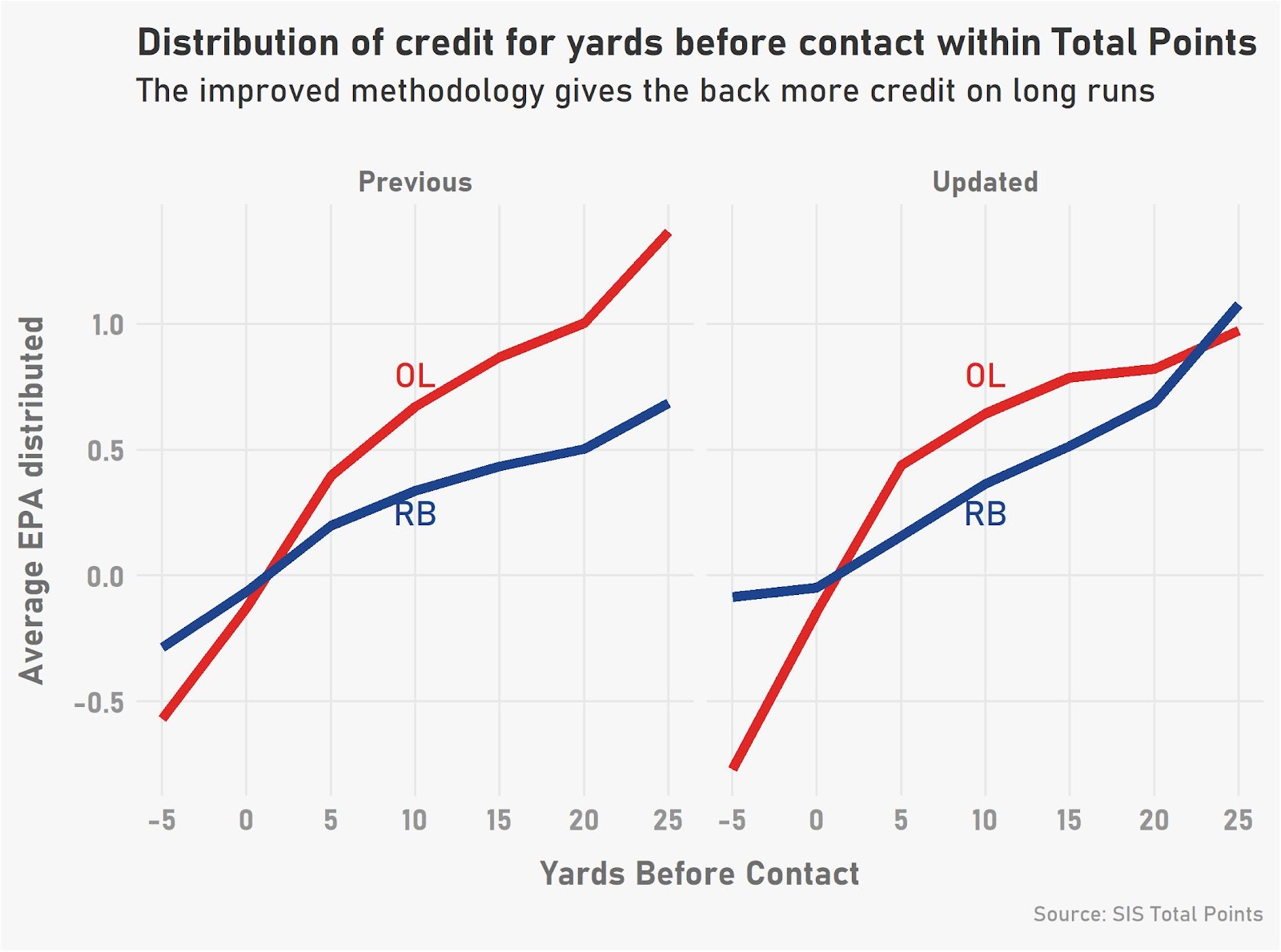
    Here is an example of how reworking this breakdown affects how one would distribute EPA responsibility between the back and the offensive line, depending on the yards before contact on the run. The EPA shown is the value of the adjusted yards before contact.

    The new system punishes the offensive line much more when the back is contacted early, and dramatically increases the back’s responsibility for downfield yards.

    Adding defensive technique data

    Defensive alignment data informs which players were run toward, and correspondingly how responsibility for a run’s initial success or failure should go to each player on the defensive front.

    From 2019 forward the defensive alignment includes technique info for all down linemen. This allows for much more accurate judging of which defenders are most relevant. 

    To go with that, the alignment of defenders is now being considered along a continuum, where 0 is an outside cornerback on the offense’s left, 1 is an outside cornerback on the offense’s right, and anyone positioned between them has a number assigned based on their relative position. This makes it so that it’s not assumed that all adjacent defensive linemen are the same distance apart, which helps handle the variety of fronts defenses employ. This is used for determining which defenders are most relevant for runs in a certain direction or blown blocks by a certain offensive player.

    Refining how tackles are evaluated

    Before the 2019 season, SIS overhauled its evaluation of tackling in the run game to allow players to be measured based on how their tackle compared to the average tackle on similar plays from a similar position. For example, a tackle made by a MIKE on a strongside run into a heavy box would be compared to the average tackle made in those circumstances.

    One big improvement is using what’s called a plus-minus system. We measure each player’s odds of making a tackle using his alignment and the run direction, and every player is given credit or debit based on whether he made the tackle and how likely he was to make it. That plus-minus value—which will be positive for the tackler(s) and negative for everyone else—is multiplied by the EPA value of that tackle. For the non-tacklers, that EPA is the average result of similar plays, since we don’t know where they would have made the tackle. 

    The plus-minus calculation described above is modified such that it’s better to make a tackle than not, even if it was after a big gain. 

    Here is how this works out for two sample plays from last season.

    Each player has a percentage that indicates how likely he was to make a tackle based on historical data, and a decimal value that shows how much value (in terms of EPA) he was credited or debited based on his tackling or lack thereof.

    Please keep in mind that the positions of the safeties and off-ball linebackers are estimated based on typical locations for those players and are not the players’ specific locations for that play.

    Total Points Run Tackle Evaluation: Pitch to right D-gap for 30 yard run

    On this play, the left safety is one of the more likely players to make the tackle, and he does so, getting some credit. Everyone else on the play is dinged slightly, with the linebackers punished most because they were the most likely possible tacklers.

    Total Points Run Tackle Evaluation: Goal Line Power to right C-Gap for 0 yard gain

    In this case, the left end plugs up the hole and tackles the ballcarrier at the point of attack, getting a decent chunk of credit. The other players get a very small demerit for not being involved on the tackle (even though it was very unlikely for the backside players).

    It’s worth noting that in both of these cases, any of the value that these players might have accumulated based on the yards before contact on the play (as described above) are carved out, so that there isn’t any double-counting of responsibility for players on the defensive front.

    Other improvements

    • In calculating the expected yards after contact on a run play, research suggests that yards after contact is higher when the runner is contacted early or late (and lower around the line of scrimmage). As a result, several tiers of yards before contact (e.g. 0-1, 2-3, 4-5, 6+) are now being used to determine expected yards after contact more accurately.
    • To ensure that there isn’t double-counting when evaluating the defensive backfield and defensive front on a pass attempt, the value accumulated by the defensive front is subtracted from that of the defensive backfield when calculating Total Points. For example, if the defense forced two blown blocks and the quarterback attempted the throw under duress, the defensive backfield is punished more if the pass is successful and credited less if the pass is incomplete.
    • Over the last couple seasons, SIS has added several detailed route types, including a variety of screens (e.g. bubble, tunnel) which are quite similar to each other. In calculating how likely a throw is to be completed and therefore how valuable a completion or incompletion is, routes are now grouped into about a dozen categories, with screens being bundled as their own group.

    Whose Evaluations Changed the Most?

    Any of the new numbers can be found on the SIS DataHub. Let’s take a look at some players who were notable movers due to our adjustments.

    The Unanimous MVP is a Little More Unanimous

    Lamar Jackson set the league aflame last year, winning the MVP award unanimously. Total Points disagreed with the assessment, as his rushing value wasn’t enough to offset his merely above average passing value.

    The funny thing was, if you looked at EPA on run plays (designed or scrambles), Jackson’s runs were nearly three times as valuable as any other rusher, while Total Points didn’t even have him as the most valuable rusher in the league.

    The new update gives him more credit for his results, particularly on short yardage, and now he’s comfortably the most valuable rusher in terms of Total Points.

    2019 Rushing Points Earned Leaders

    PreviousCurrent
    Lamar Jackson2846
    Ezekiel Elliott3231
    Nick Chubb3228
    Chris Carson2526
    Derrick Henry2226

    That surge in rushing value puts Jackson a bit ahead of Aaron Rodgers, the previous leader in terms of Total Points (139 vs. 133). And considering he didn’t play in Week 17, the gap in performance is a bit larger than that 6 point difference suggests.

    Meanwhile, in 2020…

    The changes in terms of rusher/blocker division of credit have an impact on big plays as well. The biggest gainers in terms of Rushing Points Earned line up quite well with the players who have had long runs where they were untouched into the open field. To illustrate, here are the players who have gained the most yards before contact beyond the first fifteen this season, and how their Rushing Points Earned change with this update.

    Most Yards Gained After the First 15 Yards Before Contact, 2020 (through Week 15)

    YBC Beyond First 15Rushing Points Earned Change
    Daniel Jones130+7
    Miles Sanders101+12
    Raheem Mostert94-7
    Lamar Jackson84+15
    Russell Wilson70-3
    Kenyan Drake67+9
    Kyler Murray62+19

    Moving Defensive Backs Forward

    Total Points used to lean its defensive back evaluation slightly in favor of those who made impact tackles in the running game, primarily because other defensive backs were being suppressed for their tackles (or lack thereof).

    The new system no longer debits DBs for making a tackle downfield (after all, it’s better to make a tackle than to not make one). As a result, the elite pass defenders bubble to the top in the updated DB rankings.

    2020 Defensive Back Total Points Saved Leaders (through Week 15)

    PreviousUpdated Change
    Tre’Davious White4257+15
    Xavien Howard4755+8
    Malcolm Butler3553+18
    Carlton Davis4150+9
    Kyle Fuller4250+8
    Jaire Alexander3048+18

    What to Expect Next

    These updates started as an offseason project to enhance how we evaluated run blocking, and (as projects tend to do) extended from there in a few different directions.

    What kind of things can we expect from Total Points heading into the 2021 season?

    • Using timing data and drop types to better divide credit between the offensive line and quarterback (and defensive line and defensive backs)
    • Enhanced evaluation of quarterback accuracy (i.e. using overthrown/underthrown as well as catchable/uncatchable)
    • Using the depth of broken or missed tackles to better measure their value

  • New football podcast episode: Week 10 Preview + Patrick Jones II Scouting Report

    LISTEN

    Former NFL scout Matt Manocherian (@mattmano) of Sports Info Solutions and football analytics pioneer Aaron Schatz (@FO_ASchatz) of Football Outsiders (@fboutsiders) look at the most important games on the NFL Week 10 schedule. Matt and Aaron take in in-depth look at the Seahawks-Rams (1:56), Vikings-Bears (9:26), and Eagles-Giants (19:54) before welcoming SIS Lead Scout Nathan Cooper (@coopaloop08) to give his assessment of Pitt EDGE Patrick Jones II (@P_jones9) (25:15).

    You can email the show with feedback at offthecharts@ww2.sportsinfosolutions.com and don’t forget to follow on Twitter @SportsInfo_SIS and Instagram @sportsinfosolutions. For more, check out: sportsinfosolutions.com footballoutsiders.com sportsinfosolutionsblog.com SISDataHub.com

  • The Sports Info Solutions intern experience

    SIS intern Logan King is headed to Vanderbilt to get a masters degree. We asked him to share his thoughts and advice related to the Sports Info Solutions intern experience .

    Over the past year, I have had the pleasure of working for Sports Info Solutions and getting my start in the sports analytics industry. I have served in multiple roles with the company, beginning as a Football Video Scout and later as a Research and Development Intern. I hope that my experience with the company will provide guidance to anyone looking to enter the sports analytics field.

    Before starting the Video Scout position, I had experience in the sports industry working as a recruiting assistant for the University of Virginia football team. I viewed the position with SIS as an opportunity to further strengthen my football knowledge and to gain experience in the growing field of sports analytics. Needless to say, I was not disappointed.

    The Video Scout position began with a three week training period prior to the start of football season. The training period helped to familiarize scouts with the company software and standardized football terminology. Following the training period the weekly schedule was routine and consisted of charting at least five NCAA and/or NFL games.

    Game charting consists of one of three assignments: offense, defense, and participation. A scout’s assignment for a shift dictates what they will focus on and record when charting a given game. While the training period prepares scouts to adequately handle charting responsibilities, there is additional assistance from full-time staff if needed so that no scout is left behind. 

    One of the most challenging parts of working at SIS came during the beginning of my time as a scout. The vast amounts of terminology and concepts covered during the training period that need to be recognized and recorded during the game charting process is initially daunting. While live games normally last between three and four hours, the game charting process takes much longer.

    Scouts are allotted eight hours to complete the charting of a single game, however the first assignments of the season sometimes take longer for new scouts. In my case, the first game charting assignment took nearly 12 hours to complete. It is easy to become discouraged within the first few assignments, but important to keep a positive attitude. Many new scouts are in the same boat and the full time staff is willing to assist and accommodate those in need.

    The most important aspect of game charting is accuracy; speed comes with experience. The grading system in place to provide scouts with feedback on their game charting assignments is extremely beneficial. The feedback helps scouts refine their game-charting skills and provides affirmation on the quality of their work. 

    Outside of the office, scouts are offered the opportunity to learn the art of scouting football players through SIS Scout School. Led by a former NFL scout, SIS scouts are taught the fundamentals of watching film and grading player traits. Following the season, some of the best scouting reports written by scouts in Scout School are published in the SIS Football Rookie Handbook. These reports are widely read and published on multiple platforms. (My report on Javon Kinlaw was published on Sharp Football Analysis.)

    Furthermore, scouts are offered the opportunity to learn how to code in SQL. These SQL classes are extremely valuable in developing technical skills and played a large part in preparing me for the Research and Development internship.

    The R&D internship provided a unique opportunity to contribute, further my analytical abilities, expand my football knowledge, and hone my writing skills. In this role, my schedule varied more day-to-day than in the Video Scout position. In a given day, I could be doing any of the following tasks: having research published to the company blog and other online platforms; developing new metrics to improve SIS data offerings; conducting independent research to gain new insights on a sport. Check out some of my published work: 

    Additionally I helped organize the SIS Analytics Challenge to benefit the United Negro College Fund.

    From my experience with SIS there are several key pieces of advice that will benefit those looking to begin a career in the sports industry.

    1) Take advantage of any opportunity for improvement that is offered outside of the workplace. Scout School and SQL classes that were offered by SIS helped to develop both my football knowledge and analytical abilities and served as an opportunity for my work to be seen by many people in the industry.

    2) Never be afraid to ask questions. Those with experience in the industry are willing to share their knowledge, this was especially apparent in my experience at SIS.

    My time at SIS was a truly rewarding growth experience. I was able to increase both my football and technical knowledge, received professional development, and made numerous friends. I also have the people at SIS to thank for providing recommendations which helped me gain entry to graduate school. I will be pursuing a Masters in Data Science at Vanderbilt University and hope to continue a career in sports analytics following the program.

    I would strongly recommend SIS to anyone looking to begin a career in the sports industry. Feel free to contact me via Twitter: @loganking_fb or LinkedIn with any questions.

  • Top Returning Three-Level College Football Defenders

    By LOGAN KING

    Year-in and year-out, there is buzz about versatile college players leading up to the NFL draft. Coming out of college, names like Tyrann Mathieu, Jabrill Peppers, Derwin James, and most recently Isaiah Simmons were heralded as utility players that defensive coordinators would have the luxury of lining up anywhere across the field. This versatility is highly valued and often leads to a high draft selection for players who display position flexibility at the college level, as seen by the names mentioned above.  

    While there is uncertainty heading into the 2020 season, with several conferences already eliminating out-of-conference matchups, it is still worthwhile to take a look at some players who may end up being the best all-around defender heading into next year’s draft.  

    The table below shows the top five returning NCAA defenders in terms of Total Points Saved on defensive snaps who made an impact at all three levels of the defense in 2019. Each recorded at least 100 snaps aligned at defensive back, off-ball linebacker, and defensive line (which includes standing edge rushers). Each player is listed with their upcoming school year and relevant 2019 statistics. 

    NameYearPosSchoolSnapsDB%LB%DL%Total Points
    Joseph OssaiJuniorLBTexas81219%47%34%65
    Antjuan SimmonsSeniorLBMichigan State82842%46%12%58
    JaCoby StevensSeniorSLSU93169%17%14%42
    Jeremiah Owusu-KoramoahSeniorLBNotre Dame67156%26%19%37
    Tyreke DavisSeniorLBNorth Texas69016%58%27%36

    Joseph Ossai

    The lengthy 6’4” 255 lbs Ossai was a force on the Longhorns’ defense last season, ranking fifth in Total Points Saved among all linebackers in the NCAA (second among returning linebackers). Aside from quarterback Sam Ehlinger, who ranked eighth in Total Points among all NCAA players, Ossai was the most valuable player on the team in terms of the statistic. While mostly lining up as an off-ball linebacker, more than one-third of his snaps came on the defensive line – primarily as a standing edge rusher. When outside of the box, Ossai exclusively lined up as a slot defender. 

    Ossai led the Texas defense with 90 tackles on the season and 14.5 tackles for loss. He was extremely productive against the pass, ranking eighth among linebackers in Pass Defense Total Points Saved. While rushing on 46% of passes, Ossai was able to generate pressure on 20% of pass rushes and sack the quarterback four times. He also recorded two interceptions while in pass coverage. With a similar showing this season, Ossai may end up foregoing his senior year and declaring for the 2021 draft. 

    Antjuan Simmons

    Simmons’ performance in 2019 placed him 15th among all linebackers in terms of Total Points Saved (second among returning Big 10 linebackers). He led the Spartans’ defense in Total Points and finished second among all players on the team, behind quarterback Brian Lewerke. Simmons spent almost as much time outside of the box as a slot defender as he did in the box as an off-ball linebacker. Occasionally, he lined up as a standing edge rusher with 101 of his snaps coming from the position.

    Simmons led the Michigan State defense in tackles with 88 on the season, 15.5 of which were tackles for loss. He was effective against both the run and pass, ranking 25th and 22nd at linebacker in Total Points Saved versus each, respectively. While mainly utilized in coverage against the pass-ranking 22nd at the position in Pass Coverage Total Points Saved and allowing a completion percentage of only 46% when targeted-Simmons was also efficient when rushing the passer, generating 3.5 sacks while only rushing 19% of the time. Entering his senior year, Simmons will be an intriguing prospect to watch this season who will likely end up hearing his name called in the 2021 draft. 

    JaCoby Stevens

    A key player in LSU’s perfect 2019 season, Stevens finished as the 21st ranked safety in terms of Total Points Saved (second among returning SEC safeties). A versatile full-time starter on a defense loaded with NFL talent, Stevens lined up mainly at defensive back, evenly splitting time as a deep safety and slot defender. When in the slot, he rarely lined up in press coverage – only 17 out of 325 snaps. When in the box, Stevens lined up as either an off-ball linebacker or as a standing edge rusher. 

    Stevens was very active in 2019, contributing 93 tackles (second on team) and 9.5 tackles for loss. He had similar production against the run and pass, ranking 30th and 38th among safeties in Total Points Saved versus each, respectively. In coverage, Stevens broke up nine passes on 31 targets, three of which were interceptions. He shows a particular knack for rushing the passer, generating pressure rates of 26% and 43% in each of the last two seasons along with sack rates of 8% and 10%. If Stevens is able to continue his high level of production for the Tigers’ defense in his senior season, he will command a high selection in the 2021 draft.

    Jeremiah Owusu-Koramoah

    In his first season as a starter, Owusu-Koramoah was runner-up for Total Points Saved on Notre Dame’s defense (first among returning defensive players). He played the majority of his snaps as a slot defender. When not in the slot, just over a quarter of his snaps came as an off-ball linebacker and nearly 20% came as a standing edge rusher. 

    Owusu-Koramoah finished the season with 76 tackles, 13.5 tackles for loss, and three forced fumbles. His versatility is seen against the pass. Despite mainly being a coverage player, Owusu-Koramoah was able to generate pressure on 27% of his rushes and finished with 5.5 sacks. Another year as a starter with similar or better production will surely boost his stock for the 2021 draft. 

    Tyreke Davis

    The highest rated returning three level defender in terms of Total Points Saved from Group of Five schools, Davis led the Mean Green defense in the statistic last year. The majority of his snaps came as an off-ball linebacker, followed by over a quarter of snaps as a standing edge rusher and 107 snaps as a slot defender. 

    The All-Conference USA Honorable Mention recorded 79 tackles with a team-leading 14.5 tackles for loss. From a Total Points perspective, Davis is stronger against the run than against the pass on a per-snap basis. However, his skills against the pass are not to be overlooked, as he generated pressure on 27% of pass rushes, generating 4.5 sacks. While impressive statistically, seeing Davis play on Sundays may be a long shot given his size- 5’10” 209 lbs. His best chance may be to improve upon his pass coverage skills and transition to more of a defensive back role.

  • Who Are The Most Efficient Wide Receivers by Route?

    Who Are The Most Efficient Wide Receivers by Route?

    Introduction

    Sports Info Solutions currently tracks approximately 40 routes run by potential receivers. Many players are better at running some routes than others, while some routes fit a player’s skill set better than others. 

    When looking at the stat Yards per Target (yards gained / number of targets), it gives a good indicator of how efficient receivers are at piling up yards each time their quarterback targets them. I found the most efficient receiver at six routes, or set of routes among those players who just moved on from college to the NFL and looked at their 2019 film to see what characteristics make them stand out among the rest.

    Curl – Ceedee Lamb, Oklahoma

    2019: 16.5 YPT, 13 Targets, 13 On-Target, 13 Receptions, 215 Yards, 1 TD (minimum 10 targets)

    2020 Draft: Round 1, Pick #17 – Dallas Cowboys

    The biggest thing that stands out when watching Ceedee Lamb run curl routes is his route savvy. He does a great job of reading defenses and identifying coverages. When defenders bail off the line, Lamb breaks off his route and lets his quarterback know he’s open right away. He’s able to find the open holes in zones and work away from defenders to give his quarterback a better throwing lane and give him an uncontested catch opportunity. Lamb is also really good at breaking the defender’s cushion and getting him to flip his hips just at the top of the route.

    Once Lamb makes the catch, his run after catch ability allows him to turn a 5-10 yard curl route into a 20-30 yard gain. Of his 13 receptions on curl routes this season, four of them went for at least 20 yards. In a Cowboys offense in which Dak Prescott targeted a curl route on over 19% of his attempts in 2019, look for Lamb to come in right away and contribute early on.

    Top 2021 Draft Eligible Prospect: Trevon Grimes, Florida (4SR)

    Out – Cody White, Michigan State

    2019: 11.9 YPT, 18 Targets, 15 On-Target, 15 Receptions, 214 Yards, 1 TD (minimum 15 targets)

    2020 Draft: Undrafted – Signed by Kansas City Chiefs

    The out route is a route that demands one of the most precise cuts by a receiver. Inefficient route runners often will round cuts at the top of their routes. However, regardless if the receiver is using a true speed cut or not, the route needs to be flat to the sideline and not veer upfield or that’s when the corner can jump it for an interception. With all of that said, there’s a reason why Cody White was the most efficient out route runner in 2019, and that’s because he possesses the traits needed to run a textbook out route.

    White is quick off the line and does a really good job at the top of the route to drop his weight, stick his inside foot in the ground, and quickly break outside. He also has an uncanny ability of getting his head snapped around extremely quick.

    The video below is the first play for Michigan State’s offense in their bowl game against Wake Forest. It’s a great look at White’s ability to stick his foot in the ground at the top of the route and then snap his head around to look for the ball. It’s so good that the corner slips trying to break with him.

    https://youtu.be/LW1mtBHGWNg

    When the ball approaches, White has strong hands to pluck the ball out of the air. He has the awareness along the sideline to stay inbounds on balls thrown close to the sideline and also can turn upfield and gain yards after the catch. His efficient route-running ability should give him a chance to win a back-end job for the reigning Super Bowl Champions.

    Top 2021 Draft Eligible Prospect: Warren Jackson, Colorado State (4SR)

    Slant – Jauan Jennings, Tennessee

    2019: 16.2 YPT, 14 Targets, 13 On-Target, 11 Receptions, 227 Yards, 1 TD (minimum 10 targets)

    2020 Draft: Round 7, Pick #217 – San Francisco 49ers

    Jennings lined up in the slot 76% of the time in 2019 and all 13 of his slant routes came from that spot. He’s not the fastest guy in the world (40 yard dash in 4.72 seconds at the Combine), but he makes up for it with good, precise route running.

    Even when defenders have inside leverage on him, he does a good job stemming his route off the line and getting the defender to hop outside to give Jennings an inside release. At the top of the route, Jennings nearly always sticks his foot in the ground with authority to create separation. He possesses strong hands which allow him to pluck the ball out of the air and does a really good job of getting upfield quickly after the catch to break the angles of incoming defenders and gaining extra chunks of yardage.

    https://youtu.be/mb9V_FbtwQw

    He did have two on-target incompletions on slant routes, both in the Alabama game. One was a good defensive play to break up the pass at the catch point and the other was a concentration drop that turned into an interception. With those aside, Jennings’ route running allows for him to take a short pass for a long gain. The NCAA average yards per reception on slant routes is just over 13 yards, but Jennings was able to take 7 of 11 receptions beyond that in 2019.

    The 49ers have a really strong, young crop of players at the position in Deebo Samuel, Brandon Aiyuk, and Jalen Hurd, among others, but Jennings shows enough traits to contribute at the next level, whether it’s one of the last roster spots in San Francisco or with another team.

    Top 2021 Draft Eligible Prospect: DeVonta Smith, Alabama (4SR)

    Post – George Campbell, West Virginia

    2019: 27.7 YPT, 9 Targets, 7 On-Target, 6 Receptions, 264 Yards, 3 TD (minimum 5 targets)

    2020 Draft: Undrafted – Signed by New York Jets

    Campbell’s stat line is ridiculous. After coming to West Virginia from Florida State in 2019, Campbell caught 19 passes for 469 yards and 7 touchdowns. Additionally, 32% of his receptions and a whopping 56% of his yardage came via the post route, along with 3 of his 7 scores.

    When watching Campbell run the post, it’s obvious he has the speed to win deep. If he’s pressed, his quickness off the line allows him to gain a free release and get into his route quickly. If the defender is playing off, Campbell does a good job of attacking him and then usually gives a quick, hard jab to the outside to open up the middle of the field. 

    Once he gets by the defender, he has the speed to create additional separation. He also possesses really good tracking ability down the field to adjust to off-target throws and still make the grab.

    There is a lot of youth and uncertainty in the Jets wide receiver room right now with the exception of Jamison Crowder. Campbell has enough traits to win himself one of the last receiver spots with a good camp.

    Top 2021 Draft Eligible Prospect: Reggie Roberson, SMU (4SR)

    Corner – Devin Duvernay, Texas

    2019: 16.3 YPT, 12 Targets, 9 On-Target, 9 Receptions, 195 Yards, 2 TD (minimum 5 targets)

    2020 Draft: Round 3, Pick #92 – Baltimore Ravens

    Duvernay is primarily a slot receiver, so all of his corner routes came out of the slot. In addition to his speed and quickness, he also possesses smarts in that he knows how to set up his route based on defender leverage. Many times he will stem to the inside off the line against defenders with inside leverage so that he can get on the same plane. At that point, he gets the defender guessing if he’s going outside or inside. Duvernay’s quickness at the top of the route allows him to gain separation as he heads for the sideline.

    https://youtu.be/2BTGTTJ1vT8

    He also shows strong hands to make contested catches and has good awareness and body control to stay in bounds along the sideline. Not only can he use the corner route to win deep, but he scored twice running the corner inside the 15 yard line, showing it’s an effective target type at all areas of the field.

    In Baltimore’s offense, look for Duvernay to thrive out of the slot for quarterback Lamar Jackson.

    Top 2021 Draft Eligible Prospect: Khalil Shakir, Boise State (3JR)

    Vertical Routes – Tee Higgins, Clemson

    Consists of: Fade, Go/Fly, Seam

    2019: 34.0 YPT, 13 Targets, 10 On-Target, 10 Receptions, 442 Yards, 6 TD (min 10 targets)

    2020 Draft: Round 2, Pick #33 – Cincinnati Bengals

    When you think of vertical routes, you just think of running by the defender, letting the quarterback throw it to you, and that’s that, but there’s much more to it, especially in Higgins’ case. First off, Higgins was able to get to the end zone on 6 of his 10 receptions via vertical routes, which is an absurd percentage.

    He shows a burst and second gear once he gets by the defender to create even more separation with speed. In addition to that, his ability to track the ball in the air is exceptional. Higgins possesses a large catch radius and great body control to find the ball and go get it.

    When a defender contests the catch, Higgins’ high point ability and strong hands allow him to still go up and make the grab. On underthrown passes, he’s even shown on more than one occasion that he can backpedal the last few steps away from the defender, use his hands to create extra separation, and go get the ball. The video below shows one of those examples.

    https://youtu.be/67UoP0xHFnE

    LSU’s Ja’Marr Chase led all of college football in yardage on these routes with 461 in 2019. His quarterback? New Bengals signal caller Joe Burrow. Look for Higgins and Burrow to get well-acquainted early on in Cincinnati.

    Top 2021 Draft Eligible Prospect: Isaiah McKoy, Kent State (3JR)

    NCAA Average Comparison

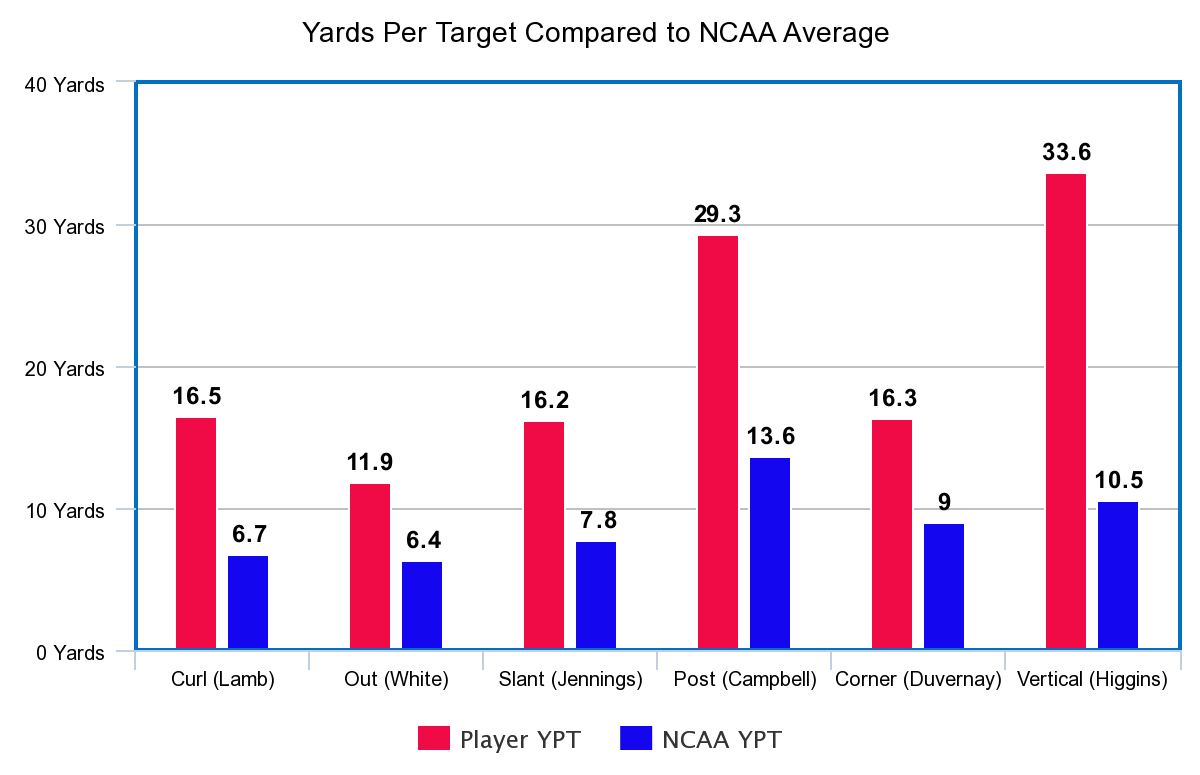
    Now when comparing each of the players we just looked at to the NCAA averages, we can see how much they stand out. All six of these receivers turned average gains into explosive ones on their respective routes. Look for these players to excel at these routes if and when given the opportunity at the next level.

    Most Efficient Receivers Returning in 2020

    I’ve highlighted six names to watch for next season on certain routes in the NFL, but who are the most efficient route runners overall that are returning to college? The table below shows the top five players in Yards per Target who are returning in 2020. True Juniors dominate the list with 4th-year Senior DeVonta Smith in there as well.

    Player College Eligibility Targets Rec Yards YPT
    Ja’Marr Chase LSU 3JR 124 84 1780 14.4
    DeVonta Smith Alabama 4SR 89 76 1259 14.2
    Rashod Bateman Minnesota 3JR 98 70 1219 12.4
    Chatarius Atwell Louisville 3JR 106 70 1276 12.0
    Dyami Brown UNC 3JR 86 51 1034 12.0

    *minimum of 75 targets

    It’s pretty easy to see why LSU’s Ja’Marr Chase leads the way. The 2019 Biletnikoff Award Winner, Chase helped lead LSU’s new-look offense to a National Championship by hauling in nearly 1,800 yards on 14.4 YPT. 

    DeVonta Smith surprised many by not declaring for the NFL Draft and returning to Alabama for his Senior season. He likely could be the best of the Alabama trio of receivers when things are all said and done. 

    For Rashod Bateman at Minnesota, he no longer has Tyler Johnson on the team to draw coverage away from his side. We’ll see if he can stay productive even with one of the most efficient quarterbacks in Tanner Morgan throwing to him. 

    Chatarius “Tutu” Atwell returns to what could be a dynamic Louisville offense which has Dez Fitzpatrick lining up with Atwell on the outside catching balls from Malik Cunningham. 

    North Carolina’s Dyami Brown also has a strong supporting cast. Dazz Newsome is another one of the top returning receivers in college football for 2020. They have a pretty good quarterback as well in Sam Howell controlling the offense.

    Conclusion

    Some players are more efficient at running certain routes than others. While it’s best to have a receiver that can run nearly every route on the route tree, it’s also good to gameplan around what receivers do best. Being efficient leads to yardage gained, which leads to first downs, which lead to touchdowns, which are points that ultimately lead to wins. 

    Half of the receivers among these six routes/route sets we took a look at were selected in the first three rounds of the draft just a short time ago. Find receivers that can run routes well and be efficient when given the opportunity, and you’ll likely find some of the better talent that’s headed to play on Sundays.

  • What’s the outlook at QB for Virginia in 2020?

    What’s the outlook at QB for Virginia in 2020?

    By LOGAN KING

    In 2019, the Virginia Cavaliers football team reached heights not seen by the program in recent memory, reclaiming the Commonwealth Cup, winning the ACC Coastal Division, and appearing in the Orange Bowl. Much of the team’s success on the field can be attributed to the play of 2nd Team All-ACC quarterback, Bryce Perkins. 

    Statistically speaking, Perkins was one of the top quarterbacks in the country last season, ranking tenth in the NCAA in Total Points, SIS’s individual player contribution metric. Perkins was more important to his offense than nearly every other player was to their own in 2019, accounting for 78% of UVA’s offensive yardage (trailing only Anthony Gordon’s 84%). Needless to say, there are big shoes to fill at quarterback in Charlottesville next season. 

    Virginia has been winning on the recruiting trail, in an effort to replace the talent lost from last year’s graduating class. According to 247Sports, the Hoos 2021 recruiting class ranks 21st overall, with eight new high school commitments since April 21. Additionally, Virginia secured the transfer of dual-threat quarterback, Keytaon Thompson from Mississippi State. Thompson joins the Cavaliers with two seasons of eligibility remaining and will be immediately eligible. 

    Thompson is expected to battle redshirt sophomore Brennan Armstrong, who backed up Perkins in each of the previous two seasons, for the starting job in 2020. Armstrong (6’2”, 220 lbs) has a similar build to Perkins (6’3”, 215 lbs) according to the team roster. Not much can be made from Armstrong’s in-game experience at the collegiate level, as he has only seen 72 offensive snaps, which have primarily come in cleanup duty. However, entering his third season in offensive coordinator Robert Anae’s system, Armstrong has experience of the playbook on his side in this position battle, which could be the deciding factor given the shortened offseason. 

    Like Armstrong, Thompson served in a backup role while at Mississippi State, however Thompson also has starting experience and is 2-0 as a starter (notching a win in his first career start against Lamar Jackson’s Louisville Cardinals). Thompson carries a larger frame than that of Armstrong (and Perkins), at 6’4” 225 lbs and was a higher ranked recruit, according to 247Sports Composite. 

    In Mississippi State’s offense, Thompson wasn’t asked to do extensive work through the air. However he was strong and decisive in the run game and showed poise in the Bulldogs’ fourth quarter comeback against Louisville in 2017. Despite a small sample of games, it is clear that Thompson fits the ‘thorterback’ (dual threat) mold that Coach Mendenhall wants under center. Furthermore, the previous two starting quarterbacks for Virginia have been transfer players with two seasons of eligibility remaining upon enrollment (Kurt Benkert, Bryce Perkins). 

    While it is unclear who may win the starting job, a look at the past offensive tendencies of the Cavaliers may shed some light on how the offense might operate depending on who is under center next season. Virginia’s designed pass-to-run split has been relatively stable the last four seasons, with the exception of 2018, Perkins’ first year in the system. 

    YearPrimary QuarterbackDesigned Pass PercentageDesigned Rush PercentagePercent of Designed Rushes by QB
    2016Kurt Benkert63%37%4%
    2017Kurt Benkert63%37%4%
    2018Bryce Perkins54%46%31%
    2019Bryce Perkins66%34%38%

    (Designed passes include plays in which the quarterback scrambles; spikes and kneels are excluded from this dataset)

    In 2016-17, the offense was led by Kurt Benkert, a traditional pocket passer. During Perkins’ first year in the offense, there was a significant shift in playcalling tendencies as the rate of designed runs was nearly 10% higher than the previous season. 

    The quarterback change was partly responsible for the drastic shift in run rate, as the percentage of designed runs by the quarterback position increased from 4% to 31% when Perkins took the offensive reins. However, in Perkins’ second year, there was a reversion back to the designed pass and run tendencies from two seasons prior, while the rate of designed rushes by the QB continued to increase.

    This reversion to a higher passing rate was likely due to an increased understanding of the playbook and strengthened connection with the core group of receivers present on the roster both years (Hasise Dubois, Joe Reed, Terrell Jana). Meanwhile the increase in the QB designed-rush ratio was the product of the desire to keep the ball in the hands of the best player on the field. 

    Extending this trend to the current quarterback situation, several possibilities reveal themselves. In the event that Armstrong wins the job, the designed pass and run ratios likely remain around 65/35, given his experience in the offensive system and the return of key offensive contributors from 2019 (Terrell Jana, Wayne Taulapapa, and the entire offensive line). 

    However, the rate of designed runs by the quarterback will likely decrease, as Armstrong has not proven himself to be the difference-maker on the ground that Perkins was. In the event that Thompson wins the job, there may be a shift back to a more run-heavy approach, similar to 2018. 

    Thompson will not have much time to absorb the playbook and gel with the rest of the offense, especially given the shortened offseason. Therefore you may see a game plan centered more around the ground game.Thompson has shown capability on the ground, which could signal a high rate of designed quarterback runs. No matter the outcome, it is sure to be a highly-contested battle for quarterback in a college football season marked by uncertainty.

  • Justin Fields has the tools to go No. 1 in 2021

    By BRYCE ROSSLER

    Around this time last year, it was all but a foregone conclusion that Tua Tagovailoa would be the first quarterback taken in the 2020 NFL Draft.

    We all know how that story went.

    Tagovailoa was the prohibitive favorite entering 2019 and even improved his efficiency on a per-snap basis despite dealing with injuries. This was enough to distance himself from other first-round quarterback prospects like 2017 Academic All-American Justin Herbert and Jordan Love, but it wasn’t enough to win him the Heisman and it’s wasn’t enough to get him drafted first overall, either. 

    Those honors were claimed by Joe Burrow, whose pedestrian 2018 had painted him as yet another LSU quarterback destined to become a practice squad refugee at the NFL level. But 5,671 yards and 60 touchdowns later, he’s the No. 1 overall pick. 

    If you missed out this time around, fear not — you’ll get another chance to bet on the first pick of the NFL Draft with Trevor Lawrence opening as the heavy favorite for next year. In fact, Lawrence has been the favorite for some time, as some oddsmakers enticed bettors with even money for his chances to go first overall just hours after he hoisted the National Championship trophy. 

    Simply put, Lawrence, who was the top-rated high school recruit in the 2018 class, has been destined to go first overall for some time. But, as we’ve seen, destiny has a funny way of working. Take the case of Justin Fields, the second-rated high school recruit in the 2018 class. Fields played his high school ball just half an hour away from Lawrence’s school, chose to stay in-state, and committed to Georgia.

    Despite his apparent confidence that he would usurp Jake Fromm, Fields was limited to package plays and garbage- time duty and summarily transferred. As differently as their college careers may have begun, Lawrence and Fields are inextricably linked and the race to be the best at the next level is once again neck-and-neck.

    In fact, Total Points suggests that Lawrence and Fields are already much closer than one might think. Fields outperformed Lawrence in 2019, adding 39.9 Total Points/100 Dropbacks to Lawrence’s 30.3. 

    While Lawrence had some early-season struggles, the sophomore slump narrative has been overblown and it is a testament to Fields that he outperformed Lawrence across the season, even if Lawrence did get the best of the Buckeyes in the semifinals. Having to languish on the bench for a year may have hindered his development, so the fact that Fields performed comparably is a great sign.

    Scouting Report

    From a physical perspective, Fields was ready to compete in the NFL yesterday. At 6’3”, 228 lbs, he has a pro-ready frame and plenty of gunpowder to make all the landmark throws. Although the hashes are tighter in the NFL, Fields has demonstrated the willingness and requisite arm strength to drive the ball towards the sideline from the far hash with velocity and timing. Seven percent of all his throws struck between 10-20 yards downfield and outside the numbers when the ball started on the opposite hash. That figure, which excludes fades, ranked 8th out of 165 qualifying players (minimum 5 attempts).

    Fields has shown similar aggression going downfield and found success doing so. Among quarterbacks with at least 100 attempts, Fields ranked 21st in deep throw percentage (20%) and 19th in catchable rate (66%) on such throws. He does have a tendency to step into the bucket when going long to his non-dominant side, as reflected by the dichotomized catchable splits of 58% to the deep left and 69% to the deep right.

    More generally, Fields’ middling on-target numbers belie his vertical orientation and the difficulty of his throws. His ADOT of 11.7 was 12th-highest among QBs with at least 100 attempts, so it would be unreasonable to expect raw accuracy metrics to cast him in a favorable light. 

    This is where predicted Completion Percentage Plus/Minus (pComp +/-) is valuable. Fields completed his passes 10.1% more often than you would have expected based on throw depth and location, the fourth-best mark in college football last season. For comparison’s sake, Trevor Lawrence ranked 19th (+5.4%). 

    Most of Fields’ errant short-to-intermediate throws on film stem from timing and not arm talent. And while he is still honing his anticipatory skills, it’s important to note that 2019 was his first year as a starter at the college level. Furthermore, Ohio State’s offense is more advanced than a lot of other college systems. Its heavy utilization of shotgun, the rate at which the team tags runs with reads and screens, and its check-with-me calls are noticeably amateur but should not distract one from the number of concepts they use that are seen on Sundays. 

    Classical west coast triangle reads litter Fields’ film and looking beyond the four-open formations reveals a system that – while still distinguishable from a pro offense – is more thoughtful than the simplistic spread-and-shred philosophies that have dominated the college ranks the past decade. With that said, another year to internalize the offense and further develop rapport with teammates could strongly benefit Fields’ development as a passer.

    One of Fields’ biggest selling points will be his ability to extend plays, as he reportedly ran a 4.42 in the 40-yard dash last spring and is a dangerous runner who averaged 7.7 yards on scrambles. He showed great play strength and suddenness to make rushers miss, ranking 13th in the country with a broken sack rate of 36% (minimum 30 sack opportunities), and showed a propensity to keep his eyes downfield and maintain a good base while stepping up in the pocket or throwing on the move.

    Old school evaluators and analysts may ultimately dock Fields for his propensity to void structure, though, as he had the 30th-highest scramble rates under pressure in the NCAA this past season (16%). Of the pressured dropbacks that did not result in scrambles, just over half ended within the pocket — effectively a coin toss. That was one of the lowest rates in college football last year, but it should be noted that Russell Wilson (55%) and Deshaun Watson (53%) have made it work in the pros and that Kyler Murray (50%) improvises similarly and was the No. 1 pick regardless.

    Murray is also one of the three most recent No. 1 picks who weren’t even in consideration prior to their final college seasons. Baker Mayfield was a system quarterback who was too short to play in the NFL. Murray was a professional baseball player with no meaningful college football production. Burrow was a sub-60% passer who played in yet another outdated, dysfunctional LSU offense. 

    Fields, on the other hand, is a rising player with good production, an exciting pedigree, and a tantalizing skillset, and if recent history is any indication, we shouldn’t write anybody’s name in ink for 2021.